

FIDE Council approves extension of FIDE Flag Representation

FIDE Council has approved the extension of FIDE Flag Representation for Russian and Belorussian players. According to this decision, Russian and Belorussian players currently performing under the FIDE flag are permitted to continue playing under the FIDE Flag until January 1, 2026. For more information, please refer to the FIDE Council resolution of September 20, 2023.
FIDE World Championship Game 9: The calm after the storm
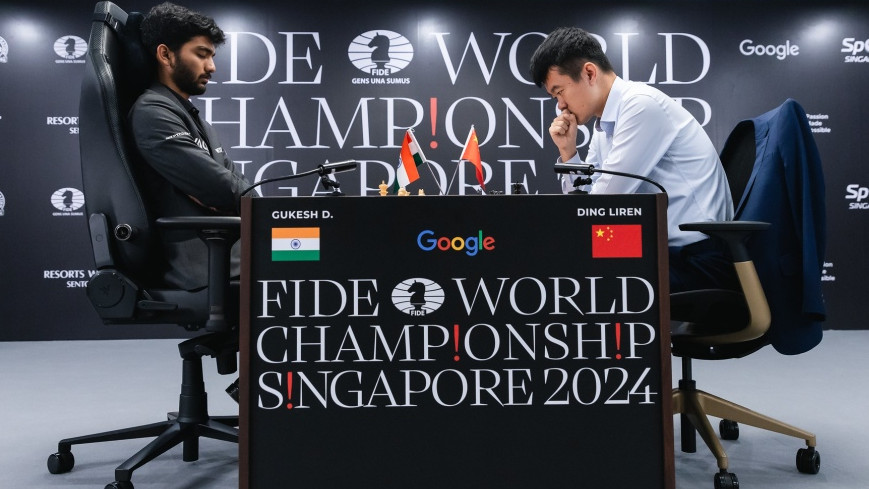
In common wisdom, after a violent storm, the weather typically becomes calm. After a period of turmoil or chaos, peace and tranquility follow. In the wake of the two very complex and dramatic previous games, today’s encounter was quite a peaceful affair. After Dr Shilpak Ambule, High Commissioner of India to Singapore performed the ceremonial move for Gukesh this afternoon, the Indian challenger opened the game with 1.d4. Playing with Black, Ding Liren opted for the Bogo-Indian defence, which after a few moves transposed into one of the most popular lines of the Catalan Opening. Although both players have employed the Catalan regularly in the past, it was the first game of the match featuring this opening. The first key moment came when Gukesh essayed an interesting move 10.Bc3 (see diagram below). One of the ideas was to try and get in b2-b4 straight away. In this position, there are hundreds of games played with the more popular 10.b3 and above all 10.Bf4. Visibly surprised, Ding Liren spent nearly twenty minutes pondering on his response, finally choosing the standard development with 10…Bb7. Still in preparation, Gukesh expanded on the queenside with 13.b4 and soon after started working his way into his opponent’s position with the dangerous pin 16.Ba5. The Indian was playing fast and confidently, while Ding appeared to overthink his moves. On move seventeen, the engines suggested a forced line beginning with 17…Nxc4, with massive exchanges. Instead, Ding preferred to relinquish his bishop with 17…Bxf3 and defend a slightly worse middlegame. Reflecting after the game, Ding admitted missing this good opportunity to equalize: “My second told me after the game that I could have played 17…Nxc4 equalizing easily. I calculated the line but missed 19…Nd7 and I am not worse at all.” By move 20, Gukesh held a significant time advantage with one hour twenty-one minutes, while Ding Liren was down to thirty minutes! Put yourself in Gukesh’s shoes. Would you play 20.Qb5 or maybe 20.Ne5? “The game was very precise. I might have had a small edge after 16.Ba5, but I think that 20.Qb5 was premature: maybe I should have played 20.Ne5 with a small edge, although it shouldn’t be decisive in any way,” explained Gukesh after the game. “It was based on a miscalculation: I missed his defensive idea 21…Qa7 and 22….Rb8.” From then on, the champion played very accurately, successfully neutralizing White’s initiative and liquidating to an equal ending, in which he even had a tiny edge. In the press conference, Gukesh calmly analyzed the match situation: “So far, it’s been a very interesting match: a few missed chances from me, a few missed chances from him. We have both showed fighting spirit and entertaining chess, and there are still five more exciting games to go.” He added: “Especially in the last few games, I think I’m playing pretty well, and I just hope to continue playing good games, and hopefully, at some point when I do the right things, I believe that the results will come.” FACT SHEET, Game 9, FIDE World Championship:White: Gukesh D Black: Ding LirenResult: 0.5-0.5Game length: 54 movesOpening: Catalan Opening (stemming from the Bogo-Indian Defence)Match score: 4.5-4.5 Although the FIDE World Championship is by far the main event, the local organisers along with FIDE have arranged a wide range of side events for all the fans coming to Sentosa for the match. Today’s agenda featured a variety of activities, starting with a lecture in the Fan Zone by FIDE Vice President GM Zurab Azmaiparashvili, who shared insights into his experiences as a second for Garry Kasparov. In the afternoon, FIDE CEO Emil Sutovsky participated in the Chess History Trivia Quiz, while Singapore’s own stars, GMs Tin Jingyao and Siddharth Jagadeesh, entertained spectators with live interactions in the fan zone. The Singapore International Open also concluded this morning, bringing together 559 players from 34 federations, including 37 GMs and 6 WGMs. GM Lu Shanglei from China emerged as the clear winner, while GM Szymon Gumularz from Poland clinched silver and local GM Jagadeesh Siddharth secured bronze. Written by IM Michael Rahal (Singapore) Photos: Eng Chin An, Maria Emelianova and Singapore Open Official website: worldchampionship.fide.com/ Full programme of side-events: worldchampionship.fide.com/events About the event Current World Champion Ding Liren, representing China, and challenger Gukesh D, from India, face each other in a fourteen-game classical chess match. The player who scores 7.5 points or more will win the match, picking up the better part of the $2.5 million total prize fund. The first of the fourteen scheduled games took place on Monday, November 25 at 5 pm with Gukesh opening with White. Hosted at the luxurious Resorts World Sentosa the match is broadcast live with expert commentary on the FIDE YouTube Channel.
World Championship Game 8: Thrilling battle ends in a draw
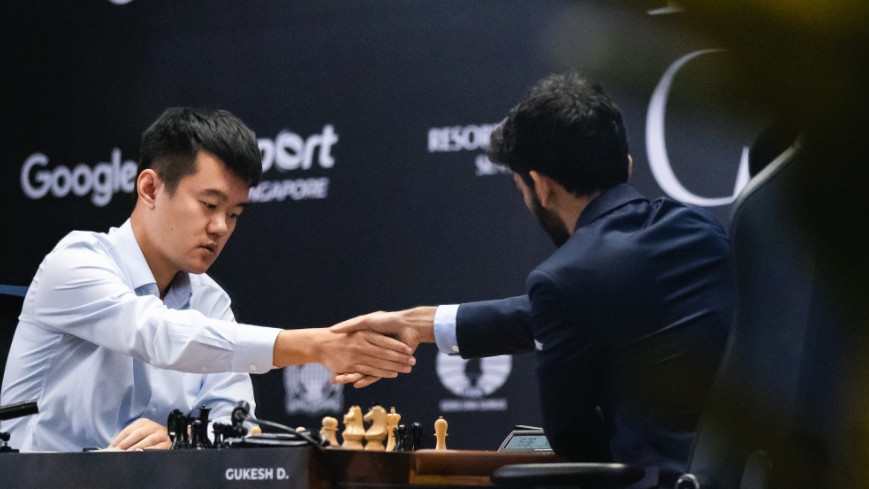
The eighth game of the 2024 FIDE World Championship, presented by Google, will go down in history as one of the most exciting encounters ever played in title matches. It was a struggle all the way through, with chances for both players, which finally ended in a draw after the challenger once again rejected a draw by threefold repetition. The game began with the traditional ceremonial move, played by two distinguished guests. Opening 1.b3 with White, Mr. Kingston Kwek is a cryptocurrency entrepreneur and the founder of Academic Labs, or “AAX,” a sponsor of the chess championships. An avid chess player himself, Kwek enjoys playing against chess engines and on online platforms. Grandmaster Kevin Goh Wei Ming, an eight-time Singapore National Champion, has represented his country in eight World Chess Olympiads and three South-East Asian Games. He is a Chartered Accountant and was the CFO of one of the fasting growing biomedical start-ups from Singapore before joining the Singapore Chess Federation as its CEO. He is also the chair of the Local Organizing Committee. On his move with Black, Kevin decided to counter with 1…a5, a move which elicited a smile from Ding Liren. The champion Ding Liren opened the game with 1.c4, the English Opening. Following the trend shown so far by both players, Ding Liren decided not to repeat any of the opening moves used previously – we had a fresh position on the board! “I have been playing the English Opening for the last ten years and one of the downsides in the variations in which Black plays a quick …e5 is that there are so many options,” observed GM David Howell in the commentary booth. He added, “When I am preparing a game, I often find that I am going down these rabbit holes, twenty moves deep in some variations, and then my opponent surprises me on move two or three. Suddenly you find yourself in waters that you haven’t researched recently.” The challenger Gukesh D replied almost instantly and essentially blitzed out his first ten moves, once again displaying excellent opening knowledge and specific preparation for the match. Ding had the two bishops, Gukesh controlled the center. Gukesh was delighted with his opening choice: “I want to congratulate my team, not only my head coach Gajewski, but also all the other coaches. They are doing an excellent job and I thank them for their interesting ideas,” he said after the game. Meanwhile, Ding Liren seemed to struggle with remembering his own preparation, and soon he was, once again, clearly behind on the clock. After barely thirteen moves, he had already spent nearly half of his thinking time. The position was remarkable – it’s not every day that you see the two center pawns on their original squares. International Master and chess streamer Eric Rosen gave his opinion on the match in the commentary booth: “Coming into the match, I honestly thought it was going to be a blowout in Gukesh’s favor, but now I think we’re in store for another close finish”. The game remained more or less equal for several moves while both players tried to finish their development and find the best squares for their pieces. However, the clock was ticking for the champion, and with less than 15 minutes for 15 moves, he inexplicably went for 25.Bb2, sacrificing his a2-pawn. After the game, Ding explained his reasoning behind the move: “I sacrificed the a2 pawn based on a miscalculation, because I figured that he couldn’t block on c5 with any of the knights, and that would allow me to play Ra1 and pick up the a5 pawn”. “Ding might have overplayed his hand here,” observed David Howell, after Gukesh captured the pawn. The key position of the game arose on move twenty-six. Put yourself in Gukesh’s shoes. Would you play 26…Nac5 or 26…Ndc5? In a very tricky position, Gukesh D. played the natural 26…Nac5, whereas the not-so-logical 26…Ndc5 was the correct move to cement the advantage according to the engines. Reflecting on his decision during the press conference, he admitted: “Blocking with 26…Ndc5 (instead of 26…Nac5) looked weird to me. I thought that my move was winning, but I missed his key move 28.Qe1, when 28…Nxd3 loses to 29.Qc3. If I had spotted this idea, then I would probably have thought a bit more. It was a very tricky position, and he found these ideas very quickly – great defense by my opponent.” Ding immediately blitzed out 27.Rc1 smelling blood. “Ding’s in the zone!” exclaimed GM David Howell. “He’s found the way to trick Gukesh and turn the game around,” observed IM Jovanka Houska, co-host. Forcing his hand, Ding was able to win the exchange, but Gukesh’s two passed pawns were scary. Maybe 31.Ne1 was a better way to go for a win instead of 31.Nd4. Sensing the danger, Ding proposed a draw via a three-fold repetition, but at the last minute Gukesh decided to play on with 41…Qa2+. However, a few moves later, both players recognized the lingering dangers in the position. Ding decided to force the exchange of queens and return the extra material, and a draw was agreed. Ding Liren was visibly happy with the result. “He outplayed me once again, but then he missed some important details and let me back into the game,” the champion acknowledged during the press-conference. In the commentary booth, the local organizer explained the process of getting a top international company to support the event: “Google is very pleased with how the project is going: there are a lot of impressions online and a lot of interest all over the world. It’s all very positive, and hopefully we can continue discussions for more events and collaborations,” said GM Kevin Goh Wei Ming. The ninth game of the match is scheduled for Thursday, December 5, at 5 PM local time in Singapore, with Gukesh playing White. FACT SHEET, Game 8, FIDE World Championship: White: Ding LirenBlack: Gukesh DResult: 0.5-0.5Game length: 51 movesOpening: English OpeningVariation:
World Championship Game 7: Ding Liren escapes by the skin of his teeth
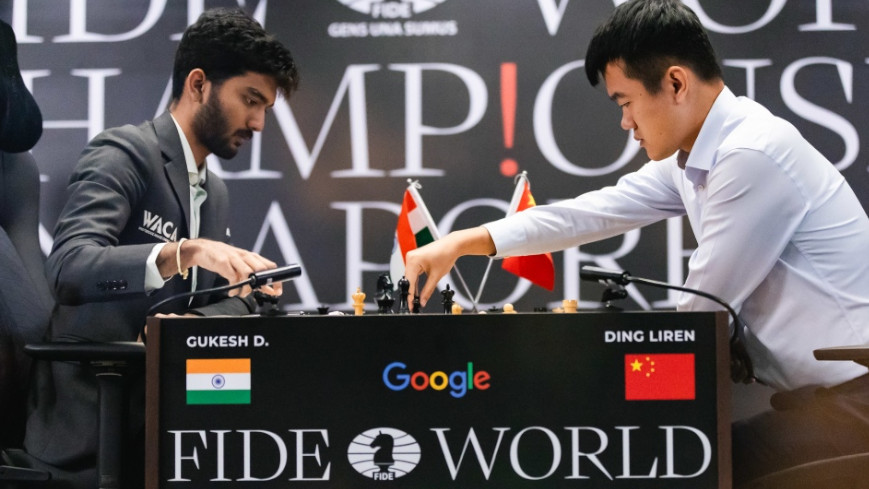
“When you cross the playing hall, you can really feel the tension.” (Anna Muzychuk) The champion Ding Liren dodged a bullet this afternoon. After his huge blunder on move forty, it looked like the challenger was poised to make an important step towards claiming the FIDE World Champion title. Gukesh’s opening strategy was point-on. His team prepared a strong novelty on move seven in a well-known line, allowing him to stay ahead on the clock for most of the game. The champion defended accurately, but at a huge time cost, and with only a few moves to go, he was under acute time pressure. With only seven seconds left on his clock, Ding Liren blundered on the last move before the time control. Instead of 40…Ke5?, he should have played 40…Nc8, followed by 41…Nb6, with a blockade and very good chances to draw. But just when victory seemed locked up for the challenger, nerves kicked in. Converting his endgame advantage was not an easy task, and low on time, Gukesh was unable to find the win. Let’s dive into the details of what actually happened this afternoon in the Sentosa World Resorts Equarius Hotel in Singapore. The ceremonial first move was performed by Mr Edwin Tong, Minister for Culture, Community and Youth, and Second Minister for Law. He chose to open with 1.d4, but after a few seconds, Gukesh took it back and played 1.Nf3 instead, one of his three main opening moves. Ding Liren took a couple of minutes to consider his options and decided on the classical variation of the Neo-Grünfeld defense, with 1…d5 and 2…g6. An expert in this line with White and Black, he had already played this setup on fourteen occasions from 2010 to 2021, against top players such as Nakamura, Kramnik, Svidler and Wesley So. Gukesh blitzed out his opening moves and stunned all the fans with the novelty 7.Re1, a pawn gambit that had never been played before in more than 5000 master games. Ding went into the tank for twenty-five minutes, trying to understand what was going on, and eventually decided to accept the pawn sacrifice, creating an unbalanced position: an extra pawn for Black in exchange for certain positional compensation. “This line is very interesting for me as I play this line with Black regularly. This is the first time I see 7.Re1. It’s a very rare move indeed but with a strong idea behind it, and actually, it’s a bit scary to capture the pawn with 7…dxc4,” explained GM Anna Muzychuk in the commentary booth. A couple of moves later, the champion made a key decision. Instead of protecting his extra pawn with 9…b5 (the suggestion of engines), Ding Liren decided to give it back and also surrender his bishop pair to enjoy a superior pawn structure. “My first mistake was 9…c5 as after 10.d5 my opponent gets a better position and I have a hard defense,” explained Ding after the game. The resulting position seemed slightly better for Gukesh, and additionally he was clearly up on the clock. A few developing moves down the road, the second key position arose. In all of his previous games with White, Gukesh had played g2-g4 at some point. “Now, g3-g4 would be a very Gukesh move,” GM Howell called on commentary. Meanwhile, FIDE media polled the question on X, and included the mirror option b2-b4. Although giving his opponent a protected passed pawn seemed very dangerous, Gukesh bravely pushed his b-pawn on move nineteen. The game was on! White got a pair of bishops and an isolated passed pawn against a well-deployed Black army with a protected passed pawn for the endgame. “I thought I should be winning before the queen exchange and also after the queen exchange,” explained Gukesh in the press conference. “I thought my position after 19.b4 was hopeless,” was Ding’s very frank opinion. Meanwhile, in the commentary booth, GM Anna Muzychuk enjoyed every minute of the event. “Every World Championship match is a wonderful story; it’s unique. No matter how it goes, I enjoy watching every game.” Back on the board, things were getting difficult for the champion. Ding only had 27 minutes left on the clock (Gukesh had 52) for 21 moves in an extremely complicated position, a fact observed by GM Danyyil Dvirnyy on “X”. Additionally, former World Champion Vladimir Kramnik wasn’t impressed at all by the champion’s play, and he made his opinion known on “X”. Taking all of this into account, it’s actually a miracle that he survived to the endgame, as there were many pitfalls along the way. Gukesh could have sealed the deal on several occasions (30.Be3 instead of 30.Qf4, 32.Bg5 instead of 32.Qxf5, and finally 37.Rd2 instead of 37.Rf4) but allowed Ding to stay in the game. Put yourself in Ding Liren’s shoes. Would you play 40…Ke5 centralizing the king or 40…Nc8 to blockade on d6 or b6? With only seven seconds left on the clock to reach move forty, Ding blundered big. Instead of the inferior 40…Ke5?, he should have played 40…Nc8! followed by 41…Nd6, with a blockade and very good chances to draw. After 41.Rh4! Ding lost his h-pawn, and things looked very bleak for Black indeed. But just when victory seemed locked up for the challenger, nerves took their toll. Converting the endgame was not an easy task and, low on time, Gukesh was unable to find the win. Instead of 44.Ke1 played in the game, the correct move was 44.h4 (44.Ra6 also looks quite strong), and the rook ending after 44…Nd2+ is winning for White. “I thought that the endgame with the weak f-pawns and my extra pawn should be enough to win, but it turned out to be more difficult than I expected,” Gukesh explained at the press conference after the game. “For sure, 46.Bd1 was a bad move due to a miscalculation. I don’t know exactly where the win was, but I should be winning,” he lamented. With seven of the fourteen scheduled classical games played,
Qualification paths for FIDE Women’s Candidates Tournament 2026 finalized
A spot that was reserved for the Women’s World Championship runner-up in the previous circle has been reallocated to the broader Women’s Circuit. This decision mirrors a similar change in the Open category. Following the changes in the Open category, the FIDE Council has made amendments to the Women’s World Championship cycle. The runner-up of the Women’s World Championship match no longer automatically qualifies for the Women’s Candidates. Instead, she will receive special bonus points for playing the match. The full list of qualification paths for the Women’s Candidates Tournament 2026 is the following: A. 2 spots – FIDE Women’s Grand Prix Series 2024-25 The players who finish 1st and 2nd in the FIDE Women’s Grand Prix Series 2024-25. B. 3 spots – FIDE Women’s World Cup 2025 The players who finish 1st, 2nd, and 3rd in the FIDE Women’s World Cup 2025. C. 2 spots – FIDE Women’s Grand Swiss 2025 The players who finish 1st and 2nd in the FIDE Women’s Grand Swiss 2025. D. 1 spot – The highest-placed player in ‘FIDE Women’s Events 2025-26’ series Unlike in the open, where a large number of different events is taken into consideration, FIDE Women’s Events 2025-26 will focus only on several major events. Those include: – Rapid and Blitz Championships 2024 and 2025: Including both rapid and blitz formats for two consecutive years; – Women’s Grand Prix Series 2024/2025 edition: Final standings are a significant contributor to qualification; – Women’s World Cup 2025; – Women’s Grand Swiss 2025. Scoring system: Players will be awarded Ranking Points (RP) based on performance in these key events as per a defined table, with players ranked by their best five results. This includes bonus points for the Women’s World Championship runner-up. The final score of a player is calculated as the sum of the player’s RP in up to five of her best events. If players are tied in the final rankings, the tie will be resolved by excluding the lowest RP score used in their final score calculation. Regular updates will be made to the public after each event to reflect the rankings. “The changes aim to streamline and unify qualification pathways by emphasizing top-tier events while providing a fairer distribution of opportunities,” FIDE CEO Emil Sutovsky said. “We believe that these changes will make the competition fairer and more exciting,” he added. The full document is published here:handbook.fide.com/files/handbook/QualificationForWCT2026.pdf
FIDE Circuit 2024: Erigaisi still in the lead, Caruana closes in
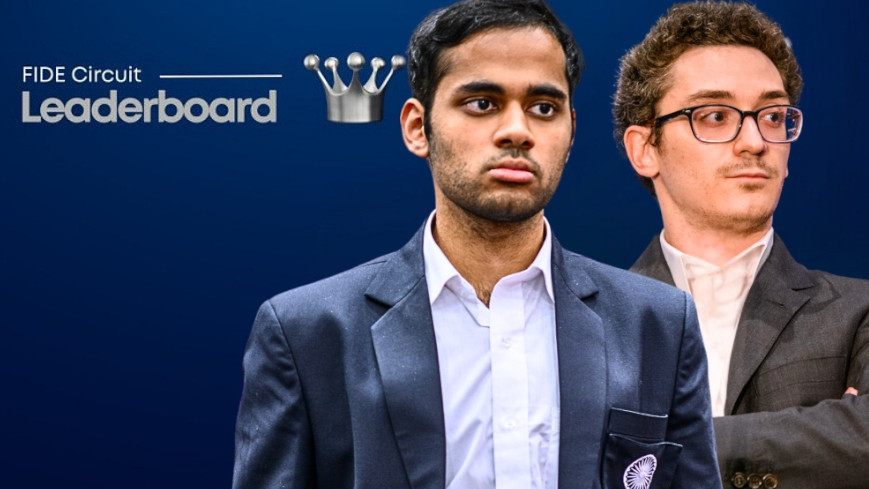
The 2024 FIDE Circuit race is approaching its thrilling conclusion. Arjun Erigaisi remains in the lead, but he can’t feel safe as Fabiano Caruana is hard on his heels. With less than a month remaining, the two are separated by just 0.74 points. Erigaisi delivered a solid performance at the Chennai Grand Masters, tying for first place but losing the tiebreaker to Levon Aronian, which left him in third place overall. This result earned him 17.22 points. However, as only the top seven results count toward the final score, Arjun had to forfeit the 5.24 points he had previously earned at the Sharjah Masters. Nodirbek Abdusattorov had high hopes for the 3rd International President Cup, but his fifth-place finish brought him only 9.11 points. As a result, he climbed to second place on the leaderboard but only for a few days. Meanwhile, Fabiano Caruana dominated the competition at the US Masters in Charlotte, NC, securing a clear first-place finish and earning 17.11 points. Unlike Erigaisi, Caruana still has one more tournament result to add to his tally. He will aim to maximize his score at the Saint Louis Masters, a Swiss tournament that begins today. Erigaisi also has a chance to improve his score as he competes in the Qatar Masters in Doha, which has started today. Abdusattorov, currently in third place, will also participate in the event, hoping to regain ground if his main competitors don’t succeed. With all this in play, the 2024 FIDE Circuit race promises an electrifying finish, with Erigaisi and Caruana being the primary contenders for the coveted top spot. We maintain a dedicated page on our website for the FIDE Circuit, offering the latest information on eligible tournaments, the current standings, and regulations.Visit: FIDE Circuit 2024.
Arjun Erigaisi crosses 2800 in December 2024 rating list
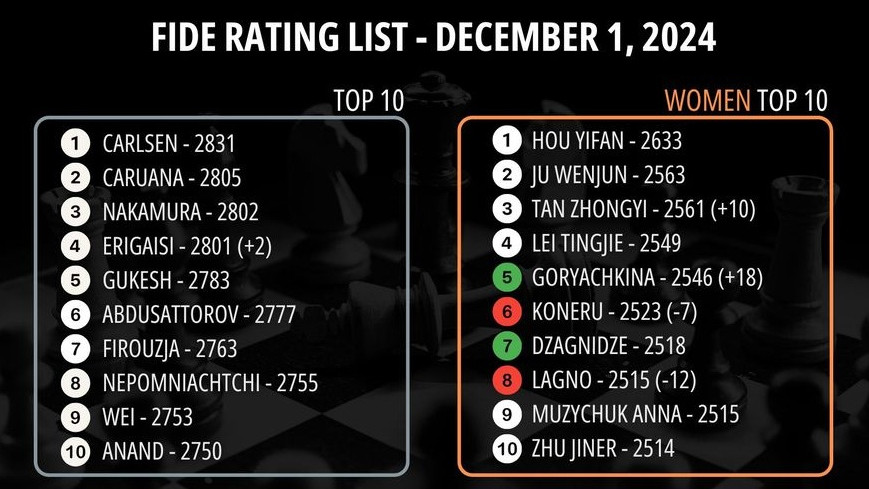
The world’s top 10 chess rankings remained largely unchanged in December, but an important milestone was reached. Arjun Erigaisi crossed the 2800 Elo mark, becoming only the 15th player in history to achieve this remarkable feat. The young Indian gained just two points at the 2024 Chennai Grand Masters, but it was enough to join the elite club. Photo: ChessBase India On the women’s side, the winner of WGP Shymkent, Aleksandra Goryachkina, and the runner-up, Tan Zhongyi, gained 18 and 10 points, respectively, with Aleksandra reentering the top five. Biggest gains in Top 100 Open and Women Kochavi, Dana WFM ISR 2362 (+196) Ouellet, Maili-Jade WGM CAN 2386 (+34) Dadha, Daniel GM BEL 2639 (+33) Roebers, Eline IM NED 2373 (+25) Indjic, Aleksandar GM SRB 2647 (+24) Khamdamova, Afruza WIM UZB 2354 (+24) Aleksandra Goryachkina GM FIDE 2546 (+18) Navrotescu, Andreea WGM FRA 2356 (+18) Svane, Frederik GM GER 2668 (+14) Cheparinov, Ivan GM BUL 2646 (+14) WFM Dana Kochavi (pictured below) became the unquestionable winner in this category. Facing very strong opponents in the 2024 European Individual Championship, the Israeli teenager scored an impressive 6.5/11, earning an incredible 186 rating points. This huge increment catapulted Dana into the top 100 women and the top 10 Juniors (women). Photo: Mark Livshitz The European Championship also boosted the ratings of Daniel Dardha, Frederik Svane, Ivan Cheparinov, and the winner, Aleksandar Indjic, who broke into the top 100 Open. Dana Kochavi wasn’t the only youngster to debut in the top 100 Women. Joining her is Afruza Khamdamova of Uzbekistan (pictured below), who dominated the U16 Girls category at the FIDE World Youth Championship (Florianópolis, Brazil) and added 24 rating points to her tally. Photo: Vivian Passig Maili-Jade Ouellet delivered a solid performance in the Fall 2024 Charlotte in the USA to gain 34 points, while Eline Roebers emerged as the winner of the Hoogeveen Schaaktoernooi 2024 double round-robin and increased her rating by 25 points.
World Championship Game 6: Accurate defense by Gukesh secures another draw
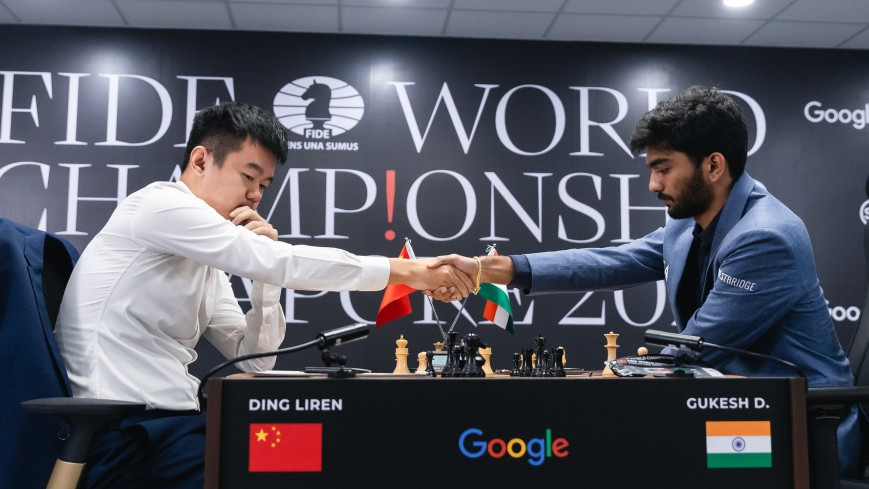
“Opening preparation is like an iceberg – most of the lines remain under the sea” (Ding Liren) The sixth game of the FIDE World Championship match, presented by Google, ended in a draw after 46 moves this afternoon. Both players tried everything on the board, probing for mistakes in each other’s play, but neither managed to break through. The Indian challenger, Gukesh D. could have forced a draw on move twenty-six, but instead he chose to play on, arguing that although he thought that he might be slightly worse, there was no reason to not continue and see what happened. The champion Ding Liren was content with the result, but acknowledged that he needed to tighten up his game. Today’s ceremonial move was performed by Scott Beaumont. A huge chess fan, Scott led Google in Asia Pacific over the last five years, and prior to that in Greater China and Korea. A key person in the partnership, he spearheaded Google’s title sponsorship of this historic match: the first ever between two Asian grandmasters. The use of super computers in high-level chess has completely changed opening preparation. Given that all openings have been analyzed to equality, it is increasingly important to find ideas that can surprise your opponent, gain some time on the clock and trust that they will not be able to find the key equalizing moves over the board. This afternoon’s game was an excellent example. The champion Ding Liren went for the London system, which he already used successfully in the sixth game of his 2023 World Championship match against Nepomniachtchi. Although Ding is a consummate 1.d4 player, the London is an unusual choice in his opening repertoire. But Gukesh came well-prepared to the board and blitzed out his first fifteen moves. He was clearly still in his preparation, no doubt following the Aronian-Dominguez game from the 2022 Saint Louis championship, which ended in a three-fold repetition draw quite early in the game. Meanwhile, in the commentary booth, five-time World Champion and legend of the game Vishy Anand gave his thoughts on both players. “They have contrasting approaches. Ding is very solid with White, not taking a lot of risk yet. On the other hand, Gukesh is pushing it a bit more but every once in a while, he stumbles, like yesterday. I think they are both trying very hard – maybe Gukesh is putting a little bit more pressure but he needs to me more accurate”. Ding uncorked his novelty on move sixteen (16.dxe5) forcing Gukesh to think out his sixteenth and seventeenth move for more than twenty minutes. Totally focused, he found one of the several lines that promised a more or less balanced position, and it was Ding’s turn to dive deep into thought: it took him over forty minutes to decide upon 21.Qxc6 – apparently, the game was on! However, suddenly two moves later it seemed that the time came to pack the bags and head over to the press conference: both players were repeating moves. Put yourself in Gukesh’s shoes. Would you play 26…Qe7, and claim a threefold position draw or go 26…Qh4 and play on? Rather unexpectedly, Gukesh decided to play on, choosing 26…Qh4 instead of 26…Qe7, claiming a draw. After the game, he clarified his thoughts behind his decision: “I thought I might be slightly worse out of the opening but I wasn’t even sure. But with the files open in front of his king I thought I would always have counterplay and I didn’t see a reason to take the draw repetition. Obviously, I wasn’t playing for a win, I just wanted to play a few more moves and see what happened.” “That’s the professional way to go – repeat twice, make your opponent think that he has a draw, and at the last moment change your move,” said commentator IM Jovanka Houska in the commentator’s booth. Anand added: “Maybe Ding has studied this position and knows there is counterplay all over the place: in that case, maybe his outlook is different.” A fantastic insight from five-time World Champion! At some point, most of the online viewers considered Ding’s position to be slightly favorable, but, following a certain trend in this event, the advantage slipped away after a few inaccurate moves. Both players proceeded with caution and eventually exchanged queens, arriving at a fairly balanced rook ending. A draw was agreed on move 46. The champion Ding Liren was content with the result, noting that the match is even with several more games still to be played. At the same time, he acknowledged the need to sharpen his focus. “I feel like I am letting my advantage slip away at a critical moment. I have to improve this in the following games,” were his thoughts after the game. “Opening preparation is like an iceberg. The positions you see in the game are the ones that are on top, higher than the sea, but there are a lot of lines that don’t occur, they are all under the sea.” Before leaving for the day, Vishy praised the young Indian players Gukesh D, Praggnanandhaa R and Arjun Erigaisi. “This is a golden generation; they were grandmasters at a very young age. The thing is they keep growing…You can’t keep talking about this as a future thing, it’s happening right now. They’re all top10 players!” Tomorrow is the second official rest day for the players. The seventh game of the match is scheduled for Tuesday, December 3, at 5 PM local time in Singapore, with Gukesh playing White. FACT SHEET, Game 6, FIDE World Championship: White: Ding LirenBlack: Gukesh DResult: 0.5-0.5Game length: 46 movesOpening: London SystemMatch score: 3-3 Although the FIDE World Championship is by far the main event, the local organizers along with FIDE have programmed a wide range of side events for all the fans coming to Sentosa for the match. On the agenda this afternoon, five-time World Champion GM Vishy Anand offered a 10-board simultaneous exhibition for VIP ticket holders, and then
World Championship Game 5: Ding Liren lets Gukesh off the hook
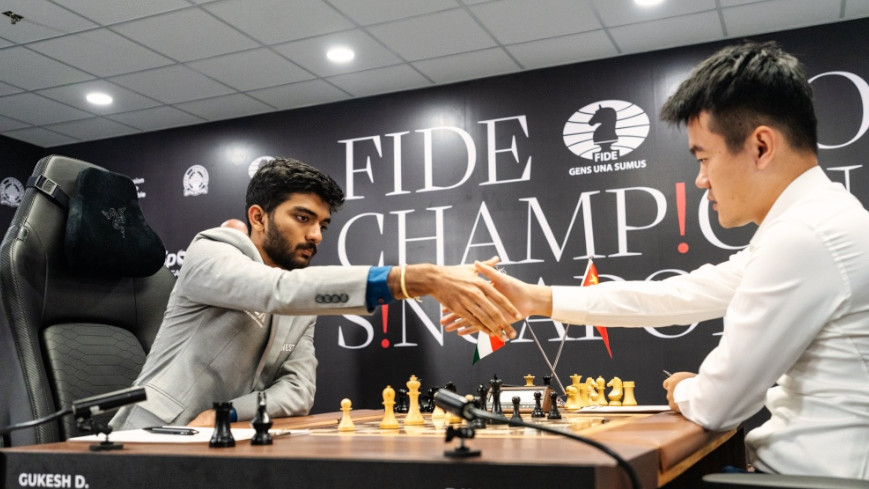
Against all odds, World Champion Ding Liren missed a great chance to pile up the pressure in the FIDE World Championship match presented by Google, misplaying a significant advantage in the endgame. Defending the black pieces, the Chinese champion efficiently neutralized his opponent’s exchange variation in the French Defence and seemed to be well on his to scoring his second win. However, just when the time seemed ripe, uncertainty crept in. Ding did not find the strongest continuation in a critical position, allowing the challenger to escape with a draw and keep the score tied at 2.5 points apiece heading into Game 6. The game started as usual with the customary handshake and ceremonial move. Both players arrived quite a few minutes before 5 PM and were introduced to K. Shanmugam, the Minister for Home Affairs and Minister for Law of Singapore. A passionate chess enthusiast, whose son is actually an International Master, performed the opening move for Gukesh. Ding Liren chose to repeat the French defence, which gave him such a good result in the first game. Gukesh changed gears and surprisingly decided to play the exchange variation, a line he had never used in his classical games. Legendary Philippine GM Eugenio Torre, invited guest for commentary, shared his thoughts: “I noticed that the players are trying to play different openings and defences. You used to be able to play the same variations but not anymore because of the computers”. On move eight, Gukesh introduced a new idea, 8.Qe2+, specially prepared for this game. He was obviously very aware of the main line with 8.0 – 0 since it was played twice in the Toronto Candidates tournament, by both Hikaru Nakamura and Ian Nepomniachtchi against Nijat Abasov. A couple of months later, Nakamura’s second, Nils Grandelius, tested it again without much success in the Budapest Olympiad against Alexei Shirov. Ding went into the tank for nearly forty minutes considering his options and came up with the best defence, maintaining the equilibrium. Regarding deep thinking, Torre made another interesting observation: “Grandmasters usually only analyse one or two moves ahead, except when there is a forced variation, in which you have to think six or seven moves ahead, for example when you sacrifice a piece.” After the early exchange of queens, realizing that his opponent was going to equalize the position without many problems, Gukesh decided to play actively with 17.g4, a risky move that he has made in all three of his games with White. “It’s cool that it’s the third game in a row that I am playing g4,” Gukesh said after the game. However, a few moves later he forgot to exchange the rooks (Gukesh should have played 23.Rxe5) and, without really knowing how, found himself in a very difficult ending. In the commentary booth, GM David Howell was amazed: “Black’s winning chances have suddenly increased massively. The move 23.dxe5 might have been a big mistake; I would have preferred to exchange rooks. Gukesh didn’t even think about it, he’s got 51 minutes on the clock, but he played it immediately. We often call it “the sting in the tail” – right at the end of a variation sometimes you forget to look one move deeper.” Put yourself in Ding Liren’s shoes. Should you play 27…Bc6 or 27…Be6? “Towards the end of the game, I was very worried about my position after the manoeuvre 27…Be6 followed by 28…Rc8. I was quite relieved when my opponent played 27…Bc6, as I thought it would be a draw” a visibly relieved Gukesh explained in the postgame press conference. The champion acknowledged missing a big opportunity: “I didn’t see the idea with 28…Rc8, I was thinking of moving the king to the kingside, like some kind of Berlin pawn structure. I didn’t realize that it was a big advantage for me.” On social media, several strong players including the Latvian legend GM Arturs Neiksans were not impressed by Gukesh’s performance. After Ding missed this one golden opportunity, the position fizzled out into an opposite-side coloured bishop endgame with a totally irrelevant extra pawn for Gukesh – a draw was quickly agreed upon reaching the reglementary move forty threshold. At the end of the press conference, Gukesh congratulated his colleague teammate Nihal Sarin for his recent success: “I didn’t know that he won the 3rd President Cup in Uzbekistan, so firstly congrats to him. During the tournament, I generally don’t talk to many people outside my team, but it’s always nice when Indian youngsters keep achieving things, it’s motivating for all of us.” The sixth game of the match is scheduled for Sunday, December 1, at 5 PM local time in Singapore with Ding Liren playing White. FACT SHEET, Game 5, FIDE World Championship: White: GukeshBlack: Ding LirenResult: 0.5-0.5Game length: 40 movesOpening: French DefenceVariation: Exchange variationMatch score: 2.5-2.5 Written by IM Michael Rahal (Singapore) Photos: Eng Chin An and Maria Emelianova Official website: worldchampionship.fide.com/ Full programme of side-events: worldchampionship.fide.com/events About the event Current World Champion Ding Liren, representing China, and challenger Gukesh D, from India, face each other in a fourteen-game classical chess match. The player who scores 7.5 points or more will win the match, picking up the better part of the $2.5 million total prize fund. The first of the fourteen scheduled games took place on Monday, November 25 at 5 pm with Gukesh opening with White. Hosted at the luxurious Resorts World Sentosa the match is broadcast live with expert commentary on the FIDE YouTube Channel.
Wall Street Gambit: Where chess meets finance

This December, chess will be all the talk on Wall Street as hundreds of players from around the world will converge to participate in the 2024 FIDE World Rapid & Blitz Championships. As if the excitement of the games was not enough, FIDE is taking the fusion of chess and finance to the next level with the introduction of Wall Street Gambit; a one-of-a-kind chess and finance conference. Featuring an exceptional lineup of keynote speakers, the unique opportunity to play blitz against legends Magnus Carlsen, Viswanathan Anand, and Fabiano Caruana, a tournament for attendees, and a networking cocktail hour, Wall Street Gambit promises to be an unmissable event—whether you’re from the world of chess or high finance. “I personally believe that Chess and Finance are very close to each other. That’s why we came up with the idea of a unique conference Wall Street Gambit… Our conference will become a great opportunity to exchange the secrets of decision-making, focusing and emotion management skills,” said Timur Turlov, CEO of Freedom Holding Corp. “This is going to be a unique event in so many ways. Top chess grandmasters will gather at the financial heart of the world, and what fascinates me is the enormous concentration of the sharpest minds and the synergies that will be born,” said Emil Sutovsky, FIDE CEO. “I’m very much looking forward to an event that has everything it takes to become a landmark, ‘I-was-there’ kind of gathering.” Wall Street Gambit will take place on December 29 at Cipriani 55 Wall Street. This unique conference will bring together two of the world’s most challenging arenas—chess and finance—for a day of strategic thinking, competition, and high-level networking. The event will feature some of the most renowned chess legends, including Magnus Carlsen, Fabiano Caruana, and Viswanathan Anand, who will be joined by leading figures from the financial and tech worlds, including Boaz Weinstein, D. Sculley, and Kenneth Rogoff. The day will begin with a chess tournament for the conference participants, offering a chance to showcase their chess skills while setting the tone for the insightful discussions ahead. After the tournament, the conference will transition to keynote speeches from some of the most influential names in chess, finance, and AI, who will explore the intellectual parallels between the worlds. D. Sculley, CEO of Kaggle, will deliver a keynote titled “Predicting in the Face of Incomplete Knowledge: Chess, Finance, and Other Challenges for AI.” Kenneth Rogoff, economist and chess grandmaster, will speak on the topic “Chess, AI, and Economics”. One of the most exciting highlights will be the opportunity for VIP attendees to play blitz games against Magnus Carlsen, Viswanathan Anand, or Fabiano Caruana. This rare chance to test your skills against two of the greatest players ever is sure to be a thrilling experience for all involved. As the day winds down, there will be a photo opportunity and awards ceremony, followed by a networking cocktail hour—an ideal setting to connect with leaders from both the chess and financial sectors. Wall Street Gambit reflects the growing interest in chess within corporate and financial circles. Events like the World Corporate Chess Championship have shown how chess can enhance decision-making and leadership. Chess is more than just a game; it’s a tool for sharpening analytical thinking, and it will be on full display at Wall Street Gambit. Whether you are a chess player, a finance professional, or simply someone who enjoys intellectual challenges, Wall Street Gambit promises to be a transformative event. Set in the iconic backdrop of Wall Street, this is your chance to experience the exciting intersection of chess and finance. Don’t miss out! Tickets are limited, and they’re expected to sell out quickly. Secure yours here.