

The 49th World Chess Solving Championship came to an end in Magdeburg, Germany, on Friday evening, bringing together the world’s leading solvers, composers, officials, and organizers for the final celebration of a memorable week of chess composition and solving.
Before the prizes were presented, the participants were greeted by four distinguished guests representing German chess, the city of Magdeburg, and the state of Saxony-Anhalt. Each delivered a short address to the assembled players and guests.
Christa Dieckmann, Undersecretary at the Ministry for the Interior and Sports of Saxony-Anhalt, and the Saxony-Anhalt State Chess Association, opened the proceedings, followed by Ronni Krug, Deputy Mayor of Magdeburg. Paul Meyer-Dunker, President of the German Chess Federation, then warmly greeted the participants, with Claudia Meffert, President of the Saxony-Anhalt State Chess Association, concluding the series of welcoming remarks. Their presence and words of welcome reflected the strong support surrounding the championship and its hosting in Magdeburg.
The newly elected WFCC Presidium was also present, making its first formal appearance in its renewed composition: President Marjan Kovacevic; 1st Vice-President Dr. Abdulla Ali AalBarket; 2nd Vice-President Marco Guida; 3rd Vice-President Julia Vysotska; and Secretary Mohammad Alhallak. They were joined by representatives of Schwalbe and Deutsche Vereinigung für Problemschach e.V., the organization behind the Congress, as well as members of the local organizing committee – Thomas Brand, Rainer Kuhn, Torsten Linss, Frank Reinhold, Axel Steinbrink, and Dagmar Steinbrink – whose dedicated work was instrumental in bringing the Congress and World Championship to Magdeburg.
Danila Pavlov Takes the World Title
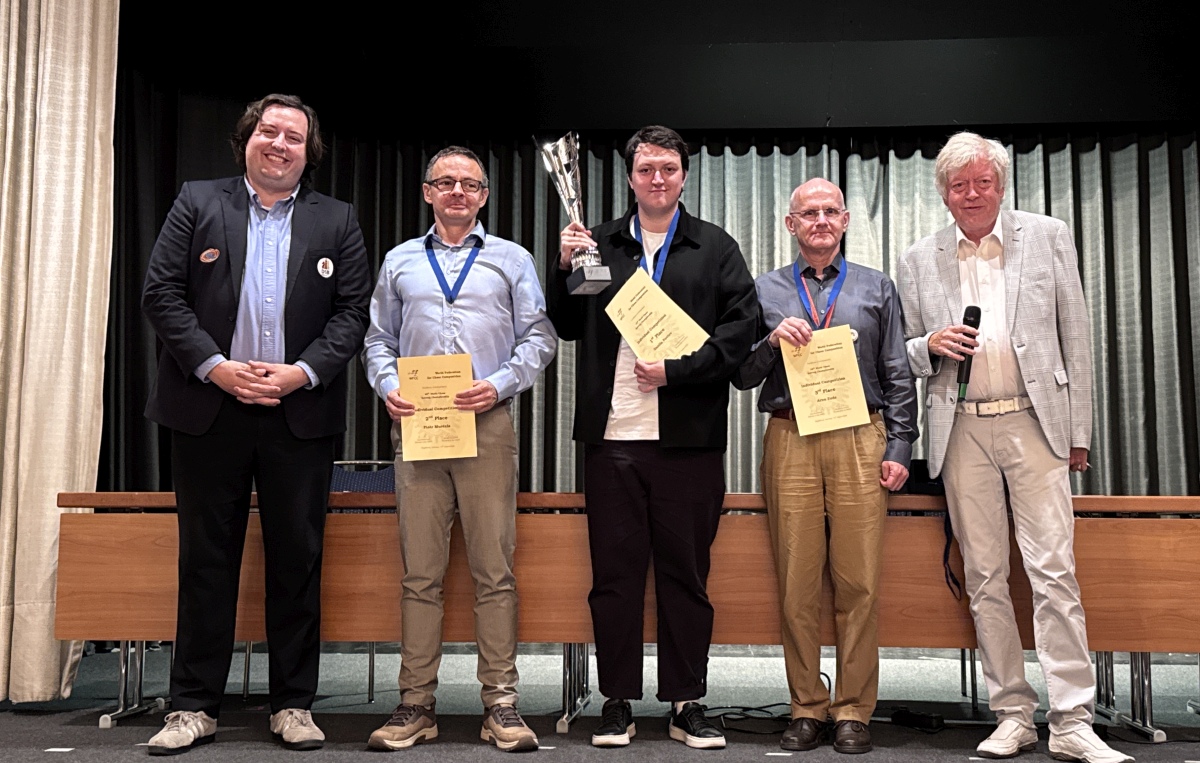
Danila Pavlov, competing under the FIDE flag, was crowned the new World Chess Solving Champion, winning his fourth world championship title overall after an exceptional performance in which he scored a perfect 90 out of 90 points. He solved all 18 problems correctly across the six rounds and finished with a total solving time of 279 minutes, emerging as the fastest solver in three different rounds.
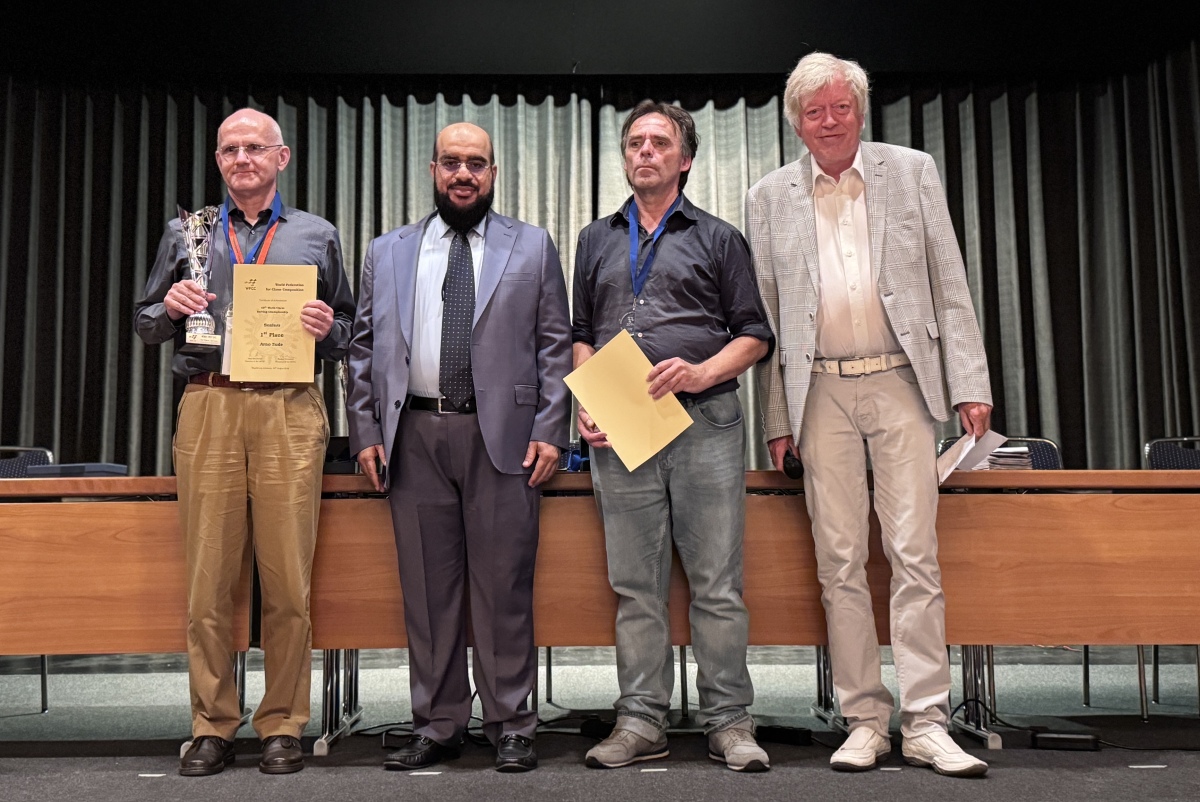
Piotr Murdzia of Poland, the reigning world champion from 2025, took silver with 86 points, while Arno Zude of Germany won individual bronze with 84 points.
The result cemented Pavlov’s position among the leading figures of modern chess solving and brought him the most prestigious individual title in the discipline. The three medalists were followed by Ural Khasanov (competing under the FIDE flag) with 83 points, and Mihnea Costachi from Romania with 82 points, who also scored a GM norm.
Germany returns to the top on home soil
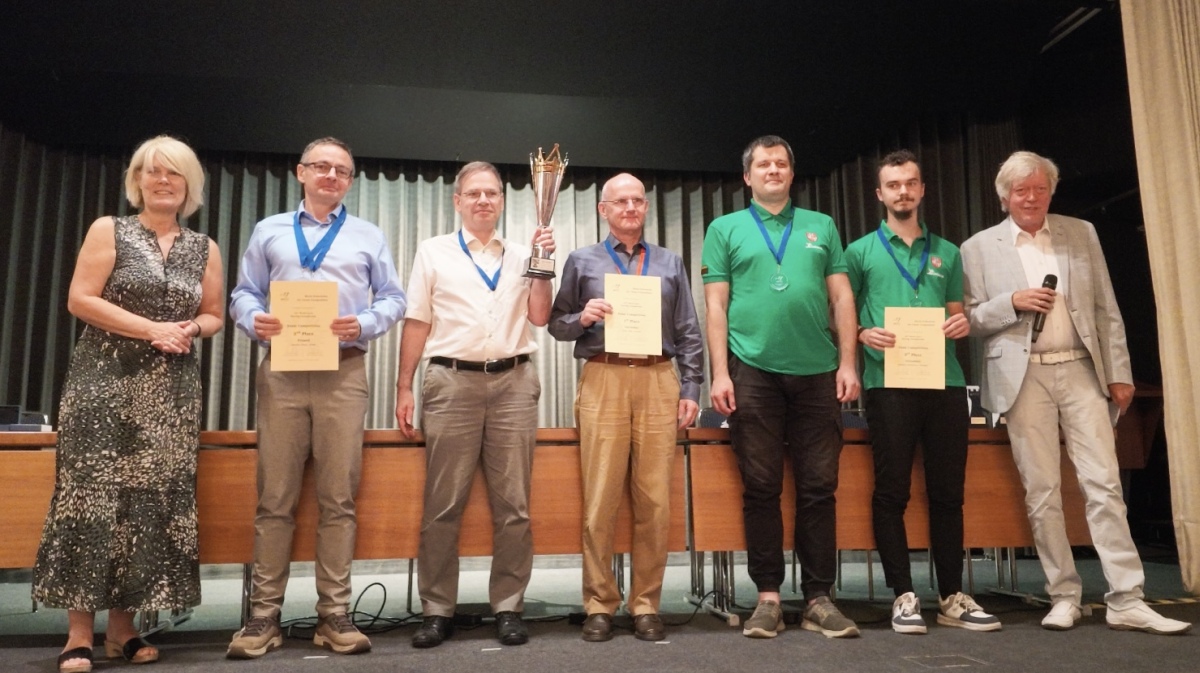
The team competition brought one of the most memorable moments of the championship, as Germany won the world team title on home soil.
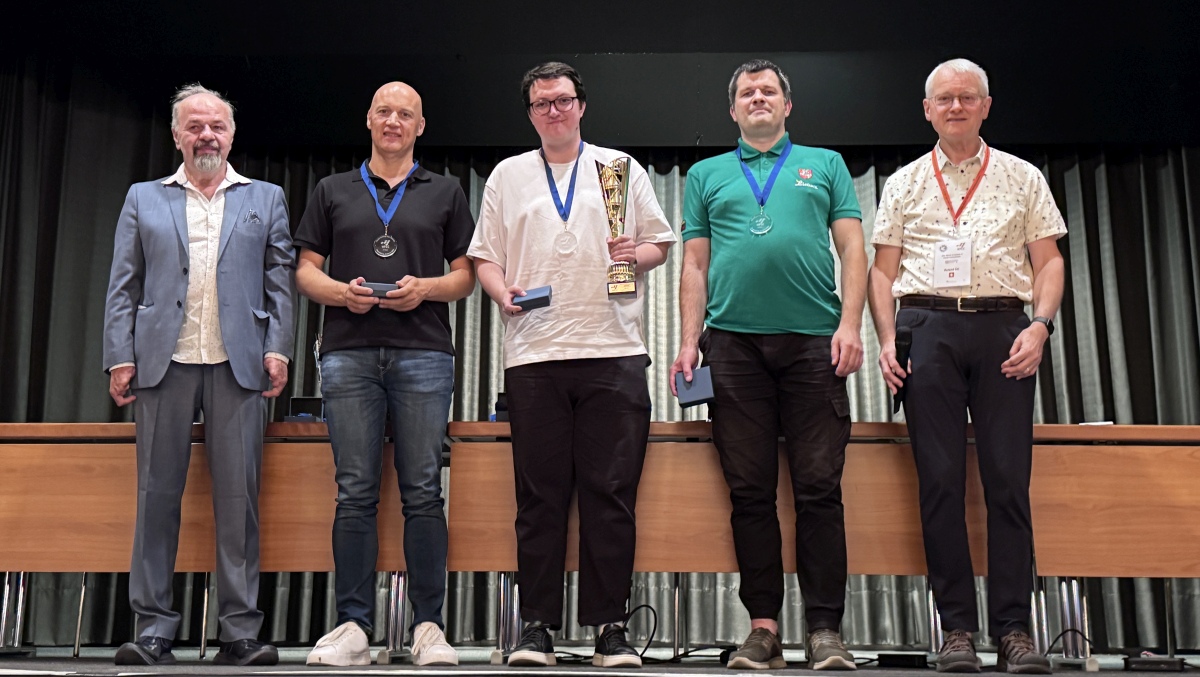
The victorious German team consisted of Arno Zude, Ulrich Voigt, and Boris Tummes, who combined for 169 points. Ulrich’s outstanding performance also earned him a GM norm. Poland, represented by Piotr Murdzia, Kacper Piorun, and Piotr Górski, took silver with the same number of points (169) but with almost an hour more time on the clock, while Lithuania, with Martynas Limontas, Kevinas Kuznecovas, and Dmitrijus Chocenka, won bronze with 162.25 points.
For Germany, the victory had special historical significance. It was the country’s first WCSC team title since 2002, when Germany won the championship in Portorož. Twenty-four years later, the title returned to Germany – this time in front of a home audience in Magdeburg.
The victory also ended a period of Polish dominance in the team competition. Poland had won 11 consecutive WCSC team titles from 2009 to 2019, reclaimed the crown in 2022 and 2023, and returned to the top again in 2025 after Great Britain briefly broke the sequence in 2024. Germany’s triumph in Magdeburg now brings another change to the recent history of the championship.
Women, juniors, and seniors
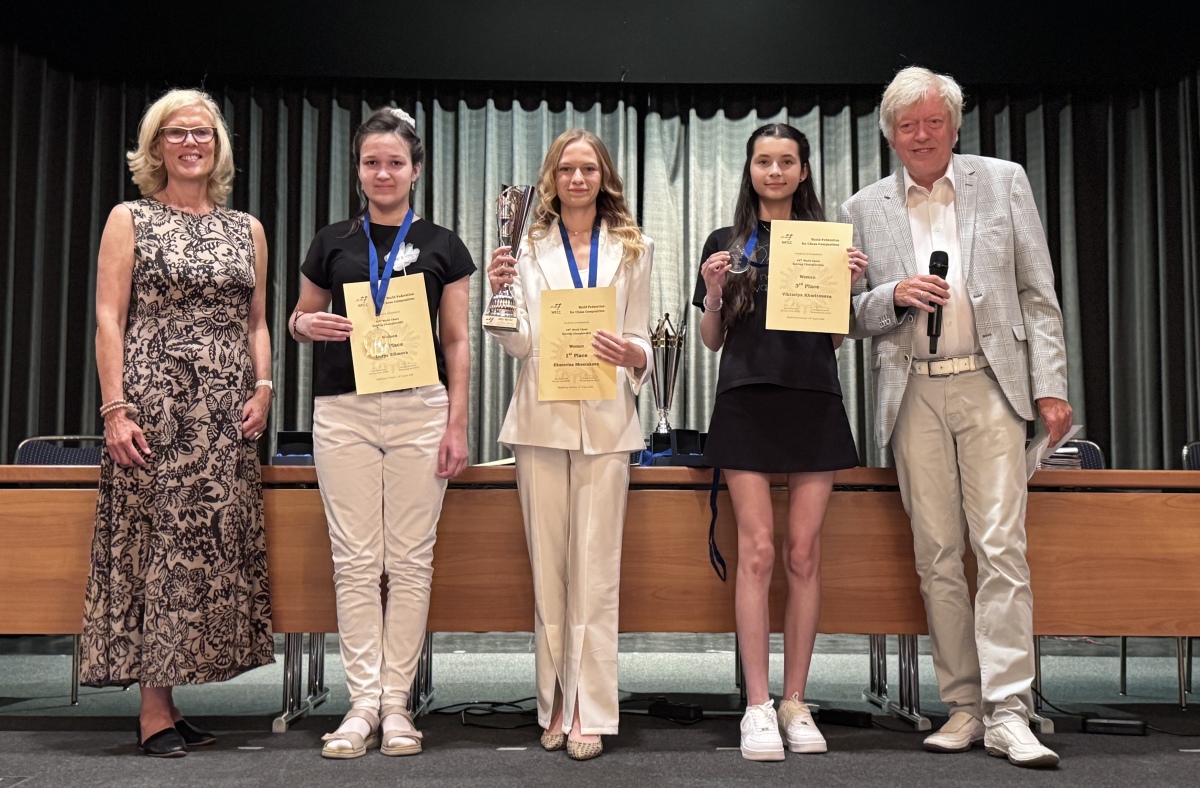
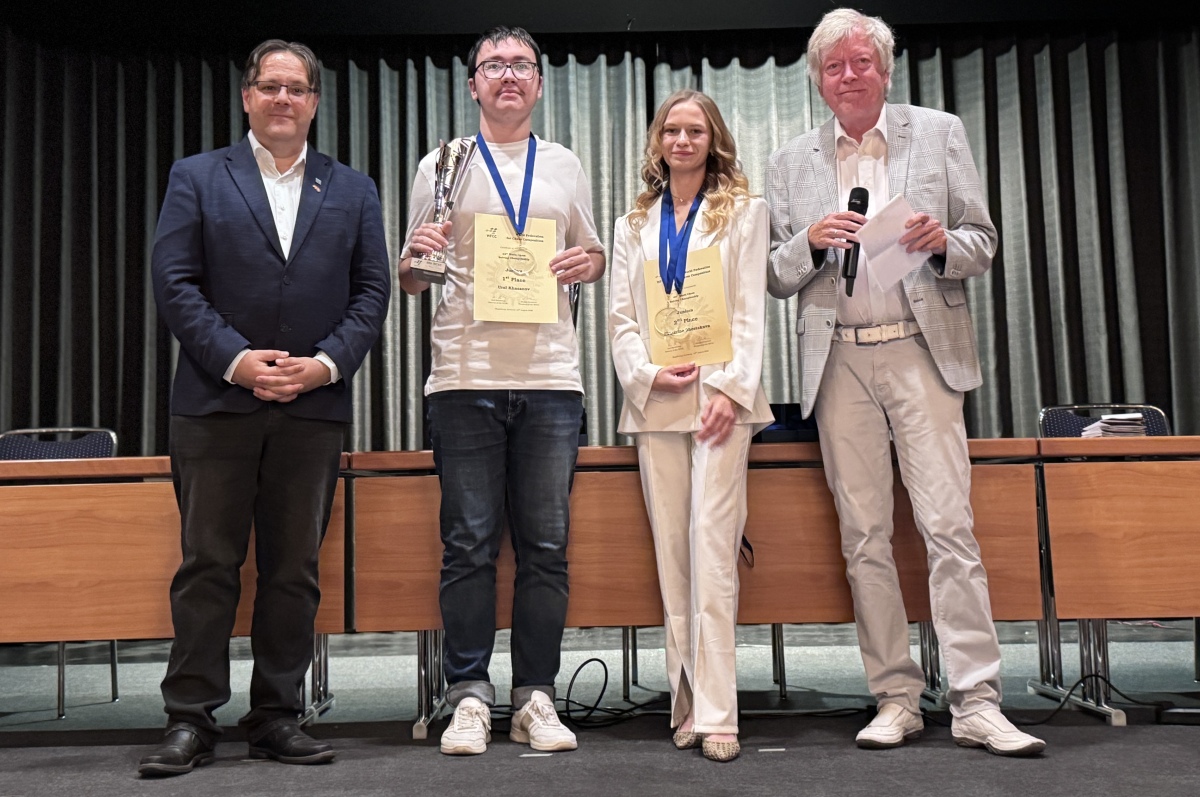
In the women’s competition, Ekaterina Shestakova won gold with 80 points, finishing 11th overall. Darya Efimova earned silver with 78.5 points, while Viktoriya Kharitonova won bronze with 72 points, all three competing under the FIDE flag. The women’s top five was completed by Anastasiya Chekina, also competing under the FIDE flag, with 64 points, and Audrey Kueh from Great Britain with 63.25 points.
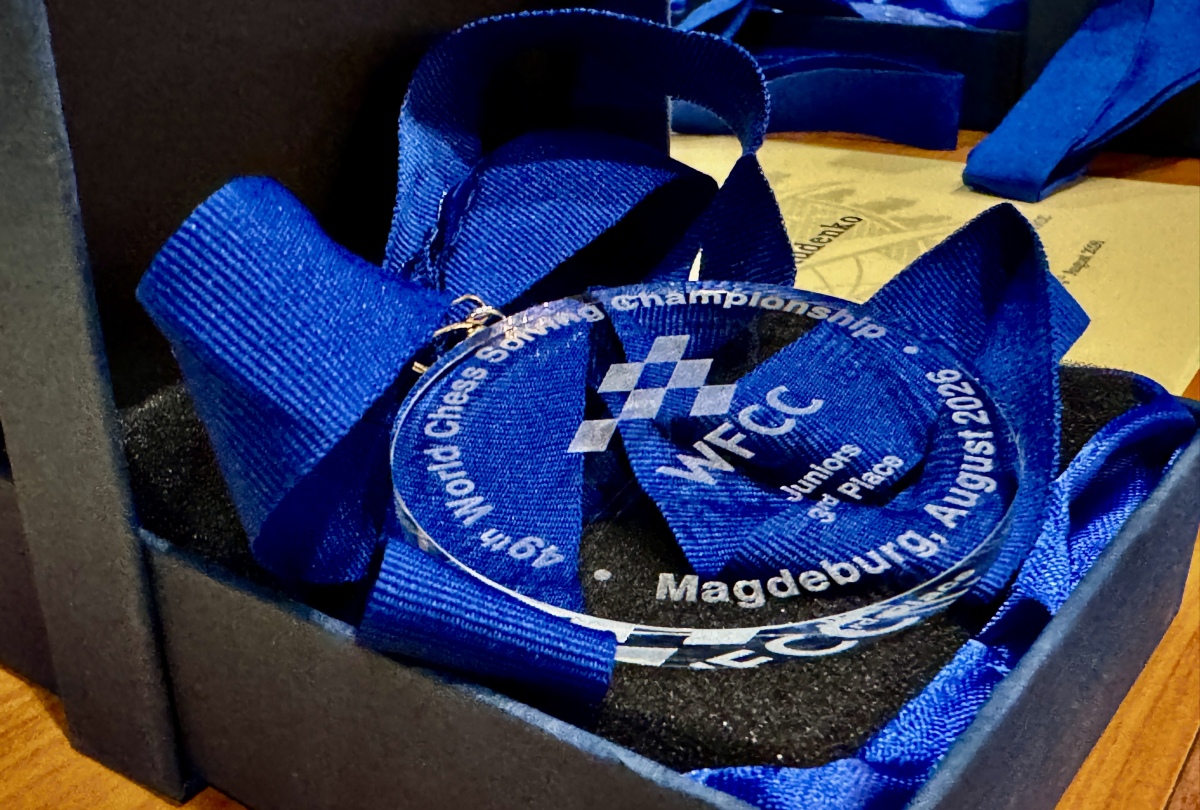
The junior title went to Ural Khasanov, whose 83 points earned him an impressive fourth place in the overall championship. Ekaterina Shestakova was second with the aforementioned 80 points, while Taras Rudenko from Ukraine took junior bronze, also scoring 80 points. Kevinas Kuznecovas from Lithuania finished fourth with 79.75 points, and Darya Efimova fifth with 78.5 points.
The senior competition was won by Arno Zude with 84 points, adding the senior title to his individual bronze medal and his team’s world champion title. Kari Karhunen from Finland finished second with 78 points, and Dolf Wissmann from the Netherlands finished third with 76.25 points. Jonathan Mestel from Great Britain and Jorma Paavilainen from Finland rounded out the senior top five.
Pavlov takes World Solving Cup
Pavlov also secured the 2025/26 World Solving Cup (WSC), the season-long international circuit comprising 19 solving tournaments. With the final event held in Magdeburg, he finished the series on 122 points, ahead of Eddy Van Beers of Belgium on 108 points and Martynas Limontas of Lithuania on 72 points. Interestingly, Pavlov did not win the final Open Solving Tournament in Magdeburg – that title went to Van Beers – but his third-place finish was enough to secure the overall Cup victory. Complete standings of the cycle can be found here. WSC Director Roland Ott officially announced the final results of the World Solving Cup during the ceremony.
A remarkable harvest of new titles and norms
The Magdeburg championship also produced an impressive number of new international solving achievements. The complete list of norms achieved and titles awarded can be found here. Those titleholders who were present at the banquet and had already fulfilled the requirements according to the latest standings were officially presented with their newly earned titles during the ceremony. Qualifications Committee Spokesman Dinu-Ioan Nicula also took part in the ceremony, presenting the newly achieved titles and norms.
Dawson-White awards recognize exceptional contributions
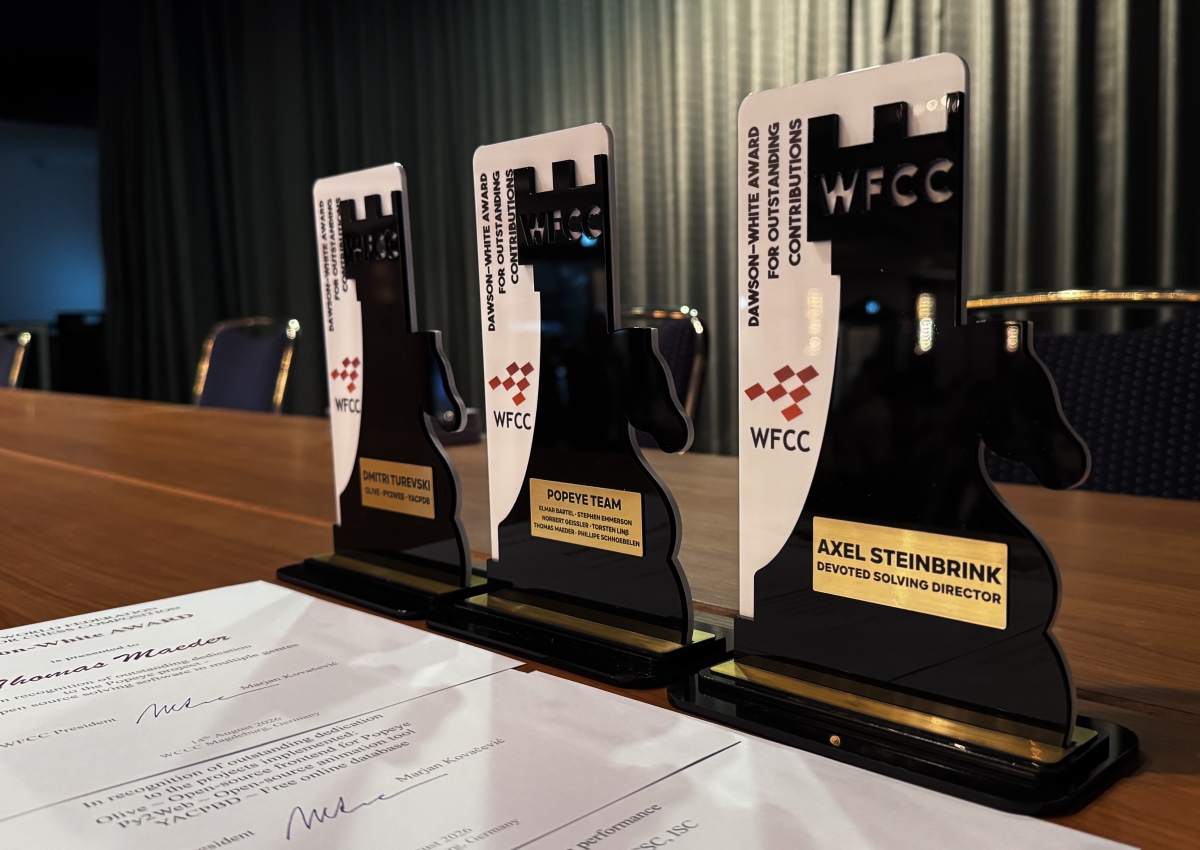
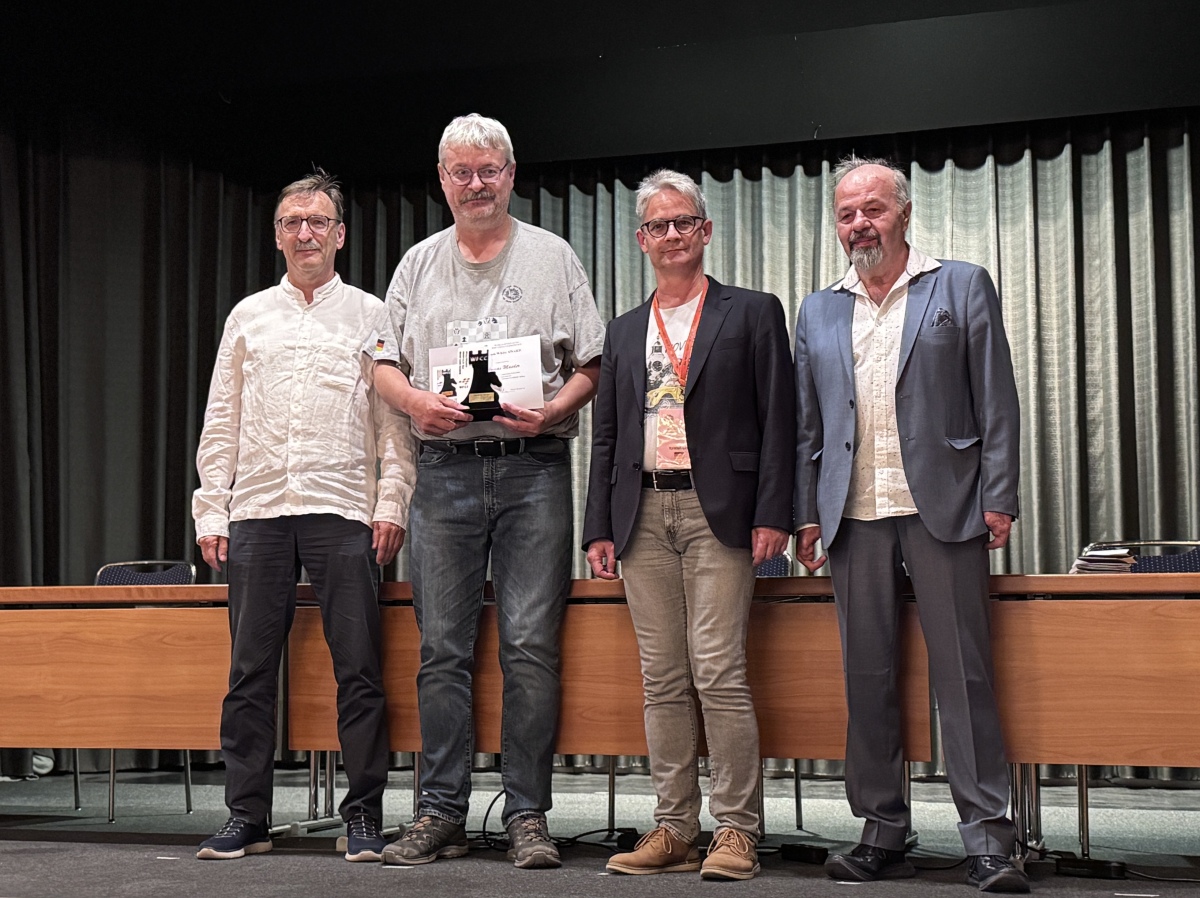
The WFCC also presented three Dawson-White Awards in recognition of outstanding contributions to chess composition and solving. Thomas Maeder received the award for his outstanding dedication to the Popeye project, an open-source chess-solving software supporting multiple chess-problem genres.
In accepting the award, Maeder invited fellow Popeye contributors Torsten Linß and Norbert Geissler to join him on stage, while the recognition also acknowledged the work of the wider Popeye team: Ilmar Bartel, Stephen Emmerson, Norbert Geissler, Torsten Linss, Thomas Maeder, and Philippe Schnoebelen.
Dmitri Turevski was recognized for his contributions to Olive, the open-source frontend for Popeye; Py2Web, an open-source animation tool; and YACPDB, the free online chess-problem database.
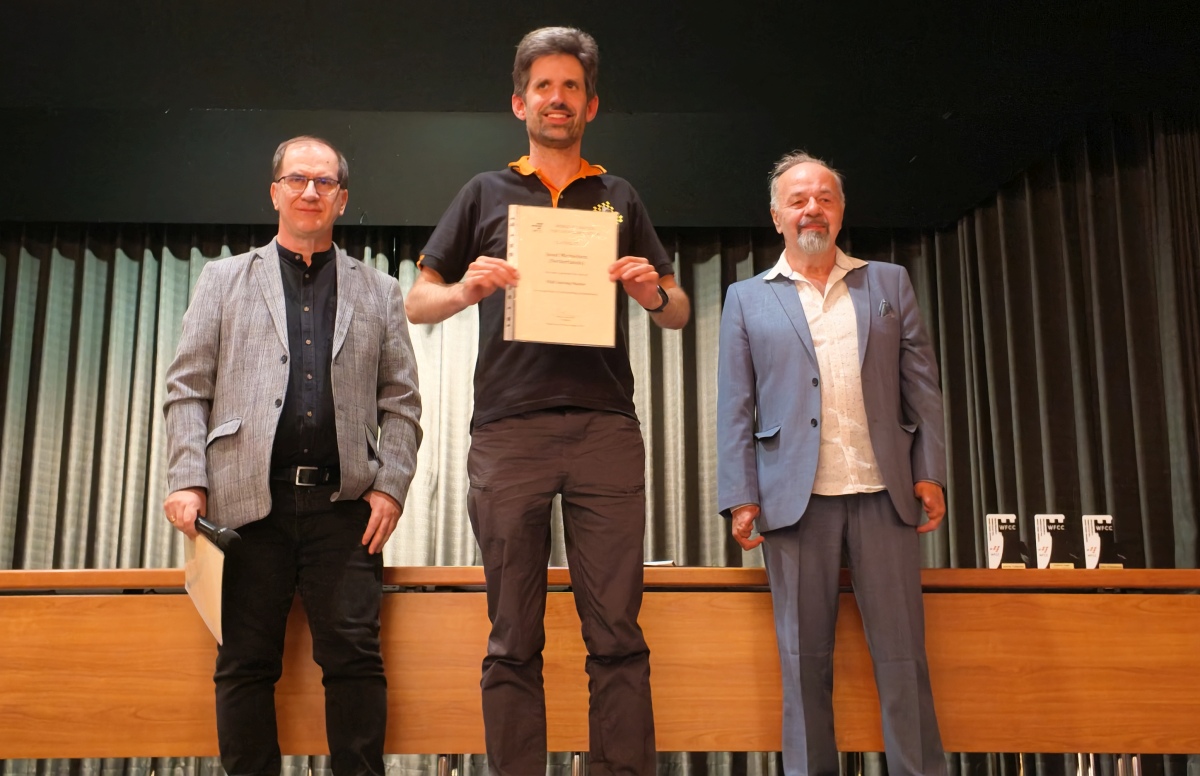
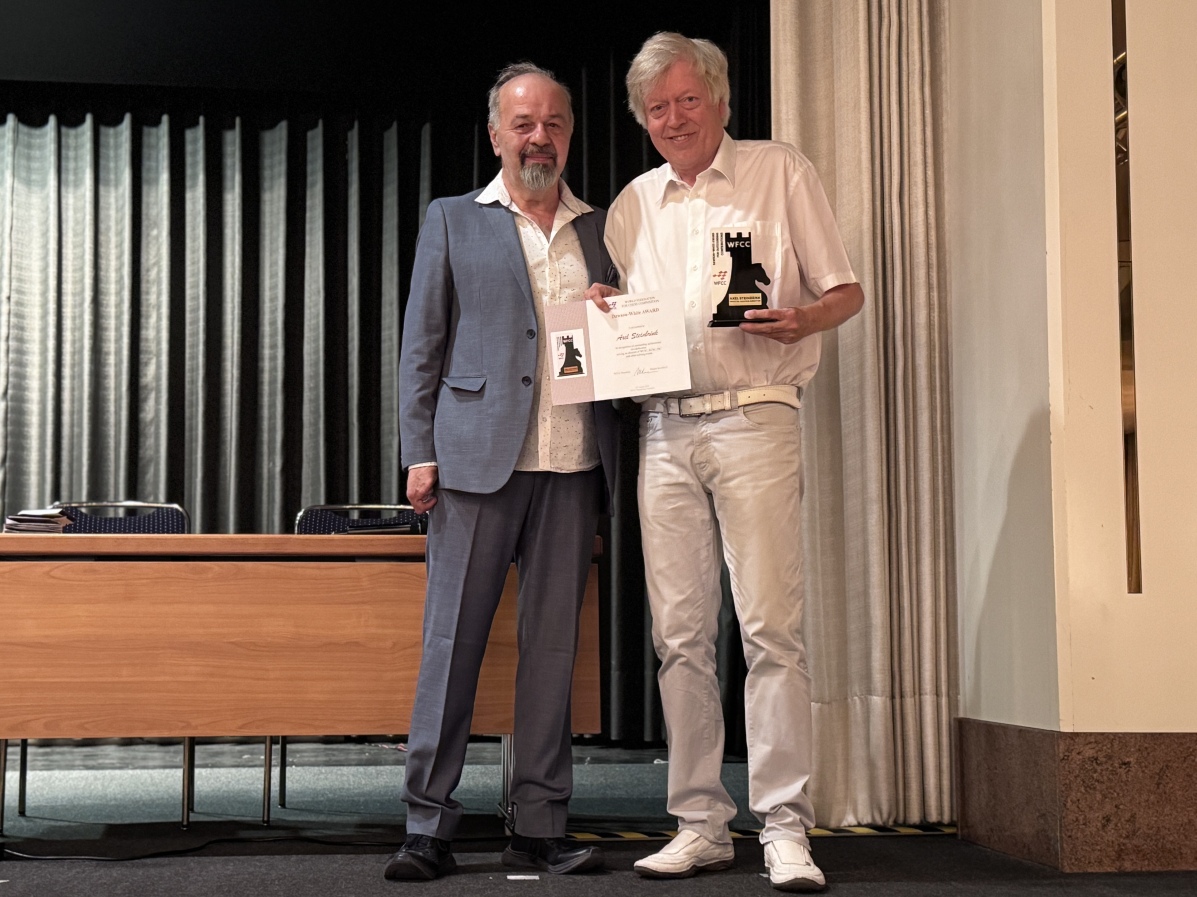
Axel Steinbrink (pictured below, right) received an award for his outstanding performance and dedication as director of the WCSC, ECSC, ISC, and other solving events.
Congratulations to all the winners and titleholders, and sincere thanks to the organizers, officials, and volunteers whose dedication made the Magdeburg Congress and Championship such a memorable success.
Photos and text by Dragana Nikolovska