
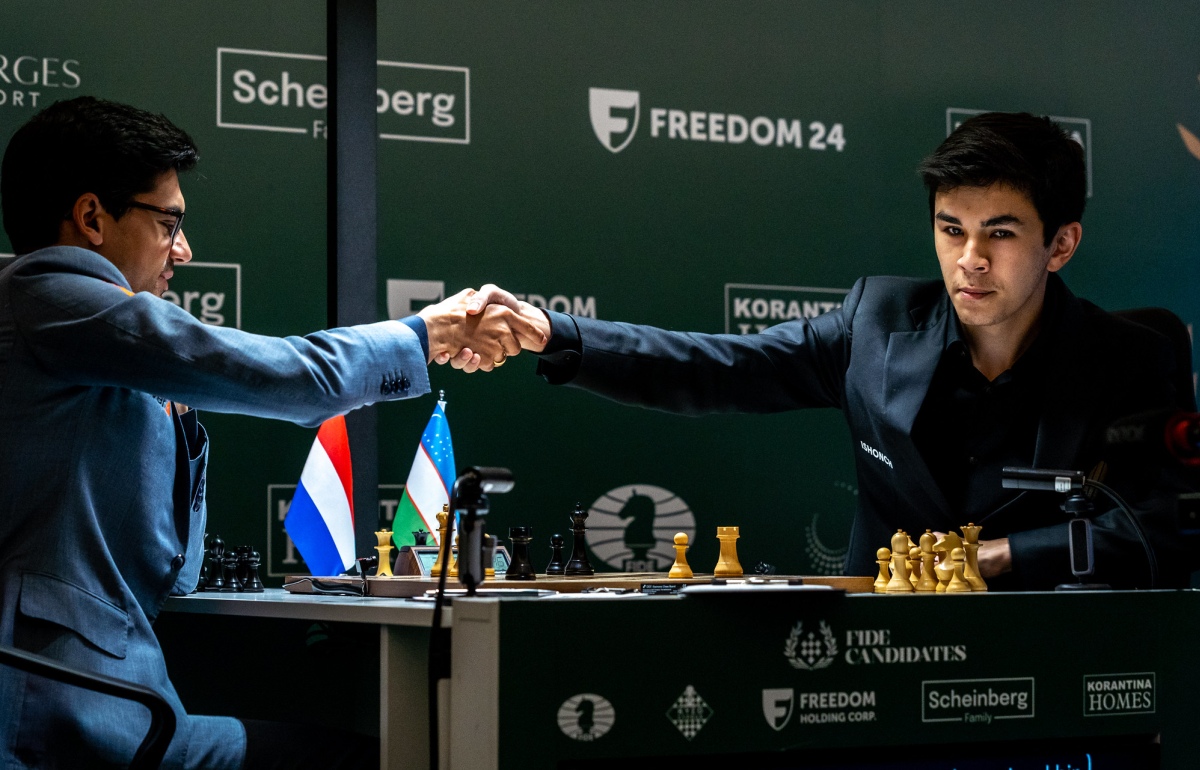
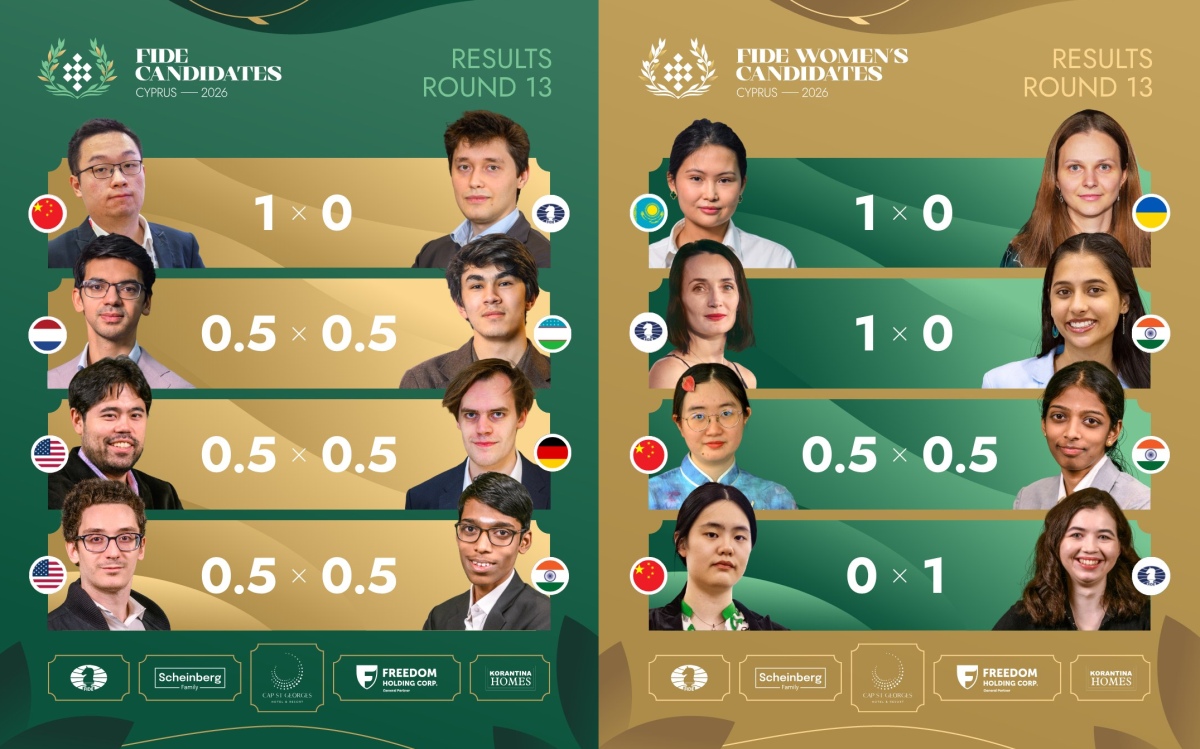

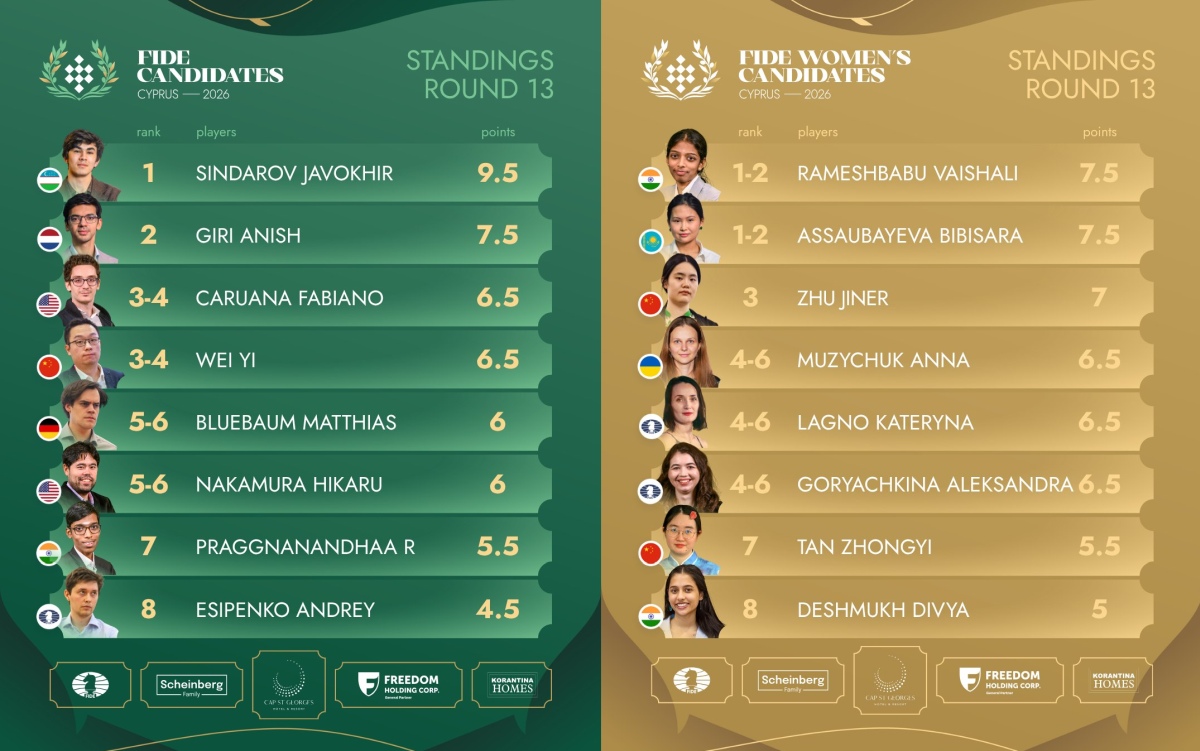
Javokhir Sindarov has won the FIDE Candidates Tournament this afternoon with a round to spare and will challenge Gukesh D for the World Championship at the end of the year. His game against Anish Giri ended in a draw, and with one round remaining, Sindarov holds a commanding two-point lead over the rest of the field.
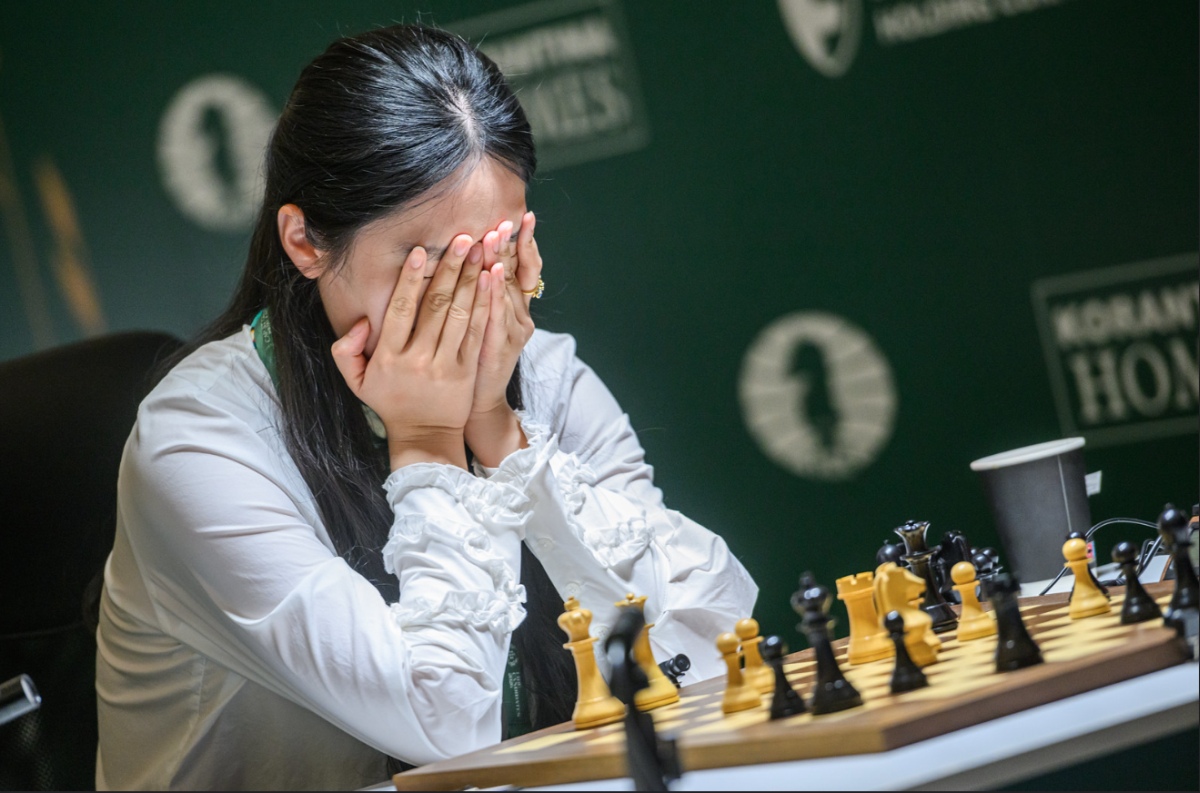
In the FIDE Women’s Candidates Tournament, Bibisara Assaubayeva defeated Anna Muzychuk to move into a tie for first place with R Vaishali. Tomorrow’s final round will determine whether there will be an outright winner or a tiebreak will be required. Up to six of the eight players still have a theoretical chance to win the event.
Let’s take a closer look at the action.
The ceremonial first move was performed by Isai Scheinberg, a long-standing supporter of chess and the first awardee of the FIDE Medal of Merit in the 21st century.
In the key game of the round, Javokhir Sindarov held Anish Giri to a draw, securing first place and claiming victory in the FIDE Candidates Tournament.
Both players blitzed out the first fourteen moves. Sindarov accepted an isolated d-pawn in the Queen’s Gambit Declined, while Giri was content with a slight edge, enjoying a dynamic position without any real risk. However, Sindarov made excellent use of the rest day and came into the game extremely well prepared.
“We checked and prepared against Anish. At some point, it became boring because I reviewed this line ten times, as he had already played it against Andrey Esipenko. We had a good fight, but after we exchanged queens, I felt I wouldn’t have any problems holding the draw. That proved true: I played quickly, and it was an easy draw,” Sindarov explained in the postgame press conference.
He also added with a touch of humour: “I had zero problems in the rook ending and saw the final line very quickly. I knew I wouldn’t lose that position with one hour and thirty minutes left on the clock – I was just chilling.”
Sindarov expressed deep gratitude to those who supported him throughout the tournament: “A big thank you to everyone who supported me during this long event. Every round was very tough, and the last week was the hardest of my life. I even slept very badly in the final days. I’m very happy it’s over. Many thanks to my family, my coach, my seconds, and everyone who supports me.”
He also praised his coach, Roman Vidonyak: “He analyses all the information from the tournament and points out what I’m doing wrong in certain positions. He gives me advice. I’ve been working with him for more than a year. He has also worked with Nodirbek Yakubboev, and you can see the results of our work. He’s a great person: we play board games together, he’s funny, very supportive, and a hard worker. With him, I’ve improved my chess a lot.”
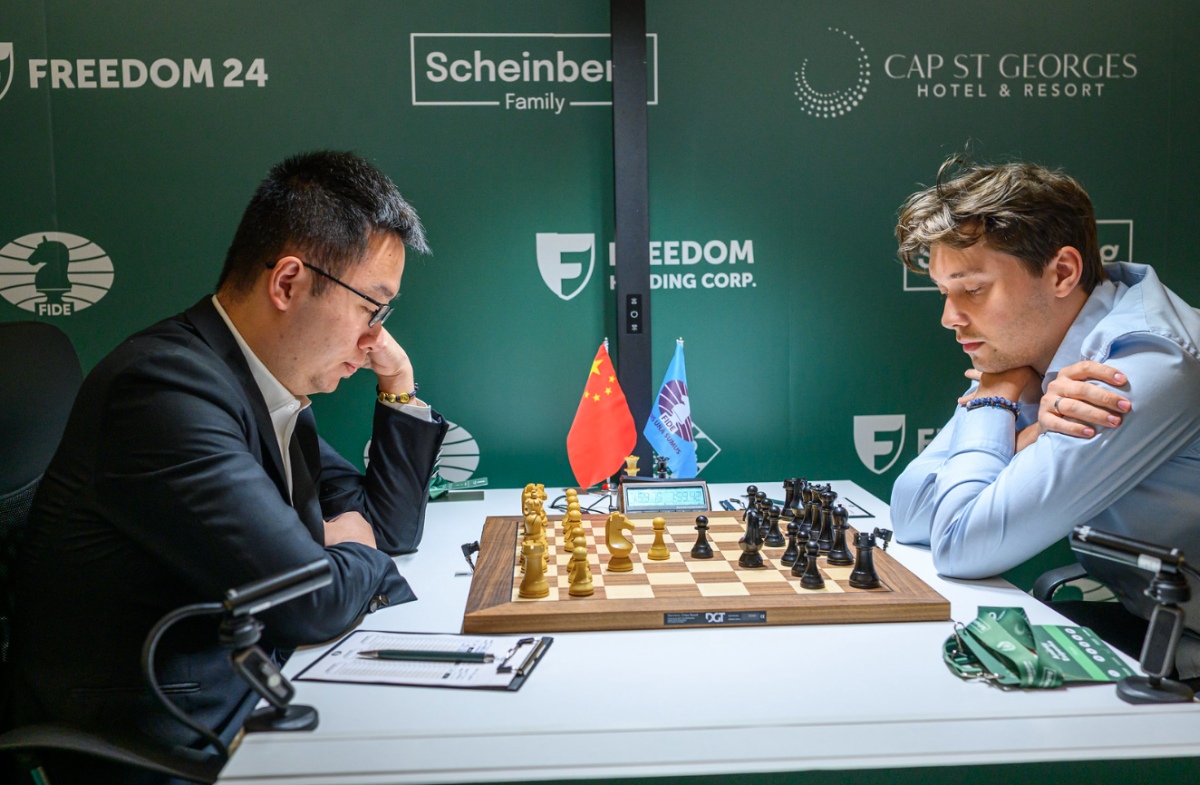
In the other three games of the round, Wei Yi defeated Andrey Esipenko in a highly complex attacking line of the Petrov Defence. Interestingly, Wei Yi had already employed this line back in 2017 against Yu Yangyi at the Hainan Danzhou GM Tournament, where he also scored a brilliant victory.
At a critical moment, Esipenko sacrificed a piece for a couple of pawns and an attacking initiative. In different circumstances, the gamble might have paid off, but Wei Yi’s defensive precision proved impeccable on this occasion. Both players joined Zachary Saine in the media centre for a joint press conference in which they went over the game.
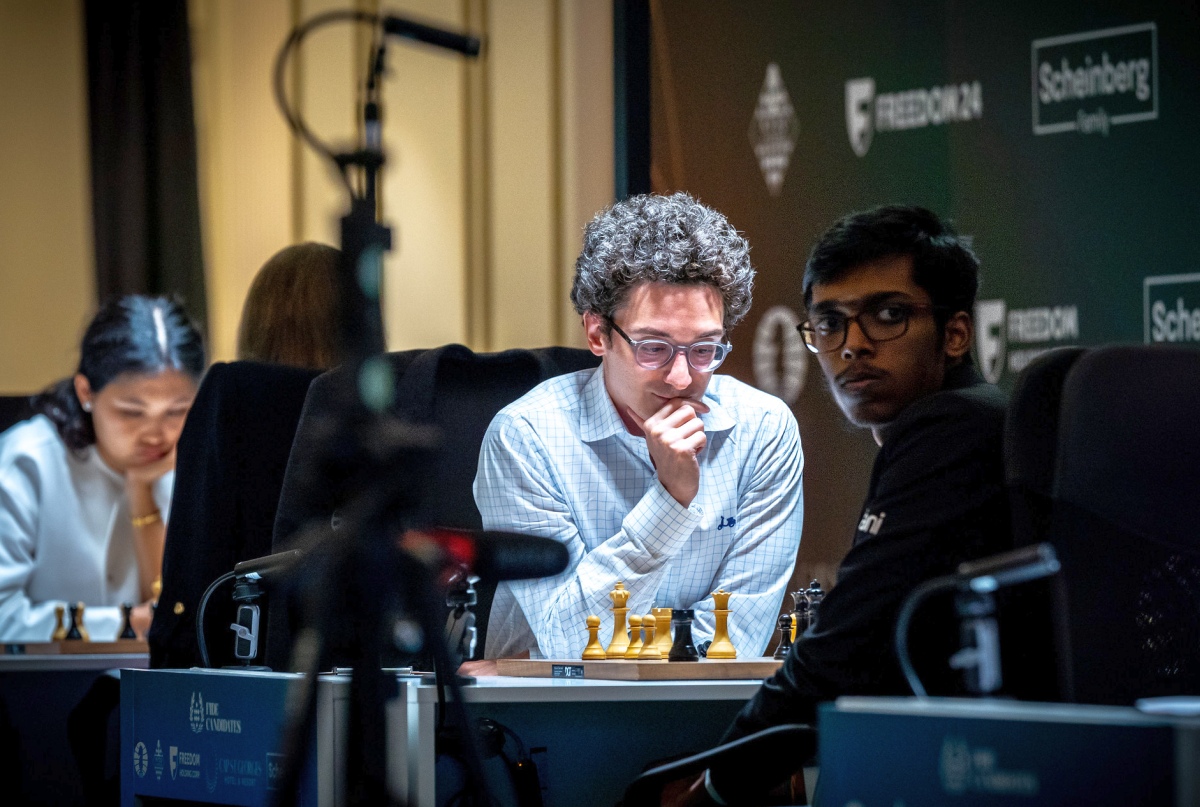
Despite his young age, Praggnanandhaa R already has extensive experience against Fabiano Caruana, with their head-to-head record standing at 13 games: two wins each and nine draws. The Nimzo-Indian Variation they chose dates back to the 1970s and is known for its deep strategic complexity.
By around move twelve, Praggnanandhaa had already spent over half an hour in a position with more than 300 recorded master games, an unusual situation indeed. This left Caruana with an intriguing choice: follow the main theoretical path or deviate.
He opted for a secondary line and soon generated a powerful attack, ultimately forcing his opponent to sacrifice his queen to avoid immediate checkmate. Caruana appeared to be on the verge of victory, but Praggnanandhaa demonstrated remarkable resilience, finding a defensive resource based on a fortress setup that allowed him to secure a draw.
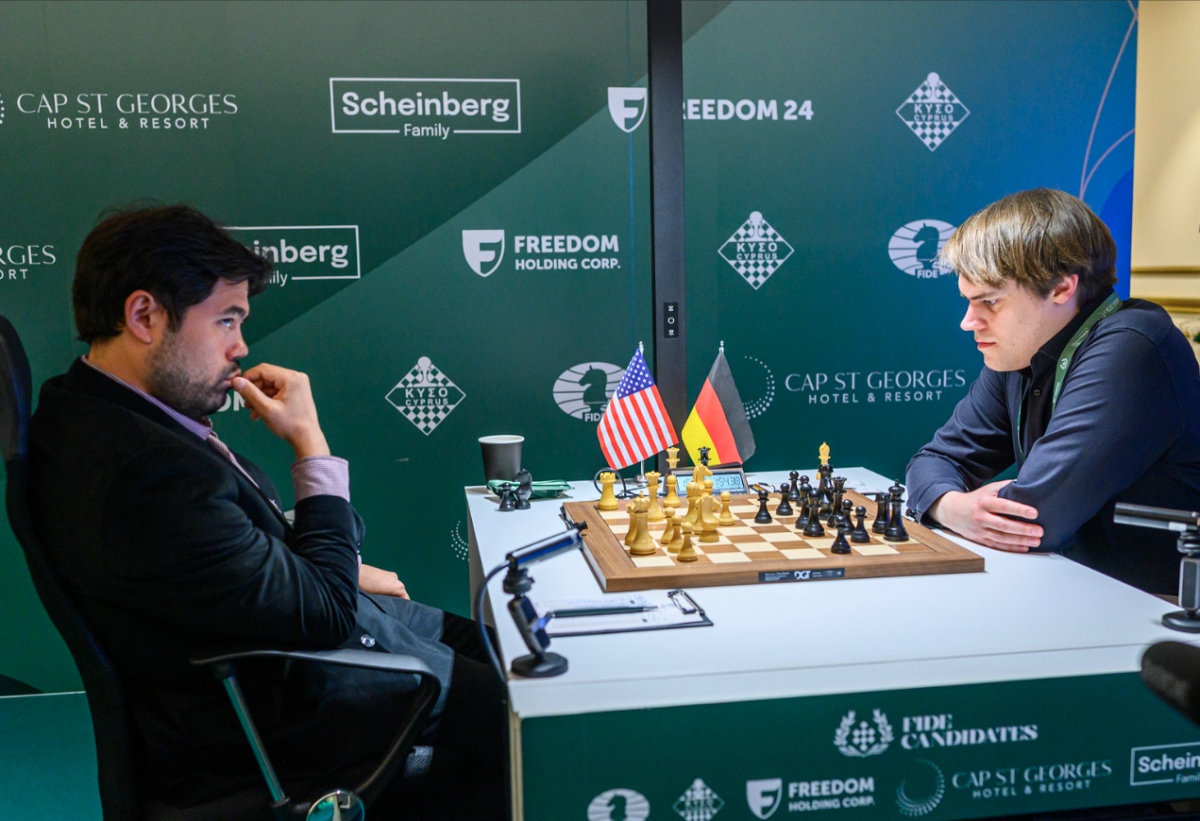
In the final game of the round, Hikaru Nakamura and Matthias Bluebaum produced an exceptionally accurate encounter, both achieving a near-perfect 99% accuracy score in a solid draw. Facing a classical Queen’s Gambit Declined setup, Nakamura quickly relinquished the bishop pair to reach a standard Carlsbad structure and prepare a minority attack.
Unfazed, Bluebaum responded confidently, simplifying the position and equalizing with ease. By move twenty-five, the game was completely balanced. Although play continued until move forty-one, the evaluation remained unchanged throughout, further reinforcing Bluebaum’s reputation as one of the most solid players on the circuit.
The results of the penultimate round in the FIDE Women’s Candidates Tournament have left the competition wide open. Six players still have a theoretical chance of winning the event, although only five can qualify for a playoff at the same time.
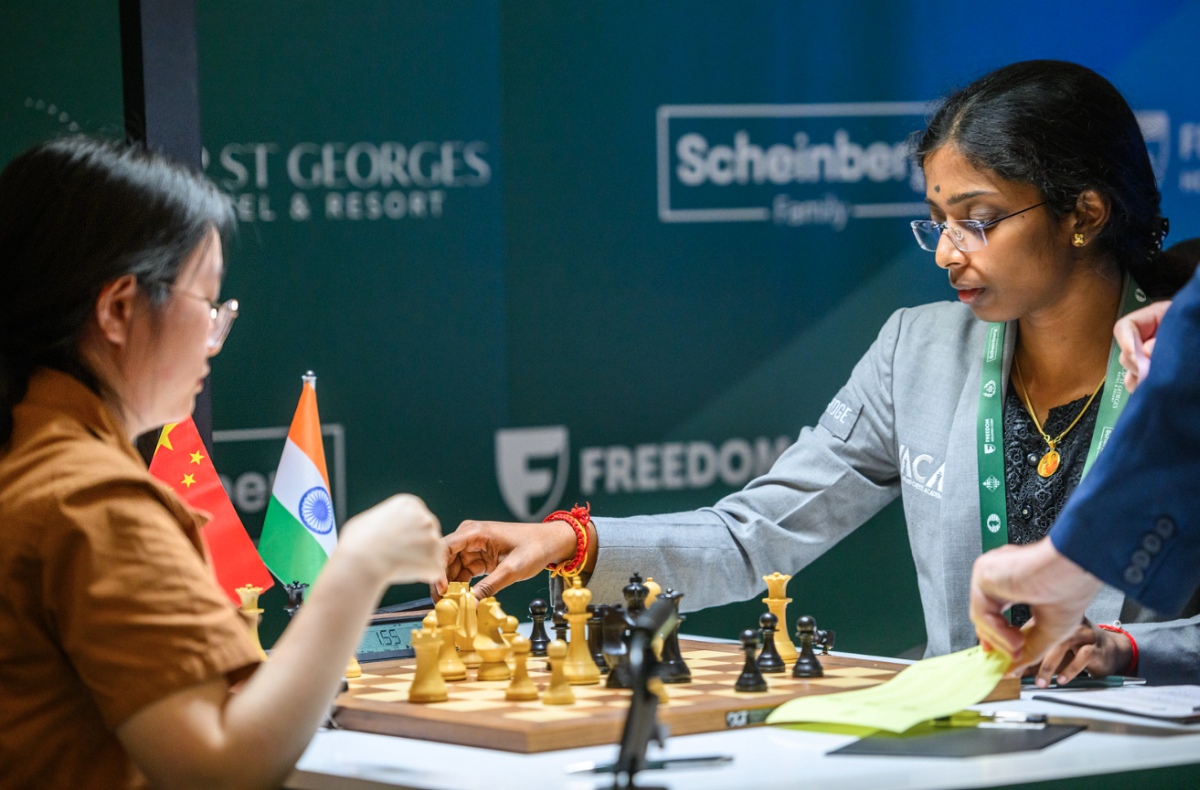
The leading contenders are Vaishali Rameshbabu, who held Tan Zhongyi to a draw, and Bibisara Assaubayeva, who defeated Anna Muzychuk with an impressive display of home preparation. Both now stand on 7.5 points.
In the final round, Vaishali will have the white pieces against Kateryna Lagno, while Assaubayeva will play Black against Divya Deshmukh. If one of them wins and the other does not, the victor will be crowned champion outright.
However, the situation remains tense. If both leaders draw, Zhu Jiner – currently on 7 points – could still tie them, as she faces Anna Muzychuk in the final round. Moreover, should both leaders lose, players on 6.5 points still retain outside chances.
Among them, Kateryna Lagno, fresh off a victory over Divya Deshmukh, and Aleksandra Goryachkina, who prevailed over Zhu Jiner in a fiercely contested seesaw battle, will be pushing hard to keep their title hopes alive in the final round.
Kateryna Lagno’s technique this afternoon was especially impressive.
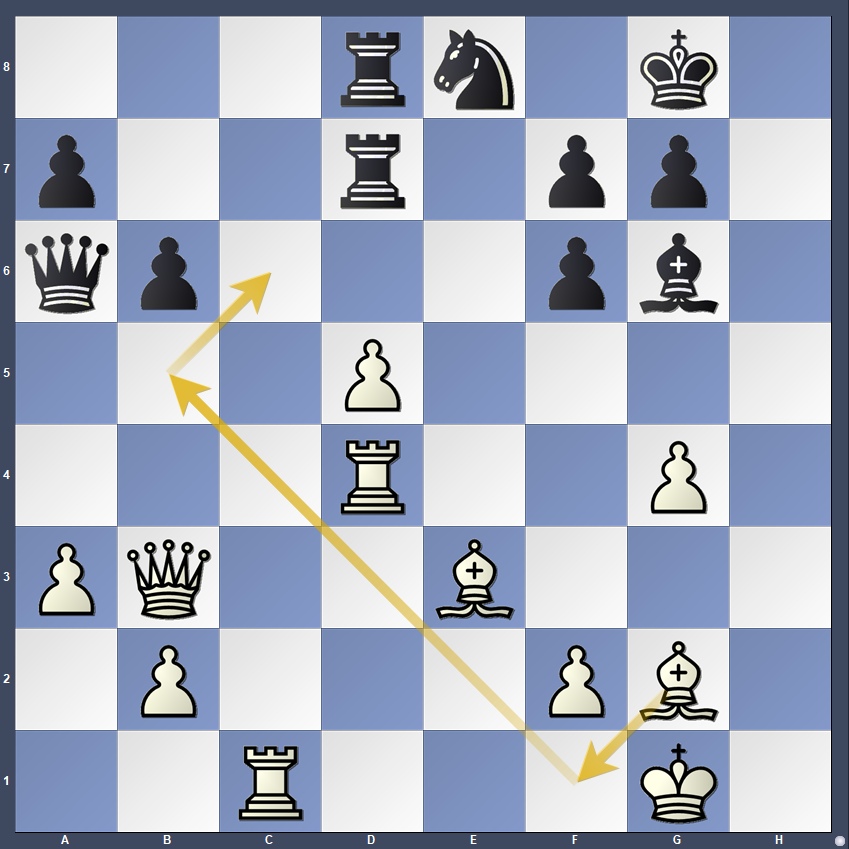
Material is equal, but Lagno holds a clear positional advantage thanks to the bishop pair and the potential of a passed d-pawn. What followed was a beautiful and highly instructive manoeuvre:
26.Bf1! – hitting the black queen, 26…Qb7 27.Bb5! attacking the rook. 27…Re7 28. Bc6! Qb8 29. Bf4! Nd6 and finally 30.Qg3!
At this point, Black is completely tied up along both diagonals. Divya Deshmukh found herself in a virtually hopeless position and was forced to resign shortly thereafter, effectively trapped in a middlegame zugzwang.
Standings after Round 13
The Fan-Zone, hosted by FIDE presenter Angelika Valkova, showcased a Masterclass by GM Maurice Ashley, a Meet & Greet with Amruta Makal from Chessbase India and Case Studies from Tournaments by Dr Yevgeny Levanzov.
The final round will be played on April 15 at 3:30 pm. If tiebreaks are needed, they will be disputed on April 16, at 3:00 pm.
Official website: https://candidates2026.fide.com/
Event photo gallery: https://www.flickr.com/photos/fide/
Live daily broadcast with GM commentary: https://www.youtube.com/@FIDE_chess
Written by IM Michael A. Rahal (Cyprus)
Photos: Michal Walusza, Niki Riga