

Olympiad Day 6: Uzbekistan make their move in Samarkand
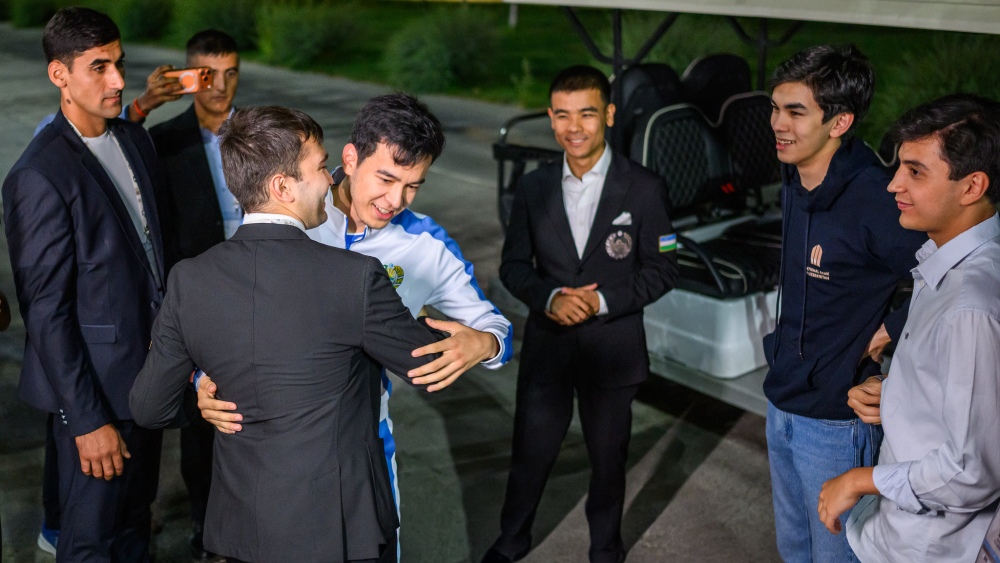
The hosts defeat India 2.5-1.5 to emerge as the Open section’s sole leaders Uzbekistan have emerged as the sole leaders of the Open section after six rounds, producing another impressive result on home soil. Their first team defeated India 2.5-1.5 in a thrilling encounter, with Nodirbek Yakubboev scoring the decisive victory on board three against Nihal Sarin. The result propelled Uzbekistan to the top of the standings heading into the rest day, with the home team having shown both consistency and the ability to win the close matches that can ultimately decide the Olympiad. China also made a major statement by defeating Germany 3-1, while Armenia, France, and England remain among the teams in contention near the top. In the Women’s section, China continued their impressive run by crushing Poland 3.5-0.5, while Kazakhstan edged out Azerbaijan 2.5-1.5 in a match decided by Alua Nurman’s victory over Gunay Mammadzada. Let’s take a closer look at the action from the playing hall. Once again, four ceremonial opening moves were performed this afternoon on the top boards. In the Open section, for the highly anticipated Uzbekistan – India match, Husen Tuxtayev, Deputy Governor of the Samarkand Region for Youth Policy, Social Development, and Spiritual and Educational Affairs, made the opening move for Nodirbek Abdusattorov, while Nitin Narang, President of the All India Chess Federation, replied for R Praggnanandhaa. Immediately afterwards, everyone moved two rows down to the Women’s section for the Azerbaijan – Kazakhstan encounter. Mahir Mammedov, President of the Azerbaijan Chess Federation, made the ceremonial first move for Govhar Beydullayeva, while Yeraly Tugzhanov, Ambassador Extraordinary and Plenipotentiary of the Republic of Kazakhstan to the Republic of Uzbekistan, responded for Bibisara Assaubayeva. Most teams arrive at the venue with more than enough time to find their boards and prepare for the match. So it was particularly unusual not to see any members of the Israeli teams when the games began. After a few minutes, the situation became clear. In observance of Yom Kippur, which falls on September 20 and 21 this year, the Israeli Open and Women’s teams had requested adjustments to their playing schedule. Yesterday, both of their opponents agreed to start the matches slightly earlier, with the games relocated to one of the official hotels. For today’s round, however, the Israeli teams requested either a later start in the evening or the possibility of playing the match tomorrow, the scheduled rest day. FIDE contacted the opponents of both Israeli teams to discuss the possibility of adjusting the playing schedule. However, neither opponent agreed to play at a different time from the official schedule, which they were fully entitled to do. As a result, and in accordance with the competition regulations, both Israeli teams forfeited their matches. Evgeni Romanov later explained the situation to Nurgyul Salimova, board one of the Bulgarian women’s team. Open section The match of the day between India and Uzbekistan brought together two of the three leaders and, unsurprisingly, both teams fielded exactly the same line-ups as in the previous round. On a personal note, after five rounds of watching these teams closely, I had the feeling that whoever came out on top today would have an excellent chance of winning the whole event. All of these top players have a long history of playing each other, meeting multiple times each year at tournaments around the world. Here is a fun fact: three of the four players on each team had also faced each other in the previous Olympiad in Budapest. That match ended 2-2, with all four games drawn. The Chennai 2022 match was also a 2-2 draw! All four games were intensely fought, and three eventually ended in draws, with Black gradually neutralising White’s initiative. But something seemed to be happening on board three, where Nodirbek Yakubboev and Nihal Sarin were heading towards severe time trouble in an extremely tricky position. Nodirbek Yakubboev – Nihal Sarin Yakubboev’s last move, 37.g3, concealed a very nice tactical idea that Nihal missed, when playing 36…Kxg5 on the previous move instead of the very strong 36…Kg7! with a huge advantage for Black. His best move here would have been to get his king to safety as quickly as possible with 37…Kh6 followed by 38…Kg7, after which Black should be able to hold the position. But Nihal had probably already decided on his next move and confidently played 37…Nf5, protecting the pawn. Yakubboev immediately grabbed the knight and followed up with 38.Ne6+!, forking Black’s king and queen. Nihal returned to the board in shock and quickly realised that he had blundered his queen. After 38…Rxe6 39.gxh4+ opens the h2–c7 diagonal, revealing the hidden attack on the queen. A very tricky tactical sequence indeed. With a full queen against a rook and bishop, Yakubboev smoothly converted his advantage, securing a 2.5-1.5 victory for his team and improving his personal score to an impressive 4.5/5. It could prove to be one of the most important victories of his career. Charlize van Zyl caught up with Yakubboev shortly after he left the tournament hall. https://www.youtube.com/watch?v=if2b2-jYRcA In the second key match of the day in the Open section, China overpowered the third-placed leader, Germany, 3-1, with crucial victories by Ding Liren on board one against Vincent Keymer and Xu Xiangyu against Alexander Donchenko on board four. The latter was a particularly instructive endgame, with Xu demonstrating the strength of two bishops against two knights. France and England drew their match 2-2, with one win apiece, while Armenia moved into a tie for third place after defeating Iran 2.5-1.5. Iran is, of course, missing several of its strongest players: Alireza Firouzja, who now represents France but is not playing in Samarkand, as well as Parham Maghsoodloo and Sina Movahed. Further down the standings, Azerbaijan, Bulgaria, Turkey and, above all, the United States recovered some ground with solid performances as the tournament heads into the rest day. The Netherlands will also climb the standings following their 4-0 forfeit victory over Israel. On the less fortunate side,
Olympiad Day 5: Home teams thrive along the Silk Road
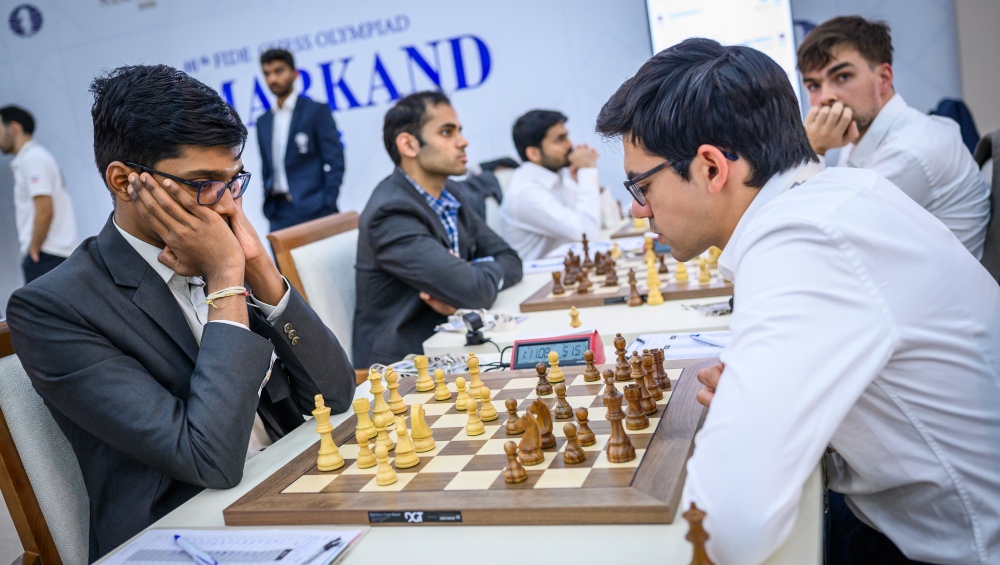
Uzbekistan shines against Hungary, while Poland stuns defending champions India in the Women’s section Another fascinating afternoon unfolded in Samarkand, with the battle for the top of the standings becoming increasingly intense in both sections. Several leading teams strengthened their positions, while a couple of unexpected results showed once again that there are no easy matches at an Olympiad. Going into the final round before the much-awaited rest day, anything can happen! Let’s take a closer look at the action from the playing hall. The energy in the playing hall this afternoon, just before the round began, was quite different from usual. The organising committee invited all the teams, along with reserve players and heads of delegation, to take part in an official photo shoot, and the excitement was palpable. Three different photo booths had been set up, giving most teams the chance to capture a special souvenir of their time in Samarkand. For a few minutes, the usual pre-round concentration gave way to smiles, laughter and plenty of team spirit. Players who would soon be battling across the chessboards were busy posing together, creating a colourful snapshot of the Olympiad and the people who make this unique event what it is. Four ceremonial moves were performed this afternoon, adding a touch of occasion to two of the day’s most anticipated matches. On board one of the Open match between Hungary and Uzbekistan, Arkady Dvorkovich, 7th FIDE President, opened the game for Richard Rapport with 1.b3, while Odil Abdurakhmonov, Representative of the President of the Republic of Uzbekistan for Sports, replied with 1…Nc6 on behalf of Nodirbek Abdusattorov. Unfortunately, Rapport had not yet arrived at the board when the ceremonial moves were made, but Dvorkovich waited patiently for the Hungarian Grandmaster, who soon arrived for the customary pre-game handshake. Immediately afterwards, Zhu Chen, FIDE Treasurer and former Women’s World Champion, opened with 1.e4 for Carissa Yip of the USA. Adiz Boboev, Governor of the Samarkand Region, responded with 1…e5 on behalf of Afruza Khamdamova, setting the stage for another important encounter. A unique situation occurred for both Israeli teams, in the Open and Women’s sections, who were not in the playing hall when the round began. Due to the observance of Yom Kippur on September 20, the holiest day in Judaism, both teams had to complete their games earlier than the standard playing schedule would normally allow. In the spirit of sportsmanship and mutual respect, the opponents of both teams – Singapore in the Open section and Colombia in the Women’s section – agreed to start their matches earlier, with the games relocated to the Savitsky Hotel. The matches were conducted in full accordance with the standard tournament regulations and all applicable fair-play measures, allowing both Israeli teams to observe Yom Kippur while completing their games under the same competitive conditions. Open section As soon as the teams sat down, I immediately noticed that both India and the United States had once again opted to bench their reserve player. Vidit has not played since Round 2, meaning three consecutive rounds on the sidelines, while Awonder Liang has also been rested since suffering two consecutive defeats. With many rounds still to come, it would be no surprise to see both players return to the action before long. Without a doubt, the major upset of the afternoon on the top boards was the United States’ narrow 2.5–1.5 defeat to Germany. The key game was Hans Niemann’s loss to Frederik Svane. It is difficult to pinpoint a single decisive mistake in the game; rather, Svane seemed to have the better-coordinated pieces throughout, gradually gaining the upper hand and converting his advantage. Wesley So came very close to leveling the match but was unable to break down Mathias Bluebaum’s stubborn queen-and-pawn versus rook-and-two-pawns fortress. White’s king cannot advance beyond the fourth rank, while any attempt to sacrifice the queen for the rook and a pawn would lead to a straightforward drawn ending. Uzbekistan took a huge step forward with a clean sweep victory over Hungary. The match started perfectly for the 2022 champions when Rapport unexpectedly blundered a pawn against Abdusattorov on board one. The Uzbek first board seized the opportunity and never looked back, converting his advantage in convincing fashion. Soon afterwards, Yakubboev out-prepared Gledura with the Black pieces to score Uzbekistan’s second win. To complete a remarkable team performance, both Sindarov and Vokhidov outplayed their opponents in rook endings, sealing an emphatic 4-0 victory on the scoreboard. India are gradually making their mark in Samarkand. Erigaisi seems to have recovered from his difficult start, while Gukesh, now on 4.5/5, is making a strong push for a medal on board four. He has always been an excellent team player, and his return to top form has added another important weapon to India’s challenge. Strong performances from Praggnanandhaa and Gukesh on boards one and four, combined with two solid draws in the middle, saw India defeat the Netherlands 3-1 and join Germany and Uzbekistan at the top of the table. In the final match involving the leading teams, China and Armenia played out four completely even draws: not much to report from that one! In the chasing pack, England, France, Iran, Spain, Türkiye and Ukraine all moved up the standings with solid performances. Neighbouring Tajikistan, however, produced one of the surprises of the day, defeating Slovenia 2.5-1.5 in a closely fought match. Women’s Section The first match to reach a decisive score among the top boards was China against Bulgaria. Zhu Jiner, now on a perfect 3/3 on board one, and Song Xuxin, an impressive 4.5/5 on board two, both won their games convincingly. A quick draw on board three was enough to seal the match, with China taking a 3-1 victory. I have been following this Chinese team closely, and their performances so far have certainly caught my attention. They are essentially fielding the same line-up that produced a strong showing at the recent World Women’s Team Championship in Linares, Spain,
Olympiad Day 4: The leaders begin to emerge
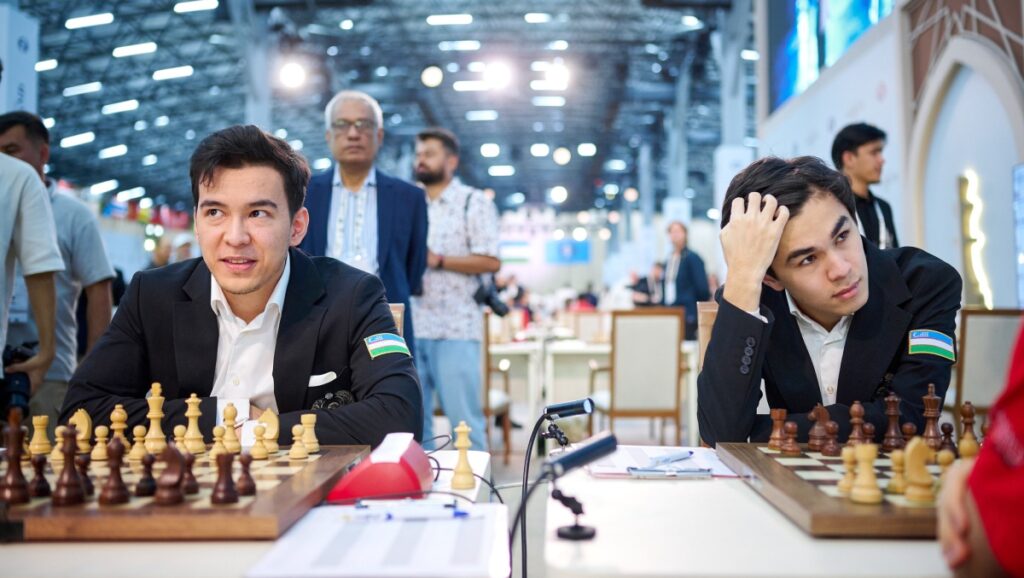
Several of the top teams remain unbeaten after another action-packed day in both sections at the Samarkand Expo venue Four rounds are now in the books, and the Chess Olympiad is beginning to reveal its first clear patterns. The leading teams are starting to separate themselves from the pack, but the margins remain narrow at the top, with several heavyweight encounters producing hard-fought battles. In the Open section, China, the host nation Uzbekistan, Germany, Armenia, the USA, India, the Netherlands, and Hungary remain perfect, winning all four starting matches. The Women’s section is equally competitive, with a large group still boasting perfect records after another day of convincing victories. India, Kazakhstan, China and the USA all maintained their winning runs, while a number of individual players have also emerged with flawless scores. Let’s take a closer look at the action from the playing hall. The fourth round began with a minute of silence in memory of Georgios Makropoulos, a longstanding figure in FIDE leadership and a devoted servant of chess. As President of the Greek Chess Federation, Makropoulos played a key role in bringing two Chess Olympiads to his native Thessaloniki, in 1984 and 1988. He was part of FIDE’s leadership from 1986, serving in several senior positions, including Deputy President and Vice President. He dedicated his life to the game and made a lasting contribution to chess both in Greece and internationally. With the last-minute arrival of the Marshall Islands, the total number of teams in the Open section has risen to a record-breaking 206, while the Women’s section remains at 189 teams. A fitting milestone to coincide with the visit of Uzbekistan’s Prime Minister, Abdulla Aripov, who was present at the Olympiad on this historic day. The Olympiad brings together, every two years, many of the best players in the world, as no one wants to miss this great chess festival. Yet not all of them are taking their seats at the board. As their playing careers enter a different phase, many Grandmasters transition into coaching and leadership roles, accompanying their teams as captains during the rounds. A quiet walk around the venue allowed me to spot quite a few familiar faces, most of them formidable players in their own right. Perhaps the strongest of them is Teimour Radjabov, who has been among the world’s elite for the past 25 years. Still ranked number two in Azerbaijan, Radjabov has gradually stepped away from competitive classical chess and embraced a leadership role with the national team. Former World Champion Rustam Kasimdzhanov is another prominent example, now helping guide a new generation of exceptionally strong Uzbek players. Other elite captains include Ivan Cheparinov (Türkiye; pictured above), Evgeny Bareev (Canada), Alexander Beliavsky (Ukraine), Jan Gustafsson (Germany) and Ivan Sokolov (Romania), alongside a large number of other seasoned Grandmasters who are now making their contribution from the sidelines. Open section Big clashes were taking place on the top boards this afternoon, with barely 100 rating points separating many of the opponents. The strength of the Indian team is particularly striking when you consider that World Champion Gukesh D is playing on India’s fourth board! The first match to finish among the top teams was Uzbekistan’s 2.5-1.5 victory over Türkiye. Three solid draws on boards one, two, and four left Nodirbek Yakubboev to get the job done on board three. His teammates quickly realised that he had emerged from the opening with a significant advantage, and Yakubboev duly converted it into the decisive point. India’s match against Spain was decided by a 3-1 score, although the encounter was far from lacking in excitement. Praggnanandhaa and his opponent agreed to a draw on board one, while on board three India also held firm with Black. Arjun Erigaisi and Gukesh then delivered the decisive blows, both producing powerful attacking games to secure the match for India. Erigaisi’s opponent, Maksim Chigaev, was visibly upset after the game and complained to both captains, but the final 3-1 scoreline was never in doubt. The United States had a tough outing against Ukraine, especially after Levon Aronian ran into serious trouble in the opening against Roman Dehtiarov, the reigning European champion. An early draw by Hans Niemann was followed by Wesley So’s third consecutive win, underlining his excellent form so far. Aronian then found a remarkable way back into the game with a positional queen sacrifice, eventually turning the tables and securing the win. Fabiano Caruana added another point with a superb positional grind against veteran Ukrainian star Vasyl Ivanchuk. China notched up another comfortable 3-1 victory, this time against the strong Serbian team. Wei Yi continued his perfect run, improving to 3/3 after defeating Aleksandar Indjic with a fascinating tactical idea that I had never seen before. Tactic of the day Wei Yi – Aleksandar Indjic Black is clearly under pressure, but how do you make progress? Wei Yi always seems to find a way. He played 32.Nxf7! Rxf7 and now came the brilliant 33.Ne6!, hitting the queen. Interestingly, the queen has very few safe squares, and after 33…Qb8, Wei Yi continued with 34.Bg3! Qa8 35.Nc7!, employing what can only be described as a “windmill tactic” – but this time against the queen rather than the king. The game continued 35…Qb8 36.Nxd5 (after a repetition of moves) Qa8 37.Nc7 Qb8, and after 38.Bc4 the game was essentially over – Indjic capitulated six moves down the road. The Netherlands are often flying under the radar during the first few rounds, but their victory over Greece today has put them firmly among the leaders. Anish Giri continued his perfect start with a fourth consecutive win, and Charlize took the opportunity to catch up with him for a short interview, in which he spoke about the team dynamics and the importance of working together. https://www.youtube.com/watch?v=L9wgkhKn0p8&t=26s Armenia, Germany and Hungary are the other three teams to have won all their matches so far. Together with the Netherlands, they will occupy the top spots in tomorrow’s pairings. Results of the five top
Olympiad Day 3: Strong starts and stunning surprises in Samarkand
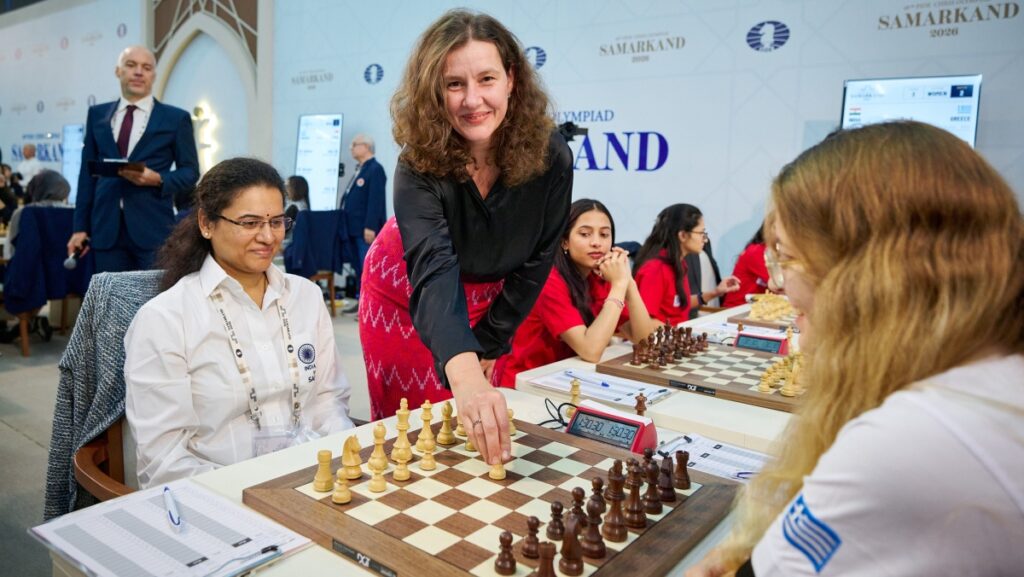
Uzbekistan, India, China and the USA continue their strong starts, while Argentina and Iran produce major upsets in a dramatic third round The third round brought another afternoon of intense action at the Chess Olympiad, with the leading teams beginning to show their strength, mixed in with a few unexpected results, reminding everyone that nothing can be taken for granted over eleven rounds. But the Olympiad is also about surprises, and the Women’s section delivered two of the biggest upsets of the day. Argentina, seeded 28th, defeated Ukraine in a memorable team performance, while Iran overcame eighth-seeded France 3–1. Tomorrow, the fourth round brings the first major clashes between many of the leading teams. Let’s take a closer look at the action from the playing hall. The ceremonial move in chess is akin to the ceremonial kick-off in football: a symbolic first move at the start of a match, often performed by a special guest, celebrity or representative of a supporting organisation. This afternoon, three distinguished guests had the honour of opening the third round at the incredible EXPO playing venue. Muzaffar Sataev, Advisor to the Chairman of the Supervisory Board of Asia Alliance Bank, and Hulkar Tokhirjonova, Advisor to the President of the Uzbekistan Chess Federation, made the ceremonial moves in the Open section. In the Women’s section, the first move was played by Dana Reizniece, Acting Chair of the FIDE Management Board and former Minister of Economics and Finance of the Republic of Latvia. With the arrival of the Central African Republic in the second round and Angola today, the final number of participating teams has reached 205 in the Open section and 189 in the Women’s event: a record number, making the 2026 FIDE Chess Olympiad in Uzbekistan the biggest Chess Olympiad in history. One of the most impressive team outfits on display today belonged to Team Vanuatu, representing the archipelagic country of Melanesia in the South Pacific. Their striking red, green, black and yellow outfits, echoing the colours of the national flag, made them instantly recognisable in the playing hall. As official commentator Peter Svidler aptly put it during the live broadcast: “A lot of teams are playing in very colourful and beautiful uniforms. It’s a proper global festival, as you have this constant atmosphere of celebration.” The Serbian Women’s team also paid a lovely tribute to the host country, Uzbekistan, arriving for their afternoon match dressed in traditional Uzbek clothing, another colourful reminder that the Olympiad is also a celebration of cultures coming together through chess. Open section Uzbekistan, the surprise champions in 2022, continued their unbeaten run with a comfortable 3–1 victory over Austria. A fast and confident win by Mukhiddin Madaminov on board four set the tone for the match, with Javokhir Sindarov adding the second point soon afterwards. Madaminov, who was Sindarov’s second during the Candidates Tournament in Cyprus, has seen his rating skyrocket since then, firmly establishing himself as a contender for a place in the Uzbek first team. He is certainly making a strong case here, scoring 2.5/3 so far. India also recorded a convincing 3–1 victory, this time against Italy, with two wins and two draws. Nihal Sarin continued his perfect start with his third consecutive victory, while World Champion Gukesh D also moved to 2.5/3. After his game, FIDE reporter Charlize van Zyl caught up with World Champion Gukesh for a short interview. https://www.youtube.com/watch?v=1x8Lu-6upWE For Arjun Erigaisi, however, the start has been less smooth. He has missed a number of relatively simple tactical opportunities in his games and will be looking to rediscover his best form as the Olympiad progresses. India will certainly need all their leading players firing if they are to challenge for another gold medal after their triumph in Budapest two years ago. China is also showing excellent form in the opening rounds. Former World Champion Ding Liren scored his second win of the Olympiad, helping his team to a convincing 3.5–0.5 victory over a tenacious Bulgarian squad. Playing on third board, Yu Yangyi produced one of the most spectacular finishes of the day, with a beautiful mating pattern. Checkmate of the day Yu Yangyi – Kiril Georgiev Yu finished the game in elegant fashion with 37.Ng6!, threatening the devastating 38.Rh8#. His opponent, Kiril Georgiev, had little choice but to capture the knight with 37…fxg6, but this only allowed another killer move: 38.Bg8+! Georgiev resigned, as there is no escape from the forced sequence 38…Kh8 39.Bf7+ Kh7 40.fxg6#. After defeating Uzbekistan 3 yesterday, Germany faced Uzbekistan 2 today and came through with another narrow victory, 2.5–1.5. The match featured three solid draws, with Vincent Keymer providing the decisive blow on board one. And here’s a fun question: could we see Uzbekistan 1 versus Germany tomorrow? The USA also squeezed out a close 2.5–1.5 victory over Denmark. Awonder Liang suffered his second consecutive defeat on board four, which could see him rested in the coming rounds. Fortunately for the team, Hans Niemann and Wesley So are playing excellent chess, while Fabiano Caruana continues to provide the kind of solidity expected from a top board. Other teams also produced strong performances this afternoon. Azerbaijan defeated Switzerland 3–1, while France overpowered Kazakhstan 3.5–0.5. Ukraine, Spain, Türkiye and Poland also recorded 3–1 victories, all without conceding a single individual loss. With three rounds now completed, the first signs of the battle for the top places are beginning to emerge. Tomorrow’s fourth-round pairings will provide an important test of both strength and stamina, as the leading teams begin to meet stronger opposition and the long eleven-round journey starts to take shape. Results of the five top matches in the Open section: Denmark vs. United States of America: 1.5-2.5India vs. Italy: 3-1Austria vs. Uzbekistan: 1-3China vs. Bulgaria: 3.5-0.5Uzbekistan 2 vs. Germany: 1.5-2.5 Women’s section It is still very early to identify the teams that will ultimately challenge for the podium in the Women’s section. There are plenty of strong line-ups in the field, and the first major clashes between the
Barcelona 1992 was special; Samarkand was something else: A night unlike any other
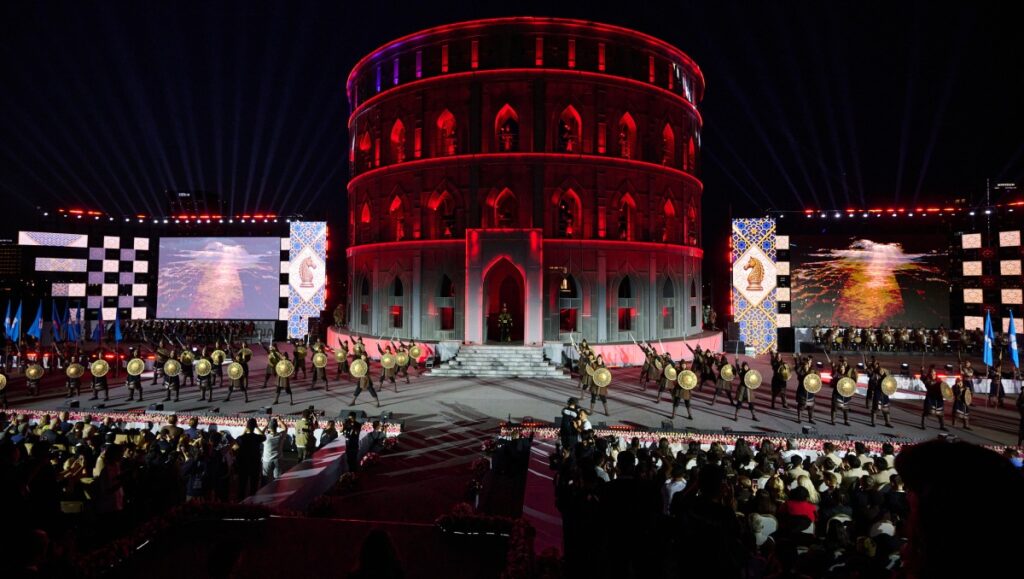
Written by Michael A. Rahal, FIDE Press Officer By now, I have attended my fair share of opening and closing ceremonies: Grand Prix events, several World Cups and Olympiads, and even the opening and closing ceremonies of the Barcelona 1992 Olympic Games. But none of them comes remotely close to what the chess community witnessed this evening in Samarkand, Uzbekistan. The Boqiy Shahar Amphitheater, located on the banks of the Silk Road channel, provided a spectacular setting for the opening ceremony of the 46th Chess Olympiad, with more than 2,000 spectators in attendance. Part of Samarkand’s Eternal City complex, the open-air venue was transformed for the occasion into a stage for an evening that brought together chess, music and the rich cultural heritage of Uzbekistan. And what a show it was! For nearly two hours, the audience was treated to a spectacular succession of performances, featuring military units, choreographed dance, opera, traditional costumes and the distribution of sweets in beautifully decorated baskets. More than 100 musicians and over 200 dancers and singers took part in the production, creating an extraordinary show, illustrating the richness and diversity of Uzbek culture. The official part of the evening featured two speeches. First, the Prime Minister of the Republic of Uzbekistan, Abdulla Aripov, conveyed greetings from the President of Uzbekistan. He was followed by a heartfelt five-minute address from Viswanathan Anand, FIDE Interim President and a five-time World Chess Champion. Halfway through the ceremony, the National Anthem of the Republic of Uzbekistan and the FIDE Anthem were performed by the Honoured Choir of Uzbekistan and the State Choir Chapel, adding a solemn and ceremonial moment to the evening. One of the most anticipated highlights of the evening was the traditional drawing of colours ceremony, determining which teams would have the White and Black pieces on the first board in tomorrow’s opening round. The honour of conducting the draw fell to Zhu Chen, the ninth Women’s World Chess Champion, and Rustam Kasimdzhanov, Uzbek chess legend and former FIDE World Chess Champion. The two guests selected pieces of both colours from traditional boxes, with White going to the highest-ranked team in the Women’s section and Black to the top seed in the Open section. The audience was particularly impressed by the spectacular 3D visual mapping and drone light show, which filled the night sky with images of chess pieces and a dazzling array of illuminations. And, to top it all off, a lively pop song and dance brought hundreds of players onto the stage, joining together in a mass celebration as fireworks lit up the sky above them. It was a fitting and unforgettable way to bring the evening to a close. Don’t miss the full show on the FIDE Youtube channel https://www.youtube.com/watch?v=oMrfXZbs7oU Photos: Rafal Oleksiewicz and Michal Walusza
A universal language: Chess, inclusion and friendship take center stage in Samarkand
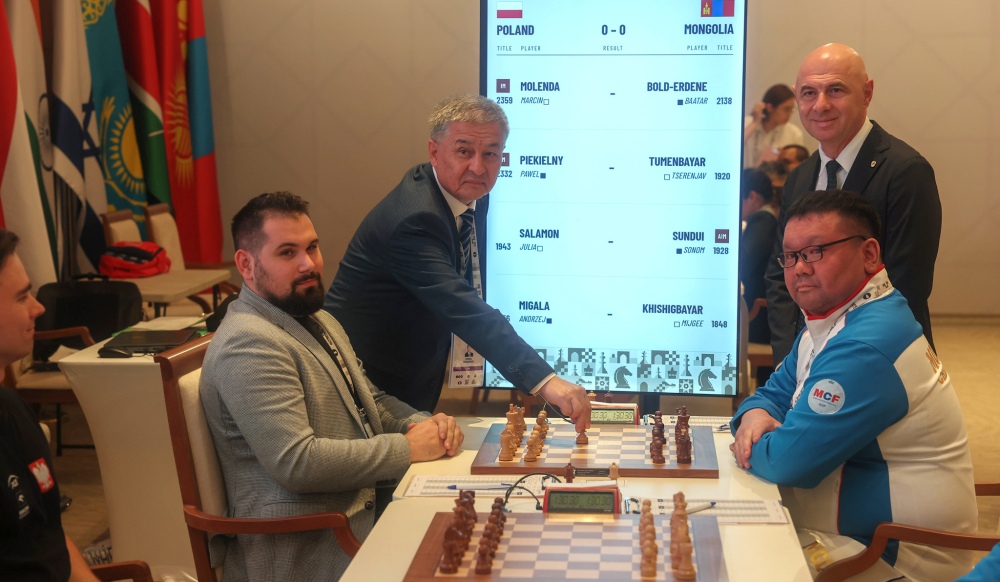
The first moves have been played at the 3rd FIDE Chess Olympiad for People with Disabilities, with 41 teams beginning their campaigns in Samarkand. Following Thursday’s opening ceremony, Round 1 brought the focus to the chessboards. Most of the favourites started confidently, but the opening day also produced some early surprises. Beyond the results, conversations with players from around the world highlighted what lies at the heart of the event: inclusion, equality, friendship and a shared love of chess. The ceremonial first move was made by Akaki Iashvili, FIDE Special Tasks Director and FIDE Technical Delegate of the Olympiad for People with Disabilities, and Komil Sindarov, Vice President of the Uzbekistan Chess Federation, on Board 1 of the Poland – Mongolia match. The encounter proved to be one of the closest of the opening round. Poland won on the top two boards, while Mongolia struck back on Boards 3 and 4 to secure a 2–2 draw. Favourites start strongly, but surprises come early Most of the higher-rated teams successfully navigated their opening matches. Cuba defeated IPCA 3½–½, Israel overcame Bangladesh by the same score, while Germany, USA, Ukraine and Hungary all began with perfect 4–0 victories. The Philippines made an impressive start with a 3½–½ victory over Brazil. Argentina defeated Egypt 3–1, the Czech Republic beat Belarus 3–1, India overcame Uzbekistan 2 by the same score, Serbia defeated Vietnam 3–1, Switzerland beat Zimbabwe 3–1, Kazakhstan defeated ICCD 3–1, and Spain recorded a 3½–½ victory over China. Uzbekistan 1 gave the home supporters plenty to celebrate with a 4–0 victory against Uganda. But not everything went according to rating. One of the biggest surprises came from Kyrgyzstan, who defeated the considerably higher-rated Turkmenistan team 3–1. After draws on the first two boards, Toktobek Bolotov and Gulzat Kasymbaeva delivered victories on Boards 3 and 4 to seal the match. There was another home success for Uzbekistan 3, who defeated higher-rated Venezuela 2½–1½. Ali Irgashev drew on the top board, while Abdurahmon Azimjonov and Abbas Eshmuratov scored the two victories for the Uzbek team. Croatia and Türkiye also shared the points in a 2–2 draw. “This can become a tradition” For Komil Sindarov, Vice President of the Uzbekistan Chess Federation, bringing the Olympiad for People with Disabilities together with the main Chess Olympiad in the same host city represents something bigger than the competition itself. “This is the first time here in Uzbekistan that the Olympiad for People with Disabilities and the Olympiad are being held at the same time. Of course, this also brings certain organizational challenges. But I believe that we must protect the rights of people with disabilities and respect them,” he said (translated from Uzbek). “We believe that the foundation being laid here in Uzbekistan today will help make it possible for the Olympiad for People with Disabilities and the Olympiad to be held at the same time in the future. I believe that this tradition will continue” (translated from Uzbek). Sindarov said that seeing the joy of participants who had travelled to Samarkand from around the world had made a particular impression on him. “When I see the happiness on their faces, I feel very happy myself. People with disabilities, who may sometimes feel that some of their opportunities are limited, can today stand equally alongside everyone else, alongside other chess players, and participate in an Olympiad like this.” (translated from Uzbek). He also reflected on the rapid development of chess in Uzbekistan, pointing to improved coaching opportunities, scholarships, training camps and the country’s growing international tournament calendar. “Whereas we once had only one or two tournaments, today we have 24 international tournaments a year. We are creating all the necessary conditions for our chess players to compete and improve their level.” (translated from Uzbek). A perfect start for the hosts Uzbekistan 1 began its campaign with a clean sweep against Uganda, winning 4–0. On the top board, Axadxon Kimsanboyev defeated Enock Seguya with the black pieces. After the game, Kimsanboyev explained that after the queens were exchanged, he felt he had obtained a favourable endgame and eventually converted his advantage. “This game was not easy for me, but I’m expecting very hard games against the top players,” he said. Having participated in every edition of the Olympiad, Kimsanboyev has watched the competition grow first-hand. “The first Olympiad was in Belgrade in 2023, and the second Olympiad was in 2025. At the first Olympiad, I took a silver medal on Board 4. Every Olympiad, the number of participants is getting bigger and bigger. I hope that in the next Olympiad even more teams will participate, and we will meet more friends at the chessboard.” His own chess journey began at the age of ten, when his grandfather taught him the game. International competition followed from 2021, and chess gradually became one of the defining parts of his life. “Chess is one of the most important things in my life. Chess has helped me find more friends, win medals, participate in more competitions, and travel to more countries.” Chess as inclusion and equality For Gweshe Shantel of Zimbabwe, the opening round brought a difficult game but also the beginning of another important international experience. “The first game was a bit tough for me, but I’m hoping that for the next games I’m going to make it,” she said. Shantel has competed in university chess tournaments and recently took part in the Minerva tournament in Harare as part of her preparation for Samarkand. She also spoke about how participating internationally has changed her ambitions as a player. “The first time when I came, I didn’t have any rating, and now I have a rating that needs to be maintained. I also want to continue participating in other tournaments, even women’s tournaments, national tournaments and international tournaments.” Her relationship with chess began much earlier, at the age of six, through her father. “My dad was a chess player. He used to always play chess every day, so I became interested
3rd FIDE Chess Olympiad for People with Disabilities opens in Samarkand
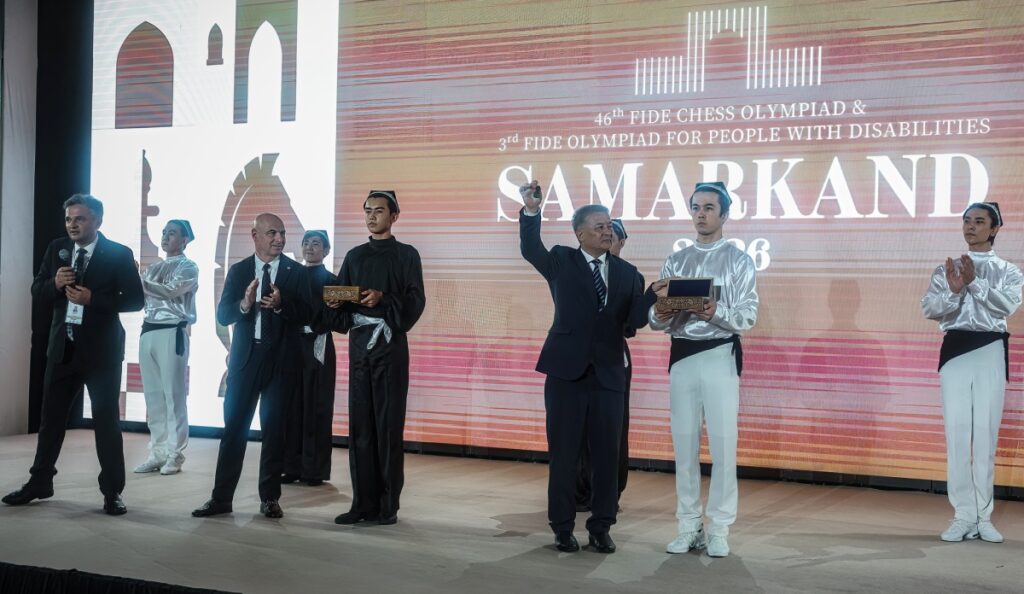
Samarkand, Uzbekistan – September 10, 2026 Chess has a unique ability to dissolve boundaries, bringing people together across countries, cultures and different life circumstances. That spirit was at the heart of the opening of the 3rd FIDE Chess Olympiad for People with Disabilities, which welcomed a record 41 teams to Samarkand. The third edition marks an important milestone in the history of the competition. For the first time, the FIDE Chess Olympiad for People with Disabilities is being held alongside the main FIDE Chess Olympiad, bringing the two events together in the same host city and during the same period. The Olympiad for People with Disabilities gets underway first, with Round 1 on September 11, while the 46th FIDE Chess Olympiad begins its competitive programme five days later, with Round 1 on September 16. The opening ceremony took place at the Hilton Hotel in Samarkand, bringing together players, officials and guests ahead of seven days of competition. “Power, passion and will” Welcoming the participants, Adkham Ikramov, Minister of Sports of the Republic of Uzbekistan, emphasized Uzbekistan’s commitment to chess and thanked FIDE for the trust placed in the country to host such an important event. He highlighted the support of the President of the Republic of Uzbekistan, Shavkat Mirziyoyev, as well as the work of the government, the Chess Federation of Uzbekistan and the Samarkand authorities in preparing the competition. Speaking both as Minister of Sports and as a medical doctor, Ikramov said that it was especially meaningful for him that this major gathering of the chess world begins with the Olympiad for People with Disabilities. Addressing the players, he said: “For me, as a medical doctor and as a Minister of Sports, it is very important that we are starting with the Paralympic chess. You, representing 36 countries, 41 teams and around 200 chess players, are showing to the entire world the power, the passion, and will. I am very, very thankful to all of you that you trust in us and came here, and I wish all success to all of you.” His words captured one of the central messages of the evening: while chess dissolves boundaries across the board, it is the players themselves who demonstrate the power and determination behind every move. “A celebration of determination” Dana Reizniece, Deputy Chair of the FIDE Management Board, placed the opening in a broader historical context, connecting Samarkand’s ancient chess heritage with the rapid development of chess in modern Uzbekistan. She recalled chess pieces carved from ivory and discovered by archaeologists in the region, dating back more than a thousand years – a symbolic link between the game’s deep roots here and the chess events Samarkand is welcoming today. “More than 1,000 years ago, some people here were sitting and carved some chess pieces out of ivory, and seven of those were found by archaeologists. And this is, I guess, the seed that was embedded back there, taken by smart people, now nurtured by smart and capable governments, and creating the future of chess here in Samarkand and in Uzbekistan.” Reizniece noted the particular significance of Uzbekistan opening its doors to the participants of the Olympiad for People with Disabilities, the main Chess Olympiad and the FIDE Congress during the same major gathering. For her, however, the occasion represented something beyond chess itself: “I would say even more: a celebration of determination. Sometimes people are mistaken when they think what determination is about. They think it’s about being strong all the time, perfect, and never making mistakes. For me, it’s something more. I think it’s the ability to make the next move, to get up and flourish at the very difficult and the most difficult times again and again and again.” She drew a parallel between that determination and the nature of chess itself. “Chess is a very honest game. It doesn’t suggest that it’s going to be easy. It gives you the position as it is, and you have to make the next move.” She concluded with FIDE’s motto, Gens una sumus – “We are one family”, expressing the hope that this spirit would define the coming weeks in Samarkand. Poland draws White The sporting element of the evening came with the drawing of lots for the colors, conducted by Chief Arbiter Nebojsa Baralic. Akaki Iashvili, FIDE Special Tasks Director and FIDE Technical Delegate of the Olympiad for People with Disabilities, and Komil Sindarov, Vice President of the Uzbekistan Chess Federation, took part in the draw for top-seeded Poland. The result gave Poland White on the first board in Round 1. The first moves await With the official opening complete and the colors decided, attention now turns to the chessboards. The 3rd FIDE Chess Olympiad for People with Disabilities will be played as a seven-round Swiss team competition. The teams are composed of players with hearing impairments, physical disabilities and visual impairments, with at least one player of each gender required in the lineup for every round. Round 1 begins on September 11 at 15:00 local time. The competition continues with one round per day, with the seventh and final round scheduled for 11:00 on September 17. Five days after the first moves of the Olympiad for People with Disabilities, the 46th FIDE Chess Olympiad will begin on September 16, bringing the two Olympiads together in Samarkand. For the coming days, the chessboards will become a shared space where differences fade and the next move is what matters. Chess dissolves boundaries – and the players gathered in Samarkand are ready to show the power, passion and will to move beyond them. You can find pairings of the Round 1 on Chess-results. Follow the games live. Written by Angelika Valkova Photos: Mark Livshitz FIDE Chess Olympiad for People with Disabilities official website: https://dis-olympiad2026.fide.com/
GCL 2026, Day 4: FYERS American Gambits go on top with win over PBG Alaskan Knights; Triveni Continental Kings upset overnight leaders Alpine APL Pipers
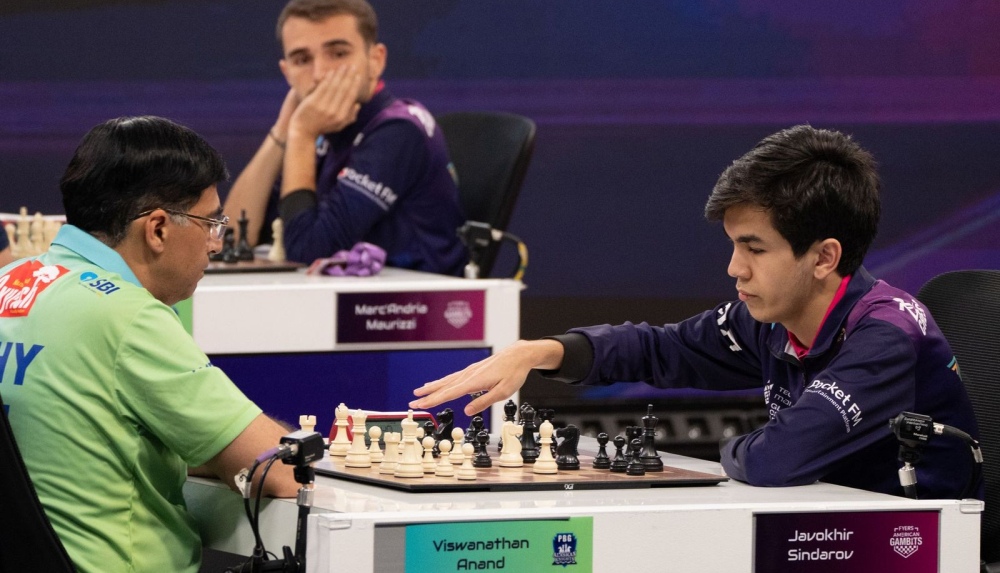
The match between Ganges Grandmasters and PBG Alaskan Knights witnessed decisive outcomes on all six boards for the first time in the competition; FYERS American Gambits win first return match. FYERS American Gambits reclaimed the top spot in the Global Chess League (GCL), a joint initiative of Tech Mahindra and FIDE, in Bengaluru on Tuesday with a thumping win over PBG Alaskan Knights, benefiting from two-time champions Triveni Continental Kings’ upset win over table toppers Alpine APL Pipers. The Continental Kings, who were at the bottom of the standings with just one win from four matches, defeated the Pipers 10-4, while CheQ Mumba Masters got the better of FYERS American Gambits 11-6 in the fifth-round matches. In the most dramatic match of the tournament so far, Ganges Grandmasters defeated PBG Alaskan Knights 12-8, with all six boards ending decisively. The Alaskan Knights also lost their second match of the day, going down 12-9 against FYERS American Gambits, as all six boards produced a result for the second time in a day. Let’s take a closer look at today’s action: Ganges Grandmasters vs. PBG Alaskan Knights: 12-8 The opening match of the day between Ganges Grandmasters, who are now third in the standings with nine match points, and PBG Alaskan Knights set the tone for a sensational day 4 at the GCL. While it was the first match in which all six boards produced decisive outcomes, a drama on the Prodigy board ultimately became the biggest talking point of the day. On the icon board, Ian Nepomniachtchi dispatched Viswanathan Anand in just 23 moves, while Polina Shuvalova registered her third win in four games by beating Kateryna Lagno. The Player of the Match Leinier Dominguez Perez squeezed out a win over 15-year-old Yagiz Kaan Erdogmus, who cracked under time pressure. But it looked like those three victories would not really help the Ganges Grandmasters wrap up the match as Arjun Erigaisi beat Levon Aronian and Nino Batsiashvili got the better of Stavroula Tsolakidou to close the gap to one point while Abhimanyu Mishra had a clearly winning position on the Prodigy board, although both players were in severe time trouble. The match score read 9-8 in favour of the Ganges Grandmasters, playing white, but they were clearly staring down the barrel. With just a second left on the clock, Mishra did not legally complete the move while promoting his pawn to a queen as the pieces were not in the right position when he hit the clock. Mendonca was quick to bring it to the notice of the arbiter and ended up winning the game on time and Ganges Grandmasters clinched the match. Explaining the reasoning behind his choice, Mendonca said, “He wanted to take my rook and make a queen. He pressed the clock and he went from to three seconds. I was given one minute but it had to be made one second for him.” “He was clearly winning and I knew this was my only chance. I have had this discussion with a friend about how much time it takes to win a piece and convert it into a queen in a second. And I knew it was very difficult,” Mendonca added. Mishra was understandably gutted. “It really hurts because if I had won, my team would have won the match,” he said, while explaining how things unfolded. CheQ Mumba Masters vs. FYERS American Gambits: 11-6 CheQ Mumba Masters caught up with the Pipers in the standings as Shakhriyar Mamedyarov defeated Daniil Dubov in 42 moves, while Carissa Yip took full advantage of Sara Khadem’s misstep in an equal endgame to make it two wins for her team. M Pranesh had a chance to extend that lead further as he was in driver’s seat against Nihal Sarin but blundered a checkmate in one move. Still, Mamedyarov’s and Yip’s victories were enough for the Mumba Masters to clinch the match. Alpine APL Pipers vs. Triveni Continental Kings: 4-10 In the third match of the day, table toppers Alpine APL Pipers had the opportunity to extend their lead as they faced the Continental Kings, who didn’t have the best of starts to the competition. However, the match followed a somewhat unexpected script. With four games drawn, Aravindh Chithambaram defeated Vidit Gujrathi in a topsy-turvy battle, while Pranav V forced Volodar Murzin to resign after 63 moves to secure the win for their team. FYERS American Gambits vs. PBG Alaskan Knights: 12-9 In the last match of the day, all six games ended decisively as well, with the Gambits wrapping it up thanks to three victories with the black pies. However, the scoreline and the match result could have been completely different. Arjun Erigaisi reached a winning position against Nihal Sarin in a tricky ending, but first missed a win and then even a draw. At the end of day 4, FYERS American Gambits had taken the top spot in the standings with three match wins and 52 game points but had played one match more than their nearest challengers. Defending champions Alpine APL Pipers and CheQ Mumba Masters have nine match points and 47 game points each and are currently in second and third positions, respectively. Standings after Day 4 Schedule for Wednesday, September 9 3.30 PM: CheQ Mumbai Masters vs Alpine APL Pipers5.00 PM: Ganges Grandmasters vs Triveni Continental Kings6.30 PM: PBG Alaskan Knights vs CheQ Mumba Masters8.00 PM: Triveni Continental Kings vs FYERS American Gambits About the Global Chess League The Global Chess League (GCL), a joint initiative between Tech Mahindra and FIDE, is the world’s first and largest official franchise league of its kind. The league brings together leading chess players from across the globe in a unique joint team format, with six players representing each franchise across Icons, Superstar Men, Superstar Women and Prodigies. Men and women compete together on the same team, with every board carrying equal value towards the team’s result. GCL has previously staged seasons in Dubai, London, and Mumbai and returns
GCL 2026, Day 3: Alpine APL Pipers seize the lead
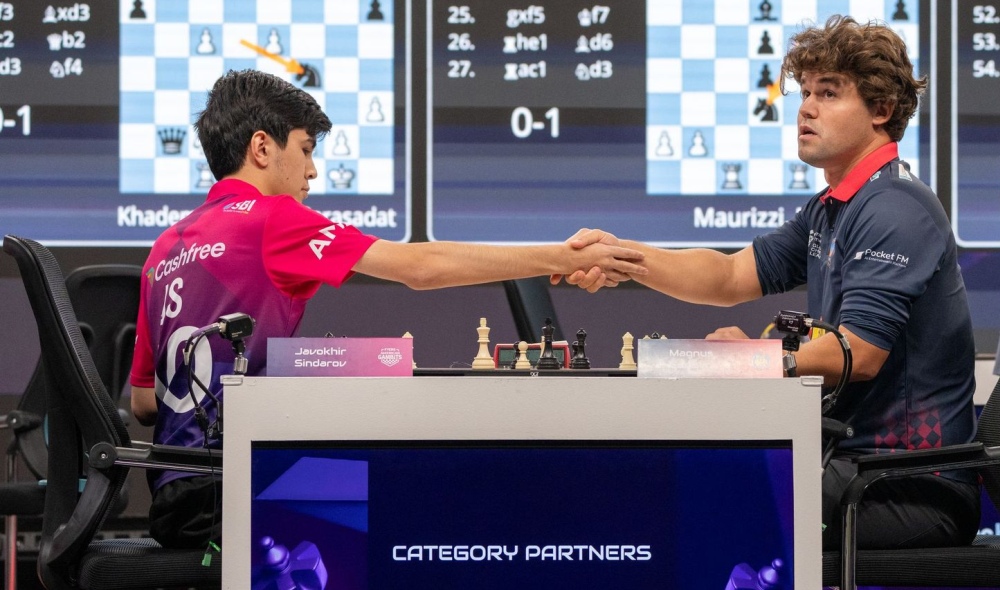
The Monday matches completely reshaped the standings in the fourth edition of the Global Chess League. Despite losing their first match of the day, Alpine APL Pipers climbed to the top spot after crushing the former leaders, FYERS American Gambits. Triveni Continental Kings put themselves on the scoreboard, posting their first team victory over PBG Alaskan Knights. After Day 3, as many as four teams are sitting on 6 matchpoints each, with the Gambits holding second place thanks to a greater number of gamepoints. Let’s take a closer look at today’s action. Magnus Carlsen ground down his predecessor on the chess throne, Viswanathan Anand, on the Icon board, but it did not help the Pipers seal the match. The Knights roared back on Superstar boards with Yagiz Kaan Erdogmus, and Nino Batsiashvili pulling off crucial victories over Vidit Gujrathi and Humpy Koneru, respectively, to tip the balance in their favor. Many expected a close match here, but somewhat surprisingly that was not the case. The Mumba Masters dominated the proceedings: Pranesh M, Carissa Yip and Bardiya Daneshvar all won their games with White, securing a landslide victory for their team. The Ganges did not manage a single win and have suffered their heaviest setback in the event so far. FYERS American Gambits, who seemed unstoppable after Day 1, were handed their second consecutive defeat, which relegated them to second place in the standings. Vidit Gujrathi, Humpy Koneru and Volodar Murzin got the job done for the Pipers, all scoring victories with the black pieces. Notably, playing with White on all boards, the Gambits failed to win a single game. The Kings desperately needed a win to join the race for the title, and the team rose to the occasion, recording their first victory in the event. Wei Yi punished Arjun Erigaisi for snatching a “poisoned” pawn, scoring his first victory in four games. Aravindh Chithambaram followed Wei’s lead, outplaying Yagiz Kaan Erdogmus in the Maroczy setup and delivering checkmate on move 52. After teams traded blows on the women’s board with Kateryna Lagno and Alexandra Kosteniuk emerging victorious and the game on the Icon and Prodigy boards ended in draws, the Kings broke their winless streak and scored three well-deserved matchpoints. Standings after Day 3 Schedule for Tuesday, September 8: Match 13: Ganges Grandmasters vs. PBG Alaskan KnightsMatch 14: FYERS American Gambits vs. CheQ Mumba MastersMatch 15: Triveni Continental Kings vs. Alpine APL PipersMatch 16: FYERS American Gambits vs. PBG Alaskan Knights About the Global Chess League The Global Chess League (GCL), a joint initiative between Tech Mahindra and FIDE, is the world’s first and largest official franchise league of its kind. The league brings together leading chess players from across the globe in a unique joint team format, with six players representing each franchise across Icons, Superstar Men, Superstar Women and Prodigies. Men and women compete together on the same team, with every board carrying equal value towards the team’s result. GCL has previously staged seasons in Dubai, London, and Mumbai and returns to India for Season 4 in Bengaluru. GCL official website: https://globalchessleague.com/
Chess Superstars Set for Total Chess World Championship Tour Pilot in Budapest
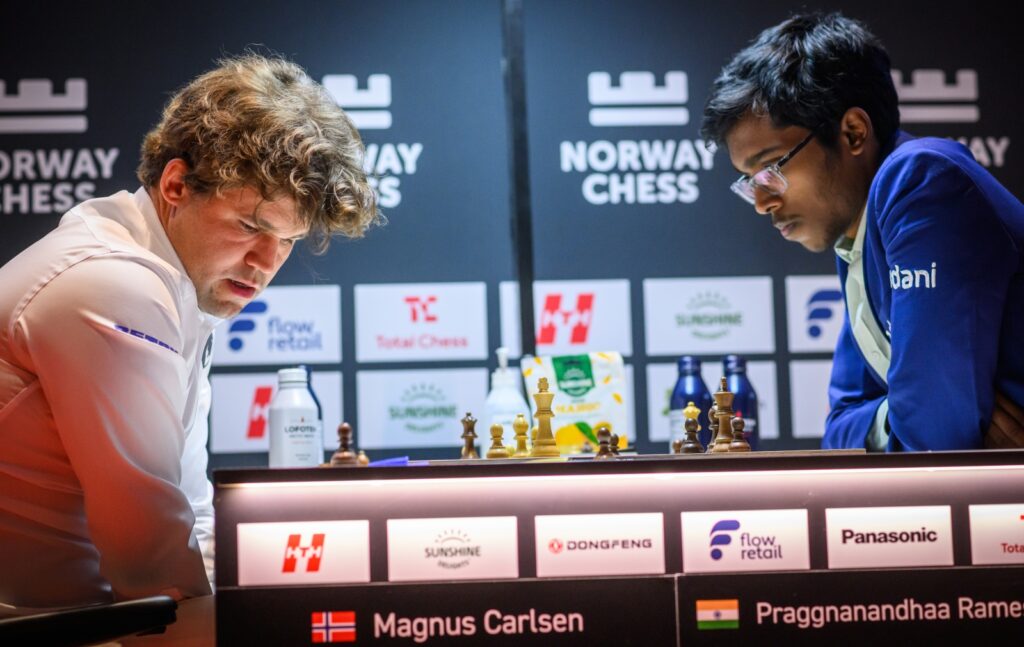
Hungary, Budapest, August 25, 2026 – The world’s biggest names in chess, led by five-time World Champion Magnus Carlsen, will gather in Budapest from November 10 to 21 for the inaugural Total Chess World Championship Tour Pilot, marking the beginning of an ambitious new chapter in professional chess. Conceptualised by Norway Chess and approved by FIDE, the Total Chess World Championship Tour introduces a revolutionary global championship format that will culminate in crowning the FIDE World Combined Champion across Fast Classic, Rapid and Blitz disciplines. The Budapest Pilot serves as the first showcase of the Tour’s vision, bringing together many of the world’s best players ahead of the official launch of the multi-city World Championship Tour in 2027. The elite field features reigning and former World Championship contenders, Olympiad heroes, elite grandmasters, and some of the brightest young talents in world chess, representing Europe, Asia, and North America. The confirmed lineup so far includes (ranked by their August 2026 FIDE standard rating): Magnus Carlsen (Norway) — World No. 1 Fabiano Caruana (United States) — World No. 2 Vincent Keymer (Germany) — World No. 5 Wesley So (United States) — World No. 6 Anish Giri (Netherlands) — World No. 7 Nodirbek Abdusattorov (Uzbekistan) — World No. 8 Arjun Erigaisi (India) — World No. 9 Alireza Firouzja (France) — World No. 10 Praggnanandhaa R (India) — World No. 12 Jan-Krzysztof Duda (Poland) — World No. 13 Richard Rapport (Hungary) — World No. 18 Hans Moke Niemann (United States) — World No. 21 Ian Nepomniachtchi (FIDE) — World No. 24 Maxime Vachier-Lagrave (France) — World No. 28 Haik M. Martirosyan (Armenia) — World No. 54 Vladislav Artemiev (FIDE) — World No. 65 Bibisara Assaubayeva (Kazakhstan) — Women’s World No. 5 Vaishali Rameshbabu (India) — Women’s World No. 14 With this star-studded line-up of 18 players, the Budapest Pilot reflects the Tour’s commitment to creating one of the strongest recurring fields in world chess. The remaining six players will be announced in September. Players will compete across Blitz, Rapid, and Fast Classic formats, providing a unique competitive environment that rewards versatility across all three time controls. Results from the pilot will help shape the competitive framework of the Total Chess World Championship Tour, which will feature four premier tournaments in different global cities worldwide beginning in 2027. The Total Chess World Championship Tour has been created to redefine elite chess through a season-long narrative, bringing together the world’s leading players in a format designed for modern audiences while preserving the competitive integrity of classical chess. Speaking of his participation, World No. 1 Magnus Carlsen said: “I look forward to playing the Total Chess World Championship in Budapest this year. It’s always interesting to try out new formats.” Confirming his participation, India’s Praggnanandhaa R, who is also the reigning Norway Chess champion, said: “It’s an exciting format that challenges players to show their best performance in all three Classical, Rapid, and Blitz formats. Looking forward to being part of the first edition.” Kjell Madland, CEO of Total Chess said: “The Budapest Pilot represents far more than another elite tournament. It is the first step towards creating a truly global championship ecosystem that celebrates every format of the game while giving fans a season-long journey to follow. Bringing together this calibre of players for our inaugural event is a testament to the belief the world’s best have in the vision of Total Chess.” About the format The Total Chess World Championship Tour Pilot introduces a groundbreaking competition format designed to identify the world’s most complete chess player by combining Fast Classic, Rapid, and Blitz into a single championship. The pilot event will bring together 24 elite players, who will begin the tournament in a group stage comprising four groups of six players each. Every group follows a double round-robin format over five days, with players contesting ten Fast Classical games (45 minutes plus a 30-second increment). Victories earn three points, while draws are worth one point. A nine-round Blitz Swiss tournament held before the competition determines tie-break rankings. Following the group stage, players progress into knockout brackets based on their finishing positions. Each knockout match is played over two days and tests competitors across all three disciplines – four Blitz games (3+2), two Rapid games (15+10) and one Fast Classical game (45+30) – with weighted scoring rewarding success in longer formats. The four highest-ranked players across the Tour qualify for the Grand Final, where semifinals and the championship match determine the inaugural FIDE World Combined Champion. Should a knockout match remain tied, an Armageddon game is used to decide the winner, ensuring every contest produces a definitive result. The format rewards consistency, versatility and excellence across every major discipline of elite chess. Further tournament details, format, schedule, prize fund, and broadcast information will be announced in the coming weeks. Three disciplines. One champion. One global tour. The journey begins in Budapest. For more information, visit: www.totalchess.com About Total Chess Total Chess is a global championship platform established to redefine elite competitive chess for the modern era. Developed by Norway Chess and approved by FIDE, the Total Chess World Championship Tour introduces a unified format that crowns the world’s ultimate champion by testing excellence across three disciplines: Fast Classical, Rapid, and Blitz. The Tour will bring together the world’s top 24 men and women players to compete across four premier international events hosted in leading global cities. Designed to elevate the sport’s commercial appeal and fan engagement, Total Chess combines world-class competition with innovation, technology, and immersive spectator experiences to create a new benchmark for professional chess. With a vision to make chess one of the world’s most engaging and commercially sustainable sports, Total Chess aims to expand the game’s global footprint, inspire the next generation of players, and connect millions of fans through a dynamic championship that celebrates intelligence, strategy, and sporting excellence. For more information or press inquiries, contact press@totalchess.com.