

FIDE Grand Swiss 2025, Day 3: Maghsoodloo and Vaishali emerge as sole leaders
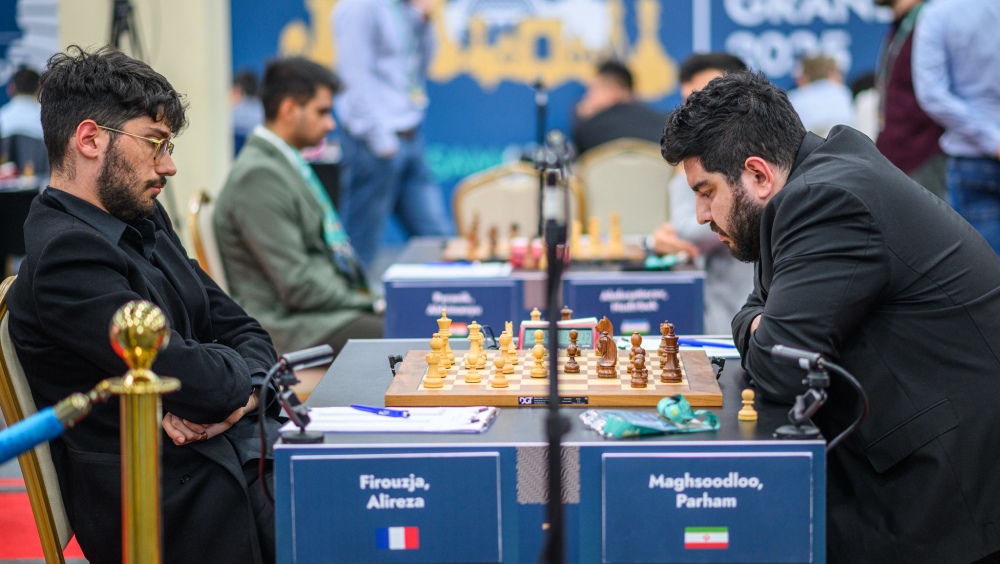
After five hours and 45 minutes of tension, Parham Maghsoodloo outlasted Alireza Firouzja to take the sole lead in the tournament. In the women’s event, Vaishali Rameshbabu – despite being down to her final minute – played fearlessly and defeated Olga Badelka to claim the top spot. It was a long day in Samarkand, with many of the top games stretching late into the evening. If there was a theme to Day 3, it was concentration – or lack of it – as several decisive matches were decided by blunders in tense, balanced endgames. The main duel of round three in the Open took place on board one, where France’s Alireza Firouzja faced his former compatriot Parham Maghsoodloo in the battle for the lead. Playing the Najdorf, the two transitioned to a complicated endgame, where Black had a slight advantage thanks to a pawn chain in the centre and two bishops. However, at some point Maghsoodloo miscalculated and lost a pawn, allowing Firouzja to equalise. White has almost complete domination on the queenside, but his g4-pawn is lost. If he’s not careful, Black can be just in time to win the race to promotion. The only option for White here is to put his rook on the eighth rank and go with checks: 43.Rb8 Rxg4 44.Rf8+ Ke6 45.Re8+ Kd7 46.Ne5+ Kxe8 47.Nxg4. Instead, after more than five hours of play, Firouzja made a fatal error with 43.Rb6?? This immediately loses: 43…Bxb6 44.axb6 Rh7! 45.c4 Rd7! Cutting off the white king from the kingside. 46.Nb4 White is forced to pull back his knight and try to stop Black’s advance on the kingside. 46…f3 47.Nd3 Ke7 48.c5 Rd8! 49.c6 Kd6 Right on time to squash any hopes for Firouzja. 50.c7 Re8 51.Kc3 Kc6 White resigns, 0-1. A crushing blow to Firouzja in the first high-stakes clash of the tournament. A crushing blow to Firouzja in the first high-stakes clash of the tournament. In another tense and long game, Arjun Erigaisi defeated Anton Demchenko in the Petroff Defence. On two occasions in the endgame, Erigaisi had a significant advantage but failed to capitalise. But when Demchenko gave him a third chance, the Indian took it: White has just played 61.c6-c7. According to chess engines, the position is even. After 61…Rb1+ (or 61…g5) 62.Nb5 g5 63.Rxg7 g4 64.Rxg4 Rxb5+ 65.Kxb5 Kxc7 all pawns would have been removed and Black would have been left with a knight against a rook, sufficient for a draw. However, Demchenko instantly blundered with 61…Rc4?? After 62.Nb5! Black has to give up his rook to avoid checkmate. The last two games on the top boards – lasting well into the seventh hour – saw Abdusattorov and Praggnanandhaa emerge as victors. Praggnanandhaa won against the resilient veteran Boris Gelfand in a fierce queen and rook endgame which could have gone either way. Abdusattorov had a commanding position from the middlegame, but his opponent Abhimanyu Puranik put up a fierce and long fight. World Champion Gukesh D continued in strong form on Day three. Playing as Black, he defeated Daniil Yufa. In the Ragozin, White mixed up his preparation and ended up a pawn down as early as move seven. After three rounds, Parham Maghsoodloo is on three points, followed by six players on 2.5/3. One of the sharpest games of the round was played between Robert Hovhannisyan and Vladimir Fedoseev. In the Scandinavian Defence, White managed to get a slight edge by holding more initiative on the board, but early middlegame complications led to a tactical position with White making a daring sacrifice: It’s unusual to see white pawns on the sixth rank this early in the game. Black should have removed one threat by taking on c6. Instead, Vladimir took the bait with 19…Qxe2, after which he was punished effectively. 20.Rfe1! Offering another sacrifice. 20…Bxe1 21.Rxe1Qb2 22.Rxe7 Be6 23.Nd4 Qb1+ 24.Kh2 g5 Opening a space for his queen to help the black king. 25.Qe5 Qg6 It’s hard to believe that White is down in material here, given his dominance across the board. The strongest move in the position was 26.Nf5. In case Black plays 26…Bxf5, then he’s checkmated after 27.Rxe8+ Rxe8 28.Qxe8#. Instead, Black would have to play 28…Rf8 and after 29.Rxe6, he could not defend the knight coming to e7 with a double attack on the king and the queen. Hovhannisyan instead went for a different line with: 26.cxb7 Rab8 27.Nc6 Nd5 28.Rxe8 Rxe8, but now he missed the winning move – Ne7+! Instead, he played 29.d7?! Which still was enough to win in a knight endgame that emerged after 29…Nxd7 30.B8=Q Qxh6 31.Qxe8+ Bxe8 32.Qxe8 Kg7 33.Qe5+ Qf6 34.Qxf6+ Kxf6 35.Nxa7. Eventually, White’s a-passer tipped the balance in his favour. The Women’s event In the Women’s tournament, only two players had a perfect score after the first two rounds: the 2023 Grand Swiss winner Vaishali Rameshbabu and naturalised Austrian Olga Badelka. In a direct duel for first place, Vaishali defeated Badelka in a sharp line of the Pirc Defence. This is the crucial part of the game. The position is extremely complicated with threats on both sides. Only 24 moves have been played, but Vaishali had a minute on her clock, while Badelka had six. Moments like these distinguish the real champions. Despite being desperately low on time, Vaishali chose the strongest move, a breakthrough on the kingside – 25.g4 – even though it led to serious complications. Black has to respond; otherwise, the pawn will advance and endanger her king. 25…fxg4 26.hxg4 Now it was Badelka’s turn to play sharply. The best option was 26…h5 – opening her king and directly challenging White. She stopped for a while to think, but it seems Badelka was tempted by White’s time trouble, and she leapt directly into a blunder – 26…Nfxd5?? White was now completely winning, and Vaishali didn’t miss her chance. After 27.Nxd5 Nxd5 28.Rxd5, Black could not recapture: 28…Qxd5 fails to 29.Ng6+! hxg5 30.Qh4+, winning the queen. 28…Bxb2 29.Rh5! Black is now completely lost. With an
FIDE launches pilot project to test “Fast Classic” for standard rating

The FIDE Council has approved a pilot project introducing tournaments with shorter time controls that will count toward the standard rating list. Current requirements Under existing regulations, the minimum time control for a game to be rated as standard depends the players’ ratings, assuming the game lasts 60 moves: If at least one player is rated 2400 or higher: 120 minutes per player If at least one player is rated 1800 or higher: 90 minutes per player If both players are rated below 1800: 60 minutes per player Pilot events As part of the pilot project, three tournaments will be played with a time control of 45 minutes plus a 30-second increment per move (starting from move one) and their results will count toward players’ standard ratings: Qatar Cup (September 7–13) QCA Training Center September Tournament Classical (September 25–27) Women’s World Team Championship (November 17–24) These events will follow standard-rating rules, but with specific conditions: No title norms will be awarded. Organizers may not schedule more than two rounds per day Why “Fast Classic”? The initiative responds to a growing demand from players and organizers to recognize “fast classic.” In modern life, time is increasingly limited, and there is a clear trend toward shorter formats that remain serious and competitive. The original idea was proposed by Oleg Skvortsov, a chess patron, organizer of the Zurich Chess Challenge 2012-2017, who suggested events with rounds lasting 2–3 hours — making it possible to hold two rounds in a single day. Next steps FIDE recognizes of the importance of this matter and is approaching it with due responsibility. The pilot events will serve as a real-world test case. After their conclusion, FIDE will conduct a thorough analysis of the outcomes and gather feedback from the participants before making a decision on further implementation.
FIDE Grand Swiss 2025, Day 2: Blunders and comebacks as favourites regroup
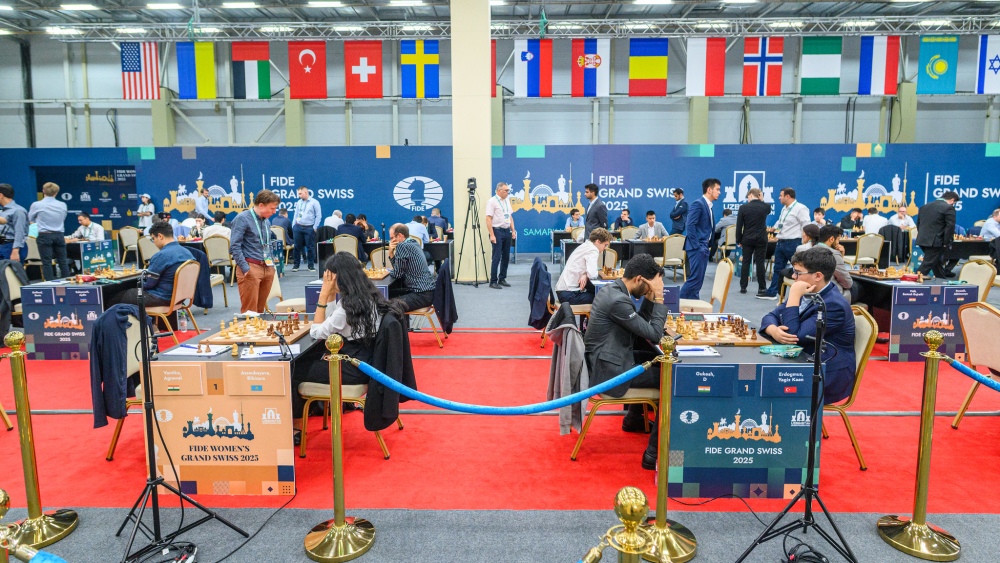
Day two of the FIDE Grand Swiss delivered more drama as the favourites were put to the test. World Champion Gukesh D was held to a draw by 14-year-old Turkish prodigy Yagız Kaan Erdogmus, while fellow favourite Arjun Erigaisi survived a near-loss to defeat Haik Martirosyan. In the Women’s event, several top players who stumbled at the start staged a strong comeback, but surprises continued to shake up the standings. The day’s drama began on the top board, where Uzbekistan Chess Federation Vice President, Komil Sindarov, made the ceremonial first move in the game between Gukesh and the world’s youngest Grandmaster, Erdogmus. It was exactly this game that opened with a surprise as early as move two. After 1.d4 d5, Gukesh played the unusual 3.c3 aimed at throwing him out of his preparation. Commenting in the live broadcast on FIDE’s YouTube channel, English IM Jovanka Houska branded the move as “anti-youngster”, hinting at the attempt to thwart the deep and excellent opening preparation very young players such as Erdogmus excel nowadays. The odd thing is that both players in this game are youngsters – Gukesh is 19 and Erdogmus 14. The World Champion got the initiative across the board and was notably better for the most part, but then he let it slip. White has an extra pawn, a chain in the centre, and a pin on Black’s a-runner. On top of that, Black played the last 10 moves in severe time trouble. Gukesh now plays a seemingly logical move which, however, backfires and completely wipes out his advantage. 40.Bxg5?? Instead, Gukesh should have opted for 40.Nf6, forcing Black to take – 40…Bxf6 and after 41.Bxh6! Bg7 (41…Rf7 fails to 42.hxg6 and Black is lost) 42.Bxg7 Rf3 43.h6 Rh3 44.e6 White is slowly but surely advancing his pawns to victory. However, the move played by Gukesh allowed Black to equalise. 40…Kxd5! 41.Bf6 gxh5 42.Rg7 trying to attack via the back ranks. But now 42…Rxf6 43.exf6 Re2+ and Black delivered perpetual check. ½ – ½ Erdogmus’ persistence in defending and withstanding pressure even with seconds on the clock paid off. The sharpest game among the top boards was played between India’s Arjun Erigaisi and Armenia’s Haik Martirosyan. Playing as Black, Erigaisi was on the brink of defeat on move 23. With his king exposed and pieces trapped on the queenside, Black is in severe trouble. However, White missed the best continuation and, in several moves, Black turned the tables. 24.Kh1?! 24.Ra2 with the idea of bringing the rook to the attack on the kingside was a better choice. 24…Nd7 25.Qf3 Nc5 26.Rb1 After a few hesitant moves White is now defending and shuffling, losing the advantage. A few moves later, with both trading advantages along the way, the following position emerged on the board: Instead of the natural 32.Qxg6+ Ng7 33.Bg5 with a roughly equal position, Haik played 32.Rf1?? giving Black a chance to get the upper hand. Black should have responded with 32…Ra7, bringing the rook to action and protecting the seventh rank. Arjun, however, played 32…Nxe5?? And the position was even again. Later down the line, White misplayed one more time and had to give up a piece. Erigaisi still had to be careful, but ultimately converted his advantage into a full point. Following a draw in round one, rating favourite Praggnanandhaa defeated Ivan Zemlyanskii, after Black overlooked a tactical subtlety. Black should have played 30…e6 here, to open a retreat route for his bishop in case of c4-c5. Instead, he played 30…Rc7? with fatal consequences. 31.c5! Bxc5 No other choice as bxc5 means the a5-knight will fall. 32.Bxc5 Rxc5 33.b4 fork. Black resigned. 1-0 In other developments among the leaders, Alireza Firouzja defeated Maxim Rodshtein on board two. The 22-year-old naturalised Frenchman played confidently, gaining the initiative and creating a passer on the a-file which White could not stop. Iran’s Parham Maghsoodloo is also on two points, after overcoming Spain’s David Anton. Local hope Nodirbek Abdusattorov played a challenging positional game as Black against Svane which ended in a draw. In a surprise of the round, seasoned heavyweight Alexander Grischuk lost as White to Chilean GM Cristobal Villagra after blundering in time trouble. The Women’s tournament The winner of the 2023 Women’s Grand Swiss, Vaishali Rameshbabu, continued strongly – she defeated Dutch champion Eline Robers with black pieces in just 22 moves. Vaishali played a rare line in the Morphy Defence in Ruy Lopez and White couldn’t counter. Here, in already inferior position White played 12.Nxf5? Instead of continuing development with 12.Nd2 she has accepted battle without being fully developed. 12…d5 Black wastes no time and strikes in the centre. 13.Bb3? after this mistake White’s position is beyond repair. Eline had to return the knight to d4 although after simple 13…dxe4 her position is no fun. 14.Nxf5 15.exf5 Bxf5 16.Bxd5+? Further digging herself in. The rest was a smooth sail for Black. White resigned on move 22 facing an imminent checkmate. In a big duel of the round, former World Champion Mariya Muzychuk defeated the seasoned player from Moscow, Valentina Gunina. The position was even until the early stage of the middlegame where Gunina blundered and from then on everything went downhill for her. A swift and convincing comeback by Mariya against a strong player is what she needed after losing on day one. Tan Zhongyi also made a quick comeback today, after starting the tournament with a loss. The former Women’s World Champion was victorious against Lina Nassr. In the Delayed Alapin variation of Sicilian Defence, Tan – playing as White – won a pawn early in the middlegame and gradually gained control across the board, resulting in her victory in 30 moves. Austria’s Olga Badelka outplayed Zsoka Gaal with black pieces on board four. With two points, the young player originally from Belarus has shown she is well prepared for this event. European Champion Teodora Injac also won, bouncing back after a loss in round one. One of the favourites in the event, Anna Muzychuk,
FIDE responds to reports of flag restrictions at tournament in Spain
FIDE is aware of reports circulating on social media regarding an alleged decision at a tournament in Spain to prohibit Israeli players from participating under their national flag. FIDE had no prior knowledge of this decision, did not make any ruling on this, nor was it consulted by the organisers. FIDE strongly condemns any form of discrimination, including on the basis of nationality and flag. The same rules apply to Israel and its players as to all other member federations that are not under any form of sanctions. We have sent a formal request for detailed information to the tournament organisers and will take all necessary actions to ensure our rules and principles are respected at all events.
FIDE Grand Swiss 2025, Day 1: A tale of two tournaments
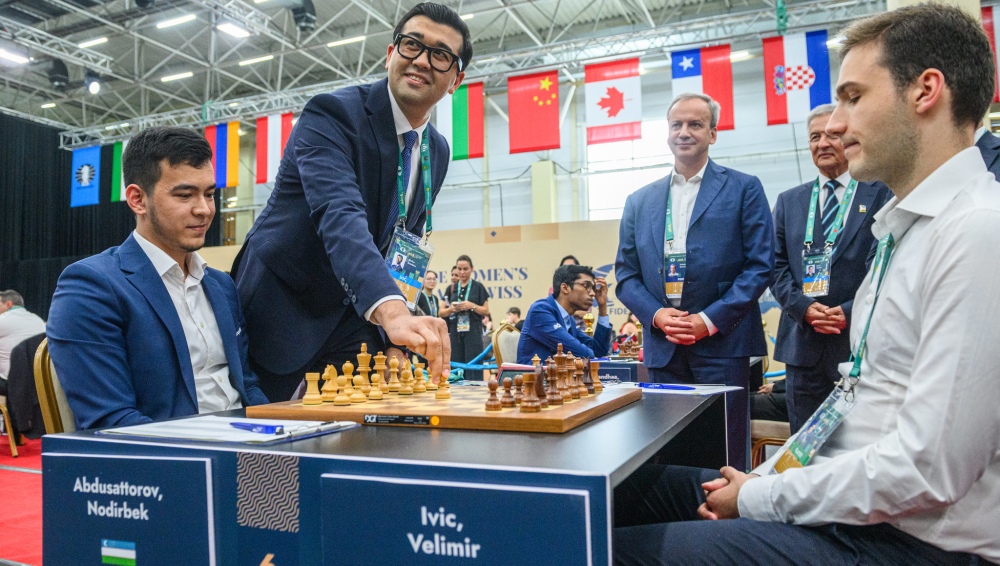
Round one of the 2025 FIDE Grand Swiss ended with a high number of draws in the Open section. By contrast, the Women’s Grand Swiss delivered early drama as several top seeds were upset by lower-rated opponents. The first games of the 2025 FIDE Grand Swiss started at 3 PM local time in Samarkand. Now in its fourth edition, the event has drawn many of the world’s strongest players – including the world champion, Gukesh D – to compete in what is widely seen as the most gruelling Swiss System tournament of the year. The round began with the traditional ceremonial first move on the top boards. Alisher Sadullaev – the First Vice-President of Uzbekistan Chess Federation and CEO of the Youth Affairs Agency of Uzbekistan – made the ceremonial move on board six, featuring Uzbekistan’s Nodirbek Abdusattorov. Sadullaev was joined by FIDE President Arkady Dvorkovich and Chief Arbiter of the event, Laurent Freyd. The opening rounds of Swiss System tournaments, especially round one, usually feature a significant number of victories, as the strongest players are pitted against the lower-rated ones. But the Grand Swiss is different: there are no weak opponents and anyone can win – and lose. It is not surprising then that the majority of the games in the Open event ended in draws. On board one, top-ranked player R Praggnanandhaa drew with Jeffery Xiong in the Exchange line of the French. “Getting Jeffrey [former World Junior Champion] is unlucky, but everyone is strong here, and you don’t really have easy games,” said Praggnanandhaa after the game. The 19-year-old Indian shrugged off suggestions that he felt any pressure as the top-rated player in the tournament. On board two, Arjun Erigaisi drew with Maksim Chigaev, while rising stars Ediz Gurel and Vincent Keymer split a point in the Ruy Lopez. GM Gabriel Sargissian – a highly successful member of the Armenian chess team – had a winning position against none other than Hans Niemann, but let the advantage slip into a draw. Among the notable winners in round one are the World Champion Gukesh D who overcame the seasoned French GM Étienne Bacrot on the black side of the Caro-Kann. Anish Giri defeated Armenia’s Robert Hovhannisyan in the Najdorf line of the Sicilian. The winner of the 2023 Grand Swiss, Vidit Santosh Gujrathi, also started with a victory against Alexander Donchenko, following time trouble. Alireza Firouzja managed to score against Bassem Amin after the Egyptian GM made a crucial mistake in an equal endgame late in the round. Uzbekistan’s biggest hope in this tournament, Nodirbek Abdusattorov, defeated Serbia’s Velimir Ivic. In the Najdorf, Abdusattorov created a passer on the a-file and gradually increased pressure on Black. The opponents traded mistakes in time trouble before the time control, but Velimir was last to err. White is winning here as his a-pawn is unstoppable. 39…Qxa4 40.Bxa4 Rc1 A desperate attempt by Ivic. 41.a8=Q Bd4 42.h4 Rxg1 43.Kh2 Ra1 44.Qe8 and after a few more checks, Black had no more choices but to resign. The first player to score victory in the 2025 Grand Swiss was Aydin Suleymanli from Azerbaijan. The 2609-rated Grandmaster prepared an opening surprise for Indian GM Murali Karthikeyan that included a queen sacrifice. A first look at the position would suggest nothing unusual after the natural 15.Nce5, but here White opted for 15.Nb2 inviting the obvious move 15…Nxc3 – the white queen is trapped and there is no other option but to sacrifice it. After 16.dxc3 Rxd1 17.Bxd1 White is a queen down, but this unbalanced position is evaluated as equal, given Black’s lag in development. 17…e6 18.g4 And now, the only move for Black was to play 18…Ba3 – giving up the white-squared bishop in exchange for activating his pieces. Instead, Black played the logical move 18…Bg6? and after 19.Bg5 Qxc3 20.Rc1 his king is dangerously exposed. 20…Qxb2 21.Rc6+ Kb7 22.Ne5 White is completely dominating the position and the only way for Black to continue the game was to hand back the queen sacrifice: 22…Qxe5 23.Rxe5 Kxc6 24.Bf3+. Although a pawn down, White’s pieces have all the space while Black is struggling. Eventually, Black had to give up another piece but could not escape defeat. The game between the winner of this year’s Women’s World Cup Divya Deshmukh and her Indian compatriot Puranik Abhimanyu brought the first real spark in the tournament. Early in the game, in the exchange line of the Queen’s Gambit, the two played a rare continuation which initially seemed like a blunder: Black has just played 7… Nh5 but after 8.Bxb8 Rxb8 9.g4 he seems to lose a piece. However, after 9…Qh4+ 10.Kd2 Ng3 11.gxf4 Nxh1 12.Nh3 Bd6 13.Bg2 0-0 14.Qh1 Puranik got sufficient compensation through pressure on the centre. Divya went on to create a strong position and dominate, but misplayed in time trouble and ended up losing. The other woman playing in the Open, Alexandra Goryachkina, lost as Black to Turkish prodigy, GM Erdogmus. The Women’s Grand Swiss The women’s event saw a completely different start, with upsets across the top boards. On board one, top seed Anna Muzychuk lost on time to 18-year-old Hungarian WGM Zsóka Gaál – despite holding a clearly better position deep into the game. White is winning after either 36.Ke2 or 36.Kf2, but at this point, she ran out of time. A very unlucky start for Anna, who came to Samarkand with the goal of securing one of the two top spots leading to the 2026 Candidates. European champion Teodora Injac was stunned by Olga Badelka, who took over the initiative in the middlegame and played confidently until the end. Former world champions also had a poor start. On board two, Tan lost to Olga Girya. In the Queen’s Gambit Declined, Tan created a strong position, making an advance on the queenside. However, towards the end, she miscalculated, lost a pawn and ultimately conceded her defeat. Another former world champion, Mariya Muzychuk, also lost – misplaying an endgame as Black against lower-rated Xeniya Balabayeva.
Ancient Samarkand sets the stage for 2025 FIDE Grand Swiss

The historic city of Samarkand welcomed the chess world with a spectacular ceremony blending history, art and chess, setting the stage for one of the strongest tournaments ever. The ceremony started with a short video that took the audience on a journey in time, from the archaeological discoveries of 7th-century Afrasiab to the present day. The carefully crafted narrative began in darkness, with a golden beam of light revealing ancient chess pieces discovered on the historic hill of Afrasiab – evidence that chess had flourished in these lands for over thirteen centuries. The video was followed by choreographic elements that reflected the tournament’s theme, featuring contemporary dance with mirrored figures and geometric formations, reminiscent of chess squares. Then came the formal part of the ceremony, with officials taking centre stage. The first to speak was the Director of the Youth Affairs Agency and First Deputy Chairman of the Chess Federation of Uzbekistan, Alisher Sadullaev, who emphasised the tournament’s importance for chess development in the region. “In the past year Uzbekistan has been engaged in organising a large number of chess competitions thanks to the support of the President of Uzbekistan, Shavkat Mirziyoyev. Samarkand has been made into a global chess arena. We hosted the 2023 World Rapid and Blitz. Next year we are hosting the Chess Olympiad, and it will be a huge event for the world,” Sadullaev said. FIDE President Arkady Dvorkovich thanked the Uzbekistan government and the country’s chess federation for their support in organising this event and for investment in chess in general. “The steps taken over the past 15 years have led to the creation of a great generation which is representing Uzbekistan today. This is a clear signal to all other countries in terms of what needs to be done if you want to be in the top of the chess world,” Dvorkovich said. “This is an exciting journey which is starting in Uzbekistan, bringing excitement to fans all over the world. I wish you all the best of luck,” the FIDE President concluded. Hokim of Samarkand region, Adiz Boboev pointed out how Samarkand and, indeed, Uzbekistan, has become one of the most prominent organisers of international sports events. “Samarkand has become one of the centres of international sports. Just in the past year we have had the World Triathlon Cup and Para Triathlon Cup, the Asian Judo Championship and other international forums”. Boboev noted that “the sports sector has been identified as a priority area of the state policy in our country” and that further investments are coming, including the 2026 chess Olympiad which will take place in Uzbekistan. The drawing of lots The ceremony’s key moment came with the drawing of lots for round one colours. Chief Arbiter Laurent Freyd took centre stage, calling forward the top-rated players from both sections: Praggnanandhaa R (Open section) and Anna Muzychuk (Women’s section). Standing next to the arbiter and the players were two models, dressed in traditional national costumes, holding miniature artworks with Uzbek motifs. The reverse side of each miniature featured white and black colours. Praggnanandhaa ended up selecting the art piece with the black colour on the back, meaning he will start round one with the black pieces. In the women’s section, Anna Muzychuk chose the art piece with the white colour, meaning she starts the tournament as White. The ceremony closed with a vibrant performance of modern Uzbek dance and a video featuring Uzbekistan’s rise to become one of the most prominent chess nations in the world. World Champion Guklesh D: “This tournament is so strong that anybody can win” Earlier in the day, a press conference was held featuring World Champion Gukesh D. The Indian was asked about the decision to play in Samarkand, in an event where his potential challenger will be chosen. “I’m happy to be back here in Samarkand. I was here in 2023 for the World Rapid and Blitz. It’s nice to be back here. Although there’s no need for me to qualify, I think this is still a great tournament. There are not many super strong open Swiss tournaments. It’s an opportunity for me to play in a different format and prove myself”. Gukesh also spoke about how his preparation for the event differed from other – closed – tournaments, where preselected top players take part. “In Swiss tournaments, you need to win more games and take a bit more chances. I’m glad there will be a lot of hungry players and exciting games. Even though I’ve been playing a lot of closed tournaments, I’ll try to adjust my preparation for the open event here”. When asked about who he sees as the favourites to win the event, Gukesh was diplomatic: “This tournament is so strong that pretty much anybody on a great day can win. I don’t really believe in favourites.” The full report from the press conference can be found HERE. Round one starts on Thursday, September 4, at 3 PM local time. The Round 1 pairings can be found here: Open: grandswiss2025.fide.com/open/ Women: grandswiss2025.fide.com/grand-swiss-women/ Written by Milan Dinic Photos: Michal Walusza Official website: grandswiss2025.fide.com About the event The FIDE Grand Swiss is one of the most significant tournaments in the World Chess Championship cycle, featuring many of the world’s strongest chess players. Launched in 2019 (with the women’s event starting in 2021), the 11-round Swiss system tournament is held every two years. Considered as one of the most difficult and unpredictable chess events given its open nature, the top two finishers in both categories qualify directly for the World Candidates tournament, where a challenger for the title of world champion is chosen. The 2025 edition runs from 4th to 15th September at the EXPO Centre in Samarkand, Uzbekistan. There are 116 players taking part in the Open and 56 players in the Women’s competition. The total prize fund for the event it $855,000 – $625,000 for the Open and $230,000 for the Women’s event. All the rounds will be broadcast live on FIDE’s official
Opening Press Conference of 2025 FIDE Grand Swiss
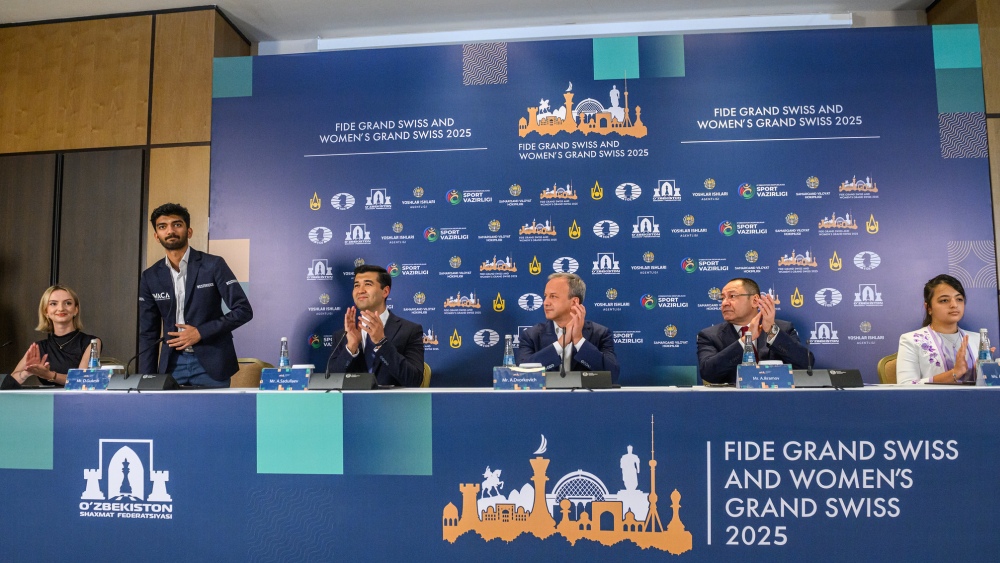
The opening day of the 2025 FIDE Grand Swiss started with a high-profile press conference featuring World Champion Gukesh D, FIDE President Arkady Dvorkovich and Adham Ikramov, the Minister of Youth Policy and Sports of Uzbekistan. Speakers highlighted the significance of the tournament for the chess world in general as well as for chess in Uzbekistan and Asia. FIDE President Arkady Dvorkovich opened by thanking the government and the chess authorities of Uzbekistan for their dedicated support in organising the tournament and helping to increase the prize fund for the event. “The Grand Swiss is the strongest open competition in the two-year World Championship cycle, allowing all top players to fight for the spots in the Candidates tournaments. There are no weak opponents here and everything is usually decided in the last round, which will bring huge excitement for the spectators”. He noted that the Grand Swiss is “a test event for the 2026 Olympiad”, which will be taking place in Samarkand in September 2026. Dvorkovich concluded by thanking the World Champion, Gukesh D, for choosing to participate in the event which will help the promotion of chess. Adham Ikramov, Minister of Youth Policy and Sports of Uzbekistan noted that the country has recently hosted several international sports events and that it enjoys the support of the international sporting organisations thanks to the high quality and standard of the organisation it is providing. “Just two years ago, we held the World Rapid and Blitz here. Last year, in Budapest [during the Chess Olympiad] we met with the FIDE President at the time when Uzbekistan has risen among the top countries in chess. Next year we will organise the Olympiad and we will do it really well”. Alisher Sadullaev, the First Vice-President of Uzbekistan Chess Federation, spoke about the preparations for the 2026 Chess Olympiad which Uzbekistan will host, highlighting Samarkand’s status as a “global chess arena”. “Uzbekistan’s history traces back 3000 years, and this history gives a lot of sense about chess back in the past. One of the great conquerors of the world, Amir Timur, he brought all the chess masters to Samarkand and organised huge championships. It’s very logical to repeat the same tradition. The President of Uzbekistan always empowers chess and brings together the most talented [chess] minds in the world, like here in Samarkand”, Sadullaev said. “The whole Uzbek chess team that will be representing our country in the next Olympiad is in Samarkand and preparing. And this event will play a crucial role in getting them ready for the huge role next year they are about to play [at the Olympiad] and we expect them to win”. Sadullaev pointed out that the Uzbekistan Chess Federation pays attention to both male and female players, noting the example of Afruza Khamdamova, a two-time girls’ World Youth Champion. “This is one of the biggest tournaments I have ever played. Here we will have many of the elite women world players and I want to show them that I can play on equal footing with them,” said Khamdamova. World Champion Gukesh D was asked about the decision to play in Samarkand, in an event where his potential challenger will be chosen. “I’m happy to be back here in Samarkand. I was here in 2023 for the World Rapid and Blitz. It’s nice to be back here. Although there’s no need for me to qualify, I think this is still a great tournament. There are not many super strong open Swiss tournaments. It’s an opportunity for me to play in a different format and prove myself”. Gukesh also spoke about how his preparation for the event differed from other – closed – tournaments, where preselected top players take part. “In Swiss tournaments you need to win more games and take a bit more chances. I’m glad there will be a lot of hungry players and exciting games. Even though I’ve been playing a lot of closed tournaments, I’ll try to adjust my preparation for the open event here”. When asked about whom he sees as the favourites to win the event, Gukesh was diplomatic: “This tournament is so strong that pretty much anybody on a great day can win. I don’t really believe in favourites.” The World Champion also praised Nodirbek Abdusattorov – Uzbekistan’s strongest player who will be participating in the event – as a great champion and competitor. Written by Milan Dinic Photos: Michal Walusza Official website: grandswiss2025.fide.com/
Final call: Share your story in the FIDE Social Chess Storytelling Challenge 2025

The FIDE Social Chess Storytelling Challenge 2025 is underway, and filmmakers, educators, and social leaders from across the globe are already sharing how chess transforms lives. With the deadline set for 25 October 2025, there’s still time to add your voice to this unique celebration of chess as a force for change. Submitted Stories Entries so far range from polished productions to heartfelt grassroots films. Some use animation, others capture simple classroom moments, but all shine a light on the power of chess. Each story follows one of the challenge’s three themes: Personal Development Chess builds confidence, sharpens critical thinking, and strengthens problem-solving skills. A powerful example comes from the United States, where the film Building Minds With Chess features GM Pontus Carlsson showing how the game nurtures decision-making and resilience among young learners in New Orleans. Social Transformation Chess brings diverse groups together, fostering inclusion, and supporting education and rehabilitation programs. In South Africa, the documentary Helping Kings and Queens Make the Right Moves explores the game’s impact in a disadvantaged community where young people face crime and gang violence. At its heart is the story of Jedidah, a girl who, after failing second grade, embraced chess as a way to rebuild her confidence and ultimately blossomed as both a student and a player. Opportunities & Livelihoods Chess offers pathways for personal and professional growth, and the entry “Women’s Chess guide” showcases chess as a lifestyle through the lens of women at every level of the game, from casual players to traveling international competitors. Beyond showing a Queen’s Gambit-like story of a female player rising to the top, it also offers a glimpse of female chess communities and clubs, an image still too rarely seen on screen. Categories & submission details The competition is open to entries in two categories: Professional – High-quality, polished productions. Grassroots – Creative and amateur video submissions Key dates: Deadline: October 25, 2025 Awards Winners will receive: A special FIDE trophy, An invitation to the FIDE Olympiad 2026 Opening Ceremony (including two nights’ accommodation for two people), A global spotlight as top films will be showcased at the 2025 Social Chess Conference, across FIDE’s social media, and other social chess events. Award categories: Best Short Film (Professional) Best Grassroots Film (Amateur) FIDE Social Commission Choice Award Who can participate? Everyone is welcome (no restrictions on age or nationality) and filmmakers may submit more than one entry. Submit your film here: fide.com/social2025-storytelling-challenge/#send
Fujairah Global Chess Championship: Pranav V claims title

India’s young Grandmaster Pranav V emerged victorious in the UAE, capturing the coveted title in the Fujairah Global Chess Championship – Superstars Section. In the final round, he defeated Spain’s GM Alan Pichot in a masterful rook endgame, finishing on 7/9 to secure the championship. With this exceptional performance, Pranav gained 28 rating points, reaching a career-best live rating of 2631, alongside 17.6 FIDE Circuit points. He also claimed the top prize of US$ 23,000. Every game on the top boards proved decisive for the final standings. On Board 2, GM Amin Tabatabaei (Iran) was held to a draw by GM Alexander Donchenko (Germany). On Board 3, GM Brandon Jacobson (USA) drew against top seed GM Nihal Sarin (India). On Board 4, GM Abhimanyu Mishra (USA) shared the point with GM Sanan Sjugirov (Hungary). These results paved the way for GM Jose Eduardo Martinez (Mexico) to reach the podium by defeating GM Sam Shankland (USA). Three players—Jacobson, Martinez, and Tabatabaei—all finished on 6 points. On tiebreaks, Brandon Jacobson took second place, Jose Eduardo Martinez third, and Amin Tabatabaei fourth. They earned US$ 13,000, US$ 9,000, and US$ 8,000 respectively. China’s GM Zhu Jiner, the only female competitor in the Superstars Section, impressed once again. She defeated Bulgaria’s GM Ivan Cheparinov in the final round, finishing fifth with 5½ points and earning US$ 7,000. Also placing in the Top 10 (by tiebreaks) were GMs Aditya Mittal (India), Alexander Donchenko (Germany), Sanan Sjugirov (Hungary), Abhimanyu Mishra (USA), and Lu Shanglei (China). Superstars section – complete results Masters section In the Masters Division, USA’s GM Brewington Hardaway triumphed with 7.5 points. GM Ata Umut Akbas (Turkey) finished second on 7/9, followed by GM Artin Ashraf (Iran) in third, GM Karthik Venkataraman (India) in fourth, and GM Reza Mahdavi (Iran) in fifth—each placement determined by tiebreaks. Masters section complete results Open section In the Open category of the Fujairah Global Chess Championship, FM Alimzhan Zhauynbay (Kazakhstan, U12) delivered a sensational performance to clinch first place with 8/9. Armenia’s Davit Baghdasaryan (U16), Turkmenistan’s CM Allayar Shirlilyev, and Iran’s CM Benyamin Babaniya all scored 7.5 points, taking second to fourth place respectively on tiebreaks. China’s Huaqi Liu (U14) also impressed, scoring 7.5 points to finish fifth. Open sections complete results Distinguished guests at the closing ceremony The championship’s closing ceremony was attended by esteemed dignitaries, including: E. Sheikh Abdullah bin Hamad bin Saif Al Sharqi, President of the UAE Bodybuilding and Fitness Federation Taryam Matar, UAE Chess Federation President GM Dana Reizniece-Ozola, FIDE Deputy Chair and of the European Chess Union Deputy President GM Victor Bologan, FIDE Executive Director Ali Nihat Yazıcı, President of the Turkish Chess Federation Written by Pavel Dvorkovich & Niklesh Jain Photos: Anna Shtourman, Vivek Sohani and Aditya Sur Roy Broadcast: YouTube Fujairah Chess and YouTube ChessBase India Hindi Flickr album: flickr.com/photos/203288106@N04/
FIDE Circuit: Praggnanandhaa pulls away with dominant summer
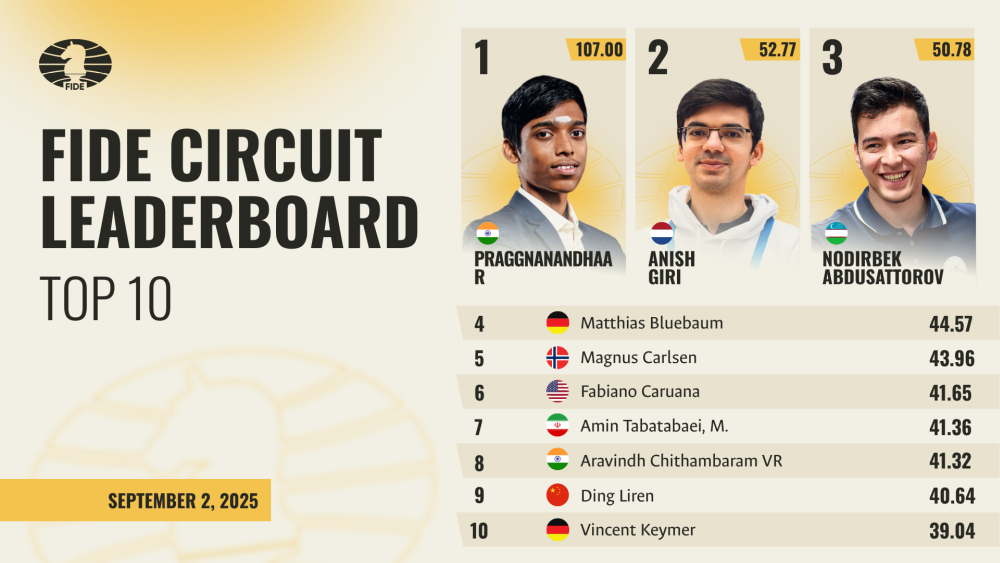
Praggnanandhaa R extended his lead in the FIDE Circuit race over the summer with impressive performances at the UzChess Cup Masters (1st place, 22.19 points) and the 12th Sinquefield Cup (2nd place, 20.72 points). With only four months remaining, he now holds a lead of nearly 55 points over second-placed Anish Giri—a gap that already looks insurmountable given the young Indian’s excellent form. Barring a highly unlikely chain of unfavorable circumstances, Praggnanandhaa seems poised to secure his spot in the 2026 Candidates Tournament. Anish Giri rose to second place in the standings thanks to a strong performance at the Quantbox Chennai Grand Masters, which earned him 20.94 points. The winner of that event, Vincent Keymer, broke into the top 10, while Amin Tabatabaei returned to this group following his good showing in the Fujairah Global 2025 – Superstars. Nodirbek Abdusattorov climbed to third in the race after finishing third at the UzChess Cup Masters, adding 18.56 points to his tally. Matthias Bluebaum also had a productive summer, gaining 17.91 points from his performances at the Sparkassen Chess Trophy 2025 A-Open and the 61st International Akiba Rubinstein Chess Festival, moving up to fourth on the leaderboard. Meanwhile, Ding Liren continues to slide down the standings—a predictable trend given that he has played only one Circuit-qualifying event this year. Notably, several Grandmasters in the current top 20—Chithambaram Aravindh, Vincent Keymer, Javokhir Sindarov, Maxime Vachier-Lagrave, and Vladimir Fedoseev—have played only two Circuit tournaments so far. This leaves them significant potential to climb the rankings. With this in mind, the upcoming FIDE Grand Swiss is expected to trigger major shifts within the top 10. However, it is unlikely to threaten Praggnanandhaa’s commanding position at the summit. We maintain a dedicated page on our website for the FIDE Circuit 2025, featuring the latest information on eligible tournaments, current standings, and regulations. Visit: FIDE Circuit 2025