Building the future of chess far from the spotlight: How FIDE’s Development Fund is shaping chess around the world

By Milan Dinic While the global chess spotlight is usually fixed on elite competitions and players, a quieter transformation has been taking place behind the scenes. Over the past six years, FIDE has channelled nearly €9.4 million into grassroots chess development. Through its Development Fund, it has supported projects across continents and helped build chess in places rarely featured in the headlines. In July 2023, the Bahamas was celebrating the 50th anniversary of its independence. Across the islands, tourists mixed with locals at festivals showcasing Bahamian heritage, music and cuisine. Against the backdrop of the celebrations, a long-held dream was transforming into reality: the Bahamas Chess Federation brought together 16 talented junior players, including members of youth national chess teams from Central America and the Caribbean, for a summer chess camp to increase the number of rated players from the region. The programme was led by National Trainer CM Elton Joseph, and supported by two junior trainers, a female trainer as well as an experienced arbiter. It was seen as a firm step in building a grassroots youth chess initiative that has continued The project in the Bahamas is one of many supported by FIDE’s Planning & Development Commission over the years. This is all part of a global effort funded by FIDE to institutionally strengthen member federations through the provision of financial and technical assistance. The FIDE Development Fund Since 2019, the FIDE Planning & Development Commission (PDC) – which runs the Development Fund – has built a robust support mechanism to strengthen national federations, continental bodies and affiliated organisations. While PDC focuses on projects initiated by member federations and associations, the Development Fund also includes projects run directly by FIDE – such as in the Kakuma refugee camp, or Chess in Prisons or Chess in Slums. The Development Fund has enabled 801 projects totalling €5.65 million between 2019 and 2025. The vast majority of this funding has gone to continental associations and national federations, with smaller but meaningful support to FIDE commissions, zonal and affiliated organisations. In addition, continental associations receive €100,000 each year to support continental championships, zonal events, training and educational projects. FIDE has also provided more than €3 million in travel subsidies for the 2022 and 2024 Chess Olympiads, bringing the total amount of support to just under €9.4 million in the 2019-2025 period. The value of travel subsidies is expected to reach €2 million for the 2026 Olympiad. The travel subsidies were all directed to Level 3 to Level 5 federations, which would otherwise struggle to fund their participation in the Olympiads. The funding net is wide. Projects span from basic chess education, to coaching, cognitive development and inclusion. FIDE has supported federations through capacity building, arbiter training, event organisation, the purchase of boards, pieces and clocks, and travel and accommodation for players. The New Zealand Chess Federation, with the support of funding from PDC, successfully held the Bob Wade Memorial Masters as an IM norm tournament. It allowed IM Herman van Riemsdijk and GM Gabor Nagy to play in the 2025 New Zealand Championships. This helped make the event another norm tournament. “FIDE’s mission is to spread chess and use it as a tool to bring people and communities together. As with the Year of Social Chess or the ongoing Year of Chess in Education, we want to promote chess as a tool for cognitive development, social inclusion and a useful instrument in education systems and for that we need strong federations and grassroots initiatives,” says Dana Reizniece, Deputy Chair of the FIDE Management Board. “For FIDE, development is not a side project – it is the mission which we have been working on persistently, including through the Development Commission,” Reizniece added. How FIDE’s Development Fund works While support for federations existed before, since 2019, FIDE’s Planning & Development Commission has focused on promoting a more robust and consistent application and funding system. The Development Fund operates as a grant mechanism, with FIDE working directly with federations that need support. Beneficiaries have to apply for support through the PDC application process which publicly outlines criteria, guidelines and KPI frameworks that must be met for grants to be eligible for consideration. The funding cycle for 2026 opened in January. FIDE is also providing an incentive for early applications – an extra 10% in funding for applications submitted before July. “While FIDE has always worked hard on providing support to our member federations, since 2019 our goal was to make this process more formal and structured, providing clear guidance and equal opportunities to all federations to apply for grants,” says Laurent Freyd, International Arbiter and Chair of the FIDE Planning & Development Commission. This includes what PDC calls “soft support” for federations. PDC provides consultancy and capacity building through pitch meetings, helping federations improve project proposals, budgeting, and strategic planning. Pitch meetings also involve relevant commissions for cross-functional project evaluation, enabling real-time feedback and alignment. Institutional, not ad hoc support The Development Fund is financed from FIDE’s overall budget, which includes income from events and sponsorships linked to major FIDE competitions. The General Assembly’s 2026 budget shows that total income is projected to rise from €13.17 million in the 2025 budget to €18.85 million in 2026. The biggest driver of this growth is income from FIDE events, which jumps from €9.6 million in 2025 to €16.1 million in 2026. The increase in event-driven income means FIDE has greater resources for development programmes. For 2026 the organisation allocated €400,000 for national-federation support and €400,000 for continent funding, with additional support for zones, commissions and social/educational projects. As the funding is approved by the General Assembly and is independently audited, it is part of a structured financial system. For fairness and transparency, FIDE has introduced the Development Index to rank national federations based on their current capacity and capabilities. The index uses six parameters, grouped into three broad areas – chess population, activity and performance – to determine which level a federation will belong to. Level 1
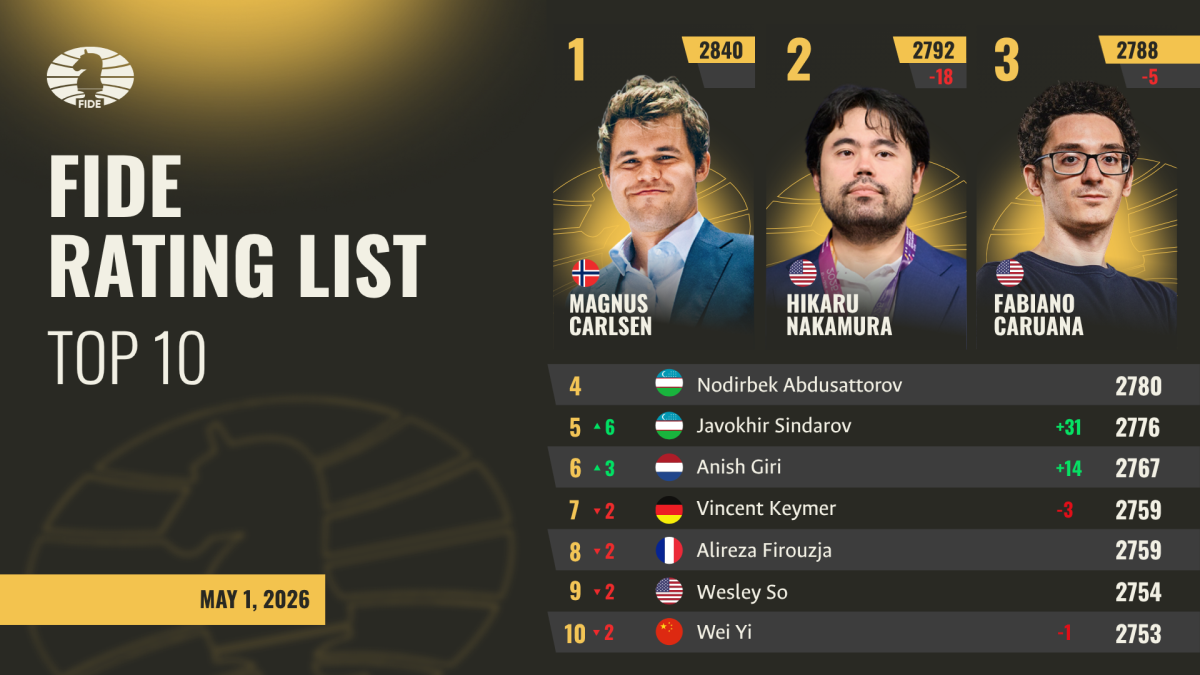
Javokhir Sindarov breaks into top 5 on FIDE May 2026 rating list

The May 2026 FIDE rating list was primarily shaped by the FIDE Candidates and Women’s Candidates, along with several strong open tournaments across Europe, including the European Individual Chess Championship. The top 10 Open saw two significant changes. The triumph at the FIDE Candidates 2026 earned Javokhir Sindarov 31 rating points and propelled him into the top 5 Open. The runner-up, Anish Giri, gained 14 points and climbing three places to No.6. Photo: Michal Walusza The second-place finish at the Women’s Candidates brought Bibisara Assaubayeva 11 rating points, lifting her to a career-high seventh position on the women’s list, while Aleksandra Goryachkina re-entered the top 5. Biggest gains in the top 100 Open and Women Kurmangaliyeva, Liya FM KAZ 2346 (+57) Yu, Jennifer FM USA 2358 (+38) Sindarov, Javokhir GM UZB 2776 (+31) Xiao, Yiyi WGM CHN 2389 (+28) Vaishali, Rameshbabu GM IND 2496 (+26) Savitha Shri B IM IND 2374 (+23) Erdogmus, Yagiz Kaan GM TUR 2708 (+21) Injac, Teodora IM SRB 2431 (+21) Milliet, Sophie IM FRA 2361 (+17) Shukhman, Anna WGM FID 2456 (+16) Photo: NZO Photography Liya Kurmangaliyeva (pictured above) recorded the biggest rating gain last month thanks to her excellent performances at the Reykjavik Open 2026 (+35 points) and the Grenke Chess Open 2026 A-Open (+22 points). Jennifer Yu returned to the top 100 Women after nearly seven years of absence, earning 38 points across those two tournaments. Xiao Yiyi shone in the 2026 Chinese Women’s Chess Team Championship, gaining an impressive 28 rating points, while Savitha Shri B overperformed at the Fagernes Chess International 2026 and Bratislava Norm Week – IM, adding 23 points to her tally. The Women’s Candidates winner, Vaishali R., earned not only the right to contest the title match but also 26 valuable rating points, bringing her within striking distance of the 2500 mark. Photo: Michal Walusza Turkish prodigy Yagiz Kaan Erdogmus (pictured above)dominated Veselin Topalov in their six-game match, convincingly winning by a score of 5–1. The result, worth 21 rating points, made him the youngest player to clear the 2700 Elo rating barrier (14 years, 10 months, and 13 days), surpassing the previous record held by Wei Yi by nearly a year. Teodora Injac (pictured below) emerged as the top female player at the recently concluded European Individual Chess Championship. Combined with a solid showing at the Reykjavik Open 2026, the Serbian IM returned to the Women’s top 30. Photo: Michal Walusza Sophie Milliet delivered at the CISF 2026 – Finale nazionale (+14 points), while Anna Shukhman proved her mettle at the V Open Chess Menorca 2026, gaining 16 rating points. Visit: https://ratings.fide.com/
Tickets now on sale for the FIDE World Team Rapid and Blitz Chess Championships 2026

The FIDE World Team Rapid and Blitz Chess Championships 2026 will be held at Queen Elizabeth Stadium in Hong Kong from June 17 to 21, marking the first time the event is hosted in East Asia. With 42 teams and more than 300 players confirmed, including seven of the world’s top ten male players and four of the world’s top ten female players, the championship brings the global chess spotlight to Hong Kong on an unprecedented scale.The field features World No. 1 Magnus Carlsen and women’s World No. 1 Hou Yifan, both returning with reigning Blitz champions WR Chess. Fans will also witness the most recent Candidates winners up close, Javokhir Sindarov and Vaishali Rameshbabu, who arrive in Hong Kong fresh from securing their World Championship matches in Cyprus. You can now secure your seats through the official ticketing platform, URBTIX, and choose between single-day tickets and multi-day packages. Single-day tickets 17 June, Rapid Day 1: HK$250 18 June, Rapid Day 2: HK$250 19 June, Rapid Day 3: HK$300 20 June, Blitz Day 1: HK$300 21 June, Blitz Day 2: HK$380 Package event passes Full Rapid Pass (17-19 June): HK$688 Full Blitz Pass (20-21 June): HK$538 5-Day All-Access Pass (17-21 June): HK$1,088 Early bird offer A discount of HK$100 is available on any package event pass purchased on or before 17 May. Terms and conditions apply. Tournament Village open to the public, free of charge Alongside the main competition, a dedicated Tournament Village will be open to the public free of charge, welcoming visitors of all ages. The Village is divided into three thematic zones covering traditional mind sports, emerging intellectual activities, and tabletop gaming, offering something for every generation. The event will also host the 2nd Asian Mind Sports Carnival, organised in conjunction with the Asian Mind Sports Association. The Carnival is set to bring together over 1,000 competitors from across the continent, taking part in more than ten disciplines including chess, bridge, Go, Xiangqi, and the Rubik’s Cube. Book your seats Tickets are available now at www.urbtix.hk/event-detail/15075. For more information, visit the official FIDE website.