FIDE World University Team Chess Championship 2026: 32 teams advance to knockout stage

The first stage of the FIDE World University Team Chess Championship 2026 has officially concluded, with university teams from around the world competing in two online Swiss qualifiers for places in the next phase of the competition. Organised by FIDE and the Kazakhstan Chess Federation, together with the Almaty city administration and support from Kazakhstan’s Ministry of Sports and Tourism, the championship has already attracted strong international participation in its inaugural edition. The over-the-board finals will take place in Almaty, Kazakhstan, from August 3-9, 2026. The championship format includes three stages: two Online Swiss Qualifiers, an Online Knockout stage, and the final over-the-board event in Almaty. Following the completion of the two Swiss qualifiers, the top 16 teams from each event have advanced to Stage 2, the Online Knockout. Qualifier 1: Americas and Africa (May 2) The first online Swiss qualifier took place on May 2 on Lichess.org, bringing together 22 university teams from the Americas and Africa regions in a seven-round Swiss-system tournament played at a rapid time control of 10 minutes plus 3 seconds per move. After the event’s completion, 16 teams had secured their spots in Stage 2. Saint Louis University (USA) came out on top with 13 match points and 23 game points, with Webster University (St. Louis, USA) finishing second on 12 match points. The University of Texas at Dallas rounded out the top three, ahead of UTRGV (The University of Texas Rio Grande Valley) and Texas Tech University, both of which also advanced comfortably. The strength of the field was notable from the outset. Saint Louis University fielded a lineup that included GM Aryan Chopra (2637, India), GM Bharath Subramaniyam H. (2599, India), GM Nikolozi Kacharava (2528, Georgia), and WGM Thalia Cervantes Landeiro (2262, USA). Webster University’s roster, led by GM Awonder Liang (2718, USA), was also very strong and included GM Francesco Sonis (2556, Italy), IM Anna Sargsyan (2360, USA), and WIM Munika Akshaya Bommini (2128, India). The 16 teams that qualified from Qualifier 1 are: Qualifier 2: Europe and Asia (May 9) The second qualifier, held on May 9 also on Lichess.org, featured 36 university teams from the Europe and Asia region and proved equally competitive. Ural State Mining University finished first with 13 match points and 24.5 game points, ahead of Universitas Gunadarma (Indonesia) in second and SRMIST (India) in third. Ural State Mining University entered the event with the highest average rating in the field at 2524. The team included GMs Arseniy Nesterov (2599), Rudik Makarian (2551), and Sergei Lobanov (2515), as well as IM Leya Garifullina (2431). Universitas Gunadarma represented Indonesia with a strong lineup consisting of IM Gilbert Elroy Tarigan (2421), IM Aditya Bagus Arfan (2370), FM Fabian Glen Mariano (2361), and WIM Diajeng Theresa Singgih (2308). SRMIST, which finished third overall, was led by IM Harsh Suresh (2435) and GM Raahul V S (2402). The 16 teams that qualified from Qualifier 2 are: With both Swiss qualifiers complete, attention now turns to Stage 2, the Online Knockout, scheduled for May 16-17 on Lichess.org. The 32 qualified teams will compete in a knockout format, with the top eight teams earning spots in the over-the-board finals in Almaty, Kazakhstan. The finals, which will take place from August 3-9, 2026, will bring together the eight surviving teams advancing from the knockout stage, alongside eight wildcard teams invited by FIDE and the organisers, competing for the championship title. The broadcast of the knockout stage will be available at: https://worlduniversities2026.fide.com/live For full tournament information, regulations and live results, visit the official championship website: https://worlduniversities2026.fide.com
ISCF’s “Chess in Education” Grant Program: Application submissions continue

Following the joint announcement by the International School Chess Federation and FIDE declaring 2026 the Year of Chess in Education, ISCF launched the “Chess in Education” Grant Program – a global initiative designed to scale proven educational projects that integrate chess into school systems.The program builds on a shared vision to bring chess closer to classrooms worldwide and strengthen its role as a tool for developing critical thinking, creativity, and social skills among children. Supporting what already works The grant program is specifically designed for projects that have already completed a pilot phase and demonstrated measurable educational impact. Its goal is to expand and strengthen existing “Chess in Education” initiatives, rather than fund new concepts. By supporting scalable and structured programs, ISCF aims to accelerate the global integration of chess into formal education – one of the key priorities of the Year of Chess in Education 2026. Who can apply Applications are open to: Schools (public and private) Educational organizations and NGOs Foundations and social enterprises Eligible applicants must already be implementing a chess-based educational program in school settings for at least one academic year. Program structure The competition will be conducted in two stages: Stage 1: Open call and initial selection Stage 2: Detailed project evaluation At the conclusion of the evaluation process, three projects will be awarded grant funding and recognized at the Grand Final Tournament. A global initiative The program is open across all four FIDE continents: Asia Americas Europe Africa It complements the broader international calendar of events under the Year of Chess in Education, including the World Schools Team Championship League 2026 and other educational initiatives worldwide. Key dates Application Deadline: 23:59 (GMT+5), July 31, 2026 Driving impact through education Selected projects must demonstrate: Proven results and measurable outcomes A structured educational methodology Readiness for scaling Real implementation in school environments Funding is allocated exclusively for scaling existing programs, ensuring long-term and sustainable impact. Apply now As part of the global Year of Chess in Education 2026, ISCF invites organizations to expand their impact and become part of a growing international movement. Register [HERE] For inquiries: edu@ischoolchess.com
Faustino Oro, the ‘Messi of chess,’ becomes second-youngest GM in history

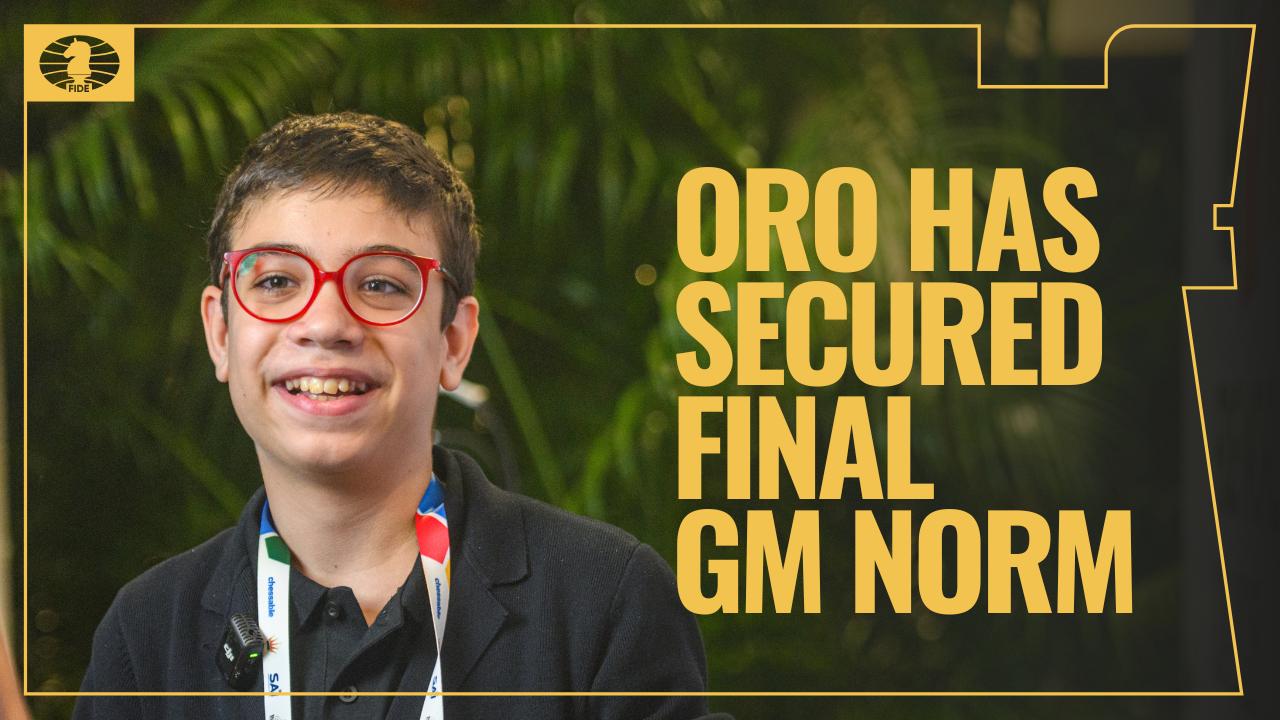
Faustino Oro, often hailed as the “Messi of chess,” achieved a historic milestone in his chess career, becoming the second-youngest Grandmaster in history.Born on October 14, 2013, in Buenos Aires, Argentina, Faustino was introduced to chess at the age of six by his father – a chess enthusiast and active member of the local chess community. This happened during the early months of the COVID-19 pandemic lockdown in May 2020. He quickly mastered the game’s fundamentals, displaying extraordinary talent, and soon began formal lessons – supplemented by online training sessions. Faustino’s rapid ascent includes breaking multiple age-related records, such as the youngest player to achieve a 2300 rating, the highest-rated 11-year-old in history, and the youngest player to attain an IM norm (later broken by Ethan Pang). He was ten when he beat reigning world number one Magnus Carlsen in an online bullet game, in a clip that went viral within hours. Faustino became an IM at the age of 10 years, 8 months and 16 days (another record, later broken by Roman Shodzhiev). At eleven, he became the first under-12 in chess history to cross 2500, a rating reached by fewer than 200 active players in the world. In November of last year, at twelve, he became the youngest player ever to win a match at the FIDE World Cup. In his pursuit of the coveted Grandmaster title, he cleared the first hurdle and achieved his first GM norm at the Legends & Prodigies 2025 tournament with an undefeated 7½/9 score, surpassing the 2500 rating mark along the way. His second norm came three months later on home soil in Buenos Aires, at the Magistral Szmetan-Giardelli, where he scored 5.5/9 and reached a 2516 rating. At the Aeroflot Open 2026, Oro came at the striking distance of becoming the youngest GM in history, but lost a crucial final-round game and had to wait for another chance. Faustino Oro at the Sardinia World Chess Festival; KNZO Photography Faustino clinched his final norm at the Sardinia International Chess Festival, scoring 6/9 and finishing 16th. Oro’s meteoric rise has resonated across Argentina and South America, sparking a surge in youth chess participation. The president of the Argentine Chess Federation (FADA) described it as a “revolution,” highlighting its broad impact. As one of the world’s oldest chess federations (founded in 1922), FADA has long supported young talent through sponsorships, school programs, and partnerships such as its cooperation with SENAF. Faustino’s success exemplifies the effectiveness of these initiatives.
2026 FIDE EDU Classroom Contest winners announced

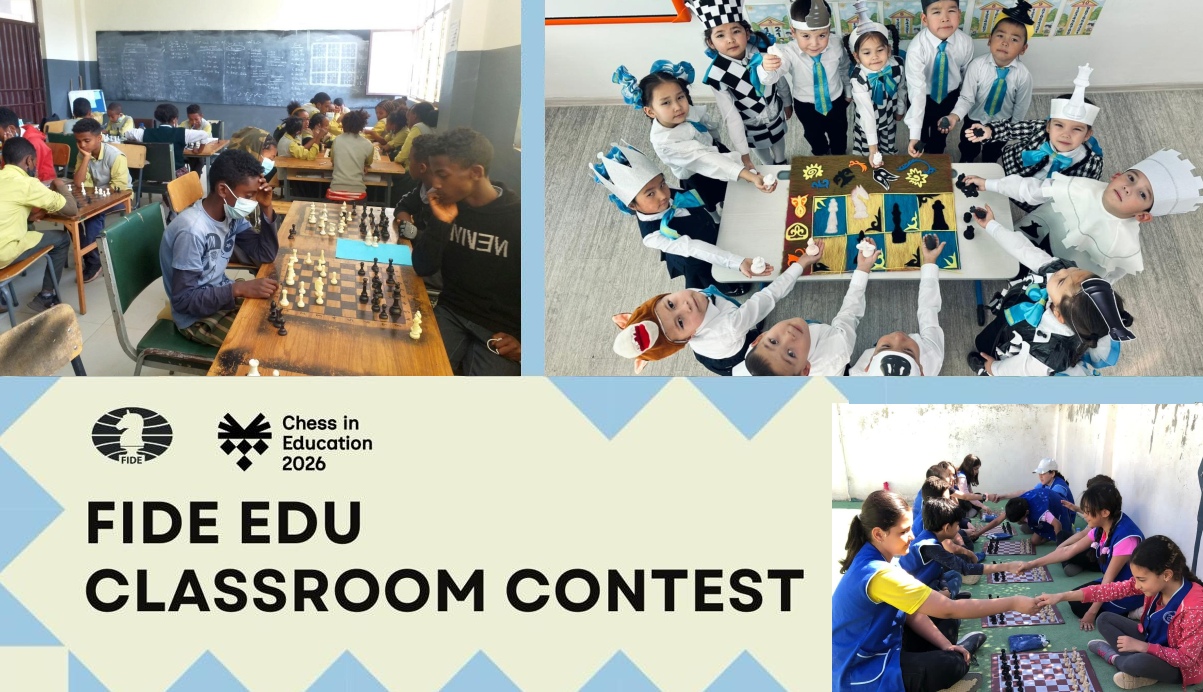
By Abel Talamantez, FIDE Senior Lead Instructor (SLI), FIDE EDU Commission The 2026 FIDE EDU Classroom Contest attracted 120 submissions from 30 different countries! To help celebrate the 2026 FIDE Year of Chess in Education, we invited schools with chess programs from around the world to submit photos of their chess classes to showcase how they use chess as an educational tool and how chess brings communities and cultures together. We wanted to engage schools and bring them into the larger FIDE EDU community, and we hoped it would give us an opportunity to better understand two things: what makes chess programs different across the world and, more importantly, what are the things that make us all alike. The universal language of chess is expressed so beautifully in pictures, and we were excited to capture how different cultures use chess in school to inspire and uplift communities. The response was amazing! We received 120 submissions from 30 different countries and over 350 photos. Looking at the photos gave us great appreciation for the wonderful teachers, coaches, parents, and children who are part of these programs. The photos told a story. Deciding which photos to choose was a challenge, but we wanted to select those that elicited an emotional response and invited further questions. In our selection process, we focused on photos that told many stories. We looked for community, culture, learning, and joy, hoping to see special ways in which chess was used to engage kids in fun ways. We selected pictures in which the culture of a region was expressed through chess, much like how the food of a particular region can itself tell a story of the region’s history. We also narrowed our selection process down to schools that were making the most of the resources available, as chess brings inspiration to all, regardless of race or socio-economic status. Although the contest was originally advertised awarding three winners, the number of submissions and quality and stories behind them led us to expand the contest and include five winners. Here are the five winners of the 2026 FIDE EDU Classroom Contest: 5th place – Nossa Senhora Aparecida, Nova Prata, Brazil Who says chess is an indoor sport? At Nossa Senhora Aparecida in Brazil, students take chess outdoors to enjoy learning, playing, and socializing outside in the fresh air. Sometimes a change in environment can make a difference in the learning process, and what better than to enjoy a game of chess on a clear day, outdoors on the green grass. Playing chess outdoors in public areas promotes it as a social activity to people who may not yet play, and inspires curiosity. The photo also shows that chess can be enjoyed in a different setting, engaging various senses and enhancing the learning experience for all. 4th place – EL Qiyem El Hadaria, Sidi Bel Abbes, Algeria Sportsmanship is at the heart of any competition, and learning to start off a game with respect is an important lesson in life. At EL Qiyem El Hadaria in Sidi Bel Abbes, Algeria, this picture tells a story of respectful competition in an outdoor setting. Coach Soumia Oukid says, “We often change the place to study chess to create a different and engaging environment for the students. As for the handshake, in Algeria we usually shake hands before starting a game. For this class, there are about ten girls, but in the whole school there are 325 students. I work with all the students in the school.” This photo captures a simple yet important concept, and it serves as a lesson on how children learn mutual respect and sportsmanship, win or lose, through chess. 3rd place – Experimental Primary School, Songling Road Branch, Zichuan District, Zibo City, Shandong Province, China This photo doesn’t show a full class, but rather one student solving a problem. However, it speaks volumes. I love how the learning tools in one photo show the classical way of learning chess, through the demo board and chalkboard, and then the modern tools in the center with the television monitor and online platform, beautifully capturing the evolution of learning. National pride with the flag of China displayed on top creates a beautiful scene. 2nd place – Addis Ababa No. 2 Government School, Addis Ababa, Ethiopia This photo is a classic school chess photo. The kids are in a classroom playing chess, but the details reveal the depth of chess’s power to connect people. We can see three tables of what looks like competitive games, but one of the tables shows a group of students watching and actively discussing a game with the coach. The tables themselves inspire a lot of curiosity, as the chessboards are embedded into the wood, like chess is part of the learning environment, and all this goes on against the background of a chalkboard with an academic lesson. This photo reveals community, culture, and the uniting social power of chess. 1st place- Zhanir Khan School Class 1B, Khan Ordasy Village, Kazakhstan This picture captures everything wonderful about the power of chess to inspire creativity, learning, and fun while bringing kids together. This is from a 1st grade class where the students are learning the basics of chess through art. Their teacher Alfia Aksenova explains, “During the lesson, we decided to pretend we were “heroes,” chess pieces, and divided up the roles. The parents agreed to sew costumes, and the kids made large chess pieces out of play dough. This made our open lesson even more colorful. The kids were thrilled to be the King and Queen, Knight and Rook. These are our costumes for the open lesson.” The broad creative use of art, chess learning, and parental engagement with the idea to make learning more colorful and bring things to life makes this photo this year’s contest winner! Congratulations to the contest winners and many thanks to all the schools that submitted photos. We will be publishing more photos and telling the stories of some of