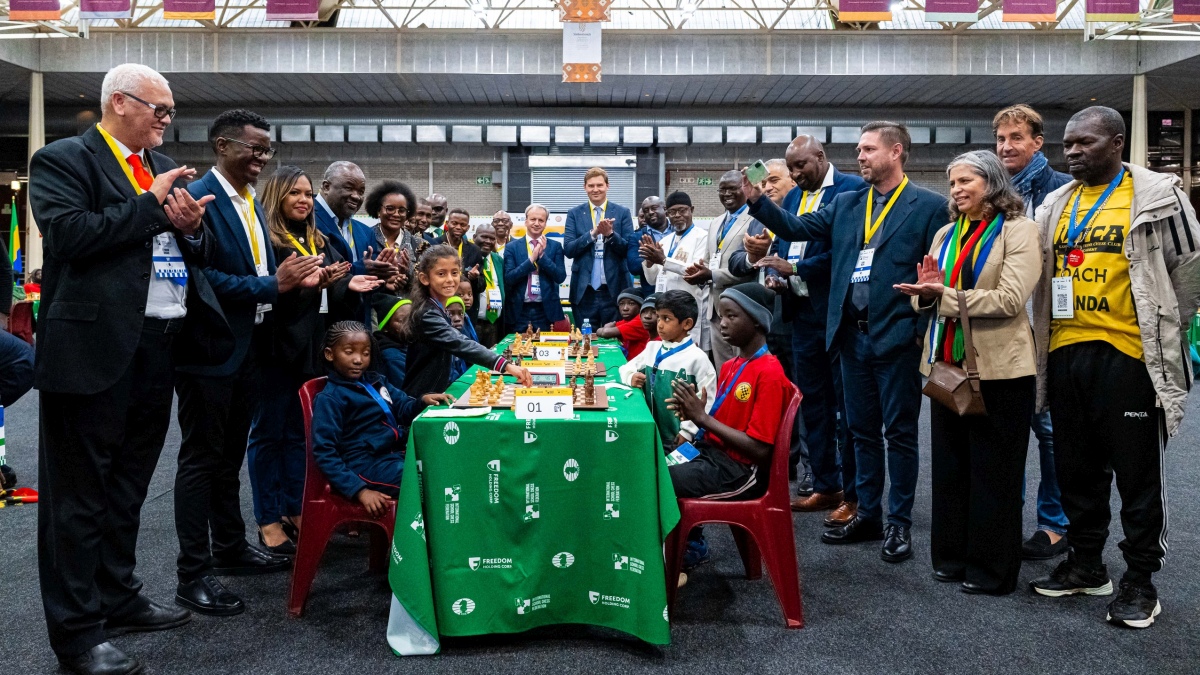
First moves in Stellenbosch: African Continental Stage of the World Schools Team Championship 2026 begins

The African Continental Stage of the FIDE ISCF World Schools Team Championship 2026 officially got underway today at the Coetzenburg Center in Stellenbosch, South Africa, marking the first time the event has been held on African soil. The second qualifying stage of the 2026 cycle, following the Asian Continental Stage in Almaty this April, brings together 26 school teams from 22 countries, all competing for a place in the Grand Final at the end of the year. Held during the Year of Chess in Education, with the support of Freedom Holding Corp., the championship places as much emphasis on what chess teaches as on who wins. Speaking on the sidelines of the event, FIDE President Arkady Dvorkovich reflected on how the cycle has grown: “When we started the World Schools Team Championships a couple of years ago, we were experimenting a bit, thinking how to do it in a proper way to involve more and more schools, more and more countries. Now we are confident that in the end we’ll have more than 100 countries competing, which is exciting. And it’s going to be five different countries, five different hosts, so that improves the capacity of local federations to move chess forward.” Format Each team fields four main players and one reserve, with both boys and girls represented. At the top of the starting rankings is Uganda’s Sr. Miriam Duggan Primary School, followed by Nigeria’s Platform School in second place and Tunisia’s representatives in third. The host country, South Africa, is represented by three schools, led by Welgemoed Primary School. The team aspect of the event has shown a true camaraderie from the players, each supporting their own. ISCF President Timur Turlov remarked on the benefits of this format: “I think it’s very human to team up, and only as a community can we build some great things. All the big institutions, all the big enterprises, are always teams of people. And if you have a strong team, that usually means that you can achieve very great results, build something really great, and create something very special. That’s why I think it’s important to develop communities. If not just one person is great, if the whole team is great, if the whole school is great, that creates much better opportunities for development. Because you can rely on your team players, and altogether you can create something really unique.” The tournament follows an eight-round Swiss system, with two rounds played each day and a time control of 45 minutes plus a 10-second increment per move from move one. The short-classical format produced plenty of quick finishes, although in both rounds several games continued deep into the session as players made full use of their time. Notably, the majority of the participants, 91 of them to be exact, are unrated and competing on an international stage for the first time in their lives. That may sound like a lot of pressure, but the atmosphere remained lively throughout the day, and the students appeared eager to return for their next game. Here is a closer look at the day’s activities. An opening ceremony with a difference The tournament opened at 10:00 with a ceremony that “set protocol aside.” Following introductory remarks, the South African national anthem, and the FIDE anthem, FIDE President Arkady Dvorkovich, ISCF President Timur Turlov, African Chess Confederation President Tshepiso Lopang, and Chess South Africa President Andre Lewaks took the stage, but not to deliver speeches. Instead, each official read letters written by young players at the previous stages in Almaty and Washington, answering one question: “What would you say to your fellow players if you were standing on the opening ceremony stage?” Their words about mistakes and victories, friendship without borders, dreams, and a big and open world captured the spirit of the championship better than any formal speech could. The heartfelt messages captivated the audience. Here are some of the most memorable answers: “If you lose, it is okay to feel sad for a little while. But not for too long. Then it is better to look through the game and pretend that learning something was your plan all along.” “Don’t be afraid if you and your opponent don’t speak the same language. In chess, you can understand each other without words – after the first move!” “May each of you have a big chess dream. For example, to become a world champion. Make smart moves! In the game and … in life too!” “I hope that at this championship you look not only at the board but also around you. Because the world is truly big, and it is wonderful to see it while playing.” Following a group photo under the event’s motto, WE LOVE CHESS, and a dance performance by the Stars of Tomorrow group, President Arkady Dvorkovich officially declared the African Continental Stage open. The ceremony also recognised the essential support of the Freedom Group of companies, whose partnership made the event possible and continues to strengthen chess education and development programmes worldwide. The ceremony set the tone for the day of chess ahead, with smiles and good spirits all around. The players then made their way to the boards for the first round, which began at 11:30. First moves were made by young chess stars – Sophia Smith (8 years old), representing Beaumont Primary School, and Theeran Varadharajan (4 years old), from Alex Blaikie Montessori School. Rounds 1 and 2 The first round produced no major upsets, although several matches ended in draws. There were also a few 4-0 clean sweeps, always an ideal way to begin a team event. Round two followed a similar pattern, although more matches were closely contested. Four teams ended the day with victories in both rounds, and the competition is expected to intensify tomorrow as more evenly matched teams face one another. It should also be noted that the early standings may not yet provide a true indication of strength, given the large number of unrated players