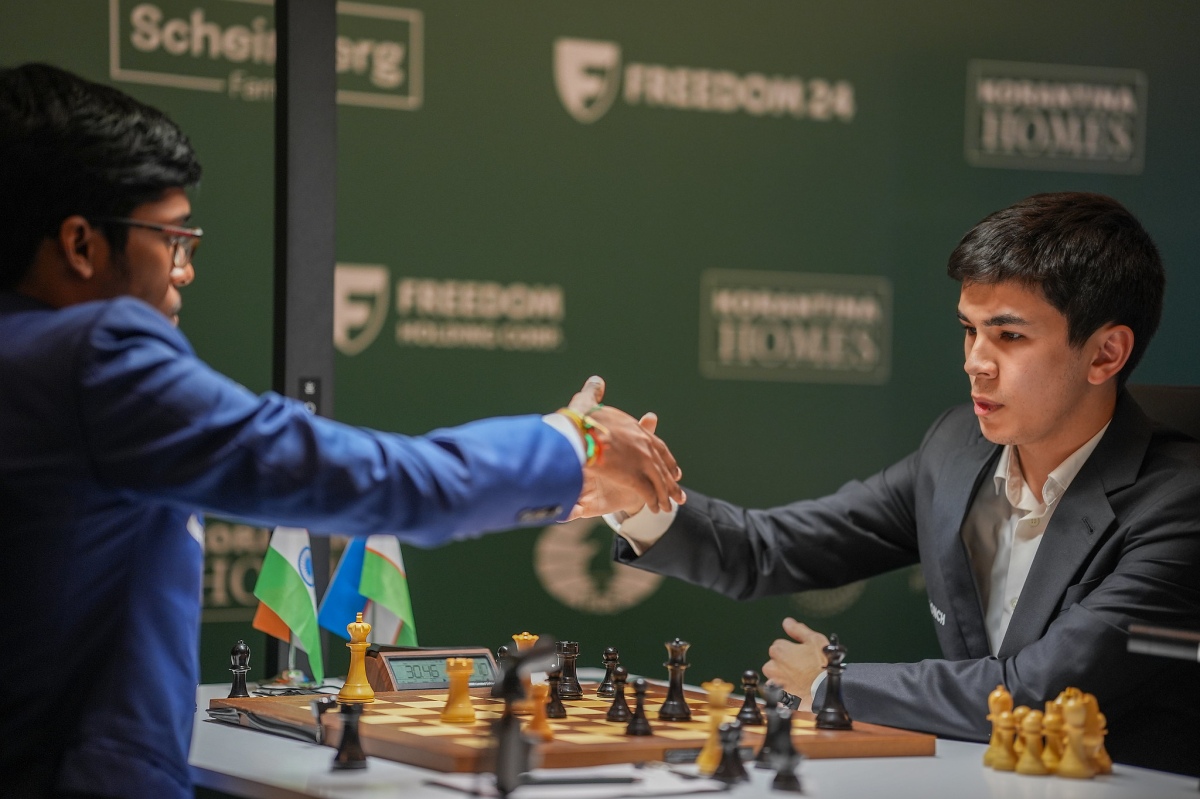
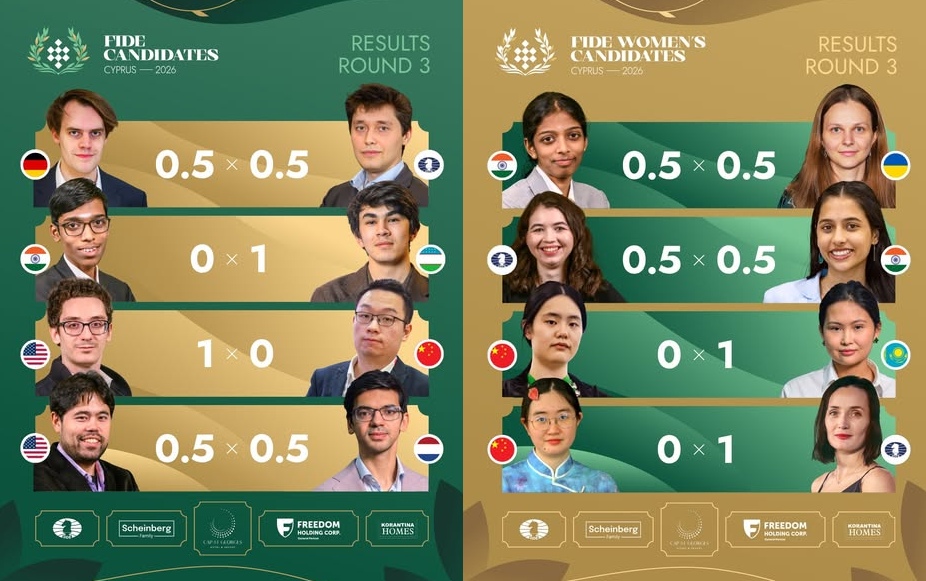

With impressive wins over Wei Yi and R Praggnanandhaa, both Fabiano Caruana and Javokhir Sindarov surged ahead of the field, staking an early claim in the tournament race.
On 2.5 out of 3 points, they already lead by a full point over the rest, a significant margin, even though eleven rounds remain.
The round marked a sharp contrast to the previous day’s quiet play, which saw eight draws. This time, the players delivered fighting chess filled with dynamic opportunities and high-level execution.
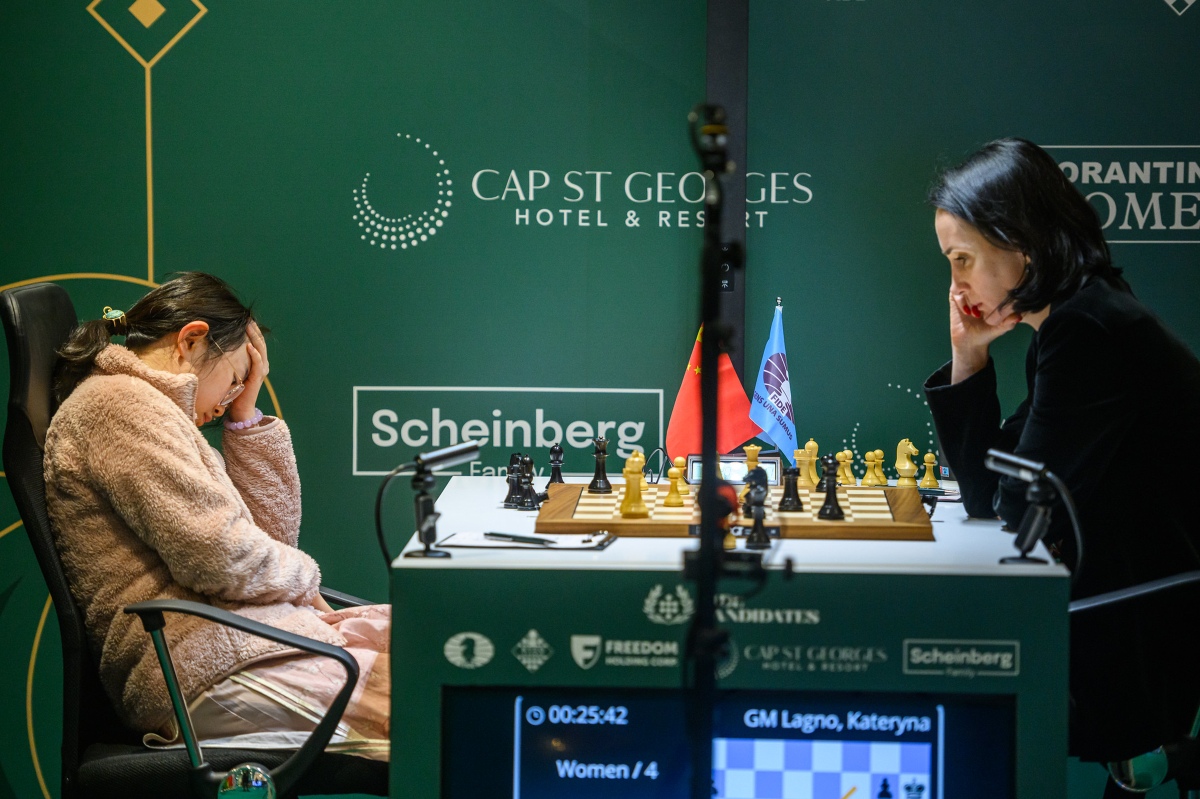
In the women’s event, Kateryna Lagno scored a crucial victory over Tan Zhongyi in a chaotic encounter, propelling her into the tournament lead. She is joined at the top by Bibisara Assaubayeva, who defeated Zhu Jiner using an aggressive opening approach.
This afternoon’s action unfolded at the luxurious Cap St Georges Hotel & Resort, providing a stunning backdrop for high-stakes chess.
Two ceremonial first moves added a touch of prestige to the round. Michael Khodarkovsky (FIDE Vice President) had the honour of opening the game for Fabiano Caruana in his clash against Wei Yi.
Meanwhile, Dana Reizniece (Deputy Chair of FIDE Management Board) made the symbolic first move in the matchup between R Vaishali and Anna Muzychuk.
While the clashes between Matthias Bluebaum vs Andrey Esipenko and Hikaru Nakamura vs Anish Giri remained completely balanced – both played with astonishing accuracy levels of 98–99% – the real fireworks in the FIDE Candidates Tournament came from the other two boards.
A decisive miniature at this level is an exceptionally rare occurrence, but today Fabiano Caruana delivered exactly that, surging into the tournament lead with a crushing victory over Wei Yi.
Opting for a highly ambitious and risky opening, Wei Yi sacrificed two full pawns in exchange for rapid development and attacking chances. Caruana, however, rose to the challenge and accepted the complications.
Reflecting on the critical moments after the game, Caruana admitted: “I was tricked with the move order, I got something I didn’t want and then I had to decide between different lines. I knew that the plan Qa4–Ng5 existed but I couldn’t remember many details. The pawn sacrifices were unexpected, but I had to go for it.”
However, Wei Yi admitted that things had already gone wrong early on: “I was out of the book after Qb5, but then I played terribly and blundered a piece.”
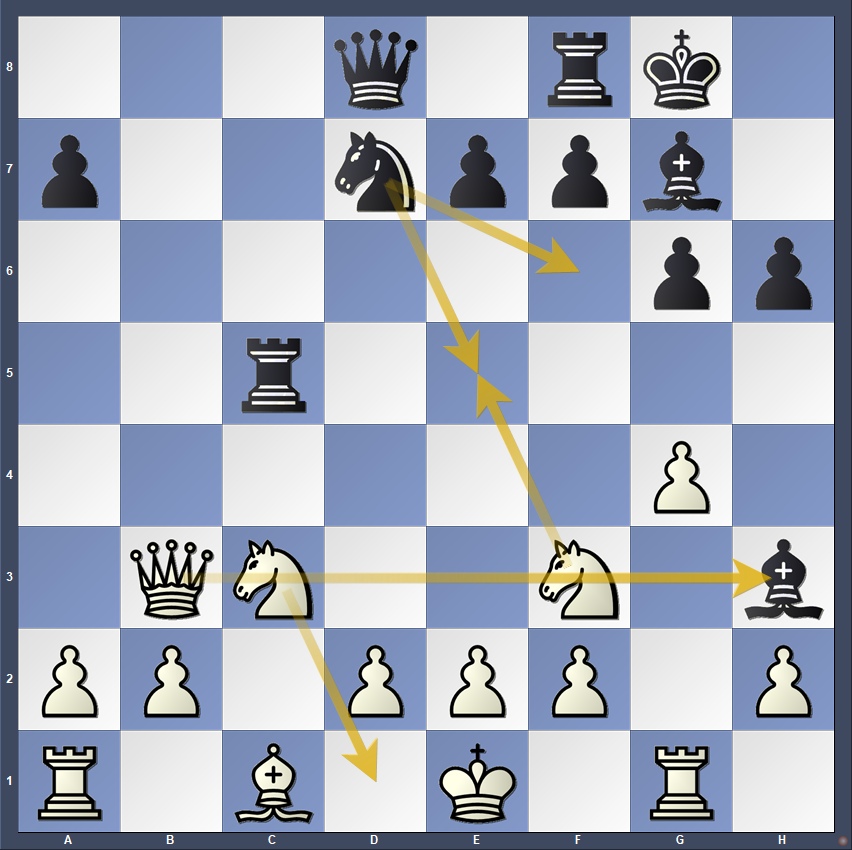
Black was already under significant pressure, but the move 17…Ne5? turned a difficult position into a lost one (better was 17…Nf6 although, after 18.d4! Black’s position is no fun). After 18.Nxe5 Rxe5 19.Nd1!, White’s idea becomes crystal clear: there is simply no way to save the trapped bishop on h3. Faced with inevitable material loss and a collapsing position, Wei Yi had no choice but to resign.
The other standout performer of the day was Javokhir Sindarov, who secured a crucial victory with the black pieces against Praggnanandhaa. Their encounter quickly spiralled into chaos, as Sindarov sacrificed a piece in the opening for two pawns and long-term initiative.
While the soundness of the idea may be debatable, it created a highly complex and double-edged position that proved difficult for both players to navigate. Explaining his decision, Sindarov noted: “If I don’t take the pawn on b4 then I would be in trouble, so I thought it was the best option and that I would find something afterwards.”
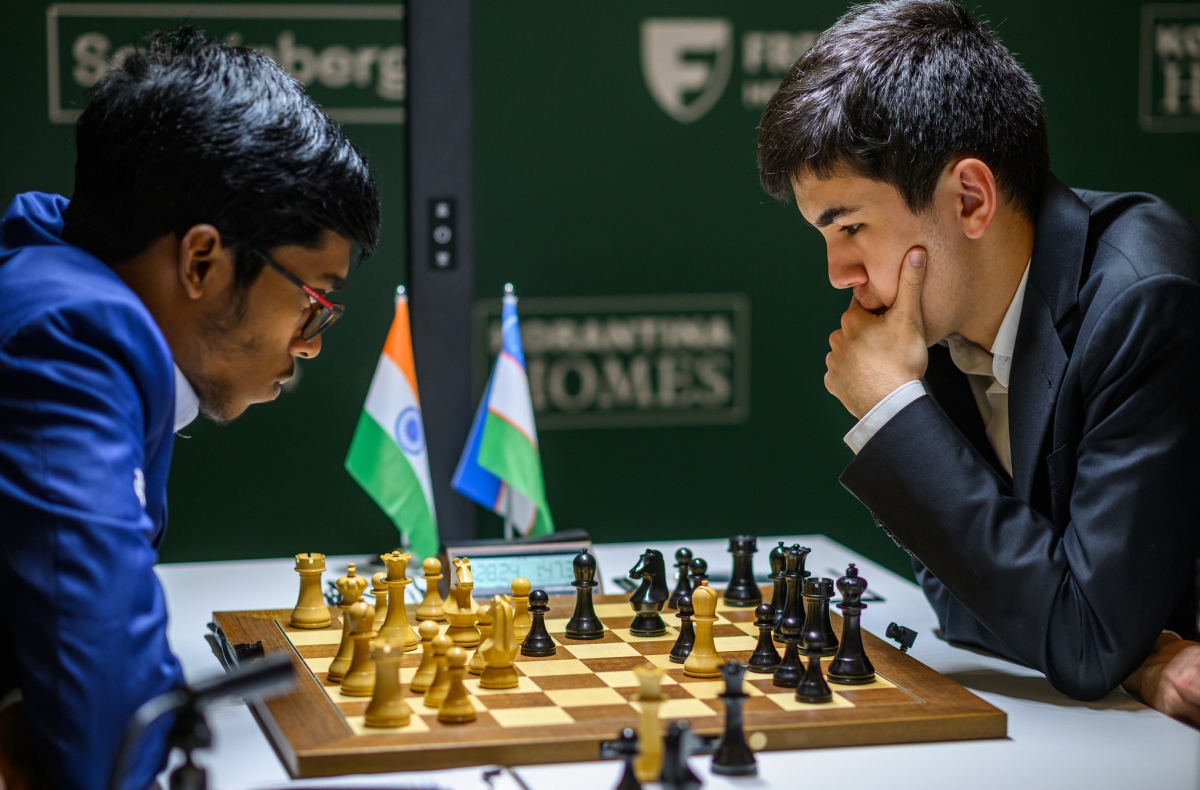
Despite the imbalance, Praggnanandhaa demonstrated remarkable resilience and managed to keep the position under control, at least until the clock became a factor. As time trouble set in, Sindarov seized his moment, capitalizing on the mounting pressure to convert the game and claim the full point.
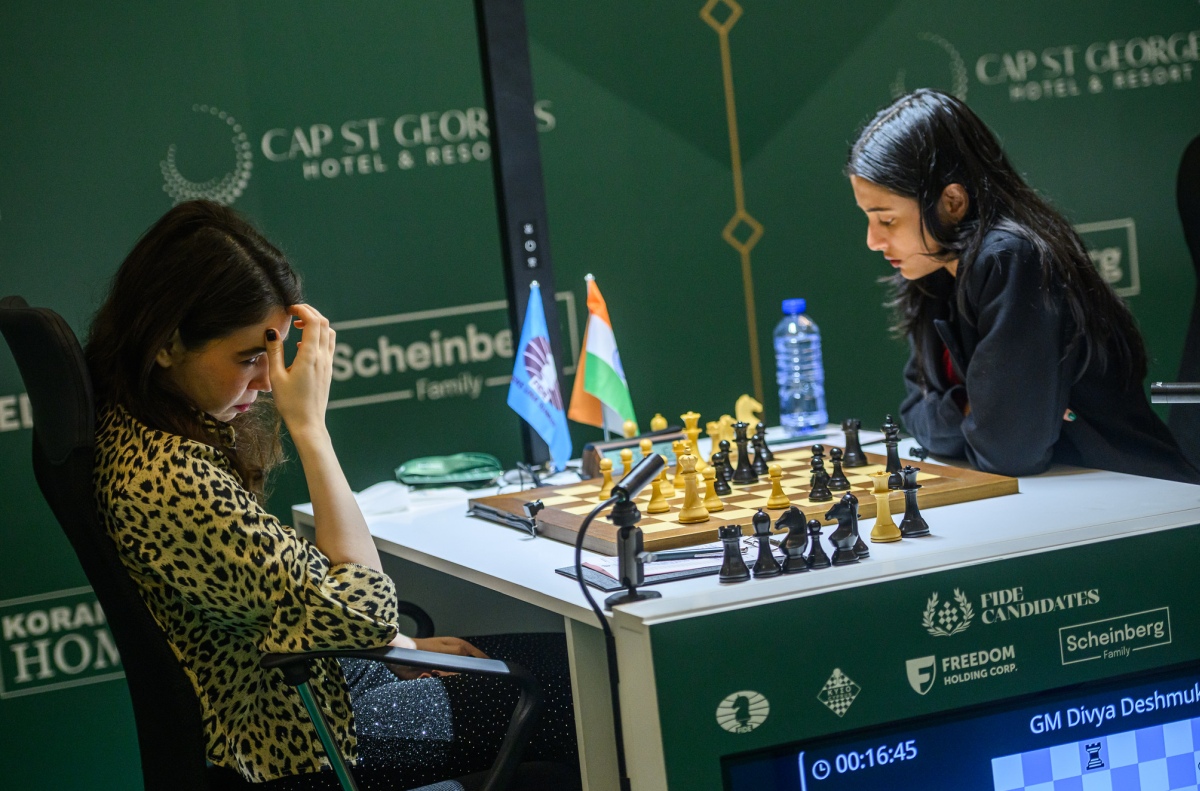
In the FIDE Women’s Candidates Tournament, the games between Vaishali and Anna Muzychuk, as well as Aleksandra Goryachkina versus Divya Deshmukh, both ended in draws, but the nature of those draws could not have been more different.
The Vaishali – Muzychuk encounter was a model of precision: highly accurate, deeply technical, and virtually error-free from start to finish. By contrast, the game between Goryachkina and Divya was a dramatic struggle.
After more than fifty moves of relentless pressure in a typical Goryachkina grind, Aleksandra managed to secure an extra pawn and transition into a theoretically winning rook endgame. However, she ultimately erred and failed unable to convert her advantage, allowing Divya Deshmukh to escape “by the skin of her teeth.”
The result served as yet another reminder of the old chess adage that “all rook endings are drawn.” It is worth noting that, in the final phase of the game, Goryachkina was also under significant time pressure.
The two winners of the day in the FIDE Women’s Candidates Tournament were Kateryna Lagno and Bibisara Assaubayeva, who now share the lead.
The encounter between Tan Zhongyi and Lagno was a wildly chaotic battle, with the advantage swinging multiple times. True to the old saying “whoever makes the penultimate mistake wins” it was Lagno who held her nerve at the critical moment and delivered a stunning finish.
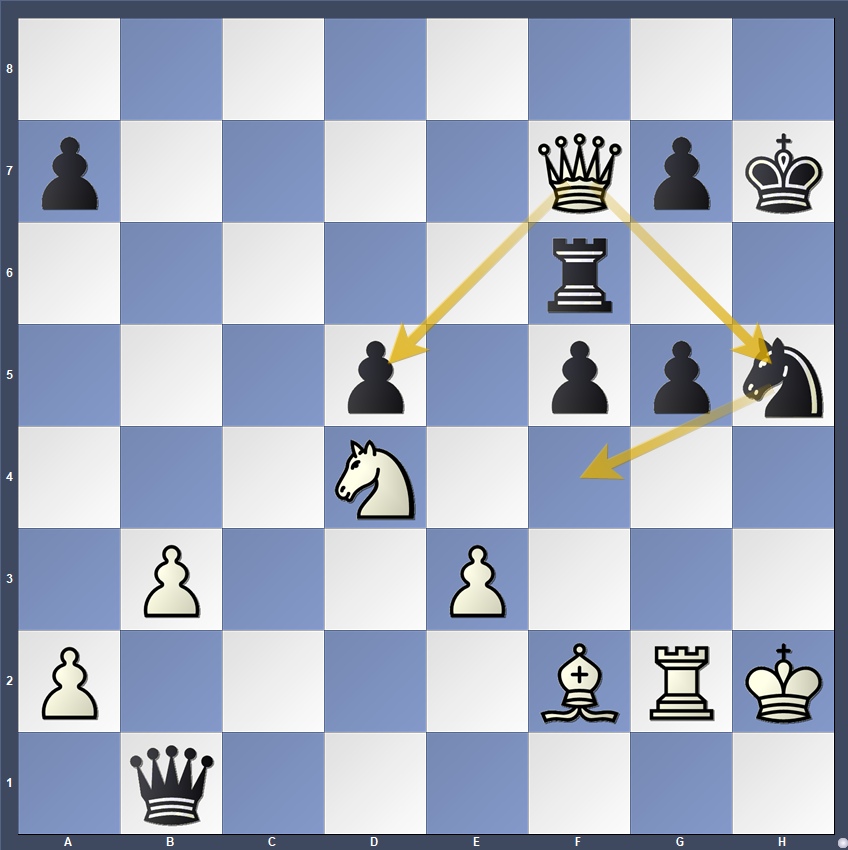
After 42.Qxd5? (better was42.Qxh5 giving up the queen but emerging slightly better) a brilliant, must-see combination followed. Lagno played 42…Nf4!, and after 43.exf4 Rh6+ 44.Kg3 Qd3+!, and White’s position collapsed.
The key point is that White cannot interpose with the knight on f3 due to the hanging queen on d5. In the game, 45.Qf3 was tried, but it runs into the spectacular decisive blow 45…g4!! blow. After 46.Qxd3 Rh3#, it is checkmate.
Reflecting on the dramatic turnaround, Lagno admitted in the press conference: “I was so disappointed that I even wanted to resign, but then I decided to fight on at least to move forty. However, I do have to improve my time management though.”
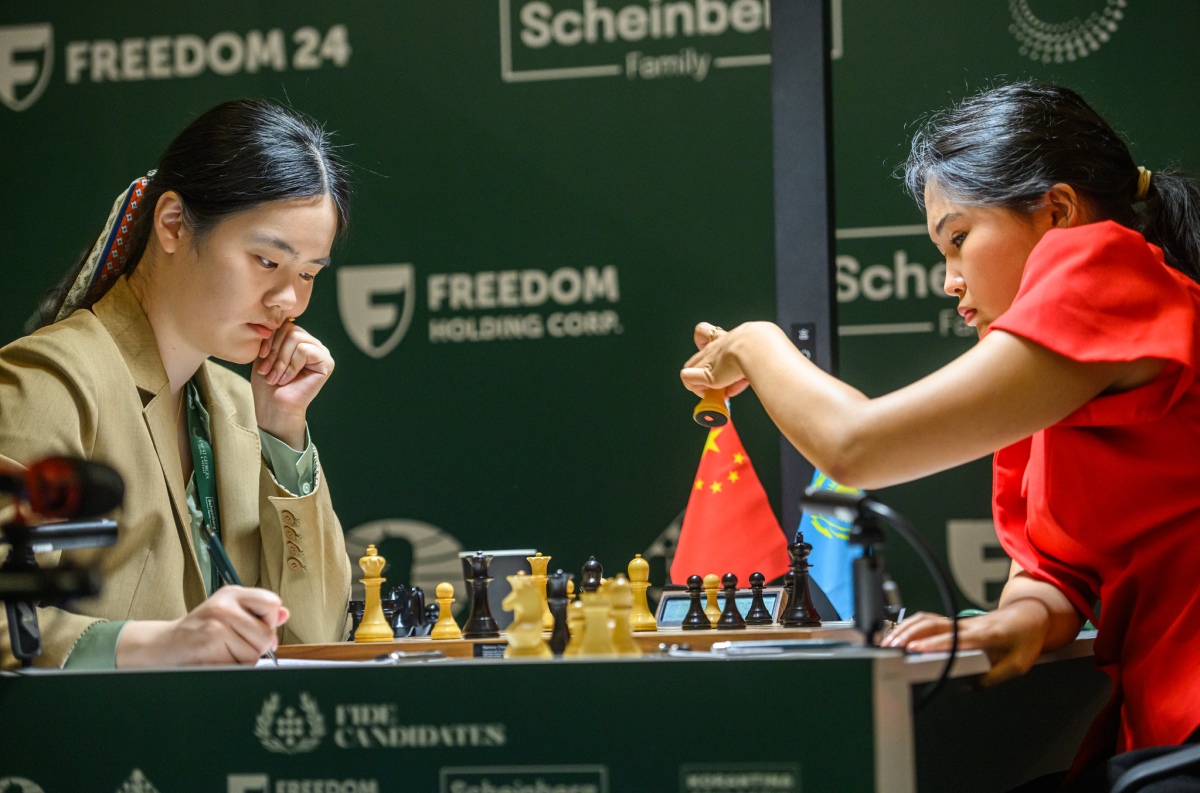
The game between Zhu Jiner and Bibisara Assaubayeva was yet another highly complex and tactical battle, one that, in truth, could have gone either way. Assaubayeva once again demonstrated her strength as a counter-attacker. The moment she sensed an opportunity to turn the tables and target Zhu Jiner’s king, she launched a direct and energetic counteroffensive.
To her credit, Zhu managed to sidestep immediate mating threats and steer the game into an opposite-coloured bishop endgame, positions that are famously drawish, even when one side holds an extra pawn or two. This time around, however, the usual rules did not apply. Assaubayeva maintained the initiative and converted her advantage with impressive precision, ultimately mopping up the endgame without giving her opponent any real chances to escape.
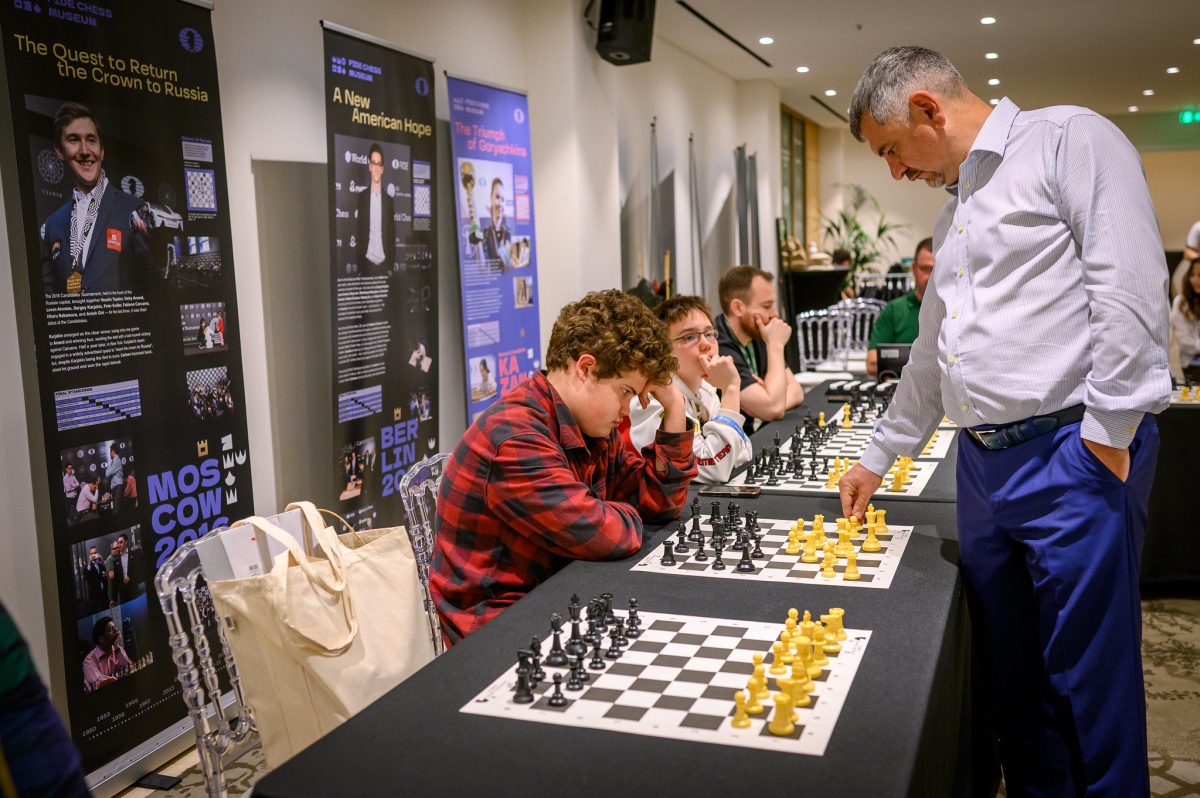
The fan zone continues to be a major attraction for spectators attending the event each afternoon. Victor Bologan, a former 2700+ rated player and current Executive Director of the FIDE Management Board, provided plenty of entertainment with a mid-afternoon simultaneous exhibition.
Facing fourteen opponents at once, Bologan delivered an impressive performance, finishing with eleven wins, two draws, and just one loss, much to the delight of the fans in attendance.
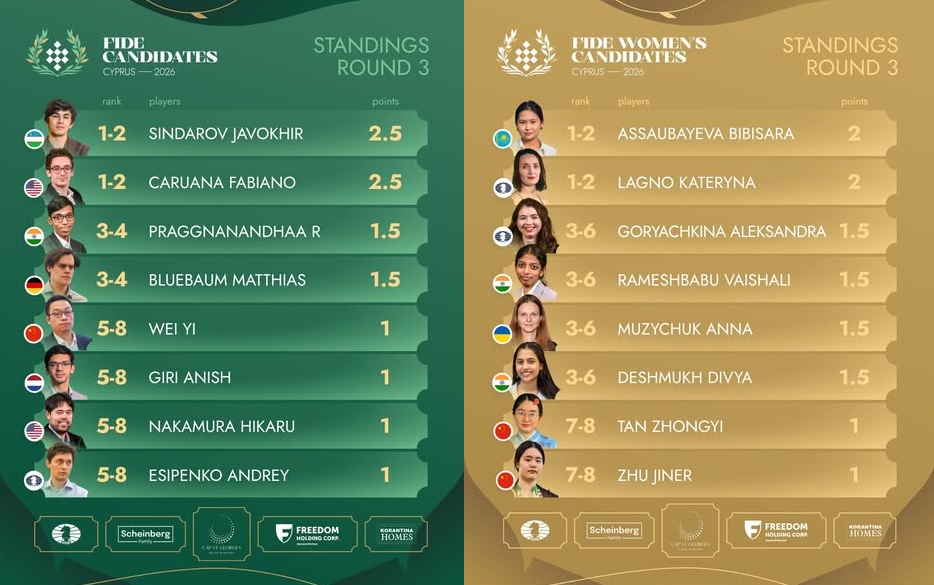
Standings after Round 3
The 4th round will commence on April 1, at 3:30 pm (Cyprus).
Round 4 pairings – FIDE Candidates Tournament:
Andrey Esipenko – Anish Giri
Wei Yi – Hikaru Nakamura
Javokhir Sindarov – Fabiano Caruana
Matthias Bluebaum – Praggnanandhaa R
Round 4 pairings – FIDE Women’s Candidates Tournament:
Anna Muzychuk – Kateryna Lagno
Bibisara Assaubayeva – Tan Zhongyi
Divya Deshmukh – Zhu Jiner
Vaishali Rameshbabu – Aleksandra Goryachkina
Official website: https://candidates2026.fide.com/
Event photo gallery: https://www.flickr.com/photos/fide/
Live daily broadcast with GM commentary: https://www.youtube.com/@FIDE_chess
Written by IM Michael A. Rahal (Cyprus)
Photos: Michal Walusza, Yoav Nis