

GCL 2025 Day 1: Defending Champions Triveni start season three with a victory

The third season of the Global Chess League began with a sold-out night at Mumbai’s Royal Opera House and three matches that set the tone for the event. The defending champions, Triveni Continental Kings, opened with a hard-fought win. The young Ganges Grandmasters suffered a heavy defeat against the home side, upGrad Mumbai Masters. In the final match, Fyers American Gambits edged out PBG Alaskan Knights in a tense encounter decided by a single decisive game. There were no easy points. Across the three matches, only a handful of games produced decisive results, and almost every board went deep into time trouble. The champions demonstrated their class, the underdogs showed they could hurt anyone, and by the end of the night, three teams had emerged with perfect match scores, with the race already taking shape. Standings after Day 1 Match 1. Triveni Continental Kings vs Alpine SG Pipers (9-7) Season three of the Global Chess League opened with a heavyweight clash between the defending champions, Triveni Continental Kings, and the Alpine SG Pipers at Mumbai’s Royal Opera House. The Kings came in as clear favorites, having won both previous seasons, and again fielded a star-packed team. Under the guidance of captain Loek van Wely, they lined up Alireza Firouzja, Wei Yi, Vidit Gujrathi, Alexandra Kosteniuk, Zhu Jiner, and GCL debutant Marc’Andria Maurizzi. About half an hour after the start, the evaluation bars pointed in Triveni’s favor. Wei Yi achieved a promising position on board two, while the remaining games were balanced. Then the mood changed. On the women’s board, Alexandra Kosteniuk fell into serious time trouble against Nino Batsiashvili. She was down to two minutes while Batsiashvili had around eight, and Kosteniuk’s position began to collapse. Batsiashvili converted, giving Alpine SG Pipers the first win of the match and the new season. Triveni struck back immediately on board one. Fabiano Caruana made a major mistake in a promising position, allowing Firouzja to sacrifice two pieces for a devastating attack. Alireza’s win leveled the score and restored momentum for the champions. Wei Yi then increased the pressure in his game against Anish Giri. Pushed back, the Dutch grandmaster kept playing, trying to create counter-chances, but Wei Yi maintained his concentration and finished the job, putting the Kings ahead on the top men’s boards. In the Indian derby, Vidit Gujrathi and R Praggnanandhaa played a tense game that ended in a draw. The women’s game between Zhu Jiner and Hou Yifan was also complex, but neither side managed to break through, resulting in another draw. The last game to finish was on the prodigy board, where Marc’Andria Maurizzi had a slight edge against Leon Luke Mendonca. Once he realized a draw would be enough for a team victory, he chose a safe path. The position simplified, and the opponents split the point. On the scoreboard, Triveni Continental Kings won the match 3.5–2.5. With three points for a win with White, four for a win with Black, and one point for a draw, this translated to nine game points for Triveni and seven for Alpine SG Pipers. The champions started their title defense with three match points. Match 2. Ganges Grandmasters vs upGrad Mumbai Masters (4-17) The second match of Day 1 presented a clear contrast in styles. The young Ganges Grandmasters faced the experienced upGrad Mumbai Masters, who enjoyed home-crowd support in Mumbai. upGrad started with all Black pieces but showed they were ready to fight on every board. For the first half hour, the match was roughly balanced, but the first serious problems appeared for Ganges on the Icon board. Viswanathan Anand, with White, was under heavy pressure from Maxime Vachier-Lagrave. At the same time, Ganges had reason for optimism, as Vincent Keymer took the initiative against Wesley So on board two and looked ready to press. Then came a turning point that hurt Ganges badly. On the prodigy board, Raunak Sadhwani blundered a piece in an equal position. The mistake was so significant that he resigned immediately. upGrad took four game points and an early lead. Ganges still had chances on the remaining boards. Polina Shuvalova was better against Humpy Koneru, while Javokhir Sindarov, fresh from his World Cup victory in Goa, outplayed Shakhriyar Mamedyarov and reached a very promising position. For a moment, it looked as if the young team might turn the match around. Instead, upGrad struck again. The second game to finish was on the top board, where Anand had to resign against Vachier-Lagrave. Another four game points went to the Mumbai side, pushing Ganges closer to a must-win situation on the remaining boards. That put extra weight on Keymer’s shoulders. He had a superior position against So and knew the team needed a victory. In time trouble, Vincent had more time than his opponent, but a rushed bishop sacrifice changed the balance. So defended accurately, escaped the danger, saved the game, and preserved upGrad’s large lead. Ganges finally scored when Shuvalova converted her advantage against Humpy Koneru, earning three game points and putting her team on the scoreboard. The match stood at four game points for Ganges against nine for upGrad, with two games still in progress. Both remaining games descended into wild time scrambles. On one women’s board, Stavroula Tsolakidou outlasted Harika Dronavalli in a nervous final phase to score the second win for Ganges. On the other side, Mamedyarov turned the tables against Sindarov and took the full point, extinguishing any hope of a comeback. The games were often close on the board, but the overall numbers told a different story. The final score was 4.5–1.5 in favor of upGrad Mumbai Masters, who took three match points. In game points, upGrad scored 17, while Ganges Grandmasters finished with four. The experienced home team started their campaign with a convincing victory. Match 3. PBG Alaskan Knights vs Fyers American Gambits (8-5) The opening night of the Global Chess League ended with a duel between the PBG Alaskan Knights, led by World Champion Gukesh D,
Turkish Championship 2025: Işık Can captures maiden title
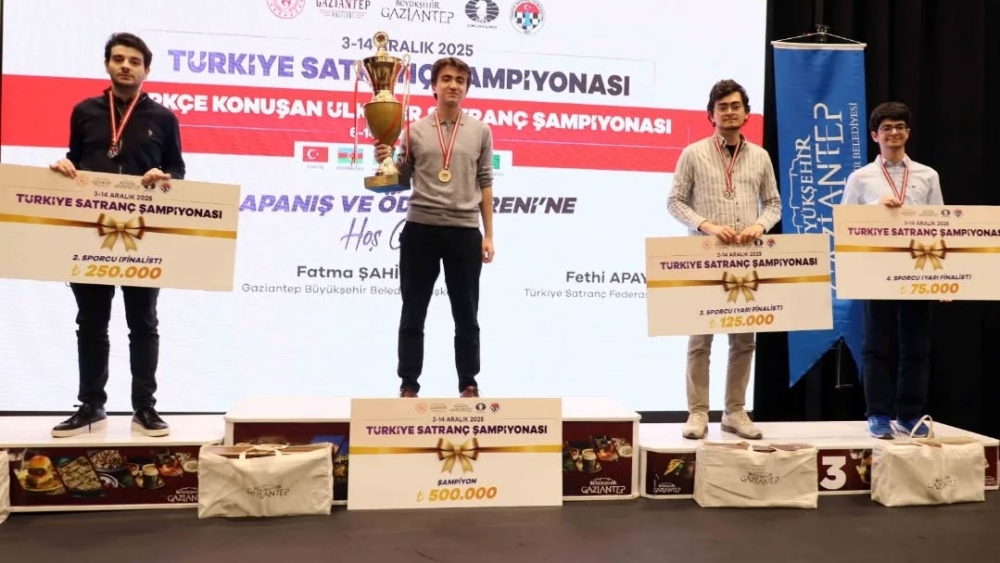
GM Işık Can has emerged as the winner of the 2025 Turkish Championship, claiming his first national title. The 60th Turkish Chess Championship, organized by the Turkish Chess Federation and hosted and supported by Gaziantep Metropolitan Municipality, was held at the Müzeyyen Erkul Science Center in Gaziantep from December 3–14. The competition followed last year’s format: ten players who qualified via a preliminary round were joined by six top seeds – GMs Mustafa Yılmaz (2594), defending champion Vahap Şanal (2546), Işık Can (2527), Cem Kaan Gökerkan (2502), and IMs Arda Çamlar (2490) and Alparslan Işık (2464) – in a 16-player knockout bracket. The rating favorite cruised to the quarterfinals, which produced the first major upset when top seed Mustafa Yılmaz was eliminated by qualifier Kerem Erten. Erten advanced to the semifinals alongside Şanal, Can, and Gökerkan. The Şanal–Can semifinal was an exciting clash in which the lower-rated player showed his mettle. In the first game, Can achieved a winning position with White in a Scotch Opening but let his advantage slip away. After a series of mutual mistakes, the opponents split the point. In the second game, Can again emerged with a better position but opted for a tempting piece sacrifice, leading to a roughly equal yet unbalanced endgame. Still Şanal faced some problems with potential Black’s pawn-chain advance in the center. The 2024 Turkish champion made a couple of subpar moves and found himself in a tough position. Can offered him a lifeline at one point, but Şanal immediately committed a grave mistake that cost him the game – and a spot in the final. In the second semifinal, Cem Kaan Gökerkan prevailed over Kerem Erten in a rapid tiebreaker to advance to the final. The final was dominated by Işık Can, who won both classical games to claim the championship title outright. In the match for third place, Vahap Şanal outplayed Kerem Erten to secure the bronze medal. Official website: tr2025.tsf.org.tr/ Photos: official website
Global Chess League opens Season 3 at Mumbai’s Royal Opera House

The first franchise-based chess league in the world – GCL – has entered its third season with a grand opening ceremony at the historic Royal Opera House in Mumbai. Is chess art, sport or entertainment? The game, long seen as an individual competition played in silence behind closed doors, is undergoing a transformative change both on and off the board. The Global Chess League – a bold attempt by TechMahidnra and FIDE to make chess into a billion-dollar fan-based league sport – is driving the charge. Capitalising on India’s rise as a global chess powerhouse, the third edition of GCL takes place in the country’s financial and entertainment capital – Mumbai. A royal ceremony for the royal game The Royal Opera House in Mumbai – whose foundations were laid in 1909 – is a unique architectural jewel in Asia, regarded as India’s only remaining traditional opera theater. With extravagant interiors mixing baroque and Indo-European influences, its auditorium ceiling provides an ideal acoustic reception from every part of the building. After opera performances, live music and film projections, the Royal Opera House will for the first time be the venue of a global chess event. The opening ceremony included the unveiling of the GCL Season 3 trophy. The ceremony was led by Anand Mahindra, Chairperson of the Mahindra Group, whose presence underlined the league’s ambition and growing global stature. He was joined by chess legends Viswanathan Anand, Arjun Erigaisi, Praggnanandhaa R, Harika Dronavalli, Volodar Murzin, and Alireza Firouzja. A trophy with a story The trophy itself tells part of the story of what GCL wants to be. Designed by Pininfarina, the 95-year-old Italian firm that helped shape Ferrari, Alfa Romeo and Maserati, it brings the language of fast cars and industrial design into the world of chess. Sharp, rising lines and polished metal give a sense of speed and movement. It is a fitting symbol for a rapid league that wants to grow quickly and speak to a wider public. For the next ten days, every move played in Mumbai will be made with that silver shape in mind. GCL as part of FIDE’s strategic effort For the International Chess Federation, the Global Chess League fits into a wider effort to bring chess to new audiences. FIDE President Arkady Dvorkovich did not hide his support for the project. “The Global Chess League has firmly established itself as one of the premier destinations for chess, bringing elite competition to a global audience in a fresh, modern, and exciting format. The GCL has an important role in FIDE’s strategic effort to popularize the sport and make it more attractive to the broader audience. I am certain that Season 3 will continue this evolution, showcasing the world’s best players and reinforcing FIDE’s commitment to making top-level chess more engaging, inclusive, and globally accessible.” The competition and the concept Season three keeps the basic structure that made the Global Chess League stand out from the start. Six franchises will compete across 34 matches, played over ten high-intensity days in a double round-robin, followed by a third-place playoff and the Grand Finale on 23 December. Every encounter is a six-board clash with a fixed mix of men, women and prodigies. Season 3 continues to feature six teams and bring the world’s elite onto a single stage. Among the big names headlining the season are Alireza Firouzja, Fabiano Caruana, Hikaru Nakamura, Wesley So, Maxime Vachier-Lagrave, Hou Yifan, Zhu Jiner, Bibisara Assaubayeva, and Alexandra Kosteniuk, alongside India’s finest, headlined by the former world champion and first Indian GM Vishwanathan Anand. Reigning two-time champions Triveni Continental Kings, led by Alireza Firouzja, Vidit Gujrathi, and Zhu Jiner, return with their sights set on an unprecedented hat-trick. Speaking at the pre-tournament press conference, Akash Premsen, CEO, Triveni Sports and Team Manager Triveni Continental Kings, said, “Coming in as two-time champions is a privilege, but it also raises expectations. The field is stronger than ever, and every match will demand precision. Our squad is experienced, balanced, and hungry, and we’re fully committed to defending the title with the same discipline that has defined our journey so far.” Kailash Kandpal, CEO, Ganges Grandmasters, framed his team’s approach in simple terms. “We’ve built our Season three squad around a solid core. The league continues to raise the competitive bar, and our focus is on consistency, teamwork, and delivering high-quality chess across all ten group-stage matches.” For PBG Alaskan Knights, World Champion Gukesh D and Arjun Erigaisi form a powerful spine. Team owner Punit Balan said, “With Gukesh and Arjun spearheading our lineup, competing in India adds a special layer of energy and expectation. Both are world-class talents, and the atmosphere here elevates every move. We believe our blend of youth, experience, and momentum positions us strongly for a deep run this season.” The FYERS American Gambits (who have added “FYERS” to their name), with Hikaru Nakamura as their icon, promise an aggressive, modern style. Their co-owner and CEO, Prachura PP, put it this way. “The Global Chess League has transformed how fans experience elite chess, and being part of that evolution is a tremendous opportunity. Our roster is dynamic and versatile, and we’re excited to bring an aggressive, ambitious style of play to a league that rewards bold, modern chess.” Alpine SG Pipers, fronted by Fabiano Caruana, Praggnanadhaa R and Anish Giri with Hou Yifan leading the women’s board, and UpGrad Mumba Masters, led by Maxime Vachier-Lagrave and Wesley So, complete a lineup that is strong on every board. “The calibre of players in Season three is exceptional, and we’re proud to contribute to that standard. With a roster built for high-quality, resilient chess, our aim is to deliver consistent performances from the opening weekend through to the knockout stages,” said Rohan Gupta, owner of Alpine SG Pipers. For the home franchise, UpGrad Mumba Masters, playing in Mumbai adds extra motivation. CEO Suhail Chandhok said, “This season features one of the most competitive fields we’ve seen, with world-class talent across every board. For
Vangelis Patrelakis and Maria Tsakona crowned Greek champions

IM Vangelis Patrelakis and WFM Maria Tsakona emerged as the winners of the Panhellenic Individual Championship in the open and women’s categories, respectively, each claiming their maiden national title. The 74th Panhellenic Championship and the 47th Panhellenic Women’s Championship were held concurrently in Aigio, Western Greece, from December 3 to 11. Both events followed a 10-player round-robin format under classical time controls. The 74th Panhellenic Championship was one of the most exciting in recent years, marked by an exceptionally close contest. Notably, no player finished the tournament unbeaten, with three participants—GMs Vasilios Kotronias, defending champion Stamatis Kourkoulos-Arditis, along with IM Vangelis Patrelakis—entering the final round tied for first place on 5/9 points. Kotronias and Kourkoulos-Arditis drew their final games, while the 21-year-old Patrelakis secured a crucial victory over Konstantinos Tsarsitalidis to clinch the title. Kotronias and Kourkoulos-Arditis shared second place with 5.5/9 points, with Kotronias taking silver on the basis of a superior Sonneborn–Berger score (the third tiebreaker). Final standings – Open In the 47th Panhellenic Women’s Championship, 19-year-old WFM Maria Tsakona dominated the field, securing the title with a round to spare and an impressive score of 7.5/9. Andrianna Anastasopoulou finished two points behind the champion to earn silver, while last year’s winner, WFM Georgia Grapsa, completed the podium with 5/9 points, reaffirming her consistent presence among Greece’s top female players. Final standings – Women “This year’s Championship was a true celebration of Greek chess—high-stakes, intensely competitive, with new talents dynamically vying for their place among the country’s top players. ESO will continue to support the young generation and take initiatives to elevate chess across Greece,” said Professor Stathis Evstathopoulos, President of the Greek Chess Federation, at the closing ceremony. Photos: Greek Chess Federation
FIDE World Cadet and Youth Rapid & Blitz Championships 2026: Registration now open
All FIDE member federations are invited to participate in the FIDE World Cadet U8, U10, U12 and FIDE World Youth U14, U16, U18 Rapid & Blitz Chess Championships 2026 to be held in Vrnjachka Banja, Serbia, from April 14 (arrival) to April 21 (departure) 2026. Gold medal winners from the 2025 World Cadet & Youth Rapid and Blitz Championships of the corresponding (or higher), age category have personal rights to participate provided they meet age requirements specified in the Invitation Letter. These participants will receive free full-board accommodation in double rooms. The participants, who need to apply for Serbian visa, shall submit their request for Invitation Letter no later than February 10, 2026. All registrations must be submitted exclusively through national federations. The registration deadline for participants and accompanying persons is March 20, 2026. Registration form (XLSX) Regulations and Invitation Letter (PDF) Email: wcyrb@fide.com Official website (coming soon): wcyrb2026.fide.com
FIDE Director for Chess Development visits Ethiopia

In his ongoing efforts to promote chess across Africa, FIDE Director for Chess Development, Grandmaster Nigel Short, paid a three-day visit to Ethiopia. He held a series of strategic meetings with local sports authorities, marking a significant step in strengthening the growth of chess in the country. Upon arrival in Addis Ababa on December 5, Nigel Short was welcomed by Mekiyu Mohammed, Minister of Sport Development and Teshome Bekele Geleta, President of Ethiopian Chess Federation (ECF) During their meeting, Minister Mekiyu Mohammed reaffirmed the government’s full support for the newly elected ECF leadership and expressed a strong commitment to close cooperation to elevate chess development nationwide. He emphasized the government’s readiness to facilitate and support the establishment of a FIDE Africa Office and ACC (African Chess Confederation) Headquarters in Addis Ababa, citing the city’s global diplomatic significance as the seat of the African Union and numerous international organizations. He highlighted that hosting these offices would accelerate both local and regional chess development. Nigel Short underlined the global and educational importance of chess, reaffirming FIDE’s readiness to support the Ethiopian Chess Federation across all development areas. He warmly welcomed the government’s willingness to host FIDE and ACC offices in Addis Ababa, stressing the strategic importance such a move would bring to the continent. Teshome Bekele Geleta expressed appreciation for the government’s continuous support and FIDE’s commitment. He noted that the Federation has ambitious plans to make chess an integral part of Ethiopian culture and highlighted that support from both the Ministry and FIDE is crucial to achieving this vision. A second key meeting was held with Gezahagn, a Senior Official of the Ethiopian Olympic Committee (EOC), and Teshome Bekele Geleta. The FIDE Director emphasized the strategic importance of collaboration between the EOC and the Chess Federation, particularly in preparation for global events such as the Chess Olympiad. Gezahagn expressed the EOC’s readiness to support the newly elected Federation leadership and to strengthen ongoing cooperation. Teshome Bekele Geleta conveyed his gratitude for the EOC’s commitment and reiterated the Federation’s readiness to work closely with the Olympic structure in all areas of mutual interest. Nigel Short also attended both the opening and closing ceremonies of the National Rapid and Blitz Chess Championships. He presided over the medal ceremony at the closing event, which served as a major motivation and source of inspiration for participating players and the chess community. As part of his visit, Nigel Short gave a simultaneous exhibition against 15 Ethiopian players, winning ten games, drawing three and losing two. Short remarked that this was one of the hardest simuls he had ever given and commended the high level and fighting spirit of the Ethiopian players. FIDE Director for Chess Development also held an in-depth consultation with senior leaders of the Ethiopian Chess Federation. The discussion focused on long-term pathways for chess development, capacity building, and FIDE-ECF partnership enhancement. Teshome Bekele Geleta expressed deep appreciation for GM Short’s timely and impactful visit, noting that it brought renewed motivation to players and administrators alike. For his part, Nigel Short reaffirmed FIDE’s commitment to supporting Ethiopia in all aspects of chess development and expressed gratitude for the warm hospitality extended during his stay. Photos: Chess in Ethiopia
FIDE Official Statement on Fair Play

FIDE is aware of recent online publications alleging that the Fair Play Commission is unwilling to cooperate with arbiters, as well as personal attacks directed at members of the Arbiters Commission and Fair Play Commission. These claims are unfounded and misrepresent the extensive collaborative work undertaken in recent months. FIDE firmly reiterates that the strengthening of fair play in chess is a shared responsibility. Significant progress has already been made in aligning the functions of arbiters and fair play specialists, improving the pathways for fair play title acquisition, and enhancing training standards across both areas. This work continues with the full support of FIDE leadership. In accordance with the decision of the FIDE Council, the Fair Play Commission will convene another consultation meeting in the nearest days with all relevant stakeholders. The goal of this meeting is to finalize the next steps for improved coordination, training, and functional alignment between fair play and arbiter responsibilities, ensuring a unified and systematic approach to fair play control at major FIDE events. FIDE unequivocally denounces any publications, statements, or personal attacks that undermine these cooperative efforts or hinder the development of a strong, integrated fair play framework. We call on all members of the chess community to support constructive dialogue, professionalism, and respect for the institutions and individuals working to protect the integrity of our sport. FIDE – the International Chess Federation – remains fully committed to fair, transparent, and unified standards in chess.
Italian Championship 2025: Luca Moroni and Olga Zimina capture titles

GM Luca Moroni and IM Olga Zimina are newly crowned Italian chess champions. Both won their fourth national titles. The Italian Individual Chess Championship 2025 took place from November 27 to December 8 in the new Technical Center of Italian Chess Federation located in Spilimbergo, Friuli Venezia Giulia region, recently opened in September. The open event an eleven-player round-robin (Michele Godena had to withdraw for very serious personal reasons) was a fiercely contested tournament with three players – GMs Sabino Brunello, Luca Moroni and IM Francesco Bettalli – sharing the lead with 4.5/6 at the half-way mark. At this crucial juncture, the top seed Moroni – the only participant rated over 2500 – reeled off three straight wins (including one over Betalli) to surge ahead. Two draws in the last rounds secured him his fourth national crown with a final score of 7.5/10. Brunello finished a half-point behind the champion, remaining the only unbeaten player in the field, while Betalli rounded out the podium with 6/10. Final standings Open The women’s event, a ten-player round-robin, followed an even more dramatic script coming down to the wire in the final round. IMs Olga Zimina and Marina Brunello dominated the competition and entered the last round tied for the lead with 7/8. Brunello could not overcome the resistance of WFM Enrica Zito in an opposite-colored bishop endgame and had to settle for a draw, while Zimina scored a crucial victory over WFM Elisa Cassi to clinch the title. WIM Camelia-Adriana Ciobanu and WFM Giulia Sala shared third place, with the former earning bronze thanks to her victory in their direct encounter. Final standings Women FM Niccolò Casadio emerged victorious in the Under 20 Open section, while Giulia Sala was crowned the best U20 Woman based on her fourth-place finish in the Women’s Championship. Final standings U20 Official website: federscacchi.com/eventi/ Photos: Denis Scarpante
List of Member Federations having right to vote at General Assembly 2025 published
In accordance with the FIDE Electoral Regulations, FIDE has published the list of Member Federations eligible to vote at the 2025 General Assembly. The list includes the names of the Presidents and Delegates for each federation, as well as a separate list of suspended Member Federations. Member Federations having right to vote at the General Assembly 2025 (PDF)
World Rapid and Blitz Champions to Qualify for Total Chess World Championship Tour
FIDE and Norway Chess have agreed on the key qualification pathways for the Total Chess Tour 2026, the pilot tournament of the new world championship concept. The format is part of the broader Total Chess World Championship Tour, that will crown an overall champion across Fast Classic, Rapid, and Blitz, officially approved by FIDE. The Tour is expected to become one of the most prestigious additions to the elite chess calendar. The Total Chess initiative, launched by Norway Chess and approved by FIDE in October 2025, is designed to identify “The Total Chess Player”, a versatile competitor who excels across multiple time controls. The Tour will ultimately consist of four events per year in global host cities and award the title of FIDE World Combined Champion. A pilot event is planned from early to mid-October 2026. The official and full championship season to crown the FIDE World Combined Champion will begin in 2027. Qualification pathways for Total Chess Tour 2026 The three medalists of the 2025 World Rapid Championship and the finalists of the 2025 World Blitz Championship will earn the right to participate in the Total Chess Tour 2026. In addition, world champions will also qualify for the inaugural Total Chess World Championship Tour in 2027. The main qualification pathways for participation in the pilot tournament have been approved as follows: 1–2. The reigning World Champions, Gukesh Dommaraju and Ju Wenjun 3–5. The three medalists of the 2025 World Rapid Championship 6–7. The finalists of the 2025 World Blitz Championship 8–16. The top nine players in the classical rating list as of January 1, 2026 17–18. The winners of the 2026 Candidates and the 2026 Women’s Candidates. 19–21. The top three players in the classical rating list as of June 1, 2026 (excluding those already qualified) 22–24. FIDE Circuit / FIDE Open Circuit (special ranking, including only open events). The full Regulations, including player replacement rules, can be found [HERE]. About Total Chess World Championship Tour The Total Chess World Championship Tour introduces a new combined world title spanning Fast Classic, Rapid, and Blitz. Fast Classic is an innovation of classical chess with a shorter time limit, down to 45 minutes plus a 30-second increment, and will receive classical rating. The Tour will feature a minimum $2.7 million annual prize pool, including at least $750,000 for each of the first three events and $450,000 for the Finals (with four players), plus performance bonuses.