

Top contenders at FIDE World Rapid & Blitz in Doha

From Carlsen and Nepomniachtchi to Abdusattorov and Erigaisi, the top seeds in the Open arrive as clear – favourites yet face a hungry field of challengers. The final week of the calendar year means one thing in chess – The FIDE World Rapid & Blitz Chess Championships. The event traditionally brings together the best players in the world for a week-long event of high-stakes chess and drama, and 2025 is no exception. As per tradition, the greatest public interest is reserved for the Open section, which Magnus Carlsen has mostly dominated in recent years. While a new generation of super-GMs rising rapidly, the top-10 list of players in the Open in Doha is still dominated by seasoned players. Here is a look at the top players in the Open in the 2025 FIDE WRB by rating, vying for the top spots. Magnus Carlsen Magnus Carlsen arrives in Doha as the top seed in both Open Rapid (2824) and Open Blitz (2881) on the official participant list. He won the world rapid crown five times (2014, 2015, 2019, 2022, 2023) and the world blitz as many as eight times (2014, 2017, 2018, 2019, 2022, 2023, 2024; albeit, the 2024 title is shared with Nepomniachtchi). With 12 total crowns, he is by far the most successful player in blitz and rapid formats. By his own confession, Carlsen is more interested in faster formats than classical chess. He continues to show that in 2025 – winning the SuperUnited Rapid & Blitz in Croatia and taking the overall title in the “Freestyle Chess Grand Slam Tour” and the inaugural Chess Esports World Cup. However, this year’s appearance is different to previous ones at the WRB: Carlsen recently become a father which for most new parents usually means lack of sleep. Whether that will have an impact on his performance remains to be seen. Ian Nepomniachtchi Ian Nepomniachtchi is the second seed in both rapid and blitz in Doha, with ratings of 2762 and 2801 respectively. The two-time challenger for the title of world champion in classical chess has a collection of “almost victories” at the World Rapid and Blitz, with three silver and two bronze medals from in rapid (including from Warsaw 2021, where he finished second on tiebreak, behind Abdusattorov). He also has a silver medal from the 2014 World Blitz in Dubai. Nepomniachtchi’s biggest success so far is sharing first place in the 2024 World Blitz in New York. Alongside Carlsen, Nepomniachtchi has for years been one of the central figures of the chess world, winning or placing near the top of the biggest events. In Doha he will be one of the main candidates for the crown in both formats. Levon Aronian Levon Aronian is seeded third in rapid (2756) and fifth in blitz (2774). The last time he won the World Rapid was in 2009, and the World Blitz in 2010. At 43, he continues to hold his own against the hungry young lions coming up in chess. In 2025 he showed that he can still win the biggest events by defeating Carlsen in the final of the “Freestyle Chess Grand Slam” event in South Africa. With a long record of success in mixed rapid and blitz formats, Aronian is one of the toughest and most experiences competitors in Doha. Fabiano Caruana Fabiano Caruana is the fourth seed in rapid seventh in blitz, both with a rating of 2751. The former candidate for the world crown and five-time US champion, Caruana is a long-time member of the absolute elite of chess. He was among the top scorers in the 2024 WRB, and – when in form – he is extremely difficult to stop. In 2025 he continued to fight for top places in super-tournaments and will be one of the most formidable players in Doha. Maxime Vachier-Lagrave Seeded fifth in the rapid (2730), and 11th in blitz (2745), Maxime Vachier- Lagrave is one of the most established stars in fast chess formats. In 2021 he won the World Blitz crown, edging out Jan-Krzysztof Duda in his native Warsaw. With a long list of rapid and blitz titles, France’s long-time number player, MVL has maintained high consistency throughout the years. He will arrive in Doha straight from the Global Chess League in Mumbai, where he leads the team of upGrad Mumbai Masters fighting in season three of the event. Vladislav Artemiev Although only 27, Vladislav Artemiev has long been a fixture in elite chess events. The Russian GM has won multiple blitz and rapid titles from Russian championships and strong online events such as the Champions Chess Tour and the Speed Chess Championship. Rapid and blitz formats are Artemiev’s forte. In Samarkand, in 2023, he finished third in the World Blitz – behind Carlsen and Dubov. This is his only World Rapid/Blitz medal so far (having narrowly missed on a medal in blitz in Warsaw). In Doha, he will be looking to change this and secure a medal in either or both formats. Nodirbek Abdusattorov Nodirbek Abdusattorov first attracted global attention at the 2019 World Rapid and Blitz in Moscow, where he started the blitz tournament with 5/5 and then held Carlsen to a draw in round six in a very tense game. Since then, he rapidly rose to prominence, as a stellar exponent of Uzbekistan’s growing chess influence. The young Uzbek star has a World Rapid crown, which he won in 2021. He was the youngest ever World Rapid Champion at 17 years and three months. Now Uzbekistan’s biggest chess hope, he is on the rise, willing to take on anyone, hungry and strong, performing strongly wherever he appears. Abdusattorov’s main challenge will be to handle his ambition and steady the nerves as he fights with the old guard. Richard Rapport The Hungarian GM is recognized as one of the most original players at top-level; his games are among the most entertaining. In 2024 at the WRB Teams, he defeated Carlsen in just 23 moves. His best individual finish
GCL Day 8: Triveni secure finals berth as Alpine closes in on second place

Day eight of the Tech Mahindra Global Chess League belonged to the champions and the teams who refused to give up. The Triveni Continental Kings crushed the Ganges Grandmasters 14–5 to secure their place in the final with a round to spare. It was a great day for the Alpine SG Pipers, who beat both the upGrad Mumbai Masters and the Fyers American Gambits in two tight matches to climb into sole second place. The PBG Alaskan Knights handed Mumbai a third straight defeat, tightening the race for the remaining final spot. Standings after Day 8 After seven days, Triveni were already clear on 18 Match Points, with the upGrad Mumbai Masters and Ganges Grandmasters six points behind. Day eight pushed them even further ahead. The Kings moved to 21 Match Points, removing any doubt about their presence in the final. Behind them, the table is now crowded: the Alpine SG Pipers ended the day on 15 Match Points, with Mumbai, Ganges, and PBG on 12, and the Gambits on 9. With one day of round-robin play left, only second place is still up for grabs. Match 24: Alpine SG Pipers vs upGrad Mumbai Masters (8–7) The day opened with the Alpine SG Pipers facing the upGrad Mumbai Masters. Both teams had suffered setbacks on Day 7 and, having played one match fewer than the rest, saw this as a direct chance to climb back into the fight for the final. In their first meeting, Alpine had beaten Mumbai 9–7 thanks to wins from Hou Yifan and Leon Luke Mendonca, with the remaining boards drawn. The same two boards decided the return match. Four of the six games were drawn, leaving everything in the hands of Hou and Leon once more. On the top women’s board, Hou Yifan faced Humpy Koneru in a Queen’s Indian Defence. Hou seized the initiative early, lost some of her edge, but then capitalised on a later error from Humpy to score a critical win for the Pipers. On the prodigy board, Bardiya Daneshvar hit back for Mumbai. In a French Defence, he outplayed Leon Luke Mendonca to bring home the full point. This narrowed the gap but did not change the match outcome. With Hou’s win and four draws, Alpine reached eight Game Points, while Mumbai finished on seven. The Pipers scored their second win over Mumbai and moved up to 12 Match Points, joining the group chasing Triveni. For Mumbai, this was a second straight missed chance to close the gap on the leaders, further weakening their hopes for the final. Match 25: Ganges Grandmasters vs Triveni Continental Kings (5–14) The second match of the day pitted the Ganges Grandmasters against the leaders, Triveni Continental Kings. In their first head-to-head on Day 4, Triveni had won 11–6. Now Ganges needed to strike back, especially after upGrad had again failed to separate from them in the standings. Both teams approached the match sharply. The first game to finish was between Vincent Keymer and Wei Yi in an English Opening. Neither side managed to unbalance the position, and the players agreed to a draw by threefold repetition. On the prodigy board, Raunak Sadhwani gained the initiative against Marc’Andria Maurizzi in a Giuoco Piano, but that game also ended in a draw. The early score was 2–2, but the real drama was still to come. On board five, Alexandra Kosteniuk scored first for Triveni. In a Caro-Kann, Stavroula Tsolakidou emerged a pawn up but then misplayed, allowing Black to launch a powerful kingside attack that decided the game in Kosteniuk’s favour, giving the champions a vital lead. On the second women’s board, Polina Shuvalova spoiled a winning position against Zhu Jiner, notably missing a checkmate in two. Instead, she walked into a completely lost ending. Another four Game Points went to Triveni, and the match swung heavily in their favour. Ganges scored their only win on board three, where Javokhir Sindarov defeated Vidit Gujrathi, but it was too late. To finish the job, Alireza Firouzja prevailed over Viswanathan Anand in a see-saw game, repeating their earlier result with the colours reversed on the scoreboard. The final result was 14–5 in favour of Triveni. The champions moved to 21 Match Points, now nine points clear of the field. No one could catch them: their place in the Tech Mahindra GCL final was confirmed. Match 26: Fyers American Gambits vs Alpine SG Pipers (7–8) Next, the Pipers returned to the stage to face the Fyers American Gambits, coming in encouraged by their win over Mumbai earlier in the day. Within twenty minutes of the start, Alpine had the initiative in three of the six games and were at least equal in the others. For the second time that day, Hou Yifan was the first to score for her team. She defeated Bibisara Assaubayeva after a miscalculated piece exchange left White in a lost rook endgame. Hou converted without difficulty and gave the Pipers an early lead. Things soon improved for the Gambits when Nino Batsiashvili overlooked a piece in her game against Teodora Injac. Despite that, Injac, in serious time trouble, did not manage to finish the job. She reached an endgame with an extra knight and two pawns against three pawns – a completely winning position – but misplayed it, allowing Black to advance a pawn so far that White’s only way to avoid defeat was to repeat moves. Injac was visibly shocked after the game, staring at the board for a long time. It was a lucky half-point for Alpine, who were gradually pushing the match in their favour. On the Icon board, Hikaru Nakamura and Fabiano Caruana drew, bringing Alpine another small step closer to victory. On board three, R Praggnanandhaa gained a completely winning position against Richard Rapport. In a knight-versus-bishop endgame, virtually every move would have won for Black, but Pragg chose the only line that led straight into a draw, granting a second lucky save to the Gambits. The last game
FIDE U9–U17 Rapid & Blitz Championships crown champions in Antalya

The FIDE U9-U17 Rapid & Blitz Chess Championship concluded on December 21 in Antalya, following nine thrilling rounds of Blitz competition. The two-day blitz segment of the championships attracted over 300 players from 31 countries, showcasing the rising global interest in youth chess. Below are the newly crowned Blitz Champions in both Open and Girls categories across all five age groups: Under 9 Open 🥇 Marc Barcelo Melnyk (ESP) 🥈 Nurali Nurshin (KAZ) 🥉 Oleksandr Savchuk (UKR) Under 9 Girls 🥇 Varvara Volkova (RUS) 🥈 Azaliya Balakanova (KAZ) 🥉 Elif Eren (TUR) Under 11 Open 🥇 Marc Llari (FRA) 🥈 Akhmediyar Sugraliyev (KAZ) 🥉 Ali Poyraz Uzdemir (TUR) Under 11 Girls 🥇 Alisa Genrietta Yunker (RUS) 🥈 Zhansaya Sholpanbek (KAZ) 🥉 Husnoraorkhon Khusnutdinova (UZB) Under 13 Open 🥇 Ramtin Kakavand (IRI) 🥈 Suleyman Akhmet (KAZ) 🥉 Makar Berdashkevich (RUS) Under 13 Girls 🥇 Lazizabonu Komiljonova (UZB) 🥈 Kristina Zavivaeva (RUS) 🥉 Mokhinur Xikmathonova (UZB) Under 15 Open 🥇 Yagiz Kaan Erdogmus (TUR) 🥈 Nam Kiet Nguyen (VIE) 🥉 Khumoyun Begmuratov (UZB) Under 15 Girls 🥇 Rosha Akbari (IRI) 🥈 Asiya Assylkhan (KAZ) 🥉 Anja Beber (SLO) Under 17 Open 🥇 Ediz Gurel (TUR) 🥈 Filip Magold (ROU) 🥉 Abkarali Abduhakimov (UZB) Under 17 Girls 🥇 Madinabonu Khalilova (UZB) 🥈 Binh Vy Nguyen (VIE) 🥉 Evgeniia Stanovskaia (RUS) Complete final standings Trophies were awarded to the top three federations based on combined results from both the Rapid and Blitz segments. Russia, Uzbekistan, and Türkiye were the most successful nations in the blitz competition, while Uzbekistan, Türkiye, and Russia led in the rapid standings. The closing ceremony took place at the Aska Lara Hotel and was attended by FIDE Events Commission Honorary Chair and Chief Inspection Officer Özgür Solakoğlu, President of the Turkish Chess Federation Fethi Apaydın, Ministry of Youth Sports Antalya Provincial officers, federation board members, players, parents and trainers. Official website: youthrapidblitz2025.tsf.org.tr/ Photo gallery: photos.app.goo.gl/8haNV29TMiGgSNvm8 Written by Kübra Ceylan Photos: Ozan Koşar
Tech Mahindra Global Chess League, Day 7: Triveni pull further ahead as Mumba collapse
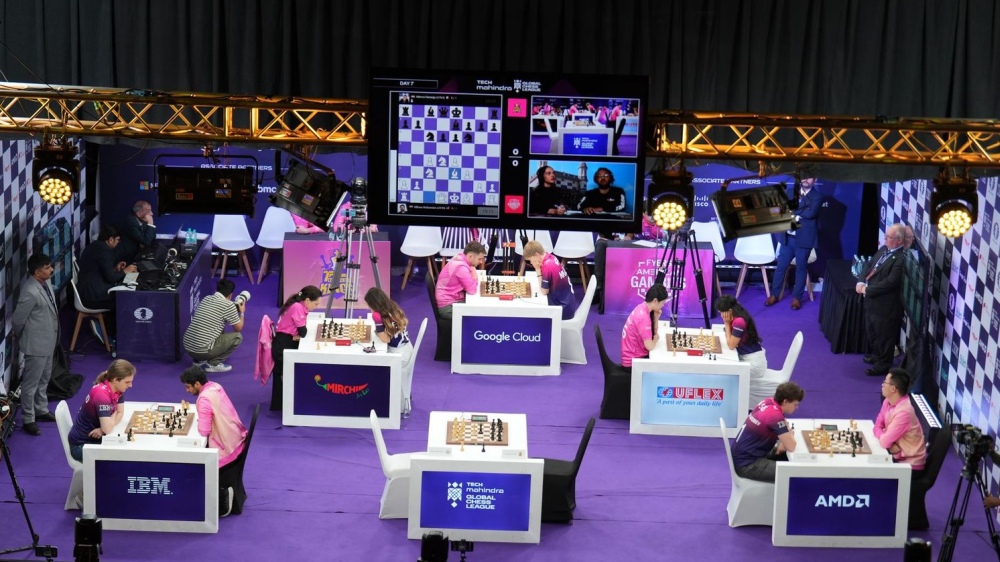
Defending champions Triveni Continental Kings scored another vital victory today, increasing their lead to 18 Match Points. Second-placed upGrad Mumba Masters were denied a chance to close the gap by Fyers American Gambits, who handed them a crushing 16–1 defeat. Ganges Grandmasters beat Alpine SG Pipers but then lost to PBG Alaskan Knights in the last match of the day With two to three matches left to play, Triveni are close to their third consecutive final in the Tech Mahindra Global Chess League. It was the second day of return matches at the Global Chess League in Mumbai. With two more days of round-robin play to go before the final, every team knows it has to push hard to reach the top two spots and keep its hopes alive in the race for the $1,000,000 prize fund. After six days and nineteen matches, Triveni were leading with five wins from seven matches, 15 Match Points and 70 Game Points. Despite a painful 12–8 loss to Alpine SG Pipers, they had bounced back in their second match of day six, edging PBG Alaskan Knights 10–9 to claim sole first place. Close behind on 12 Match Points, with one match fewer played, were upGrad Mumba Masters on 67 Game Points. Match 20: Fyers American Gambits vs upGrad Mumba Masters (16 – 1) upGrad were the first to take the stage. This was their only match of the day, their single chance to collect three Match Points and join Triveni at the top. In their first encounter this season, upGrad had edged out the Gambits 9–7 thanks to wins by Shakhriyar Mamedyarov and Bardiya Daneshvar. This time, while upGrad were looking to secure the lead, the Gambits had a score to settle. With the white pieces on all boards, the Gambits came out swinging. Early on, they gained the initiative on three of the six boards, including the Icon board and both Superstar boards. Like a general checking on his troops, Hikaru Nakamura stood up and walked around the stage, looking at each position to make sure his team was in control. The first to strike was Teodora Injac. The European champion from Serbia delivered a harsh blow to Harika Dronavalli in the Réti, finishing the game with a checkmate. Two quick wins followed. Bibisara Assaubayeva defeated Humpy Koneru, and Vladislav Artemiev scored against Wesley So. The score shot to 9–0 for the Gambits, with a heavy defeat looming for upGrad. Some respite came for upGrad when Bardiya Daneshvar drew with Volodar Murzin, bringing his team their first Game Point. At 10–1 the match was already decided. Even if upGrad had won the remaining two games, they would still have finished one point behind the Gambits. Instead, the blows kept coming: on the Superstar board, Richard Rapport avenged his earlier loss to Mamedyarov, defeating the Azeri grandmaster in a Giuoco Piano. The last game was between the Icon players, Nakamura and Maxime Vachier-Lagrave. Hikaru had won their first duel with Black. This time he obtained an even more comfortable position and took control early. MVL was clearly struggling, often staring away from the board, knowing he had to keep fighting while realising his chances were slim. Nakamura stayed focused, built up a decisive advantage and reached a completely winning rook endgame. With five wins and one draw, Fyers American Gambits produced their best score of the season, 16–1 in Game Points. They denied upGrad the chance to catch Triveni and moved up to nine Match Points, closing in the middle of the table. Match 21: Ganges Grandmasters vs Alpine SG Pipers (10 – 9) This was a clash between two teams sitting in the middle of the standings, both on nine Match Points. Ganges Grandmasters have had a roller coaster campaign – crushed by Mumba twice and beaten by Triveni, but also scoring big wins over Alpine, PBG and the Gambits to climb back into contention. Their recovery has been led by Javokhir Sindarov, Polina Shuvalova and Raunak Sadhwani, while Viswanathan Anand’s results have swung sharply from day to day. Alpine SG Pipers started the league with two losses and looked in trouble, then beat Mumba and Fyers, lost heavily to PBG but defeated Triveni to return to nine Match Points. Their season has been full of streaks and drama, with Nino Batsiashvili and Leon Luke Mendonca often rescuing them from difficult situations. In their first meeting, Ganges had won 13–7. Alpine hoped to change that, but playing with the black pieces on all six boards was a serious handicap. Even so, Alpine scored first. In an Alekhine Defence, Leon Luke Mendonca took control early, pushing his pawn to d3 and tying down Raunak Sadhwani’s pieces. White never shook off the pressure, and Mendonca converted his advantage and gave the Pipers an early four Game Points. Ganges replied quickly. Stavroula Tsolakidou defeated Batsiashvili in a Giuoco Piano, handing Nino her first loss of the event. On the Icon board, Vishy Anand and Fabiano Caruana drew a balanced Ruy Lopez. Neither player was willing to take excessive risk so early in the match. As the clock ticked down on all boards, tension mounted. Ganges got a key break when Anish Giri erred in a complicated but equal position and allowed Vincent Keymer to convert. The German grandmaster took his chance and pushed Ganges into a 7–5 lead. Things were not going well for Alpine on the second Superstar board either, as Javokhir Sindarov gained an overwhelming position against Praggnanandhaa. In time trouble he missed a checkmate in two but never lost control and eventually won. That victory took the score to 10–5 and secured the match for Ganges. Hou Yifan saved some ground for the Pipers. She fought back from a lost position against Shuvalova and turned the game around, denying Ganges a win by a big margin. The final score was 10–9 in Game Points. Match 22: Fyers American Gambits vs Triveni Continental Kings (7 – 8) In their second outing of
David Antón Guijarro and Marta Garcia Martin win 2025 Spanish Championship

GM David Antón Guijarro and IM Marta García Martín have been crowned Spain’s 2025 Absolute and Women’s Chess Champions, each securing their second national title. The Spanish Chess Championship 2025, a 9-round Swiss tournament, was held the Alanda Marbella Hotel from December 11-19. While men and women competed in the same pool, final rankings were determined separately by gender. Top seed David Antón Guijarro dominated the 100-player field, which included seven Grandmasters. He made a fantastic start by winning six straight games, leaving no doubt about his overall victory. Antón secured the title with a round to spare, finishing with an impressive score of 8/9. A remarkable seven players tied for second place with 6.5/9, but GM Jaime Santos Latasa claimed the silver medal and IM Daniel Alsina Leal took bronze, both benefiting from a superior Buchholz tiebreak. Notably, all three podium finishers completed the tournament undefeated. In the women’s standings, Marta García Martín edged out WFM Inés Prado Acebo on tiebreaks after both players finished with 5.5/9, sharing first place. Last year’s champion, Sabrina Vega, secured the bronze medal with 5/9. Final standings Official website: feda.org/feda2k16/ Photos: Facebook FEDA
GCL Day 6: Triveni stay in front as Mumba chase and pack closes behind
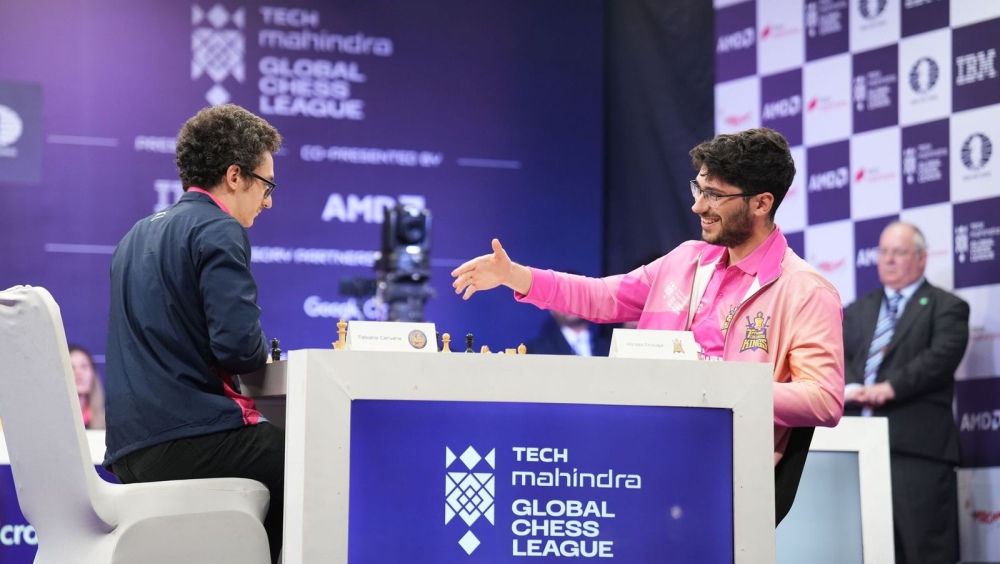
Day six opened the return round with four tense matches and dramatic swings at both ends of the table. The Triveni Continental Kings remain alone at the top after playing twice – losing to the Pipers but making a comeback against PBG – to stay in front with 15 Match Points. The upGrad Mumbai Masters are a close second with 12 Match Points after defeating the Ganges Grandmasters 11–6. The Alpine SG Pipers and Ganges Grandmasters share third place with 9 points, while the Fyers American Gambits and PBG Alaskan Knights are level on 6 Match Points. With the league now in the return round, four matches are played each day, and every result has a direct impact on the title race and the fight at the bottom. Standings after Day 6 Match 16: Fyers American Gambits vs PBG Alaskan Knights (8–9) The Fyers American Gambits started the day on six Match Points after a narrow loss to Ganges. The PBG Alaskan Knights, fresh from their first victory of the season against Alpine, were trying to climb away from last place. In their first encounter, the Gambits had won 8–5, and PBG came into the rematch looking for payback. PBG had the White pieces and started the match with clear intent. The first game to finish was on the Superstar board. Leinier Dominguez tested Richard Rapport in the Open Sicilian and obtained a small edge but fell behind on the clock. With no clear way to increase his advantage and the whole match ahead, Dominguez decided not to force the issue, and the players agreed to a draw. On one of the women’s boards, things soon went PBG’s way. European champion Teodora Injac reached a promising position against Sara Khadem but lost control. Khadem traded her h3-pawn for the opponent’s d3-pawn, took control of the c-file, and put the black king under pressure. In her search for counterplay, Injac fell into serious time trouble and ultimately blundered her queen. This was the first win of the match—and Khadem’s first victory of the tournament. Almost simultaneously, on the other women’s board, Kateryna Lagno let a sizable advantage slip away against Bibisara Assaubayeva and agreed to a draw. After three games, the score stood at 5–3 for PBG. Then came a huge moment on the first men’s board. In an equal bishop endgame, Vladislav Artemiev made a terrible mistake and allowed Arjun Erigaisi to push his pawn through to promotion. Artemiev had to give up his bishop for the new queen and could only hope for a miracle in time trouble, but it never came. Erigaisi calculated everything to the end and secured the win. With that result, the Knights increased their lead to 8–3 in Game Points. In the remaining games, the Gambits had little counterplay, and PBG seemed close to a smooth match victory. Then fortune swung sharply on the Icon board. World Champion Gukesh D reached a completely winning position against Hikaru Nakamura and was also ahead on the clock. However, he relaxed too early and blundered. Nakamura seized his chance and turned a hopeless position into a victory—a huge escape for the Gambits and a painful blow for Gukesh. The score narrowed to 8–7. Everything now depended on the prodigy board, where Daniel Dardha sacrificed a pawn against Rapid World Champion Volodar Murzin but did not get sufficient compensation. After sharp play in the centre and a series of tactical exchanges, Dardha managed to equalise and even put some pressure on Murzin. By then, he knew his team had already secured at least a draw in the match and that his opponent still needed to be careful. With that in mind, Dardha chose the practical solution: he offered a draw, and Murzin accepted. The final score was 9–8 in Game Points for the PBG Alaskan Knights. They took their second win in a row and moved level with the Gambits on six Match Points, keeping their season alive and tightening the middle of the table even further. Match 17: Alpine SG Pipers vs Triveni Continental Kings (12–8) The second match of Day 6 brought a repeat of the opening-round pairing between the Alpine SG Pipers and the defending champions, the Triveni Continental Kings. Triveni had won the first encounter 9–7 and started this match as sole leaders on 12 Match Points. Alpine were on six, boosted by recent wins and knowing they needed another big result to stay in the race. After the coin toss, the Pipers took White and came out fighting. From the first moves, it was clear this would be a tense, emotional match. The first breakthrough came on the women’s board. Nino Batsiashvili, Alpine’s most reliable player this season, scored her fifth win in six games. In the London System against former women’s world champion Alexandra Kosteniuk, Nino chose a sharp piece sacrifice. The idea looked risky and was not fully correct, but Kosteniuk failed to find the best defence. White’s attack grew menacing with every move, and the black king was driven into a net of checks and threats. With her position collapsing, Kosteniuk had to resign. Almost simultaneously, Anish Giri delivered another blow for Alpine on the Superstar board. Facing Wei Yi with White in a Queen’s Pawn Opening, he played aggressively from the start, brought all his pieces into the attack, and offered a rook sacrifice. Wei initially declined correctly but accepted a few moves later with catastrophic consequences. Giri broke through and forced resignation. After these two wins, the Pipers led the match 6–0 in Game Points. The champions then began their comeback. On the prodigy board, Marc’Andria Maurizzi secured an extra pawn in the middlegame against Leon Luke Mendonca and gradually took control. Leon tried to create counterplay but could not hold the endgame. Triveni cut the deficit to 6–4. The turning point seemed to come on the second women’s board. In a very sharp middlegame, Zhu Jiner outplayed Hou Yifan. The former Women’s World Champion missed an
Gleb Dudin and Szidonia Lazarne Vajda crowned 2025 Hungarian Champions
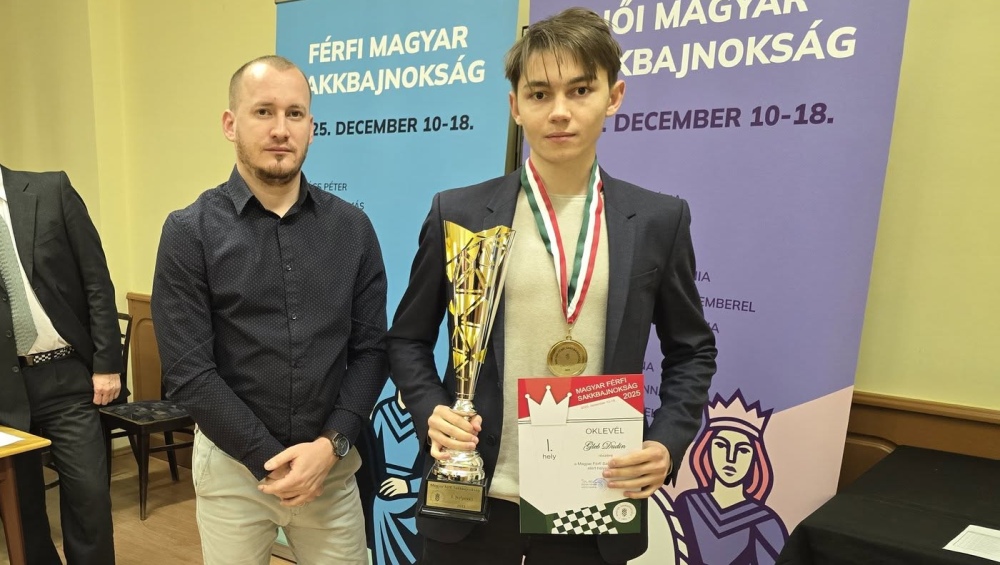
GM Gleb Dudin and IM Szidónia Lázárné Vajda triumphed at the 2025 Hungarian Chess Championships. Dudin captured his first national title, while Lázárné Vajda claimed her third Hungarian women’s crown, repeating her successes of 2004 and 2015. The Hungarian Individual Championship, featuring simultaneous open and women’s competitions, was held in Budapest from December 10–18. Both events were 10-player round-robins under classical time controls. Legendary Lajos Portisch making the first ceremonial move The open section turned into an exciting race between GMs Gleb Dudin and Tamás Bánusz. Dudin seized the lead early, but Bánusz caught up after Round 6. Their direct clash in the next round ended in a draw, and the two preserved their shared lead. Dudin pulled ahead in the penultimate round by defeating Ágoston Juhász, while his main rival could only draw. Trailing Dudin by half a point going into the final round, both Bánusz and top seed Benjamin Gledura (who finished strongly) were held to draws. Dudin, meanwhile, achieved a much better position against Sergey Grigoriants but decided to play it safe, settling for a draw to secure the title with a score of 6.5/9. Gledura and Bánusz finished half a point behind on 6/9 and tied for second place, with Gledura claiming silver thanks to a superior Sonneborn–Berger score. Notably, all three top finishers completed the tournament undefeated. Final standings – Open The Women’s Championship was even more tightly contested. IM Szidonia Lázár–Vajda and WFM Kata Karácsonyi tied for first with 6.5/9, with Lázár–Vajda winning the title by a mere 0.5 Sonneborn–Berger points. IM Nomin-Erdene Davaademberel scored 6/9 to take the bronze medal. Final standings – Women Photos: Magyar Sakkszövetség FaceBook
FIDE Global Conference on chess in society and education announced

Marking the launch of the FIDE Year of Chess in Education 2026, FIDE, in partnership with KIIT and the All India Chess Federation, is proud to announce the Social and Educational Chess Conference. The conference will take place from January 14 to 16, 2026 in Bhubaneswar, India. It aims to bring together experts from the fields of education, academic research, social development, public policy, and chess to critically examine and advance the use of chess as a structured instrument for learning and social impact on a global scale. “Chess has a unique ability to bring together education, social programmes, and public institutions. When it is organised well and supported by strong partners, it can reach people globally and create real opportunities for learning and participation. This conference is about sharing what works, learning from each other, and building stronger cooperation so that chess can play a meaningful role in education and social projects around the world,” said Arkady Dvorkovich, FIDE President. The event will take place at the Kalinga Institute of Industrial Technology (KIIT), one of India’s leading educational institutions, and will focus on two core pillars of FIDE’s global strategy: Social Chess and Chess in Education. “Education must go beyond textbooks and classrooms to nurture character, values, and the ability to think independently. Chess is a powerful tool in this journey, as it cultivates discipline, critical thinking, patience, and ethical decision-making. We are honoured that KIIT and KISS will host this global conference and partner with FIDE and the All India Chess Federation in advancing chess as an instrument for social transformation and inclusive education worldwide,” said Dr. Achyuta Samanta, Founder, KIIT, KISS & KIMS. Over the course of the conference, participants will examine how chess can support inclusion, education, rehabilitation, and personal development across different communities and age groups. The programme combines strategic discussions, academic research, practical case studies, and on-the-ground experiences. The first day of the conference, titled “Every Move Matters: Social Chess in Action”, will focus on social impact initiatives. Sessions will highlight the outcomes of FIDE’s Social Chess Year 2025 and present priorities for 2026. Speakers and project leaders from around the world will share experiences from initiatives working with refugees, prison populations, children in underserved communities, elderly participants, and individuals facing addiction and social exclusion. The programme will also address institutional models, partnerships, CSR engagement, volunteer management, and sustainable project development. As part of the Every Move Matters theme, the first day of the conference will conclude with the presentation of the FIDE Social Chess Storytelling Challenge. Short films submitted through the global initiative will be screened, showcasing real stories of how chess supports education, inclusion, and social change across communities worldwide. The evening programme will culminate in the announcement of the winning films, followed by a networking reception hosted by KIIT and the All India Chess Federation. The second day, “Every Lesson Counts: The Present and Future of Chess in Education”, will focus on chess in formal and non-formal education systems. Discussions will include current research on the cognitive and academic impact of chess, national and regional implementation models, teacher training, curriculum integration, and policy development. Digital tools and platforms supporting chess in education will also be showcased, alongside case studies from established programmes around the world. Beyond the main conference sessions, the programme includes exhibitions of social chess projects, educational workshops, networking activities, and presentations from digital and educational partners. Interactive formats such as audience Q&A, project showcases, and short film screenings will encourage dialogue and exchange between participants. The final days of the programme will be dedicated to site visits at KIIT and KISS facilities, local social chess initiatives, school activities, and Chess in Education teacher training courses, reinforcing the conference’s emphasis on practical application and long-term capacity building. The Social and Educational Chess Conference reflects FIDE’s ongoing commitment to developing chess as a tool for education, inclusion, and social development, while strengthening collaboration between institutions, educators, researchers, and federations worldwide. Registration detalis, speakers, and programme are published at https://soc.fide.com/global-chess-conference
Winners emerge from FIDE U9–U17 Rapid Championship; Blitz up next
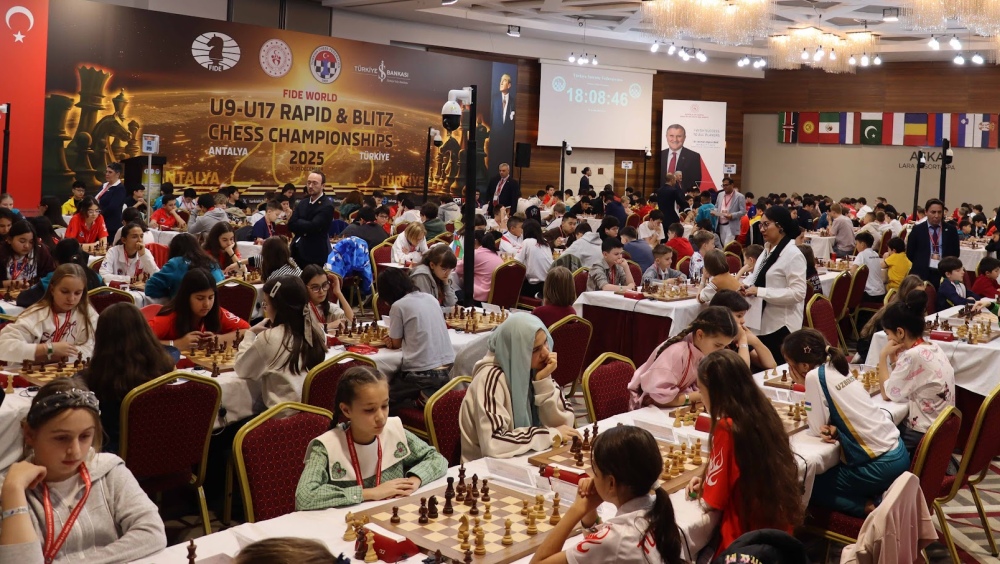
The rapid section of the FIDE U9–U17 Rapid & Blitz Chess Championship concluded on December 19 after nine exciting rounds played over three days in Antalya. Players now turn to the blitz portion of the event, which begins on December 20 and will be held over two days at an even faster pace. The Blitz championships will again be contested in Open and Girls sections across five age categories: U9, U11, U13, U15, and U17. A total of 310 players, including 98 titled players and 2 Grandmasters, have registered for the Blitz event. Those two Grandmasters are the Turkish youngsters Yağız Kaan Erdoğmuş and Ediz Gürel, both World Top 100 players. Erdoğmuş, who claimed a silver medal in the U15 rapid section, and Gürel, competing in the U17 blitz, are among the top contenders. Below are the newly crowned Rapid Champions in both Open and Girls categories: Rapid Champions – Open Category Title Name Federation Rating Points U17 IM Asrorjon Omonov UZB 2233 7 U15 IM Khumoyun Begmuratov UZB 2435 7½ U13 FM Ali Gür TUR 2073 7 U11 FM Marc Llari FRA 2135 7½ U9 CM Luca Protopopescu FRA 2096 7½ U13 Rapid Open Champion FM Ali Gür Rapid Champions – Girls Category Title Name Federation Rating Points G17 WIM Binh Vy Nguyen VIE 1950 7½ G15 WFM Rukiya Olimova UZB 1913 7 G13 WCM Kristina Zavivaeva FID 1956 6½ G11 WFM Alisa Genrietta Yunker FID 2128 8½ G9 Elif Defne Özer TUR 1529 7 U15 Rapid Girls Champion WFM Rukiya Olimova Pairing and results: s2.chess-results.com/tnr1318937.aspx?lan=1&SNode=S0 Official website: youthrapidblitz2025.tsf.org.tr/ Photo gallery: photos.app.goo.gl/8haNV29TMiGgSNvm8 The International School Chess Federation (ISCF) has launched a series of educational master classes to support young participants of the FIDE World U9–U17 Rapid & Blitz Championships 2025. Designed to enrich the championship experience, these sessions offer players, coaches, and parents practical insights into long-term development and high-level training methodology. Two master classes were held at the Aska Lara Hotel in Antalya, Türkiye. On December 17, GM Rustam Kasimdzhanov, FIDE World Champion 2004 and one of the world’s most respected chess trainers, led an online session based on his extensive coaching experience. Kasimdzhanov has served as second to Viswanathan Anand in three World Championship matches, worked with Fabiano Caruana during the Candidates and the 2018 World Championship cycle, coached national teams including Germany (European Team Champions, 2011), and in 2025 was appointed Head Coach of the Uzbekistan Men’s National Team. His work with elite players provides invaluable perspective on sustained, long-term improvement. The following day, December 18, FM/FT Alper Efe Ataman, Board Member of the Turkish Chess Federation, founder of Analiz Satranç publishing house, and author of Instructive Chess Miniatures, delivered a clear and structured in-person presentation on developing young talent, focusing on priority-setting, consistency, and sustainable progress. For more information, visit ISCF social media @ischoolchess or the official website. Written by Özgür Akman Photos: Ozan Koşar
I am woman, I am president: Women at the helm of national federations

Out of 201 FIDE members, only 13 have women presidents. In a slow but steady shift, more women are taking executive roles in chess and business. FIDE spoke to four women who run national chess federations. Here is what they say about the role women can play in chess away from the board. In 1971 the Australian singer Helen Reddy came out with the song “I am woman” which by 1972 reached the number one spot on the U.S. Billboard Hot 100 chart. The famous chorus “I am strong, I am invincible, I am woman,” went on to become an anthem of the rising feminist movement. At the same time, another story of women’s voices was taking shape: in 1971 FIDE organised the first Women’s Interzonal in Ohrid (which was Yugoslavia, at the time), a step towards bringing it in line with the competing system for men. The following year, Nona Gaprindashvili defended her world title against Alla Kushnir by the narrowest margin, eight and a half to seven and a half. In Skopje, the Soviet team with Gaprindashvili and Kushnir on the top two boards dominated the Women’s Olympiad. Also that year, Olga Rubtsova quietly became the first ever women’s world correspondence champion, and the only person in history to hold both over the board and correspondence world titles. For the first time since Vera Menchik, it became more common to talk about women in chess. On the board, women were already making a breakthrough in chess. But away from the board, they were almost absent from the rooms where chess was governed. Nona Gaprindashvili – who is the first woman in history to earn the title of Grandmaster – was also faced with dismissal by many of her male colleagues or men in positions of power. Turning back to the U.S. where the global feminist movement from the 1970s was most prominent, it took another three decades before the U.S. Chess Federation elected its first woman president – Beatriz Marinello (pictured below), in 2003. Today the picture of women in chess looks quite different, but it is far from transformed. At the moment, according to FIDE data, out of 201 member federations, only 13 have a woman president. That is still a small percentage, yet – it would have been unthinkable when Helen Reddy first recorded her song and Gaprindashvili faced Kushnir across the board in Riga. Things are changing. The changing times Recent years have seen more emphasis and support not just for getting women into chess, but for using chess to help them improve their own careers. FIDE has not only increased the number, scope and support for women’s events, but has made women’s chess one of its top priorities, with the Commission for Women’s Chess and the appointment of Dana Reizniece as the Deputy Chair of the organisation’s Management Board. For years, FIDE’s finances have been looked after by Zhu Chen – a former Women’s World Champion, who is the treasurer of the International Chess Federation and is tasked with overseeing revenue flow and ensuring financial transparency. The Commission for Women’s Chess has supported programmes that help countries build women’s national teams from scratch. A 2024 initiative helped nine federations to send a women’s team to the Chess Olympiad for the first time. A conference on chess and life balance discussed the impact motherhood has on a woman’s chess career. Development projects such as the Queen’s Gambit Challenge have brought together more than five hundred eighty women from over eighty countries for training and support. The struggles women face in chess – be it as players or decision-makers in organisations – are the same as those faced in business. A recent Global Gender Report by the World Economic Forum notes that women are a large share of the workforce but a much smaller share of senior leadership. Deloitte’s Women in the Boardroom report, published in March 2024, notes that “women hold less than one-quarter (23.3%) of the world’s board seats”. Like companies, chess federations exist in that same world. They are sports bodies, but they are also employers, event organisers and public facing institutions. When women take the chair in those organisations, they are not only symbols. They are also decision makers in a sector that shapes how millions of children and young people first meet the game. FIDE spoke to several women who are presidents of national chess federations and asked them to share their views and tips on women looking to make a career in chess which is not strictly tied to the performance on the chessboard. From Women’s World Champion to federation President Few stories link together a path from “I am woman” to “I am president” better than that of Xie Jun. She began in Chinese chess at six. At ten, she switched to what people in China call “international chess” and by sixteen she was already in the national team. In 1991, she became Women’s World Champion, the first world champion from outside Europe. She recalls that moment in simple terms, saying that nothing compares to seeing your national flag raised for the first time at a world title match. In parallel with her chess career, Xie Jun pursued a doctorate in psychology – an extremely rare combination in the chess world. Her transition from the board to the boardroom was gradual: After playing she started coaching, then taught at university and worked as a sports administrator, and in 2024 she became the President of the Chinese Chess Association. “Every promotion felt like a logical ‘next move’ on a larger board, if you want to change the rules, you have to help write them,” notes Xie Jun. Xie Jun making the first ceremonial move in the 2025 FIDE Women’s World Championship Match On the evergreen question of work-life balance, Xie gives a simple answer: “I treat life like a long game with two clocks: family and career. If you work hard enough and put your heart into it, you