

From chessboards to classrooms: How AI is transforming education
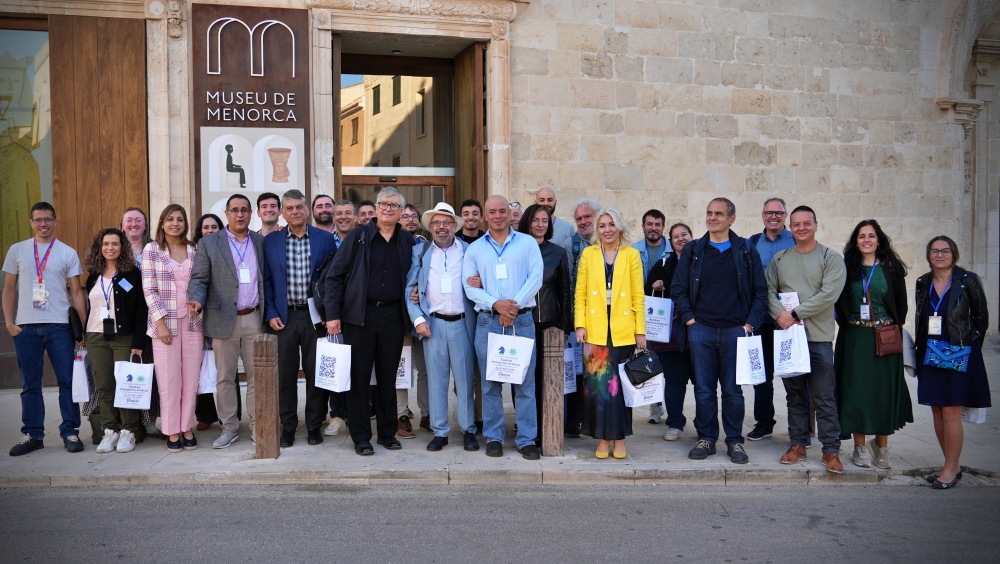
From April 24–26, international experts in education, technology, and chess gathered in Menorca, Spain, for the “Chess & AI in Education” Congress, organized under the framework of the FIDE. The event brought together leading voices to explore how artificial intelligence (AI) is reshaping the way chess is taught, learned, and applied—both inside and beyond the classroom. AI in education: Enhancing, not replacing The congress opened with a keynote by Dr. Mario Antonio Ramírez Barajas, a specialist in chess and education focused on how AI can enhance learning, coach training, and educational program development. His presentation highlighted the growing role of data-driven tools and personalized learning environments. Following this, Rita Atkins addressed one of the most pressing issues in modern education: the overuse and misunderstanding of AI. “They overuse it – they think they are obliged to use it because there is so much hype about AI… keep using yourself as the main instrument in the classroom and slowly introduce AI as a tool.” Atkins emphasized that AI should support – not replace – teachers, particularly highlighting its potential in special education: “AI is not replacing teachers… The chess classroom is mostly about playing with each other, and AI will never replace human interaction.” Bridging theory and practice in schools Practical applications were presented by Mauricio Arias, a key figure in educational chess within FIDE America, who shared his experience implementing chess programs in schools using digital tools. Dilda Nauryzbayeva examined how AI can enhance Chess in Education (CIE) through personalized learning and real-time feedback, while also acknowledging a critical gap between technological potential and measurable classroom impact. A unique intersection of chess and neuroscience One of the most compelling and memorable presentations came from Dr. Cristóbal Blanco, who shared a unique real-life case demonstrating the powerful connection between chess and brain function. During an awake brain surgery, the patient remained fully conscious while playing chess without sight of the board, announcing moves verbally throughout the procedure. This allowed the surgical team to monitor essential cognitive functions such as memory, concentration, and decision-making in real time. The operation was considered a success, and the patient was able to return to daily life, living two additional years with a good quality of life. Dr. Blanco emphasized that chess is far more than a game—it is a powerful tool for strengthening and evaluating cognitive abilities, even in the most critical medical situations. Inclusion through technology and chess The congress also highlighted chess as a tool for social inclusion and accessibility. Susana Gonçalves and Miguel Gonçalves presented Chess2Mind, a platform designed to make chess accessible for people with diverse needs. Their innovations include: Real-time voice interaction systems Tools reducing cognitive load Adaptive interfaces for users with speech or physical limitations These efforts reflect a broader vision of chess as a tool for community transformation and equal opportunity. The augmented teacher and digital innovation Mădălina-Maria Lejean-Anușca, leader of Romania’s national program “Education through Chess,” demonstrated how AI can enhance teaching through innovative pedagogy, combining chess with digital tools, creativity, and structured teacher training. Meanwhile, Fran Otero showcased technological solutions aimed at modernizing chess education and management. Dr. Isaac Lozano explored how artificial intelligence can be applied to game analysis, algorithm-assisted training, and data-driven learning tools, reinforcing chess as a testing ground for AI innovation. Beñat Lomas introduced practical approaches to using AI and digital systems to optimize clubs, tournaments, and educational programs, bringing efficiency into the organizational side of chess. Chess as a laboratory for innovation The congress also featured contributions from Dr. Jonathon Quest, founder of the first undergraduate chess degree program in the United States, and Andrea Manzo, who emphasized the need to move beyond using AI purely as a calculation tool and instead leverage it as a true educational resource. Educational experts Eloi Nortes Mesas and Ramón Pérez Rodríguez reinforced the importance of chess as a tool for holistic student development, integrating cognitive, social, and emotional learning. A shared vision for the future The event concluded with reflections from organizer Pep Suárez, who highlighted the transformative potential of AI: “Artificial intelligence is changing everything… and chess has always been a laboratory for innovation.” He also emphasized the importance of the international community gathered in Menorca: “These are top-level professionals from around the world… bringing strong energy and very good vibrations about the future.” The Menorca Congress demonstrated that the convergence of chess, artificial intelligence, and education is already shaping the future of learning. From AI-powered classrooms to neuroscience applications and inclusive technologies, chess continues to evolve as a powerful educational and social tool. The message was clear: The future lies in collaboration – between teachers, technology, and human creativity.
FIDE World Team Rapid and Blitz Chess Championships 2026: Top teams already confirmed for Hong Kong

The fourth edition of the FIDE World Team Rapid and Blitz Chess Championships will take place from 16 to 22 June in Hong Kong, marking the event’s first appearance in East Asia. Since its inaugural edition in Düsseldorf in 2023, this championship has grown into one of the most anticipated events on the calendar, bringing together world-class grandmasters and rising talents in a format unlike any other in competitive chess. It is one of the rare occasions in international chess where world-class players can be seen forming their own squads and playing as a team, something that is almost never seen outside of the Chess Olympiad. Top teams have already confirmed their participation, featuring some of the biggest names in the game, including world number one Magnus Carlsen, alongside the most recent FIDE Candidates and Women’s Candidates winners, Javokhir Sindarov and Vaishali Rameshbabu. The Rapid Championship will be played as a 12-round Swiss tournament across three days, with four rounds per day and a time control of 15 minutes plus a 10-second increment. The Blitz Championship follows on 20 and 21 June, beginning with pool stages before moving to a knockout format for the top 16 teams, with a time control of 3 minutes plus a 2-second increment. The total prize fund across both championships is €500,000, with the Rapid champion team receiving €110,000 and the Blitz champion team taking home €75,000. Registration is well underway, and a number of formidable teams have already confirmed their participation. WR Chess return as defending Blitz champions with a stellar lineup: Magnus Carlsen, Fabiano Caruana, Maxime Vachier-Lagrave, Wesley So, Jan-Krzysztof Duda, Andrey Esipenko, Alexandra Kosteniuk, and Hou Yifan. Carlsen and Caruana playing on the same team is a rare sight, and WR Chess will once again be the team to beat. Uzbekistan, captained by former FIDE World Champion Rustam Kasimdzhanov, bring Nodirbek Abdusattorov, Javokhir Sindarov, Nodirbek Yakubboev, Shamsiddin Vokhidov, Mukhiddin Madaminov, alongside Afruza Khamdamova and Umida Omonova. Sindarov arrives in exceptional form after winning the 2026 FIDE Candidates Tournament with a round to spare. Seeing him compete alongside Abdusattorov and his Uzbek teammates offers a preview ahead of the 46th Chess Olympiad in Samarkand later this year, where Uzbekistan will be amongst the favourites on home soil. Dragon Chilling bring together former World Champion Ding Liren and reigning Women’s World Champion Ju Wenjun in a powerhouse Chinese squad that also features Wei Yi, Yu Yangyi, Lu Shanglei, Bai Jinshi, and Lei Tingjie. The team name itself is a playful nod to the viral “Ding Chilling” moment during the 2024 World Championship match. Hexamind Chess Team return after an impressive second-place finish in the Rapid at last year’s edition in London. This time, their lineup includes Alireza Firouzja, Anish Giri, Levon Aronian, Volodar Murzin, and Kateryna Lagno. Chessgurukul feature Vaishali Rameshbabu, fresh from her historic victory at the 2026 FIDE Women’s Candidates, playing alongside her brother Praggnanandhaa, Aravindh Chithambaram, Pranesh Munirethinam, and Karthikeyan Murali. Vaishali became the first Indian woman to win the Candidates and will challenge Ju Wenjun for the Women’s World Championship, meaning both challenger and champion will be competing in Hong Kong on rival teams. Chess United bring five-time World Champion Viswanathan Anand together with former Women’s World Rapid Champion Humpy Koneru, Jorden van Foreest, and Jose Eduardo Martinez Alcantara. Their roster also includes Roman Shogdzhiev, the youngest International Master in history at the age of 10, and Tunde Onakaya, the founder of Chess in Slums Africa and Guinness World Record holder for the longest marathon chess game. Several other strong teams have also registered, including Chessnut Nova (featuring Raunak Sadhwani, Daniel Dardha, and MarcAndria Maurizzi), Global Ramblers (with Alexei Shirov and Alexander Motylev), and the Farm – Valera Chess Training team (with the legendary Vasyl Ivanchuk). Teams representing Indonesia, Malaysia, Mongolia, the Philippines, Spain, Australia, and many more regions are also set to compete, reinforcing truly international scope of this event. Register your team The registration deadline is May 15, 2026, 12:00 pm Lausanne time. The playing venue capacity is limited to 42 teams, with places allocated based on the highest team ratings and earliest registration, alongside six wildcard entries from the organisers. The entry fee is €1,000 per team. Each team must consist of a minimum of six and a maximum of nine players, including at least one female player and at least one recreational player. Full regulations and the registration form are available on the official event website. Registration form: https://formdesigner.pro/form/view/243338 Regulations (PDF) Contact: hkchessevent@gmail.com Photos: Rafal Oleksiewicz and Michal Walusza
Sérgio Pereira and Ariete Almeida crowned São Tomé and Príncipe chess champions

The São Tomé and Príncipe Chess Federation (FEXASTP) is pleased to announce the successful conclusion of the 2026 National Absolute Chess Championship and Women’s National Chess Championship, held at Hotel Miramar in São Tomé. The open tournament was played over 11 rounds and brought together the country’s top players in a highly competitive field. The rating favorite Sérgio Pereira lived up to his top billing and emerged as the winner, scoring 8.5 points out of 11. Waldyr Espírito Santo finished in second place with 8 points, maintaining an unbeaten record throughout the tournament. Jeremias Costa placed third with 6.5 points and achieved the title of National Master. Final standings – Absolute National Championship In the Women’s Championship, a seven-player round-robin, Ariete Almeida delivered a dominant performance, winning all six of her games. Emelisa Malone and Carla Taraveira claimed silver and bronze, respectively. Final standings – Women’s National Championship The Federation congratulates all participants for their commitment, sportsmanship, and contribution to the continued development of chess in São Tomé and Príncipe. The overall level of play reflects the steady progress of national chess and reinforces FEXASTP’s mission to promote the sport both locally and internationally. FEXASTP extends its appreciation to Abnildo Oliveira, President of Parliament, and all partners, organizers, and the venue, Hotel Miramar, for their support in ensuring the success of the championships. Photos: CST and São Tomé and Príncipe Chess Federation Facebook
FIDE Circuit 2026-27: Abdusattorov maintains the lead; Sindarov closes in
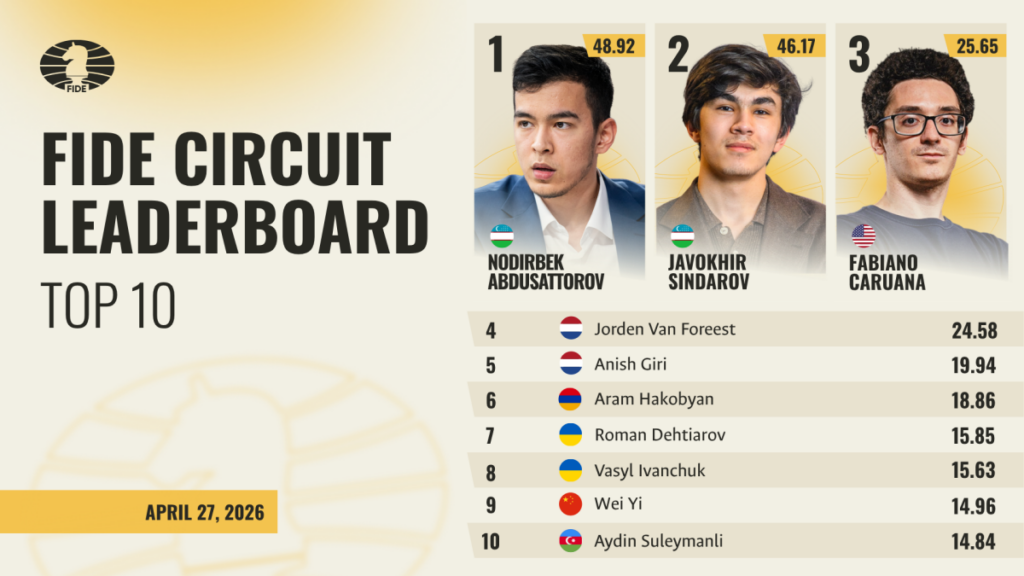
The recently concluded FIDE Candidates and the European Individual Championship have considerably reshaped the upper echelon of the FIDE Circuit 2026-27. Nodirbek Abdusattorov, who has not played classical chess since early March, preserved his lead, but Javokhir Sindarov trails him by only 2.75 points following his triumph in Cyprus. The runner-up and third-place finisher of the point-heavy FIDE Candidates tournament – Anish Giri and Fabiano Caruana – as well as Wei Yi, have also entered the Circuit’s top 10. Aram Hakobian moved up two positions after earning 6.2 circuit points for his third-place finish in the XXIII Karpov tournament, while Vasyl Ivanchuk collected 10.2 points in the Reykjavik Open and the X Open Internacional de Ajedrez Semana Santa San Vicente, placing third in both tournaments. Roman Dehtiarov, turning 18 this year, caused a major sensation in the European Individual Chess Championship by claiming the title. This result catapulted the Ukrainian teenager to 7th position in the circuit race. The bronze winner, Aydin Suleymanli, gained 10.09 points in this competition to round out the top 10. The FIDE Women’s Circuit 2026-27 also saw major shifts in the top layer, following the FIDE Women’s Candidates and the IV International Women’s Tournament in Uzbekistan. The winner of the Women’s Candidates, Vaishali Rameshbabu, surged to the top of the standings, followed by other top finishers: Bibisara Assaubayeva, Zhu Jiner, Aleksandra Goryachkina, and Anna Muzychuk. Ulviyya Fataliyeva’s victory at the IV International Women’s Tournament in Uzbekistan earned her 15.37 circuit points, propelling her to the fifth position in the race, while the runner-up, Nana Dzagnidze, broke into the top 10. We maintain dedicated pages on our website for the FIDE Circuit 2026-27, featuring the latest information on eligible tournaments, current standings, and regulations. Visit: FIDE Circuit 2026-27 and FIDE Women’s Circuit 2026-27
Chess debuts at South American Youth Games

FIDE President Arkady Dvorkovich visited Panama to take part in activities aimed at strengthening the role of chess in education and supporting its growth across Latin America. During the visit, he attended the 2026 South American Youth Games, a continental multi-sport event for young athletes. This is the first edition of the Games to include chess in the official program, providing new competitive opportunities for young players. FIDE President made the ceremonial first move and later participated in the awards ceremony. Alongside the Games, a seminar for school instructors was held, bringing together around 40 teachers from Panama. The seminar focused on modern methods of teaching chess in schools, equipping educators with practical tools to introduce the game to pupils and integrate it into the learning process. This initiative forms part of FIDE’s broader commitment to promoting chess as an educational tool worldwide. “Developing chess at the grassroots level is essential for the future of our sport. By introducing chess in schools, we not only nurture future champions but also equip children with valuable life skills. It is especially symbolic that 2026 has been designated as the Year of Chess in Education, reinforcing our global commitment to this mission,” said Dvorkovich. As part of the visit, he also met with Damaris Young Aranda, the President of the Panama Olympic Committee, Mario Moccia, First Vice President of ODESUR, and José Carrillo Pujol, President of the Confederation of Chess for America. The discussions explored future joint initiatives to further develop chess across Latin America. In recent years, the region has emerged as a dynamic hub for international chess, hosting major events such as the FIDE World Youth U16 Chess Olympiad in Colombia. Strengthening partnerships with continental organizations remains a strategic priority for FIDE as it continues to invest in the long-term, sustainable growth of the game.
Chess joins the International World Games Association

Lausanne, Switzerland – 25 April 2026 – The International World Games Association (IWGA) is pleased to announce that the International Chess Federation (FIDE) has been granted membership status within the organisation. The decision was taken by the IWGA Members during the Annual General Meeting (AGM) held at the Olympic Museum in Lausanne on 25 April 2026. Following a review process of the application submitted, IWGA Members voted to approve FIDE’s admission. With this decision, the number of IWGA Member Federations increases to 40. FIDE’s inclusion represents an important step in the continued development and diversification of the IWGA, further strengthening its global reach and the range of sports represented within The World Games Movement. As the international governing body for chess, FIDE brings a well-established global structure and a strong community of players and stakeholders. IWGA CEO, Joachim Gossow, welcomed the decision, stating: “We are very pleased to welcome FIDE as a Member of the IWGA. Chess is one of the most widely practised and recognised disciplines worldwide, and its inclusion reflects our commitment to embracing a diverse range of sports, including mind sports, within our organisation.” FIDE President, Arkady Dvorkovich, stated: “Chess is a truly global sport that unites millions of players across all continents through strategy, discipline, and creativity. Its inclusion within the IWGA reflects the growing recognition of mind sports alongside traditional athletic disciplines and the shared values of excellence, fair play, and international exchange. We are very excited for this new chapter and the opportunities it will bring for the continued development of chess within the international sporting movement.” The IWGA looks forward to collaborating with FIDE and exploring future opportunities within The World Games framework. About IWGA The International World Games Association (IWGA) is a non-profit-making international sports organisation recognised and supported by the International Olympic Committee. The IWGA comprises 40 International Member Sports Federations. It administers and promotes The World Games (TWG), a multi-sport event held every four years that features popular, traditional, emerging, and trend sports on its programme. The World Games 2025 took place in Chengdu (CHN) from 7-17 August 2025. 4,000 athletes from more than 110 countries took part in this 12th edition. The World Games 2029 will take place in Karlsruhe, Germany, from 19-29 July 2029, 40 years after it hosted TWG in 1989. Official website: https://www.theworldgames.org/
Chess for Inclusion: A powerful educational transformation in Catalonia
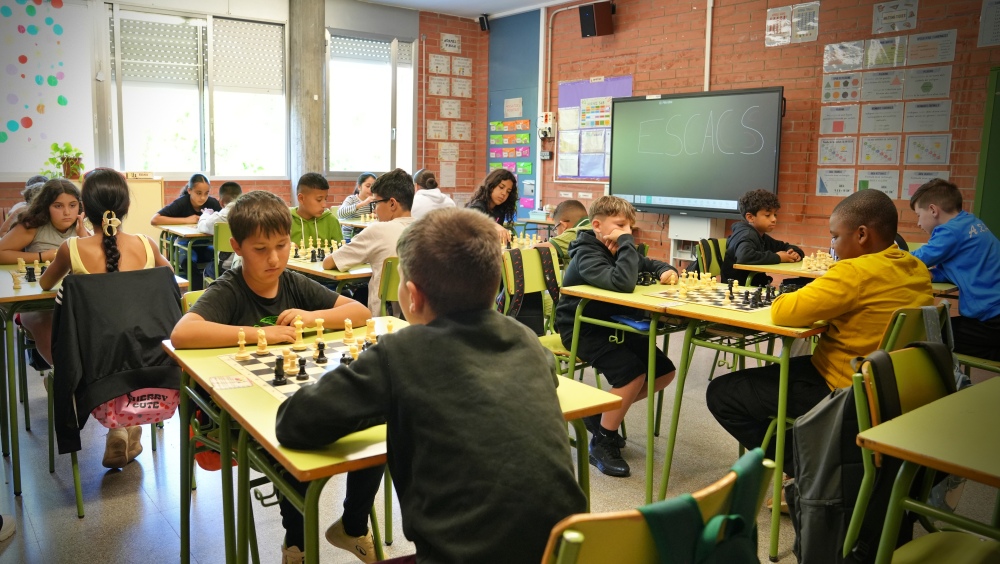
Barcelona, Spain – In Catalonia, chess is no longer just a game played after school. In public classrooms, it has become a powerful tool for learning, inclusion, and personal growth. Since the 2012 resolution by the European Parliament recognizing chess as a powerful educational tool, schools across the region have been building something truly innovative. With teacher training starting in 2014 and new methods developing since 2016, chess has become part of how children learn, not just what they learn. This transformation did not happen by chance. It is the result of years of dedication, training, and the hard work of many teachers, trainers, and chess advocates who strongly believe in the value of chess in education. At two public primary schools (children from 3 to 12 years old): Escola Jaume Balmes and Escola Ramon y Cajal, this vision is now a daily reality. Learning through chess at Escola Jaume Balmes At Escola Jaume Balmes, around 280 students aged 5 to 12 use chess as part of their everyday learning. Here, chess is not taught as a separate subject; it is used to teach other subjects. Teachers of all disciplines are trained to use chess as a learning tool in their classes. On the chessboard, certain squares include images such as cities or countries. When a student lands on one of these squares, they must answer a question. A correct answer allows them to continue and earn points. Subjects like mathematics, science, Spanish, and Catalan are all integrated into the game. Each subject has a color, turning learning into an interactive and engaging experience. In mathematics, for example, students use the movement of pieces, like the knight, to solve problems. The game itself becomes a way of thinking. A tool for inclusion In schools with many students from non-Spanish-speaking families, inclusion can be a challenge. Language barriers often make it hard for children to participate and connect. Chess changes that. Because it doesn’t rely on words, it gives every child a way to join in and feel part of the class. Zoya, a girl from Pakistan who arrived just three weeks ago, didn’t want to communicate with anyone except her sister. Through chess, she slowly began to connect with her classmates. Kimi from China spoke very little Spanish when he arrived in September. Chess helped him make friends, become more involved. Today he is a happy, fully engaged student. According to the teachers at school, chess creates a simple but powerful bridge: it helps every child feel included. A long tradition at Escola Ramon y Cajal In Terrassa, Escola Ramon y Cajal has been developing chess in education for many years. With over 400 students, starting from the age of three to twelve, the school has built a strong and lasting chess culture. A key figure behind this work is Toni Arboleas, a primary school teacher and chess expert who has played an important role in shaping the program. His experience and dedication have helped bring structure, resources, and a long-term vision to chess at the school. He actively involves other teachers, encouraging them to be present during chess lessons so they can learn how to use chess as a teaching tool themselves. In classes where chess is integrated into learning, there are always two teachers: the subject teacher and Toni, working together to guide the students and support each other. Learning by moving and playing For younger children, chess is integrated with physical activity. Using a giant chessboard in the gym, even children as young as three years old: Move between black and white squares Learn colors and spatial awareness Name squares and understand positions Set up the board and identify missing pieces They learn by moving, exploring, and playing. Chess competition The school has a long tradition of chess tournaments, running for more than 20 years. In recent years, they have become extremely popular among pupils. Participation is optional, yet many children choose to play during their breakfast break at 11a.m. They sit with their snacks and play chess in a relaxed, social atmosphere; it’s not a tense competition, but a shared moment. Students from different grades are paired together, for example, grades 2 and 3, or 4 and 5. Older pupils take on important roles: sixth graders act as referees and help explain the rules when needed. It is especially encouraging to see that at least 40% of the pupils taking part are girls, showing strong and growing female participation in the school’s chess activities. This is a great example of a school community, where everyone is involved and learning from each other. Rita Atkins, Secretary of the FIDE Chess in Education Commission and Lead Developer of FIDE’s training programs, visited schools in Catalonia, where she met with teachers and education officials. During her visit, she also delivered seminars and workshops for local teachers, sharing knowledge, ideas, and practical approaches to using chess in education. A key role in the visit was played by Marta Amigó Vilalta, who guided the FIDE team through the schools and introduced them to the Catalan approach to chess in education. The program itself is coordinated by two key figures: Eva Zamarreño from the Catalan Chess Federation, and Marta Amigó Vilalta from the Department of Education of Catalonia – the two institutions leading and promoting the initiative. What is happening in Catalonia shows that chess in schools truly works. In schools like Escola Jaume Balmes and Escola Ramon y Cajal, chess is helping children learn subjects, connect with others, and feel included, no matter their background, age, social status, or gender. This success comes from strong commitment and the hard work of dedicated teachers and leaders like Toni Arboleas. His message to other schools is clear: even if introducing chess feels challenging at first, it’s worth taking the step. It requires effort and commitment, but the impact on students makes it truly worthwhile. Photos: KNZO Photography
World Senior Team Championship heats up, reaching midpoint
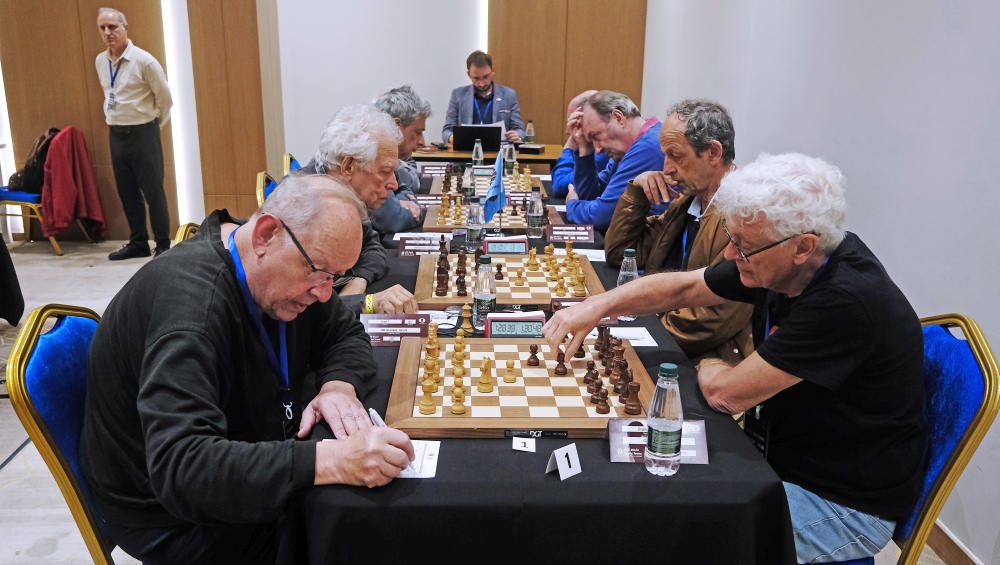
The battles have intensified in both sections of the World Senior Team Championship as the event has reached its halfway mark. In the 50+ category, going into Round 5, Kazakhstan, USA 1, Italy, and England 1 shared first place with 7 team points each (three wins and one draw). Round 5 featured key matchups on the top boards, with USA 1 facing England 1, while Kazakhstan took on Italy. Both encounters were crucial in the fight for the lead. After a long five-hour battle, USA 1 wrested victory by a score of 2.5–1.5, while Italy joined them in 1st place after narrowly defeating Kazakhstan by the same margin. Senior 50+ – Standings after Round 5 Similarly, in the 65+ category, the situation was also unclear prior to Round 5, as six teams were tied for 1st place: FIDE team, England 1, Germany, Italy, Israel, and France I, each with 7 team points. In the 5th round, the top contestants were pitted against each other. Matches between Israel and England 1, as well as between the FIDE team and Italy, both ended in draws, giving France 1 the sole lead with 9 team points after their victory over Germany. Although the women’s categories have been merged with the Open sections due to an insufficient number of participants, the ladies have delivered strong and competitive performances in both groups. In the 50+ section, Kazakhstan Women, with three wins and one loss, stood in joint 5th place going into Round 5, while Czech Republic Women, USA Women, and England Women shared 14th–20th place alongside several other teams. In Round 5, the Kazakhstan Women’s team was paired against one of the top seeds, Alkaloid Chess Club, and lost. The Czech Republic women’s team joined them with 6 team points in shared 8th–13th position after beating Brazil 1. The USA and England women’s teams were paired together and drew their match, remaining on 5 team points. In the 65+ section, FIDE Women led the women’s race before Round 5 with 5 team points, sharing 15th–20th place, followed by Latvia Women and Germany Women, both on 4 team points, while Poland Women had a difficult start, losing four matches. In Round 5, all women’s teams except one were defeated by their respective opponents, while Poland Women managed to secure a draw, resulting in no changes to their standings. Following the 5th round comes the long-awaited free day, with options for organised excursions around Durrës and Berat, as well as participation in an open rapid tournament. After this break, the players will return refreshed and well-rested for the final portion of the competition and the decisive last rounds. Stay tuned for the exciting finish! Text and photos: WFM/IA Georgia Grapsa Official website: https://wstcc.com/
FIDE opens applications for Olympiad Training Support Program 2026
FIDE is pleased to invite federations to apply for the Olympiad Training Support Program ahead of the 46th Chess Olympiad 2026 in Samarkand, Uzbekistan. This well-established and highly regarded initiative has earned strong appreciation from participating federations. Building on its success, the 2026 edition is delivered within the framework of cooperation between FIDE and Freedom Holding Corp., aimed at supporting developing chess nations. A total of over 100 federations across FIDE development levels 3, 4, and 5 are eligible to apply for this year’s program. Participating federations will benefit from a structured preparation program delivered in two phases: Online phase: Each team will receive up to 10 hours of training conducted by professional coaches selected by the FIDE Trainers Program. On-site phase: During the Olympiad, federations will receive co-financing for the presence of their assigned coach. FIDE President Arkady Dvorkovich emphasizes the importance of the program: “Over the past editions, the Olympiad Training Support Program has proven to be an impactful and widely appreciated initiative. It demonstrates FIDE’s commitment to supporting developing federations and ensuring that players have access to professional preparation. We are pleased to further expand this program in cooperation with Freedom Holding Corp. and look forward to another successful edition in 2026.” Timur Turlov, CEO of Freedom Holding Corp., added: “Supporting developing chess federations is an investment in the future of the game. Access to high-quality training and professional guidance helps unlock talent in regions where opportunities may be limited, creating a more inclusive and competitive global chess community. We are proud to contribute to this initiative together with FIDE.” Federations in development levels 3, 4, and 5 wishing to participate must confirm their interest in both the online and on-site phases and indicate their preferred language of instruction no later than May 22, 2026. Based on the number of applications and development levels, the FIDE Trainers Commission will design and allocate training resources accordingly. Olympiad Training Support Application Form (for Federations): https://formdesigner.pro/form/view/243554 FIDE-licensed trainers interested in supporting participating teams are also invited to apply by May 15, 2026. Olympiad Trainer Application Form (for Trainers): https://formdesigner.pro/form/view/243553 Eligible federations: Chess Development Level 5 Federations Antigua and BarbudaBurundiBhutanBelizeBurkina FasoCentral African RepublicCambodiaChadCameroonDemocratic Republic of the CongoComoros IslandsDjiboutiDominicaEritreaEthiopiaFijiGabonGambiaEquatorial GuineaGhanaGreenlandGrenadaGuineaIsle of ManBritish Virgin IslandsKiribatiLiberiaMacau, ChinaMarshall IslandsMaliNew CaledoniaNigerPapua New GuineaRwandaSenegalSeychellesSierra LeoneSolomon IslandsSomaliaSouth SudanSao Tome and PrincipeSudanSyriaTanzaniaTongaSaint Vincent and the GrenadinesYemen Chess Development Level 4 Federations Brunei DarussalamCote d’IvoireHaitiHong Kong, ChinaJapanSaudi ArabiaKuwaitLibyaLesothoMauritaniaNamibiaNepalOmanPalestineSaint Kitts and NevisWales Chess Development Level 3 Federations Netherlands AntillesAlbaniaAlgeriaAndorraAngolaArubaAustraliaBahamasBangladeshBermudaBoliviaBotswanaBahrainCayman IslandsChileCape VerdeCyprusDominican RepublicEgyptEl SalvadorFaroe IslandsGuernseyGuatemalaGuamGuyanaHondurasIraqUS Virgin IslandsJamaicaJerseyJordanKenyaSouth KoreaKosovo*LaosLebanonSaint LuciaMadagascarMoroccoMalawiMaldivesNorth MacedoniaMaltaMozambiqueMauritiusMyanmarNicaraguaNigeriaNauruNew ZealandPakistanPanamaPalauPuerto RicoQatarScotlandSan MarinoSri LankaSurinameEswatiniThailandTajikistanTimor-LesteTogoChinese TaipeiTunisiaUgandaVanuatuZambiaZimbabwe
World University Team Chess Championship: Registration deadline extended
IMPORTANT UPDATE: Due to the strong interest in the tournament from universities worldwide, and considering that additional time is required to complete all stages of the registration process, it has been decided to extend the registration period. The new deadline for applications is April 29, 2026, 11:59 PM (UTC). The best university teams will meet in Almaty, Kazakhstan, this August to compete for the title of FIDE World University Team Chess Champion. The World University Team Chess Championship is governed by FIDE and organized by the Kazakhstan Chess Federation, together with the Almaty city administration and with support from Kazakhstan’s Ministry of Sports and Tourism. The competition has three stages. It begins with Online Swiss Qualifiers, followed by an Online Knockout stage. The over-the-board finals will then take place in Almaty from August 3–10, 2026. There will be two Online Swiss Qualifiers. The registration deadlines are: April 29, 2026, 11:59 PM UTC for teams participating in Online Swiss Qualifier 1 May 4, 2026, 11:59 PM UTC for teams participating in Online Swiss Qualifier 2 The finals will feature 16 teams – eight that qualify from the knockout stage and eight wild cards invited by FIDE and the organizer. The tournament features an inclusive team concept – each match will be played on four boards, and lineups must include at least one female and at least one male player. Participation is open to university teams with players born between January 1, 2001 and December 31, 2008 who are currently enrolled in at least one class at the university. The winning team will become the FIDE World University Team Champion and receive a prize of €25,000. The team finishing second will be awarded €15,000, while the third-place team will receive €10,000. The entry fee is €100 per team. However, each national chess federation may nominate one university to participate free of charge. Payment details will be published on the tournament website. Team registration is available here: https://worlduniversities2026.fide.com Among the registered teams there are many well-known universities, including: Universidad de El Salvador The University of Texas at Dallas University of Auckland Riga Technical University Birla Institute of Technology and Science, Pilani (BITS Pilani) The Egyptian Chinese University Universiti Malaya University of Dhaka Universidad Nacional Autónoma de México (UNAM) Webster University Samarkand State Pedagogical Institute École Polytechnique de Ouagadougou For more information, please email worlduniversity@fide.com. Official website: https://worlduniversities2026.fide.com