

Building the future of chess far from the spotlight: How FIDE’s Development Fund is shaping chess around the world

By Milan Dinic While the global chess spotlight is usually fixed on elite competitions and players, a quieter transformation has been taking place behind the scenes. Over the past six years, FIDE has channelled nearly €9.4 million into grassroots chess development. Through its Development Fund, it has supported projects across continents and helped build chess in places rarely featured in the headlines. In July 2023, the Bahamas was celebrating the 50th anniversary of its independence. Across the islands, tourists mixed with locals at festivals showcasing Bahamian heritage, music and cuisine. Against the backdrop of the celebrations, a long-held dream was transforming into reality: the Bahamas Chess Federation brought together 16 talented junior players, including members of youth national chess teams from Central America and the Caribbean, for a summer chess camp to increase the number of rated players from the region. The programme was led by National Trainer CM Elton Joseph, and supported by two junior trainers, a female trainer as well as an experienced arbiter. It was seen as a firm step in building a grassroots youth chess initiative that has continued The project in the Bahamas is one of many supported by FIDE’s Planning & Development Commission over the years. This is all part of a global effort funded by FIDE to institutionally strengthen member federations through the provision of financial and technical assistance. The FIDE Development Fund Since 2019, the FIDE Planning & Development Commission (PDC) – which runs the Development Fund – has built a robust support mechanism to strengthen national federations, continental bodies and affiliated organisations. While PDC focuses on projects initiated by member federations and associations, the Development Fund also includes projects run directly by FIDE – such as in the Kakuma refugee camp, or Chess in Prisons or Chess in Slums. The Development Fund has enabled 801 projects totalling €5.65 million between 2019 and 2025. The vast majority of this funding has gone to continental associations and national federations, with smaller but meaningful support to FIDE commissions, zonal and affiliated organisations. In addition, continental associations receive €100,000 each year to support continental championships, zonal events, training and educational projects. FIDE has also provided more than €3 million in travel subsidies for the 2022 and 2024 Chess Olympiads, bringing the total amount of support to just under €9.4 million in the 2019-2025 period. The value of travel subsidies is expected to reach €2 million for the 2026 Olympiad. The travel subsidies were all directed to Level 3 to Level 5 federations, which would otherwise struggle to fund their participation in the Olympiads. The funding net is wide. Projects span from basic chess education, to coaching, cognitive development and inclusion. FIDE has supported federations through capacity building, arbiter training, event organisation, the purchase of boards, pieces and clocks, and travel and accommodation for players. The New Zealand Chess Federation, with the support of funding from PDC, successfully held the Bob Wade Memorial Masters as an IM norm tournament. It allowed IM Herman van Riemsdijk and GM Gabor Nagy to play in the 2025 New Zealand Championships. This helped make the event another norm tournament. “FIDE’s mission is to spread chess and use it as a tool to bring people and communities together. As with the Year of Social Chess or the ongoing Year of Chess in Education, we want to promote chess as a tool for cognitive development, social inclusion and a useful instrument in education systems and for that we need strong federations and grassroots initiatives,” says Dana Reizniece, Deputy Chair of the FIDE Management Board. “For FIDE, development is not a side project – it is the mission which we have been working on persistently, including through the Development Commission,” Reizniece added. How FIDE’s Development Fund works While support for federations existed before, since 2019, FIDE’s Planning & Development Commission has focused on promoting a more robust and consistent application and funding system. The Development Fund operates as a grant mechanism, with FIDE working directly with federations that need support. Beneficiaries have to apply for support through the PDC application process which publicly outlines criteria, guidelines and KPI frameworks that must be met for grants to be eligible for consideration. The funding cycle for 2026 opened in January. FIDE is also providing an incentive for early applications – an extra 10% in funding for applications submitted before July. “While FIDE has always worked hard on providing support to our member federations, since 2019 our goal was to make this process more formal and structured, providing clear guidance and equal opportunities to all federations to apply for grants,” says Laurent Freyd, International Arbiter and Chair of the FIDE Planning & Development Commission. This includes what PDC calls “soft support” for federations. PDC provides consultancy and capacity building through pitch meetings, helping federations improve project proposals, budgeting, and strategic planning. Pitch meetings also involve relevant commissions for cross-functional project evaluation, enabling real-time feedback and alignment. Institutional, not ad hoc support The Development Fund is financed from FIDE’s overall budget, which includes income from events and sponsorships linked to major FIDE competitions. The General Assembly’s 2026 budget shows that total income is projected to rise from €13.17 million in the 2025 budget to €18.85 million in 2026. The biggest driver of this growth is income from FIDE events, which jumps from €9.6 million in 2025 to €16.1 million in 2026. The increase in event-driven income means FIDE has greater resources for development programmes. For 2026 the organisation allocated €400,000 for national-federation support and €400,000 for continent funding, with additional support for zones, commissions and social/educational projects. As the funding is approved by the General Assembly and is independently audited, it is part of a structured financial system. For fairness and transparency, FIDE has introduced the Development Index to rank national federations based on their current capacity and capabilities. The index uses six parameters, grouped into three broad areas – chess population, activity and performance – to determine which level a federation will belong to. Level 1
Javokhir Sindarov breaks into top 5 on FIDE May 2026 rating list
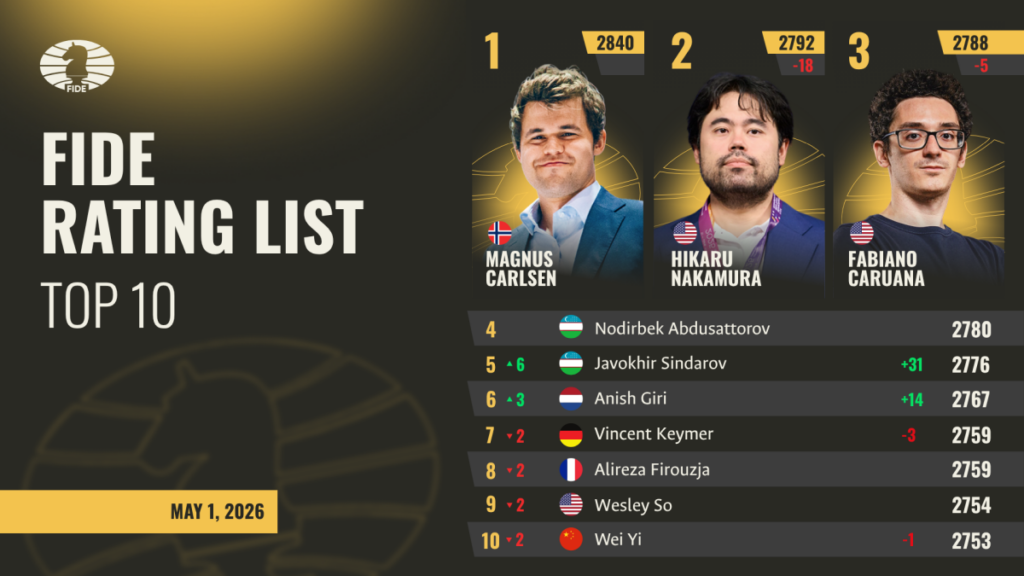
The May 2026 FIDE rating list was primarily shaped by the FIDE Candidates and Women’s Candidates, along with several strong open tournaments across Europe, including the European Individual Chess Championship. The top 10 Open saw two significant changes. The triumph at the FIDE Candidates 2026 earned Javokhir Sindarov 31 rating points and propelled him into the top 5 Open. The runner-up, Anish Giri, gained 14 points and climbing three places to No.6. Photo: Michal Walusza The second-place finish at the Women’s Candidates brought Bibisara Assaubayeva 11 rating points, lifting her to a career-high seventh position on the women’s list, while Aleksandra Goryachkina re-entered the top 5. Biggest gains in the top 100 Open and Women Kurmangaliyeva, Liya FM KAZ 2346 (+57) Yu, Jennifer FM USA 2358 (+38) Sindarov, Javokhir GM UZB 2776 (+31) Xiao, Yiyi WGM CHN 2389 (+28) Vaishali, Rameshbabu GM IND 2496 (+26) Savitha Shri B IM IND 2374 (+23) Erdogmus, Yagiz Kaan GM TUR 2708 (+21) Injac, Teodora IM SRB 2431 (+21) Milliet, Sophie IM FRA 2361 (+17) Shukhman, Anna WGM FID 2456 (+16) Photo: NZO Photography Liya Kurmangaliyeva (pictured above) recorded the biggest rating gain last month thanks to her excellent performances at the Reykjavik Open 2026 (+35 points) and the Grenke Chess Open 2026 A-Open (+22 points). Jennifer Yu returned to the top 100 Women after nearly seven years of absence, earning 38 points across those two tournaments. Xiao Yiyi shone in the 2026 Chinese Women’s Chess Team Championship, gaining an impressive 28 rating points, while Savitha Shri B overperformed at the Fagernes Chess International 2026 and Bratislava Norm Week – IM, adding 23 points to her tally. The Women’s Candidates winner, Vaishali R., earned not only the right to contest the title match but also 26 valuable rating points, bringing her within striking distance of the 2500 mark. Photo: Michal Walusza Turkish prodigy Yagiz Kaan Erdogmus (pictured above)dominated Veselin Topalov in their six-game match, convincingly winning by a score of 5–1. The result, worth 21 rating points, made him the youngest player to clear the 2700 Elo rating barrier (14 years, 10 months, and 13 days), surpassing the previous record held by Wei Yi by nearly a year. Teodora Injac (pictured below) emerged as the top female player at the recently concluded European Individual Chess Championship. Combined with a solid showing at the Reykjavik Open 2026, the Serbian IM returned to the Women’s top 30. Photo: Michal Walusza Sophie Milliet delivered at the CISF 2026 – Finale nazionale (+14 points), while Anna Shukhman proved her mettle at the V Open Chess Menorca 2026, gaining 16 rating points. Visit: https://ratings.fide.com/
Tickets now on sale for the FIDE World Team Rapid and Blitz Chess Championships 2026

The FIDE World Team Rapid and Blitz Chess Championships 2026 will be held at Queen Elizabeth Stadium in Hong Kong from June 17 to 21, marking the first time the event is hosted in East Asia. With 42 teams and more than 300 players confirmed, including seven of the world’s top ten male players and four of the world’s top ten female players, the championship brings the global chess spotlight to Hong Kong on an unprecedented scale.The field features World No. 1 Magnus Carlsen and women’s World No. 1 Hou Yifan, both returning with reigning Blitz champions WR Chess. Fans will also witness the most recent Candidates winners up close, Javokhir Sindarov and Vaishali Rameshbabu, who arrive in Hong Kong fresh from securing their World Championship matches in Cyprus. You can now secure your seats through the official ticketing platform, URBTIX, and choose between single-day tickets and multi-day packages. Single-day tickets 17 June, Rapid Day 1: HK$250 18 June, Rapid Day 2: HK$250 19 June, Rapid Day 3: HK$300 20 June, Blitz Day 1: HK$300 21 June, Blitz Day 2: HK$380 Package event passes Full Rapid Pass (17-19 June): HK$688 Full Blitz Pass (20-21 June): HK$538 5-Day All-Access Pass (17-21 June): HK$1,088 Early bird offer A discount of HK$100 is available on any package event pass purchased on or before 17 May. Terms and conditions apply. Tournament Village open to the public, free of charge Alongside the main competition, a dedicated Tournament Village will be open to the public free of charge, welcoming visitors of all ages. The Village is divided into three thematic zones covering traditional mind sports, emerging intellectual activities, and tabletop gaming, offering something for every generation. The event will also host the 2nd Asian Mind Sports Carnival, organised in conjunction with the Asian Mind Sports Association. The Carnival is set to bring together over 1,000 competitors from across the continent, taking part in more than ten disciplines including chess, bridge, Go, Xiangqi, and the Rubik’s Cube. Book your seats Tickets are available now at www.urbtix.hk/event-detail/15075. For more information, visit the official FIDE website.
Husan Turdialiev turns 70
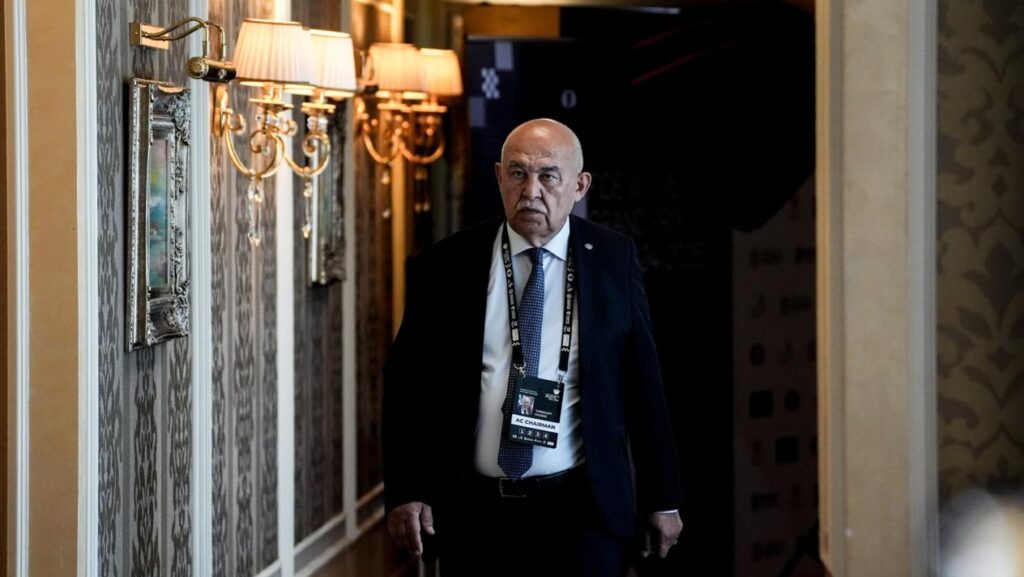
Renowned chess arbiter and organizer Husan Turdialiev has turned 70 today. Born in 1956 in Boysun (Southern Uzbekistan), Turdialiev graduated from Tashkent State University and after retiring from government structures, he devoted himself to chess, excelling in refereeing and organizing various competitions. In 2001, Turdialiev was awarded the title of International Arbiter and, for over 25 years, has compiled an impressive resume officiating major chess competitions, including the following: Chief arbiter at FIDE Zone 3.4 Championships (2008, 2011, 2013, 2015, 2017, 2019); the 2012 and 2014 FIDE Grand Prix and the 2013 FIDE Women’s Grand Prix legs in Tashkent; the 2023 Women’s Candidates; and the 2016 and 2023 editions of the Asian Championships, as well as many international tournaments in Beirut, Sharjah, Astana, Tashkent, and Samarkand. Line arbiter at the World Rapid and Blitz Championships (2018, 2019). Deputy chief arbiter at the 2014 World Championship match between Magnus Carlsen and Viswanathan Anand and the 2025 World Junior Championship. FIDE Chess Olympiads – 2004, 2006, 2008, 2010, 2012 (match arbiter); 2016 and 2024 (sector arbiter); 2022 (a member of the Appeal Committee). In 2002, he was elected President of FIDE Zone 3.4 and has held this position to the present day. FIDE sincerely congratulates Husan Turdialiev and wishes him many years of productive work and many happy returns of the day!
FIDE World Championship Match 2026 – Call for bids
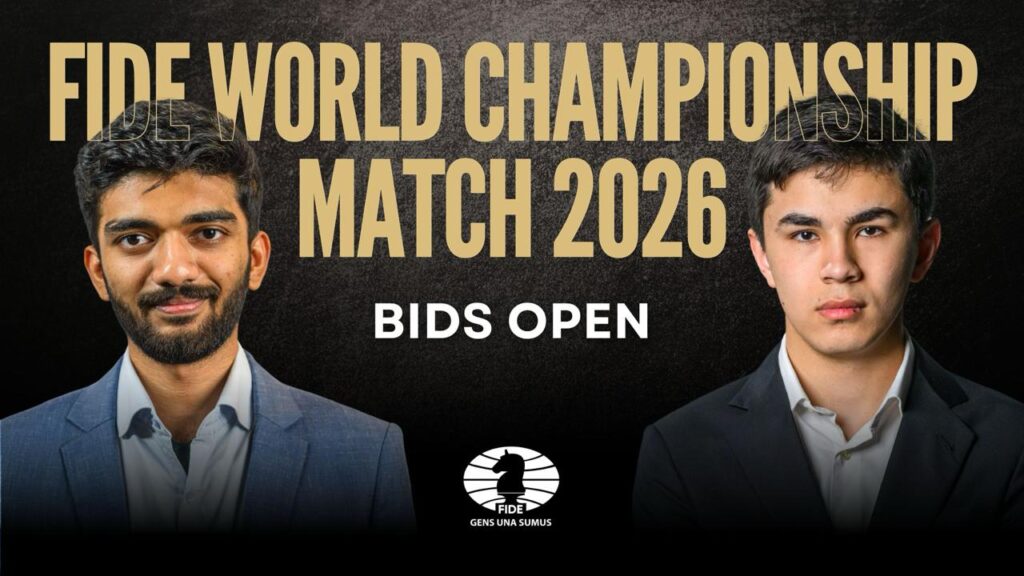
The FIDE World Chess Championship Match is the pinnacle of the FIDE World Championship Cycle. The 2026 edition will decide who will reign over the chess world for the next two years – the reigning world champion, Gukesh D (India), or the challenger, Javokhir Sindarov (Uzbekistan). The upcoming clash will be the youngest-ever chess world championship match. Both Gukesh and Sindarov will be 20 at the time it begins. The World Championship Match 2026 is provisionally scheduled between November 23 and December 17, 2026. FIDE is opening a bidding procedure to host the event. 1.2 The basic provisions are the following: a) Total duration of the event – up to 25 days b) The Regulations shall be approved by July 1, 2026. с) Estimated total budget of the event – 8,500,000 (eight million five hundred thousand) USD d) Minimum prize fund – 2,500,000 (two million five hundred thousand) USD e) FIDE fee – 1,100 000 (one million one hundred thousand) USD f) Payment for commercial, sponsorship, and broadcasting rights shall be specified in the bidders’ proposals. g) The Organiser shall respect the rights of the FIDE sponsors and partners, including for the video broadcast. 1.3 The Applicant shall fill in the Bidding Form. The Applicant must indicate the exact breakdown of the budget by item, including proposals for payments to FIDE for the commercial and sponsorship rights, payment for the broadcasting rights, and the distribution of sponsorship and broadcasting rights between FIDE and the Organisers. A signed copy shall be submitted as an e-mail message to the FIDE Secretariat to office@fide.com no later than May 31, 2026, by 23:59 Lausanne time. The bid should be accompanied by the relevant supporting documents. FIDE has the right to extend this deadline if considered necessary. All the documents shall be submitted in English. 1.4 FIDE reserves the right to enter into additional negotiations with any of the Applicants in order to improve or modify the bid. 1.5 The final decision of FIDE will be based on the totality of all the proposed conditions and interests of chess development.
FIDE and ISCF announce dates for African and American Continental Stages of the World Schools Team Championship 2026

FIDE and the International School Chess Federation (ISCF) are pleased to announce the dates for the African and American Continental stages of the World Schools Team Championship 2026 (WSTC 2026). As part of the global WSTC cycle, continental events bring together leading school teams from around the world, with best teams qualifying for the Grand Final at the end of the year. African Continental StageCape Town, South AfricaJuly 6–11, 2026 (arrival: July 6, departure: July 11) American Continental StageSan Jose, Costa RicaAugust 11–16, 2026 (arrival: August 11, departure: August 16) Arkady Dvorkovich, FIDE President: “We are delighted to launch two new continental school championships in Africa and the Americas as part of our Year of Chess in Education. These regions are emerging chess hubs with tremendous potential. In recent years, we have seen significant progress in their chess infrastructure and school programs, and these championships will help drive that growth even further. FIDE will continue to provide support as part of our long-term strategy to expand the game beyond its traditional centers.” Timur Turlov, ISCF President:“I am very pleased to see the expansion of continental school championships to Africa and the Americas. These initiatives are an important step in strengthening youth engagement and building sustainable chess ecosystems in both regions. I look forward to the upcoming events in Cape Town in July and San Jose in August, which will undoubtedly inspire a new generation of players.” The format and competition regulations remain consistent across all continental stages. Each event will be played in a team format under official FIDE regulations, ensuring a high level of sporting and organizational standards. Each participating team must consist of: four main players one reserve one non-playing captain Teams are required to include both boys and girls (with limited exceptions for single-gender schools), and all players must meet the age eligibility criteria as outlined in the Regulations. In line with the Year of Chess in Education 2026, each continental stage will also feature an educational programme alongside the competition, including masterclasses, workshops, and cultural exchange activities. National federations are kindly invited to plan their national selection processes and prepare their teams for participation. Registration for both events will open in due course. Further details, including invitation letters and logistical information, will be published soon. Regulations for World Schools Team Championship 2026 (PDF) For inquiries, please contact: worldschoolteam@fide.com Official website: https://worldschoolteam2026.fide.com/
Egon Mattaaq wins historic first Greenlandic Chess Championship

In late April 2026, a quiet but significant milestone was reached at the edge of the Arctic. From April 24 to 26, Greenland staged its first-ever national chess championship – a groundbreaking event that brought together players from across the country in a unified competition. The tournament was played over seven rounds on Lichess and featured 10 participants. In a country where vast distances and challenging geography often make travel difficult, the online format proved to be the perfect solution, allowing players from multiple cities and settlements to compete together in an official national championship for the very first time. After three days of intense play, Egon Mattaaq (6/7) of Upernavik Chess Club emerged as the inaugural national champion. Silver went to Hans Christian Dahl (5/7), while Carl Fleischer (4/7) claimed the bronze medal. Final standings Self-taught 24-year-old champion works night shifts as a fish packer. Mattaaq’s victory carries special significance. He represents Upernavik, a small town located on an island of the same name in northwestern Greenland. With a population of just 1,067 people as of 2025, Upernavik is a powerful reminder that chess talent can emerge from even the most remote communities. The championship marks an important step forward for the development of chess in Greenland. The national federation, Kalaallit Nunaanni Skakkertut Kattuffiat, was founded in 2014 with the mission of promoting and developing the game across the island. A major milestone followed on September 24, 2024, when the federation was unanimously admitted as a full associated member of FIDE during its 100th anniversary congress in Budapest. Kids from Tasiilaq, Greenland at a chess festival, organized by Chess Club Hrókurinn While Greenland has traditionally had a small chess culture, recent years have seen growing efforts to expand the game. A key contributor to this development has been Hrókurinn, whose members have been traveling to Greenland since 2003, organizing events in towns and villages and helping to inspire new generations of players. The success of the 2026 championship demonstrates that, despite geographical challenges, a vibrant chess community is taking shape. By connecting players across the country and providing a national platform for competition, the event represents not just a tournament, but the beginning of a new chapter for chess in Greenland.
World Team Rapid & Blitz Chess Championships 2026: Hong Kong debuts as global chess hub
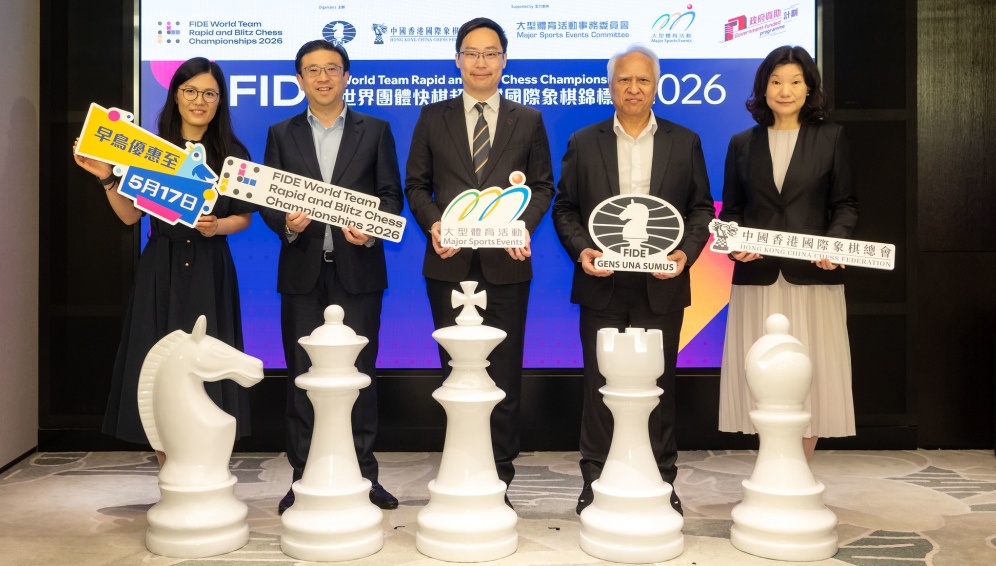
Hong Kong, April 29, 2026 – Organized by the International Chess Federation (FIDE) and the Hong Kong China Chess Federation Limited, the FIDE World Team Rapid and Blitz Chess Championships 2026 will be held in Hong Kong for the very first time, taking place from June 17 to 21, 2026, at Queen Elizabeth Stadium. The tournament, which establishes Hong Kong as the epicenter of the chess world, will convene 42 teams and more than 300 world-class players from across the globe, all competing for a total prize purse of €500,000. The event is anticipated to attract players and tourists from more than 50 countries, significantly boosting the development of the city’s sports tourism and related industries and further solidifying Hong Kong’s position as a centre for major international sports events. The fourth edition of the FIDE World Team Rapid and Blitz Chess Championships also marks its inaugural appearance in East Asia. In gathering the world’s elite players in Hong Kong, the tournament promises a showcase of high-level matchups, defined by its rapid pace and dynamic complexity. For audiences, it is an opportunity to witness first-hand the strategic brilliance and real-time decision-making of global masters, offering an immersive insight into the captivating world of international chess. Best grandmasters to gather in Hong Kong Around 50 of the top 100 players, from both the men’s and women’s categories, have confirmed their attendance, making this the strongest field in the event’s history. Among them are seven of the world’s top ten male players and four of the world’s top ten female players, including current World No. 1 Magnus Carlsen and women’s World No. 1 Hou Yifan. Reigning Blitz champion WR Chess Team has confirmed that Magnus Carlsen will be returning to board 1, alongside Fabiano Caruana on board 2, with Maxime Vachier-Lagrave also joining the lineup. Their women’s boards remain unchanged, with Hou Yifan and Alexandra Kosteniuk. Six Hong Kong teams will compete, providing local players with a rare and invaluable opportunity to compete alongside the world’s elite. Women’s World No. 1 Ms. Hou Yifan remarked, “I am eagerly anticipating the FIDE World Team Rapid and Blitz Chess Championships in Hong Kong. This is more than just a matchup of minds featuring the world’s elite. It is a pivotal milestone that will elevate the profile of chess across Greater China. As a premier international city with world-class facilities and a vibrant community, Hong Kong is perfectly positioned to bring its unique vibrance to this prestigious tournament.” Arkady Dvorkovich, President of the International Chess Federation (FIDE), said, “FIDE is truly delighted to learn that Hong Kong is hosting the tournament. In recent years, we have watched your city grow into a genuine powerhouse of the game. One of the key pillars of this revival has been the hard work and enthusiasm of the Hong Kong China Chess Federation. We believe Hong Kong is the perfect stage for expanding this collaboration, and we look forward to seeing you all in Hong Kong this June.” Geoffrey Kao, Honorary President of the Hong Kong China Chess Federation, said, “We are honoured to partner with the International Chess Federation (FIDE) to bring this world-class tournament to Hong Kong. This event gathers the world’s most distinguished chess elite. While past editions have predominantly been held in Europe, its relocation to Hong Kong this year signifies a historic shift, bringing the global chess spotlight to Asia—and specifically to Hong Kong – on an unprecedented scale. With participants expected from over 50 countries, the tournament will be broadcast globally via major media and live-streaming platforms, allowing millions of spectators to discover and engage with our city. This is more than just a sporting spectacle; it serves as a vital window to showcase Hong Kong’s internationalism, vibrant dynamism, and unique urban charm to the world, further solidifying Hong Kong’s status as the Premier Hub for Mega Events.” George TSOI, JP, Commissioner for Sports, Culture, Sports and Tourism Bureau, said, “Today marks a significant milestone for our city’s sporting calendar as we announce the FIDE World Team Rapid and Blitz Chess Championships 2026. We are excited to welcome hundreds of elite grandmasters. By hosting this prestigious event, we are providing a platform for local athletes to sharpen their skills on home soil, and for the broader community to engage with and enjoy the sport. I would like to express my gratitude to FIDE and the Hong Kong China Chess Federation for their relentless efforts in bringing the Championships to Hong Kong.” M Mark Event The FIDE World Team Rapid and Blitz Chess Championships 2026 has been awarded “M” Mark status by the Major Sports Events Committee, symbolizing an intense, spectacular, and signature event in the territory’s sports calendar, which helps enhance the image of Hong Kong as a centre for major international sports events. Mixed team format with total prize fund of €500,000 Following three successful editions in Düsseldorf (2023), Astana (2024), and London (2025), the championship returns with an exciting format: mixed teams where elite professionals and recreational players compete side by side across rapid and blitz events. Every match is played on six boards, and each team must include at least one female player and at least one recreational player, defined as someone who has never achieved a FIDE rating of 2000 or higher in standard, rapid, or blitz. The FIDE World Team Rapid Chess Championship will be played as a 12-round Swiss tournament across three days (June 17-19), with four rounds per day and a time control of 15 minutes for the whole game plus a 10-second increment per move. The FIDE World Team Blitz Chess Championship follows on June 20 and 21, beginning with pool stages before moving to a knockout format for the top 16 teams, with a time control of 3 minutes plus a 2-second increment per move. The total prize fund across both championships is €500,000. The Rapid Champion team will receive €110,000, with the Blitz Champion team taking home €75,000. Tickets now on sale – enjoy exclusive early bird
Winners crowned at World Senior Team Championship 2026 in Durrës, Albania
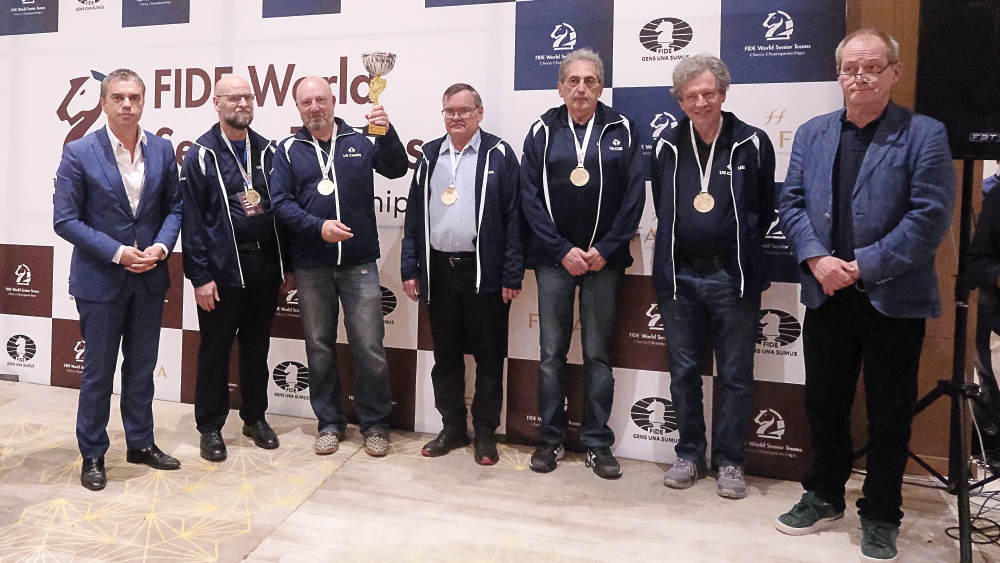
After ten thrilling days of competition, the World Senior Team Championship 2026 has concluded in Durrës, Albania.. In the final round, of the 50+ section USA 1 drew quickly on board 1 against Iceland, securing first place. The remainder of the podium was decided at the very last moment: Italy pressed hard against Norway Oslo on board 2 and ultimately won by 2.5–1.5. Despite catching up on match points with the leader, Italy finished behind the USA on tiebreaks (game points). Kazakhstan swept Iceland Vestfirdir 4–0 to take bronze, while England 1 defeated the USA Women’s team by the same margin to finish fourth. Iceland and Hungary followed closely in the final standings. Despite their loss in the final round, the USA Women retained first place in the women’s standings, ahead of Czech Republic Women and Kazakhstan Women. Final standings – 50+ In the 65+ category, things were much tighter going into the final round, with Germany – Lasker in 1st place on 13 team points and six teams were sharing 2nd–7th place and fighting for a spot on the podium. In the end, Germany – Lasker prevailed over Slovakia (2.5–1.5) to claim the title with 15 team points. Italy secured silver by defeating England 2 (3–1). A four-way tie for third ensued, with Iceland clinching the bronze medal on tiebreaks after drawing their match against England 1. Among women’s teams, the FIDE Women’s team held onto their lead with a final-round draw against Poland Amateurs 65, finishing as the top female squad. Germany Women and Latvia Women completed the podium. Final standings – 65+ Throughout the event, participants displayed exceptional fighting spirit, resilience, and sportsmanship – powerfully reaffirming that chess is a game for all ages. Text and photos: WFM/IA Georgia Grapsa Official website: https://wstcc.com/
Second Continental Online Chess Championships for Prisoners: Registration deadline approaching
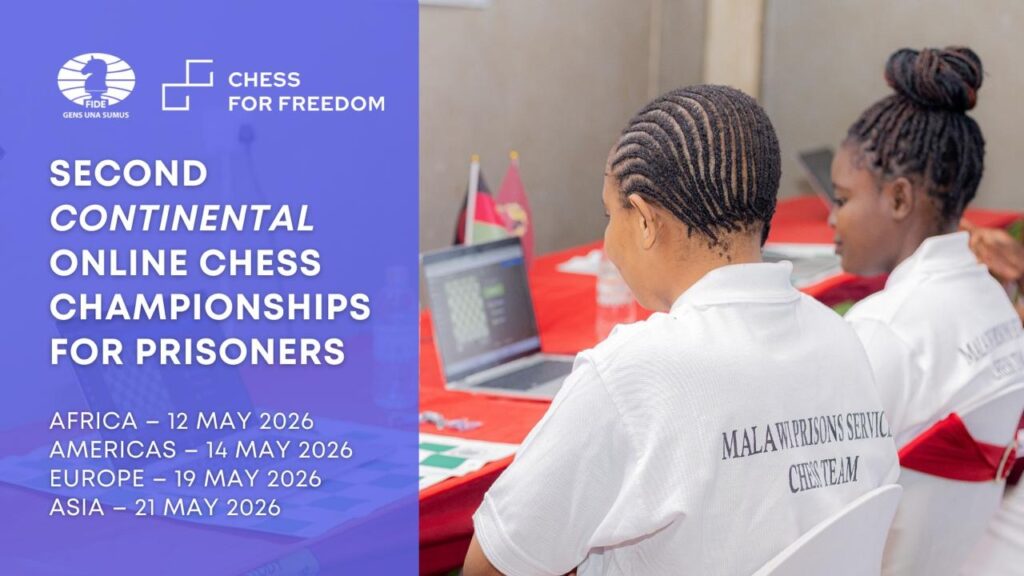
The FIDE Continental Online Chess Championships for Prisoners will return for its second edition in May 2026, with competitions scheduled across four continents. Building on the success of the inaugural 2025 event, this initiative is a cornerstone of FIDE’s Chess for Freedom programme – a global effort to expand opportunities for intellectual engagement, personal development, and social reintegration through chess. The first Continental Online Chess Championships for Prisoners, held in May 2025, marked a major milestone in the Chess for Freedom programme, bringing together teams from correctional institutions around the world in structured online competition. That pioneering event demonstrated the power of chess to create connection and opportunity even in challenging circumstances, reinforcing the value of regular regional championships as a complement to FIDE’s established intercontinental events. The 2026 Continental Championships will again feature separate regional competitions for the following continents: Africa – May 12, 2026 Americas – May 14, 2026 Europe – May 19, 2026 Asia – May 21, 2026 Each continental championship will take place over a single day, with teams from correctional facilities within the region competing online on Chess.com. The format (round-robin or Swiss) will be determined by the number of registered teams to ensure competitive balance and maximum engagement. National federations and correctional institutions are invited to register teams representing: One men’s correctional facility team One women’s correctional facility team One juvenile team (players under 20) Countries that organise national prison chess championships may qualify additional teams, expanding access to regional competition. The championships feature rapid time control (10 minutes with a 5-second increment) and are structured to maintain fair play and security, with oversight and technical support coordinated by FIDE and its partners. As in the first edition, the focus remains on providing meaningful competitive opportunities while upholding the integrity of the event and the dignity of participants. Continental champions will be recognised with official titles and certificates, and all participants will receive acknowledgement for their achievements. FIDE encourages participating institutions to share reports and photos, where permitted by local regulations, to highlight the ongoing impact of chess behind bars. Registration & key dates Registration deadline: May 1, 2026 (no entry fee) Registration: Click [HERE] to register Technical meeting: May 5, 2026 (via Zoom) Correctional institutions must complete the online registration form and confirm their team’s participation via email to Mikhail Korenman at mikhail.korenman@ccsheriff.org. On May 5, three technical meetings will be held at 8:00 CET, 13:00 CET, and 16:00 CET. Team representatives are required to attend one of them. So far, 84 teams have registered for the competition: Europe – 24 men’s, 6 women’s and 4 juvenile teams Asia – 13 men’s, 5 women’s and 5 juvenile teams Africa – 4 men’s, 4 women’s and 5 juvenile teams Americas – 12 men’s and 2 women’s Notably, teams from Belgium, Albania, and Madagascar will make their championship debuts in 2026. The 2nd Continental Online Chess Championships for Prisoners reflect the continued evolution of the Chess for Freedom programme – reinforcing FIDE’s commitment to using chess as a constructive force for inclusion, empowerment, and personal growth around the world. Regulations for 2nd Continental Online Chess Championships for Prizoners (PDF)