

FIDE WGP Cyprus 2025 Preview
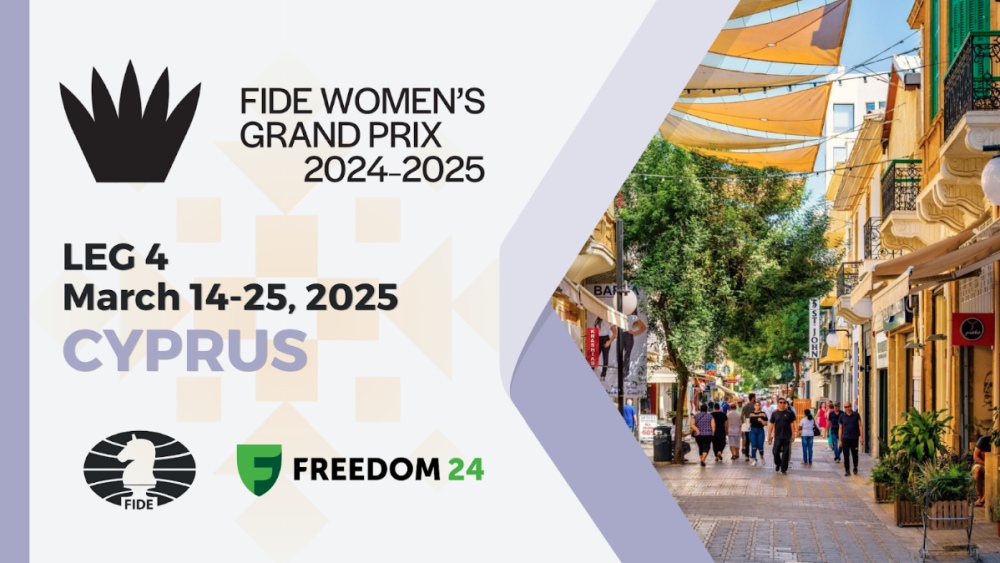
The fourth leg of the 2024-25 FIDE Women’s Grand Prix is set to take place in Nicosia, Cyprus, from March 14-25, under the auspices of the International Chess Federation and Cyprus Chess Federation. This event brings the tournament series to the idyllic Mediterranean setting, where ten of the world’s leading female players will gather in the capital city to battle not only for prizes but also for the critical Grand Prix points that will determine qualification for the next FIDE Women’s Candidates Tournament. About the Event The Women’s Grand Prix Series 2024–25 features 20 players, with each player participating in three of the six tournaments. Each event is a 10-player round-robin, where participants earn points based on their final standings. The series winner is determined by the total cumulative points earned across all three tournaments played. Prize Fund: €80,000 per event, with an additional €120,000 distributed among the top 10 finishers in the overall standings. Qualification: The top two players from the series will qualify for the 2026 FIDE Women’s Candidates Tournament. Participants The event boasts a stellar lineup, including Aleksandra Goryachkina, who leads the Grand Prix standings after consecutively winning the second and third legs in Shymkent and Monaco. Also returning are Indian stars Harika Dronavalli and Divya Deshmukh, and the celebrated Muzychuk sisters, Anna and Mariya. Also competing are former European Champion Nana Dzagnidze, German No. 1 Elisabeth Paehtz, Greece’s top player Stavroula Tsolakidou, and this season’s newcomers, Zhu Jiner, and Olga Badelka, who replace Lei Tingjie and Regina Theissl-Pokorna in the series. After three out of four legs completed, Aleksandra Goryachkina leads the Grand Prix standings, having secured first place in both the Shymkent and Monaco legs. This is her final opportunity to accumulate points. FIDE President Arkady Dvorkovich emphasized the importance of the Grand Prix series as a dedication to advancing women’s chess, stating, “This tournament not only showcases the exceptional talents of the women’s elite in chess but also reinforces our commitment to promoting chess globally” further adding that, “Creating a strong women chess community is very important for us to continue pursuing our goals and representing the interests of women in chess. We look forward to witnessing high-level chess in Cyprus.” Venue Nicosia, the capital of Cyprus, will provide a picturesque backdrop for this prestigious event. Participants can look forward to experiencing the city’s unique culture, historic sites, and Mediterranean charm. Nicosia is also the largest city of Cyprus and has established itself as the island’s financial capital and its main international business center. Schedule and Round 1 Pairings The first round is scheduled for March 15th at 15:00 Eastern European Time, with the pairings already out. To ensure fair play, players from the same countries are paired in the first round, setting the stage for intense matchups from the outset: Aleksandra Goryachkina vs. Nana Dzagnidze Anna Muzychuk vs. Mariya Muzychuk Divya Deshmukh vs. Harika Dronavalli Stavroula Tsolakidou vs. Elisabeth Paehtz Zhu Jiner vs. Olga Badelka Full pairings (PDF) Timur Turlov, CEO of Freedom Holding Corp., expressed his support for the event, stating, “We value chess not only for its intellectual depth and versatility, but also for the opportunity for everyone to show their strength at the board, regardless of gender and age. Today, women are increasingly confident and brightly declaring themselves in the chess world, demonstrating exceptional willpower, strategic thinking, and strength of character. They break stereotypes and prove that chess is a unique space for self-expression. Freedom Holding Corp., as one of the largest sponsors of the chess movement, is proud to support this inspiring trend. We believe in the power of women’s skill and will follow the fourth stage of the World Grand Prix with interest.” Evgenii Tiapkin, Executive Director at Freedom24, reaffirmed the company’s commitment to promoting chess in Cyprus, stating, “On the eve of the fourth stage of the FIDE Women’s Grand Prix in Nicosia, supported by Freedom24, we reaffirm our commitment to promoting chess in Cyprus through our partnership with the Cyprus Chess Federation. Chess cultivates strategic thinking and resilience, qualities that are invaluable both in sports and in life. As part of our long-term dedication, I am pleased to announce the upcoming opening of the Freedom Chess Academy in Limassol, aimed at nurturing future champions and promoting the game within local communities.” For more information and live updates, visit the official website. You can follow the games with expert commentary by GM Alik Gershon and WGM Anastasia Karlovich, and read daily reports written by press officer Michael Rahal. Join us in Cyprus to witness world-class chess as these elite players compete for glory and a spot in the 2026 FIDE Women’s Candidates Tournament.
World Junior Championship 2025 crosses midpoint
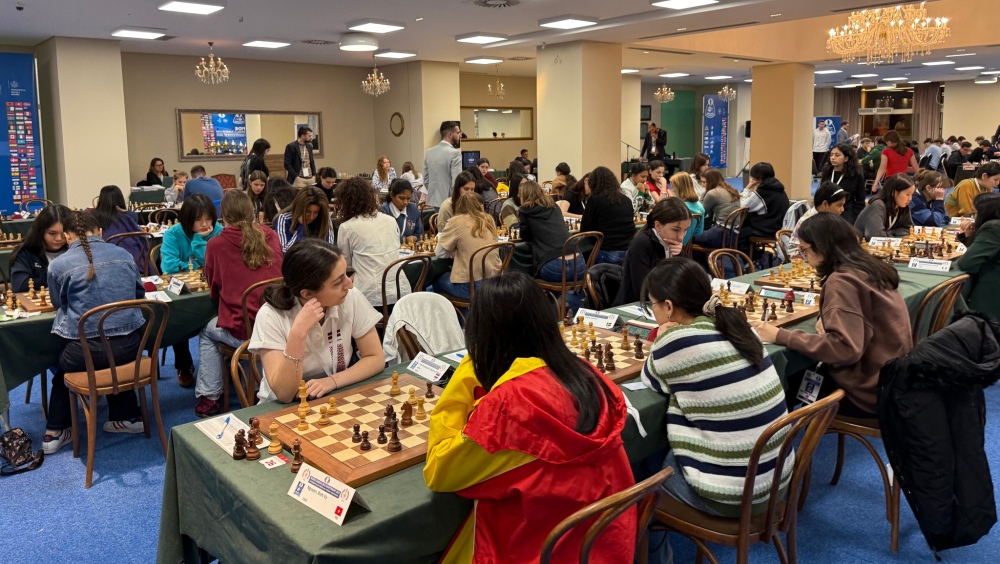
Six exciting rounds have been played at the FIDE World Junior Chess Championship in Petrovac, Montenegro. Due to the decision to start the championship one day later, participants have played every day without a rest day. After six rounds, GM Venkatesh Pranav (IND, 2602; pictured below) leads the open section with 5.5 points. The Indian GM is closely followed by GM Yahli Sokolovsky (ISR, 2552), IM Adar Tarhan (TUR, 2460), and Meng Yihan (CHN, 2412), who all have 5 points. The tournament’s top seed, GM Daniel Dardha (BEL, 2652), is in a large group of players with 4.5 points. Standings after Round 6 Open In the women’s section, four players are tied at the top after six rounds: WIM Ayan Allahverdiyeva (AZE, 2284; pictured below), WIM Umida Omonova (UZB, 2228), WFM Keseria Mgeladze (GEO, 2219), and WFM Mariya Yakimova (FIDE, 2201;)—all with 5 points. They are followed by a group of six players with 4.5 points. Standings after Round 6 Girls Notably, the Fujairah Chess Club has announced that the winners in both categories will receive free accommodation and covered travel expenses for the 1st Fujairah Global Chess Championship, set to take place from August 25 to September 2, 2025. This was announced by the club’s Vice President, Mr. Mohammed Abdullah Al Zaabi, who also made the ceremonial first move in the sixth round. Jovan Milovic, President of Montenegro Chess Federationd and Mr. Mohammed Abdullah Al Zaabi Vice President of Fujairah Chess and Culture Club Here are two interesting games of played in Rounds 3 and 4, with brief commentaries. Chasin,Nico (2415) – Pranav,V (2615) [D20] World Junior Chess Championship (3.1), 27.02.2025 1.d4 d5 2.c4 dxc4 3.e3 e5 4.Bxc4 Nc6 5.Nf3 e4 6.Nfd2 Qg5 Black has chosen a very agressive, but risky line. 7.Nxe4 Qxg2 8.Ng3 Qh3 9.Nc3 Nf6 10.e4 10.Qb3!? should be considered as well. 10…Bg4 11.f3? The risky strategy pays off. One wrong move is all it takes for Black to take over the initiative. 11.Qa4 was the correct response, with better prospects for White. 11…0–0–0! 12.Be3? 12.fxg4 Nxd4 13.Bf1 Qh4 14.Be3 Bc5 seems quite dangerous for White, but it was probably the best hope for survival. 12…Bc5! From this moment on, the pressure on White position just keeps growing. 13.Bd5 Nxd5 14.Nxd5 Bd6 15.Kf2 Be6 16.Nc3 16…f5! The end is near. 17.Bg5 Rd7 18.d5 f4 19.Nge2 Bc5+ 20.Ke1 Qg2 21.Rf1 Bh3 Facing huge material losses, White resigned. 0–1 (2032) Kaldarova,Ayaulum (2248) – Nurman,Alua (2336) [A34] World Junior Chess Championship (4.3), 28.02.2025 1.Nf3 c5 2.c4 Nf6 3.Nc3 Nc6 4.g3 d5 5.d4 cxd4 6.Nxd4 e5 7.Nxc6 bxc6 8.Bg2 d4 We see another ultra-agressive, but risky set-up for Black. 9.Bxc6+ Bd7 10.Bxa8 Qxa8 11.Nd5 Nxd5 12.cxd5 Qxd5 Objectively, Black might not have full compensation, but it’s quite easy to go wrong as White in such a position. 13.f3 Bc5 14.Qd3 0–0 15.a3? And one mistake is again all it takes. 15.Bd2 was a much better option. 15…f5! White is already in big trouble. 16.e4? This only helps Black, but the correct 16.b3 e4 17.fxe4 fxe4 18.Qc4 Qxc4 19.bxc4 e3 was also difficult for White. 16…fxe4 17.fxe4 Qb7 18.Bd2 Kh8 19.a4 Bh3 20.Rg1 Qxb2? Complicating things. The simple 20…Qf7 would finish the game quickly. 21.Rb1? But White returns the favour. She could’ve forced the Queen exchange with 21.Qb1, keeping good chances to hold. 21…Qa2 22.g4 Qf7 The Queen has finally found the right square, and it’s all over now. 23.Kd1 Qf2 24.Qxh3 Qxg1+ 25.Be1 Bb6 26.Qh4 Qe3 27.Qg3 Qxe4 28.Rb3 Rc8 0–1 Photos: Mitar Djukanovic Official website: https://worldjunior2025.sahcg.me/
FIDE and idChess sign partnership agreement

The International Chess Federation (FIDE) and idChess, a platform for recognizing and broadcasting chess games and implementing chess VAR, have signed a partnership agreement. This agreement establishes the intention of FIDE and idChess to cooperate long-term in making chess digitization more accessible worldwide. idChess enables the broadcasting of games from any chessboard. To start a broadcast, users simply need a mobile device mounted on a tripod above the board. The idChess technology also supports a video assistant referee (VAR) system. In July 2023, idChess VAR was used for the first time at the Asian Youth Chess Championship in Kyrgyzstan. This technology helps increase the number of correct decisions made by chess arbiters while making the decision-making process simpler and more transparent for both arbiters and players. “We aim to make chess even more accessible and interactive for everyone, regardless of geographical location or financial capacity, so we consider the introduction of new technological tools such as idChess an effective way to develop chess,” said Arkady Dvorkovich, FIDE President. The partnership aims to promote innovative chess solutions and improve the accessibility of digital tools for players and tournament organizers. Under the agreement, idChess provides FIDE and local chess federations with exclusive opportunities to use its technology. Previously, the idChess platform was approved by the FIDE Technical Commission. You can purchase idChess products on the website idchess.comidChess products will soon be available in the official FIDE store at shop.fide.com. To purchase idChess for chess federations, please email at hello@idchess.com
Gukesh D enters top 3 Open in March 2025 rating list

The March 2025 FIDE rating list was primarily influenced by the 2025 Tata Steel Masters and the third leg of the FIDE Women’s Grand Prix (WGP) in Monaco. World Champion Gukesh D gained 10 rating points in Wijk aan Zee, entering the top 3 for the first time and reaching a career-high ranking. His countryman and Tata Steel Masters champion, Praggnanandhaa R, earned an impressive 17 points, marking his return to the top 10 Open. Photo: Tata Steel Chess/Jurriann Hoefsmit Hou Yifan continues her dominance at the top of the women’s rankings, while the recently concluded FIDE WGP Monaco caused only minor shifts within the top 10 Women. Biggest rating gains in top 100 Open and Women Contreras Huaman, Fiorella WIM PER 2349 (+103) Munguntuul, Batkhuyag IM MGL 2361(+29) Praggnanandhaa R GM IND 2758 (+17) Mamedyarov, Shakhriyar GM AZE 2748 (+17) Fedoseev, Vladimir GM SLO 2739 (+15) Sarana, Alexey GM SRB 2689 (+17) Dardha, Daniel GM BEL 2665 (+13) Zhai, Mo WGM CHN 2366 (+15) Gukesh D GM IND 2787 (+10) Cori T., Deysi IM PER 2354 (+10) The biggest rating gainer of the month was Fiorella Contreras Huaman (pictured below), who earned 103 points after sharing first place in both the Sampa Chess Masters and the II Sampa Chess Open. Photo: Lennart Ootes Batkhuyag Munguntuul re-entered the top 100 Women following an outstanding performance (+29 points) in the FIDE WGP Monaco, where she tied for first place with Aleksandra Goryachkina and Humpy Koneru. In Azerbaijan, Shakhriyar Mamedyarov lost in the final of the 2025 Azerbaijani Championship, but probably found solace in 13 rating points gained in this competition. Ironically, the tournament winner, Rauf Mamedov, increased his rating by just one point. Photo: Azerbaijan Chess Federation Vladimir Fedoseev earned most of his rating gain at the 2025 Tata Steel Masters. Additionally, like several other players (Alexey Sarana, Daniel Dardha, and Shakhriyar Mamedyarov), he picked up crucial points in Schachbundesliga. Daniel Dardha’s second-place finish in the Djerba International Masters earned him 11 rating points. Remarkably, the tournament winner, Marc’Andria Maurizzi, collected 35 points, bringing him close to the top 100 Open. He also broke into the top 10 in the junior rankings. Photo: Djerba Chess Festival In other notable results, Zhai Mo delivered a solid performance at the Graz Open (+15 points), while Deysi Cori emerged victorious in the Zonal 2.4 Women’s Tournament, adding 10 rating points to her tally.
FIDE announces Enhanced Development Funding for 2025

The International Chess Federation (FIDE) has launched its revamped funding programme on March 1, 2025, introducing significant improvements to its Planning and Development Commission (PDC) funding guidelines. These changes aim to strengthen chess development worldwide while streamlining support for FIDE beneficiaries. Designating 2025 as the Year of Social Chess, FIDE is introducing additional funding opportunities for projects that demonstrate community impact. Organizations developing programs that integrate chess into social development initiatives may qualify for enhanced financial support. A major innovation is FIDE’s new digital application process, replacing traditional paperwork with a comprehensive online survey. This modernized system, will be available on the PDC website, offering a more efficient application experience for all beneficiaries. FIDE has also expanded its support network, recognizing three new affiliated members—Isle of Man, New Caledonia, and Greenland—which will now receive the same funding consideration as national chess federations. FIDE now requires affiliated organizations to maintain proper legal registration and dedicated bank accounts to qualify for funding support. A key procedural enhancement requires beneficiaries to participate in preliminary pitch meetings with FIDE before submitting funding requests. This strategic approach ensures better alignment between proposed projects and FIDE’s development objectives. “The 2025 programme represents a significant step forward in FIDE’s development strategy,” states Laurent Freyd, Chair of the Planning and Development Commission. “By modernizing our processes and emphasizing social impact, we’re creating a more robust framework for chess development worldwide. We anticipate that these upgrades will help us build stronger partnerships and deliver more meaningful support to chess communities all around the world.” The updated guidelines reflect FIDE’s commitment to professional, transparent, and impactful chess development. Federations interested in applying for funding are encouraged to review the new requirements.
FIDE Social Chess Research Conference 2025: Scientific insights on chess

In one of the most comprehensive gatherings of scientists and researchers on the topic of chess, the conference addressed issues such as the role of chess in education and mental recovery. Although chess is widely regarded as a tool for cognitive and personal development, these claims are seldom substantiated by concrete research. With this in mind, the FIDE Social Chess Research Conference—which took place online on February 22—brought together experts in sports and mental health from different health and research institutions worldwide to present their findings and discuss the broader societal role of chess. The conference is part of FIDE’s Social Chess Year initiative, which aims to promote the social value of chess and its importance beyond being just a game, highlighting its role in personal development. Why chess should be considered a sport One of the first issues addressed at the conference was the long-standing debate on whether chess qualifies as a sport. The International Olympic Committee and over 100 countries recognise chess as a sport, though some do not. Prof. Filip Kobiela from the University of Physical Education in Kraków, who has researched the topic, noted that traditional definitions of sport emphasise physical skills, which some argue chess lacks. Kobiela noted that chess demands endurance and quick reflexes—especially in fast formats like blitz—and highlighted chess-boxing as a hybrid of mental and physical competition, challenging ‘narrow definitions of sport’ that overlook chess’s physical aspects. He concluded that a broader, more inclusive definition should consider chess a sport, taking into account its physical elements as well as its institutional recognition by the IOC and numerous countries worldwide. Scientific proof of chess improving cognitive skills One of the key topics discussed at the conference focused on the role of chess in enhancing cognitive skills. Juan Antonio Montero Aleu and Rodrigo Babeito introduced the ECAM Method—a cognitive training approach using chess. The method is applied in various settings, from elderly care to addiction treatment and autism therapy. Its applicability without prior chess knowledge broadens its potential for implementation. According to the researchers, the method aids memory, attention, and executive function training while providing a motivating and engaging way to stimulate the brain. The method is available via the Gym Chess App—a digital version of the ECAM Method featuring over 2,500 exercises designed to train cognitive functions. Speaking specifically on brain and addiction recovery, Prof. Dr. Sabine Vollstädt-Klein from the Central Institute of Mental Health in Mannheim presented her research findings. Her research found that chess enhances cognitive function in both children and older adults, particularly by strengthening their reflective system and improving self-control. It also reduces substance cravings—tested on smokers and individuals with alcohol dependence—and enhances life satisfaction. When chess-based cognitive training was compared to standard treatment, the research found that the chess-infused approach led to greater improvements in attention, executive function, and cognitive flexibility, as well as stronger brain activation in key cognitive areas post-training. The method was integrated with the Gym Chess App and recommends incorporating physical exercise for better cognitive results. Towards future research projects The FIDE Social Chess Research Conference also featured breakout sessions where participants discussed ongoing projects and ideas for future research benefiting chess. Topics included integrating wellness tools for chess and increasing eco-friendly practices and sustainability in chess clubs. FIDE Social Commission Chair Andre Vögtlin thanked the participants of the conference, noting that their contributions are helping chess gain recognition “in the market,” in both the public and private sectors—”as we bring forward concrete evidence of the positive impact of chess on society.”
Zhu Jiner to replace Lei Tingjie in FIDE WGP 2024–25 Series
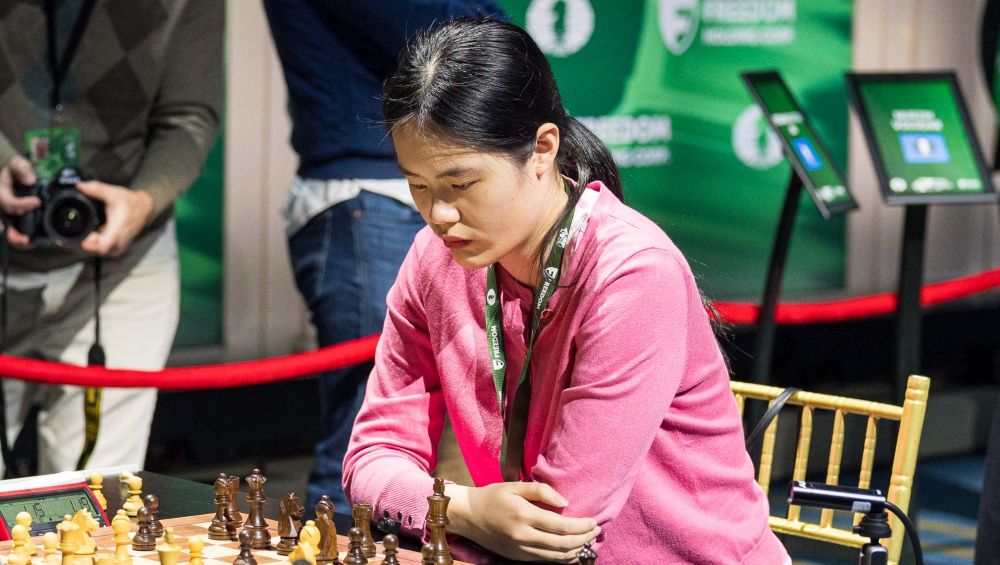
GM Lei Tingjie has withdrawn from the FIDE Women’s Grand Prix 2024–25 for personal reasons. In accordance with WGP regulations, she will be replaced by GM Zhu Jiner (pictured above), who is now set to compete in the FIDE WGP legs in Cyprus, India, and Austria. Zhu Jiner has held the Grandmaster title since 2023 and is currently China’s fifth-ranked female player. She won the Girls’ U14 section of the World Youth Chess Championships in Khanty-Mansiysk in 2016. In 2017, she finished third in the Asian Zone 3.5 behind Zhai Mo and Ni Shiqun, earning qualification for the Women’s World Chess Championship 2018. That same year, she was awarded the FIDE Woman International Master (WIM) title. In 2018, she won the bronze medal at the Women’s China Rapid Chess Championship. Zhu Jiner competed in the first three legs of the FIDE Women’s Grand Prix 2022–23. In Astana, the first leg, she finished third with 6.5/11. In Munich, she tied for fifth place with 5.5/11, and in New Delhi, she tied for first place with Aleksandra Goryachkina and Bibisara Assaubayeva, scoring 6/9. Her performance in New Delhi secured her final GM norm, and in August 2023, she was officially awarded the Grandmaster title, becoming the 41st woman in history to achieve this distinction. The fourth leg of the FIDE WGP 2024–25 will take place in Cyprus from March 14–25, with Zhu Jiner replacing Lei Tingjie in the draw. The full pairings can be found below: FIDE Women’s Grand Prix Cyprus 2025 Pairings (PDF) FIDE WGP official website: https://womengrandprix.fide.com/ Photo: Lennart Ootes
Goryachkina clinches second FIDE WGP 2024-2025 title in Monaco after dramatic finale
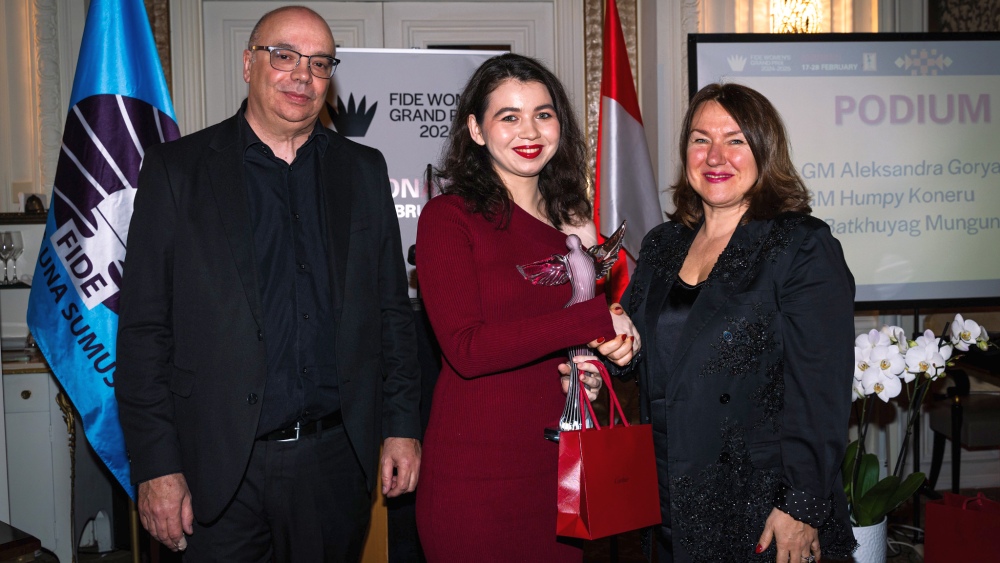
We have reached the end of a spectacular Grand Prix leg in Monaco, filled with intense battles, unexpected turns, and a newly crowned champion. After nine grueling rounds, three players—Aleksandra Goryachkina, Batkhuyag Munguntuul, and Humpy Koneru—finished tied for first place. However, it was Goryachkina who emerged as the tournament winner, securing her second Grand Prix leg victory, thanks to the superiour Sonneborn-Berger tiebreak. The final round delivered high-stakes drama, with Munguntuul and Goryachkina drawing their encounter, allowing Humpy Koneru to join them at the top after defeating Bibisara Assaubayeva. Meanwhile, Alexandra Kosteniuk bounced back with a victory over Elisabeth Paehtz, Tan Zhongyi and Harika Dronavalli drew, and in a shocking twist, Sarasadat Khademalsharieh defeated Kateryna Lagno, dashing her hopes for the title. Yesterday’s results had already reshaped the leaderboard, with Goryachkina and Munguntuul catching up to Lagno, setting up a final-round showdown. The stakes were high: a win in Munguntuul-Goryachkina would likely secure first place for the winner, while Lagno needed a victory against Khademalsharieh to stay in contention. With everything on the line, the last round was a fitting climax to an unforgettable event. Round 9 results Batkhuyag Munguntuul 1/2-1/2 Aleksandra GoryachkinaAlexandra Kosteniuk 1-0 Elisabeth PaehtzTan Zhongyi 1/2-1/2 Harika DronavalliHumpy Koneru 1-0 Bibisara AssaubayevaSarasadat Khademalsharieh 1-0 Kateryna Lagno Batkhuyag Munguntuul – Aleksandra Goryachkina This was the game everyone had their eyes on. The tournament’s bottom seed, Batkhuyag Munguntuul, delivered a phenomenal performance in Monaco, while Goryachkina, the winner of the previous Grand Prix leg, fought her way to the top after an early setback in round one. A victory for either would have secured at least a shared first place, while a draw would have left the final standings uncertain, depending on Lagno’s result. The opening choice—a Berlin Defense in Ruy Lopez—was particularly interesting, as it is known for its drawish tendencies. However, throughout this tournament, we have seen dynamic interpretations of this setup, and this game was no exception. Both players sought complications, but multiple exchanges eradicated any attacking chances, leading to a draw. Goryachkina remains the clear favorite in the overall Grand Prix standings and will play her third and final leg in Cyprus (March 14-25). Will she cement her place at the top? Meanwhile, Munguntuul, who had a tough start in Shymkent but shone in Monaco, will return for the Indian leg (April 13-24). What will her third appearance bring? Alexandra Kosteniuk – Elisabeth Paehtz A King’s Indian Defense quickly turned favorable for White, both on the board and on the clock. Alexandra first advanced on the queenside, securing a strong outpost for her knight, and then took full advantage of Black’s passive pieces and ill-timed counterplay on the kingside. Both players have not had great time management in this tournament, and today they exchanged long tanks – for more than 20 minutes at some points. A key moment came at move 18 when Black faced a recapture dilemma: Kosteniuk noted in her post-game interview that King’s Indian players instinctively want to recapture on f5 with a pawn, but here, Black’s passive position demanded either 18…Bxf5 or 18…Nxf5 instead. After further simplifications, White’s advantage became undeniable due to Black’s misplaced pieces and weak pawn structure. The game concluded with a tactical shot following 36. Bb4, making White’s passed a-pawn a decisive factor. Paehtz, understandably determined to win, took risks, but Kosteniuk—bouncing back from her previous loss—remained composed and converted the advantage. Paehtz started the tournament strongly but lost momentum. However, with her next appearance in Cyprus, she has the opportunity to regain her form. Meanwhile, Kosteniuk will return for the final Grand Prix leg in Austria. Tan Zhongyi – Harika Dronavalli Both players entered the round with confidence after winning their previous games. While neither had a standout tournament, ending on a strong note was crucial—especially for Harika, who will play in Cyprus next, and Tan, who is set to challenge the Women’s World Champion in just four weeks. Tan, trailing the leaders by just half a point, still had an outside chance of winning, making this game all the more significant for both players. It began with a Sicilian but quickly deviated from mainline theory. White appeared more comfortable in the resulting closed position, securing a strong outpost knight. However, her other pieces were passive, preventing any decisive breakthroughs. As the game progressed, Black found chances for a kingside initiative, but the position remained balanced. Eventually, the queenside opened up, leading to multiple exchanges and leaving Black with a passed a-pawn. Dronavalli could have forced a draw by trading queens but opted to continue, given her slightly more active pieces. Despite Black’s winning pawns, the ensuing complications allowed Tan’s queen to remain a constant threat. Ultimately, the game ended in a hard-fought draw. Tan will soon be in China for the World Championship match before returning for the Grand Prix final leg in Austria (May 6-17)—will she compete as the newly crowned World Champion? Meanwhile, Harika, despite an underwhelming performance in Monaco leg, will have two more chances to shine in Cyprus and India. Humpy Koneru – Bibisara Assaubayeva Trailing the leaders by half a point, Humpy had every reason to go all in, and that’s precisely what she did. Her opponent, Assaubayeva, struggling with health issues and sitting at the bottom of the standings, was likely not at her sharpest. An early mistake cost her a pawn, and from there, Humpy dictated the game. Here, instead of 11…c6 or 11…Nh5 Black played 11…Nd7?, allowing 12. Qxd8 Rxd8 13. Nb5, attacking the c7-pawn. Despite being down material early, Assaubayeva fought on, posing as many problems as possible. However, Humpy’s experience prevailed, and she secured a critical victory, joining the tournament leaders. This was Assaubayeva’s final Grand Prix leg, while Humpy will return to compete in India, playing on home turf. Sarasadat Khademalsharieh – Kateryna Lagno Lagno had led the tournament for multiple rounds and played a quick draw on the previous day. But with her co-leaders facing off, she needed a win. Unfortunately, pushing
Boris Spassky (1937–2025)

FIDE is deeply saddened by the passing of Boris Spassky, the tenth World Chess Champion, at the age of 88. Spassky was born in 1937 in Leningrad and recognized as a chess prodigy from an early age. He earned the Grandmaster title at 18 and made his Candidates Tournament debut in 1956 (Amsterdam) at 19. Though Spassky showed immense promise, he missed the next two World Championship cycles after failing to qualify for the Interzonals. However, he resumed his quest for the chess crown eight years later. After defeating Keres (1965), Geller (1965), and Tal (1965) in the Candidates matches, Spassky earned the right to challenge Tigran Petrosian for the world title. Though Boris lost the 1966 match in Moscow, he fought his way back and, three years later, defeated Petrosian in their rematch (Moscow, 1969) by a score of 12½–10½, becoming the tenth World Chess Champion. Spassky held the title until 1972, when he famously lost to Bobby Fischer in Reykjavik, one of the most iconic matches in chess history. A symbol of rivalry between the USA and USSR during the Cold War, the “Match of the Century” was held in Reykjavik, Iceland, and boasted a record-breaking prize pool of $250,000, dwarfing other sports’ rewards. The showdown between an American and a Soviet drew unparalleled media coverage, with major outlets present. The match was broadcast to 50 million viewers. The contest lasted 21 games, and Fischer won 12½ to 8½, becoming the eleventh World Chess Champion. This victory propelled chess into the mass media spotlight. Spassky continued competing at the highest level, notably reaching the Candidates semifinal in 1974 and the final in 1977. A two-time USSR Champion (1961 and 1973), Spassky played for the Soviet team in seven Chess Olympiads (1962–1978), winning thirteen medals (team and individual) and scoring 69 points in 94 games (+45−1=48). An independent spirit and true chess artist, Spassky felt constrained by the Soviet system. In 1976, he emigrated to France with his third wife, became a French citizen in 1978, and later represented France in three Olympiads (1984–1988) on board one. In 2012, Spassky returned to Russia. The first genuinely universal player, Spassky was not an opening specialist, but he excelled in complex and dynamic middlegame positions, where he was in his element. FIDE extends its sincere condolences to Boris Spassky’s family, friends, and loved ones.
PDC webinar on 2025 FIDE Funding Guidelines announced

Dear FIDE members, We are happy to announce that FIDE starts its Planning and Development Funding programme 2025 cycle on the 1st of March 2025. All beneficiaries entitled to the funding programme are welcome to submit their requests for 2025 development projects. FIDE PDC has published the new 2025 FIDE Funding guidelines with some adaptations and amendments of 2025 here: https://pdc.fide.com/guidelines2025/. We would like to invite you to the FIDE PDC Webinar initiated to discuss the new guidelines with amendments, new application procedure, format of applying for funds and other important changes related to the FIDE Planning and Development programme and procedure. The FIDE PDC Webinar will take place on March 03, 2025, at 14.00 pm CET via ZOOM platform. Link to the webinar is below: us06web.zoom.us/j/83941940294?pwd=a9WxS5mqbC3q4fPN0saPNqC1RxEF7k.1 Meeting ID: 839 4194 0294Passcode: 801501Topic: FIDE PDC Funding Programme 2025 – start of the cycleTime: Mar 3, 2025 02:00 PM Paris Tap mobile +15074734847,,83941940294#,,,,*801501# US+15642172000,,83941940294#,,,,*801501# US Dial by your location +1 507 473 4847 US• +1 564 217 2000 US• +1 646 876 9923 US (New York)• +1 646 931 3860 US• +1 669 444 9171 US• +1 669 900 6833 US (San Jose)• +1 689 278 1000 US• +1 719 359 4580 US• +1 253 205 0468 US• +1 253 215 8782 US (Tacoma)• +1 301 715 8592 US (Washington DC)• +1 305 224 1968 US• +1 309 205 3325 US• +1 312 626 6799 US (Chicago)• +1 346 248 7799 US (Houston)• +1 360 209 5623 US• +1 386 347 5053 US• +1 408 638 0968 US (San Jose) Meeting ID: 839 4194 0294Passcode: 801501 Find your local number: https://us06web.zoom.us/u/kgAfCsiXP Looking forward to seeing you at the webinar, FIDE PDC Team