

Online Olympiad: Top Division Round-up
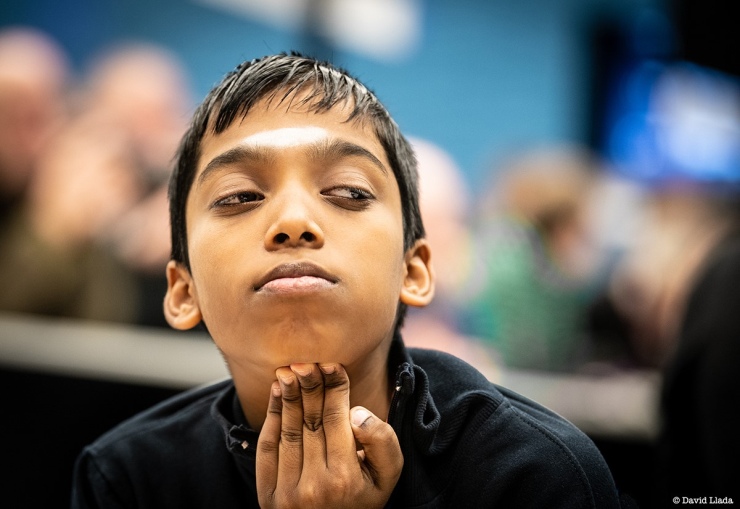
India overthrows China in Group A As it was expected, the top place in Group A of the Chess Olympiad would only be decided in the very last round, when China and India were scheduled to face each other. India beat China by 4-2 in the direct encounter, and thanks to this result India is the first team to qualify directly for the quarter-finals. China advances to the play-off stage. The four games on the top four boards ended in a draw, but India proved to be stronger on the under-20 boards, were Praggnanandhaa (pictured above) won against Yan Liu and Deshmukh Divya outplayed Jiner Zhu. Some of the youngest and more promising Grandmasters in the world are from India, and this enormous potential is already starting to show in international competitions. The Indian players were especially spurred after the technical difficulties that some of them experienced yesterday when Vidit and Humpy lost their games due to a power failure. This incident deprived the Indian team of a certain victory in a crucial match against Mongolia that could have cost them dearly. But the Indians didn’t lose heart and reacted in the best possible way, turning frustration into motivation. Before the decisive victory against China, India had also defeated another two strong opponents: Georgia (4-2) and Germany (4½-1½). Germany claimed third place and advanced to the play-off stage, despite collapsing in the last two rounds losing to India and Uzbekistan. Considering that the team could not count on some of its strongest players, making it into the playoff stage in this event is no mean achievement. Azerbaijan, Hungary, and Ukraine advance to the play-offs The most hard-fought and balanced group of the top division was decided by tie-breaks, as the top half of the table ended very tightly packed with five teams within 1-point of the leader. Azerbaijan, with 14 points, took the first place thanks to a strong performance on the final day and impressive total 37 board points out of 54 games. Hungary (14) and Ukraine (13) claimed second and third place respectively, and they advance to the playoff, while top-placed Azerbaijan is seeded directly into Quarter-finals. GM Teymour Radjabov (Azerbaijan) Kazakhstan and Spain, also with 13 points, had a worse tie-break than Ukraine, so they are out of the Olympiad. Sadly, the event says goodbye to Alexei Shirov, who emerged as one of the stars of the competition scoring 13/15 and exhibiting his characteristic fire-on-board style. With such a close finish, exciting was there until the very last minute. But actually, the key clashes happened in the first round of the day, when the top teams had to face each other: Azerbaijan defeated Spain (4-2), Ukraine won against the Netherlands (4½-1½) and Hungary prevailed over Kazakhstan (3½-2½). In the end, these three teams would be the ones to advance to the next stage. Ukraine was the top-seeded team in this group, despite the absence of Eljanov and the Muzychuk sisters, but they struggled a little and a last-round defeat against Kazakhstan was not the best possible ending. Ivanchuk did not play for the team in any of the day 3 matches, and it is not known whether he will be part of the line-up for the play-offs. Russia enters the quarter-finals Rampant Russia took clear first place in Group B of the Chess Olympiad, five points ahead of second-placed Bulgaria, after winning all nine matches. Team Russia played the most difficult match in Round 8 against the always-dangerous Armenia. In this decisive clash, all games ended in a draw except on board 5, where Alexey Sarana defeated Haik Martirosyan to tip the balance in favor of the Russians. So far, no other team in all the pools has been as effective and ruthless as Russia. Out of 54 individual games played, they have nicked 43.5 board points, with 37 victories, 13 draws and losing only four games. Bulgaria’s third board, Antoaneta Stefanova Bulgaria earned a surprising second place, despite being #7 in the initial rankings. The Bulgarians had a tough start suffering a severe defeat in Round 1 against Russia (4½-1½), but they bounced back right after their defeat, beating Armenia in Round 2 and did not look back after that. The team rounded up its solid performance by winning 5-1 against England in the last round. Armenia qualified for the play-offs finishing in third place, narrowly edging Romania on tie-break: both teams had 12 match points, but the Armenian players accumulated 37.5 “board points” against 33 by the Romanians. It is a bit surprising that one of the most successful nations in chess Olympiads found itself struggling to advance to the next stage. Armenia had finished Saturday’s session in second place, and today the team featured its main star Levon Aronian in all three matches, so everything seemed to be on track for them. However, they started the day with a shocking defeat against England (2½:3½), and in the next round bit the dust against Russia, so the situation got a bit worrisome. A 5-1 victory against Egypt in the last round saved the day for the Armenians. Romania played a good tournament, but they knew they had to face the “final boss” in the last round, and that’s where the team cracked and lost 1½ -4½ despite having winning positions on three boards. As for Croatia, they ended up in 5th place – winning all their three matches today did not help the team after a disastrous second day. USA progresses into quarterfinals, Greece and Poland advance to play-offs One could say there are no big surprises in Pool D of the Online Chess Olympiad, as three of the top five teams according to the initial ranking took the top three spots: USA, Greece, and Poland. However, the way things unfolded was a bit unexpected. The USA won its first six matches in succession, but the third day of play turned out to be much more difficult for them. First, the team lost to Poland in Round 8 then drew against Peru in Round 9. It was
China, Hungary, Russia and USA top pools at Online Olympiad
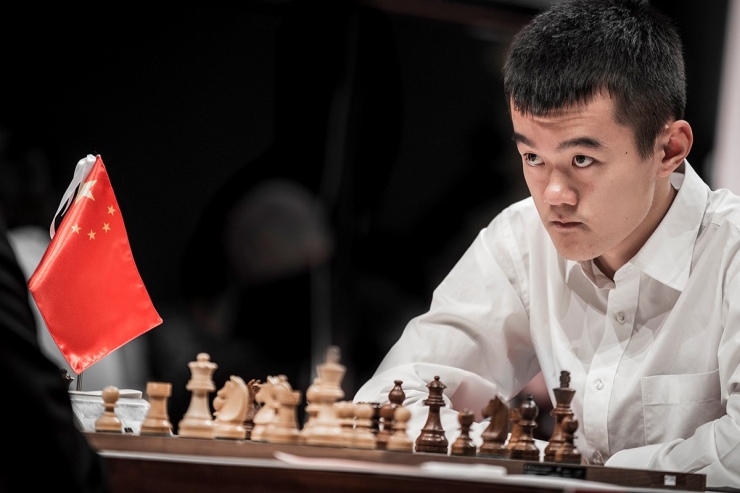
China’s first board, GM Ding Liren China takes the lead in Pool A, closely followed by India It is a close race between the two Asian chess superpowers in Pool A of the Online Chess Olympiad. For the second day in a row, China won all three matches, and India was on track to do the same and co-led the group. However, technical problems got in their way, as Vidit Gujrathi and Humpy Koneru lost due to power failure and disconnection in their match against Mongolia. This unfortunate incident turned a very likely victory into a mere draw. India’s misfortune allowed China to become the sole leader, one point ahead of the Indians. However, it feels like the Chinese are still warming up and the overall favorites are not showing their full potential yet. Out of 36 games played so far, China has suffered 2 losses and conceded 15 draws. Germany managed to keep the third place in the standings, but they are now 3 full points behind China. It was a long-and-not-so-good day at the office for them: they beat Vietnam by a minimal margin, but drew against Georgia and suffered a bitter defeat at the hands of China: 1½ – 4½. It must be noted that the German team is weakened by the clash with the “German Masters”, the national championship, and some of the players in the team are taking part in both events at the same time. Iran climbs to fourth place, as Vietnam lost all three matches today and goes down to 8th place. Hungary emerges as a frontrunner in Pool B As many anticipated, Pool B is proving to be the most balanced out of four. It was clear from the beginning that France, Norway, and South Africa wouldn’t progress to playoffs, but this has been the only fulfilled prediction: other than that, everything is still open. Hungary is the unexpected leader, but no less than five teams still have a chance to advance to the next stage, or even to claim first place. Members of the Hungarian team at the Batumi Chess Olympiad The day started well for Ukraine, defeating Azerbaijan in the first game of the day (Round 4) and taking the lead. However, the clash with Hungary in Round 5 was a real carnage: all six games reached a decisive result, and Ukraine took the worst part. The team led by Viktor Erdos scored a very important victory 4-2. The Hungarians were in high spirits since they had already whitewashed South Africa in Round 4. The Magyars rounded up their day with a third victory, 4-2 against their close neighbors of Slovakia, a result that put them on top of the table. Kazakhstan and Spain did their part to turn the crosstable upside down: both teams won all the three matches, displacing Azerbaijan to the fifth position and tying with Ukraine for second place with 9 points. Unstoppable Russia The Russian team is cruising through Pool C. The Russians started the day with two clean 6-0 sweeps against Algeria and Morocco. In Round 6 the team faced a much tougher opponent, England, but had no problem whatsoever and scored another convincing victory 5-1. Luke McShane and Jovanka Houska drew against Grischuk and Lagno, respectively, but Russia won on the remaining four boards. With these results, Russia reaches the last day of the competition with a two-point gap over Armenia, which seems to be the only team that can keep pace with them. Today the Armenians won three lopsided matches: they beat Croatia 4½-1½ (despite Aronian’s defeat against Ante Brkic), and then shut out both Algeria and Morocco 6-0. Romania is third, tied with England and their match on the final day might be decisive one given that Romania is yet to play against Russia. England, led by the seven-time British Champion Michael Adams, is having a pretty decent run so far. The team won four matches but unfortunately went down in flames against Russia and Croatia, scoring just one point each time. The Croatians were the sensation on the first day of play, but today they lost two matches and only managed to draw against Bulgaria. GM Vladislav Artemiev Round 5 will also be remembered for a great display of sportsmanship by the Russian team. Morocco failed to provide the line up on time, and when that happens the team is supposed to play with their six starting players. However, Morocco’s second board was not available today, so Russia would have won automatically by default on that board. Default time passed, but Vladislav Artemiev rejected the idea of being given the point without playing. So the arbiters managed to get him the game he was due to play (had Morocco submitted the team list in time) against the first reserve Nassim Zrikem. USA leads with a perfect score After two days of play and six rounds, only three teams can boast a perfect score: China in Pool A, Russia in Pool C, and the USA in Pool D. It will be hardly a surprise if the three of them make it to the semifinals. Brazil, Cuba, and Argentina lost in succession today against the USA. The team led by Wesley So is so dominant that they not only have won their six matches, but they have done so giving away just a few points: out of 36 games, they have won 22, drew 13, and lost just 1 game. Greek Grandmaster Dimitrios Mastrovasilis Greece also won all their three matches today and climbed to second place, three points behind the leader, and one ahead of Peru. Taking into account that Greece has already played against the top teams, they will have relatively easier pairings on the last day and a very good chance to progress to the next stage. Peru lost to Greece in Round 4 but then bounced back by beating Paraguay and Italy. Still, the Peruvians go down from second place at the end of Day 1, to third place at the end of Day 2. They still
India, Azerbaijan, Russia and USA lead in their pools

Santosh Gujrathi Vidit won both his games for the Indian team playing on the first board India leads Pool A, ahead of China and Germany China, India, and Germany won all three matches on the first day of play at the Top Division of the Online Chess Olympiad. Since India won its matches by a bigger score, the team tops the group, ahead of the rating favorite, China. India only conceded one defeat and three draws in the 18 games played so far. China and Germany won’t cross swords until Round 6 (Saturday), while another decisive match India – China will be played in the final round (Sunday). Round 1 China 5 : 1 Uzbekistan Zimbabwe 0 : 6 India Germany 3½ : 2½ Indonesia Mongolia 2 : 4 Vietnam Georgia 2½ : 3½ Iran Round 2 Indonesia 1½ : 4½ China Vietnam 2 : 4 India Iran 2½ : 3½ Germany Mongolia 3 : 3 Georgia Uzbekistan 5½ : ½ Zimbabwe Round 3 China 4 : 2 Iran India 5½ : ½ Uzbekistan Germany 4½ : 1½ Mongolia Georgia 2 : 4 Vietnam Zimbabwe 0 : 6 Indonesia Radjabov, Mamedyarov and Mamedov, at the Batumi Chess Olympiad Azerbaijan is the sole leader of Pool B Azerbaijan was the only team in this Pool to win all the three matches on the first day of play in the Top Division. They faced the main obstacle in the first round facing Netherlands in a match that they won by a minimal margin (3½ : 2½) although Anish Giri defeated Shakhriyar Mamedyarov on board one. After that, Azerbaijan went on to smash Hungary and South Africa, and now tops the leaderboard with a 1-point margin over Ukraine. The Ukrainians had a bumpy start, conceding a draw in their first match of the day against Spain. In fact, the Spaniards had them against the ropes, but a mistake by the young Marta Garcia turned a winning endgame into a draw and the victory just slipped out of their hands. Slovakia and Hungary took 3rd and 4th positions, respectively, ahead of Kazakhstan & Spain. Slovakia’s result is a bit surprising, but this is one of the most balanced groups in the Top Division, and it will probably be a very tight affair. Norway, playing without Magnus Carlsen, and France, that did not enlist most of the top guns, will have hard time making it to the top half of the table. Netherlands’ performance on the first day was a negative surprise: despite featuring Anish Giri on the first board, the team only managed to draw one match and lose the other two. Round 1 Azerbaijan 3½ : 2½ Netherlands Hungary 3½ : 2½ France Ukraine 3 : 3 Spain South Africa 2 : 4 Norway Slovakia 2 : 4 Kazakhstan Round 2 Azerbaijan 5 : 1 Hungary Norway 1 : 5 Ukraine France 6 : 0 South Africa Netherlands 3 : 3 Kazakhstan Spain 2½ : 3½ Slovakia Round 3 Kazakhstan 2½ : 3½ Spain Ukraine 5½ : ½ France Slovakia 4½ : 1½ Norway South Africa ½ : 5½ Azerbaijan Hungary 4 : 2 Nertherlands Russia’s first board Alexander Grischuk Russia leads Pool C with a comfortable margin Russia is the top seed in the Online Olympiad and the team didn’t disappoint, ending the day on top. The squad headed by Alexander Grischuk and Ian Nepomniachtchi was the only one in Pool B to win all three matches today. However, the main sensation so far is the performance of the Croatian team, which was leading after the first two rounds. The “Checkered” started the day with a 6-0 victory over Algeria, then stunned England 5:1, and only in the third round the team was stopped, losing to almighty Russian squad by a minimal margin. Five teams share the second position, but Croatia is the best positioned among them, having scored 13,5 points in 18 games (as many as the leaders). Besides, Croatia already played against the leader team Russia. Armenia suffered an unexpected defeat against Bulgaria in the second round, but still has all the chances to qualify for the playoff, but in the following rounds, the team should bring its A-Game. Group C features three African teams, and Egypt confirmed one more time that they are the dominant chess nation in Africa: the team comfortably defeated Algeria and Morocco, and these wins allowed them to join the pursuing pack despite a loss to Romania. The Egyptians are now third, and they are dreaming big, but the key matches lie ahead of them. Round 1 Russia 4½ : 1½ Bulgaria Armenia 4 : 2 Romania England 3½ : 2½ Turkey Morocco 0 : 6 Croatia Algeria ½ : 4½ Egypt Round 2 Turkey ½ : 5½ Russia Croatia 5 : 1 England Bulgaria 3½ : 2½ Armenia Egypt 2 : 4 Romania Algeria 2 : 4 Morocco Round 3 Russia 3½ : 2½ Croatia Armenia 4½ : 1½ Turkey England 4½ : 1½ Algeria Morocco 1 : 5 Egypt Romania 2 : 4 Bulgaria Wesley So plays on board 1 for Team USA USA takes command of Pool D The United States is off to a great start in the first-ever Online Olympiad. The winners of the gold medal in Baku 2016 are on track to repeat this great success, as today they won the first three matches against Greece, Paraguay, and Italy. The USA leads with a two-point gap over a group of three nations: Peru, Poland, and Italy. Wesley So leads the team, playing on board one, with Samuel Shankland defending the second board. The US is missing two of its main players, Fabiano Caruana and Hikaru Nakamura, but is still a firm candidate to win the event, along with Russia and China. On
Icelandic Championship starts this Saturday
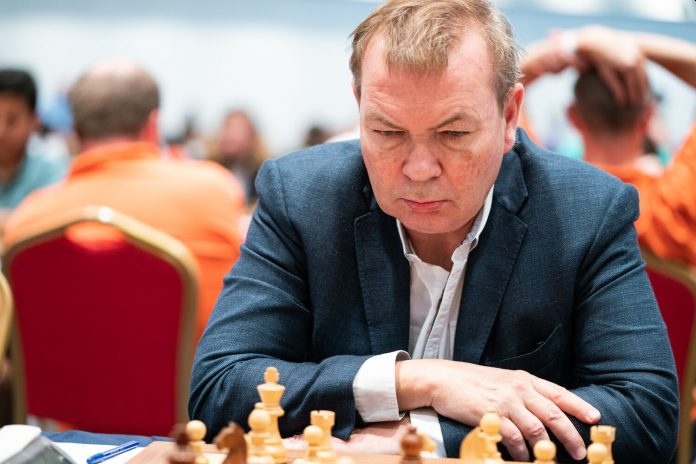
The Icelandic Championship will start this Saturday, August 22. The event will be played in the town of Gardabaer which incidentally was also the venue when GM Margeir Petursson last played in the event, way back in 1996! Many people are looking forward to his participation as one of the old guards of Icelandic chess. Margeir will have a tough task though as he will be among five grandmasters participating in the event which is a 10-player round-robin. The top seed is GM Hjorvar Steinn Gretarsson (2579) who will look to capture his first Icelandic Championship and hopes to do so in his hometown. The event features several former champions: GM Throstur Thorhallsson (2012), IM Gudmundur Kjartansson (2014 and 2017) and GM Helgi Gretarsson (2018). Their chances for the title increased after the withdrawal of a 13-time Icelandic champion GM Stefansson. Also in the field will see GM Bragi Thorfinnsson who once again has to face his brother, IM Bjorn Thorfinnsson. Finally, some young players including IM Dagur Ragnarsson, FM Vignir Vatnar Stefansson, and Gauti Pall Jonsson will seek to make their mark on the championship. The tournament was originally supposed to be held in late March but like so many things was put on hold because of Covid-19. The Icelandic chess federation in co-operation with local authorities has got the green light to go ahead with the event as chess and other sporting events are getting exempted from the current social restrictions. The Challengers group will also be played at the same time, but in a different venue due to restrictions. No spectators are allowed and there will be some strict rules applied in terms of sanitation and other regulations. The event will be streamed locally. Official site: https://skak.is/skakthing/
FIDE President address on anti-cheating policies
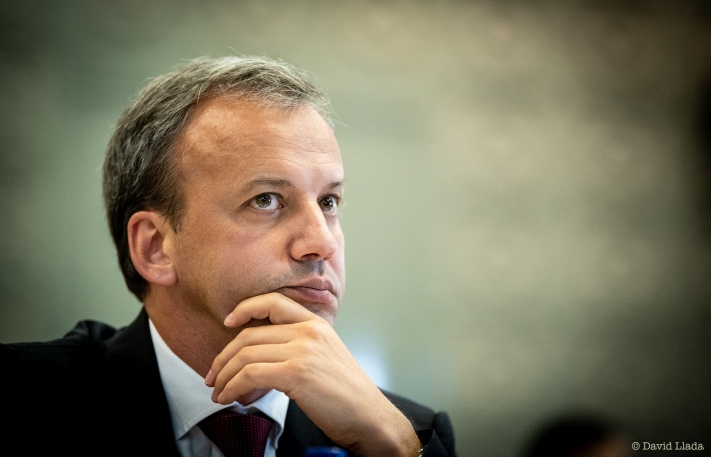
Dear chess friends, I believe there is a consensus that computer-assisted cheating is a real plague of contemporary chess. We have already taken strong steps to enhance our efficiency in fighting it, including strengthening analytical tools, using detectors and scanners in all official FIDE events, training arbiters, finding a right legal basis, and having a dedicated team working on these matters. The online chess boom brought new challenges, and although the number of suspicious cases is fairly low, FIDE must act vigorously, sending a clear message to potential violators in order to create a secure environment in our competitions. We work together with the leading online chess platforms. We have adjusted the algorithms used for online play. Having a lot of data, we sharpened our statistical methods – and in these regards, I’d like to thank Professor Ken Regan, who keeps improving his algorithm – and those who think his method does not work against the so-called smart cheaters, they will be surprised. We must act, and I want to emphasize that FIDE will be ready for the ensuing legal challenges. However, I feel that we need a broad consensus on the measures applied. Below are the main questions we would like to have your opinion on: 1. Our methods of detection, although very advanced and ever-improving, can’t provide a 100% confirmation. In many cases, the probability estimated is higher than the one for DNA tests. Do you believe a statistical algorithm (or a combination of those) giving close to 100% probability of cheating could stand as sufficient grounds for banning a player? If yes – what odds would you find sufficient? 2. Shall FIDE apply sanctions for alleged online violations to over-the-board-play (and vice versa)? 3. Shall we apply sanctions for alleged violations at platforms’ own events, and other unofficial online events, to official FIDE online events (and vice versa)? 4. Shall we publish the names of alleged violators after the very first conviction? 5. Shall the violators be punished retroactively, with their prize money, rating and titles been revoked for some period preceding the verdict? And, if yes, how far back should these actions go? 6. What would you consider a reasonable banning period for first-time violators, and for repeat offenders? How strict should be the measures in youth competitions? There are many questions and some of them are related to the moral and legal aspects of the subject. Having a fair and transparent system will require a trusted framework. The worst thing to do would be to ban an innocent player. Likewise, the reputation of chess and our global chess family could suffer tremendous damage if a tsunami of scandals and court procedures starts to overshadow the exciting environment of international chess competitions. We must be strict, but responsible. Firm, but accountable. And before approving a general policy, we would like to hear your opinions. You may answer the questions raised in this communication or simply submit your proposals to the following email: anticheating@fide.com It is going to be a long battle, but I am sure we will succeed.
King Carlsen wins richest online chess event ever
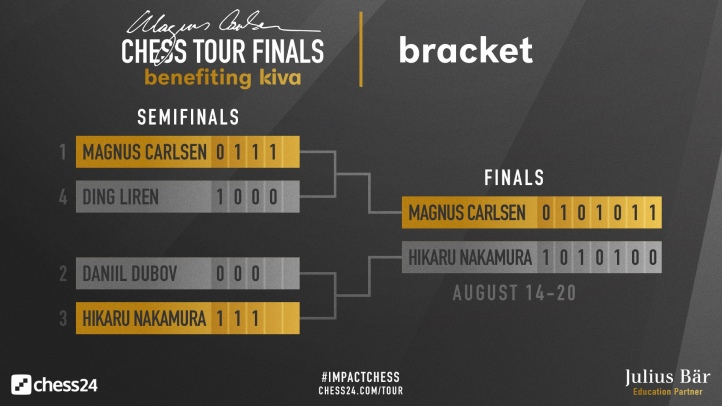
Magnus Carlsen has won his own $1 million signature tournament proving he is the best online speed chess player on the planet. Chess fans around the globe were gripped today as the World Champion overcame US star Hikaru Nakamura in a thrilling marathon Magnus Carlsen Chess Tour final. Carlsen had to come from behind three times over the week before finally toppling his rival in a nail-biting tiebreak today to decide an incredibly-tight seventh set. A clearly relieved Carlsen said afterward: “I don’t know what to say, there were just so many twists and turns. Ultimately it’s a bit random that everything is decided by one game but it has to end at some point.” Paying tribute to his opponent, Carlsen said: “He’s just very, very resilient and I just found the whole match very difficult and unpleasant to play. At some points, I felt that I was outplaying him and then he started turning it around. “I never felt I had the energy and never felt at any moment cruising so it was just a never-ending struggle. That’s why it became so close.” The Norwegian banks an online record of $140,000 for winning the final and takes a total of $315,000 in prize money overall from the event. It brings to an end a scintillating summer of elite-level chess that has seen the richest and most prestigious online event ever transfix fans. Nearly 70 million TV and online viewers have tuned in to the five tour stages that started in April and then culminated in a four-player Tour Finals. It was broadcast in 10 languages and at times this week has been the most-watched TV show in Norway. Carlsen devised the unique online tournament with chess24.com after all traditional chess events were postponed due to the COVID-19 pandemic. He then went on to win three of the four stages before the Tour Finals, losing only one match at a knockout stage to Nakamura. In the grand final, Carlsen faced Nakamura for the overall title and the American showed he was a true threat by going ahead three times. But each time the champion bounced back and refused to be beaten. In today’s deciding set it was Carlsen who went ahead first before Nakamura dramatically leveled to take the match to tiebreaks. Then Nakamura went ahead leaving Carlsen desperately needing a win to hang on. He managed it and then in the resulting “Armageddon” final play-off Carlsen finally broke Nakamura’s heart to win the title. It was an astonishing end to the biggest online chess event ever and it had every viewer on the edge of their seats. Supporting Kiva Broadcaster chess24 has pledged 50 percent of new Premium memberships bought during its Tour Final to Kiva’s Global COVID-19 Response fund that aims to raise at least $50 million for entrepreneurs and small businesses impacted by COVID‑19. During the event, chess24 and Kiva will highlight stories where chess has changed people’s lives under the official tournament social media hashtag #ImpactChess. Viewers are encouraged to engage with the Tour Final and support small businesses impacted by COVID-19 by signing up for a premium subscription here. More details on the Finals The Magnus Carlsen Chess Tour was devised by Norway’s World Champion and chess24 after traditional over the board chess was halted suddenly due to the COVID-19 pandemic. The Tour Final kicks off on August 9 and runs until August 20. It is the culmination of four elite-level super-tournaments that began in March as a way of getting chess started again while other sports worldwide were prohibited. The first four stages of the first Magnus Carlsen Chess Tour were: The Magnus Carlsen Invitational The Lindores Abbey Rapid Challenge The Chessable Masters The chess24 Legends of Chess Four players have qualified for the final crescendo of chess after being the best performers during the preceding tour events. The winner of the Tour Final, which has a total prize pot of $300,000, will scoop a top prize of $140,000 and the title of Champion of the Magnus Carlsen Chess Tour. Tournament rules and schedule The Tour Final is a 12-day event running from August 9 to August 20. Time control is a rapid 15m + 10s from move 1 played in the chess24 Playzone. The semi-finals of the Tour Final tournament were a best of 5 four-game mini-matches. The final was a best of 7 mini-matches. Highlights English:https://drive.google.com/drive/folders/1_QSmtZoiwL24EGuZSEmi1UR5j4hInR0u?usp=sharingNew files at around 23.00 CEST Rough edit highlights:https://drive.google.com/drive/folders/12mwKPkAfzeyfzd1Gay-FU5dJ8uU6OXMY?usp=sharingNew files ready around 02.00 CEST FOR MORE INFORMATION:Leon Watsonleon@chessable.com+447786 078770
Online Olympiad Top Division: Preview

It is time for the decisive matches at the Online Olympiad. On August 21, 40 best teams divided into four pools are getting into action in Top Division to determine 12 participants of a playoff over the upcoming weekend. These 12 teams will fight for the champion title over August 27-30. The first place in every pool is particularly valuable as the winner gets straight into quarterfinals whereas the teams occupying 2-3d place will have to play an extra match to advance to this stage. 25 out of 40 teams got into Top Division outright (five best teams in accordance with “Gaprindashvili system” based on the last Olympiad in Batumi and five best teams representing each part of the world – Europe, Asia, Americas, and Africa), whereas the other 15 squads qualified from Division 2. There was a striking difference between Division 3 and Division 2 in terms of chess strength – none of the qualifiers from Division 3 had a bid for advancing to Top Division. The situation will be somewhat different in Top Division – many teams, that started their Olympic quest last weekend in Division 2 have a fair chance to get into the top-3 in their pools. Pool A (China, India, Germany, Vietnam, Georgia, Iran, Indonesia, Mongolia, Uzbekistan, Zimbabwe) Two clear favorites – China and India – should not have many troubles progressing into the playoff. Both teams fielded optimal lineups which meant that they can count on maximum points on women’s boards in almost all the matches. Indeed we will see in action #1 of women’s rating Hou Yifan, the World Champion Ju Wenjun, and the Rapid Chess Women’s World Champion Humpy Koneru (pictured below). Photo: Maria Emelianova It is really hard to predict the team to take third place in this group. Germany looks like a favorite based on the average rating, but the team has to enlist its best women (they did not play in Division 2) and solve the problem of a junior board (only 3 out of 9 points at the previous stage). Vietnam, Georgia, and Iran also have hopes for the third slot. A young and very promising team Uzbekistan is capable of springing a surprise as well. The team’s relatively low rating should not be misleading – young players from this country are really strong and have a great experience in online battles. Pool B (Ukraine, Azerbaijan, Kazakhstan, Netherlands, Spain, Hungary, Slovakia, Norway, France, South Africa ) This is the most balanced pool out of four featuring two very strong qualifiers from Division 2 Spain and Hungary, whereas main favorite Ukraine did not manage to mobilize its best players. Nevertheless, team Ukraine headed by Vasyl Ivanchuk and Anton Korobov (pictured below) looks impressive but this quick tournament won’t be a walk in the park for this squad. Photo: Maria Emelianova The best Azerbaijani players, including the youngsters who have made their presence felt lately, banded together under the banner of the national team. Most likely we will see this squad, lead by Shakhriyar Mamedyarov and Teimour Radjabov in the knockout stage. Kazakhstan has the most powerful duo on women’s boards – Zhansaya Abdumalik and Bibisara Assaubayeva can make the difference and pull the team into the next stage. It will be very interesting to follow the Netherlands – the team jumped into a bandwagon, scraped through to Top Division but in the decisive match Anish Giri and his teammates showed their mettle. Since the Dutchmen take on Azerbaijan in the first round, the team will have no time for a warm-up. Pool С (Russia, Armenia, Romania, Turkey, England, Croatia, Bulgaria, Egypt, Algeria, Morocco) The composition of this pool is similar to that of pool A. There are two clear favorites – if either Russia or Armenia does not advance this news will hit the headlines. Alexander Grischuk (pictured below) and Kateryna Lagno, who had skipped the Online Nations Cup, returned to team Russia; strong junior boards are another thing going for Russia. Indeed the online European Champion Alexey Sarana is just a substitute player, whereas the World Junior Champion U18 and U20 Polina Shuvalova plays on women’s junior board. Armenia is traditionally very good at team events. This time around it can boast of a very strong and balanced lineup. Photo: Lennart Ootes Pointing out the main candidates for the third spot in the playoff is just an impossible mission. Two African teams – Algeria and Morocco don’t have enough experience on such a high level to count on a place in the top-3; all the other teams have a shot. Romania and Turkey are very consistent, England has very strong men’s boards, Croatia counts on Ivan Saric who has been in great shape lately, Bulgaria pins hopes on Antoaneta Stefanova who most likely will score a lot of points on a women’s board. Pool D (USA, Cuba, Poland, Greece, Italy, Canada, Peru, Argentina, Brazil, Paraguay) Team USA is the main candidate for first place in this “American” pool. Even in the absence of Fabiano Caruana and Hikaru Nakamura but with Wesley So on the first board and Jeffery Xiong on a junior’s board this squad appears to be a prohibitive favorite. Cuba has the second-best average rating. As Cuban players are not very well known outside of the Caribbean area the Online Olympiad, followed by thousands of people around the world is a great chance to make a name for them. Jeffery Xiong Poland fielded a very impressive lineup lead by Jan-Krzysztof Duda and Radoslaw Wojtaszek. It is worth mentioning that the best players of this team already played a few tournaments after the quarantine and gained momentum. Team Peru with brother and sister Cori regularly showing good results in online tournaments looks the strongest of South American teams. Nevertheless, it will be quite a challenge for both Peru and Argentina, which became a real breakthrough in Division 2, to advance to the playoff. The matches in Top Division start on Friday, August 21 at 08:00 UTC. The teams of Pool A are first to get into action. Then at 11:00 the matches in Pool B get underway, at 14:00 – Pool C, and finally, at 17:00 it is time for Pool D. We will know all the participants of the knockout stage by Sunday late night.
Carlsen plays through pain to launch stunning comeback
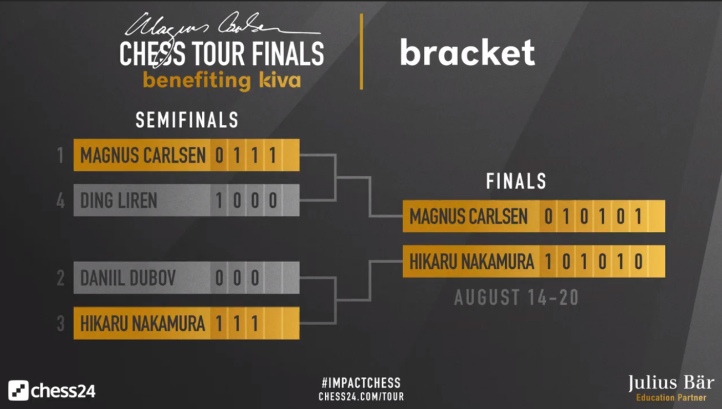
Magnus Carlsen fought off severe back pain and his big rival Hikaru Nakamura to set up a winner-takes-all Tour Final match for $140,000 tomorrow. The World Champion grimaced throughout yet still roared back to level the match 3-3 against Nakamura and take the epic best-of-seven final to the seventh day. Carlsen’s injury was sustained just 30 minutes before play when he twinged his back on a beach near where he is staying in Denmark. He had to constantly adjust his seating position as the match got underway but the injury didn’t stop him playing some of his best chess so far against Nakamura. The American had gone into the day’s play 3-2 ahead and on the brink of a famous Magnus Carlsen Chess Tour win but found a wounded Carlsen was a different animal. Asked how he got his injury, Carlsen said: “I was generally feeling great today and then half an hour before the game I was going for a quick swim in the ocean and I started running and something just happened. But there’s a little less pain now than there was before.” On tomorrow’s do-or-die match, Carlsen added: “It’s obviously going to be tough I feel like every day has been so far and I don’t expect anything to be different.” Carlsen has been on the back foot throughout the match and was behind for the third time. He had to win today and took an early lead as he crashed through in game 1. From then on there was no let-up for a hopeful Nakamura. Any thoughts that Carlsen would park the bus in game 2 were quickly dissipated in game 2 as the Norwegian came out swinging. But after appearing in serious trouble as Nakamura fought back, it took an escape described as “Houdini-like” by Grandmaster Yasser Seirawan for the champ maintain his lead with a draw. With his 1.5-0.5 lead intact and the white pieces, Carlsen decided now was the time to shut up shop and steered game 3 to a 17-move draw. It left Nakamura in a must-win situation in game 4 if he wanted to settle the match today. Try and he might, the five-time US champ just couldn’t break down Carlsen and fell apart. Carlsen won to finish off the set 3-1 and draw level in the match 3-3, coming back from behind for the third time. It was the most convincing win so far in this encounter and takes it into a final day of play tomorrow. Play is due to start again at 16:00 CEST. Supporting Kiva Broadcaster chess24 has pledged 50 percent of new Premium memberships bought during its Tour Final to Kiva’s Global COVID-19 Response fund that aims to raise at least $50 million for entrepreneurs and small businesses impacted by COVID‑19. During the event, chess24 and Kiva will highlight stories where chess has changed people’s lives under the official tournament social media hashtag #ImpactChess. Viewers are encouraged to engage with the Tour Final and support small businesses impacted by COVID-19 by signing up for a premium subscription here. More details on the Finals The Magnus Carlsen Chess Tour was devised by Norway’s World Champion and chess24 after traditional over the board chess was halted suddenly due to the COVID-19 pandemic. The Tour Final kicks off on August 9 and runs until August 20. It is the culmination of four elite-level super-tournaments that began in March as a way of getting chess started again while other sports worldwide were prohibited. The first four stages of the first Magnus Carlsen Chess Tour were: The Magnus Carlsen Invitational The Lindores Abbey Rapid Challenge The Chessable Masters The chess24 Legends of Chess Four players have qualified for the final crescendo of chess after being the best performers during the preceding tour events. The winner of the Tour Final, which has a total prize pot of $300,000, will scoop a top prize of $140,000 and the title of Champion of the Magnus Carlsen Chess Tour. Tournament rules and schedule The Tour Final will be a 12-day event running from August 9 to August 20. Time control is a rapid 15m + 10s from move 1 played in the chess24 Playzone. The semi-finals of the Tour Final tournament will be a best of 5 four-game mini-matches. The final will be a best of 7 mini-matches. As usual, play will start at 16:00 CEST. Highlights English:https://drive.google.com/drive/folders/1_QSmtZoiwL24EGuZSEmi1UR5j4hInR0u?usp=sharingNew files at around 23.00 CEST Rough edit highlights:https://drive.google.com/drive/folders/12mwKPkAfzeyfzd1Gay-FU5dJ8uU6OXMY?usp=sharingNew files ready around 02.00 CEST FOR MORE INFORMATION:Leon Watsonleon@chessable.com+447786 078770
Magnus Carlsen Tour Finals: Nakamura stuns Carlsen
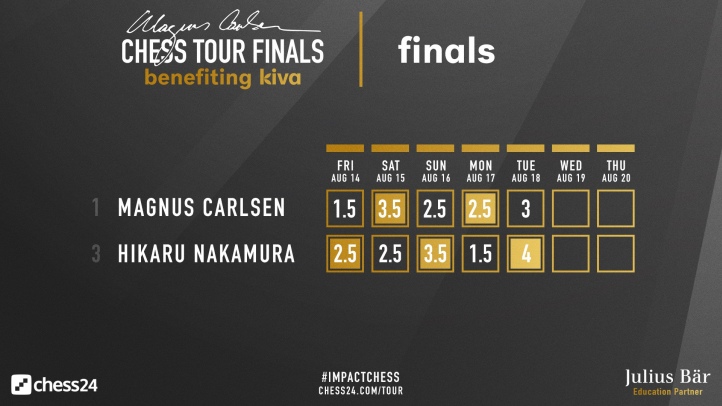
Magnus Carlsen faced his kryptonite today as Hikaru Nakamura launched an astonishing comeback win to go just one set away from glory in the Magnus Carlsen Chess Tour. Nakamura and Norway’s World Champion fought tooth and nail in an incredibly tight encounter that was decided in a nail-biting final tiebreak game. The regulation four rapid chess games on day 5 of the final finished all-square as the two rivals matched each other blow-for-blow in a series of draws. But then in a two-game blitz playoff, Carlsen pulled a rabbit out of the hat with his choice of opening and win the first. It looked like curtains for Nakamura because Carlsen simply does not lose in situations like these. But the five-time US champ did what no-one else appears able to do and beat Carlsen when the pressure is really on in a must-win second blitz game. It was an astonishing turnaround that had Nakamura saying afterward it was a “crazy match”. “I was thrilled that I got to the Armageddon because after the first blitz game I assumed it was over,” he said afterward. Before the final, Carlsen had lost just 1 out of his last 23 matches. Now Nakamura has beaten him in 3 out of the last 5. Nakamura has been 1-0 and 2-1 up in sets so far in the match leaving Carlsen to play catch-up and blowing apart any lingering thoughts that the climax of the Magnus Carlsen Chess Tour would be a coronation. After today’s result, the pre-event tour favorite Carlsen needs to win tomorrow or face losing his own signature tournament. The final of the world’s richest, most prestigious online chess tournament, played between two of the game’s fiercest rivals, really could not be more dramatic. For the third day in a row viewing figures hit new highs across chess24 channels along to watch the drama unfold. Play is due to start again today at 16:00 CEST. Supporting Kiva Broadcaster chess24 has pledged 50 percent of new Premium memberships bought during its Tour Final to Kiva’s Global COVID-19 Response fund that aims to raise at least $50 million for entrepreneurs and small businesses impacted by COVID‑19. During the event, chess24 and Kiva will highlight stories where chess has changed people’s lives under the official tournament social media hashtag #ImpactChess. Viewers are encouraged to engage with the Tour Final and support small businesses impacted by COVID-19 by signing up for a premium subscription here. More details on the Finals The Magnus Carlsen Chess Tour was devised by Norway’s World Champion and chess24 after traditional over the board chess was halted suddenly due to the COVID-19 pandemic. The Tour Final kicks off on August 9 and runs until August 20. It is the culmination of four elite-level super-tournaments that began in March as a way of getting chess started again while other sports worldwide were prohibited. The first four stages of the first Magnus Carlsen Chess Tour were: The Magnus Carlsen Invitational The Lindores Abbey Rapid Challenge The Chessable Masters The chess24 Legends of Chess Four players have qualified for the final crescendo of chess after being the best performers during the preceding tour events. The winner of the Tour Final, which has a total prize pot of $300,000, will scoop a top prize of $140,000 and the title of Champion of the Magnus Carlsen Chess Tour. Tournament rules and schedule The Tour Final will be a 12-day event running from August 9 to August 20. Time control is a rapid 15m + 10s from move 1 played in the chess24 Playzone. The semi-finals of the Tour Final tournament will be a best of 5 four-game mini-matches. The final will be a best of 7 mini-matches. As usual, play will start at 16:00 CEST. Highlights English:https://drive.google.com/drive/folders/1_QSmtZoiwL24EGuZSEmi1UR5j4hInR0u?usp=sharingNew files at around 23.00 CEST Rough edit highlights:https://drive.google.com/drive/folders/12mwKPkAfzeyfzd1Gay-FU5dJ8uU6OXMY?usp=sharingNew files ready around 02.00 CEST FOR MORE INFORMATION:Leon Watsonleon@chessable.com+447786 078770
FIDE responds to queries regarding the Chess ID Game Viewer

August 19, 2020 As per Art 5.2 and 9.3 of the Chess ID Game Viewer Call for Offers Procedure, FIDE publishes responses to queries received. Sources of the queries are not mentioned; queries were edited for clarity and identifying details were stripped. Q: Do you need the software itself to be hosted on your own servers, or just to use it as a service? A: FIDE allows applicants to present both SaaS and in-house proposals. FIDE Offer Evaluation Committee