


FIDE Treasurer and Women’s World Champion Zhu Chen, together with WIM Liang Zhihua, attended the “Brain-Computer Interface (BCI) Clinical Application Symposium” on June 11, as special guests at The Chinese University of Hong Kong, Shenzhen (CUHK-Shenzhen).
Chess has long been associated with intelligence and human creativity. Increasingly, the game is finding its place at the cutting edge of brain science.
FIDE representatives and chess players were invited to attend an event that brought together leading neurologists, clinicians, and technology companies working on brain-computer interface systems. At first glance, chess may seem an unusual guest at a medical symposium. Yet over the past year, the game has emerged as one of the clearest demonstrations of what brain-computer interface technology can achieve.

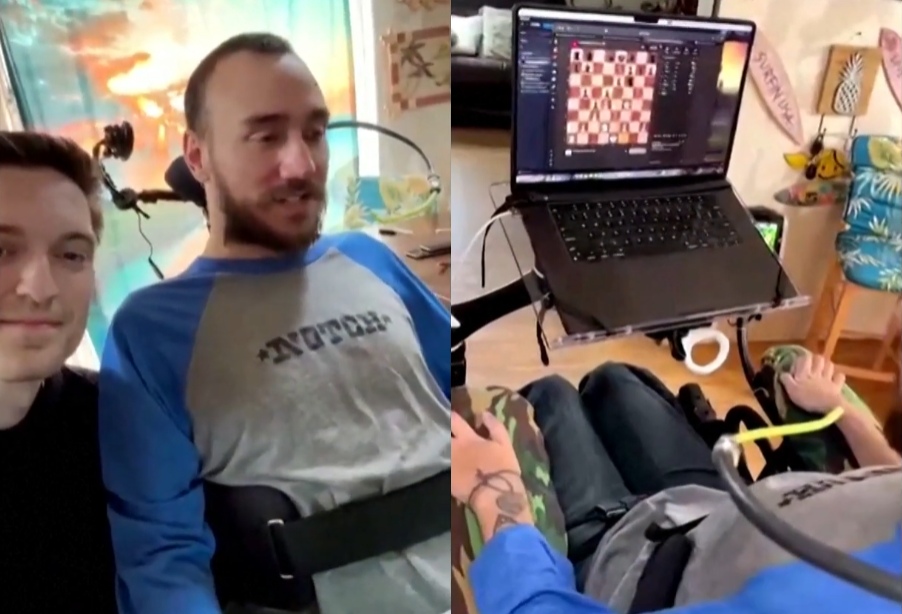
The event comes nine months after a historic moment in September 2025, when Neuralink patient Noland Arbaugh played a game of chess online against Swedish WFM Anna Cramling, marking the first time chess appeared on the global stage as a real-world BCI application. The match served as a public demonstration of how consumer-grade digital platforms can integrate with next-generation medical hardware.
During the match, Arbaugh, who was left quadriplegic after a swimming accident in 2016, controlled his side of the board on chess.com using a coin-sized Neuralink skull implant that contained over 1,000 electrode threads tracking his neural intent. The match highlighted a shift from robotic arm movements towards complex cognitive multitasking.
That connection was reflected in discussions at the Shenzhen symposium. Researchers from top Chinese institutions took part, including Peking Union Medical College Hospital; Xuanwu and Tiantan Hospitals, affiliated with Capital Medical University; Huashan Hospital, affiliated with Fudan University; Southeast University; and many others from the Greater Bay Area. Representatives from BCI companies also attended.
During the conference, chess was recognized as a tool for connecting scientific research and technology in the study of cognitive functions. Zhu Chen, a former Women’s World Champion, shared her views from the perspective of a chess player, linking scientific discussions with a board game built on human thought.
“It was very interesting to see the extent to which science has advanced in brain research. It seems almost sci-fi! It was exciting as well as heartwarming to hear that chess, an ancient game, has a very important role to play in the groundbreaking research which will strongly impact the future of humanity,” said Zhu Chen.

“FIDE has always been supportive and open to working with scientific institutions and organizations and will continue to do so,” Zhu added.
Experts also shared the latest advances in using BCI to treat Parkinson’s disease, epilepsy, consciousness disorders, and spinal cord injuries and highlighted the rapid development of BCI research in China.
The organizers said that the next stage of the project will involve multicenter clinical projects with leading BCI companies in China. Chess was again recognized as a useful tool for hypothesis testing.
Whether those efforts ultimately transform medical treatment remains to be seen, but what is clear is that chess has a role to play in supporting scientific research and development.
Photos: Liang Ziming and Neuralink live stream