

2023 3rd FIDE Council Meeting: List of Decisions

FIDE publishes the list of decisions of the 3rd FIDE Online Council meeting which was held on December 14, 2023. 2023 3rd FIDE Council Meeting List of Decisions (pdf)
2023 FIDE Online General Assembly: List of Decisions

FIDE publishes the decisions of FIDE Online General Assembly Meeting which was held on December 17, 2023. FIDE General Assembly Decisions (pdf)
FIDE Qualification Commission – Policy on Ratings and Titles

The FIDE Qualifications Commission (QC) is responsible for managing and maintaining the integrity of the FIDE Ratings System (FRS) and the FIDE Titles System. In doing so, QC is guided by the following principles: – The FIDE Qualification Commission regards FIDE Titles as being earned as a result of competitive play, where all players in an event are playing under the same conditions and are aiming to achieve the best possible tournament outcomes. – Under the management of FIDE, the FIDE Rating System (FRS) processes results from competitive chess events, played according to FIDE rules and tournament regulations, to provide a statistically meaningful measure of a player’s chess ability, as measured against the abilities of their contemporary chess players. – QC does this with the cooperation of players, arbiters, tournament organisers, and Federation Ratings Officers. The expectation is that tournaments submitted for rating to the FRS meet the regulatory and ethical standards expected by FIDE. Organisers are reminded that under regulation B.02.0.4 (FIDE Handbook), FIDE reserves the right not to rate a specific tournament. The organiser of the tournament has the right to appeal to the FC. Such an appeal must be made within seven days of the communication of the decision. FIDE QC has removed Scheveningen and Schiller formats from the FIDE Title Regulations. This decision takes effect on March 1, 2024. The reasoning behind this decision is that not all players play under the same conditions. In these formats, players aiming to achieve title norms have a different motivation and rewards than players who already have titles. QC believes that titles are earned as a consequence of achievements in high-level competitive play, not simply by ‘passing an exam’ against a set of previously titled players. FIDE QC have also investigated a number of tournaments where the motivation was either (a) designed to increase the ratings of a subset of players; (b) generate artificially high starting rating for a player or players; (c) arrange for a player (or players) to achieve a title (by rating), title norms, or other reward, through the manipulation of results. Where these cases have been identified, FIDE QC has decided not to approve such events if detected in advance or remove such events from the FRS if detected later. In the most serious of cases, QC has reported such events to the FIDE Fairplay Commission, FIDE Ethics Commission and FIDE Arbiters Commission. FIDE QC recognises that it is difficult to detect all such cases of ratings manipulation, but with the continued cooperation of arbiters, organisers and federations, we are taking serious steps to reduce the number of cases. Examples of events under investigation (a) A Scheveningen or match event where one team contains older players while the other team consists mainly of young players. The clear intent is to transfer rating points from older players (with a K factor of 20/10) to younger players (with a K factor of 40). In a normal round robin or Swiss, such players would play a mix of opponents and ages. (b) An unrated player (or group of players) playing a Schiller/Scheveningen or RR against highly rated (2000+) opponents. The score of the unrated player(s) is sufficient to give them a very high (2100+) initial rating. The vast majority of players gain their rating through Swiss events or against fields with much lower ratings. (c) A player needing a specific score to achieve a specific outcome does so through a series of “non-competitive” games (e.g. short draws, blunders by higher-rated opponents, stand-alone matches between players with significant rating differences). While it is difficult to identify this behaviour from a single game, such repeated results will draw the attention of FIDE QC.
FIDE wins prestigious Anthem Award for Diversity, Equity & Inclusion

The International Chess Federation, FIDE, has been recognized as a distinguished recipient of the Anthem Award, winning Bronze in the Diversity, Equity & Inclusion category for its Chess for Freedom Project. The social initiative has also become an Anthem Community Voice Winner, selected by the online community. The International Academy of Digital Arts & Sciences (IADAS) announced the Winners for the 3rd Annual Anthem Awards, which was launched by The Webby Awards in 2021 to recognize social impact work across the globe. This year’s Anthem Winners were selected from a pool of over 2,000 submissions from 44 countries. Now in its third year, the Anthem Awards are the biggest and most comprehensive social impact award in the world. This year’s winners include change-making nonprofits and foundations like the Planned Parenthood, IllumiNative, It Gets Better Project, World Central Kitchen, Decolonizing Wealth Project, and UNICEF; cultural figures including Taylor Swift, The Daily Show, and Amazon Music; industry and brand leaders like PepsiCo, Rare Beauty, Patagonia, Google, and NFL; and groundbreaking news and media organizations including ABC News, CNN, Al Jazeera, and VICE Media. FIDE, the global sporting body of chess recognized by the IOC, has earned the Anthem award for its outstanding Chess For Freedom project, launched in 2021 as a cooperation with the Cook County Sheriff’s Office (Chicago, USA). This initiative focuses on empowering inmates to improve their life chances and skills through learning and playing chess. A recent edition of its flagship event, the Intercontinental Chess Championship for Prisoners, held in October 2023, attracted 116 teams, including 22 female and 17 youth squads, from 50 countries worldwide. Sonja Johnson, President of the Trinidad & Tobago Chess Federation and Dr Mikhail Korenman, Cook County Jail Chess Coach “FIDE is exceptionally honored and pleased to have received this award,” said Arkady Dvorkovich, President of the International Chess Federation. “This recognition signifies the acknowledgement of the dedicated work undertaken by our organization and the entire global chess community. We are committed to introducing more people to the personal and social benefits of chess and showcasing how it can complement our daily lives.” “The Anthem Awards were born out of the desire to amplify and celebrate the voices that are creating sustainable change and to inspire others to take action,” said Patricia McLoughlin, Anthem Awards General Manager. “In a year where so much is at stake, it is incredibly important to recognize impact work and celebrate the progress happening globally. Congratulations to all of this year’s Winners.” “This recognition further fuels FIDE’s dedication to advancing its mission, inspired by the positive impact of chess on individuals and communities globally. Chess is not just a game; it’s a tool of change. Together, we’re rewriting the story of second chances and triumphs behind prison walls,” Dana Reizniece-Ozola, FIDE Deputy Chair of the Management Board, added. About FIDE: The International Chess Federation (FIDE) is the global governing body for chess, recognized by the International Olympic Committee. FIDE is dedicated to organizing chess events and promoting the game worldwide. About the Anthem Awards: Launched in 2021 by The Webby Awards, The Anthem Awards honors the purpose & mission-driven work of people, companies and organizations worldwide. By amplifying the voices that spark global change, we’re defining a new benchmark for impactful work that inspires others to take action in their own communities. The Anthem Awards honors work across seven core causes: Diversity, Equity & Inclusion; Education, Art & Culture; Health; Human & Civil Rights; Humanitarian Action & Services; Responsible Technology; and Sustainability, Environment & Climate. Founded in partnership with the Ad Council, Born This Way Foundation, Feeding America, Glaad, Mozilla, NAACP, NRDC, WWF, and XQ. Official website: anthemawards.com/
Infinite Chess Project launched in Tanzania
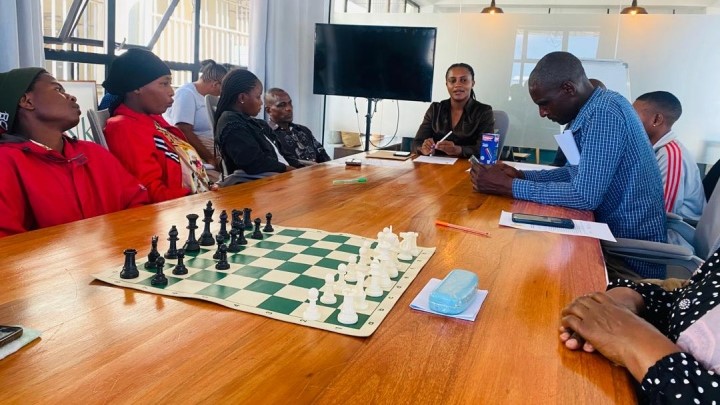
The official launch of the chess project for people with autism spectrum disorder organized by the Iyanna Foundation took place on January 24 in Kaloleni Primary School, Arusha, Tanzania. First, an introductory meeting was arranged with the parents/guardians of kids with autism from Kaloleni Primary School who have been selected to participate in the Infinite Chess program. Three Iyanna Foundation chess coaches, three chess tutors and the head teacher of the school were also present. The agenda of the meeting was to raise parents’ awareness of the Infinite Chess program and its impact on children’s mental health and skills needed for adaptation in society. Maria Tamkovich, project coordinator, and Prisca Lema Iyanna, CEO of Iyanna Foundation, introduced the project and shared the experience of other countries that had joined the initiative earlier. The follow-up questions from parents mainly concerned the influence of chess on children with autism spectrum disorder and their daily lives. Project officials explained the benefits of chess, and most parents agreed that it is something that they would love their kids to be a part of. Moreover, some parents expressed a desire to learn chess alongside their children to support them at home. The program is tentatively planned to start this week. The chess classes will be held once a week but with the flexibility of adding one additional day depending on the children’s reception. About Infinite Chess project: Spearheaded by Anastasia Sorokina, Chair of the FIDE Commission for Women’s Chess, a pilot Infinite Chess project was launched in January 2021 in six countries: Spain, Turkey, France, Gibraltar, South Africa and Norway. Currently, it is already running in 12 countries – Albania, Cyprus, France, Gibraltar, Latvia, Malaysia, Mongolia, Morocco, South Africa, Spain, Taiwan, and Turkey – and involves 130 children with ASD. The “Infinite Chess” training program for teaching chess to children with autistic spectrum disorder (ASD) is available in several languages — English, French, Spanish, and Russian. Recently, it has been translated into Arabic language and published on the project’s website. To learn more about the initiative, visit its official webpage: infinitechess.fide.com
Wei Yi wins 2024 Tata Steel Masters

Wei Yi emerged as the winner of the Tata Steel Masters 2024 after beating Gukesh D in the tiebreak blitz final. This victory is the most significant achievement in the 24-year-old Chinese GM’s chess career. Round 13 encounters Ding Liren – Ju Wenjun and Nepomniachtchi – van Forrest quickly ended in draws, while the main events unfolded in the games of the leaders. Praggnanandhaa R – Alireza Firouzja | ½-½, 60 moves The opponents followed the game Praggnanandhaa – Duda (Esports Cup, 2022) in the Classical Line of Gruenfeld up to move 16, where Alireza deviated with 16…Be8. White emerged slightly better, and after exchanging most of the pieces, the opponents transitioned into a minor piece endgame in which the young Indian had the remote a-passer. At a certain point, Pragg seemed to make substantial progress, but Alireza was up to the challenge. 47…d4! The only move! With this timely pawn sacrifice, Black penetrated the kingside with his king and reached a draw after 48. Nxd4 Kd5 49. Nb5 Bg6 50. Nc3+ Kd4 51. a4 Bd3 52. a5 f5 53. Na4 Be2 54. Nc5 Kd5 55. Na4 Bf1 56. Nc5 Be2 57. a6 Bxa6 58. Nxa6 Ke4 Anish Giri – Max Warmerdam | 1-0, 41 moves The players castled to the opposite wings in a popular line of the English opening, but White was first to launch an attack. However, Anish did not demonstrate the necessary accuracy, and Max equalized by breaking in the center. Giri ventured upon a piece sacrifice for a couple of pawns, which yielded dividends surprisingly quickly. Here, Black could have held his ground with 21… Qc6 22. Qh7+ Kf7 23. Rh6 Re6 but even 21…Kf8 played by Max was OK. Unfortunately, Black failed his defensive mission with several subpar moves and came under a crushing attack after 22. f5 Qf7 23. Qd6+ Kg8? (23… Qe7 24. Qf4 Be5) 24. f6 Qg6? (24… Bf5 25. fxg7 Qxg7 26. Qd5+ Qf7 27. Rh8+ Kg7) 25. Qf4 Qf5 26. Qg3 Be6 27. fxg7 Bf7 28. Rf4 Qe6 29. Qh2 Kxg7 Here, Anish delivered the final blow 32.Rxf7+! and after Qxf7 31. g6! Qe6 32. Rd7+ Qxd7 Max capitulated. Parham Maghsoodloo – Gukesh D | 0-1, 65 moves Gukesh introduced a new move on the black side of a topical line of the Ragozin and obtained a comfortable position. True to his aggressive style Parham castled long, advanced his kingside pawns but could not resist temptation of a dubious knight sacrifice. After 16.Nxf7?! Gukesh accepted and got the upper hand, but the position remained very tense and complicated. Unsurprisingly, both made errors. White has just played 29.Qf4+. Gukesh had three winning continuations at his disposal, namely Kg7, Qf6 and the strongest 29…Bf5!! The Indian, however, decided to evacuate his king to the queenside and played 29…Ke6? giving his opponent a great chance to equalize with either 30.exd5 followed by 31.b3! or the immediate 30.b3! The idea behind this move is that after 31…cxb3+ 32.Kb2 White’s king is safe while Black is under attack, while 31…Rxb3 is met with 32.Na4! threatening Nc5+. Parham played a natural 31.Rb1 and after 30… Kd7 31. exd5 Bb7 32. Qf7 Rb8 33. d6 Qxd6 34. d5 Ba8 35. Rh8 Bxd5 36. Nxd5 Qxd5 37. Rxf8 Qe5 Black returned a piece but launched a devastating counter-attack. After 39..c3 40. Ke1 Rxb2 41. Rd1+ Ke6 Maghsoodloo threw in the towel. Wei Yi – Vidit Gujrathi | 1-0, 38 moves Wei quickly got a very good attacking position in the Colle System after a serious inaccuracy on move 12 by Vidit. After 12…Be7 13.Rc1 Qd8 White is just slightly better. Vidit opted for 12…Nxe4?, but after 13.Rxe4 Bb7 14. Rc1 Qb8 15. Rh4 White transferred his rook to the kingside, creating dangerous threats. Interestingly, all these moves were played almost a century ago in the game Pzepiorka – Prokes (Budapest, 1929), which White also won. After 15…f5 16.Bc4 Qe8 17.Qb3 Vidit had a last chance to put up some resistance with 17…Bxf3 18.Qxf3 Qg6, but he played 17…Kh8 and after 18.Re1 Be4 19.Bxe6 White got an overwhelming position. The rest was a smooth sail for the Chinese GM who cruised to his third straight victory and tied for first place. Nodirbek Abdusattorov – Alexander Donchenko | 1-0, 66 moves Once again, Alexander played the Najdorf with g6 as Black and managed to equalize. On move 19, instead of castling, Black went for a knight sortie on g4, which White could have punished with 20.e5, but Nodirbek preferred 20.Rd5 Alexander struck with 20…g5 and after 21. Bg3 e6 22. Rxd6 gxf4 23. Rxf4 Be5 Nodirbek was forced to sacrifice an exchange as 23.Bxf4 fails to 23…Nxh2. White got sufficient compensation, but over the next several moves, Black consolidated and emerged better. Doncheko, however, too hastily traded his dark-squared bishop for White’s knight and it was even again. Here, Alexander could have forced a draw with 30… Qa1+ 31. Kh2 Qe5+ 32. Kh1 (32. Bf4 Qc5 33. Qg3 Qc3) 32… Qa1+ but he snatched the c2 pawn with 30…Qxc2, which was more dangerous, although Black still could have maintained the balance with accurate play. Closer to the time control, Alexander weakened his position too much, and Nodirbek forced the transition into a won queen endgame. After 42. Bb4! Qf7 43. Rxg7 Qxg7 44. Bd6 Kc8 45. Bxc7 Qxc7 46. Qxf6 a5 47. Qf8+ Kd7 Abdusattorov converted his decisive advantage on move 66. As a result, Gukesh, Abdusattov, Giri and Wei Yi scored 8.5 and tied for first place. A four-player knockout tiebreak was played with the time control 3 min +2 sec increment to determine the champion. Wei Yi miraculously escaped with a draw in his first game vs Nodirbek Abdusattorov and came from behind in the second one to win the first semifinal. Anish Giri and Gukesh D exchanged blows, both winning with the black pieces. The young Indian came out victorious in the third decisive game (this time with White) and advanced to the final. The first game of the final was a logical draw, while in the second one Wei gradually outplayed Gukesh in a roughly equal position and clinched the title. Final standings Tata Steel Masters 2024 1 Wei Yi 2740 8½ 2 Gukesh 2725 8½ 3 Abdusattorov, Nodirbek 2727 8½ 4
Tata Steel Masters: Five share the lead going into final round
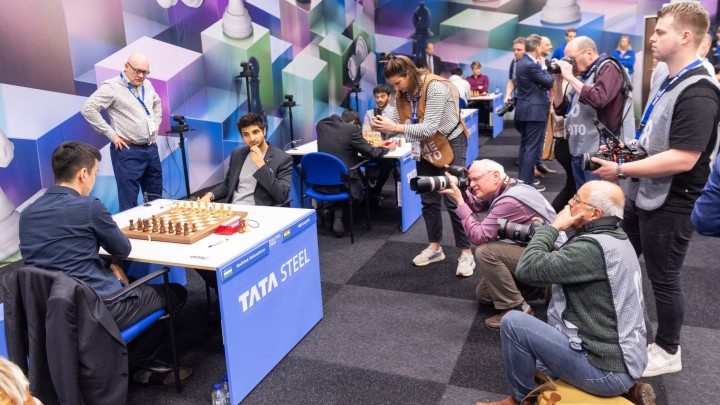
In a thrilling climax to the Tata Steel Masters 2024, five players are going the final round tied for first place. In the penultimate round Vidit Gujrathi toppled leader Nodirbek Abdusattorov, joining him at the top, while Anish Giri, Wei Yi, and Gukesh D caught up with this duo. Praggnanadhaa R and Alireza Firouzja stay in the race, trailing the leaders by a half point. As many as seven players have a shot at the title on Sunday. Vidit Gujrathi – Nodirbek Abdusattorov | 1-0, 77 moves The Indian GM essayed a new plan in a popular Nimzo-Indian line that hardly promises much. Surprisingly, this approach paid off very quickly as Nodirbek went overboard only to end up losing a pawn. On his previous move, the Uzbek GM played 10…Ba6, preventing White’s castling. Here, he should have retreated 11…Bb7 with a normal position. Nodirbek, however, continued down the disastrous path with 11…Bc4, but after 12.b3! Bd3 13.Ne5 Nxe5 14.Qd4! Nxc3 15.Bxc3 Bg6 16.Bxd5 Vidit won a pawn. It took him quite a long time to convert it, but on move 77, he broke Black’s resistance and notched up a full point. Jorden van Foreest – Anish Giri | 0-1, 24 moves Anish comfortably equalized in the Exchange Variation of French despite having the isolated d-pawn. Jorden played somewhat passively, but the position remained balanced up to move 21 when disaster struck. White has to demonstrate accuracy, with 21.Rxe5 is the only move maintaining equality. Jorden, however, stepped into the abyss with 21.Qc3?? and threw in the towel after 21…Rc8! 22. Qd2 a4 23. Rxe4 Nxe4 24. Qa5 Qf6! 0-1 Alexander Donchenko – Parham Maghsoodloo | ½-½, 65 moves Parham obtained a comfortable position on the black side of QGD and, after Alexander made a serious mistake in an equal endgame, emerged much better. With his back against the wall, Donchenko defended resiliently and managed to save a half-point. Ju Venjun – Wei Yi | 0-1, 39 moves Eager for a real battle, Wei tried the Dutch Defense and got a fresh playable position as early as by move 10. After trading the queens, the opponents steered into a complex endgame with an asymmetrical pawn structure, which the Women’s World Champion misplayed on move 22. After 22.Nf2? (22.Bb5 maintained balance) 22…Ba3! 23. Rcb1 Bxb2 24. Rxb2 Nxd4 Black simply won a pawn. Wei converted his small material advantage with great energy and accuracy and scored his second straight victory. Gukesh D – Praggnanandhaa R | ½-½, 41 moves Gukesh introduced a very interesting novelty (13.Ne2) in the Leningrad system of Nimzo-Indian and got a very promising position after transferring four pieces to the kingside. Pragg was holding his ground up to a certain point, but eventually, he broke through on the queenside but missed a nice exchange sacrifice by his opponent. After 32. Rxe5 dxe5 33. Bxe5 f6 34. d6 Bxd6 35. Bxd6 White got to minor pieces for a rook and winning position. Unluckily for Gukesh, he allowed a threefold repetition in mild time trouble and had to settle for a draw. Alireza Firouzja – Ian Nepomniachtchi | 1-0, 37 moves Alireza sacrificed a pawn in a popular line of the Veresov with 3.Bf4 and got sufficient compensation but hardly more. However, instead of natural 18…Nb5, with a roughly equal position, Ian decided to sacrifice an exchange. After 18…Be5 19. f4 Rxc3 20. Qxc3 Nb5 21. Qf3 Bd4 22. Ka2 White emerged better. Still, Black had some compensation for the exchange, but a few moves later, Ian committed one-move-blunder and resigned immediately. After 27…0-0, White has many obstacles to overcome, converting his extra exchange. Ian, however, played 27…Rf8? and capitulated after 28.Qd3 as any move with the bishop fails to 29.Rxe4. Max Warmerdam – Ding Liren | 0-1, 64 moves The opponents quickly traded queens, bishops and a pair of rooks in the Nimzo-Indian and transitioned into a roughly equal endgame in which Black had a slightly better pawn structure. Ding played more purposefully and got the upper hand by advancing his kingside pawns. Later, he traded his h-pawn for the opponent’s f4-pawn and reached a winning position. However, a single inaccuracy by the World Champion in a rook endgame offered Max excellent drawing chances. After 45.a5 a5 Ra4 (45… Rc2+ 46. Kg3 Ra2 47. Rb5) 46. Rb5 Ra2+ 47. Kg3 Ra3 48. Kg2 Black can’t make progress. Max opted for 45.Rb2? and after 45…Rxa4 Black was winning again. Surprisingly, Ding let his guard down and fell into a trap set up by the Dutchman. Black was winning with 52…Re1, but instead, he played 52…Rxh2?? and after 53. Ra5+ Ke6 54. Rxe5+! the rook is taboo because of stalemate. The final act of this drama came on move 62 when Max missed a draw. After the correct 62. Kf2 White could have held his ground. The Dutchman, however, played 62.Rd7+ and had to resign after 62…e5 63. Rg7 Kf4 64. Kf2 g1=Q+ as the pawn endgame is hopeless for White. Masters pairings Photos: Jurriaan Hoefsmit and Lennart Ootes – Tata Steel Chess Tournament 2024 Official website: tatasteelchess.com
Changes to qualification paths for the Candidates Tournament

FIDE has introduced a series of changes to the qualification paths that will be in effect for the FIDE Candidates Tournament in 2026. Most notably, the runner-up from the World Championship match no longer automatically qualifies for the Candidates The alterations are aimed at enhancing the competitive landscape, encouraging player participation, and ensuring a fair representation of the top contenders. The amendments will impact the selection process through various paths. The key changes and the renewed qualification paths for the Candidates Tournament 2026 are the following: World Championship Runner-Up – no spot The runner-up in the World Championship will no longer automatically get a spot in the next Candidates Tournament. Instead, the runner-up will now need to navigate the qualification process. To compensate for this change, World Championship Match 2024 is also recognized as an eligible tournament for FIDE Circuit and the runner-up will receive special bonus points for playing the match. The points they gain in the match for the World Championship title will be calculated based on performance. This means the points gained for the FIDE Circuit will depend on the score of the match. If the match is lost on tie-breaks, the runner-up will get more points than when they lose in the standard part of the match with rounds to spare. The highest-rated player – 1 spot The spot reserved for the highest-rated player will now be determined by the six-month average rating, not the previous 12 months or the current rating. This spot is exclusive to the player ranked first in the FIDE rating list. If the player withdraws, the qualification spot shall be awarded to the second-highest rated player. If the second-highest rated player has already qualified, the qualification spot will be redirected to FIDE Circuit 2025 path. Notably, the six-month average rating rule eliminates the possibility of players relying on a “last chance” tournament in December of the year in the run-up to the Candidates. FIDE Circuit – 2 spots Two spots in the FIDE Circuit – for the years 2024 and 2025 – will serve as qualifying paths for the 2026 Candidates. The final score will be the sum of a player’s highest event scores, but not more than seven event scores. For reference, the score calculation for Circuit 2024 was based on five event scores. Other main changes in FIDE Circuit rules: 1) for round-robin tournaments points are given to the top three places only, 2) a new bonus for sole 1st place without any tie-break criteria is added, 3) an unlimited number of tournaments in one country is allowed, in case the average rating of top eight players of each event is 2650 or higher. Organizers of events taking place after July 1st, 2024, must notify FIDE GSC at least three months in advance. FIDE World Cup – 3 spots The FIDE World Cup 2025 will provide three qualifying spots for players who finish 1st, 2nd and 3rd. FIDE Grand Swiss Tournament – 2 spots The FIDE Grand Swiss Tournament will offer two qualifying spots for the Candidates Tournament, for the players who finish 1st and 2nd. This table highlights the difference between the existing and new qualification system for the Candidates: FIDE Candidates Tournament 2026 will witness eight players qualifying through distinct paths, emphasizing diversity and fairness, ensuring a competitive and merit-based selection process. “These changes have been carefully thought through, considering all important factors, with the aim of making the qualification process more engaging and fairer. This reflects FIDE’s commitment to evolving and refining the qualification process, promoting a dynamic and competitive chess environment,” FIDE President Arkady Dvorkovich said. As the chess community eagerly awaits the Candidates Tournament in Toronto, these alterations for the 2026 event are poised to shape a new era in the journey towards determining the World Chess Champion. Related documents: Regulations for FIDE Circuits 2024 Regulations for FIDE Circuits 2025 FIDE Candidates Tournament 2026: Qualification paths
Tata Steel Masters 2024: Abdusattorov forges into the lead
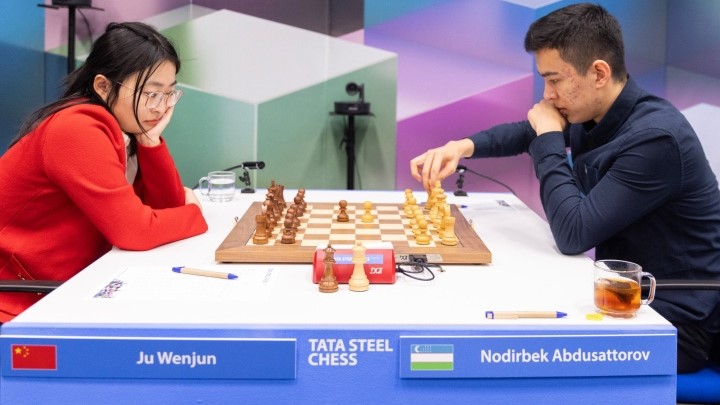
Nodirbek Abusattorov scored a crucial victory over Ju Wenjun in Round 11 of Tata Steel Masters and grabbed the lead. Gukesh D had a chance to keep up with the Uzbek GM but missed a couple of chances in the game with Alireza Firouzja and had to settle for a draw. Wei Yi and Vidit Gujrathi pulled off wins against Max Warmerdam and Parham Maghsoodloo, respectively, and joined Praggnanadhaa R and Giri, trailing the leader by a full point. Nodirbek Abdusattorov – Ju Venjun | 1-0, 34 moves In Giocco Piano Nodirbek surprised the Women’s World Champion with unusual 7.c4!? blocking his light-squared bishop and it worked out for him as instead of natural 8…Bg4 (a typical move in such positions) Ju carried out somewhat sluggish maneuvers with her knight. White expanded on the queenside and, after taking control over the a-file, delivered a nice blow. 23. Nxf7! Kxf7 At this point, the opponents traded serious mistakes, but Ju made the last one. 24. Qa2?! (24. dxe4 Rd8 25. Nd5 Qc6 26. Qe2 Ke8 27. Nxf6+ Bxf6 28. Bxe6 Qxe6 29. Rxb7 was much stronger, but it was not easy to calculate all the lines). Here, in the case of 24… Rd8! 25. Bxe6+ Kf8 26. Bd5 Nxd5 27. Nxd5 Bxd5 28. Qxd5 Rxd5 29. Rxc7 exd3 30. Bd2 Rd4 White has to work for a draw. The Women’s World Champion, however, played 24…Qc6? and after 25. Rxb7 Qxb7 26. Bxe6+ Ke8 27. dxe4 Qxe4 28. Nd5 Bd8 29. h3! Black had no arguments against the coordinated attack of White’s pieces. Nodirbek conducted the final portion of the game in a clinical fashion and scored a full point. Parham Maghsoodloo – Vidit Gujrathi | 0-1, 37 moves The game saw a sharp tactical melee in the QGD, from which White emerged with an extra pawn, but his king got stuck in the center. Unluckily for Parham, choosing between aggressive and more solid continuations, he stayed true to himself and went for an active but erroneous move. Instead of 20. Be3 with a slightly better position, the Iranian played 20.Bxh6? but it failed to 20…Qxc5! 21. Rxf6 Qe7! 22. Bxg7 Kxg7 23. Rf5 Rd8 24. h4 (better was 24. g3 Bxf5 25. Qxf5 Rac8) 24… Bxf5 25. Qxf5 Rd4 and Black won an exchange. The rest was a smooth sail for Vidit, who swiftly converted his material advantage. Ding Liren – Jorden Van Foreest | ½-½, 25 moves The game saw a popular line of English Opening in which Black sacrifices a pawn and trades the queens but builds a defensive line on dark squares. On move sixteen, Ding could have undertaken some activity in the center, but he preferred a more reserved approach. After some maneuvering in an equal position, a draw by repetition was agreed on move 25. Gukesh D – Firouzja | ½-½, 38 moves Alireza achieved a promising position on the black side of the Gruenfeld and put pressure on White’s d5-pawn. Gukesh, in his turn, sacrificed it but pushed f4-f5 and got sufficient compensation in the form of weakening the opponent’s kingside. Just a couple of moves down the road, the opponents reached the critical position of the entire game. Here after 25…Nd5-f4? White had a very strong queen sacrifice 26.Rxd7! and after 26. Rxd7 Nxe6 27. fxe6 Black is doomed to an uphill battle with little chance of escape. Gukesh preferred to trade his queen for two rooks with 26.Qxd7 and got an edge anyway as Alireza erred with the very next move. However, on move 31, the young Indian missed another chance to obtain a considerable advantage, and the game ended in a draw by repetition. Praggnanandhaa R – Alexander Doncheko | ½-½, 56 moves Praggnanandhaa had an initiative throughout the game that saw the QGA, but his advantage never became decisive as Alexander found the best defensive moves at critical moments. White eventually won a pawn, but it was just another case of “all rook endgames are drawn” as Black comfortably held a draw. Wei Yi – Max Warmerdam | 1-0, 27 moves The most exciting game of the round started as the Bishop Opening, but after White played f2-f4 early on, it quickly took shape the King’s Gambit. The opponents played the most principled moves, with White sacrificing a rook and Black accepting the challenge, but the evaluation of an erratic position surprisingly hovered about equal. Both demonstrated precise calculation up to a certain point, but Max’s first mistake became fatal. Black could have maintained equality with the precise 16… a5 17. Bxf8 Rxf8 18. Kb1 Qf6 19. d4 b5 20. Bd3 Bxf3 21. gxf3 Qxd6. Warmerdam, however, played 16…Bxf3? and after 17. gxf3 Ne5 18. Kb1 Qd4 19. Rxh1 Nxc4 20. dxc4 Qb6+ 21. Kc1 Rxf7 22. Rd1 Rff8 23. d7 White’s d-passer decided the game in his favor. Amish Giri – Ian Nepomniachtchi | ½-½, 54 moves Ian equalized on the black side of the Dutch-Peruvian Gambit (a variation of the QGD), but his decision to keep more minor pieces on the board backfired as Anish gradually turned a slight edge into a sizable advantage. However, at the game’s turning point, Giri was tempted by snatching a pawn but underestimated Black’s counterplay. After 26. Rce1 Rxe5 27. Rxe5 Qc6 28. Qb3 Kf8 29. h4 White could have exerted long-lasting pressure, with Black being doomed to passive defence. Anish captured the d-pawn with 26.Rxd5, but after 26… Bc6 27. Re1 Rcc8 28. Rde5 Rxe5 29. dxe5 Qe6 Ian got a serious counterplay against White’s weak pawns. Giri quickly realized that the tide had changed and soon offered a draw, which was accepted. Masters pairings Photos: Jurriaan Hoefsmit – Tata Steel Chess Tournament 2024 Official website: tatasteelchess.com
Announcing winners of FIDE Trainer Awards 2023

The FIDE Trainers Commission is pleased to announce the winners of the 15th FIDE Trainer Awards 2023, which recognize and celebrate the achievements of the chess training community and the best chess books of the year 2022. Ramesh R B (IND)Mikhail Botvinnik Award 2023 Ramesh R B (IND) wins the Mikhail Botvinnik Award for the best achievement in Open Section competitions. Over the last few years has worked with many Indian chess stars, including Rameshbabu Praggnanandhaa; the winner of Dubai Open 2022, Aravindh Chithambaram; Rameshbabu Vaishali and the bronze winner in the World Women’s Rapid Championship and Savitha Sree. Ramesh R B also captained Indian Team B, which earned bronze at the 2022 Chess Olympiad. Abhijit Kunte (IND)Vakhtang Karseladze Award 2023 India’s fourth GM, Abhijit Kunte (IND) receives the Vakhtang Karseladze Award for the best achievement by a trainer in women’s and/or girl’s competitions. Serving as non-playing captain and coach, he led the Indian Women’s Team to silver in the World Women’s Team Championship (2021) and Asian Games (2022) and to bronze at the 44th Chess Olympiad. Djakhangir Agaragimov (AZE)Mark Dvoretsky Award 2023 Djakhangir Agaragimov (AZE) has been chosen by the judges for the Mark Dvoretsky Award for the best achievement by a trainer in junior events. Over many years of coaching, Djakhangir raised several GMs, WGMs, and IMs. His pupils became winners and medalists of European Championships in different age groups. In 2022, his student GM Abdulla Gadimbayli won the World Junior U20 Championship title. The Yuri Averbakh/Isaac Boleslavsky Award for the best book published in 2022 goes to “Rock Solid Chess: Tiviakov’s Unbeatable Strategies: Pawn Structures“, co-authored by Sergei Tiviakov and Yulia Gokbulut and published by New In Chess. In his first book, Sergei Tiviakov explains everything he knows about the fundament of chess strategy: pawn structures. Famous for deep chess knowledge and rock-solid positional play the Dutch GM has gathered a rich collection of strategic lessons he has been teaching worldwide, drawing mainly from his personal experience. The examples and exercises suit any reader from club player to grandmaster level. The runners-up were “The Exchange Sacrifice According to Tigran Petrosian” by Vassilios Kotronias, published by Russell Enterprises, Inc. and “Learn from Bent Larsen” by Mihail Marin, published by Quality Chess. These were the panels for Trainer Awards and Book Award respectively: Trainer Awards Jury Panel FST & GM Le Quang Liem (VIE)FST & GM Vladimir Akopian (USA)FT & GM Bassem Amin (EGY)FT & GM Mihail Marin (ROM) Book Awards Jury Panel FST & GM Antoaneta Stefanova (BUL)FST & GM Rustam Kasimdzhanov (UZB)FST & GM Emil Sutovsky (ISR) The winners of the FIDE Trainer Awards will be invited by TRG to be awarded during one of the major FIDE events.