

Four slow Slavs in Round 4 of FIDE Grand Swiss
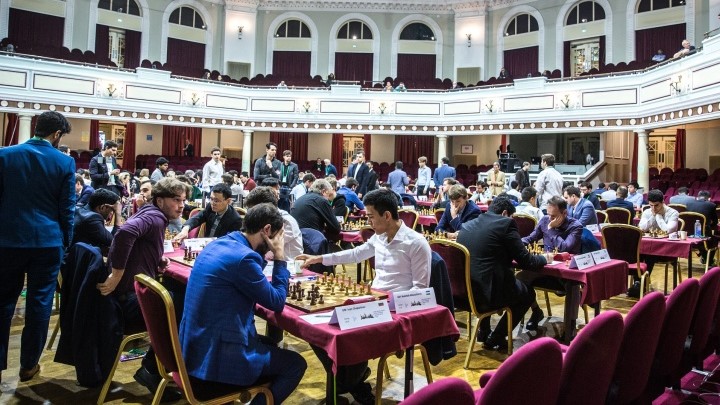
Former prodigy Andrey Esipenko overcame the reigning World Junior Champion Marc’andria Maurizzi for a third win in four games and emerged as the sole leader in the open section. There was excitement everywhere, from Erigaisi’s king walk to b4 to the theoretical duels in the Slav and Volokitin’s touch-move rule violation. In the women’s section, Anna Muzychuk missed a huge chance to win a fourth game after spoiling her excellent opening preparation e against former World Champion Tan Zhongyi. Bibisara Assaubayeva and Rameshbabu joined the leaders with convincing wins The Slav Defence is one of the most popular openings. Its popularity comes from its versatility, as it allows Black to choose from several set-ups according to their tastes. However, White also has a say when it comes to the Slav. The Exchange Variation, for example, is not as dull as it may sound, but there is also the so-called slow Slav, where White intentionally slows the thigns down, thus avoiding the sharp options like the Semi-Slav, the Botvinnik Variation or the Anti-Moscow gambit. In round four of the FIDE Grand Swiss, there was an unexpected occurrence of the slow Slav on the top boards. On board eight, Radoslaw Wojtaszek chose the slow Slav against Anish Giri. Then, curious things started to happen early on. In the position after 1.d4 d5 2.c4 c6 3.Nf3 Nf6 4.e3, Black has three main moves, and these are 4…Bg4, 4…Bf5 and 4…e6. Giri chose the first one. Interestingly, Wojtaszek was on Team Anand in 2008 when Anand played the World Championship match against Kramnik. The Slav Defence was Anand’s main weapon in that match, which he won thanks to excellent preparation in the sharpest lines of the Meran. While preparing the Slav in general, the team considered the slow Slav as well, and their intention was to play the line with 4…Bg4! Fast-forward to 2023, and here we see Wojtaszek on the white side of the line he prepared as Black in 2008! He continued with 5.Qb3 Qb6 6.Ne5 and they followed mainstream theory for a while. Suddenly, White got a great chance. Black’s last move 15…h5? was positionally sound – stopping possible White expansion on the kingside, but it turned out to be too inconcrete. Possibly, Giri was lulled by the “slowness” of the Slav and didn’t expect any dynamic factors. Luckily for him, so did his opponent as he continued with the “slow” 16.Rhd1? missing a great chance to put his opponent under tremendous pressure with 16.Na5! Rb8 17.e4 Nc7 18.Bf4 Kd7 19.Nc4 and Black is on the brink of defeat as White threatens Rxa7 and Ne5. With this unexpected chance not taken, White couldn’t pose more problems, and the subsequent advance in the centre with e4 and d5 only led to simplifications and a draw. On the next board, board nine, Hans Niemann chose the slow Slav against Richard Rapport. Black deviated quickly from the board he could easily see next to him and chose 4…Bf5. After 5.Nc3 e6 6.Nh4 Bg6 7.Qb3 Qc7, both players followed theory, and when it ended, a complex middlegame was on the board. This is a rather typical situation in the slow Slav, where White’s pair of bishops is compensated by Black’s solid position and better pawn structure. It was a true slow Slav until the final moves before the time-control. Instead of continuing to manoeuvre with 39…Rc8 or 38…Bb8, Rapport took the poisoned pawn on a5 and was swiftly punished after 39…Bxa5? 40.Qa4 Qc7 41.b4 Bb6 42.Bxa6! White transferred the rook to a2 and launched a decisive attack along the a-file. Two more slow Slavs were played on boards 14 and 15. On board 14, Santosh Gujrathi Vidit decided to try to tame Alexey Shirov by slowing things down. Shirov played his usual choice against this line, 4….Bf5 5.Nc3 e6 6.Nh4 Be4 (deviating from Rapport’s 6…Bg6) 7.f3 Bg6. The idea of the move …Be4 is to provoke a slight weakening in White’s position with the move f3. The game followed an earlier game by Vidit, played against Illya Nyzhnyk, and it was surprising to see Shirov not try to improve on that game and end up in the same inferior position as Nyzhnyk. Black should have played …Nb6 before taking …c5xd4, and now both Shirov and Nyzhnyk found themselves in an inferior position. Black’s main problem is the lack of safe shelter for the king – if it stays in the centre, then f4-f5 is coming, and if it goes to the kingside, then h4-h5 is dangerous. Shirov’s time management, spending almost an hour to reach a position that his opponent had played earlier, perhaps indicated that his preparation wasn’t of the highest quality. Shirov eventually deviated from the game Vidit-Nyzhnyk on move 22, but he was already in a very bad position. Vidit won without too many problems. On board 15 Nikita Vitiugov and Chithambaram Aravindh followed the game Niemann-Rapport for a few moves before deviating with 7.Nxg6 hxg6 8.Bd2 Nbd7. In this popular position, White chose the relatively rare 9.cxd5, transposing to a Carlsbad structure. His intentions were aggressive, as after 9…exd5 10.Qc2, he prepared long castling. Black wasn’t very precise, and White quickly built up an attack with f3 and g4. However, Vitiugov misplayed and rushed with g5, allowing Black to block the kingside with …Nh5, then it was Black who started to attack at the queenside! He achieved a winning position, but then… Instead of 32…Qf1 or 32…Qd1 or even the prophylactic 32…Kh7, Black rushed with 32…Re1? when after 33.Qb8 Kh7 34.Qg3! suddenly, it was White who was better! The threat of mate with Rc8 forced Black to go back with the rook when Black’s attack was gone, and White could go on to collect the c4-pawn and advance his central pawns. Vitiugov exchanged rooks and entered a queen endgame, but now it was his turn to be imprecise. White already gave checks on c8 and h3, but here he missed that after the immediate 44.Kxa6? Black has the excellent 44…f5! cutting off the white queen and advancing his own passed pawn. After this, the position is objectively a draw, and Black managed to reach it. The winning manoeuvre was 44.Qc8 Kh7 45.Qc6!
José Cubas and Thalia Landeiro win 2023 Pan American Chess Esports Finals

Chess was a part of the 2023 Pan American Games in Santiago in the Esports category, with the open and women’s finals taking place online on chess.com from October 26-27. Both competitions were eight-player round robins with 3+2 time control. The opening ceremony was attended by the Vice President of FIDE, Mario Ramirez Barajas, who stressed the importance of chess in the Pan American Games; the President of FIDE America, Jose Carrillo Pujol, who summarized the scope of the event and inclusion of chess in multisport events and a member of the FIDE Chess in MULTISPORT Games commission, Mario Petrucci, who had a meeting Thomas Bach, President of the International Olympic Committee, where he discussed a possible chess inclusion in the Olympic Games. The open final saw the triumph of GM José Cubas (Paraguay). Despite losing to Diego Flores of Argentina in Round 2, Jose scored an impressive 5.5/7 and finished first a full point ahead of Andrés Rodríguez Vila (Uruguay). Santiago Yago Moura (Brazil) tied for third place with Diego Flores and took bronze thanks to a slightly better Sonnenborn-Berger. Final standings: 1 GM Cubas, Jose Fernando PAR 2542 5½ 2 GM Rodriguez Vila, Andres URU 2387 4½ 3 GM Santiago, Yago De Moura BRA 2453 4 4 GM Flores, Diego ARG 2603 4 5 GM Hernandez , Gilberto MEX 2521 3½ 6 WGM Francisco, Candela ARG 2320 2½ 7 GM Hungaski, Robert USA 2433 2 8 GM Zambrana, Osvaldo BOL 2373 2 The women’s tournament was a very close race, with Thalia Landeiro Cervantes and Miranda Yerisbel sharing first place on 5.5/7. Thalia came out on top thanks to a greater number of victories, whereas the runner-up, Yerisbel, became the only undefeated participant. Deysi Cori netted 5/7 and finished third. Final standings: 1 WGM Landeiro Cervantes, Thalia USA 2303 5½ 2 WGM Yerisbel, Miranda CUB 2262 5½ 3 IM Cori, Deysi PER 2367 5 4 WIM Corrales Jiménez, Zenia MEX 2140 4½ 5 WGM Pérez Rodríguez, Jennifer PAR 2242 3 6 WIM Argote Heredia, Valentina COL 2179 2 7 WIM Campos, María José ARG 2206 2 8 Ruchinskaya, Valerie CAN 1862 ½ Games and results
FIDE Grand Swiss: King’s Representative sparks excitement in Round 3
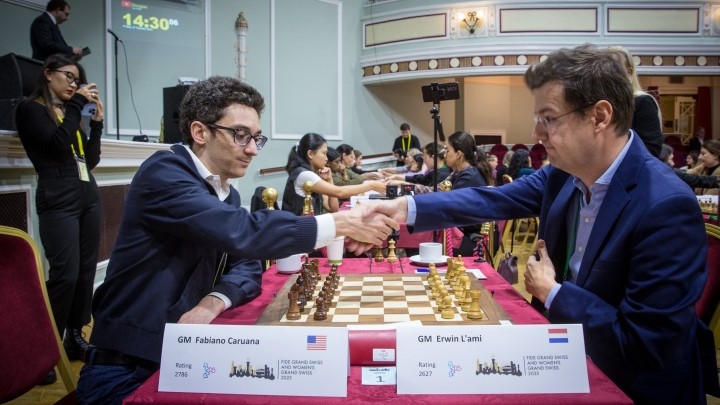
There were multiple draws on the top boards in the open section and many wins in the women’s section today. Only Tan Zhongyi and Anna Muzychuk have maintained their 100% score, with a massive tie for first place in the open section. Some players took risks; others didn’t, producing a mix of exciting and theoretical games in Round 3 The third round of the FIDE Grand Swiss was visited by His Excellency Sir John Lorimer, Lieutenant Governor and the King’s representative on the Isle of Man. He walked around the tables for a venue tour and had pleasant conversations with the tournament director Alan Ormsby, the FIDE Delegate Jeroen van den Berg and FIDE’s CEO Emil Sutovsky. The esteemed guest also paid a visit to the broadcast room, enjoying the live commentary of the games in progress. The visit happened after the start of the round, and while the players may have been aware of the visit, their opening choices didn’t seem affected by the occasion. On board one, Erwin L’Ami was somewhat surprised (meaning before the game he didn’t revise his notes on that particular variation – make no mistake, these players have analyzed everything, so it is only a matter of memorizing those notes) by Fabiano Caruana’s choice of the …a6 line in the Queen’s Gambit Declined, arising after 1.d4 d5 2.c4 e6 3.Nf3 Nf6 4.Nc3 a6. L’Ami went for the Carlsbad structure by taking on d5, and Caruana sprung another minor surprise by developing the knight on the c6-square. Instead of the more common 8…0-0 followed later by Nd7, Caruana played the rare 8…Nc6!?, a move played by his compatriot and a participant of the tournament, Jeffery Xiong. The Carlsbad structure was soon transformed. After Black jumped on e4, a couple of light pieces were traded, and the following position appeared on the board. Soon, the queens and the light pieces were exchanged, leading to an equal double-rook endgame and a draw. On board two, Arjun Erigaisi’s 1.e4 was met by Alexey Sarana’s Petroff. Sarana is a well-known Najdorf player, but here he opted for solidity. White went for the aggressive 5.Nc3, and soon the opponents castled to the opposite sides. In a well-known position, Sarana deviated from the main moves 10…c5 and 10…Re8 in favour of the third suggestion by the engine: Sarana opted for 10…d5, a move played several times by Wei Yi in 2019. The game soon left theory, and in the middlegame, Black sacrificed a pawn in order to establish a blockade on the dark squares. Black’s compensation is obvious as White cannot establish any control over the dark squares. After a lot of manoeuvring, White managed to first get into a double-rook endgame and then into a rook endgame and certainly improved his chances. However, as everybody knows, all rook endgames are drawn. On board three, a quick draw was agreed in the game between Andrey Esipenko and Alexandr Predke. This was a result of Black’s excellent opening preparation. In a long theoretical line of the Rossolimo that the engines evaluate as clearly better for White, Predke dug deeper and realized that Black, in fact, has a fortress-like position. White’s only active plan is to try to push f4, but Black is ready to deal with this. Therefore, Esipenko found nothing better than repeating moves with 22.Bg5 Be7 23.Be3 Bf8. Rest assured that Predke also knew how to deal with White’s plan of f4. An instructive example of a modern opening preparation! The surprise leader, Ramazan Zhalmakhanov, faced the stern test of playing Alireza Firouzja with the black pieces. The rating favourite chose the Catalan and had a lasting pressure on Black’s position, which the exchanges of all the pieces but the rooks didn’t entirely diminish. The game saw a curious double-rook endgame. Objectively, this is a draw, but White continued to press. Still, Zhalmakhanov deserves full credit for not buckling under the pressure and holding a draw. Anish Giri’s strategy against Etienne Bacrot is worth noting. Bacrot is known for his propensity towards time trouble, so Giri decided to surprise him early on, first by selecting the King’s Indian Attack after 1.e4 c5 2.Nf3 e6 3.d3, and later by playing the seemingly random move 7.a4. The intention was to give his opponent something to think about from the start. The move is only seemingly random – to discover the secret of its origin, switch on the engine, and you will discover that along with the natural and theoretical 7.0-0, it is the second line! (Depending on hardware and depth, it may also be the first.) Elite players pay attention to every suggestion of the engines. This approach bore immediate fruit as after spending tons of time, Bacrot decided to change the course of the game by 7…dxe4 8.dxe4 e5, but this weakened the d5-square and gave White a long-term target to aim for. Giri increased his advantage to quite some extent, but in spite of his usual time trouble, Bacrot held firm and managed to hold a draw. Hikaru Nakamura scored his first win against Aryan Chopra, but not without squandering a solid advantage first. Here, Black missed his last chance. In spite of having a lot of time after the control on move 40 he didn’t find the saving 41…Nxf3! and went for the other pawn with 41…Qxb4? which failed to 42.Qd3! and Black was losing due to the problems with the knight and the weak pawns on the kingside. In the women’s section, in the duel on board one between Tan Zhongyi and Antoaneta Stefanova, Black obtained good play against White’s hanging pawns. In a tense middlegame, Stefanova was undone by granting White a crucial tempo. Black wasn’t even forced to let the knight on d6, but once there, it had to be eliminated immediately with 23…Rxd6! 24.cxd6 Qd7. After taking the d6-pawn, Black would have had a good compensation thanks to control over the blockading square. Instead, Stefanova waited with 23…Qa8? but after 24.Bg5! Kh8 25.Qg3 she was already in trouble as taking the knight now (it was better not to!) led to the wrecking of her kingside structure with Bxf6. White soon wrapped up with a direct attack with Qh4 and Bd3. On board
Winners crowned at World Cadets Chess Championship 2023
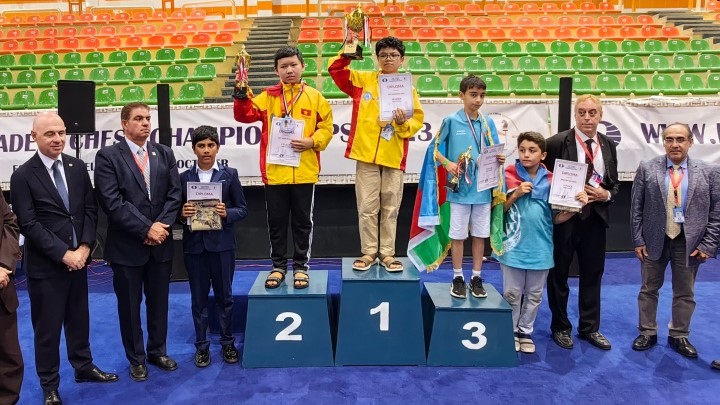
The World Cadets Chess Championship 2023 is in the books. Held in six categories (Open U-8, Girls U-8, Open U-10, Girls U-10, Open U12 and Girls U-12), the competition took place from October 16-26 in the International Youth and Sport City, Sharm El Sheikh, Egypt. The event attracted 502 young players representing 66 national federations. It was a close affair in most sections, but two of them – U8 and U8 Girls – were dominated by Roman Shogdzhiev (FIDE) and Bodhana Sivanandan (ENG), winning all eleven games. Xue Tianhao of China put in an excellent performance (10.5/11) in the U10 Girls tournament and clinched the title with a round to spare. Devindya Gunawardhana (Sri Lanka) and Diana Preobrazhenskaya (FIDE) tied for first place in the U12 Girls section, with the former claiming gold as the winner of their direct encounter. The champions and top-finishers of the World Cadets Chess Championship: U8 1. Shogdzhiev, Roman (FIDE)2. Gafurov, Aidan (FIDE)3. Andre, Tomas (SVK) U10 1. Kuandykuly, Danis (KAZ)2. Guo, Ethan (USA)3. Banerjee, Supratit (SCO) U12 1. Dau, Khuong Duy (VIE)2. Nguyen, Nam Kiet (VIE)3. Ahmad, Khagan (AZE) U8 Girls 1. Sivanandan, Bodhana (ENG)2. Yi, Ruiyu (CHN)3. Tran, Hoang Bao An (VIE) U10 Girls 1. Xue, Tianhao (CHN)2. Guzman Garcia, Mia Fernanda (MEX)3. Zavivaeva, Kristina (FID) U12 Girls 1. Gunawardhana, Devindya Oshini (SRI)2. Preobrazhenskaya, Diana (FIDE)3. Altynbek, Aiaru (KAZ) During a brief closing ceremony, FIDE Special Tasks Director Akaki Iashvili thanked all the participants and expressed his gratitude to the President of the Egyptian Chess Federation, Hesham Elgendy, General Mayor of Sharm El-Sheikh representing Governor of South Sinai Ramah Hashim, Senator Ramy Galal, Deputy Minister of Sports of Egypt Mohamed Fathi for their support of the event. Photos: Sergei Indeikin Official website: wccc2023.com/
FIDE Grand Swiss: Trench warfare in Round 2
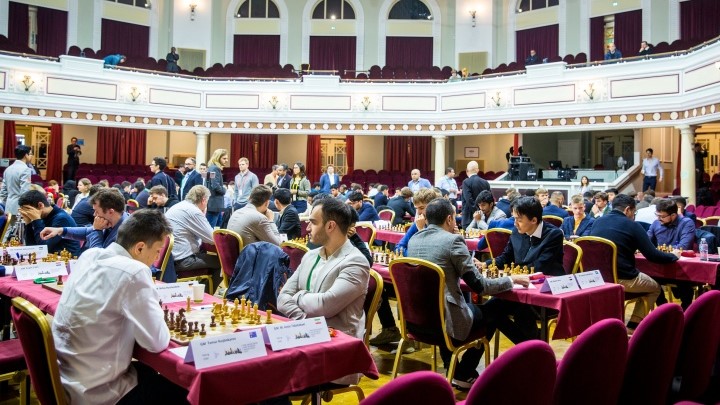
Wins don’t come easily, so draws are a normal occurrence at the FIDE Grand Swiss. Only a handful of players are on 100% in both sections. Fabiano Caruana extended his streak against Hans Niemann in classical games. Anish Giri and Alireza Firouzja scored their first wins, and Nakamura drew again. The Muzychuk sisters both won, though in a completely different manner, while top seed Goryachkina is still on 50%. A lot of players freely share their thoughts on various matters on social media nowadays. Sometimes, these matters concern their opponents, and the things said, while always interesting to the public, can be informative, condescending, disapproving or even critical of the players they meet over the board. In one of his recent videos, Fabiano Caruana described the scenario of his games against Hans Niemann. According to Caruana, he would obtain a comfortable position out of the opening, increase it almost to a winning one, and then, in mutual time-trouble, Niemann would defend excellently. Caruana would lose almost all of the advantage; they would transpose to an endgame where he would still press for a win, and at the end, Niemann would make the decisive mistake. So far, they have played four classical games, and they were all won by Caruana. As fate would have it, the second round of the FIDE Grand Swiss saw this very interesting match-up on board one. Given his 0-4 record, Niemann chose the most solid of all openings, the Berlin in Ruy Lopez. Caruana spent some time deciding what to do against it and went for his preferred 4.d3 followed by 5.Bxc6. Elite players like these positions with plenty of options and an equally huge number of possible move orders and transpositions. Herein lies the popularity of the Giuoco Piano, for example. As usual in these positions, a manoeuvring game followed. The position underwent different transformations more than once, but Black was doing fine. Then, an unexpected mistake happened. In this seemingly innocuous position, there is more danger for Black than it might appear at first sight. The best was the composed 22…Qc7, keeping the pieces together. After Niemann’s 22…Qa6? Caruana pounced with 23.Rxd8 Rxd8 24.Rd1 when suddenly the wayward position of the queen on a6 meant that Black could not satisfactorily protect the seventh and eighth ranks. Niemann defended the eighth by avoiding the exchange of rooks, but after 25.Rd7 followed Qf3xb7, Caruana completely tied down Niemann’s pieces and won the game. Caruana-Niemann 5-0. Alexandr Predke outplayed and eventually checkmated Jan-Krzysztof Duda in a very complex middlegame position that arose from the Vienna Variation in the Queen’s Gambit Declined. White wrapped things up with a powerful attack. 28.Nxh5+! gxh5 29.Bh6+ Kf7 30.Qg7+ and Duda resigned, facing imminnent 31.Qf8# 1-0 One of the players who has a chance to qualify for the Candidates via the FIDE Circuit, Anish Giri, scored his first win after Rasmus Svane (White) lost his way in the complications. Everything is hanging, so calculation is everything. Svane didn’t manage to navigate the rough waters and played 18.Ncd6? instead of 18.Bd6 or 18.Nbd6. After 18…Bc6 19.Nxe8 Nxe5 White eventually ended up a piece down. Hikaru Nakamura couldn’t do much with Black against Raunak Sadhwani’s Alapin Sicilian. It’s curious that Nakamura has tested the Alapin himself quite often recently, so the young Indian offered him a chance to play against his own preferred weapon. Nakamura did better than his online opponents by drawing the game. The leading group scoring 2/2 includes Fabiano Caruana, Alexandr Predke, Arjun Erigaisi, Andrey Esipenko, Alexey Sarana, Erwin L’Ami and the rare non-grandmaster Ramazan Zhalmakhanov. The young IM from Kazakhstan already made a splash by beating Alan Pichot and Bassem Amin in the first two rounds. In the women’s section, Anna Muzychuk and Stavroula Tsolakidou played a very sharp line in the Alapin Sicilian, recently tested in online games by both Carlsen and Caruana with the black pieces. The position was inherently more dangerous for Black, so when preparation (or the memorized variations) ended, it was more difficult for Black to come up with good moves. Therefore, it wasn’t surprising that Stavroula faltered first. In this critical position, Black had to make the only move 15…Be6, while 15…0-0? (it is natural to move the king out of the centre as soon as possible, but unfortunately for Tsolakidou it didn’t work) failed to 16.Ne4 g4 17.Qb3, and with threats like Bd6 and Rae1, White was close to winning already. Muzychuk didn’t make the most of her advantage and allowed her opponent to come back into the game and obtain counter-chances. The game saw a dramatic finale in mutual time trouble. Instead of exchanging queens and then taking the knight on c5, which would have led to a draw, Muzychuk took on d4, 34.Qxd4?? which allowed Black to win on the spot with the tactical shot 34…Nd7! that allows her to cover from the discovered check with …Nf6 while White cannot take on c8 twice in view of the weak back rank after …Qb1. Tsolakidou missed this chance and went for 34…Nb3? which only led to an equal position. On the last move of the time-control, the following happened. The position is equal as White’s extra pawn is compensated by Black’s counterplay against the opponent’s king. However, with her last seconds on the clock, Tsolakidou played 40…Qh6???, completely forgetting her rook on e8. A heart-breaking loss for Tsolakidou and a lucky break for Muzychuk. Compatriots Mihaela Sandu and Irina Bulmaga played an incredibly wild game. In the Ruy Lopez, Black chose the Siesta Variation, played by Capablanca against Reti in 1928. Both Reti and Sandu went for the dubious 7.Ng5?! (instead of 7.Nxe5, which should lead to an unclear position that is objectively balanced). This seems to be a blind spot in modern theory because even Caruana played the same move in an online game against Adhiban! After 7…exd4, Sandu deviated from the games of the luminaries with the inferior 8.0-0, instead of 8.Nxe4. Objectively, this wasn’t very good, but it led to fireworks after 8…d5 9.c4!? b5?! Instead of this flashy move, the developing 9…Nf6 would have given Black an almost decisive advantage. In the game after 10.cxb5 (taking on d5 was better) axb5 11.Bxb5 Bulmaga played the awkward 11…Nge7, voluntarily shutting her kingside when 11…Qd7, with the idea of Ba6 was superior. After almost 18
FIDE World Senior Championship 2023 kicks off in Terrasini, Italy
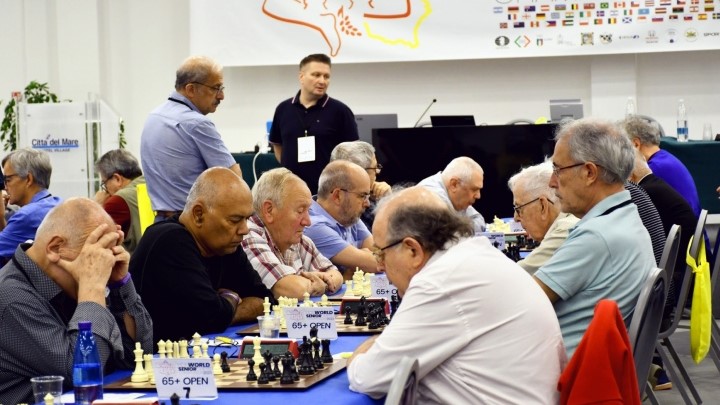
The 31st edition of the FIDE World Senior Championship kicked off in Terrasini, Italy on October 25, 2023. Italy has already hosted this tournament eight times, and this year, the event is taking place on the beautiful island of Sicily. Organized by FIDE and the Italian Chess Federation together with UniChess and Accademia Scacchistica Monrealese, the competition brought together 271 players from 53 different national federations battling for the title of the World Senior Champion in the categories Open 50+, Open 65+ and Women. FIDE Events Commission decided to merge the Women 50+ and 65+ categories into a single 11-round Swiss tournament as proposed by the organizing committee. Prizes will be awarded separately to the best players in the Women 50+ and Women 65+ categories according to the final standings. The prize fund for this year’s championship hit a record high of €42,500. The first day started with a technical meeting, followed by a brief opening ceremony held by IA Ashot Vardapetyan, FIDE Delegate and ECU Vicepresident Eva Repkova and GM Roberto Mogranzini. After WGM and IM Eva Repkova made the first ceremonial move on the first board in the game between GM Gaprindashvili Nona (GEO) and WFM Kierzek Mira (GER) in the women’s category, the competition went underway. The tournament is officiated by the chief arbiter, IA Ashot Vardapetyan (ARM). All rounds will be broadcast live and can be watched online. The top-rated participants are GM Michael Adams (ENG, 2670) in the Open 50+ category, GM Jhon Nunn (ENG, 2560) in the Open 65+ category and GM Nona Gaprindashvili (GEO, 2267) in the Women category. Official website: worldseniorchess2023.com/ Complete results: https://chess-results.com/tnr832133.aspx?lan=16 Photos: Patricia Claros Aguilar
FIDE Grand Swiss 2023: Day 1 Recap
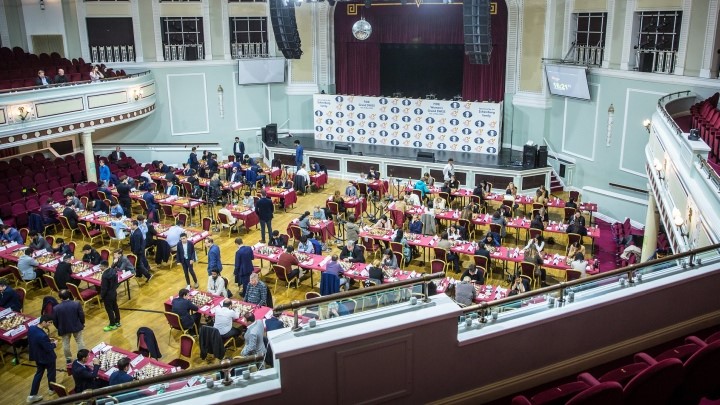
The difference between the FIDE Grand Swiss and any other Swiss tournament is that nobody gets a weak opponent in round one. Usually, at open Swiss events, the favourites can expect weaker opponents in the first few rounds before facing each other. However, at the Isle of Man, challenging games started immediately. Therefore, it’s not surprising that there were some draws and wins by the underdogs. Still, these are not surprises, as everybody can beat everybody in this tournament. Top seed Fabiano Caruana surprised his opponent Ivan Saric with the Sicilian Najdorf, a variation he doesn’t usually play. Most likely, his intention was either to conceal his ideas in the openings he normally plays or to try a new opening and/or to confuse his future opponents in the Candidates. Whatever his reasons, it worked to perfection, as Fabiano obtained a promising position very quickly. Black’s usual choices here are 8…Nc6 or 8…0-0. Caruana’s 8…Nbd7!? is a rare continuation, but perhaps that will change after this game. After the natural 9.Qd2 Black continued in provocative style with 9…b5, inviting 10.a4 b4 11.Nce2, and here, the second-rated player in the world sacrificed a pawn with 11…d5! Saric spent more than 25 minutes on his reply and chose the sub-optimal 12.Bh6?! Taking the pawn with 12.Qxb4 offers Black good compensation after either 12…Qc7 or 12…Rb8. If White wanted to play Bh6, it was better to insert the exchange on d5 first and then play Bh6, which would have led to an unclear position. After the immediate exchange of bishops, Black took on e4 and created an isolated pawn on e4, which gave him a structural advantage. Black has a better structure, but White can certainly fight here. However, instead of 17.c3 or even going for the endgame with 17.Qf4, where White’s activity should keep him out of danger, Saric over-optimistically sacrificed an exchange with 17.Rxf6?! exf6 18.Qg7 Rf8 19.Qxf6, but after the cold-blooded 19…Bb7, threatening …Rd8 or …Qd8, he had little to show for it. Caruana masterfully controlled the tactics and wrapped up the game in 30 moves. Levon Aronian has been out of the top 10 for some time now and recently didn’t do so well at the US Championship. Playing young and ambitious Max Warmerdam with the black pieces, he seemed invigorated and introduced a very interesting novel direction as early as move five (!) in a popular line in the English Opening. The usual move here is the natural 5…Nxe5, played by Levon on more than one occasion. Instead of that, Aronian played the surprising 5…Qe7!?, which is a long-term pawn sacrifice. After 6.Nxc6 dxc6 7.d3 White is solid, so where’s the compensation? Not surprisingly, the engine doesn’t see anything troublesome for White, but in practice, things are far from simple, especially when seeing the position for the first time. It does resemble the notorious Stafford Gambit, the difference being the pawn on c4 instead of c2. Just compare it with the position from the Stafford Gambit, arising after 1.e4 e5 2.Nf3 Nf6 3.Nxe5 Nc6?! 4.Nxc6 dxc6 5.d3 Bc5. White continued with natural moves, but this seemed to be all preparation by Aronian, who continued to play fast, making the engine’s preferred moves. Soon enough, the engine gave Black full compensation, with the evaluation hovering around 0.00. The critical position arose after Aronian’s 13th move when White should have accepted Black’s piece sacrifice, but since it seemed very risky, he declined it. Here, Max should have played 14.d4! Rxd4 15.Rf1 though after 15…Rd3 things look scary for White; even objectively, Black isn’t worse. Unfortunately, already under a lot of pressure, Warmerdam wanted to bail out quickly and went for 14.Nxe4?! Rxf4 15.0-0-0 Rxg4 when material was equal, but Black was better thanks to White’s weak pawn on d3. Aronian managed to convert his positional advantage with surprising ease. Hikaru Nakamura was in trouble early, which is surprising as his opening preparation is usually top-notch. He was in danger of losing but showed his signature defensive grit and managed to draw against Rasmus Svane. A notable duel in the first round was between Vasyl Ivanchuk and Ihor Samunenkov. Both from Ukraine, they are separated by 40 (!) years: Ivanchuk was born in 1969, and Samunenkov in 2009. Ivanchuk posed all the questions in their game, trying to squeeze something out from a position where his opponent had an isolated pawn on d5. The 14-year-old defended with admirable tenacity and managed to draw in spite of the veteran’s pressing for more than 60 moves. In the women’s section, the top three favourites, Aleksandra Goryachkina, Aleksandra Kosteniuk and Mariya Muzychuk, all drew. While Kosteniuk and Muzychuk didn’t have real winning chances, Goryachkina outplayed Anna Matnadze in her trademark positional fashion and obtained a winning position, only to blunder her rook and end up losing an exchange! Then it was Matnadze’s turn to miss her golden opportunity, and the game ended in a draw. Elizabeth Paehtz started with a magnificent attack to checkmate Alice Lee in a miniature. It was a tough blow for the 14-year-old prodigy from the USA and a promising start for one of the tournament favourites. In a sharp English Opening, both players seemed out of the book early on. White quickly obtained a huge lead in development but gave her opponent a chance to limit the damage. Finishing the development with 12.Bg2! would have been decisive, while White’s 12.Nxe4?! allowed Black a sudden chance. Alice should have played 12…Bxd2 13.Nxd2 a5! Intending 14…a4-a3. This is very counter-intuitive; lagging back in development, Black goes for counterplay with the a-pawn, neglecting it even more! But it works, and that’s what counts in modern chess… Lee took the knight, but after 12…Qxe4? 13.Bxa5 the threat of Rd8 was decisive. After 13…Be6 14.Bg2! Qe5 15.Rd8 Kf7 16.Qa3 with Qf8 to come, White already had a crushing attack. The final position speaks volumes about the importance of piece development in the opening. Black resigned in view of 23…g4 24.Qxf7# 1-0 Sometimes, young players mess up the theory. 16-year-old Savitha Shri fell into a well-known trap against Marsel Efroimski in the Accelerated Dragon. In this position, the usual move for White is 8.Bb3, because after 8.f3?!, as played by Savitha, Black has 8…Qb6! and suddenly a lot
FIDE Grand Swiss and FIDE Women’s Grand Swiss 2023 kick off in the Isle of Man
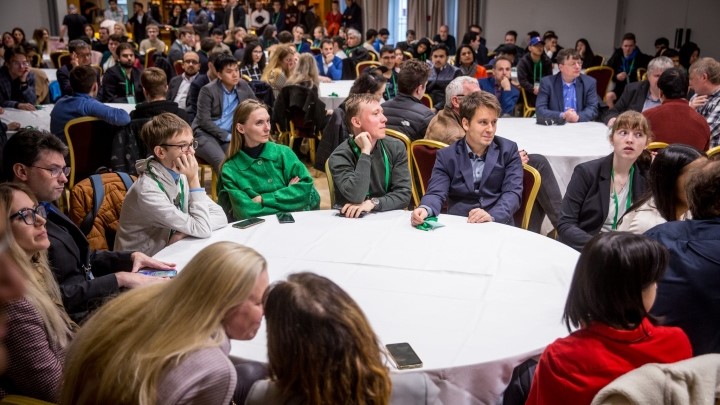
Every great competition deserves a great opening ceremony. For chess players, a great opening ceremony is one that is efficient. This criterion was fully satisfied at the Villa Marina, the venue of tonight’s opening ceremony and the games tomorrow. The Master of Ceremonies, Alex Brindley, opened the proceedings by introducing Alan Ormsby, the Chief Organiser of the Grand Swiss. Mr Ormsby welcomed the players and everybody who made the event possible. A notable fact was mentioned when he thanked the Isle of Man Immigration Service, which issued 120 visas to make it possible for players and everybody else who needed it to come to the island. Mr Ormsby spoke about the Isle of Man open tournament, which ran from 2014 to 2018 and the first Grand Swiss in 2019. He said that the Isle of Man is now an affiliate member of FIDE and, as such, has a right to field a team at the upcoming chess Olympiad in Budapest in 2024, a goal achieved after 30 years of hard work. He wished the best of luck to the two local players, Li Wu and Dietmar Kolbus, ranked 113 and 114 out of 114 participants, who will represent the Isle of Man. He concluded with special gratitude to the Scheinberg family for their continuous support and generous help in all the years of the event. Next to speak was Alfred Cannan, Chief Minister of the Isle of Man. In his brief speech, Mr. Cannan welcomed the participants and spoke of chess’s importance in these turbulent modern times. He condemned the recent terrorist attacks by Hamas and expressed his desire that chess can serve as an agent of peace. He also emphasised the generous support of the Scheinberg family, a support that, apart from the previous events, also made this event possible. He also thanked the Scheinberg family for making this event possible and for the generous support of other chess competitions. FIDE’s CEO Emil Sutovsky started by saying that his last professional tournament was at the Isle of Man in 2018. He was happy to see the players he met back then again, but also new faces and promising youngsters. He noted the event’s growth and thanked the Scheinberg family for their incessant support and for making it all possible. “We work for you,” he concluded. Finally, the Chief Arbiter Alex Holowczak took the stage and invited the top seeds, Fabiano Caruana and Aleksandra Goryachkina, to choose one from the two bags that contained a king inside. Coincidentally, they picked the bag containing the black king, thus starting their round one games with the black pieces. It also mean that all odd numbers will play with black in round one, with the even numbers having the white pieces. The games start tomorrow at 14-30 PM local time. Round 1 pairings Open Round 1 pairings Women Written by GM Alex Colovic Photos: Anna Shtourman Official website: grandswiss.fide.com About the event: The FIDE Grand Swiss and FIDE Women’s Grand Swiss 2023 takes place from the 23rd of October to the 6th of November at the Villa Marina, Douglas, Isle of Man. Both tournaments are part of the qualifications for the World Championship cycle, with the top two players in the open event qualifying for the 2024 Candidates Tournament and the top two players in the Women’s Grand Swiss qualifying for the 2024 Women’s Candidates. Eleven rounds will be played under the Swiss System, with 164 players participating from all continents: 114 in the Grand Swiss and 50 players in the Women’s Grand Swiss. The total prize fund is $600,000, with $460,000 for the Grand Swiss and $140,000 for the Women’s Grand Swiss. The first Grand Swiss was held in 2019 in the Isle of Man and was won by GM Wang Hao, who scored 8/11. Because of COVID-19, the 2020 edition of the event was cancelled. The 2021 edition took place in Riga and was won by GM Alireza Firouzja. This is the second time that a Women’s Grand Swiss event will be held. The inaugural edition in Riga was won by GM Lei Tingjie.
FIDE Circuit: Fabiano Caruana consolidates his lead
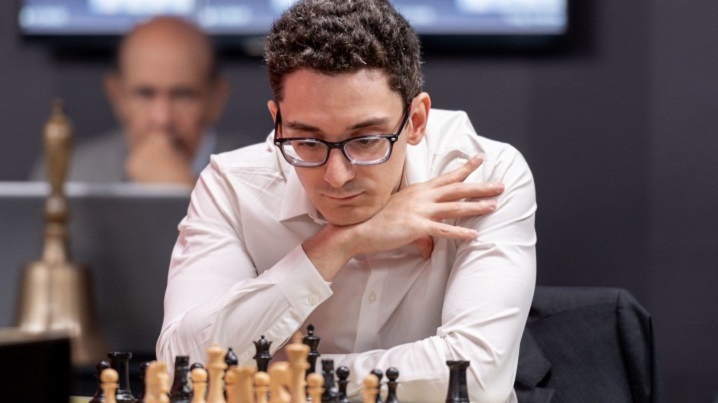
Photo: Saint Louis Chess Club | Crystal Fuller Fabiano Caruana extended the lead over the closest rivals in the FIDE Circuit race following his excellent performance in the 2023 U.S. Championship, where he picked up 22.68 points. Since Fabiano is going to participate in the last two points-heavy tournaments of the year – FIDE Grand Swiss and Sinquefield Cup – he looks like an overwhelming favourite to win the leaderboard. Given that Caruana already qualified for the Candidates Tournament through the World Cup, the battle for second place (which gives a ticket to the Candidates) has become more intense. Gukesh D and Wesley So improved their tally last week after earning points in the Qatar Masters and the U.S. Championship, respectively, and ousted Anish Giri from the second position. Still, these three GMs stand very close together, with less than four points between them. The upcoming Grand Swiss is particularly important for Gukesh D as both Wesley and Anish will have another shot at the Sinquefield Cup. Arjun Erigaisi and Nodirbek Abdusattorov moved up in the standings after their strong showing in the Qatar Masters. Sitting in 6th and 8th positions, respectively, they also have a theoretical chance, but in order for them to qualify for the Candidates, many things have to come together. FIDE Circuit Race Top 10 as of October 23, 2023 You can find full current standings on wcc.fide.com/fide_circuit.phtml
Important changes to the 2024 Women’s Grand Prix series

The Women’s Grand Prix series returns in 2024 with more tournaments and a significantly increased prize fund The FIDE Women’s Grand Prix is a series of tournaments exclusively for women players where the top two qualify for the Candidates Tournament. The 2024-25 series will introduce several notable format changes following consultations between FIDE and renowned women players. These changes are designed to provide more opportunities and more favorable conditions for women in chess. Key changes for 2024: 1. Increased number of tournaments: The number of Grand Prix tournaments in the series will rise from four to six. 2. Higher prize fund: The overall prize fund for the Women’s Grand Prix Series will increase from 80,000 Euros to 120,000 Euros. The winner of the Grand Prix series will now receive 30,000 Euros (up from 20,000 Euros), and the runner-up will be awarded 22,000 Euros (compared to the previous 16,000 Euros). Notably, the prize for first place in individual tournaments will rise from 15,000 to 18,000 Euros. 3. Increased number of participants: In the 2024-25 edition of the Grand Prix, 20 players will be participating, as opposed to the 16 in the previous season. 4. Updated qualification process: While the tournaments that serve as qualification events for the Grand Prix remain the same, the number of qualifying spots from each tournament has changed. Here’s a look at the new qualification format and the players who have already secured their spots: Both players of the 2023 Women’s World Championship Match (GM Ju Wenjun and GM Lei Tingjie) The winner and the runner-up of the 2023 FIDE Women’s Grand Prix (GM Kateryna Lagno and GM Aleksandra Goryachkina) Top three players from the 2023 Women’s World Cup (IM Nurgyul Salimova, GM Anna Muzychuk, GM Tan Zhongyi) Top three players from the 2023 Grand Swiss (to take place from 25th October to 5th November) Four spots will be allocated based on the Standard Rating in the April 2024 FIDE Rating List Six spots go to players nominated by the local hosts (Organizers) of the WGP tournaments Despite the increase in the number of players as well as in the number of tournaments, each player will still play in three tournaments, as in the previous edition. Updated tournament format: Instead of 12 there will be 10 players in each tournament. While the tournaments will still be played under a round-robin format, there will be nine instead of the previous 11 rounds. Scoring adjustments: The overall scoring system remains unchanged, but due to the increase in tournaments and adjustments to player participation, the points awarded per tournament have decreased from 850 to 600 points. The two players with the highest cumulative points in the WGP Series will qualify for the FIDE Women Candidates Tournament in 2026. Change in the draw rules: The number of moves required before a draw can be agreed upon has increased from 30 to 40, while the time control remains the same (90 minutes for the first 40 moves, followed by 30 minutes for the remainder of the game with a 30-second increment per move from move one). Grandmaster Pavel Tregubov, Secretary of FIDE’s Global Strategy Commission, says that the changes were made based on inputs from the players who are most likely to take part in the next WGP cycle. “The greatest number of top events for women is organized by FIDE, and we are constantly looking for ways to improve the conditions. With regards to the WGP series, the players have noted that the previous tournament format was too long”, says Tregubov. In order to assess this properly, FIDE sent out an email to the players – either those who have already qualified for the next WGP series or those who are most likely to qualify, based on their rating – and asked them to list their preferred format type and share any other thoughts they have. “We asked the four semi-finalists of the most recent Women’s World Cup and the top-rated players. Altogether, 17 players were asked to take part in a poll, and 14 of them provided their replies. The round-robin with 12 players came on top together with the double round-robin for 16 players with a knockout for the final four, but other choices were close. In the interest of transparency, the results of the poll were shared with all the players, and everyone saw what everyone else voted for,” said Tregubov. Photo: Lennart Ootes Humpy Konery, currently ranked fourth in the world and India’s top-rated female player, has been a regular participant in the Women’s Grand Prix. She has finished as the runner-up in five out of the six WGP Series events, which have been held since 2009. Humpy was one of the players in favor of the round-robin: “I voted to stick with the round-robin format as it gives the opportunity for the best player to win”. “The increase in the number of tournaments is good news for female chess players – while every player will still be playing three tournaments, they will have more choice of events. The prize fund has also increased, and it’s also good that we will have more players in the circuit as new stars in women’s chess are coming up, and they need more opportunities. For women’s chess, this is very important as there are not that many tournaments for women, and FIDE is the driving force to improve this,” Tregubov said. The new regulations for the 2024-2025 Women’s Grand Prix can be found – here.