

WWC Match 2023: Ju Wenjun equalises after a grueling battle
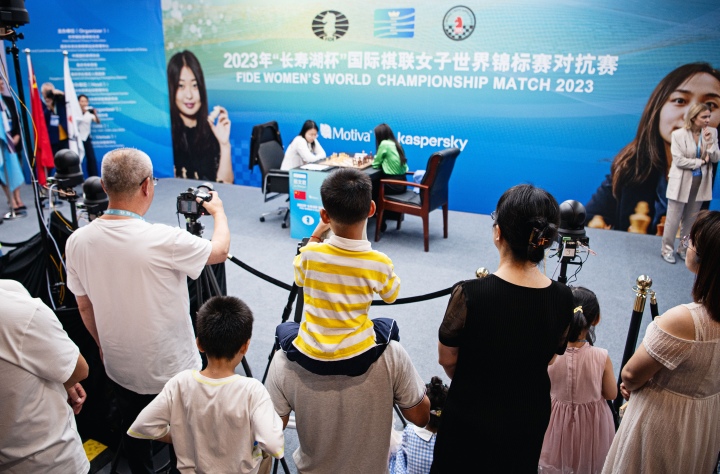
World Champion Ju Wenjun defeated Lei Tingjie in game eight of the World Championship Match, as the challenger misplayed in the endgame. Instead of finishing her opponent swiftly, Ju went for a position with a minimal advantage but managed to squeeze a victory in the end, despite Lei having one chance to save a draw Game eight of the Match for the title of Women’s World Champion unfolded calmly. Starting with 1.Nf3, the defending World Champion Ju Wenjun opted for an opening sideline leading to a positional game. In the manouvering that followed it seemed that Ju was more in sync with the position and gained a minimal edge, but it was overall equal. Lei’s pieces were a bit uncoordinated which she resolved by an excellent move 21…a4, giving up a pawn but forcing an exchange after which it was even. Just as it seemed the two were heading for a technical draw, Lei decided not to follow the simplest line but instead opted for 28…Nb3?!, which gave White chances. Ju took them and soon, Lei was struggling – with pieces hanging and severely low on time, the challenger was in dire straits. Finally, everything aligned for the defending World Champion: she obtained a significantly better endgame and had a substantial time advantage. However, instead of finishing off her opponent with an attacking move, Ju opted to go for an exchange of pieces, ending a pawn up, but with a minimal advantage on the board. Like in game seven, Ju again gave Lei chances for a save in the endgame. In a long trench-style endgame fight that ensued, where progress was measured in inches, Lei had to hold a very uncomfortable position. Although the computers gave White a minimal edge, from a practical standpoint this was a very tough endgame for Black, who was doomed for a long defence with any mistake being fatal. Miraculously, Ju allowed Black one last chance for a draw in the end on move 56. Even though Lei made the drawing move, she missed the saving idea, choosing the wrong continuation. White was winning again. Eventually, playing with just a minute on the clock, Lei faltered. Ju managed to squeeze a victory, albeit going the long way round. Asked about how she felt after the victory, Ju said her happiness level is now “on eight out of ten”. Despite losing the game, Lei Tingjie was smiling in the press conference. She was frank: “I didn’t play precisely and gave chances to my opponent. I probably deserved to lose”. After letting victory slip in round seven, a point in game eight is a critical leap for Ju Wenjun. Winning a drawn endgame and equalising the overall score gives the defending World Champion a psychological edge. Lei will now need to show that she has enough strength and perseverance to mount a comeback. After all, maintaining composure after severe blows is fundamental for an existing or aspiring World Champion. Here follows a closer look at game eight of the match: The honorary guests making the first move in today’s round were Dai Ming, Deputy Secretary of the Party Committee of Changshou District and Chief Executive of the District-level Government and Luo Li, Employee of Sinopec Chongqing SVW Chemical Co Ltd. The World Champion, Ju Wenjun, was White. Most of the time, she would open 1.d4, but now she played 1.Nf3 – keeping her options open. Lei responded with 1…d5 and after 2.e3 c5, Ju opted double fianchetto setup stepping into uncharted territory with the early 6.d2-d4. Grandmaster Alik Gershon said that it has become clear that the “team Ju is trying to take the initiative in the openings”, to respond to the fact that in the first part of the match, Lei was the one launching opening surprises. Both sides have finished development, entering a long positional manoeuvring game. 12.a3 a5 13.h3 Bh5 14.Qe2 Rfd8 15.Rac1 Commenting on the position, Grandmaster Judit Polgar – the strongest woman chess player in history – was a bit critical of the challenger, saying that she “feels that Lei is misplacing her pieces a bit. Pawn on a5, rook on d8… If you want to have a good spot it should be on e8…”. Polgar pointed to an important moment in the positions such as this one: “This is very tricky in this complicated middlegame positions – where do you put your rooks? When you play a system, it’s very important to understand the position of the rooks. When the position opens up, the rooks will play an important role, but then you’re not going to have time to regroup them so easily, so where you position them early in the game matters”. 15…dxc4 Lei abandoned holding the tension and decided to take on c4, inviting White to the so-called hanging pawns structure. Ju spent quite a bit of time thinking about her move, although bxc4 was obvious. “I’m shocked”, said Polgar – commenting on the length of time Ju was taking in this seemingly clear position. 16.bxc4 played after eight minutes. 16…Be7 16.Qe3 Rac8 18.Rfe1 The position was still even, but now the d-file is open for Black. At the same time, one of the main attacking opportunities for White is to sacrifice the d-pawn with a d5-push and open the h1-a8 diagonal for the white-squared bishop, as noted by Judit Polgar. However, it seemed that the challenger was struggling to find the right moves and get into the groove for the position on the board. Ju picked up the speed in which she was playing her moves and also got a slightly better position, with more initiative across the board. 21…a4! A move suggested by the computer. Lei is giving up a pawn to force massive exchanges on the board. It allowed Black to trade several poorly coordinated pieces and regain some space for play. Despite being a pawn down, Black has enough activity to counter it. Also, White’s d5-pawn is hanging. Black now decided to exchange the queens, and the game was going towards a draw. With 28.d5, Ju got rid of
WWC Match 2023: Ju Wenjun lets victory slip against Lei Tingjie
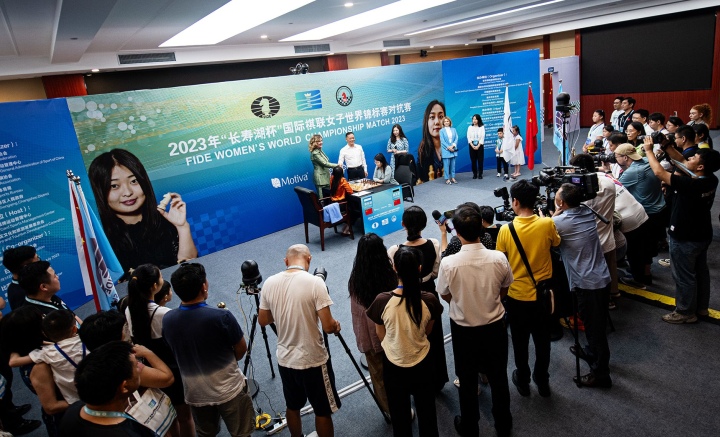
In a game which saw a surprise as early as move one, defending World Champion Ju Wenjun had a dominating position but allowed Lei Tingjie to save a draw in the endgame. Lei still maintains her lead: 4:3 This marked the first game of the second part of the match, which transitioned from the coastline to central China. Following six games in Shanghai, the players had two days to relocate and adapt to Chongqing, Lei Tingjie’s hometown. The defending Women’s World Champion Ju Wenjun, being one point down, needed to make a comeback. Playing as Black, she sprang a surprise on move one – 1.e4 c6 – going for the Caro-Kann, an opening never played by Ju in top-level classical games. As she made the move, Lei put a hand on her head and looked to the side, away from the board, realigning her focus to an opening that she wasn’t expecting. After the first opening moves, White had more spatial control and initiative. At one point, Lei decided to sacrifice a pawn for a strong centralised knight on d6 and more pressure across the board, hoping to mount a strong push against the black king. She indeed got adequate compensation, but hardly more. Unfortunately for Lei, she overcommitted at some point, overlooked Black’s threat and ended significantly worse. For the first time in the match, Ju was considerably better. Her body language was clearly relaxed – she was relishing her position. Black was now pressing hard and making concrete threats against White who was struggling to defend her overextended position. Yet, rather than escalating the attack, Ju made a questionable but understandable decision to exchange the queens and entered an endgame where she held a two-pawn advantage. Black was still better, however, White got some real drawing chances thanks to her active rook. As the endgame unfolded, Ju’s advantage gradually dissipated. Lei managed to regain a pawn, activate her knight and king, and was off the hook. Ju leaned back in her chair, hands above her head, coming to terms with what had happened. After Lei exchanged her c6-pawn for Black’s a3-passer a draw became virtually inevitable: despite being a pawn down, White’s pieces were well coordinated and the black king was cut off on the eighth rank. In the final stage of the game, Ju set a trap for White to which Lei responded with a brave but well-calculated move giving up her last remaining pawn. Black was again two pawns up but White’s active pieces offered sufficient counterplay. The game concluded in dramatic fashion with a draw on move 65. Commenting on the game immediately afterwards, Lei said that she wasn’t surprised by her opponent playing Caro-Kann in the opening, “as she played that a few weeks ago”. Lei noted that she “underestimated Ju’s counterplay” in the game, adding that she feels “dizzy” from everything. Ju said that she was clearly better after 29.g4. “I just tried to play the game with a good fighting spirit and focus. As for the results – I don’t expect too much”, the defending World Champion noted. A big miss by Ju and a great save by Lei. Game eight will start on Sunday, 16th July, at 3 PM Local Time in Chongqing (GMT +8). Here follows a closer look at game seven of the match: Lei was White, and she opened with, now her standard choice in the match, 1.e4. The first move ceremony was officiated by Dana Reizniece-Ozola, Deputy Chair of the FIDE Management Board, and Liu Xiaoqiang, Secretary of the Changshou District Committee and member of the Changshou Economic Development Zone Party Committee. The defending Women’s World Champion, Ju, immediately responded with 1…c6 – entering the Caro-Kann defence. A big surprise from Ju, but the challenger wasn’t surprised, as she quickly proceeded and was soon ahead on time. Caro-Kann is a well-known line to Lei, who also plays it as an opening choice as Black. On move 12, the challenger sprang a surprise of her own and introduced a novelty by castling short. Usually, with h2-h4 already played, White evacuates the king to the queenside. White has a comfortable space advantage – she controls the centre, and her pieces are slightly more active than Black’s. On the other hand, Black has a solid position with no real weaknesses. The fact that White has pushed forward to occupy space made her pieces more exposed to an attack. It was the first point when Lei started spending more time on the clock. Eventually, she came up with the idea of lifting her rook over the third rank, but it doesn’t seem the best option. 16.Rd3. Pawn moves – a3, b4 – were considered as a better choice here. After 16…Nxe5 17.dxe5 Nh7, the position is even. Lei now spent nearly half an hour thinking on an important decision: she gave up a pawn for a strong knight on d6. 18.Ne4 Rxd3 19.Qxd3 Bxh4 20.Nd6 The question now was: Will the strong knight be enough to compensate for a pawn? The answer is yes. White indeed has sufficient compensation but hardly more. In subsequent play, Lei fortified her d6-knight. White has pressure, a dominating and well-defended knight on d6, and Black has a knight on h7, completely sidelined. Still, White’s position depends on keeping the initiative, and it’s on her to do that, while Black needs just to hold on and counter. Both sides had about 35 minutes on the clock now, gradually approaching time trouble. It looks like Lei became more ambitious at this point. 29.g4? Lei overcommitted with this aggressive move. There was no need for such drastic measures as after 29. Bd4 or 29. Bf2, the position is roughly equal. Now after 29…Qa5! the situation has turned in Black’s favour. White can’t take on c6 because 30…Qc3, attacking a rook and a bishop. In addition, the b8-rook can get to the second rank and the c5-pawn is hanging with a pin on the diagonal, aiming at White’s king. Now Lei needed to play very precisely.
FIDE World Schools Team Championship: Meet the teams
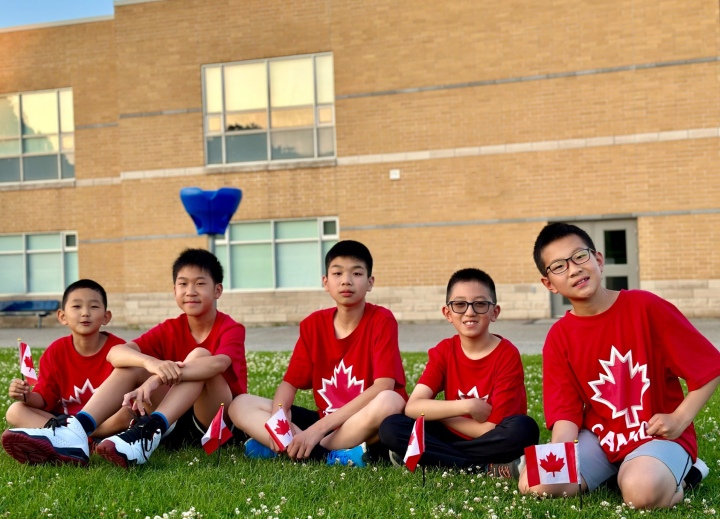
The inaugural edition of the FIDE World Schools Team Championship will take place in Aktau, Kazakhstan, from August 3-8, 2023. About 50 teams representing schools from all around the world will compete in U12 and U18 age categories. Many of them are winners of their national school chess championships. For them, the FIDE flagship event stands on top of the existing school chess competitions. Here we introduce some of the teams that will soon go to Aktau to battle for the title of the World Cchool Champions: A U12 team from Belgium is made up of Sint-Pietersinstituut Turnhout school pupils (pictured below). “In our school, everyone can play chess from the age of 6,” said Team Captain Dusty Bracke, “Kids have lessons during lunch breaks: they eat while they have a short instruction lesson, and then they play. It is done once a week for a 6-7 age group and twice a week for older pupils. Next year we plan to give chess lessons in kindergarten too. We know playing with teams from different countries will be a great experience. Now we are getting ready for the tournament. Normally it would be summer break, but we attend chess lessons every Friday and have online lessons from an International Master.” One of their future competitors, the team of the Silver Stream Public School from Canada (pictured at the top of this article), took first place in the 2023 Canadian School Team Championship and punched their ticket to Aktau. “Chess was not going well in our school, and we had a chess club only for students of grades 7 and 8, but a new chess club for all grades will be in place in the next school year of 2023-2024. Our team has been diligently working to improve as quickly as possible before the tournament. We practice every day, engaging in activities such as solving puzzles, practicing our chess skills, and more. Additionally, we attend chess camps, participate in chess tournaments, and focus on addressing our weaknesses. We would like to build a good reputation for Canada in the chess world, and hope to meet a lot of people from different countries and experience a world-class tournament,” said the captain of U12 team Canada, Yan Sun. Another Canadian team is going to play in the U18 category and is made up of students of Upper Canada College, Toronto (pictured above). “Chess has become an extremely popular pastime amongst the student population in our country. At UCC, we have a chess club with over 70 members, making it one of the largest clubs at the school,” said the captain Shixiong Liu. “In Kazakhstan, we’re hoping to play our best chess to finish high on the standings and also make some friends along the way.” On another continent, a U12 team representing School Lycee MIRVA from Madagascar is working hard to prepare for the World Schools Team Championship in Aktau. The school chess program was launched there in 2015 for children aged from 6 to 9, so the team line-up has some very strong players, including Ny Andolalaina Fitia Noah Rabarison, U8 and U12 champion of Madagascar, 4-time champion of Analamanga region. “The team is training four times a week. We are reading chess literature and play online. Of course, we want to win the title in Aktau, but we also expect a new adventure, where we could meet a new culture and make new acquaintances, and, more than that, acquire an atmosphere of solidarity between teams,” said Andrianantenaina Ramalanjaona, captain of Madagascar team. FIDE believes chess is a powerful tool for education, social inclusion, and personal growth. That is why promoting and supporting chess activities for children and schools around the world is one of the main priorities of the international federation. According to the survey made in the summer of 2020 by FIDE and the European Chess Union, over 25 million children participate in chess activities in school. And FIDE aims to double that number! The World Schools Team Championship will be one more step towards achieving this goal.
Queens’ Festival 2023 enters final stage

The Queens’ Festival 2023 is getting to its final stage this weekend. With the Online Blitz Qualification tournaments for Asia and the Americas finished, the last stage of the competition will be played tomorrow to determine the ultimate winners. The Asian Qualification event attracted 166 players from 24 countries. The title of the Queens’ Festival Continental European queen went to WIM Hong Anh Nguyen from Vietnam, who scored 9½ points in 11 rounds. Her compatriot WGM Hoang Thi Bao Tram finished second with 9 points, and WFM Tan Li Ting of Malaysia got bronze with 8½ points. The complete list of top-25 players qualified for the semi-finals on Saturday: Rank Name FED Pts 1 WIM Hong Anh Nguyen VIE 9½ 2 WGM Hoang Thi Bao Tram VIE 9 3 WFM Tan Li Ting MAS 8½ 4 Li Shenyue CHN 8½ 5 Wang Qinxuanyi CHN 8½ 6 Gupta Shubhi IND 8 7 Carreon Melizah Ruth PHI 8 8 Severin Helen D Silva IND 7½ 9 S Pournami IND 7½ 10 WIM Ranasinghe S D SRI 7½ 11 WIM Komiagina Maria FIDE 7½ 12 CM Aparajita Gochhikar IND 7½ 13 Alwis Jenuki SRI 7 14 Romanillos Shaina Magne PHI 7 15 Pattnaik Sherali IND 7 16 Batzaya Yanjav MGL 7 17 Momyn Madina KAZ 7 18 WFM Singgih Diajeng Theresa INA 7 19 Butuzova Tatyana FIDE 6½ 20 Binoj Shybi IND 6½ 21 Katakam Deethya Sai AUS 6½ 22 Sheikh Abdullah Munshee MAS 6½ 23 Meenu Rajendran IND 6½ 24 Natarajan Indusheetala IND 6 25 Cao Youjia CHN 6 164 players from 33 countries representing the Americas competed in another Online Blitz Qualification tournament. WIM Tatiana Brizzi Milagros from Argentina netted 9½/11 and tied for first place with WFM Erin Bian of the USA to become the Queens’ Festival Continental Queen, thanks to better tiebreaks. Paula Sofia Hernandez Diaz from Mexico was third with 9 points. The complete list of 25 qualifiers to advance into the semifinals of the Queens’ Festival from the Americas: Rank Name FED Pts 1 WIM Brizzi Milagros Tatiana ARG 9½ 2 WFM Bian Erin USA 9½ 3 Hernandez Diaz Paula MEX 9 4 GM Krush Irina USA 8½ 5 Hyatt Jessica USA 8 6 Jou Esther USA 8 7 WCM Yellamraju Ambica USA 8 8 WIM Plazaola Maria ARG 8 9 WCM Pang Ashley USA 8 10 WFM Jimenez Salas Maria PER 7½ 11 WFM Velasquez Angie Gabriela COL 7½ 12 Montano Vicente Guadalupe MEX 7½ 13 Rodriguez Rivero Jinela CUB 7½ 14 Ortegon Villacorte Linda COL 7 15 Galeano Solis Mayte ARG 7 16 Wilson Hannah BAR 7 17 Tapia Morocho Alison ECU 7 18 Santos Taina Moura Dos BRA 7 19 WCM Rivera Negron Yanira PUR 7 20 Montiel Marin Micaela ARG 7 21 WFM Torres Hernandez Leslie HON 7 22 WCM Adam Ernestina ARG 7 23 Rozas Lazcano Valeska CHI 7 24 IM Cori T. Deysi PER 7 25 Moscoso Paz Esther BOL 7 In addition to the Semi-finals and Finals of the Queens’ Women Open Tournament, this weekend, the Unrated Princesses’ tournaments will be held. U16 girls without FIDE rating will compete in two age categories – U9 and U16. There are 277 players from 74 countries of the world on the starting list. The finals of both the Queens’ Women Open Tournament and the Unrated Princesses’ tournaments will be streamed live on the FIDE Youtube channel with commentaries by WGM Anastasiya Karlovich and WIM Fiona Steil-Antoni. Link to the broadcast: youtu.be/72vbPHkL1A0
Shawn Rodrigue-Lemieux is the new champion of La Francophonie 2023

Led by its dynamic president Eric Bopala, a very strong Quebec delegation made the trip to Côte d’Ivoire to participate in the 2023 Francophonie Championships and won most of the trophies! This year, for the first time in its history, the Rencontres Internationales des Echecs Francophones (RIDEFs) took place in Sub-Saharan Africa. The International Francophone Chess Association (AIDEF) organized this event in partnership with the Ivorian Chess Federation. The two presidents, Patrick Van Hoolandt and Justin Brou, joined forces to make it happen. The International Francophone Chess Meetings (RIDEF), financially supported by FIDE, took place from July 1 to 13 in the prestigious “Félix Houphouët-Boigny Foundation for Peace Research” in Yamoussoukro, the capital of Côte d’Ivoire. A total of 76 players from 17 countries competed for the prize fund of 17,000 euros in the Open, Women, Senior and Veteran categories. There were also separate rapid and blitz tournaments. The games on the first 20 boards were broadcast live on various online platforms. The reigning U18 world champion, Quebec IM Shawn Rodrigue-Lemieux (pictured above, left), is the new champion of La Francophonie 2023. Shawn tied for first place with GM Bator Sambuev, also from Quebec (both scored 7.5/9) but came out on top by winning the direct encounter. Another Quebecer, IM Olivier-Kenta Chiku-Ratte, netted 6.5/9 and completed the podium. Among the women, a regular at the tournament, WGM Maili-Jade Ouellet (pictured below, left), who is also from Quebec, won the title with 6 points. IM Damir Levacic (Monaco) is Senior Champion Mohamed Lameti (Morocco) Veteran champion IM Loïc Travadon (France) Rapids champion GM Victor Bologan (Moldova) Blitz champion IA Laurent Freyd officiated the competition, assisted by Kpan Deckalet Mario Prosper (deputy arbiter), Esso, Ulrich Wilfried, Okoro, Aderemi Bankole Mubarak, Dzoglo, Ave MariaSename, Melvin, A. Weah and Rakotomaharo, Yves Andre. Complete results But the RIDEF is not only about competition. It is also an opportunity for Francophone chess players to share the moments of conviviality, cultural and festive activities conducive to establishing lasting links and developing North-South mutual aid. In addition to the scheduled sightseeing excursions, the program included several training sessions. Over two days preceding the start of the RIDEFs, IA Laurent Freyd conducted a national arbiter training course of about twelve hours at the headquarters of the Ivorian Chess Federation in Abidjan. Twenty participants attended. This new approach is part of a pilot program with the Planning & Development Commission and the FIDE Referees Commission to support the development of refereeing in countries that still don’t have an established curriculum. FIDE Executive Director GM Victor Bologan, who visited Yamoussoukro as an official representative of FIDE, also organized a master class on the morning of July 2 at the Canaan Hills Hotel for thirty students. Victor also kindly made himself available at the end of the second and fourth rounds to analyze the games with the players who wished. On the morning of July 5, the Minister Governor of the Yamoussoukro district, Dr Augustin Thiam, met with an official chess delegation consisting of Victor Bologan, FIDE Executive Director, Patrick Van Hoolandt, President of AIDEF, Justin Brou, President of the Ivorian Chess Federation and Éric Bopala, President of the Quebec Chess Federation. After a warm welcome, the parties had a constructive discussion. At the end of the meeting, convinced that children who learn chess are better prepared to face academic challenges and develop essential skills for their future, the Minister made a commitment to introduce chess into the school curriculum of 2024 in the entire Yamoussoukro district. It will be a pilot project before extending it to the entire country. Eric Bopala also offered to provide several copies of the book used in Quebec for learning chess. The Minister Governor also expressed his desire to award a special “Félix Houphouët-Boigny” fair play prize to one of the participants. After consultations, the organizers decided to award it to Laurent Freyd for his relentless efforts and commitment to fair play over many years of working in the French Federation and FIDE. The prize was presented to Laurent by the Secretary General of the Foundation during the closing ceremony. In the end, the president of the Quebec Chess Federation, Eric Bopala, announced that the 10th “Rencontres Internationales des Echecs Francophones” would take place in the summer of 2024 in Quebec City. Photos: official website Official website: www.9ridef.net
Winners crowned at International Schools Chess Festival, Ploiești, Romania

The International Schools Chess Festival in the city of Ploiești, Romania, ended in triumph for the Lviv Academic Gymnasium, Ukraine, with a perfect score of 7 wins 7 matches, followed by Otilia Cazimir School from Iasi 6/7, and School no. 10 from Bacau, both from Romania. Organized by ISCU and Romanian Chess Federation under the auspices of FIDE, the event attracted 75 school teams from Mexico, Israel, Poland, Greece, Moldova, Ukraine and Romania (from 19 different counties). On a free day, an open-air blitz event was held in the central park of Ploiesti. The organizers also offered sightseeing tours for tours “Footprints of Dracula” and Bucharest tour to all the participants. The champion, Lviv Academic Gymnasium, received a special award established by FIDE: a travelling grant and accommodation at the World Schools Team Championship, which will take place in Aktau, Kazakhstan, from August 3-8, 2023. The top-finishing teams were presented with special gifts and electronic devices from the partners Rompetrol and Aqua Carpatica. At the awarding ceremony, Dana Reizniece-Ozola, Deputy-Chair FIDE Management Board, delivered a video message on behalf of FIDE, which was warmly appreciated by the audience. There was also a separate ranking in the boys’ section, won by “Saint Vasile” school from Ploiesti, Romania. The team received the trophy “Alexander Kostyev”, named after Professor Kostyev, the founder of ISCU and the initiator of World and European School events. The girls’ section saw the victory of the Academic Gymnasium, Lviv, Ukraine, lifting the “Elisabeta Polihroniade” trophy. Elisabeta Polihroniade, an honorary member of FIDE and vice-president of ISCU was a true chess legend in Romania and a great promoter of chess in schools. Photos: promarkstudio.com/ Official website: iscu.info/club-activities/
Infinite Chess Project: 3rd stage of ends with a Zoom meeting

The final online meeting with partners of the Infinite Chess project (3rd stage: February – June 2023) will be held on 15th July 2023 at 11:00 CEST. This meeting, organized in cooperation with FIDE Social Commission, is open to the project partners and everyone interested in the topic. The main goal of the meeting is to share the outputs of the project, check progress and follow up on outstanding issues. Schedule of the meeting: 11:00 – welcome speech by Dana Reizniece-Ozola, Project supervisor, FIDE Deputy Chair 11:05 – welcome speech by Anastasia Sorokina, Leader of the project, FIDE WOM Chair (recorded video) 11:10 – Viesturs Kapce – chess coach, Latvia 11:15 – See, Swee Sie – national instructor, Malaysia 11:20 – Kamal Daodi – chess coach, Morocco 11:25 – Kanthi Sarjoo – speech-language pathologist, South Africa 11:30 – Sinem Çağla Gündoğan – chess coach, Turkey 11:35 –Sharon Whatley – chess coach, Gibraltar 11:40 – Questions Zoom link to join the meeting:us02web.zoom.us/j/89634977372 Meeting ID: 896 3497 7372 About the Infinite Chess Project FIDE’s INFINITE CHESS Project aims to increase knowledge and awareness of chess for children with autism spectrum disorder (ASD), give practical advice to teachers and parents, study the benefits of introducing them to chess and develop various teaching methods. In 2019, the Infinite Chess Project started in Belarus when the Belarus Chess Federation launched four pilot groups of 4 people each. In January 2021, a pilot project was launched in 6 countries: Spain, Turkey, France, Gibraltar, South Africa and Norway. The project is very much in line with FIDE’s strategy of promoting inclusivity and equity and the recently approved corporate social responsibility guidelines of FIDE. The 3rd phase of the pilot project (February-June 2023) included simultaneous implementation of the chess training for 120 kids children with autism spectrum disorder, based on the methodology developed by FIDE. The project is currently running in 12 countries: Spain, France, Latvia, Gibraltar, Albania, South Africa, Morocco, Malaysia, Turkey, Taiwan, Cyprus and Mongolia. It is co-financed by the IOC’s Recognized International Federations’ Development Program. As a next step of the project development, FIDE is planning to expand the implementation of the program in the African and American continents.
3rd Intercontinental Online Chess Championship for Prisoners announced

The International Chess Federation is excited to announce the third Intercontinental Online Chess Championship for Prisoners, to be held from October 11-13, 2023. As a part of the Chess for Freedom program and the continuation of the International Championship among prisoners first held back in 2019, the event aims at introducing chess as a tool for education and social inclusion in prisons worldwide. The championship, organized by FIDE and the Cook County (Chicago, IL, USA) Sheriff’s Office and hosted by Chess.com, is open for teams made of 4 players in three categories – men’s, women’s and juvenile correctional facilities. “We started the Chess for Freedom program in May 2021 with an exhibition online tournament with four participating countries. Since then, the event has rapidly grown, as in October 2022, the Intercontinental Online Chess Championship for Prisoners boasted 85+ teams from 46 countries, becoming the largest event of its kind. And we will keep growing this year, providing an opportunity for a bigger number of inmates to play chess with their peers across the globe,” said FIDE President Arkady Dvorkovich. “I am pleased to continue the special partnership between my office and FIDE by hosting the third Intercontinental Online Chess Championship for Prisoners at the Cook County Jail,” said the Cook County Sheriff Thomas J. Dart. “I look forward to welcoming returning participants from chess communities worldwide, as well as teams who will be joining us for the first time.” Deputy Chair of the FIDE Management Board Dana Reizniece-Ozola added that FIDE’s role is not limited to hosting chess events: “It’s not only about organizing tournaments. Our plans include the development of the training methodology, awareness-raising activities and post-incarceration educational programmes. We are inviting new countries to join us, even if they are not running chess programs in their prisons yet. We are ready to assist with any advice, sharing best practices, and proving that chess is an excellent educational tool for everyone.” The tournament will be played online and streamed on FIDE’s Youtube channel. The broadcast will not only cover the games but also include interviews with special guests of the event – FIDE officials, government officers, members of the penitentiary administration and policymakers sharing the best practices of introducing chess to inmates, as well as former convicts proving from their own experience the positive impact of the game on prisoners. Each country can have up to three teams in the event: – main team – team representing a female correctional facility with all four female team players – team representing juvenoid correctional facility (under the age of 20). The participating countries can also submit more teams to the waiting list as the tournament organizers might need additional teams to complete the 8-team field for each group. Each correctional facility shall submit an application via an online registration form: forms.office.com/g/xPqGaWbR4Q The registration deadline is September 22, 2023. There is no entry fee. Tournament regulations (pdf) Contact person: Mikhail Korenman, Chess Program Coordinator at Cook County Department of Corrections,FIDE International Chess Organizer and Member of FIDE Social Commission E-mail: Mikhail.Korenman@ccsheriff.org Tel.: 1-785-906-0402 About the Chess for Freedom program The rights and opportunities of self-realization and development for people in imprisonment are essential prerequisites in order to consciously build their future after liberation. Access to training and learning, as well as to quality ways of socializing, could give a strong motivation to change for the better. To support and promote this line of work, FIDE and the Cook County Sheriff’s Office (Chicago, USA) have launched the “Chess for Freedom” program. This project kicked off in May 2021 with an online conference and an exhibition tournament with four participating countries. Later on, in October 2021, the first Intercontinental Online Chess Championship for Prisoners – a much larger competition with the participation of tens of prisons – was held. The 2nd edition of the event, organized in October 2022, attracted more than 85 teams from 46 countries. As a next step, in May 2023, the Chess for Freedom Conference was organized in Chicago, USA. It attracted 40 participants, including FIDE officials, representatives of national chess federations and experts involved in chess programs for inmates, who discussed concepts and approaches to using chess as a rehabilitation tool for incarcerated people. In recent years, we have witnessed the successful introduction of chess in prisons through different educative programs in many countries. They demonstrated that chess improves behaviour, helping to reduce inmate violence and developing communication skills while promoting the positive use of leisure time. Chess also drastically improves decision-making and fights depression, stress and anxiety. To learn more and join the project, visit the official website: chessforfreedom.fide.com
Promoting Africa: CIE Awareness Campaign launched in Zimbabwe and Nigeria

FIDE EDU Commission, together with the Chess Federations of Zimbabwe and Nigeria, has kickstarted Promoting Africa: CIE Awareness Campaign project involving Preparation of Teacher (PoT) training and presentations for educators and decision-makers on how to implement chess as an educational tool in schools and universities. Spearheaded by Jerry Nash, Chairman of FIDE EDU, and Anzel Laubscher, EDU Commission member, this joint effort is funded by the national federations, FIDE EDU, and a generous grant from the International Olympic Committee (IOC). On arrival to Zimbabwe, Jerry and Anzel had a productive meeting with a group of local head teachers, who were receptive to the idea of chess as an educational tool in the classroom. They eagerly awaited the first PoT course, which runs from July 11-13, with around 60 participants. On Wednesday, July 12, Zimbabwe Chess Federation hosted a corporate simultaneous exhibition at Organikks, which was a black-tie event. GM Nigel Short conducted a simul against 30 participants from corporate sponsors. Many high-profile guests attended the event, including several dignitaries such as the Minister of Sport, Minister of Education, Sport and Recreation Commission Chairman, Sports and Recreation Commission Director General, and diplomats from US and UK embassies. On Friday, July 14, the team will fly out to Victoria Falls and then on Sunday, July 16, Jerry and Anzel will set out for Lagos, Nigeria, to run the second PoT course and promote Chess in Education via several social engagements. FIDE Chess in Education Commission focuses on expanding the global outreach for chess in education. Since children enjoy learning through play, chess is a powerful educational tool for developing and honing various intellectual skills. Chess can be taught as a stand-alone class or integrated into other subjects through exercises, investigations, and chess-related activities. Game-based education engages students and improves the quality of their learning experience. Jerry Nash has been involved in the field of chess in education for over 20 years providing training for educators around the world on how to teach the game and use it to introduce skills development. WIM Anzel Laubscher is a practising Advocate of the High Court in South Africa. She has run numerous FIDE teacher training courses all around Africa. She is the co-author of the new Preparation of Teachers course that awards the School Instructor title to successful participants.
WWC Match 2023: Last game in Shanghai ends in a draw
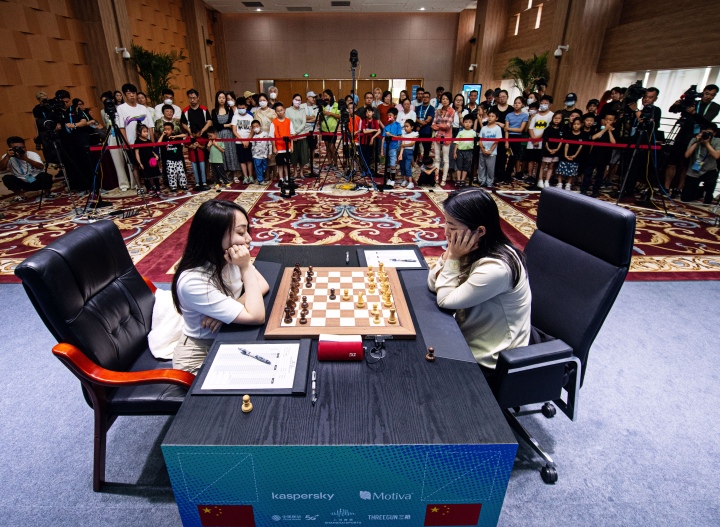
The defending Women’s World Champion fails to score a victory in her native city as Lei leads with 3.5:2.5. Game six saw a fast draw as both players seek respite ahead of the second part of the match which will take place in Chongqing With 12 games scheduled for the classical part of the match, game six in the match marked the halfway point. It was also Ju’s last chance to score victory in her native city, as the second part of the match will take place in the central-Chinese city of Chongqing, Lei Tingjie’s home town. Following a loss in game five and with two free days ahead, defending Women’s World Champion Ju Wenjun was looking for either a comeback or some respite, going into the second part of the match. While in the past five games Lei had typically been the one to set the opening tone, this time Ju (playing as White) made a surprise. In the Queen’s Gambit, she played the early 3.cxd5 but it all came down to a very popular line of Tarrasch Defence. The sides blitzed the moves and quickly exchanged the queens and a pair of minor pieces. The two reached a seemingly calm but complicated middlegame with a minimal edge for Ju: she had a pair of bishops and slightly more initiative. Also, she did not put herself at risk of losing and had a small advantage which she was happy to play on, as in the previous games. Facing threats luring under the calm waters, Lei swam confidently, quickly developing her pieces and forcing exchanges to simplify and hold an even position. Despite a pair of bishops and some minimal initiative, Ju could not develop anything concrete as Black countered very well. As the game progressed more pieces were traded and the two entered a drawn rook and knight endgame. On move 48, after three hours of play, the two agreed on a draw. Summarizing the first six games, Ju Wenjun said that the “overall quality was not bad, but I hope that in the second part of the match, I will improve my chess”. Lei was asked whether the fact that the match is moving to her home city of Chongqing will have any impact on her. “As a professional player you just focus on chess. I will be playing in my hometown, but playing in Shanghai was also good. Nothing will change for me”. The Chinese WGM Gu Xiaobing asked the players how much truth they tell in press conferences. World Champion Ju claimed to tell “99 percent,” while Lei was coy, saying she shares “about 50 percent.” Ju’s answer was a bit surprising, given that she is the world champion. But perhaps she is simply used to being in the spotlight and knows how to handle the media without raising much attention. With six more games set to take place, the players will now relocate to Chongqing, the native city of Challenger Lei Tingjie. The match will continue on Saturday, 15th of July. The starting time of the games remains the same as China has only one time zone – 3 PM Local Time in Chongqing (GMT +8). Here follows a closer look at game six of the match: The first move today was made by Zhang Yi, Director of the Youth Sports and Education Department in the Shanghai Administration of Sports and Ma Jiabin, Director of Jing’an District of the Shanghai Administration of Sports. As in the previous five encounters, game six brought another opening surprise. While it was usually Lei who was setting these up and gaining an advantage, this time, Ju took the unexpected path in the opening. Following 1.d4 d5 2.c4 e6, she decided to take on d5, preventing Lei from deploying the openings from previous rounds. Lei went for the Tarrasch defence – as in game two, but with a different setting, due to Ju’s 3.cxd5 move – and both players were blitzing the well-known moves. Soon, a pair of light pieces and the queens were off the board. Here the Women’s World Champion castled long, making the first original move in the game. Ju’s opening choice and approach were branded as “very clever” by GM Xu Yi, who is part of FIDE’s commentary duo, together with GM Alik Gershon. “White has a pair of bishops and a more enjoyable position… From the previous games, we saw that Ju Wenjun can play these positions with tiny advantages, and the position doesn’t put her at too much risk”, Xu noted, as both he and Gershon agreed that losing today would be “a disaster” for Ju. Both sides have now finished development. White has a minimal edge but the position is roughly even. 20.Bg5 After this move, White lost even the tiny edge she had before. Somewhat better options were Bc1 or Nh4. Indeed after 20…f6 21.Rxd8+ Rxd8 22.Bd2 Bd3 Black had no problem whatsoever. Lei intended to exchange a pair of bishops and further simplify, heading for a draw. Ju refused at first, but a few moves down the road, she accepted the inevitable. It is difficult to see how White can improve her position here. 27.Bc5 is met with 27…Nf5, while in the line 27. Be2 Bd3 28. Bd1 Nd5 Black is also fine, thanks to his active pieces. 27.Bd6 Rd7 28.Rxe4. With this move, Ju admitted she could not make progress keeping her pair of bishops on the board. The only thing White has in her favour after trading the bishops is Black’s slightly extended queenside. On the other hand, Ju’s position on the kingside was not flawless. The Women’s World Champion was going for a very long technical squeeze, hoping to outplay her opponent, but realistically speaking, the position did not offer much, and Black faced no real problems. The position is even. The bishops are off the board, and the pressure of the queenside for Black has eased while White holds on the kingside. After exchanging the rooks, the two continued testing each other in a knight endgame, but