

Nepomniachtchi maintains the lead following a draw in the longest game of the match
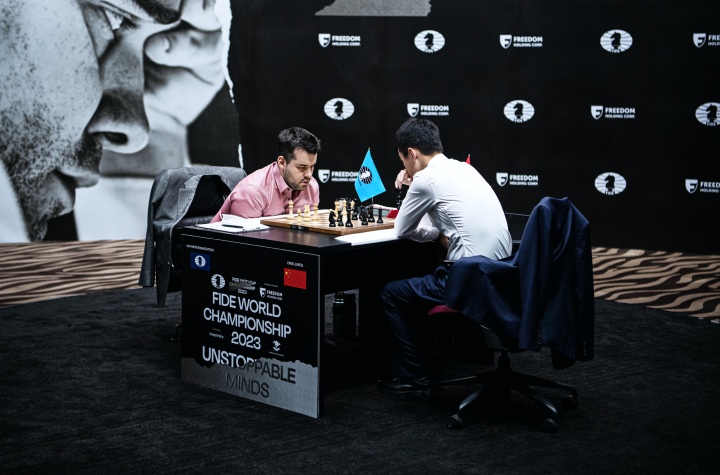
Following almost six hours of play, game nine ended in a draw. Nepomniachtchi maintains the lead with 5:4 After a fierce battle in round eight, both players appeared to have dialled down the intensity. Game nine was the calm after the storm, despite lasting for nearly six hours. Although they reached a dead draw by move 50, Nepomniachtchi decided to test his opponent for another 32 moves. This was the longest game of the match so far. The game started slowly, but the position that transpired on the board had a lot of venom in it. Unlike in previous games, for the first time, Ding was the one who was with some advantage on the clock early on. In the popular Berlin variation of the Ruy Lopez, the two played a familiar line leading to a mostly calm, positional debate on the board. Nepomniachtchi, who played as White, went for an attack on the kingside and sacrificed a pawn for the initiative. At one point, it started looking dangerous for Black. Ding was defending solidly and countered on the queenside, forcing White to reevaluate his chances for a victory. Despite having to defend, it seemed that Ding was more comfortable and played with more ease than his opponent. As the game progressed, Nepomniachtchi made a few imprecise moves, leading to a mostly even position. The two then proceeded to simplify the position by exchanging heavy pieces, White regained his pawn and the two reached an even position. In the end, Black conceded a pawn to solidify a drawn rook and knight endgame. Nepomniachtchi decided to test Ding, despite the position being a dead draw. After an exchange of rooks on move 52, Nepomniachtchi had an extra pawn and was pushing in an even knight endgame. Ding was walking a thin line in his defence but managed to hold. After 82 moves and nearly six hours of play, the game ended in a draw. Following this critical game, both players will be looking to regroup during the rest day on Saturday and come back stronger in the remaining games of the match. Game ten is scheduled for Sunday, 23rd April at 3 PM Astana time. Here follows a closer look at game nine of the match. The honour of making the first ceremonial move was given to Marat Azilkhanov, Deputy Chairman of the Assembly of the People of Kazakhstan, Head of the Secretariat of the Assembly of the People of Kazakhstan. The opponents tested a popular line of Anti-Berlin and up to move 13 followed the game Gopal – Gupta (Pardubice 2017). Two moves down the road, they finally got off the book, and it seemed that Black was perfectly fine. Ian spent some 20 minutes on his last move, giving Ding an advantage on the clock, something which did not happen in the match until now. It seems that Ding was more comfortable in this position. Commenting on the game, Grandmaster and former contender for the title of World Champion Fabiano Caruana, said that “it has been a very good opening for Ding as he knows the position well.” “It’s going to be a headache for Ian in terms of having the white pieces and not knowing what to do against the Berlin in the future games,” Caruana added. In the subsequent play, Ian was more accurate and purposeful and gradually grabbed the initiative. 20.Bxh6 Nc5 21.Ng6 – going for the attack at the cost of giving up a pawn on b2 and allowing Black to get to his back-rank. The position is sharp but Black is the one who seems to be more in danger and has to play more precisely. Being weaker on time and on the defensive is something Ding has faced before in this match and it didn’t always work out for him. 21…Bxb2 22.Nxf8 Rxf8 23.Bg5? An inaccuracy, dropping any advantage White had. A far better move was 23.Bc4 – showing patience and improving his position. However, Ding quickly returned the favour after 23…Nh7 24.Bc1 Rb5? and after 26.Bc4 Be6 decided to sacrifice an exchange. Ian did not accept, although it might have been his best chance in this game, and played the safer 27.Bxe6 move, after which the worst was behind Black. The two then now proceeded to simplify the position and go towards an even endgame. The position is even. Black now opted to give up a pawn to trade more pieces and get closer to a draw. Indeed, after massive exchanges, the two found themselves in a drawish endgame three-vs-two on one wing with a pair of rooks and a pair of knights on the board. By move 52, the rooks were off the board. Nepo continued to pressure, aiming to capitalise on his extra pawn. Ding was walking a thin line but defended well in a three vs two pawn and knight endgame. Nepo wanted to tire his opponent out and test him until almost all the pieces were removed from the board, after nearly six hours of play. Nepomniachtchi was not happy with how he came out of the opening, saying he ended up “going through dry positions”. Talking about the endgame, he said he “should have caused more problems, but it was not that simple. The endgame looks dangerous for Black but probably a draw”. Ding said that he prepared the line played in the game and that he felt comfortable after the opening. The two now have an extra day to rest, refresh and prepare. The match is now about to enter its final phase. Text: Milan Dinic Photo: Stev Bonhage and Anna Shtourman Official website: worldchampionship.fide.com/ About the match The 2023 FIDE World Chess Championship match between Grandmasters Ding Liren and Ian Nepomniachtchi takes place from 7th April to 1st May 2023 in Astana, Kazakhstan. The match consists of 14 games, followed by a rapid/blitz tiebreak in case of a tie. The time control for the standard games is 120 minutes for the first 40 moves, followed by 60 minutes for the next 20 moves, and then 15
Polish Championship: Bartosz Soćko and Michalina Rudzińska win titles
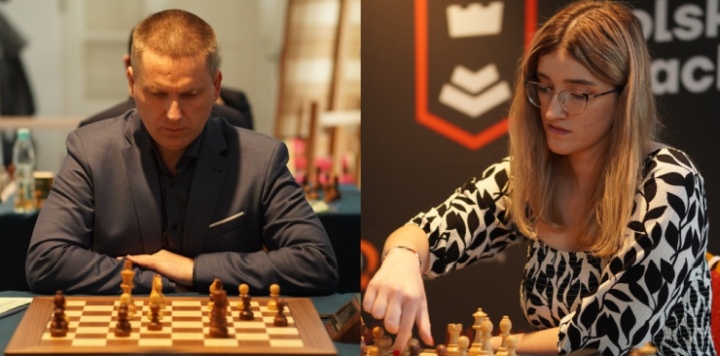
GM Bartosz Soćko and WFM Michalina Rudzińska are the new Polish Champions. Michalina successfully defended her last-year title, while Bartosz won his third national chess crown. The 80th PGNiG TERMIKA Polish Championship and the 75th PGNiG TERMIKA Polish Women’s Championship took place from April 11-21, 2023, in Warsaw. Just like the two last editions, the tournaments were played in different formats. The open event was a 16-player knockout tournament, which attracted the best Polish players, except for Jan-Krzysztof Duda. The defending champion Radoslaw Wojtaszek cruised to the semifinals, where he faced a last-year finalist Kasper Piorun. The opponents exchanged blows in the classical games, but Radoslaw prevailed in rapid and advanced to the final to battle for the title with Bartosz Soćko. Bartocz’s road to the final was not as smooth as he had to play tiebreakers in the round of 16 and the quarterfinals. In the semifinals, however, he convincingly outplayed Szymon Gumularz and punched his ticket to the final. As many expected, the final was a close battle that came down to a tiebreaker after two draws in classical games. The opponents split a point in the first rapid encounter, but Bartosz Soćko won the second one with the black pieces and clinched the title. In the match for third place, Szymon Gumularz whitewashed Kasper Piorun (2-0). The women’s event, a 10-player round-robin, also saw a tight race for the title. The defending champion Michalina Rudzińska grabbed the lead early on after two starting victories with black and kept her top position throughout the tournament distance, coming into the final round on 5.5/8, a half-point ahead of Julia Antolak, Alina Kashlinskaya and Alicja Sliwicka. Rudzińska drew her last-round game with Antolak and took the title as neither of her rivals managed to win. An astonishing achievement by Michalina, who won back-to-back titles despite being seeded 10th in 2022 and 9th in 2023. Julia Antolak and Alina Kashlinskaya tied for second place, with the former claiming silver thanks to better tiebreaks. Official website: mp2023.pzszach.pl/ Photos: Polski Związek Szachowy Facebook
Ding drops crucial victory as Nepomniachtchi maintains lead in title match
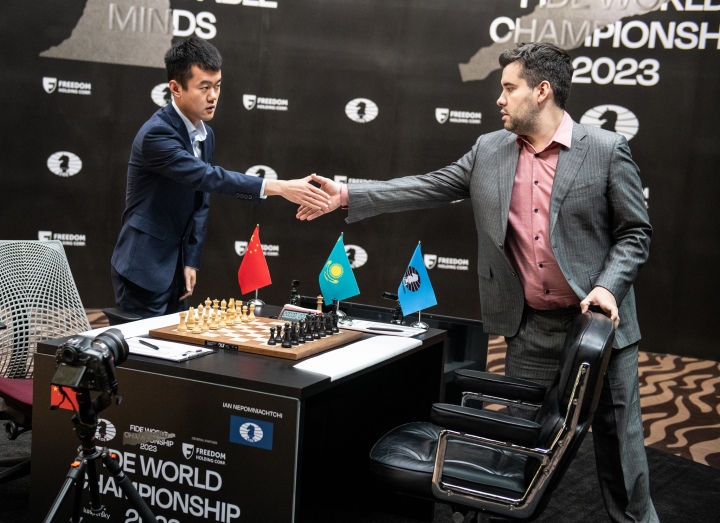
After achieving a won position in the eighth game of the match, Ding Liren badly misplayed allowing Nepomniachtchi to draw and stay ahead in the race for the 17th world chess champion. The score is 4,5:3,5 for Nepomniachtchi In a stunning turn of events, Ding Liren squandered several chances in a winning position and ended up playing for a draw in the eighth game of the FIDE World Chess Championship match. In the Nimzo-Indian Defence, Ding Liren surprised his opponent with a sharp line, sacrificing a piece for an attack on the black king. Nepomniachtchi was caught off guard and, in the critical moment of the game, he misplayed by exchanging a bishop for a knight on e4 on move 22, entering a losing position. At that point, however, Ding made several bad decisions, ultimately squandering his huge advantage. Despite repeated opportunities handed to him on a silver platter by Nepomniachtchi, Ding failed to capitalize on any of them. By the time the two reached the first time control, the position was even but visually more dangerous for White. The momentum shifted, and Nepomniachtchi seemed to gain confidence as he sensed Ding’s grip on the game loosening. Ultimately, Ding managed to find solid moves to simplify the position to a drawn rook endgame. After four and a half hours of play and 45 moves, the two agreed on a draw. Ding’s own missteps led to his undoing, but Nepomniachtchi’s resourcefulness in finding great defensive moves such as 31…Qh4! And 37…Nxf2!! also deserve credit for this result which allows him to stay in the lead. In the words of Grandmaster Daniil Dubov: “The players have been playing roulette today… It doesn’t look to me as if this is Ding’s last chance to win a gem in the match.” A huge opportunity wasted by Ding and a lucky escape for Nepomniachtchi, who maintains the lead. Game nine of the match will take place on Friday, 21st April at 3 PM Astana time. Here follows a closer look at the eighth game of the match. Every single game in the match for the title of World Champion in chess is important but game eight in the duel between Ding and Nepomniachtchi in Astana meant more to both players. Game eight was a crucial turning point for both players, and the tension was palpable: if Nepo wins he extends his lead, if Ding wins the race is open. With the match at its halfway point, Ding had been trailing behind Nepo, evening the score twice before suffering a defeat in the seventh game. Now, Ding had to level the score again, for the third time. Playing catch-up is never easy, especially against a player like Nepomniachtchi, who got his third chance to extend the lead. If this match has shown anything so far, it is that the players are going for sharp play and a win in each game, without any hesitation or regrets, till the bitter end. That was also the case in game eight. The opponents tested a relatively rare line in the Rubinstein Variation of Nimzo-Indian, in which Ding was first to surprise his opponent with a rare 9.Ra2, recently introduced by GM Aram Hakobyan. Ding walked off the board after playing this move. Daniil Dubov made a point about this: “This is very typical for chess players. He played Ra2 and left the board, which means Ding is saying to Nepo: I know you had a clue about Bd3, I know Ra2 is good, and I know how a rare move this is, I know the engine doesn’t prefer this as White, and I know you’re out of the book”. Later in the post-game interview, Nepomniachtchi confirmed that he was aware of the move Ra2. Nepomniachtchi spent some time thinking and opted for the most natural move 10…b6. 10.e4 Played quickly by Ding. White is delaying his castle to seize the initiative in the centre. 10…Ba6 11.Bg5 h6 12.h4! The plan of the line Ding took, going for a sharp position, attacking Black’s kingside. Nepo spent six minutes thinking before taking on g5 and went for a forced line 12…hxg5 13.hxg5 g6 Ding also was taking his time. This was probably all in his preparation, but he was checking the lines. Black’s king is vulnerable on the h-file, and Ding has a chance to increase further pressure with f4. Ding restored the material balance and started spending more time on the clock for each move. 14…Qxf6 15.e5 Playing sharp, opening the space for the knight to jump to e4. “This position is a gift for Ding” said Dubov. Now Nepo got into deep thought. After 15…dxe5 Ding proceeded with 16.d5 sacrificing a pawn to which Ian reacted with 16…Ne7. According to chess engines 16…Rad8 was a worthy alternative. 17.d6 Played after 33 minutes. This was the best choice, preferred by the computer. The position is roughly equal, but White had momentum on his side. But, again, as in previous games, Ding was spending huge amounts of time. After a series of logical and well-calculated moves, the opponents reached the first critical position of the game. Ian played 22…Be4? This move gave a huge advantage to White. Nepo’s argument was that he believes that his knight is stronger than White’s bishop. He spent 20 minutes on the clock. Ian started feeling the pressure of White’s knight, the d6-pawn is getting better protected. Meanwhile after sensible 22…Rh8 Black is fine. “He panicked,” said Anish Giri when he saw Nepo taking the knight. 23.Qxe4 Nf5 24.Rd2! Improving his position further and keeping Black on the backfoot. Played instantly by Ding – and the engine also liked this move as the best one. Black can’t take on d6 because Qxe5 wins a piece. Taking on g5 by Black would give Ding a chance to create a masterpiece on board: 24…Qxg5?? 25.Qxe5+ f6 26.Qh2 Rh8 27.Rxh8 Rxh8 28.Qxh8+!! Kxh8 29.d7 and Black can’t prevent White from promoting his pawn! Just a few moves down the road, Ding got an overwhelming position but yielded to the temptation of making a natural but
Double crown for France at the Mitropa Cup 2023
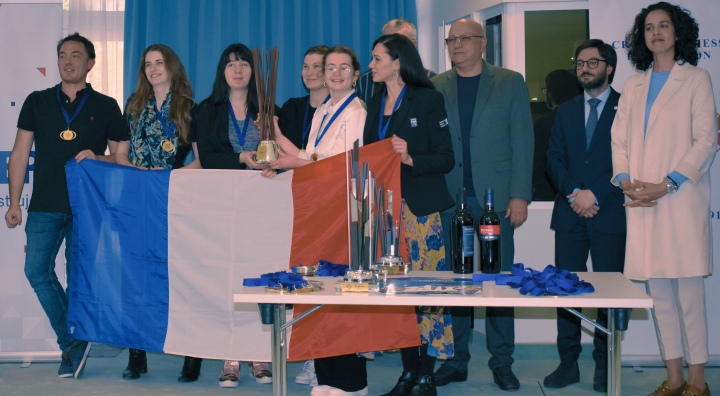
France won gold medals in both the open and women’s sections at Mitropa Chess Cup 2023, organized by the Croatian Chess Federation in Mali Lošinj. Les Bleus successfully defended the titles won back in 2022. The closing ceremony featured some honourable guests: the Mayor of Mali Lošinj, Mrs Anna Kučić, and the President of the European Chess Union, Mr Zurab Azmaiparashvili. The President of Mitropa Chess Association, Mr Marco Biagioli, handed them a small presents from MCA. Croatia passed the baton to Germany, the country that will host the 2024 Mitropa Cup. Mr Biagioli also congratulated the Tournament Director, Mr Alojzije Janković, ECU Vice President and Croatian Chess Federation Secretary General, for the perfect organization. During the tournament, the Mitropa Chess Association Board held a meeting in Mali Lošinj, where many new projects were discussed and will be announced in the following weeks. All results and standing can be found in Chess-Results: Open section and Women’s section and on the official website: https://mitropa.chess.at/. Text: Aleksandra Dimitrijević Photos: Aleksandra Dimitrijević and Croatian Chess Federation
The World defeats Kazakhstan in a unique match
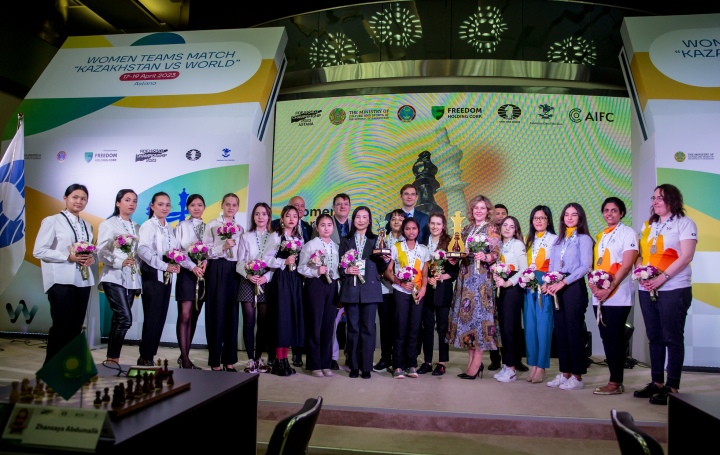
The World team emerged victorious over Kazakhstan in a thrilling three-day match featuring the best women players. Team World defeated Kazakhstan with 73:55 The third and final day of the match, “World vs Kazakhstan”, made up of top women players, ended with a Blitz tournament. After eight rounds of the rapid tournament played on Monday and Tuesday, Team World was in the lead with 34½:29½ . The Blitz match – consisting of eight rounds (like the rapid) was a chance for Kazakhstan to even the score. Team World, however, was better. They defeated top women players from Kazakhstan in all but one round (in the final, eighth round, the result was 4:4). The fight was much more vicious than the results suggest. On the first day team Kazakhstan lost three matches in a row, but on the second day, they came out swinging, taking four consecutive matches. But Blitz is always an open race where experience is more important than knowledge. Team World was made up of more experienced players, and that played into their hands. Dana Reizniece-Ozola, the Captain of Team World, was balanced in celebrating her team’s success, saying that “the final result doesn’t resemble the dynamics of the past three days.” “It was very tense for us, especially on day two, where we lost three out of four matches. The format was great – two days of rapid and one day of Blitz.” As the leader of her team, Reizniece-Ozola couldn’t help but notice something quite extraordinary: “Normally, they don’t play in one team. They are used to seeing their current teammates as challengers and competitors in world events, so it was great to see how they were glued together by team spirit.” Captain of team Kazakhstan, WGM Gulmira Dauletova (pictured below, left), said that despite the loss, the event was “a very important experience for Kazakhstan, especially for our young girls.” “This was a chance for them to show themselves to the world. And some of them – such as Alua Nurmanova, who won seven out of her eight games in the rapid – have made a name for them now,” said Dauletova. Indian GM and Harika Dronavalli, currently ranked as the 11th strongest women player in the world, said that this event was “a great initiative” and that “these steps are a start of something huge in the future. It’s really nice to start women matches, and we should appreciate that this was organised so wonderfully”. Kazakhstan native and the reigning two-time Women’s World Blitz Chess Champion, Bibisara Assaubayeva, was the best player in her team. Despite the defeat, she says this event was a great opportunity for Kazakhstan’s women’s players to play against the world’s best. “We have great chess players, but we are a young team and we need to play more against the strongest players in the world”, Bibisara said. The four-time women’s world champion and top-rated women’s player Hou Yifan was one of the stars of the event. Despite changing her life focus from chess to teaching, she has accepted to take part in this event which has taken the chess world by surprise. “In general, this event was well organised. It was a lot of fun, and there were very exciting moments. I enjoyed it very much except for my results. Blitz is more exhausting as it’s very fast and intense”, Hou Yifan said. In the Blitz Hou Yifan was on 50% (three victories, three defeats and two draws), which, for someone of her stature, is not a great achievement. However, “the point of this event isn’t in the result but in what it means for the promotion of chess in Kazakhstan and women’s chess in general”, as she noted. “One of the main reasons for this event is to encourage more young players to improve their chess skills, and it was great to contribute to that”, Hou Yifan said. The total prize fund was 50,000 USD and the winning team received 30,000 USD (20,000 USD equally shared by women players, 10,000 USD equally shared by youth players), while the other 20,000 went to the runners-up. There are already plans for a rematch either at the end of this year or the beginning of next. Text: Milan Dinic Photos: Anna Shtourman
FIDE World School Championship crosses halfway mark
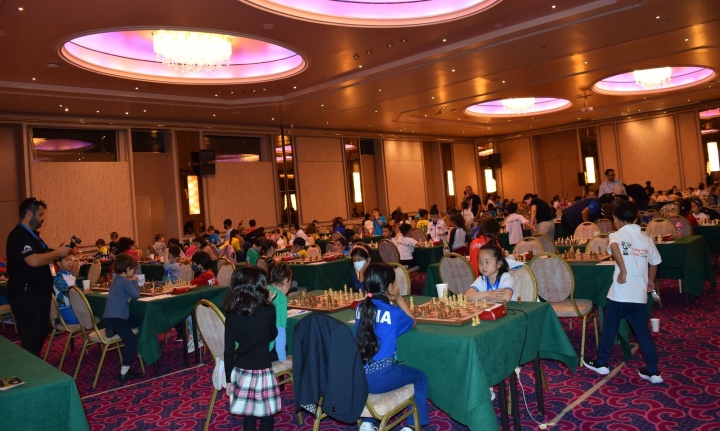
Day 5 of FIDE World School Championship started with the National arbiters’ seminar, presented by Lecturer IA professor Tania Karalis and Assistant Lecturer IA Michalis Keramiotis. Mr. Panagiotis Nikolopoulos, chief arbiter of the World School Championships, welcomed the participants of the seminar and explained how important and necessary the arbiter’s role is in chess. After Round 5, four players still have a perfect score 5 out of 5. See, in detail, all the contenders for 1st place by age group. U07: Elliot McCallum first with 5 in 5.U09: First Thetas Rithmitha Kiringoda with 5 out of 5.U11: Four-way tie with 4.5 out of 4 Baver Yilmaz, Danis Kuandykuly, Vlad Petroff and Philippos Oikonomopoulos with 4.5 out of 5. U13: First with 5 out of 5 is Uygar Durucay.U15: First and with an excellent performance (Performance: 2358!) with 4.5 out of 5 is Inayat Bolat.U17: First with 4.5 out of 5 is FM Adar Tarhan.G07: First with 4.5 out of 5 is Tsogtgerel Gerelt-Oyu.G09: First with 5 out of 5 Alanna Berikkyzy.G11: Daliya Diaskyzy and Batpelden Buyankhishig are tied for 1st place with 4.5 out of 5.G13: Evangelia Siskou and Liennys Ferrer Naranjo are tied for 1st place with 4.5 out of 5.G15: First with 4.5 out of 5 is Davaademberel Nandin – Erdene.G17: WIM Amina Kairbekova and WFM Zeynep Ciftci are tied for 1st place with 4.5 out of 5. Round 5 produced many interesting and instructive games. A very nice smothered checkmate was put up by Garg Hriday against Rares Foral in the under 7 category.Another classic checkmate idea – cooperation of Knight and Rook (Hook Mate) was nicely executed by Edward Jackson against Kiril Kostov As for the Greek results, Filippos Oikonomopoulos (U11) and Evangelia Siskou (U13) are tied for first place with 4.5 out of 5. Grigoris Tamiolakis (U09) also remains undefeated – tying for 3rd place in his category – with 4 out of 5, while in the first 10 places are Dimitris Papaioannou (U15 – 7th), Nikolas Poupalos (U15-10th), Marianda Lambou (G11 – 9th) with 3.5 out of 5 and Katerina Argyro Goutzouki (U15 – 7th) with 3 out of 5. The top five boards in each category are broadcast on chess24.com and chess.com. News and photo materials can be found or downloaded from the official pages of the Rhodes Chess Club “Ippotis”, on the website wscc2023.ippotis.com , on Facebook @cc.ippotis, on Instagram @rhodes_chess_events & on Youtube @rhodes_chess_events The championship is a joint event of the Rhodes Chess Club “Ippotis” with the South Aegean Region and the Municipality of Rhodes through the Municipal Organization of Culture and Sports (DOPAR) under the auspices of the World Chess Federation (FIDE) and the Hellenic Chess Federation (ESO). The organizers express gratitude to the sponsors of the event. To facilitate transportation, Mr. Nikos Xenakis (Xenakis Cars) as the sponsor of electric mobility, provided 3 modern cars (electric–hybrid) covering the needs for the transportation of the organization’s executives. Beekeeping of Dodecanese, J&D Rent a Car, Rodos Palace Hotel, Radio Taxi Diagoras, Accounting Office of Papadimitriou and Associates (Papadimitriou Panagiotis), AtHolidays, Cafe Auvergne & Restaurant Romaio, Tropaion, Odeon of Dodecanese. Communication Sponsor: Eleftheros Typos Official website: wscc2023.ippotis.com/ Text and photos: Official website
World Solving Cup 2022/2023: Female touch in Riga
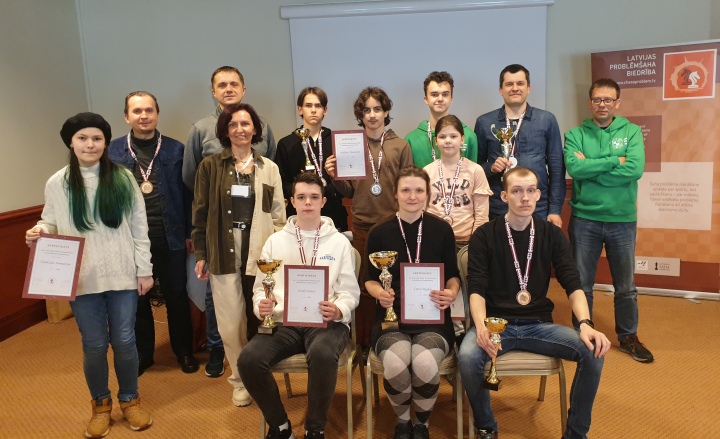
Laura Rogule left all Latvian men behind; Martynas Limontas extends the lead in the World Solving Cup Latvia is a country with a high percentage of women in top management and other important positions. In the world of chess, Latvian ladies are represented on the highest level by Dana Reizniece-Ozola, the Deputy Chair of FIDE Management Board. At the same time, another prominent Latvian lady has become a star of the World Federation for Chess Composition. Soon after her first steps in composing (2011), Julia Vysotska (Jūlija Visocka) quickly extended her activities in chess composition, first as the creator and editor of the highly popular website Julia’s Fairies (2012) and then as the Administrator of the WFCC website. Since 2016 she’s been directing the Youth Chess Composing Challenge, and later serving as the Latvian delegate and member of the WFCC Youth Committee. With all those duties, in 2021, Julia managed to become the first-ever woman with the title of the FIDE Master for Chess Compositions. Julia Vysotska directs the 4th Youth Chess Composing Challenge As the President of the Latvian Chess Problem Society, she’s been arranging lessons in chess composition for juniors and organizing all domestic solving competitions. To raise the bar even higher, she hosted and organized two European Chess Solving Championships in Riga back in 2017 and 2022. So, the Open Solving Championship of Latvia, the 5th leg of the World Solving Cup 2022/23, held this month, was just another evidence of her devotion to chess composition. Latvian solving events are more than just competitions. They combine the beauty of chess art in the fittingly decorated ambient, with perfect conditions and a friendly atmosphere. This year’s edition, held in the heart of Art Nouveau district, in the Neo-Gothic building of the 4-star Monika Centrum Hotels in Riga, was no exception. Artistic surrounding for the chess art: solving in the heart of Art Nouveau district in Riga The selection of problems made by Antons Gajevskis, the most experienced Latvian solving judge, also had a female touch. Five out of the 14 problems to be solved in four hours (two rounds of two hours each) were composed by women. Both two-movers were by Odette Vollenweider (1933-2021), the famous Swiss chess composer, writer and editor. The next one is very characteristic of Odette’s style: a surprising key move introduces attractive variations and intense tactics: 1 Mate in 2 moves For many years Odette remained anonymous in the men’s world, using the pseudonym Gabriel Baumgartner. That’s how she signed the problem above and her first book Faszinierendes Schachproblem (1963). At the time of revealing her identity, she became a Swiss delegate in the WFCC and the editor of the chess problem section of the “Neue Zürcher Zeitung”. During the three decades of her caring and passionate editing, the NZZ column became famous. In 2017 she was granted the title of Honorary Master of Chess Composition. One of the three-movers to be solved in Riga was authored by the Ukrainian chess composer Nadya (Nadezhda) Leontyeva (1928-2012). Nadya was born without both hands in the village of Andriyashivka, Sumi region, and lived most of her life in Rivne. She started composing in 1962, producing around 220 problems and endgames, mostly three-movers. In 1973 she earned the title of Candidate Master in chess composition and left a mark in the theory of #3 with the “Rivne theme”. Her three-mover presents two harmonious pairs of quiet moves by White after mutual obstructions by black pieces, completely solved only by four participants: 2 Mate in 3 moves The Riga selection also included a selfmate in two moves by Edith Baird (1859 – 1924). Mrs Baird (née Winter-Wood), was the most prolific chess composer in the world of her day, with over 2000 problems to her credit. She published two books with selected compositions and was sometimes referred to in the press as the “Queen of Chess”. Her daughter Lilian Edith also became a chess composer. Finally, one of the two fairy problems (the trademarks of the Latvian Open Championships since 2018) was by the main organizer Julia Vysotska, specially composed for this event. It proved to be the most difficult of all 14 problems and was completely solved only by the overall winner of the Open section. The outcome of the 49th Latvian Solving Championship deserves special attention, as perfectly fitting to the overall female contribution in Riga. It was the Woman Grandmaster Laura Rogule who left all the Latvian men behind, and it was no surprise at all. Laura Rogule in action Latvia is probably the only country where a woman leads the overall rating list in any chess branch. The 12 times chess champion of Latvia for women is among the top 4 women in the World’s Solving List, and now she has won her second domestic solving title ahead of men. Her main rivals were the winners of the previous two domestic championships. The silver medal went to the 17-years old rising talent Emīls Tabors, the defending champion, and the winner from 2021 Emīls Miķelis Miķelsons ended in third place, closely followed by the ex-champion Rāviņš Modris. Laura Rogule is not only a great champion, but she is also a skilled trainer, first in chess and then in chess composition, too. This time she prepared her daughter Lauma Mieriņa for the junior solving competition held at the same time. In her first appearance, 11-years old Lauma won the bronze medal, not so far behind the winner Mihails Pučinskis and runner-up, Mihails Šalašovs, both one year older than her. The boys should soon beware of a strong rival coming. The event bridged the generational and historical gaps. It was nice to see the oldest participant Ēriks Priednieks (84), who won the silver medal in the 1st Latvian Chess Solving Championship in 1972 and was 12 times among the medallists. Ēriks Priednieks (84) won silver medal in the 1st Latvian Chess Solving Championship (1972) Back to the international event, the Open Solving Championship of Latvia was convincingly won by Martynas Limontas, with the maximal result of 70 points. The Solving Grandmaster from Lithuania has extended his lead in the World Solving Cup Standings 2022-23, and the 2nd
Global Chess League unveils its official logo

New Delhi, 19th April 2023: Global Chess League (GCL), a joint venture by FIDE and Tech Mahindra, today unveiled its official logo, which resembles a chess board with 64 squares. The logo has been strategically launched 64 days before the inauguration of the first-ever GCL, a number that is well-known in the chess world. GCL is the world’s largest and first-ever league-styled chess tournament set to take place from June 21st, 2023, to July 2nd, 2023. The first edition of GCL will feature six teams with six players each, including a minimum of two female players and one icon player per team. Viswanathan Anand, five-time world chess champion and Mentor, GCL, said, “As we inch closer to the start of the tournament, we are seeing all our plans come to fruition. The GCL logo is a reflection of the vision that we have for the tournament. We hope the fans will like the concept and theme we created here. The primary objective of GCL is to promote the sport of chess globally and make it visually attractive for the masses.” Each team will compete in 10 matches in the rapid format across all six boards in the tournament. Sutovsky Emil, CEO, FIDE, said, “GCL aims to change how chess is played, viewed and visualized globally. We are only a few weeks away from the inaugural season, and we are happy to launch the official logo of the league. FIDE looks forward to an exciting debut of the GCL in June 2023.” The top two teams after the round-robin format will progress to the final on July 2, 2023, and the winning team will be crowned the World Champion Franchise Team. Jagdish Mitra, Chairperson, Global Chess League Board, said, “As we gear up for the first edition of GCL, we are excited to launch the official brand identity, which has been created after a great degree of consideration and collaboration. The GCL brand identity, uniquely crafted and designed from the 64 Squares of chess, forms into a regal King piece representing the highest level in chess. The GCL brand has been designed for the digital space to support and elevate the incredible chess game full of mastery, judgement, and time pressure. We believe, GCL represents a new beginning in chess, and the carefully designed brand identity representing chess in its majestic glory is the first step in that direction.” The league will also set the standards for technological innovations in chess as FIDE and Tech Mahindra are exploring innovative ways to promote the game through interactive technology-enabled platforms by leveraging next-generation technologies such as 5G, artificial intelligence, and virtual reality, among others. About Tech Mahindra Global Chess League The Global Chess League is the world’s first and largest official franchise league of its kind, with chess players from all over the world competing in a unique joint team format. It is a joint venture between FIDE and Tech Mahindra, a part of the Mahindra Group. GCL will feature male and female chess champions competing in the same team. Playing on the popular Rapid format, the league’s joint male-female teams will have the rare distinction of being a unique multiplayer team in the world of professional sports. In addition, the League will be the first ever Live televised chess event of its kind that will help offer fans a unique viewing experience. FIDE and Tech Mahindra will explore innovative ways to promote the game through interactive technology-enabled platforms by leveraging next-generation technologies such as 5G, artificial intelligence, and virtual reality, among others. The first edition of the Global Chess League (GCL) will begin on June 21, 2023, and end on July 2, 2023. In the first season, ten round-robin matches will be played among six teams competing (six players in each team), followed by a final match between the top two teams. For more information on Tech Mahindra Global Chess League, please contact: Abhilasha Gupta, Global Corporate Communications and Public Affairs Email: Abhilasha.Gupta@TechMahindra.com; media.relations@techmahindra.com
Nepomniachtchi takes the lead for the third time as Ding misplays in time trouble
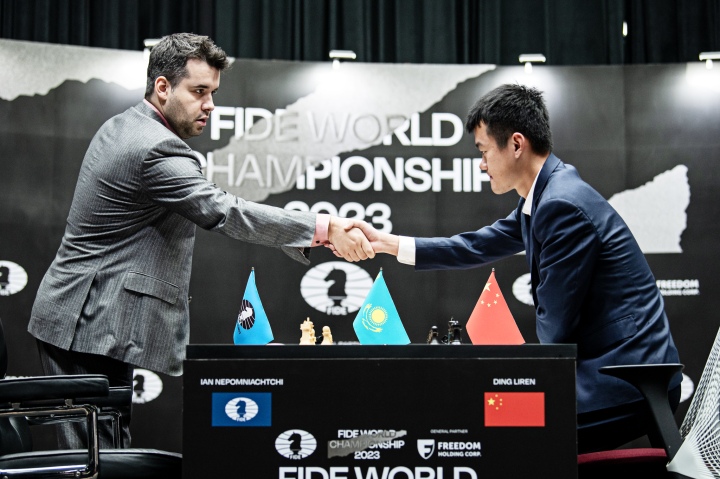
The seventh game of the match for the title of FIDE World Chess Champion ended in drama with Ding losing a stable position after misplaying in severe time trouble. In an attempt to surprise his opponent, Ding Liren played the French Defence. This is the first time the French Defence was played in a world championship match since 1978. “I told Richard [Rapport, Ding’s second] that I was going to play the French Defence. But it was a half-joke, half-serious. He took me seriously and told me that I can try this French Defence to surprise my opponent.” Nepomniachtchi went for a sideline in the opening and Black managed to obtain a solid position with the only weakness on c6. However, in the process of the game, Nepomniachtchi managed to engineer some initiative and press on the kingside. At some point Ian pushed too hard and with a timely exchange sacrifice Ding simplified the position and emerged slightly better. By this moment, however, Ding was short on time which was his ultimate pitfall. With just 44 seconds on the clock, in a critical position, Ding misplayed with 33…Rd3 he found himself in a hopeless position and soon had to resign. The game lasted 37 moves and just under four hours. It echoed the drama in the 24th game of the Karpov-Kasparov match in Seville, where Kasparov sacrificed a pawn for an attack while Karpov was in desperate time trouble. In the seven games of the match played so far, five ended with a decisive result. Nepomniachtchi now leads with 4:3. Here follows a closer look at the seventh game of the match. Ian was White and he played his standard 1.e4. It’s worked well for him so far and it’s his preferred move. Ding responded with 1…e6 – the French defence, played for the first time in the match. This was Ding’s favourite opening in his early days. In the post-game press conference, Ding revealed that his second, Richard Rapport, suggested that he should play this opening to surprise Nepomniachtchi. 2.d4 d5 3.Nd2 3.Nc3 is more common. “This is not the main line but I felt it gave a small but safe edge for White”, said Nepomniachtchi after the game. Ding responded with the most popular 3…c5, the Tarrasch defence and by move nine the opponents were out of the book. The opponents deployed their forces in the most natural way and by move thirteen reached the first important position of the game. 13…Nf6 a more preferable move here was g6, closing off the white bishop’s attack h7-pawn and keeping the knight on d5. After 14.Qh4 Ding for the second time spent a lot of time thinking (21 min) on a natural move 14…c5. In the subsequent play, Ian tried to create some activity on the kingside but it turned out that Black had sufficient defensive resources. Nevertheless, Nepo kept pushing although objectively speaking, his position did not offer much. With 22.c3 Ian gave Ding a chance to go for an exchange which would turn the initiative over to Black. After 22…Nxf4 23.Bxf4 Rxf4 24.Rxf4 Bxe5 25.Rh4 a very sharp position emerged on the board. In the heat of the battle, Nepo went too far with 28.Rh4?! This risky move was met with cool-blooded 28…Qd6! taking control over the d-file and threatening to come to the second rank, increasing pressure on White. Indeed 29.Rxh7 fails to 29…Rd1! winning. After 29.Qe3 h5 30.g3 Black is slightly better. He has secured his kingside, centralised and coordinated his pieces and is taking the initiative. However, Ding was falling into ever deeper time trouble. Still, with a timely h5-h4 push the Chinese GM weakened White’s position even more. 32…Rd2 was the first step into the abyss. After correct 32…Be5! Black has long-lasting initiative and continuous pressure over White’s weaknesses. Nepo played natural 33.Re2 and with just 44 seconds on the clock Ding made his fatal error and immediately got into a lost position. Instead of playing his rook to d5 and maintaining the pressure, Ding opted for 33…Rd3?? He made the move instantly and – lost. 34.Qxc5 Rd1+ 35.Kg2 Qd1 Qd3 36. Rf2 Kg7 37.Rcf4 Qc3 Here with just three seconds on the clock Ding realized that after 38.Qxc3 Bxc3 39. Rxf7 the endgame is absolutely hopeless and conceded defeat. The match has reached its halfway point. With seven more games to be played and a day of rest ahead, both sides will need to recoup and reorganise themselves for the second part of the event to determine who will become the 17th FIDE World Chess Champion. Game eighth will take place on Thursday, 20th April, at 3 PM Astana time. Text: Milan Dinic Photo: Stev Bonhage, David Llada and Anna Shtourman Official website: worldchampionship.fide.com/ About the match The 2023 FIDE World Chess Championship match between Grandmasters Ding Liren and Ian Nepomniachtchi takes place from 7th April to 1st May 2023 in Astana, Kazakhstan. The match will consist of 14 games, followed by a rapid/blitz tiebreak in case of a tie. The time control for the standard games is 120 minutes for the first 40 moves, followed by 60 minutes for the next 20 moves, and then 15 minutes for the rest of the game, with an increment of 30 seconds per move starting from move 61. The first player to reach 7,5 points in the 14 games will win the match. If it’s a tie, the two go to tiebreaks. The prize fund for the match is two million euros, with the reward being split 60:40 between the winner and the runner-up. The main Partner of the match is Freedom Holding.
FFE and Île-de-France Region sign an agreement on chess for people with ASD

On Monday, April 17, the French Chess Federation (FFE), in partnership with the Île-de-France Region and with the support of FIDE and the European Chess Union organized an event dedicated to the signing an agreement between the Regional Council and the French Chess Federation. The document is related to the launch of social chess programmes, including the Infinite Chess Project for children with ASD and other projects of the Health Social Disability Commission of FFE dedicated to health, well-being and social inclusion issues through the game of chess. The Commission is chaired by Franck Droin, who is also a chairman of the ECU Social Commission and a councillor of the FIDE Social Commission. The panel of speakers included Eloi Relange, President of the French Chess Federation, Franck Droin, ECU Social Commission Chairman, President of the Health Social Disability Commission of the FFE, Anastasia Sorokina, Infinite Chess Project Leader, and Andre Voegtlin, Chair of the FIDE Social Commission. The speakers exchanged their experiences and showcased how chess helps people worldwide and makes changes for the better. According to them, many recent studies have already highlighted the benefits of playing chess to support the development of children with autism spectrum disorders, the DYS (dyslexia, dyspraxia, dyscalculia) or attention and hyperactivity disorders. Eloi Relange, the President of FFE: “Among its many assets, the game of chess brings many benefits for mental health. The French Chess Federation is proud to have set up Health Social Disability Commission to pilot a set of programmes dedicated social aspects of chess. The Infinite Chess Programme is the first of a set of measures focused on mental health and using chess as a new tool at the service of health professionals.” Anastasia Sorokina, Infinite Chess Project Leader: “FIDE pays a lot of attention to Social projects, and I am extremely happy and proud that under the supervision of FIDE Deputy Chair Dana Reizniece-Ozola, our ambitious initiative became a major international project that helps so many children around the world. The vast interest in the programme in many countries resulted in our cooperation with IOC and project expansion to Asia. Next step of our prosperous partnership is Africa and America regions.” In 2023, the Infinite Chess Project runs in 25 health and leisure centres in France, with around 200 children with autism spectrum disorder learning chess. The future development of the programme in France includes creating a large chess center and introducing more children with ASD to chess.