

WGP New Dehli: Round 7 Recap
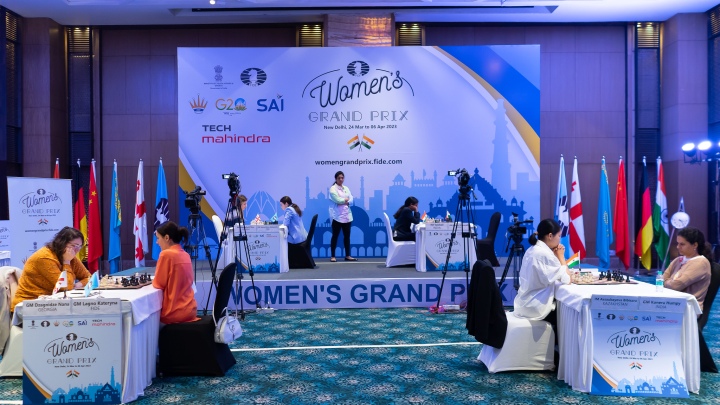
Bibisara Assaubayeva made her first draw in New Delhi but is still in the lead with 4,5 points. The race for the top is heating up as both Lagno and Goryachkina scored Round 7 saw two decisive outcomes and two draws. It was a relatively short round, with the last game finishing after three and a half hours of play. Round 7 results: Nana Dzagnidze – Kateryna Lagno, 0 – 1Bibisara Assaubayeva – Humpy Koneru, ½ – ½Vaishali Rameshbabu – Harika Dronavalli – ½ – ½Nino Batsiashvili – Aleksandra Goryachkina – 0 – 1 In the seventh round of the Women’s Grand Prix in New Delhi, Bibisara Assaubayeva made her first draw of the event against Humpy Koneru, playing the Reversed Benoni. Although Assaubayeva had a better position, she couldn’t find a path to victory. Despite this, the player from Kazakhstan still leads the tournament with 4,5 out of 6 points. Koneru has three points. Meanwhile, Aleksandra Goryachkina took another step towards the top, capitalizing on a blunder by Nino Batsiashvili in Veresov. Kateryna Lagno also had a successful match against Nana Dzagnidze, taking advantage of Nana’s misplay in the Bogo-Indian to secure a win. Lagno and Goryachkina both have 3,5 points, but Goryachkina has one game more. The Indian derby between Harika Dronavalli and Vaishali Rameshbaby, ended in a draw. Vaishali has 1,5 points while Harika has two. Here follows a more detailed look at the games of Round Seven in the Women’s Grand Prix: Nana Dzagnidze – Kateryna Lagno In the huge number of games the two have played, Lagno leads by a significant margin. Nana forgot her moves in the opening and spent a lot of time in a rare line of the Bogo-Indian. Kateryna sacrificed a pawn early on and got some compensation but hardly more. On her fourteenth move, however, Dzagnidze made a serious mistake. Here White should play 14.a3, but Nana forgot the line and played 14.f4? allowing Black to create a strong pawn centre and obtain a serious space advantage, which Kateryna used to align her pieces for the attack. After due preparation, Black started her onslaught on the white king. Nana had just one way to stay in the game for a while by putting her rook on f1, to protect and control the f4 square. Instead, she played 23.Qc2?, allowing Black to open the g-file with deadly threats. 23…gxf4 24.gxf4 Qh4 – White has no escape. The final portion of the game turned into a hunt for the White’s king that ended on move 29. Leaving the playing hall, Nana Dzagnidze briefly commented that “one can’t play when they forget or don’t know the lines”. Despite a challenging tournament, Nana Dzagnidze is maintaining a courageous demeanour and refraining from displaying any overtly negative emotions. Lagno now has four points, while Dzagnidze is on two. Bibisara Assaubayeva – Humpy Koneru This was the first classical game between Assaubayeva and Koneru. So far, they have played 23 Blitz games with an even head-to-head record. Just like in the encounter between Assaubayeva and Dronavalli, the game saw the Reversed Benoni and, again, White emerged clearly better in the opening. In the post-game analysis, Koneru explained that here she misplayed the line – she should have continued with 10…c6 but played 10…Re8. Bibisara had an extra pawn with no visible compensation for Black. On move 16, White had a chance to increase her advantage by grabbing the b7-pawn but Assaubayeva opted for a safer approach. Little by little, Koneru coordinated her pieces and countered by pushing the a-pawn and then activating her kingside pieces, to force exchanges and blunt White’s edge. Despite not finding the best moves, White had a better position for most of the game, although to Koneru’s credit, she put up a stubborn resistance. In the end, as both reached time trouble, it all turned around as Assaubayeva handed her advantage to Black. Sensing the moment, Assaubayeva made a good practical decision by offering a draw in the following position after 37.f3 Koneru was better here: Black just needs to realign her heavy pieces on the kingside and put pressure on White’s centre. However, Humpy was not in the mood to continue, and the two agreed to split a point. This is the first draw for Bibisara Assaubayeva who now has 4,5 points out of six games. Humpy Koneru has three points. Vaishali Rameshbabu – Harika Dronavalli In the Indian duel between Vaishali and Harika, out of 17 games played between the two, Vaishali won nine, and Harika won eight. In the Open variation of the Ruy Lopez, the opponents tested a rare line and quickly stepped off the beaten track. Both played quite logical natural moves keeping position in balance. Following exchanges and simplifications, the two reached an even rook endgame and called it a day. Dronavalli is on two points while Rameshbaby is on 1,5. Nino Batsiashvili – Aleksandra Goryachkina Out of the total of 13 games the two have played so far, Nino has two wins and Goryachkina has four. In the Veresov with 3.Bf4, the two entered unchartered waters as early as move six. Batsiashvili went for an unusual move 6.Nh3 but after natural 6…Bb4 played by Goryachkina, Black was already slightly better. A more logical move was 6.h4, heading into a sharp position. After Nino closed the centre on move eight, Aleksandra got a very good version of advanced Karo-Cann with a couple of White’s pieces misplaced. White’s uncastled king is exposed, and the centre is hanging by a thread. White should have proceeded with 13.dxc5 to remove the c5 pawn, countering Black on the left flank and centre. Instead, 13.b4 played in the game was premature and, costly. After the game, Nino explained that the occasional noise coming from another part of the hotel affected her concentration, and she misplayed. After 13…cxb4, instead of taking 14.axb4 and continuing resistance in a worse position, Nino played 14.Nb5? – a well-known idea in the French Defence, that just doesn’t work here. It failed to 14…Bxc2! 15.Qxc2 b3+ 16.Qd2
Aravindh Chithambaram wins 20th edition of New Delhi Open
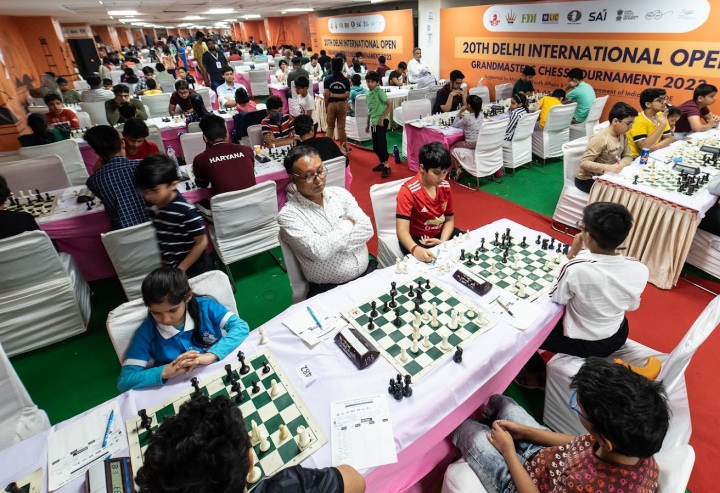
The 20th edition of the spectacular New Delhi Open, in which 1057 players took part, ended with the victory of Indian GM Aravindh Chithambaram, while GM Luka Paichadze of Georgia finished as first runner up. In what is in the West now, mostly a memory from the heyday of chess popularity, India has hosted its biggest tournament – the New Delhi Open – in a stadium. The jubilar 20th edition of the New Delhi Open (started in 2003) took place at the Jawaharlal Nehru Stadium, named after the first Prime Minister of India, and is the fourth biggest stadium in the country. Traditionally, the tournament is held at the Indira Gandhi Stadium, the largest indoor sports arena in the country, but due to the World Women’s Boxing Championship, it had to be moved. The New Delhi Open has become a beacon for chess enthusiasts around India, attracting nearly 3000 players annually. The event has three different categories: one is the GM Open, then B category, below 1999 rating, and C category, below 1599. While the event traditionally takes place every January, due to the rise in Covid cases in India at the start of the year, it was postponed. The initial prize fund was $153,000 in three categories, but due to health and safety, the organisers decided to have the event in just one – top category, with a prize fund of $55,000. Altogether, 19 Grandmasters and a number of IMs and FMs from over 10 countries took part in the event. The second seed Aravindh Chithambaram (India, pictured below), turned in an excellent performance and came out on top, scoring a spectacular 9.5/10. Luka Paichadze (Georgia) finished just a half-point behind the winner. As many as six participants netted 8.5/10, with the top seed GM Sethuraman S P (India) taking third place thanks to superior Buchholz. The excitement at the New Delhi Open was further amplified as it coincided with the third leg of the Women’s Grand Prix. The atmosphere was electrifying as both events showcased the very best of chess. “India has become a chess nation, and the New Delhi Open is a beacon of our success. With numerous Grandmasters and thousands of young players participating from all corners of the country, this event has become an annual celebration of our love for the game. And with the successful hosting of the Olympiad, we are committed to promoting chess in India and transforming our country into a true superpower in chess,” said Bharat Singh, Director of the New Delhi Open and a key figure in the All India Chess Federation. Final standings: 1 GM Aravindh, Chithambaram IND 2607 9½ 2 GM Paichadze, Luka GEO 2515 9 3 GM Sethuraman, S.P. IND 2639 8½ 4 GM Savchenko, Boris FID 2552 8½ 5 GM Kobalia, Mikhail FID 2577 8½ 6 AIM Vaz, Ethan IND 1949 8½ 7 GM Krasenkow, Michal POL 2527 8½ 8 GM Aleksandrov, Aleksej FID 2484 8½ 9 GM Murzin, Volodar FID 2554 8 10 GM Mchedlishvili, Mikheil GEO 2569 8 The top eight finishers of the New Delhi Open earned FIDE Circuit race points based on the final standings: 1. 7,99 2. 6,39 3. 4,59 4. 4,19 5. 3,79 6. 3,39 7. 3,00 8. 2,60 Complete results Text: Milan Dinic Photo: Ismael Nieto
WGP New Dehli Round 6 recap: The halfway point

Bibisara Assaubayeva defied the odds and secured a remarkable victory against Polina Shuvalova, despite initially facing an uphill battle. The three other games ended in a draw As the Women’s Grand Prix tournament in New Delhi reached its halfway point, Round Six brought an electrifying array of games to the forefront. With all four boards featuring sharp and skilful play, it’s a surprise that just one game finished with a decisive result. Round 6 results: Kateryna Lagno – Nino Bastiashvili, ½ – ½Aleksandra Goryachkina – Vaishali Rameshbabu, ½ – ½Polina Shuvalova – Bibisara Assaubayeva, 0 – 1Zhu Jiner – Nana Dzagnidze, ½ – ½ Bibisara Assaubayeva is the biggest winner of the day overturning a lost position against Polina Shuvalova. Assaubayeva got into trouble early on, after forgetting the opening. Shuvalova missed several good chances to seal the victory and, in the end, lost. Assaubayeva is the only player in New Delhi who had decisive results in all of her games so far. In a second surprise of the day, Zhu dropped a huge advantage against Nana Dzagnidze following Black’s misplay in the Najdorf. Despite achieving better positions, Kateryna Lagno and Aleksandra Goryachkina could not find the right way forward and ended up drawing their games. Zhu Jiner and Bibisara Assaubayeva are now joint leaders with four points, though the latter has played one game less. Here follows a more detailed look at the games of Round Six. Kateryna Lagno – Nino Batsiashvili Out of four games the two have played until New Delhi, Lagno won three and Batsiashvili one. In a rare line of the Archangel variation in the Ruy Lopez, Nino seemed to be uncomfortable. Lagno went for a strike in the centre with 8.d4 and got the upper hand. However, Kateryna couldn’t find the best way forward and started spending significantly more time. Instead of 18.Bf4, attacking the e5 knight and opening the path for the a1 rook to get involved in the game, White went with 18.Bg5. Batsiashvili responded resourcefully, exchanging her passive pieces for White’s attacking pieces, erasing White’s advantage. After exchanges and simplifications, this was now an even rook and bishop endgame. It did not take too long for the opponents to shake hands and split a point, right after reaching the time control. The two players spent some time after the game discussing and analysing the positions. In the post-game interview, Lagno pointed out that Batsiashvili did not know the opening line well. “I had a better position but I couldn’t find the right way forward,” Lagno said. Kateryna Lagno now has 2,5 points out of five games, while Batsiashvili is on 1,5. Aleksandra Goryachkina – Vaishali Rameshbabu Goryachkina and Vaishali have played seven games so far. Somewhat surprisingly, the young rising star from India leads with three victories and four draws against the current World number two player! Their eighth game saw a popular line of the Gruenfeld Defence, extensively tested on the highest level. The opponents followed the encounter between Anish Giri and Ding Liren up to move 17 when the Indian deviated with 17…f6 and grabbed White’s e4-pawn. Aleksandra got more than sufficient compensation but stumbled at a critical moment. Goryachkina spent nearly 40 minutes(!) thinking but instead of 20.Bd7 followed by 21.Rc7 with considerable pressure, she played 21.Qe3, which wasn’t the best choice. This allowed Black to relieve the tension with a timely 20…e5 and activate her pieces, leading to an even position. The two played on, but the evaluation of the position was not changing: White had sufficient compensation for a pawn but hardly more. A draw by perpetual came as a logical outcome. In a post-game interview, Goryachkina said that she felt that she was better but that she couldn’t find the right move forward. Goryachkina now has 2,5 points out of four games played, while Vaishali has one point with the same number of games. Polina Shuvalova – Bibisara Assaubayeva Facing the King’s Indian Defence on the white side, Shuvalova opted for a very sharp Four pawns attack and, after advancing her kingside and central pawns, got a clear advantage. Still, White had to put her king to safety – 12.0-0, which was the most natural and strong continuation. After 12.exd6 Nb6 White was still better, but overambitious 13.f5 led to an unclear position. Bibisara immediately returned the favour by 13…exd5 and after 14.Bf4 Nc4 15.Bxc4 dxc4 White was in command again. However, instead of natural 16.Qd2 Ng8 17.0-0-0 with a crushing attack, Polina played 16.f6? giving up a pawn and dropping her advantage. Black’s reaction was far from optimal, and Polina obtained a decisive advantage one more time. The pendulum kept swinging as Shuvalova missed another opportunity to seal the deal. Instead of 20.Nd5 (or 20.Rxe8 Qxe8 21.Nd5) she opted for 20.Ng5? and after 20…Rf8 21.Qd5, the position was equal. White’s woes did not end there. Black already achieved some counter-play in a roughly even position, but here Polina made a step into the abyss: 24.Kg3?? After 24…Bb7 25.Rh2 h6 26.h4 Qd7 27.Nce4 h5 Black was completely winning. Three moves later, Shuvalova threw in the towel. A great misfortune for Polina Shuvalova, and a lucky break for Bibisara Assaubayeva. Assaubayeva now has four points out of five games, while Shuvalova is on 2,5 and is bye on day seven. Zhu Jiner – Nana Dzagnidze Up to this round, Zhu has one victory and two draws with Nana Dzagnidze. The opponents tested a very sharp line of the Najdorf Sicilian, in which White missed a chance to sacrifice a piece for a dangerous initiative Zhu opted for 11.Bb3, but a stronger move was 11.Bxe6 fxe6 12.Nxe6 with excellent positional compensation and continuous pressure. The Chinese player went for a more cautious approach and still came out with a preferable position. White is better: she has two strong knights in the centre, threatening to take on g5 and then press on the f7 and d8 squares, endangering Black’s weak king. Dzagnidze’s best option was to play 16…Be7 to guard the d8-square and try and move her king to safety. Instead, she blundered with 16…Nxb3? After 17.axb3, there is no escape for Black. However, at
WCF Game Recap 3: 98% precision in Chongqing!
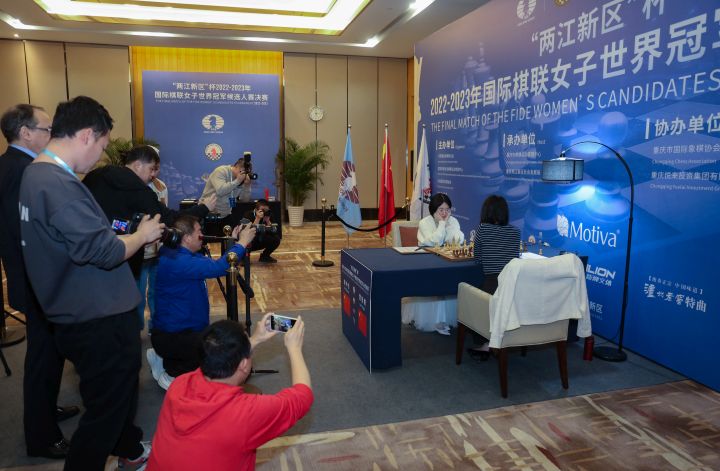
They say that the sun always shines after a storm. In the wake of two days of excitement and ups and downs, this afternoon’s third game in Chongqing was an oasis of peace and tranquillity. After three of the six scheduled classical games, the Women’s Candidates final is now tied 1.5-1.5. Playing with White, Tan Zhongyi switched back to her normal opening repertoire with 1.d4, side-stepping Lei Tingjie’s excellent opening preparation in the first game. Her bold play in that encounter was rewarded, but readers will recall that luck was definitely on her side in the critical moments – she didn’t seem to be so familiar with the nuances of the variation. Lei Tingjie opted for the Tarrasch variation in the Queen’s Gambit, with 3…c5. According to my database, this is the first time she has played this line in her career: a risky choice. Tan Zhongyi thought for a moment and decided to repeat the same variation she had played recently in an online blitz game. Instead of the most theoretical line with 6.g3 – which would have permitted the fashionable “Dubov “ 8…Bc5 system, Tan Zhongyi went for the solid 6.dxc5, considered to be very slightly better for White. Both players demonstrated excellent opening preparation, blitzing out their moves at an unusual speed for this kind of event. The queens were exchanged very soon, and around move fifteen, both players were already facing the prospect of yet another minor piece ending. White did enjoy the advantage of the two bishops in an open position, but the weak pawn on e3 somewhat restricted the activity of the dark-squared bishop. The engine suggests that the position is approximately equal. Shortly afterwards, Lei Tingjie correctly sacrificed a pawn to activate the rest of her pieces, receiving full compensation – both of her rooks occupied active lines while the bishop on a6 and the knight on f6 were on the lookout for a killing blow. In these positions, one has to be careful. Tan Zhongyi went into defence mode, swapping off all of her opponent’s active pieces, with the unfortunate downside that she wasn’t able to avoid transitioning into yet another opposite-coloured bishop ending. Although still enjoying the advantage of her extra pawn, Lei Tingjie had no trouble at all defending the very simple fortress that this type of endgame provides. A draw was agreed on move forty. According to the online precision ratings, both players scored 98%, with no mistakes and no imprecisions: a remarkable feat. “A calm game, with really not much happening. Both players played well and solid chess,” reflected GM Alik Gershon on the live stream. WIM QiuMengjie added: “This game had no mistakes, but the fourth game will be a crucial encounter for both players, with Lei Tingjie playing White. Both players will enjoy a well-deserved rest day tomorrow, and the match will resume on Sunday, April 2nd with Lei Tingjie conducting the White pieces. You can follow all the games with with top-notch commentary by GM Alik Gershon and WIM QiuMengjie on the FIDE YouTube Channel. Text: IM Michael Rahal Photo: Liu Yi Official website: womenscandidates.fide.com/ The match The 2023 FIDE Women’s Candidates Final is being disputed in Chongqing (China) from March 27th to April 6th. Chinese Grandmasters Lei Tingjie and Tan Zhongyi face each other in a six-game classical chess match. The winner will receive 60.000 euros and the right to challenge the current Women’s World Champion Ju Wenjun for the title in July. The venue Strategically positioned as a gateway to China’s west, Chongqing is China’s major modernized manufacturing base, a financial center, and an international transport hub in Western China. Home to more than 32 million people, it was an obvious choice for hosting the event as both players were born in the city. In addition, it’s an important center of chess activity in the country, abode to many important chess clubs and academies. A fun fact – both Lei Tingjie and Tan Zhongyi are teammates at the Chongqing Sports Lottery Chess Club.
WGP New Dehli Round 5 Recap: Zhu Jiner takes the lead
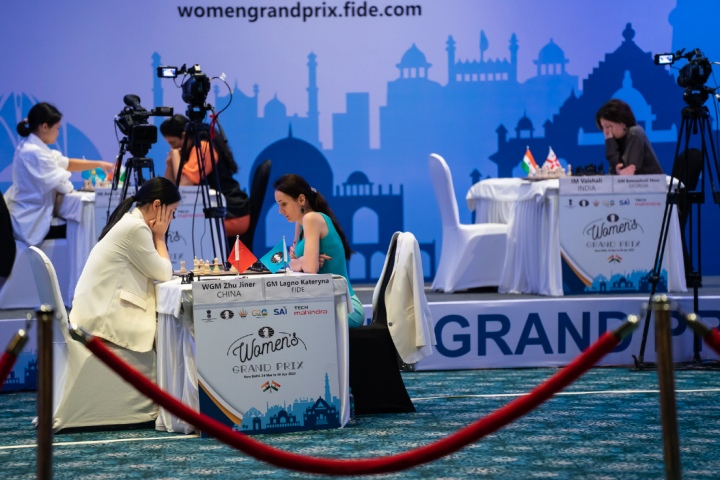
Zhu Jiner scored an impressive victory over one of the tournament favourites, Kateryna Lagno, to reach 3½ points and take the lead in New Delhi More drama unfolded on the fifth day of the Women’s Grand Prix in New Delhi, with three decisive outcomes and one draw. Results of Round 5: Zhu Jiner – Katerina Lagno, 1-0Nana Dzagnidze – Humpy Koneru, 0-1Bibisara Assaubayeva – Harika Dronavalli, 1-0Vaishali Rameshbabu – Nino Batsiashvili, ½ – ½ Polina Shuvalova and Aleksandra Goryachkina had a free day. In a tense battle in the Sicilian, in what was only their second encounter so far, Zhu came out victorious against Kateryna Lagno. Zhu is now the leader with 3½ points. Lagno is on two points. Nana Dzagnidze was surprised by Humpy Koneru who grabbed the initiative early on in the Queen’s gambit declined. Despite efforts to hold back Black’s advances, Dzagnidze was powerless and lost. She now has 1½ points while Koneru has 2½. Harika Dronavalli had a similar experience as Dzagnidze. Playing as Black against Bibisara Assaubayeva, in the Reverse Benoni, Dronavalli got into a passive position in the middlegame and couldn’t find a way out. After nearly five hours of play, spent mostly in defence, Dronavalli had to put up the white flag. A great comeback for Bibisara following a defeat in the fourth round. She is now on three points out of four games played, while Dronavalli has 2½ (but with one bye). In a game full of twists and turns, the youngest player in the tournament Vaishali Rameshbabu drew with Nino Batsiashvili of Georgia. The two played the Italian game, and the position was mostly even, but, towards the end, Viashali blundered and lost an exchange. Luckily for her, Batsiashvili erred in return and, in the end, the two agreed to a draw. Both have played only three games so far. Batsiashvili has two points while Vaishali Rameshbabu is on 1½. Let’s take a look at today’s games in more detail. Zhu Jiner – Katerina Lagno The two have met only once so far and Lagno came out victorious in the Four knights variation of the Sicilian Defence. Now, in their second duel, the Sicilian Defence was played once again, but Lagno went for the Taimanov which quickly transposed into a topical line of Scheveningen which was very popular about 30 years ago.Zhu implemented a standard plan for organising an attack on the black king’s fortress, while Lagno countered by aligning her queen and bishop on the a8-h1 diagonal, aiming at White’s monarch. Zhu proceeded with her kingside push with 17.f5, which is the most popular move in this position. However, Black had enough pieces, space and time to coordinate a response. After 17…exf5 18.Rxf5 Kateryna responded with precise 18…Ne8! 19.Bd3 g6 20.Rf1 Rd8. Black maintained equality and the position was even. Following the exchange of several other pieces, the two reached the following position. White is pressuring on f7 but Black can hold if playing precisely. For example after 27…Qd7 or 27…f6 Black is fine. However, with about 10 minutes left on the clock, Lagno blundered 27…Nd6??, allowing White to execute some tactics for a winning position. 28.Nxh7! Kxh7 29.Rh3 Rh5 30.Rxh5 gxh5 31.Re5 Ne8 Now Black has to give up her queen. 32.Rxh5 Kg8 33.Qf5 Qg6 34.Rg5 Ng7 35.Rxg6 fxe6 36.Qd5+ Kh7 37.h3 White is winning. Her queen is dominating, her king is secure and White’s queenside passer will cost black a piece. Zhu scored yet another victory in the Grand Prix in New Delhi and now has 3½ points, while Lagno remains on two points. Nana Dzagnidze – Humpy Koneru The two have played 29 games so far and each has nine victories, with 11 draws. After the fifth round in New Delhi, Humpy is in the lead. Koneru opted to play the Queen’s Gambit declined, going for a sharp line with 5…Bb4. Nana seemed surprised and started spending much more time thinking. A sharp position emerged on the board soon after the first opening moves. Here Dzagnidze played a dubious move (as it turned out later) 13.f3. After 11…Nxg3 12.Nxg3 Humpy introduced a novelty 12…Be6! After this move (the first line of chess engines) Black is already slightly better. The opponents proceeded with 13.Qa4 Nc6 14.Bb5 and here Koneru opted to exchange her bishop on b4 for a knight on c3, after which the position became equal. A better choice was 15…Bd7. However, just a couple of moves down the road Nana made a serious inaccuracy and Humpy got the upper hand. Nana just played 16.Qc2? but after 16…gxh4 17.Bxc6 Bxc6 Black emerged clearly better: she has a secure king, unexposed weaknesses and more active pieces and open lines on the kingside. On top of this, Nana was also short on time. Still, White had defensive resources, but Nana’s 24th move was a costly mistake. After 24.e4? (consolidating 24.Re2 was much better) Black managed to transfer her rook from h6 to the a-file, threatening White all along the width of the board. Ultimately, Dzagnidze lost the central pawn on d4. But Nana was still fighting on. She picked up White’s h4-pawn and had three against one on the kingside, but it was not enough as Black’s heavy pieces were positioned well to penetrate White’s camp. Humpy first picked up the a2 pawn and then proceeded to pillage white pieces on the kingside. Nana had no chances but still played on, in the spirit of the saying that “a game is never lost until you resign”. In the end, however, she had to accept the inevitable and capitulate. Dzagnidze is now on 1½ out of five games, while Humpy is on 2½ points. Bibisara Assaubayeva – Harika Dronavalli The duel between Bibisara and Harika turned into a very original game. The two had an even score against one another until now – two victories each. Following 1.c4 e6 Bibisara entered the so-called Reversed Benoni. After 2.g3 d5 3.Bg2 Nf6 4.Nf3 d4 White opted for a less common line – with 5.d3. After 5…Bb4+ 6.Nbd2, Black played a questionable novelty with 6…Be7 instead of the known move 6….a5. Bibisara had an interesting option
WCF Game 2: Lei Tingjie grinds down Tan Zhongyi and ties the match
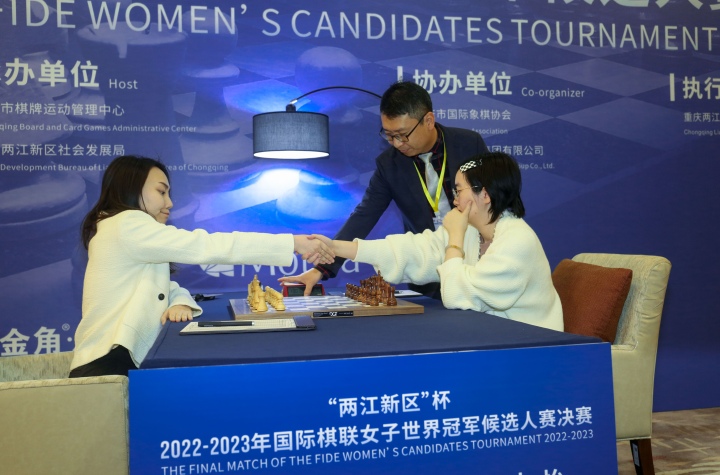
Employing impressive technique in today’s second game, Lei Tingjie relentlessly jumped back into the match, and with four games to go, the Women’s Candidates Final is once again completely open. After nearly six hours of play and seventy gruelling moves, with everything pointing towards a draw, a last-minute mistake by Tan Zhongyi in severe time trouble put the 1-1 result on the scoreboard. The second game of the match began as usual at 3 pm local in Chongqing. Trailing her opponent by a full point on the scoreboard, the onus was on Lei Tingjie to showcase her skills with the White pieces. She opened the game with 1.d4, and both players went for the fashionable Queen’s Gambit. On move three, Tan Zhongyi opted for 3…dxc4, and a few moves down the line, the position transposed into one of the most exciting lines of the Semi-Slav defence, in which White sacrifices a pawn for the initiative. According to my database, Lei Tingjie usually plays it safe in the opening – therefore, maybe she was slightly surprised by this turn of events. One can never know for sure, but there is a possibility that both players ended up in a position somewhat unknown to them in their wish to sidestep their opponent’s preparation. The first major deviation from theory was played by Tan Zhongyi. Her choice 7…Qb6 is fairly unknown at the top level, whereas 7…a5 would lead to the trendy Noteboom variation. Sensing the danger, she intelligently gave back her extra pawn to finish her development and castle. A few moves later, after an inaccuracy by her opponent, Lei Tingjie missed a golden opportunity to strike first with 21.Nxb4 Qxb4 followed by 22.Qc2. According to the engines, the threats on b4, f6, and e6 would have offered White excellent chances to bring home the full point. Nonetheless, Lei Tingjie continued pressing her small positional advantage: two bishops and a slightly favourable pawn structure gave her a decent edge in the late middlegame and early stages of the endgame. Although Tan Zhongyi displayed excellent defensive skills, Lei Tingjie pushed on, understanding that her opportunity might arrive in time trouble. Finally, they reached an opposite-colour bishop endgame, which is generally well-known for its drawing tendency. Fate struck on move seventy-one. Tan Zhongyi could have held the draw with 7….Be8, but instead, she played 71…Bg4? and after White’s 72.Kg6! was forced to exchange her h-pawn for the opponent’s f-pawn allowing Lei Tingjie to win the game by advancing her two connected passed pawns. Commentating live from the venue, GM Alik Gershon summarized the situation fantastically: “Very impressive technique by Lei. Slightly unfortunate for Tan, but this is how you can lose these types of positions. White can make many small mistakes and still have chances, while Black can’t make any mistakes because she can lose immediately.” Co-commentator WIM Qiu Mengjie agreed: “If White makes a mistake, she will always have the draw at hand.” The third game of the match will be disputed tomorrow, March 31st. Tan Zhongyi will play with the White pieces. You can follow all the games with live commentaries on the FIDE YouTube Channel. Text: IM Michael Rahal Photo: Liu Yi Official website: womenscandidates.fide.com/ The match The 2023 FIDE Women’s Candidates Final is being disputed in Chongqing (China) from March 27th to April 6th. Chinese Grandmasters Lei Tingjie and Tan Zhongyi face each other in a six-game classical chess match. The winner will receive 60.000 euros and the right to challenge the current Women’s World Champion Ju Wenjun for the title in July. The venue Strategically positioned as a gateway to China’s west, Chongqing is China’s major modernized manufacturing base, a financial center, and an international transport hub in Western China. Home to more than 32 million people, it was an obvious choice for hosting the event as both players were born in the city. In addition, it’s an important center of chess activity in the country, abode to many important chess clubs and academies. A fun fact – both Lei Tingjie and Tan Zhongyi are teammates at the Chongqing Sports Lottery Chess Club.
Meri Arabidze clinches European Women’s Chess Championship
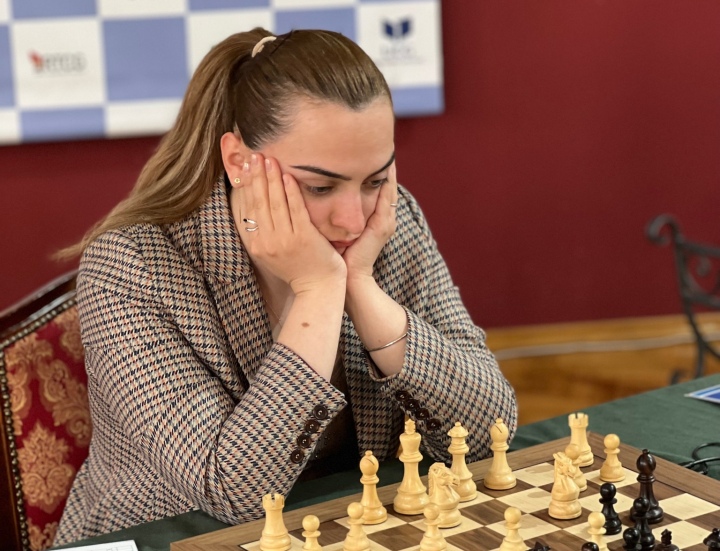
After eleven thrilling rounds at the European Women’s Chess Championship 2023, two players emerged on the top, tying for first place with 8.5 points each: IM Meri Arabidze (GEO, 2433) and IM Oliwia Kiolbasa (POL, 2406). Thanks to her 8th-round victory in the direct encounter over the Polish IM (the first tiebreaker), Meri Arabidze clinched the European Women’s Chess Champion title. Oliwia Kiolbasa (pictured above) had to settle for the silver medal. Four players scored 8 points each to tie for third place: IM Aleksandra Maltsevskaya (POL, 2388), IM Stavroula Tsolakidou (GRE, 2358), IM Salome Melia (GEO, 2366) and IM Klaudia Kulon (POL, 2290). Aleksandra Maltsevskaya had the best tiebreaks and claimed bronze. Final standings: 1 IM Arabidze, Meri GEO 2433 8½ 2 IM Kiolbasa, Oliwia POL 2406 8½ 3 IM Maltsevskaya, Aleksandra POL 2388 8 4 IM Tsolakidou, Stavroula GRE 2358 8 5 IM Melia, Salome GEO 2366 8 6 IM Kulon, Klaudia POL 2290 8 7 IM Javakhishvili, Lela GEO 2443 7½ 8 IM Garifullina, Leya FID 2372 7½ 9 FM Toncheva, Nadya BUL 2192 7½ 10 IM Sargsyan, Anna M. ARM 2371 7½ Complete results The Closing ceremony of the event took place yesterday evening with the attendance of ECU President Zurab Azmaiparashvili, ECU Vice President Alojzije Jankovic, ECU CEO Erald Dervishi, ECU Honorary Vice President and Vice President of the Montenegro Chess Federation Veselin Draskovic, and the President of the Montenegro Chess Federation Jovan Milovic. The European Women’s Chess Championship 2023 took place from March 17-30 in Petrovac, Montenegro, and brought together over 130 players from 34 federations. The total prize fund of the event was EUR 60,000, and according to the ECU Board decision and FIDE regulations, nine players qualified for the next FIDE Women’s World Cup. Text: europechess.org/ Photo: Official website
Cyprus to host fourth stage of FIDE Women’s Grand Prix

The fourth and decisive leg of the FIDE Women’s Grand Prix will take place in Cyprus from May 15 to May 28. The event will be held under the auspices of the Cyprus Chess Federation and supported by the Limassol-based Freedom Finance Europe, the European subsidiary of Freedom Holding Corp. “This event is one more step towards strengthening our intended long-term partnership with Freedom Holding Corp., following the successful cooperation during the World Rapid and Blitz in Almaty and the upcoming World Championship Match in Astana, where Freedom Holding will be the General Partner,” said FIDE’s CEO Emil Sutovsky. “I would also like to stress that Cyprus has never hosted any major FIDE event or any other chess event of this caliber. Bringing top-level competitions to the countries which haven’t staged top-level events for many years – or ever, like the recently announced Candidates Tournament in Canada, or the Olympic Esports Series in Singapore, is one of FIDE’s goals, and we are happy to make it possible thanks to the support of Freedom Finance Europe,” he added. “We are honored to sponsor this tournament. We know that both in chess and in business, success often depends on the will to win and the ability to think a few steps ahead. Freedom Holding Corp. and its founder Timur Turlov, the head of the Kazakhstan Chess Federation, do a lot to popularize chess and educate new champions. Thanks to our joint efforts with FIDE, chess has been attracting more players, helping them to realize their potential and achieve high goals. We sincerely wish all the participants spectacular chess ideas and fair victories. I am sure that we will see many beautiful and interesting games,” said Evgeniy Tyapkin, Executive Director of Freedom Finance Europe. Criton Tornaritis, President of the Cyprus Chess Federation, said: “We work behind the scenes and are very excited to see this event coming to Cyprus. I want to highlight the perfect alignment between FIDE, the Cyprus Chess Federation, and the sponsor, Freedom Holding Corp. We look forward to expanding this cooperation to our future projects.” The tournament will be held at the Hilton Hotel in Cyprus’ capital, Nicosia. Featuring 12 ballrooms and state-of-the-art technology meeting rooms, totalling 1,800 square meters of space for events, the venue is a very suitable option for both leisure and business visitors. Twelve players are invited to the fourth stage of the Women’s Grand Prix in Cyprus: Bibisara Assaubayeva, Nana Dzagnidze, Aleksandra Goryachkina, Harika Dronavalli, Alina Kashlinskaya, Alexandra Kosteniuk, Kateryna Lagno, Anna Muzychuk, Mariya Muzychuk, Polina Shuvalova, Tan Zhongyi, and Dinara Wagner. About Freedom Finance Europe Freedom Finance Europe, a subsidiary of Freedom Holding Corp., is a leading European stockbroker. The company’s Freedom24 web and mobile app investment platform provides traders with direct access to 15 global stock exchanges, including NYSE, Nasdaq, LSE, Euronext and others. Freedom Finance Europe is licensed by Cyprus Securities and Exchange Commission (CySEC) with the right to cater clients from EU and EEA countries. The company is rated “B/B” by S&P Global Ratings. Headquartered in Limassol, the company has tied agents and representative offices in Berlin, Madrid, Paris, Milan, Vienna, Warsaw, and Athens. More information: https://freedomfinance.eu
WGP New Delhi: Goryachkina takes the lead in a day of decisive games
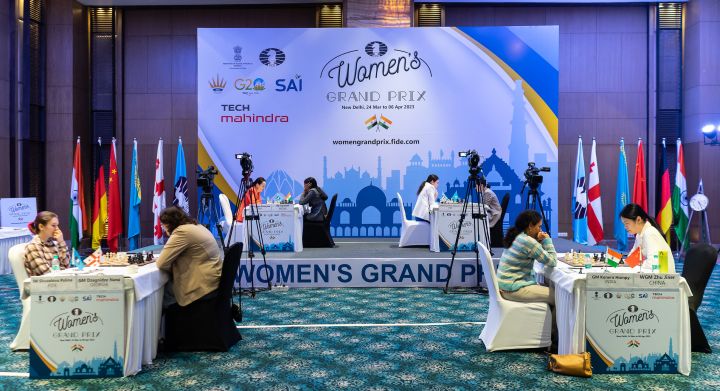
A day of high-stakes and thrilling victories in New Delhi, with three wins for White and one for Black. Kateryna Lagno, Zhu Jiner, Polina Shuvalova, and Aleksandra Goryachkina dominated the round Following three rounds of the Women’s Grand Prix where all games ended in a draw, round four saw intense action on the boards in the third leg. Three out of four games were dramatic from the start but all four ended in victories. Results of Round Four: Kateryna Lagno – Vaishali Rameshbabu 1-0Humpy Koneru – Zhu Jiner 0-1Aleksandra Goryachkina – BibisaraAssaubayeva 1-0Polina Shuvalova – Nana Dzagnidze 1-0 The day proved to be a disappointment for Indian players, as both Vaishali Rameshbabu and Humpy Koneru suffered defeats. Vaishali Rameshbabu’s surprise opening line in the Sicilian did not unsettle Kateryna Lagno who quickly gained control over the position and confidently defeated her opponent. Humpy Konery had a steady game against Zhu Jiner, but a costly blunder in the final moments led to her downfall. Meanwhile, Shuvalova outplayed Nana Dzagnidze. The Georgian could not find the right plan against Shuvalova and chose the wrong moves leading to a lost endgame with a rook against two bishops. Aleksandra Goryachkina was the first player of the day to create a much better position on the board, but it took her five hours before BibisaraAssaubayeva finally had to surrender. Here follows a recap of today’s games. Kateryna Lagno – Vaishali Rameshbabu This was only the second game in the tournament for Vaishali, given that she was free in rounds two and three. The opponents had a discussion in the Four Knights Variation of Sicilian Defence, which is considered to be a sharp line. It was Vaishali’s preparation taking Lagno by surprise. However, after spending some time thinking, Kateryna grasped the position and started playing quicker. On move nine, the Indian played 9…a5 instead of the more common 9…Qb6, which leads to a highly dynamic position on the board. Lagno responded with 10.a3 Qb6 11.c4 – a logical sequence – and after 11…Ne3 12.Qd3 Nf1 13.Rf1, a roughly equal and sharp but by no means new position, emerged on the board. The first important moment came after 17.a4 – the first original move made in the game. Vaishali opted for 17…f5?!, forcing Lagno to bring her knight to d6. Most likely 17…f6, keeping tension in the centre was a better option. After 18.Nd6 Bxd6 19.exd6 c5 Kateryna got an edge thanks to control over dark squares. Even more importantly, Black had no active plan, while White had some targets on the board and a clear course of action. Lagno proceeded to realign her heavy pieces towards the kingside, preparing an attack on the black king, using the advantage of the excellent, centralised e5-bishop. Vaishali eventually had to offer her rook for the white bishop, sacrificing an exchange but hoping to get some squares in return. Lagno didn’t take the bait but, instead, used the third rank to transfer her rooks to the kingside and increase pressure. Soon, Vaishali ran out of reasonable options. Still, a short work over Black’s king deserved one more diagram. 37.Rxg7+ Qxg7 38.Rg3 Qxg3 39.hxg3 Rf7 40.Qd8! 1-0 This is the first victory for Lagno in the tournament, following two draws and a rest day. She is now on two points. Vaishali is still on one point. Humpy Koneru – Zhu Jiner In the standard line of the Nimzo-Indian the opponents followed the footsteps of Rapport and Vidit (Belgrade, 2022) up to move 15. With a lot of positional manoeuvring, both sides maintained equality on the board. Only in the fourth hour of play did one side make a breakthrough. Here Humpy launched an overly-optimistic pawn march on the kingside with 20.g4? This was the beginning of the losing path for White. After 20…g6 21.Ng3 Zhu relatively quickly found 21… Ne4!! offering a knight sacrifice. White couldn’t take it because she would end up in a completely shattered position. Humpy played 22.Be1 and had to defend an inferior position with numerous weaknesses. Zhu sacrificed a pawn and emerged much better thanks to the two dominating bishops controlling the diagonals in all four directions on the board. The lesser of many evils for White was to give up her d-pawn immediately by d4-d5, but Humpy made the fatal mistake – 26.Bc3?? After 26…Re3 Koneru’s kingside crumbled, and Black went for a hunt after White’s king: 27.Bb2 Rxf3 28.Rxf3 Bxf3 29.h3 Qd6 30.Qf1 Qxf4 31.Qf2. And now a little combination for the end: 31…Bxd4! (a double deflection!) 32.Bxd4 Qxc1+ 33.Kh2 Rd8 34.Ne2 Bxe2 35.Qf6 – the last desperate attempt – 36…Rxd4 37.Qxd4 Qd1 and Black is up a piece and two pawns. A huge blunder by Humpy Koneru who is now on 1,5 points while Zhu moves up, with 2,5. Aleksandra Goryachkina – BibisaraAssaubayeva This was the derby of the round. Goryachkina is one of the top candidates in the Women’s Grand Prix for first two places, while Assaubayeva – two-time world Blitz champion – is the leader in New Delhi after two victories in two rounds she played. Assaubayeva launched her surprise on the second move by playing e6 after 1.d4 Nf6. She usually plays the King’s Indian, but here she opted for something different. Goryachkina spent five minutes checking her lines before she played 3.g3, going for the Catalan. Bibisara seemed to be unfamiliar with the subtleties of the opening as after a couple of inaccuracies – 10…c6?! instead of thematic 10…c5 11.0-0 Ra6? (again, 11…c5 was a better alternative) – she found herself in a cramped position. Aleksandra was building up pressure with natural moves and avoiding the worst Bibisara decided to part with a pawn, although defending an inferior position with equal material might have been a better option. White is a pawn up, has more active pieces, and, simply put, a won position. Bibisara was clearly uncomfortable, sitting tensely in her chair. Known for her excellent technique, Goryachkina traded the queens as soon as an opportunity presented itself and headed to an ending. The final portion of the game required precision and patience from Aleksandra, which she demonstrated and gradually brought her opponent to defeat. It is the first
Fortune favours the brave: Tan Zhongyi draws first blood in Women’s Candidates Final
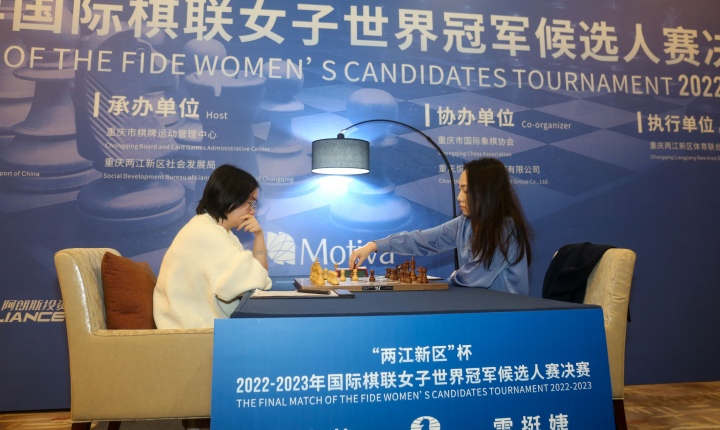
Tan Zhongyi takes the lead in the six-game Candidates final after defeating Lei Tingjie in one of the most exciting games of the year. Primarily remembered today for his formulation of an atomic theory of the universe, the ancient Greek philosopher Democritus left many quotes for history. “Boldness is the beginning of an action, but fortune controls how it ends” is one of them, very appropriate to understand what happened today in the first game of the Women’s Candidates Final in Chongqing, China. The action began punctually at 3 pm local time with the ceremonial first move, performed by Du Xueyong, Deputy Director of Chongqing Sports Bureau, accompanied by FIDE Vice-President and former Women’s World Champion Xie Jun. Playing with White, Tan Zhongyi opened with 1.c4, the English Opening, one of her two main weapons. Hardly a surprise for Lei Tingjie, she quickly replied with 1…e5, against which Tan Zhongyi blitzed out 2.d3, a secondary line which, according to my database, she had never played before in her career. Already on move six, the position was completely new, a rare occurrence nowadays. Customary in English Openings, Tan Zhongyi went for the kingside fianchetto, followed by the typical queenside pawn expansion with a3 and b4. Lei Tingjie defended with precision, obtaining a very promising middlegame position. Around move twenty, with both players under fifteen minutes to reach the 40-move time control, Tan Zhongyi boldly opted for a very risky and unbalanced idea, allowing her opponent two strongly connected passed pawns in exchange for active piece play and her own passer on d5. Soon, a second pawn had to be sacrificed to maintain the initiative. Although the computers were indicating a decisive material advantage for Lei Tingjie, her king was considerably exposed – in addition, she was getting very low on time. On move thirty, Lei Tingjie could have scored first blood if she had found 30…c4! (instead of 30…Qe6? played in the game): however, the lines are very difficult to calculate with only seconds on the clock. Tan Zhongyi won a piece but still had to deal with her opponent’s advanced passed pawn. She missed a win on move thirty-five (35.e4! instead of 35.Qe8, with a decisive advantage), but luck was on her side today. With less than thirty seconds on her clock and five moves to go for the time control, Lei Tingjie blundered with 36…f4? and was forced to resign a couple of moves later, after Tan Zhongyi correctly spotted 37.e3! followed by the exchange of queens on d3. Commentating the match from the venue, GM Alik Gershon witnessed the meltdown live. “What a blow for Lei Tingjie. Until the very last moment, she had a draw with 36…Qb1. This has been a very upsetting game for her” were Gershon’s final words. Chief Arbiter Panagiotis Nikolopoulos retrieved the scoresheets from the players, certifying a win for White in the first game of the match. Excited after her victory, Tan Zhongyi attended the press conference, while a disappointed Lei Tingjie retired to her chambers to regroup for tomorrow’s second game, in which she will be playing with White. You can follow all the games with live commentaries on the FIDE YouTube Channel. Text: IM Michael Rahal Photo: Liu Yi Official website: womenscandidates.fide.com/ The match The 2023 FIDE Women’s Candidates Final is being disputed in Chongqing (China) from March 27th to April 6th. Chinese Grandmasters Lei Tingjie and Tan Zhongyi face each other in a six-game classical chess match. The winner will receive 60.000 euros and the right to challenge the current Women’s World Champion Ju Wenjun for the title in July. The venue Strategically positioned as a gateway to China’s west, Chongqing is China’s major modernized manufacturing base, a financial center, and an international transport hub in Western China. Home to more than 32 million people, it was an obvious choice for hosting the event as both players were born in the city. In addition, it’s an important center of chess activity in the country, abode to many important chess clubs and academies. A fun fact – both Lei Tingjie and Tan Zhongyi are teammates at the Chongqing Sports Lottery Chess Club.