

FIDE Development Fund 2023 is now open

FIDE Planning and Development Commission (PDC) is happy to announce that the 2023 FIDE Development Fund cycle is now open for submissions of funding requests by National Chess Federations, Continents, Affiliated Organizations, FIDE Commissions and, starting this year, FIDE zones. The submission period is open until October 31, 2023. Beneficiaries may submit their funding requests or questions about the process to FIDE PDC (fedfunding@fide.com). This year, the cycle is starting a bit later than initially planned due to the evolution of the documents to be used. We wanted to make the process smoother and get better connected with applicants. All potential beneficiaries have to use the new documents for their applications. To help National Chess Federations, FIDE Commissions, FIDE Zonal officials, FIDE Affiliated Organizations and FIDE Continental officials in their requests for funding in 2023, FIDE PDC is organizing a special webinar. Scheduled for March 31, the webinar aims to explain and illustrate the application process, highlighting priorities and PDC vision on funding applications. For those who cannot attend, it will be recorded and posted on the PDC website. The main topics of the webinar are: 2023 FIDE funding programme overview (orientations and priorities, covered expenses, etc.) Application documents and process steps to follow An illustration of application through a sample project Date of the webinar: Friday, March 31, 2023 – 14:00 CEST Open to federations and other beneficiaries’ officials. Please fill in the registration link to get access to the webinar.
London Chess Conference: Back to classroom

The London Chess Conference established how chess enhances 21st century skills, interest in STEM subjects and even pre-school education. No one seemed more surprised by the renewed interest in the London Chess Conference than its Director, John Foley, from ChessPlus, which organized the conference. His expectations were only for sixty attendees, and he started planning accordingly. Despite only two months´ notice and limited social media activity, 120 attendees from 32 different countries attended the conference centre at the University of Roehampton in Southwest London for its ninth edition, the first after the pandemic, the first that was not part of a London Chess Classic festival usually held in December, and the first streamed live throughout. The video recordings are available on the FIDE YouTube channel. Friday afternoon was devoted to pre-school chess, or “Early Years Chess”, with presentations on different aspects and projects from Armenia, Germany, Greece, Italy, the Netherlands, Russia, Spain and the United States. Some of these presentations were delivered remotely and included talks in Spanish and German with subtitles. Christel Minne, a Belgian educator, presented her children chess book “Someday, I´ll be a Queen”. Returning to its raison d’être of exploring chess in education, the conference headline theme was “Chess and STEM”, the acronym for academic subjects in science, technology, engineering and mathematics, which will be providing many of our jobs in the future. Several presentations demonstrated how strategic games are integrated into teaching mathematics, informatics and robotics. There is a familiarity with board games, and they make these rather dry subjects more attractive to students. Jerry Nash, the chairman of the FIDE Education Commission, showed how classroom chess could promote critical thinking or “21st-century skills” when the focus is not on the right move but on the process and reflection. Alexey Root, Chief Science Officer at Chessable, presented the Chessable Research Awards and shared a first glimpse of an upcoming Harvard University study that shows how the lower participation rate of girls and women in chess is linked to the performance gap. Leading providers of school chess brought their latest developments: conference co-sponsors Chess in Schools and Communities (CSC) for the first time mentioned that they are connecting chess and mathematics in their new curriculum, which also pays attention to social and emotional issues. They have also started to use classroom software for playing chess minigames and other strategy games on the chess board. Carey Fan and Mike Klein from ChessKid revealed that 50,000 kids come to the website daily, there are now more than 8 million accounts. They have just signed a contract with the Bolivian Ministry of Education which seeks chess as a tool in its fight against poverty. An impressive session was that on Chess and Mathematics. Tiago Hirth from the Portuguese maths association Ludus and Monika Musilek from the Pedagogical University in Vienna presented results of the Erasmus+ 8×8 project in which they showed that simple games can help with learning mathematics as the same thought processes are involved. Hari Neocleous, a maths teacher from London, showed how chess could be adapted to teach numeracy in primary school. Rita Atkins, recently appointed Secretary of the FIDE Education Commission, showed stimulating exercises which would stretch those taking mathematics in secondary school. The session concluded with Vince Negri pointing out that mathematical thinking is also about drawing conclusions from what is in front of you. His example was to show that the results of a calculation can be estimated within a range in a similar way to how the right move can be arrived at through elimination. The session Chess for All Children tackled how chess helps students with learning difficulties or mental health issues. Beatrice Rapaccini, a science teacher and innovator from Italy, argued for teachers using the game to instill creativity, which is lacking in most school subjects. Since creativity is a parameter measured in the Pisa academic monitoring exercise, it is worth taking games seriously in the classroom. Anastasia Sorokina presented the Infinite Project for children diagnosed with autism spectrum disorder. She described suitable playing arrangements which would lead to more productive learning sessions. The speaker from Dansk Skoleskak, Mikkel Nørgaard, explained how chess could be used to improve mental health at school and how his organization has been training 200 special needs teachers. Several presenters focused on their respective countries. In India, school chess is mostly seen as a sport and is only recently being recognized as an educational tool, said Abhijit Kunte on behalf of the Indian Chess Federation. The federation in neighbouring Pakistan was relatively inactive until a new team took over in 2022 and pushed activities energetically in several directions, with schools being of critical importance, as Hanif Qureishi, the President of the Pakistan Chess Federation, pointed out. Another very dynamic federation is Romania, whose new school chess materials have recently been accredited by the Ministry of Education, opening the way to thousands more teachers and hundreds additional schools, as Mădălina-Maria Lejean-Anușca revealed. Mark Nowacki, founder of the Singapore-based education consultancy LogicMills and an advisor of FIDE, spoke about the consequences of school closings during the pandemic. Catching up by speeding the curriculum has been shown to increase the damage. Based on anecdotal evidence that children who benefited from chess were more resilient, Nowacki devised an international study and is inviting countries to join. As usual, at London Chess Conferences, there were numerous side meetings. Notably, the FIDE Education Commission met for the first time under the leadership of Chairman Jerry Nash (USA) and Secretary Rita Atkins (Hungary). They are preparing a new website and a repository of research on chess in education. Franck Droin, the French chairman of the ECU Social Commission, met, among others André Vögtlin, President of the Swiss Chess Federation, who has replaced Geir Nesheim as chairman of the FIDE Social Commission. The programme was rounded up by a presentation from Mikhail Korenman on chess as an intervention for imprisoned men in Cook County, Illinois, which had a positive effect on recidivism. From L-R: Rita Atkins, Secretary FIDE Education Commission, John Foley, Conference Director, and Dana Reizniece-Ozola, FIDE Managing Director The conference, which had FIDE, ECU and CSC as partners
FIDE Women’s Candidates Final 2022-2023 kicks off in Chongqing
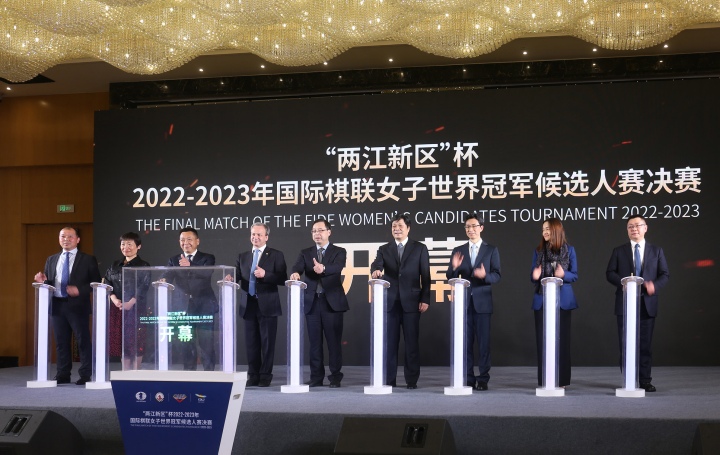
On March 28th, a press conference was held at the Wyndham Hotel Chongqing Yuelai for the final of the “Liangjiang New Area” Cup 2022-2023 FIDE Women’s World Championship Candidates Tournament. FIDE President Arkady Dvorkovic, FIDE Vice President Xie Jun, FIDE treasurer Zhu Chen, the local leaders, and the two players Tan Zhongyi and Lei Tingjie answered questions from the media. FIDE President Dvorkovic said: “The fact that the two Chongqing players met in the final is a major victory for Chinese women chess players. I think such a victory is not an accident; it is the result of the tireless efforts of Chinese chess, both individually and as a team. We all remember that the Chinese men’s and women’s teams both won the 2018 Olympiad, and the Chinese men’s team won the World Team Championship in Israel last year. This year, FIDE’s two world championships will feature three Chinese players, which is a remarkable achievement. This achievement is the result of a good and continuous tradition of chess development in China and is the result of the systematic development of chess in all major cities in China. At present, China has joined Russia, India and the United States as a chess superpower.” Then FIDE treasurer and former women’s world champion Zhu Chen said: “In my life, chess has been the best teacher. When I encountered difficulties, I was able to guide my way through life by playing chess. I think all chess players will feel the same as me and will gain from chess. The development of chess in Chongqing is obvious, and Chinese players have been working very hard, and our young players have been working twice as hard. Therefore, I am confident in the development of our chess players, including the young players.” Four-time World Champion and FIDE Vice President Xie Jun said: “I am very happy to be here today for the press conference. I would like to thank FIDE for organizing so many important tournaments so that players can be trained, and I would also like to give special thanks to the Chinese Chess Association, both for the establishment of the national team and for the tournaments at all levels in our provinces and cities, which allow our players to have more opportunities and to grow continuously. Now already, we have made the world championship a national championship and let people witness the achievements of Chinese chess. This is the glory of Chinese chess!” The two finalists also answered questions from journalists. Former world champion Tan Zhongyi said, “Compared to playing hundreds of games with Ju Wenjun, Lei Tingjie and I were teammates in Chongqing, so we have had fewer games with each other, and were a kind of ‘most familiar strangers’. So I thought this match with Lei would be more interesting.” Lei Tingjie said: “This tournament is a little bit closer to my dream. For every player, the world championship is the ultimate goal. I hope I can focus on the tournament. I am happy that all three of us (and Ju Wenjun) are Chinese women players, and it is a special pride that the future queen title belongs to us in China, and of course I hope to stay in Chongqing”. At the drawing ceremony, Tan Zhongyi drew the white pieces in tomorrow’s first round. The first game will be played at 3:00 pm local time on March 29th. You can follow all the games with live commentaries on the FIDE YouTube Channel. Text: Gu Xiaobing Official website: womenscandidates.fide.com/
Women’s Grand Prix New Delhi: Round 3 recap
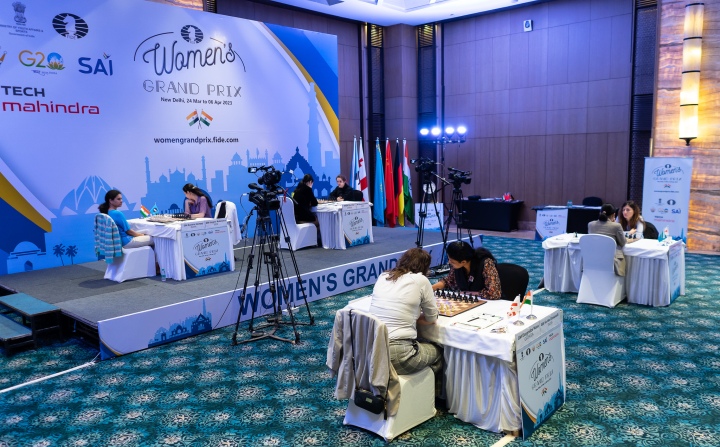
With a second consecutive victory, Bibisara Assaubayeva is in the lead after three rounds of the Women’s Grand Prix Assaubayeva had a lucky break after Nino Batsiashvili made a blunder in an even position and lost. Assaubayeva now shares first place with Alexandra Goryachkina who is also on two points, but who had a free point today as she wasn’t playing. The two will be facing each other in the fourth round. Kateryna Lagno and Harika Dronavalli both surprised their opponents in today’s round but that wasn’t good enough for a victory. While Lagno, playing as Black, had more chances and initiative after some imprecisions from her opponent Humpy Koneru, it wasn’t enough. On the other hand, Harika was happy to draw with her friend and well-known competitor Nana Dzagnidze having surprised her with the opening choice. The longest game of the day was between Zhu Jiner of China and Polina Shuvalova. Following a dynamic game, the two ended in a drawn rook endgame which lasted until the 87th move. Here follows a recap of today’s games. Humpy Koneru – Kateryna Lagno Humpy and Lagno have played 39 games until now, and all have been Gruenfield or Benoni. However, in this game, Lagno decided to go for the Semi-Tarrasch line of the Queen’s gambit declined, surprising her opponent. “I felt that she was surprised”, said Lagno afterwards. Following the opening, the two reached the following position. Here Humpy opted to open the centre, probably somewhat prematurely: 11.e4 dxe4, and White immediately pressed on: 12.d5 Bc3 13.dxe6 Bxd2 14.Qxd2. However, after 14…Ne5! 15.Qf4 and Black emerged slightly better, threatening to put her knight on d3, which could be fatal for White. Harika decided to give up the e6 pawn but after 16.Rfd1 Qxe6 17.Bxf6 Qxf6 18.Qxe4 had to switch to defence as Black enjoyed some edge because of the stronger knight and an extra pawn. Black’s chances of putting more pressure were hanging on keeping the e5-knight which protected the c4-pawn. Lagno decided to plant the knight on d3, where it was immediately traded. Although White could not take the d3-pawn immediately due to the weakness of her b2-pawn, Humpy made a couple of consolidating moves first and only after that restored the material balance with a completely even position. More exchanges followed, leading to a drawn queen’s endgame. Both are now on 1,5 out of three. Zhu Jiner – Polina Shuvalova Zhu offered to battle in the Italian Game, but Shuvalova opted for the quieter line with the bishop on e7 (known as the Hungarian Defence) with an early d7-d5. On move 12, White struck in the centre and decided to play with the isolated d-pawn, which Black zeroed in on immediately. In the subsequent maneuvering play, both opponents traded slight inaccuracies in a roughly equal position, but it was Shuvalova who made a serious one first. After 22…Be7? (22…c5 was a much better alternative). White is much better: she can exchange the bishops and then centralise the queen on d4 and continue with the advance on the kingside. Instead, Zhu decided to avoid the exchange with 23.Bg3? thus allowing breathing space for Black. In a dynamic position that emerged, Zhu pressured on the right flank while Shuvalova was countering on the queenside. Black had to be more cautious as White pushed, but Shuvalova demonstrated good calculation, steering to an endgame despite being down a pawn. As soon as the queenside pawns were exchanged, Black was out of trouble. Still, Zhu tested her opponent in a drawn three-vs-two paws on one side rook endgame for another 46 moves. Having finally exhausted all options, the two agreed to split a point after four and a half hours of play. Both Zhu and Shuvalova are on 1,5 points after the first three rounds. Nana Dzagnidze – Harika Dronavalli The game began with a surprise: As Nana confessed later, Harika’s second move 1.d4 d5 2.c4 c6, was something she didn’t expect. “We are friends, and we played many games together, but Harika never ceases to surprise with her openings,” said Nana in the post-game interview. The two followed the main moves of the exchange variation of the Slav Defence, which does not offer much for White. The game was mostly calm, with a flicker of excitement seen after White’s 18th move. White just played 18.e4 aiming to make a push through the centre. Dronavalli responded with 18…Re8. Here Dzagnidze opted for innocuous 19.Rc2, while a stronger move was 19.Rfd1, building up the pressure on the centre. However, Nana did not feel she had achieved much and was overall not happy with her position. With this in mind, she soon offered a move repetition. Dronavalli was comfortable with a draw as Black, so the two called it a day after 25 moves and two and a half hours of play. Both Dzagnidze and Dronavalli are now on 1,5 points after three rounds. Bibisara Assaubayeva – Nino Batsiashvili Bibisara Assaubayeva scored her second consecutive victory in the Women’s Grand Prix in New Delhi, having defeated Nino Basiashvili. Assaubayeva has now extended her lead against Batsiashvili to 4:1. In a popular line of Tarrasch Defence tested extensively over the last few years on the highest level, Black sacrificed a pawn but got sufficient compensation. The two soon headed into an endgame, and that’s when things took an unpleasant turn for Nino. White has an extra pawn on a4, but Black has more activity and can pose some threats to the king. The position was equal until this moment when Batsiashvili made a terrible blunder Rxa4?? Bibisara naturally responded with 31.Nc5, winning an exchange. To make things even worse, Batsiashvili played 31…f6, weakening the seventh rank, which made her position absolutely hopeless. The rest was a smooth sail of Bibisara, who easily converted her extra material. Batsiashvili now has 1,5 points, while Assaubayeva has two victories from two games played so far. Standings after the third round: Bibisara Assaubayeva – 2 pointsAlexandra Goryachkina – 2 pointsHarika
Women’s Grand Prix New Delhi: Round 2 Recap
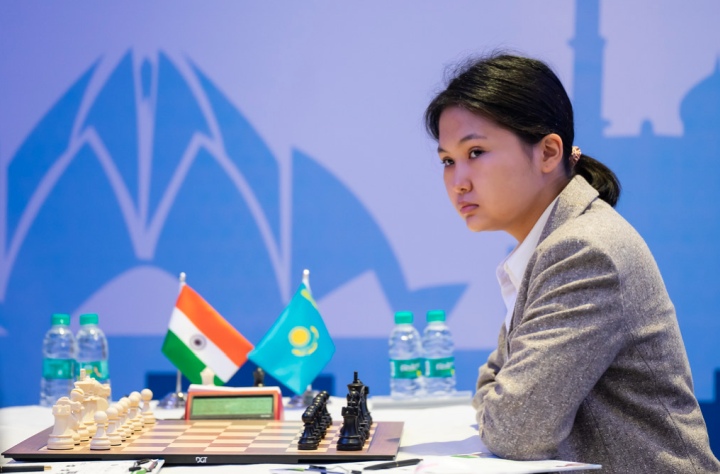
Bibisara Assaubayeva claims victory over local star Vaishali Rameshbabu, in the first decisive game played in New Delhi. The remaining three games ended in a draw The warm weather of New Delhi at 32 degrees Celsius could not deter the players from their game, as they battled it out in the second round of the Women’s Grand Prix. Amidst the blazing sun, the playing hall provided much-needed relief with its cool and tranquil atmosphere. While three games ended with a draw (two of them after around an hour of play) one ended in a victory. Vaishali Rameshbabu – Bibisara Assaubayeva: First victory in the tournament This was the first game played in the tournament to end with a decisive result. Following a rest day in Round One, Bibisara Assaubayeva claimed a victory in her first game in New Delhi. After Vaishali’s 1.e4 с5 2.Nf3 g6 Vaishali (not Assaubayeva) opted for the Alapin variation of the Sicilian Defence with 3.c3. After several standard moves, the Indian IM had to make a decision, shaping up the pawn structure. She opted for 8.cxd4 instead of 8.Nbxd4 – creating an isolated pawn in her camp but hoping for some dynamic play. However, it did not work out for Vaishali. After a couple of inaccuracies on her part, Black gradually traded the majority of minor pieces and put serious pressure on the isolated d4-pawn. By this point, Vaishali was getting into more dangerous time trouble. For a while, however, she managed to find solid moves to keep her in play, although in an inferior position. However, it is difficult to keep finding good moves when your time is measured in seconds and not even minutes. Also, playing against the two-time Women’s World Champion in Blitz games doesn’t help. In the course of the rest of the game, given her severe time trouble, Vaishali managed to trade her isolated pawn to Black’s e7-pawn and simplified the position but ended up significantly worse. After 30…Rb4 31.Ra7 Rxb3 32.Rxa6 Rxb2 33.Rb6 b4 Black emerged with an advanced and well-protected runner on the b-file. Here Vaishali made her final and – as it turned out, deadly – mistake. Instead of placing her knight on a4, attacking the rook and controlling the b2 square, she put her knight on b5 after directly in the line of her rook on b6. After that, she was completely lost. Assaubayeva then brought in her knight to protect and then advance the b-pawn, and she confidently carried on giving her opponent no quarter. After four hours of play – most of which the Indian player spent in desperate time trouble – Bibisara Assaubayeva became the first player to win in New Delhi. Assaubayeva now has one point, as does Vaishali. Aleksandra Goryachkina – Nana Dzagnidze: A quick draw After just an hour of play, in a lively position that emerged from so-called Anti-Meran system, the players decided to go for a repetition and call it a day. The game lasted just 20 moves, with 15 of them being the reproduction of an earlier game Goryachkina – Dronavalli (2021), which also ended in a draw. Black deviated on move 15, but it did not change the evaluation of the position as roughly equal. Since it’s still early days in New Delhi and given that the opponents have one more chance in the fourth tournament, the two decided to take it slower today. Both Goryachkina and Dzagnidze are now on one out of two. Harika Dronavalli – Zhu Jiner: The long way to a draw This was the last game to finish in New Delhi, following four and a half hours of play. Surprisingly, this is the first game the two have met over the board, despite both being among the top women’s chess. The reason for this is that they belong to different generations (Harika was born in 1991 and Zhu in 2002), so they mostly played in different age categories in junior and youth events. Harika opened with her standard move – 1.Nf3 and after 1…d5 2.c4 e6 3.cd5 ed5, the two went for a popular line in the exchange variation of the Queen’s Gambit Declined that has been tested at the highest level many times. Harika went for a standard minority attack on the queenside and, after exchanges in the center, the two reached the following position: White is slightly better but doesn’t pose any serious threats. After Harika straightforwardly traded all the rooks along the c-file, the game transpired into a knight endgame where Black had a remote b-passer. It seemed that only Zhu had a chance to play for a win but with precise play, White is fine. Harika did just that, and the game ended in a draw. Both have one point after two rounds. Polina Shuvalova – Humpy Koneru: A simple draw It was the second relatively quick draw of the day. After 19 moves and an hour and a half of play, the two split a point. Humpy Konery played the Queen’s Gambit Accepted which was a surprise as she had employed this opening on just a handful of occasions before. Shuvalova opted for a trendy 7.b3 line that has become very popular lately. Here White has a minimal advantage, but Shuvalova dropped even this slight edge after taking the black night on c6, enabling her opponent to activate the white-squared bishop on a8-h1 diagonal. After 12.Nc6 Bc6 13. Ne5 Bd5 – Black got the bishop to a better square and offered an exchange for White’s strong c4-bishop. Shuvalova refused and played 14.Bd3. Black had no real problems in this position and was holding her ground confidently. After 14…Bd6 they two followed a three-fold repetition. With two draws in the first two rounds, both players now have a point each. The third round of the third leg of the Women’s Grand Prix will take place on Tuesday, 28th March, at 3 PM local time. Round 3 parings: Humpy Koneru – Kateryna LagnoZhu Jiner – Polina ShuvalovaNana Dzagnidze – Harika DronavalliBibisara Assaubayeva – Nino BatsiashviliAleksandra Goryachkina and Vaishali Rameshbabu are free. Text: Milan Dinic
Toronto will host the 2024 FIDE Candidates Tournaments

Toronto will host the 2024 FIDE Candidates and Women’s Candidates, scheduled for April 3-25, with a prize fund of EUR 750,000. It will be the first time in chess history that both events will be held at the same time and venue, and also the first time that the Candidates Tournament is held in North America. The event will be sponsored by the Scheinberg family, as part of the long-term collaboration agreement that was announced in 2022. FIDE would like to thank the Scheinberg family, whose support for chess over the last nine years has made possible a number of top-level events and is going to be instrumental in staging the Candidates and Women’s Candidates in 2024. FIDE President Arkady Dvorkovich said: “FIDE is happy to award such an important competition to Canada, a country that has made significant chess progress in recent years, with more kids playing the game, more titled players, and more chess fans and chess streamers. The fact that it is going to be the first time that the Candidates and Women’s Candidates will be played under one roof underlines FIDE’s efforts to promote chess, providing more opportunities and proper financial conditions for top female players. Holding the events concurrently at the same venue with a single broadcast can only help bring the Women’s Candidates to a wider audience, with a greater following.” “The Candidates Tournaments will start in just over a year’s time, but I know many chess fans will already be counting down the days towards these exceptional events,” added Dvorkovich. Isai Scheinberg said: “My family and I are very happy that the Candidates Tournaments will be held in Canada, our home country. The Candidates has a long tradition of producing exciting and gruelling battles in pursuit of the biggest prize in chess, and I’m sure that the 2024 edition will be no exception. I look forward to seeing many of the world’s top players in action, with Toronto at the center of the chess world for over three weeks in April 2024.”
Hikaru Nakamura and Irina Krush win American Cup 2023

Hikaru Nakamura and Irina Krush emerged as the winners of the 2023 American Cup, a unique competition featuring an exciting and rare double elimination format. The tournament brought world class chess masters to America’s chess capital to compete in a fierce do or die struggle for $300,000 in prize money. Both champion prevailed in rapid tiebreakes. Hikaru Nakamura pulled through to become the 2023 American Cup Champion after defeating Wesley So 2.5-1.5 in a difficult final elimination match. The finale started out with three solid draws, but finished abruptly in the fourth game after a blunder by So got his queen trapped inside Nakamura’s territory. NAKAMURA – SO | 2.5-1.5 The day started with two 25+10 games in the final elimination match. The first game saw Nakamura emerge with an extra pawn in a theoretically drawn rook endgame, which So had few problems holding. In the second game Wesley was a bit better in a double-bishop endgame, but eventually allowed a draw by three-fold repetition, taking the players to a rapid playoff. In the playoff So started as White, and after a balanced middlegame ended up with a very pleasant advantage in a knight endgame. But Hikaru defended well and managed to hold the draw. After 33.Ba3, So had good winning chances thanks to the passed b-pawn, but never a clear win. In the next game Hikaru got a bit of an edge after starting with 1.Nf3, but the game ended rather surprisingly in the middlegame after a devastating blunder by So got his queen trapped with no way out. 17…Qxd2?? was an unfortunate blunder, as after 18.Rfd1 Qb2 19.Nc4! Black’s queen was trapped. After three solid draws Nakamura seized his opportunity to win the game, match, and title. Photo Courtesy of Saint Louis Chess Club, Lennart Ootes 8-time U.S. Champion Irina Krush bounced back from a loss in classical to defeat a surging Alice Lee in a rapid playoff and win her second straight American Cup title. After winning the first classical game against WIM Alice Lee, Irina Krush unexpectedly blundered in the middlegame, miscalculating a knight sacrifice that would leave her down a piece. In the playoff, Krush recovered nicely, as she managed to outplay Lee in a drawn rook and pawn endgame, winning the first game as Black. This put Alice in a must-win situation once again, and although she was under pressure out of the opening, she managed to defend and even emerge with an extra pawn in a knight endgame. However it wasn’t enough to win, as Krush had plenty of activity with her king and knight to save the day, eventually forcing a draw in order to clinch the playoff and win her second title. It wasn’t easy, but top seed GM Irina Krush got it done. Photo Courtesy of Saint Louis Chess Club, Lennart Ootes Next up for the Saint Louis Chess Club will be the Spring Classic, which takes place April 5-13. Fans should tune in for live commentary on the Saint Louis Chess Club’s YouTube & Twitch.tv channels. Text: IM Kostya Kavutskiy Photo: Saint Louis Chess Club, Lennart Ootes Dates & Location: March 17 – 26, 2023World Chess Hall of Fame Livestream:USChessChamps.Com Web: uschesschamps.com | Twitter: @STLChessClubInstagram: @STLChessClub | Facebook: @STLChessClubYouTube: @STLChessClub | Twitch.tv: @STLChessClub#TheAmericanCup #STLChessClub Press Contact:Rebecca Buffingtonrbuffington@saintlouischessclub.org
Women’s Grand Prix New Delhi: Round 1 Recap
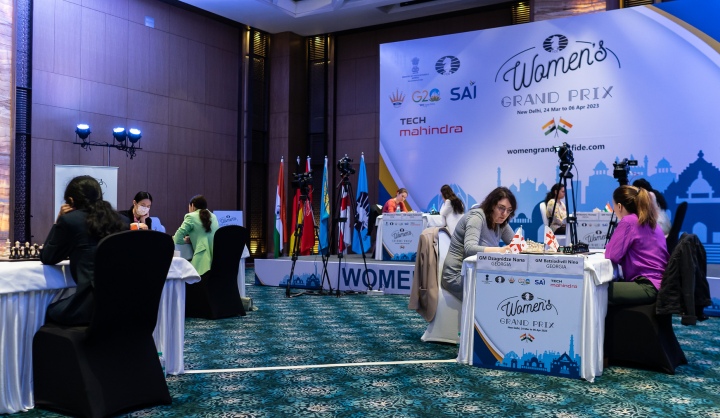
All four games played in the first round of the Women’s Grand Prix in New Delhi ended with a draw. IM Vaishali R won on default after Elisabeth Paehtz decided to withdraw from the tournament. Bharat Singh Chauhan, Chairman of FIDE’s Advisory Board and Secretary of the All India Chess Federation, made the ceremonial first move in the game between Koneru Humpy and Harika Dronavalli in the inaugural round of the New Delhi Women’s Grand Prix. “This is a huge event for women’s chess and chess in India. We should all look at the broader picture and acknowledge all the efforts made to organise this event and to help boost women’s chess both in India and globally. It’s not easy to find sponsors today given the global situation, but we and FIDE are committed”, Bharat Singh said. The round started at 3 PM local time, as planned. Shortly before the round, Elisabeth Paehtz sent a letter to FIDE announcing her decision to withdraw from the tournament. Save for a relatively peaceful draw between the top two Indian players, all other games were fought to (an almost bitter) end. Polina Shuvalova –Kateryna Lagno: Sharp meets aggressive Polina Shuvalova and Kateryna Lagno drew their game after much tension on the board and time trouble. Following 1.d4, Lagno played the King’s Indian Defence. Shuvalova opted for a sharp line, advancing her pawn on h4, to which Lagno responded by offering a pawn sacrifice a la Benko Gambit and then opening the centre. White went for a breakthrough in the center and exchanged the queens hoping that Black’s weaker pawn structure would provide opportunities for an initiative. However, Lagno had enough play for her pieces. Instead of waiting for Shuvalova to probe Black’s weaknesses, Lagno also played actively and aggressively. Still, White had some pressure but on move 20, Polina opted for a tempting but not so-strong 20.Nfg5, allowing Kateryna to get sufficient counterplay, bringing her rook to the second rank. Both players ended up in time trouble. After massive exchanges in the centre and on the queenside, the position was even, and the two agreed to draw their game. In the post-game interview, both players said they were happy with the start and optimistic about their tournament. Humpy Koneru – Harika Dronavalli: A peaceful draw The Indian derby between Humpy Konery and Harika Dronavalli ended in a peaceful draw. Dronavalli opted for the Gruenfeld Defence, which, as she said, “might have been a surprise” for her opponent. Humpy went for a lesser-known line but did not achieve much. As the game progressed, both players centralized their pieces and then initiated massive exchanges. After transpiring into an equal rook endgame, the Indian GMs agreed on a draw after 31 moves. Zhu Jiner – Aleksandra Goryachkina: A missed chance for Zhu Zhu Jiner missed a huge chance to settle a score with Aleksandra Goryachkina, who defeated her in Astana as Black, in the first leg of the Grand Prix. It was a duel between two leaders of the ongoing Women’s Grand Prix series. Zhu currently holds the second position in the overall standings. However, emerging from Astana with a commendable second-place finish, Goryackhina has secured her status as a top contender for the top of the Grand Prix cycle. Notably, this is only her second tournament in the cycle, adding a thrilling element of unpredictability to the competition. Following 2.e4 by Zhu, the two quickly entered the Berlin defence of Ruy Lopez, a popular line among the chess elite. Zhu went straight for an exchange path, leading to a typical Berlin endgame. An interesting choice given Goryachkina is well-known for her excellence in endgames. Black was confidently holding her ground up to a certain point but closer to the time control Aleksandra made a severe mistake taking the rook on f7. Аfter 39…Kxf7? (39…Bxe5!) 40.Bxh6 White has a much better bishop endgame thanks to a remote passer on the kingside, which she imminently creates. Indeed, several moves down the road, Zhu got a dominating position and was winning. With her back against the wall, Goryachkina resisted, and eventually, it paid off, but not without some help from her opponent. In this position, instead of 60.Be5 (60.g7 also looks very strong) followed by pushing her g-pawn and then moving in with the king on the queenside pawns, Zhu missed Black’s only defensive idea and carelessly played 60.Kf4? allowing Aleksandra to get off the hook by 60…bxc4 61. bxc4 Bd4! Finally, after more than five hours of play, the two agreed to a draw. Nana Dzagnidze – Nino Batsiashvili: Ups and downs Nana and Nino are two members of the highly successful Georgian women’s team. Between them, Nana has a better score, but in an event such as the Grand Prix, that might not mean anything. Batsiashvili, who generally plays the Queen’s Indian Defence, today went for the Queen’s Gambit Declined, hoping to surprise her opponent. Dzagnidze preferred the Catalan – which generally gives white a small initiative in most cases. The two found themselves on an uncharted territory by move 14 and ended up in a position with the opposite-coloured bishops. The first breaking point of the game occurred on move 30. In time pressure Batsiashvili played 30…Rb5? directly forcing her to give up her queen. However, after 31. Rd2 Qd2 32. Bd2 Rd2 Nana returned the favour and now she was the one to blunder. Dzagnidze opted for 33.Rxc5?, which enabled Black to exchange a pair of rooks and then collect two pawns on the second file. In time trouble, Dzagnidze ended up giving all her pawns on the kingside in an attempt to open up the black king for checks. Now it was Batsiashvili who had the upper hand, having reached the time control and achieving a seizable advantage. However, in time trouble, she couldn’t find the right setup, and eventually, the two agreed on a draw after move repetition. In the post-game interview, both players were asked to comment on how they deal with such huge ups and downs which happen in a game. The answer both
Women’s Grand Prix in Delhi starts after delays

Following a day of discussions between FIDE and the players regarding playing arrangements, the first round of the third leg of the Women’s Grand Prix kicked off in New Delhi. Grandmasters Zhansaya Abdumalik and Elisabeth Paehtz decided to withdraw. Following the decision of Zhansaya Abdumalik (Kazakhstan) to withdraw before the start of the event, 11 players instead of 12 were due to take part in the tournament. However, less than an hour before the first round was due to start, Grandmaster Elisabeth Paehtz sent a letter to FIDE announcing her decision to withdraw from the tournament. Paehtz noted that she had been strongly affected by the events that took place in the last two days and that she didn’t feel she could perform well. The tournament kicked off at 3 PM New Delhi time, as planned, with several exciting matchups between top-ranked players. On board one, Polina Shuvalova is playing as White against Kateryna Lagno, who – after a convincing victory in the first leg of the Grand Prix in Astana at the end of 2022 – is one of the favourites of the event. With 160 points and just one Grand Prix tournament in this cycle, Lagno has 160 points and is currently third in the overall standings. The eyes of the local audience are focused on the second board where India’s top two women players, Humpy Koneru and Harika Dronavalli, are playing one another. Koneru has 130 points from the second leg in Munich and currently shares 5-6th place in the overall standings, while Harika is tenth, with 90 points. The biggest derby of the first round is taking place on board three, where Zhu Jiner is playing as White against Aleksandra Goryachkina. Zhu is currently second in the overall standings with 165 points. While Zhu won third place in Astana (and 110 points), she underperformed in Munich, netting only 65 points. As Zhu has already played two tournaments in this cycle, New Delhi is her last chance for the top spot. On the other hand, Goryackhina has 130 points from Astana (where she was second), and this is her second tournament, which makes her one of the top contenders for first place. The two have previously met in the first leg of this Grand Prix cycle in Astana, where Goryachkina won as Black. Another match of compatriots is taking place on the fourth board, where Nana Dzagnidze is playing Nino Batsiashvili, who was brought in as one of the replacements for the Muzychuk sisters following their decision not to play in the Grand Prix. Dzagnidze has 110 points from Munich, and this is her second tournament in this Grand Prix cycle. On board five, Germany’s Elisabeth Paehtz was due to face the third Indian player in this event, IM Vaishali Rameshbabu, who joined the event as a replacement for one of the Muzychuk sisters. Paehtz has 95 points from both Astana and Munich and had no chance to qualify for the top two spots in the Women’s Grand Prix. Kazakhstan’s Bibisara Assaubayeva, the reigning women’s world Blitz Champion, has a free day. The challenges leading up to the start of the event Despite the best intentions, plans and hopes, the path to the first round of the tournament in New Delhi was difficult. Due to issues surrounding the arrival of players, regarding the pick up from the airport and reception at the hotel, Zhansaya Abdumalik decided to leave the tournament on the 24th of March. Other players also expressed their dissatisfaction with the way the organisation had been handled and, at one point, suggested the postponement of the event. They also noted issues which took place in previous top women’s events. Following the complaints, FIDE organised a meeting via video link with all of the players taking part in the tournament in New Delhi. An open discussion took place between FIDE President Arkady Dvorkovich and the participants. Apart from the problems upon arrival, the players also highlighted issues they are facing in other women’s events, including – the shifting of the events calendar, organisational and technical challenges in previous top women’s tournaments as well as the gap in the prize funds between Open and Women’s events. FIDE President apologised to the players for the issues and took on board their comments and suggestions. Following the call, Dvorkovich published a letter issuing an apology to the players for the problems they have faced. Apart from Bharat Singh Chauhan, the Chair of FIDE President’s Advisory Board and one of the key organisers of the highly successful Chennai Olympiad in 2022, who is already in New Delhi, FIDE is sending a coordinator to help improve the communication between local organisers and the players and to provide additional reassurance to everyone involved. Concerning women’s chess events and the broader issues raised, FIDE has committed to the following: To conduct a thorough review of the guidelines and standards for organising women’s tournaments and make sure to strengthen the connection with players, as well as further improve the proficiency of the events organising team. To ensure that the cooperation between local organisers and FIDE functions significantly better, to reflect the standards of events. To Improve and sharpen the mechanism of selecting the host cities and venues for the tournaments, thus improving the planning of the FIDE calendar. To continue to work on closing the prize gap between Open and Women events. Official website: womengrandprix.fide.com/
Letter of FIDE President regarding the Women’s Grand Prix in New Delhi, India

FIDE President, Arkady Dvorkovich, has issued an apology for the errors of local organisers regarding the Women’s Grand Prix tournament in India. In a letter addressed to the participants of the event, Dvorkovich expressed his sincerest apologies for the problems and inconveniences experienced by the players, which led to the withdrawal of one player. Despite this setback, the tournament will continue with adjustments made for the remaining players. FIDE will also appoint an additional coordinator to be at the full disposal of the participants and provide compensation for any additional expenses they may have incurred. Dvorkovich has also pledged to conduct a thorough review of the guidelines and standards for organising women’s tournaments and improve the proficiency of the organisers of future events. Here is the letter in full. The publishing of the letter has been agreed upon with the players participating in the tournament in New Delhi. New Delhi, 25 March 2023 To: Bibisara Assaubayeva Nino Batsiashvili Harika Dronavalli Nana Dzagnidze Aleksandra Goryachkina Zhu Jiner Humpy Koneru Kateryna Lagno Elisabeth Paehtz Polina Shuvalova Rameshbabu Vaishali On Women’s Grand Prix tournament Dear Participants, On behalf of the International Chess Federation (FIDE), I would like to extend our sincerest apologies for the mishandling of the Women’s Grand Prix tournament in India. We deeply regret the problems and inconveniences you have experienced, which has led to one player withdrawing from the tournament. We understand that this situation has caused great dissatisfaction among the players and has put the tournament in danger. We acknowledge your concerns and frustrations, and we take them seriously. We highly appreciate your openness and would like to assure you that we are committed to addressing the issues that have been raised regarding this tournament and FIDE women events in general. We are also determined to improve the level of communication with the participants. Considering all the arguments in place, we have decided to continue with the Women’s Grand Prix tournament in India. We believe that such a decision is best under the given circumstances, even though the withdrawal of a player would require all of the tournament participants and organizers to adjust themselves. In case of postponement, the current FIDE calendar does not allow space for strong assurances when the tournament can be held. It is also important not to create a precedent that the whole event can be terminated and other players’ plans influenced due to the decision of a player to withdraw. Alongside the utmost respect for the comfort of our professional players, we are equally committed to demonstrating our reliability as trustworthy, credible partners to our organizers and sponsors. We are fully committed to taking swift and decisive action to improve the situation immediately. Above all, our priority is to demonstrate that we truly care about our participants, and we will spare no effort to ensure that they receive the highest level of support and attention. To that effect, FIDE will appoint an additional coordinator to be at the full disposal to the participants of the event. Also, all affected players will be provided with compensation, such as covering any additional expenses they may have incurred or will incur during the event. In order to manage the tournament under the new conditions, the following schedule and principles will apply: The tournament will be held with the participation of 11 players The first round pairings will remain as they are (IM Assaubayeva exempt) The following rounds will be affected as less as possible in order to balance colours where it is possible. The broader issues which have been highlighted by the players regarding other events have also been taken into account. From the very beginning, my team and I have been dedicated to promoting women’s chess, and we are proud to have made significant strides in this regard. This includes the creation of numerous new events for top players, the allocation of major tournaments across three continents, record prize funds, and an increasing number of opportunities for female participation. We remain committed to advancing the cause of women’s chess around the world. Having said that, I realise there is still a lot we should do to improve. Concerning women’s chess events and the broader issues raised, FIDE will take the following steps: We will conduct a thorough review of the guidelines and standards for organizing women’s tournaments, and make sure to strengthen the connection with players, as well as further improve the proficiency of the events organizing team. We will ensure that the cooperation between local organizers and FIDE functions significantly better, to reflect the standards of events. Improve and sharpen the mechanism of selecting the host cities and venues for the tournaments, thus improving the planning of the FIDE calendar. We will continue to work on closing the prize gaps between Open and Women events. Once again, please accept my apologies and thank you for your understanding and cooperation. Yours sincerely, Arkady Dvorkovich FIDE President