

WR Chess Masters: Levon Aronian’s tiebreak triumph
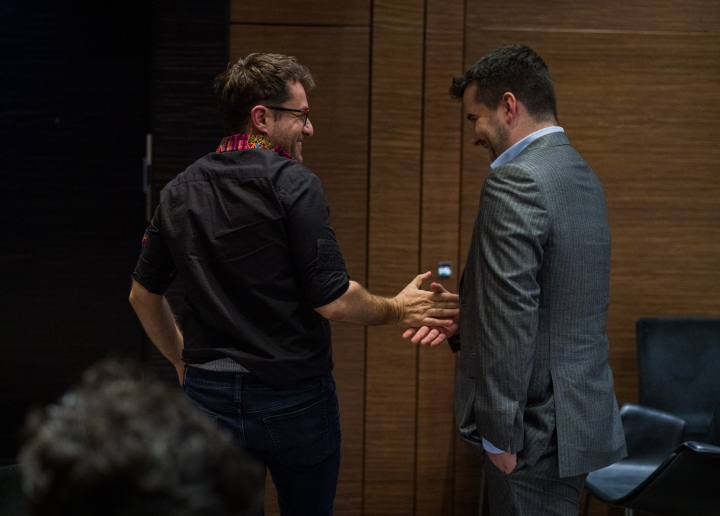
Levon Aronian has won the WR Chess Masters. After Aronian, Gukesh and Ian Nepomniachtchi were tied with 5.5/9 each at the end of the regular distance of nine rounds, Aronian won the tiebreak. He was very happy about the victory, Aronian said. He thanked host Wadim Rosenstein for an excellently organized tournament and the exceptionally good conditions in Düsseldorf, where he had “felt the respect for the players” every day. Levon Aronian with the winner’s trophy. | Photo: Lennart Ootes Predicting the first and last finished games of the ninth round wasn’t too difficult. In their tournament game, the supposed showdown, co-leaders Levon Aronian and Gukesh were not looking for a fight to the death. In a well-known variation of the Ragozin, both opponents headed straight for a repetition that many grandmasters have used to quickly split the point. The two had thus postponed the decision about the tournament victory and who would win the first prize of 40,000 euros and the trophy to the tiebreak – and risked Ian Nepomniachtchi disputing this prize. But before Nepomniachtchi got the chance to do so, he had to win against Vincent Keymer. The World Championship finalist needed a full point to catch up with Gukesh and Aronian. After six hours and 82 moves, Ian Neponiachtchi defeated Vincent Keymer. | Photo: Lennart Ootes While all the other games of the day gradually petered out, Vincent Keymer once again had to put in a six-hour shift. Opposite of him, Nepo didn’t let up, looking for opportunities to sharpen things up even with reduced material. For five hours, Keymer kept the position balanced, then he rashly let his passed pawn run, and it was over: On the other wing, Nepomniachtchi’s play against the white king would prove decisive, while Kemer’s passed pawn didn’t reach the eighth rank. Nepomniachtchi had managed to catch up with Aronian and Gukesh on the home stretch. Three players tied at the top of the table – a rarity, but it happens. Levon Aronian has experience with this situation: back in 2018, at the Sinquefield Cup in Saint Louis, he, Magnus Carlsen and Fabiano Caruana ended up at the top with equal points. A drawing of lots was scheduled there – and the players negotiated it away at short notice. They preferred to share first place. Such negotiations were not planned in Düsseldorf, and they did not arise. The rules in the event of a tie at the top of the table were clear. So where do we go from here? | Photo: Lennart Ootes Nepomniachtchi, after his hard-fought victory over Keymer, nevertheless first had to ask main referee Gregor Johann how things would proceed. “A round robin, double round robin, 10+2,” he got in reply. After an 82-move and more than 6-hour tournament game, he was now to face a potentially more than five-hour playoff against two rested opponents. After winning the first tiebreak game against Gukesh, Aronian added another win in the second against Nepo. Nepomniachtchi seemed to have created nice attacking chances but had made structural concessions. And these weighed heavier. After that, Nepomniachtchi had to play again, this time against Gukesh, and it was already a decisive game. Only the winner would still have a chance to challenge Levon Aronian for the tiebreaker. It went back and forth, with both having chances, and in the end, the Indian prevailed. That gave him a must-win game against Aronian: now, one more win and the youngest competitor would be back on the heels of the oldest. It started well for Gukesh, who first smashed up Aronian’s structure, then took aim at some pawn weaknesses and seemed to be on the winning track with two extra pawns. But Aronian didn’t let up, continuously creating problems, and Gukesh failed to turn his big advantage into a decisive one. In the end, the game turned completely around. After these three full points in a row, Aronian could no longer be denied the tournament victory. The last two games of the tiebreak were not played. The youngest and the oldest participant before the last game of the tournament. | Photo: Lennart Ootes More photos and interviews in the tournament feed Text: Official website Photo: Lennart Ootes Offical website: wr-chess.com/
WR Chess Masters: Three candidates for tournament victory
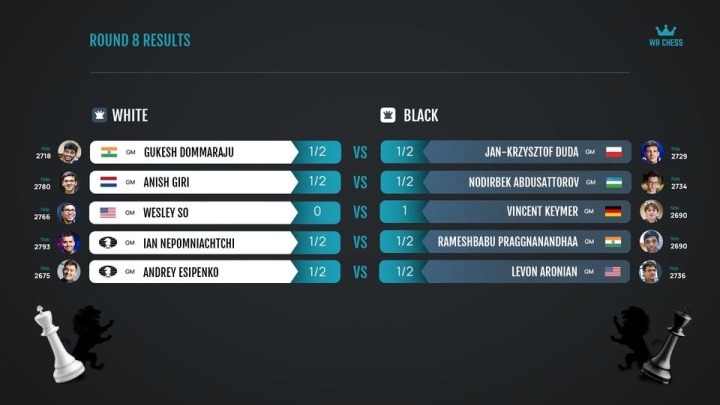
Showdown with Joker: After eight rounds of the WR Chess Masters, the field is set for an exciting final round, in which the two leaders on equal points, Gukesh and Levon Aronian, meet. Half a point behind them lurks Ian Nepomniachtchi, who can still catch up in the event of a draw between the two. To do so, however, he’ll have to beat Vincent Keymer, who is in increasingly good form. Keymer defeated Wesley So in the eighth round. With this loss, the previously undefeated US grandmaster was eliminated early from the fight for the first prize. So versus Keymer was the only decisive outcome of the day. Over 2700 Elo again: Now that it’s almost over, Vincent Keymer seems to have really arrived. | Photo: Lennart Ootes Keymer, back in the 2700-Elo club, expressed his relief after the game. “Super happy” he was with this victory over one of the very best in world chess. “Wesley So in top form is on a par with Magnus Carlsen, a hugely strong player,” explained Keymer, who has now climbed from “minus 2” to 50 percent. However, if someone were to offer him to play a second round of nine now, given his good results recently, Keymer would hesitate: “Don’t underestimate the energy that such strong competition takes.” The WR Chess Masters makes very different demands than a “normal” tournament with “normal” opponents, he said. “There is no relaxed moment here.” If the opponents are not world-class, “then you just make normal moves, which may not always be precise, and you don’t get punished. It’s very different here.” Speaking to Yasser Seirawan, Keymer recalled his black game against Jan-Krzysztof Duda: “I allowed myself one inaccuracy, and then as punishment, I had to sit and defend for 6.5 hours.” Levon Aronian demonstrated in the eighth round against Andrey Esipenko not his best chess but his chess psychological extra class. In a game in which he thought he had no chance after an opening mistake, Aronian sent a perfectly timed draw offer across the board – just at the moment when he had built up a little counterplay, and Esipenko was threatening to run out of time. Now the 20-year-old had to deal with not only Aronian’s activity during his ticking-down seconds but also the question: “To accept or not?” Esipenko accepted, and Aronian was happy to have escaped. Cheating control with a magnet: If Andrey Esipenko wore a button in his ear, the magnet would pull it out. | Photo: Lennart Ootes Nodirbek Abdusattorov got away with an opening mistake in a classical Sicilian, with which he wanted to surprise Anish Giri. But the latter was prepared. “I can’t explain it exactly, but somehow I guessed what Nodirbek would play,” the world number five said after the game. What happened to Giri was what he believes happens to him too often: After catching his opponent thanks to superior opening preparation, he let him escape into a draw. “That was unfortunate, of course,” Giri said. Gukesh will play for the tournament title on Saturday. | Photo: Lennart Ootes Gukesh had his eyes on two boards during his battle with Jan-Krzysztof Duda. Tied with Levon Aronian at the top of the table, “of course, I followed how he was doing.” But even when Aronian was supposedly on the losing side, “it didn’t affect my game”. Now Gukesh is looking forward to the showdown in the ninth round. “Levon is a great player, for sure it will be an interesting match. I’m excited about it.” Praggnanandhaa experienced a déjà vu with the black pieces – almost. Just two weeks ago in Wijk aan Zee, he had beaten the World Championship finalist Ding Liren with black in an Italian game. Now he was facing Ian Nepomniachtchi, the other World Championship finalist, in Düsseldorf, and once again, the Italian was on the board. However, the game went the other way. Nepomniachtchi, encouraged by his win the day before, put on the pressure to catch up with the two leaders if possible. Pragg, however, defended with precision and came away with a perpetual check and half a point. Ian Nepomniachtchi put the pressure on but couldn’t get through. | Photo: Lennart Ootes More photos and interviews in the tournament feed Text: Official website Photo: Lennart Ootes Offical website: wr-chess.com/
WR Chess Masters Round 7: Gukesh catches up with Aronian
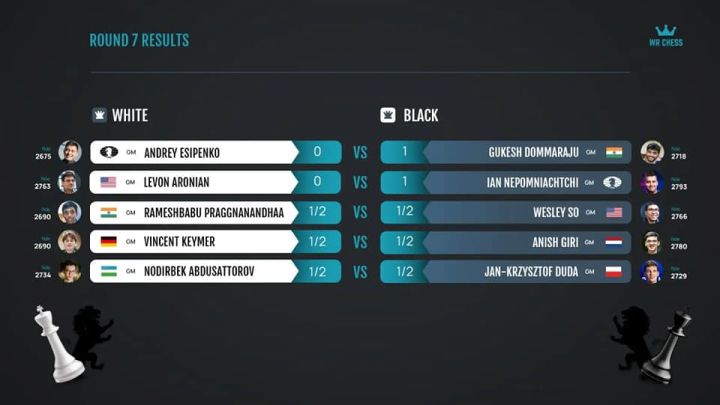
Gukesh has caught up with Levon Aronian. After a Black win over Andrey Esipenko in the seventh round of the WR Chess Masters, the youngest competitor now shares the top spot with the oldest on 4.5 points. The two will meet in the ninth and final round, potentially a showdown for the tournament title. Heading for a showdown to win the tournament? Gukesh, twice. | Photo: Lennart Ootes Aronian lost to Ian Nepomniachtchi, who managed to break his run of drawn games. With four points from seven, the upcoming World Championship finalist is hot on the heels of the two leaders and in a good position to win the tournament himself. Levon Aronian’s queen had lost its way a bit on the wing named after it with no discernible task and no quick way back, one reason why Nepomniachtchi was satisfied with his position early on. Alone: he had used up a lot of time. On the other hand, the exposed position of the opponent’s queen gave him the opportunity to chase it back and forth, thus repeating moves without changing the position. After the first back and forth, Aronian suddenly called arbiter Gregor Johann to the board and claimed a draw because of a threefold repetition. But Aronian had miscounted. Johann ordered the game to continue. When Ian Nepomniachtchi realized how much Levon Aronian wanted a draw, he decided to play on and was rewarded. | Photo: Lennart Ootes “When Levon even went for the arbiter to get a draw, I saw how big his desire for a draw was,” Nepomniachtchi explained after the game. And he named another argument to continue the game: “I don’t have so many classical games before the World Championship match. I should use them.” And how he used this one. With the white queen locked out on the other wing, Nepomniachtchi launched an attack against the under-defended white king. Gradually, he managed to bring more and more forces into position against Aronian’s monarch. After Aronian missed one or two opportunities to raise counterplay, the black initiative became irresistible. Form exchange: There was a form on the board that started at move 61, not move 1. Arbiter Thsepiso Lopang corrected the matter. | Photo: Lennart Ootes The second Black victory, not only of the round but of the tournament, came to Gukesh, although it didn’t look like it at first. In a Catalan gambit, the Indian was on his own early – unlike his opponent. “He’s prepared, it’s probably quite dangerous for me,” Gukesh reflected during the opening. “But I’m proud of what I then found on the board.” A knight move that was actually offside looked terrible at first glance but was tactically and strategically justified in these specific circumstances. Nevertheless, it looked as if Esipenko was gradually organizing a promising king attack. But Gukesh coolly fended off what came, and he was still playing on the other side of the board with the extra pawn Esipenko had sacrificed at the start of the game. The white attack petered out, and the black counterattack soon took hold. Wesley So and Praggnanandhaa provided the marathon of the day. For over seven hours, So pressed for the full point with the black pieces. The Indian defended flawlessly in the rook ending until after 82 moves, there was only one rook each left on the board. The most spectacular game of the day seemed to be played by Nodirbek Abdusattorov and Jan-Krzysztof Duda. Already on move seven, Black’s king had to flee to g6 into the open field, but one move later, a black knight snatched a white rook on h1. But what looked wild and hardly transparent was known to both players. Both had embarked on a rare line of the Steinitz Attack in the Petrov Defense, and both knew exactly what they were doing. The spectacle soon petered out into a roughly even endgame. Pawn c4? Sebastian Siebrecht provides guidance to Düsseldorf’s head of sports Britta Zur on how to execute the ceremonial opening move. | Photo: Lennart Ootes Vincent Keymer and Anish Giri also had such an endgame on the board very early on. Keymer claimed possession of a pawn, Giri had greater activity and a better pawn structure. The result was an even game. More photos and interviews in the tournament feed Text: Official website Photo: Lennart Ootes Offical website: wr-chess.com/
Wissmann wins in Finland, solvers move to Poland and Netherlands
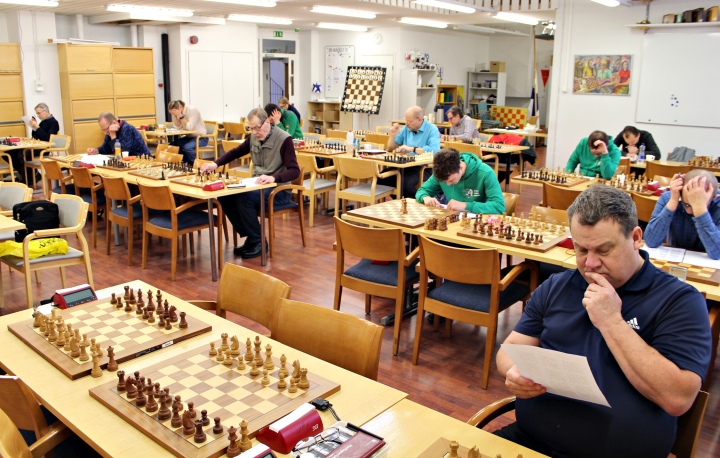
The 44th Finnish Championship in solving took place in the Chess Arena in Helsinki. The longtime director of the competition, Neal Turner, carefully selected the 12 problems to be solved within three hours. In solving competitions, the problems should not be just challenging; they must be of good quality, showing interesting and original ideas in an artistically satisfying way. The chosen problems met all these requirements, so Neal Turner did an excellent job! All 18 participants received points for their solutions and were also able to enjoy the beauty of chess compositions. Take, for instance, this mutual firework in two moves only: Mate in 2 moves The selection included two problems of each type: 2# (mate in two moves), 3#, more-movers (mate in four or more moves), endgame studies, helpmates and selfmates. The top finishers were close to the maximum of 60 points. For every correct solution, a solver received five points, but it was difficult to find all variations in the allotted time. Those who think a helpmate is easy to solve because Black helps to be mated may try the following problem from the competition in Helsinki: Helpmate in 2 moves (4 solutions) Black plays first and cooperates to be mated in the 2nd white move. As usual in helpmates, there are more intended solutions as parts of the overall concept. There is a powerful white battery Qa2-Nc4, suggesting it should be used for the mating move, but it gets paradoxically abandoned each time to create four other batteries. One of the solutions works this way: 1.Qb4! (Black has to take care of his own checking battery Qc5-Kd5) Rb3! 2.Kxc4 Rc3#. Can you find the other three solutions? In the close contest for the top honours, five solvers managed to score more than 50 points. Dutch GM solver Dolf Wissmann missed only 1.5 points and emerged as a deserved winner, ahead of two other GMs, Martynas Limontas of Lithuania and Jorma Paavilainen of Finland, who shared the 2nd place. Both netted an equal number of points and used the maximum time, but for the ex-World champion in solving Jorma Paavilainen, that was enough for the 11th domestic title, bringing him closer to the record holder with 14 Finnish titles, the multiple World Champion Pauli Perkonoja. Jorma Paavilainen (2nd-3rd), Dolf Wissmann (1st) and Martynas Limontas (2nd-3rd) Experienced Finnish IM Kari Karhunen, the holder of ten Finnish titles, finished only one point behind this duo, followed by the rising Lithuanian talent Kevinas Kuznecovas. Vidmantas Satkus, on the 6th place, rounded out a great performance by the Lithuanian squad. The youngest participant Kevinas Kuznecovas (18), was by far the fastest of all 18 solvers in Helsinki, using only 142 minutes. However, being that fast, he missed 5 out of 10 possible points in two endgames. For the maximal score in the following endgame, the solvers had to find all 13 White’s moves in a surprising King’s corner-to-corner walk! White to play and win Final standings: 1. Wissmann 58.5 points (166 minutes), 2-3. Limontas and Paavilainen 57 (180), 4. Jarhunen 56 (180), 5. Kuznecovas 54 (142), 6. Satkus 46 (180), 7. Tanner 43.5 (180), 8. Mockus 35 (180), etc. Is my solution correct? The strong Lithuanian team The best six solvers significantly rose in the overall standings of the World Solving Cup 2022/23: 1. Martynas Limontas (LTU) 29 points (+10 points), 2. Kevinas Kuznecovas (LTU) 17 (+4), 3. Arno Zude (GER) 16, 4. Dolf Wissmann (NED) 13 (+13), 5. Vidmantas Satkus (LTU) 12 (+2), etc. The next legs of the WSC 2022/23 will be the open championships of Poland (Sekocin Stary, March 4-5) and the Netherlands (Nunspeet, March 4). Solutions: Position 1 (Vjacheslav Kamenskij)1. Rg6! Position 2 (Fadil Abdurahmanovic)1.Qb4 Rb3 2.Kxc4 Rc3#1.Q×d4 Qb1 2.Ke4 R×d4#1.Qd6 Rc3 2.Kc6 Na5#1.Qe7 Qxb2 2.Ke6 d5# Position 3 (Aleksander Maskimovskic, Yu. Makletsov)1.Re7+ Kh8 2.Re8+ Kxh7 3.Rxe4 Ra1+ 4.Kxa1 bxc2 5.Re7+ Kh8 6.Rh7+ Kg8 7.Bc4+ Kf8 8.Rf7+ Ke8 9.Bb5+ Kd8 10.Rd7+ Kc8 11.Ba6+ Kb8 12.Rb7+ Ka8 13.Rb1 All 12 problems from the 44th Finnish solving championship Solutions with the distribution of the points Text: Marjan Kovačević, WFCC President Photos: Hannu Harkola Official website: wfcc.ch/
UPDATE: Fair Play Commission on the Carlsen/Niemann Report

On February 17, the Fair Play Commission (FPL) unanimously adopted the report on the Carlsen/Niemann incident drafted by the Panel tasked with investigating the case, composed of Klaus Deventer (chair), Vincent Geeraets and Salomeja Zaksaite. On February 20, the 30-page report was forwarded to the Ethics and Disciplinary Commission (EDC) for further consideration. EDC’s nominated panel will assess the FPL’s findings and reach a decision on the case within six weeks. Pursuant to Art. 5 of the EDC Procedural Rules, until a decision is made, the contents of the Report shall be kept confidential to protect the procedure itself and all interested parties. Until then, no further comment on the matter shall be released by any FPL, EDC member, or any other FIDE official.
WR Chess Masters Round 6: Endgame battles
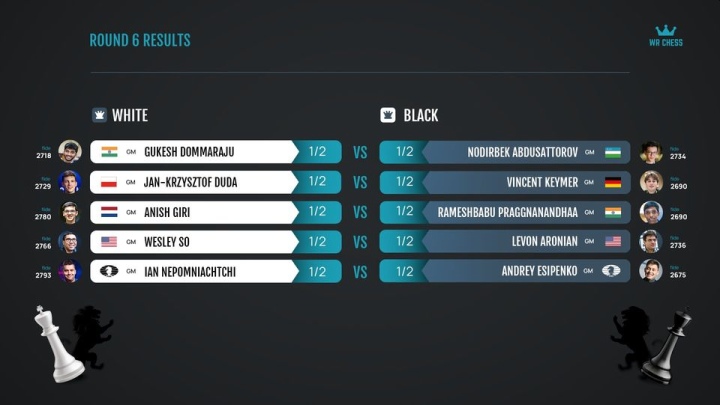
First against second: It could have been the game that made the tournament’s outcome completely uncertain again. Wesley So, one point behind, had to do nothing more than defeat Levon Aronian with the white pieces. Then both would have been back on level ground, and the field would have been close together. But the game ended in a draw – like the other four games of the sixth round, some of them after endgame battles lasting more than six hours. The standings are unchanged after this day of draws. Wesley So played a fighting game but didn’t come close to catching Levon Aronian. | Photo: Lennart Ootes Aronian was even close to almost deciding the tournament early. However, it would have required a computer-like solution, which So and Aronian missed. Instead of the computer maneuver, Levon played a very human one: transfer the knight from the edge back into the game. On the move after that, Aronian missed a very similar opportunity. After that, So did not again let the dynamic equilibrium of the sharp position out of his hands. In the end, Aronian forced a draw by perpetual check. Still in a comfortable situation with “plus three,” Aronian was not overly disappointed after the game. “I played a fighting game, and when you fight, you get chances,” Aronian explained in the interview. “But it’s also hard to avoid missing chances in the course of a tournament. The opponents are strong, it happens.” After the draw against So, Levon Aronian continues to lead the field with a one-point advantage, followed by Wesley So and Gukesh with 3.5 points each. The young Indian failed to capitalize on the opportunity to catch up half a point to the leaders in his white game. Gukesh and Nodirbek Abdusattorov played until the board was almost cleared. | Photo: Lennart Oootes After an English opening, Gukesh and Nodirbek Abdusattorov soon ended up in an even endgame in which the two white bishops were not superior to the two black knights. Which of the two played the balanced position to win? Probably not only the commentators Yasser Seirawan and Elisabeth Pähtz were wondering. One thing is certain: they played until the board was almost cleared, and the draw was inevitable. Ian Nepomniachtchi would have drawn level with the two runners-up with a win. After his series of draws, he now wanted to achieve this victory against Andrey Esipenko, not only on the board but also by psychological means. When Esipenko, after more than six hours and almost 80 moves, had worked out how to sacrifice his knight but eliminate all the white pawns in return and force a draw, Nepo suddenly had an intense facial expression. “He pulled a face like he pulls when his opponent has made a mistake,” Andrey Esipenko reported afterwards. And he told about his fear in the face of Nepomniachtchi’s grimaces, he had made a mistake. Esipenko: “I aged ten years in this game.” Andrey Esipenko (before ageing ten years). | Photo: Lennart Ootes Jan-Krzysztof Duda and Vincent Keymer played an Anti-Marshall, in which Keymer initially got good play after an original exchange sacrifice. Later he gave back the exchange, perhaps prematurely. The result was a stable but slightly inferior position for Black, where the Pole could play for a long time for two results. Duda tried his best for a good six hours, but Keymer held his ground. Praggnanandhaa was pressing from the opening against Anish Giri. He kept up the pressure deep into the endgame, where only the Indian was playing for a win despite being down an exchange thanks to his central passed pawn duo. Giri finally managed to take both passed pawns off the board by sacrificing the exchange back. The game ended in a bloodless queenside endgame with nothing to gain for either side. After the second time control, some observers were confused when they noticed that chief arbiter Gregor Johann had stopped the clock. Is it over? No, it was not. The players did not write down their moves in time trouble. While Giri and Pragg updated their sheets, Johann paused the clock according to FIDE rule 8.5.1. Elo 2800 when it comes to chess rules: Chief Arbiter Gregor Johann. | Photo: Lennart Ootes More photos and interviews in the tournament feed Text: Official website Photo: Lennart Ootes Offical website: wr-chess.com/
WR Chess Masters R05: Who’s going to stop Aronian?
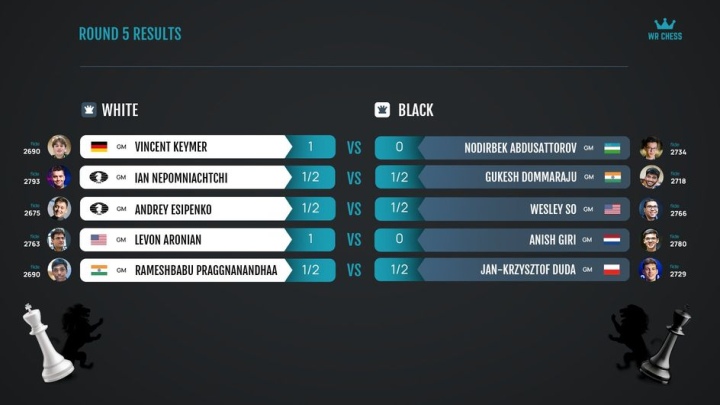
Levon Aronian’s fifth-round win doesn’t mean it is all over for other participants in the WR Chess Masters, but the 40-year-old is now the clear favourite to win the tournament. After his full point against Anish Giri, Aronian leads the standings with four points from five games, one ahead of Wesley So and Gukesh with three each. With his third win in the tournament, Aronian is back in the world’s top 10 (live ranking). If you’re as good as Anish Giri and Levon Aronian, you don’t need a board to discuss the game. | Photo: Lennart Ootes Anish Giri had surprised Aronian in the opening: Berlin Defense instead of the Open Ruy Lopez Aronian had expected. Perhaps it was his four drawn games in a row that tempted Giri to push things harder on move 21 instead of simplifying into a hardly dangerous endgame? As a result, the world number five came under pressure and eventually even had to allow Aronian to double two rooks on his seventh rank. That could not end well. Vincent Keymer was the second winner of the day. After 17 winless super-tournament games in Wijk aan Zee and Düsseldorf, he was granted a full point in the 18th. Keymer is no longer at the bottom of the table, at least not alone. He is now part of a quintet with two points from five games. After 0.5 points scored in the last three games, Nodirbek Abdusattorov is part of that quintet as well. In the game between the two best 18-year-olds in the world, Abdusattorov played his part in making it a battle worth watching. Whether his pawn sacrifice in the opening was improvisation or preparation is unclear. “I certainly didn’t believe him,” Keymer recounted after the game. The critical move of the game: Abdusattorov could have played 23…Bxb4, probably nothing would have gone wrong for him. But he didn’t resist the temptation to play 23…Bb6?!! and invite Vincent Keymer to 24.b5, which only seems to win the c6-bishop. Abdusattorov had planned 24…Re6! (the only move that doesn’t lose) with a huge Black’s attack. Despite Keymer’s disbelief, Abdusattorov was to put up strong play against the white kingside. But then he succumbed to the temptation of a pseudo piece sacrifice for further attack instead of moving the game into calm waters that might even be slightly advantageous for Black. When Abdusattorov finally slammed a rook into the white castling position, Keymer thought it was “almost a miracle that I’m not mated, it looks so dangerous.” All the black pieces were perfectly placed, he said, except that “he has too few of them, unfortunately.” The Keymer stare, now a trademark of the world’s second-best 18-year-old. | Photo: Lennart Ootes For Praggnanandhaa, there was a very good reason to end the game early against Jan-Krzysztof Duda. His sister Vaishali was playing for her team “Indian Yogis” against the “Canada Chessbrahs” in the Pro Chess League on Tuesday afternoon. And in their ranks was a certain Magnus Carlsen. Who wouldn’t want to watch his sister play a live match against the World Champion? Unfortunately, the game seemed to be heading for a heavy-piece endgame, which could have been an opportunity for the Indian to celebrate his love of grinding out small advantages. But it didn’t come to that. A hasty advance by Pragg on the kingside gave Duda the counterplay he needed to keep the game in balance and force a repetition before move 40. Pragg now has two reasons to be dissatisfied with his fifth round. Against Duda, he could have pressed longer and possibly got more out of it. And Vaishali vs. Carlsen, he still had to watch in the replay. The door to tournament victory is not yet closed for Jan-Krzysztof Duda, but with 2 points from 5 games, he will have to finish with a huge push if he wants to be on top in the end. | Photo: Lennart Ootes Aspiring World Championship finalist Ian Nepomniachtchi failed to gain momentum for everything else on Rest Monday. Nepo’s draw streak continued, and he even has to be satisfied with that. With the black pieces, his opponent Gukesh managed to outplay the world number two in a symmetrical, balanced position. Nepomniachtchi can at least take away from this encounter that he held it. When he found himself in an extremely critical endgame down a pawn, Nepomniachtchi rallied to a precise defensive performance and saved at least half a point. Got away with half a point: Ian Nepomniachtchi is not yet in World Championship form. | Photo: Lennart Ootes There wasn’t much action between Andrey Esipenko and Wesley So in the fifth round. Esipenko didn’t think he got anything out of it with White, and So thought a draw with Black was a decent result. The two repeated moves, and after 22 moves, the game was drawn. Text: Official website Photo: Lennart Ootes Offical website: wr-chess.com/
FIDE resolution on the Russian Federation joining the ACF

The FIDE Council reviewed yesterday, February 21, the report prepared by the Constitutional Commission on the request made by the Chess Federation of Russia (CFR) to join the Asian Chess Federation (ACF). The Asian Chess Federation is expected to decide on this request at its General Assembly, which will take place in Abu Dhabi on February 28. Its acceptance would automatically imply that the Chess Federation of Russia withdraws its membership to the European Chess Union, since a federation cannot belong to two continents at the same time. In view of this, and after examining all legal considerations presented to them by the Constitutional Commission, the FIDE Council has made two main decisions: 1) To rename Zone 1.6 (Russia) as Zone 3.8, as part of Asia, effective May 1, 2023, given that the Asian Chess Federation confirms it accepts the Chess Federation of Russia as a member in their General Assembly. 2) To adopt a series of additional measures to protect those players who decide to leave the Russian Chess Federation at this point and join any European chess federation. Players previously belonging to the CFR will be allowed to represent their new federation with immediate effect, from the next day of submitting their application, without any restrictions. All transfer fees, to FIDE or CFR, are waived. You can read below the full resolution: FIDE Council Resolution Whereas: 1) Chess Federation of Russia (CFR) has informed FIDE about their request to be accepted as a member of the Asian Chess Federation (ACF); 2) FIDE Constitutional Commission (CC) has reviewed the matter from the legal perspective and recommends the FIDE Council revise FIDE zones before such transfer of RCF to ACF; 3) CC has highlighted the need to provide the minimum remedy and fairness to players who have chosen to remain in European Chess Union (ECU), FIDE Council decides: 1. To approve that Zone 1.6. (Russia) from May 1, 2023, is considered to belong to the Asian zone, and will be renamed as Zone 3.8. 2. To approve that: 2.1. All the transfer fees to FIDE and compensation fees to the CFR are waived for any player who has previously been registered with the RCF and who, from March 1, 2022, until August 31, 2023, has applied or will apply for the membership of any of the ECU’s federation. 2.2. All these players (further – Players) have the right to represent the new federation in all official individual events of FIDE from the next day of submitting their application without any restrictions, provided that all other conditions for the transfer have been met besides paying the fees. Such applications should be checked and confirmed or rejected (only if the application contradicts art. 2.6. of the current Transfer rules) by FIDE 15 days after their submission. 2.3. The conditions mentioned in Articles 2.1 and 2.2 of this resolution also apply to Russian players who have transferred to the special FIDE status. 2.4 In the event that the Players decide to leave the national federation to which they transferred under the above procedure, such a federation is not entitled to receive any compensation fee. Also, these Players can transfer to CFR later with no fees to be paid to their previous national federation or FIDE. 2.5. The right of such Players to participate in European team competitions is determined by the decision of the ECU, without any additional restrictions from FIDE. The decision about the rights of such Players to represent the new federation in FIDE team competitions should be approved by the FIDE Council no later than by May 1, 2023. 2.6. To avoid any doubt, official FIDE competitions are FIDE world championships and events providing direct qualification spots to FIDE world championships, FIDE Candidates tournaments and the FIDE World Cups. 3. Both above-mentioned decisions come into force, given the Asian Chess Federation (ACF) accepts the Chess Federation of Russia (CFR) as a member of the ACF as of May 1, 2023. 4. If the date of ACF accepting CFR as its member differs, the above decisions apply from the same date, respectively. 5. To create a FIDE working group for further revision of the structure of FIDE zones according to the opinion of the Constitutional Commission.
Oleiny Linares wins 2023 Cuban Women’s Championship
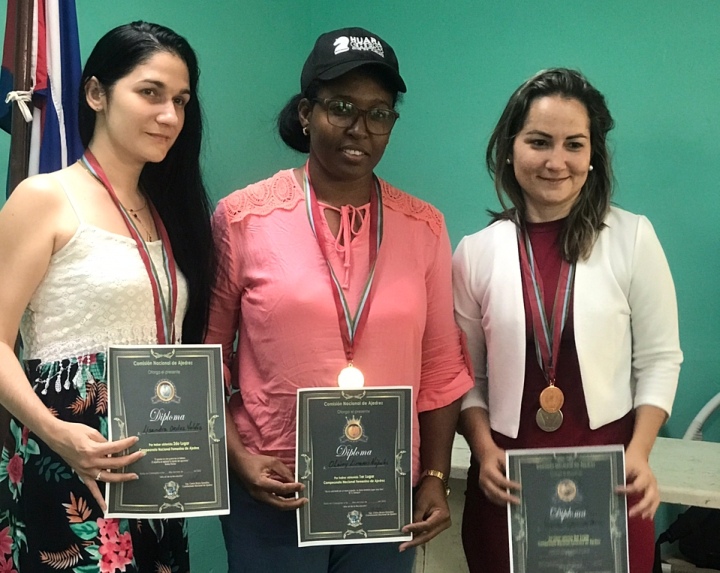
Oleiny Linares emerged as the winner of the 57th Cuban Women’s Championship. WGM from Santiago took her third national title in fierce competition with top-rated IM Lisandra Ordaz. The 12-player round-robin with classical time control took place in José Raúl Capablanca Academy in Camagüey from February 09-20. The event turned into an exciting race between Lisandra Ordaz (pictured below, left), WGM Yerisbel Miranda and Oleiny Linares (pictured below, right). Ordaz was in the lead for most of the event, but Linares caught up with her coming into the final round, while Miranda trailed by 1.5 points. In a dramatic final round, Ordaz suffered a defeat with the white pieces at the hands of Yaniela Forgas, whereas Linares drew her game with Yoana Gonzalez and clinched the title by scoring 8.5/11. The champion became the only paricipant to complete the tournament unbeaten. Lisandra Ordaz had to settle for silver. Yerisbel Miranda finished on 7/11 and took bronze. Final standings: 1 WGM Linares Napoles, Oleiny 2179 8½ 2 IM Ordaz Valdes, Lisandra 2312 8 3 WGM Miranda Llanes, Yerisbel 2269 7 4 WGM Forgas Moreno, Yaniela 2304 6½ 5 WGM Arribas Robaina, Maritza 2225 6 6 WFM Muniz Guevara, Amanda 2057 5½ 7 FM Hernandez Machado, Patricia 2143 5½ 8 WIM Hernandez Gil, Ineymig 2158 4½ 9 WIM Gonzalez Ochoa, Yoana 2104 4½ 10 WIM Obregon Garcia, Roxangel 2158 4 11 WFM Gutierrez Espinosa, Karen 2110 3½ 12 WFM Cabrera Ladron, Mayra 1923 2½ Photo: Federación Cubana de Ajedrez
Chess events to celebrate the International Women’s Day set in Tirana, Albania
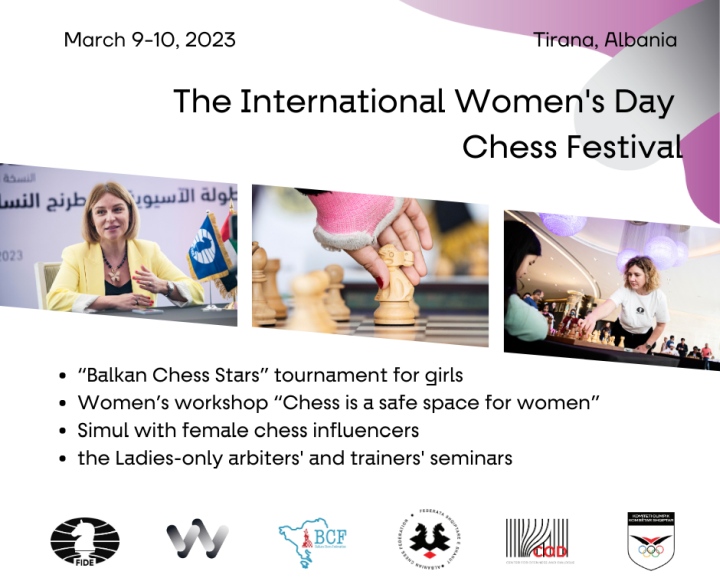
International Chess Federation, Balkan Chess Federation and Albanian Chess Federation, in collaboration with Albanian Center for Openness and Dialogue, are pleased to announce the International Women’s Day Chess festival, a series of chess events to celebrate the International Women’s Day and reinforce a commitment to women’s equality. The large-scale celebration will be held from March 9-19, 2023. It will start with the “Balkan Chess Star” tournament, the women’s workshop “Chess is a safe space for women”, organized with a contribution from ECU Women Commission, and a simul with female chess influencers, scheduled for March 9-10 in Tirana, Albania. The events will take place at COD – Center of Openness and Dialogue, located within the Prime Minister and Council of Ministers Edifice. The “Balkan Chess Star” blitz tournament is played by 16 girls born in 2007 and younger, representing all Balkan countries, who will first compete in 2 round-robin qualification events on March 9. The Final between the winners of each event is scheduled for March 10. Workshop and simul by chess influencers will feature Dana Reizniece-Ozola, WGM, FIDE Deputy Chair of Management Board; Antoaneta Stefanova, GM, former Women’s World Champion; Anastasia Sorokina, WIM, Chair of FIDE Commission for Women in Chess, international arbiter; Agnieszka Milewska, Director of the Women’s Chess in England; Carol B Meyer, Executive director of the US Chess Federation and Majlinda Pilinci, General Secretary of Albanian Chess federation, member of FIDE PDC Commission, international organizer. Programme of the festival: March 9 14:30 – 15:00 Opening ceremony with officials (FIDE, Albanian Ministry of Education and Sports, NOC Albania, Balkan Chess Federation, Albanian Chess Federation, special guests). 15:00 – 17:30 The “Balkan Chess Star” tournament. Qualification stage 17:30 – 20:00 Workshop “Chess is a safe space for women” Simul with female influencers March 10 10:30 – 13:00 The “Balkan Chess Star” tournament. Final stage 2-hour session with GM 14:00 The Closing Ceremony The events will be followed by the Ladies-only arbiters seminar held by IA Panagiotis Nikolopoulos (GRE), IA Mihail Prevenios (GRE), and IA Tshepiso Lopang (BOT) from March 10-12. The Seminar will award norms and titles of FIDE Arbiter and is open for national arbiters nominated by their federations. The Online FIDE Trainers’ Seminar for female trainers organized by the FIDE TRG Commission in partnership with the FIDE WOM Commission, scheduled for March 17-19, will finalize the celebration of International Women’s Day. Contact details: Majlinda Pilinci: pilincimajlinda@gmail.com Anastasia Sorokina: a.sorokina@fide.com