

Rising stars and surprises: Highlights from Rounds 1–2 of the FIDE Women’s World Team Championship
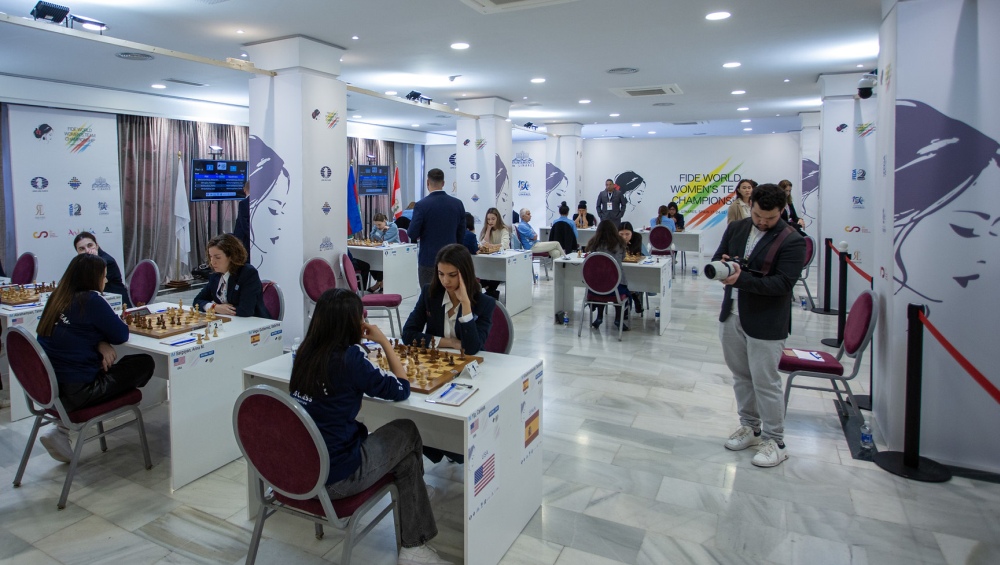
Savitha Shri B and Zhai Mo Shine with tactical brilliance while fast classical debut sparks excitement. Linares was one of the strongest chess tournaments in the world from the late 1980s through the 2000s, attracting Garry Kasparov, Anatoly Karpov, and many other elite players. At the start of each round of the Super-Tournament a large ceremonial gong was struck by a guest of honour to officially begin play. This ritual became one of Linares’s most memorable trademarks. It originated as part of the organizers’ effort to give the event a distinctive identity and elevate it to true world-class status. FIDE President Arkady Dvorkovich and FIDE Deputy President – and former five-time World Champion – Viswanathan Anand opened both rounds of the 2025 FIDE Women’s World Team Championship, reviving one of the most recognisable symbols of that earlier era. Each of the two pools in the event, A and B, features six teams that face one another in a round-robin format over five rounds. The top four teams from each pool will advance to the knockout stage, beginning with the quarterfinals. Most of today’s matches – played with the debuting 45 + 30 “fast classical” time control – were dominated by the rating favourites, though several encounters were decided by narrow 2.5–1.5 margins. After the first two rounds, Team FIDE has taken a commanding lead in Pool A, scoring convincing victories over the USA and Kazakhstan, while four teams sit just behind on 50%. Peru currently trails the group after losing both of today’s matches, against Azerbaijan and Spain, though not without putting up a resilient fight. On the other side of the hall, Pool B is led by China – playing without GM Hou Yifan – and Georgia, with India and Ukraine close behind. Great excitement is expected on day two, as rounds three and four are likely to determine the fate of several teams. One of the relative surprises of the day came in round one, where India defeated Ukraine despite being outrated by nearly 100 points. Although the current Olympic champions did not travel with their top lineup, they still field a young, cohesive, and ambitious team capable of challenging any opponent. On board three, IM Savitha Shri B (2319), playing White, controlled her game against GM Natalia Zhukova (2322) from early on, steadily building pressure on the kingside. Savitha is one of the brightest rising stars in Indian women’s chess, already progressing rapidly through high-level norms. Although White had several winning continuations, the Indian player struck decisively with 34.Rxf6!, tearing apart Black’s defensive structure. Zhukova replied with 34…Bc6+ (as 34…Qxf6 loses immediately to 35.Qxd7), but after 35.Qxc6! Rxc6 36.Rxf7, the former two-time European Women’s Champion had no choice but to resign. A clean and elegant tactical finish. Team captain GM Swayams Mishra and two of the players from the match later joined me in the interview area for a brief post-game assessment of their performance and of the new “fast classical” time control making its debut at this event. https://www.youtube.com/watch?v=d6R0GDyJOKk Meanwhile, the Chinese squad secured two convincing wins and, alongside Georgia, now leads their pool. On board four in their second-round match, WGM Zhai Mo (2384) delivered a spectacular miniature against WCM Madinabonu Khalilova (2228). Zhai Mo is a former Girls U12 World Champion and the 2018 Chinese Women’s Chess Champion. Black had just played 15…Bg7-f8, attacking the rook on d6 and attempting to provoke exchanges that might relieve the pressure. However, Zhai Mo responded aggressively with 16.Ng5!, sacrificing the exchange. After 16…Bxd6 17.exd6 Qd7 18.Ne4!, the weaknesses around the black king quickly became apparent. The decisive threat 19.Nf6+ was temporarily parried by 18…Kg7, but 19.Bb5! highlighted another vulnerability on e5. After 19…Bb7, White unleashed the final tactic: 20.Nf6!!, attacking the queen. Black resigned, as 20…Kxf6 21.Bxc6! Qxc6 22.Qe5 leads to an inevitable checkmate. A brilliant and clean finish from Zhai Mo. After the first two rounds of the tournament, the standings in both pools are as follows: Round three tomorrow at 1:30 pm promises some exciting encounters. In Pool A, the most intriguing match will be USA vs. Azerbaijan, as both teams vie for second place in the group. Close behind, Spain will aim to secure at least a draw against the formidable Team FIDE. https://youtu.be/nb8LA9s-K48?si=TA6AHrw7JvAJQ35Z In Pool B, the dramatic clash between France and Uzbekistan will provide both teams with a final chance to avoid elimination and potentially catch up with the leading teams. Round 3 begins on November 19 at 1:30 PM local time. The action can be followed live on the FIDE YouTube Channel, featuring expert commentary by GMs Antoaneta Stefanova and Ivan Cheparinov. Official website: worldwomenteams2025.fide.com/ Written by IM Michael Rahal (Linares, España) Photos: Raúl Martínez / Pavel Dvorkovich
FIDE World Cup: Three quarterfinals poised for decisive tiebreak battles
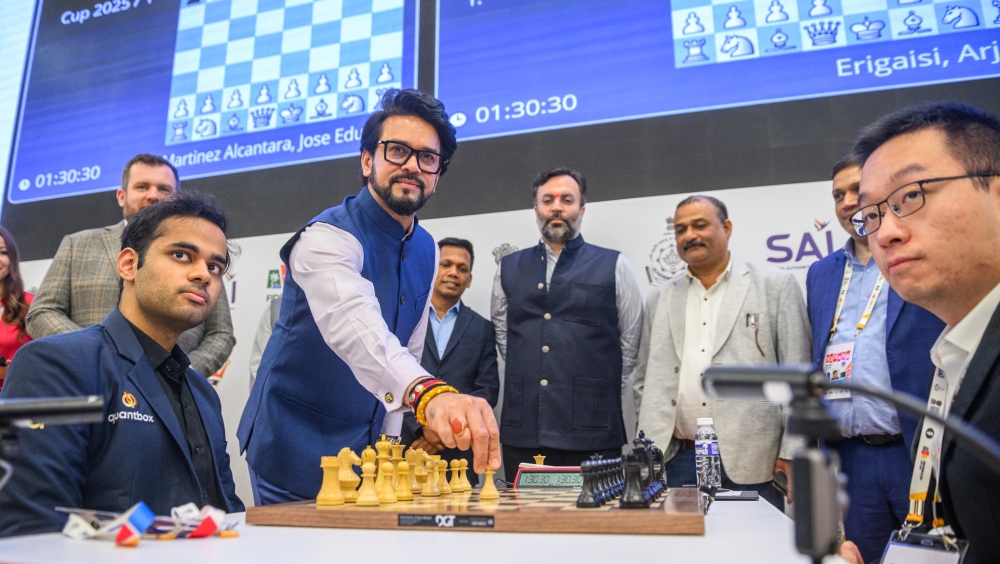
The tension was evident as players entered into the playing hall today, several arriving just minutes before the clocks were started, a sure sign of the pressure mounting at this decisive stage of the World Cup. The air in the playing hall was quiet and concentrated, yet packed with spectators eager to witness the eight remaining players in action. With only four spots in the semifinals, chess fans were treated to a blend of high-stakes precision and tightly controlled risk. The outcome was draws across all boards, meaning tiebreaks in three of them, and GM Nodirbek Yakkuboev advancing as the first semi-finalist after his victory over Alexander Donchenko yesterday. Before play began, the ceremonial first move was made by Mr. Anurag Singh Thakur, former Sports Minister of India, Member of Parliament, and Chairman of the Parliamentary Standing Committee on Coal and Mines on Board 2, for Erigaisi vs. Wei Yi. Quarterfinals Game 2 results: José Eduardo Martínez Alcántara ½-½ Javokhir Sindarov Arjun Erigaisi ½-½ Wei Yi Andrey Esipenko ½-½ Sam Shankland Alexander Donchenko ½-½ Nodirbek Yakubboev With the semifinal lineup still very much undecided, here’s a closer look at how each game unfolded today. Nodirbek Yakkuboev (2689) vs Alexander Donchenko (2641) Alexander Donchenko had a great deal at stake today. After fighting hard to survive the Round 5 tiebreaks, his classical loss yesterday left him in a must-win situation. He certainly tried, pushing until the very end, creating an imbalanced structure that forced Yakubboev to stay alert. The game followed the Exchange Variation of the Queen’s Gambit Declined, and Donchenko appeared well-prepared, gaining a 30-minute time advantage early on. However, despite his confident opening, his pace slowed and a series of imprecise choices led to a position where his winning chances faded. Black has just played the thematic 21…Bb1, aiming for a Ba2–c4 maneuver. While White has no obvious plan here, Donchenko chose one of the weakest options with 22.f3?, a move our commentators called “strange” as it gave Black easy counterplay. Yakkuboev responded with 22…f5 and followed through with his intended bishop maneuver, fully seizing the initiative. The critical moment came soon: White’s pieces were poorly coordinated, and the pawns on the third rank were vulnerable. Here, the powerful 26…Re8 could have posed major problems for White, especially with the threat of …Nb5 looming. If White tries passive defense with 27.Re1 Black builds up pressure with 27…Rb5 28.Rc2 Rb3. For instance, the natural-looking 29.Ng2 to guard the e-pawn is met by 29…Bd3 30.Rf2 (or 30.Rc3, also losing) 30…Bxb1 31.Rxb1 Nc4, leaving Black in full control. Instead, Yakkuboev started with 26…Rb5, allowing 27.Rg2. Though Donchenko escaped immediate danger, Black still held a comfortable edge. After further exchanges, the game entered a tense endgame where White appeared to retain some chances. However, Yakkuboev maintained accuracy and steered the game to a dead-even draw. With this result, he became the first player to qualify for the semifinals of the 2025 World Cup. Wei Yi (2752) vs Arjun Erigaisi (2773)As the only remaining Indian player in the field, Grandmaster Arjun Erigaisi carries significant expectations. Yet he has remained composed throughout the event, arriving calm at the board each day and greeting enthusiastic fans waiting (and chanting his name) outside. After a quick draw yesterday, today’s strategy was different – with the White pieces, Arjun prepared a fresh idea in the Queen’s Gambit Declined. Wei Yi, however, played confidently and quickly as well. The game soon left known theory and entered territory in which both players could just play chess. Tension started when Wei Yi chose to complicate with 18…c5, accepting an isolated queen’s pawn but gaining activity. The position suddenly became sharp: Arjun played the quiet-looking 20.Qe2 instead of the more natural 20.Qb1. Commentators GMs Jan Gustafsson and Peter Leko praised it as “strong and unexpected,” as it unpins the queen while provocatively placing it opposite Black’s rook and hinting at Na4 ideas. It posed psychological pressure. Wei Yi spent over 30 minutes here, visibly unsettled and shifting in his chair, before deciding on 20…Qc6. After 21.Nd2, however, Black 21…Nd7? (21…Nh5 was the better choice – we will get into that mess later, so bear with me if you want to get into deep analysis) allowing a tactical sequence: 22.Nb3 Bxc3 23.bxc3 Rxc3 Here Arjun had a golden opportunity – 24.Bxd5! and after 24…Qc8 25.Rxc3 Qxc3 White simply captures a free pawn with 26.Bxb7. Black also can choose 24…Qxd5 – and here is why the earlier mistake of 21…Nd7 matters. 25.Rxc3 Ng5 26.e4 (only move to keep the advantage and stop …Nf3), 26…Rxe4 27.Rd1! And the d7-knight is ill-placed and hanging. Instead, Erigaisi played 24.Qd2? and after 24…Rxc1 25.Rxc1 Qa6 26.Bxd5 Nf6! Wei Yi equalized and the game was drawn on move 32. Now let’s go back to the better 21…Nh5 which makes the difference. Now 22.Nb3 Bxc3 23.bxc3 Rxc3 24.Bxd5 does not hold the same venom after 24…Qxd5 25.Rxc3 Ng5 26.e4 Rxe4 and Black’s pieces, particularly the knights, are very active. The same idea we saw in the previous line of 27.Rd1 is a big blunder because of the desperado 27…Qxb3! And suddenly Black would be winning. This tactic would not be the same with the knight on d7. All of this analysis just goes to show how small nuances of a position can affect the evaluation but only surface moves later, and it’s curious to know whether all of this was seen. After intense days like these, we don’t corner the players for interviews, but after tomorrow I will definitely find out from the match’s victor how much was calculated here. Javokhir Sindarov (2721) vs José Eduardo Martínez Alcántara (2644)The draw between Sindarov and Martínez was the most curious result of the day, not for the score, but for how swiftly it was achieved. The players entered a known drawing line in the Four Knights Spanish and followed the theory to a peaceful result in just 20 minutes. For Martínez, who had the White pieces and momentum from previous rounds, it
Flamenco, speeches, and chess: Linares hosts 2025 FIDE Women’s Team Championship
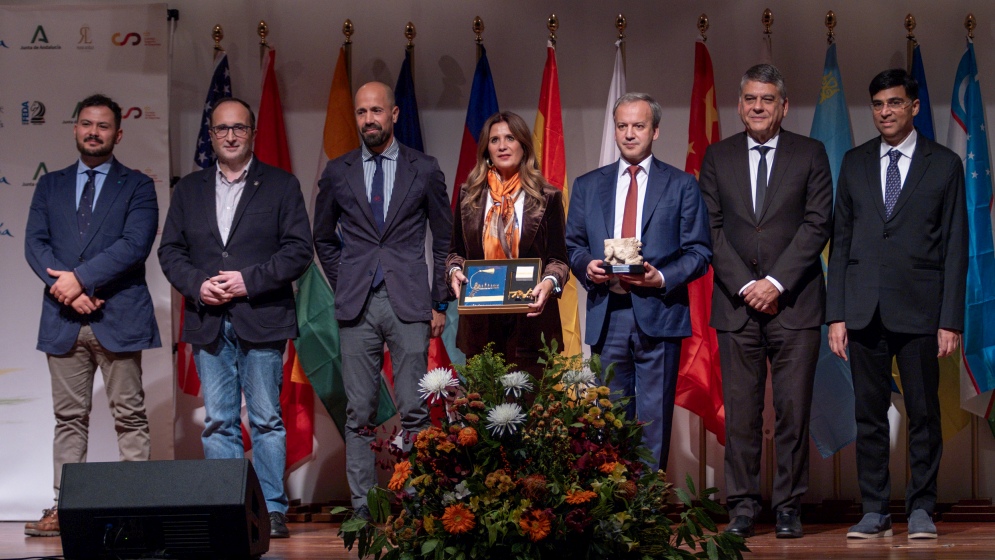
El Pósito, a fully restored 18th-century building, now serves as an exhibition space where visitors can explore the essence of Linares, in the province of Jaén (Spain). The center brings together the city’s history and cultural heritage, giving special prominence to mining and the art of flamenco. It was therefore fitting to enjoy a vibrant performance of Spanish flamenco, which delighted an audience of over two hundred players, officials, and guests, interwoven with inspiring speeches from dignitaries and chess leaders. Olivia Aranda, presenter of the opening ceremony, welcomed everyone promptly at 7 p.m., noting that Linares, with its rich history and heritage, provides the perfect setting for the 2025 FIDE World Women’s Team Chess Championship. After the audience stood for the Spanish and FIDE anthems and enjoyed a promotional video about Linares, they were treated to a spectacular fifteen-minute flamenco performance featuring José Manuel Cuenca on piano, Nazareth Romero singing, and Rosa González dancing. Immediately afterward, Auxi del Olmo Ruiz, the Mayor of Linares, took the floor. In an inspiring three-minute speech, she greeted the authorities, players, and guests, reminding everyone of the city’s deep chess history – a tradition that began in 1978 with the first Linares Tournament. She also highlighted that last year the Ibero-American Championship, along with several other Spanish national championships, was held in the city. In addition, she announced that Linares and the Spanish Chess Federation had signed a three-year sponsorship agreement to host numerous events. Next, Javier Ochoa de Echagüen, President of the Spanish Chess Federation, and Gorka Lerchundi Rebollo, Director General of Events and Sports Facilities for the Regional Government of Andalusia, gave uplifting speeches, emphasizing the city’s strong commitment to chess. Arkady Dvorkovich, President of the International Chess Federation, then took the stage. He impressed everyone with his excellent command of Spanish during a two-minute speech, expressing his gratitude to the Government of Andalusia and the city of Linares for hosting the tournament in a city with such a remarkable chess tradition. In a moment of great tenderness, Dvorkovich shared that it was his first visit to Linares, but that his father had visited the city many times, serving the Linares Tournament in various capacities, leaving him with fond memories. He concluded by officially opening the championship. Following the speeches, the ceremony continued with the drawing of lots to determine the pairings for each round. Viswanathan Anand, Deputy President of the International Chess Federation, and Jesús Mena Sarasola, Chief Arbiter of the championship, invited the team captains onto the stage. Anand greeted the audience and fondly recalled his first visit to Linares thirty-five years ago, sharing how meaningful it was to return. By selecting a bottle of olive oil numbered from one to six, each captain determined the starting number for their team in their respective pool, and the ceremony concluded with a group photo of each pool. With the drawing of lots complete, the Mayor of Linares and the FIDE President returned to the stage to exchange gifts, followed by a final group photo with all authorities. To close the ceremony, Olivia Aranda thanked everyone for attending, expressed her hope that the championship would run smoothly, and wished the chess players the best of luck. Round 1 begins on November 18 at 1:30 PM local time. The action can be followed live on the FIDE YouTube Channel, featuring expert commentary by GMs Antoaneta Stefanova and Ivan Cheparinov. Official website: worldwomenteams2025.fide.com/ Written by IM Michael (Linares, España) Photos: Raúl Martínez
FIDE World Cup: Tight starts in quarterfinals as only Yakubboev strikes
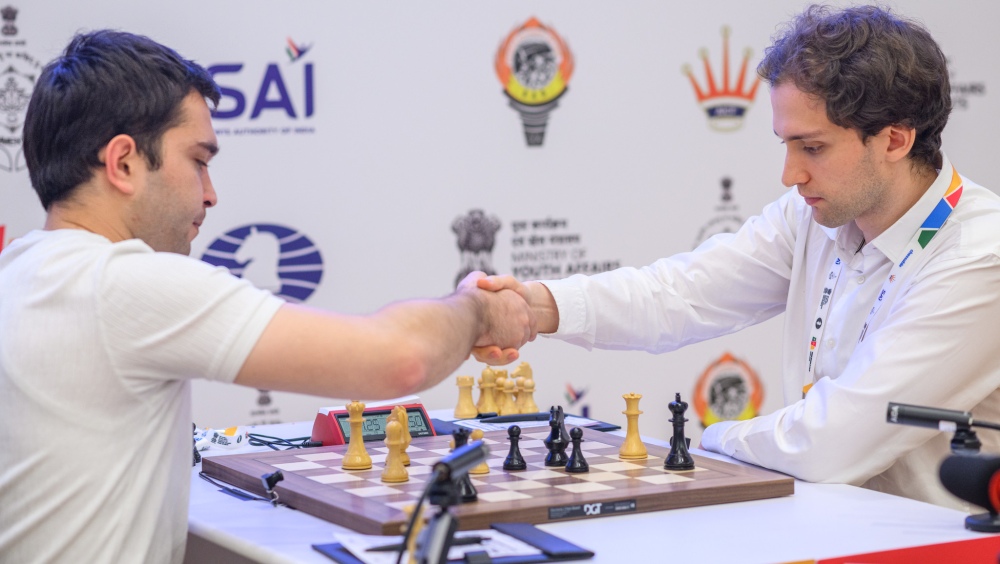
The quarterfinals have arrived at the FIDE World Cup 2025 in Goa, and the stakes could not be higher. Eight players remain, none of whom have qualified for the FIDE Candidates before. The field is a mix of seasoned super grandmasters and inspired underdogs, all of whom have battled tiebreaks on their journey here. Today, with no easy matchups and everyone hungry for a breakthrough, the questions were simple: Who would strike first? Who would hold their nerve? Some players opted for safety from the start: Wei Yi vs Arjun Erigaisi saw lightning-fast preparation and 99% accuracy from both sides, ending in a draw within an hour. Whereas Nodirbek Yakubboev vs Alexander Donchenko saw a chaotic game, and the only decisive one of the day. The atmosphere was calm but charged. The ceremonial first moves, 1.Nf3 d5, were played on Board 2 (Wei Yi vs. Arjun Erigaisi) by Shri Alok Kumar, IPS, Director-General of Police of Goa, and Gourav Rakshit, Global Chess League Commissioner. Quarterfinals Game 1 results: Javokhir Sindarov ½–½ José Eduardo Martínez Alcántara Wei Yi ½–½ Arjun Erigaisi Sam Shankland ½–½ Andrey Esipenko Nodirbek Yakubboev 1–0 Alexander Donchenko Nodirbek Yakkuboev (2689) vs Alexander Donchenko (2641) According to GM Peter Leko, this was “the game of the day,” and indeed, it could have gone in multiple directions. Nodirbek Yakubboev entered the round fresh, having not dropped a single game, but without facing a player rated above 2650. Alexander Donchenko, on the other hand, the lowest seed remaining, has been fighting giants all event, eliminating Candidates-qualifiers Anish Giri (2769) and Matthias Blübaum (2680), and surviving a nerve-wracking tiebreak against Lê Quang Liêm (2729). When asked about his choice to play the Alekhine Anti-Grünfeld setup (1.d4 Nf6 2.c4 g6 3.f3), Yakubboev said he wanted a “complicated but solid central structure.” Early on, Donchenko overoressed instead of completing development. In this early position, the safe retreat 11…Ng7 would have been best, but Donchenko went for the aggressive 11…Qh4? Black prevented White from castling but at unacceptably high price. White’s king found a safe heaven on c2, while Black’s pieces were awkwardly misplaced. Things went from bad to worse for Doncheko as he had no active plan, while Yakubboev gradually improved his position and secured the decisive advantage by move 20. The final blow occurred right after the time control. White finished off nicely with 42.Qb8+ Re8 43.Rg8+ Kxg8 44.Qxe8+ and Black resigned. In the post-game interview, Yakubboev exuded confidence, not just about qualifying for the Candidates but going all the way to win the World Cup. Tomorrow he has the black pieces and will need only a draw against the German Grandmaster to seal his spot in the semi-finals. On paper, this task seems simple enough, but the stress brought on by the World Cup can drastically alter that at any point. https://www.youtube.com/watch?v=tCIutOPMjWQ Javokhir Sindarov (2721) vs José Eduardo Martínez Alcántara (2644) Jose Martinez has had an incredible World Cup run, eliminating multiple top players in his wake – Nodirbek Abdussatorov (2750), Alexey Sarana (2675), and most recently, Pentala Harikrishna (2690). His momentum has been fueled by confidence, incredible preparation, and belief that his current strength is much more than his rating suggests. I think few players in the field could match this ambition as much as his opponent today – Javokhir Sindarov, the 19-year-old Uzbek star who earned his title at the mere age of 12, and is just a handful of points away from becoming Uzbekistan’s number one – overtaking Nodirbek Abdussatorov. A difference between the two, which could influence their approach to the classical segment, is their view of the faster time controls. Martinez thrives in the adrenaline of fast-paced chess, having even recently won Chess.com’s first edition of 3+0 Thursdays. Sindarov, on the other hand, had stated in his first interview with me that blitz is not his “type of chess”. Their first encounter featured a Queen’s Gambit Accepted line that has historically favoured White. Both players appeared to be well versed until Sindarov, playing with the white pieces, offered an early queen trade, which got Jose thinking – a rare occurrence for the Peruvian-Mexican grandmaster in the opening stage. Perhaps a sign of leaving his preparation and knowledge of the position. Despite the queenless middlegame, there was still a lot of play for both sides. Martinez, who at some point seemed more passive with the black pieces, and all pieces tied to the 6th-8th ranks, finally managed to break through with some space and simplifications. The resulting endgame saw both sides with four pawns each, white two knights and black a knight and a bishop. Then, a critical moment arose, when Martinez, with less than two minutes on his clock played incorrectly, giving White a chance: Here, Black has just played 33…f5, leaving the h6-pawn hanging. Sindarov however opted for 34.Ne5 – a nice-looking move if there hadn’t been a free pawn to capture (albeit at the expense of a somewhat awkward knight trapped on the rim after 34.Nxh6 Bc8 35.g4 Kf8 36.b6 Kg7 37.g5). A few moves later, the game was drawn. Wei Yi (2752) vs Arjun Erigaisi (2773) The heavyweight clash of the round featured two of the tournament favorites, both world-class talents with an eye on qualification. The downside: only one will progress. Both players arrived early at the board and looked relaxed. Their game followed a solid line of Closed Ruy López. Erigaisi, playing Black, blitzed out every single move and finished the entire game with more time on his clock than when he started – clear evidence of deep preparation. Both players showed perfect control: 99% accuracy, zero mistakes or inaccuracies, and a draw by repetition on move 31. A quiet start, but as the commentators noted, this match has all the ingredients for a fierce fight in Game 2. Sam Shankland (2654) vs Andrey Esipenko (2693) Between them, these players have appeared in ten World Cups. Both had their best runs in 2021: Shankland reached the quarterfinals before losing to
Commonwealth Championship 2025: Daniel Howard Fernandez lifts crown; India shines across categories
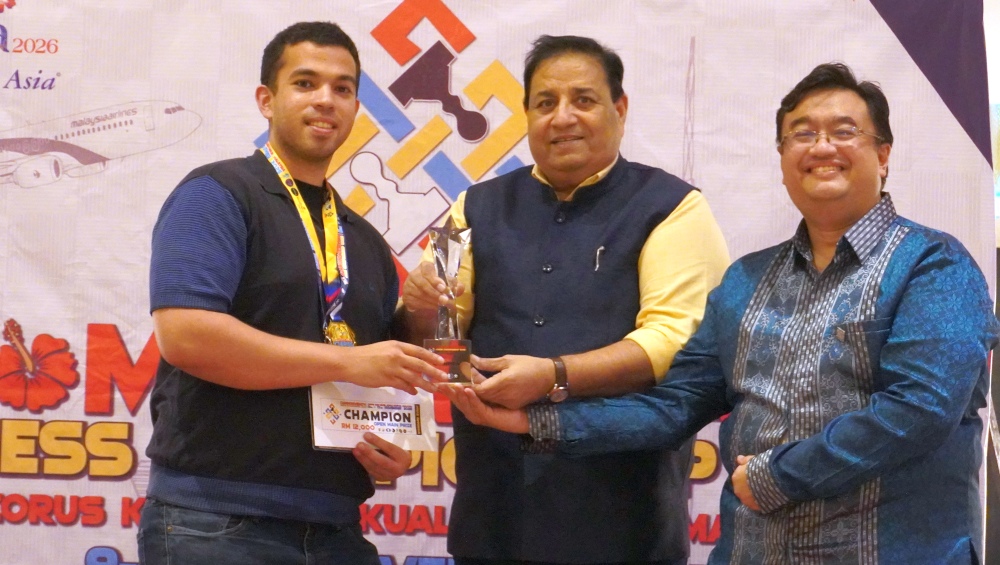
English Grandmaster Daniel Howard Fernandez was crowned Commonwealth Champion as the 2025 Commonwealth Chess Championship concluded on Sunday. Organized by the Malaysian Chess Federation under the auspices of the Commonwealth Chess Association and FIDE, the event brought together 373 players from 17 nations, making it one of the most vibrant editions in recent years. Howard’s steady and confident performance earned him the title with an impressive 7.5/9 points, after he drew his final-round game against India’s FM Adireddy Arjun. The race for second place was fiercely contested, with four Indian players finishing on 7 points. Tiebreaks awarded FM Adireddy Arjun (pictured below) the silver medal and GM Lalit Babu M R the bronze, followed by IM Neelash Saha and GM Deepan Chakkravarthy in fourth and fifth place, respectively. In the Women’s category, which was integrated with the Open event, India demonstrated overwhelming dominance by sweeping the podium. Srija Seshadri captured the gold medal with an impressive performance, while Mary Ann Gomes secured silver and Nisha Mohota claimed bronze. Category highlights The tournament featured a wide range of categories, each showcasing spirited battles and outstanding performances from emerging talents across the Commonwealth. Junior categories: Under-20 (Junior): Singapore’s Goh Zi Han (Gold), Bangladesh’s Tashriq Saihan Shan (Silver), Malaysia’s A’qil A’lauddin Bin Abd Aziz (Bronze). Junior Girls: Sri Lanka’s Sandula K M Dahamdi (Gold), India’s Mrittika Mallick (Silver), Singapore’s Liew Tze Chi (Bronze). Senior: Malaysia’s Ismail Ahmad (Gold), Kenya’s John Mukabi (Silver), India’s IM Sekhar Chandra Sahu (Bronze). Open youth categories: Under-08: Malaysia’s Muhammad Aariz Daniel Bin Mohd Shah (Gold), India’s Prayank Gaonkar (Silver), Sri Lanka’s Basnayake Kevon Dulkith (Bronze). Under-10: Sri Lanka’s CM Karunasena A P Chenitha Sihas Dinsara (Gold), India’s Parv H Hakani (Silver), India’s Nidhish Shyamal (Bronze). Under-12: India’s CM Madhvendra Pratap Sharma dominated with a perfect 9/9 points (Gold), Singapore’s AFM Aaradhya Suyog Bagul (Silver), Sri Lanka’s CM Wijerathna Vinuka Dihain (Bronze). Under-14: India’s AIM Adhiraj Mitra (Gold), Sri Lanka’s Wickramasinghe V W A Vinuda Vidmal (Silver), India’s FM Reyan Md. (Bronze). Under-16: India’s IM Borgaonkar Akshay (Gold), Sri Lanka’s Induwara T H D Thisarindu (Silver), India’s CM Velavaa Ragavesh (Bronze). Under-18: India’s IM Sriram Adarsh Uppala delivered a dominant performance with 9 points (Gold), India’s Borkhetariya Devarsh M (Silver), Singapore’s Lee Tsuen Jin Aiesec (Bronze). Girls’ youth categories: Under-08: An Indian sweep with Anaya Sharma (Gold), Anvi Deepak Hinge (Silver), and Teesha Byadwal (Bronze). Under-10: India’s Vanshika Rawat (Gold, 8/9 points), Malaysia’s Maha A/P Nathan (Silver), India’s Kiyanna Parihaar (Bronze). Under-12: India’s WCM Divi Bijesh (Gold), Singapore’s Liew Tze Yu (Silver), Australia’s Daniel Suria (Bronze). Under-14: India’s Aditri Shome (Gold, 8.5/9 points), Sri Lanka’s De Silva B P Chanthuli Thanishka (Silver), India’s WFM Saranya Devi Narahari (Bronze). Under-16: Another Indian sweep with FM Prishita Gupta (Gold), Ananya Raman (Silver), and Aswinika Mani R (Bronze). Under-18: India’s Sagar Siya (Gold), India’s WCM Anupam M Sreekumar (Silver), Bangladesh’s WCM Omnia Binta Yusuf Lubaba (Bronze). The championship concluded with a vibrant closing ceremony, where Bharat Singh Chauhan, President of the Commonwealth Chess Association, and Akhramsyah Muammar, President of the Malaysian Chess Federation, presented the awards. The 2025 edition not only celebrated exceptional individual talent but also highlighted the growing depth and competitive spirit across Commonwealth nations, reaffirming the event’s status as a landmark festival of chess. Complete results are available on chess-results.com.
FIDE launches Global Survey on Chess in Education
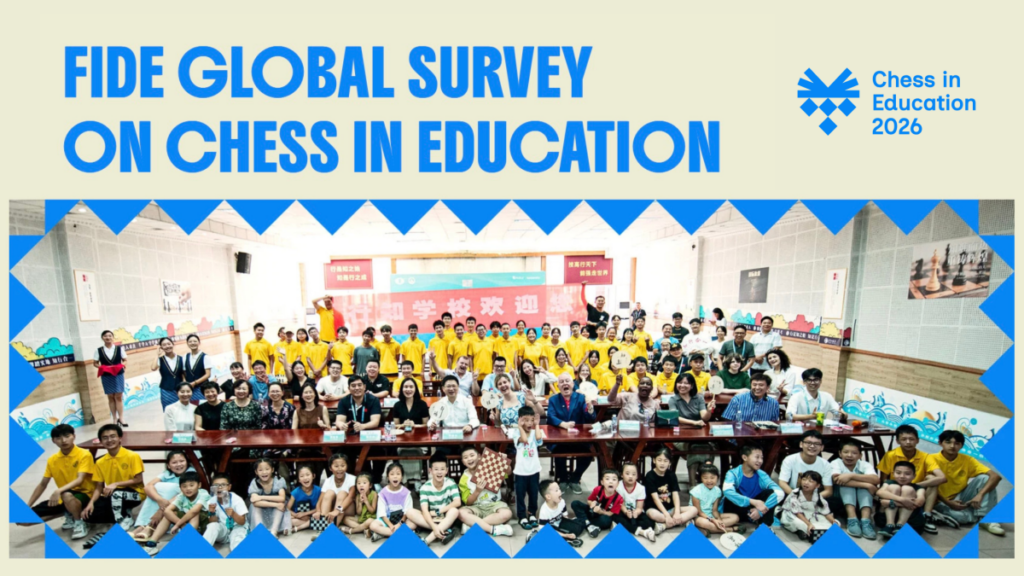
The International Chess Federation (FIDE) has announced the launch of its Global Survey on Chess in Education, inviting federations, schools, and partner organizations worldwide to participate before February 28, 2026. This initiative aims to gather essential insights to guide FIDE’s Educational Strategy and Action Plan for 2027–2030, ensuring that chess continues to grow as a powerful tool for learning and inclusion. In his official message, FIDE President Arkady Dvorkovich emphasized the importance of this effort, recalling the success of the 2021 survey which revealed that more than 25 million children and 237,000 teachers and trainers were already engaged in educational chess. Since then, FIDE has expanded training courses, launched certification systems, organized international conferences, and facilitated research projects worldwide. The new survey will: Identify global trends in educational chess and strengthen FIDE’s policies. Support visibility and recognition at the highest international levels, with results to be shared with UNESCO, UNICEF, ministries of education, universities, and NGOs. Encourage participation by confirming that survey responses will be taken into account when awarding Chess in Education grants in 2026. Prepare the ground for a landmark initiative: 2026 has been declared the Year of Chess in Education, celebrating and expanding chess as a medium for learning and growth. FIDE warmly invites all federations, schools, and partner organizations to contribute to this important effort. By participating, stakeholders will help demonstrate the global power of chess as an educational catalyst, attract new sponsorship opportunities, and empower millions of children, teachers, and communities worldwide. The survey is available in English, Spanish, and Russian. Please read the Presidents s letter and access the Global Survey [HERE].
FIDE World Cup: Quarterfinals set after high-stakes Round 5 tiebreaks

The FIDE World Cup in Goa reached a boiling point today as four intense tiebreak matches unfolded, each with a place in the quarterfinals on the line. With no more second chances and yesterday’s classical draws setting the stage, today’s rapid and blitz battles brought drama, tension, and decisive outcomes across the board. Before the games began, the ceremonial first move was made for Lê Quang Liêm on Board 2, by Mr. Kedar J Naik, Member of the Legislative Assembly of Goa and Chairman of the Goa Tourism Development Corporation. Sam Shankland and Andrey Esipenko secured clean wins early in the first rapid portion against Daniil Dubov and Alexey Grebnev respectively, while José Martínez defeated Pentala Harikrishna in the 10+10 rapid. Alexander Donchenko took Lê Quang Liêm into blitz territory before stamping his ticket to the next round. The quarterfinal lineup is now complete, and as the dust settled, four more players advanced with confidence and momentum on their side. Round of 16 tiebreaks results: Daniil Dubov 1-3 Sam Shankland Andrey Esipenko 2.5-1.5 Aleksey Grebnev José Martinez 3.5-2.5 Harikrishna Pentala Alexander Donchenko 4.5-3.5 Lê Quang Liêm Here’s how the day played out: Daniil Dubov – Sam Shankland In earlier interviews, Daniil Dubov made no secret of his strategy: to steer matches into tiebreaks. As a former World Rapid Champion, he felt this format played to his strengths. He also claimed that playing solidly with White and pushing with Black was the best way to capitalize on opponent’s overextending. But today, Sam Shankland flipped that plan on its head. Playing White in the first rapid game, he unleashed a novelty in the opening that led to an imbalanced position and early initiative on his side. With pressure mounting and the clock on his side, Shankland methodically limited Dubov’s options. Dubov, rarely short of creative ideas, struggled to find counterplay and instead fell into mistake after mistake, resulting in a convincing win for the American. The second game, a symmetrical English, saw early queen exchanges and a dry position that offered little for either side. A draw seemed impending, but Dubov overpushed in the endgame, losing the game and with it, his World Cup run came to an end. After the match, Shankland reflected on reaching the quarterfinals once before in 2021, a run that ended painfully at the hands of Sergey Karjakin in tiebreaks. “That’s haunted me ever since,” he admitted, adding that he now hopes to “banish the demon” for good. https://www.youtube.com/watch?v=PTRXDSWaWkA Andrey Esipenko – Alexey Grebnev It raised eyebrows when Andrey Esipenko took relatively quick draws in his classical games against Alexey Grebnev. But if anyone doubted his strategy, the first rapid game removed all uncertainty. After a Petroff turned into a wild opposite-side castling battle, Esipenko seized the initiative by move 14 and was in complete control by move 20. It was a dominant win. The second game was a stark contrast and stretched all the way to move 145. Esipenko, now with Black, came out of the opening in a stable position. When it looked like both players were shuffling pieces with no progress, Esipenko made a bold choice to open up the queenside. This ambition backfired with a missed tactic, and suddenly Grebnev was up a pawn. But nerves kicked in and Grebnev misplayed the critical move order and let Esipenko seize control once more The game soon turned into a technical endgame with each side down to a rook and Grebnev holding two pawns to Esipenko’s one. Esipenko, calm and prepared, navigated the position to a theoretical draw. Ironically, by move 145, both players had more time on their clocks than they did on move 50. With this match victory, Esipenko reached the deepest stage of a FIDE World Cup in his career. Harikrishna Pentala – José Martinez This was widely expected to be the longest match of the day, especially after the first two rapid games ended in uneventful draws. Much of the chatter centered around José Martínez’s reputation as a blitz expert, regularly beating the world’s best online. That meant Harikrishna’s best chances were in the rapid phase. In their first rapid game, the players entered a Richter-Rauzer Sicilian and while both appeared prepared, a few subtle inaccuracies left Harikrishna with isolated doubled pawns and passive pieces. Martínez, whose pieces worked seamlessly together, activated his rooks and pushed the kingside majority. The result was a smooth breakthrough and the first decisive game of their match – a must-win situation for Harikrishna in game two. In the second game, Harikrishna opted for an offbeat Caro-Kann with …Na6 on the third move, likely intending to avoid his opponent’s preparation. The opponents quickly entered unexplored territory and a critical position arose at move 21: Harikrishna quickly played 20…Nd3?, a move which our commentator Peter Leko exclaimed is a good move if it does not lose. Martinez had to see the important move 21.g4! and after 21…Qe4 suddenly 22.Bxf7+ gives White a huge advantage as capturing is not possible due to Ng5. Instead, Martinez played 21.Rad1 and the position became equal once more. In his post-game interview, he acknowledged seeing this line but decided to not enter the complications. Even so, the move g4 was played a few turns later, this time with full effect. Harikrishna erred instantly and Martinez seized a decisive advantage. With everything in hand, Jose chose a threefold repetition to seal the draw and punch his ticket to quarterfinals. In his interview, Martinez issued a spirited challenge to the field: “Those who want to go far in this World Cup have to get through me.” With his confidence and composure, it’s easy to see why he’s becoming one of the breakout names of the tournament. https://www.youtube.com/watch?v=x8VM1iNxW9s Alexander Donchenko – Lê Quang Liêm The last match of the day to finish briefly seemed like it would actually be the first match to finish after Alexander Donchenko struck first with the black pieces. After yesterday’s tense and heartbreaking draw where one misstep in the
WCCC 2025: Greco crowned the smartest company in the world

The final day of the 2025 FIDE World Corporate Chess Championship saw Greco crowned Corporate Chess Champions and officially recognised as the smartest company in the world. After an intense round-robin phase, the competition moved to the semi-finals, where the four strongest teams – Morgan Stanley, Greco, Deloitte, and Google – faced off in knockout matches to decide the title. By the end of the afternoon, Greco had emerged victorious after a closely contested final against Morgan Stanley, bringing this year’s championship to a dramatic finish inside the FIDE World Cup hall in Goa. Excitement filled the room from the first move. Whether it was the thrill of representing their companies on a global platform, being within reach of a world title, or competing in the same hall as the World Cup, the players (all non-professionals) were fully focused. Almost every board featured titled competitors, and the chess was intense from the outset. Semifinals The semifinals featured Morgan Stanley vs Google and Greco vs Deloitte, with each match played over two rounds. In the event of a tie, a sudden-death game would have been used to decide the winner. In the match between Morgan Stanley and Google, the rating difference was clear, with Morgan Stanley outranking their counterparts by 200 to 500 points on every board. They confirmed their status as favourites by sweeping both rounds 4-0. With a perfect 8-0 match score and not a single half-point conceded, Morgan Stanley cruised into the finals. The encounter between Greco and Deloitte was more tightly contested. On paper, Greco had the edge thanks to the presence of GM Volodymyr Onyshchuk (2608) on the top board. They took the first match 3.5–0.5. As IM Sagar Shah observed on the live ChessBase India broadcast, the second match was significantly closer, with Deloitte holding a draw on board two and pushing on others. In the end, Greco repeated the same match score of 3.5-0.5 to book their spot in the finals. FINALS Morgan Stanley vs Greco The championship match between Morgan Stanley and Greco brought the two strongest teams of the event head-to-head. The matchups were finely balanced: Greco outrated Morgan Stanley on boards one and four, while Morgan Stanley held the rating edge on boards two and three. The opening round reflected this balance. GM Joshua Sheng struck first for Morgan Stanley, securing victory on board two. On the remaining boards, the clock played a significant role as the 10+3 time control led to scrambles in equal or better positions. The first round ended in a tense 2-2 draw, setting up a dramatic second match. GM Alojzije Janković, commenting on-site, compared some of the positions to those in the World Cup itself, noting the remarkably high level of chess across all boards. Despite the rating differences, the tides shifted throughout, leaving spectators and commentators on edge. In the end, Greco prevailed with a commanding 3.5-0.5 win in the second match, securing their place as 2025 World Corporate Champions. Deloitte vs Google In the bronze medal match, Deloitte took the early lead with a 3-1 win in the first round and repeated the same result in the second, securing third place in the championship. Their play was solid and consistent under pressure, earning them a podium finish behind the two tournament frontrunners. Game of the tournament One encounter stood out as a highlight of the entire championship. IM Sagar Shah called it the game of the tournament. In the position after 31…Qe4-Qc6, GM Joshua Sheng (White) was a piece down against IM Valeriy Grinev, but engines evaluated it as equal due to White’s activity. The commentators pointed out the stunning tactical opportunity: 32.Qxg7! The queen cannot be captured as 32…Rxg7 fails to 33.Rxd8#. The only defense for Black in this case would have been 32…Qe8, still holding equality. Instead, Sheng played 32.Rd6, and after 32…Qh1+, the game was drawn soon by three-fold repetition. Chess and business share a natural connection. Both require strategic planning, flexibility under pressure, and precise decision-making in complex situations. More companies are embracing chess not just as a recreational pastime, but as a tool to develop these skills among employees. Internal chess clubs, learning sessions, and corporate tournaments form part of a workplace culture built around challenge and collaboration. On today’s broadcast, WGM Keti Tsatsalashvili recalled visiting Meta’s offices after last year’s finals in New York, where she found chess boards in most rooms and learned the company even maintains its own internal rating system, an example of how deeply chess is woven into corporate environments. This movement toward chess in the workplace is evident at the FWCCC. Grandmaster Praggnanandhaa, who made the ceremonial first move yesterday, commented, “It’s great to see big companies like Google, Microsoft, Deloitte, Tech Mahindra all here… it shows how chess is expanding into the corporate world,” adding, “If companies find chess interesting and join, even in a small way, it’s great for the game.” As Gabor Szamoskozi from Morgan Stanley shared, “We’ve been running an interoffice chess tournament for more than a decade now. Participation has grown, more than 1,000 players take part every year.” He added, “Chess teaches us to think ahead under time pressure, just like in business. It’s no surprise the game resonates so well with people in our field.” The trend goes beyond office walls. Leading companies now support chess at the highest levels, from Google sponsoring the 2024 FIDE World Championship Match, to Morgan Stanley supporting Judit Polgar’s Global Chess Festival, and Tech Mahindra’s continued backing of the Global Chess League – to name a few. The FIDE World Corporate Chess Championship reflects this growing synergy, bringing together teams who apply the same analytical thinking and teamwork on the chessboard that they use in their daily work. It’s a clear sign that modern business culture values intellectual challenge, community, and strategic excellence in equal measure. Companies interested in joining this movement and competing at next year’s FWCCC are encouraged to contact FIDE for early registration and participation details.
World Cup Round 5 Game 2: Chinese momentum, Uzbek steel, and Armenian tragedy in a thrilling day of chess
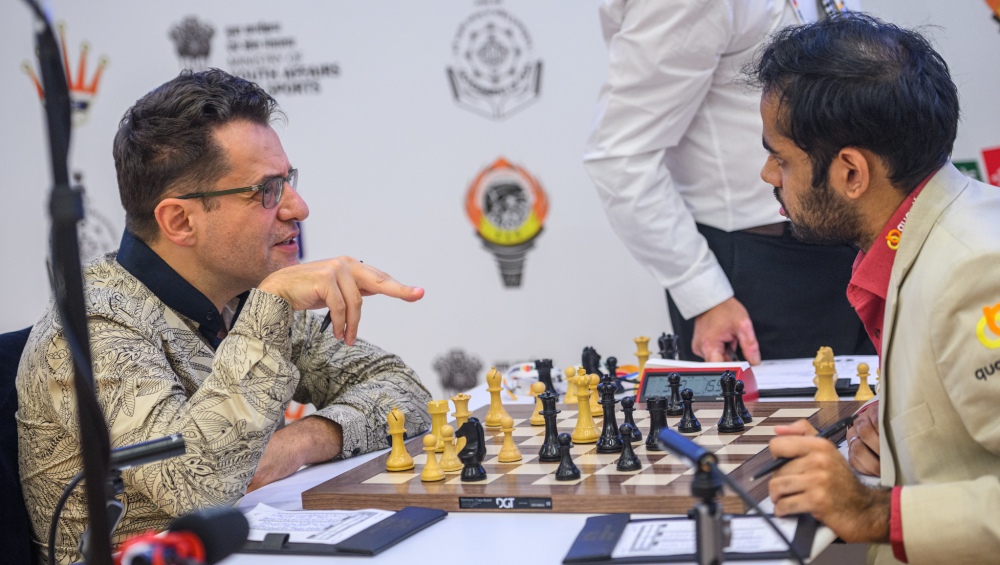
Round after round, the FIDE World Cup in Goa continues to deliver high-level chess and gripping storylines. Today’s classical games brought a mixture of precise technique, strategic battles, and edge-of-the-seat tension, with several matches heading toward the inevitable tiebreaks. From commanding wins to miraculous escapes, the field once again showcased the depth and fighting spirit of the world’s elite players. It was a difficult day for Armenian chess, marked by the sudden and emotionally heavy exit of two of its most iconic figures. Levon Aronian, once the heartbeat of Armenian teams and now a pillar of American chess, fell after a tense, error-studded battle. Minutes later, Gabriel Sargissian, long admired for his team heroics and impeccable opening preparation, also bowed out after a single, costly misstep. Their simultaneous elimination closed a chapter of resilience and brilliance that has defined Armenian chess for two decades. But if anyone needed a reminder of the steely resolve that made Uzbekistan Olympiad champions, today’s games provided it. Under pressure, under fire, or under the clock, the Uzbek players simply refused to break. Javokhir Sindarov coolly neutralized every attempt to unbalance him, while Nodirbek Yakubboev struck with cold precision to secure his spot in the next stage. Their collective discipline and composure have become one of the defining narratives of the event: unyielding, confident, and remarkably mature for such a young squad. Let’s take a closer look at this afternoon’s action in the Goa Resort Rio. With so much at stake, it was clear from the outset that several matches were destined for the tiebreaks. And indeed, the first two games to finish — just shy of the two-hour mark — were precisely the two I had predicted before the round began. The round was officially opened by GM Humpy Koneru, runner-up of the Women’s World Championship and reigning two-time Women’s World Rapid Champion, who performed the first ceremonial move on Board 3 for former World Rapid Champion GM Daniil Dubov. GM Daniil Dubov’s (2684) classical-game strategy in this event has been remarkably consistent: minimise risk, avoid unnecessary complications, and steer the match toward rapid tiebreaks, where he excels as a former World Rapid Champion. It was therefore no surprise that he opted to reproduce a line from a previous game between GM Sam Shankland (2654) and GM Dmitry Andreikin in the Grünfeld Defence: a highly theoretical path that, with accurate play, leads almost inevitably to a draw. In this variation, Dubov sacrifices a pawn, but with precise moves there is virtually no danger of losing (or winning). A 99% accuracy rate tells the story well enough. I caught up with Shankland as he was leaving the venue. After congratulating him on his performance so far, he referenced that very game against Andreikin: “It’s a dead draw. I think he wants to play the tiebreak.” The second game to finish, also showing an impressive 98% accuracy, was the encounter between GMs Aleksey Grebnev (2611) and Andrey Esipenko (2693). In a fully symmetrical Queen’s Gambit Accepted, neither player was willing to take even the slightest risk, both likely believing they hold the upper hand in the tiebreaks. With two open files on the board, they exchanged rooks on one of them and then repeated moves, reaching the thirty-move mark with most of the pieces still in play. This match has been the most evenly balanced of all eight pairings, and predicting a favourite in the rapid segment feels nearly impossible. It would not be surprising if this one ends up going all the way to blitz before a winner emerges. Over an hour passed before the next result came in. With White, GM Pentala Harikrishna (2697) attempted to press GM José Eduardo Martínez Alcántara (2644) in an offbeat line of the King’s Indian Attack. The former Indian Olympiad team member managed to create a mild pull in the early middlegame, but Martínez Alcántara’s defensive technique was flawless this afternoon. After a series of mass simplifications, the players agreed to a draw on move thirty-five in a level endgame. This tiebreak is also extremely hard to call. Martínez Alcántara is a blitz specialist — his online results rival those of Carlsen and Nakamura — and he currently holds a slightly higher FIDE rapid rating. But Harikrishna’s vast experience and steadiness under pressure mean he will be anything but an easy opponent. Within the space of just ten minutes, the first two decisive results of the day arrived back-to-back and, with them, the elimination of the two Armenian legends still remaining in the event: Levon Aronian (now representing the USA) and Gabriel Sargissian. The clash between heavyweights GMs Levon Aronian (2722) and Arjun Erigaisi (2773) delivered all the excitement one could hope for. The opening and middlegame remained largely balanced, but as the players approached time trouble, the tension rose and the mistakes began to appear. Aronian has just played 33.Qf2–f1, a move that looks perfectly normal at first glance, but a hidden tactical shot was lurking. Erigaisi, likely focused on other strategic ideas, missed the powerful 33…Bxh2!, winning a pawn. The point is revealed after 34.Kxh2 Rxe3! 35.Rxe3 Qf4+, picking up the rook with a winning position. Instead, 33…Re6? was played. Even so, giving a player of Erigaisi’s caliber a second chance is rarely survivable. A few moves later, under increasing pressure, Aronian finally faltered. Here, Aronian needed to play 38.Rf1 to keep the game going. Instead, his fatal 38.Re1?? allowed the crushing response 38…Nh3!, and with it, his elimination. White’s queen is completely overloaded, unable to defend both the rook and the bishop (which is itself guarding against mate on h2). After 39.gxh3 Rxe1 followed by …Qxf3#, or the spectacular 39.Qf1 Nxg1 40.Rxe6 Qh2#, there is no escape. “It was a tough match; at some point, I started regretting some of my moves, and I wasn’t sure about my position. When he offered me a draw, my confidence increased,” Erigaisi explained afterward in his interview with Charlize van Zyl. https://www.youtube.com/watch?v=RCkrOP4IAic&t=2s The second Armenian player to
FWCCC 2025: Morgan Stanley, Deloitte, Greco, and Google through to semi-finals
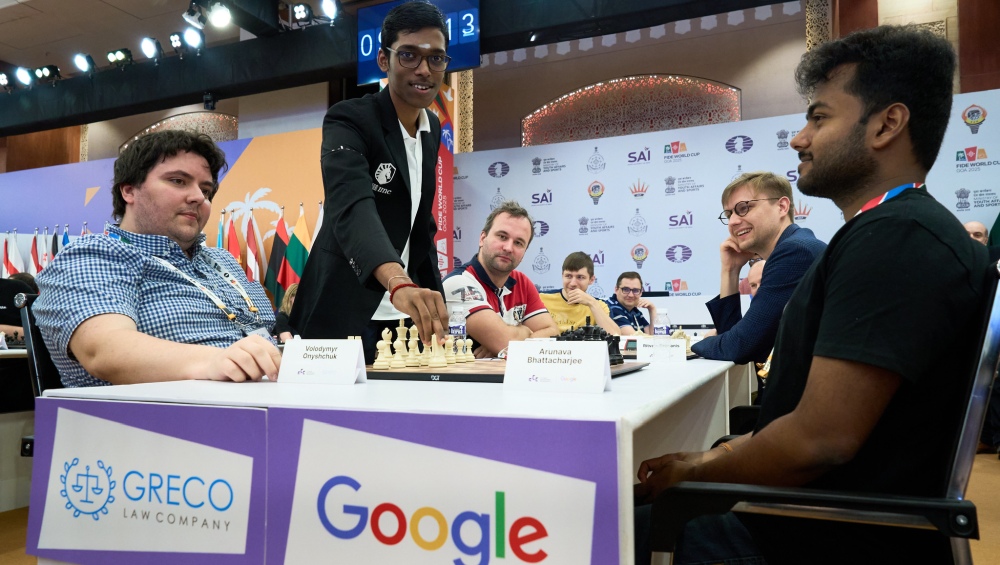
Day 2 of the FIDE World Corporate Chess Championship 2025 concluded the group stage of the event, with Morgan Stanley and Deloitte 1 qualifying from Pool A and Greco and Google qualifying from Pool B. Tomorrow they will face off in the semifinals, followed by the final to decide the 2025 World Corporate Champions. The second half of the group stage saw the continuation of the double round-robin format, where the teams played each other again, this time with reversed colours. The day started off with a special moment for all participants as Grandmaster Praggnanandhaa R visited the venue as Guest of Honor. He made the ceremonial first move on the top board, met the teams and posed for photos – a rare opportunity for corporate players to meet one of the world’s leading super grandmasters. Pool A The second half of the double round-robin confirmed Morgan Stanley as the clear frontrunners of Pool A. They finished with 18 match points and 31 game points, losing only one match, the final round of the day, against Microsoft. Deloitte 1 secured the second qualifying spot with 15 matchpoints, though the final standings tightened after a key result in the return leg against Microsoft. Yesterday the match was tightly drawn, but today Microsoft struck with a 2½–1½ victory, temporarily putting pressure on the qualification race. Deloitte responded strongly in their remaining encounters, holding their position ahead of Microsoft, who finished third with 13 matchpoints. Final Standings Pool A Morgan Stanley — 18 MP / 31 GP Deloitte 1 — 15 MP / 27.5 GP Microsoft — 13 MP / 23.5 GP UBS — 10 MP / 22 GP Tech Mahindra — 4 MP / 12 GP Equity Bank, Kenya — 0 MP / 4 GP Pool B Pool B completed its return legs as well, with Greco maintaining full control of the field. They finished the group stage unbeaten with 20 matchpoints and 28 gamepoints, confirming their status as one of the most dominant teams of the championship. The battle for second place between Google and J.P. Morgan unfolded across both days. Yesterday Google had won their first meeting by a wide 4–0 margin, but today J.P Morgan struck back with a close 2.5-1.5 victory. This result opened the door for J.P. Morgan to chase on tiebreaks, but Google’s superior gamepoint total ultimately secured their qualification. Deloitte 2 also delivered an impressive turnaround on the final day. They defeated J.P. Morgan 2½–1½, reversing the outcome of their first encounter and coming within striking distance of second place. Final Standings – Pool B GRECO — 20 MP / 28 GP Google — 12 MP / 15.5 GP J.P. Morgan — 12 MP / 14.5 GP Deloitte 2 — 10 MP / 15 GP ERG — 6 MP / 7 GP Player spotlight: Saraswat Tushar (Tech Mahindra) One of the standout individual performances of the day came from Saraswat Tushar of Tech Mahindra. Rated just 1702, he produced multiple upsets against much higher-rated opponents, including an astonishing win over FM David Moskovic (2314) from Morgan Stanley. A key moment arose in his game against Georgios Tsichlis (2123, Microsoft). After White played 35.g3??, Tushar found the precise refutation: 35…Rxh2! Following 36.Kxh2 Qxf2+, Black launched a decisive attack and soon forced resignation. Last night’s social programme brought all teams together for a relaxed networking evening inside the playing hall. The session began with a masterclass by GM Alojzije Janković, followed by an informal gathering where teams played bughouse, exchanged stories, and learned more about each other’s internal chess cultures. The Google team, for example, shared that more than 2,500 employees actively participate in chess inside the company, supported by bi-weekly events hosted on Lichess. ChessBase India also made a guest appearance, engaging with teams and capturing moments from the evening. As the group stage concludes, players now shift their attention to the decisive final day. Many continued their afternoon by watching Round 5, Game 2 of the FIDE World Cup, taking advantage of the unique setting where two major FIDE events run side by side in Goa. Tomorrow promises a dramatic finish, with semifinal matchups set to determine which two companies will compete for the championship trophy. Written by Charlize van Zyl, FIDE Press Officer (Goa, India) Photos: Eteri Kublashvili