

FIDE Grand Prix Berlin – Round 5 Recap
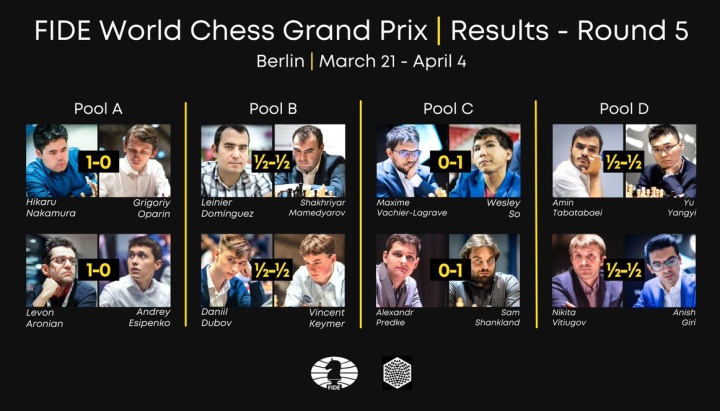
Half of the games ended with decisive results in Round 5 of the final stage of the FIDE Grand Prix Series organized by World Chess. It was a very good day for the American players as three of them, namely Levon Aronian, Hikaru Nakamura and Wesley So, defeated their opponents. All three are leading in their groups before the final round of the group stage. Hikaru Nakamura’s persistence was rewarded, as he won a difficult ending against Grigoriy Oparin and caught his main rival Levon Aronian, who outplayed Andrey Espenko. Both are in the lead in Pool A. Vincent Keymer earned a draw in his game against Daniil Dubov with precise defense. Leinier Dominguez and Shakhriyar Mamedyarov drew their game and stayed in the shared lead of pool B. Maxime Vachier-Lagrave sees his Candidates hopes evaporate after losing a hectic game to Wesley So, who now shares the lead in pool C with his compatriot Sam Shankland. Nikita Vitiugov and Anish Giri played out an uneventful draw, while Amin Tabatabaei saved a lost endgame against Yu Yangyi. All four players of pool D enter the last round in a tie, postponing the big fight for pool D victory for tomorrow. Pool A Andrey Esipenko was expecting to play against Hikaru Nakamura today and was shocked to learn he had to play against Levon Aronian 5 minutes before the start of the clock. He didn’t check the pairings carefully and gave a big advantage to Levon by playing with Black without any preparation. According to Levon, he had analysed this line in Nimzo-Indian Defense some time ago, knew the idea with h4-h5 and remembered that Black is losing after inaccurate 12…c5. Andrey explained that his move c5 was an attempt to create counterplay in the center. However, it failed as White’s attack was way too strong. After the best defensive move for Black 12…Bg7 White would have continued with 13.h5 Nh5 14.Nh7! with a powerful attack. After 13…h6? Aronian didn’t give his opponent any chance, got to Black’s king and forced his resignation on 23rd move. Hikaru Nakamura and Grigoriy Oparin played a very interesting game in the Nimzo-Indian. “At some point, I got very optimistic in the middle game. I thought I should be much better. It was so complex and after 25.g3 Qh1 I was not even sure if White was better,” commented Hikaru after the game. It seemed for the American player that Rf6 was an innacuracy that helped White to trade the rooks and win a pawn. Hikaru demonstrated an excellent technique in the ending, even though Grigoriy could put more stubborn resistance. The players analysed a computer line 47…Bc8 followed by Kh5, which could have given Black certain drawish chances but came to the conclusion this line was simply impossible to find for humans. Pool B Leinier Dominguez was trying to improve his time management today in his game with Shakhriyar Mamedyarov and played faster compared to the previous rounds. However, it seemed to the American it would have helped to think a bit longer in critical moments as he missed the clear advantage, which he got out of the opening. After 19…Bg5 White decided to go for the force line but underestimated Black’s counterplay with 21…Raf8 from far. Leinier wisely changed his original plans to capture the pawns of the queenside due to an unpleasant blow Rxf2! After 22.Qc5 played in the game, most of the pieces were traded, and the players ended up in a drawish rook ending. Daniil Dubov got a promising position in the Moeller Variation in the Ruy Lopez. After 15 moves, he had also 1 hour more on the clock and decided to sacrifice a piece in order to complicate the game, hoping to make it more difficult for Vincent Keymer to solve all problems. “It was a bit of a contradiction. I could force a draw, and I’m pretty sure I was not better, and I didn’t want to play at all. And again, while you are at home you don’t want to play, but then you come here, and your opponent is down to 3 minutes. And then I thought, ok we would play three moves he would probably blunder, and then we played two moves and I couldn’t repeat the moves any more and again I had to play, and it was a very tricky game somehow,” said Daniil, who seemed clearly disappointed with the outcome. The local hero Vincent Keymer showed great defensive skills and stopped White’s attempts to create a dangerous attack. He could have hoped for more had he found 25…Qf6 with a chance to gradually convert his extra material. Later on in the ending, Vincent blundered a pawn, giving winning chances to his opponent again but was lucky to hold onto a draw in the end. Pool C Wesley So was surprised with the opening choice of Maxim Vachier-Lagrave and could not recall if Maxime had ever played Nimzo-Indian with f3 earlier. Taking into account the tournament situation and the fact that it was the last game with White for MVL, the French Grandmaster decided to go for a sharp variation with g4 and was ready to take some risks. Maxime decided to break through with f4 in a complex position, the move that was later criticized by both players. Wesley found a very strong continuation 20…Qa4, with an idea c4 and since that moment, Black were clearly better in all variations. “Of course, with my opening choice today, I knew it involved a very big risk component, so I feel there were things I could have done better, but overall it was a very strong game by Wesley,” said Maxime after the game. Alexandr Predke didn’t get much out of the opening and decided to complicate the position by sacrificing a pawn. Sam Shankland grabbed the pawn, and it turned out White didn’t get sufficient compensation. Alexandr’s desperate attempts to fish in troubled waters of complications only precipitated his defeat. Pool D Anish Giri was fully prepared for Semi-Slav, which appeared on the board after some opening transformations and quite comfortably reached equality. His
‘Huge relief’ for Carlsen as champ survived Duda’s spirited comeback to win Charity Cup

A stunning end to the Charity Cup final saw Magnus Carlsen survive a major scare from Jan-Krzysztof Duda to clinch a second Meltwater Champions Chess Tour title of the season. The Norwegian started where he left off after the first day of the final by dominating Poland’s top player in game 1. It all appeared too easy for the champ who seemed to be breezing to victory in record time. Yet Duda, somehow, sparked an inspired comeback to win two in a row and take the match to tiebreaks. It was an astonishing turnaround that put the pressure right back up on Carlsen. Duda, the exciting young Pole with a big future ahead of him, was seen as a serious threat going into the final and one of the few players who could lay a glove on the champ. The 23-year-old had scored famous victories over Carlsen to end the champ’s record 125-game unbeaten streak and knock him out of the World Cup last year – an event Duda went on to win. And in this event, a unique elite-level fundraiser for UNICEF, Duda showed yet again that his chaotic, dangerous style can hurt Carlsen. Game 1: Carlsen on a roll Game 1, however, started with Carlsen heaping pressure on the challenger and it took just 17 moves for the writing to be on the wall. With 17… Ne4 the champ offered an ingenious knight sacrifice, Duda took the bait and captured with a pawn. But when Carlsen retook with his pawn, Duda’s position collapsed. The Pole played 19. Qxe4 which simply allowed a vicious attack. Carlsen responded with 19… Bd5 attacking the white queen and bringing his bishop into the centre of the board. Duda was paralysed and defeat was inevitable. At this point, the challenger had lost three in a row to Carlsen and now found himself needing to win the second game of the day just to stay in the final. Duda was at rock bottom. Game 2: Duda hits back Poland’s World Cup winner had one last throw of the dice with the white pieces and had to make it count. He tried to spark game 2 into life with 20. Bxe5 to create threats and mess up the position. It didn’t work initially. By now Carlsen was in safety-first mode looking for the draw that would win him the title. Yet a few moves later Carlsen lost a bishop and the game really did heat up. For the first time in the final, the champ appeared lose control in a wild position. Carlsen made the fatal mistake of pushing a pawn too far with 48. a6, overlooking a one-move checkmate threat with 48… Qa7 that Duda played which picked him up the a-pawn and forced a queen trade. Duda was now a knight for two-pawns ahead. His luck had turned. Carlsen’s pawns quickly dropped and Carlsen resigned in a hopeless position. Game 3: Duda on fire Despite the win, Duda still had to win another game to take the match to tiebreaks. But now he was no longer afraid and immediately tried to take Carlsen off piste. In the opening, the underdog pulled out the rare 3.g3 – a move that Carlsen played and lost with in a 2019 game against Levon Aronian. Duda and Carlsen castled on opposite sides and when white played 10. b4 to launch an attack it was clear the game would catch fire. The champ didn’t flinch and responded with the brave 10… Qxb4 putting his queen out in the open. The board appeared to be full of tactics with Duda on the attack and both black’s king and queen in danger. Duda found the tricky 18. Ng5 and the engine favoured him. Carlsen played 22… a5 and then Duda found the crushing 23. Bxc6. Carlsen resigned on move 25 and Duda – incredibly – was in the lead. Game 4: Duda gets the draw The Pole had the momentum doing into the final game of the set and only needed a draw to take it to tiebreaks. Duda successfully neutralised the champ and then took control. There was nothing better left for Carlsen but to force a draw. Duda had got himself back on level terms and the first blitz tiebreaker of the Charity Cup was on the cards. Tiebreaks The tension continued in the first of the blitz tiebreaks as the game appeared to be heading towards a draw before a moment of magic from Carlsen that tricked his opponent into playing 46… Bxg3 that led to Duda losing a rook. Carlsen set a trap, Duda fell for it and the champ was now one-up. Game 2 started with Duda offering a speculative knight sacrifice early out of the opening with the complex 14.Ng5 that led to an unbalanced position, but again Carlsen didn’t flinch. After the desperate lunge of 19. Qg6 Duda was left too open and was forced to resign. The tournament was over. Carlsen said: “Huge relief now. This was right out of the playbook of what feels like every tournament last year after the first few ones where it seems like I’m cruising and then there’s one bad moment and it all falls apart. But yeah, I managed to survive.” The event was supported by NEAR Foundation and was being held as a fundraiser for UNICEF. So far, more than $100,000 has been raised. The next tournament in the Meltwater Champions Chess Tour is a Major, which starts on April 20. For further comments contact: Leon Watson leon@championschesstour.com About the Meltwater Champions Chess Tour The Champions Chess Tour is the leading online chess Tour worldwide determining the world’s best chess player over a full competitive season of online chess. The 2022 season begins in February 2022 and features monthly tournaments culminating in a Final in November 2022. The best chess players in the world are competing in rapid chess. All games take place online on www.chess24.com with players competing for a total prize pool of over USD 1.5 million. For more information visit www.championschesstour.com. About Play
Winners crowned at Sao Tome and Principe Championship

The Absolute Individual National Championship of Sao Tome and Principe was held from March 03-19, 2022. The open event consisted of two stages: the semifinals and the Grand Final. The highest-rated participant of the open section Sergio Pereira lived up to his reputation and convincingly won the competition conceding his opponent just a half-point. Waldyr Espírito Santo finished one and a half points behind the champion and took silver; the bronze winner Admilton de Ceita dos Santos scored 6 points. With these results, the top four qualified for the national team to represent Sao Tome and Principe at Chess Olympiad that will take place in Chennai (India) this July. Final standings Open: 1. Sergio Pereira – 8.52. Waldyr Espírito Santo – 73. Admilton de Ceita dos Santos – 6 4. Osvaldo dos Santos Lima – 5.55. Fabio Costa Alegre – 5 The women’s tournament, a five-player round robin was much closer affair as Jualzimira de Oliveira Bastos Rita and Stela Lourenço Lima tied for first place, scoring 3 points each, with the former claiming the title thanks to better tiebreaks. Izidora Lourenço Lima netted 2.5 points and came third. Final standings Women: 1. Jualzimira de Oliveira Bastos Rita – 32. Stela Lourenço Lima – 3 3. Izidora Lourenço Lima – 2.54. Cristiana Biko – 1.55. Marcia Gomes – 0
FIDE President Arkady Dvorkovich turns 50
Today FIDE President celebrates his jubilee. All of us at FIDE wish Arkady Dvorkovich the happiest of celebrations, full of love and warm feelings. Let the path ahead be filled with successes and inspired moves, be it in chess, football or life!
FIDE Grand Prix Berlin – Round 4 Recap
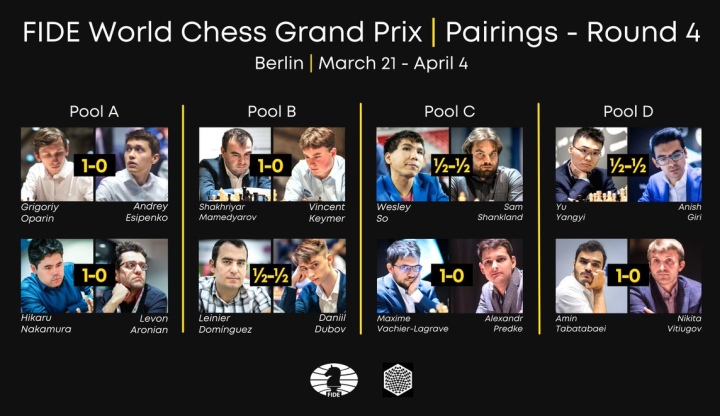
Five games out of eight ended with decisive results in Round 4 of the final stage of the FIDE Grand Prix Series, organized by World Chess. In a crucial game for the overall Grand Prix standings, Hikaru Nakamura defeated Levon Aronian and caught up with him. Grigoriy Oparin outplayed Andrey Esipenko and took the lead in Pool A, leaving Levon and Hikaru half a point behind. The game between Leinier Dominguez and Daniil Dubov ended in a draw; Leinier thus remained in the lead of pool B, now shared with Shakhriyar Mamedyarov, who outplayed Vincent Keymer. Maxime Vachier-Lagrave also took revenge on Alexandr Predke, and before the free day, the pool C ended up with all players tied on 2/4. Amin Tabatabaei avenged his first-round loss to Nikita Vitiugov, bringing all players of the pool D tied on 50% too. Pool A The game between Hikaru Nakamura and Levon Aronian was following the line in Ruy Lopez from the game Esipenko-Aronian in Round 3, but Hikaru chose to play 12.a4 instead of 12.Ne4. After numerous exchanges, White managed to get a promising position in the following endgame with rooks and minor pieces left on the board. “I think Levon got careless and thought there was no risk at all and went for Rg5-Rh5, but after I found 29.Ne7 I believe it’s very difficult for Black practically,” commented Hikaru after the game. It turned out to be one of the critical moments of the game and Hikaru assumed it was still possible to hold this position for Black with an accurate play. Aronian thought the mistake came even earlier on the 27th move, where he had to choose c6 instead of b6 played in the game. Hikaru managed to get a very strong passed pawn on d-file and placed his rooks on the seventh rank, forcing his opponent to defend against numerous threats and eventually converting his advantage. “It’s funny. It’s probably very bad for both of us because Grigoriy will probably win this game,” commented Nakamura on the Pool A situation after winning against Aronian. One inaccurate move 10…c5 by Andrey Esipenko in a well-known position that emerged from Nimzo-Indian gave his opponent Grigoriy Oparin a chance to get a very comfortable position with the stable edge due to the weak and isolated d-pawn in the Black’s camp. The game was a good example of how to handle this type of position: Grigoriy blocked the d-pawn, exchanged a few minor pieces and got prepared to win the pawn in a couple of moves. Andrey Esipenko’s desperate attempt to complicate the issue by playing 30…d4 and 31…a5 only postponed the catastrophe for Black, and even though the game finished the last today, the outcome was never in doubt. Pool B Shakhriyar Mamedyarov tested an original idea 8.Nh4 in the four knights English Opening against Vincent Keymer. He read about this move in an old book and remembered that g5 should not be good as White gets quite a strong attack on the kingside. Vincent decided to check if the sacrifice was a correct one and got into trouble after an unexpected 13.Qd2, missing that White’s pieces would get to Black’s King very quickly if he trades his knight for the Bishop on h6. After making a few precise moves, White transposed into a winning ending with a rook and four pawns vs two knights and a pawn and handily converted his advantage. Daniil Dubov played Two Knights defence today, but Leinier Dominguez didn’t show any intention to check a Fried Liver Attack and chose a solid line with 4.d3. Daniil was playing very fast today and had a huge time advantage by move 20. Black found the way to sharpen things after move 20 – Dubov thought he had some chances to get an advantage at this stage. However, Leinier found an excellent recourse 23.f4 followed by 24.Re1 thwarting Black’s attempts to get a strong initiative. After trading major pieces, a drawish bishop vs. knight ending appeared on the board, and the peace was signed after 52 moves of play. Pool C Two American GMs played a very solid game. Sam Shankland forgot to check the line with Bf4 and Qb3, which happened in the game and got a slightly worse ending due to the double pawns on b file. He decided to play more actively and put his rooks on a-file. “At some point, I really didn’t like my position but the move 16.Bf3 by Wesley was careless as I had g5, and Black is fine after that.” By playing g5, Sam Shankland offered a temporary pawn sacrifice, and following exchanges, the game ended in a draw. “If Maxime wins, then all of us are at 50%, and we will have a four-player tiebreak at the end,” said Sam after the game, while the MVL-Predke game was still in progress. Maxime Vachier-Lagrave and Alexandr Predke played a hard-fought game in a Ruy Lopez. After a long manoeuvring play, Maxime was hoping to get some attacking chances on the King’s side, but his opponent was finding interesting resources and even sacrificed a pawn to sharpen the game. Hoping to get a complex position with some winning chances, Maxime went for an unclear queen’s sacrifice. In time trouble Alexandr Predke didn’t find the best way to stop White’s threats, and after inaccurate 37… Rb2, Maxime gained the upper hand. “Objectively, I was worse or maybe even losing at some point… scary, but at the same time, I knew I had chances—that’s all I could hope for in this situation,” commented Maxime Vachier-Lagrave after the game. Pool D Yu Yangyi and Anish Giri waged a tense and very complicated battle in the Hungarian variation of the Gruenfeld Defense. The opponents followed a well-known theoretical path for awhile, but as Anish said in the post-game interview, he mixed something up and by move 14 they stepped into uncharted territory. With his 16th move, the Dutchman started chipping away in the center by f6 but it seems that White had an edge, although, in a very sharp position.
FIDE Veterans Support Program 2022: A tribute
A few weeks ago, FIDE announced the names of twelve chess seniors who will benefit from FIDE’s support to chess veterans. A total of €30,000 will be distributed among them with each receiving €2,500. As we did on previous occasions, we would pay tribute to these illustrious veterans with a few words about each one of them, summarizing their careers and achievements: Alexey Yuneev (Russia) Jay Bonin (USA) Jiri Lechtynsky (Czech Republic) Vija Rozlapa (Latvia) Giorgi Macharashvili (Georgia) Reynaldo Vera (Cuba) Evgenij Ermenkov (Bulgaria) Alexey Kosikov (Ukraine) Sheila Jackson (England) Galina Strutinskaia (Russia) Rani Hamid (Bangladesh) Gediminas Rastenis (Lithuania) Vija Rozlapa Born in 1942 in Liepaja, Vija Rzlapa learned chess at the age of 12 and immediately showed great promise. Just four years later she won the Latvian Girl Championship (1958) and then Soviet Girl Championship (1960). In 1970 Vija became a national master. A four-time Latvian Women Champion (1967, 1971, 1972, 1974) she started her career as a chess trainer back in 1964 and successfully continues nowadays. She has been working in Riga Chess School since its foundation in 1972. The list of her students includes GM Alexei Shirov, WGM Laura Rogule (LAT) and NA Egons Lavendelis. An active participant of senior events Vija Rzlapa has won bronze at the World Senior Team Chess Championship twice (2014, 2015). Alexey Yuneev Born in 1957 Leningrad, Alexey Yuneev came master in 1980 and nine years later won his native city championship. A graduate of the Gertsen Pedagogical University, Yuneev has been working as a trainer-instructor since 1985 to date in the St. Petersburg State Palace of the Youth Creativity. The list of his students includes GM N. Vityugov, gold winner as a member of the Russian team at the World Team Championships (2010, 2013), Champion of Russia (2021, super finals winner), and GM M. Matlakov, (European Champion 2017), runner-up in the Championship of Russia (2021, super finals). Since 1990 Alexey Yuneev has been in charge of the municipal union of the chess instructors, which is a very important body for the St. Petersburg chess development. Starting from 2000 has been organizing and holding chess workshops for chess instructors helping more than 300 people to improve and hone their teaching skills which indirectly translates into thousands of young chess players. Giorgi Macharashvili Born in 1955 in Tbilisi, Giorgi Macharashvili became a professional chess coach in 1976. The author of 11 books, since 1992 he has served as the main coach of national youth and cadets’ teams at World and European Chess Championships. With Giorgi at his helm, the National Georgian Women’s team won silver at the European Team Chess Championship. The long list of his students includes GM Nana Dzagnidze – Women’s World Blitz Champion (2017), European Women’s Champion (2017) and the winner of Chess Olympiad (2008); WGM Maia Lomineishvili – the winner of Olympiad (2008) and European Junior Champion U14 and U20; WGM Ketino Kachiani-Gersinska, the winner of Word Junior Championship U20 (1989 and 1990). Reinaldo Vera Born in 1961, Reinaldo Vera achieved his first international success at Junior World Championship (Innsbruck, 1977) where he finished fourth. In 1979, he was awarded the IM title and nine years later received GM title. A prominent fixture of the National team for over 20 years, a two-time Cuban Champion, Reinaldo Vera took part in four World Team Championships and ten Chess Olympiads. His best result was an individual gold medal on the third board (Elista, 1998). His tournament record includes winning or sharing the first places in Havana (1980), Varna (1986), Leon (1996), and San Sebastian (2007). FIDE Senior Trainer since 2007 he gives chess lessons both live and online. Evgenij Ermenkov Born in 1949, Evgenij Ermenkov has been a competitive chess player the last 60 years of his life. He became the junior champion of Bulgaria at the age of 17 and quickly moved up in the rankings. He became an IM in 1974 and three years later received GM title. The 5-time national champion he represented Bulgaria at Chess Olympiads from 1978 to 1992. His most notable achievement in team competitions is silver medal on board 4 at the Olympiad in Novi Sad (1990). Ermenkov’s tournament resume includes victories in Albena (1997 and 1979), Plovdiv (1978 and 1979), Varna (1986), Dieren (1990), Beirut (2004) and Imperia (2005). Jay Bonin Born in 1955 in New York, Jay Bonin is known the “Iron Man of Chess”. One of the most active tournament players in history of chess, he played over 25,000 tournament games (over 13,000 games since the US Chess Federation started collecting data in 1991 and an estimated 12,000 games for his almost 20 years of tournament play prior). His prolific and long chess career took off in 1980s, when Bonin won the New York State Championship (1982). He later won this title in 1997 and 1999. In 1983 he earned the title of FIDE Master and two years later became Jay also won the championship of the Marshall Chess Club (in which he worked as a manager and tournament director from 1977 to 1979 and then from 1998 to 2002) in 1984, 1987 and 1997. The year 1997 was marked by his unique achievement as Bonin won “Triple Crown” of New York chess events: The New York State Championship, Manhattan Chess Club Championship, and Marshall Chess Club Championship. His life as a chess professional was twice profiled in the New York Times. A popular chess teacher, author, and lecturer, Jay Bonin is a true legend of US chess. Jiri Lechtynsky Born in 1947, Jiri Lechtynsky was one of the leading players of Chezcoslovakia in 1970s and 1980s. He earned the title of IM 1974 and eight years later became GM. The participant of three Chess Olympiad he played for Czechoslovakia in 1974 in Nice (with a score of 5/7 as a second reserve player), in 1980 in La Valletta, Malta (with a score of 2,5/4 as a second reserve player), and in 1986 in Dubai (with a score of 4/6 as a second reserve
FIDE Grand Prix Berlin – Round 3 Recap
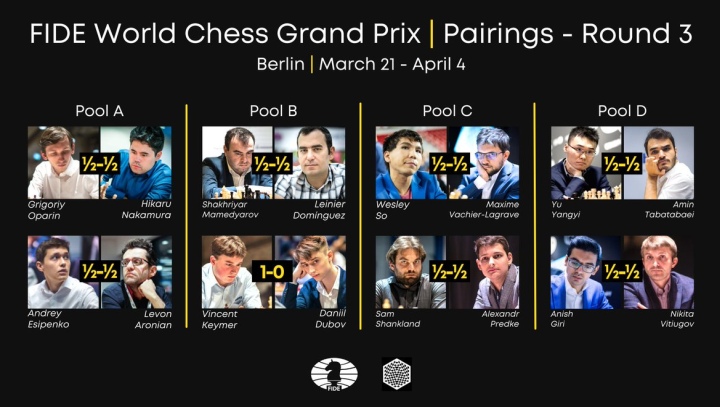
The local hero Vincent Keymer outplayed Daniil Dubov and joined Leinier Dominguez in the lead of Pool B of the third leg of the FIDE Grand Prix Series, organized by World Chess. The rest of Round 3 games ended in a draw, which allowed Levon Aronian, Alexandr Predke, and Nikita Vitiugov to keep leading positions in other groups. Two more games could have finished decisively today. Grigoriy Oparin came very close to upsetting Hikaru Nakamura, who eventually escaped with a draw. Sam Shankland had winning chances in the endgame with Alexandr Predke but could not make it work. It was the longest game of the day, which ended in a draw after 57 moves. Pool A Nakamura played the most existing game of the round. Oparin guessed his opponent’s choice in the opening right, which was the Queens-Indian Defence today. It has been more than five years since Hikaru Nakamura played it in the tournaments, so he was not expecting the idea of h4-h5-h6. White quickly got quite a promising position but had to play precisely in order not to give a chance for Black to consolidate. A beautiful move 19.Bg6 came as a huge surprise to Hikaru, who simply missed this option. “I was very upset with myself during the game because essentially I blundered one move. In this line with 19.Bg6 and after 19…fxg6 20. Qe7 Rd5 White has this Re6. I simply have forgotten this move existed,” said Hikaru in his post-game interview. Similarly to the game against Aronian in Round 1, the American player was ready to resign once his opponent had played 20.Bb1. Even better was 20.Bf5! simply winning a piece. Grigoriy failed to find these continuations and opted for 20.Bh7, which gave Hikaru some hope to escape with a draw. Despite being down a pawn, Black had some compensation due to the pair of Bishops and active pieces. After a few exchanges, the game ended in a draw after a three-fold repetition. “After finding Bg6 it feels it would be nice to win the game, but it is what it is,” said Grigoriy Oparin after the game. Andrey Esipenko and Levon Aronian tested one of the lines in the Ruy Lopez but Andrey mixed something up right in the opening and was clearly disappointed with his play. He had to show a certain level of creativity not to get into trouble and came up with an interesting idea 17.Bg5 which changed the course of the game. Levon Aronian saw the strongest continuation 17…Kh8 but started seeing ghosts in some lines as he pointed out after the game. He chose another option 17…h6 but it turned out that White could trade the queens and maintain the balance in the game that was drawn on move 33. Pool B The Ragozin Variation was played in the game Mamedyarov – Dminguez and for the first time in the tournament Shakhriyar Mamedyarov was satisfied with the outcome of the opening. He came up with a very tricky idea Ba2 hoping to get a very strong attack on the King’s side. The American Grandmaster proved he has nerves of steel once again and found very precise moves to stop ambitious plans of Azeri Grandmaster. 17-year-old Vincent Keymer managed to break his drawing streak in Berlin by defeating Daniil Dubov. Players chose a complicated line in Vienna Variation of Queen’s Gambit, where Daniil showed an original set up of the pieces by placing his knight on d7 with an idea of pushing c5. Vincent started to like his position after Black put his queen on e8 as he felt it was easier to play with White. The German thought he could afford many waiting moves without worsening his position. In contrast, Daniil thought he should get better after White’s Bishop maneuvers g5-f4-g3 as, in his opinion, it was not the way to play for victory with White. “I was trying to find some ways to get a better position, and I thought it must be winning, It became complicated and then I blundered a piece”, described the game Daniil. According to the heartless computer, the position became hopeless for Black after move 21 when Daniil didn’t remove his knight from d3 but went for a very complex line. White always had the upper hand from that moment to the very end. Vincent Keymer scored a crucial victory over Daniil Dubov, leaving him on minus two after three days of play. Pool C Sam Shankland and Alexandr Predke had an interesting discussion in the Carlsbad structure of the Queen’s Gambit. Alexandr chose an interesting plan of advancing his pawns and the queenside and trading his light-squared bishop on a6. White regrouped his pieces and managed to place his knight on the central square e5 but didn’t achieve much by this point. The first critical moment happened on move 23 when Predke carelessly played Nc4 missing a strong reply 24.a4, which left Black with weaknesses on the queenside. Shankland transposed into a rook ending with a pawn up, but it was not enough for a victory. Maxime Vachier-Lagrave used his pet Gruenfled Defence against Wesley So reached a draw quite comfortably. “I have no idea what to play against Maxim’s Gruenfeld after seven years now”, confessed Welsey So. He didn’t expect the line with c5 and Bf5, which was previously played by Alexander Grischuk and had prepared for a different variation. Maxim didn’t want to burn bridges despite the tournament situation and found the precise way to avoid any trouble. After massive exchanges, the players ended up in an equal ending and signed the peace after 37 moves. Pool D The game Yu Yangyi – Amin Tabatabaei saw a rock-solid Makagonov-Bondarevsky system in which White has problems getting any edge. After the Chinese player made a thematic breakthrough in the center e3-e4, the game liquidated in a drawn endgame in which the opponents spit the point on move 30. Nikita Vitiugov essayed the Paulsen System of Sicilian against Anish Giri, and very
Fourth Chess in Education Lecturer course announced
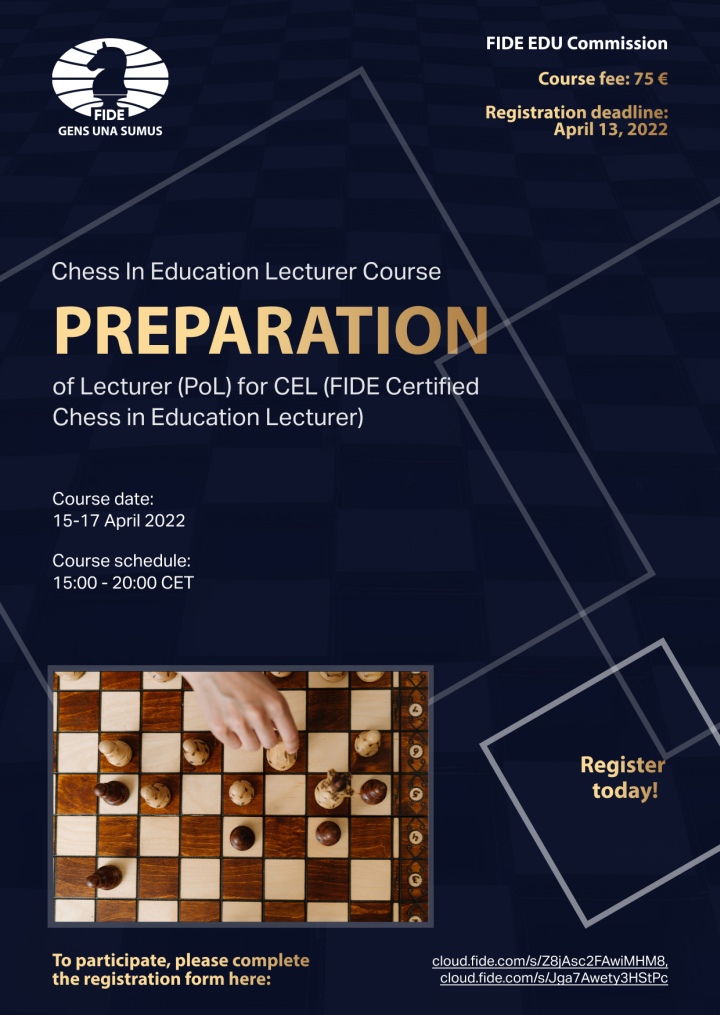
This fourth course of the Chess in Education Lecturer series will be held on 15-17 April. Those who gain this qualification (CEL) will be those, exclusively, who we appoint to the paid lectureships of the FIDE School Instructor seminars. ‘I have learned a lot,’ WGM Eva Repkova, Chairperson of FIDE Commission for Women’s Chess. CEL Lecturers will be experts in educational chess (not necessarily experts in competitive chess). They will be trained by the EDU Commission, after an online capacitation course of 15 hours, with some offline extras. This training has a cost of €75, which covers both access to materials and preparation, and the exam. Those who successfully pass the course will receive the diploma of Certified FIDE Chess in Education Lecturer (CEL). This is valid for three years, and it implies an administrative fee of €50. Here is the course description in more detail:https://cloud.fide.com/s/kY9Fs5pQ5D9gDS7 ‘A nice experience, fantastic course,’ FM Vlad Ungureanu, national coordinator of Romania chess in schools program. Applications for the course are open now and will close on 13 April. If you want to apply, please fill in the Registration form for “Preparation of Lecturers”, Your CV & Motivation letter should pay special attention to your relevant experience in “educational chess”, rather than “sport chess” (please check this explanatory document if you are unsure about the difference between these two concepts). ‘This kind of course is a very good idea,’ FM Leontxo Garcia The course will be held 15-17 April, in English, online 15:00-20:00 CET (Central European or FIDE time). Applicants must complete the Registration Form (DOC), (PDF). The course is limited to a maximum of 20 people (first come, first served). Applicants who cannot be given an assured place will be placed on the waiting list for the subsequent course.
Support Ukrainian Chess Players and their Families
The FIDE Commission for Women’s Chess in cooperation with chess24 seeks your donations to help our Ukrainian chess players and their families. In light of the recent events, the FIDE Commission for Women’s Chess has established a fundraising for Ukrainian chess players and their families being affected by the ongoing war in Ukraine. We have also reached out to a number of women chess players in Ukraine that all of us know well in our chess community. They are being caught up in a conflict that would have been unimaginable just a month ago. You can join this great initiative of providing support to the Ukrainian chess players and their families by making your donation here.
#40
Geir Nesheim, new Chair of the Social Commission Ahmed Adly, new Chair of the Athletes Commission FIDE’s support program to chess veterans: a tribute French Chess Federation acquires “delegation” status in France Brief news from National Federations READ NEWSLETTER