

FIDE Grand Prix Berlin – Round 2 Recap
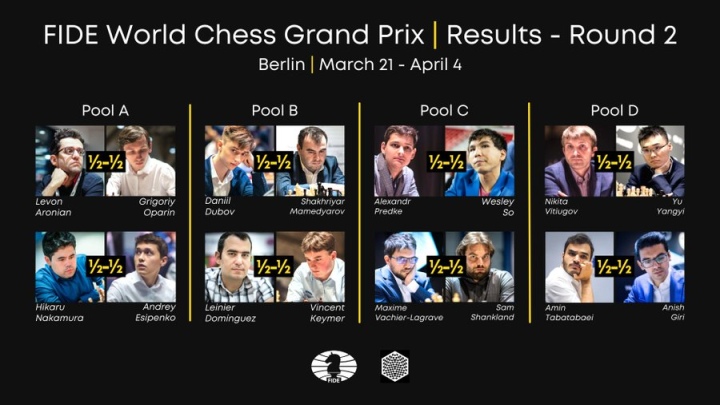
It was a peaceful, but by no means uneventful day at the third leg of FIDE Grand Prix Series organized by World Chess although all eight games in Round 2 were drawn. “Let’s talk about how dramatically the situation changed in every group after today’s round” joked the tournament commentator GM Evgeny Miroshnichenko and certainly, the standings have not changed at all as we have the same leaders as after Round 1 in each pool, namely Levon Aronian, Leinier Dominguez, Alexandr Predke, and Nikita Vitiugov. Round 2 results still don’t tell the entire story, as, despite peaceful outcomes, the games were hard-fought and enthralling. Pool A In the Giuoco Piano Levon Aronian, playing with White against Grigoriy Oparin, essayed the idea 12.Ra3, introduced by Nils Grandelius in the match against David Howell. After the game the American player added that he learnt from the best. He could not regret his choice as the game turned out to be very eventful. By lifting his rook White offered a pawn sacrifice, hoping to get some long-term initiative instead. Grigoriy spent a lot of time trying to remember his notes but eventually had to figure everything over the board. “At that point, I had to take the pawn. With the whole concept of Black’s play, it doesn’t make any sense otherwise,” Oparin explained after the game. Aronian managed to regain the pawn in the ensuing complications, but he is not sure if 21.g4 was the best option. According to Levon, he could have played 21.Nc8 trading the knight for the bishop, followed by g3, which he thinks is more unpleasant for Black. On the other hand, it looks like after 21…g5, Black is OK. Grigoriy defended with precision, and the peace was signed right after the first time control. Hikaru Nakamura obtained a promising position in Nimzo-Indian against Andrey Esipenko with a strong knight on e5. American Grandmaster played creatively in the opening, trying to get something interesting but then allowed the opponent to grab initiative by planting his knight on c4. “The game was basically around two squares e4 and e5. At some point, I just needed to trade the knights on c6 and make a draw, but I didn’t want to and just kept playing,” said Hikaru after the game. He called his plan with b4 and Na4 “insane” as after those moves, Black emerged clearly better, and for the rest of the game Andrey pressured Hikaru. Being in a time trouble Andrey didn’t find the a precise way to keep the tension, and after the massive exchanges, the game stirred into the ending with a visible edge for Black due to the pair of Bishops and better pawn structure. Nevertheless, it was hard to break through the position of White, and the American escaped with a draw thanks to the resilient defence. Pool B: The game Leinier Dominguez – Vincent Keymer saw a topical line of the Ruy Lopez in which the American introduced a novelty (the first line of Stockfish) on the move 14. After a tactical battle in the centre, Leinier won a pawn for which Black did not have sufficient compensation. After trading the queens, a very interesting ending with opposite-colour bishops and extra pawn for White appeared at the board. According to Lenier, he thought Black could not allow g6 move and had to take on g5 on 49th move. It seemed White had good winning chances, but the endgame requires a detailed analysis to make the final conclusions. To Vincent’s credit, he defended exceptionally well and saved a half-point in the game. Daniil Dubov surprised Shakhriyar Mamedyarov with a rare 4.Nc3 in the Italian Game, but did not achieve much. Daniil pointed out that c5 was a strategically risky move for White as if White doesn’t manage to push d4, he can be worse. The Azerbaijani GM played solid, logical moves and got some play against the d3-pawn that outweighed White’s pressure in the center. The opponents started repeating the moves in a very complex balanced position in which draw seemed like a logical outcome. “I think both sides could actually play in the final position, I don’t think I was better or worse; in general, it all felt very logical, and I think it was just a decent game. The reason why we repeated the moves is that if my opponent will play Nh7 when I don’t have d4 I’m much worse. That’s why I needed his rook to go away from d8,” explained Daniil after the game. Pool C Alexandr Predke, playing with White, managed to pose some serious problems for Wesley So in Giuoco Piano, which he called “very playable”. As the American confessed in a post-game interview, he missed the move 23.Ne3, which gave White a dangerous activity in the center. Alexandr thought that he had good winning chances, but it seems that Black’s position was not that bad, as Wesley reached a draw with several precise moves. “This is the first time I play against Alexandr… He is a very good player; yesterday, he won a very good game against Maxime,” said Wesley at the post-game interview. Maxime Vachier-Lagrave and Sam Shankland played the Berlin Defense, which is known as the Berlin Wall. Many great players have struggled to breach this solid barricade, and the French GM could not complete the task. Sam went for a strategically risky line, allowing White to play f5 as he was looking for a more dynamic fighting position. In a critical moment of the game Sam correctly sacrificed an exchange and got good compensation in the form of two pawns and active pieces. After trading a pair of rooks, none of the sides had winning chances and the game finished in a draw. It turned out that both players had visited the Berlin Wall and surprisingly didn’t think about chess while walking next to it. Sam Shankland was actually thinking about his close relative who lived in Germany many years ago. “My dad grew up in Germany, my grandparents
FIDE Council Meeting, March 15, 2022: List of decisions

The FIDE Council held on March 15, 2022, in online format, made several important decisions: 1. To award the organisation of the 44th Chess Olympiad to the All India Chess Federation to be organised in Chennai within the period from 28.07.(opening ceremony) till 10.08. (departure). 2. To award the organisation of the 94th FIDE Congress to the All India Chess Federation to be organised in Chennai within the period from 31.07. (arrival) till 09.08. (departure) and to approve 07.08. as the date for FIDE elections. 3. To note strong preference to organise the Chess Olympiad for people with disabilities at the same dates as the 44th Chess Olympiad. 4. Taking into account the current recommendations of the IOC, to suspend the national teams of Russia and Belarus from participation in official FIDE tournaments until further notice. In the individual tournaments of the FIDE World Championship cycle, players from these countries will be allowed to participate under the FIDE flag. 5. To postpone the Women’s Candidates Tournament 2022 to the last quarter of 2022 and to continue consultations with players regarding the format of the tournament. 6. To approve the proposals of the FIDE Medical Commission in principle. To request the FIDE Management Board and FIDE Medical Commission to prepare details regarding practical steps in respect of the implementation. 7. To hold the next meeting of the FIDE Council on 27-29 April 2022 in the United Arab Emirates. 8. To approve the bid of the Isle of Man for the organisation of the Grand Swiss 2023 and Women Grand Swiss 2023.
FIDE Grand Prix Berlin – Round 1 Recap
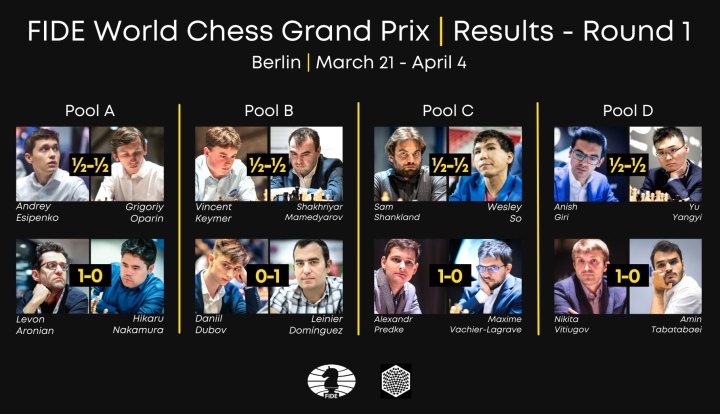
The third leg of the FIDE World Chess Grand Prix Series organized by World Chess got off to a promising start, with four players securing victories and four games ending in a draw The first round of the final leg of the FIDE Grand Prix saw Levon Aronian, Leinier Dominguez, Alexandr Predke and Nikita Vitiugov score victories and grab the lead in their pools. The four other games all ended in a draw. Pool A: Andrey Esipenko didn’t manage to give himself a birthday present in his game against Grigoriy Oparin as the two split a point. Nevertheless, the present was “delivered” a few days earlier when Esipenko joined the tournament becoming the last-moment replacement of Dmitry Andreikin. Esipenko turned 20 today and as a real professional player spent the whole day at the board. The opponents tested a popular line of the Catalan in which Black solved all his opening problems, reached equality and confidently made a draw in a slightly inferior endgame. Hikaru Nakamura challenged Levon Aronian with Black in a sharp line of the Queen’s Gambit Accepted that the latter had played against Leinier Dominguez just a month ago at the first FIDE Grand Prix leg. Levon expected anything but this line today but still had “a couple of ideas” in his pocket. He deviated with 14.Qd2 (one of the possible moves in this position) and probably threw Hikaru off his preparation as just five moves down the road, he committed a serious inaccuracy 19…Bf5. Still, the position remained quite unbalanced but another grave mistake by Nakamura 23…Nf4? became the last straw. Aronian immediately transposed to a won endgame and smoothly scored a full point. According to Hikaru, the critical moment came on move 20 when he spent most of his time contemplating g5. He didn’t go for it and ended up in a worse position. “If Levon would have played 25.Qa5 instead of 25.Qa7 I would probably just resign the game, I was just ready to go home,” said Nakamura with a smile on his face, admitting that the game went off the track for him either way. Pool B: Vincent Keymer obtained a slightly better position in a quiet line of the Queen’s Gambit against Shakhriyar Mamedyarov, but after massive exchanges the Azerbaijani GM had no problems holding a draw in a bishop ending. Leinier Dominguez defeated Daniil Dubov in a topsy-turvy game that could have ended in a draw. The American gradually outplayed his opponent in a fresh position with two knights vs. two bishops that emerged from a classical line of the Nimzo-Indian but let his advantage slip away in a mutual time scramble. During the post-game interview, the American grandmaster noted he missed the queen’s manoeuvre Qe4-Qh4 and thought his position looked very dubious at that point. He exchanged his Bishop for the Knight on f3, opening g-file for his opponent, but managed to survive the toughest times of the game by moving his knights to h5 and f6 squares. Surprisingly, right after passing the time control, Dubov dropped the ball with 43.Rf3?? and after 43…Rc2! he had no other option but a hopeless rook endgame in which he capitulated just a few moves later. Pool C: Sam Shankland and Wesley So played a trendy line of the Nimzo-Indian tested on a very high level recently. Once again Shankland impressed everyone with his home preparation as he introduced a novelty 12.Ne2 and had analysed everything at home until move 23, albeit with a different move order. “The whole position looks symmetrical but it’s not so easy for Black as White gets first on d5 square with the knight and Black’s knight on f6 is passive,” noted Sam after the game. Wesley managed to equalize with a series of precise moves. The opponents ended up in a rook endgame in which White had some practical chances. Shankland even managed to win a pawn, but it was not enough with four-vs-three on one side. So demonstrated necessary accuracy and reached a draw on the move 50. The game Alexandr Predke – Maxime Vachier-Lagrave saw a very sharp line of the English Opening in which the former demonstrated much better preparation. On the move fourteen, the Frenchman quite optimistically castled short, apparently missing quite a strong pawn sacrifice 15.g4! White opened the lines on the kingside and arranged his pieces for an attack which became unnecessary after Maxime blundered with 19…Nxe4? and threw in the towel facing the loss of a piece. Despite the result, the French grandmaster doesn’t lose hope: “I know I just need to win this tournament and obviously it’s not a good start for me but there are a few more games to go and I will be ready to fight.” Pool D: Anish Giri didn’t follow the recommendations of his own Chessable course in the Petroff Defence and instead surprised his opponent Yu Yangyi with an interesting novelty 9.Be3, achieving a good compensation for the sacrificed pawn. The Dutchman quickly restored material equality and got the upper hand. Anish built up pressure with precise moves, but just one mistake 26.h5? was enough to change the evaluation from “White is winning” to “not so clear”. “Probably I played well until very far but it took me a lot of time. To be honest I can’t say I regret taking the time as I could not see all those ideas in the game at first.” The Chinese player got some dangerous activity on the queenside and even emerged slightly better, but after going through a very tough position earlier, he accepted a draw. Nikita Vitiugov probably caught Amin Tabatabaei on the back foot by introducing a novelty 13.Qxd2 (the first line of Stockfish) in the Open Variation of the Ruy Lopez. Indeed, the GM from St-Petersburg quickly won a pawn and although his conversion was not ideal, he eventually put away the Iranian in a rook endgame. “I believe that after 14…f6 White is significantly better, but later on Black definitely had some drawing chances,” said Nikita after the game. Amin agreed that the biggest chance to equalize the game came on move 30 after White played 30.Ra5. “I should have played
Ahmed Adly, new Chair of the Athletes Commission
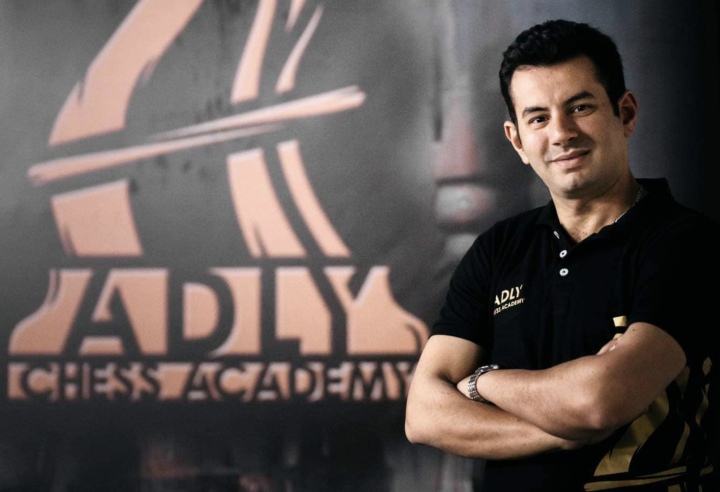
Grandmaster Ahmed Adly, from Egypt, is the new Chair of the Athletes Commission for a period of six months. He takes the baton from the Women’s World Champion Ju Wenjun. When the Commission was created in the beginning of 2021, FIDE received nine candidacies for the ten elected positions. Therefore, voting was not required, and these nine candidates made it directly into the Commission. In order to reach the number of members established on the regulations another four members were appointed by the FIDE Council: IM Ekaterina Atalik (proposed by Ms Tulay), IM Jomo Pitterson (proposed by Mr. Wilkinson) and IM Alina Kashlinskaya (proposed by Mr. Dvorkovich). Dinara Saduakassova (Kazakhstan) was the first athlete to chair this Commission for a period of half a year, followed by Ju Wenjun and now Ahmed Adly, in a six-month rotation. After the FIDE Congress 2022, a new electoral process will be held, electing 15 new members for a four-year term. Born in February 1987, Adly is one of the strongest African players in history, and a world-class player who won the World Junior Chess Championship in Armenia in 2007, as well as a bronze medal in the World Championship Under 18 in Greece, 2004. In 2005, 2011 and 2019, he won the African Chess Championship, and in February 2021, he won the Africa Online Open with a score of 7.5/9. Ahmed is also the CEO of his own chess school, a FIDE official Academy in Cairo that bears his own name. With a 600 sqm venue and a staff of 26 people working there, Adly Chess Academy trains more than 250 pupils, who are already achieving their first successes in national and continental competitions. The purpose of the Athletes Commission (ATH) is to enable the players’ voices and experiences to be heard and used for the improvement of chess as a sport. Involving athletes in the decision-making process is a core component of good governance within sports organizations, allowing them to provide early feedback on potential decisions that will affect them. This peer-to-peer cooperation helps to safeguard the credibility of the sport. Likewise, this body will actively promote and support the establishment of Athletes’ Commissions in Area Associations and Member Federations. The figure of an Athletes Commission is common among members and stakeholders of the Olympic movement, like other International Federations (IFs), National Olympic Committees (NOCs), the World Anti-Doping Agency (WADA), or the Organizing Committees of the Olympic Games (COCGs).
Final leg of FIDE Grand Prix Series kicks off in Berlin
— The third leg of the FIDE Grand Prix Series 2022 begins on March 22 in Berlin; — The event features 16 of the strongest chess players who will compete for two final spots in the Candidates Tournament; — All tickets are sold out. Berlin, March 21, 2022 – The third and final leg of the FIDE Grand Prix Series 2022 organized by World Chess gets underway in Berlin. For the next 13 days, chess fans’ attention worldwide will be focused on World Chess Club Berlin, a chess venue in the German capital where the chess superstars will compete for €150,000 and, more importantly, for the last two spots in the upcoming Candidates Tournament. It will be quite a challenge, as the winner of the second stage, GM Richard Rapport, has almost secured the first spot, but the strongest chess players competing in the last leg are determined to fight. The pool stage will start on March 22. The winners of four groups will move to the semi-finals, and then two best players will meet in the final. The pairings for Round 1 promise several exciting battles: Pool A: Andrey Esipenko (FIDE), 2723 — Grigoriy Oparin (FIDE), 2674Levon Aronian (USA), 2785 — Hikaru Nakamura, (USA), 2750 Pool B: Vincent Keymer (Germany), 2655 — Shakhriyar Mamedyarov (Azerbaijan), 2776Daniil Dubov (FIDE), 2711 — Leinier Dominguez (USA), 2756 Pool C: Sam Shankland (USA), 2704 — Wesley So (USA), 2778Alexandr Predke (FIDE), 2682 — Maxime Vachier-Lagrave (France), 2761 Pool D: Anish Giri (Netherlands), 2771 — Yu Yangyi (China), 2713Nikita Vitiugov (FIDE), 2726 — Amin Tabatabaei (Iran), 2623 Due to covid restrictions, only 35 guests per day will be allowed to visit the venue. All the tickets for the tournament were sold out in February. For those who did not manage to buy tickets or cannot attend the tournament for other reasons, the tournament will be broadcast on chessarena.com, the official gaming platform of the Series. About the tournament: The three-tournament series which will unfold from February to April features 24 of the world’s best Grandmasters competing in two out of three events. To make the series more exciting with a minimum number of draws, FIDE and World Chess have changed the format. In this series, each event consists of a group stage followed by a knockout semi-final and final. Two winners of the Series will qualify for the Candidates Tournament that will take place later in 2022. The prize fund for each event is €150,000, a €20,000 increase from 2019. The third leg of the FIDE Grand Prix will take place in the city centre at Unter den Linden 26-30. The rounds start at 3PM Berlin time. Due to COVID restrictions currently in place, only a limited number of tickets are available. Please note that the 3G rule applies to the event. The games will be broadcast live on https://chessarena.com/broadcasts/13606 FIDE Grand Prix Series is brought to you by World Chess. Leading partners supporting the FIDE Grand Prix Series 2022: Kaspersky as the Official Cybersecurity Partner; Algorand as the Official Blockchain Partner; Prytek as the Technology Transfer Partner; FIDE Online Arena as the official Partner. For further questions, please contact: media@worldchess.com Official Photo FIDE Grand Prix Berlin Press kit About World Chess World Chess is a London-based chess gaming and entertainment group and FIDE’ official broadcaster and commercial partner. World Chess organized the FIDE Championship Matches in Russia, the USA, and the UK, and revolutionized the sport by signing the biggest media partnerships in history. World Chess develops Armageddon, the chess league for prime-time television. World Chess also runs FIDE Online Arena, the exclusive official chess gaming platform. More at worldchess.com. About Kaspersky Kaspersky is a global cybersecurity and digital privacy company founded in 1997. Kaspersky’s deep threat intelligence and security expertise is constantly transforming into innovative security solutions and services to protect businesses, critical infrastructure, governments and consumers around the globe. The company’s comprehensive security portfolio includes leading endpoint protection and a number of specialized security solutions and services to fight sophisticated and evolving digital threats. Over 400 million users are protected by Kaspersky technologies and we help 240,000 corporate clients protect what matters most to them. Learn more at www.kaspersky.com. About Algorand Algorand is building the technology to power the Future of Finance (FutureFi), the convergence of traditional and decentralized models into a unified system that is inclusive, frictionless, and secure. Founded by Turing Award-winning cryptographerSilvio Micali, Algorand developed a blockchain infrastructure that offers the interoperability and capacity to handle the volume of transactions needed for defi, financial institutions and governments to smoothly transition into FutureFi. The technology of choice for more than 700 global organizations, Algorand is enabling the simple creation of next generation financial products, protocols and exchange of value. For more information, visit www.algorand.com. About Prytek The Prytek Group combines technology companies and services companies to create a new asset class. We build legacy service businesses and combine them with deep tech technologies to increase margins. We buy out entire operations and create efficiency and scalability through our technologies. The group is divided into a Corporate Arm – which comprises of controlled companies and an Investment Arm – which acts as a VC and PE fund of the Group. The goal of the Corporate Arm is to generate consolidated cash with a legacy vision, while the Investment Arm is to develop products for our operations and generate profit via equity value growth and exit at a high valuation. Prytek Building Technologies, Delivering Managed Services. Prytek: www.prytek.com About FIDE Online Arena FIDE Online Arena is the exclusive online chess gaming platform that awards online ratings recognized by FIDE. It hosts rated tournaments and games 24 hours per day. The platform runs an advanced fairplay engine. Play official games at chessarena.com.
FIDE Candidates 2022 venue and schedule announced

We’re pleased to announce the schedule and venue of the FIDE Candidates Tournament 2022. The magnificent Palacio de Santoña, a centrally located historic building in Madrid, will become the venue of the most anticipated chess tournament of 2022. Built in 1730, this mansion boasts of distinguished carved granite baroque façade and is home to one of the most refined eclectic interiors in the Spanish capital. It is currently one of the headquarters of the Madrid Chamber of Commerce. Eight prominent grandmasters will compete for a top spot in a double round-robin (all play all) tournament from 16 June to 6 July. The schedule includes four free days, one after every three rounds: 14-15 June 2022 Arrivals 1 day 16 June 2022 Technical meeting and Opening Ceremony 2 day 17 June 2022 Round 1 3 day 18 June 2022 Round 2 4 day 19 June 2022 Round 3 5 day 20 June 2022 Free day 6 day 21 June 2022 Round 4 7 day 22 June 2022 Round 5 8 day 23 June 2022 Round 6 9 day 24 June 2022 Free day 10 day 25 June 2022 Round 7 11 day 26 June 2022 Round 8 12 day 27 June 2022 Round 9 13 day 28 June 2022 Free day 14 day 29 June 2022 Round 10 15 day 30 June 2022 Round 11 16 day 1 July 2022 Round 12 17 day 2 July 2022 Free day 18 day 3 July 2022 Round 13 19 day 4 July 2022 Round 14 20 day 5 July 2022 Tie-breaks and Closing Ceremony 21 day 6 July 2022 Departures The first place is all that matters as the tournament’s winner becomes the World Championship Challenger and acquires the right to face World Champion Magnus Carlsen in a match. You can follow the updates on the World Championship Cycle on our dedicated page: worldchampionshipcycle.fide.com/
Geir Nesheim, new Chair of the Social Commission
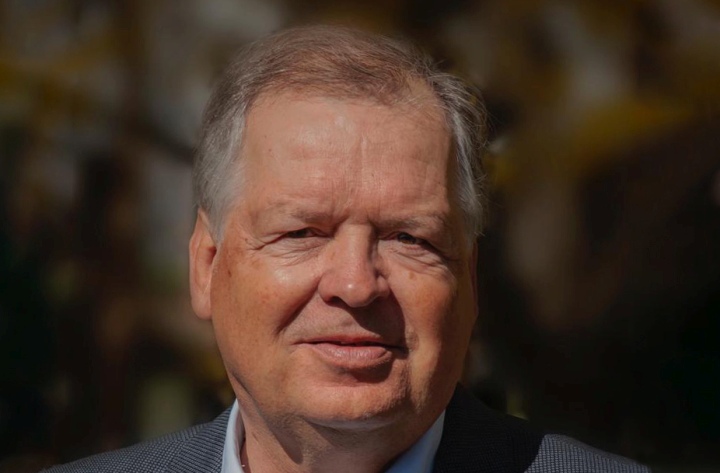
Geir Nesheim, from Norway, is the new Chairperson of the FIDE Social Commission, following the resignation of his predecessor, Paris Klerides. Paris steps down due to personal reasons that prevented him from devoting to the SOC Commission as much time as it currently requires. FIDE would like to warmly thank him for the time and passion he put into the Commission during the years he chaired it. The use of chess as a social tool is one of the areas where the work of FIDE has expanded more clearly during the past two years. Part of the credit for this increase in activity already goes to Geir, who joined the SOC Commission in 2020, making a decisive contribution with his vast experience and enthusiasm. In his working life, Geir has been a very successful corporate finance specialist, holding CFO roles for more than 25 years in multinational companies. After returning to Norway, he established himself as an independent consultant. Like so many others, Geir got hooked on chess during the match Fischer – Spassky fifty years ago and has always been connected to chess ever since. As a curiosity, he was the first-ever full-time employee of the Norwegian Chess Federation (NSF) in 1978, before becoming its President in the period 1985-86, and its Secretary-General from 2014 to 2021. He is also a FIDE Arbiter, FIDE Instructor, and has a diploma as FIDE International Organizer. Geir has launched very successful chess in schools and chess for youth programs, and in 2019 he created the “Chess and Society” project, which aims at bringing chess to a number of areas in society. These areas so far include libraries, prisons, the elderly care sector, mental health, substance abuse and asylum seekers (to be launched later in 2022). “FIDE has launched numerous social initiatives during the year 2021. Social projects have become a vital part of our everyday activities and FIDE’s image. All this requires regular and intensive maintenance and development work with partners, society and potential sponsors”, explain Dana Reizniece-Ozola, FIDE’s Managing Director. “A person with Geir’s profile is crucial for structured work and long-term sustainability of the programmes. He is currently a Member of the Commission but also has extensive experience in management, which will be very useful for the successful implementation of our Project. Particularly, for the most challenging ones, like “Chess for Protection” (chess for refugees). You can contact the FIDE Social Commission at socialchess@fide.com
FIDE Ethics imposes a six-month ban on Karjakin
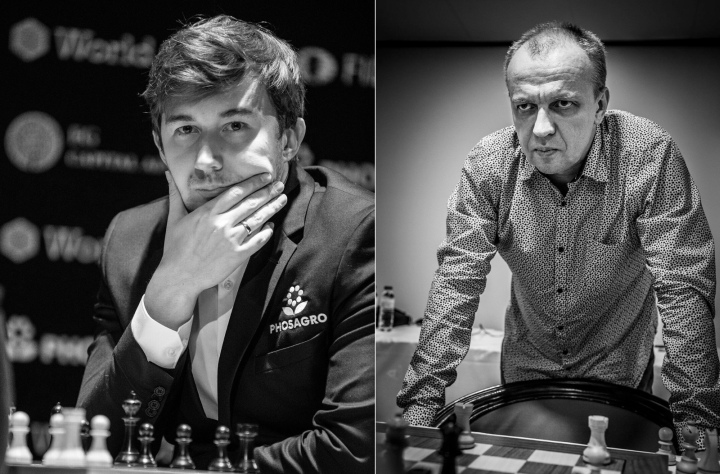
The FIDE Ethics and Disciplinary Commission (EDC) has reached a verdict on the case 2/2022, relating to public statements by grandmasters Sergey Karjakin (FIDE ID 14109603) and Sergei Shipov (FIDE ID 4113624). The EDC First Instance Chamber, formed by Yolander Persaud (Guyana), Ravindra Dongre (India), and Johan Sigeman (Sweden) as Chairperson, unanimously decided as follows: Sergey Karjakin is found guilty of breach of article 2.2.10 of the FIDE Code of Ethics, and is sanctioned to a worldwide ban of six months from participating as a player in any FIDE rated chess competition, taking effect from the date of this decision, 21 March 2022. Sergei Shipov is found not guilty of breach of article 2.2.10 of the FIDE Code of Ethics. The article 2.2.10 of the Code of Ethics reads as follows: “(…) Disciplinary action in accordance with this Code of Ethics will be taken in cases of occurrences which cause the game of chess, FIDE or its federations to appear in an unjustifiable unfavorable light and in this way damage its reputation.” “The statements by Sergey Karjakin on the ongoing military conflict in Ukraine has led to a considerable number of reactions on social media and elsewhere, to a large extent negative towards the opinions expressed by Sergey Karjakin”, reads point 7.37 of the 10-page document where the EDC explains the reasons and legal background for its decision. It continues: “A necessary condition for the establishment of guilt is that the statements have reached the public domain. This concept, with respect to disrepute clauses in sport, is not the world at large but the sport in which the accused engages, such as chess. Information concerning the accused’s conduct which is not published in the media, but which can be learnt without a great deal of labour by persons engaged in the chess world or a relevant part of it, will be in the public domain and satisfy the public exposure element. The EDC Chamber is comfortably satisfied that this condition is fulfilled in this case.” “The EDC Chamber finds, against the background given above, on the standard of comfortable satisfaction that the statements of Sergey Karjakin, which, by his own choice and presentation, can be connected to the game of chess, damage the reputation of the game of chess and/or FIDE. The likelihood that these statements will damage the reputation of Sergey Karjakin personally is also considerable”, it concludes. The Chamber explains its decision to not sanction Sergei Shipov with the following argument: “In comparison with Sergey Karjakin, Sergei Shipov is considerably less known and has, therefore, a less powerful platform. The statements made by Sergei Shipov are also of a slightly different and less provocative character than the ones made by Karjakin. In an overall evaluation of the potential negative impact on the game of chess and/or FIDE, the EDC Chamber is not sufficiently convinced that Sergei Shipov’s statements qualify as a breach of article 2.2.10.” Sergey Karjakin has been advised by EDC that this decision may be appealed to the Appeal Chamber of the EDC by giving written notice of such appeal to the FIDE Secretariat within 21 days from the date upon which this decision is received. The notice of appeal must clearly state all the grounds for the appeal. Failing the due exercise of this right of appeal, the EDC Chamber’s decision will become final. The FIDE Ethics and Disciplinary Commission (EDC) decision on the case 2/2022, relating to public statements by grandmasters Sergey Karjakin (FIDE ID 14109603) and Sergei Shipov (FIDE ID 4113624) (PDF)
Vietnam’s speed chess star races ahead in Charity Cup
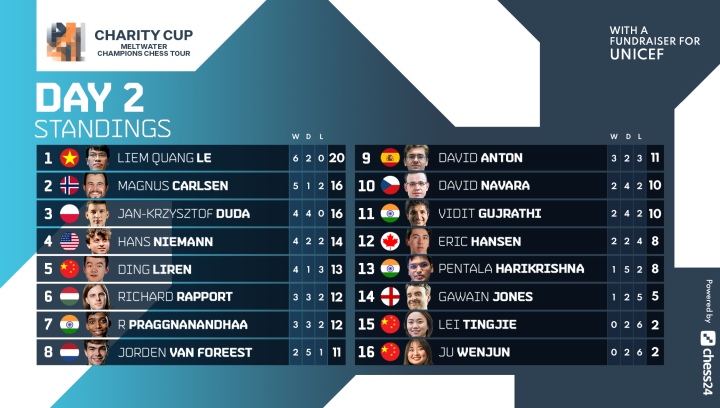
Vietnam’s speed chess star Liem Quang Le left World Champion Magnus Carlsen in his wake as he raced into a commanding lead in the Charity Cup today. The former World Blitz Champion, who is now a university chess coach, scored three wins and a draw to stay unbeaten in the event being held as a fundraiser for UNICEF. So far more than $51,000 has been raised as Liem racked up 20/24 points at the half-way point in the Prelim stage. It means Liem, who won an incredible 6/8 games, has all-but booked his place in the Meltwater Champions Chess Tour event’s Knockout. Liem said afterward: “This is amazing. I did not expect this! I think this is my best performance ever on the Tour.” Asked what he’s doing differently this tournament, Liem added: “I think I’m just getting used to it and I don’t have too much stress and I just try to enjoy the games, and I tried to prepare a little bit better a play a bit more practical.” Four points behind in second is the World Champion Magnus Carlsen, who won three and lost his second of the tournament. The Norwegian is looking ominous and will also breeze into the last eight. Indian teen sensation Rameshbabu Praggnanandhaa took another big scalp in the Tour, beating world No.3 Ding Liren in the final round of the day. He ended the day in 6th and faces Carlsen in his first game tomorrow – a re-match of the clash Pragg won in the Airthings Masters. David Navara also had a strong day, taking two wins and two draws – including his Round 6 win over Carlsen. But it could have been even better for the Czech No.1 after a third win in his Round 8 game against Richard Rapport slipped through his fingers to finish in a draw. Navara sits in 10th and has a battle ahead to make the cut while the other top eight spots are occupied by Jan-Krzysztof Duda, the American teen Hans Niemann, Ding, Rapport, Pragg and Jorden Van Foreest. The Prelim stage ends at Round 15 on Tuesday. Eight will progress to the Knockout stage and eight will be eliminated. The event is supported by NEAR Foundation and is being held as a fundraiser for UNICEF. Tune in at 17:00 UTC / 18:00 CET tomorrow for day 3 of the Charity Cup. About the Meltwater Champions Chess Tour The Champions Chess Tour is the leading online chess Tour worldwide determining the world’s best chess player over a full competitive season of online chess. The 2022 season begins in February 2022 and features monthly tournaments culminating in a Final in November 2022. The best chess players in the world are competing in rapid chess. All games take place online on www.chess24.com with players competing for a total prize pool of over USD 1.5 million. For more information visit www.championschesstour.com. About Play Magnus Group Play Magnus Group is a global leader in the chess industry focused on providing premier digital experiences for millions of chess players and students. The company offers e-learning and entertainment services via its market leading brands: chess24, Chessable, iChess, New In Chess, Everyman Chess, Silver Knights, Aimchess, the Play Magnus App Suite, and the Meltwater Champions Chess Tour. The Group’s mission is to grow chess to make the world a smarter place by encouraging more people to play, watch, study, and earn a living from chess. Play Magnus Group is listed on Euronext Growth Oslo under the ticker PMG. www.pmg.me
FIDE Grand Prix Berlin: So and Mamedyarov advance to semifinals
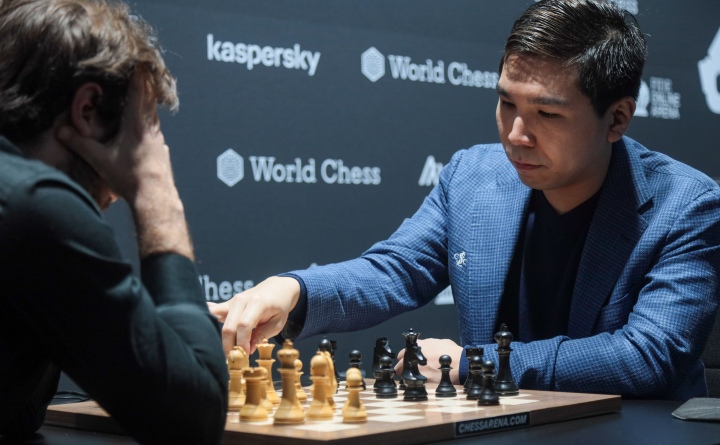
Wesley So defeated Sam Shankland in the rapid tiebreak games by a score of 1½:½ to reach the semifinals of the third stage of the FIDE Grand Prix Series organised by World Chess in Berlin. The tiebreak games were played with the quicker time control of 15 minutes per game with an increment of 10 seconds per move starting from the first move. In the second tiebreak match, Shakhriyar Mamedyarov won the first game against Vincent Keymer, but the 16-years-old local hero managed to win on demand and levelled the score. The tiebreak continued with a shorter time-control of 3 minutes per game with an increment of 2 seconds per move. Shakhriyar dominated the blitz outplaying his young opponent in both games, finishing the match by a 3:1 score. In the semifinals scheduled for the 30 and 31st of March, Welsey So is up against Amin Tabatabaei, while Shakhriyar Mamedyarov will face Hikaru Nakamura. Both American players, Nakamura and So, will play with white pieces in the first game. Wesley So – Sam Shankland 1½:½ Sam Shankland got a nice position with White in the Catalan in the first the game against Wesley So. With a pair of bishops and the prospects to open the center, he was planning to fight for an advantage but Wesley had a solid position that was not easy to crack. After losing the central pawn, Sam was hoping his a-pawn would play a decisive role in the endgame, but Wesley’s pieces surrounded White’s king, forcing Sam to give up some an exchange. The rest was a smooth sail for So, who sealed the victory on move 54. In the second game, Sam got really good chances to equalise the score. He sacrificed an exchange and, after a few inaccuracies by Wesley, got a strong initiative on the kingside. So felt he was in trouble and returned material, moving the game into an ending with an extra pawn for Black. The only problem with Sam’s position was his rook on g5, which got stuck on the kingside. Sam didn’t find the precise way to activate his rook (33…f6! instead of 33…c5 looks much better) and let all his advantage slip away. The game was drawn in an equal rook endgame after 40 moves of play. Sam Shankland summed up his FIDE GrandPrix performance: “On paper, it was fine. I came in seeded number 3 in a group both times, and I finished in second both times, and I gained some rating. But I am sort of annoyed with myself that I never managed to get through.” “Sam is a very strong player and also very hardworking. He’s got a strong will to improve,” said Welsey So after the game. In a post-game interview, Wesly noted that he was looking forward to facing Iranian Grandmaster Amin Tabatabaei representing a new generation of Iranian players, who showed good play in the tournament. Shakhriyar Mamedyarov – Vincent Keymer 3:1 All the games of the tiebreak match between Mamedyarov and Keymer ended decisively. “It was a very fighting match – no draws. I tried to play for a win with both colours, and I think we had good tactical games,” commented the winner Shakhriyar Mamedyarov. Certainly, all the games were very exciting, and Mamedyarov was the first one to break the ice. A very sharp position with opposite castling appeared on the board in the first game, and Shakhriyar, known for his aggressive style, felt like a fish in water. He managed to open the files on the kingside, aggressively arranged his pieces and launched an unstoppable attack on his opponent’s king. It was the first-ever tiebreak match for Vincent, and he managed to pull himself together and staged an impressive comeback by defeating Mamedyarov in the second game. “I know myself; I cannot play for a draw in such situations when I need to make a draw”, commented Shakhriyar on his opening choice in the second game. Vincent knew the Botvinnik Variation in the Semi-Slave Defense quite well and thought it was a pleasant position to play with White. In an unbalanced position with chances for both sides, Vincent played precisely and managed to stir into a favourable ending in which his passer on the h-file, created in the opening, played a critical role. Eventually, this pawn sealed the deal for Vincent, who levelled the score. Mamedyarov was not taken aback and scored a crushing win in the first blitz game. In the Anti-Meran system, both players were slowly manoeuvring, preparing for the fight in the center. After numerous pawns exchanges, it turned out Black pieces are much more powerful and active. Mamedyarov won in style after sacrificing his knight on g2. After the loss in the first blitz game, Keymer was in a must-win situation again, hoping to force Armageddon, but the second encounter also went wrong for the German Grandmaster, who found it hard to defend the open king with a few seconds on his clock. “I think, in our pool, he showed the best play… He is fighting, he’s very good and still young. I hope he will be 2800 – I think he can do it. His only problem, I think, is school, university. If he can solve it somehow, he can be the very top player,” said Mamedyarov about his opponent after the match. The semifinals starts on March 30 with the pairings as follows: Hikaru Nakamura – Shakhriyar Mamedyarov Wesley So – Amin Tabatabaei The FIDE Grand Prix Series is brought to you by World Chess. Leading partners supporting the FIDE Grand Prix Series 2022 include: Kaspersky as the Official Cybersecurity Partner; Algorand as the Official Blockchain Partner; Prytek as the Technology Transfer Partner; FIDE Online Arena as the official Partner. Photo: Official Photo FIDE Grand Prix Berlin Press kit and Niki Riga