

FIDE Grand Prix Belgrade – Knockout: Day One Recap
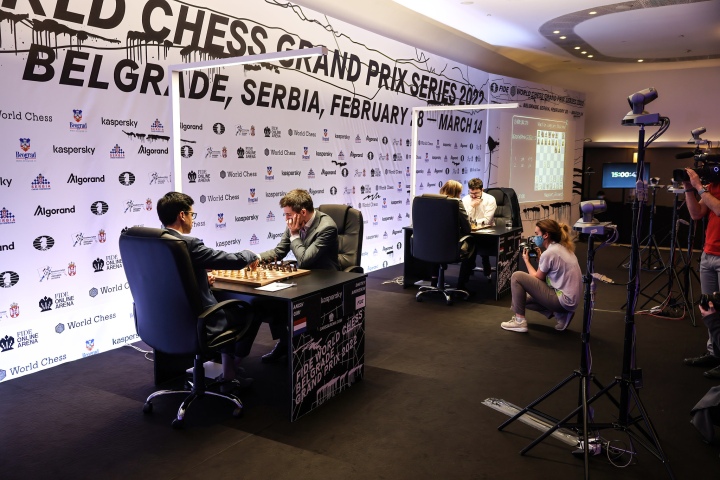
Richard Rapport defeats Maxime-Vachier-Lagrave as White, while Giri and Andreikin draw The first round of the semi-finals of the second leg of the Grand Prix saw one decisive result and one draw. Richard Rapport defeated Maxime Vachier-Lagrave. Before this game, the two had played eight classical games, five of which were drawn and three were won by the Frenchman. Despite the head-to-head record favouring Vachier-Lagrave, every game is a story of its own, and this one did not have a happy ending for MVL. Rapport opened with 1.d4, and Vachier-Lagrave responded with his favourite, the Gruenfeld. The opponents tested a relatively rare variation in which the Hungarian introduced a logical novelty (the first line of Stockfish) 14.Bd2. White got an edge that only increased after Black opted not to contest for the open c-file on move 19. MVL tried to put pressure on the white king in the centre, however, Black was doomed after that. Indeed, Rapport had a very dangerous d-pawn and a stronger bishops pair. Black was better developed, but it just did not work for him in concrete variations. By move 23 White’s d-pawn seamlessly advanced to d7. Soon afterwards, the e-pawn joined the race and – supported by a strong pair of bishops – Black was hopeless in preventing defeat. On move 37 the Frenchman capitulated. The outcome of the first knockout round suggests that Maxime will have to play for a win in the second game, as he will be leading white pieces, and the Frenchman will certainly enter the match swinging. On the other board, the game between Anish Giri and Dmitry Andreikin ended in a draw, despite both sides (especially White) having a chance to win at certain points. The odds were even before the match as Giri and Andreikin played five classical games and drew all five of them. Their most recent clash was at the 2021 Tolstoy Memorial 2021, where they split a point. In the Sicilian with 3.b3, an offbeat line that has become trendy recently, the opening was similar to the one Nihal Sarin played against Andreikin in the 2021 World Cup. White (Giri) came out of the opening with a slightly better position, as he had more space, quickly castled long and put some pressure on the kingside. Andreikin rushed things with 17…c4? but this dubious move quickly backfired after a simple exchange followed by 19.b4. White dominated the board, but after 19…h6, attacking his g5-knight, Anish sacrificed it on f7 (which is not in his style), letting a greater part of his advantage slip away and allowing Black to find breathing space. Instead, a simple and natural knight retreat 20.Nh3 would have posed insurmountable problems for Black. White continued to pressure but then overstretched himself with 23.Rd5, giving an exchange for an attack that didn’t work. Following the exchange of queens on move 28, the tables have turned, and Black was now better; however, he had to be very precise as White had a very active bishops pair. Most likely, after avoiding the worst, Andreikin was happy with a draw, as a few more moves down the road the two split a point. In the post-game analysis, Giri and Andreikin said that it was a complicated game where they both missed some crucial lines and concluded that the outcome was fair. Pairings for day two of the knockout: Dmitry Andreikin vs Anish Giri Maxime Vachier-Lagrave vs Richard Rapport The round starts on Thursday, 10th March, at 3 PM local (CET) time. Leading partners supporting the FIDE Grand Prix Series 2022 include: Kaspersky as the Official Cybersecurity Partner; Algorand as the Official Blockchain Partner; Prytek as the Technology Transfer Partner; FIDE Online Arena as the official Partner. Text: Milan DinicPhoto: Mark Livshitz Official Photo FIDE Grand Prix Belgrade Press kit
2022 Women’s Speed Chess Championship announced

Happy International Women’s Day! On this special occasion, FIDE is thrilled to announce that the 2022 edition of the Women’s Speed Chess Championship has been confirmed and is set to start on May 24. The event was born from a partnership between FIDE and Chess.com and is the most important online tournament for titled women in the world. This year, fans will enjoy top women players vying for their piece of the $70,000 prize fund! Last year, fans had the chance to appreciate the lightning-fast chess of many of the leading women of our time. Six out of the top 10 active women in the world participated, including GMs Hou Yifan, Kateryna Lagno, Lei Tingjie, Nana Dzagnidze, and Anna Muzychuk. Other formidable players such as GM Humpy Koneru, current Women’s Blitz World Champion IM Bibisara Assaubayeva, and Women’s Rapid World Champion GM Alexandra Kosteniuk also joined last year’s field. With such fierce competition, not even Hou, a four-time world champion and the highest-ranked woman in the world, had an easy time. The Chinese grandmaster clinched the title only after defeating GM Harika Dronavali in the nick of time, winning the last two bullet games of the match to uneven the score. Earlier this year, FIDE declared 2022 as the Year of Women in Chess. According to FIDE’s Managing Director, Dana Reizniece-Ozola, partnering with Chess.com once more to promote the Women’s Speed Chess Championship is part of the effort to celebrate women in chess. “Celebration does not mean being entertained or amused. Celebration is about appreciation,” said Reizniece-Ozola. “With FIDE announcing 2022 as the Year of Women in Chess, the power of great women in chess is celebrated. And this tournament organized by Chess.com is one such event. Chess moves women forward and women move the chess world forward.” With an increased prize fund and tweaks to improve the event’s format, this year’s Women’s Speed Chess Championship promises to be the best yet. Make sure you tune in to Chess.com/TV, Chess.com Twitch channel, or FIDE YouTube to catch the live broadcast with expert commentary!
FIDE Workshop for Changes in Regulations held online
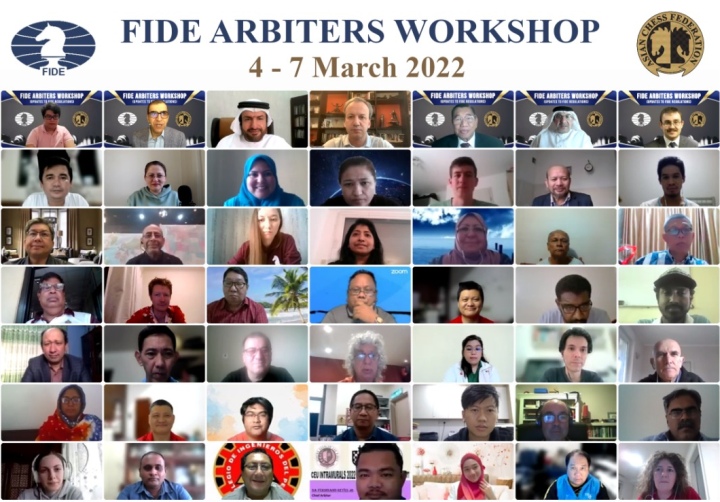
The FIDE Workshop for Changes in Regulations organized in partnership with the Asian Chess Federation was held online from March 4-7, 2022 via Zoom. At the opening ceremony, the Asian Chess Federation General Secretary Hisham Al Taher welcomed participants and the Guest of Honour FIDE President Arkady Dvorkovich. The FIDE President said that the FIDE General Assembly held last December had approved these changes to regulations and emphasized the importance of keeping up with the latest FIDE regulations for arbiters and organizers. Arkady Dvorkovich thanked Arbiters for their participation, welcomed feedback and invited comments for further discussion with FIDE. Mr. Dvorkovich drew attention to the recent FIDE Council decision caused by the current geopolitical situation and the tragic war in Ukraine – Russian players can take part in FIDE events only under the FIDE flag. He confirmed that FIDE had to move the Chess Olympiad and FIDE Congress from Russia. FIDE opened bids for hosting Chess Olympiad and has already received a bid from All India Chess Federation. There can be separate bids for Chess Olympiad, Olympiad for People with Disabilities and FIDE Congress. FIDE President invited all potential bidders to contact FIDE. A total of 180 participants from 53 countries registered for the Workshop, namely 30 Asian countries, 10 European countries, 7 African countries and 6 countries from the Americas. The Workshop was attended by 49 International Arbiters, 54 FIDE Arbiters, 63 National Arbiters and eight International Organizers. FIDE Qualification Commission Secretary Alex Holowczak of the U.K. made a report on changes to FIDE title and Rating Regulations which came into effect 1st January 2022 explaining the logic behind the changes. Rules Commission Chairman Abdulrahim Mahdi of the UAE presented the updates to the FIDE Laws of Chess and online regulations. Rules Commission Secretary Mehrdad Pahlevanzadeh of Iran told about updates to Arbiter title regulations, classification and updates to Fair Play regulations. ACF Executive Director Casto Abundo of the Philippines rounded off the seminar with a lecture on How to Organize Chess Tournaments. The Workshop was a project of the Asian Chess Federation aimed to assist Arbiters and Organizers and speed up a post-pandemic return to over-the-board chess.
FIDE Grand Prix Belgrade: Round 6 Recap
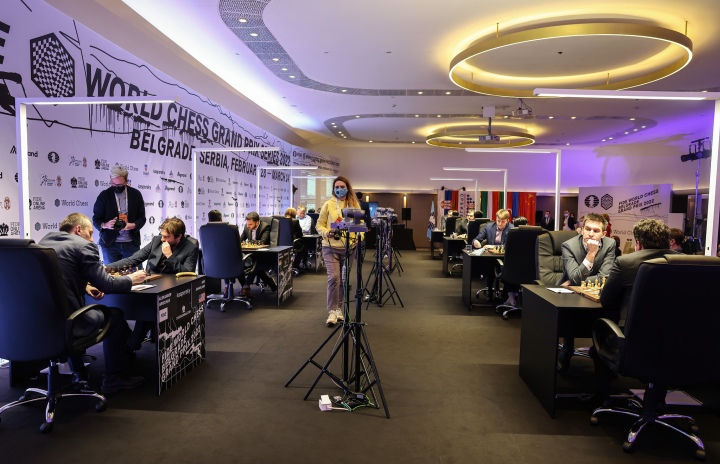
Dmitry Andreikin, Anish Giri, Richard Rapport and Maxime Vachier-Lagrave move on to the next stage of the FIDE Grand Prix Belgrade The final – sixth round – of the group stage of the Grand Prix finished in Belgrade, with four clear winners progressing to the semi-finals. Despite players such as Richard Rapport and Anish Giri entering the round as comfortable leaders in their groups, it was a tense day as things could have still gone wrong even for them. On the other hand, players such as Etienne Bacrot, Shakhriyar Mamedyarov and Nikita Vitiugov had to play for a win in order to secure a place in the tiebreaks. These circumstances were promising an exciting final round of the group stage of the Belgrade leg of the Grand Prix. The first move in the round was made by Lukasz Turley, FIDE Vice President, in the game between Nikita Vitiugov and Anish Giri. Pool A: In Pool A it was Andreikin and Shankland who had the most chances to move to the next stage. If they drew their games, or if both won, the two would have to play each other in the tiebreak. However, if Andreikin lost and Shankland drew, it would be the Bacrot and the American who would have to decide in tiebreaks who moves forward to the semi-finals. Dmitry Andreikin opted for a rare line in the Queen’s Gambit Accepted against Etienne Bacrot but did not get even a slight edge. Bacrot was holding his own quite comfortably, and a draw seemed like the most logical outcome. Trying to reverse his fortune, Andreikin ventured upon a queen sacrifice for a rook and minor piece, but it did not offer much had Bacrot played the natural move 27…Qxd5. The game was full of twists and turns where both sides had a significant advantage and then blundered it away. The final portion of this encounter was a real blunder fest. Black had just a rook for the queen at some point but allowed the opponent to weave a mating net around his king. A miracle victory by Andreikin, who qualified for the semis. Sam Shankland essayed the Sicilian defence against Alexander Grischuk, who responded with the Rossolimo Attack. White opted for a very solid setup, restricting Black’s activity. Shankland played the right logical moves, but unfortunately for him, they led to massive exchanges and a draw was agreed on move 24. Pool B: Anish Giri was the favourite to win in Pool B. He was Black against Nikita Vitiugov. In their previous game, in the second round, Giri was victorious as White. In the round six game, Vitiugov had to win in order to get a chance to fight Giri again, but in the tiebreak. Starting with the English Opening, the game quickly transposed into a sideline of the Tarrasch Defence. It seemed that Vitiugov managed to surprise Giri as Black spent a lot of time on the opening: nearly 32 minutes on move eleven and 15 minutes on his 15th move. The time was well-spent as Anish got a comfortable position and after exchanges in the centre reached equality. With a solid pawn structure and no queens on the board, Giri was safe, and the two called it a draw. With this draw, Anish Giri was on 4/6 and in clear first place in Pool B. “It’s very important that I qualified and not so much how the games went… All the games were tough, and my play was decent. I’m happy with my score, and I’m looking forward to the next phase”, said Giri in his post-game interview. Pentala Harikrishna lost as White to Amin M. Tabatabaei. The two had no chances to qualify for the next stage, but they still played an exciting game. In the Open Line of the Ruy Lopez, White sacrificed an exchange, getting a pawn and a bishops pair as compensation, following the idea introduced in the game Caruana – Dominguez in 2021. Tabatabaei offered a repetition on move 23 but White opted to play on. However, immediately after this, following a strange move 28.b3, White opened the queenside to Black. Tabatabaei’s rooks jumped into action, and his extra exchange quickly came to fore. The Iranian finished the event with his first and only victory. Pool C: Richard Rapport drew with Alexei Shirov, and with this result, sealed his card for the next stage of the tournament. In the English Opening, the Hungarian opted for the line he had tested back in 2013 but with black pieces. Shirov was trying to create some chances on the queenside but did not manage to get anything substantial. Everything was in Rapport’s hands, who opted for a safe path to a draw that promoted him to the next stage. Vladimir Fedoseev and Vidit Santosh Gujrathi had a theoretical discussion in a popular line of the Petroff Defense. Castling on opposite sides promised a sharp game, and the opponents did not disappoint. Black pushed his pawns towards the centre, pressing White’s c4-square. Fedoseev had to switch to defence and allowed Vidit to seize the advantage, which he increased by cutting off White’s king on a1. Vidit Gujrathi was in control, but a strong computer-like move 30…Rd8! escaped his attention. White avoided the worst and after several unsuccessful tries by Vidit the game ended in a draw. Pool D: One of the most anticipated games of the round was between Shakhriyar Mamedyarov, who was leading white pieces against Maxime Vachier-Lagrave. The only way Mamedyarov could qualify for the next stage was to score a victory against the Frenchman, who was the leader in the extremely strong Pool D. After 1.d4, MVL decided not to play his pet Gruenfeld and opted for a more solid opening. In the Carlsbad Variation of Queen’s Gambit, the two players castled to the opposite wings suggesting a sharp game. White tried to engineer some activity on the kingside but the Frenchman was quick in his counterplay. His dark-squared bishop was a particularly functional piece, cementing defence and eyeing the b2-pawn in White’s camp. By move 30 Mamedyarov exhausted his attacking options and
Dominican Championship: Gian Carlo Arvelo claim title

Gian Carlo Arvelo and Raydily Rosario Almánzar are new chess champions of the Dominican Republic. The Open and Women’s Championships, Swiss tournaments with classical time control, were held from February 18 to March 06 (with a long break from February 20-25 in the open competition). The 18th rated Gian Carlo Arvelo produced a major sensation by winning the open event with an excellent result 9/11. The champion completed the tournament unbeaten, finishing with three straight victories and picking up 91 rating points. Gian Carlo qualified for the national team and will represent his country at Chess Olympiad 2022. “This day is very special for me because I become the National Chess Champion of the Dominican Republic. To be the number 1 in whatever is not an easy task; it is a dream that many cannot achieve, and today I could,” said the happy champion. The rating favourites FM Carlos Paul Abreu and IM Jose Lisandro Muñoz netted 8½/11 each and tied for second place. Silver went to Carlos Paul thanks to slightly better Buchholz over Jose Lisandro, who had to settle for bronze. Final standings: 1 FM Arvelo, Gian Carlo 9 2 FM Abreu, Carlos Paul 8½ 3 IM Munoz, Jose Lisandro 8½ 4 FM Guzman, Christopher 8 5 FM Hernandez Sanchez, Elvis 7½ 6 Mendez Ramirez, Victor 7 7 CM Crispin Ferreras, Darvi Abraham 7 8 IM Dominguez, Jose Manuel 6½ 9 Mesa Cruz, Juan Carlos 6½ 10 Sanchez Castillo, Jose Rafael 6½ In the Women’s Championship, Raydily Rosario Almánzar (pictured below) tied for the first place with CM Jennifer María Almanzar. The two will lock horns in the match for the title in April. CM Doribel Muñoz Santana claimed bronze scoring 6/8, while the defending champion Patricia Evarista Castillo Pena did not make it to the podium and finished only 5th. Final standings: 1 Rosario Almanzar, Raydily 6½ 2 WCM Almanzar Vasquez, Jeniffer Maria 6½ 3 WCM Munoz Santana, Doribel 6 4 WFM Diaz Cesar, Wilsaida Pieranlly 5½ 5 WCM Castillo Pena, Patricia Evarista 5 6 Gonzalez Peguero, Mary Loly 5 7 Coronado Paulino, Karen Libell 5 8 WCM Villar Acevedo, Darlin Rocio 5 9 Sanchez Jaspez, Rosangel 4½ 10 Ramirez Luzon, Franchesca 4½ Photo: Federación Dominicana de Ajedrez Facebook page
Chess for Ukraine: FIDE announces series of fundraising events on Women’s Day

In light of the ongoing war in Ukraine, and under the roof of the Year of the Woman in Chess, the FIDE Commission for Women’s Chess had established a fundraiser for Ukrainian chess players and their families affected now by war. They have also reached out to a number of women chess players in Ukraine, well-known in our chess community, to provide them with help and support. You can read their letters and messages and make your donation in the fundraiser. Also, the FIDE Women’s Commission, in partnership with Chess24, has prepared a series of events on the Women’s Day to support Ukrainian chess players and their families. The main hosts of the Women’s Day special broadcast will be IM Jovanka Houska and IM Eva Repkova. The Chess for Ukraine 3 min arena tournament will start at 17:00 CET. The first of a series, this tournament is named after the World Champions Anna & Marija Muzychuk and Anna Ushenina. FIDE Commission for Women’s Chess and Chess24 joined forces in this fundraising event to help female chess players in Ukraine. Everyone can join. To do it, click here. In addition the arena tournament, the team competition is planned at 20:00 CET. FIDE will have its own team represented by WGN Dana Reizniece-Ozola (FIDE Managing Director), GM Zhu Chen (FIDE Treasurer), WIM Salomeja Zaksaite (Chair of FIDE Fair Play Commission) and WGM Martha Fierro (Chair of Commission for Women’s Chess in Americas). The schedule of the events is the following: Time (CET) Event 16:45 The start of the Women’s Day special broadcast Main hosts: IM Jovanka Houska and IM Eva Repkova 17:00 Chess for Ukraine – “Women’s World Chess Champions Anna Ushenina and sisters Muzychuk” Two-hour arena tournament Time control: 3 min. 19:00 Talk with guests invited by FIDE/Play Magnus Group 20:00 Team competition Let us show our strong support for our Ukrainian chess players and their families by participating in these events and a fundraiser!
FIDE adopts simplified procedure for playing under FIDE flag

Dear players, In connection with the decision of the FIDE Council to provide a simplified procedure for performing under the FIDE flag for players representing Russia/Belarus, we herewith explain the details of the procedure: 1. For the transfer, a player should send a request to federations@fide.com with a copy of the identity document attached. In case of a minor player, a document certifying the identity of the player, as well as the identity of the legal representative, has to be attached. A copy of the request should be sent to the following e-mail addresses: dana.reizniece-ozola@fide.com and aleksandr.martynov@fide.com. 2. The right to play under the FIDE flag is granted until 31 May 2022. After this period, in the absence of other requests, the player will automatically be returned to the previous federation. 3. If a player wants to continue playing under the FIDE flag after 31 May 2022, he/she should submit a new request to FIDE after 1 May 2022. Such request will be considered in a due manner.
FIDE Grand Prix Belgrade: Round 5 Recap
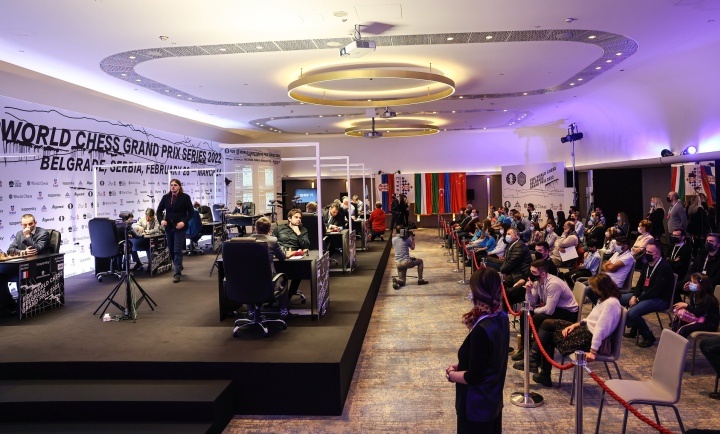
Twists and turns in round five set a scene for a tense final day in the group stage of the FIDE Grand Prix Belgrade, organized by World Chess. Following a day of rest, 16 top-world players gathered in the “Atlantic-Pacific” playing hall of the Belgrade Crowne Plaza Hotel, for the final rounds of the group stage of the Grand Prix. With two more games to play before the knockout, the tension was high. Round five started at 3 PM CET time, and the first move was made by GM Aleksandar Colovic, ACP president and FIDE Fair Play Councillor, in the game between Sam Shankland and Dmitry Andreikin. Just half an hour later, at the same hotel, another chess event started – the “Belgrade 2022” GM tournament where ten strong players, from Serbia and abroad (including the likes of Parham Maghsoodloo, David Navara, Nihal Sarin and world rapid champion Nodirbek Abdusattorov), are taking part. Here are the results from each pool of the second leg of the Grand Swiss, taking place in Belgrade, Serbia. Pool A: The derby of Pool A, between leaders Sam Shankland and Dmitry Andreikin ended in a draw. With just over an hour of play, this was the first game to finish. In the Janowski variation of the Queen’s Gambit, Shankland got caught out in the opening by Andreikin. White played 9.Bh4 instead of the more common line 9.Bf4 and by move 12 Black equalised. Following the exchange of queens, Andreikin had an isolated pawn but got his rooks lined up on the c-file and actively positioned his pieces. Overall it looked very solid for both sides. Following threefold repetition, a draw was agreed on move 24. Soon afterwards, the second game of Pool A finished, where Etienne Bacrot and Alexander Grischuk decided to split point. In the Ruy Lopez with 6.d3 White achieved a position where he could have exerted some pressure with 14.d4. Instead, Etienne played 14.c4, allowing Black to get a slight edge. After exchanging minor inaccuracies the opponents started repeating moves and agreed to call it a day. Shankland and Andreikin both have 3/5 and are the joint leaders of Pool A. Bacrot has to win against Andreikin and hope that Shankland loses to Grischuk in order to be the qualifier. Grischuk, however, has no chance to move to the next stage. Pool B: It was a day of draws in Pool B. Amin M. Tabatabaei and Nikita Vitiugov played the Giuoco Piano. After a lot of slow manoeuvring in a roughly equal position, Tabatabaei ventured upon d3-d4, allowing Black to activate his knight and start posing problems for White. At first glance, Vitiugov had some advantage in the endgame but Amin had sufficient defensive resources to hold his ground. In the post-game analysis, both players agreed that “the draw was a fair result”. Anish Giri got out of the Ragozin with a better position against Pentala Harikrishna but then hastily played 17.Ne5, allowing Black to equalise. While this move is in line with the ideas of the opening, the concrete variations did not favour White. Harikrishna seized the opportunity and played 17…c5, opening the position and creating a protected c4-passer. Giri timely carried out a standard e3-e4 breakthrough in the centre to weaken Black’s c4 pawn. Pentala still had some edge but after he grabbed the a3-pawn further exchanges became inevitable and the two agreed to split a point on move 31. The clear leader in this group is Anish Giri with 3.5/5 and he is followed by Nikita Vitiugov on 2.5 points, while the other two players are out. In the final round of the group stage, Vitiugov is White against Giri and he will have to win in order to stand chances to move on to the next phase of the tournament. Pool C: Alexei Shirov defeated Vladimir Fedoseev in the Sveshnikov System of the Sicilian. This is his first victory in five rounds. Black got a very promising position after planting his bishop on d3 but then launched a somewhat hasty attack on the kingside which proved to be without venom. Shirov – in his style – played bravely. As Black was mounting pressure on White’s king which looked dangerous but was in fact not really threatening thanks to an excellent defensive manoeuvre Nd5-e3, Shirov advanced his pawns down the d-file opening the a1-h8 diagonal and penetrated with his rook to the seventh rank. White’s arguments were much stronger, and although Shirov made an inaccuracy on move 29, he quickly converted his advantage into a full point. In an insightful post-game commentary, Shirov gave an in-depth analysis of the game from the first move. Despite not standing chances to move to the next stage, Shirov said that he was happy he managed to beat “one of the youngsters”. Vidit Santosh Gujrathi lost as White to Richard Rapport. In the French Defence, Rapport got control of the White squares but fell behind in development. Gujrathi didn’t manage to use this temporary advantage, allowing Black’s strategical long-lasting pluses to come to the fore. Rapport got a firm grip over the game, both threatening the white king and having control on the queenside. By move 43 Black had a three-pawn advantage and Gujrathi’s capitulation became just a question of time. The Indian GM resigned on move 61. With 3.5/5 Rapport is the clear favourite to qualify for the next stage. The only one who could catch up with him is Gujrathi (2.5/5) providing that he defeats Fedoseev as Black and that the Hungarian loses to Shirov as White. Seems it’s too much to hope for, but Caissa can be both generous and cruel. Pool D: A strange game transpired on the board where Alexandr Predke was playing as White against Shakhriyar Mamedyarov. This was one of the last games to finish in the fifth round. In the Giuoco Piano White came out of the opening slightly better. However, Predke handed the advantage to Black with 20.Re4 but Mamedyarov did not find the best response – he played 20…d5 and the position was even again. In the subsequent play Mamedyarov emerged a pawn up but White had compensation as his opponent’s
Second season of FIDE Chessable Academy starts on Chessable Classroom
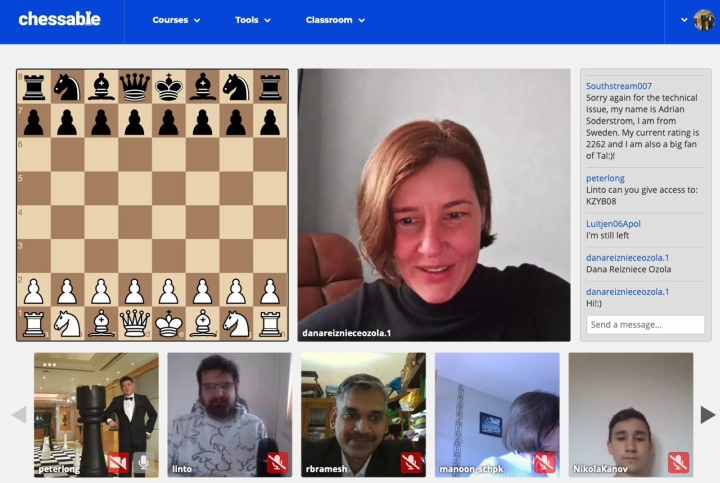
The FIDE Chessable Academy, the initiative of Chessable, the world’s leading chess E-learning platform, in partnership with FIDE, resumed on Saturday, 5 March 2022. The FIDE Trainers’ Commission (TRG) initially implemented a three-year junior educational program in summer 2021, when 265 most talented and promising young players between the ages of 8 to 16, representing 100 national federations, attended the program from July till December 2021. The new semester will be held from March to May 2022. And it attracted even more talented young players. 415 participants from 88 countries will learn and improve their chess working with the strongest trainers, including grandmasters Mikhail Kobalia, R. B.Ramesh, Evgeniy Najer, Farrukh Amonatov, Yu Shaoteng, Mikhail Gurevich, Alexey Kuzmin, Nigel Short, Alonso Zapata, Ilya Smirin and many others.. The introductory classes were held today in 10 Groups in English, Russian and Spanish languages and featured FIDE Managing Director Dana Reizniece-Ozola, Chief Executive Officer of Chessable Geert van der Velde, FIDE Executive Director Victor Bologan and other officials. FIDE Managing Director Dana Reizniece-Ozola: “Let me welcome you on behalf of FIDE! The fact that you are here means that you are not only among the most talented children in your country, but also you have worked a lot. I am a chess player myself, and I know that there’s no easy way to the top of the mountain. You have to work very hard, that is why I respect you so much! I hope you will have a great experience here. Just remember that every regular boring day, you are preparing yourself for the one extraordinary one. And my special greetings to girls! Now we have the Year of the Woman in Chess in FIDE and we want to emphasize how smart female chess players are what a strong part of the chess community they are. I have a dream that one day it will be a lady sitting at the board at the World Chess Championship match! Try hard to make my dream come true!” Chief Executive Officer of Chessable Geert van der Velde: “I am really proud that we have over 400 kids this season joining from almost 90 different countries and federations. That is a really broad spectrum of kids joining this year. You guys are obviously some of the strongest players already. Some of you actually are grandmasters, but it is still fantastic. One of the things that we envisioned when we built the Chessable Classroom was to create a live video learning environment where people can gather around the chessboard. One of the nice things that this board is interactive; I hope you will have a lot of fun with it. This is the second season of the Chessable FIDE Academy. We are still working on improving the product every single time, so you might see some new features released over the next couple of months. If you have any ideas for us on how to improve our product, we are very happy to hear your suggestions.” FIDE Executive Director Victor Bologan: “We had very good successful in-person meetings with pupils from the first season in Dubai during the World Championship match. It was a great experience. I remember myself when I was a kid; for me, those meetings, lessons and seminars with grandmasters and world champions were very inspirational. So I hope that these lectures with famous trainers will also help you. That’s why FIDE is very happy to support these courses and thanks Chessable for this great opportunity. I think it is a very good synergy of knowledge, tools, experience and platform. From the FIDE’s side, we do have a very good interaction with almost 200 national chess federations in the world. It’s a huge scale, and I understand we have the best of the best. We are aiming for good attendance, so don’t miss classes, even if sometimes you feel it is boring. It will surely positively impact your performance and chess skills. Good luck to all of you!” During three months of training, a panel expert representing FIDE and Chessable will oversee the participants’ progress, provide assignments, and work together to evaluate the young talents. Students will also get access to numerous free chess learning materials from Chessable. The players, showing the best performance during the training, will have a chance to attend the offline training with top grandmasters. About Chessable Chessable is the world’s leading chess E-learning platform and the largest digital chess library in the world. Chessable’s mission is to make learning chess as fun and efficient as possible. It has published interactive video courses by a wide range of presenters and authors, including many of the world’s top players, such as current World Chess Champion Magnus Carlsen. The company was co-founded in 2015 by David Kramaley and International Master John Bartholomew. Chessable’s team consists of expert content creators, scientists, developers and chess grandmasters all working together to create the best chess learning platform in the world.
FIDE Grand Prix Belgrade: Round 4 Recap
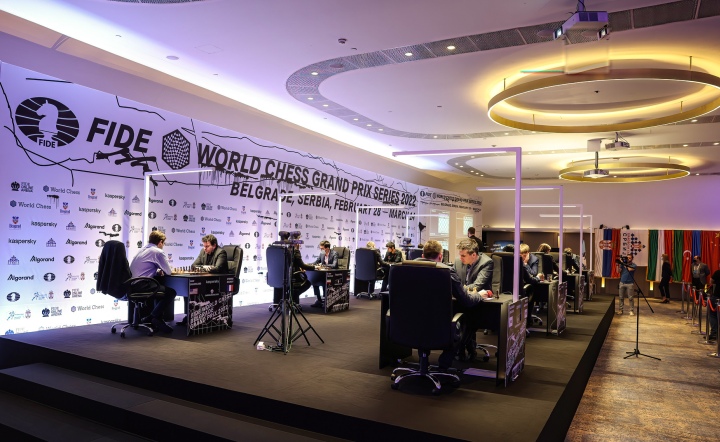
A day of draws in the FIDE Grand Prix Belgrade organized by World Chess as Maxime Vachier-Lagrave is the only one to score a victory, producing a first decisive game in Pool D The fourth round of the second leg of the FIDE Grand Prix was mostly calm as seven out of eight games ended in a draw. The only one to win was the World Blitz champion and seasoned top-class player, Maxime Vachier-Lagrave (MVL), who scored an important victory in Pool D, breaking a three-round long cycle of draws in that group. In the overall results, Anish Giri is doing best with 3/5, leading Pool B, followed by five GMs on 2.5 points: Andreikin and Shankland (leaders in Pool A), Rapport and Gujrathi (leaders in Pool C) and MVL, who leads in Pool D. Pool A: The game between Dmitry Andreikin and Alexander Grischuk was the first to finish after an hour and 15 minutes of play. The two played a well-researched line in the Grunfeld Defence, and the game followed a familiar theoretical path leading to a draw. As Grischuk said – “Dmitry only checked if I knew the theory and it turns out I do”. Dmitry Andreikin noted that he was happy with a draw given the overall standings as he prepares for the key duel in the group – the Round 5 encounter with the other leader of Pool A, Sam Shankland. Alexander Grischuk was more direct: “I can now buy a [plane] ticket, as it’s guaranteed I won’t reach the playoffs”. In the other game in this group, Sam Shankland drew with Etienne Bacrot. White got a better position out of the opening but did not manage to coordinate his pieces and allowed Black to regroup. By move 14th White’s advantage melted. Then it was Etienne’s turn to misstep – his rook made a long voyage to b4, but it was just a waste of time. Sam achieved a virtually won position but failed to find 34.e5! He went for Black’s a-pawn, hoping to advance his a-runner, but Bacrot also had a pawn on c5, which played an important role in his defensive setup. In the end, the Frenchman gave up his knight for White’s a-runner to collect Shankland’s pawns on the kingside to secure a draw. Pool B: Nikita Vitiugov split a point with Pentala Harikrishna. In the Anti-Marshal, the two quickly achieved a balanced position. Although it was not without venom, neither side had any serious chances. Both opponents made very logical moves, and a draw came as a natural outcome. Amin M. Tabatabaei and Anish Giri drew their round four game as well. The Rossolimo attack of the Sicilian was played, and both sides wanted to force the other out of their preparation, but neither succeeded. After Black played 11…b5, Tabatabaei spent 15 minutes thinking about his response, but he didn’t manage to find anything sharp. Giri easily equalized, and the game moved towards calmer waters. After massive exchanges, the position transpired to a rook endgame, and the two agreed to split a point on the move 31. Pool C: Vladimir Fedoseev was eager to catch up with Richard Rapport, but the latter opted for a very solid Petroff Defense. The two followed a critical line in which the Hungarian introduced a novelty recommended by chess engines. After exchanges on the queenside, Vladimir managed to win a pawn, but Richard had two strong bishops as compensation. The position was even, and the two agreed to split a point on the move 42. Alexei Shirov and Vidit Santosh Gujrathi played the longest game of the round (five and a half hours) before deciding to call it even. In the Open Variation Ruy Lopez, the opponents tested a very old line first played by the fifth World Champion Max Euwe in a couple of games back in 1920. The encounter played more than a century later did not change the evaluation of the position as safe for Black. The opponents ended up in a roughly equal endgame in which Shirov tested the precision of his opponent but to no avail. The game was drawn on move 57. Pool D: Shakhriyar Mamedyarov and Yu Yangyi drew their game. In the Ragozin Defence, Black solved all the opening problems and reached equality. Things shifted after White’s move 21.Rb2, allowing Black to get an edge after seemingly illogical knight exchange on d4. However, Yu either missed or underestimated a very strong move 22…b5 creating a protected b5-passer. As played, White avoided the worst, and after mutual annihilation of the weak pawns, the opponents split a point on the move 30. The duel between Alexandr Predke and Maxime Vachier-Lagrave was the first one to produce a decisive outcome in Pool D after four rounds. Vachier-Lagrave played a less common line in his trademarked Najdorf. In a sharp game where both players forced each other out of preparation, Predke was the first one to err, venturing upon a breakthrough in the center that did not work out for him. The following middlegame was a typical complicated Scicilan battle: Maxime allowed White to exert pressure on the e-file, aiming for the uncastled king, but at the same time, he had enough resources to launch a counter-attack on the queenside. It was all going Black’s way in this critical portion of the game as the Frenchman completely outplayed his opponent. On move 30 White had to give up an exchange, and the rest was a smooth sail for MVL. The Frenchman is now the leader of Group D. Round 5 Saturday is a rest day at the FIDE Grand Prix. Round five will be played on Sunday, 6th March, from 3 PM local (CET) time. The pairings for the fifth round are as follows: Pool A: Sam Shankland (2704) vs Dmitry Andreikin (2724)Etienne Bacrot (2635) vs Alexander Grischuk (2758) Pool B: Amin M. Tabatabaei (2623) vs Nikita Vitiugov (2726)Anish Giri (2771) vs Pentala Harikrishna (2716) Pool C: Alexei Shirov (2691) vs Vladimir Fedoseev (2704)Vidit Santosh Gujrathi