

Salinas Herrera and Gomez Barrera win Chilean Championships

After one-year hiatus caused by the pandemic situation, the Chilean Chess Federation held National Championships 2022 from February 18-27 (open and women). Both tournaments were OTB 12-player round-robins with classical time control. The only GM in the open section Pablo Salinas Herrera crushed the competition – conceding his opponents only three draws and took gold with an excellent result 9½/11. It is his fourth national title. Hugo Lopez Silva turned in a good performance and finished just a half-point behind the champion. Cristian Vasquez Toledo came out third. Final standings: 1 GM Salinas Herrera Pablo Patricio 2517 9½ 2 Lopez Silva Hugo Andres 2407 9 3 Vasquez Toledo Cristian 2154 7½ 4 FM Olivares Olivares Claudio 2380 6½ 5 FM Donoso Diaz Sebastian 2212 6 6 Diaz Vasquez Martin 2253 6 7 FM Diaz Villagran Robert 2318 5½ 8 Barriga Silva Felipe 2162 5 9 FM Aguirre Contreras Cristian Rodrigo 2261 5 10 Bahamondes Ortiz Benjamin 2164 2½ The rating-favorite of the women’s section WIM Javiera Gomez Barrera emerged as the winner, netting 8/11. Monserrat Morales Flores completed tournament unbeaten but finished a full point behind the champion. Francisca Sanchez Tobar claimed bronze and became the only player to defeat Gomez Barrera. 1 WIM Gomez Barrera Javiera Belen 2199 8 2 WCM Morales Flores Monserrat 1943 7 3 WCM Sanchez Tobar Francisca Valentina 1837 6 4 WFM Toro Pradenas Maria Jose 1979 5½ 5 WCM Lemus Peña Macarena 1703 5 6 WFM Reyes Jara Paula 1880 5 7 Rozas Lazcano Valeska 1456 4½ 8 Luna Benalcazar Gianella 1736 4½ 9 Vildosola Canales Melany Selena 1645 4 10 WFM Fuentes Inzunza Lesly 1816 3½
FIDE Grand Prix Belgrade: Round 3 Recap
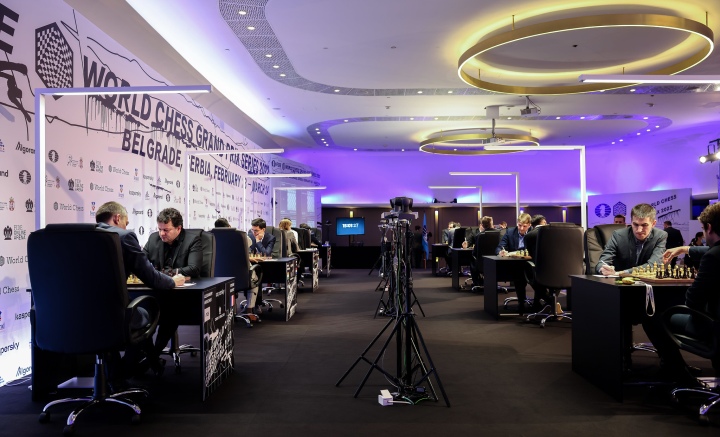
Pool C is the only group where both games had a decisive outcome, while the rest ended in a draw Richard Rapport stopped Vidit Gujrathi, and Vladimir Fedoseev delivered a blow to Alexei Shirov in Group C. All other games in the remaining three pools ended with a draw. The first move in today’s round was made by two chess legends – Alisa Maric (the former contender for the title of women’s world champion) and Nigel Short (who played Garry Kasparov in 1993 for the world chess crown). They made the first move in the game between Vladimir Fedoseev and Alexei Shirov. Pool A: Dmitry Andreikin made a draw against Sam Shankland. In the Grunfeld, the opponents followed a well-worn theoretical line in which White sacrifices a pawn and gets compensation for it, but hardly anything more. The only concern for Black was to ensure that White did not coordinate his bishop and queen along the diagonal a1-h8. As soon as Andreikin restored the material balance, the position became even. While Andreikin described it as “a boring game”, Sam Shankland said that “it was a little bit uncomfortable for Black”, but he didn’t see himself losing with enough time on the clock. In the post-game analysis, the two players discussed whether the small advantages computers evaluate in a very close position have a realistic potential to be materialized. Both players agreed that this is hardly ever the case and suggested that players at a lower level should be much more careful when looking at such evaluations in “tight” positions. “The computer is a useful tool to have, but if you’re not reasonably strong yourself and think for yourself, it’s entirely useless. You need to use your own brain, otherwise – you just become a monkey pressing buttons”, concluded Shankland. In terms of their overall play so far, Shankland noted that he has “more points than he deserves”, referencing two mistakes in the openings of the previous games. Andreikin said that “the first two rounds were OK” for him but that in the third round – he was tired. The game between Alexander Grischuk and Etienne Bacrot was the first to finish. The two made a quick draw in the Petrof. “This was a more solid game than we played in Berlin”, said Bacrot. Grischuk opted for a very tricky line, but Bacrot knew the right moves. White was slightly better after the opening and even won a pawn. However, the position didn’t offer anything substantial, and the two moved to an endgame with opposite-coloured bishops with mutual weaknesses. While Bacrot made three draws in three rounds, Grischuk only scored half a point. Asked how he feels about his performance so far, he said: “I made seven blunders so far… Better to make a draw than to lose”. When asked if he feels that he is getting into his “element”, Grischuk just said “no”. Pool B: Nikita Vitiugov and Amin M. Tabatabaei drew their game after 40 moves. The queens were quickly exchanged in the Carlsbad Variation of Queen’s Gambit, and the two sides moved to an endgame with a lot of positional manoeuvring. Black has a ruined pawn structure on the kingside in this line, but as tournament practice has demonstrated so far, it is really hard to exploit that. At some point, Nikita lost the thread and found himself in a slightly inferior position, but with no real weaknesses in his camp, he reached a draw by repetition with relative ease. One of the more exciting games of the day was played by Pentala Harikrishna and Anish Giri, who had a perfect winning score until this round. Despite ending in a draw, the game was full of sharp turns. In the Open Variation of Ruy Lopez, Harikrishna got a seemingly more promising position, threatening an attack on the Black king’s fortress. However, after White advanced his pawn from c3 to c4, Giri responded with a queen sacrifice: Pentala Harikrishna – Anish Giri 23…Qxf3, which was a straight way to force a draw. Harikrishna said that he was surprised by the move. Black got a rook and a bishop for a queen, but, more importantly, he had the perpetual check along the f-file, which Anish executed. Pool C: In Pool C, both games ended with a decisive outcome. Vladimir Fedoseev dominated Alexei Shirov in a rare line of the Slav. Before the game began, on first moves, Nigel Short suggested White should play the English opening, alluding to his country of origin. Fedoseev politely declined. Short later joked that if Fedoseev loses, it will be because he chose “the wrong opening”. However, that wasn’t the case as Fedoseev managed to create a very strong position against Shirov, surprising him in the opening. The opponent quickly found themselves in uncharted waters, and after Black’s 10…b5, White got a substantial edge making serious threats on the queenside and forcing Shirov to sacrifice an exchange. After grabbing an exchange, White opted to collect Black’s pawns on the queenside, allowing Shirov to move his king to safety and somewhat weaken the pressure. Feeling that in an ordinary course of events, Black will gradually go down, Shirov sacrificed a piece hoping to create some chances, but that only precipitated defeat. Following the move 23…Rb8 White was completely winning, even with his king uncastled and a passive rook on h1. On move 31 Shirov had to resign, facing an imminent checkmate. Richard Rapport scored an important victory over Vidit Santosh Gujrathi (who had won his previous two games). In the Carlsbad pawn structure that emerged from Nimzo-Indian, Rapport smoothly carried out a typical plan of building a strong pawn centre with f2-f3 followed by e3-e4. This plan – introduced by Steinitz and developed by Botvinnik – worked very well for White this time. With dominance in the center the Hungarian carefully regrouped his pieces for a decisive attack against which Gujrathi had no response. By move 28, it was all over for Black. Gujrathi almost made it to the time control but resigned on the move 40. Pool D: The last game of the
FIDE Chess Olympiad 2026 – Call for bids

1.1 FIDE is opening a bidding procedure to invite any federation member of FIDE or any organiser approved by the national federation to host the FIDE Chess Olympiad and FIDE Congress 2026 (see the Main Event Regulations, Competition for Players with Disabilities, and FIDE Congress). 1.2 The bid may contain special proposals on financial and commercial conditions. The FIDE Council shall decide whether these conditions are admissible. 1.3 The Bidding Form shall be filled in by an Applicant. A signed copy shall be submitted as e-mail messages to the FIDE Secretariat to office@fide.com from 3 March to 31 May 2022 by 23:59 Lausanne time (FIDE has a right to extend this deadline). All the documents shall be submitted in English. Additional documents may be requested by the FIDE General Strategy Commission (GSC) for further evaluation. 1.4 Bid Evaluation Report shall be presented by GSC for approval of FIDE Council. 1.5 Once the Organiser is granted the right to organise the event, a relevant announcement shall be made on the FIDE website.
FIDE-ISF World School Online Chess Cup 2022 postponed

By mutual decision, the International Chess Federation (FIDE) and the International School Sport Federation (ISF) announce that the FIDE-ISF World School Online Chess Cup 2022 has been postponed until further notice. New dates for this online event will be announced by FIDE and ISF at a later date, with registration remaining open.
FIDE Grand Prix Belgrade: Round 2 Recap
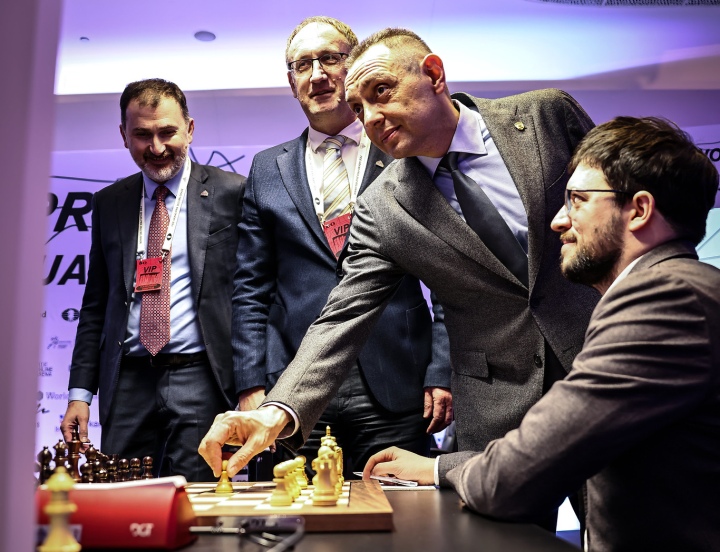
Three victories, five draws and Grischuk’s second defeat in a row have marked the second day of the FIDE Grand Prix Belgrade, organized by World Chess Anish Giri and Vidit Gujrathi have scored again, and they are the only two players with two victories. The second round started at 3 PM local time, with Aleksandar Vulin – Serbia’s minister of interior affairs – making the first move in the game between Maxime Vachier-Lagrave and Shakhriyar Mamedyarov. Pool A The game between Etienne Bacrot and Dmitry Andreikin ended in a draw. In the Ruy Lopez, White managed to gain a slight edge in the opening, putting pressure on Black’s position. After a few imprecise moves, however – particularly 19.Rc1 – Black got some breathing space and engineered a counter-attack on the kingside. Bacrot found a nice move 24.Bg5, securing that any further simplifications help relieve him of the pressure on the board. The game transpired into an endgame where Black was better; however, Bacrot managed to pose some problems, which Andreikin did not manage to find the correct answer for. Probably Black had to venture upon g6-g5 at some point because after the Frenchman pushed h2-h4 and f2-f4, he got out of danger. After losing in the first round, Alexander Grischuk suffered another defeat, this time at the hands of Sam Shankland. Although Grischuk was standing better on the black side of Nimzo-Indian by move 17, he allowed White to come back into the game after a suspicious 19…Nc5, sacrificing a pawn. Alexander had sufficient compensation but erred with 22…Rc6 – the game liquidated into a hopeless ending for Black despite equal material. With no better options, Grischuk resigned on the move 39. Grischuk is now the only player in the tournament without any points. Pool B Anish Giri won a second game in a row. He was better against Nikita Vitiugov, who had an easy pass in the first round following Pentala Harikrishna’s early blunder on Tuesday. The game started calmly, as Giuoco Pianissimo suggests, with both sides developing and trying to gain control of the centre. However, Anish met 14…f6? with a powerful breakthrough in the center and grabbed the initiative. Giri did not find the best way to build up pressure, and by move 20, the game was even. It did not prevent Giri from setting off some fireworks as he sacrificed his dark-squared bishop to launch an attack on the kingside. Vitiugov accepted the gift and defended with precision until move 30, when he committed a fatal error 30…c7-c5. Giri leapt at the chance, and two moves down the road, Nikita threw in the towel. With this victory, Giri is on two out of two and shows that he is in excellent form. The second pair of Pool B, Amin M. Tabatabaei and Pentala Harikrishna, made a draw in the Caro Kann. It was a lucky escape for the Iranian, who spent a lot of time in the opening and then made a blunder with 21.c4, handing over an almost decisive advantage to Black. By move 26, Black was completely dominating the board. However, instead of bringing his knight into play and going for the white king, Pentala opted to collect two pawns on the kingside, giving White time to organise a defence and “trap” Black’s queen perpetually attacking the most powerful piece. Following the game, Tabatabaei said that he is spending too much time thinking about the moves and that time management is a problem for him in this tournament. Conversely, Harikrishna said he was too hasty in his play, allowing White the repetition and even more chances to play for an advantage. Pool C Vidit Santosh Gujrathi scored a well-deserved victory over Vladimir Fedoseev in the Nimzo Indian. It was the longest game of the second round, lasting around four and a half hours. Vidit played the same line that Rapport tested against Feseev yesterday and also got some edge. White gradually restricted Black’s pieces and timely opened the centre on the move 23 to give some work for his bishop pair. Despite some time trouble the Indian was building up pressure, taking control over the proceedings. Fedoseev gave up an exchange hoping for his c-passer and active knights, but Vidit penetrated with his rooks into Black’s camp along the h-file, and that made all the difference. Fedoseev resisted, but his efforts were not enough to repel White’s advances, and he had to call it a day. “I feel very good that I managed to win these games. In the last couple of tournaments, I managed to bodge similar positions. So I’m relieved I won,” said Gujrathi after the game. The game between Alexei Shirov and Richard Rapport was the first one to finish, after just over an hour of play. Rapport surprised Shirov with the Petrov and then with 4…Nc6. “I used to have some games in this line more than 20 years ago”, Shirov recalled after the game. He spent quite some time thinking about the next move. Alexei could have opted for much sharper lines, but the seasoned GM probably concluded that he didn’t feel confident going down that path. Instead, Shirov took a safe line leading to simplifications. After exchanges in the centre, the game transpired into an opposite colour bishops endgame and the two Grandmasters agreed on a draw after the 30th move. In the post-game interview Alexei Shirov reflected on the time spent in Belgrade and the tournaments he played in the capital of former Yugoslavia during the 1990s. “It was quite a thing to play in Belgrade back then… What stood out was a big audience at the event and huge interest for chess which was rather unusual”, noted the seasoned GM. Pool D One of the most exciting games of the day took place on the board where Maxime Vacheir-Lagrave was leading the white pieces against Shakhriyar Mamedyarov. The Open Variation of Ruy Lopez was played, and an interesting position emerged after White’s 11th move Qe1, one that was tested in the game Vachier-Lagrave – Giri back in 2019 in Zagreb. There were several lines for Black to choose. Instead of continuing as Giri with 11…Nc5, Mamedyarov opted to castle and
Erigaisi, Nakamura and Aronian move up in March rating list
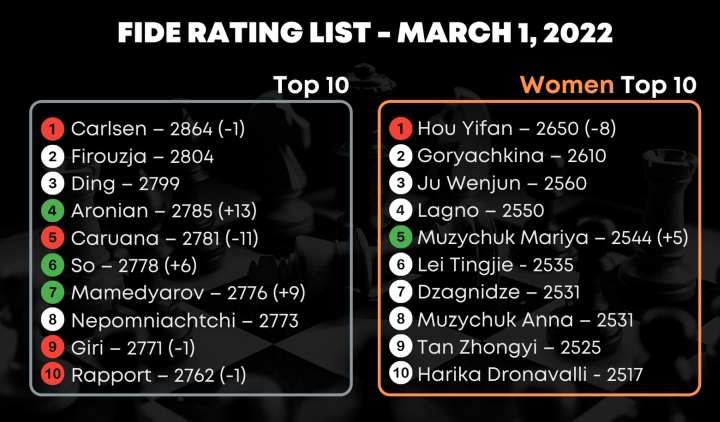
The FIDE rating list for March 2022 is out. The traditional Tata Steel festival, the first leg of the FIDE Grand Prix, Battle of Sexes in Gibraltar, Iberoamericano Championship in Mexico-city became the main rating-changers in February (the Tata Steel ended in January, but its results were incorporated in the March rating-list). Levon Aronian gained 13 points in the first leg of the FIDE Grand Prix in Berlin; combined with an 11-point loss by Caruana in Tata Steel Masters, this enabled him to rise to #4, the position he occupied back in November 2021. Photo: Official Photo FIDE Grand Prix Berlin Press Kit Wesley So and Shakhriyar Mamedyarov also picked up some rating points in Berlin to overtake Ian Nepomniachtchi. Magnus Carlsen, who recently voiced an ambitious goal of clearing the 2900 mark, earned 3 points in Tata Steel Masters, but all this gain was wiped out in a single draw against much lower-rated Geir Sune Tallaksen Osmoe, played in the Norwegian Premier League. Still, the World Champion’s top position in the rating list is indisputable. Women’s #1 Hou Yifan returned to action but lost 8 points in her match vs Bu Xiangzhi. Humpy Koneru (previously #3) no longer appears in the list due to inactivity; thus, all players below her rose one place, with Harika Dronavalli entering the top 10. Biggest gains (in both Open and Women top-100): Erigaisi, Arjun 2660 (+27) Sargsyan, Anna M. 2395 (+15) Nakamura, Hikaru 2750 (+14) Aronian, Levon 2785 (+13) Van Foreest, Jorden 2714 (+12) Stefanova, Antoaneta 2457 (+12) Mamedyarov, Shakhriyar 2776 (+9) Esipenko, Andrey 2723 (+9) Saric, Ivan 2687 (+9) Efroimski, Marsel 2446 (+9) Wojtaszek, Radoslaw 2694 (+8) Arjun Erigaisi, who was considered one of the main favourites before the start of Tata Steel Challengers, did not disappoint. The Indian youngster won the event with an excellent score of 10½/13, earned 27 rating points and made a roaring debut in the top-100 Open. Photo by © Lennart Ootes – Tata Steel Chess Tournament 2022 Anna Sargsyan turned in a solid performance in the Lozovatsky Memorial (the open won by Nikita Afanasiev), netted 15 rating points and deservedly became second in this category. Hikaru Nakamura returned to OTB chess with a bang by winning the first leg of the FIDE Grand Prix in Berlin and picking up impressive 14 points along the way. Photo: Official Photo FIDE Grand Prix Berlin Press Kit Jorden Van Foreest and Andrey Esipenko got their well-deserved rating points earned in Tata Steel Masters and continue to climb the ladder. Again, junior players outside of open and women top-100 can boast of more significant rating progress. Alice Lee (+111), Elif Mehmed (+61), Miaoyi Lu (+37), Roxangel Obregon Garcia (+37), Lara Schulze (+36), Christopher Yoo (+20), Balaji Daggupati (+20), to name just a few, considerably increased their rating.
World Team Championship postponed to November 2022
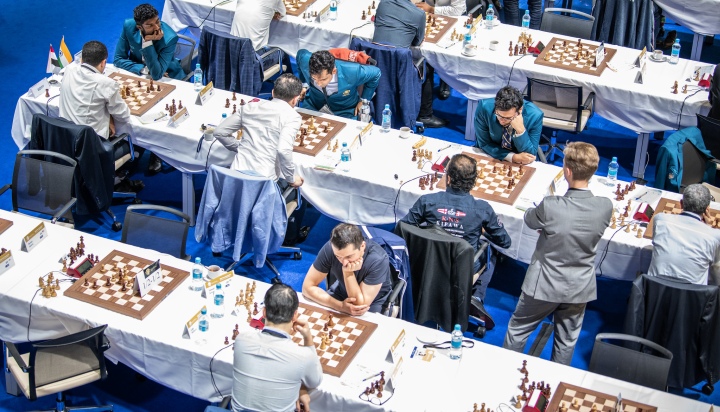
The International Chess Federation (FIDE) has decided to postpone the World Teams Championship 2022 to November 2022. The rights to host the tournament are retained by the Israeli Chess Federation. At the moment, due to the ongoing tragic events related to Russia’s invasion of Ukraine, the participation of the Ukrainian team cannot be ensured and the Russian national team cannot be allowed to participate in the championship. In addition, a number of other teams have not confirmed their participation. FIDE calls for an immediate cessation of hostilities.
The Official Statement of FIDE Council
Today, on February 27, 2022, an extraordinary meeting of the FIDE Council was held on the current situation and the urgent measures to be taken after the military action launched by Russia in Ukraine. As stated by the FIDE President Arkady Dvorkovich, the FIDE Council regards its main mission in preserving the unity of FIDE and respecting the basic human rights enshrined in the FIDE Charter. In this regard, the FIDE Council has adopted a number of important emergency decisions. FIDE Council approves the following statement condemning the military action: “FIDE expresses its grave concern about the military action started by Russia in Ukraine. FIDE stands united against wars as well as condemns any use of military means to resolve political conflicts. FIDE will take any necessary action to ensure the security of chess players and other members of the chess community. No official FIDE chess competitions and events will be held in Russia and Belarus.” Following the call from IOC, the FIDE Council decides that no Russian and Belarusian national flag be displayed or anthem be played in all FIDE-rated international chess events. Instead – the national chess federation’s flag or the official symbol/logo shall be used. A simplified procedure for performing under the FIDE flag would be followed where it is crucial for the players or any other chess officials under the current geopolitical situation. In order to safeguard FIDE from reputational, financial, and any other possible risks, FIDE terminates all existing sponsorship agreements with any Belarusian and Russian sanctioned and/or state-controlled companies and will not enter into new sponsorship agreements with any such companies. FIDE Council condemns any public statement from any member of the chess community which supports unjustified military action and brings the case of chess grandmasters Sergey Karjakin and Sergey Shipov to the Ethics and Disciplinary Commission. The FIDE Council reaffirms the FIDE Congress dates, welcomes the AICF’s bid to host the 44th Chess Olympiad, and suggests 10 days for other bids. The FIDE Council suggests that regardless of the organization of the Chess Olympiad 2022, FIDE will organize the annual FIDE Congress during the previously planned dates – from 27.07.2022. till 02.08.2022. with the election date on 01.08.2022. The preference is to combine the FIDE Congress with the Chess Olympiad 2022. However, consultations with the potential organizers of the Chess Olympiad 2022 will be carried out and adjustment of the FIDE Congress dates is possible if it does not imply a notable delay of elections. The FIDE Council confirms that the continental elections shall be organized within their constitutional terms. The FIDE Council confirms its commitment to the continuation of all the established development programs for national federations, zones, continents, and affiliated organizations. * * * March 2, 2022 update: After receiving the opinion of Mr Rivello, the Chair of FIDE Constitutional Commission, the FIDE Council decides to suspend the title of the FIDE Ambassador for Life for Anatoly Karpov and asks the General Assembly to take a decision on the matter. The FIDE Council also approves that sanctioned persons would be denied to hold any honorary or official positions in FIDE and would not be invited to any official FIDE events. Both decisions have been taken by the majority of votes. 2022 Extraordinary FIDE Council Meeting: Protocol (click to download)
FIDE Grand Swiss & Women’s Grand Swiss 2023 – Call for bids
1.1 The International Chess Federation (FIDE) will hold the Grand Swiss Tournament & Women’s Grand Swiss Tournaments in the second half of 2023 (see the Tournaments Regulations for FIDE Grand Swiss and Women’s Grand Swiss). 1.2 FIDE is opening a bidding procedure to invite any federation member of FIDE or any organiser approved by the national federation to host the event. The federation’s letter of support may be provided later when the bid’s evaluation procedure is launched. 1.3 The bid may contain special proposals on financial and commercial conditions. The FIDE Council shall decide whether these conditions are admissible. 1.4 The Bidding Form shall be filled in by an Applicant. A signed copy shall be submitted as e-mail messages to the FIDE Secretariat to office@fide.com from 3 to 17 March 2022 by 23:59 Lausanne time (FIDE has a right to extend this deadline). All the documents shall be submitted in English. Additional documents may be requested by the FIDE General Strategy Commission (GSC) for further evaluation. 1.5 Bid Evaluation Report shall be presented by GSC for approval of FIDE Council. 1.6 Once the Organiser is granted the right to organise the event, a relevant announcement shall be made on the FIDE website. FIDE Technical Delegate (FIDE TD) may be appointed at the same time to supervise the event on behalf of FIDE in consultation with GSC.
92nd FIDE Congress: 2021 FIDE Zonal Council Minutes

FIDE publishes the Minutes of FIDE Zonal Council Meeting which was held on December 26th, 2021. Location: Warsaw/hybrid. Download FIDE ZONAL COUNCIL MINUTES (pdf)