

2021 4th FIDE Council Agenda and Commissions reports/proposals

FIDE publishes the Agenda of the 4th FIDE Council meeting which was held on December 27th, 2021. Location: Warsaw/hybrid. Download FIDE COUNCIL AGENDA (pdf)
92nd FIDE Congress: 2021 FIDE General Assembly Minutes
FIDE publishes the Minutes of FIDE General Assembly meeting which was held on December 28th, 2021. Location: Warsaw/hybrid. Download FIDE GENERAL ASSEMBLY MINUTES (pdf)
2022 Extraordinary FIDE Council Meeting: Protocol
FIDE publishes the Protocol of the Extraordinary FIDE Council Meeting which was held online on February 27, 2022. Download PROTOCOL (pdf)
FIDE Grand Prix Belgrade: Round 1 Recap
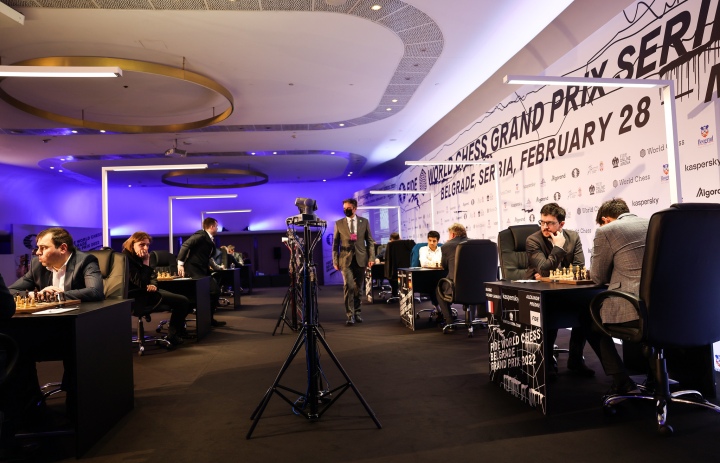
The second leg of the FIDE Grand Prix organized by World Chess got off to a sharp start with four players securing victories and four games ending in a draw. The first round was opened with a brief ceremony where the players were welcomed by the Serbian minister for sport, Vanja Udovicic, who was one of the world’s best ever water polo players (the sport is very popular in Serbia and southern Europe). Together with the head of the Serbian Chess Federation Dragan Lazic, Mr Udovicic made the first move in the game between Richard Rapport and Vladimir Fedoseev. The first round of the second leg of the FIDE Grandprix concluded with Dmitry Andreikin, Nikita Vitiugov, Anish Giri and Vidit Gujrati scoring victories. The four other games all ended in a draw. The 16 players are split into four pools with four participants each. The winner of each pool progresses to the knockout semi-final, and the two winners meet in the final. Pool A The first game in Pool A was between two seasoned players – Alexander Grischuk and Dmitry Andreikin, which was won by Black. Andreikin out-calculated his countryman in a sharp Sicilian battle. Most likely, Grischuk missed a queen sacrifice 21…Qxe1! which gave Black a rook and two minor pieces in return. After Andreikin regrouped his pieces to launch a decisive attack, Grischuk capitulated. It was a rough day for both players. Andreikin landed in Belgrade just a few hours before the round, having to endure an almost epic travel ordeal changing flights between Moscow – St Petersburg – Istanbul and, finally, Belgrade. “I didn’t sleep much, and I was afraid of entering into a long boring endgame and that I might fall asleep”, noted Andreikin explaining that this made him opt for some sharper lines. At one point, he also semi-jokingly added that he wanted to play more interesting lines. Grischuk also said that it wasn’t his day, voicing his concerns about the ongoing conflict between Russia and Ukraine and making a long sharp statement about the actions of the Russian government. The second game of Pool A, between Etienne Bacrot and Sam Shankland, ended in a draw. Bacrot took the initiative and created an edge for White, approaching a significantly better – if not won – position. However, he missed a couple of relevant moves giving space to the American to jump back into the game. After White’s 24.Qxb7?, Black equalised. There were plenty of interesting skirmishes afterwards, but nobody managed to get the upper hand. In the post-game interview, Shankland confessed to being “over-optimistic” with certain moves. “After 15.e5 Ne8, the more I was looking at the position, the more I thought I was checkmated”, said Shankland adding that afterwards “it got messy” and that he was “under a lot of pressure”, but that towards the end he managed to improve. Bacrot noted that he wasn’t very precise with executing his advantage. “I am not completely professional anymore. I had chances today, but I needed to play one or two good moves more”. Pool B This pool of players produced the longest and the shortest game played in the first round. The first game to finish on the first day of the Belgrade Grand Prix was between Pentala Harikrishna and Nikita Vitiugov. There isn’t really much to say about the game as White blundered on move 13. with Nxd5, ending up a pawn down and in a hopeless position. “I missed 13…Ne4… It just happened. I thought Black would take on d5…”. It just goes to show that these things happen even to the best professionals. “This is not the first time I blundered, and it won’t be the last time. It happens. But I will just think about tomorrow’s game and fight,” said Harikrishna. A much tougher struggle unfolded in the game between Anish Giri and Amin Tabatabaei, who were the last ones to finish, after nearly five hours of play. In the Giuoco Pianissimo of Italian Game so popular nowadays, Giri introduced a very interesting novelty with 10.b4. Tabatabaei struggled to find the best solution for a new situation that emerged. In the subsequent battle, Giri handily outplayed his opponent and scored a full point. In the post-game analysis, the two players reflected on the issue of dealing with mistakes and how to keep on fighting. Giri pointed out that even after making a big mistake, “it’s never too late” to make a comeback. “In chess and in life, you make a mistake, and it often happens that you continue making mistakes one after the other. In theory, if you’re able to improve just after one mistake, but in life, it’s different… You can learn from your mistakes; it’s just important that they don’t come at the crucial moment”, said Giri. Pool C The game between Richard Rapport – who has for some time now been living in Belgrade – and Vladimir Fedoseev ended in a draw. White managed to grab the initiative in the opening, putting Black in an uncomfortable position. Fedoseev resiliently held his ground, managed to find the right balance and, eventually, saved half a point. In the second game of the pool, Vidit Gujrathi scored an impressive victory over Alexei Shirov in a very sharp game. In a rare line of the Najdorf, Vidit introduced a novelty 8.Nd5 and the opponents stepped into uncharted territory. Shirov equalised with active play but was then maybe too aggressive with pawn-push, handing White the edge. The position remained dynamic and sharp but after 23…Qe8 Shirov lost a piece and, with it, the game. Pool D Both games in Pool D ended in a draw. Maxime Vachier-Lagrave, playing as White, tested Alexandr Predke in the Ruy Lopez. Predke not only passed the test but also emerged better after a fierce clash in the centre. Maxime had to work hard for a draw and, eventually, he reached it. Following the game, the World Blitz Champion said that despite not being very satisfied with his performance, it was a “useful exercise” for him to play such a long game where he had to work a lot and calculate and that it will help him get into his form
The second leg of FIDE Grand Prix 2022 kicks off in Belgrade

The second leg of the 2022 Fide Grand Prix series was officially opened in Belgrade, Serbia. In the next 14 days, 16 top world players will try to advance in the 2022 GP series in the hope of securing one of the two places leading to the Candidates Tournament The Opening Ceremony was held at the ballroom of the “Dom Grade” venue – an impressive building from the 1920s, which was once home to the Serbian Royal Guard. The guest list included prominent Serbian chess figures, athletes, senior government officials and business representatives and was attended by many journalists. The host of the evening, Dragan Lazic, the president of the Serbian chess federation, reminded the guests of the long-lasting chess tradition in Serbia and former Yugoslavia and the tremendous popularity the game has in this part of Europe. “The Serbian public has been eagerly anticipating once again to see some of the strongest world chess players,” Lazic said. The president of the Serbian chess federation also emphasized that chess is a game of peace and that “in these complex and difficult times we should all remember to act in the spirit of the motto of FIDE: ‘Gens Una Sumus’ – ‘We are one Family’”. FIDE Vice President Lukasz Turlej noted how popular chess is in Serbia and also reflected on the rich chess history of the country: “We appreciate how many people play chess in Serbia, and we are happy that such a big and important event is hosted in this country.” Turlej expressed his gratitude to everyone who helped in organizing this event and wished the tournament participants “a wonderful start”. The speeches were followed by a remarkable short video covering the history of chess in former Yugoslavia. The video included never before seen footage of famous players attending tournaments and events across former Yugoslavia. The video will also be broadcast on Serbian national television, which will air daily reports from the Grand Prix. Following the Opening Ceremony, the guests were invited to attend a reception where they discussed chess and the pairings for the first round, which were determined by the drawing of lots held by Chief Arbiter Nebojsa Baralic earlier today. Round 1 pairings: Pool A: Alexander Grischuk (CFR/FIDE), 2764 — Dmitry Andreikin (CFR/FIDE), 2724Etienne Bacrot (France), 2642 — Sam Shankland (USA), 2708 Pool B: Pentala Harikrishna (India), 2719 — Nikita Vitiugov, (FIDE), 2726Anish Giri (Netherlands), 2772 — Amin Tabatabaei (Iran), 2623 Pool C: Richard Rapport (Hungary), 2763 — Vladimir Fedoseev (FIDE), 2704Vidit Santosh Gujrathi (India), 2727 — Alexei Shirov (Spain), 2704 Pool D: Maxime Vachier-Lagrave (France), 2761 — Alexandr Predke (FIDE), 2682Yangyi Yu (China), 2713 — Shakhriyar Mamedyarov (Azerbaijan), 2767 Full pairings for the pool stage can be found here. Text: Milan Dinic Photo: Mark Livshitz About the 2022 Grand Prix series: The three-tournament series, which will unfold from February to April, features 24 of the world’s best Grandmasters competing in two out of three events. To make the series more exciting with a minimum number of draws, FIDE and World Chess have changed the format compared to previous events. In this series, each event consists of a group stage followed by a knockout semi-final and final. Two winners of the series will qualify for the Candidates Tournament that will take place later in 2022. The prize fund for each event is €150,000, which is a €20,000 increase from 2019. The second leg of the FIDE Grand Prix will take place in the Crowne Plaza in Belgrade (Vladimira Popovića 10) from March 1 to 14. The rounds start at 3 PM Belgrade time. The games will be broadcast live at worldchess.com: https://chessarena.com/broadcasts/13605. For further questions, please contact media@worldchess.com. Official Photo FIDE Grand Prix Belgrade Press kit
Parligras and Ciolacu win Romanian Championship

The Romanian Championship 2022 took place in Eforie Nord from February 20–27. The event included Open, Women’s and Amateur championships with a total prize fund of 100,000 lei (approximately $26,700). All three competitions were 9-round Swiss tournaments with classical time control. The Open Championship that brought together all top Romania players, except for the 2021 champion Bogdan-Daniel Deac, was a very close affair, with the rating favourites vying for the top position to the very end. GM Mircea Pârligras (pictured below) stringed together four victories in the middle of tournament distance and finished with three draws against his main rivals, which was enough to climb to the top with an impressive result 7/9. Mircea took his third national title – he previously won this event in 2001 and 2016. Four players tied for second place, scoring 6½/9. The Buchholz favoured a five-time national champion, Constantin Lupulescu and Tiberiu-Marian Georgescu, who claimed silver and bronze, respectively. Final standings: 1 GM Parligras, Mircea-Emilian 2575 7 2 GM Lupulescu, Constantin 2620 6½ 3 GM Georgescu, Tiberiu-Marian 2467 6½ 4 IM Gavrilescu, David 2512 6½ 5 IM Anton, Teodor 2457 6½ 6 GM Nanu, Costica-Ciprian 2513 6 7 GM Nevednichy, Vladislav 2498 6 8 FM Ghimpu, Samuel-Timotei 2420 6 9 GM Manolache, Marius 2485 6 10 GM Miron, Lucian-Costin 2511 6 In the Women’s Championship, the defending champion Alessia-Mihaela Ciolacu (pictured below) started off with five wins in a row, grabbed the lead and never looked back. Coming into the final round a full point ahead of her closest competitors, she pushed hard against Andreea-Bianca Panainte and reached a won position but let the victory slip away in the endgame. Still, she netted impressive 7½ points out of 9 and won her second straight national title. The ninth-rated Miruna-Daria Lehaci surprised many by scoring 7/9 and claiming silver. Mihaela Sandu finished on 6.5/9 and took bronze. Final standings: 1 WFM Ciolacu, Alessia-Mihaela 2239 7½ 2 WIM Lehaci, Miruna-Daria 2125 7 3 WGM Sandu, Mihaela 2269 6½ 4 IM Bulmaga, Irina 2390 6 5 IM Peptan, Corina-Isabela 2384 6 6 WCM Panainte, Andreea-Bianca 1865 6 7 WGM Cosma, Elena-Luminita 2281 5½ 8 WGM Ionescu, Irina 2131 5½ 9 WFM Cosman, Andreea-Marioara 2127 5½ 10 Hoanca, Alexia-Ioana 1710 5 Stefan Romulus (pictured above) and young Mihai Venetenu shared first place in the Amateurs section, with the former claiming the title thanks to better tiebreaks. Official website: frsah.ro/ Photo: Romanian Chess Federation Facebook page
Magnus Carlsen wins Airthings Masters

Magnus Carlsen has won the first event of the 2022 Meltwater Champions Chess Tour, the Airthings Masters, after overcoming Ian Nepomniachtchi with a classy display today. The World Champion was hugely-impressive in the 16-player online super-tournament knockout stages, having struggled at times during the round-robin. Then on day 2 of the final, after five draws against his Russian opponent, Carlsen turned on the style to break through. In Game 6, the 31-year-old marched his king up the board and weaved a mating net around Black’s monarch. Ian had to resign and was left needing a draw in the next game just to stay in it. True to his style, Nepomniachtchi didn’t play safe and tried to hit back. Yet Carlsen, who faced Ian for the world title back in December, did not flinch and turned a piece advantage into the win he needed to secure the title. The Norwegian said after: “These things are always going to be about whether you can perform on that particular day. But even so, my games were going in a positive direction here. “I felt I was playing better as the tournament went along, and that was enough.” Carlsen paid tribute to his opponent but said it just wasn’t his day. The Russian, who was on fire early on in the tournament and topped the prelims, has been under considerable strain given the events happening in Ukraine, which he expressed considerable unease about. However, he managed to hold himself together and contributed to a sparkling first day of the final yesterday when the two players were left locked at 2-2. The Meltwater Champions Chess Tour will return with the next event starting on March 19. For further comments, contact: Leon Watson – leon@championschesstour.com About the Meltwater Champions Chess Tour The Champions Chess Tour is the leading online chess Tour worldwide, determining the world’s best chess player over a full competitive season of online chess. The 2022 season begins in February 2022 and features monthly tournaments culminating in a Final in November 2022. The best chess players in the world are competing in rapid chess. All games take place online on www.chess24.com, with players competing for a total prize pool of over USD 1.5 million. For more information, visit www.championschesstour.com. About Play Magnus Group Play Magnus Group is a global leader in the chess industry focused on providing premier digital experiences for millions of chess players and students. The company offers e-learning and entertainment services via its market-leading brands: chess24, Chessable, iChess, New In Chess, Everyman Chess, Silver Knights, Aimchess, the Play Magnus App Suite, and the Meltwater Champions Chess Tour. The Group’s mission is to grow chess to make the world a smarter place by encouraging more people to play, watch, study, and earn a living from chess. Play Magnus Group is listed on Euronext Growth Oslo under the ticker PMG.
Second leg of FIDE Grand Prix starts in Belgrade on February 28
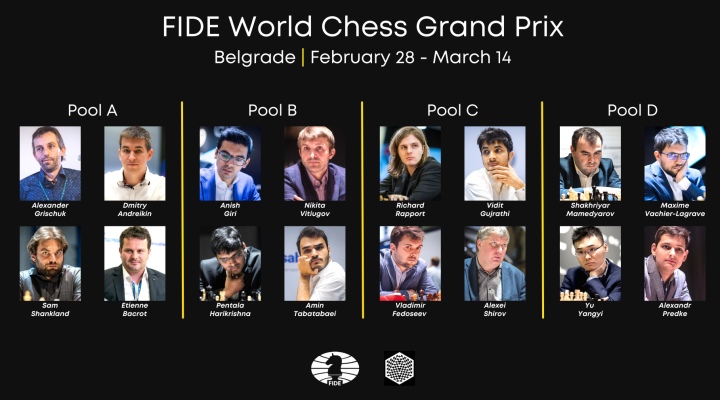
The second leg of the FIDE Grand Prix is around the corner. The competition hosted by Belgrade (Serbia) runs from February 28 to March 14 and features 16 elite chess grandmasters vying for a prize fund of €150,000 and the last two spots in the Candidates Tournament. Previously the capital of the mighty chess nation, it has been decades since the region has been home to major chess events involving many of the world’s strongest players. The leaders after the first leg, Hikaru Nakamura and Levon Aronian are not playing in Belgrade; on the other hand, several top grandmasters start their Grand Prix campaign in the capital of Serbia. GP points after the first leg: 1. Hikaru Nakamura, (USA), 2736 — 13 points2. Levon Aronian (USA), 2772 — 10 points3. Leinier Dominguez (USA), 2752 — 7 points4. Richard Rapport (Hungary), 2763 — 7 points5. Wesley So (USA), 2772 — 4 points6. Radoslaw Wojtaszek (Poland), 2686 — 4 points7. Andrey Esipenko (Russia), 2714 — 4 points8. Vidit Gujrathi (India), 2727 — 3 points9. Daniil Dubov (Russia), 2720 — 3 points10. Alexander Grischuk (Russia), 2764 — 2 points11. Vladimir Fedoseev (Russia), 2704 — 2 points12. Pentala Harikrishna (India), 2717 — 2 points Just like in the first leg, sixteen players were allocated to four different pools through a randomized selection, with the final pairings to be determined at the opening ceremony: Pool A: Alexander Grischuk (Russia), 2764Dmitry Andreikin (Russia), 2724Sam Shankland (USA), 2708Etienne Bacrot (France), 2642 Pool B: Anish Giri (Netherlands), 2772Nikita Vitiugov, (Russia), 2726Pentala Harikrishna (India), 2719Amin Tabatabaei (Iran), 2623 Pool C: Richard Rapport (Hungary), 2763Vidit Gujrathi (India), 2727Vladimir Fedoseev (Russia), 2704Alexei Shirov (Spain), 2704 Pool D: Shakhriyar Mamedyarov (Azerbaijan), 2767Maxime Vachier-Lagrave (France), 2761Yu Yangyi (China), 2713Alexandr Predke (Russia), 2682 Photo: ihg.com The second leg of the FIDE Grand Prix will take place in Belgrade’s Crowne Plaza Hotel. All the rounds start at 3 PM CET. The games will be broadcast live at worldchess.com: https://chessarena.com/broadcasts/13605 For further questions, please contact media@worldchess.com. About FIDE Grand Prix 2022: The competition consists of three legs that span over three months and two cities: First leg: February 3 — 17, Berlin, GermanySecond leg: February 28 — March 14, Belgrade, SerbiaThird leg: March 21 — April 4, Berlin, Germany The FIDE Grand Prix will feature 24 players, with each player competing in two out of three events. Each 16-player event will consist of a group stage followed by a knockout semi-final and final. At the group stage, the participants will compete in four double-round-robin tournaments, with only the winners of each pool advancing. Both the semi-finals and final will consist of 2 regular time limit games, plus tiebreaks if needed. Players receive Grand Prix points according to their finishing position in each tournament: Round Grand Prix points Winner 13 Runner-Up 10 Semi-final loser 7 2nd in pool 4 3rd in pool 2 4th in pool 0 Two winners of the Series will qualify for the Candidates Tournament that will take place later in 2022. Regulations for the FIDE Grand Prix Series 2022 (pdf) About World Chess: World Chess is a London-based chess gaming and entertainment group and FIDE’ official broadcaster and commercial partner. World Chess organized the FIDE Championship Matches in Russia, the USA, and the UK, and revolutionized the sport by signing the biggest media partnerships in history. World Chess develops Armageddon, the chess league for prime-time television. World Chess also runs FIDE Online Arena, the exclusive official chess gaming platform. More at worldchess.com.
Carlsen and Nepomniachtchi play out epic 2-2 draw
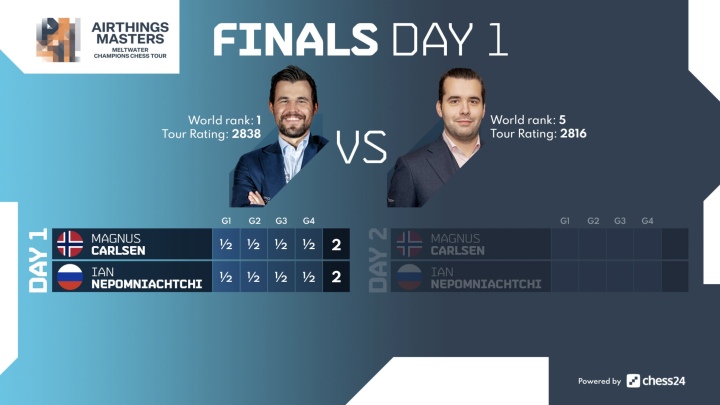
Magnus Carlsen and Ian Nepomniachtchi played out an epic see-saw encounter on day 1 of the Airthings Masters final that leaves the event on a knife-edge. The match started with Carlsen having earlier tweeted “peace is cool” in reference to world events. That proved appropriate as, after four stunning games, there was a pleasingly peaceful resolution on the chessboard. The chess, of course, was anything but friendly. Purely in chess terms, the four epic drama-filled games were as exciting as anything seen on the Meltwater Champions Chess Tour – despite all being draws. Games 2 and 3 were filled with twists and turns as both Magnus and Ian took huge risks to go for the win. Then in the final game, it seemed like one player would finally get ahead going into tomorrow’s decider. Nepomniachtchi took his eye off the ball for a moment and blundered a piece. A win for Carlsen, a full rook up, looked inevitable. But incredibly, Carlsen blew it with a careless move of his own. Both players were visibly shocked as game 4 headed towards another draw. It ended a stunning encounter that belied the sombre mood among the players due to outside events. The players will resume tomorrow with four more games and tiebreaks if needed. A winner must be found. Full coverage with commentary is available on chess24.com/tour/ and chess24’s YouTube and Twitch channels. For further comments, contact: Leon Watson – leon@championschesstour.com About the Meltwater Champions Chess Tour The Champions Chess Tour is the leading online chess Tour worldwide, determining the world’s best chess player over a full competitive season of online chess. The 2022 season begins in February 2022 and features monthly tournaments culminating in a Final in November 2022. The best chess players in the world are competing in rapid chess. All games take place online on www.chess24.com, with players competing for a total prize pool of over USD 1.5 million. For more information, visit www.championschesstour.com. About Play Magnus Group Play Magnus Group is a global leader in the chess industry focused on providing premier digital experiences for millions of chess players and students. The company offers e-learning and entertainment services via its market-leading brands: chess24, Chessable, iChess, New In Chess, Everyman Chess, Silver Knights, Aimchess, the Play Magnus App Suite, and the Meltwater Champions Chess Tour. The Group’s mission is to grow chess to make the world a smarter place by encouraging more people to play, watch, study, and earn a living from chess. Play Magnus Group is listed on Euronext Growth Oslo under the ticker PMG.
FIDE delegation visits Kakuma Refugee Camp

By Geir Nesheim, FIDE Social Commission On February 23, FIDE President Arkady Dvorkovich and FIDE Managing Director Dana Reizniece-Ozola visited the Kakuma refugee camp in northwestern Kenya to get first-hand insight into the FIDE-led chess education project. Since August 2021, some 800 learners have been introduced to the game of chess. In a parallel project, three girls’ boarding schools have been part of the “Girl Club” project, where some 100 girls have obtained chess training and interacted with experienced female chess profiles and heard their stories. The FIDE Social Commission is currently running its first big-scale project in Kakuma refugee camp in Kenya together with UNHCR – the UN Refugee Agency, Lutheran World Federation (LWF) and Chess Kenya. The project aims to offer access to the game of chess to 1,600 schoolchildren in the Kakuma refugee camp, which is home to some 220,000 refugees and asylum-seekers. Since the project launched in August 2021, 10 refugee chess teachers and facilitators have been trained to give chess classes in Kakuma. The FIDE Trainer Commission has designed a special education package for the facilitators and conducted several training seminars. At the first stage, ten chess teachers (facilitators), who are actually refugees themselves, were trained to perform the actual chess lectures in the classrooms. The FIDE Trainer Commission designed a special education package for the facilitators and conducted several training seminars. In the project’s first phase, the facilitators engaged with 400 learners in 10 schools with the aim of bringing them from beginner level to a first command level of the game, which will allow them to participate in beginner tournaments. The first phase took place from September to December 2021 and concluded with a series of school chess tournaments. The second phase was launched in January 2022, with additional 10 schools and 400 new learners starting their chess class. At the same time, the first 400 learners were offered sustained chess training from project volunteers from the refugee community in Kakuma. In the “Girl Club” program, learners from three girls’ boarding schools in Kakuma, around 100 girls received chess training, lectures and inspirational storytelling from female chess players. The project has been specially designed to empower and inspire refugee girls. Head of sub-office Kakuma UNHCR Nicolas Kaburaburyo flanked by FIDE Managing Director Dana Reizniece-Ozola and FIDE president Arkady Dvorkovich On February 23, FIDE President visited the Kakuma refugee camp and met with partner representatives Nicolas Kaburaburyo, the Head of UNHCR Sub-Office in Kakuma, and Benard Wanjala, the President of Chess Kenya. During the visit to Kakuma, the delegation also met learners at the Angelina Jolie Girls Boarding School, where Dana Reizniece-Ozola gave them a chess training session and played with the chess trainees. The FIDE President then visited the “FIDE Project Office” in Kakuma, where the project staff, including project leader-in-camp Kong’or Deng Maketh and the facilitators, have their daily planning activities. “FIDE thanks UNHCR, LWC and Chess Kenya for their support in carrying out this very important social project. We all need goals to strive for in our life. And I hope that chess gives a meaningful scope to the lives of these displaced people. I hope to see the first refugee team being represented in the World Chess Olympiad 2022. Last year it was just an idea; today, it sounds like a plan,” FIDE President Arkady Dvorkovich said. FIDE Managing Director Dana Reizniece-Ozola added: “We want to use chess for empowering those who are less fortunate. We launched this project in Kakuma and Kalobeyei with the hope that our beautiful game would give the refugee children and youth valuable life skills and also a very important sense of belonging to the chess family. A few hundred kids have already been trained, and many more are still to be engaged in chess. We are also looking forward to expanding the initiative to neighbouring countries while ensuring the long-term sustainability of the current initiatives launched.” Head Teacher of Angelina Jolie Girls Boarding School (one of three girl schools in the project) Sabella Muthoni shared her feedback: “The program has really improved the learners’ critical thinking. The girls enjoy the game as part of their curriculum activity and break classroom boredom.” Head Teacher Angelina Jolie Headmaster Sabella Muthoni with FIDE Social Commission member Geir Nesheim, who is coordinating the Kakuma project on behalf of FIDE Social Commission Nicolas Kaburaburyo, Head of UNHCR’s Sub-Office in Kakuma: “The Chess for Refugees project has proven to have a real impact on a remarkable number of refugee children and youth in Kakuma refugee camp over a very short period. We are very pleased with the investments FIDE has already made in this innovative partnership and hope that the project will help to produce some long term positive solutions for refugees and their host communities in terms of providing meaningful activities and offer psychosocial support.” Benard Wanjala, president of Chess Kenya:” Chess Kenya has considerable working experience in Refugee camps. Chess Kenya launched the first tournament for refugees in 2014 on World Refugee Day. In 2019 we organized the South Sudan players’ travelling to the Zonal tournament in Nairobi. With their help, it would potentially be possible to get the trained kids involved in regular Chess Kenya activities. The Chess for Protection project aims to bring the game of chess to refugee children and offer them the benefit of playing the game, but also develop all the positive elements that chess could offer, such as cognitive skills, problem-solving, decision making, social training, and so many other elements, to better equip them for life ahead. A special focus is on making it sustainable, ensuring that the learners’ access to chess activity continues after the first project period. This will be provided through partnership and cooperation with the Kakuma Chess Club, which was founded in 2006, and have activities close to the Project office. The Kakuma Chess Club will be supported to continue with chess activities for the trainees, the Girl Club learners and new learners coming through in the years to come. The FIDE Social Commission plans to launch similar initiatives in