

FIDE World Championship Dubai 2021: Back to the grind
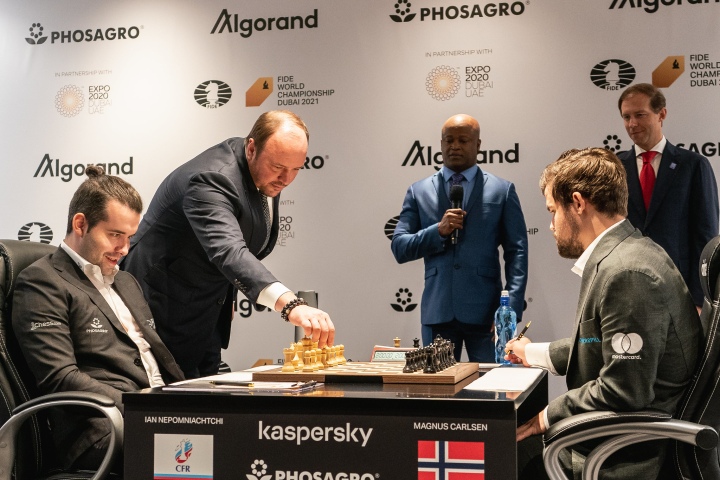
A quick look back Yesterday history was made, with the longest game ever in the world championship ending in a 136-move victory for defending champion Magnus Carlsen. The marathon game lasted nearly eight hours and broke the deadlock of five preceding draws. Although the result could be easily ascribed to the champion’s legendary ability to squeeze slow wins from nano-advantages, the dramatic game raises more complex talking points, examining it the morning after. It takes two Even though several key in-game choices, and both players, indicated that this record tussle flared up thanks to mutual efforts, in the second-hand excitement and adrenaline, it was easy to overlook challenger Ian ‘Nepo’ Nepomniachtchi’s role in the epic struggle. Despite playing with the statistical disadvantage of the black pieces, Ian was clearly feeling confident enough with his form and position to try to create winning chances once he had neutralised Carlsen’s first move initiative. Perhaps emboldened by Magnus’ massive deficit on the clock, Nepo chose to further sharpen play with his 25th move, which he said was ‘unnecessary’ but created complications and chaos without great risk. Carlsen was taking minor chances of his own trying to keep the position alive and was slightly surprised to see his opponent doing the same: “I felt like we were both risking a bit, but I thought maybe Black was risking a bit more. And it meant that we would get a serious struggle that I was happy with.” The champion eventually emerged the winner after an immense technical grind, with both players left with minimal time for the last 75 moves of the game. The players traded blows, missed opportunities, and fierce ambition. The result aside, the game revealed that despite very conservative appearances in his early white games, the challenger is lacking neither confidence nor ambition. He has repeatedly created chances to rock the champion – but has yet to convert an edge. Wolf in sheep’s clothing A discussion point that will probably only be resolved with hindsight is whether Nepomniachtchi started the match with a strategy to frustrate Carlsen, which his predecessor, and assistant here, Sergey Karjakin, seemed to employ in his New York 2016 title match. Experts have debated whether Ian’s slightly hesitant approach when playing white might be due to an ill-fitting match plan and that he may be itching to let loose his more aggressive style. It is too early to draw conclusions, but his attitude at the board and demeanour off suggest that we may soon see a more ‘typical’ Nepomniachtchi, especially since he now has no choice but to crank up the chaos factor to fight back – the only question being when. Looking ahead There are now eight games left. Plenty of time to mount a comeback for Nepomniachtchi, but he needs to find a tricky balance of timing and risk assessment to defeat the champion without falling further behind. An indicator of how tough this can be is Carlsen’s world record of 125 consecutive games without defeat at the elite level, set over a period of 26 months. What makes this match special is that Nepomniachtchi has one of the best one-on-one records against Carlsen, even if his edge was set when they were battling pre-teen prodigies. Game seven Both players emerged promptly to their call to arms today, and the ceremonial first move is executed by Andrey Guryev, the CEO of PhosAgro, a major FIDE partner and sponsor. He is accompanied onstage by Denis Manturov, the Minister of Industry and Trade of the Russian Federation. Guryev’s hesitant but correct guess of 1.e4 is allowed to remain on the board, Ian only adjusts it slightly, and they are off. Ringside view One trend that cannot be disputed is the Carlsen suit. So far, Magnus appears to be alternating apparel in sync with his colours in the game – wearing a dark suit and white shirt when playing black and a light suit with a black shirt when playing white. Magnus also has a regular cycle of body language for the start of the game. As he plays and writes down the first few moves, he props his head up lazily on his left hand. A little later, his left elbow lifts off the table, and the subsequent flurry of moves is executed with his left hand screening his eyes. Once it is time to have a real thing, he bends forward and grasps his head between both hands. Ian flits around early, often preferring to disappear backstage if there is the least hesitation in his opponent’s reply. Carlsen sank into thought over his 12th move, and this signalled a change of pace as more profound decisions began to arise. Ian remained offstage for five minutes while his time was running, but when he returned, he stayed. Afterwards, he would tell the press that when offstage, he is sitting on a sofa, analysing the position onscreen, a familiar feeling after long months of playing online chess on a computer. Post-marathon After the immense exertions of game six, there is a sense of caution and fatigue today. The battleground is familiar from all of Nepomniachtchi’s white games in Dubai, and Carlsen aims for safety, playing to neutralise the first move and reach very solid equality. The pace is slow, with fear of error seemingly foremost in their minds. The challenger’s long think on move 20 created the possibility of wholesale material exchanges, which commentator Judit Polgar, the strongest woman player in history, called a silent draw offer. In the following moves, the board was emptied, and a draw was the inevitable result, with the players going through the motions to reach move 40 when peace can be agreed without a repetition of moves. Immediately after the game, Carlsen admitted that energy levels were a factor after yesterday’s marathon. “I couldn’t sleep yesterday; I was way too excited,” Carlsen said before saying he assumed it was probably even worse for his opponent. He also said he expected care from Nepomniachtchi
FIDE Chessable camp: Time to say goodbye
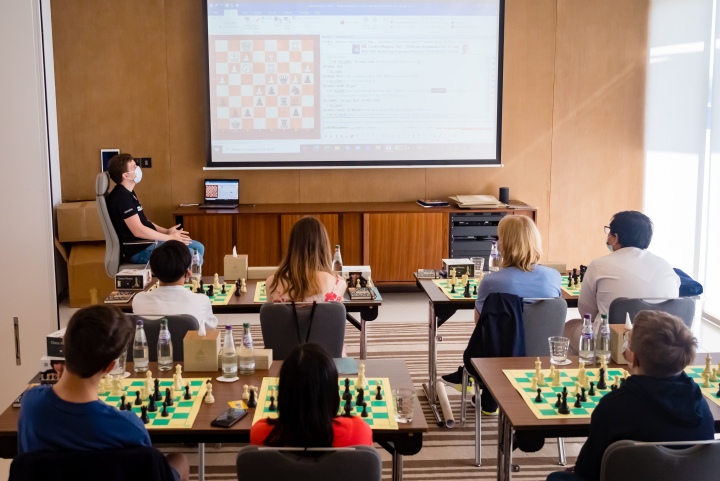
The FIDE Chessable Camp held between November 28 and December 3 in Dubai as a part of the FIDE Chessable Academy program has come to an end. Twelve youngsters from India, Malaysia, UAE, Belgium, Azerbaijan, Germany, Sweden, and Argentina visited Dubai for a unique opportunity to be trained by ex-World Champion Viswanathan Anand and 2021 FIDE World Cup winner Jan-Krzysztof Duda. The students also enjoyed a behind-the-scenes visit to the FIDE World Championship Match between the World Champion Magnus Carlsen and the Challenger Ian Nepomniachtchi. On December 3, the students of the camp had a day of intense training at the World Championship match venue. TRG Chairman and Russia National Junior Coach Mikhail Kobalia started the morning session with a review of the match and analysis of the games played. Then Viswanathan Anand and his Q&A session followed. On the last day of the camp, students met 2021 FIDE World Cup winner Jan-Krzysztof Duda who explained some key games from his career and played blitz with each and everyone. At the end of the camp, children received their certificates of participation signed by the lecturers of the project. “Most probably you will forget some nuances you’ve learnt here, but I do hope that what will remain is a lot of positive emotions, strong impressions and this very special feeling of being close to chess elite and understanding how the road behind the scenes of the world championship match is organized. I hope this will leave you with a strong level of motivation; it will boost your energy and serve as a battery for the following years to work hard,” said FIDE Managing Director Dana Reizniece-Ozola. “I enjoyed seeing all of you interact with the coaches. When we partnered with FIDE, we felt really excited by the possibility of working together and creating new opportunities for talented kids like you. Thank you so much for being a part of our first-ever FIDE Chessable academy camp here in Dubai, and I hope to see you back in the Chessable classroom in the future!” added the Chief Executive Officer of Chessable Geert van der Velde. The Dubai camp is over, but studies of the FIDE Chessable Academy, a three-year junior educational program, will continue. The most talented and promising young players aged from 8 to 16, representing 100 national federations, will be having two hours of training every weekend in English, Spanish, and Russian. Among the FIDE Chessable Academy students are young talents in the top five rankings in their age group and winners at the World Youth and Cadets Championships.
FIDE World Championship 2021: Are we there yet?
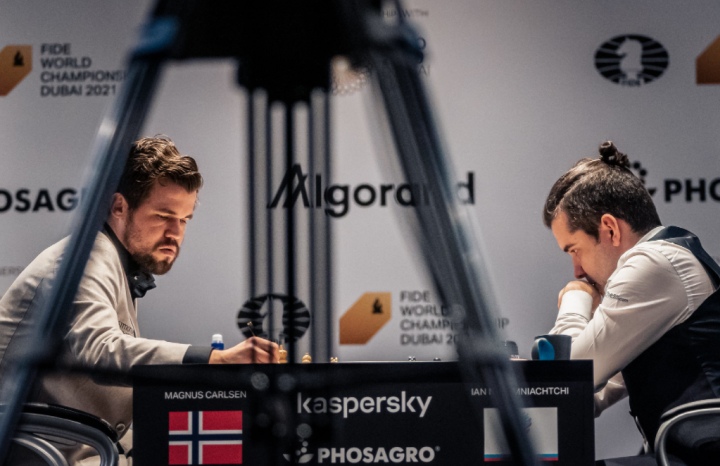
The unique 14-game format of the 2021 FIDE World Championship means that there is no easy spot to stop and play the game of drawing halfway mark conclusions. After game 7, we’ll have had a lopsided half, with challenger Ian ‘Nepo’ Nepomniachtchi enjoying an extra game with the white pieces and advantage of the first move, and we would be comparing the action to the coming mirror version. If we want to balance colours out, then we need to choose game 6 or 8. Since we have so many pundits assembled, we can expect retrospective assessments … constantly. Game 8 is probably the best time to get a symmetric look back, as it will mark a full set of three blocks of play, 3-2-3. Since the match is two games longer than normal, rest days have been trimmed down to keep the event the same length, so we need to wait until after game 8 to have seen each player try this new segment with an extra white out of the trio of games. More equal Besides the halfway mark, any rest day is a natural opportunity to dissect the preceding action. We may have had five draws, but there are plenty of ways to extract fuzzy information from what we’ve seen, to support gut feelings that, even if the score is winless and deadlocked, one of the players is ‘ahead’. Although it’s too early to investigate all the nuances, the word on the street, or in the Dubai Exhibition Centre, is that Team Nepomniachtchi and their supporters are feeling like the challenger has an abstract lead after five games, and it isn’t hard to find discussions in print or online that agree. The two previous games have reversed the early sense that champion Magnus Carlsen has been the better prepared of the two, and in the fifth game Nepo achieved the holy grail of deeper preparation, an advantage on the clock, and a safe but dangerous superiority on the board. War of nerves Weighing up these not entirely tangible victories, there is also the tricky equation of game 2, where Carlsen clearly detonated a dangerous surprise weapon, but his childhood nemesis of an opponent managed to turn the tables and was the only one who had serious winning chances. The games have been tense and hard-fought, if peaceful in the end. At the last post-game press conference, the champion was visibly weary but happy, and the challenger appeared distracted and disappointed. The trickiest part of tallying up these mostly psychological points, is assessing their impact. Is having a few more shots on goal uplifting, or is keeping a clean sheet? Magnus has a clear track record of becoming hugely frustrated when starved of wins, Ian is widely reckoned to be a moody player. Before the match, Carlsen said his opponent’s biggest flaw was probably losing form when disappointed, whether by a loss, or missed opportunities. So – are they both annoyed so far? Perhaps new Chessable CEO Geert van der Velde found the key metric, suggesting: ‘who is getting in the other’s head?’. This makes it feel like the real duel boils down to stamina; how many frustrating draws can Magnus take, and can Ian shrug off any sort of disappointment and continue to follow a match strategy that might be rubbing him the wrong way? Only hindsight knows. Game six Today’s game featured the usual rituals but with twists. Carlsen, who has been chronically late to appear after the daily starting summons from Master of Ceremonies Maurice Ashley, took his seat on stage a few minutes before the start of play, which caused a bit of confusion. Ashley launched into the introduction of the players at once since one was already visible. Today’s trio for the ceremonial making of the first move was FIDE President Arkady Dvorkovich, Natalya Komarova, Governor of the autonomous region Khanty-Mansi, and the Mayor of Moscow, Sergey Sobyanin, who actually played the move. The players returned to the Catalan Opening, which produced the most dramatic clash of the match so far, in game two. Phase one Carlsen was again the first to vary, and once more offered to sacrifice a pawn in return for the more active pieces. Nepo began thinking very early, but his decisions in the opening phase of the game indicated that he might have been surprised but was solving the problems posed confidently at the board. First, the challenger declined the offered pawn, and after a longer pause on move 10, appeared to work out a long-term plan. From here, the roles were reversed, with Carlsen grim-faced and immersed in his calculations, burning clock time. Expert commentators were impressed by the challenger’s handling of the position and felt his combination of care and accuracy had given him a very pleasant position. “I think we can say Ian did comfortably well in the opening, mostly through good play,” said previous world title challenger, US grandmaster (GM) Fabiano Caruana, implying that the challenger had been out of his preparation early. On his 17th move Nepomniachtchi rejected the exchange of queens, hinting that he not only felt comfortable in the position, but was interested in a more complicated game. Experts assessed the chances as equal, but the position was not necessarily dull. Further reflection As many of the star-studded commentary teams, both in Dubai and online, used the players’ long thinking time to do their own deeper dives, the mood began to shift, with a new consensus that Carlsen was generating the kind of micro-advantages that became his trademark strength, an ability to convert nearly invisible pressure into smooth victories. Although computer ‘commentators’ continued to assess the position as in total balance, human authorities began to scent excitement. The challenger found a bold continuation, offering a material imbalance to stay active, and the champion found himself seriously short of time for the first time in the match, with under 10 minutes to work out his last 11 moves, or forfeit the game. The human factors
Max Warmerdam wins Dutch Championship 2021
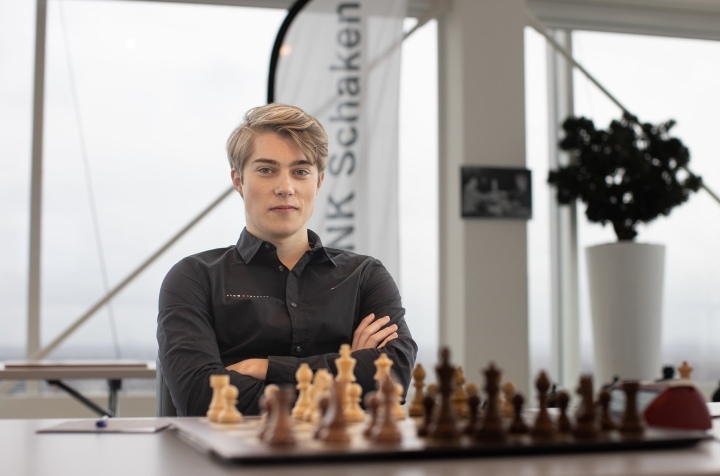
Max Warmerdam is a new Dutch chess champion. The 21-year-old grandmaster from Tegelen, municipality of Venlo, clinched his first national title with a round to spare. “I could not have imagined this a year ago. At that time, I was still an international master,” said the happy champion. The 2021 open Dutch Championship was a two-stage event. The preliminary knockout stage was held in Hoogeveen alongside the Women’s Championship at the end of October. With several top Dutch GM missing, Roeland Pruijssers, Max Warmerdam, Robin Swinkels and Hing Ting Lai advanced to the final. The four-player double round-robin tournament with classical time control took place from November 27 to December 3 2021, in Rotterdam. Warmerdam grabbed the lead in the third round after beating his main competitor Hing Ting Lai in the direct encounter and never looked back. Even after securing the title, the champion kept the momentum going – in the final round, he beat Robin Swinkels in 24 moves to finish on 5/6. Warmerdam became the only player to suffer no defeats and finish on the plus side. Silver was on the line in the final round game between Roeland Pruijssers and Hing Ting Lai. Facing a must-win situation, Roeland rose to the occasion and convincingly outplayed his opponent to come in second. Hing Ting Lai had to settle for third place. Final standings: 1 Warmerdam, Max 2608 5 2 Pruijssers, Roeland 2570 3 3 Lai, Hing Ting 2450 2½ 4 Swinkels, Robin 2523 1½ Photo: Harry Gielen and Frans Peters Official website: schaken.nl/
Havana 1966 inspires Dubai 2021
After the table to be used in the match between Carlsen and Nepomniachtchi was assembled and painted, FIDE shared on social media the first images of it. The table was placed inside a real-size mockup of the stage built in a warehouse outside the Expo, as part of an inspection and general rehearsal. In the past, the tables used in title matches had a starring role: many of them are still kept in museums, and a few others have been sold for a fortune to private collectors. However, their importance has diminished in recent years, probably due to the use of electronic boards. Now the board simply rests on top of the table instead of being an integral part of it. FIDE wanted to honour this tradition and restore the table to its former importance. The first idea was to build an exact replica of the legendary table used by Bobby Fischer and Boris Spassky in their 1972 match, which will soon celebrate its 50th anniversary. That iconic piece was created by Icelandic furniture designer Gunnar Magnússon, to whom FIDE wanted to pay tribute. However, due to contractual obligations established half a century ago, building a replica was not possible. In view of this, the idea of creating a unique design for Dubai 2021 took form. FIDE’s media department did some research and discussed the matter with furniture designers. Some tables used in legendary matches, like the one from the 1985 world championship between Karpov and Kasparov housed at the chess museum in Moscow, were also examined. But the one taken as a main reference for the 2021 match was the table used at the 17th Chess Olympiad in Havana. Once the final piece was designed, the table went to production by PICO, the global brand activation agency providing its services at EXPO 2021. Two identical copies were produced, in a sleek black finish, with an armrest in white leather. The table also features a small space underneath where players can keep small items, like the snacks or energy bars that many of them consume during the game, without leaving them in plain sight.
FIDE World Championship Dubai 2021: More than meets the eye
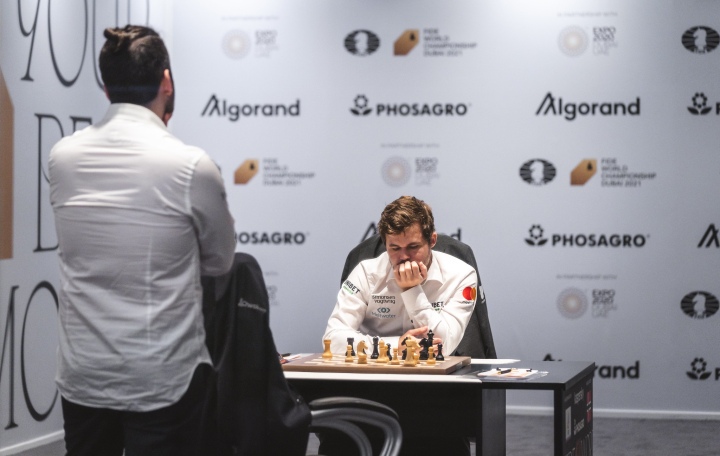
As the expert predictions emerge online on the morning of Game 5, there is a foreseeable sense of permanent deadlock about the match at this stage. While casual observers are quick to bemoan a start of four draws, the aficionado is more concerned about the complexity and fighting spirit behind the results. Chess is a game of complete information, innate balance, and now, computer encroachment. A draw is a correct result and the most likely at the top level. Like football fans, what often matters most to chess addicts watching a draw is drama and application. The feeling of continuing deadlock is due to a more worrying trend, the games are getting shorter, and the sense of nearly full-game preparation is rising. Live mood There is something very special about watching a world championship match live. Even in this day and age, with an overabundance of real-time coverage in all manner of channels, you can still get a better sense of what is happening by taking it in on the spot. The hushed reactions of the crowd; the traffic patterns of spectators in and out of the playing theatre as the complications on the board fluctuate; the expressions and secretive chats of any members of the players’ delegations; the growing excitement of the expert commentators – all of this blends with the ability to scrutinize the players themselves, and creates a cocktail of tension and atmosphere. A fascination with body language might be the first step to appreciating live classical chess, but a sense of the mood in the building, the collective buzz and hum – this can only be experienced live. It is palpable – enough so that in the middle of Game 4, most of the media suddenly surged out of the press box, convinced that the game was about to end in a draw. They had underestimated the champion’s work ethic, or misread his body language. He might have been frustrated, but he was there to put in a full shift, trying to extract water from the challenger’s stone of the day. The opening ritual Each game begins with the loud ringside introduction of the players, white first, by Master of Ceremonies Maurice Ashley. Today, for game five, the summons brings both players promptly from their backstage areas. His Excellency Sheikh Nahyan bin Mubarak Al Nahyan, Minister of Tolerance and Coexistence and Commissioner General of Expo 2020, made the first move today, as ever, in the presence of FIDE President Arkady Dvorkovich. Dvorkovich took the opportunity to congratulate the UAE on the Golden Jubilee of the national union and thanked the match hosts for their hospitality. The ceremonial first move was captured on camera, and as the Minister played 1.c4, there was a moment of anticipation for a new opening from challenger Ian Nepomniachtchi. The reset and official start, however, confirmed the expert forecasts, and the familiar battleground from games and 1 and 3 was revisited. Champion Magnus Carlsen was the first to deviate, choosing a new 8th move, but his opponent fired off moves at speed, showing the confident breakaway-train pace that he is famous for but has reined in during the match so far. Although it was hard to read any clear signs of surprise on the champion’s face, Nepomniachtchi raced out to roughly a half an hour edge on the clock, indicating that he was both still in his pre-game preparation and still in control. Pressure on the champ Official match commentator, former world champion Vishwanathan Anand, had one of the strongest opinions as Carlsen sank into thought on his 19th move. While there was general expert agreement that Nepomniachtchi had maintained the advantage of the first move, Anand said that not only did he not like the black position, he didn’t think Magnus did either. As the players hit move 20, it was the challenger’s turn to pause and contemplate, something he habitually does while twirling a captured pawn with the fingers of his right hand. Anand also had a slightly different take on the subject of nervous pressure. Drawing on his own vast experience of playing title matches, Anand believes that the nerves never stop jangling in a title match, since there is a constant, growing fear of error, and one misstep could determine the result. Diminishing returns The expert consensus was that the beginning of Nepomniachtchi’s deep thinks resulted in a surprising dispersal of his pressure, with commentators pointing to his 20th move as unambitious. This was followed by a sequence of material trades that steered the game once more towards a peaceful conclusion. Interest was piqued again as the champion appeared to choose a passive defence, but with precise play, Carlsen erected an impregnable fortress. Elite grandmaster (GM) Anish Giri echoed Garcia’s earlier observation, saying he felt the Norwegian had arrived tired for game five, and had been vulnerable today. A common talking point among commentators was whether the challenger’s conscious decision to adopt a cautious match strategy might have inhibited him from mounting a serious winning bid after he secured an early advantage. To all appearances, Nepomniachtchi had the upper hand in speed, preparation and position today, and even if his superiority was not deadly, it was likely a rare opportunity to have this trifecta in a title match. When the time control was reached at move 40, the champion was visibly relaxed, and confident that he no longer had anything to fear on the board. After brief reflection, Nepomniachtchi agreed, and initiated a repetition of moves that signalled the fifth consecutive draw of the match. A new detail Although the players exchanged a few words after the end of play, for the first time, they didn’t linger and have a longer discussion of the critical points in the game. Previous title challenger, US GM Fabiano Caruana, said he read Nepomniachtchi’s reticence and expression as a sign the challenger was angry with an opportunity missed, even if his advantage had never been decisive. Regardless of how he arrived, Carlsen was visibly subdued
Velammal Nexus School wins World School Chess Tournament at Expo 2020
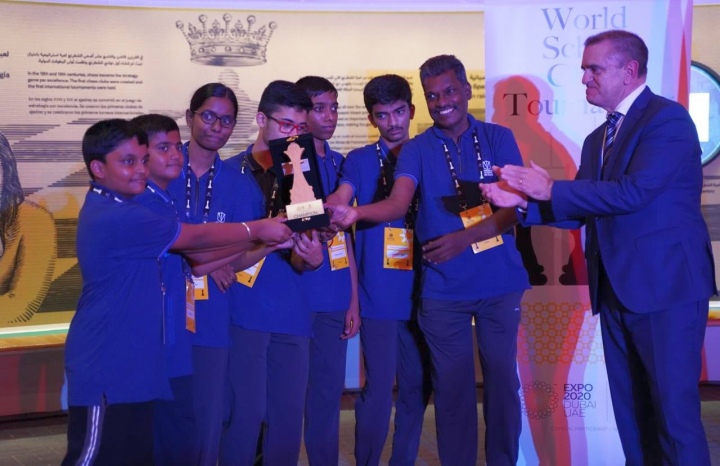
293 teams and 2,637 players from 53 countries took part in the biggest online competition ever, the World School Chess Tournament, organized by the Spanish Pavilion. The qualifying stage of the tournament for schools with students of all ages up to the U-16 category, representing the countries participating in the World Fair was held online on Chess24 throughout 2021. Twelve top-qualifying teams from the preliminary stage came to UAE to play in the OTB finals at the Dubai Expo. The finals of the World School Chess Tournament brought together 118 young people from India, Mongolia, Peru, the Czech Republic, Hungary, the USA, Israel, Spain, Turkey and UAE. The Indian team Velammal Nexus School emerged champions after beating the Peruvian School Saco Oliveros in the final. GMs D Gukesh, R Praggnanandhaa and Leon Mendonca, along with International Master V Pranav and V Rindhiya bested their opponents by a score of 3-2. Saco Oliveros from Peru had to settle for silver; the 33rd Secondary School of Mongolia came in third. “We were favourites to win the tournament, but the Peruvian team fought, and they were quite close; it was a very interesting tournament,” 15-year-old Grandmaster Gukesh Dommaraju of Velammal Nexus School said. The Velammal Nexus School received the trophy from Reem Ibrahim Al Hashemy, Minister of State for International Cooperation and Director-General of Expo 2020 Dubai and José Manuel Franco, Spanish Secretary of State for Sports. “I would like to first thank all our friends and our colleagues from Spain for your successful conception and delivery of such a splendid tournament and appropriate celebration of a game that was introduced to the Iberian Peninsula by Arab travellers,” said Al Hashemy. “At Expo, we are honoured to welcome chess events and activities over the coming weeks, the FIDE World Championship is already taking place at Dubai Exhibition Centre, and before the end of December, we will also welcome the Sheikh Hamdan bin Rashid Cup, organized by Dubai Chess & Culture Club,” she added. José Manuel Franco, Spanish Secretary of State for Sports, said: “We are grateful for being able to host the final rounds of this chess tournament on-site; I would like to congratulate and highlight the enormous effort of all the institutions and federations involved.” During the award ceremony, representatives of the Emirati and Israeli teams played a friendly game.
FIDE Chessable Camp at EXPO 2020 Dubai: Days 1-3 recap
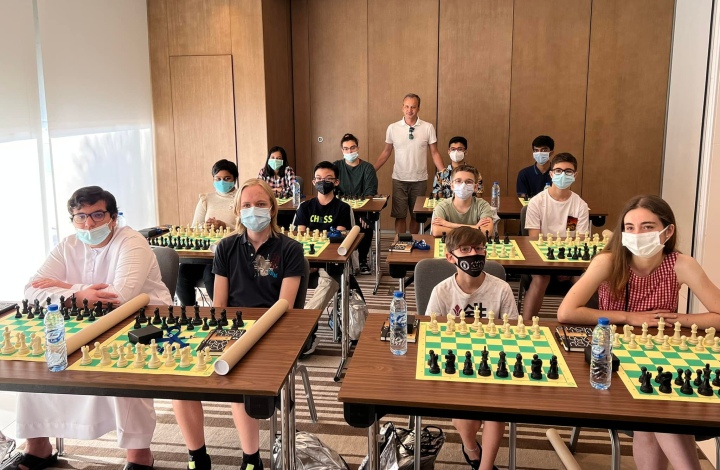
At the end of Day 3 of the FIDE Chessable Camp @ EXPO 2020 Dubai, the participants had an opportunity to attend the fifth game of the FIDE World Chess Championship match between Magnus Carlsen and Ian Nepomniachtchi. The lucky 12 youngsters were selected from 250 players aged from 8 to 16 nominated by 100 federations, who have been undergoing training for two hours every week since July. From Asia, there are six, with four from India: Gukesh D and Leon Luke Mendonca, the wild cards, and Divya Jitendra Desmuth and Sahiti Varshini Moogi. Others are Poh Yu Tian from Malaysia and Abdulrahman Mohamad Al Taher nominated by the host country UAE. There are four representatives of Europe: Enrico Follesa from Belgium, Ayan Allaverdiyevam from Azerbaijan, Magnus Ermitsch from Germany, and Adrian Stenier Soderstrom from Sweden The Americas is represented by Ilan Schnaider and Caldela Belen Francisco Guecamburu, both from Argentina. Day 1 started with a room full of guests who have rarely been seen together in one place before: FIDE President Arkady Dvorkovich, Deputy President Bachar Kouatly, Managing Director Dana Reizniece-Ozola, and Chessable CEO Geert van der Velde. It was hard to tell whose words were more inspiring! It only got better when former World Champion Viswanathan Anand delivered an instructive lecture of the highest quality. Did a tremendous and quick improvement occur right in this camp, or it can be attributed to the five months of weekly lessons two hours a week in English, Spanish and Russian before? Whatever the reason, the ten youngsters who took on TRG Chairman and Russia National Junior Coach Mikhail Kobalia in clock simul were on fire, scoring five wins, three draws and suffering only two losses! Day 2 was a treat of another kind for the young participants as, together with their parents, they had a chance to experience EXPO. Day 3 saw Chessable CEO Geert van der Velde lead a round table discussion where life lessons took the centre stage together with the development of industry-leading training platform Chessable with Chessable Classroom. What’s ahead? Day 4 will be a day of intense training at the actual match venue with Mikhail Kobalia and Viswanathan Anand, a behind the scenes visit that Dana Reizniece-Ozola will wrap up. The FIDE Managing Director will talk about her career path from being a chess player to becoming an award-winning Minister of Finance and still having enough skills to beat the world No 1 Hou Yifan when Latvia met China at the 2016 Olympiad in Baku. On Day 5, the young participants will have some precious time with the FIDE World Cup 2021 winner Jan-Krzysztof Duda sharing his valuable experience with them.
Alireza Firouzja surpasses 2800-mark in December rating list

November 2021 saw two major chess competitions: FIDE Chess.com Grand Swiss and European Team Championship. These two events caused a lot of changes in the new rating list. The big story is Alireza Firouzja‘s achievements in November that simply stagger the imagination. Indeed, after winning the FIDE Grand Swiss 2021 in Riga with an excellent result 8/11, the Iran-born teenager representing France steamrolled the competition in the European Team Championship, scoring 8/9 on the first board. These incredible results translated into 34 rating points and catapulted Firouzja to the second position in the open rating list. Alireza became the youngest player ever to surpass the 2800-rating mark, breaking the record set by Magnus Carlsen. Photo: Anna Shtourman Several top tenners, namely Alexander Grischuk, Levon Aronian and Maxim Vachier-Lagrave, dropped quite a few rating points in Riga. In the Frenchman’s case, it cost him the place in the top-10. On the other end of the spectrum is Fabiano Caruana, who qualified for the Candidates and picked up one point along the way. In the women’s rating list, the winner of Women’s Grand Swiss Lei Tingjie (pictured below) earned 30 rating points and returned into the top-10 after more than a three-year absence, whereas Aleksandra Goryachkina widened her margin over Humpy Koneru in the women’s top-10 after gaining 6 rating points in the two major November competitions. Photo: Anna Shtourman Biggest gains Vantika Agrawal WGM IND 2381 (+52) Firouzja, Alireza GM FRA 2804 (+34) Assaubayeva, Bibisara IM KAZ 2434 (+34) Antolak, Julia WGM POL 2368 (+34) Javakhishvili, Lela IM GEO 2479 (+33) Shirov, Alexei GM ESP 2704 (+31) Lei, Tingjie GM CHN 2535 (+30) Deac, Bogdan-Daniel GM ROU 2679 (+28) Keymer, Vincent GM GER 2664 (+25) Anton Guijarro, David GM ESP 2693 (+24) Zhu, Jiner WGM CHN 2478 (+23) Oparin, Grigoriy GM RUS 2681 (+22) Photo: Anna Shtourman Coincidentally, many winners in this category debut in the open and women’s top-100. Indeed, Vantika Agrawal (pictured below), Julia Antolak and Vincent Keymer significantly increased their rating and deservedly broke into the respective top-100s. Vincent and Vantika did a great job in the FIDE Chess.com Grand Swiss, whereas Julia picked 34 points in the Polish Women’s Championship semifinals and Frauenbundesliga 2021/2022. Photo: Anna Shtourman Alexei Shirov, David Anton, Grigory Oparin and Bogdan-Daniel Deac greatly benefited from their excellent performance at the FIDE Chess.com Grand Swiss as well, with the Russian and the Romanian reaching his career-high. For the most part, the same applies to Bibisara Assaubayeva (pictured below), Lela Javakhishvili and Zhu Jiner, who netted plenty of points at the FIDE Chess.com Women’s Grand Swiss with the Kazakhstani youngster mounting to 33rd position in the women’s rating list and 4th place in the top-100 girls. Photo: Mark Livshitz Outside of top-100 open and women, we can see even more impressive rating jumps by the youngsters. For one thing, the progress at a young age is more rapid; for another, the lower you are ranked, the easier it is to accumulate points. Kudos to Nilufar Yakubbaeva (+77), Eline Roberts (+61), who is knocking at the top-100 door, Anastasia Avramidou (+57) and Alua Nurmanova (+53) for their impressive rating gains.
FIDE World Championship Dubai 2021: Closing window
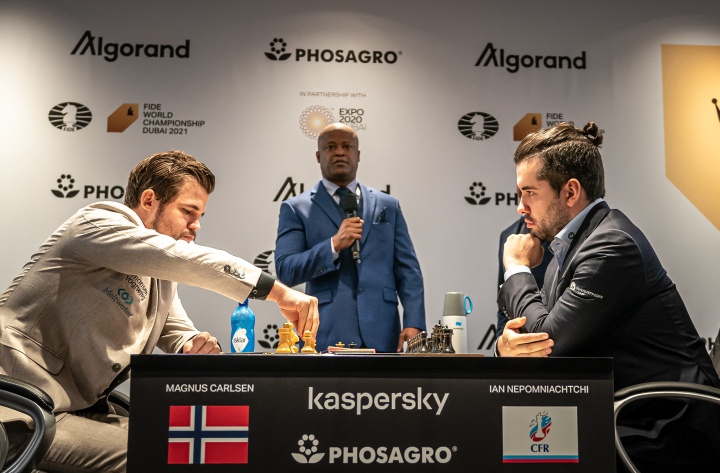
Today’s game will supply a bit more information about the general match strategy of the players. Pundits tend to read the opening moves and systems to infer the wider-ranging approach to the match. So far, we have seen a slightly unexpected solid, cautious approach from challenger Ian Nepomniachtchi when having the advantage of the first move and one risky, full-blooded charge from champion Magnus Carlsen when he played white. A larger sample size is needed! One thing we do know in terms of overall strategy is that Carlsen clearly remembers the crippling nerves that affected him and his challengers in their debut matches. He declared openly in interviews that he was keeping this in mind and would make an extra effort to try and strike early before his opponent felt settled. Magnus said that debutant nerves lasted 3-4 games, which means that today this particular window of opportunity is closing – and this might inspire a bolder stance. It remains to be seen whether the challenger will adopt the frustrate and provoke strategy that nearly allowed Sergey Karjakin to unseat Carlsen in 2016 – Karjakin is a member of Team Nepomniachtchi here in Dubai – or whether both players are doing what they feel best suits the early phase of the duel. Getting underway For the third game in a row, Magnus did not emerge when announced, taking a few minutes before rushing out of the players’ offstage rest area. Ian came on stage promptly, with his customary thermos of tea. Today’s special guest was Secretary General of Dubai Sports Council, His Excellency Saeed Mohd Hareb, who made the ceremonial first move with FIDE President Arkady Dvorkovich attending. The electronic board does not seem to be live before the actual game starts anymore so that the possibility of slightly misleading excitement from an unexpected move was absent. Hostilities began on a new front, and plenty of new information was provided by move two. Carlsen switched to Nepomniachtchi’s favoured 1.e4 and was quickly informed by Ian’s second move that the safety-first tactics are still in force from the challenger. Ian chose the Petroff, or Russian, Defence, which was a favourite and reliable brick wall for the previous challenger, the US grandmaster (GM) Fabiano Caruana, in London 2018. Reading the tea leaves Already here, experts could mull over a variety of topics: Carlsen’s switch of the first move could mean that he wants to play on a wide number of fronts; Nepomniachtchi looks intent, at least in the early phase of the match, on following the match strategy of another predecessor, his assistant Karjakin; and the choice of an atypically quiet and purely defensive system raises the constant talking point of how drawish title matches can be. Other topics of debate included whether adopting a defence that Carlsen and his team have worked on for years is a good idea, even if the Petroff held up well for Caruana; and if a match strategy of neutralization is suited to the challenger’s perceived style and temperament, or even wise in general against a champion who has been devastating in faster-paced tie-breaks. Here again, the question of the advantage of the first move in a modern title match returns: In the three decisive classical games between Carlsen and Nepomniachtchi in their adult careers, Nepo has a 2-1 edge. All wins came with the black pieces, and in all of them, Carlsen was the aggressor. When Carlsen fell behind versus Karjakin in New York 2016, it was after overextending completely – with white – after a long series of frustrating draws. One final observation – Nepomniachtchi adopted the Petroff Defence when trying to safeguard his lead at the Candidates tournament which earned him this title challenge – and defeated Chinese GM Wang Hao. Carlsen referred to this after the game, saying this encounter had made the opening a natural target of his pre-match preparation. A new idea The game featured a flurry of early material exchanges, a customary harbinger of a peaceful outcome. Carlsen appeared to be the first to surprise in a well-known and briskly played opening, unveiling a new and sharper idea on his 18th move. Experts were not convinced that this was anything more than choosing an obscure and slightly tricky line from a large selection of objectively equal alternatives. Despite the challenger being the first to sink into thought, he continued to play quite quickly, and official match commentator and former world champion Vishwanathan Anand suspected that the entire game could well be in both players’ prepared files, and that any hesitations were due to them checking their memory. The position remained in balance, with the champion having one advantage – that he could always force a draw by repetition of moves. With this in mind, he invested time and energy in an effort to unearth some way to drum up subtle problems for the challenger to solve. Carlsen thought for over half an hour on his 30th move in search of a way forward but finally acquiesced to splitting the point by repeating the position, and after a third repetition, a draw could be claimed. The players discussed the course of the game, and both sounded confident that the black position had been impervious to real danger. Post-game highlights Both players implied that the game had been more of a memory in exercise than calculation. Nepomniachtchi told Norwegian broadcasters NRK that he had not played any of ‘his own’ moves and that a draw was the usual result when both players were well prepared. At the post-game press conference, Carlsen referred to the ‘Insanely complicated’ positions that could have resulted from his new idea, but that the challenger’s optically risky, but in fact, sensible way of playing the position just worked. “That’s the state of modern chess,” Carlsen said, also referring to the massive intervention of computer analysis. “Not much else to say.” The session ended with the daily question from FIDE’s social media followers, with an offbeat query getting