

FIDE and Chessable host training camp for young talents in Dubai
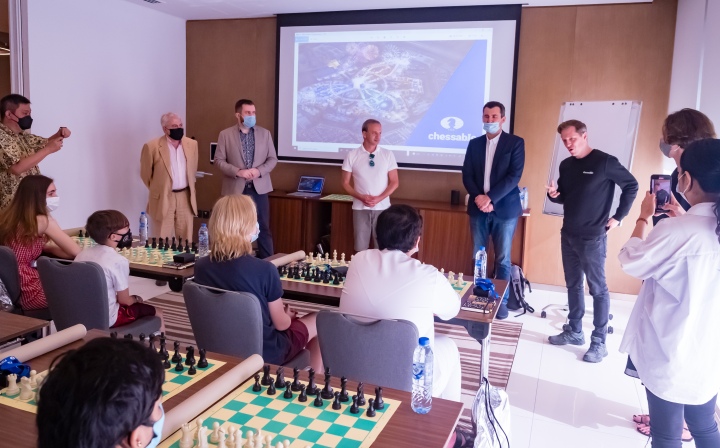
The FIDE Chessable camp is held between November 28 and December 4 as a part of the FIDE Chessable Academy program. In July 2021, Chessable, the world’s leading chess E-learning platform, in partnership with FIDE, launched the FIDE Chessable Academy, aiming to support young talents worldwide and encourage them to succeed in chess. 250 most talented and promising young players aged from 8 to 16, representing 100 national federations, are attending the program. Among the FIDE Chessable Academy students, there are top-five rated young talents in their age groups and the winners at the World Youth and Cadets Championships. Children divided into ten groups have two hours of training every weekend in English, Spanish, and Russian. Twelve of them were selected to come to Dubai and have a unique opportunity to be trained by ex-World Champions and chess legends Viswanathan Anand and 2021 FIDE World Cup winner Jan-Krzysztof Duda. The students will also enjoy a behind-the-scenes visit to the FIDE World Championship Match between World Champion Magnus Carlsen play Challenger Ian Nepomniachtchi. On the first day of studies, the camp participants were greeted by the FIDE officials and those organizing the camp. “You have been selected from hundreds of kids, that means that you’re among the best. I wish you to work hard, but most importantly, to enjoy what you’re doing. I remember when I was a kid myself going to a chess school, I was having fun. Maybe it’s not good advice but anyway, here you’re both to work and to have fun. It’s a huge opportunity for you, and I’d like to thank all the coaches who are going to work with you. Do your best, show the best possible results, and love chess!” said FIDE President Arkady Dvorkovich. The Chief Executive Officer of Chessable Geert van der Velde stressed that the camp is not only about getting better at chess but exploring other things as well: “You are here because you have passion for chess, passion for learning. There’s a lot of things that you can take away from chess and from participating in chess events. Having a place where you come to learn about chess from some of the best in the world like Viswanathan Anand and Jan-Krzysztof Duda is absolutely amazing. But what I would like to hope you’d walk away with from participating in a camp like this is not just becoming really good at chess but also becoming really good human beings, taking away friendships, coming away with unique experiences. Chess is a beautiful vehicle for you to explore the world and I’d like to say to you: Keep driving that vehicle, explore and learn!” Fourteen-year-old Sahithi Varshini from India is among the participants of the Dubai camp. A WFM with one WIM norm, she is the winner of the Asian U-10 & U-12 girls championships and U-10 girls commonwealth championship. “My sincere thanks to the All India Chess Federation for nominating me for the FIDE Chessable Academy and to FIDE for selecting me for this wonderful training camp by the legendary world champions Viswanathan Anand. It’s really a great opportunity for me to hone my knowledge and skills on a wonderful platform and attend the sessions, which are helpful to me to move forward. My sincere thanks for the wonderful opportunity to be in the training camp,” she said. Fifteen-year-old Enrico Follesa of Belgium confesses that participating in a camp is a unique opportunity for him: “I will do my best to learn from Viswanathan Anand and Jan-Krzysztof Duda as much as possible. I am also excited to attend two world championship games between Magnus Carlsen and Ian Nepomniachtchi, whom I hope to be able to meet in person. Last but not least, it will be great to meet and exchange experiences with some of the strongest chess players in the world of my age. I want to thank everyone who made this possible: the Belgian chess association KBSB, the FIDE Chessable Academy team and its great trainers. For me, this camp is a wonderful result and a new starting point”. Today participants of the camp are attending lectures by the five-time world champion GM Viswanathan Anand and the Chairman of the FIDE Trainers’ Commission GM Mikhail Kobalia. And tomorrow, they will go to Expo 2020 Dubai to see the fourth game of the FIDE World Championship Match between Magnus Carlsen and Ian Nepomniachtchi.
FIDE World Championship Dubai 2021: Armed and informed
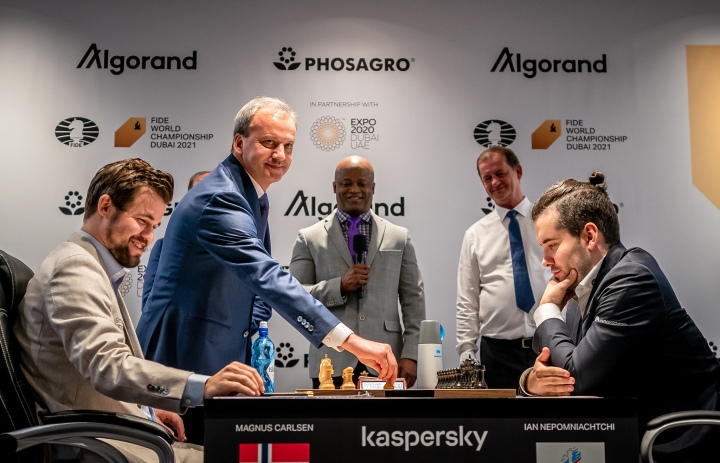
The third game of a world championship match reveals a little bit more about the months of work done by the players and their teams. Will they return to the site of their first battle, or will one of them feint and run, expanding the number of possible opening variations needed to be scrutinized and gathering more information about where they should make their stand? What have we learned? The first two games have followed an unexpected course, and champion Magnus Carlsen called them ‘atypical’. Both games featured early pawn sacrifices from the titleholder in return for long-term pressure – the kind of aggression and risk usually associated with his opponent. This ambitious approach very nearly backfired in game two, when Carlsen suddenly found himself on the ropes after overlooking challenger Ian Nepomniachtchi’s defensive resources. While the early games of the match may have been atypical in style, they do fit in with conventional wisdom about title bouts. The champion is advised to push hard in the early games, before the challenger has time to acclimate to the unprecedented nervous tension of the occasion. Magnus admitted before the match that he was keeping this in mind as an early strategy. Ian Nepomniachtchi has had a mantra here when asked about early nerves. He agrees they exist, but he insists they evaporate as soon as the first move is played. Then it is just chess, and he just enjoys playing chess. Setting the stage Ian ‘Nepo’ Nepomniachtchi had the advantage and onus of the first move today. One early online prediction came from tweeter extraordinaire, the world number six, Anish Giri. The Dutch grandmaster, who predicted the opening of game one, now believed the chess public was in for a day of dull safety, a common reaction to the incredible stress and complications of the preceding round. But will the challenger really ‘burn’ a white after a near-miss the day before? First move(s) The making of the first move is a daily ceremony, and if you are watching live, it offers an extra moment of mild excitement or confusion. The move played on the board by the dignitary of the day for the cameras is not necessarily the one requested by the player. On day one it was accurate, but since then, the wrong central pawn has been ceremonially advanced. Yesterday 1.e4 was seen before Magnus chose his d-pawn. For game three FIDE President Arkady Dvorkovich was joined by Her Excellency Mrs Hanan Al Aleeli, the UAE Ambassador to the Republic of Latvia, and Anastasia Myskina, the first Russian female tennis player to win a Grand Slam singles title, at the 2004 French Open. Myskina had the honour of starting the players off, and her choice of 1.d4 caused a murmur of surprise in the theatre audience before Ian went back to his game one repertoire after the reset. The opening followed the path of game one, and the now familiar rhythm of a brief pause from Magnus on the move eight, the sight of his eyes wandering as he consulted his memory banks, and then a resumption of the usual pace. The champion took a surprisingly longish 5-minute pause on his 10th, with general expert agreement that this was again a psychological moment, where Carlsen was making a subtle decision about where an ambush might lie, as well as which of his own prepared lines best suited his mood. As play entered the middle-game phase, the position remained in approximate balance, with white still enjoying the slight superiority inherited from the first move. Tension and resolution The critical segment of the game arose as the players hit move 20 and invested long thought tackling the subtle complexities of the position. According to the various computers examining the position, Carlsen had a very narrow road to full equality, but he neutralized any dangers efficiently. Nepomniachtchi seemed somewhat disappointed by failing to make an impression with his second white, but his advantage had been kept in check throughout, and another draw was inevitable. Immediately afterwards, Magnus said that It would be good to get a rest day tomorrow. “Of course, I’ve had two blacks, but I have to create some chances at some point.” Reactions The press conference touched upon a number of familiar topics apart from the game: plans for the coming rest day, the drawishness of top-level chess, and a new one, doping – as the players faced a control after today’s exertions. Ian focused on engine consultation being the only real form of chess doping, while Magnus joked that he might investigate possible drug enhancement someday ‘if his level drops drastically’. The players agreed that a binge of watching sports on TV and getting in some needed physical exercise were on their agendas. FIDE’s social media followers produced the session’s final question of the day, directed at the champion, wondering how he thought he would be remembered in 50 years time. Carlsen said he didn’t think his legacy was something to discuss during a world championship match before finding an answer with a call-back to the questions about the lack of decisive results in recent title matches: “Hopefully as someone who won a classical game in a world championship match after 2016!” Local colour While we focus on the world championship, we can’t forget its setting. Dubai Expo 2020 is a World Expo, a spectacular event with the slogan ‘Connecting Minds, Creating the Future’, making it an easy link to the world championship match. Chess, particularly its educational value, has a starring role in the Spain pavilion, which is also the venue of the World Schools Team Championship. Leontxo Garcia, who has been organizing the chess activities at the pavilion alongside expanded duties as the reporter for chess-mad Spanish daily El País, reports that a little bit of history was made there today at the schools event. The first-ever over-the-board team match between the UAE and Israel took place there this morning. Further détente is planned for tomorrow, when the closing ceremony of the World Schools
FIDE World Championship 2021: The champion’s turn
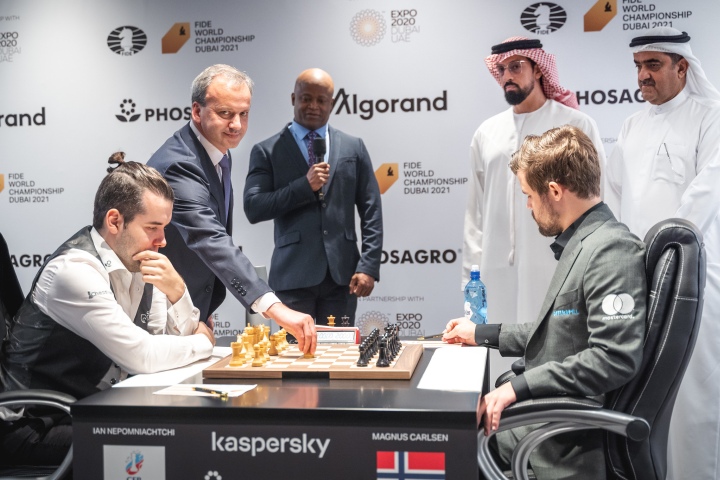
Game two of the FIDE World Championship gave viewers a glimpse of what may be a pivotal over-the-board battlefield as titleholder Magnus Carlsen set the pace with the advantage of the first move today. As the players were introduced to the audience, there was a few minutes delay before the champion emerged onstage. Once again FIDE President Arkady Dvorkovich made the ceremonial first move on the board, again flanked by two special guests: Andrey Simanovsky, President of the Chess Federation of the Sverdlovsk region, whose company Sima Land has sponsored the Candidates tournament and the Online Olympiad; and Alexander Filatov, co-founder and CEO of TON Labs, a FIDE NFT (non-fungible token) partner behind the joint launch of the ChessNFT marketplace. In the isolation of their soundproofed stage, and blind to the audience outside behind one-way glass, the hostilities of game two commenced. Fully focused, the champion chose to play the Catalan Opening against challenger Ian Nepomniachtchi, and just as in game one, there was an intriguing psychological dance in the first phase of play. Opening duel Once again Carlsen was the first to hesitate, but like the day before, this seemed to be him consulting his mental database. He chose a sharp and unusual reply, sacrificing a pawn for active play, again echoing his decision in game one. This plunged the challenger into long thought surprisingly early, and it soon appeared that Carlsen had succeeded in snaring his opponent in a dangerous line doubtless prepared in his training camp. US grandmaster Fabiano Caruana, the previous world title challenger, called the development of the first stage of the game for the challenger as “any player’s ultimate nightmare ” – getting caught in a sharp position of your opponent’s preparation. “Again, Magnus has won the opening battle,” Caruana concluded. Although it is too early to declare a trend after two games, it is impossible to ignore the unexpected sight of the supposedly quiet Carlsen intent on sacrificing material to create pressure and a more solid stance from the normally aggressive challenger. This might break the apparent mould of how their styles are easily summarized, but it does echo their previous history, where Magnus has overpressed with the white pieces trying to show his problem opponent who is boss. Despite the fierce early pressure on Nepomniachtchi, the immense complexity of the position meant that one slip from Carlsen could swing the balance – and that slips were in high supply. Slips Experts pointed to Carlsen’s 17th (17.Ne5) move as inaccurate, and there was visual confirmation as the challenger suddenly began to play at his patented high speed, while the champion began to burn thinking time, realizing that he would have to sacrifice even more material to avoid a grim defence. This further investment would mean that defeat would loom large if Carlsen could not generate enough pressure to compensate. As the pace slowed and experts had time to grapple with the complications, a vague consensus emerged that Nepomniachtchi had seized the upper hand but that the position remained extremely difficult to play. The human factor would likely decide, especially as their thinking time ticked towards zero. High drama The challenger appeared to let some of his edge slip with some patented swift play, and as the position began to clarify, the champion clawed his way to safety. Then, according to some grandmaster observers, the champion even held the possibility of pressing once again for a win. In the end, Carlsen actually managed to emerge with a pawn advantage in a rook endgame, but in a position well known to be easily drawn, the point was destined to be split. The verdict Game two was a breathtaking clash, with champion Carlsen getting an early grip on both board and clock. Challenger Nepomniachtchi was creative and resourceful in defence, turned the tables, and then probably let his rival off the hook with a few rushed decisions. Once the position stabilized, the game finally reached a predictable scenario – a subtle technical position where Carlsen often manages to make something out of next to nothing – but not against Nepomniachtchi today. In a brief discussion about the game after the draw was agreed, the players compared thoughts about the baffling complications, and Magnus could be heard to say: that he hadn’t been sure who had been better or why – a telling summary of an exceptionally dramatic fighting game. The players confirmed this in the post-game press conference, with Magnus admitting he had totally overlooked Ian’s 18th move, and that he then realized he was in danger rather than in the ascendancy. Ian said it was “in general a very puzzling game” and labelled it chaotic and crazy. Carlsen summarized the match so far as ‘atypical of both players’, explaining that the games were just fights and that it might settle down later. The question of colours Although the advantage of the first move carries a clear statistical superiority, it is quite common for the reverse possibility to come up for debate during a title match – might there be more positives to playing with the black pieces in the unusual setting of a lengthy one-on-one duel? This debate is usually sparked due to the incredibly high level of preparation for world championship matches, and a few simple considerations. The most important factor is that there are always a large number of defensive systems, and Black only has to choose a few and prepare these deeply. The player with white has to try and predict where the battle will take place and cannot be as deeply prepared in advance – for everything. Historically, this often resulted in some probing in the early stages, with the white player gradually and cautiously discovering where his opponent had decided to fight. The bigger this surprise, the more problematic for the attacker. Now, with shorter modern matches and incredibly sophisticated computer analysis, there is less time to readjust to surprise, and this can give the impression that having black is no handicap at all. But, in
FIDE World Championship Dubai 2021: The battle begins
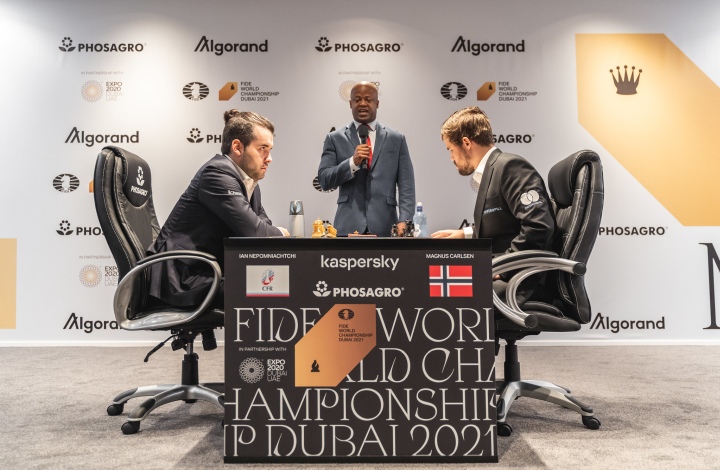
The voice of master of ceremonies Maurice Ashley booms out of the darkness, welcoming those gathered in the theatre of the Dubai Exhibition Centre South Hall to the FIDE World Championship 2021. At the very front of the stage, dozens of photographers crowd towards the playing area, visible behind three huge panes of glass, the board and chairs centred behind the middle pane. Challenger Ian Nepomniachtchi appears briefly about 20 minutes before the start of play, surprisingly early, perhaps to acclimatize to the penultimate new experience, being surrounded by a media frenzy of unaccustomed proportions. After this, only the novelty of playing a game for the world title remains. Maurice begins with some opening words of praise for the organizers before calling the player onstage in turn, challenger first. The first move is executed by FIDE President Arkady Dvorkovich, accompanied by Sheikh Sultan bin Khalifa Al Nahyan and Sheikh Saud bin Abdulaziz Al Mualla, both prominent chess figures in the region. As the photographers snap away, play starts and the game begins. It follows the sage prediction of Anish Giri – the elite grandmaster from the Netherlands told social media followers earlier in the day that his heart hoped for an Italian Opening, but his brain said Spanish – and with his third move, Nepomniachtchi showed he reached the same conclusion. Body language Watching two people play chess for hours has been a hard sell over the years, but more and more spectators are acquiring a taste for it. While it helps to have lively expert commentary to educate and entertain during the long thinks – and the chess world has never been as spoilt for choice as in the coverage of the Dubai match – the real secret to enjoying a match is gradually immersing oneself in the study of body language. Both revealing and mysterious, the details of facial changes and fidgets hint at the hidden inner turmoil of these apex thinkers, and the longer you watch, the more you believe you can see. The first hesitation as the players reel off their surely deep, computer-assisted, opening preparations is usually a significant moment. It appears to come from champion Magnus Carlsen, whose face darkens. He rubs his face, raises his eyebrows, but after only a small pause makes his decision, sacrificing a pawn for active play. On move 14, the players’ quick replies raise expert eyebrows and convince them the combatants are still in their prepared lines. Grandmasters scrutinizing these unexpected decisions agree that to be played so fast, they had to be the product of their training camps. The normally speedy challenger slows first, but by move 17, both regularly sink into deep thought. Now they appear to be on their own, and are tackling the subtle problems on the board head-to-head. Global scrutiny by man and machine The stereotyped roles are reversed in a tense middle-game without queens, where the normally swashbuckling challenger is on the defensive, hoping to gradually shake off the pressure and make use of his extra pawn, while the typically technical champion has sacrificed material to enjoy the momentum gained in return. The bottom line is that both players are versatile – and willing to see who is better out of their customary comfort zones. Giri combines detailed online chess commentary with body language scrutiny, pausing to assess the speed and meaning behind Carlsen’s sudden flurry of blinks while thinking. Supercomputers also examine the game, which is in a delicate balance, with microscopic fluctuations in both directions. Previous title challenger, US grandmaster Fabiano Caruana, explains strategic subtleties on another online broadcast, revealing the long-term potential behind the champion’s sacrifice. Former world champion Vishwanathan Anand tells spectators at the venue similar tales – the general consensus is that a draw is likely, but anything could happen thanks to the tension. Verdict after about 30 moves – the simple position conceals complex tension, and may suit Carlsen better. A shift in momentum Carlsen’s 33rd move threatens to perforate the white position, and convinces his opponent the time has come to return his extra pawn and seek safety through simplification. The initiative had shifted to the Norwegian, but his advantage was still slender. Once the players reached the first time check at move 40 – which they must complete within their allotted two hours – the position was balanced and drawn by repetition. Post-game explanations In the post-game press conference, Magnus said he assessed the final stage of the game as not offering real chances to win once Ian had opted to return the material and gain some activity for his pieces. Neither player seemed particularly pleased with the result, but both seemed satisfied. Carlsen confessed to feeling “a bit shaky at times” and that there were things he could have done better, but a draw was a fair result. Nepomniachtchi summed up his reaction: “I feel like you feel after a draw with the white pieces. It’s quite a usual result nowadays, but still, you want more.” The players jokingly dodged efforts to get them to reveal their teams of assistants, and Ian shrugged off questions about the sense of occasion, reiterating that as soon as the game starts, his focus was just on doing what he has been doing since childhood, playing chess. The conference ended with a fitting question from FIDE’s Twitter followers, notably: How much do you dread post-game press conferences? Do you just want it to be over, or do you use it as a time of rest? – sent in by ‘Matt Beef’. Although the query amused the players, they both gave serious answers: Magnus Carlsen: I think it depends very much on the situation. At the moment, with only the first game played, and not much has happened, it’s OK and I guess, a way to relieve the stress a bit after the first one. Ian Nepomniachtchi: I guess it’s a part of the job of the professional sportsman, so I think I come here and I try to speak. FACT SHEET, Game 1: White: Challenger Ian Nepomniachtchi, CFR Black:
FIDE World Rapid & Blitz Championship 2021: Visa & technical info
The registration for the FIDE Open World Rapid and Blitz Championship 2021 and the FIDE Women’s World Rapid and Blitz Championship 2021 continues. Eligible players, accompanying persons, FIDE Principals, arbiters and media are invited to register via the following link: https://worldrapidandblitz.fide.com/registration/ The registration deadline is 12:00 PM Lausanne time on 18 December 2021. Players are expected to read the tournament regulations before starting the registration process. Regulations for FIDE Open Rapid & Blitz World Championship (pdf) Regulations for FIDE Women’s Rapid & Blitz World Championship (pdf) The citizens of thirteen counties (e.g. Russia, Turkey, Armenia, etc.) are not required entry visa to Kazakhstan; the citizens of 104 countries (e.g. Angola, Montenegro, the USA, etc.) can receive a В1, single-entry visa upon arrival at the international airport of the Republic of Kazakhstan in Nur-Sultan city; the citizens of 48 countries (e.g. Australia, Canada, France, etc.) are invited to receive B1, single-entry visa under a simplified procedure (3-5 days) at consulates of the Republic of Kazakhstan. 80 USD fee is charged for a B1 single entry visa (credit cards only). You can find these lists of countries and complete visa information here. If you have any questions regarding the registration, feel free to contact the organiser via email: worldrapidandblitz@fide.com Official website of FIDE World Rapid and Blitz Championship 2021: worldrapidandblitz.fide.com/
FIDE QC to present changes in Rating, Title, and Rapid & Blitz regulations online

FIDE Council recently approved new changes to Qualification Commission regulations, which will be applied from 1st January 2022. The Qualification Commission will present these changes at two Zoom presentations, held on Wednesday, 8th December at 08:00 and 20:00 UTC. They will cover the following sets of regulations: Rating Regulations Rapid and Blitz Rating Regulations Title Regulations If you are interested in attending either of these presentations, which should last no more than 1 hour, please fill in this form by 7th December: The Zoom link will be distributed on the day of the meeting. Alex Holowczak,Qualification Commission Secretary
FIDE World Championship Dubai 2021: Catching up and final preparations
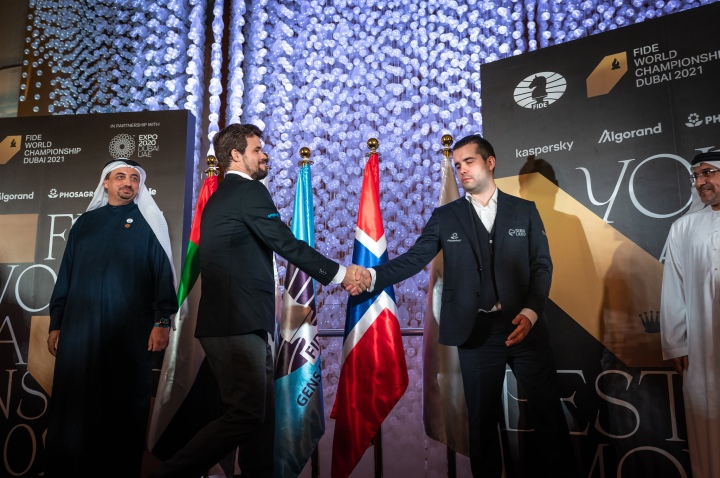
Challenger Ian Nepomniachtchi will have the advantage of the first move when the FIDE World Championship begins on November 26th. Champion Magnus Carlsen had the right to choose first – by puncturing one of two large gold balloons at the opening ceremony in the Dubai Opera – and the crisp *pop* revealed a shower of black confetti, awarding the white pieces to the challenger. This ceremony was one of few words, after a lengthy Q&A session with the press earlier in the day, where the combatants traded subtle digs and respectful compliments, as well as addressing a few complex questions. What about women? At the press conference, the players were quizzed about the possibility of a woman eventually bridging the rating gap and becoming a candidate for the world championship since they are currently such a minority in the chess world and do not play exclusively in open events. Ian said he saw no difference in general, except that there were fewer women playing seriously. He predicted that it would just be a matter of time before a ‘really strong female player’ emerged and pointed to the example of Hungary’s unparalleled but retired talent, Judit Polgar. Magnus felt the topic was ‘way too complicated to answer in a few sentences’ but felt that the current situation was largely down to cultural factors. “What I would say in general is I encourage everybody to play chess and what I’ve found around the world is that young girls find as much joy as young boys in the game of chess, and if that could be communicated more, I think that would be very helpful.” The subject did move FIDE President Arkady Dvorkovich to chime in, saying that FIDE plans to offer coaching and programs to help talented girls create career opportunities in chess, targeting the age groups that have traditionally evaporated to pursue other professions. Insights Both players agreed that even the proliferation of online blitz games flooding their databases could and should be examined in case they provided some inspiration for new ideas to add to their opening arsenal, and both were in total accord about the best advice for aspiring champions. Ian: “I’ll just try to say that you’ve got to enjoy what you’re doing, and you should just enjoy what you do if it’s chess or science or sports or basically whatever.” Magnus: “Enjoy what you do! If you’re going to excel in a field, I think, at least my philosophy is, that that has to be the main component.” Colours One question has become more topical now that the draw for colours has been completed, and that is whether the players would prefer to begin the duel with white or black. Nepomniachtchi had joked about this, saying that he would only prefer not to have 14 blacks and that ‘hopefully the rules are strict so it will be more or less balanced’. Magnus was more serious, and confessed that he probably slightly preferred to start with white for psychological reasons but didn’t feel it made a significant difference. In recent 12-game title matches, keeping any possible impacts of colour sequence to a minimum has meant that the alternation was switched mid-way, so that the person starting with white also ended with white, and the other player received two whites in a row in the middle. This year, with a 14-game match and an odd-numbered mid-point, the colours will simply alternate throughout. More sports Why all this talk of whites? The subject can return again to sports angles to chess. One of the traditional ways the advantage of the first move has been ‘translated’ for a novice audience has been to compare it to having the serve in tennis. It seems far from ideal, though – serve is a huge edge, and there are no draws at set or match, so it is either decisive or disastrous. A likely better analogy is that playing white is closer to home-field advantage in football (soccer), significant but less tangible, and one that the away side is often just content to neutralize and draw. Countdown Today, the final day of rest or preparation before battle, the players or their representatives should be inspecting the venue for those finicky but extremely important details such as the comfort and settings of their chairs, the lighting, noise levels. If not for the historic pioneering complaining of Bobby Fischer, these vital ingredients of optimal concentration would not be part of the pre-match organizational ritual. And then, preparations should be complete, and the players ready to enter the ring. Text: Jonathan Tisdall, Press Officer press@fide.com Photo: Eric Rosen Official website of FIDE World Championship Dubai 2021
Mariano Ortega clinches his second title of Cape Verde Champion
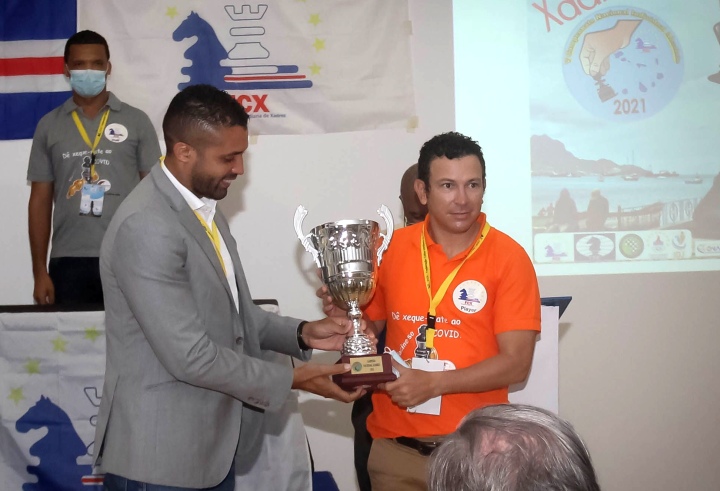
The city of Mindelo, on the island of S. Vicente, hosted the final of the Absolute Individual National Championship of Cape Verde, which took place from November 15-21, in the Conference Room of the Barlavento Chamber of Commerce. The ten best local players competed for the title of 2021 National Champion of Cape Verde in a round-robin tournament, with all the games broadcast on various chess platforms. For the first time in the history of Cape Verde national championships, all the participants had a FIDE rating. As tournament fate would have it, two leaders, Mariano Ortega and David Mirulla came to the final round with a perfect score of 8/8 and locked horns in the direct encounter to determine the champion. The rating-favorite Ortega outplayed his opponent with black pieces and clinched the title, second in his career. The results by the champion and the runner-up clearly demonstrate that they were head and shoulders above the field. Célia Rodriguez Guevara (pictured below), the only female player in the competition, tied for third place with Gil Teixeira, but took bronze thanks to better tiebreaks. The closing ceremony attended by, among others, the Minister of Sport, the President of the Cape Verdean Olympic Committee and the President of the Sport and Youth Institute started with a small performance by Chico Serra, a famous national musician followed by speeches and prize awarding. After the closing ceremony, there was a small cocktail reception where everyone could socialize and comment on the key moments and games of the tournament that will undoubtedly remain in the memory of all participants. Final standings: 1 Ortega Amarelle, Mariano 2465 9 2 Mirulla, David 1946 8 3 Rodriguez Guevara, Celia M. 1849 6 4 Teixeira, Gil 1674 6 5 Monteiro, Antonio 1743 4 6 Fortes, Aires 1474 4 7 Moes Joaquim, Carlos 1403 3½ 8 Pereira, Eder Marcio 1787 2½ 9 Miranda, Iura 1517 2 10 Santos, Bruno 1484 0 Photo: Daniel Lopes Official website: fcvx.org/cnia-2021/
FIDE World Championship Dubai 2021: The first skirmish
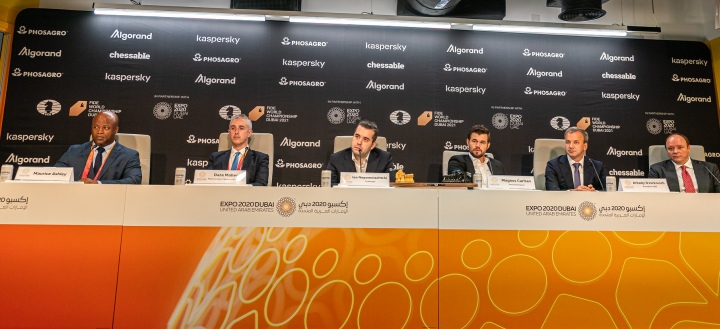
Reigning titleholder Magnus Carlsen and challenger Ian Nepomniachtchi met side-by-side at the opening press conference of the 2021 World Championship, fielding questions from gathered media and taking their chances to demonstrate confidence – and mutual respect – in a warm-up battle of wits. They meet face-to-face when their 14-game duel for the title begins on November 26th. The challenger will have white in the first game as he popped a balloon with white confetti during the opening ceremony. The panel included FIDE President Arkady Dvorkovich and representatives for event partners Kaspersky and PhosAgro. PhosAgro has sponsored title matches starting with Sochi in 2014, and Andrey Guryev, CEO as well as vice-president of the Chess Federation of Russia (CFR), began by excusing himself to Magnus for openly hoping Ian could bring the crown back home, emphasizing the desire to rekindle interest there: “We are trying to increase the popularity of chess among young people, to instil an interest in the game among schoolchildren.” The Q&A session was then kicked off by panel chairman and match commentator Maurice Ashley, who wanted to know how both players felt now that the contest was finally at hand after months of preparation. Ian’s “I can’t wait to actually get started” was delivered with a calm smile, and Magnus raised the banter level by saying: “I’m going to feel better in a few days,” leaning back, arms crossed, with a wide grin. When asked why they were going to win this match, Carlsen chose to deflect and joke that he ‘predicted’ the victor would be the one with the most points over the coming three weeks, while Nepomniachtchi opted for “Normally, I think the best player wins,” and looked pleased to have found a simple, confident answer that looks neutral in print. Chess press conferences can be unpredictable, but this session was lengthy and lively, with the players tackling topics ranging from their thoughts on an eventual female world title challenger, the impact of technology on match preparation, if online blitz games could provide inspiring new ideas, the extent of their much-discussed friendship, to which famous footballer they would compare the other to. The players complimented several of the questions, and after the slightly cheeky start, the answers grew more serious and the interplay carefully respectful. Nepomniachtchi’s summary of prior good relations between the two was particularly striking and quotable: “Once you sit at the board, you have no friends.” The unveiling of the match trophy, an impressive five-kilo cup forged from sterling silver, gold plating, dolerite and obsidian, created by the Chamovskikh Jewelry House, with the support of the Sverdlovsk Region Chess Federation represented by its president Andrey Simanovsky, owner of SIMA-LAND company, concluded the conference. The design of the cup was provided by FIDE President Arkady Dvorkovich. When asked to pose with the Championship Cup, Magnus ended the day with a final show of respect, refusing with the words: “That would be highly inappropriate.” You can watch the entire press conference here. Text: Jonathan Tisdall, Press Officer press@fide.com Photo: Eric Rosen Official website of FIDE World Championship Dubai 2021
FIDE World Championship Dubai 2021: Preview
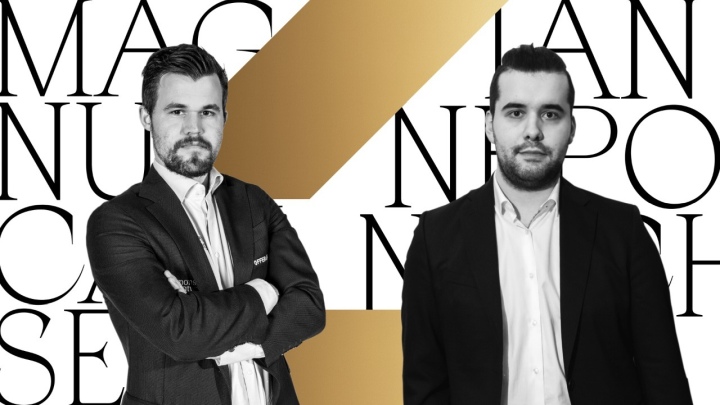
A Special Sense of Occasion On November 26th, the duel for the ultimate chess title will begin, between favourite and reigning champion Magnus Carlsen of Norway, and challenger and fascinating rival, Ian Nepomniachtchi of Russia. The clash should reach the biggest and widest audience ever, and esteemed pundits are predicting the match to deliver more excitement than ‘just’ a battle for the chess crown and title of World Champion. The event has been postponed a year due to the inevitable logistical complications of the global pandemic. During the lengthy wait to produce a challenger and arrange the match safely, chess has enjoyed a new surge of popularity. As the world went remote and online, the game flourished due to its natural affinity for digital competition. The timing and success of the Netflix series The Queen’s Gambit has given the general public an unprecedented level of interest and sympathy for the subtle yet brutal mental combat involved. If the experts are right, the Carlsen-Nepomniachtchi encounter has the potential to be a memorable occasion, and captivate viewers eager for both chess content, and human drama. The odds Carlsen’s credentials make him an undeniable favourite: He won the title by dethroning India’s Vishwanathan Anand in 2013, and has defended it three times since. Perhaps more daunting, and perhaps also closer to his heart, the Norwegian has been the top ranked player for over a decade now, and both his baseline and peak rating levels during this period are unprecedented. In the case of a deadlocked match – which has happened in the previous two title defences vs. Sergey Karjakin (Russia) and Fabiano Caruana (USA) – a tiebreak series of faster, ‘non-classical’ games will result. Carlsen also has eight world titles at quicker disciplines (3 rapid, 5 blitz), and has held all three titles simultaneously, twice. When asked to predict the outcome of the match, a common line of reasoning lists up the champion’s merits and concludes that if you had to place a bet, it would be on Magnus; followed by a pause and a long ‘But…’ The X factors The players have history. Nearly 20 years ago they were fierce rivals for world youth crowns. Ian took three consecutive European titles, winning the Under-10 and then the U-12 twice. In 2002 Ian and Magnus duelled for the European and World U-12 championships, and the Russian also took the latter, on tie-break. This early rivalry set the stage for the obvious dramatic narrative around the match. Not only will this contest be a chance for ‘Nepo’ to redeem his faded early promise at the very highest level, the mutual respect that was forged in their early meetings resulted in a lasting friendship. In the intervening years, they have even worked together, with Ian providing assistance at a few major events, including a Carlsen-Anand title bout. Although Nepomniachtchi’s route to the very top of the world elite was a bit slower and meandering, his obvious talent, and rather unusual skill set, have never been in doubt. He has extended his positive score in sedate, classical chess against Carlsen into their adult meetings. Ian is widely viewed as having a complex, creative style tailored to cause Carlsen problems, and is capable of applying relentless practical and psychological pressure by playing at high speed. The Russian’s history and head-to-head numbers may not mean much in the unique format of a pressure-cooker 14-game marathon, but coupled with his natural self-confidence, it should afford him an inner calm that no other player can boast against the champ. Showing up After the long ‘But…’ and factoring in the intangibles, the verdict tends to be a sense of anticipation and excitement. Anand remarked that he felt a key factor would be the challenger’s level of preparation. From recent interviews, and even to the naked eye, it is safe to assume that Ian is fully embracing his opportunity. He has described his recent existence as one long training camp, and besides the intense chess preparation ‘Nepo’ is also visibly lighter and fitter, tangible evidence that he is preparing for every aspect of the coming fight. Another ex-world champion, the great Garry Kasparov, touched on a similar theme, but from the other direction. He felt that for the match to be predictable, Magnus simply had to play ‘to his full capacity’ – before admitting that he was not confident this would happen, since Magnus had shown increasing signs of vulnerability, especially in recent title defences. Swings and stamina The champion has vowed to deliver, and in no uncertain terms. Carlsen has declared that his goal is to be back at peak physical and chess form for the match. Anand, who will be the official FIDE match commentator in Dubai, has also previewed the match by dissecting Carlsen’s qualities, something which is of special interest given that ‘Vishy’ acquired expert insight through back-to-back title bouts against the Norwegian. Speaking to Ilya Levitov on YouTube, Anand made two particularly interesting observations when assessing the dynamics of the match. After the standard mention of Nepo’s rare ability to occasionally drag Magnus into tactical danger, Anand compared their swings, noting that while they can be close when both are playing at their peak powers, Carlsen’s lows are much higher than Ian’s dips in form. This recalls a wise Caruana remark about real success not being found through raising ceilings, which occurs as a natural part of improvement, but by raising floors and ensuring one’s slumps are never severe. Then, returning to what I long felt could be a decisive factor in the upcoming duel, Vishy highlighted the champion’s tremendous physical strength and stamina, and how he consistently couples this with a tireless drive to play positions to death in search of a win. As an afterthought, and perhaps with empathy, Anand also wondered if Magnus could be motivated to burn so fiercely in a fifth title match… Game? Sport? Art? Science? This reminds me of a classic discussion, about how players actually view the essence