

FIDE Olympiad for People with Disabilities, Day 1: A celebration of inclusivity and determination
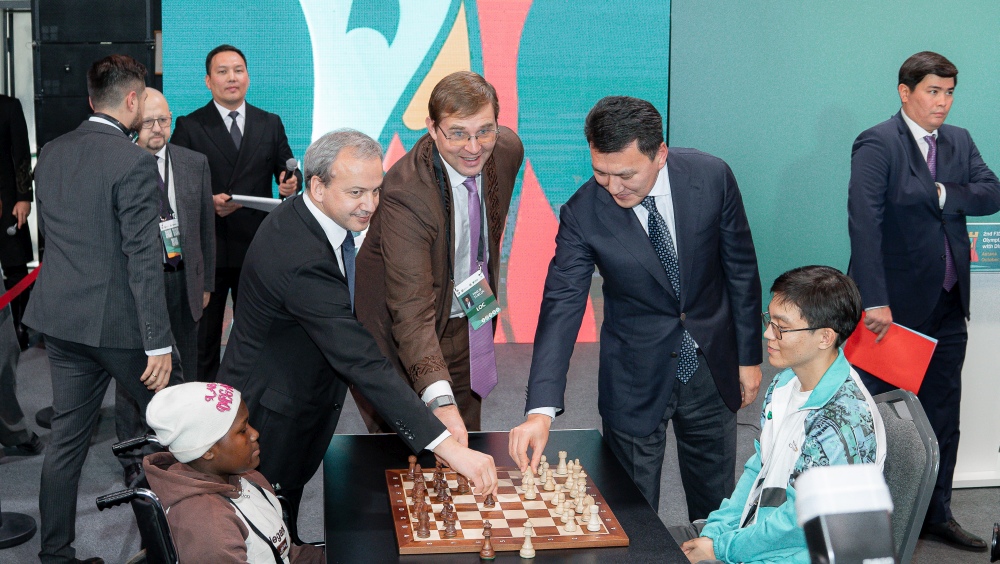
The 2nd FIDE Olympiad for People with Disabilities officially began in Astana, Kazakhstan, bringing together 34 teams from 29 countries. Additionally, eight more nations are represented through the teams of the IPCA (International Physically Disabled Chess Association), IBCA (International Blind Chess Association), and ICCD (International Committee of Silent Chess) — making it a truly global event, with participants from 37 countries in total. The games are hosted at the Paralympic Training Centre, one of the most advanced and accessible sports facilities in Central Asia. With two spacious playing halls, the venue offers perfect and comfortable conditions for all participants, reflecting the Olympiad’s core message of inclusion and equal opportunity. Opening ceremony The opening ceremony was held in a warm and inspiring atmosphere, attended by dignitaries, players, and guests who celebrated the start of this unique event. In the main playing hall, the first ceremonial move was made by Erlan Karin, State Counsellor of the Republic of Kazakhstan; Arkady Dvorkovich, President of FIDE; and Timur Turlov, President of the Kazakhstan Chess Federation. Timur Turlov spoke about the significance of this Olympiad, saying: “Chess is a great symbol of equality and an opportunity to play across the globe. Having differences doesn’t change that – chess unites.” In the second playing hall, the first move was performed by Baglana Musina, President of the Corporate Fund Freedom Shapagat; Oscar Santana Leon, Ambassador of Cuba; and Dmitriy Balandin, Olympic Swimming Champion. FIDE President Arkady Dvorkovich emphasized the importance of inclusivity in chess, noting that this Olympiad stands as a model of equal opportunity: “Chess is inclusive, and we must ensure that everyone has access to top events. The Olympiad for People with Disabilities proves that we are creating those opportunities for all.” He also highlighted FIDE’s broader commitment to social initiatives around the world: “Through projects like Chess for Refugees, Chess for Freedom, and Chess for Children with Autism, we’re showing that chess is truly for everyone. This Olympiad is our flagship event – a reminder that chess is accessible and brings happiness to all who play it.” Voices of the 2nd Olympiad for People with Disabilities The Olympiad is not only about the results – it’s about people and their stories. Every participant brings a story of resilience, courage, and passion for the game. Shantel Panashe Gweshe from Zimbabwe, a social worker and first-time Olympiad participant, shared her experience: “It’s my first time coming all the way from Zimbabwe, participating in this Olympiad. What I have seen here – there’s so much inclusivity for people living with disabilities. When I go back to Zimbabwe, the first thing I’m going to do is empower other people with disabilities to ensure inclusivity and participation.” Meanwhile, Henry Lopez from the Philippines (pictured above), who won a bronze medal at the first Olympiad in Serbia in 2023, reflected on how deeply chess has shaped his life: “Chess for me now is my source of living. I am a national team player in the Philippines, and I receive a stipend from the government. Chess is a universal language – it’s a great equalizer. No matter how old or young you are, or whether you have a disability, you can play. Chess is for everybody.” With determination in his voice, Henry added: “At the previous Olympiad, we got third – this time, frankly speaking, we are aiming for number one.” This is what the FIDE Olympiad for People with Disabilities is truly about – gathering players from all around the world, giving them opportunities to show the power of their minds, and celebrating the unifying strength of chess. Games and results The first round brought exciting games and strong performances by the top teams. Almost all favorites won their matches convincingly. Uzbekistan, India, Venezuela, and FIDE 1 began their campaigns with impressive 4–0 victories. There were, however, two notable ties: North Macedonia held the Czech Republic to a 2–2 draw, and ICCD (International Committee of Silent Chess) also drew with Argentina. You can find all results, pairings, and standings after the first round on Chess-Results: s3.chess-results.com/tnr1276749.aspx?lan=1&art=0&rd=1&SNode=S0 Side events in Astana In addition to the competition, today featured two important milestones for the global chess community. A Memorandum on Declaring 2026 the Year of Chess in Education was signed between FIDE President Arkady Dvorkovich and President of the International School Chess Federation Timur Turlov, who also leads the Kazakhstan Chess Federation. Following the signing, Timur Turlov said: “I hope that it will help a lot of kids to discover themselves better – to train their ability for strategic thinking, to keep concentration, to build clubs, and to make friends across the globe.” FIDE President Arkady Dvorkovich highlighted that this initiative aims to significantly expand chess participation among young people: “Our goal is to double the number of children playing chess worldwide, and our partnership with the International School Chess Federation will help us make that a reality.” Another memorandum was signed between Turkey, Kazakhstan, Uzbekistan, Turkmenistan, and Kyrgyzstan, establishing an Association of Turkic-Speaking Countries. This new initiative aims to bring the work of these nations closer together, strengthening cooperation in chess development and the organization of joint events. A celebration of unity and inclusion The first day of the 2nd FIDE Olympiad for People with Disabilities set the tone for a remarkable event – one that celebrates not only competitive excellence, but also the human values of inclusion, equality, and respect. The Paralympic Training Centre in Astana has become a home for players from all corners of the world, united by one timeless truth: chess is for everyone. Official website: dis-olympiad2025.fide.com/
Arkady Dvorkovich’s interview for ChessBase India

The FIDE President discussed the Total Chess World Championship Tour, changes to the 400-point Rating rule, the success of the Year of Social Chess, and the state of FIDE. In an online interview with Sagar Shah of ChessBase India, one of the leading chess media outlets, Arkady Dvorkovich highlighted the importance and the role of the new Total Chess World Championship Tour which was recently announced by FIDE. “FIDE has for a long time been thinking about a new format where we can combine different time controls and adjust to the reality of the faster, digital world, but also reflect the existing high interest in classical and blitz chess. We were happy that Norway Chess came up with the initiative to do something like that. It was the right time, the right moment and the right partners. From the very beginning, we had a clear understanding that we can do it only together,” Dvorkovich said. “We do believe this [project] will bring many new spectators and excitement to the players. Most of the top players believe that it is a very interesting format”. Dvorkovich emphasized FIDE’s position that the classical world championship title “is the most important one… but we believe it is the right time to increase the importance of other formats as well”. The new partnership with Norway Chess is a long-term commitment, based on an eight-year contract with an option to renew for an extended period. “I do believe that – based on the concept that we have – it will be at least equally important as Rapid and Blitz, but potentially much bigger,” Dvorkovich added. On the subject of how the rising number of global chess events in a year has an impact on the annual chess calendar, Dvorkovich said that “in an ideal world, we should have agreements with all top events and – like in tennis – put them in a universal tour where every top event will count, but that’s not easy”. The FIDE President expressed a commitment to working with all partners to achieve a future ‘universal tour,’ similar to tennis, where every top event counts, and where a consensus on time control, aligned with the exciting World Cup format, can be reached. Chess in India “India is the motherland of chess, and everyone respects that. We always have at least one major event every year in India,” said Dvorkovich. When asked about the forthcoming World Cup in Goa – one of the longest events planned for this year, lasting nearly four weeks – the President of FIDE expressed his confidence in the All India Chess Federation and the local organisers, saying that progress [on organising this event] is made every day, adding that FIDE has “trust that everything will be fine”. Another major event towards the end of the year is the Tech Mahindra Global Chess League, which FIDE has a stake in. The event will take place in Mumbai in December. The media-friendly concept of the event has put a new spotlight on chess globally, and Dvorkovich expressed his support for the project, noting that it has become commercially sustainable. Photo: Aditya Sur Roy “I think it’s good that two big events are in India [this year]. Doha is also not far away, so it’s convenient [for those players participating in the World Rapid and Blitz at the end of the year]”. A more competitive approach to wild cards In recent years, FIDE has refined its approach to the use of ‘wild cards‘ – special invites that ensure the participation of both talented up-and-coming players and chess legends in top world events. “We always give chances to very young players because we can see their potential. This way, we are showing we are aware of the fast growth of these players. Also, we have it as a rule that we give wild cards to veterans”. The FIDE President noted that the approach to issuing the special invites has evolved. “We started using a competitive approach for wild cards, telling players that they can play against each other” to determine who will qualify. No “farming of rating” to be allowed Speaking about the recent targeted amendments to the FIDE Rating Regulations, Dvorkovich said that the organisation does “not allow farming of rating” by top players playing against significantly lower-rated opponents. Acknowledging that such a matchup is possible in an open event or an Olympiad, Dvorkovich noted that “many games like that” clearly suggest “it’s artificial”. “I think we found a good solution,” said Dvorkovich, noting that the goal of the change was never to prevent any player from qualifying for the Candidates. On the subject of FIDE rating in general, including in relation to the question of ratings of inactive players, Dvorkovich acknowledged that it is an “extremely difficult” complex system, with opinion polls and discussions showing a deep split in the chess community about any changes. “When we ask players, normally there is no consensus at all. But most players are not happy about keeping inactive ratings in the system. People do want ratings to reflect the real strength of players,” Dvorkovich said. From the Year of Social Chess to the Year of Chess in Education The interview also touched on the social initiatives, which have become one of the key tools in FIDE’s approach to engage the broader, non-professional, chess audience. “We showed the whole world that chess is a combination of a professional and a social mission to improve society”. Noting that the Year of Social Chess helped “many governments in the world see the social value of chess,” leading to them starting to provide more support for the game not just on a competitive basis but as a tool for social engagement and levelling. “Here we are not talking about medals but [about] society. From this perspective, the year was successful. It doesn’t mean we will finish those projects on the 31st of December – we will continue them. For next year, there is already an
FIDE and ISCF declare 2026 as the Year of Chess in Education

Following the Year of Social Chess, 2026 will be dedicated to chess in education, underscoring FIDE’s focus on integrating chess into the global school curricula worldwide. On 20 October, at NGS School in Astana, FIDE and the International School Chess Federation (ISCF) signed a Memorandum of Cooperation to jointly promote scholastic chess globally. The initiative builds upon the successful 2025 Year of Social Chess and aligns with FIDE President Arkady Dvorkovich’s proposal – made at the recent Smart Moves Summit in Washington, D.C. –to make education one of key focus areas for 2026. Under the agreement – which will guide future cooperation – ISCF will work closely with FIDE to organise a series of international school team tournaments under the name “World Schools Team Championship League 2026” (WSTCL), which will serve as a flagship event of the “Chess in Education 2026” programme. The tournaments will unfold in two stages: Continental Championships for Africa, the Americas, Asia and Europe. Grand Final featuring the winners of respective Continental Championships. The parties expressed their intent to draft an action plan for additional events alongside each WSTCL 2026 tournament, aiming to expand scholastic chess and promote chess as an educational tool. The memorandum was signed by FIDE President Arkady Dvorkovich and Timur Turlov, President of the International School Chess Federation. “Education is the foundation for a good and successful life, and chess is a proven and powerful tool to underpin that goal,” said FIDE President Arkady Dvorkovich. “Investment in chess education, youth and school events has been one of the goals of my team since taking the helm of FIDE. I am delighted that after a successful Year of Social Chess, we are continuing with the Year of Chess in Education, launching new projects and initiatives and getting more schools and educational facilities involved in chess.” The memorandum will serve as a foundation for implementing initiatives aimed at developing school chess and popularising intellectual sports in school education. “Inclusion and equal opportunities have always been close to my heart. With the backing of our Freedom Shapagat Foundation, we have consistently supported social initiatives that help children and promote a more compassionate and humane society. That is why hosting these initiatives within the framework of the FIDE Olympiad for People with Disabilities feels especially meaningful,” said Timur Turlov. “It is only natural that in this year — declared by FIDE as the Year of Social Chess — together with the International School Chess Federation, we take the next step and announce 2026 as the Year of Chess in Education. From early childhood, it is through learning that we build a society grounded in respect, empathy, and support for every child,” he added. The “Chess in Education 2026” initiative marks a major milestone in FIDE’s global efforts to promote chess as a valuable component of learning, supporting both cognitive and social development among students worldwide. About ISCF: The International School Chess Federation (ISCF) is dedicated to the global promotion and integration of chess within the educational system globally. Launched in September 2024 as a FIDE-affiliated organization, the ISCF operates as a main institutional platform for advancing chess in schools — developing educational programs, supporting national federations, and fostering cognitive and social growth among students through the game of chess.
5th FIDE Intercontinental Online Chess Championship for Prisoners: India, El Salvador and Iran claim titles
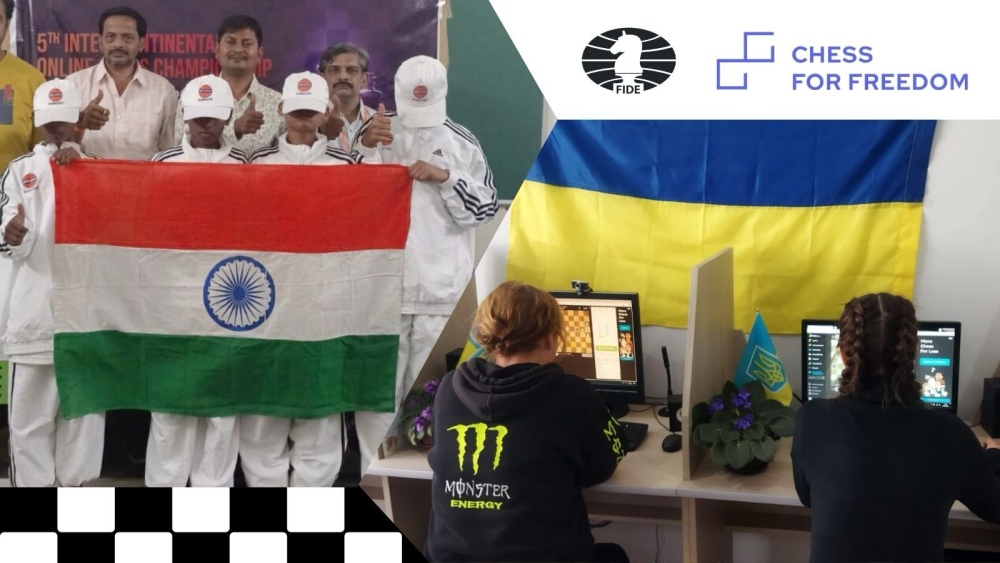
India won the male competition after a decisive Armageddon game in a tense final match against El Salvador. The women’s tournament was also closely contested, with El Salvador taking the title after beating Ukraine. The Youth competition title went to the all-female team from Iran, which defeated England. The fifth FIDE Intercontinental Online Chess Championship for prisoners concluded after three days of play with winners crowned in the Male, Women’s and Youth categories. The event unfolded across three stages: group qualifiers (14 October), the championship stage (day two), and the finals, which concluded today. In most international chess competitions – from the Olympiad to continental team championships – players typically leave the board once their own game concludes, retreating to analyse their moves or decompress in private while their teammates fight on. But in the prison chess championship, the atmosphere was strikingly different. Here, players lingered long after finishing, following the remaining boards to offer quiet encouragement and moral support to their teammates. Even through prison facility cameras, the sense of solidarity was palpable – a team spirit born not just of competition, but of shared circumstance. In the Men’s final, India faced El Salvador in a tightly contested four-match series. El Salvador started with a 3:1 win only to be defeated by India with 3:1 in the second match. In round three, India scored a narrow victory 2.5:1.5 but in the final round they were completely dominated by El Salvador with 3:1. The results took them to tiebreaks: in the Armageddon match, Indian top-board was better, securing the crown for the team. Mongolia took third place after beating Serbia 3 in the Blitz playoffs. El Salvador also stood out in the Women’s competition, where their team beat Ukraine. Despite the narrow loss in the first match (2.5:1.5), El Salvador stormed back winning all three remaining matches with 3:1. El Salvador also had a team in the fight for third place (El Salvador 2) in the Women’s event, but they fell to Mongolia. The Youth competition saw England and Iran face off in the finals. The all-female Iranian youth team defeated England 3:1 in the first match, while the second ended in a draw. Third place went to India, defeating Ecuador in both matches 3.5:0.5. Starting with 42 teams in 2021, the fifth edition of the FIDE Intercontinental Online Chess Championship featured 135 teams from 57 countries. After five years, certain countries have shown consistent strong performance, specifically, Mongolia, Serbia and India who have so far (with the exception of Serbia this year) have consistently won a medal. “The true victory lies in the personal transformation that chess has unlocked” In his congratulatory message to the winners, FIDE President Arkady Dvorkovich stated that “although today we recognise those who have come up first, every single player who participated is a winner”. The FIDE President went on to say that “the true winners of this event were not determined by the final round result or the scoresheet. In fact, the true victory lies in the personal transformation that chess has unlocked, and I hope you will see it through”. The successful conclusion of the FIDE Intercontinental Championship for Prisoners is a notable highlight of the Year of Social Chess which celebrated the game’s transformative power, providing the means for self-improvement and change. “I hope chess will continue to be a loyal part of your life, guiding you and making you happy, challenging you to move forward and improve. The games are over, but the future is wide open. Make your next move really count, make it your best move”, Dvorkovich concluded. Written by Milan Dinic About the Chess for Freedom project The Chess for Freedom project officially started in May 2021 with an online conference and an exhibition tournament with four participating countries. In October of the same year, the first International Online Chess Championship for Prisoners was held, growing each year and attracting more teams and countries. The goal of the project is to use chess as a tool for education, personal development and change, helping inmates prepare for life after release from prison. In prisons, just as in broader society, the impact of sport and games can be far-reaching. The experiences demonstrate that chess improves behaviour, helping to reduce inmate violence and developing communication skills, while promoting positive use of leisure time. Chess also drastically improves the decision-making capabilities of a group of people that, very often due to the lack of opportunities and access to proper education, has ended up in jail after making a wrong choice in life. The project is closely coordinated with the Chess For Freedom Network which operates under the auspices of the FIDE Social Commission. To get involved or get more information about the project, please visit: chessforfreedom.fide.com.
FIDE World Youth U14, U16 & U18 Championships 2025 conclude with celebration and pride
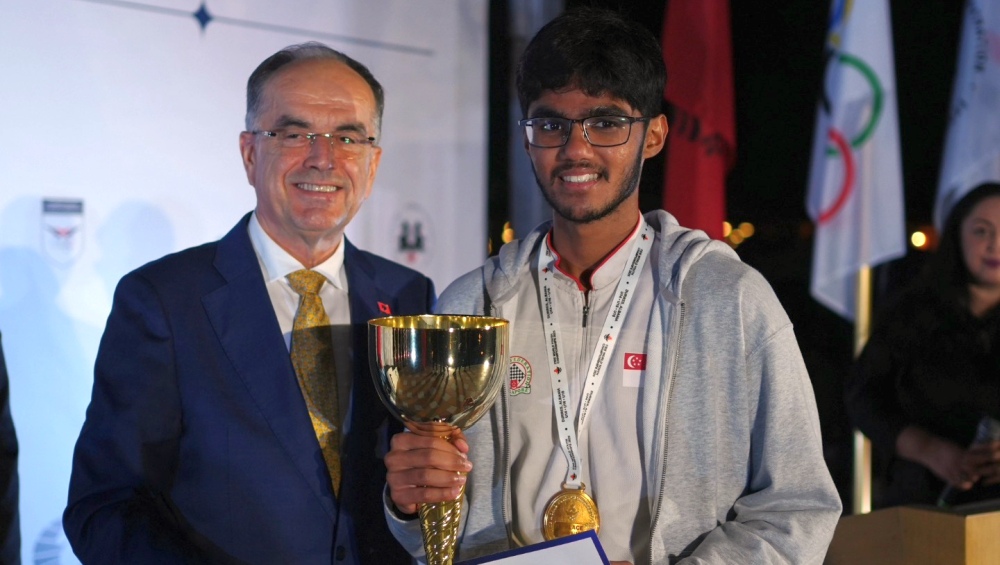
The curtains have closed on the FIDE World Youth U14, U16 & U18 Championships 2025, marking the end of two unforgettable weeks of competition, friendship, and global unity through chess. Hosted at the Grand Blue Fafa Resort in Durrës, Albania, the championship brought together 720 players from around 90 federations — the world’s most promising young talents — in an atmosphere of excellence and fair play. After 11 intense rounds, the world’s best young talents were crowned in six categories: U18 Open GM Siddharth Jagadeesh (Singapore) IM Artiom Stribuk (FIDE) IM Adarsh Uppala Sriram (India)U18 Girls WIM Gao Muziyan (China) WIM Manon Schippke (France) Valeria Kleymenova (FIDE)U16 Open GM Edgar Mamedov (Kazakhstan) IM Sauat Nurgaliyev (Kazakhstan) FM Alexandr Volodin (FIDE)U16 Girls WFM Diana Khafizova (FIDE) WFM Marija Kuznecova (Latvia) Chen Yining (China) U14 Open FM Mark Smirnov (Kazakhstan) IM Haochen Jiang (China) CM Artem Lebedev (FIDE)U14 Girls WFM Polina Smirnova (FIDE) Rukiya Olimova (Uzbekistan) Jamaicah Yap Mendoza (Philippines) Each winner received their medals from distinguished guests, underlining the spirit of unity and respect that defined the championship. Applause filled the hall as the young players stood proudly, representing not only their countries but also the future of chess worldwide. The closing ceremony The closing ceremony, held on October 15, was a fitting celebration of talent and achievement, blending official addresses, cultural performances, and heartfelt moments of recognition. The evening began with the National Anthem of the Republic of Albania and the FIDE Anthem, performed by the Durrës City Band, setting a tone of dignity and international solidarity. Opening the ceremony, moderator Kozeta Kurti welcomed guests and participants, expressing gratitude to everyone who made the championship possible — from organizers and arbiters to volunteers and partners. She highlighted the event as a “celebration of friendship, respect, and shared values that connect us all through sport and intellect.” Erald Dervishi, President of the Albanian Chess Federation (FSHSH) and Grandmaster, addressed the audience with pride, emphasizing Albania’s growing role in the international chess scene: “Under the guidance of FIDE, and with the support of our partners, we have successfully hosted another world-class event that brings together young champions from around the globe. This tournament is a testament to what passion, teamwork, and vision can achieve.” The ceremony also honored the presence of distinguished guests: Erald Dervishi – President of the Albanian Chess Federation (FSHSH) Bajram Begaj – President of the Republic of Albania Fidel Ylli – President of the National Olympic Committee of Albania (KOKSH) Eduard Shalsi – Honorary President of the Albanian Chess Federation (FSHSH) Gentian Kallmi – Deputy Mayor of Durrës Ozgur Solakoglu – Technical Director of the Event / Representative of the World Chess Federation (FIDE) Fatos Çerenishti – President of FAFA Group Their attendance symbolized the recognition of chess as not only a sport, but also a tool for education, discipline, and cultural diplomacy. Honoring excellence and announcing a new partnership Before the medal presentations, the Albanian Chess Federation proudly announced a new partnership with the Kasparov Chess Foundation Academy (KCF Academy). As part of this collaboration, full scholarships will be awarded to all category champions, granting access to a 164-hour online program featuring lessons from some of the greatest chess minds — including Garry Kasparov, Fabiano Caruana, Levon Aronian, and Veselin Topalov. The announcement received enthusiastic applause, signaling a powerful continuation of the champions’ educational journey beyond the tournament. A cultural celebration The evening featured vibrant performances, including a Traditional Dance from the Mirdita region by the National Folk Ensemble and a Folk Dance from Central Albania performed by the Durrës Folk Group — celebrating Albania’s cultural richness and warm hospitality. A memorable farewell In the closing remarks, participants were thanked once more for their dedication and sportsmanship. Moderator Kozeta Kurti concluded with an uplifting note: “This concludes the Closing Ceremony of the FIDE World Youth U14, U16 & U18 Championships 2025. We congratulate all participants and champions and invite you to enjoy one last performance. Have a good night — and see you at the next championship.” A legacy for the future The 2025 FIDE World Youth U14, U16 & U18 Championships in Durrës leave behind more than medals — they mark a milestone for Albania as a growing hub for international sports and youth development. With the joint efforts of FIDE, FSHSH, KOKSH, Durrë Municipality, Ministry of Culture, Ministry of Education and Sports and local partners, the event showcased how chess continues to inspire minds and connect communities worldwide. Photos: Vlera Zenjullahi and Dardan Bajrami Official website: fideworldyouth.achf.org.al/
2nd Chess Olympiad for People with Disabilities: Chess dissolves boundaries
From October 19 to 26, 2025, the city of Astana, Kazakhstan, will host the 2nd Chess Olympiad for People with Disabilities – a landmark event that celebrating inclusion, unity, and the power of the human mind. Organized by FIDE and hosted by the Kazakhstan Chess Federation, this Olympiad will bring together 34 teams from around the world, featuring players with visual, hearing, and physical impairments. While each participant may face unique challenges in daily life, at the chessboard they meet as equals—united by a shared passion for the game. The Paralympic Training Centre in Astana, one of the most advanced accessible sports venues in Central Asia, will serve as the stage for this inspiring event. The city of Astana is a perfect location – a modern and welcoming capital that has already hosted major chess events, including the 2023 FIDE World Chess Championship Match between Ding Liren and Ian Nepomniachtchi and the 2024 FIDE World Rapid & Blitz Team Championship. Photo: Anna Shtourman The Year of Social Chess FIDE has declared 2025 the Year of Social Chess, a global initiative dedicated to highlighting chess’s positive impact on society. Throughout the year, FIDE supports projects that make the game more accessible, inclusive, and transformative. The 2nd Chess Olympiad for People with Disabilities stands as one of the initiative’s flagship events—demonstrating how chess connects people of all abilities and backgrounds. From online beginnings to global growth The Chess Olympiad for People with Disabilities has a short but meaningful history. It began in 2020 with the first Online Olympiad for People with Disabilities, which brought together 61 teams from 45 countries and nearly 400 players. Held in conjunction with the United Nations International Day of Persons with Disabilities, the event saw Poland claim gold. Photo: Mark Livshitz In 2023, the dream of meeting over-the-board became reality with the 1st Chess Olympiad for People with Disabilities in Belgrade, Serbia. 23 from all continents participated, and Poland once again finished first, followed by the IPCA (International Physically Disabled Chess Association) team and the Philippines. Made possible through the collaboration of FIDE and the international organizations IBCA (International Braille Chess Association), ICCD (International Chess Committee of the Deaf), and IPCA, the event marked a historic step toward a more inclusive global chess community. Photo: Mark Livshitz Now, in 2025, the Olympiad arrives in Astana with a record 34 teams—a testament to the rapid global growth of this movement. Teams and favorites The field in Astana will be stronger than ever. The Polish team, with an impressive average rating of 2296, enters as the top seed and favorite to win their third consecutive title. Other strong contenders include Israel (2189), FIDE 1 (2176), and Cuba (2164). Teams from the USA, Philippines, Hungary, Czech Republic, Serbia, and many others will also be fighting for top places. This year’s lineup spans every continent – from Argentina to Uzbekistan, Egypt, Bangladesh, Zambia, and Kenya –showcasing chess’ unique power to unite people across cultures and abilities. Format and schedule The Olympiad is a team event: each team consisting of four players and one captain or reserve player. While there is no fixed women’s board, at least one player of each gender must compete in every round. The tournament will be played using the Swiss system, over six rounds. Time control: 90 minutes for the first 40 moves, followed by 30 minutes for the rest of the game, with a 30-second increment per move starting from move one. The default time is 15 minutes. The opening ceremony will take place on Monday, October 20, at 14:00 local time, right before the first round begins at 15:00. Rounds will be played daily at 3 PM local time, and the final, sixth round will be held on Saturday, October 25, at 11 AM. Global network of inclusion The three international organizations – the International Braille Chess Association (IBCA), International Chess Committee of the Deaf (ICCD), and International Physically Disabled Chess Association (IPCA) – have been instrumentla in promoting chess for people with disabilities. Their work, together with FIDE’s leadership, ensures that every player, regardless of physical ability, can participate in international events, connect with others, and enjoy the beauty of chess. The Chess Olympiad for People with Disabilities provides a dedicated platform for these athletes to compete, connect, and inspire one another. More than a tournament Beyond medals and standings, this Olympiad is about connection, courage, and opportunity. It affirms that true strength lies not in physical ability, but in creativity, determination, and the will to overcome challenges. In Astana 2025, the message will be clear: Chess dissolves boundaries – and the power of the mind knows no limits. Written by Angelika Valkova Official website: dis-olympiad2025.fide.com/
Champions crowned at Asian Senior Chess Championships 2025
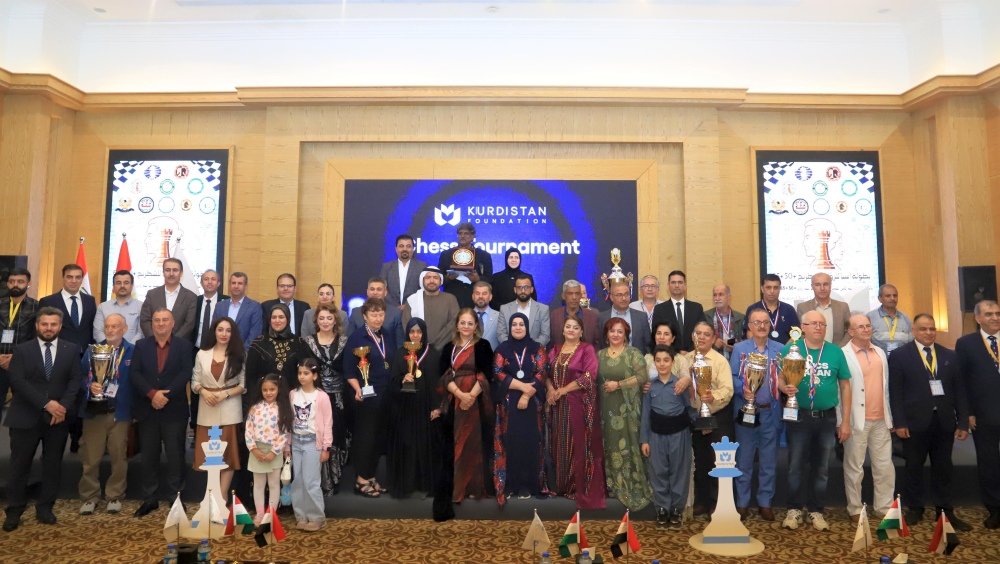
The Asian Senior Chess Championships 2025, held in the 50+ and 65+ categories, took place in Erbil, Iraq, from October 4–14. The competitions—nine-round Swiss-system tournaments with classical time control—were organized by the Iraq Chess Federation under the auspices of the Asian Chess Federation and FIDE. Over-50 category: Aziz Umarbekov crowned champion In the Over-50 category, Aziz Umarbekov of Kyrgyzstan captured gold with a commanding 7.5/9, demonstrating remarkable consistency, composure, and tactical precision throughout the tournament. Close behind, IM Hussein Ali Hussein Al-Ali of Iraq—the hometown favorite from Erbil—delighted local supporters with his resilient play, securing silver with 7 points. GM Ramil Hasangatin (FIDE), who led early in the event, suffered a loss in the penultimate round but finished strongly to claim bronze with 6.5 points. CM Marwan Aboudi of Jordan and CM Joseph Ebenezer of India both scored 6 points, rounding out the top five in a tightly contested field. Adding to the host nation’s success, Iraqi players swept the Best Woman awards in the Over-50 category. Iman Mahdi Ahmed earned top honors with 4.5 points, followed by WCM Jwan Jamal Mohammed Ameen in second place (4 points) and Dilpak Ali Hamzah in third (3.5 points). Over-65 category: Marat Primbetov claims gold The Over-65 category witnessed equally fierce competition. Marat Primbetov of Kazakhstan clinched the title on superior tiebreaks with 6.5 points, edging out FM Hossein Aryanejad of Iran, who also scored 6.5 to take silver. Randolph Schain of Cambodia completed the podium with 6 points, while Aliasghar Akhavan Rad of Iran and FM Ali Jalal Adil of Iraq followed closely with 5.5 points each. The Best Woman in this category was WGM Galina Strutinskaia (FIDE), who scored 5 points in a highly competitive field. Blitz Championship The concluding blitz tournament merged both age groups, producing fast-paced excitement as players battled for final honors. Although the event combined the divisions, awards were presented separately by age category. GM Ramil Hasangatin (FIDE) bounced back brilliantly to capture the Blitz Over-50 title with 7.5 points, sharing the top score of WGM Galina Strutinskaia (FIDE) and FM Hossein Aryanejad of Iran. In the Blitz Over-50 section, Hasangatin took gold with 7.5 points. Hussein Ali Hussein Al-Ali of Iraq, maintaining his strong form from the classical event, earned silver, while CM Salih Al-Aqrabi of Yemen secured bronze—both finishing with 6.5 points after an intense race for the podium. The Blitz Over-65 section brought another success for WGM Galina Strutinskaia, who captured gold with an outstanding performance of 7.5/9. FM Hossein Aryanejad of Iran, a former national champion, earned his second silver medal of the tournament, demonstrating impressive consistency across both formats. CM Abdul Kareem Kashush from Iraq completed the podium with 6 points, proudly securing bronze for the host nation. In the Best Women blitz category, Iraqi players continued to shine: Dilpak Ali Hamzah won gold with 4 points, followed by WCM Jwan Jamal Mohammed Ameen (3.5 points) and Bayan Jamal Mohammed Ameen (3 points). Special recognition On the sidelines of the final rounds, Hisham Al Taher (second from left), General Secretary of the Asian Chess Federation, accompanied by Dhafer Madhloom (left), President of the Asian Zone 3.1 and the Iraqi Chess Federation, and Dr. Dlzar Hama Salih Qadir (right), President of the Khanzad Chess Club, paid a courtesy visit to Dr. Rebar Ahmed, Minister of Interior of the Kurdistan Region. During the meeting, Hisham Al Taher presented the Asian Personality of the Year award to Dr. Rebar Ahmed, in recognition of the late Barzani’s selection as Asia’s Personality of the Year, acknowledging his enduring legacy and support for regional development and culture, including the promotion of chess in Kurdistan and Iraq. A historic 1974 photo shows the late Kurdish leader Mustafa Barzani playing chess with American journalist Dana Adam Schmidt—a moment that inspired the Asian Chess Federation’s 2025 tribute. As the curtain fell on the Asian Senior Chess Championships 2025, Erbil reaffirmed its place as one of Asia’s most welcoming and vibrant chess destinations — where legends of the game continue to write new chapters in the timeless story of chess. For full results, visit chess-results.com Live games at Lichess
Norway Chess Launches New World Championship – Approved by FIDE

The new championship, titled the Total Chess World Championship Tour, will consist of four events each year and crown a combined champion across three disciplines – Fast Classic, Rapid, and Blitz chess. “We expect this to become one of the most prestigious events in the entire chess Calendar,” says Kjell Madland, CEOof Norway Chess and of the new championship. Key Highlights: A brand-new World Championship format in chess, organized by Norway Chess, has been officially approved by the International Chess Federation, FIDE. The Total Chess World Championship Tour will crown an overall champion across three disciplines: Fast Classic, Rapid, and Blitz. The winner will be crowned FIDE World Combined Champion. The tour will consist of four tournaments per year in various global cities. Minimum $2.7M annual prize pool across the Tour ($750k per event for the first three events; $450k for the Finals), plus performance bonuses. A pilot tournament is planned for fall 2026, with the first full championship season in 2027. The initiative comes from the organizers of the prestigious Norway Chess tournament, and the official World Championship status agreement was signed with the International Chess Federation (FIDE) in early October. The vision of the Total Chess World Championship Tour is to find the player who best masters the disciplines Fast Classic, Rapid and Blitz combined. Fast Classic is an innovation of classical chess, featuring a time limit as short as 45 minutes plus a 30-second increment per move. This will receive rating as classical chess. “We are looking for “The Total Chess Player” – a versatile, tactically intelligent, and technically skilled athlete who seamlessly adapts to multiple time controls,” says Kjell Madland. The tour will take place in various cities across the globe and during the final stop an overall winner will be crowned: the official FIDE World Combined Champion. A one-tournament pilot version will kick off during fall 2026, to test the new tour format, with the full official tournament to follow in 2027. “We want to create an entertaining tournament using cutting-edge technology, innovative and engaging TV and streaming broadcasts, and faster formats to open up the sport of chess to a broader audience than ever before. We expect this to become one of the most prestigious events in the entire chess Calendar. We are very honored by the strong trust FIDE has shown in the project. From the very beginning, the federation has been an active and engaged partner — ensuring the project aligns with FIDE’s vision and standards. We want to thank them, and especially the FIDE President, for their close involvement and support,” says Kjell Madland. Prize Pool and Bonuses The Total Chess World Championship Tour features a robust prize pool: a minimum of $750,000 for each of the first three events. The Finals, which crown the FIDE World Combined Champion, will award at least $450,000 to a four-player field. Additional performance bonuses will be available for the highest point total at each tournament and for the top overall score across the Tour. “For the fans” FIDE President Arkady Dvorkovich expresses strong support for the initiative. “We are always looking for ways to innovate and push the boundaries of what chess can be. Although chess is already one of the most popular games in the world, its growth potential is still enormous. With the Total Chess World Championship Tour, we give players a new title to compete for, and the audience a faster tournament format, and we hope the tournament can captivate both the existing chess fans and new audiences,” says FIDE President Arkady Dvorkovich. “We see this as a great addition to the traditional and prestigious World Chess Championship, where we crown the undisputed champion of classic chess. The championships will complement each other and offer even more excitement for the fans. This is not a short-term initiative, but a long-term agreement between FIDE and Norway Chess,” he added. Norway Chess is now inviting potential host cities, investors, and partners to engage in discussions about joining the Total Chess World Championship. For more details on the tournament format, see the separate document (PDF). https://youtu.be/3annvv6988A Facts about Norway Chess: Founded in 2013, Norway Chess has quickly become a fixture on the elite chess calendar. It’s regarded as one of the world’s most prestigious and innovative international chess tournaments. The event helped professionalize chess, treating it as a modern sport and viable commercial product. Norway Chess introduced the world’s first women’s tournament with prize money equal to the open sections. Facts about FIDE: The International Chess Federation (FIDE) is the governing body of the sport of chess, and it regulates all international chess competitions. It was recognized by the International Olympic Committee as a Global Sporting Organization in 1999. Initially founded in 1924 in Paris under the motto “Gens una Sumus” (Latin for “We are one Family”), it was one of the very first International Sports Federations, alongside the governing bodies of the sports of Football, Cricket, Swimming, and Auto Racing. It is now one of the largest, encompassing 201 countries as affiliate members, in the form of National Chess Federations.
Ukraine and Poland crowned European Team Champions 2025
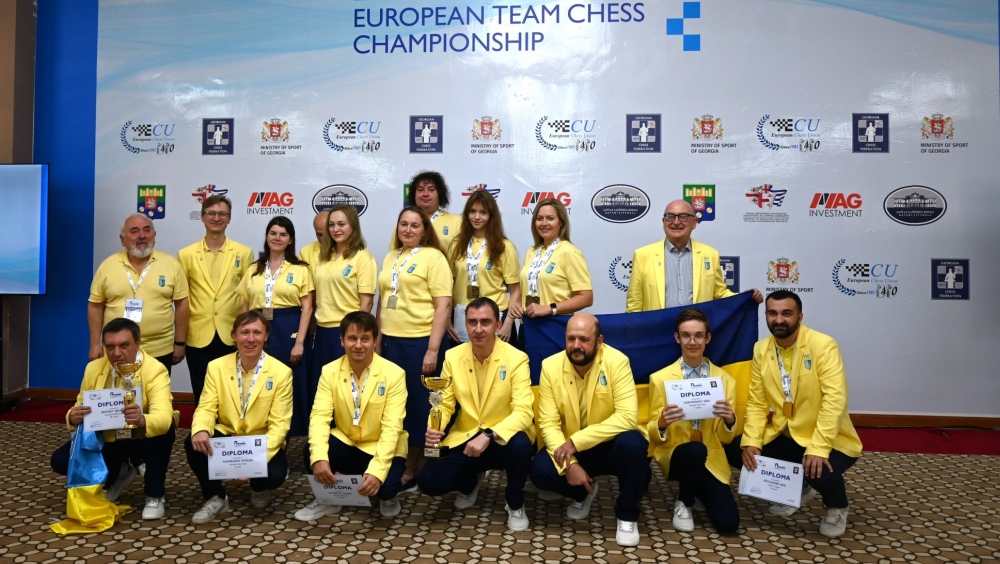
The European Team Chess Championship 2025 concluded on October 14 in Batumi, Georgia. A dramatic final round decided the winners in the open section as Ukraine and Azerbaijan entered it tied for first place. Azerbaijan faced Serbia, while Ukraine took on England. The higher-rated Azerbaijani team were favourites against Serbia, but the Serbians delivered a convincing 3–1 victory. GM Alexey Sarana (SRB, 2661) defeated GM Shakhriyar Mamedyarov (AZE, 2742), GM Aleksandar Indjic (SRB, 2618) outplayed GM Rauf Mamedov (AZE, 2655), and GM Robert Markus (SRB, 2535) overcame GM Aydin Suleymanli (AZE, 2614). GM Eltaj Safarli (AZE, 2630) was the only Azerbaijani to score, defeating GM Velimir Ivic (SRB, 2638). Serbia’s victory secured them a medal. With this result, Ukraine needed only a 2–2 draw against England to clinch the title. They already had the upper hand, as GM Ihor Samunenkov (UKR, 2568) held a decisive advantage against GM Luke McShane (ENG, 2614), while GM Anton Korobov (UKR, 2596) and GM Igor Kovalenko (UKR, 2669) both had extra material in drawish rook endgames. The first-board game between GM Ruslan Ponomariov (UKR, 2633) and GM Nikita Vitiugov (ENG, 2654) had already ended in a draw. Samunenkov eventually converted his advantage into a full point, while the other two games were drawn, allowing Ukraine to clinch the title with 15 match points. Azerbaijan and Serbia tied for second place with 13 match points, but Azerbaijan had superior tiebreaks to claim the silver medal, while Serbia took bronze. Final standings – Open In the women’s section, Poland won the European Women’s Team Chess Championship 2025 after defeating Azerbaijan in the final round. IM Oliwia Kiolbasa (POL, 2388) outplayed IM Gulnar Mammadova (AZE, 2323), while IM Alina Kashlinskaya (POL, 2450) and IM Klaudia Kulon (POL, 2336) drew solid games against IM Khanim Balajayeva (AZE, 2351) and WIM Ayan Allahverdiyeva (AZE, 2220), respectively. IM Aleksandra Maltsevskaya (POL, 2394) also drew her rook endgame with an extra pawn once it became clear that her team had secured the match victory. With a final score of 16 match points, Poland claimed gold. Ukraine — the only team to defeat the champions — took silver with 14 match points after a 2–2 draw against Armenia in the final round. Despite a final-round loss to Bulgaria, Germany secured the bronze medal with 13 match points. Final standings – Women The best individual players by board are: Open Board 1 (Open): GM Richard Rapport; 2.GM Vincent Keymer, 3.GM Anish Giri Board 2 (Open): GM Alexey Sarana; 2.GM Jorden Van Foreest; 3.GM Laurent Fressinet Board 3 (Open): GM Eltaj Safarli; 2.GM Aleksandar Indjic; 3.GM Jones Gawain Maroroa Board 4 (Open):GM Igor Kovalenko; 2.GM Lorenzo Lodici; 3.GM Dimitrios Mastrovasilis Board 5 (Open):GM Ihor Samunenkov; 2.GM Isik Can; 3.GM Frederik Svane Women Board 1 (Women): IM Mai Narva; 2.IM Stavroula Tsolakidou; 3.GM Alexandra Kosteniuk Board 2 (Women): GM Anna Ushenina; 2.IM Sabrina Vega Guiterrez; 3.WGM Hanna Marie Klek Board 3 (Women):IM Oliwia Kiolbasa; 2.IM Lela Javakhishvili; 3.IM Ann Matnadze Bujiashvili Board 4 (Women): 1.GM Bella Khotenashvili; 2.GM Natalia Zhukova; 3.IM Gulnar Mammadova Board 5 (Women): WGM Kateryna Dolzhykova; 2.WFM Bozhena Piddubna; 3.WIM Silvia-Raluca Sgircea The closing ceremony was attended by the ECU President Zurab Azmaiparashvili, Head of Adjarian Autonomous Republic Sport Department Irma Nizharadze, ECU Vice Presidents Malcolm Pein, Gunnar Bjornsson, and Alojzije Jankovic, ECU Commercial Chief Adviser Moshe Slav, President of the Azerbaijan Chess Federation and FIDE Vice President Mahir Mammedov, President of the Georgian Chess Federation and FIDE Special Task Director Akaki Iashvili, and other distinguished guests. Text and photos: European Chess Union Official website: etcc2025.com/
Record number of teams and countries compete in FIDE Intercontinental Online Chess Championship for Prisoners
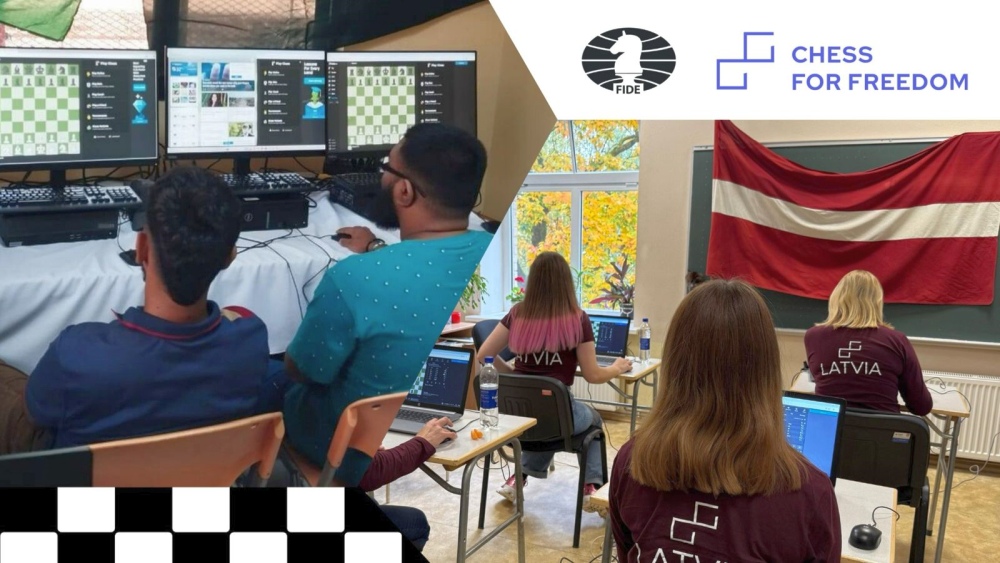
What began as a modest chess programme in a Chicago jail has grown into a worldwide movement. The fifth edition of the FIDE Intercontinental Online Chess Championship for Prisoners has set a new participation record, with 135 teams from 57 countries competing between 14th and 16th October. The first chess programme for inmates and detainees was launched by the Cook County Sheriff’s Office in Chicago in 2012. In 2019 they organised their first international tournament. Two years later, they partnered with FIDE. Since 2021, the International Chess Federation and Cook County Sheriff’s Office have been working together on the “Chess for Freedom” programme, aimed at inmates across the world, helping them learn essential life skills through chess. The central event of the programme is the FIDE International Online Chess Championship, which has over the years attracted teams from nearly 60 countries worldwide. The event is held around the mid-October to coincide with the celebration of the International Day of Education in Prison. Observed on 13th October, it highlights the importance of education in correctional facilities as a fundamental human right and a pillar for rehabilitation and improvement. The fifth edition of the Championship for Prisoners takes place between 14th and 16th October and is one of the final events in the Year of Social Chess, which highlighted the role of chess as a tool for inclusion and empowerment. The competition is split into three stages – the group stage (14th), the championship stage (15th) and the finals (16th). This year set a new record, with 135 teams from 57 countries taking part. The lineup includes 89 teams in the Open section, 26 in the Women’s, and 20 in the Youth. Several countries are making their debut, among them Eswatini, Guyana, Lesotho, Poland, Aruba, and St. Kitts and Nevis. Each team has four players, and the games are played entirely online with 10 minutes for each player plus a five-second increment from move one. “We all make mistakes in life. But as long as we are alive, we can learn” The event was opened by FIDE President Arkady Dvorkovich, who said that playing chess offers a direct path to self-motivation, logical thinking, stress reduction, and foresight of consequences, all “important pillars for a good life”. “We are all human. We all make mistakes in life. But as long as we are alive, we have a chance to learn from them and correct them. It takes a lot of courage to change, and that is why I want to warmly welcome you all on behalf of the entire chess community and thank you for taking part in this event”, said Dvorkovich in his message to the players. Dana Reizniece, the Managing Director and Deputy Chair of the Management Board of FIDE, who has been deeply involved in social chess programmes around the world, explained why the governing body of chess decided to engage in this project. “Chess teaches us focus, resilience and consistency. It sharpens the mind and allows us to channel the energy in a constructive way. Chess also gives hope. Hope that growth is possible, hope that change is possible.” Global coverage This year’s event is accompanied by a live broadcast which started at 6 AM CET and finished around 8 PM CET – nearly 13 hours in total. Apart from live commentary of the games, the broadcast featured special reports, presentations, and live conversations with guests from Australia to America who spoke about their experiences with the Chess for Freedom project. The life of a chess player in prison: Experiences from Australia to U.S. Tom Noiprasit works as an Education Services Coordinator at the Macquarie Correctional Centre, a maximum-security prison for male offenders located in Wellington, in the Orana region of western New South Wales, Australia. The facility has had a chess team for the past five years. A software engineer and former consultant, Noiprasit moved to teaching before taking a position at the Macquarie Correctional Centre. He noted that a common misconception people have is that education in prison is about “fixing people,” when it is more about helping them develop skills. As Noiprasit explains, the ambitions of people in prison are not much different from those on the outside – they want a job, a career, and they want to have a house to build their own life around. “Our job is not to judge people in prison but to make sure when they come out, they can choose to be what they want to be.” Different prisons have different rules when it comes to using computers for chess or anything else. In most cases, prisons do not allow inmates to use computers. Instead, they are given books and magazines where they can read about chess games and analyse. “It helps them talk to one another and practice social skills as well,” Noiprasit noted. While access to the internet seems like an everyday thing for most people, it’s not the case for those behind bars. “Access to the internet is a big thing and you need to be fully supervising this,” says Noiprasit. Prison officials also have to check very carefully who should be permitted to access the internet. “It could be anything – using the internet could bring up trauma, or an inmate who usually might not do a wrong thing might be tempted to do it.” “Emotional self-regulation and, in particular, the ability to let go are the main skills relevant for inmates when it comes to chess,” Noiprasit concluded. In Singapore, Grandmaster Goh Wei Ming – who visits prisons once a week to play chess – pointed out that “all inmates who participated in the Chess for Freedom programme exhibited much better behaviour, according to prison officers.” “We had a case of a player who had very high blood pressure. When he was playing for the first time, he had a counsellor with him, reminding him to look after his blood pressure. Two years into the programme, he is now much calmer and