

October rating list: Firouzja and Rapport debut in top-10

September of 2021 was marked by several important chess competitions: the Norway Chess, European Individual Championship, European Club Cup and Sharjah Masters. Subsequently, those players who fared well in these events got a substantial rating boost. Although the top echelon remained basically intact as most players preserved their positions in the list, one thing just jumps out at you – Alireza Firouzja and Richard Rapport have debuted in the top-10. The Norway Chess 2021 was an uplift for both – the runner-up Firouzja picked up 16 points and third-finisher Rapport 10. Photo: Lennart Ootes 18-year-old Alireza Firouzja is one of the youngest ever players to reach the top-10, comparable to Garry Kasparov and Magnus Carlsen. In January 1981, 17-year-old Kasparov was #6 in the world, and Carlsen became #5 in March 2008, when he was 17 too. Biggest gains (within top-100 open) Mamedov, Rauf AZE 2673 (+19) Alekseenko, Kirill RUS 2710 (+17) Firouzja, Alireza FRA 2770 (+16) Navara, David CZE 2691 (+15) Eljanov, Pavel UKR 2691 (+11) Salem, A.R. Saleh UAE 2690 (+11) Rapport, Richard HUN 2770 (+10) Shirov, Alexei ESP 2659 (+7) Jumabayev, Rinat KAZ 2658 (+7) Anton Guijarro, David ESP 2658 (+7) Rauf Mamedov (pictured below) did a great job in the European Individual Championship and European Club Cup, picking up 9 and 10 points respectively and climbing 31 positions in the rating list. Kirill Alekseenko triumphantly returned into a 2700+ club following his strong performance at the European Club Cup. The same applies to David Navara, who netted 15 rating points and got closer to the 2700 mark. Photo: Thorsteinn Magnusson The 4th Sharjah Masters International Chess Championship 2021 ended in a four-way tie for first place, with Saleh Salem (+11), Pavel Eljanov (+11) and Amin Tababtabaei (+15) considerably increasing their rating. Amin Tababtabaei is on his way to Top-100 Open Photo: Anastasiya Karlovich Speaking of the absolute numbers, we can’t fail to mention some fantastic rating-jumps by the players outside of the Top-100 Open. It is no coincidence that most of them are under 20 – progress is particularly fast at the young age: Yana Zhapova (+103), Miruna-Daria Luhaci (+96), Zala Urh (+76), Nadya Toncheva (+69), Gukesh D (+41), Hans Moke Niemann (to name a few) shoot up in the junior rating lists.
2021 2nd FIDE Online Council Agenda and Commissions reports/proposals

FIDE publishes the Agenda of the 2nd FIDE Online Council Meeting which was held on August 2, 2021. Download Agenda (pdf) Annex 5.2a FIDE Online Chess Regulations Annex 5.2b Summary of Changes Annex 6.1 Global Strategy Commission’s report Annex 6.2.1 Arbiters’ Commission’s report Annex 6.3 Chess in Education Commission’s report Annex 6.4.1 Events Commission’s report Annex 6.5 Commission for the Disabled report Annex 6.6.1 First draft of the Ethics & Disciplinary Code Annex 6.7.1 Fair Play Commission’s report Annex 6.8 Medical Commission’s report Annex 6.9 Planning and Development Commission’s report Annex 6.10.1 Rules Commission’s report Annex 6.10.2 Rules Commission’s proposal Annex 6.11.2 Qualification Commission’s proposal Annex 6.12 Social Commission’s report Annex 6.13 Systems of Pairings and Programs Commission’s report Annex 6.14.1 Technical Commission’s report Annex 6.14.2 Technical Commission’s proposal (draft) Annex 6.15.1 Trainers’ Commission’s report Annex 6.15.2 Trainers’ Commission’s proposal Annex 6.16.1 Commission for Women’s Chess report Annex 6.17.1 Historical Committee’s report
Judit Polgar’s Global Chess Festival brings pioneers of education to the table
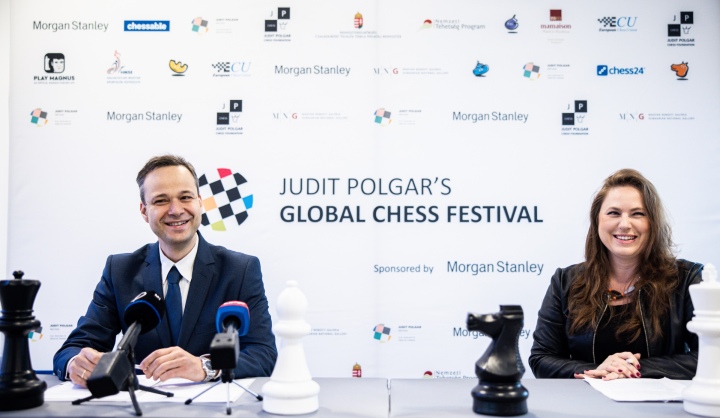
How can chess revolutionize education? How can self-esteem issues be tackled by this ancient game? What does our pulse say about our chess game? Thinkers from all around the globe will get together to answer these questions on the 9th of October, at Judit Polgar’s Global Chess Festival, which – for the first time – will be available in a hybrid form. At the press conference held on Thursday, new, world-famous presenters were announced, like Ernő Rubik, inventor of Rubik’s Cube and Dana Rezniece-Ozola, managing director of FIDE, Ms. Mariya Gabriel, patron of the Global Chess Festival and European Commissioner for Innovation, Research, Culture, Education and Youth also sent a video message to show her support towards chess education. Norbert Fogarasi, head of the Budapest office and Managing Director at Morgan Stanley, the event’s primary sponsor for the past three years, spoke about the connection between chess and STEM fields. He also discussed the importance of STEM skills within Morgan Stanley and financial services broadly. In a few days, the Global Chess Festival will conquer the walls of the Hungarian National Gallery, where the main topics will be creativity and innovation. Visitors will be presented with revolutionary ideas and initiatives inspired by chess in the fields of science, education, art and business. Is creativity a divine spark or a teachable method? How do pulse and blood pressure influence the performance of chess players? Visitors of Judit Polgar’s Global Chess Festival will find out with the help of this year’s presenters both on and offline. This year the Global Chess Festival hosts the Educational Chess Summit conference, where presenters prove: chess does deserve a place in classrooms as a profound way of skill development. Lorena Garcia, an educational researcher, will prove to the audience that chess can improve self-esteem and deters anxiety. Rita Atkins, British International Master, will show practical examples of incorporating chess in mathematics classes; Jesper Berger, international chess coach, will debunk a widespread theory: chess only develops children with exceptional capabilities; chess can be surprisingly beneficial for children suffering from learning disabilities. Fernando Moreno, a Spanish psychologist, is a recurring presenter at the Global Chess Festival – this time, he will discuss the “life lessons” chess can teach us. Furthermore, a screening of Judit Polgar’s and Ernő Rubik’s – inventor of Rubik’s Cube – discussion will be presented, where a whole new idea of education systems based on creative energies will emerge. The conference also welcomes Leontxo García, Spanish chess journalist, as co-host of the Chess Festival alongside Judit Polgar, but Dana Reizniece-Ozola managing director of FIDE, Bachar Kouatly, president of FIDE and Mariya Gabriel, European Commissioner for Innovation, Research, Culture, Education and Youth will also speak. “It has been a dream of mine to create a forum that makes a home for international discussions surrounding chess and education, a forum which showcases how the game can be incorporated into school subjects and brings kids’ strengths to the surface. The Educational Chess Summit is also a cultural trip: it shows how colourful the way we think about this around the world” – said Judit Polgar during her speech at the press conference. She also claims that “this year’s Chess Festival will be of historical significance, as Budapest never hosted a conference like the Educational Chess Summit before” – Judit Polgar told. Introducing young people to chess is also an important goal for Morgan Stanley Budapest, which has been sponsoring the Global Chess Festival for three years. With its close connection to STEM, chess provides an excellent foundation in many valuable soft skills, including strategic planning, problem-solving, decision-making and rational thinking – very similar to the skills necessary for many of the roles and functions carried out by the firm’s employees in Budapest. ‘In Budapest, we operate an important technology and analytics center within one of the world’s leading investment banks. The majority of our 2,500+ colleagues have a background in STEM fields, as they are closely related to what we do, from mathematical modelling to developing trading algorithms. We are committed to supporting STEM education, an area where chess can play an important role. Morgan Stanley has numerous chess players among its employees, including five international masters and this year, we were pleased to organize the finals of our inter-office chess tournament to coincide with the Global Chess Festival, attracting 400 players from our offices around the world. We are proud to partner with Judit Polgár and the Global Chess Festival again this year”, said Norbert Fogarasi, Head of Morgan Stanley’s Budapest office. Gender equality is also of paramount importance for Morgan Stanley, not only in the workplace but in STEM education as well. In 2018, the Budapest office, in partnership with the Association of Women in Science, launched a mathematics and coding course called Smartiz to help encourage female high school students to consider a career in STEM. Now in its 4th year, the goal of Smartiz is to ensure every talented child who enjoys science, technology, engineering and mathematics can go out and pursue careers in these fields, regardless of their gender. Big Chess Survey: the majority thinks that chess has a positive impact on studies and career A survey has been conducted in order to unravel the connections between chess and STEM-education under the aegis of the Global Chess Festival, with over 650 participants. Those who took part in the survey – mostly students – gave an in-depth insight to chess and its relevance to STEM. Almost half of the participants (45%) claimed that they play chess in order to develop their logic skills, but many opted into chess for the challenge and the competition. Over ⅔ of the participants think that chess develops their strategic thinking capabilities and many think that it has a rather positive impact on their decision-making skills and their abilities to recognize and analyze patterns. It is not surprising that the majority thinks that chess can have a positive impact on their studies and their career. The survey also concluded that for the majority of the participants (72%) there is no difference between the competences of men and women when it comes
2021 FIDE Chess.com Grand Swiss and Women’s Grand Swiss: the lists of players

FIDE is pleased to confirm the list of players who will take part in the 2021 FIDE Chess.com Grand Swiss Tournament and the inaugural Women’s Grand Swiss. Altogether 164 players will be participating. The Grand Swiss tournament will see 114 players from 39 federations take part. The world’s second highest-rated player and former contender for the title of World Champion, American Fabiano Caruana, leads the lineup. He is joined by other leading world heavyweights such as Levon Aronian, Alexander Grischuk, Maxime Vachier-Lagrave, Shakhriyar Mamedyarov, as well as the top-10 newcomers, Richard Rapport and Alireza Firouzja. FIDE has awarded special wild cards to more than 20 players, ensuring that the strongest world juniors and players from all continents take part. The average rating of the players in the Grand Swiss is 2647, making this the strongest Swiss-system chess tournament in the world. This year the inaugural Women’s Grand Swiss will be played as well, bringing together the top 50 women players from 26 federations. The field is led by the former European Women’s Champion and currently ranked fifth women’s player in the world, Kateryna Lagno. She is joined by Mariya Muzychuk, Alexandra Kosteniuk and Nana Dzagnidze, from the women’s top-10 list. The average rating of players in the Women’s tournament is 2417. “FIDE is very pleased that the Grand Swiss – organised together with Chess.com and with the generous support of the Scheinberg family – is returning this year. By bringing together most of the highest-rated players in the world, including the strongest juniors, FIDE and its partners are demonstrating their support for talented, promising players from across the globe. This year we will also have the first-ever Women’s Grand Swiss, which is another step in FIDE’s effort to promote female chess,” said FIDE President Arkady Dvorkovich. “I hope that Riga, the birthplace of the great Mikhail Tal and Aron Nimzowitsch, will warmly welcome the world’s best players and that this will be a great event”, Dvorkovich said. Alan Ormsby, the original organiser of the Grand Swiss before it was moved from the Isle of Man to Riga, welcomed the announcement of the list of players for the forthcoming event. “Unfortunately, covid-related restrictions made it impossible for the Isle of Man to commit to hosting the FIDE Chess.com Grand Swiss and Women’s Grand Swiss, although we left the decision as late as possible. Emil Sutovsky and Dana Reizniece-Ozola are to be commended for finding an alternative host at such short notice that could welcome all 164 players”. “On behalf of IOM International Chess Limited, plus the event’s sponsor, the Scheinberg family, I wish the Riga organisers well in hosting the tournaments”, said Ormsby. Photo: https://www.fold.lv/ The 2021 FIDE Chess.com Grand Swiss Tournament and Women’s Grand Swiss will be held from the 25th of October to the 8th of November at the Hanzas Perons Cultural Centre in Riga, Latvia. Both tournaments are part of the qualifications for the 2021-23 World Championship cycle, with the top two players in the open event qualifying for the 2022 Candidates Tournament and the following six securing spots in the Grand Prix. The winner of the Women’s Grand Swiss will qualify directly for the Women Candidates and four best players will qualify for the next year’s Women’s Grand Prix. Please find the list of players for the 2021 FIDE Chess.com Grand Swiss Tournament and the Women’s Grand Swiss. Regulations for FIDE Chess.com Grand Swiss 2021 (pdf) Regulations for FIDE Chess.com Women Grand Prix Swiss 2021 (pdf) Official website: grandswiss.fide.com For further information and press accreditations to the event, please contact the FIDE Press Office at press@fide.com
Magnus smacks down Hikaru to stretch Tour Finals lead
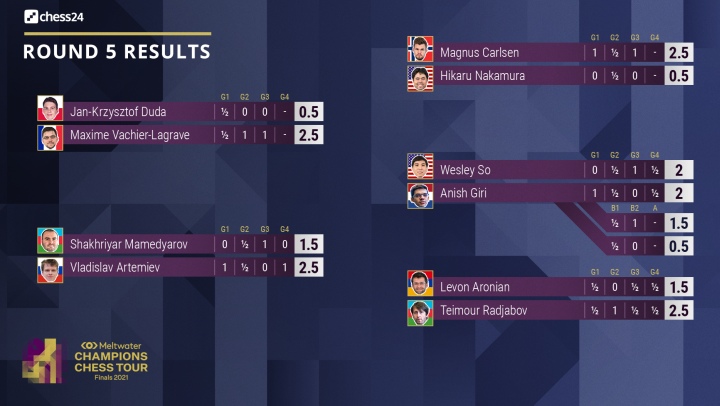
Magnus Carlsen brutally smacked down one of his biggest rivals today to extend his lead in the Meltwater Champions Chess Tour Finals. The World Champion, who suffered a serious hiccup yesterday, got back on track with a dominating performance against the American streamer Hikaru Nakamura. Nakamura has vied with the Norwegian for many years, both on and off the board. He memorably pushed Carlsen right to the limit in last year’s epic Magnus Carlsen Chess Tour final. But in Round 5, he was totally outclassed as Carlsen ambushed him with two masterful wins to end the match with a game spare. In doing so, the champ picked up the maximum three tournament points. Meanwhile, Carlsen’s nearest rival Wesley So could only earn two as his match went to tiebreaks. It means So, who failed to take advantage of Carlsen’s loss yesterday, now has only four rounds left to close the gap. Carlsen controlled all three games and only let Nakamura off the hook briefly in game 2. Magnus, being typically understated, said afterwards: “I thought I played relatively well.” Then in an interview with Norwegian channel TV 2, Carlsen went further, saying Nakamura offered “very, very little resistance”. He added: “With this kind of resistance I got today, it’s not difficult to play well.” In comparison, So had suffered a horrible start as the ever-dangerous Dutchman Anish Giri played a near-perfect game to beat him with the black pieces. After a draw in the second, So managed to hit back and with another draw, the match ended 2-2 and went into overtime. With his tournament hanging by a thread, So finally found a way to beat Giri in a nervy second blitz play-off. It meant a relieved So picked up two points to stay in touching distance of the top. After his shock win against Carlsen yesterday, the Russian Vladislav Artemiev followed it up with a brilliant victory over Azerbaijan’s Shakrhiyar Mamedyarov. Artemiev, the breakout star of the Tour who reached two event finals in just three appearances, struggled at the start of the tournament but is on fire now. France’s number 1 Maxime Vachier-Lagrave was also in fine form as he battered the Polish World Cup winner Jan-Krzysztof Duda 2.5-0.5. In the last match, a refreshed Teimour Radjabov won the re-run of the Airthings Masters final as he dispatched Levon Aronian 3-1 to make it two match wins in a row. Radjabov is out of the running for the Tour Finals title, but the Azeri number 2 still has Carlsen to play and could be a potential banana skin for the champ as he chases the title. The Finals of the 2021 Meltwater Champions Chess Tour sees the world’s best chess players face off across nine rounds of rapid chess from September 25 to October 4. Tune in on www.chess24.com, YouTube or Twitch starting at 17:00 CET each day. For further information, please contact: Leon Watson, PR for Play Magnus Groupleon@chessable.com+44 7786 078 770
CFR Team and Georgia win the group stage
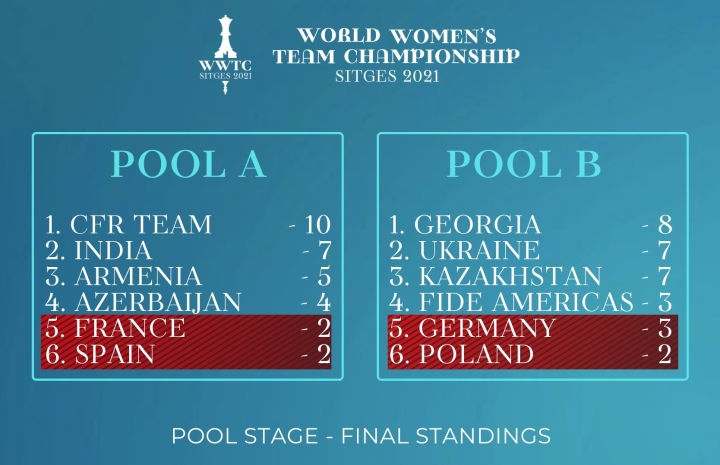
The inability to play under their flag has not affected the morale of the Russian chess players: if anything, it seems to have given them extra motivation. The team headed by Aleksandra Goryachkina, who turned 23 yesterday, bulldozed through the pools stage, scoring five lopsided victories. Moreover, they haven’t lost a single individual game either: from 20 games played so far in the competition, they have won 14 and drew 6. The dominant performance by CFR Team is the main sensation of the event. The Russians will advance to the next stage alongside India, Armenia, and Azerbaijan, while France and Spain were sent packing. In fact, the Azerbaijani had a bit of luck on their side against the host country: they had inferior positions in two of the games, but the Spanish players ruined them and suffered a severe loss that put an end to their aspirations in the tournament. India, second in the group, lost – like everybody else – against CFR Team, but they also conceded a draw against Azerbaijan. Without Humpy in the team, they would need to take up a notch if they are serious about winning the event or even aiming for the silver. Georgia came out on top in pool B, with a much more modest performance compared to the Russians. Three victories and two draws were good enough to take the top spot in the group, one point ahead of Ukraine and Kazakhstan. Nino Batsiashvili, with 4/5, and Lela Javakhishvili, with 3/4, are the top scorers in the Georgian team, while Nataliya Buksa (4/4) (pictured below) and Dinara Saduakassova (4/5)are the best performers among those in the chasing teams. The FIDE Americas team, which englobes players from all over the continent, managed to qualify in the last moment, despite having won only one match. The 1-3 loss they suffered in the last round against Georgia was good enough to leapfrog Germany by half a point in “board points”, which is the main tie-break. The Germans will have to say goodbye to Sitges, just like Poland, much to their keen disappointment. Text: David Llada Photo: Niki Riga and Lourdes Porta Official website: worldwomensteams.fide.com
Rakeem Jeter: “Chess gives an opportunity to improve”
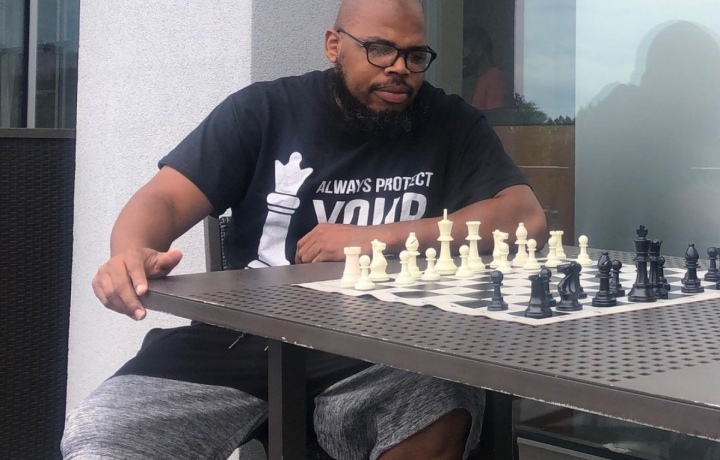
The first Intercontinental Online Chess Championship for Prisoners is scheduled for October 13-14, 2021, on the International Day of Education in Prison. With 31 countries registered, the event is going to be the biggest Chess in Prison tournament ever. Sometimes chess is not something that can change the lives of prisoners; it is something that prevents people from going to prison. In West Philadelphia, Rakeem Jeter, who goes by ‘Rock,’ is using the game of chess to reach at-risk teens offering them free chess coaching. He is sure that chess has real-life benefits that can change the lives of youngsters from communities riddled with crime and a climbing murder rate. FIDE Managing Director Dana Reizniece-Ozola talked to Rakeem to find out how learning the game teaches people to think about the consequences or repercussions of every move made in real life. – Rakeem, tell us your story. You are familiar with the city’s youth facilities and even served prison time yourself. How did you get incarcerated? – My first introduction to the prison system was when I was 15. I was like a typical Philadelphian kid, getting into trouble. I committed some robberies, and I was arrested. In my neighbourhood, that’s what people are doing; a lot of people are introduced to the prison system at an early age. – You played chess before you got into prison. Normally, people consider that the chess players know the relationship between the cause and the consequences, so all this didn’t work? – Actually, I started playing chess when I was getting in trouble. I think I was 14, I was getting in trouble, and they told me to see the counsellors. And the counsellor had a chessboard set in his office. I didn’t want to talk to him, so I was just looking at the chessboard, and one day he said: “You wanna learn to play chess?” I said yes. So he showed me the pieces and how they moved, and I learned really fast. And then I started playing, and it soon became one of my favourite games. I was playing in the neighbourhood, playing wherever I went. – You’re a perfect character of the second season of Netflix series like “The Queen’s Gambit”. Apart from playing in parks, since 2017, you’ve been part of the free Chess Chat Program under a non-profit Organization called Childhood lost. Do you think that your example motivates youngsters you’re playing with? – Yes, I think they are motivated by understanding my personal story and knowing that I came from a place just like theirs. Chess is just a vehicle that I use. I really don’t care whether or not they like the game itself; I just want them to understand that they can be sharper by learning the game of chess. First, they don’t want to play chess; they think that chess is for nerds and uncool. But little by little, I get them engaged using tools that they are familiar with – entertaining them to bring them to the board. – When in prison yourself, you were the one who taught your inmates how to play chess. – Absolutely! That’s where I first got the love for teaching chess. We were locked there, and I wanted to play chess, so naturally, I started teaching others how to play chess so that we could play. And as I was teaching, they were getting better and more competitive, so we had fun playing games. – You also played correspondence games and had at least five games going at any time. – Yes, correspondence chess was like my life language in prison. Regardless of anything happening in the world, I was always in the thick of chess games. I had a little correspondence book, and every game was on its own little board in my book. Correspondence chess always gave me something to look forward to. – How do you teach people to play chess? – I naturally teach them by letting them watch the moves that I make. I say, “I’m not gonna say a word, I’ll just show you the way how they move”. We are doing it with each piece and at the end, I am asking them how this or that piece move. Normally, it takes them 15-20 minutes. But then, when we start to play the game, I realize that they forget how the pieces move, so then I just correct them as they go along. A 45-minute session takes them to learn how the pieces move, and then we start learning different strategies, openings and stuff like that. – It takes 45 minutes for you to teach somebody to play chess, but how much time does it take for chess to teach the essential things to a person playing it? – It takes a lifetime to learn all those things that chess can give you, and I still have to learn them too. That’s why I love the game; it offers infinite possibilities. – What is your chess life about? – I do play tournaments. When I started teaching chess actively, I noticed that my chess game went down. I started to lose more and more. I realized that I am not that competitive as tournament players are. I am rated about 1800 or somewhere around. So I do play tournaments, but I also play on the street. I love bullet chess, as I want to play fast, I don’t want to play long games. I prefer to play with 1-minute time control on a computer or my phone and 2-3 minutes on the streets. – What are the things you want your students to learn from you and from chess? – One thing they notice is how I do myself with the other people. It’s about patience. They see me not losing patience and not losing my cool. I am able to demonstrate that outside of chess, and that gives me credibility and an opportunity to have their hear. I talk about the streets
Team CFR and Georgia hold the lead in Sitges
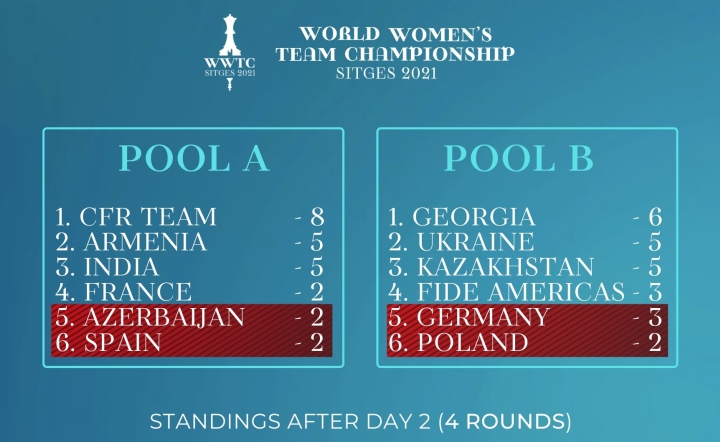
The second day of play brought almost no changes to the standings: the Russian stars, playing under the denomination “CFR Team” due to the WADA sanctions, remain the unchallenged leaders in pool A, followed by Armenia and India. In group B, Georgia tops the standings, being the only team still undefeated in its pool. The leader of the Russian team, Aleksandra Goryachkina, celebrated her 23rd birthday by scoring an important victory over Gunay Mammadzada. The World Championship finalist made chess look easy: on the black side of a Berlin Defense, she opened the a-file, activated her rook, won a pawn, and converted her advantage flawlessly. It was not the best of days for the Azerbaijani players: Mammadova blundered a pawn against Kosteniuk that cost her the game, while Turkan, the youngest of the Mamedjarov clan, allowed a rook lift that ended in an elegant mate attack by Kashlisnkaya. Shuvalova wrapped up the team victory (3½-½) with a draw against Fataliyeva. In the second round of the day, CFR Team defeated a direct rival, India, with victories by Kosteniuk and Lagno. Goryachkina, with a better position, allowed a perpetual check. At the bottom of the table, the host team beat France, which gave Spain some hope to qualify. However, a harsh defeat against Armenia in the next round sent the Spaniards back to the last position in the standings. Only a victory by a wide score margin against Azerbaijan, and a bit of luck, could allow Spain to stay in the competition. In pool B, Georgia had a perfect start of the second day after crushing Germany by 3½-½. Despite the absence of Bela Khotenashvili, who had to withdraw from the team at the last minute, the Georgians seem to be in good shape. They are so far the only team that hasn’t suffered a defeat in group B, having scored two victories and two draws. They ended the day with a 2-2 against Poland, a team that, surprisingly, is the tailender after four rounds, a lacklustre performance for a squad that usually outperforms expectations at team events. The last round of the pools stage, the fifth, will take place on Wednesday, at 15:00. The competition will then move to the knockout playoff. Text: David Llada Photo: Niki Riga Official website: worldwomensteams.fide.com
Carlsen’s lead cut to 4 points but So blows chance to take full advantage
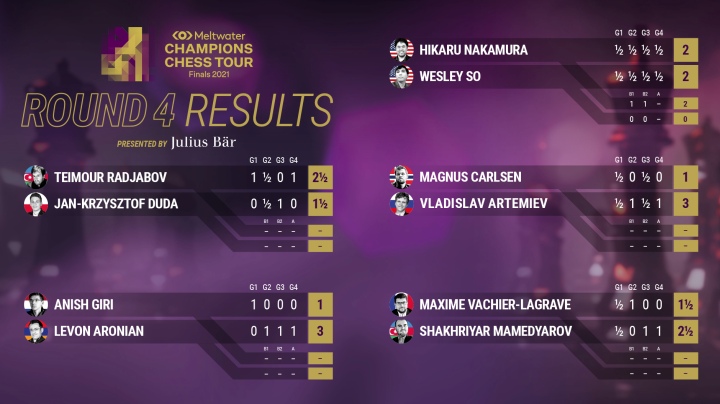
Wesley So blew a chance to get within two points of Magnus Carlsen as both the frontrunners lost in a dramatic day at the Meltwater Champions Chess Tour Finals. The American started off 5 points behind Carlsen on the leaderboard and could have cut that to 2 with a much-needed win over fellow countryman Hikaru Nakamura. But after the pair played out four ultra-safe draws to leave their match hanging on tiebreaks, So then crashed out in the blitz section. Instead of taking the maximum 3, he had to settle for knocking a single point off Carlsen’s lead. It was an opportunity squandered for So who must have been left regretting his tactics in the rapid section of the game. So left the broadcast without being interviewed after the defeat and so wasn’t able to explain. So’s loss came after Norway’s World Champion was downed by Russia’s latest big chess hope Vladislav Artemiev, who beat him twice in a nervy Round 4 match. Artemiev showed nerves of steel as he calmly steered the fourth game in his favour as Carlsen launched increasingly desperate attacks. The Russian had missed a chance of his own to finish off Carlsen in three as he needlessly offered up a draw by repetition while in a strong position. Carlsen, at that point, breathed a sigh of relief. Artemiev, who was the runner-up in both the Goldmoney Asian Rapid and the Aimchess US Rapid, was always going to be a dangerous opponent for the title-chasing Carlsen. Artemiev showed exactly why in the second game as he crashed through to go ahead and set up a difficult evening for Norway’s world number 1. Carlsen, it seemed, played overly risky chess when he could have locked the game down. Artemiev said afterwards that he had tried to play more aggressively against the champion, and his plan worked well. He added: “It’s a little surprise for me that I play in the Finals tournament because before that, I only played in three tournaments.” It was a bad day at the office for the Dutch number 1 Anish Giri, who lost three games in a row to a resurgent Levon Aronian. Shahriyar Mamedyarov, meanwhile, scored his first match-win in the Finals with a 2-5-0.5 victory over the Frenchman Maxime Vachier-Lagrave. The last result was a 2.5-0.5 win for Teimour Radjabov who beat the Pole Jan-Krzysztof Duda. The Finals of the 2021 Meltwater Champions Chess Tour sees the world’s best chess players face off across nine rounds of rapid chess from September 25 to October 4. Tune in on www.chess24.com, YouTube or Twitch starting at 17:00 CET each day. For further information, please contact: Leon Watson, PR for Play Magnus Groupleon@chessable.com+44 7786 078 770
Training program for arbiters of online and hybrid events continues
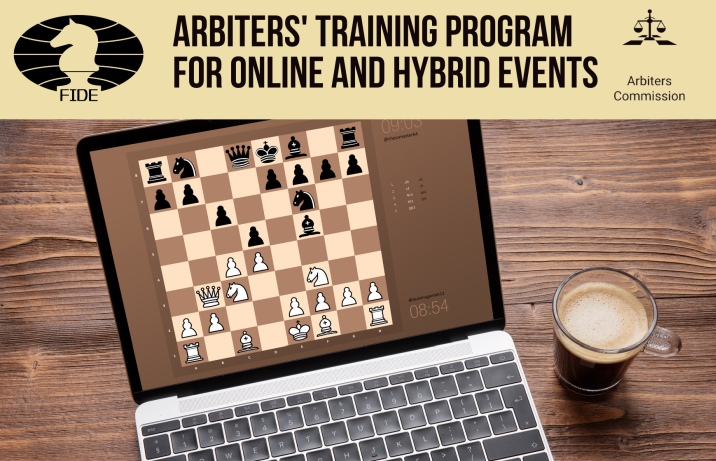
When the COVID-19 pandemic hit the world over a year ago, people learned new ways of living. Online chess tournaments already existing before the pandemic became a new reality. With the number of online and hybrid tournaments increasing, it became obvious that the role of arbiters in such events is not the same as in OTB tournaments. Although playing chess online is no different from playing it in person, being an efficient online arbiter means not only ensuring that laws of chess are followed and acting in the “best interest of the competition”, but having proper knowledge of the online/hybrid chess regulations, supervising such games, knowing online platforms, general concepts, fair play and basic tools to operate. Earlier this year, the FIDE Arbiters’ Commission released a new program to support the development of arbiters in online and hybrid events. Two levels of seminars included an 8-hour basic course for online arbiters and local chief arbiters in hybrid events, and an 8-hour advanced course to cover the roles and duties of chief arbiters in such tournaments. “We wanted to design a course which would not be limited to teach technical aspects about one or two platforms but highlight to the arbiters the questions they would have to ask themselves about the tools and platforms when being involved in an online tournament. The only technical platform studied in detail was Zoom, as this is the most used one and is a must for online supervision”, – says the leader of the project Laurent Freyd, Chairman of the Arbiters’ Commission. – “This training program was a way to position the FIDE Arbiters’ Commission as a real development actor in the chess community! The collaboration with more than 145 federations was excellent, and I wish to continue in that direction with some other innovative programs for arbiters coming soon”. The initial training program was conducted from April to July 2021 and got positive feedback from many participants. “Thank you very much for organising the online/hybrid arbiters’ course. You have done a great job; the new online tool has positively inspired me. In the courses, I found the many suggestions for chief arbiters helpful. I don’t remember to have seen anything similar in the FA/IA education. The professionalism shown here has impressed me positively”, – wrote Walter Kastner, General Secretary of the Austrian Chess Federation. Following the success of the initial courses, the recurring training sessions for arbiters in online and hybrid events are announced. Basic course, opened to any arbiter with a valid FIDE license, is scheduled from October 4-7, 2021, 19:00 to 21:00 CEST, while advanced course, for arbiters who attended the basic course or have proven participation in at least 2 World or Continental online events, is scheduled from 11-14 October 2021, 19:00 to 21:00 CEST. The team of the project include Alex McFarlane, Education Team Leader, Nebojsa Baralic, Secretary of the Arbiters’ Commission and 4 official FIDE lecturers with strong experience of online events – IA Shohreh Bayat, IA Laurent Freyd, IA Aris Marghetis, IA Omar Salama. Entry fees are 30 € for a single course or 50 € if you register to both courses. The deadline for registration and payment to FIDE is September 30th, 2021. Contact and registration: Nebojsa Baralic, FIDE ARB Secretary (secretary.arbiters@fide.com)