

FIDE Women’s World Team Championship: CFR Team and Georgia take the lead
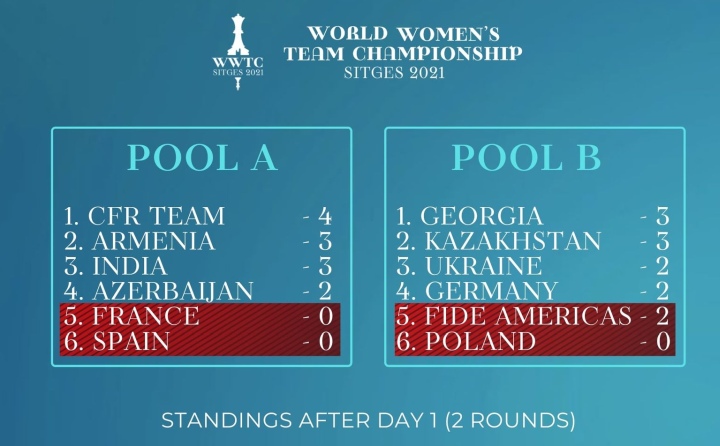
The FIDE Women’s World Team Championship kicked off yesterday in the coastal touristic resort of Sitges, a mere 25 km ride from Barcelona airport. This town is not new to chess: in 1934, it already hosted an international tournament of the first level, with the participation of Tartakower, Spielmann, Lilienthal, and the legendary Spanish champion Ramon Rey Ardid. The local chess club, “Casino Prado”, was founded that very same year and has remained very active during all these decades. In recent times, this tradition found continuation in the Sunway Chess Festival: its 8th edition took place last December, being one of the very first open tournaments being held since the start of the pandemic. The Women’s World Team Championship is played this year under a new format: two pools of six teams each, followed by a knock-out playoff with the eight best teams. The time control has been reduced to 45 minutes + 10 seconds per move, with two games to be played each day. This format allows for the tournament to be played in just 7 days instead of 12, like previous editions, which makes it easier to stage, and more likely to count on the participation of all the top guns. More importantly, it is also expected to raise the interest of the fans, with the knock-out adding some intrigue and excitement. “It is an experimental format, and we are not planning to make it extensive to the Olympiad or other tournaments. After holding this event, and the World Teams one next year, we will carefully weigh the pros and cons. We are aware that breaking is easier than building, so no changes are introduced unless there is strong confidence that they are needed. That was the case with the World Teams, and we hope that the new format will breathe new life into this competition”, said FIDE’s Director General, Emil Sutovsky. One first consequence of these changes became evident during the first day of play for those lucky ones who were present in Sitges: the new format is great for team building. In the break between the two rounds, all the team members gathered together around their respective coaches in the lounge, discussing the strategy for the next match, or simply trying to boost team morale. This created a very nice atmosphere, barely seen on any other chess event before. Team Azerbaijan had a lot to discuss Talking about team morale, the Russian players seem to be highly motivated, and they won their first two matches by storm: 4-0 against Spain and 3½-½ against France. The squad, composed of Kosteniuk, Goryachkina, Lagno, Shuvalova and Kashlinskaya, competes under the denomination “CFR Team”, due to the WADA sanctions against Russia. Athletes from this country cannot wear their flag or use the name “Russia” at any event in the category of World Championship. Fortunately, these restrictions will not apply during the Chess Olympiad next year in Moscow. Different name, but the same formidable team: the Russian ladies only conceded a draw in the game between Aleksandra Goryachkina (who celebrates her birthday today) and Marie Sebag (FRA), and are the clear leaders in their group (A), with two victories and 7½ points. They are followed by India and Armenia, both with one draw and one victory and 4½ board points. Vaishali, for India, and Sargsyan, for Armenia, won both their games on day one. The host team, Spain, will struggle to qualify after having lost both matches. CFR, first, by 4-0, and then India, by 2½-1½. A disappointing start that relegates them to the last position. In group B, no team shows the same dominance as the Russian in the other pool. Georgia and Kazakhstan are on top of the standings with one victory and one draw each. The Georgians lead, with five board points out of eight games. The major surprise was the bad result by the Polish team, that lost both their matches. The winners of a silver medal at the Baku Chess Olympiad 2016 had a bumpy start: one of their top players, Karina Cyfka, had to be replaced at the last minute before travelling to Sitges. Then, they lost both their matches by 1½-2½, first against FIDE Americas and then against Germany. The third round will start today at 15:00 CET. Text: David Llada Photo: Niki Riga Official website: worldwomensteams.fide.com
Carlsen’s lead narrows as pressure rises in Tour Finals
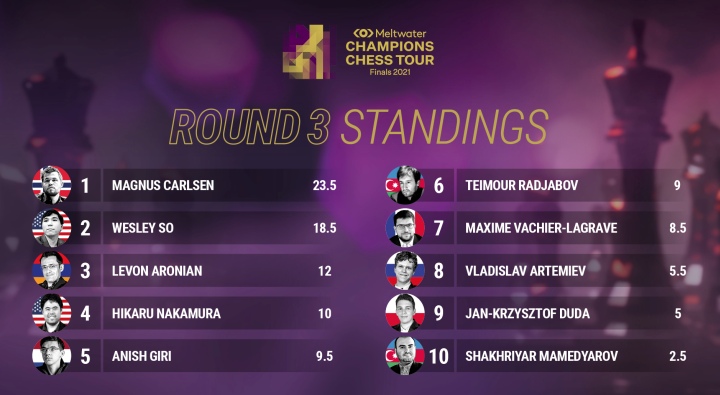
The pressure ramped up in the $300,000 Meltwater Champions Chess Tour Finals today as Magnus Carlsen had a point chipped off his lead. Norway’s World Champion needed a blitz playoff to beat the tricky Frenchman Maxime Vachier-Lagrave, who was dangerous right to the death. Carlsen got pegged back twice in the match and had to settle for two rather than three points. He is, however, one round closer to victory. “I feel very good,” said Carlsen after his win. “ All eyes were also on the leader’s nearest rival, Wesley So, who picked up the maximum in his match against Vladislav Artemiev to keep the pressure up. The American is now 5 points behind Carlsen with six rounds to play – but these two are yet to face each other. So said afterwards that Carlsen had a “huge lead”, but the tournament still had a long way to go. Carlsen had started perfectly with a quickfire win in game 1. Following a draw in game 2, the third was then a game to forget for the champ. Carlsen struggled out of the opening and never recovered. Finding himself in a hopeless position, the 30-year-old was eventually forced to resign. The Frenchman levelled the score. The fourth then ended in a draw as the match headed into tiebreaks. Carlsen crashed through in the first to break MVL’s resistance before a draw in the second handed him the win. America’s blitz king Hikaru Nakamura had a strong return to form as he posted a 3-1 win over Levon Aronian. The loss effectively ends Aronian’s faint hopes of catching Carlsen and So. Meanwhile, Shakrhiyar Mamedyarov and Jan-Krzysztof Duda, two of the tournament’s most exciting players, traded blows in an explosive match that went to tiebreaks. Duda took the first blitz game, and then a draw secured the two-point win. Anish Giri also launched a comeback to level his match 2-2 against the super-solid Teimour Radjabov before turning the screw to win in the tiebreaks. The Finals of the 2021 Meltwater Champions Chess Tour sees the world’s best chess players face off across nine rounds of rapid chess from September 25 to October 4. Tune in on www.chess24.com, YouTube or Twitch starting at 17:00 CET each day. For further information, please contact: Leon Watson, PR for Play Magnus Groupleon@chessable.com+44 7786 078 770
Vojtěch Plát and Karolina Pilsova win Czech Championships
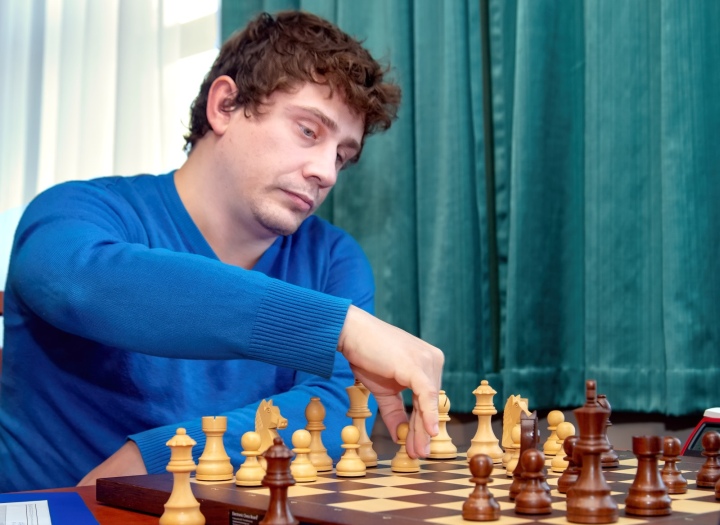
Vojtěch Plát (pictured above) and Karolina Pilsova won the Czech chess championship that took place in Zlin, a city in southeastern Moravia. Both events were ten-player round-robins with classical time control running from September 11-19 (women) and September 17-26 (open). With two top-rated Czech players (David Navara and Viktor Laznicka) missing in the open competition, Vojtěch Plát had a great showing. The 27-year old GM from Prostejov scored 6½ points, earned the second national title in his career and became the only unbeaten participant in the tournament. GMs Štěpán Žilka and Jan Krejčí finished just a half point behind the champion. Žilka who had a slightly better Sonneborn-Berger took silver, whearas Krejčí had to settle for bronze. Final standings open: 1 GM Plat, Vojtech 2536 6½ 2 GM Zilka, Stepan 2570 6 3 GM Krejci, Jan 2539 6 4 GM Babula, Vlastimil 2561 5 5 GM Stocek, Jiri 2584 4½ 6 GM Nguyen Thai Dai Van 2594 4 7 IM Zwardon, Vojtech 2498 4 8 GM Petr, Martin 2508 3½ 9 GM Polak, Tomas 2545 3 10 FM Mladek, Richard 2361 2½ By an odd coincidence, in the women’s tournament, the champion Karolina Pilsova also netted 6½ out of 9 and suffered no defeats either. Karin Nemcova and Magdalena Miturova tied for the second place with the former taking silver thanks to better tiebreaks. Final standings women: 1 WGM Pilsová, Karolína 2280 6½ 2 Němcová, Karin 2137 5½ 3 WIM Miturová, Magdaléna 2219 5½ 4 WGM Petrová, Kristýna 2285 5 5 WIM Richterová, Nataša 2160 5 6 WIM Novosadová, Kristýna 2107 4½ 7 WIM Kaňáková, Natálie 2180 4 8 WGM Kulovaná, Eva 2164 3½ 9 WFM Laurincová, Kristýna 2070 3 10 WGM Sikorová, Olga 2205 2½ Photo: Vladimír Jagr Official website: chess.cz
FIDE and Establishment Labs announce landmark sponsorship agreement for women’s chess

September 27, 2021 – The International Chess Federation (FIDE) announced a landmark partnership agreement with Establishment Labs, a global medical technology company. The partnership is the first-ever corporate sponsorship agreement specifically aimed at supporting women’s chess events. The agreement will continue through 2022, a year that has been designated by FIDE as “The Year of Women in Chess”. Establishment Labs is a global medical technology company dedicated to improving women’s health and wellness, principally in breast aesthetics and reconstruction. The company has developed a comprehensive portfolio of advanced breast products, branded as Motiva®, that include a number of innovative and patented features designed to deliver improved clinical and aesthetic outcomes. Establishment Labs is listed on the NASDAQ exchange under the ticker ESTA and its products are available in over 80 countries around the world. “Establishment Labs has championed women’s health and wellness for over a decade and our partnership with FIDE to promote professional women’s chess is the natural embodiment of all that we stand for as an organization,” said Juan José Chacón Quirós, Founder and CEO of Establishment Labs. “We are proud to support these exceptional women and are continually inspired by their achievements and determination.” Among the events sponsored by Establishment Labs will be the FIDE Women’s Candidates Tournament and the FIDE Women’s World Championship Match. The first event in which Establishment Labs will be a partner is the FIDE Women’s World Team Chess Championship, which kicked off on Sunday, September 26 in Sitges, Spain. “One in eight women will develop breast cancer in her lifetime, and in most of the world, the number of women receiving a breast reconstruction is less than 10% with waiting times as long as eight years,” said Dana Reizniece-Ozola, FIDE’s Managing Director. “Many women undergo mastectomies as part of their treatment. Though lifesaving in many cases, a mastectomy may cause cancer survivors to feel mournful after losing an essential part of their body. Breast reconstruction is not only about repairing physical damage but also about repairing and even preventing psychological trauma. At FIDE, we value Establishment Labs’ commitment to women’s health and wellbeing. The company supports expanded access to breast reconstruction and has been a pioneer in offering technologies that can improve the outcomes for these women. We are grateful for their sponsorship.” Establishment Labs embraces several international sustainability standards in its business practices, including the United Nations Sustainable Development Goals (SDGs) and the Women’s Empowerment Principles to promote gender equality and women’s empowerment. The company also supports breast health programs and quality breast reconstruction initiatives in a number of countries. All of these activities are part of the company’s purpose as a global corporate citizen: “Putting Women First: in health and wellbeing, science and technology, and our communities.” Please visit the Establishment Labs’ website for additional information at www.establishmentlabs.com and motiva.health.
Chess for children with ASD seminar: Registration deadline approaches

The International Chess Federation, together with its Chess in Education Commission, Commission for the Disabled and FIDE Social Commission, is organizing the 2nd FIDE Educational Seminar of Infinite Chess Project’ Chess for children with an autism spectrum disorder. Learn and teach’. The event will take place on October 2-3, 2021, at 15:00 – 18:00 CEST. For registration, please, please fill the form before September 30, 2021. On October 01, all the registered participants will receive the access link to the online seminar. The participants who successfully pass a test will get a certificate of attendance. The seminar will give core knowledge on using chess in educating kids with ASD. Teachers and coaches working with children with an autism spectrum disorder will share their experience, explain their methodology and present the running projects. Among them, a special chess club for children with autism, which opened in Minsk in the FIDE Chess Academy in September 2019, with the support of the Belarusian Chess Federation under the leadership of FIDE Vice-president Anastasia Sorokinа. The two-year-long project was launched under the guidance of an experienced coach, WIM, FIDE Trainer, Natalia Popova. Boys and girls aged between 6 and 12 immersed themselves with great interest in the game of chess. Fifteen pupils divided into four groups have been learning to play chess for nine months. With the help of different teaching methods and memorization techniques, kids were introduced to chessboard and pieces, learned how to play, but more importantly, chess classes had a positive impaсt on their communication abilities, speech, thinking, self-esteem and confidence. “My son wants to continue attending chess classes; he is always looking forward to playing chess on Sundays,” says the mother of Peter Boksha, one of the participants of the project. “Peter is not ready to participate in mini-tournaments yet. Still while studying chess, he improved his visual memory, thinking, he can concentrate attention longer, and tries to solve logic problems for five or six-year-old children”. The classroom equipment of the chess club was designed specifically for children with ASD. Thus, the demonstration board and pieces are made in a special colour scheme: squares on the board are white and dark grey, and the pieces are white and black with contrasting edging so as not to merge with the squares. Every child has his own timer on the table with a smiley indicating the break so that they can see how much time is left until the end of the lesson. Fitball chairs for every child are used during the breaks for relaxation. “Dasha is so enthusiastic about going to chess classes; she worries a lot when we can’t attend them. She learned how to play, understands the logic of chess. Now she feels the desire to win; I didn’t notice it before. She begins to understand when she is being deceived in the game and follows the game’s progress. Still, we need to train her endurance and perseverance,” says the mother of Darya Bashlakova. Presentation of the project (pdf) Seminar presentation (pdf) Apart from the project leader Anastasia Sorokina, FIDE Vice-President and the project supervisor Dana Reizniece-Ozola, FIDE Managing Director, the seminar speakers are: Natalia Popova – WIM, FIDE Trainer, Trainer of the FIDE Chess Academy in Belarus, leader of the two-year-long project teaching chess to children with autistic spectrum disorder (Belarus); Ala Mishchanka – Special needs educational assistant, more than 15 years of experience (Canada); Dr. Anna Charchyan – researcher in Chess Research Institute at ASPU named after Kh.Abovyan, PhD in Pedagogy, Lecturer faculty of Special and Inclusive Education at the Department of Speech Therapy and Occupational Therapy (Armenia); Dr. Lilit Karapetyan – Senior researcher in Chess Research Institute at ASPU named after Kh.Abovyan, PhD in Psychology, Lecturer at the Department of Special Pedagogy and Psychology (Armenia). Dr. Sandra Maria Guisso, Researcher with more than 15 years of experience (Brazil) Luis Blasco de la Cruz, International Arbiter, CEO Madrid Chess Academy, Member of EDU FIDE Commission (Spain). Special guests from the French Chess Federation: Franck Droin, a member of the International Commission of the French Chess Federation and Dr Maurice Bensoussan, President of the French Association of Psychiatry. Moderator of the event: Judit Sztaray, FIDE Arbiter, Developmental Instructor, General Manager of Events and Youth Outreach at Mechanics’ Institute. For more information, please contact: Anastasia Sorokina, FIDE Vice President a.sorokina@fide.com Nadezhda Krauchuk, project coordinatornadzeya.krauchuk@gmail.com
Carlsen storms 6 points clear in Tour Finals as So beaten
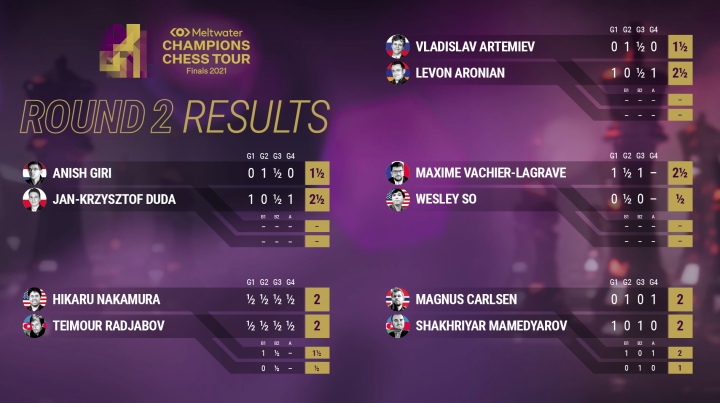
Wesley So’s hopes of catching Magnus Carlsen in the Meltwater Champions Chess Tour Finals took a severe blow today as he crashed to defeat in just three games. The American suffered a painful 2.5-0.5 collapse against France’s top player Maxime Vachier-Lagrave that leaves his challenge teetering on the edge of a precipice. So’s loss was made worse when Carlsen went on to come back twice against the dangerous Azerbaijani Shakrhiyar Mamedyarov before finally prevailing in tiebreaks. It was an epic encounter that left the champ looking thoroughly exhausted afterwards. But Carlsen said he’d have no problems coming back with energy in Round 3 of the $300,000 event. Carlsen had lost the opening game in just 20 minutes and then, after a masterful second game pulled him level, fell behind again. But in a must-win situation for the Norwegian in game 4, Mamedyarov blundered and Carlsen converted. The blitz tiebreaker saw Carlsen win the first game as Mamedyarov fell into a trap. Then, in the second, it was Carlsen who blundered to leave the score 1-1. Carlsen, however, was just too fast against his older opponent in the Armageddon decider. It meant Carlsen banked two vital and hard-fought points that put him six ahead of So. With just seven rounds remaining, the American now has a mountain to climb to overhaul Carlsen. Asked if defeat had scuppered his chances of catching Carlsen, So said: “I just want to take it one round at the time; the tournament is very long.” In the battle for placings, Poland’s World Cup winner Jan Krzysztof Duda bounced back from being humbled by Carlsen yesterday to beat Anish Giri 2.5-0.5. Levon Aronian, playing from St Louis, also came back from a Round 1 defeat against MVL to overcome the Russian Vladislav Artemiev 2.5-0.5. There was also a hint of controversy in the tie between Hikaru Nakamura and Teimour Radjabov as the pair played out four quick draws before settling the match in tiebreaks. Grandmaster David Howell, who was commentating on the action from Play Magnus Group’s Oslo studio, said their safety-first tactics were “disrespectful” to chess fans. Nakamura eventually prevailed in the Armageddon section to pick up 2 points, while Radjabov took 1. The Finals of the 2021 Meltwater Champions Chess Tour sees the world’s best chess players face off across nine rounds of rapid chess from September 25 to October 4. Tune in on www.chess24.com, YouTube or Twitch starting at 17:00 CET each day. For further information, please contact: Leon Watson, PR for Play Magnus Groupleon@chessable.com+44 7786 078 770
Fast-start for Carlsen on first day of Finals
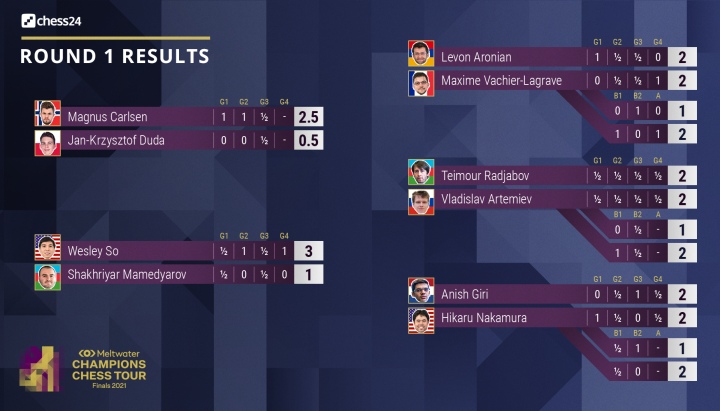
Magnus Carlsen declared he was “quite happy” today after getting his Meltwater Champions Chess Tour Finals campaign off to a perfect start. The World Champion savaged Poland’s World Cup winner Jan-Krzysztof Duda with two wins and draw to end the match with a game to spare. Carlsen began the $300,000 event with a four-point head-start over his closest rival Wesley So as a result of topping the Tour leaderboard over the course of the season. And Carlsen showed no sign of giving up that hefty advantage with a quick-fire win that picked up the maximum three points. The pressure was well and truly piled up on So, who faced a tough opponent in Azerbaijan’s Shakrhiyar Mamedyarov. But the American, who beat Carlsen in two events on the Tour, responded to win 3-1 and stay within touching distance of the lead. “It’s a very long tournament so one match at a time,” So, playing from St Louis, said. So added that he would go for it and that playing catch-up he has nothing to lose and everything to gain. “Someone’s gotta catch Magnus! He is in a comfortable lead and the best player, but someone’s gotta try. I just wanna play good chess.” Carlsen, meanwhile, will himself face Mamedyarov in Round 2. “I don’t think I have played him in a KO match on the Tour, so it should be interesting,” Carlsen said. “I know it won’t be easy.” While Carlsen’s fast-start was an ominous sign for the rest of the field, for Duda it was also a disheartening day to forget. “I’ve played terribly today,” Duda said, who has been a thorn in Carlsen’s side this year. “I was out of form and blundered tactics all the way.” Asked how he would pick himself up for the next round, Duda added: “Hopefully, tomorrow I will forget about this performance.” In the race for placings, all three of the other matches went to tiebreaks. After four draws, Vladislav Artemiev beat Teimour Radjabov in the blitz section while Dutch number 1 Anish Giri scored a win over Hikaru Nakamura. The final match to finish between Levon Aronian and France’s top player Maxime Vachier-Lagrave went to an Armageddon play-off. It ended with a scramble as Aronian, winning on the board, ran out of time to leave MVL the victor. The Finals of the 2021 Meltwater Champions Chess Tour sees the world’s best chess players face off across nine rounds of rapid chess from September 25 to October 4. Tune in on www.chess24.com, YouTube or Twitch starting at 17:00 CET each day. For further information, please contact: Leon Watson, PR for Play Magnus Groupleon@chessable.com+44 7786 078 770
FIDE World Championship 2021: Schedule, hotels, and health & safety measures

In a couple of weeks from now, the website for the FIDE World Championship Match in Dubai will be launched, and tickets for spectators will go on sale shortly after. In the meantime, we would like to share with you the schedule for the games, a list of hotels where visitors and journalists can enjoy preferential rates, and the current health and safety measures that one should take into consideration before visiting Dubai and Expo 2020. SCHEDULE: HOTELS: In the document linked below, you can find a table with the official hotels where you can book a room at preferential rates. In order to get these discounted rates, please book directly with the hotel and mention to them that you are a visitor for “EXPO – FIDE Chess Championship”. Preferential rates at official hotels: HEALTH AND SAFETY: We would also like to share with you the most up-to-date information regarding health and safety measures for all those visiting the FIDE World Championship match, Expo 2020, and Dubai. As of September 15, 2021, all visitors aged 18 years old and above must present a valid vaccination certificate issued by the competent National Authority or present a negative PRC taken within the previous 72 hours in order to enter the Expo site. Proof of vaccination or PCR results must be shown by the visitor at the entry gate. Non-vaccinated ticket-holders who have not been tested within the 72-hour period can benefit from the PCR testing facilities available at and or near the Expo2020 site. EXPO 2020 Covid-19 Guide (pdf) You can find more information on this topic at the Expo 2020 website. MEDIA ACCREDITATION: The accreditation process is a four-step procedure. 1) Please read FIDE’s media accreditation policy. 2) Send an email to press@fide.com, indicating the exact dates you are planning to visit the match and the type of accreditation you will require (A, B, or C). 3) Register to access Tawassul, the media information system at https://media.expo2020dubai.com/. All media, even if they are not yet accredited for Expo, can register for access to Tawassul. Tawassul is an essential operational tool connecting media to important information and updates on facilities and services such as media accreditation and permits for Expo. 4) Once registered for Tawassul, the media will be able to submit an Expo 2020 Media Accreditation expression of interest. Only one Media Accreditation expression of interest is to be submitted per organisation within Tawassul to commence the accreditation process. Typically, you will receive confirmation after 4-5 days. There are no important space limitations at the Expo press center, which is located 350 from the playing hall. However, due to COVID regulations, the place allocated for journalists at the venue itself will be limited. Preference will be given to accredited camera crews and news agencies.
Mednyi Vsadnik and South Ural clinch European Club Cup titles
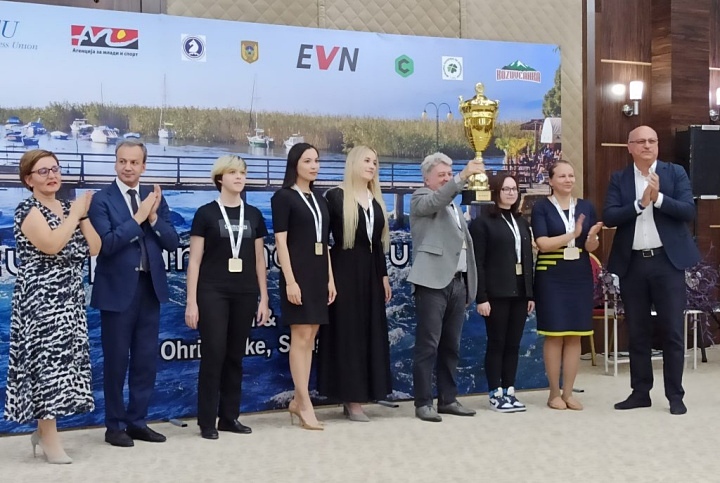
Mednyi Vsadnik (Russia) and South Ural (Russia) are the winners of the European Club Cup and European Women’s Club Cup. The 36th European Club Cup and the 25th European Club took place Struga, Ohrid Lake, North Macedonia from September 17-25 in two different venues: Hotel Drim (Women’s event) and Hotel Izgrev (Open event). The total prize fund of the events amounted to €44,000. The open event attracted 38 competing in the 7-round Swiss tournament. The highest-rated team, Alkaloid lost two matches and finished just 8th, but other favourites and first of all, the eventual champion Mednyi Vsadnik from St-Petersburg (Russia) delivered on the promise. The team headed by Peter Svidler and Andrey Esipenko conceded just one team-point in the match with the runner-up AVE Novy Bor (Czech Republic) and deservedly took the first prize of €10,000 and the title, second in its history. AVE Novy Bor kept pace with the champions for most of the tournament distance, but a tie with Alkaloid in the penultimate round cost them a critical team point that separated them from the first place. Vugar Gashimov was coming into the final round in the sixth position, but the victory over Alkaloid catapulted the Azerbaijani to third place in the final standings. FIDE President Mr Arkady Dvorkovich, ECU President Mr Zurab Azmaiparashvili, ECU Vice President and FIDE Managing Director Mrs Dana Riezniece-Ozola, ECU Secretary-General Mr Theodoros Tsorbatzoglou, President of North Macedonia Chess Federation Mrs Aleksandra Gakidova took part in the awarding ceremony. Final standings: 1 Mednyi Vsadnik RUS 13 2 AVE Novy Bor CZE 12 3 Vugar Gashimov AZE 11 4 KPRF RUS 10 5 Skakfelag Selfoss ISL 10 6 Team XtraCon DEN 10 7 Sloven Ruma SRB 10 8 Alkaloid MKD 9 9 Silla-Valencia Origin of Chess ESP 9 10 Schachgesellschaft Riehen SUI 9 The women’s competition, held in a different format (an 8-team round-robin), was dominated by South Ural (Russia). The Russian team won all the matches and clinched the title and the first prize of €6,000 with a round to spare. Monte-Carlo (pictured above) finished second three points behind the champion, GRECO-Kyiv Chess Federation came third. Final standings: 1 South Ural RUS 14 2 Monte-Carlo MNC 11 3 GRECO – Kyiv Chess Federation UKR 10 4 SK Erste Bank Baden AUT 9 5 Kumanovo MKD 4 6 Tajfun – SK Ljubljana SLO 3 7 Alkaloid MKD 3 8 MSK Centar MKD 2 Photo: europechess.org and official website Official website: europeanchessclubcup2021.com.mk/
Magnus Carlsen: “Ian can be very difficult to play against”

This extensive interview with the World Champion, courtesy of the Chess Federation of Russia (CFR), was recorded just before the closing ceremony of the FIDE World Cup when the long tournament came to an end. Magnus Carlsen talked frankly about various things – from the performance in Sochi and the World Championship match with Ian Nepomniachtchi to chess in the COVID-10 era and the future of our sport. The video version is available on the FIDE YouTube channel. – Magnus, please sum up your performance at the FIDE World Cup. – Overall, I’m satisfied with the performance. The classical part was very, very good, with eight wins and no losses. I think everybody, when playing such a tournament, aims to win it, but it’s very difficult against such opposition in the knockout format, and I have to say that winning six out of seven matches is something to be generally happy with. Winning the World Cup has been a goal of mine for some time, so that goal still hasn’t been achieved, but I guess it’s good to have something to strive for. – This time, you were closer to win it than ever before. What do you think went wrong? – I think there was really only one weak moment, the match against Duda. Obviously, he pressured me a bit with the white pieces, but I think I handled that fairly well in the classical part. Then, that one game was a combination of me losing my nerves, and clearly, he was the one who played the strongest chess among my opponents. So if I were going to lose to somebody, it would be him, but I do think that I would win that match more often than not, obviously. I knew coming in that Duda was not only strong in classical but also very good at rapid and blitz; he was going to be a strong opponent. That’s what happens in this format; sometimes, you lose to strong opponents if you play enough rounds. – Yes, knockout is very cruel. Do you think that the chess world needs more knockout events? – I’ve always been very much in favour of knockout events, I think that, in a way, they are the fairest, so I’m all for that. I think the public also likes it. There’s drama in every round; there’s always going to be a decision. It’s unbelievably cruel for the players… – But still, it’s fair. – But still, that’s the way it is, and I think there’s no particular harm for us in experiencing those emotions. Even though it’s cruel, the good thing about the knockout system is that when you lose, you can just go home. So, it’s cruel to be out, but at least you don’t have to suffer in a bad turn of form for weeks. – Yes, and this time the players also faced other problems. Were the anti-Covid measures here in Sochi a problem for you? – I thought that, in general, people here were pretty relaxed about Covid. Obviously, there was a scare at the start with the positive tests, but I’m happy – as far as I know, everybody is… – Negative. – Yes, everybody is OK now. Personally, I don’t really mind the mask and the testing and everything so much. It’s become a kind of normalised, and I’m just happy that we were able to have this tournament without a lot of problems. – Sometimes, there are comments when you take part in events that are a part of the World Championship cycle. The comments imply that you’re somehow interfering in the qualification system. What can you answer to those who say it? Would you consider playing in the Candidates Tournament if you had such a possibility? – That’s an interesting question. So far, both in the World Cup and the Grand Swiss, I hadn’t reached qualifying spots, but you can say that yes, I knocked out people along the way. I mean, personally, for me, the World Cup is such a prestigious and interesting event, so I’m very happy to take part in it, and I don’t think it’s up to me to decide whether I should be allowed to play or not. I mean, I’m very happy to take part, even though I understand that to some it can be a bit confusing to see the system, but it’s not up for me. – So, if you’re allowed, you’re taking part, right? – In general, yes, I don’t have any ethical problems with it (laughs). – Speaking about the World Championship matches. Since 2013, you have played in four matches. Do you enjoy this type of chess event? Which match was the most difficult for you, and which was the most memorable? – I would say that the most difficult match for me was the one against Karjakin. I started out fairly OK, putting serious pressure. I was winning in both the third and fourth games, but after I failed to win them, I was sort of cut out of rhythm a bit, and I was very, very close to losing the match. I never had a good feeling at all during that match, so that was definitely the most difficult and the most stressful and also the least enjoyable one for me. I guess the most memorable was the first match against Anand, since everything was new, and I was the challenger. But I must say that the most enjoyable for me was the match against Caruana in 2018. – Why? – I just had a different feeling during that match since I felt that Caruana was pretty much equal to me in rating at that point, and I felt that he was a completely equal opponent. That made it easier for me, because I didn’t feel the same way I needed to win the match. I didn’t feel that I was playing someone whom I should beat. So, I would say that the match in London was a