

Historic win for Mishra as Wesley So smashes score record
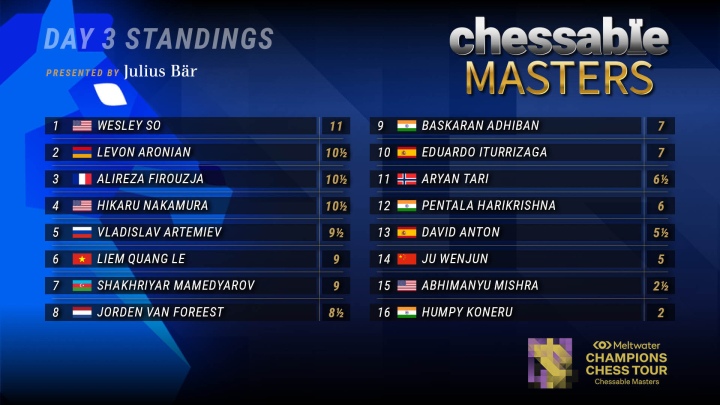
A dramatic end to the Chessable Masters prelim stage saw boy wonder Abhimanyu Mishra score a historic win and US star Wesley So break the event’s score record. Twelve-year-old Mishra, the world’s youngest Grandmaster, shocked the field by toppling Pentala Harikrishna. It was Mishra’s first win over a Super GM and first win of the event. The youngster and Harikrishna are separated by 595 places in the world rankings, 23 years in age and an ocean of experience. In a frantic endgame in Round 14, Mishra needed to hold his nerve with just seconds left on his clock to seal the win. When it was finally over, Mishra, who is ranked 616 in the world, rocked back on his chair in relief. Harikrishna looked stunned. “It was a dream come true to play in this event, against these players,” Mishra said afterwards. “It was amazing, it was full of ups and downs and at the end I was able to win.” Meanwhile, Mishra’s fellow American So continued his incredible dominance of this event by extending his unbeaten streak to 15 games. In the process, he broke the $1.6 million Meltwater Champions Chess Tour prelim stage score record with a stunning 11/15. So said he was “inspired” by the absence of World Champion Magnus Carlsen who he is chasing in the overall Tour table. “I figured I should try and score as many points when he is not here,” he added. So took a draw with the Dutchman Jorden Van Foreest in the final round as both went through to the knockouts. For Van Foreest, it was a big achievement. He made the cut for the first time along with Vietnam’s Liem Quang Le. While So was dominant, close behind were a pack of three led by the other young hotshot in the field, Alireza Firouzja. The Iranian-born teenager beat Misha in the final round to finish joint-second on 10.5/15 and clearly justify the hype around him. Level with Firouzja were the two heavyweights, speed demon Hikaru Nakamura and Armenia’s Levon Aronian. Making up the top eight were Goldmoney Asian Rapid finalist Vladislav Artemiev and Shakrhiyar Mamedyarov. However, in the scramble for places in the top eight the bottom eight players were eliminated. The exciting Indian Adhiban Baskaran came the closest, just missing out. The knockouts start tomorrow. The kick-off is at 17:00 CEST. All matches in the Chessable Masters are hosted in chess24.com’s playzone and available to watch on the platform’s Twitch and YouTube channels for free. The Chessable Masters is the penultimate leg of the Meltwater Champions Chess Tour before the Finals event in San Francisco, where the ultimate winner will be crowned the world’s best online chess player. For further information, please contact: Leon Watson, PR for Play Magnus Groupleon@chessable.com+44 7786 078 770
Alexandra Kosteniuk, Women’s World Cup Champion!
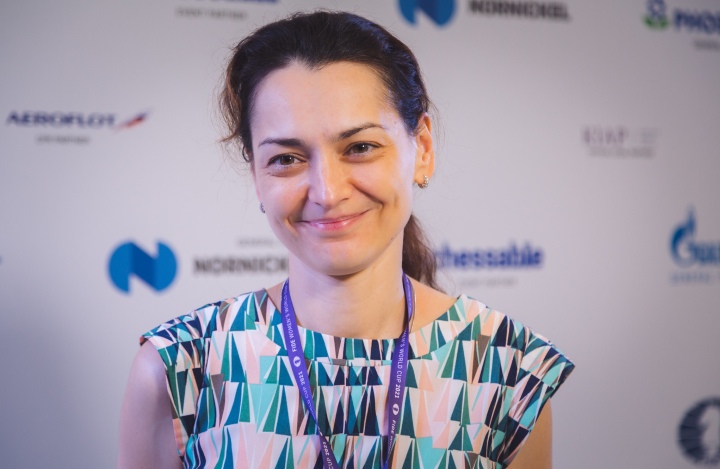
Sergey Karjakin first finalist: Carlsen and Duda will tie-break tomorrow Monday, August 2nd 2021 – Afternoon’s such as today are a joy for chess fans. Aggressive openings, hard-fought middlegames, great endgame technique and of course amiable companionship. So interesting that FIDE President Arkady Dvorkovich keenly followed the games at the start of the round, before returning to his duties at the important FIDE Council Meeting, which is also being held these days in Sochi. In the first semi-final between GM Jan-Krzysztof Duda (2738) and GM Magnus Carlsen (2847), Poland’s number one opened with 1.e4 and the World Champion went for an open game. Soon the game evolved into one of the many anti-Marshall variations of the Ruy Lopez with 8.a4, which Carlsen had already faced a few days ago in his game against Bacrot. Possibly fearing some dangerous home preparation, Carlsen deviated with the less common 8…Rb8 (instead of 8…Bb7), which Duda was definitely not expecting, as he took nearly ten minutes for his next move. The game spiced up when Carlsen went for 9…d5, going for a Marshall Gambit type of position. Duda picked up the gauntlet and captured the pawn. After 17…g5 it was obvious to everybody that Carlsen had it all worked out: he was playing very fast and Duda was falling behind on the clock. Prudently, Duda decided to exchange queens and the game transitioned into an equal endgame, with an extra pawn for White compensated by Black’s bishop pair and development. Although we were not able to find any games with the actual position, this type of endgame normally ends in a draw. White generally gives back the pawn to keep the balance, or opposite-colored bishop endgames often appear. However, unexpectedly in pure Marshall spirit, Duda sacrificed his rook for a knight and a pawn. With two pawns for the exchange, it was clear that Duda couldn’t be worse but did he have the advantage? Magnus demonstrated that the draw was always there. A hard-fought game, but nevertheless both of them will return tomorrow to battle it out in what will be a very exciting tie-break. In the second semi-final, between Russian top players GM Sergey Karjakin (2757) and GM Vladimir Fedoseev (2696), the opening was also the Ruy Lopez, although in this case, Fedoseev chose the solid Zaitsev variation, quite content with the famous draw by repetition that occurs after 11.Ng5 Rf8 12.Nf3 Re8. However, no one expected Karjakin to back down so early, and therefore 11.Nb-d2 was the main continuation. The turning point in the opening was move thirteen, when Fedoseev chose 13…d5 – played several times by Alexander Morozevich – instead of the main line 13…Nb8. Both players were blitzing out their moves until Fedoseev pushed 19…f5. Karjakin went into the tank and after twenty-five minutes of deep thought came up with the novelty 20.h4, trying to improve on the games between Tari-Vidit (2018) and Oparin-Morazevich (2015). The idea is to control Black’s kingside expansion. This might have taken Fedoseev by surprise, as soon after he blundered with 21…Rf8? allowing White to take the initiative with 24.e6!, which vacates the e5 square for a minor piece. Fedoseev didn’t react in the best way and soon he was under serious pressure, the main threat being f3!, expelling the knight from the center and activating White’s hidden bishop on c2. In desperado mode, Fedoseev initiated a series of exchanges beginning with a knight sacrifice on f2, but Karjakin had it all under control. After 31.d5 it became clear that Karjakin would be playing his second World Cup final: he won the title on Baku in 2015. After the game, Karjakin was kind enough to give us his views on the game and who he prefers in the final: Duda or Carlsen? After yesterday’s defeat, GM Aleksandra Goryachkina (2596) was in a must-win situation. Although she lost with the French Defence against GM Alexandra Kosteniuk (2472) in 2018, she decided to give it a second chance today. Kosteniuk deviated from that previous game with 3.Nd2 and Goryachkina went for 3…c5, her main weapon against the Tarrasch variation. On move nine, Goryachkina tried 9…b6, instead of 9…Nc5, which was her choice against Kashlinskaya in 2019, a game which she went on to win. She had prepared this move having seen an even older game which Kosteniuk played in 2013 against Jovana Rapport in the European Championship. Did Kosteniuk recall the game? Hard to know. One can only speculate on such things. In any case, 12…Rc8 was Goryachkina’s novelty and after a few moves the game was totally unbalanced: Black’s development was decent, but her king would have to stay in the center for the rest of the game. Obviously, this kind of unbalanced middlegame would clearly favour Goryachkina. Kosteniuk had a lot on the line. She prudently decided to play it safe, avoiding unnecessary risks, and timely exchange of queen’s and rook’s nipped Goryachkina’s counterplay in the bud. The endgame was academic: opposite-side coloured bishops and equal pawns. The game was heading to a draw but Goryachkina over-pressed and ended up in a clearly lost queen ending. However, Kosteniuk graciously offered a draw, which her opponent accepted. In the final women’s World Cup interview, a very happy Alexandra Kosteniuk gave us her thoughts on the match and her overall tournament success. In the match for the third and fourth place in the Women’s World Cup, China’s GM Tan Zhongyi (2511) repeated the Petroff Defence and GM Anna Muzychuk (2527), representing Ukraine, went for the unambitious 5.Bd3 side-line. White could have obtained the bishop pair with 12.Nxe7+ but she decided that Black’s development was more than enough compensation. After twenty moves the position was equal and resembled more an exchange French defence than a Petroff. White had the two bishops but Black’s strong knight on e4 was impressive. Slightly worse, Muzychuk offered a move repetition on move twenty-seven with 27.Bd1 and 28.Bc2. However, Tan Zhongyi declined and waited for a better moment to force the simplification. The ending was clearly better for the Chinese player – her minor pieces were clearly better – but Muzychuk defended tenaciously and a draw was agreed on move forty-nine. Tomorrow’s tie-break
FIDE deploys Chess for Protection project for refugees

The International Chess Federation with the support of UNHCR, the UN Refugee Agency, Lutheran World Federation (LWF), Kenya Chess Federation and Kakuma Chess Club has launched a Chess for Protection project, aiming to consolidate and develop chess practice in Kakuma refugee camp and Kalobeyei settlement in Kenya. The name of the project is “Chess for Kakuma and Kalobeyei People”. The project started today, on 2 August, with the online opening ceremony and simultaneous exhibition played between FIDE Managing Director Dana Reizniece-Ozola and members of Kakuma Chess Club. The kick-off event also featured UNHCR Head of Sub-Office Kahin Ismail, UNHCR Kenya Country Representative Fathiaa Abdalla, FIDE President Arkady Dvorkovich, Chess Kenya President Benard Wanjala, FIDE Vice President Anastasia Sorokina and other officials. “Over 55% of the refugee population in Kakuma are children and adolescents. The importance of engaging youth in extra-curriculum activities cannot be overestimated. This initiative will no doubt contribute to the wellbeing of youth, their psychological needs and their development. We are very glad to launch this project with all our partners – FIDE, LWF, Kenya Chess Federation, chess clubs in Kakuma. We are looking forward to nurturing and supporting this very important activity as an additional element in which our youth will partake, and I am sure will excel as we see them do in many other sport and cultural activities,” said Kahin Ismail, UNHCR Head of Sub-Office in Kakuma. “The Chess for Kakuma and Kalobeyei project is an excellent initiative to engage refugee youth in productive and engaging social activities. Chess is becoming increasingly popular among the youth in Kakuma and Kalobeyei. Our young boys and girls, women and men are joining many chess clubs. It will allow youth to bring the solidarity, enthusiasm, inspiration and energy to act as agents of positive change in their communities. I wish to thank FIDE and LWF for providing innovative and productive solutions to address some of the challenges faced by refugee youth in Kakuma and Kalobeyei,” Fathiaa Abdalla, UNHCR Kenya Country Representative emphasized. FIDE President Arkady Dvorkovich: “In FIDE we really believe in inclusive sports and inclusive chess. We are happy that our joint initiative with UNHCR, LWF and Chess Kenya has attracted so much attention. We have to promote chess not just as a sport but as a tool to improve our society, to promote healthy habits and inspire self-improvement and self-growth in many people. A big part of our mission is to promote chess as an instrument to improve the social environment for thousands or millions of people. We have been doing quite a few things already including projects like Chess for Freedom, Chess for Children with Autistic Spectrum Disorder, we ran the Online Olympiad for people with disabilities with 400 people participating. Now we are launching this huge project for refugees. We welcome all of you to our chess family! Yesterday we discussed the possibility of having a team of refugees at the next Chess Olympiad in Moscow. Hopefully, some of you can come to Moscow next year to participate in this event along with 200 other national federations.” LWF representative Julius Arawan: “I’d like to say that I appreciate what was done by FIDE and UNHCR to support youth in Kakuma and engage it in chess activities. We know that playing chess is very important for youth, for developing critical thinking and for future careers. We will continue to work with FIDE and UNHCR to ensure that this activity is realized and youth is involved in it.” Chess Kenya President Benard Wanjala: “I am very happy to be a part of this historic launch of the Chess for Protection project. Kenya has the second biggest refugee camp and the third biggest slum in the world. This creates very uncomfortable living conditions for youth and children who lack resources and opportunities to follow their life dreams. This is not just about chess, it’s about giving dreams to children. Chess Kenya is very proud to be a part of this initiative.” FIDE Managing Director Dana Reizniece-Ozola: “I hope that this project will bring fruits not only to refugees themselves but will also be a great satisfaction for us, the people involved in it. There’s strong evidence that chess structures the brains of people. If they regularly go for it, it increases their analytical skills, self-esteem and the understanding between the cause and the consequence. That is something that is instrumental in the lives of all human beings, but probably particularly in the lives of people in vulnerable situations. We will start with training the youth and kids in approximately 40 schools. In parallel, we will focus on the empowerment of young females and girls. Life skills training program will be carried out in the schools for girls where they will have chances to meet inspirational chess players and ladies representing other professions. They will be sharing their experiences and life stories and giving examples of how to reach success even if your starting point is not the best.” FIDE Vice President and the mastermind of Chess for Protection project Anastasia Sorokina: “I kept an idea of this project for a long time as I believe with all my heart that chess gives a lot of extra opportunities in your life. Chess also gives you extra skills, it teaches you not only how to win, but also how to survive when you lose. All of them are really life skills. That’s why I think this project is especially important for people who lost their homes or are living in new places where they are trying to adopt and live in a new community. Chess makes people united. I shared this idea with FIDE Managing Director Dana Reizniece-Ozola, and I am happy she supported it. I would like to thak all the UNHCR team for their support, we are very happy to work together and to get this project on board.” The official ceremony was followed by a simultaneous exhibition by FIDE Managing Director Dana Reizniece-Ozola for four members of Kakuma Chess Club. One of the
Winners crowned at Rudaga-Kaissa 2021 Festival
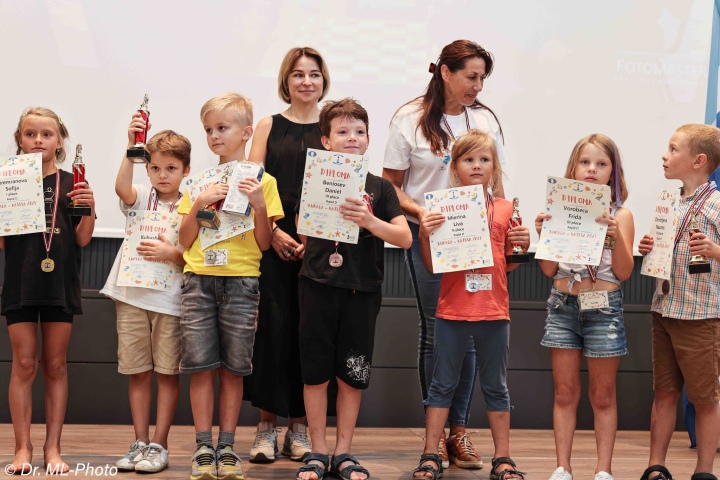
The Rudaga-Kaissa 2021 International Festival that brought together over 400 participants came to an end in Jurmala. For the first time, the event was held in the festival format and under the auspices of FIDE. Apart from online and over-the-board tournaments, the festival included masterclasses, meetings, simultaneous exhibitions, and other chess activities. We are happy to announce the winners of the over-the-board tournaments in different categories. Naturally, there were many top-finishers from the host country, but guests from other parts of Europe proved to be very serious competitors. Congratulations to all! Standard Open: 1. Shturman Arseniy (RUS)2. Strods Kristaps Reinis (LAT)3. Tabors Emils (LAT) Standard Girls: 1. Kuznecova Marija (LAT)2. Daineko Jevgenija (LAT)3. Locmele Valerija (LAT) U14 Open: 1. Jaakkola Niklas (FIN)2. Testelecs Ilja (LAT)3. Sokolovskis Pavels (LAT) U14 Girls:1. Maklakova Naomi (LAT)2. Maklakova Dafne (LAT)3. Kirijanova Sintija-Lina (LAT) 10 Boys:1. Jeronovics Toms (LAT)2. Platonovs Nikolajs (LAT)3. Kakurin Artem (RUS) U 10 Girls: 1. Gurevich Alexandra (ENG) 2. Teremranova Sofija (LAT)3. Sirajeva Anna Mira (LAT) The youngest boy and girl in the festival, the best boy and girl in rapid group C (born after 2009) and group D (born after 2013), the best boy and girl in blitz born after 2009, and the best boy and girl in standard chess born after 2009, all received Gold Participant certificates from ChessKid.com. The winners of the standard chess event, Arseniy Shturman (RUS) and Marija Kuznecova (LAT) received the main prize of the festival – accreditation to the 2022 World Chess Olympiad, tickets to the opening ceremony, and accommodation for two nights at the official hotel of the Olympiad. During the closing ceremony, FIDE Vice President Anastasia Sorokina thanked the participants, parents and organizers – public organization “Rudaga plus”, Jurmala City Council, Rudaga Children and Youth School of Education and Creativity (Jurmala, Latvia), KAISSA (Riga, Latvia), Semarah hotel Lielupe. She expressed hope that this festival under the auspices of FIDE will become an annual event. Tournament Director Inessa Testelec thanked FIDE for its support and presented a memorable gift for the FIDE President.
Round 7 Game 01: Kosteniuk pulls ahead in the Women’s final
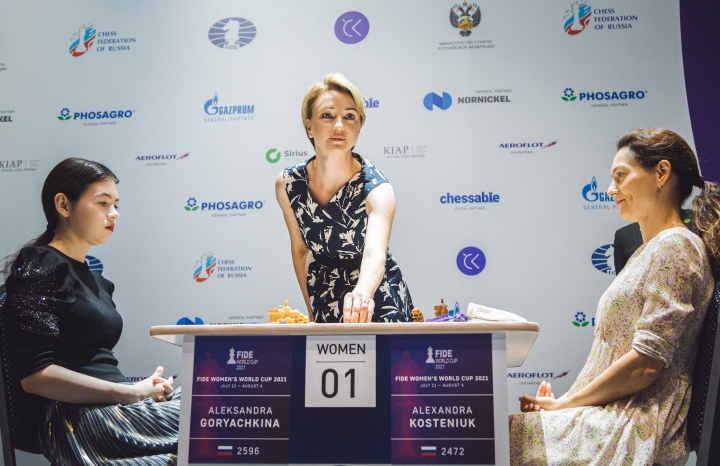
Solid draws in Carlsen-Duda and Fedoseev-Karjakin Sunday, August 1st 2021 – After a well-deserved free day, the eight remaining players returned to the venue this afternoon to continue the fight for the 2021 World Chess Cup. They were joined on the stage by Polina Lion, Chief Sustainability Officer of ROSATOM, the largest producer of electricity in Russia, who played the first move in the women’s final. On board one in the open group, Norwegian World Champion GM Magnus Carlsen (2847), opened with 1.d4, and his opponent, Polish GM Jan-Krzysztof Duda (2738) opted for the Queen’s Gambit declined, starting with the 1…Nf6 move order. In other games here, Carlsen has preferred the Catalan opening but today he went for 4.Nc3 allowing 4…dxc4, transposing directly into a fashionable variation of the Queen’s Gambit Accepted, in which White sacrifices a pawn for development. Nothing new under the sun, of course: both players had already tested this line in the 2019 Tata Steel tournament. In that game, Carlsen emerged victorious. However, today he brought a new, and rather less-known, idea to the table. Duda decided to play it safe by giving the pawn back in order to reach an equal position albeit with an imbalance in the pawn structure and minor piece (knight against bishop). Although Carlsen tried his best to push for a win in the rook ending, Duda played with great precision and a draw was agreed just after move thirty. Before he left the venue to prepare for tomorrow’s game, Jan-Krzysztof gave us his thoughts in a brief interview. A fun fact occurred in the other all-Russian semi-final between GM Vladimir Fedoseev (2696) and GM Sergey Karjakin (2757). The former 2015 World Cup winner chose a very solid side-line in the Queen’s Gambit Semi-Tarrasch variation. Funnily enough, the same opening was being played a few metres away in the Women’s third-fourth place match! As luck would have it, both games deviated on move thirteen. The position remained equal for most of the game: neither player wanted to risk being essentially eliminated in the first game due to an unforced blunder. Soon enough, all the minor pieces were exchanged and some lengthy manoeuvring with the queen and rooks began. After more exchanges, Karjakin voluntarily went into a rook ending a pawn down, but in any case, a clear draw due to his passer. As top Russian GM Peter Svidler put it “Karjakin doesn’t lose many of these”. A draw was agreed on move sixty-nine. In his post-game interview, Fedoseev considered that he was pressing most of the game and that some of these rook endings can be won. In the all-Russian women’s final, between GM Aleksandra Goryachkina (2596) and GM Alexandra Kosteniuk (2472), the rules stipulated that Goryachkina would play with White in the first game. She opened with 1.d4 and soon the game followed the theory of the Catalan opening, one of her favourite set-ups. On move seven, 7.Be3 was definitely a surprise for Kosteniuk – 7.Bg5 and above all 7.e3 are by far the main moves – and she thought for nearly ten minutes before replying with the sensible 7…Nd5. She was able to keep the balance, in which her two bishops and optimal pawn structure compensated White’s extra space in the centre. However, fate struck hard on move twenty as 20…e5? was a big mistake. Obviously, 21.dxe5 would just return the blunder due to 21…Rd3 winning, but 21.b4! (after only two minutes of thinking time) was the perfect response. Goryachkina won a pawn and was clearly in the driving seat. She gradually increased her advantage and could have sealed the deal on move thirty-six if she had played 36.Rd1 intending Rd6 or Rd7, and Black is in big trouble. However, low on time, Goryachkina missed the win. With both players approaching move forty, huge complications commenced and this time Kosteniuk came out on top. Goryachkina – Kosteniuk Unfortunately for Kosteniuk, she threw away most of her advantage with 41…Qd4? (instead of either 41…c2 or 41…Qe3 which are both winning), but was lucky enough to get a second chance a few moves later when Goryachkina misplayed the ending, and this time she scored the win. In the match for third place between China’s GM Tan Zhongyi (2511) and GM Anna Muzychuk (2527), representing Ukraine, the Semi-Tarrasch variation of the Queen’s Gambit declined was played, just as in the men’s second semi-final. However, White’s 13.Bxf6 followed by 14.Nxd5 just didn’t have enough punch to achieve a serious advantage. After a few exchanges, Muzychuk spotted from afar the neat trick with 25…Nd4! and held the queen ending to a draw with no trouble at all. A good result for Muzychuk, who will now enjoy the white pieces in the second game tomorrow. Pairings of the rounds, live games and PGN files can be found on the World Cup website alongside a great amount of other interesting information such as daily videos, a complete photo collection and other useful data. Text: Michael Rahal, FIDE Press Officer press@fide.com Photo: Eric Rosen and Anastasiia Korolkova About the tournament: Scheduled to take place from July 12th (Round 1) to August 6th (finals), the 2021 FIDE World Cup will gather together in Sochi (Russia) 309 of the world’s best chess players, with 206 of them playing in the Open World Cup (and 103 participants in the first-ever Women’s World Cup. The top two finishers in the tournament, aside from World Champion Magnus Carlsen who is also participating, will qualify for the 2022 Candidates Tournament, in addition to winning the 110.000 USD first prize (80.000 USD for the runner-up). Organisers: International Chess Federation (FIDE), Chess Federation of Russia, Russian Ministry of Sports, and Government of Krasnodar Krai. Partners: Gazprom – general partner Nornickel – general partner PhosAgro – general partner Chessable – event’s partner Aeroflot – CFR’s partner Educational centre “Sirius”
Online Cadets and Youth World Cup 2021 kicks off on Tornelo
Online Cadets and Youth World Cup 2021 has started today. The qualifying stage tournaments will run until August 20, followed by finals on 26-31 August. More than 1600 participants from more than 100 national federations take part in the event. It is the first stage of the world championship cycle that also includes the Grand Prix series and culminates in a Super Final in December. The games are played online on Tornelo platform with substantive anti-cheating measures in place. FIDE Vice President Akaki Iashvili welcomed the players on behalf of FIDE and the Georgian Chess Federation: “Despite the global pandemic, FIDE moves forward with tangible results. Last year, we organized World Cadets and Youth Championships. This year, we have the world championship cycle, with World Cup, Grand Prix and Super Final in December.” “We wish you the best luck and to continue loving chess as you do. We rely on you as a new generation of players to come to the highest possible rankings in the next few years,” was the message to the participants from the FIDE President Arkady Dvorkovich. You can watch the opening ceremony here: https://www.youtube.com/watch?v=ijhFVu2KLEo The event is supported by SOCAR, the State Oil Company of the Azerbaijan Republic. You can find the results, regulations, and other information on the official website.
FIDE distributes an additional €37,500 among chess seniors
FIDE is pleased to announce the names of the additional fifteen chess seniors who will benefit from the FIDE’s support program to chess veterans this year: Andrei Lukin (RUS)Jan Plaсhetka (SVK)David Dzhanoev (GEO)Sergio Mariotti (ITA)Ewen Green (NZL)Svetlana Mednikova (RUS)Nathan Zilberman (KGZ) Mikhail Marandyuk (UKR)Tõnu Truus (EST)Khandsuren Sandagdorj (MGL)Nelson Borges (DOM)Luben Popov (BUL)Rakhil Eidelson (BLR)Silvino Garcia (CUB)Maria Macieja (POL) They will join the twelve recipients already announced back in March: Sergey Makarychev (RUS)Tamaz Giorgadze (GEO)Hanna Erenska-Barlo (POL)Roman Hernandez (CUB)Avigdor Bykhovsky (ISR)Juzefs Petkevich (LTV)Anatoly Noskov (KAZ)Bosko Abramovic (SER)Jan Kalendovsky (CZE)Nina Medyanikova (RUS)Julio Ostos (VEN)Irina Ostry (KGZ) Each one of them will receive a grant of €2,500, with the total amount allocated to this program during 2021 rising to an unprecedented €67,500. As we did in March and in other previous occasions, we will pay tribute to these illustrious veterans with a few words about each one of them, summarizing their careers and achievements: Andrei Lukin (Russia) International Master (1982), Master of Sports of the USSR (1966) and Honored Trainer of Russia, Andrei Lukin combined participation in chess tournaments with his job as an engineer for some time but later devoted himself to the profession of chess trainer. Andrei Lukin is a five-time champion of Leningrad (1972, 1978, 1981, 1983, 1988) and a prize winner of the Russian Chess Championship (1993). His best results in international competitions include Nałęczów (1981, 1st – 2nd place) and Leningrad (1984, 2nd-3rd place). As a part of the St. Petersburg chess team, he won the Russian Team Chess Championship (1992). He is also a medalist of the Russian Club Chess Championship (1995) as a member of the “University” team (St. Petersburg). Photo: Vladimir Barsky For his achievements in fostering many talented chess players, Andrei Lukin was awarded the title of Honored Trainer of Russia. Andrei Lukin trained grandmasters Konstantin Sakaev (until 1993) and Peter Svidler (since 1993). He headed the youth team of Russia at world tournaments, became the winner of the Russian Chess Federation “Coach of the Year” award. Peter Svidler attributed his breakthrough into the elite of world chess to his cooperation with Andrei Lukin and stated that he was lucky to have him as his chess trainer. Lukin also trained grandmasters Kirill Alekseenko (since 2008) and Anastasia Bodnaruk (since 2013). Jan Plachetka (Slovakia) Born on February 18, 1945, in Trencin (Czecho-Slovakia) Jan made his debut in the national championship in 1962 and soon joined the Chezco-Slovakian student team. After graduating from university, he climbed to the podium of the Chezco-Slovakian championship (1973) and became a member of the national team. Five years later he earned the grandmaster title. His tournament resume includes the victories in Rimavska-Sobota (1975), Polanica Zdrój (1975), Maribor (1977), Vincovici (1977), Sofia (1979), Champagnol (1984), Prague (1984), Strasbourg (1985), Metz (1986), but his glory moment came at the Olympiad in Luzern (1982). Jan turned in an excellent performance and helped his team to win silver. Overall he participated in Chess Olympiads (seven as player, seven as a team captain) Jan is making first move at Prague Chess Festival 2020 Photo: praguechessfestival.com/ FIDE Senior Trainer since 2010, he served as coach of men´s and women´s team of Slovakia in the period 1992 – 2014. With Plachetka at the helm, Slovak women were the European Champions in Batumi in 1999. A prolific author, Jan penned many articles in several chess magazines. David Dzhanoev (Georgia) David Dzhanoev (born on November 22, 1938, in Tbilisi) is one of the most successful chess trainers, working in Georgia (when it was a part of the USSR). He is most known as the coach of Nana Alexandria with whom he productively worked from 1977 to 1991. He also helped Gennady Zaichik, Sergei Movsesian and Giorgi Bagaturov (the Senior World Champion 50+) at different periods of their careers. After moving to Russia he coached Sanan Sjugirov, Pavel Shkapenko and Evgeny Reshetnikov. David lavishly shared his coaching experience consulting national teams of Bolivia, Ecuador, Syria and Columbia. Sergio Mariotti (Italy) Born in Florence (Italy) on 10th August 1946, Sergio Mariotti had quite a successful career in chess: after becoming Italian junior champion in 1964 (Turin), he won the international tournament in Naples in 1968-69 and became Italian champion for the first time in 1969 in San Benedetto del Tronto. One of his best tournament results is second place at the Venice international tournament in 1971 (behind GM Walter Browne and ahead of champions like GM Vlastimil Hort, GM Lubomir Kavalek and GM Svetozar Gligorić), also scoring his maiden GM norm. Sergio represented Italy at the Chess Olympiads in 1972, 1974, 1986 and 1988. At the 21st Olympiads in Nice (1974) he won the individual bronze medal on the first board and got my final GM norm, becoming the first-ever Italian chess player to get the title. British Chess Magazine nicknamed him “The Italian Fury”, referring to his enterprising, tactical style. Mariotti is still one of the most successful Italian players in World Championship cycles, winning the zonal tournament held in Caorle in 1975 and qualifying for the Manila Interzonal tournament of 1976, where he reached 10th place together with former World Champion GM Boris Spassky. Photo: novisad2017.org He served as President of the Italian Chess Federation (Federazione Italiana Scacchi – FSI) between 1994 and 1996, and later worked as a Technical Director (Direttore Tecnico) of Italian national teams between 2002 and 2007. A true ambassador of the game he has been supporting spreading chess across Italy and launching a long-term valorization process of Italian young talents. A milestone has been the creation of a team of young players for the 37th Chess Olympiad (Turin 2006), that represented the first opportunity for the new generation of Italian chess players to appear at the international level. Ewen Green (New Zeland) Born on April 4, 1950, Ewen Green represented New Zealand in World Under-20 Chess Championship in Stockholm 1969 and later played under the banner of his country at the 1970, 1974 and 1976 Olympiads. He participated in many NZ Championships jointly winning the 1979-80 New Zealand Championship and represented New Zealand again in the 1977 Asian Teams Championship and 1978 Zone 10 Championship in Japan.
$100,000 Chessable Masters gets underway
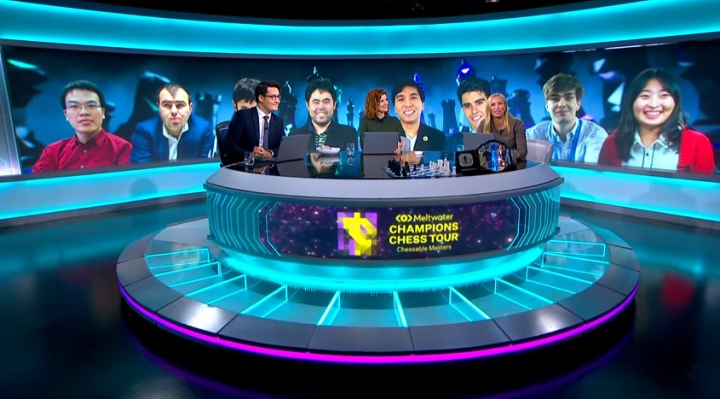
US star Wesley So is a half-point clear of the pack after the $100,000 Chessable Masters got off to a thrilling start today. The Fischer-Random World Champion, who is chasing the overall lead in the $1.6 million Meltwater Champions Chess Tour, scored three fine wins to finish on 4/5. Hot on his heels are fellow American Hikaru Nakamura, talented teen Alireza Firouzja and the Russian hotshot Vladislav Artemiev who all scored 3.5/5. The event’s 15-round prelim stage started with a huge interest in 12-year-old American prodigy Abhimanyu Mishra. Mishra is the world’s youngest Grandmaster having broken Sergey Karjakin’s long-standing age record last month. Mishra was making a big step up in class and was not expected to challenge, and it was predictably tough for the youngster. He suffered four successive defeats before picking up a draw in the final round against India’s Humpy Koneru. But Mishra, from Englishtown, New Jersey, wasn’t downbeat afterwards. “It’s an honour to play in this tournament, it is a very good learning opportunity for me,” he said. What wasn’t expected was that top seed Levon Aronian, the winner of the last Tour event, would have a catastrophic start. Aronian blundered away a winning position against the Dutchman Jorden Van Foreest and found himself on only half a point after three rounds. Two successive wins against Mishra and the Norwegian Aryan Tari got him back on track but the experienced Armenian still has a lot to do. The three-day prelim stage will resume tomorrow with rounds 6 to 10 before the cut is made on the final day and eight players are eliminated. All matches in the Chessable Masters are hosted in chess24.com’s playzone and available to watch on the platform’s Twitch and YouTube channels for free. The Chessable Masters is the penultimate leg of the Meltwater Champions Chess Tour before the Finals event in San Francisco, where the ultimate winner will be crowned the world’s best online chess player. For further information, please contact: Leon Watson, PR for Play Magnus Groupleon@chessable.com+44 7786 078 770
Sergei Karjakin “The Comeback Minister” advances to semi-finals

All-Russian women’s final between Goryachkina and Kosteniuk Friday, July 30th, 2021 – Although in the women’s group game two of the semi-finals were being played, most of the attention –online but also in the press room – was focused on the tiebreak match between GM Sam Shankland (2709), representing USA and GM Sergey Karjakin (2757), the Russian local hero. The winner would not only advance to the Open Group semi-finals but would also acquire a very decent shot at the 2022 Candidates qualification (there are two spots in play here). As usual, the tiebreak format is nerve-wracking; two 25 minutes + 10-second increment rapid games, followed by two 10/10 games. If there is still not a winner, two Blitz games 5/3 followed by a “sudden death” Armageddon game eventually decides the match. In the first 25/10 game, Shankland opened with 1.c4 but after a few moves the game headed down the paths of the Catalan Opening, a line that has a very solid reputation. Both players started their maneuvering tactics: for the most part, it seemed clear that they were playing it safe. The position remained balanced until Karjakin blundered with 33…Nc7? and then again with 36…Qd2? It’s always tricky for an annotator to suggest what he might have missed: maybe the 39.Bxc6 sacrifice, leaving White with two passed pawns and a clearly winning position. Karjakin defended as best as he could, but there was no way that Shankland was going to let this unique opportunity slip through his hands, and his endgame technique was more than enough to take the point home. Karjakin’s body language in the second game was unmistakably aggressive. After being crushed in the French in the classical games, Shankland brought back his beloved Sicilian but didn’t react well to White’s setup. Sergey Karjakin – Sam Shankland Already in the opening, 11…Qa5? was a big mistake, which Karjakin punished mercilessly with 12.f5! Again, it’s hard to know exactly where Shankland’s preparation was flawed – generally these mistakes happen due to mixing-up the different move-orders – but he was soon a piece down for two pawns. Karjakin wrapped-up the game and forced the second series of 10/10 rapids. Karjakin won the toss and played White again in the first of the two 10/10 rapids. On his tenth move he went for 10.e5 – home preparation – instead of 10.0-0-0, not expecting Shankland to repeat the same mistake twice. Kudos to his second Denis Khismatullin for preparing this idea during while the second game was being played! Shankland accepted the invitation, and after the exchange of queens he was a pawn up, but Karjakin had huge positional compensation and cashed in after a couple of dubious moves played by the American. Ahead on the score-cards, Karjakin chose the solid Queen’s Indian defence for the second 10/10 game. Although he was somewhat worse in a queen-rook endgame, his defensive skills came into play once again. With no other choice, Shankland over-pressed in the ending and “The Comeback Minister” qualified to the semi-finals. A very happy Sergey Karjakin gave us his thoughts on the match in a brief interview, cheered on by many supporters from the rail. After two draws in the first game, it was all on the line in the women’s section. Would GM Aleksandra Goryachkina (2596) from Russia, be able to take advantage of the white pieces and defeat her opponent, Ukrainian GM Anna Muzychuk (2527). What about the second game? GM Alexandra Kosteniuk (2472), playing for Russia, looked great in game one, seamlessly equalising with no effort at all in her game against GM Tan Zhongyi (2511) from China. How would the second game go, now that she would be playing with White. Goryachkina opened with 1.d4 and Muzychuk responded with the 10…Qa5+ / 11…Qa3 side-line in the Grunfeld defence, which had already been tried out here in the fifth round between Kateryna Lagno and Tan Zhongyi. Goryachkina spent quite a lot of time in the opening but found an interesting idea, isolating Black’s doubled pawns with a timely exchange of bishops on e6. Soon after, Muzychuk sacrificed a piece on d4 having calculated that she was getting it back with equality, but the idea was bad: Aleksandra Goryachkina – Anna Muzychuk Goryachkina could have won on the spot with 21.e5! but she chose 21.Rxb7 instead. After more than forty minutes of thought, Muzychuk opted for the exchange of queens, transitioning into a double-rook ending, which was slightly worse but defendable. However, Goryachkina piled on the pressure, played for the two weaknesses and notched up the win and the qualification to the Women’s World Cup final. Meanwhile, in the other semi-final game, Alexandra Kosteniuk surprised Tan Zhongyi with the so-called Keres-Kaufman attack against the solid Petroff Defence (5.c4). She achieved a small edge going into the middlegame, with a strong knight on b6 and two bishops pressuring the centre. Alexandra Kosteniuk – Tan Zhongyi Under serious pressure, Tan Zhongyi blundered with 19…dxc4? possibly missing that after 20.Rxc4 Qxa5 21.Ra4 Qb5 22.Be2! traps the queen. However, Kosteniuk had another idea in mind – to sacrifice her own rook for the opponent’s bishop on e6 after 22.Re1 Be6? 23.Rxe6 And it worked out! The former world champion from China was unable to find the best defence and eventually crumbled under the pressure. Although visibly tired after the huge effort, Alexandra still found time to attend to the press and give us her thoughts on the match and her qualification to the World Cup final. Tomorrow, Saturday, July 31st is the second free day. The World Cup Open semi-finals along with the Women’s final (and third-fourth place match) will begin on August 1st. More information on the World Cup website: Pairings of the rounds, live games and PGN files can be found on the World Cup website alongside a great amount of other interesting information such as daily videos, a complete photo collection and other useful data. Text: Michael Rahal, FIDE Press Officer press@fide.com Photo: Eric Rosen and Anastasiia Korolkova About the tournament: Scheduled to take place from July 12th (Round 1) to August 6th (finals), the 2021 FIDE World Cup will gather together in Sochi (Russia) 309 of
Chess for Protection: FIDE and UNHCR introduce a chess project for refugees
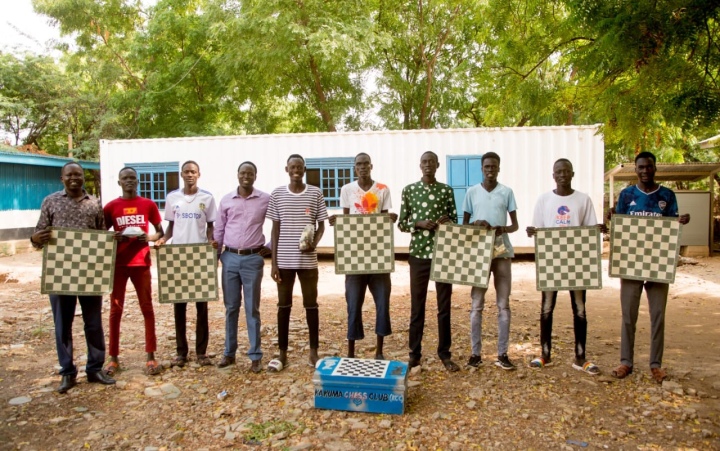
The Chess for protection project aiming to consolidate and develop the playing of chess in Kakuma Refugee Camp in Kenya starts on August 02. Chess often serves as a tool for empowerment that helps to enhance the psychosocial wellbeing of people, to reach their full potential, regardless of their background. The game can also make a huge impact in the lives of young people, giving them new learning opportunities and engaging in meaningful activities where they have a chance to heal, develop and grow. These are the aims of the Chess for protection project, implemented by the International Chess Federation, the UN refugee agency (UNHCR), Lutheran World Federation (LWF), Kenya Chess Federation and Kakuma Chess Club is expected to consolidate and develop the playing of chess in Kakuma Refugee Camp in Kenya. The kick-off event of the project starts on Monday, August 02 at 10:00 a.m. Kenya time (9:00 CET). It includes an online opening ceremony with key speakers such as UNHCR representative Fathiaa Abdalla, FIDE President Arkady Dvorkovich, Chess Kenya President Benard Wanjala and others and a simultaneous exhibition played between FIDE Managing Director Dana Reizniece-Ozola and members of Kakuma Chess Club. The arbiter at the simultaneous exhibition will be IA Shohreh Bayat. The program aims to raise awareness about the availability of chess as a sport including the opportunities it presents to talented players. It will also provide training to improve players’ knowledge and life skills which will, in turn, be passed to others. Linkages and networks will also be created with the larger chess community in Kenya and globally for greater development of chess in the camp and external opportunities for the professional development of players. Many young women and girls find it difficult to meaningfully engage in education and extra-curricular activities due to negative cultural norms that often prevent them from equal access to opportunities. Chess for Protection project includes activities of Girl Club Project under the leadership of FIDE Vice President Anastasia Sorokina, such as meeting and communicating with successful women, reading and discussing books, painting workshops and many others. Chess has been predominantly embraced by the youth from Kakuma and currently, 180 club members are actively participating in chess. Building on existing chess activities, the International Chess Federation will further bring in the experience and expertise of chess programs to contribute to the protection and well-being of refugee youth and adolescents and elevate chess to the level of key activities through which young people are engaged. The project is expected to directly benefit 1.600 learners, with various levels of chess proficiency through online presentations, provision of play materials and equipment, training and mentorship. Further, it is estimated that another 800 individuals from various parts of the camp community at large will be affected indirectly in various positive ways. Background Kenya is one of the biggest refugee-hosting countries in Africa and the world, hosting over 508,000 refugees mainly from the Great Lakes and Horn of Africa region. Over 40% of all refugees reside in Kakuma refugee camp. The majority of the refugee population in Kakuma and Kalobeyei consists of children and youth. Having been forced to flee from their homes, youth and adolescents are exposed to extreme stressors that may impact their psychosocial well-being. Further, 30% of children in primary school age and 94% at the secondary school age are out of school and not engaged in any income-generating activities, leaving them vulnerable to risks related to idleness such as developing stress, disorientation and hopelessness which predisposes them to engage in dangerous and risky behaviours – crime, violence, drugs, gang activities, and survival sex – as a means for coping with the situation. Further, many young women and girls find it difficult to meaningfully engage in education and extra-curricular activities due to negative cultural norms that often prevent them from equally accessing opportunities. They are expected to take care of family members while their parent/parents are working, which leaves them with very little time for learning opportunities.