

Istvan Csom (1940-2021)
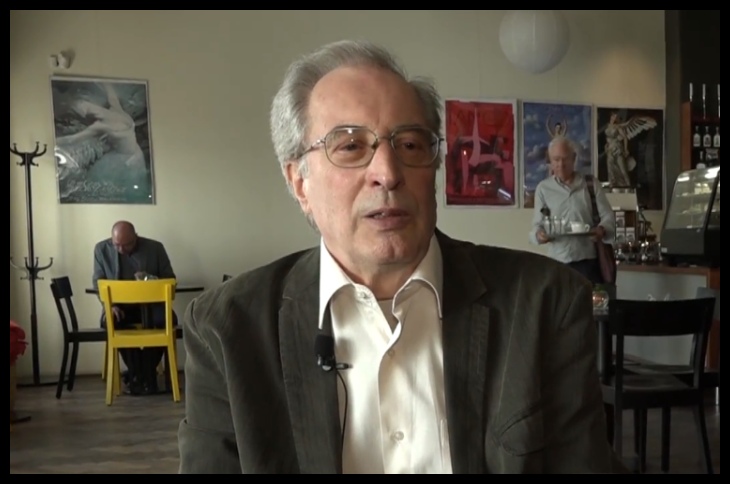
It is with the deepest sadness that we learned about the passing of GM Istvan Csom at 81. The Hungarian champion (1972 and 1973) he represented his country at nine Chess Olympiads. Istvan Csom won an Olympic gold medal with the Hungarian team in Buenos Aires 1978. He also took silver 3 times in Siegen (1970), Skopje (1972) and Valetta (1980) being the best scorer in the Hungarian team. He was a Hungarian Master Trainer and IA as well. Over the course of his career, Csom defeated many top grandmasters, including Mikhail Tal, Ulf Andersson, Boris Gulko, Antony Miles, Lajos Portisch, Samuel Reshevsky and Nigel Short. Famous for his legendary fighting spirit and fair play Istvan Csom became an icon of Hungarian chess. He will stay in our hearts. FIDE extends its sincere condolences to Istvan’s family, friends, and loved ones.
FIDE World Cup semis: Carlsen vs Duda
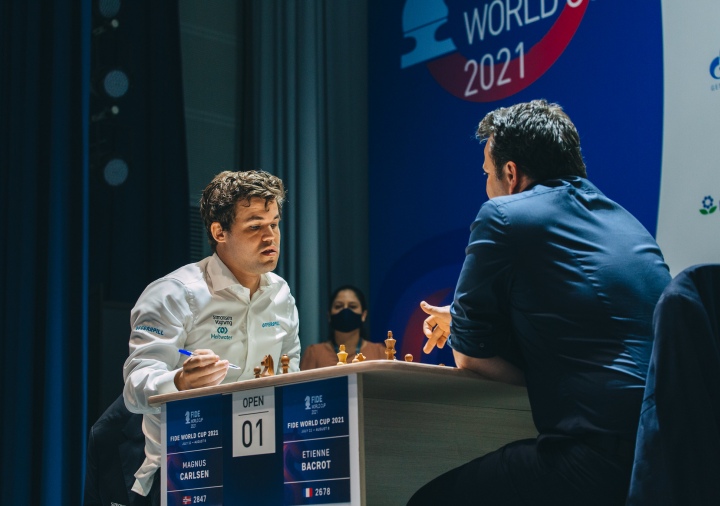
Both of the women’s semi-final games end in a draw Thursday, July 29th, 2021 – Yesterday evening, after the game, GM Etienne Bacrot (2678) representing France, expressed his feelings on Twitter. A rough translation would be something like “Magnus is too strong for me”. However, he came to the board with a fight in mind and lashed out 1…c5 – the ever-dangerous Sicilian defence. Unfazed, World Champion GM Magnus Carlsen (2847), from Norway, decided to play it safe, choosing the solid 3.Bb5+ side-line, as a draw would suffice for qualification to the semi-finals. Magnus Carlsen – Etienne Bacrot After the game, he confessed that he was slightly surprised with Bacrot’s choice of opening but the game remained approximately equal until Bacrot blundered with 31…Rxe4? which was promptly responded by 32.Ne7! After sacrificing the exchange Bacrot offered a draw which Carlsen declined. A better defence would have been 32…Qg4 when Carlsen was planning 33.Rxe4 Qxe4 34.Qf7! and after 35…Qe6 the World Champion evaluated the minor piece ending as clearly better although maybe not 100% winning. Don’t miss his post-game interview, in which Carlsen reveals this and much more! On board two, GM Sam Shankland (2709) from the United States, with a one-point advantage in the match, surprised former 2015 World Cup winner GM Sergey Karjakin (2757) from Russia by playing the French defence with Black, which he hardly ever uses. Karjakin took a deep breath, thought for a few minutes and responded with 2.d3 – the King’s Indian Attack – possibly trying to avoid running into Shankland’s home preparation. The game remained balanced until move twenty-one when Shankland went for 21…Na5 intending 22…Nc4. The more direct 21…a3 was probably necessary. Karjakin quickly forced his kingside breakthrough with 22.g5! and the attack was on. Sergey Karjakin – Sam Shankland After a few preparatory moves, he found a magnificent rook sacrifice – 27.Rxg7!! – and the game was soon over. These two players will return tomorrow for what will be a great tiebreak for the fans. Nonetheless, Karjakin found time to give us his insight on the game. While all of this excitement was taking place, Russian GM Vladimir Fedoseev (2696) was trying to grind his opponent down in a solid Catalan Opening on board three. He chose the 7.dxc5 variation, in which the queens are exchanged off the board very early. His opponent, GM M. Amin Tabatabaei (2613) from Iran, defended actively, and at no point seemed to be in trouble. Although Fedoseev did his best to try and unbalance a double-rook plus opposite-colored bishop ending, it was all to no avail and a draw was going to be the most likely result. But at the last minute the Iranian player, who has had a brilliant tournament, was eliminated by a huge blunder. Vladimir Fedoseev – M. Amin Tabatabaei Several moves would have secured the draw but 77…Rxg3?? was not one of them. After 78.Be5+ Kc6 79.Ra6+ Tabatabaei resigned as after 79…Kd7 80.Rd6+ Ke7 81.Rxe6+! Kxe6 82.f5+ wins a piece and the game. On board four, GM Jan-Krzysztof Duda (2738) from Poland, and GM Vidit, Santosh Gujrathi (2726) from India, played the most entertaining opening of the round. Pieces were flying around on the board, with sacrifices and counter-sacrifices at the speed of light. For many moves they were following a game played in 2013 between Adhiban Baskaran (2587) and Ashwin Jayaram (2461) – Adhiban was Vidit’s toughest match in Sochi – but it was clear that both players had studied the line in-depth as the balance was always maintained. Eventually, an approximately equal knight vs three pawns ending was reached. Jan-Krzysztof Duda – Vidit Santosh Gujrathi The game remained equal until move thirty-four. Just when it seemed to be heading for a draw Vidit blundered with 34…Re2? and after the very precise 35.Kh1 Duda was suddenly winning. It’s hard to suggest what Vidit might have missed, possibly the idea of playing 36.Ra1! before capturing the pawn on a6 with the knight. In his postgame interview, a very happy Duda affirmed that this was “the game of his life”. After their rest day, the semi-finals of the Women’s World Cup restarted with game one of the two-game match. On board one, GM Anna Muzychuk (2527) representing Ukraine, opened with 1.e4 against top seed GM Aleksandra Goryachkina (2596) from Russia. After ten theoretical moves in a Ruy Lopez opening side-line, Goryachkina decided to deviate from known theory with 10…Bg4 (instead of 10…Bf5 which has been played several times at the highest level). However, something went wrong – maybe 12…a5?! – as after a few more moves she had already dropped a pawn and things were looking very good for Muzychuk, who was enjoying a +2 advantage according to the main engines. But Goryachkina is a tough nut to crack. The precise defence combined with a few small inaccuracies and the double-rook ending was drawn on move forty-six. On board two, GM Alexandra Kosteniuk (2472), playing for Russia, equalised quite comfortably with Black against the Queen’s Pawn opening with fianchetto that her Chinese opponent GM Tan Zhongyi (2511) brought to the table today. A rather early exchange of queens lead to a blocked pawn structure in which Tan Zhongyi’s doubled f-pawn was compensated by the bishop pair and a bit more space. Both players maneuvered without much success and a draw was agreed on move thirty-one. The second game of the women’s section semi-final will be disputed tomorrow afternoon on the main stage while the men’s tiebreaks will be decided in the main playing venue hall. More information on the World Cup website: Pairings of the rounds, live games and PGN files can be found on the World Cup website alongside a great amount of other interesting information such as daily videos, a complete photo collection and other useful data. Text: Michael Rahal, FIDE Press Officer press@fide.com Photo: Eric Rosen and Anastasiia Korolkova About the tournament: Scheduled to take place from July 12th (Round 1) to August 6th (finals), the 2021 FIDE World Cup will gather together in Sochi (Russia) 309 of the world’s best chess players, with 206 of them playing in the Open World Cup (and 103 participants in the first-ever Women’s World Cup. The top two finishers in the tournament, aside from World Champion Magnus Carlsen who is also participating, will qualify for the 2022 Candidates Tournament,
Online Olympiad: Registration deadline approaching

Just two days are left to confirm the participation and submit initial rosters for the 2021 Online Olympiad! Following multiple requests to extend the registration deadline from 31 July, FIDE has resolved that: 1. The deadline to confirm participation in the 2021 Online Olympiad remains 31 July. 2. The deadline to submit rosters via the online registration system remains 31 July. 3. Federations may change their submitted roster until 1200 UTC, 7 days before they are scheduled to play in the Online Olympiad for the first time, after which their squad composition will be fixed. This means the deadlines are as follows: Base Division Friday, 6th August 1200 UTC Division 4 Friday, 13th August 1200 UTC Division 3 Friday, 20th August 1200 UTC Division 2 Thursday, 26th August 1200 UTC Top Division Wednesday, 1st September 1200 UTC FIDE.com and the official website of the FIDE Online Olympiad (http://onlineolympiad.fide.com) will provide daily coverage of the event. The games will be broadcast live with multilingual expert commentary on the on the FIDE’s official Youtube channel and by Chess.com. Chess.com will be again the hosting platform for this event that, on its inaugural edition, became one of the highlights of 2020. With more than 1,500 participants representing 163 national teams, it was a truly global competition, very much in the spirit of the traditional chess Olympiads. It helped our big chess family to unite around a wonderful event at a time of crisis, when it was most needed. The second edition of the Online Olympiad will receive the support and sponsorship of the Shenzhen authorities, which include the Shenzhen Longgang District Culture and Sports Bureau, the Shenzhen MSU-BIT University, Shenzhen Chess Academy, Shenzhen Pengcheng Chess Club. Simaland, the Russian wholesale online store and proud sponsor of the Candidates tournament 2020-21, will also be a partner for the Online Olympiad 2021. Once again, the event will consist of two stages: the “Divisions stage”, and the Play-offs stage with the top eight teams qualified from Stage 1 battling in knockout format. Usually, at live Olympiads, the teams that can’t boast of the world’s best players in their lineups are not in the spotlight, as the general chess audience focuses on favorites. The unique format of the FIDE Online Olympiad gives us a chance to take a closer look at the teams bereft of chess stars but united by a sincere love for the game and a strong desire to develop and make progress. The qualifying format of tournaments in divisions also allows us to make some predictions and try to figure out the teams that will advance to the next stage. Tournament regulations (pdf) List of Teams by Starting Divisions (pdf)
Round 06 Game 01: One foot in the semi-finals for Carlsen
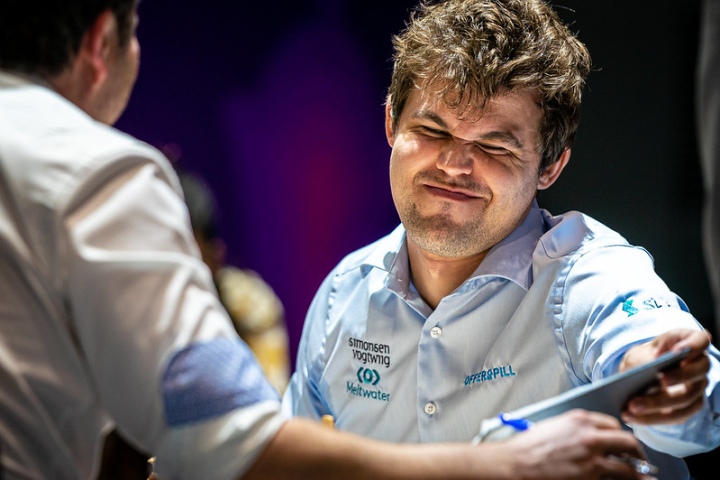
Shankland grinds down Karjakin in a technical ending Wednesday, July 28th, 2021 – Eight players returned to the Galaxy Centre this afternoon for Game 1 (of 2) of the sixth round of the World Cup: the quarter-finals. The stakes are really high: there is a lot in play. Not only the World Cup title and the fantastic 110.000 USD first prize: there are two spots for the 2022 Candidates tournament up for grabs, in addition to the direct qualification for the 2022 FIDE Grand Prix series. GM Emil Sutovsky (FIDE Director General) pinpointed an interesting fact on Twitter (edited): “Nobody would have guessed these eight (players). Notably, none of the five players that took part in the Candidates 20/21 tournament (Nepo and Ding didn’t play, Wang Hao quit afterwards). Well, that is a KO. And no, don’t call it a lottery!”. The women’s section enjoyed a well-deserved rest day today – it will be the open group’s turn on the 31st. Therefore, only four games were played, all of them very evenly matched. Board one – on the main stage – featured the match between GM Etienne Bacrot (2678) representing France, against World Champion GM Magnus Carlsen (2847) from Norway. Excluding blitz and rapid games (in which Bacrot has defeated Carlsen twice), the World Champion had a 6-3 track record in his favour, with no wins for Bacrot, and this statistic didn’t improve today. Carlsen played a very good game with Black, sacrificing a pawn for two bishops and the initiative in an anti-Marshall Ruy Lopez opening. Bacrot started to go astray with 24.f4?!, weakening his kingside, and a few moves later he blundered with 26.Qh3? (the move 26.f5 was better and the game goes on). Carlsen followed up by sacrificing his queen for a rook and a bishop in addition to a very strong passed pawn, and soon notched up the win and made his claim to advance to semi-finals. After the game, he analysed the different variations with GM Almira Skripchenko in the official commentator’s booth. On board two, USA top player GM Sam Shankland (2709) took on former 2015 World Cup winner GM Sergey Karjakin (2757), in the first official game between the two. After an earlier exchange of the queens, the game seemed to be heading for a draw, but Shankland did have some light-square pressure and chances to pressure a double pawn. Sam Shankland – Sergey Karjakin However, he needed a mistake and it finally came. Karjakin’s 38…f5?, allowing 39.e5, creating a strong supported passed pawn, was a game-deciding move. With excellent endgame technique and top-notch pawn-ending theoretical knowledge, Shankland was able to grind his opponent down. Sam was kind enough to share this thoughts of the game in a short interview. The former 2015 World Cup winner will now have to win tomorrow on-demand to force the tiebreak. GM Vladimir Fedoseev (2696), playing for Russia, was relatively happy with a draw with Black on board three. Both players castled queenside in a Queen’s Gambit – exchange variation -, but his opponent, GM M. Amin Tabatabaei (2613) from Iran, played for the attack on the queenside. Fedoseev sacrificed a pawn for some compensation, but Tabatabaei declined the offer and the Russian escaped unscathed. He gave us his thoughts in a brief post-game interview. Last but not least, the match between GM Vidit, Santosh Gujrathi (2726) from India and GM Jan-Krzysztof Duda (2738) representing Poland, will have to be decided tomorrow. Vidit went for a solid Catalan opening which gave him a very slight edge, two bishops and some squares for the knights, but Duda defended perfectly and the game ended peacefully on move 28. In the post-game interview, we questioned Vidit on his opening decision. More information on the World Cup website: Pairings of the rounds, live games and PGN files can be found on the World Cup website alongside a great amount of other interesting information such as daily videos, a complete photo collection and other useful data. Text: Michael Rahal, FIDE Press Officer press@fide.com Photo: Eric Rosen and Anastasiia Korolkova About the tournament: Scheduled to take place from July 12th (Round 1) to August 6th (finals), the 2021 FIDE World Cup will gather together in Sochi (Russia) 309 of the world’s best chess players, with 206 of them playing in the Open World Cup (and 103 participants in the first-ever Women’s World Cup. The top two finishers in the tournament, aside from World Champion Magnus Carlsen who is also participating, will qualify for the 2022 Candidates Tournament, in addition to winning the 110.000 USD first prize (80.000 USD for the runner-up). Organisers: International Chess Federation (FIDE), Chess Federation of Russia, Russian Ministry of Sports, and Government of Krasnodar Krai. Partners: Gazprom – general partner Nornickel – general partner PhosAgro – general partner Chessable – event’s partner Aeroflot – CFR’s partner Educational centre “Sirius”
Round 05 tiebreaks: A close scrape for Carlsen
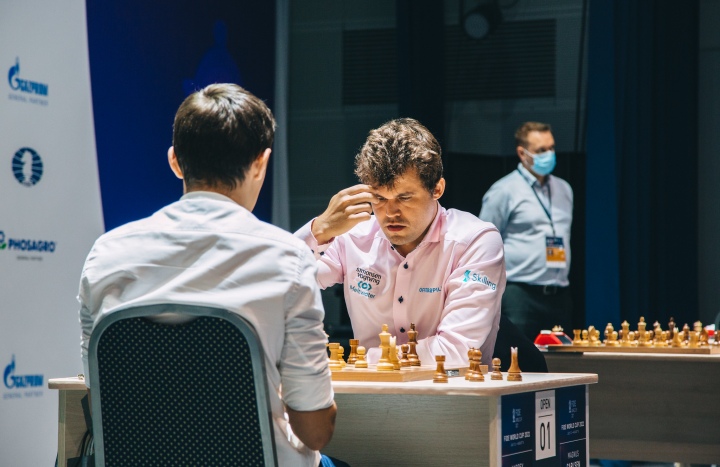
Anna Muzychuk advances to semi-finals in the women’s section Tuesday, July 27th, 2021 – Seven tiebreak matches were contended this afternoon in the Galaxy Centre – six in the open section and one in the women’s group – all of them very evenly matched, to qualify for the sixth round (quarter-finals) of the World Cup. Many surprises occur each day: after Grischuk’s elimination, the World Champion Magnus Carlsen is the only player left in the top ten FIDE rating list. As usual, all eyes were focused on the board one match between GM Magnus Carlsen (2847) and GM Andrey Esipenko (2716). The two classical games ended in draws, and it seemed that in general Esipenko was having the better part of it. But Carlsen is a beast in rapid and blitz games, several times World Champion in all the disciplines, in addition to a huge amount of recent online rapid event wins in his track record. Even so, the two 25/10 rapid games finished in a draw, and although Carlsen won the first 10/10 game, Esipenko bounced back with his own win, something that generally doesn’t happen when Magnus scores first. The Blitz games 5/3 is where the World Champion went for the kill, with great technique in the first and tactical efficiency in the second, all within the last few seconds. Witnessing this display of chess in person in the playing venue is a joy for all chess fans. Visibly tired, but clearly content, Carlsen came down to the press center to give us his opinion on the match and comment on tomorrow’s quarter-final pairing with Etienne Bacrot. The Carlsen-Esipenko match was the last to finish. Meanwhile, three other matches ended much earlier, in the 25/10 rapid games. The first of them to finish was the encounter between GM Haik M. Martirosyan (2632) from Armenia and GM M. Amin Tabatabaei (2613) from Iran, which was absolutely crazy. Martirosyan won the first classical game and came very close to winning the match outright: he only needed to find one or two simple moves in a knight and pawn ending in the second game. However, nerves, tiredness and a miscalculation all came together and a fatal exchange left the match 1-1. Today’s first rapid game was madness again: up and down, left and right, anything could have happened, but the game ended in a draw. The second rapid game was all Tabatabaei and the Iranian phenom discussed it with us in a brief interview. The amazing player of the tournament has clearly been GM Velimir Ivic (2582). Only 18 years old, he has surprised many of us with his fresh approach and huge strength. But his run came to an end today. His opponent GM Vladimir Fedoseev (2696) was unmatched in the rapid games, winning clearly with a 2-0 score. The first game was a nice technical win with Fedoseev with White. Although Ivic had some advantage in a messy position in the second game, ultimately Fedoseev took it down. Fedoseev will face Tabatabaei in the quarterfinals. He gave us his thoughts in a brief postgame interview. The third match to finish in the first two rapid games was GM Jan-Krzysztof Duda (2738) from Poland who defeated GM Alexander Grischuk (2778) from Russia, not a huge surprise but without doubt one of the most important eliminations of the round. Duda took us through the key moments of the match and gave us his views on the upcoming quarterfinals pairing with Vidit. Two matches were still tied after the first two rapid games and went on to the 10/10 rapids. After five consecutive draws in which, to date, has been the most equal match-up, former World Cup winner GM Sergey Karjakin (2757) from Russia pulled through with a win in the second 10/10 game and will now face Sam Shankland in the quarterfinals. In the post-game interview Karjakin talked about the games and revealed that he had never played against Shankland before. Finally, French GM Etienne Bacrot (2678) defeated his opponent GM Kacper Piorun (2608) from Poland. Although he lost the first rapid game, he was able to recover in the second, winning on demand. Piorun was unable to regroup and lost both of the two 10/10 rapid games. The pairings for the quarter-finals of the open world cup, scheduled to start tomorrow Wednesday 28th July are: Carlsen-Bacrot, Duda-Vidit, Fedoseev-Tabatabaei and Karjakin-Shankland Yesterday’s results in the women’s group left just one game for the tiebreaks, the exciting match between GM Anna Muzychuk (2527) from Ukraine and GM Nana Dzagnidze (2523) representing Georgia. The first of the two 25/10 rapid games ended in a clear win for Muzychuk: her opponent played a rare side-line in the Sicilian Najdorf, which was promptly refuted by Muzychuk, who opted for an aggressive opposite-side castled kings’ setup. Although she could have probably decided the game earlier, her attack plus material advantage eventually was too much to defend against. In a must-win scenario, the second game didn’t go well for Dzagnidze. Her opening setup with White was slightly dubious and it didn’t seem that Muzychuk was in danger at any point during the game. After a few mistakes, the Ukrainian grandmaster won and will now face Aleksandra Goryachkina in the semi-finals. Anna was kind enough to come to the press center and give us her thoughts on both of the games and also discussed her track record against Goryachkina. The pairings for the semi-finals of the women’s world cup, scheduled to start on Thursday 29th July are: Goryachkina-Muzychuk and Kosteniuk-Tan Zhongyi (tomorrow the women’s group enjoy a well-deserved rest day). Pairings of the round, live games and PGN files can be found on the World Cup website alongside a great amount of other interesting information such as daily videos, a complete photo collection and other useful data. Text: Michael Rahal, FIDE Press Officer press@fide.com Photo: Eric Rosen and Anastasiia Korolkova About the tournament: Scheduled to take place from July 12th (Round 1) to August 6th (finals), the 2021 FIDE World Cup will gather together in Sochi (Russia) 309 of the world’s best chess players, with 206 of them playing in the Open World Cup (and 103 participants in the first-ever Women’s World Cup. The top two finishers in the tournament, aside
Gregory Kaidanov clinches 2021 U.S. Senior Championship title
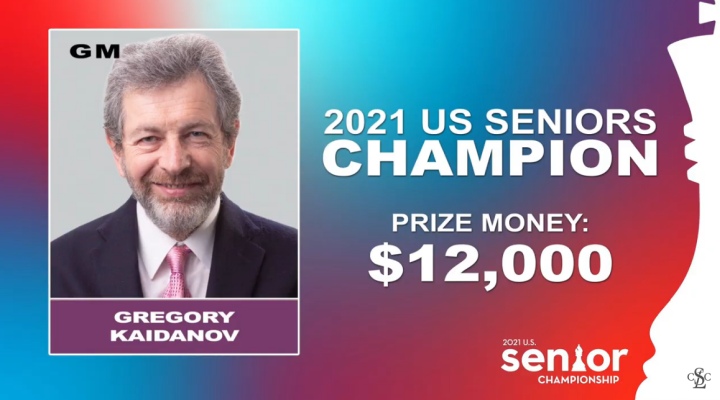
GM Gregory Kaidanov won the 2021 U.S. Senior Championship title after defeating GM Larry Christiansen in an exciting playoff tiebreak, scoring 1.5 – 0.5 in the two-game rapid match. Gregory was a half-point ahead coming into the last round of the round-robin, but GM Larry Christiansen won a critical last-round game forcing a tiebreaker. The first game saw Kaidanov miss a golden opportunity out of the opening as Christiansen fell into trouble early on in a Bogo-Indian Defense. Despite winning a clear extra pawn, Kaidanov was not able to consolidate his advantage, as Christiansen created enough counterplay to win the pawn back and equalize the game. After more trades the players ended up in an equal rook endgame, agreeing to a draw soon thereafter. In the second game, Christiansen essayed the London System, to which Kaidanov responded in an aggressive manner, playing an early Qxb2 to isolate White’s queenside pawns. Christiansen in turn continued to play for the initiative, sacrificing a pawn for development. While under pressure, Kaidanov found an incredible resource to refute White’s attack, temporarily sacrificing a piece but leaving White with multiple pieces hanging. After the dust cleared, Kaidanov was left with an extra exchange, which he duly converted into the full point, winning the tiebreak and the national title. 19…Rc8!! was a brilliant find securing Black a decisive advantage Coming up next month will be the Saint Louis Rapid & Blitz, taking place August 9 – 16, followed by the Sinquefield Cup, which runs August 16 – 28. Check out more info for both events on grandchesstour.org. Text: IM Kostya Kavutskiy Photo courtesy of Saint Louis Chess Club, Lennart Ootes
Round 05 Game 02: Shankland and Vidit advance
Goryachkina, Kosteniuk and Tan Zhongyi qualify for semi-finals Monday, July 26thth, 2021 – There were two very happy chess players this afternoon in the playing venue: Sam Shankland and Vidit Santosh Gujrathi. Both of them won their games in good style and are the first qualifiers for the quarterfinals: the rest of the players will have to return tomorrow afternoon for the stressful tiebreaks. The first one to finish was USA’s number five player GM Sam Shankland (2709). After holding his opponent, Russian GM Peter Svidler (2714), to a draw with Black in the first game, Shankland went all out with the aggressive 3.h4 against Svidler’s pet Grunfeld defence. Soon the game entered a tactical stage with opposite-side castled kings and both players attacking with all their forces. Svidler’s 24…Qb6 was a big mistake (24…Qb5 was the correct move, with approximate equality) probably based on a miscalculation, and Shankland cashed in with a direct attack on his opponent’s king. He will now face the winner of the match between Sergei Karjakin and Maxime Vachier-Lagrave, which will be decided in the tiebreaks. After dealing with the mandatory testing, Sam was kind enough to pop in to the press-centre and give his thoughts on both of the games of this round. The other happy face of the day was Indian’s number three player GM Vidit Santosh Gujrathi. He missed a win with White in game one and the game ended in a draw. Today, with Black, he played an interesting side-line in the Ruy Lopez in which his opponent’s light-squared bishop – the “Spanish bishop” is the key piece. In the game, GM Vasif Durarbayli (2625) wasn’t able to solve this equation over the board and in the end the bishop was blocked in with no activity. Vidit’s excellent technique did the rest. He will be paired against the winner of the more than interesting tiebreak between Karjakin and Vachier-Lagrave. Before abandoning the playing venue, a relieved Vidit gave us a brief interview, explaining the reasoning behind his thought process in both of the games. The third decisive result of the day in the open group was Iran’s GM M. Amin Tabatabaei (2613) defeating on-demand GM Haik M. Martirosyan (2632) from Armenia, levelling the score in the match 1-1 and forcing the tiebreak. Tabatabaei was pressing with Black most of the game but the draw was always in hand. But in the nick of time, Martirosyan miscalculated a pawn ending, exchanged the last piece and found himself resigning after a few moves. Instead of 58.Nxf3? , a move like as 58.Nf1 would have probably held the draw and Martirosyan would have advanced to the quarterfinals. The rest of the games all ended in draws, some of them hard-fought, others blitzed out in the opening. Funnily enough, the first game to finish was the rematch between GM Sergey Karjakin (2757) and GM Maxime Vachier-Lagrave (2749). While the rest of the players were essentially starting to get comfortable in their chairs, preparing for a long afternoon of chess, Karjakin and MVL blitzed out a fashionable line of the Grunfeld defence, which includes a spectacular queen sacrifice, but that ultimately ends in a perpetual check. There will be six tiebreaks (of the eight matches) battled out tomorrow afternoon at the Galaxy Center in Sochi. GM Magnus Carlsen (2847) vs GM Andrey Esipenko (2716)GM Vladimir Fedoseev (2696) vs GM Velimir Ivic (2582)GM Etienne Bacrot (2678) vs GM Kacper Piorun (2608)GM Jan-Krzysztof Duda (2738) vs GM Alexander Grischuk (2778)GM Haik M. Martirosyan (2632) vs GM M. Amin Tabatabaei (2613)GM Sergey Karjakin (2757) vs GM Maxime Vachier-Lagrave (2749) In the women’s group, the action was fast and furious. Three players qualified for the semi-finals with their result today and only one match will be decided at tomorrow’s tiebreak. An interesting fact is that the three top finishers in the women’s section qualify directly for the Candidates tournament. Since Goryachkina is out of the contest, all the other three semi-finalists have qualified for the Candidates. Kosteniuk and Tan already got their tickets, and the third name will be decided in tomorrow’s tiebreak. The first game to finish in the women’s group was the rematch between GM Anna Muzychuk (2527) and GM Nana Dzagnidze (2523). A three-fold move repetition in a tense position of the Sicilian Najdorf “Poisoned Pawn” variation left the match with a final 1-1 score. Soon after, playing with Black, GM Aleksandra Goryachkina (2596) found a convincing way to equalise against the London System proposed by IM Dinara Saduakassova (2483). Dinara Saduakassova – Aleksandra Goryachkina However, the blunder 22.Rc2?? (22.Rfe1 and anything can happen) decided the game immediately, the point being that 22.Qxc2 Qxf1+! (but not 22…Ne3 23.Qb3+ which was probably what Dinara had in mind) 23.Kxf1 Ne3 and White has to resign. As the first game ended in a draw, the top seed representing Russia advances to the semi-finals. Towards the end of the playing session, the other two games finished one after the other. In GM Kateryna Lagno (2559) vs GM Tan Zhongyi (2511) the game seemed to be heading for a draw, but around move 30 Lagno went astray, and let Tan Zhongyi’s rooks penetrate to the seventh where they proved to be decisive. Meanwhile, on the adjacent board, GM Valentina Gunina (2437) and Alexandra Kosteniuk (2472) were fighting it out in a side-line of the Ruy Lopez. Gunina, in a must-win situation, was forced to play aggressively in a situation where she might have been able to hold a draw. Kosteniuk will now face Tan Zhongyi in one of the semi-finals while Goryachkina’s opponent will come out of tomorrow’s tiebreak and will be either Nana Dzagnidze or Anna Muzychuk. The tiebreaks of Round 5 are scheduled for tomorrow Tuesday, July 27th at 3 pm. Pairings of the round, live games and PGN files can be found on the World Cup website alongside a great amount of other interesting information such as daily videos, a complete photo collection and other useful data. Text: Michael Rahal, FIDE Press Officer press@fide.com Photo: Eric Rosen and Anastasiia Korolkova About the tournament: Scheduled to take place from July 12th (Round 1) to August 6th (finals), the 2021 FIDE World Cup will gather together in Sochi (Russia) 309 of the world’s best chess players, with 206 of them playing in the Open World Cup (and 103 participants in the
Hans Niemann and Annie Wang win U.S. Junior Championships

Two national champions were crowned on Sunday, July 25, as GM Hans Niemann and IM Annie Wang clinched victories in the 2021 U.S. Junior Championships, both winning $10,000 scholarships in addition to the first-place prize. With their victories, Hans and Annie qualified for the 2022 U.S. Championship and U.S. Women’s Championship. Each event featured a 10-player round-robin format, with a time control of 90 minutes for 40 moves, followed by an additional 30 minutes with a 30-second increment added from move one. After the loss in the penultimate round to IM Christopher Yoo, GM Hans Niemann (pictured below) started the final round just half a point ahead of his nearest rivals GM Brandon Jacobson, IM Praveen Balakrishnan, and IM David Brodsky. Playing White against Jacobson, Niemann utilized a safe line in the English Opening and stood better for most of the game, though missed some chances to secure a large advantage. Meanwhile, IMs Brodsky and Balakrishnan faced each other, both needing to win in order to possibly tie for first and force a playoff tiebreak. It was Balakrishnan who had the better position in the middlegame, as he built up a strong attack against White’s king, but Brodsky defended well, and the game eventually petered out into a draw by repetition, with neither player being able to push for a win. Once Brodsky and Balakrishnan agreed to a draw, Niemann forced a draw in an equal rook endgame against Jacobson, securing first place in the tournament and clinching the title. In the U.S. Girls’ Junior, IM Annie Wang (pictured below) just needed a draw in her final game to clinch the title, and was paired against her main rival WCM Ruiyang Yan, who going into the round was a full point behind. Annie prepared well for her opponent’s Ragozin Defense, essaying a drawish variation that left her with virtually zero losing chances. After trading into an endgame in which only White could play for the win, Ruiyang offered a draw in a slightly worse position, giving Annie clear first place in the event. Text: IM Kostya Kavutskiy Photo courtesy of Saint Louis Chess Club, Crystal Fuller
FIDE endorsed festival “Rudaga-Kaissa 2021” kicks off in Jurmala
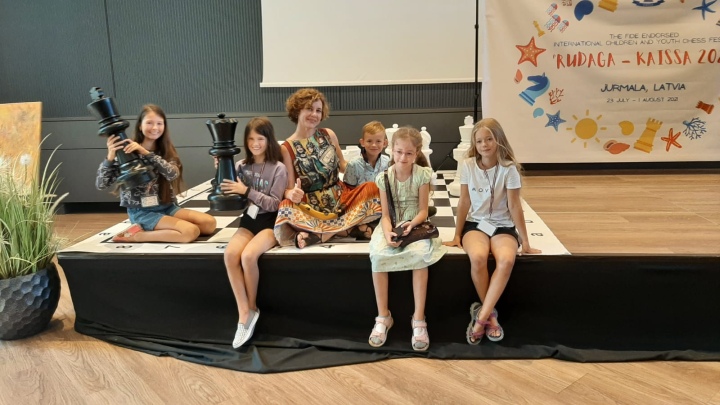
The Rudaga-Kaissa 2021 International Festival that brought together over 400 participants took off in Jurmala today. For the first time, the event is held in the festival format and under the auspices of FIDE. The official ceremony was attended by FIDE President Arkady Dvorkovich, FIDE Vice President Anastasia Sorokina, and FIDE Managing Director Dana Reizniece-Ozola. The festival started with a rapid tournament. In addition to the competitive part of the festival, participants can take part in masterclasses, meetings, and other related activities. The guests of the festival had a chance to take part in simuls by GM Nikita Meshkov (Latvia) and IM Sergey Berezuk (Czech Republic). Before these simuls, there were several tournaments and a busy entertainment program on the menu. In 2021, online tournaments were added to the traditional over-the-board format for the first time. On July 23, 235 participants from more than 50 countries in the under-12 and under-16 age categories (open and girls) took part in the qualifying stage. After two days of intense chess battles the winners were crowned in four categories: Open U12 1 – Samunenkov Ihor (Ukraine)2 – Dau Khuong Duy (Vietnam)3-4 – Le Nguyen Hoang Nhat Dinh (Vietnam)3-4 – Duong, Vu Anh (Vietnam) Girls U12 1 – Çaku Kler (Albania)2 – Morales Perez Ghisell (Colombia)3 – Azjargal Chinzorigt (Mongolia) Open U16 1 – Turkey Gurel Ediz (Turkey)2 – Viet Nam Dau Khuong Duy (Vietnam)3-4 – Bialiauski Artsiom (Belarus)3-4 – Mongolia Chinguun, Sumiya (Mongolia) Girls U16 1 – Hertlein Irena (Poland)2 – Gilani Mysha (Canada)3-4 – Bondar Daria (Ukraine)3-4 – Laamim, Roaa (Morocco) The winners will receive accreditation to the 2022 World Chess Olympiad in Sochi as a prize, tickets to the opening ceremony, and online lectures by Antoaneta Stefanova, world champion (2004-2006), and Ruslan Ponomariov, the 2002 FIDE world chess champion. Photo: Anna Shturman
Round 05 Game 01: Magnus Carlsen skates on thin ice
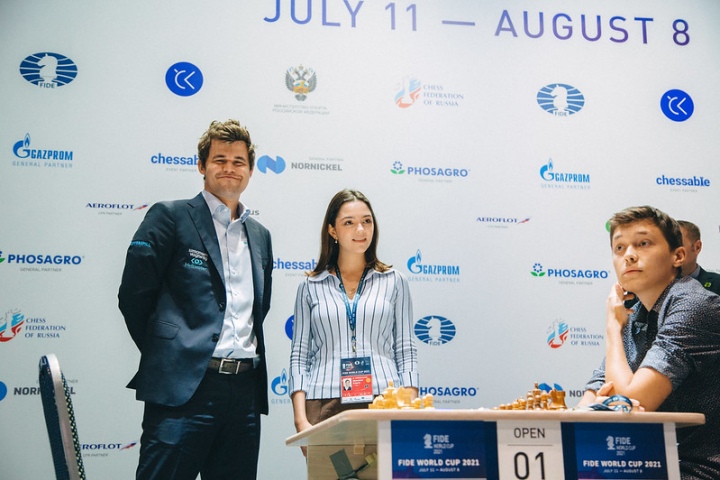
Alexandra Kosteniuk takes the lead in the women’s group Saturday, July 24th, 2021 – Artistic figure ice-skating and chess don’t seem to have much in common at first glance, but world-class performers of both disciplines share several common skillsets: high levels of pre-game concentration and constant technique improvement are just a couple that comes to mind. International ice-skating star Evgenia Medvedeva, two-times World and European Champion and two-times Olympic silver medallist was the guest of honour this afternoon in the Galaxy center, performing the first move – 1.d4 – in the GM Magnus Carlsen (2847) vs GM Andrey Esipenko (2716) game on board one. In a brief interview after the on-stage ceremony, Medvedeva summarized her sensations: “I sensed the tension, the “silent” adrenaline, the concentration in the playing hall. Figure skaters like me usually do more physical work before the start of the competition: we are always in motion, we warm up, listen to music, we even communicate to relax the nervous system and muscle tension. And here in the hall, there was complete silence”. The first game to finish in a draw was the top-level clash between GM Maxime Vachier-Lagrave (2749) and GM Sergey Karjakin (2757). In a theoretical Berlin Ruy Lopez, the former 2015 World Cup winner bashed out his moves with Black at lighting speed, sacrificing a pawn for active piece play in the ending and forcing a three-fold draw repetition with more time on his clock than he started with. The second match to finish was precisely the game one bout between GM Magnus Carlsen (2847) and GM Andrey Esipenko (2716), both of them back to the playing hall after a tough tiebreak yesterday. Carlsen went for a Catalan opening and Esipenko chose the “hanging pawns” set-up with Black, which left him with quite a decent position. The World Champion wasn’t able to create any momentum and decided to offer a three-fold repetition which Esipenko accepted. After the game, the young Russian quickly checked the computer to assess a specific position before our daily interview, in which he gave us his thoughts on the first game of the match. Unbelievably, we hadn’t had a chance to talk to GM Jan-Krzysztof Duda (2738) yet. However, the opportunity came today, after a tough draw against GM Alexander Grischuk (2778). The Russian grandmaster sacrificed a pawn in the opening and got a nice attack going, with many pieces on the kingside looking to finish off Duda’s weakened castled king. But Poland’s number one player had it all under control: solid defence and a couple of sacrifices to force a perpetual leaves the match totally open for tomorrow’s rematch. Duda was kind enough to accept our invitation and give us a brief postgame interview. The only decisive result of the round in the open group occurred in the game GM Haik M. Martirosyan (2632) against M. Amin Tabatabaei (2613). The young Armenian, who is having the tournament of his life – Brkic and Mamedyarov are his two most important match victories – was able to convert the extra pawn that Tabatabaei lost in the middlegame. Visibly tired, he still came along to the press centre to pinpoint the key moments of the game. The rest of the games ended in hard-fought draws that leave all the matches open. GM Peter Svidler (2714) was pressing with White most of the game against GM Sam Shankland (2709) but the American defended carefully and a draw was agreed on move 47. GM Nigel Short, official commentator and also a member of the Appeals Committee, went over the game with Svidler. Insert link to video clip if uploaded if not delete this line The other results of the round were: GM Vladimir Fedoseev (2696) 0.5-0.5 GM Velimir Ivic (2582)GM Etienne Bacrot (2678) 0.5-0.5 GM Kacper Piorun (2608)GM Vidit Santosh Gujrathi (2726) 0.5-0.5 GM Vasif Durarbayli (2625) In the women’s group GM Aleksandra Goryachkina (2596), playing with the White pieces, had a small advantage most of the game against IM Dinara Saduakassova (2483) but the Kazakhstani number one women’s player defended tenaciously and a draw was agreed. The last game of the round to finish was the incredible fight between GM Alexandra Kosteniuk (2472) and GM Valentina Gunina (2437). Gunina, with Black, had a clear advantage for most of the game and could have won on move 37 (…Rf4) and then again on move 42 (… Qg1 instead of …Kh6). But in these tough matches with everything on the line one must close the games. After saving these two match-balls Kosteniuk went on to win an opposite colour bishop ending in great style, and now leads the match going into the second day. The other two games ended in a draw and will be decided in the rematch. GM Nana Dzagnidze (2523) 0.5 – 0.5 GM Anna Muzychuk (2527)GM Tan Zhongyi (2511) 0.5 – 0.5 GM Kateryna Lagno (2559) The second game of Round 5 is scheduled for tomorrow Monday July 26th at 3 pm. Pairings of the round, live games and PGN files can be found on the World Cup website alongside a great amount of other interesting information such as daily videos, a complete photo collection and other useful data. Text: Michael Rahal, FIDE Press Officer press@fide.com Photo: Eric Rosen and Anastasiia Korolkova About the tournament: Scheduled to take place from July 12th (Round 1) to August 6th (finals), the 2021 FIDE World Cup will gather together in Sochi (Russia) 309 of the world’s best chess players, with 206 of them playing in the Open World Cup (and 103 participants in the first-ever Women’s World Cup. The top two finishers in the tournament, aside from World Champion Magnus Carlsen who is also participating, will qualify for the 2022 Candidates Tournament, in addition to winning the 110.000 USD first prize (80.000 USD for the runner-up). Organisers: International Chess Federation (FIDE), Chess Federation of Russia, Russian Ministry of Sports, and Government of Krasnodar Krai. Partners: Gazprom – general partner Nornickel – general partner PhosAgro – general partner Chessable – event’s partner Aeroflot – CFR’s partner Educational centre “Sirius”