

Magnus Carlsen wins world’s first bitcoin chess tournament

Magnus Carlsen is the world’s first bitcoin chess champion after overcoming Wesley So in a thrilling FTX Crypto Cup final. The Norwegian takes home the $60,000 first prize plus a 0.6 bitcoin bonus offered by tournament sponsor FTX. It is the largest prize pot ever offered in an elite online chess event. After the see-saw match ended with Carlsen punching the air in delight, the champ said: “It’s pretty sick! I came back five times when I needed it, and I also lost twice. “It’s absolutely insane. I am just so happy to have pulled through. It’s a massive, massive relief.” Carlsen also stretches his lead at the top of the $1.5 million Meltwater Champions Chess Tour table and avenges two defeats to So in finals this season. Carlsen had to dig deep to triumph over the US star as the record-breaking final went down to an incredibly tense “Armageddon” play-off. Nothing could separate the pair after two four-game rapid matches spread over two days both finished 2-2. But the reigning World Champion finally broke through when the pressure ramped up in with the quicker time control. When victory finally came, the relief showed. So has emerged as Carlsen’s most dangerous foe in the Tour, beating him in the Skilling Open and the Opera Euro Rapid events. But an unthinkable hat-trick of final wins against the champ proved one step too far. In the opener in the rapid section, Carlsen played a model game that showed off all his legendary crushing strengths. The Norwegian simply didn’t give So a chance. So, the World Champion at Fischer-Random chess had to resign and Carlsen was finally ahead. However, So wasn’t beat yet and Carlsen’s lead didn’t last long. It all went wrong for the champ in Game 2 as So calmly turned the screw on Carlsen to strike back immediately. The third was an unbalanced thriller that could have gone either way – but it ended in a fighting draw by repetition. Game 4 was completely different – a quick draw as both players drew breath before going into the blitz playoff. It started with incredible drama as Carlsen fell into a trap set by So and lost his queen. Carlsen was furious with himself and then had to resign. The champion was left needing to win with the black pieces to take it to an Armageddon tiebreaker. It seemed impossible: but he did it. Carlsen showed all his passion and punched the air shouting “come on” as So lost. Everything then rested on the Armageddon game with Carlsen with White and 5 minutes on the clock needing to win and So with Black having a minute less but only needing a draw. Carlsen won as So ran out of time in a losing position. With a huge release of energy, Carlsen punched the air again as his opponent resigned. So said afterwards: “I’d like to thank Magnus, I think he is the fully deserved winner as I think he played the best.” In the match between the losing semi-finalists for third-place, Russia’s Ian Nepomniachtchi beat Teimour Radjabov 2.5-1.5. After a drab encounter that saw four straight draws yesterday, it was Nepo who secured $25,000 and 0.25 bitcoin prize for finishing third. The FTX Crypto Cup is leg 6 of the Meltwater Champions Chess Tour, organised by the Play Magnus Group. All games are played in the new chess24.com play zone. The next event is a Regular tournament that carries a $100,000 prize pot. It will run from June 26 to July 4. There are two more after that before the Tour Finals in September starting on September 25. For further information, please contact: Leon Watson, PR for Play Magnus Groupleon@chessable.com+44 7786 078 770
Eight American players qualify for 2021 FIDE World Cup

The American Hybrid World Cup Qualifier was an 8-group (16 players in each) knockout tournament taking place from May 22-29. The winner of each group qualified for the 2021 FIDE World Cup that will be held in Sochi, Russia from July 10 to August 7. All the games were played online on Tornelo platform from designated venues. All the matches consisted of two classical games (120 min + 30 sec) and tiebreakers (2 games, 10min + 3sec) when needed. In case of an even score after a tiebreaker, an Armageddon blitz-game was played. Playing venue – St. Louis Chess Club Photo: St. Louis Chess Club Twitter The following eight players punched their tickets to the 2021 FIDE World Cup: GM Mareco, Sandro ARG 2629 GM Tang, Andrew USA 2538 GM Krysa, Leandro ARG 2527 GM Henriquez, Villagra Cristobal CHI 2600 GM Bachmann, Axel PAR 2599 GM Mekhitarian, Krikor Sevag BRA 2554 GM Moradiabadi, Elshan USA 2555 GM Hungaski, Robert USA 2514
Round 8: Zhansaya Abdumalik stretches her lead
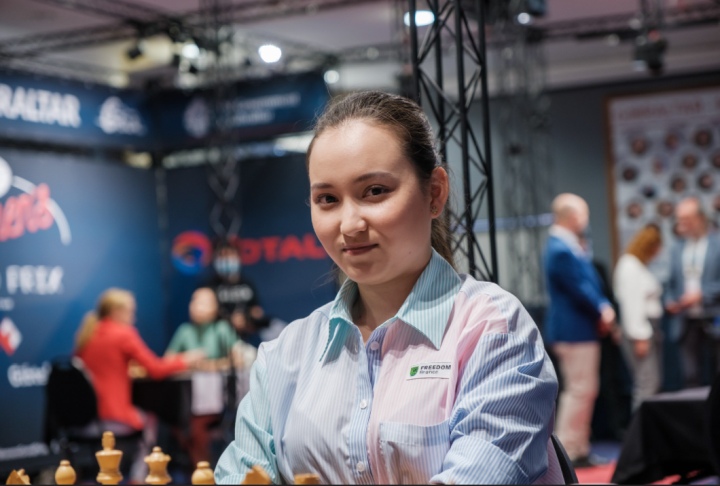
IM Zhansaya Abdumalik, of Kazakhstan, increased her lead to a full point over the field in round eight of the Gibraltar leg of the FIDE Women’s Grand Prix by defeating Alina Kashlinskaya of Russia. Zhansaya also took a big step towards achieving the rating she needs for her GM title. Kateryna Lagno, of Russia, a front runner for the Candidates’ place which will go to the highest placed eligible player, lost her game to Gunay Mammadzada of Azerbaijan, but despite that reverse remains the best-placed contender to go through to the Candidates. By scoring her third successive win Gunay has taken herself to the brink of a nine-round GM norm for which she needs a draw against Anna Muzychuk in round nine. The star game of the day was the one between two players on 4½ points, Gunay Mammadzada and Kateryna Lagno. Kateryna started the round as one of three undefeated players in the field. The opening was a Ruy Lopez, with Gunay playing her opening moves significantly quicker than Kateryna, indicating better preparation by the Azerbaijani player. Before long, Kateryna offered a queen exchange with 20…Qd3 but this allowed a minor piece exchange on f6 and then a piece sacrifice with 22.Qxf6. Gunay had a long think and then decided to go for this sacrifice, which could be followed by a further piece sacrifice to launch a dangerous attack on the black king. There followed a double oversight shortly afterwards (24. Rfe1 could have been answered by 24…Nd5! – instead 24. Rae1! was winning), but Gunay then reasserted her advantage with some powerful play, reaching a position with an extra pawn and a strong positional grip. Kateryna could not find any way to get back into the game and Gunay went on to score another remarkable win. We now think she needs just half a point in round nine for a nine-round GM norm. Though this was not a great result for her, Kateryna still has the best chance of the small group players in Gibraltar who are eligible, to annex a place in the Candidates. The game between the leader, Zhansaya Abdumalik and Alina Kashlinskaya started with a solid line of the Two Knights’ Defence. Zhansaya occupied the centre with pawns, but Alina developed comfortably and was soon able to exchange heavy pieces and reach an equal position in the late middlegame. However, Zhansaya kept pressing and she eventually emerged with an extra pawn. A queen endgame was ominous for those of us who were looking forward to our dinner but, unfortunately for Alina, she misplayed it and allowed Zhansaya a decisive f5 push after which the game ended with surprising speed. Another determined performance by Zhansaya, who seems to have made a quantum leap in strength recently. Mariya Muzychuk opened 1.e4 against Nana Dzagnidze, who defended with the Najdorf Sicilian. Mariya chose a line with h3 and g4, which Nana countered with a typical Sicilian exchange sacrifice (RxNc3), opening lines for her minor pieces. Veselin Topalov, on commentary, preferred Black “because I like exchange sacrifices.” However, he later criticised 22…f4 after which White’s king became safer. Also, White’s rooks got the open files to operate on. “I think Dzagnidze seriously misplayed,” said the former world champion. However, that wasn’t the end of the story as Nana’s position held together well and eventually, Mariya offered a draw. Antoaneta Stefanova versus Dinara Saduakassova started with a Queen’s Indian, developing into a small but stable edge for White. Then the game followed an encounter that Dinara had played earlier in the tournament against Valentina Gunina but came very imbalanced after a tricky phase of play in the late middlegame. Antoaneta gained two connected passed pawns for a minor piece. Dinara had earlier spurned a chance to draw by perpetual check and must have regretted not taking it as Antoaneta’s pawns steadily advanced up the board, ably supported by the king. Eventually, Antoaneta was able to sacrifice an exchange and force a promotion to clinch the point. Irina Bulmaga, playing against Valentina Gunina’s Caro-Kann Defence, opted for a quiet line (3.exd5 and 4.Bd3) which we old-timers recall Bobby Fischer using against Tigran Petrosian with some success. Irina’s 13.c4 looked suspicious, allowing Black easy equality and perhaps a little bit more. Valentina played quickly and confidently in response but faltered with 23…Bc7 when 23…b5 looked strong and natural. Perhaps encouraged by Valya’s slip, Irina gradually wrested the advantage back for White. However, Irina didn’t play the strong positional advance 29. c6, which Veselin Topalov thought was very good for White, instead opting for 29.Qb7 for a slightly better pawn structure. Later she conceded a pawn to Valentina and ended up in a worse position. After the time control, Valentina pushed a pawn to f3 and this enabled her to mount a successful attack on the white king which concluded the game. The round had started inauspiciously with a quick draw in 15 moves and around 35 minutes between Elisabeth Paehtz (GER) and Anna Muzychuk (UKR) in a Grünfeld Defence. This seems to indicate that Anna has given up on her rapidly dwindling chances of qualifying for the Candidates’ tournament. Round 9 is on Monday 31 May at 15.00 CET. Live transmission, with Veselin Topalov and Fiona Steil-Antoni, may be found at https://wgp2019.fide.com/#live Standings after Round 8: 1. Zhansaya Abdumalik – 6½; 2-3. Mariya Muzychuk and Gunay Mammadzada – 5½ 4-5. Kateryna Lagno and Elisabeth Paehtz – 4½; 6-8. Nana Dzagnidze, Antoaneta Stefanova and Valentina Gunina – 4; 9. Anna Muzychuk – 3½; 10. Alina Kashlinskaya – 2½; 11. Dinara Saduakassova – 2; 12. Irina Bulmaga – 1½ Leading Grand Prix Places after Round 8 (based on current positions) Women’s Grand Prix Points Nat’y Pr. events Gibraltar Total 1 Aleksandra Goryachkina * RUS 398 0 398 2 Humpy Koneru IND 293 0 293 3 Zhansaya Abdumalik ** KAZ 110 160 270 4 Kateryna Lagno RUS 180 85 265 5 Mariya Muzychuk UKR 120 120 240 6 Nana Dzagnidze GEO 180 60 240 7 Anna Muzychuk UKR 165 40 205 8 Alexandra Kosteniuk RUS 193 0 193 Players marked in bold would
Qualifier III: Third time’s the charm for Assaubayeva

The third time is a charm for IM Bibisara Assaubayeva (Kazakhstan) who qualified for the Main Event of the 2021 Women’s Speed Chess Championship on her third try. Previously she reached semis in both Qualifiers I and II but did not manage to make it farther. The Qualifier III was a marathon 21-round Swiss tournament (1+1 time control), with the top eight finishers advancing to the knockout playoff stage. In semis, Bibisara faced Deysi Cori (Peru) whereas Daria Voit (Russia) took on Padmini Rout (India). The Russian WGM whitewashed her Indian opponent but in the second match it came down to the wire. After convincingly winning the first game Assaubayeva suffered a painful defeat in the second but braced up and pulled off the third one to advance into the final. The first game of the final ended in a draw as neither player was able to tip the balance in her favour but in the second one, Bibisara completely outplayed Daria with black pieces and deservedly earned a spot in the Main Event of the 2021 Women’s Speed Chess Championship. The next qualifier will be on Thursday, June 3, starting at 7 a.m. Pacific/16:00 CEST. The FIDE Chess.com 2021 Women’s Speed Chess Championship is an online competition for titled female players. The qualifiers for the event will happen from May 28-June 6, while the main event runs from June 10 to July 3. Players will battle for their share of a total prize fund of $66,000. One player from each playoff qualifier will move on to the main event. There they will be joined by eight invited players: GM Humpy Koneru (IND), GM Alexandra Kosteniuk (RUS), GM Antoaneta Stefanova (BUL), GM Anna Muzychuk (UKR), GM Irina Krush (USA), GM Kateryna Lagno (RUS), GM Lei Tingjie (CHN). Fans can follow the FIDE Chess.com Women’s Speed Chess Championship by watching the live broadcast with expert commentary on Chess.com/TV and Chess.com’s Twitch channel. They will also be able to enjoy the event through Chess.com’s Events page (https://www.chess.com/events). More info and a full schedule of the FIDE Chess.com Women’s Speed Chess Championship can be found here.
36 European players qualify for 2021 FIDE World Cup
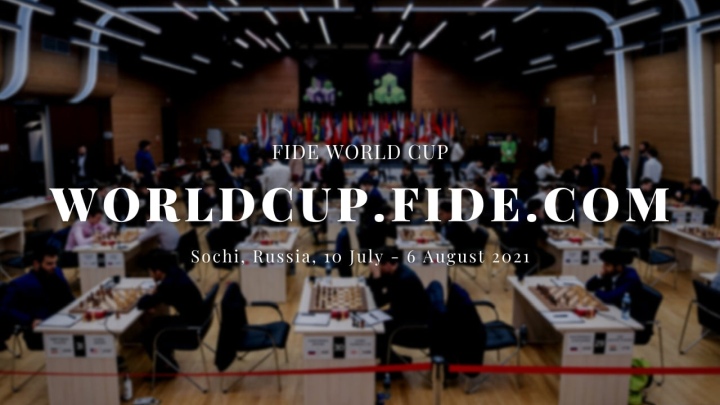
The European Hybrid Qualification Tournament for the FIDE World Cup took place from May 24-30 on Tornelo online platform. All the federations had specially designated and approved venues supervised by local arbiters and monitored by cameras. The event brought together 264 players from 35 European federations. Playing venue – Greece After three rounds of knockout playoff 36 players punched their tickets to the 2021 Sochi FIDE World Cup: Vladislav Artemiev (RUS, 2709) Evgeny Tomashevsky (RUS, 2706) Andrey Esipenko (RUS, 2701) Alexandr Predke (RUS, 2690) Maxim Matlakov (RUS, 2688) Vladimir Fedoseev (RUS, 2687) David Anton Guijarro (ESP, 2673) Ivan Cheparinov (BUL, 2667) Sanan Sjugirov (RUS, 2663) Constantin Lupulescu (ROU, 2656) Grigoriy Oparin (RUS, 2652) Viktor Laznicka (CZE, 2647) Alexander Motylev (RUS, 2641) Haik Martirosyan (ARM, 2637) Mustafa Yilmaz (TUR, 2630) Daniel Bogdan Deac (ROU, 2627) Pavel Ponkratov (RUS, 2624) Shant Sargsyan (ARM, 2618) Evgeny Alekseev (RUS, 2617) Rasmus Svane (GER, 2615) Vadim Zvjaginsev (RUS, 2614) Arik Braun (GER, 2609) Aleksandar Indjic (SRB, 2607) Ivan Ivanisevic (SRB, 2606) Baadur Jobava (GEO, 2603) Michal Krasenkow (POL, 2597) Ante Brkic (CRO, 2592) Hovhannes Gabuzyan (ARM, 2590) Thai Dai Van Nguyen (CZE, 2577) Can Emre (TUR, 2569) Luka Paichadze (GEO, 2565) Sasa Martinovic (CRO, 2548) Boris Savchenko (RUS, 2538) Nikita Afanasiev (RUS, 2522) Adam Kozak (HUN, 2518) Pawel Teclaf (POL, 2502) Playing venue – Russia Photo: Vladimir Barsky The event was dominated by the Russian players as 14 of them qualified for the FIDE World Cup taking place in their country. Armenia got 3 qualifiers, while Turkey, Croatia, Serbia, Czech Republic, Germany, Georgia, Poland and Romania earned two slots each. Bulgaria, Spain and Hungary got one ticket each. The 36 qualifiers took part in the European Hybrid World Cup Qualifier Swiss Tiebreaker – a 9-round Swiss tournament (10+3) held to distribute the €32,000 prize fund. Vladislav Artemiev (RUS, 2709) and Aleksandar Indjic (SRB, 2607) tied for first with the former coming out on top thanks to better tiebreaks. Pavel Ponkratov (RUS, 2624) shared third place with Haik Martirosyan (ARM, 2637) and again tiebreaks favoured the Russian GM. All games at the event were broadcast live with commentary by WGM Keti Tsatsalashvili and GM Marcin Tazbir.
Round 7: Black is more than OK
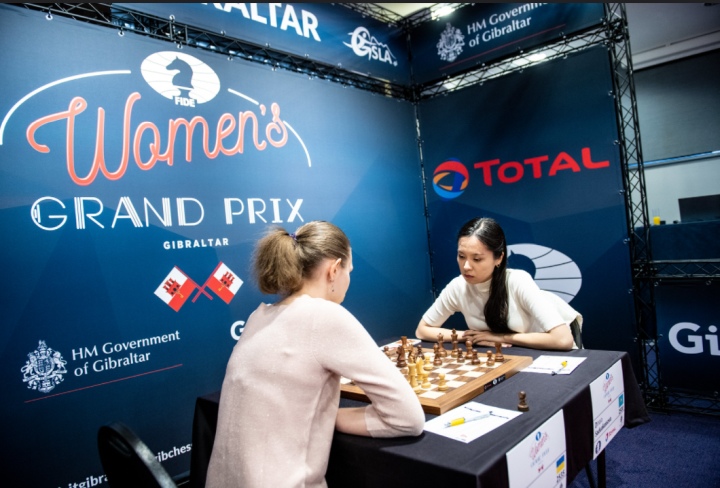
After another exciting day’s play and four decisive results, round seven of the Gibraltar leg of the FIDE Women’s Grand Prix at the Caleta Hotel on 29 May 2021 ended with Zhansaya Abdumalik of Kazakhstan in the lead on 5½, Mariya Muzychuk in second place on 5, and Kateryna Lagno of Russia and Gunay Mammadzada of Azerbaijan in joint third on 4½. In the race for the two places in the Candidates’ tournament, it was a good day for Humpy Koneru, watching from afar in India, and Kateryna Lagno, but a bad one for the other contenders, Nana Dzagnidze and Anna Muzychuk, who both lost with White and now have considerable ground to make up. Anna Muzychuk’s game with Dinara Saduakassova was an eventful battle. It started with an intriguing variation of the open Ruy Lopez, with Black sacrificing the exchange on move 24. On commentary, Veselin Topalov expressed some surprise about White’s 21.Ba2, as the light-squared bishop became vulnerable to the previously mentioned exchange sacrifice. He preferred 21.e6 followed by ideas such as Ne5. “Critical and natural,” as he put it. After the exchange sacrifice, Anna immediately went wrong with 26.Ra6, putting the rook seriously offside. Anna’s next move, 27.Ne5, left her kingside wide open to a wide range of tactics, although not so easy for humans to disentangle. However, Dinara soon hit on the best plan and finished the game in some style. This defeat put a severe dent in Anna’s hopes of qualifying for the Candidates’ tournament. As much as we feel sorry for her, we also have to be delighted for Dinara who has had a tough time in the first half of the tournament and has now recorded her first win. Nana Dzagnidze opened against co-leader Zhansaya Abdumalik with a London System (involving d4 and Bf4), which always used to be regarded as insipid but has now been in vogue for some years. On move 15 Zhansaya played 15…Qd8, allowing Nana to capture a pawn on b7. Zhansaya countered with 16…Nxd4 but the computers were flagging up 17.Bf1 as a strong reply. Nana opted for 17.Kf1 instead. Zhansaya was still walking a tightrope, but the Georgian failed to take advantage. Zhansaya deliberately conjured up a big mess on the board when Nana started getting short of time. Nana would still have been in the game had she found 24.Rcc4 but this was a deep computer game that no human could be expected to find. Thereafter the win was easy for Black. The result substantially increased the young Kazakhstani player’s chances of winning the tournament. A loss for Nana means her prospects of reaching the Candidates’ tournament have been affected. Humpy Koneru, no doubt following events in India, will be feeling that losses for Anna and Nana in this round have greatly increased her chances of playing in the Candidates’ event. Alina Kashlinskaya and Irina Bulmaga, both on 1½/6, had a discussion with a Bogo-Indian. One snag about the line chosen is that it gifts White the two bishops. Perhaps 15…Nxd2 was an improvement for Black. As played, White gained space and was able to follow her plan while Black had difficulty in unravelling her slightly cramped position. On move 30 Black might have been able to fight on but 30…Ng8 allowed a move forcing the win on the f7-pawn, after which White’s attack broke through quickly. Irina paid her opponent the courtesy of playing through to checkmate. Elisabeth Paehtz defended against Kateryna Lagno’s e4 with a Najdorf Sicilian, which usually results in some entertaining chess. However, Elisabeth settled for something more restrained and, as the material was exchanged, the game was soon headed for a quiet conclusion. Kateryna could still be well content with her day as her two rivals for the Candidates’ place, Nana and Anna, had lost with White. With four rounds remaining, she is a clear point ahead of Nana and 1½ points ahead of Anna, and her rivals need to overtake her to, not simply finish level with her. The battle of the former world champions, Mariya Muzychuk and Antoaneta Stefanova, started in a strange way with an unusual treatment of the Queen’s Gambit for Black by Antoaneta. Her fellow countryman Veselin Topalov, making his debut as commentator today, admitted on commentary that he didn’t understand Antoaneta’s plan of 3…a6 followed by 5…Nc6. He also questioned moves such as 8…f5 and 9…h5, weakening the dark squares. Mariya held a stable plus, but much depended on the e4 break, which she opted for as soon as it became feasible on move 19. The position soon looked miserable for Black when White lodged a knight on f4 and menacing a number of weak white squares in the Black camp. Antoaneta later admitted she was lost, though there were still some complications. Then, just as the players reached the time control, Mariya allowed a trick. Antoaneta checked with the queen, sacrificed a rook on b2, and then infiltrated the white camp with her queen. At first sight, it didn’t look like a perpetual check as the queen was only supported by a pawn on c4. But perpetual check it proved to be and Antoaneta had escaped with a draw. The longest game of the day, Valentina Gunina, playing White against Gunay Mammadzada, saw the Russian GM play a restrained line, the Closed Sicilian, against Gunay’s 1…c5. Commentator Veselin Topalov wasn’t sure about Gunay’s plan of 8…h5, though Stockfish seems to favour it. Valentina opted for a queenside thrust with 12.b4, which looked promising but needed to be followed up accurately. Soon the game became complicated and descended into a slugging match. Eventually, Gunay emerged with extra material after Valentina blundered with 47.Be2. In desperation, Valentina sacrificed a second piece to create chaos, but it didn’t really work and Gunay could return one piece and retained a stable material advantage. Still, Valentina fought on, as she always does, but Gunay didn’t buckle under the pressure of having to play purely on the increment. Valentina is a tough fighter but she finally had to call it a day on move 96. Another excellent
Vaishali R. wins Qualifier II

WGM Vaishali R. became the second player to qualify for the main event of the 2021 Women’s Speed Chess Championship. She is the second player from India to make it to the final stage of this prestigious online competition. This qualifier was a 9-round Swiss tournament (3+1 time control), with the top eight finishers advancing to the knockout playoff stage. In the semifinals, Vaishali R. defeated Bibisara Assaubayeva 2-0, whereas Polina Shuvalova (Russia) who had reached semis the day before made it one step further this time after besting Karina Ambartsumova by the same score 2-0. The final started with a drama in the first game – the Indian GM completely outplayed her Russian opponent in a knight-vs.-bishop endgame with black pieces but lost on time in an absolutely winning position (most likely due to some connectivity issue). With her back against the wall, Vaishali R. launched a furious attack in game two, checkmated Black’s king and levelled the score. The third and final game turned into a roller-coaster. The Indian obtained a very promising position from the opening but spoiled it by hastily sacrificing her queen for a rook and minor piece. Polina seemed in full control but then she made a terrible blunder in mutual time scramble that cost her dearly. Vaishali emerged up a rook and sealed her spot in the main event of the 2021 Women’s Speed Chess Championship. The next qualifier will happen on Sunday, May 30 starting at 7 a.m. Pacific/16:00 CEST. The FIDE Chess.com 2021 Women’s Speed Chess Championship is an online competition for titled female players. The qualifiers for the event will happen from May 28-June 6, while the main event runs June 10-July 3. Players will battle for their share of a total prize fund of $66,000. One player from each playoff qualifier will move on to the main event. There they will be joined by eight invited players: GM Humpy Koneru (IND), GM Alexandra Kosteniuk (RUS), GM Antoaneta Stefanova (BUL), GM Anna Muzychuk (UKR), GM Irina Krush (USA), GM Kateryna Lagno (RUS), GM Lei Tingjie (CHN). Fans can follow the FIDE Chess.com Women’s Speed Chess Championship by watching the live broadcast with expert commentary on Chess.com/TV and Chess.com’s Twitch channel. They will also be able to enjoy the event through Chess.com’s Events page (https://www.chess.com/events). More info and a full schedule of the FIDE Chess.com Women’s Speed Chess Championship can be found here.
Shamsiddin Vokhidov clinches Asian Hybrid Championship title

Shamsiddin Vokhidov became the winner of the Asian Individual Hybrid Chess Championship. The 19-year old from Uzbekistan (pictured below) scored 7 out of 9 tied for first place with IM Tin Jingyao (Singapore) but came out on top thanks to better tiebreaks (average rating of the opponents). The champion beat a leader Temour Kuybokarov in a critical Round 8 clash and then drew the last round game with Tin Jingyao. The event, a 9-round Swiss tournament took place from May 21-29 on Tornelo platform. The top seven finishers qualified for the FIDE World Cup, which will be held in Sochi, Russia (July 2021). Photo: Galina Popova It is worth noting that the top-rated player Parham Maghsoodloo did not make the cut, whereas Tin Jingyao (ranked 19) and Mohamad Ervan (ranked 36) caused a minor sensation and punched the tickets to Sochi. Given that Temur Kuybokarov and Nodirbek Yakubboev qualified for the FIDE World Cup 2021 via Zonal 3.6 and 3.4 respectively, Sugar Gan-Erdene (Mongolia) and Lu Shanglei (China) who finished just outside of top-7 also can pack their bags for the trip to Russia. Since the Indian players were unable to take part in the tournament due to the pandemic and new restrictions, one spot in the FIDE Word Cup is granted for the Indian Chess Federation. Final standings: 1 GM Vokhidov, Shamsiddin UZB 2529 7 2 IM Tin, Jingyao SGP 2482 7 3 GM Kuybokarov, Temur AUS 2549 6½ 4 GM Tabatabaei, Amin IRI 2613 6½ 5 GM Yakubboev, Nodirbek UZB 2605 6½ 6 IM Ervan, Mohamad INA 2356 6½ 7 GM Sindarov, Javokhir UZB 2544 6½ 8 IM Gan-Erdene, Sugar MGL 2419 6 9 GM Lu Shanglei CHN 2615 6
From “flashcards” to Chessable

We’ve received many congratulations and positive words about FIDE’s new partnership with Chessable, the world’s leading and largest chess e-learning platform. However, for those of you not yet familiar with our new sponsors, we would like to share a bit more about Chessable and their mission to help make learning chess more fun and efficient, while making chess education a more professional and sustainable career for all. These are values that both FIDE and Chessable share, making them a perfect partner for FIDE in the years to come. Chessable’s staff consists of certified chess coaches, grandmasters and scientists in the field of educational psychology. Chessable’s CEO David Kramaley himself is a published scientific author on the topic of chess improvement. So, what is Chessable? Chessable.com is a comprehensive and social learning website that offers interactive chess courses with and without video instruction on all possible areas of expertise such as openings, endgames, tactics, strategy and more. Chessable also offers interactive versions of classic chess books built on top of its unique MoveTrainer™ software. Chessable’s online library of courses has quickly grown to be one of the largest in the world with hundreds of exclusive courses free and paid, by top players and coaches, including world champion Magnus Carlsen. What makes Chessable different and unique? With its MoveTrainer™ software, Chessable utilizes two main concepts – spaced repetitions/scheduling and gamification – and relies on a scientific approach. How does it work? By now, we think the story of the Polgar family’s famous private flashcard system, the “cartothec”, is no longer a secret in the chess world. It was a key part of the Polgar sisters’ tremendously successful training regimen. Photo courtesy of the Polgar family In many ways, Chessable has taken this classic idea of “flashcards” to a whole new level. On Chessable everything is an interactive flashcard. Opening lines, endgame positions, tactics, and grandmaster games are given to students as part of an online curriculum, a course. Sometimes the student starts by copying the moves shown and is then asked to repeat them to show he has learned them. At other times the student is quizzed to show what he has already learned. All of the student’s progress is stored on the site and served back in timed intervals until the student can play the moves perfectly. Students can earn points and badges for their progress making the act of studying itself a game! Chessable saves coaches and students alike enormous amounts of time by having all of the positions already preloaded on the site making it instantly accessible and instantly trainable. “My experience with the Chessable digital version of 100 Endgames You Must Know (by New In Chess) was highly favourable. Because I’m a data nut, I can tell you exactly how long it took me to go through the paper version in 2008, setting the board included: 88 hours. That doesn’t include positions I photocopied and carried with me, but actual sit-down time with the book and board. The Chessable version has taken me 34 hours (and change), and I’ve gone through the book more than 9 times already. The degree of efficiency, not having to deal with setting up the board, is outrageous”, says David Milliern, a Chessable student. To top it off, most authors on Chessable are active on the site and readily answer questions by students and coaches in the comments section under the trainable positions, making the study experience both a social and an educationally complete tool for anyone interested to improve. FIDE Official Chess Learning Partner
Harika Dronavalli wins Qualifier I
Harika Dronavalli (India) became the first player to qualify for the Main Event of the 2021 Women’s Speed Chess Championship, after beating Le Thao Nguyen Pham (Vietnam) in the final of the Qualifier I playoffs on May 28. This qualifier was a 9-round Swiss tournament (5+1 time control), with the top eight finishers advancing to the knockout playoff stage. In the semifinals, Harika defeated Bibisara Assaubayeva from Kazakhstan (1.5-0.5) whereas Le Thao Nguyen Pham broke down the resistance of Polina Shuvalova (Russia) only in the third game to advance into the final. It was all Dronavalli in the final who convincingly outplayed her Vietnamese opponent in both games and secured her spot in the Main Event of the 2021 Women’s Speed Chess Championship. “It feels really good. Since we have so many qualifiers you don’t know when you actually qualify and you have to work hard every day. So it is very good to qualify on Day 1” said the happy winner in a short interview after the final Qualifier II will be on May 29 at 7 a.m. Pacific/16:00 CEST. The FIDE Chess.com 2021 Women’s Speed Chess Championship is an online competition for titled female players. The qualifiers for the event will happen from May 28-June 6, while the main event runs June 10-July 3. Players will battle for their share of a total prize fund of $66,000. One player from each playoff qualifier will move on to the main event. There they will be joined by eight invited players: GM Humpy Koneru (IND), GM Alexandra Kosteniuk (RUS), GM Antoaneta Stefanova (BUL), GM Anna Muzychuk (UKR), GM Irina Krush (USA), GM Kateryna Lagno (RUS), GM Lei Tingjie (CHN). Fans can follow the FIDE Chess.com Women’s Speed Chess Championship by watching the live broadcast with expert commentary on Chess.com/TV and Chess.com’s Twitch channel. They will also be able to enjoy the event through Chess.com’s Events page (https://www.chess.com/events). More info and a full schedule of the FIDE Chess.com Women’s Speed Chess Championship can be found here.