

Ahmed Adly and Jesse February win African Chess Championship

The Egyptian Chess Players dominated the 2021 African Individual Chess Championship, taking four top places in the open section. The event was held from May 17-28, 2021 in Lilongwe (Malawi). The last championship took place in 2019 before the pandemic. The defending champion, GM Ahmed Adly retained his title in fierce competition with his compatriots. He scored an equal amount of points (8/9) with his fellow countryman and the top-rated participant GM Amin Bassem, but the tiebreaks (average rating of the opponents) favoгred the second-rated player of the competition. GM Fawzy Adham and GM Hesham Abdelrahman (both Egypt) finished in third and fourth places respectively. All four qualified for FIDE the FIDE World Cup 2021 that will take place in Sochi, Russia from July 10, 2021, to August 3, 2021. Final standings open: 1 Adly Ahmed EGY 2615 8 2 Amin Bassem EGY 2701 8 3 Fawzy Adham EGY 2473 7½ 4 Hesham Abdelrahman EGY 2400 6½ 5 Mwale Joseph MAW 2148 6 6 Bellahcene Bilel ALG 2508 6 7 Chipanga Chiletso MAW 2043 6 8 Bwalya Gillan ZAM 2405 6 9 Silva David ANG 2296 6 10 Barrish Daniel RSA 2306 6 In the women’s section, WIM Jesse Nikki February emerged as the winner. The 24-year old from South Africa clinched the championship, finishing a half-point ahead of her main rivals. This result also earns her the Woman Grandmaster (WGM) title – she needs to fulfill FIDE title requirements, by attaining the rating of 2100. WIM Lina Nassr tied for second with WIM Ayah Moaataz but took silver thanks to better tiebreaks. Final standings women: 1 WIM February, Jesse Nikki RSA 7 2 WIM Nassr, Lina ALG 6½ 3 WIM Moaataz, Ayah EGY 6½ 4 WFM Mwango, Lorita ZAM 6 5 WGM Wafa, Shahenda EGY 6 6 WCM Charinda, Kudzanayi ZIM 6 7 Shriyan, Santosh MAW 5½ 8 WFM Marape, Naledi BOT 5½ 9 WFM Mongeli, Sasha KEN 5½ 10 WFM Staal Michaela Francis RSA 5½ The Closing Ceremony of the 2021 African Individual Chess Championships took place on Thursday 27th May 2021 at Golden Peacock Hotel, Lilongwe. In attendance were Ulemu Msungama, Malawi’s Minister of Youth and Sport; Kezzie Msukwa, Malawi’s Minister of Lands, Housing and Urban Development; Lewis Ncube, President, African Chess Confederation, Susan Namangale President of Chess Association of Malawi and many more dignitaries. Kudos to the African Chess Confederation (ACC) and Chess Association of Malawi on the successful organization of the 2021 African Individual Chess Championships. Our sincere appreciation goes to Mrs. Susan Namangale and the media department at the AICC for providing us with pictures of the event. Text: Fawole John Oyeyemi, bruvschessmedia.com
“The Queens’ Festival”: Connecting Women in Chess

The Global Women’s Online Chess Challenge “The Queens’ Festival”, a series of continental and global women’s online chess tournaments and educative side events, will start on June 11, 2021. The festival organized by the FIDE Commission for Women’s Chess in cooperation with the FIDE Events Commission and with the support of the Asian Chess Federation, African Chess Confederation, European Chess Union, and Confederation of Chess for Americas is a unique all-inclusive event aiming at developing a strong global community of women in chess and enhancing the participation of women in all aspects of chess life. Built on the recent success and appeal of the Netflix series “The Queen’s Gambit”, this event promotes female players, organizers, arbiters, influencers, leaders, and rising stars of all levels, backgrounds and countries. Players from Africa, Asia, Europe and the Americas will first be able to participate in the Continental Online Blitz Qualification Tournaments and those who qualify will advance to the Queens’ Online Individual and Team Finals. You can view the Regulations here. Registrations for the tournaments are made by the National Federations by filling this Excel file and sending it to the organizers’ email address: queensfestival@fide.com For those interested in various chess-related topics, we prepared seminars and networking events with special guests including Dana Reizniece-Ozola, Dinara Saduakassova, Jennifer Shahade, Susan Namangale, Regina Pokorna, Sarkhan Gashimov, Dr. Gnounewou Fopa Seraphin and others. Registration for side events is here. More information about the event can be found at queensfestival.fide.com We invite all female chess enthusiasts to participate, play, learn and connect. Doing what we love, together we can make a difference in our global chess community! Eva Repkova, Chair of FIDE WOM Commission
Round 6: Valentina’s vultures
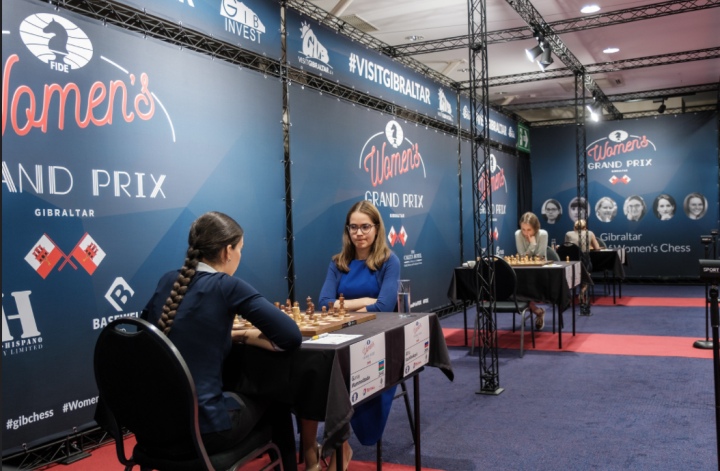
Zhansaya Abdumalik (KAZ) and Mariya Muzychuk (UKR) are the co-leaders going into the rest day of the Gibraltar leg of the FIDE Women’s Grand Prix which took place at the Caleta Hotel on 27 May 2021. Zhansaya and Mariya drew their game to move to 4½ out of 6, and are followed by Kateryna Lagno (RUS) on 4. The round started quietly but we were in for a rousing finale when Elisabeth Paehtz (GER) and Valentina Gunina (RUS) played out an exciting second session. We’ll save it for last. The first game to finish was a quiet draw in a Grünfeld between Dinara Saduakassova (KAZ) and Kateryna Lagno (RUS). Dinara has had a tough tournament and perhaps wants to refocus on the rest day and see what she can achieve in the final five rounds. Kateryna is playing cautiously, with one eye on her rivals for the Candidates’ place that is sure to be available from the Gibraltar tournament. A second draw was sealed in the game between Antoaneta Stefanova and Anna Muzychuk. This started life as a QGD, with some resemblance to a 2.c3 Sicilian in due course. A cagey game ensured, with both players steering clear danger. The third game to end was the clash between the two tournament leaders, Zhansaya Abdumalik and Mariya Muzychuk. In Rossolimo Sicilian, both players castled kingside, with Mariya (Black) advancing her kingside pawns nevertheless, and Zhansaya countering in the centre. Material gradually disappeared from the board and the players agreed to a draw as the game moved towards a level rook endgame. Finally, after around three hours’ play, we saw a couple of decisive outcomes. I think it’s fair to say that both came as a result of blunders and perhaps some tiredness after six solid days of uncompromising chess. Alina Kashlinskaya, after playing a Petroff Defence, miscalculated a long variation and was stunned when Gunay Mammadzada played a temporary queen sacrifice to win material. Or perhaps Alina missed an intermezzo check in an even longer variation. This was another blow for the Russian player who has had a nightmare tournament. Let’s hope she can recover after the rest day. At the same time, we must congratulate Gunay for her tactical opportunism and energetic play. She followed up her win of material accurately and efficiently. Nana Dzagnidze tried an unusual line of the Sicilian against Irina Bulmaga and it paid off handsomely as she emerged with a comfortable position from the opening. Nana said she didn’t like Irina’s move 10.Qd3. It was interesting that analysis engines disagreed with her at first, but then came round to Nana’s way of thinking after a few more moves. Nana felt confident she was better after she placed her bishop on e5. Irina’s position kept worsening the move and she tried a piece sacrifice with 20.Bxd5, but it achieved little and the rest of the game proved to be a technical mopping up operation. The game of the day was also the longest. Elisabeth Paehtz’s encounter with Valentina Gunina began with an unusual line of the Caro-Kann. After queens were exchanged, Elisabeth emerged with a spatial advantage which she maintained well into the middlegame. Her prospects looked promising but then she played 32.b6. This might have been a little hasty as Valentina responded with a very clever exchange for pawn sacrifice which received the analysis engine’s seal of approval. As the players reached the time control, Black was arguably a little better, with two passed pawns ably supported by two bishops. The game still might have turned out a draw, but Elisabeth made a further mistake and Valentina’s demon bishops started to menace her king like vultures. White’s king found itself herded to the side of the board as the black bishops and rook circled. The problem for Elisabeth was that she was so short of time and her defensive moves rather harder to find than Valentina’s attacking ones. Sure enough, as her time ebbed away, Valentina found a way through Elisabeth’s various tactical tricks to escape the net and mated the white king. It was an exhausting game for both players. Even in victory, Valentina was still in shock as she left the playing hall and didn’t utter a word until I began the interview. Candidates Tournament: Qualification Possibilities As we reach the halfway mark of the tournament, it’s time to give consideration to the principal reward of the Women’s Grand Prix series: qualification for the Candidates Tournament. The full current standings after three tournaments can be found here. Aleksandra Goryachkina (RUS), with 398 points, has already secured the top place in the Grand Prix but she has also qualified for the Candidates via a different route as world championship runner-up. So that means the two people to qualify for the Candidates via the Grand Prix will be numbers two and three in the Grand Prix overall points table. Before the Gibraltar tournament, Humpy Koneru, who is not playing here, was in second place with 293 points. Three Gibraltar contestants, Nana Dzagnidze (180), Kateryna Lagno (180) and Anna Muzychuk (165) can still pass her score with a first or second place, but that would only push the Indian grandmaster down to third place, which still qualifies. Thus it would need two of the above names to finish first and second or share first place, to deprive Humpy Koneru of a spot in the Candidates. Another Gibraltar non-participant, Alexandra Kosteniuk, currently has 193 Grand Prix points to be in third place. But, to qualify, she would need all three Gibraltar participants cited above to score fewer than 13 points. Sadly for Alexandra, this is not mathematically possible as the player who finishes last in Gibraltar scores 10 Grand Prix points but, fatal to Alexandra’s aspirations, the 11th placed finisher scores 20 points. Even if two of the above players were to tie for last, they would still score 15 points each and overtake Alexandra. This means that at least one player currently in the Gibraltar line-up must overtake Alexandra and qualify for the Candidates from Gibraltar. Together with Nana, Kateryna and Anna, a fourth player in the line-up has a theoretical chance of qualifying for
FIDE Chess.com WSCC kicks off on May 28

The FIDE Chess.com Women’s Speed Chess Championship starts on May 28. The tournament, organized by the International Chess Federation and Chess.com, will consist of qualifiers held until June 6 and the main event from June 10 to July 3. Players will battle for their share of $66,000, the highest-ever prize fund for a women’s online competition.$58,000 will be allocated to the main event with $20,000 going to the winner and $12,000 to the runner-up. The first of the eight qualifiers of the FIDE Chess.com Women’s Speed Chess Championship will start this Friday at 7:00 a.m. PT (16:00 CEST). The events are Swiss Tournaments open to all titled female players (FIDE titles only). The participants can register by navigating to the upcoming tournaments tab located at Chess.com/live up to one hour before each qualifier begins. The eight top-finishing players from each Titled Swiss event will advance to a knockout Playoff Qualifier, which will happen right after each Swiss tournament is over. The participants will face each other in the 16-player brackets under three different time controls – rapid, blitz and bullet. One player from each playoff qualifier will move on to the main event. There they will be joined by eight invited players: GM Humpy Koneru (IND), GM Alexandra Kosteniuk (RUS), GM Antoaneta Stefanova (BUL), GM Anna Muzychuk (UKR), GM Irina Krush (USA), GM Kateryna Lagno (RUS), GM Lei Tingjie (CHN). Fans can follow the FIDE Chess.com Women’s Speed Chess Championship by watching the live broadcast with expert commentary on Chess.com/TV and Chess.com’s Twitch channel. They will also be able to enjoy the event through Chess.com’s Events page (https://www.chess.com/events). More info and a full schedule of the FIDE Chess.com Women’s Speed Chess Championship can be found here.
Round 5: Zhansaya and Mariya hold the Lead
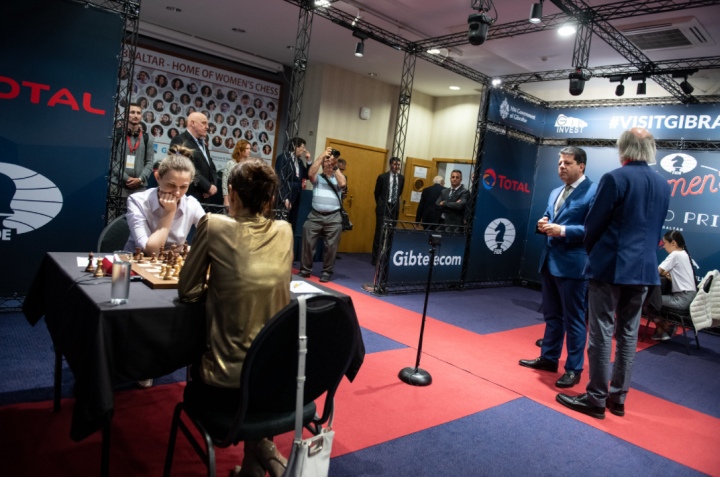
After round five of the Gibraltar leg of the FIDE Women’s Grand Prix played at the Caleta Hotel on 26 May 2021, two players share the lead on 4/5 points: Zhansaya Abdumalik (Kazakhstan) and Mariya Muzychuk (Ukraine). Two players, Kateryna Lagno (Russia) and Elisabeth Paehtz (Germany) have 3½ points. The round was opened by Fabian Picardo, Chief Minister of Gibraltar. After welcoming the players and complimenting the organisers on a ‘very impressive’ layout for the tournament, he expressed the wish that one day a Gibraltarian flag would appear alongside one of the competitors, who would compete alongside the top women’s world championship contenders. It wasn’t long before one of the games started to go downhill for one of the players. Antoaneta Stefanova came badly unstuck against Zhansaya Abdumalik’s Scotch Opening. Her 10…Bd6 was a grave error, and the young Kazakh player took full advantage, forcing the win of her opponent’s queen for two minor pieces, followed by a brisk mopping-up exercise. This took the overnight co-leader to 4/5 and threw down the gauntlet to her two main rivals to try and catch her. Another overnight leader, Kateryna Lagno, was unable to follow suit, despite having a promising position from an Italian Opening against Anna Muzychuk. Kateryna should perhaps have reacted more directly with 23.Qxe4 but she still managed to annex a pawn on move 25. However, Anna had calculated that she might have sufficient positional compensation for the material and so it proved. Kateryna returned the pawn to secure a drawn position. Alina Kashlinkskaya is having a nightmare tournament. For the third time in five games, she let a winning advantage slip and lost. At first, it seemed that her opponent, Elisabeth Paehtz, was suffering a bad dream as she played a calamitous move, 9…Nfd7, in a QGD Tarrasch Defence, allowing her opponent a combination leading to a big plus. Elisabeth was unable to castle and her rooks couldn’t connect, so the resourceful German player hit on a plan of developing her entombed rook via the h-file. Later analysis revealed that it should not have been successful but mutual time trouble led to a chaotic position in which Elisabeth gradually gained the upper hand. By the time control, poor Alina was looking at a wreck of a position and a material deficit. After a few mating tries were rebuffed, she was forced to resign. All credit, though, to Elisabeth who, not for the first time in this tournament, rode her luck and displayed her resourcefulness. The three remaining games were long and hard-fought. Gunay Mammadzara plays some of the most exciting chess of the players present in Gibraltar and she gave Nana Dzagnidze a really good fight, coming close to a win. The opening was a Semi-Slav and Gunay managed to isolate and put pressure on Nana’s d-pawn. She also opened up lines against the white king on h2 and might have missed a couple of tactical shots (e.g. 25…gxh3 and if 26.gxh3 then 26…Bxh3!) along the way when in her habitual time trouble. Nana too might have missed some counter-chances such as 38 Qb4 to wrest the initiative. Eventually, it came down to Gunay’s three pawns against Nana’s knight and nothing, but the only possible result was a draw. The remaining two games boiled down to rook and pawn endgames, both of which were won by the player with the extra pawn. Valentina Gunina told us she had been instructed to be more circumspect by her coach rather than overindulging tactics, and this proved a sage move. The opening was a Queen’s Indian (or possibly a Bogo-Indian) and Dinara Saduakassova was unable to mount a sufficiently active counterplay, soon being tied to the defense of a weak d-pawn. After the time control the pawn dropped off and, with some careful, patient play, Valentina was able to create a passed e-pawn and also infiltrate her king at b5, after which the fight was over. Mariya Muzychuk quickly secured a slight but persistent edge against Irina Bulmaga in Rossolimo Sicilian, but she felt that Irina might have put up a more solid defense had she played 19…Kf6 rather than 19…Kd7. As played, White was quickly able to gain an extra pawn when, despite a few technical problems, the endgame also looked likely to be a winning one. Mariya thus joined Zhansaya as an overnight leader on 4/5. The two leaders, Zhansaya Abdumalik and Mariya Muzychuk clash in round six on Thursday 27 May at 15.00 GMT+2 with Nigel Short and Fiona Steil-Antoni providing the commentary. The rest day is on Friday 28 May, after which former world champion Veselin Topalov takes over commentary duties from Nigel Short. Standings after Round 4: 1-2. Zhansaya Abdumalik, Mariya Muzychuk –4; 3-4. Elisabeth Paehtz, Kateryna Lagno – 3½; 5-7. Gunay Mammadzada, Nana Dzagnidze, Anna Muzychuk – 2½; 8-9. Antoaneta Stefanova, Valentina Gunina – 2; 10-11. Irina Bulmaga, Alina Kashlinskaya – 1½; 12. Dinara Saduakassova – ½ Text: John Saunders Photo: John Saunders and David Llada
Carlsen survives almighty scare Caruana wins prelim stage
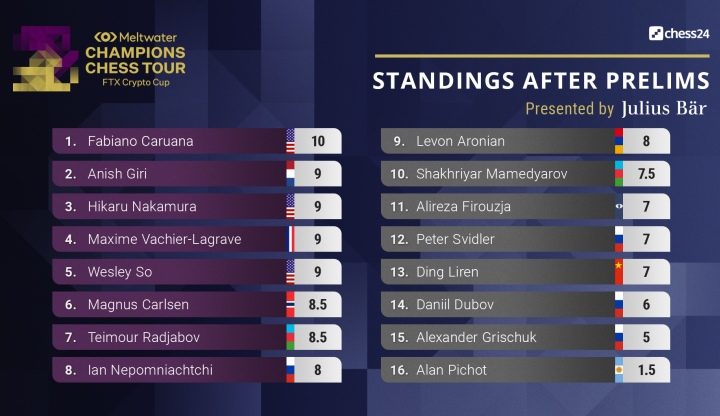
A frantic end to the FTX Crypto Cup’s prelim stage saw a surprise winner and Magnus Carlsen narrowly avoid being knocked early. The World Champion survived by the skin of his teeth as the three-day round-robin finished with Fabiano Caruana out on top. Caruana may be world number 2, but he is playing in his first Meltwater Champions Chess Tour event and was thought to have struggled to adapt to the rapid format. The American dispelled those myths immediately with a dominant 10/15 to sail into the knockout stage. However, the real surprise was Carlsen in serious danger of being knocked out at the first hurdle of a Tour event before pulling out a win when it mattered most. Carlsen got the vital point he needed to save the day in a nerve-jangling final round against Airthings Masters champ Teimour Radjabov. Anything less than a win would have meant Carlsen’s exit at the prelim stage for the first time since elite chess went online last year. The result meant heartbreak for Levon Aronian who had won his final game to pile even more pressure on Carlsen – but when it mattered most the champ held firm. “Obviously it’s a massive relief,” Carlsen said after. Tied for second behind Caruana were four players: Anish Giri, Hikaru Nakamura, Maxime Vachier-Lagrave and Wesley So all on 9/15. Radjabov finished level with Carlsen on 8.5, half a point ahead of this year’s World Championship challenger Ian Nepomniachtchi. Like his opponent in November, the Russian also had a rough ride and only just scraped into the top 8 at Aronian’s expense on a tiebreak. For further information, please contact: Leon Watson, PR for Play Magnus Groupleon@chessable.com+44 7786 078 770
R 04: Joy for the Muzychuks, but Elisabeth steals the show
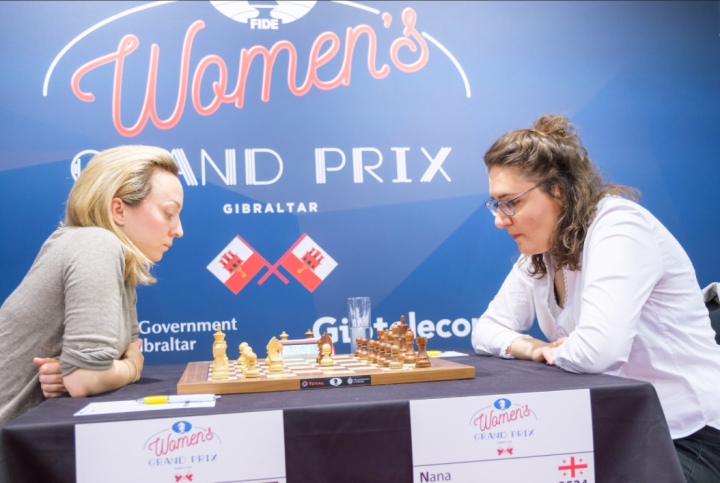
Three players share the lead after round four of the Gibraltar leg of the FIDE Women’s Grand Prix played at the Caleta Hotel on 25 May 2021. Zhansaya Abdumalik (Kazakhstan), Mariya Muzychuk (Ukraine) and Kateryna Lagno (Russia) have three points from a possible four, and they are also the only players in the field who remain unbeaten, such has been the uncompromising nature of the play. In fourth place is Elisabeth Paehtz (Germany) on 2½. Nana Dzagnidze of Georgia is one of the leading contenders to qualify from the Women’s Grand Prix for the Candidates’ competition, but her chances suffered a severe blow when she lost to Elisabeth Paehtz in what was the game of the day. Elisabeth played a c3 Sicilian which resulted in hanging pawns on c4 and d4. However, there was no obvious way to bring pressure to bear on what is usually seen as a weakness (but, in this case, wasn’t). Nana took four moves to relocate her knight from a6, where it had no prospects, to f6, where it might have more scope. However, allowing Elisabeth to swap a bishop for the knight on f6 and break up her kingside pawn structure proved disastrous. Elisabeth immediately launched her full force at the kingside and it was soon apparent that Black had little defence against the onslaught. Eventually, Nana had to give up her queen, plus two pawns, for two rooks, to prevent being mated but the cost was too high. With White’s king safely protected from rook checks, and Black’s opposite number exposed to an infinity of unpleasant checks, the outcome was never in doubt. A fine win for Elisabeth. Gunay Mammadzada of Azerbaijan has established a reputation for brinkmanship and enterprise in this tournament so far but she came unstuck against former world champion Mariya Muzychuk. After 18 moves of solid Sveshnikov Sicilian theory, Mariya went into a side-line with 18…Bd7, though the first new move was her 20…f5, following a pawn sacrifice for some activity Gunay’s play in an imbalanced and complex position seemed reasonable enough until she went seriously wrong with 25.b4, after which her position collapsed with alarming rapidity. It was a great round for the Muzychuk sisters as Mariya’s sister Anna also secured a full point in the longest game of the day against Valentina Gunina of Russia. Anna chose an offbeat and innocuous line against Valentina’s Caro-Kann. Anna was of the opinion that she was slightly worse in the early middle game until Valentina embarked on a three-move excursion with her queen, during which time the position equalised and then swung in favour of Anna by virtue of her control over the d-file. Though a little short of time, Anna maintained her grip until the time control, steadily outplaying her opponent from that point on. A knight ending morphed into a queen and knight ending as both players queened pawns but by now Anna had worked out a continuation through to victory. Irina Bulmaga’s game with round three co-leader Zhansaya Abdumalik was another Sveshnikov Sicilian and had some point of interest. But, after the queens came off, despite an imbalanced pawn structure, neither player found enough scope to merit playing on beyond move 30. Antoaneta Stefanova and Kateryna Lagno headed into an unpromising side-line of the Grünfeld, which resulted in massive exchanges and a sterile rook and pawn endgame after 30 moves. Dinara Saduakassova, playing White, was content to end her run of losses with an early draw against Alina Kashlinskaya in a line of the English which ended with a three-move repetition. Standings after Round 4: 1-2. Zhansaya Abdumalik, Kateryna Lagno, Mariya Muzychuk – 3; 4. Elisabeth Paehtz – 2½; 5-8. Gunay Mammadzada, Nana Dzagnidze, Anna Muzychuk, Antoaneta Stefanova – 2; 9-10. Irina Bulmaga, Alina Kashlinskaya – 1½; 11. Valentina Gunina – 1; 12. Dinara Saduakassova – 1/2. Text: John Saunders Photo: John Saunders and David Llada
FIDE expands support program for distinguished veterans

Dear Member Federations: The International Chess Federation is pleased to announce the expansion of its support program to distinguished chess veterans in 2021. Following the 12 grants that have been already distributed earlier this year, another 12 will be awarded in June. Players, coaches, and organizers aged 65+, who have contributed to the development of chess and who are in an unstable financial situation, are eligible to submit an application. We invite federations, clubs, and players themselves to send their applications, including a CV of the nominee, to the FIDE Secretariat: office@fide.com. The deadline for submissions is June 10, 2021. In 2020, FIDE allocated to this program an initial sum of €35.000, which was later expanded with an additional €21.000. Combined, this amounted to a total of €56.000, a record since FIDE launched this program in 2013. In 2021, €30.000 have already been distributed, and a similar sum has been allocated for this new batch of grants.
Round 3: Players go all-in
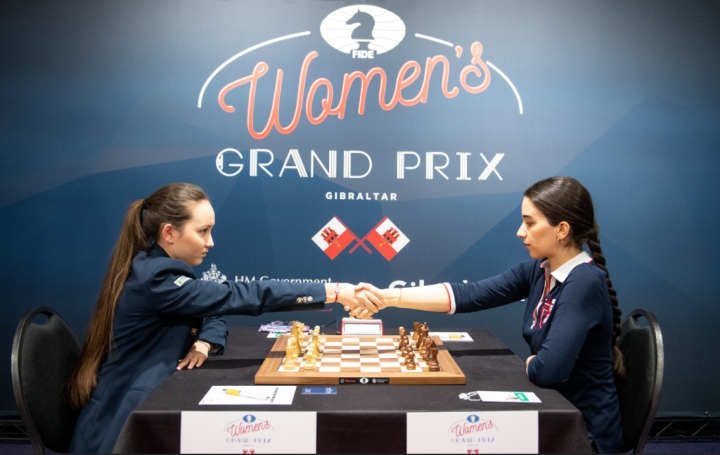
The lead after round three of the Gibraltar leg of the FIDE Women’s Grand Prix, played at the Caleta Hotel on 24 May 2021, is shared by two players: overnight leader Zhansaya Abdumalik (Kazakhstan) drew with Gunay Mammadzada (Azerbaijan) to make her score 2½ out of 3, while Kateryna Lagno won an all-Russian clash against Valentina Gunina to reach the same score. Three players, Gunay Mammadzada, Mariya Muzychuk (Ukraine) and Nana Dzagnidze (Georgia) are a further half-point behind, after another round of uncompromising chess which produced four decisive encounters and two hard-fought draws which lasted well into the second session. Everyone went all-in today: this is exactly the sort of chess we’ve been missing during the pandemic. There was much interest in the meeting of the two players born in the year 2000, leader Zhansaya Abdumalik and Gunay Mammadzada who is just half a point behind her. Despite their youth, they have already been rivals for many years, having first met in the World Girls’ Under 8 Championship in 2008. Today they proceeded down a familiar line of Semi-Slav Meran theory until about move 16, when Gunay, playing Black, gradually assumed the initiative as White proved to have wasted time with 13. Ng5. Zhansaya, not wanting to succumb meekly, lashed out with a dramatic piece sacrifice, 21.Bxh6. Capturing it was possible, and seemed to find favour with engines, but the advantage of doing so is not obvious to the human eye as the resultant position only looks slightly better for Black. Gunay opted to retain more options but Zhansaya defended tenaciously. The game remained horribly complicated right up to the time control, with Gunay running her clock down to one second remaining before playing her 39th move. Still, she retained an edge which led to winning a pawn. However, that wasn’t the end of the story as she was unable to find a way past Zhansaya’s determined defence. A draw after a splendid fight, which reflected well on both players. Alina Kashlinskaya had a nightmare start to the tournament, but fate smiled upon her last against Anna Muzychuk as the Ukrainian played into some of the Russian’s Classical Nimzo-Indian opening preparation. The consequence of 12…d4 and the subsequent exchange (for a pawn) sacrifice on d1 had all been carefully stress-tested in the Kashlinskaya/Wojtaszek opening laboratory before being inflicted on Anna. It meant leaving the white king in the center, but Alina was able to develop her rook via h3 and g3 and increase the pressure on Black’s king. Anna tried to blunt the attack by offering the exchange back but White simply emerged a pawn up to the good. Black tried to counter with an attack but Alina, after checking and double-checking her calculations (for fear of blowing another won position), mounted a final assault on Anna’s king. There’s still plenty of time to recover but this put a severe dent in Anna Muzychuk’s chances of challenging for a Candidates’ place. Nana Dzagnidze and Dinara Saduakassova opened with a line of the English in which the queens disappear as early as move 8. Dinara’s new move 9…b6 steered the game away from a line disputed by Levon Aronian and Maxime Vachier-Lagrave a couple of times. Though even for much of its course, the pawns were imbalanced on both sides of the board and it became a battle to see who could squeeze the most positional juice out of the structure in Magnus Carlsen style. During the post-game interview, Nana said she felt confident about her chances of exploiting her well-placed kingside pawns. That said, had Dinara played 33…Bd7, Nana wasn’t entirely sure of the way to take advantage of her extra kingside pawn (with Black’s extra queenside pawn having few prospects of undoubling). Thereafter Black soon succumbed. Elisabeth Paehtz versus Mariya Muzychuk was another Classical Nimzo-Indian, with Elisabeth as Black obtaining some early pressure against White’s d-pawn. Mariya’s reaction 15.Nh4 looked quite outlandish, but it proved its worth subsequently as she gained some compensation for the pawn. Indeed, White soon became the player with an extra pawn herself. However, it came down to a queen endgame in which White was unable to make real progress. Another draw and a real fight, albeit less entertaining for the spectators than the Abdumalik-Mammadzada confrontation. Valentina Gunina played an unusual line against Kateryna Lagno’s choice of King’s Indian Defence… at least, that’s what I thought until I checked a database and discovered that a good number of modern GMs, including Ian Nepomniachtchi, have been experimenting with these very same ideas.. (I suppose it goes to show that my own concept of what is usual in this defence is about fifty years out of date.) But I wasn’t impressed and neither, evidently, was Kateryna Lagno as she secured a comfortable, flexible black set-up quite quickly. More seriously, Valentina played 18.b4 rather too quickly and Kateryna exploited this with 19…Ra3 with a lateral attack along the rank. White’s 20.e5 worsened the situation and Valentina had to give up a knight in return for a pawn on the seventh and some tactical tricks. Kateryna proceeded to defuse all the tricks and cashed in her extra material to win, thus moving alongside Zhansaya as co-leader. Irina Bulmaga against Antoaneta Stefanova began life as a Scotch Opening. With the queens off and the pawns balanced on either side, a draw seemed the likeliest prospect, and remained so for much of the game, though both players strove to be positive and try to win. Irina, with White, seemed to preserve what little advantage there was as a result of having her king nearer the kingside action. Consequently, Black’s moves were a little harder to find. Eventually, Antoaneta went astray, according to analysis engines, on move 55 when 55…Kd7 would have kept her within sight of a draw, while everything else lost. But it looks like a desperately hard ‘only move’ for a human to work out, so Antoaneta will be too experienced and phlegmatic to reproach herself for missing it. A very fine win for Irina, who told us later that she had never won a classical game against Antoaneta previously. Standings after Round
FIDE announces qualification paths for Candidates Tournament 2022

The International Chess Federation has approved the qualification criteria to select the eight players who will participate in the Candidates Tournament 2022. Like in the previous cycle, the goal has been to devise a democratic qualification system, where every reasonably strong player is given a chance to qualify. These are the different qualifying events and criteria: A) One spot – FIDE World Championship Match 2021, Runner-up As tradition goes, one spot will go directly to the runner-up at the FIDE World Championship Match, to be played in Dubai (UAE) in November-December 2021. B) One spot – GM Teimour Radjabov (winner of the FIDE World Cup 2019) One place will be reserved for Teimour Radjabov, the winner of the FIDE World Cup 2019. FIDE President Arkady Dvorkovich mentioned that this was his intention in a recent interview. The FIDE Council members fully supported his position, so we are happy to confirm that Teimour will be granted this possibility. C) Two spots – FIDE World Cup 2021 Two spots will be decided at the FIDE World Cup 2021, to be played in Sochi (Russia), in July-August 2021. The two finalists in this event will earn their tickets to the Candidates 2022. It may happen that Teimour Radjabov or any of the two contenders in the 2021 match (Magnus Carlsen or Ian Nepomniachtchi) are in the final. In this case, the place will be passed on to the next non-qualified player in the FIDE World Cup (but not further than 4th place) or to the next non-qualified player in the FIDE Grand Prix Series 2022. D) Two spots – FIDE Chess.com Grand Swiss Tournament 2021 Two places will be at stake in the FIDE Chess.com Grand Swiss Tournament 2021, to be held in October-November 2021 in Douglas (Isle of Man). The two top-finishers in this 114-player event, which is expected to be the strongest Swiss event ever held, will advance to the next stage of the world championship cycle 2021-2022. If any of these two players happen to be already qualified through events A, B or C, the spot will go to the next non-qualifying player in the standings of the FIDE Chess.com Grand Swiss Tournament 2021. E) Two spots – FIDE Grand Prix Series 2022 The remaining two spots will be granted to the two top-finishers at the FIDE Grand Prix Series 2022, which will take place between February and April 2022. The Regulations for the Series will be published in June. We must note that the winner of the FIDE World Championship Match 2021 is not allowed to participate in Grand Prix Series. Likewise, none of the players already qualified via events A, B, C or D, is expected to take part in the Grand Prix. If any of them decides to participate, they should give up their qualification spot previously earned. In the eventuality of any schedule modification caused by the pandemic or any other force majeure circumstances, the FIDE Council is entitled to adjust the qualification criteria accordingly.