

FIDE Online Cadets & Youth Rapid World Cup 2021 announced

The FIDE Online Rapid World Cup (Cadets & Youth 10-18) is a two-stage tournament that will be played in 5 different age groups – under 10, 12, 14, 16, 18, and 2 sections – open and girls (totally 10 tournaments). The participants must not have reached their 10th, 12th, 14th, 16th, 18th birthday, respectively, before January 1st of the year 2021. Qualifying Stage (August 1 – 20, 2021) Every Chess Federation can register 3 (three) players per category in the qualifying stage (30 players in total) which is held in the format of 10-round Swiss tournament. In some cases, the federations are entitled to replace players from various age categories, boys and girls, within 30 players. According to the “medal statistics” of 2017 – 2020, some federations can register additional players. Federations are entitled to apply to the organizer for the wild cards during the registration process. Final stage (August 26 – 31, 2021) The finals will consist of ten separate 16-player KO tournaments (Girls under 10, 12, 14, 16, 18 and Open under 10, 12, 14, 16, and 18) with 6 players who have personal right to participated and 10 qualifiers in each, 160 participants in total. Three top-finishers per category will qualify for the FIDE Online Rapid Super Final 2021. The prize fund of Super Final amounts to €30,000. The players placed 4-8 (5 players) and one highest-rated player (by 01.08.2021 Fide Standard rating) among 9-16th places in the World Cup 2021 per category in each qualifying tournament will advance to the FIDE Online Rapid Grand Prix Series 2021. Registration deadline is July 10th, 22:00 CET, 2021. World Cup will be played on Tornelo platform. You can find all the information related to World Cup information on the tournament official website https://youth-worldcup.fide.com/ CONTACT INFORMATION Email address: youth@fide.com Additional Quota for Federations based on World Cadets & Youth Medal Statistics (2017 – 2020) FEDERATION Points Gold Points Silver Points Bronze Number of Playersallowed to participate 1 USA 99 36 21 156 2 RUS 72 54 27 153 3 IND 72 30 18 120 4 CHN 45 42 12 99 5 KAZ 9 24 9 42 6 ARM 9 12 3 24 7 UZB 0 18 6 24 8 POL 0 12 9 21 9 GER 18 0 0 18 10 IRAN 9 6 3 18 11 AZE 9 6 0 15 12 MGL 9 0 6 15 13 UKR 0 12 0 12 14 INA 9 0 3 12 15 HUN 0 12 0 12 16 NED 9 0 0 9 17 UAE 9 0 0 9 18 ESP 9 0 0 9 19 GEO 0 6 3 9 20 PER 9 0 0 9 21 SVK 9 0 0 9 22 SLO 9 0 0 9 23 CZE 0 6 0 6 24 PUR 0 0 3 3 25 SRB 0 0 3 3 26 ECU 0 0 3 3 27 VIE 0 0 3 3 28 COL 0 0 3 3 29 ITA 0 0 3 3 414 276 138 828 1 Gold = 9 points 1 Silver = 6 points 1 Bronze = 3 points
FIDE Chessable Academy: 140 Nominations from 51 Federations

Dear member Federations: At the close of the official deadline, the newly created FIDE Chessable Academy has received 140 nominations from 51 Federations to enrol their most promising young talents into this training program. Eligible players are between the ages of 8 and 16. This is the breakdown by country: No Country Boys Girls Total Africa 1 Botswana 1 1 2 2 Gambia 1 1 2 3 Senegal 1 1 2 4 Uganda 1 1 2 America 5 Argentina 2 1 3 6 Barbados 1 1 2 7 Brazil 1 1 2 8 Canada 1 1 2 9 Chile 2 1 3 10 Cuba 1 1 2 11 Jamaica 1 1 2 12 Panama 1 1 2 13 Paraguay 1 1 2 14 Trinidad & Tobago 1 1 2 15 USA 3 3 6 Asia 16 Chinese Taipei 1 1 2 17 India 8 4 12 18 Japan 1 1 2 19 Jordan 1 1 2 20 Kazakhstan 1 3 4 21 Kyrgyzstan 1 1 2 22 Malaysia 1 1 2 23 New Zealand 1 1 2 24 Palestine 1 1 2 25 Singapore 1 1 2 26 Sri Lanka 1 1 2 27 Syria 1 0 1 Europe 28 Albania 1 1 2 29 Andorra 1 1 2 30 Belgium 2 1 3 31 Bulgaria 2 2 4 32 Cyprus 1 1 2 33 Czech Republic 1 1 2 34 England 1 1 2 35 France 3 2 5 36 Germany 1 1 2 37 Greece 1 1 2 38 Italy 1 1 2 39 Ireland 1 1 2 40 Latvia 1 1 2 41 Moldova 1 1 2 42 Nederlands 1 2 3 43 Poland 1 3 4 44 Romania 1 1 2 45 Russia 4 8 12 46 Scotland 1 1 2 47 Spain 1 1 2 48 Sweden 1 1 2 49 Turkey 2 1 3 50 Ukraine 2 1 3 51 Wales 1 1 2 There have also been many requests to allow for extra time to contact candidates and especially due to this coinciding with the start of several FIDE World Cup continental qualifying events. Therefore, FIDE agreed to extend the deadline to the end of Tuesday, May 25, by 17:00 CET.
Round 2: Blood on Board
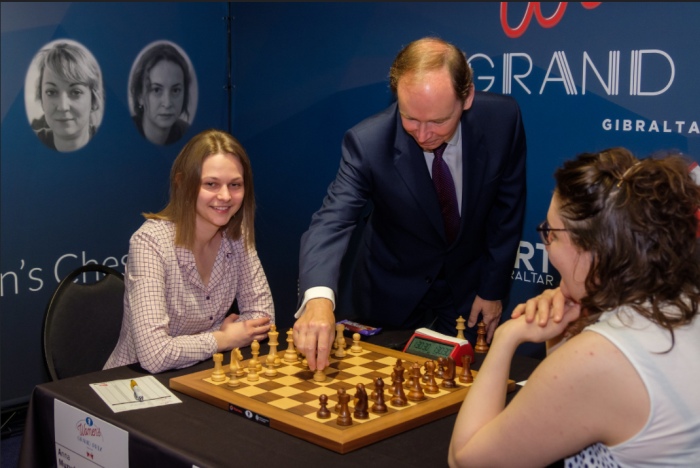
Zhansaya Abdumalik, 21-year-old IM from Kazakhstan, is the sole leader on two points after round two of the Gibraltar leg of the FIDE Women’s Grand Prix was played at the Caleta Hotel on 23 May 2021. There are four players on 1½ points: Gunay Mammadzada (Azerbaijan), Mariya Muzychuk (Ukraine), Kateryna Lagno (Russia) and Antoaneta Stefanova (Bulgaria). The round was opened by the Governor of Gibraltar, His Excellency Sir David Steel, who expressed his gratitude to the players. “Thank you for coming so far to play in this magnificent tournament. Chess and Gibraltar go hand in hand: not quite as much, perhaps, as chess and Russia, chess and Azerbaijan, chess in Bulgaria, but quite close – we’re catching up. And you have come to Gibraltar at a time when Gibraltar is opening up after the pandemic and you have come, some of you a very long way, to be here.” Today we were also pleased to welcome back the founder and long-time organiser of the Gibraltar Chess Festival, Mr. Brian Callaghan, without whose untiring efforts major tournament chess would never have established a home in Gibraltar. The first result of the day was a draw between Anna Muzychuk and Nana Dzagnidze. This was an interesting skirmish in the Sveshnikov Sicilian, with the first decision of significance occurring on move 14 when Anna opted for 14 g4 to keep an eye on the light squares. Some cagey maneuvers followed, as two of the highest-rated players in the field jockeyed for superiority. The players safely neutralized each other’s attempts to win and by the time the queens were exchanged, the draw was in view. Thereafter there were terrifying quantities of blood spilled on the board, with no fewer than three players suffering a second defeat in two games. All five remaining games ended decisively, though, as in Round 1, not all ended in the result as first expected. Kateryna Lagno put herself in great danger of defeat as she unaccountably retreated her queen to its original square on move 12 on the white side of a Petroff defense, allowing a slow squeeze to be applied by Alina Kashlinskaya. It seemed improbable that Kateryna would get out of jail, but, as in round one, all Alina’s initial success went for naught as she snatched a hot pawn on the queenside, only to be shocked by Kateryna’s 21.Nxg7, underpinned by a sneaky tactic that would have won Black’s had the knight been captured. As a result, Black had to live with an ugly gash in her kingside pawn capture. Having blown a won position the day before against her other Russian colleague, poor Alina must have been suffering déjà vu and quickly subsided. Elisabeth Paehtz and Zhansaya Abdumalik went into round two with a win apiece but it was the young Kazakhstani player who proceeded to a perfect 2/2 start with another assured performance. The game began with an offbeat line of the Ruy Lopez (Berlin). Zhansaya’s original development of her a8 rook, via a6 to b6 to f6, and subtly undermining White’s queenside pawn structure, impressed commentator Nigel Short, and no doubt many others. Black snagged a pawn and deftly nursed her material and positional advantage through to another victory. One is beginning to wonder whether Zhansaya might have made a breakthrough in standard during the lull caused by the global pandemic, much as Aleksandra Goryachkina did a year or two back. Gunay Mammadzada versus Irina Bulmaga was some sort of indeterminate Sicilian which I would hesitate to give a more specific name to. Nor am I sure I’m qualified to give an opinion on who had the advantage out of the opening, despite having the inestimable advantage of hearing Gunay’s enthusiastic demonstration of the game at close quarters in the media center. Gunay seemed to relish the cut and thrust of the ensuing battle as both players descended into serious time trouble with only seconds left on their clocks. “It was more like a bullet game, then,” I observed to her and she agreed. Unsurprisingly, engines signalled wild swings of fortune during the period between move 23 and the time control. Black missed one golden opportunity with 26…Rh6 and once again the engine informs us that 33…Kb8 was a killer. Gunay herself felt sure without the benefit of engine analysis that 38…Qb5 represented another move that might have won for Black. Sadly for her, Irina missed all of these shots, and yet I cannot be sorry as otherwise I wouldn’t have been treated to Gunay’s entertaining exposition of this encounter. The game between Dinara Saduakassova and Mariya Muzychuk was a Catalan which followed a game between Deac and Gavrilescu from the Romanian Championship less than a month ago for some 15 moves, which I guess makes it a hot theory. It could also be described as one of those unusual Queen’s Gambits where Black hangs on grimly to the gambit pawn. Instructional manuals always used to be full of such games where Black is punished for such greediness, but whatever positional compensation Dinara gained for the pawn never quite materialized. Perhaps things mightn’t have been so bad had not Dinara retreated her knight to the a1 square where it looked decidedly unhappy. She then made the decision to hoover off the rooks to leave a most unpromising knight endgame, and she soon succumbed. The final game to finish was a slightly old-fashioned Caro-Kann between Antoaneta Stefanova and Valentina Gunina. Though Valentina professed to have “slept like a baby” the night before after her earlier travel woes, perhaps they caught up with her in round two. Things started getting interesting around move 18 or 19, as it became a question of whether the black bishop on b7 could exploit the white squares around White’s exposed king or whether White’s two bishops might cooperate to harass Black’s vulnerable kingside. A few moves down the line, Black’s choice of 21…g6 looked unhealthy on the long black diagonal. White even had the luxury of snaffling the b5-pawn. Talking about it afterwards, Antoaneta Stefanova felt confident of ultimate success once she had engineered a queen exchange. Just before the
12 chess gems by the 12th World Champion
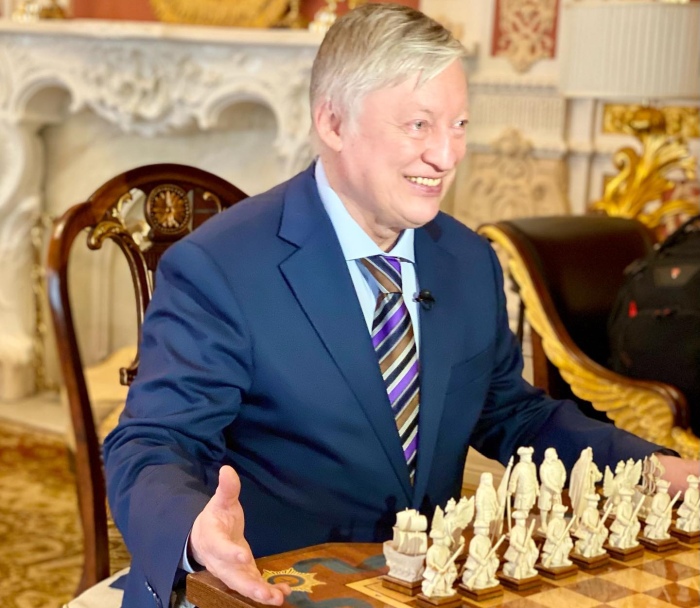
Anatoly Karpov is celebrating his 70th anniversary. The entire chess world congratulates the legendary champion. To mark this occasion we handpicked 12 fragments, 12 chess gems created by Anatoly Yevgenyevich throughout his long and rewarding career. Karpov – Kortschnoj (Moscow, 1974) 24. e5!! It is extremely important block up the fifth rank. 24.Nxf6? exf6 25.Nh5 Qg5! was a false trail. 24…Bxd5 25. exf6 exf6 26. Qxh7+ Kf8 27. Qh8+ (27…Ke7 28. Nxd5+ Qxd5 29. Re1+) 1-0 Karpov – Czom (Bad Lauterberg, 1977) One may think that White is in great trouble, as the h7-square is protected, but Karpov went for this position foreseeing a deadly blow 50. Nf5!! (50… Nxd7 51. Qh2+ Kg8 52. Qg3+ Kf7 53.Qg7#) 1-0 Karpov – Quinteros (Buenos Aires, 1980) 32. f5! White breaks through in the most fortified point. 32… Rxh7 (32… exf5 33. Bxf5) 33. fxg6+ Kg8 (33… Kxg6 34. Bxe6+ Qg5 35. Nf4#) 34. gxh7+ Kh8 35. Nf4 1-0 Karpov – Geller (Moscow, 1981) 31. Rxf7!! Black has to go with the tide. 31…Kxf7 32. Qxg6+ Kf8 33. Qxh6+ [33. Qxh6+ Ke8 (33… Kg8 34. Qh7+Kf8 35. Qh8+ Ke7 36. Qg7+ Ke8 37. Bg6#) 34. Bb5+] 1-0 Karpov – Miles (London, 1982) Black’s position looks OK, as White’s is a6-pawn is cut off from the rest of the army, but 29. Rxd5! Rxd5 30. Rc3! Rd8 31. Rc7! (but not 31.Bg2? Rd4 32.a7 d5) Rd1 32. Bxb5 e5 33. a7 exf4 34. Rb7 Rb1+ 35. Ka4 Rxb5 36. Rxb5 f3 37. Rb8 f2 38. Rxd8+ 1-0 Karpov – Sax (Linares, 1983) White executes Black’s king using geometrical motifs: 35. Re7!! Rd1+ 36. Kxd1 Qxe7 37. Qa8+ Kc7 38. Qa7+ Kd6 39. Qb6+ 1-0 Karpov – Jussupow (Moscow, 1983) Black is threatening with a highly unpleasant discovered attack Rg3+. Karpov found a simple and elegant solution. 43. Rh2!! The queen will be protected, the game is over 43…Qd7+ 44. f5 1-0 Karpov – Gurevich (Reggio Emilia, 1991) 77. Qh8+ Bh6 78. Qe5+!! Deflection in its purest form! [78…Qxe5 79.g4#] 1-0 Karpov – Shirov (Biel, 1992) Karpov carried out an instructive attack over the light squares. 29. Qg4! Qc6 (29… Rxa7 30. Qe6+) 30. Rxb7 Qxb7 31. Qe6+ Kh8 32. Be4 (32…Qa6 33.Ng6+ Kh7 34.Ne5+ Kh8 35.Nf7+ Kg8 36. Nh6+ Kh8 37.Qg8+ Rg8 38.Nf7#) 1-0 Karpov – Salov (Linares, 1993) 33. Qxg6! (33… hxg6 34. Rh4) 1-0 Karpov – Morovic Fernandez (Las Palmas, 1994) 32. Rh8+! Kxh8 33. Qh1+ Kg8 34. Bxf6 Qxg3+ 35. fxg3 Re2+ 36. Kh3 gxf6 37. Kg4 1-0 Karpov – Topalov (Dos Hermanas, 1994) 30. Nf6!! Combining the ideas of decoying and discovered attack. 30…Kxf6 (30… Qxf3 31. Nxe8+) 31. Be5+! Kxe5 32. Qxe4+ Kxe4 33. Re1+ Kf5 34. Rxe8 Be6 35. Rxf8 Bxa2 36. Rc8 1-0
Round 1: Opening Salvoes
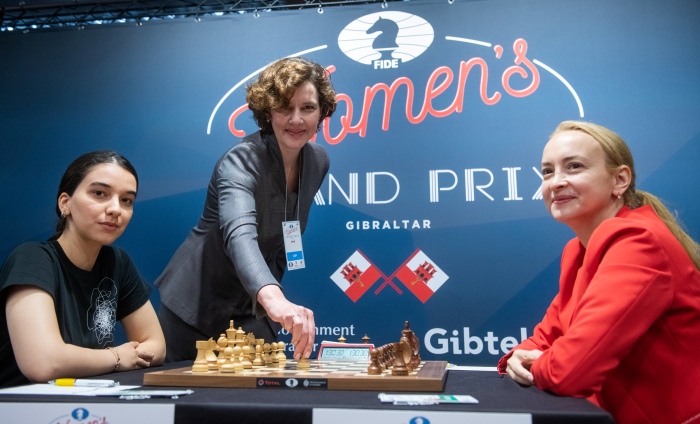
Round 1 of the Gibraltar leg of the FIDE Women’s Grand Prix got underway at the Caleta Hotel on 22 May 2021. Thankfully, all players were present for the start, with Valentina Gunina of Russia being the last to arrive just a few hours before the round started at 3 pm local time. Opening proceedings with a short address was Dana Reizniece-Ozola, managing director of FIDE. Dana holds the woman grandmaster title and herself took part in the 2010 Gibraltar Masters, later embarking on a career in politics and administration in her native Latvia. Dana made the ceremonial first move for Gunnay Mammadzada (Azerbaijan) against former women’s world champion Antoaneta Stefanova of Bulgaria. The first game to finish concluded in around half an hour as sisters Anna and Mariya Muzychuk agreed to a draw. They played a sprightly line of an Anti-Marshall Ruy Lopez/Spanish opening with Black (Anna) giving up her queen to launch a minor piece assault on the white king. However, it is all been seen before and leads to a draw by perpetual check. Nana Dzagnidze and Kateryna Lagno played down a lengthy theoretical variation in the Fianchetto Grünfeld. The pawn structure remained balanced, and pieces were exchanged, until the queenside pawns disappeared completely after which a draw seemed inevitable. Gunay Mammadzada is perhaps a lesser known name in Western Europe, though she has played in Gibraltar once before. She lives in Baku (or ‘Chess City’ as she referred to it after her game) and will turn 21 a few days after the tournament. She found herself facing the redoubtable former women’s world champion Antoaneta Stefanova who has played in Gibraltar many times before and captains the women’s team in the annual Battle of the Sexes match held at the festival. Gunay was unfazed by her opponent’s reputation and embarked on a long line of Ruy Lopez/Spanish theory. The position had some interest but when a repetition presented itself, the players decided to split a point. So far, three draws, but the watching audience was richly rewarded with some entertainment in the three remaining games, all of which resulted in decisive though not in the way that had seemed likely earlier in the games, at least in two cases. As has already been mentioned, Valentina Gunina was the player to arrive in Gibraltar, after a trying journey from Russia and with only a few hours to compose herself for this important game. To be honest, it looked like it as she subsided into a poor position. Her compatriot Alina Kashlinskaya looked almost certain to win. Valentina found herself forced to surrender the exchange just to maintain some semblance of a chance. But then fortune suddenly changed: an injudicious 27.f4, attacking a knight, was countered by a clever 27…d3 intermezzo move which gave Valentina some strong play against Alina’s weak kingside structure. Still, the great wheel of fortune hadn’t yet turned completely, but a further mistake (34.h3) allowed Valentina’s small commando force to run riot on the dark squares, stymieing White’s hopes of capitalising on her advanced passed pawn and threatening mate. Alina could do nothing and Valentina found herself with what in all the circumstances was the most improbable of full points. She could hardly believe it when interviewed, pronouncing herself “tired and lucky”. Zhansaya Abdumalik and Dinara Saduakassova fought a well-contested game which we were surprised to learn was only the second time these talented players from Kazakhstan had ever met over the board at classical chess. It took a while to catch fire after a steady Giuoco Piano opening, but then a tricky phase of play allowed Zhansaya to gain the advantage of an outside passed pawn. It didn’t look fatal by any means in the early stages, but it was impressive to see how the 21-year-old exploited and increased this positional edge against her 25-year-old rival. The last game of the day to finish, after four and a half hours’ play was between Irina Bulmaga of Roumania and Elisabeth Paehtz of Germany. The opening was a full-blooded Najdorf Sicilian so the audience could expect a real fight from the start. When Irina’s pawn roller started to advance on Lizzie’s king down the kingside, one started to fear for the German IM’s chances. All the more so when White’s attack the weak spot at f7 more times than it could be defended. The black king was obliged to flee towards the middle of the board, where it would surely have perished but Irina made a disastrous mistake 38.Nd2??, which allowed Lizzie to threaten mate on b2. The black king was still an open target to White’s remaining group of pieces, but none of them could land a fatal blow or even secure a perpetual check. Lizzie’s first words after the game: “I’ve aged 100 years today.” A tough day indeed, but wonderful entertainment for the audience and a great start for the event. Standings after Round 1: 1-3. Zhansaya Abdumalik, Valentina Gunina, Elisabeth Paehtz – 1; 4-9. Gunay Mammadzada, Mariya Muzychuk, Nana Dzagnidze, Kateryna Lagno, Anna Muzychuk, Antoaneta Stefanova – ½; 9-12. Irina Bulmaga, Alina Kashlinskaya, Dinara Saduakassova – 0. Text: John Saunders Photo: John Saunders and David Llada
FIDE Women’s Grand Prix Gibraltar: Opening Ceremony

The final leg of the FIDE Women’s Grand Prix, was opened by the Hon. Steven Linares, Gibraltar minister for Minister for Sport, Culture, Heritage & Youth at the Caleta Hotel on Friday evening. Stuart Conquest, chess grandmaster and organiser of the multi-award-winning Gibraltar International Chess Festival, opening the ceremony, said “It’s the most prestigious event we’ve ever run.” After a beautiful rendition of the Gibraltar national anthem by Michelle Brown, and the playing of the FIDE anthem, Stuart introduced the minister, who also refers to himself as ‘the minister for chess.’ Speaking on behalf of the Gibraltar government, he expressed Gibraltar’s pride in being invited to host such an important chess event, and in particular a women’s event, given the Gibraltar Festival’s long-standing role in supporting and boosting the women’s game since its inception in 2003. When the opportunity came to host an official FIDE event which is part of the women’s world championship cycle, it was a great honour to accept. It was his great pleasure to declare the tournament open. The audience, which included players, officials and local sponsors, then viewed a video message from the FIDE president, Arkady Dvorkovich, recorded earlier the same day. The president also alluded to the important role Gibraltar and its chess festival had played in the development of women’s chess over the years and expressed his particular pleasure that FIDE was able to show its gratitude by holding an official event in Gibraltar. Nigel Short, who will be a co-commentator for the first half of the tournament, then took the podium and entertained the audience with some impromptu observations. The former world championship runner-up, who has himself won three Gibraltar Masters titles, took particular pleasure in the fact that the tournament marks the return of over-the-board chess in an official world championship qualifier. As a traditionalist, OTB chess remains his favourite form of chess, though he also welcomes the huge recent upsurge in chess activity online, as a result of the global success of the Netflix series The Queen’s Gambit. Nigel amused the audience by referring to the competitors as ’12 Beth Harmons but without the narcotics’. Each competitor has then introduced in turn and took the stage to pose for photos with the minister. Because of travel difficulties, nine of them were present in the room, with another two, who had only just arrived at the venue, not present in the room. The twelfth, Valentina Gunina, is due to arrive on Saturday, the day of the first round. Text and photo: John Saunders
In memory of Max Euwe on the 120th anniversary of his birth
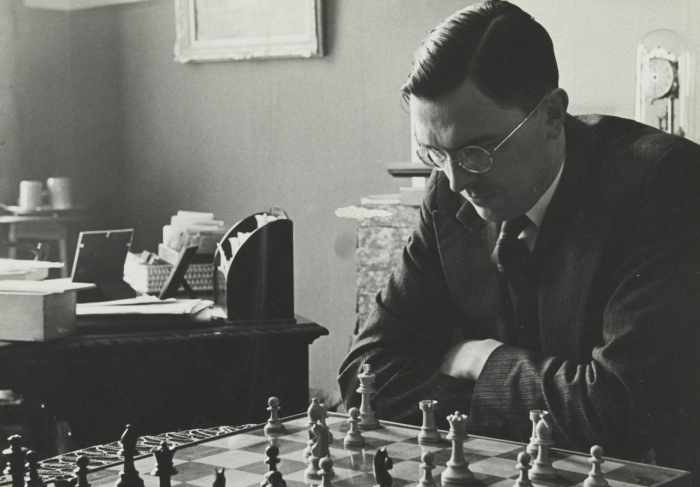
The fifth World Champion Max Euwe was born on May 20, 1901, precisely 120 years ago. A champion, whom many call accidental, a champion whose games are somewhat understudied, a champion who, in fact, has never even been a professional chess player. How did this happen? Was it just a confluence of circumstances or there is some logic behind his ascend to the top? Let’s try to figure it out. Young Max quickly came to the forefront of Dutch chess, winning the national by the age of 19. But chess went hand in hand with his studies – Euwe dreamed of becoming a mathematician. He enrolled at the University of Amsterdam, and not only graduated with honours but also continued his research and received his Ph.D. by the age of 25. In 1926 Euwe was already such a respected maestro that Alekhine offered Max to play a short match when preparing for his duel with Capablanca. It was a close match – Euwe lost but was quite satisfied with the +2-3=5 result. The Dutchman was getting a taste for it, and although Euwe did not forget about mathematics, he tried his hand not only in tournaments (there were still few in the late twenties) but also in matches. Two duels with Bogoljubov were particularly interesting. Efim Dmitriyevich won both 10-game matches by a minimal margin. Curiously, these matches were called First FIDE Championship Match and Second FIDE Championship Match, respectively. Photo: Amsterdam City Archives / Vereenigde Fotobureaux NV As the winner, Bogolyubov had the moral right to challenge Alekhine, which he did. Max kept his chin up, he felt that he could already play with the best of the best on equal footing. In 1930 Euwe beat Capablanca in Hastings and challenged the legendary Cuban to a duel. Once again, his opponent was stronger and won this hard-fought match by a score of +2-0=8. It should be noted that Euwe was certainly lucky to be born in Holland. This rich country suffered relatively little damage from the First World War and has always treated chess with respect. It is no coincidence that all these matches were played in Holland. Subsequently, Timman would follow a similar path, but half a century later he did not manage to make it all the way to the top. Euwe was doing a great job combining work with chess. He started a family, moved up the career ladder to become a respected teacher, but at the same time he decided to work more on the game, taking a break from tournament play. Indeed, Euwe played very little for a year and a half and then in the summer of 1934 started moving from one tournament to another performing consistently well (with just one exception). Max beat his countrymen Van den Bosch and Landau (6:0 and 4.5:1.5), tied for second place with Flohr at the strongest tournament of the year in Zurich, finishing just one point behind Alekhine but beating him in the head-to-head encounter. Later on, he won Hastings 1934/35, defeating Botvinnik along the way. His only hiccup was a 50% score in a tournament against the strongest Soviet masters. However, I am sure that Max learned a lot from this trip. By 1935 Euwe was an undisputed player of the top-5 or even the top-3. Comparing him with other champions we can see that, say, Petrosian’s results were no more convincing. So the Dutchman certainly had the moral right to challenge the World Champion. At the same time, everyone (and Euwe himself) considered Alekhine to be the favourite. An unofficial training match with maestro Rudolf Spielmann, which the challenger supposedly lost 4-6, did not inspire optimism. However, since the games of this match are not available, it is hard to say how committed Euwe was when playing. Whatever the case, Euwe was diligently preparing for the match, patching up his trademark Slav, Defence, working on his “first serve” – the opening preparation with white. It should be noted that Euwe has always been an advocate of closed openings. The Dutchman even went to Vienna to work with Becker’s archives. He got some help from a recognized opening guru Ernst Gruenfeld, studied endgames with Marozy, and invited Flor (who was in the top-5 at this point) to be his second. Flohr thought that such assistance would be improper and accepted this offer on the condition that Alekhine would not mind. The Russian champion was magnanimous, noting that all such preparation would be too little too late. And then something unthinkable happened. Photo: National Archives of The Netherlands Alekhine, who always approached any competition very professionally, was surprisingly flippant this time. The first signs of this attitude became visible in his match with Bogoljubov in 1934 – but it was a competition of unequal opponents after all. However, he found his match this time. Why did this happen, how many games did Alekhine play being tipsy, how important is the fact that the match was played in nine Dutch cities? All of these matters require careful analysis. One thing is clear – there is no room for an accident in a long 30-game match. Alekhine was not in his optimal condition that is for sure. But the fact that a chess player of his caliber was unable to come round and beat Euwe speaks volumes of the Dutchman as an opponent. Euwe won 15½:14½ and became the fifth world champion. He was always humble about his victory and did not react publicly to Alekhine’s words about the crown being lent out for two years. The Dutchman was not afraid of putting his reputation at risk as he continued to play a lot, and although Max did lose the chess crown in 1937, he remained a top player for one more decade. Playing in the AVRO 1938, the event that brought together the eight best players of that time, Euwe turned in a decent performance scoring 50%. In 1940 the former World Champion Euwe locked horns with Keres and again
Attention FIDE World Cup participants
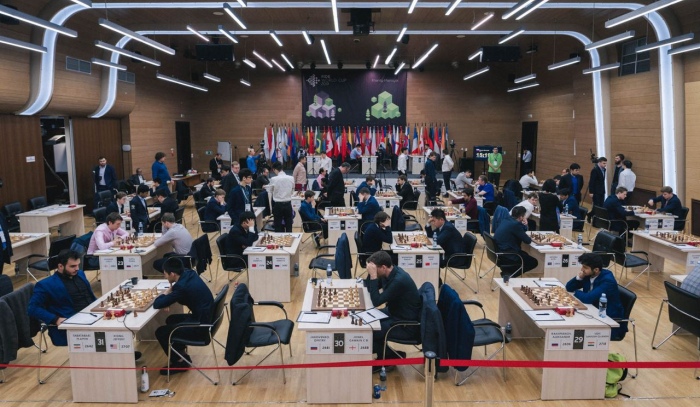
Dear chess friends, Next week the Organizing Committee expects the final confirmation from the Russian Foreign Ministry on visa support for the participants of the World Cup. In order to collect and process the necessary information, the World Cup ?????? ???????????? ?????? will be launched next week. Those participants (players and accompanying persons) who need an Entry Visa to Russia will be provided with ???? ?????????? ??????? (ENG and RUS). These letters are mandatory to obtain an Entry Visa in the Russian Consulates in participants’ home countries or abroad. The Visa Invitation Letter will be available for downloading from the System after a participant is accredited by the Registration Manager. Due to the COVID-19 pandemic restrictions, those Non-Russian citizens who don’t need an Entry Visa to Russia, still need to provide a passport copy and passport details through the System to be able to enter the Russian Federation.
Women’s World Cup: List of qualified players

The list of participants of the FIDE Women’s World Cup, scheduled for July 2021, has nearly shaped up. Canada is the only remaining federation to run qualifiers in early June. World Championship 2018 (4) 1. GM Ju Wenjun (CHN)2. GM Kateryna Lagno (RUS)3. GM Alexandra Kosteniuk (RUS)4. GM Mariya Muzychuk (UKR) https://ugra2018.fide.com/pairings/ U-20 (2) 2018 – WGM Aleksandra Maltsevskaya (RUS) http://wjcc2018.tsf.org.tr/en/component/turnuva/?task=fileview&kid=978 2019 – WGM Polina Shuvalova (RUS) http://chess-results.com/tnr479944.aspx?lan=20&art=1&rd=11&flag=30 Average Rating (5) 1. GM Hou Yifan (CHN)2. GM Humpy Koneru (IND)3. GM Anna Muzychuk (UKR)4. GM Harika Dronavalli (IND)5. GM Tan Zhongyi (CHN) Continental – Africa (3) 2019 1.WGM Shrook Wafa (EGY)2.WIM Sabrina Latreche (ALG)3. WIM Ayah Moaataz (EGY) Continental – Americas (8) 2018 WGM Deysi Cori (PER) 2019 WIM Maili-Jade Ouellet (CAN) Zone 2.1: 1. WGM Jennifer Yu (USA)2. WGM Tatev Abrahamyan (USA) Zone 2.3: WIM Yerisbel Miranda (CUB) Zone 2.4: WIM Anahi Ortiz Verdezoto (ECU) Zone 2.5: WIM Gabriela Vargas (PAR) Zonal 2.2: The nominee will be decided shortly Continental – Asia (12) 2018 IM Padmini Rout (IND) 2019 IM Dinara Saduakassova (KAZ) Zone 3.1: IM Sarasadat Khademalsharieh (IRI) Zone 3.2: WIM Sultana Sharmin Shirin (BAN) Zone 3.3: IM Medina Aulia Varda (INA) Zone 3.4: WIM Yakubbaeva Nilufar (UZB) Zone 3.5: 1. WGM Zhu Jiner (CHN) 2. WGM Huang Qian (CHN) 3. WGM Zhai Mo (CHN) 4. GM Lei Tingjie (CHN) Zone 3.6: WGM Julia Ryjanova (AUS) Zone 3.7: IM Kulkarni Bhakti (IND) Continental – Europe (28) 2018 GM Valentina Gunina (RUS) GM Nana Dzagnidze (GEO) GM Anna Ushenina (UKR) IM Ekaterina Atalik (TUR) GM Antoaneta Stefanova (BUL) IM Elisabeth Paehtz (GER) WGM Klaudia Kulon (POL) GM Aleksandra Goryachkina (RUS) IM Gunay Mammadzada (AZE) IM Iulia Osmak (UKR) IM Lela Javakhishvili (GEO) IM Karina Szczepkowska (POL) GM Marie Sebag (FRA) WGM Laura Unuk (SLO) http://chess-results.com/tnr338143.aspx?lan=20&art=1&rd=11&turdet=YES&flag=30 2019 IM Alina Kashlinskaya (RUS) IM Inna Gaponenko (UKR) WGM Pauline Guichard (FRA) WGM Ulviyya Fataliyeva (AZE) IM Stavroula Tsolakidou (GRE) WGM Jolanta Zawadzka (POL) GM Pia Cramling (SWE) IM Anastasia Bodnaruk (RUS) GM Monika Socko (POL) WGM Anastasya Paramzina (RUS) WGM Marina Brunello (ITA) WGM Turkan Mamedjarova (AZE) IM Nurgyul Salimova (BUL) WGM Dina Belenkaya (RUS) http://chess-results.com/tnr423302.aspx?lan=20&art=1&rd=11&flag=30 In case of the withdrawal of a zonal and continental tournament qualifier, she is substituted with the highest-ranked player from the respective tournaments (the links can be found in this document). In all other cases, the rating criteria are applied. The list of reserve players by rating: 1. WGM Pogonina, Natalija (RUS)2. WGM Girya, Olga (RUS)3. IM Abdumalik, Zhansaya (KAZ)4. GM Khotenashvili, Bela (GEO)5. IM Bulmaga, Irina (ROU) All qualified players are required to sign their respective contracts (Player’s Contract for Participation in the FIDE Women’s World Cup 2021) and send them scanned to the FIDE Secretariat – office@fide.com by 4 June 2021 11:59 pm Lausanne time. We would welcome the most prompt response from the players. In accordance with Article 2.1.V of the updated recently FIDE Women’s World Cup Regulations, thirty-nine Federations are selected according to the average rating of their five highest-rated women players in the December 2020 FRL (not more than 15 per Continent). These Federations should nominate any player of their choice who is registered to their Federation by June 9th, 2021 (in addition to players already qualified through other paths). N FEDERATION Avg of Top 5, FRL Dec 2020 1 China 2544 2 Russia 2516 3 Georgia 2473 4 Ukraine 2469 5 India 2455 6 United States of America 2406 7 Kazakhstan 2401 8 Poland 2395 9 France 2388 10 Spain 2371 11 Hungary 2364 12 Azerbaijan 2362 13 Bulgaria 2361 14 Germany 2356 15 Armenia 2345 16 Netherlands 2342 17 Romania 2336 18 Iran 2333 19 Mongolia 2328 20 Cuba 2322 21 Serbia 2318 22 Turkey 2315 23 Vietnam 2303 24 Indonesia 2284 25 Canada 2256 26 Argentina 2244 27 Uzbekistan 2206 28 Australia 2187 29 Colombia 2162 30 Brazil 2130 31 Philippines 2129 32 Mexico 2121 33 Peru 2096 34 Egypt 2084 35 Venezuela 2028 36 Chile 2016 37 Turkmenistan 2016 38 Saudi Arabia 2014 39 Malaysia 2012 Please note that the deadline for submission of nomination, as well as for nominees’ confirmation of participation is 9 June. As previously announced, FIDE World Cup and FIDE Women’s World Cup were expanded to 206 and 103 players, with prize funds in both competitions substantially increased.
Ahead of FIDE WGP Gibraltar: standings and full pairings

The Women’s FIDE Grand Prix Gibraltar postponed due to COVID-19 restrictions in the British Oversea Territory will take place from May 22 to June 2, 2021. Hosting this prestigious event opens a new chapter in Gibraltar’s continued tradition of supporting chess, in general, and the best female chess players, in particular. Since the inception of the Gibraltar Chess Festival in 2003, almost all the world’s top female players have taken part, including the greatest woman player of all time, Judit Polgar, as well as a total of seven Women’s World Champions. The fourth and final leg of the FIDE Women’s Grand Prix will be hosted by Caleta Hotel. As usual, twelve players will compete in a round-robin tournament. All the rounds (except the final one – TBA) start at 15:00 local time. The event will be very important in regards to two qualifying spots for the FIDE Women Candidates Tournament. They are reserved for the two winners of the Series, but we must keep in mind that the leader after three legs Aleksandra Goryachkina (398 series points) already has a place in the Candidates Tournament as a previous world championship match runner-up. Consequently, her spot will be awarded to the next top-scorer of the Grand Prix which promises a fierce fight. Humpy Koneru (293 points) and Alexandra Kosteniuk (193) follow Goryachkina in the overall standings, but both won’t play in the final leg. Nana Dzagnidze (180), Kateryna Lagno (180), Anna Muzychuk (165), Alina Kashlinskaya (130), Maria Muzychuk (120) all have a chance to pick up the needed points in Gibraltar and claim the qualifying spot. Winning an event scores 160 points, second place – 130, and third – 110. The list of participants: 1 IM Gunay Mammadzada 2443 AZE 2 IM Irina Bulmaga 2440 ROU 3 IM Zhansaya Abdumalik 2472 KAZ 4 GM Mariya Muzychuk 2544 UKR 5 GM Nana Dzagnidze 2524 GEO 6 IM Alina Kashlinskaya 2494 RUS 7 GM Valentina Gunina 2421 RUS 8 GM Kateryna Lagno 2546 RUS 9 GM Anna Muzychuk 2535 UKR 10 IM Dinara Saduakassova 2500 KAZ 11 IM Elisabeth Paehtz 2467 GER 12 GM Antoaneta Stefanova 2470 BUL FULL PAIRINGS: Round 1 on 2021/05/22 IM Gunay Mammadzada (2443) – GM Antoaneta Stefanova (2470)IM Irina Bulmaga (2440) – IM Elisabeth Paehtz (2467)IM Zhansaya Abdumalik (2472) – IM Dinara Saduakassova (2500)GM Mariya Muzychuk (2544) – GM Anna Muzychuk (2535)GM Nana Dzagnidze (2524) – GM Kateryna Lagno (2546)IM Alina Kashlinskaya (2494) – GM Valentina Gunina (2421) Round 2 on 2021/05/23 GM Antoaneta Stefanova (2470) – GM Valentina Gunina (2421) GM Kateryna Lagno (2546) – IM Alina Kashlinskaya (2494) GM Anna Muzychuk (2535) – GM Nana Dzagnidze (2524) IM Dinara Saduakassova (2500) – GM Mariya Muzychuk 2544 IM Elisabeth Paehtz (2467) – IM Zhansaya Abdumalik (2472) IM Gunay Mammadzada (2443) – IM Irina Bulmaga (2440) Round 3 on 2021/05/24 IM Irina Bulmaga (2440) – GM Antoaneta Stefanova (2470) IM Zhansaya Abdumalik (2472) – IM Gunay Mammadzada (2443) GM Mariya Muzychuk 2544 – IM Elisabeth Paehtz (2467) GM Nana Dzagnidze (2524) – IM Dinara Saduakassova (2500) IM Alina Kashlinskaya (2494) – GM Anna Muzychuk (2535) GM Valentina Gunina (2421) – GM Kateryna Lagno (2546) Round 4 on 2021/05/25 GM Antoaneta Stefanova (2470) – GM Kateryna Lagno (2546) GM Anna Muzychuk (2535) – GM Valentina Gunina (2421) IM Dinara Saduakassova (2500) – IM Alina Kashlinskaya (2494) IM Elisabeth Paehtz (2467) – GM Nana Dzagnidze (2524) IM Gunay Mammadzada (2443) – GM Mariya Muzychuk 2544 IM Irina Bulmaga (2440) – IM Zhansaya Abdumalik (2472) Round 5 on 2021/05/26 IM Zhansaya Abdumalik (2472) – GM Antoaneta Stefanova (2470) GM Mariya Muzychuk 2544 – IM Irina Bulmaga (2440) GM Nana Dzagnidze (2524) – IM Gunay Mammadzada (2443) IM Alina Kashlinskaya (2494) – IM Elisabeth Paehtz (2467) GM Valentina Gunina (2421) – IM Dinara Saduakassova (2500) GM Kateryna Lagno (2546) – GM Anna Muzychuk (2535) Round 6 on 2021/05/27 GM Antoaneta Stefanova (2470) – GM Anna Muzychuk (2535) IM Dinara Saduakassova (2500) – GM Kateryna Lagno (2546) IM Elisabeth Paehtz (2467) – GM Valentina Gunina (2421) IM Gunay Mammadzada (2443) – IM Alina Kashlinskaya (2494) IM Irina Bulmaga (2440) – GM Nana Dzagnidze (2524) IM Zhansaya Abdumalik (2472) – GM Mariya Muzychuk (2544) Round 7 on 2021/05/29 GM Mariya Muzychuk 2544 – GM Antoaneta Stefanova (2470) GM Nana Dzagnidze (2524) – IM Zhansaya Abdumalik (2472) IM Alina Kashlinskaya (2494) – IM Irina Bulmaga (2440) GM Valentina Gunina (2421) – IM Gunay Mammadzada (2443) GM Kateryna Lagno (2546) – IM Elisabeth Paehtz (2467) GM Anna Muzychuk (2535) – IM Dinara Saduakassova (2500) Round 8 on 2021/05/30 GM Antoaneta Stefanova (2470) – IM Dinara Saduakassova (2500) IM Elisabeth Paehtz (2467) – GM Anna Muzychuk (2535) IM Gunay Mammadzada (2443) – GM Kateryna Lagno (2546) IM Irina Bulmaga (2440) – GM Valentina Gunina (2421) IM Zhansaya Abdumalik (2472) – IM Alina Kashlinskaya (2494) GM Mariya Muzychuk 2544 – GM Nana Dzagnidze (2524) Round 9 on 2021/05/31 GM Nana Dzagnidze (2524) – GM Antoaneta Stefanova (2470) IM Alina Kashlinskaya (2494) – GM Mariya Muzychuk 2544 GM Valentina Gunina (2421) – IM Zhansaya Abdumalik (2472) GM Kateryna Lagno (2546) – IM Irina Bulmaga (2440) GM Anna Muzychuk (2535) – IM Gunay Mammadzada (2443) IM Dinara Saduakassova (2500) – IM Elisabeth Paehtz (2467) Round 10 on 2021/06/01 GM Antoaneta Stefanova (2470) – IM Elisabeth Paehtz (2467) IM Gunay Mammadzada (2443) – IM Dinara Saduakassova (2500) IM Irina Bulmaga (2440) – GM Anna Muzychuk (2535) IM Zhansaya Abdumalik (2472) – GM Kateryna Lagno (2546) GM Mariya Muzychuk 2544 – GM Valentina Gunina (2421) GM Nana Dzagnidze (2524) – IM Alina Kashlinskaya (2494) Round 11 on 2021/06/02 IM Alina Kashlinskaya (2494) – GM Antoaneta Stefanova (2470) GM Valentina Gunina (2421) – GM Nana Dzagnidze (2524) GM Kateryna Lagno (2546) – GM Mariya Muzychuk 2544 GM Anna Muzychuk (2535) – IM Zhansaya Abdumalik (2472) IM Dinara Saduakassova (2500) – IM Irina Bulmaga (2440) IM Elisabeth Paehtz (2467) – IM Gunay Mammadzada (2443)