

Day 2: Praggnanandhaa scores eight wins in a row
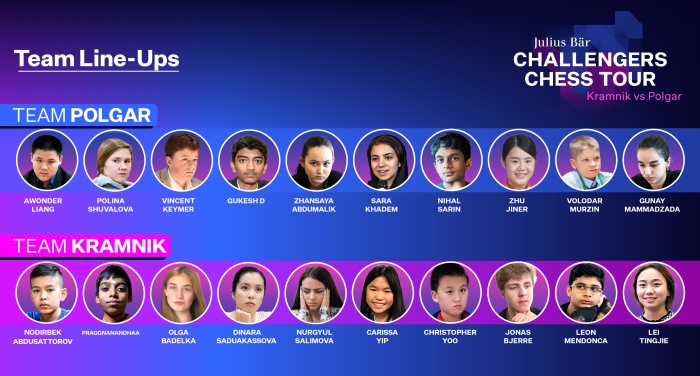
Indian prodigy R Praggnanandhaa took his winning run to an incredible eight in a row today as he emerged the clear leader of the Polgar Challenge online chess event. The 15-year-old, playing for Team Kramnik, dominated his opening two games against America’s top female player Carissa Yip and Jiner Zhu, of China. Two wins in those games added to Pragg’s four back-to-back victories yesterday – and then he benefited from some luck to just storm on from there finishing on 8.5/10. Incredibly, after being tied 25-25 overnight, Team Kramnik and Team Polgar are still locked on 50-50 – although the top three on the individual leaderboard all represent Team Kramnik. Pragg did not have it all his own way, however. His run was nearly derailed in Round 8 by Bulgaria’s Nurgyul Salimova, 17, who missed a chance to win on the spot and then nearly saved a draw against him. Pragg was too strong and a slip in the endgame from Salimova allowed the teenager from Chennai to force a seventh win. Meanwhile, there was disappointment for Kazakhstan’s Dinara Saduakassova who was forced to forfeit all her remaining games after Round 8 because of a bad internet connection. Saduakassova’s departure handed Pragg another win in Round 9 – albeit without playing – to make it eight full points in a row after losing his first game in the tournament. It also gifted Pragg a rest going into the final round of the day. He ended the day with a draw against US teen Awonder Liang, who was celebrating his 18th birthday. Top seed Nodirbek Abdusattorov, 16, had kept pace until he suffered his first loss in Round 8 against another Indian prospect, Goa’s Leon Mendonca. Both Abdusattorov, from Tashkent, Uzbekistan, and American Christopher Yoo had been level with Pragg overnight but fell back today. The two chasers did however pullback in Round 10 to finish just half a point behind Pragg on 8/10. Yoo remains unbeaten and faces Pragg in Round 11 tomorrow. A win in that and he will take the lead. Five more rounds will follow tomorrow before the first event of the new $100,000 Julius Baer Challengers Chess Tour reaches its climax on Sunday. The young stars of chess represent 12 nations and are competing for a prize pot totalling $100,000 and places. They are receiving coaching and support from teams of coaches, which include world champions and legends of the game. The Polgar Challenge, named after Judit Polgar, is the first of four tournaments before a tour final in September organised by the Play Magnus Group. The team that wins the Julius Baer Challengers Chess Tour overall will also get a trip to this year’s World Chess Championship in Dubai. For further information, please contact: Leon Watson, PR for Champions Chess Tourleon@chessable.com+44 7786 078 770 About the Tour: Fronted by the strongest female player of all time, Judit Polgar, and former World Champion Vladimir Kramnik, the Julius Baer Challengers Chess Tour will run alongside the hugely popular Meltwater Champions Chess Tour. The Tour is organised by the Play Magnus Group and is designed to tackle head-on the lack of female role models competing in top events and promote emerging talent. More information here. Team Kramnik:Nodirbek Abdusattorov (aged, 16, Uzbekistan); Rameshbabu Praggnanandhaa (15, India); Dinara Saduakassova (24, Kazakhstan); Jonas Bjerre (16, Denmark); Leon Mendonca (15, India); Lei Tingjie (24, China); Christopher Yoo (14, United States); Olga Badelka (18, Belarus); Carissa Yip (17, United States); Nurgyul Salimova (17, Bulgaria) Team Polgar:Nihal Sarin (aged 16, India); Awonder Liang (17, United States); Vincent Keymer (16, Germany); Gukesh D (14, India); Sarasadat Khademalsharieh (24, Iran); Volodar Murzin (14, Russia); Polina Shuvalova (20, Russia); Zhansaya Abdumalik (21, Kazakhstan); Jiner Zhu (18, China); Gunay Mammadzada (20, Azerbaijan)
Three-way tie for the lead after Day 1
The Polgar Challenge, the first event of the new $100,000 Julius Baer Challengers Chess Tour, got underway today with a series of fighting games that ended in a three-way tie for the lead. Top seed Nodirbek Abdusattorov grabbed the first win of the five-month tour with a convincing victory over Bulgarian teen Nurgyul Salimova. Abdusattorov, from Tashkent, Uzbekistan, famously beat two Grandmasters in a tournament when aged only nine. The ambitious 16-year-old aims to be World Champion one day and showed his class by finishing joint-top of the table on day one of four after scoring an unbeaten 4/5. Abdusattorov shares the lead with India’s exciting prodigy R Praggnanandhaa and the youngest International Master in American history, 14-year-old Christopher Yoo. Round 1 finished with eight decisive outcomes and only two draws. Round 2 followed the pattern with only two more draws. In total, there were only 14 draws in 50 games played over the first five rounds – a stat that demonstrated the fighting chess on display. The 20 young talents on the show are divided into two teams, Team Kramnik and Team Polgar. The overall day 1 score is 25-25. Going into the final round of the day China’s Lei Tingjie was the leader after beating America’s top-ranked female player, 17-year-old Carissa Yip. However, Lei was caught by Abdusattorov after a final-round loss to Praggnanandhaa that allowed both of them to leap-frog her. The young stars of chess represent 12 nations and are competing for a prize pot totalling $100,000 and places on the Meltwater Champions Chess Tour. They are receiving coaching and support from teams of coaches, which include world champions and legends of the game. The Polgar Challenge, named after Judit Polgar, is the first of four tournaments before a tour final in September organised by the Play Magnus Group. The team that wins the Julius Baer Challengers Chess Tour overall will also get a trip to this year’s World Chess Championship in Dubai. For further information, please contact: Leon Watson, PR for Champions Chess Tourleon@chessable.com+44 7786 078 770 About the Tour: Fronted by the strongest female player of all time, Judit Polgar, and former World Champion Vladimir Kramnik, the Julius Baer Challengers Chess Tour will run alongside the hugely popular Meltwater Champions Chess Tour. The Tour is organised by the Play Magnus Group and is designed to tackle head-on the lack of female role models competing in top events and promote emerging talent. More information here. Team Kramnik:Nodirbek Abdusattorov (aged, 16, Uzbekistan); Rameshbabu Praggnanandhaa (15, India); Dinara Saduakassova (24, Kazakhstan); Jonas Bjerre (16, Denmark); Leon Mendonca (15, India); Lei Tingjie (24, China); Christopher Yoo (14, United States); Olga Badelka (18, Belarus); Carissa Yip (17, United States); Nurgyul Salimova (17, Bulgaria) Team Polgar:Nihal Sarin (aged 16, India); Awonder Liang (17, United States); Vincent Keymer (16, Germany); Gukesh D (14, India); Sarasadat Khademalsharieh (24, Iran); Volodar Murzin (14, Russia); Polina Shuvalova (20, Russia); Zhansaya Abdumalik (21, Kazakhstan); Jiner Zhu (18, China); Gunay Mammadzada (20, Azerbaijan)
Alireza Firouzja wins 2021 Bullet Chess Championship
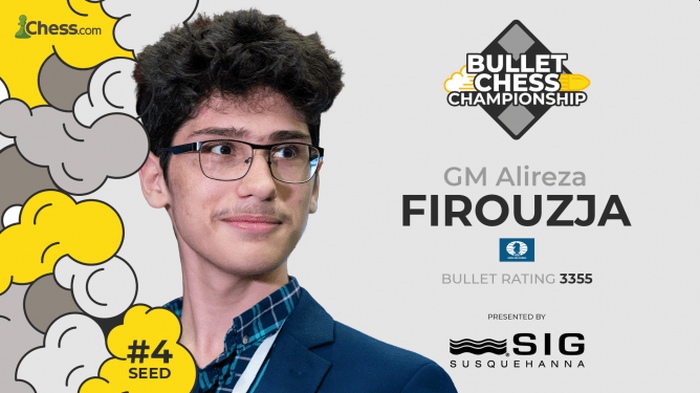
GM Alireza Firouzja won the 2021 Bullet Chess Championship presented by SIG. The Iran-born super-GM first eliminated top favourite GM Hikaru Nakamura in the semifinals and then was too strong for GM Andrew Tang in the final. The Bullet Chess Championship presented by SIG ran April 5-7, 2021 on Chess.com among the very best bullet players on the planet. Only World Champion Magnus Carlsen was missing from an otherwise star-studded field. Firouzja earned $10,000 for his victory. Semifinals In the semifinals, the action started with GM Daniel Naroditsky, making his first moves in the championship, against Tang. Because GM Eric Hansen had to withdraw at the last moment, Naroditsky reached the semis without playing. Charlotte resident Naroditsky didn’t need much of a warmup as he took a 4-3 lead before the half-time break and later increased it to 6-4. Tang, however, levelled the score to 6-6 with incredibly fast play. As 7-7 was on the scoreboard with three minutes left, Tang convincingly won two games in a row to secure a place in the final. Right after, the much-anticipated match between Firouzja and Nakamura started. It was a repeat of the final of the Bullet Open Championship from the end of 2020 and also of the 2019 quarterfinal when both times Nakamura emerged victoriously. The American GM was definitely the slight favourite again, also because he had just beaten GM Arjun Erigaisi 13-3 the other day. Nakamura had an excellent start and was about to go 3-0 when he blundered a piece and it was 2-1 instead. He still reached 4-1 anyway, winning game five in the nick of time. With Nakamura leading 6-3 at halftime, few would have predicted Firouzja to win this match. However, the second half saw a completely different picture with the Iran-born prodigy winning that second “set,” also nine games, 7-2 to take the match 10-8. “[During the break] I thought I had to play more relaxed and play more like I’m playing every day against Naroditsky or like this,” Firouzja explained his comeback. “That way I could have a chance, at least.” The end was an absolute nailbiter, with Nakamura winning a must-win game to make 8-9 with 21 seconds left on the match clock. Having double the amount of time (22 seconds vs. 11 for Firouzja) he seemed on his way to flag his opponent, make 9-9 and force a playoff. He also could have won a piece there but instead, he blundered his own rook. “It was a bit of luck I guess, but overall I think I played good chess against Hikaru,” Firouzja would later say. “The first games were a bit shaky but after that, it was pretty decent.” Final Having taken such a huge hurdle, Firouzja then dominated the final against Tang. He won the first five games before Tang, who was sporting his Cloud9 jersey, could do something back. Now known for his slow starts, Tang had come back from being down 5-1 the day before. This time, it wasn’t going to happen as he simply couldn’t get into top form while Firouzja is simply on fire these days – he also won the last two Titled Tuesdays. By winning the last two games, Tang could at least set an “acceptable” final score but the 11-6 didn’t leave any doubts. Firouzja took the $10,000 first prize while Tang earned $6,000. Both Nakamura and Naroditsky won $2,500. Firouzja definitely had his share of winner’s luck as GM Vladislav Artemiev had him on the ropes in the quarterfinals and only needed to let the match clock run down for nine more seconds to win their match. Instead, the Russian GM resigned, allowing another game after which Firouzja eventually won. Speaking after the final, Firouzka called that quarterfinal match “a miracle,” adding: “I should have lost that, a 100%. I got lucky, I guess.” The 2021 Bullet Chess Championship is presented by Susquehanna International Group, LLP (SIG). SIG is a global quantitative trading firm founded with a growth mindset and an analytical approach to decision-making. As one of the largest proprietary trading firms in the world, SIG benefits the financial markets by providing liquidity and ensuring competitive prices for buyers and sellers. SIG brings together the brightest minds, the best technology, and an expansive library of industry data to design and implement qualitative trading strategies that make it leaders in the financial markets. Beyond trading, SIG is active in global private equity, structured capital, and institutional brokerage. Text: Peter Doggers (chess.com) Photo: Chess.com
Line-up revealed
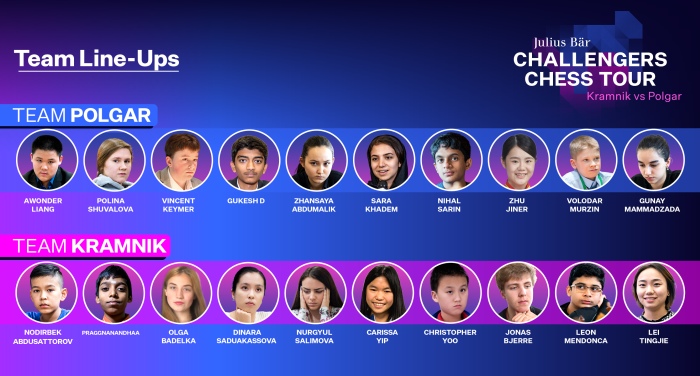
Judit Polgar and Vladimir Kramnik reveal the 20 young stars lined up to play in the $100k Julius Baer Challengers Chess Tour 20 young chess talents from 12 countries Gender-balanced teams led by two legends Winners get a chance to take on the elite $100k prize pot for junior online event The names are in – a line-up of 20 stars from 12 nations ready to compete in the new Julius Baer Challengers Chess Tour. From among them, the next big thing in chess will emerge. Who will it be? Starting on April 8, two teams of young players handpicked to take part in a new series of five events will go head-to-head for a prize pot totaling $100,000. This journey will be unlike any other in chess. Not only is it gender-balanced to find the best in male and female talent, but the four “Challenge” tournaments and the tour final – all played online – will provide a unique training ground for every competitor. Watch the players grow as Judit Polgar and Vladimir Kramnik, two of the greatest names in chess, mentor them. Teams of coaches, which include world champions and yet more legends of the game, will also be on hand to offer support and guidance. Who will progress the most? Will we find a player ready to make the next step up? The players have been divided into two teams, Team Polgar and Team Kramnik, competing in a series of four four-day round-robin tournaments organised by the Play Magnus Group before the grand finals. The first tournament, the Polgar Challenge, will start on April 8 and will be followed by the Gelfand Challenge, the Hou Yifan Challenge and the Kramnik Challenge. Then in September, the Tour Finals will take place. Judit, Vladimir and members of the Play Magnus Group, met the players in a pre-tournament Zoom meeting last week and then gave their teams their first team-talks. Judit spoke of how she hoped the gender-balanced events would help female players gain confidence in the game and told how managing a team would be challenging for her too. She said: “It’s a great opportunity for the youngsters to win an event and qualify for a Meltwater Champions Chess Tour event which is probably for most one of the most important goals here. But I think anyone who is invited to an event here will definitely not leave without great experiences. “In five months we are going to be meeting the players and following them, together with Vladimir as both of us have our team. “Chess is an individual sport, but at the same time sometimes it becomes a team sport. That will be very interesting and challenging for both me and Vladimir to see how we can manage them and have great teamwork between them.” Kramnik thanked the sponsors Julius Baer and Play Magnus Group, the tour organisers, for putting on a “priceless” event during the lockdown and told his players it was an “incredible opportunity” for them. Addressing the players, the former world champion said: “First of all this big project is about learning. Yes, the result is important and you want to win but the one who will be on top later, who has the best career, is not necessarily the one who will win this tournament, it is the one who will learn most from each tournament, each project you have on your way.” Kramnik, now aged 45 and retired, added: “This is an incredible opportunity for you to learn, to progress in chess.” Sebastian Kuhnert, Chief Development Officer for the Play Magnus Group, also told the group: “I feel really amazed that all the great coaches have committed to this great project and I feel we are starting a new era in chess. It started with what we did a year ago [with what became the Meltwater Champions Chess Tour] and now it goes into the next cycle that we are starting together with you.” In a separate Zoom call to his team, Kramnik said: “Good luck to all of you! Try to enjoy the journey because it’s important to learn, first of all, to improve and to come out of it a better player – that’s the main goal – and, of course, to try to secure our trip to Dubai – because it’s quite expensive to go there! Give your best!” Grandmaster Boris Gelfand, who will assist Kramnik as a coach, revealed Team Kramnik would start preparing immediately. The 2012 world title challenger added: “It’s a great opportunity and I wish good luck to everyone!” Winners of the individual events will get a rare chance to compete on the elite stage in a Meltwater Champions Chess Tour event, and perhaps take on World Champion Magnus Carlsen. The team that wins the Julius Baer Challengers Chess Tour overall will also get a trip to this year’s World Chess Championship in Dubai. All matches will be played in chess24.com’s PlayZone and broadcast live with expert commentary from 16:00 CEST on chess24’s YouTube, Twitch and Facebook channels. Team Kramnik: Nodirbek Abdusattorov (aged, 16, Uzbekistan)Rameshbabu Praggnanandhaa (15, India)Dinara Saduakassova (24, Kazakhstan)Jonas Bjerre (16, Denmark)Leon Mendonca (15, India)Lei Tingjie (24, China)Christopher Yoo (14, United States)Olga Badelka (18, Belarus)Carissa Yip (17, United States)Nurgyul Salimova (17, Bulgaria) Team Polgar: Nihal Sarin (aged 16, India)Awonder Liang (17, United States)Vincent Keymer (16, Germany)Gukesh D (14, India)Sarasadat Khademalsharieh (24, Iran)Volodar Murzin (14, Russia)Polina Shuvalova (20, Russia)Zhansaya Abdumalik (21, Kazakhstan)Jiner Zhu (18, China)Gunay Mammadzada (20, Azerbaijan) About the Tour: Fronted by the strongest female player of all time, Judit Polgar, and former World Champion Vladimir Kramnik, the Julius Baer Challengers Chess Tour will run alongside the hugely popular Meltwater Champions Chess Tour. The Tour is organised by the Play Magnus Group and is designed to tackle head-on the lack of female role models competing in top events and promote emerging talent. More information here. For further information, please contact: Leon Watson, PR for Champions Chess Tourleon@chessable.com+44 7786 078 770
World Women’s Team Championship 2021 – Call for bids

The International Chess Federation (FIDE) will hold the World Women’s Team Championship in the second part of September and the first part of October 2021 (see the tournament regulations). FIDE is opening a bidding procedure to invite any federation member of FIDE or any organiser approved by the national federation to host the event. Bid Forms shall be filled in by the applicants. A signed copy shall be submitted as e-mail messages to the FIDE Secretariat to office@fide.com from 3 April to 2 May by 23:59 Lausanne time. All the documents must be submitted in English. Additional documents may be requested by the FIDE General Strategy Commission (GSC) for further evaluation. GSC will present the FIDE Council a report with an evaluation of the bids received. Once the Organiser is granted the right to organise the event, this will be announced on the FIDE website. FIDE may appoint a Technical Delegate (FIDE TD) to supervise the event on behalf of FIDE in consultation with GSC.
Manyok Chaderek Panchol wins 4th South Sudan Championship

Manyok Chaderek Panchol came out as the winner of the 4th National South Sudan Chess Championship (Qualifying Stage). He scored comfortable 10 points out of 11 gruelling rounds. John Makuach, Thon Gong, Juach Marol and Peter Manyang all ended up with 8½ points in joint second place. Manyok Chaderek Panchol went home with SSD 200,000 (USD 1,500). The 11-round Swiss tournament with classical time control attracted over 120 hopefuls who battled daily from 13th to 22nd March 2021. The cash prize fund amounted to SSP 570,000 (approximately USD 4,300). The top twelve players will play in the Final Section, which will take place in June 2021. Nile Petroleum Corporation, 1People Technologies Ltd, Trinity Holdings and GS Construction were the event sponsors. Final standings: 1. Manyok Chaderek – 102. John Thon Makuach – 8½3. Gong Thon Gong – 8½4. Juach Deng Marol – 8½5. Peter Majur Manyang – 8,56. David Maluak Bol – 87. Agook Madol Agook – 88. Joseph Deng Buol – 89. Yuot Mabut Deng Yal – 810. Ayuen Kuer Riak – 811. Gai Athel Riak – 812. Mabior Anyuat Mabior – 7½ Chess facts about South Sudan The South Sudan Chess Federation was registered in 2014 and joined FIDE in 2016. Juuk Thiong Juuk is the current President of the South Sudan Chess Federation. Henry John is South Sudan’s highest-rated player at 2245. South Sudan has just over 370 registered players with FIDE. The federation has only three ladies players who are registered with FIDE. South Sudan has participated in two Olympiads, namely the 2016 Baku and the 2018 Batumi editions. Text and photo: Kenya Chess Masala
How can chess help children with autism?
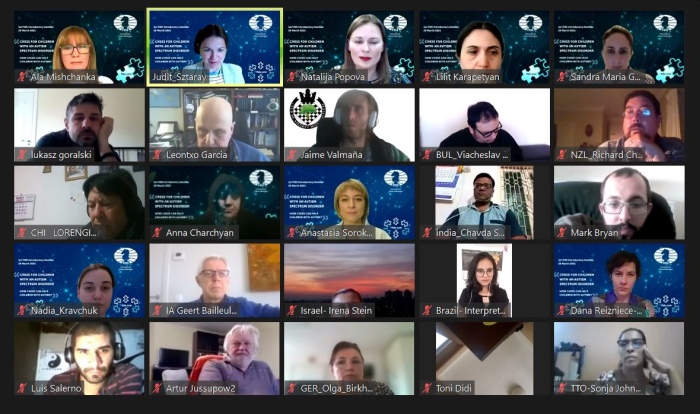
The question above, particularly relevant today on World Autism Awareness Day, was answered by a group of five lecturers during the first FIDE Introductory Seminar “Chess for children with an autism spectrum disorder. How chess can help children with autism” held on March 29. 130 representatives of chess federations and FIDE academies took part in the two-hour event, organized as part of the Autism Awareness Week. The audience included legendary figures like Judit Polgar, Artur Yusupov, and the former Women’s World Champion Antoaneta Stefanova. “You’d see a quote in one of today’s presentations which says ‘Autism is not a disability, it is a special ability’. But how to make use of it? And our answer today would be to think of chess as a discipline that might not only give enjoyment, satisfaction and pleasure to these special kids but also improve their physical and mental health,” said FIDE Managing Director Dana Reizniece-Ozola in her welcome speech. Five speakers from different parts of the world shared their experiences in teaching chess to children with ASD: Ala Mishchanka, Special needs educational assistant from Canada with more than 15 years of experience, made an introduction to the concept of “Autism Spectrum Disorder”. “Some sports can be challenging for kids with ASD; that’s why it is important to help children choose sports they are likely to enjoy and excel at”, says Ala Mishchanka. “But not every sport requires high-level communication and cooperation and could be a great match for children with autism. Chess is definitely one of them.” The next lecturer was Dr Lilit Karapetyan, Senior researcher at the Chess Research Institute of the Abovyan Armenian State Pedagogical University (ASPU), and Lecturer at the Department of Special Pedagogy and Psychology. Lilit shared the Armenian experience in chess lessons with students with an autistic spectrum disorder. They used unique chess tasks and lessons to develop speech and other cognitive processes and regulate the behaviour of children with ASD. “The study showed the effectiveness of special psychological-pedagogical methods. These methods are also very effective in the development of spatial orientation. Based on the work done during the chess lessons with children with ASD, we suggest the list of methods and exercises.” Lilit’s colleague Dr Anna Charchyan also a researcher in chess at ASPU, with a Ph.D. in Pedagogy, and Lecturer in Speech Therapy and Occupational Therapy at the Faculty of Special and Inclusive Education, provided practical advice and comments about each of them, which you can find in the seminar’s video recording. WIM Natalia Popova, Trainer at the FIDE Chess Academy in Belarus who has led a project in Minsk for the last two years, was the next one to share her experience. She stressed the positive impact that chess lessons had on the children, and how this progress was also acknowledged by the parents: “If we speak about the personal development of a child with ASD, even I, not being a specialist in ASD children, witnessed the first signs of positive results within the first three or four months. Children pronounced the words more clearly, were able to formulate their thoughts. The children that are non-verbal and have problems with hearing demonstrated the ability to answer simple questions. Last year, many children worked only in the presence of their parents. This year, most children work without their parents; only one boy requires his mum’s presence. Last year, several children demonstrated significant aggression. This year they have become less aggressive and show at least some control of their aggressive behaviour. They became more persistent. So within a year, their behaviour and overall interaction have improved.” Dr Sandra Maria Guisso, Ph.D. in psychology and MSc in Biology and Education, is a very reputed authority who studies the game of chess in various situations of daily life and with people affected by Down syndrome, autism, and people deprived of freedom. In her dissertation “the game of chess and the autistic child” she presented a case study from Brazil. “This study shows us that autistic kids are not abnormal, they are just different. We have abilities that we need to work on. In the same way, the autistic child has abilities that need to be worked on. We, researchers, always look for new tools to develop those abilities. Chess is one of the tools that we can use more,” stressed Dr Sandra Maria Guisso. According to the latest data, 1 in 54 children has ASD in the USA, and the prevalence has increased 178% since 2000. FIDE believes that using chess as a development tool is an important priority, and will continue supporting educational efforts in this direction. “From FIDE side, we are willing to have further follow-up activities, allowing us to use our royal game as an efficient tool for empowerment, social integration and psychosocial well-being of those members of society who need it the most, in this case, it’s the kids with autistic spectrum disorder, always unique, totally intelligent and sometimes mysterious,” said Dana Reizniece-Ozola in conclusion. The first introductory seminar proved that there is a big interest in the topic from the federation representatives and chess trainers. We hope that the follow-up surveys will confirm the interest and we will have a basis to expand on the project, providing more seminars and training courses as soon as in summer. You can watch the complete recording of the seminar on the FIDE YouTube channel. All the presentations are also available for download: Indroduction to Autism Spectrum Disorder (by Ala Mishchanka) Chess lessons with students with autistic spectrum disorder: Armenian experience (by Lilit Karapetyan and Anna Charchyan) Belarus project teaching chess to children with autistic spectrum disorder (by WIM Natalia Popova) The game of chess and the autistic child: A study case (by Sandra Maria Guisso) We would like to thank FIDE Vice President Anastasia Sorokina, and Nadezhda Kravchuk, a member of the FIDE Social Commission, for their initiative in organizing this successful event.
SF Deizisau e.V wins European Online Chess Club Cup 2021

SF Deizisau e.V took the European Online Chess Club Cup 2021 after winning the final stage of the competition. 91 teams participated in the event with 18 squads advancing to the play-offs. The best 10 teams of play-offs qualified for the final which took place from 30th-31st March. Neither team completed the tournament distance unbeaten. The champion scored 14 match points losing one match and drawing two. Clichy Echecs 92 from France came in second with 13 match points. Two teams, Mednyi Vsadnik (Russia) and Poland Hussars (Poland), tied for the bronze medal netting 11 match points each with the former getting bronze in accordance with board points. Special prize “Vasily Smyslov” was awarded to a winner of the best game of the tournament Vladislav Artemiev who stunned Mateusz Bartel with a spectacular queen sacrifice. The game can be seen here. The best individual players per board will be awarded special prizes according to their performance: the top three individual board players will receive e-medals, while the best players on each board will take home €400. 1st board: GM Jan-Krzysztof Duda (POL, 2729, Poland Hussars), Performance: 2890 GM Jorden Van Foreest (NED, 2701, Clichy Echecs 92), Performance: 2857 GM Vladimir Fedoseev (RUS, 2687, Mednyi Vsadnik), Performance: 2823 Jan-Krzysztof Duda Photo: Maria Emelianova (chess.com) 2nd board: GM Vidit Santosh Gujrathi (IND, 2726, Novy Bor), Performance: 2786 GM Maxim Matlakov (RUS, 2688, Mednyi Vsadnik), Performance: 2726 GM David Howell (ENG, 2658, 4NCL Guildford), Performance: 2725 3rd board: GM Bartosz Socko (POL, 2618, Poland Hussars), Performance: 2674 GM Amin Bassem (EGY, 2695, Clichy Echecs 92), Performance: 2664 GM Nijat Abasov (AZE, 2664, Odlar Yurdu), Performance: 2654 4th board: GM Andrey Esipenko (RUS, 2701, Mednyi Vsadnik), Performance: 2767 GM Gawain Jones (END, 2670, 4NCL Guildford), Performance: 2708 GM Vasif Durarbayli (AZE, 2606, Odlar Yurdu), Performance: 2697 Andrey Esipenko Photo: John Saunders 5th board (Reserve players): GM Vincent Keymer (GER, 2591, SF Deizisau e.V.), Performance: 2812 GM Aleksandr Shimanov (RUS, 2597, Mednyi Vsadnik), Performance: 2661 GM Eltaj Safarli (AZE, 2598, Odlar Yurdu), Performance: 2656 All the results and standings can be found here. The Closing Ceremony of the event will take place on Friday, 2nd of April, starting from 17:00 CET and will be broadcasted through the ECU Twitch channel and the European Chess TV Youtube channel. All the rounds and games of the event were broadcasted live from the ECU LIVE studio, together with commentaries by WGM Keti Tsatsalashvili and her special guests: ECU President Zurab Azmaiparashvili, ECU Vice Presidents: Adrian Mikhalchishin, Dana Reizniece-Ozola, and Eva Repkova. Text: europechess.org/
Saint Louis University clinches Team Rapid Cup

Similar to the blitz event of the FIDE World University Online Championship, the four best teams qualified for the Team Rapid Cup semifinals after the individual rapid. Both semifinals and the final were best-of-two-sets matches played on March 28 on chess24 platform. According to the tournament regulations in case of a tie on match-points, board points did not count so the team had to play a tie-break blitz match. In the semifinals, the University of Missouri was pitted against Shanghai University of Finance and Economics whereas Texas Rio Grande Valley squared off with Saint Louis University again, just like in the Team Blitz Cup. The first semifinal started with a draw in the first set (all four games produced decisive outcomes) but in the second set, the University of Missouri took the situation under control and advanced to the final thanks to the victories by Grigoriy Oparin and Christopher Repka on first and third boards. In the second semifinal, Saint Louis University pushed hard from the very start, grabbed the first set 3:1, and after drawing the second one 2:2 made it to the final. The University of Missouri and Saint Louis University met in the final again but this time around the latter took revenge. Again it was a very close battle – the first set was drawn after the teams exchanged blows on all four boards. The fate of the match and the title was decided in the second set on the first board: Nikolas Theodoru toppled the highest-rated player of the event Grigoriy Oparin in a spectacular fashion and tipped the scales for his team. Nikolas Theodoru – Grigoriy Oparin 18.Rxh7! fxg5 19.Bxg6 Qf6 20.Rxd7 Qxg6 21.Rxb7 and White converted his extra material 1-0 Final standings: 1. Saint Louis University 2. University of Missouri 3. University of Texas Rio Grande Valley 4. Shanghai University of Finance and Economics
FIDE Arbiters’ Manual 2021 published

Last summer, the Arbiters’ Commission invited the chess community to provide feedback and contribute with ideas to improve the FIDE Arbiters’ Manual, a key working tool for chess arbiters worldwide. The result of this team effort is the 2021 edition of the FIDE Arbiters’ Manual that was published a few days ago, in which more people contributed than ever before. Apart from many of these suggestions, this important document was also enlarged and is now composed of 14 chapters. The two new ones are #13, with the FIDE Online Chess Regulations, and #14, with sample exam questions for FIDE arbiters. The document also now includes more educational content, like a section by Professor Ken Regan about his Anti-cheating tool, and more comments and interpretations written by experienced arbiters. The topics have also been rearranged in a different order that better reflects their importance: 1. Governing play: Roles and duties, Laws of Chess, Anti-Cheating, Pairings2. Players’ focus: Ratings and norms3. Technical references: Tournaments and tie-breaks4. Administrative: titles and classifications of arbiters, application forms The International Arbiter Shohreh Bayat, Councillor of the ARB Commission, was the leader of the project, and she expressed her gratitude to all those who contributed. in particular, Alex McFarlane, Ken Regan, Juergen Klueners, David Sedgwick, Aris Marghetis, Gopakumar MS, Shaun Press, Sabrina de San Vicente, Alex Holowczak, Anantharam Rathinam, Hal Bond, Igor Vereshchagin, and Pierre Denommee. They all provided very valuable input. DOWNLOAD THE FIDEARBITERS’ MANUAL 2021 The Arbiters’ Manual is an ongoing project, so any feedback, comments, and proposals to continue improving it are welcome any time. Feel free to address them to the ARB Commission using their contact email: secretary.arbiters@fide.com