

Team FIDE wins FIDE Candidates Countries Youth Tournament
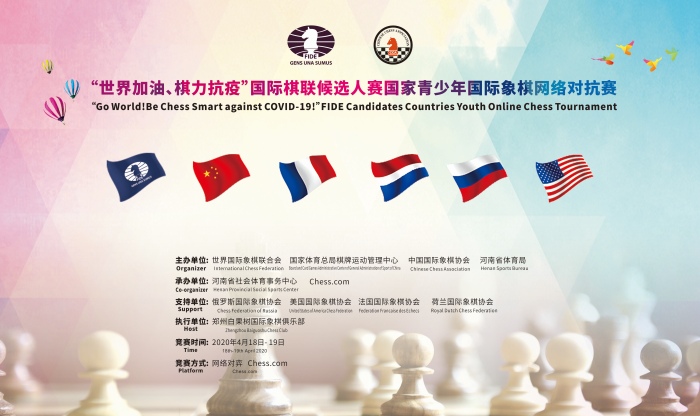
On April 18-19, the Chinese Chess Association organized an online competition – FIDE Candidates Countries Youth Online Chess Tournament. The motto of the event, held on Chess.com, was “Go World! Be Chess Smart against COVID-19!” The tournament was broadcasted live on China Leisure Sports TV Network with GMs Hou Yifan (#1 in women’s rating list) and Peng Zhaoqin commentating on proceedings. It reached more than 10,000 views, even though the show was in the late evening in China. This youth competition was inspired by the Candidates Tournament 2020 with five teams representing China, USA, France, Russia, and the Netherlands taking part. Each team consisted of 5 young players under 16 each (3 boys and 2 girls). To make the number of participant teams even, a sixth team was added, playing under the FIDE flag and comprising five players from Cuba, Germany, Kazakhstan, Uzbekistan, and India. The tournament started on April 18, 22:00 Beijing time. The highest ever rated woman-player Judit Polgar and the former women’s World Champion Zhu Chen recorded videos of making the first symbolic moves in the event. The organizers showed these videos before the start of the tournament. To ensure fair game, the arbiter group supervised all games via Zoom. All the teams were required to enter a Zoom room with one arbiter inside. During the game, every player set up a smartphone or same function device in the right (or left) corner to let the camera show the screen and the player. Besides the measure taken, all captains as members of the appeal committee have discussed and signed a guarantee letter, promising fair play. Team FIDE headed by GMs Nihal Sarin (2620) and Noribek Abdusattorov (2627) entered the competition as prohibitive rating favorites but in Round 1 it suffered a defeat at hands of the Chinese squad. Meanwhile, Russia was held to a draw by a lower-rated USA. Somewhat surprisingly, in Round 2 Russia dismantled China 4:1 and took the joint lead with the USA which beat France with the same score. In Round 3 team FIDE stopped Russia (3:2), but the USA won its match against France and preserved one-point distance from the closest pursuers. In Round 4, which became decisive one, team FIDE whitewashed the leader 5:0; China and Russia also scored victories. In the final round, team FIDE made a short work of France, but China convincingly outplayed the USA. As a result, the teams FIDE and China tied for first place with the former claiming the title by the total number of game points. Russia finished 3rd, USA 4th, whereas France and Netherlands shared 5-6 places. 16-year-old Bibisara Assaubayeva from the FIDE team showed the best individual result in the event with 4 wins and 1 draw. GMs Nihal Sarin (FIDE) and Huang Renjie (China) were the best on board 1, scoring 4 points each.
90th FIDE Congress: 2020 FIDE Extraordinary General Assembly Minutes and Annexes

FIDE publishes the Minutes of 2020 FIDE Extraordinary General Assembly which was held in Abu Dhabi, UAE on February 28th. Download 2020 Extraordinary General Assembly Minutes (pdf) Annex 1.1 Admission of new federations Annex 1.2 Admission of new affiliated members Annex 2.1 Change of FIDE Statutes: new FIDE Charter Annex 3.1 New Financial Regulations
90th FIDE Congress: 2020 FIDE Executive Board Minutes and Annexes
FIDE publishes the Minutes of 2020 Executive Board meeting which was held in Abu Dhabi, UAE on February 29th. Download 2020 FIDE Executive Board minutes (pdf) Annex 3.1 Report of the FIDE Treasurer Annex 3.2 FIDE Financial Statements for 2018 Annex 3.3 Verification Commission report Annex 3.5 Budget 2020 Annex 4.1 Report of Continental Association for Europe Annex 4.2 Report of Continental Association for Americas Annex 4.4 Report of Continental Association for Africa Annex 5.2 Arbiters’ Commission report (ARB) Annex 5.3 Chess in Education Commission report (EDU) Annex 5.4 Commission for the Disabled report (DIS) Annex 5.5 Commission for Women’s Chess report (WOM) Annex 5.7 Ethics Commission report (ETH) Annex 5.8 Events Commission report (EVE) Annex 5.8.3 Bids for World Senior Team Championship 50+ and 65+ 2021 (Italy and Russia) Annex 5.8.4 Bids for World Senior Championships 2021 (Malta and Russia) Annex 5.8.5 Bids for World Amateur Championship 2021 (Italy and Malta)Annex 5.8.6 Bid for World Junior and Girls U-20 Championship 2021 (Italy) Annex 5.8.7 Bids for World Youth Championships U-14, U-16, U-18 2021 (Italy and Russia) Annex 5.8.8 Bid for World Cadet Championship U-8, U-10, U-12 2021 (Egypt) Annex 5.8.9 Bids for World Cadet & Youth Rapid and Blitz Championships U-8,10,12 2021 (Croatia and Georgia) Annex 5.9 Fair Play Commission report (FPL) Annex 5.10 Global Strategy Commission report (GSC) Annex 5.11 Medical Commission report (MED) Annex 5.12 Online Commission report (OLC) Annex 5.13 Planning and Development Commission report (PDC) Annex 5.14 Qualification Commission report (QC) Annex 5.15 Rules Commission report (RC) Annex 5.17 Systems of Pairings and Programs report (SPP) Annex 5.18 Technical Commission report (TEC) Annex 5.19 Trainers’ Commission report (TRG) Annex 5.20 Data protection GDPR Annex 8.1 Chess ID Annex 8.3 Fischer Random Chess Annex 8.4 Athletes Commission
Arkady Dvorkovich: FIDE is moving online
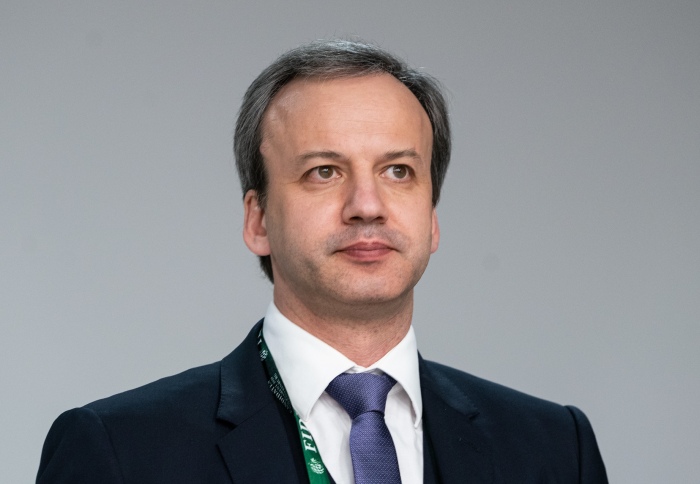
FIDE President Arkady Dvorkovich gave a big interview to a popular Russian newspaper Kommersant. The first part was published on the official FIDE site website three days ago. This is the second part of this interview. When announcing the suspension of the Candidates Tournament you told that FIDE would try to make smart use of this period of self-isolation to search for new ideas. What is the International Chess Federation doing right now? Arkady Dvorkovich: We are moving many of our activities online, to digital platforms. There have been already several unofficial competitions on different websites. We carefully reviewed this experience and worked out our own strategy. First of all, we are going to organize team events for the leading chess countries including a “digital copy” of the Chess Olympiad that was scheduled for August. Now we are planning to hold it in the online format. That is a big project. We are also considering the formats involving competitions among schools, universities, corporations, and cities. The rapid chess championships are also on the menu. I think we will organize one massive tournament with a wide range of players taking part. Are regional federations active as well? A.D.: They are. The European Chess Union (ECU) has planned the European Championship for May. Magnus Carlsen with his team announced Magnus Invitational tournament with all the top players participating. The event starts on April 18. Many of our activities also go digital – seminars for trainers and arbiters, tournaments organizers and chess players. We will be very active in these spheres for the next several months. Currently, the lectors are intensively preparing for the planned seminars. All these measures will help people all around the world to be part of the chess life even in this difficult period. Am I right that this crisis in a way gave chess some boost? A.D.: There is one problem with that – in addition to an emotional aspect – after all chess players prefer to get together in clubs, to socialize and play live (most of them enjoy it much more than online). I am talking about cheating. Unfortunately, no one can be trusted, except maybe for the top-players for whom their reputation is the key asset. On lower levels, anti-cheating is highly relevant. We are working together with chess platforms and cybersecurity companies on the solutions to these problems. It is too early to summarize the results of the World Championship cycle which coincided with you taking the office. Maybe you can specify some trends? Has the popularity of chess increased? A.D.: All that we have done over the last two years, was done on a higher level than previously. I am referring to both marketing efforts and engaging leading companies into chess. I am talking about such companies as Coca-Cola, Total, RZD, Rosseti, Gazprom. The same applies to the coverage of the tournaments. For example, we provided coverage for the Women’s World Championship match and the Candidates tournament in several languages (Russian, English, and Chinese), whereas our partner Chess24 added several extra languages to the broadcast. This is a great improvement of the situation as language diversity attracts extra users to the World Championship cycle. Plus, the look of the chess broadcasts is much more professional now. I hope that it will measure up to the highest standards to be broadcasted on TV. Is the chess audience growing? A.D.: We saw an exponential viewership growth in women’s chess. The size of the audience is still not that great in absolute numbers but we are talking about tens of thousands of people following the games. As far as the open category is concerned, we expanded our audience by hundreds of thousands of people by involving Chinese viewers. FIDE made an experiment by making the Grand Swiss a part of the World Championship cycle. It was a Swiss-tournament, the format that often produces unexpected results. Are you happy with this event? A.D.: This tournament on the Isle of Man brought together the participants from different rating categories. It was different from the elite Grand Prix in which only the best compete in a playoff format. I would compare Grand Swiss with the FIDE World Cup, but unlike the latter, it attracted virtually all the best players. This is a more democratic format that gives a chance to the maximum number of players to distinguish themselves. We saw two biggest sensations of this cycle come out of Grand Swiss. Thanks to this event, not only the top players qualified for the Candidates, but also two “dark horses” – Wang Hao (China) and Kirill Alekseenko (Russia). Summing up, we are quite happy with this tournament and hope to continue. Some advocates of chess traditions argue that two random players qualified for the Candidates in Yekaterinburg but their level is below the rest of the field. A.D.: Going by this logic we should hold no qualifying events, just take eight best players by rating and that’s it. All in all, we think that the qualifying process has to be as open and democratic as possible. Have you planned any experiments in the new cycle? A.D.: We would like to stick to the principles of the current cycle. Maybe we will make some changes in the qualifying for the Candidates. First of all, it is about determining the best-rated player who gets his spot in the Candidates. The current system has drawn a fair amount of criticism because from a mathematical standpoint the rating points earned several months ago are more valuable than those picked up right before the Candidates. We are working with the experts in math and statistics on possible corrections of the current system. One of the solutions might be using so-called performance, i.e. how good a particular player was in the period right before the Candidates. Many of my friends play online either rapid or blitz. Don’t you think that these formats are not represented enough at the highest level? A.D.: I don’t think so. All top players constantly participate in various online rapid and blitz tournaments. The Rapid and Blitz World Championship is
Vladislav Artemiev wins Abu Dhabi Super Blitz Challenge
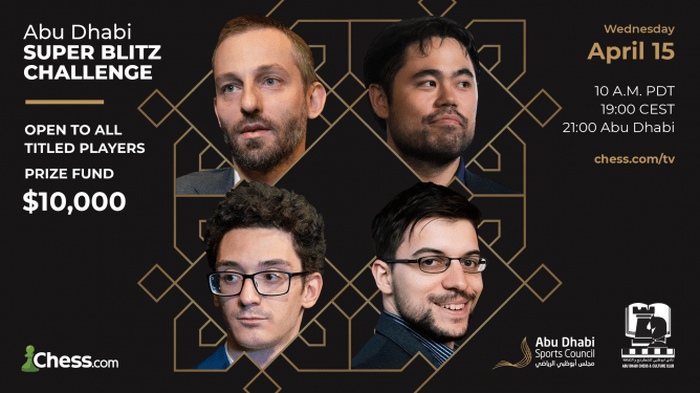
The event by Abu Dhabi Chess & Culture Club was held on Chess.com on April 15 and became one the strongest online tournaments ever. “Based on the directives of the authorities to the residents to stay at home during the lockdown, the Abu Dhabi sports council took the initiative to organize a big online event,” said Hussein Abdullah Khouri, Chairman of the Board of Directors of the Abu Dhabi Chess & Culture Club. $10,000 prize fund with $5,000 going to a winner attracted an impressive field. More than 1100 titled players started the race, including superstars like Hikaru Nakamura, Fabiano Caruana, Maxime Vachier-Lagrave, Alexander Grischuk, Ian Nepomniachtchi, Anish Giri and others. The time control was usual for regulars of blitz events on chess.com: 3 minutes + 1 second increment. The first stage was an 11-round Swiss tournament with the top eight finishers going to the playoff. Seven players finished on 9.5/11: GMs Nihal Sarin, Ian Nepomniachtchi, Oleksandr Bortnyk, Peter Svidler, Daniil Dubov, Vladislav Artemiev, and somewhat surprisingly FM Artur Avalyan. GM Parham Maghsoodloo was the luckiest one of the big tie on 9/11 – he had the best tiebreak to close the top 8 rankings. Several upsets included Nakamura, Caruana, Grischuk, and Giri failing to qualify as well as Andreikin falling out of the top despite being a sole leader after round 9. The playoff stage consisted of mini-matches of 2 games and a 5/4 armageddon as a tiebreaker and had the players to be on camera for the duration of the games as an additional anti-cheating measure, as well as a treat for spectators. The facial expression of Peter Svidler blundering and losing to Daniil Dubov in the Armageddon of their quarterfinal said it all before the winning move was made by Dubov. Quarter-finals: Nihal Sarin – Parham Maghsoodloo 2-0Oleksandr Bortnyk – Artur Avalyan 1.5-0.5Vladislav Artemiev – Ian Nepomniachtchi 2-0Daniil Dubov – Peter Svidler 2-1 Vladislav Artemiev proved the Russian saying “a champion always has luck on his side” in the very first game of the playoff when his opponent Ian Nepomnichtchi blundered mate in a totally winning position. The current European champion did not stumble again and was very convincing in the next matches, though. In the semis, Oleksandr Bortnyk eliminated Nihal Sarin 2-0 and Vladislav Artemiev knocked our Daniil Dubov by the same score. Nobody could stop Artemiev that evening. Being on a roll, he smashed Bortnyk with his signature 2-0 in the final to take home the main jackpot of $5,000. Bortnyk earned $3,000 for his second place. Dubov defeated Nihal Sarin in the match for third and took home $1,500. Following this victory, Artemiev also became the number-one-rated blitz player on chess.com. Photo: chess.com
Firouzja beats Carlsen in the Banter Blitz Cup final
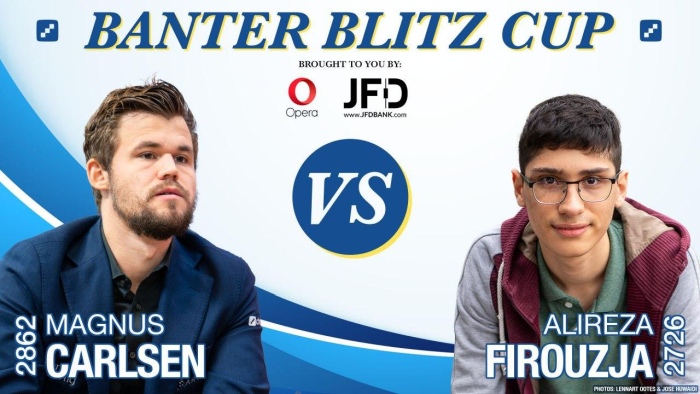
The 132-player knock-out event with the total prize fund of $50,000 stretched from the beginning of autumn. The final on April 15 saw Magnus Carlsen and the crowd favorite 16-year-old Alireza Firouzja clash in a 16-game (3 minutes, no increment) blitz battle for $14,000 first prize. On the way to the ultimate showdown, Carlsen defeated GM Sanan Sjugirov in the semis and GM Nils Grandelius in the quarters. Firouzja eliminated GM SL Narayanan (SF) and GM Georg Meier (QF). Due to a lack of over-the-board events, this match was a real treat to spectators and lived up to the highest expectations. Firouzja grabbed the lead after winning the first game with Black but Carlsen bounced back in game 3 and kept coming back after each win of the youngster. The opponents kept this pace for 11 games and the score was still even. In game 12, Carlsen took the lead for the first time, but Firouzja leveled the score right away. They exchanged the blows in games 14 and 15 again to find themselves on an even score before the last game. Game 16 went perfectly for Firouzja as he outplayed the world champion in his own element – the endgame. After it was over, Carlsen complained about being in a bad shape but gave credit to his opponent: “He’s amazingly strong. Full credit!” Both players streamed and commented on the games live, thus “Banter Blitz”. You can replay the match by the following links.Carlsen: https://chess24.com/en/live/video/banter-blitz-cup—magnus-carlsen-vs–alireza-firouzjaFirouzja: https://chess24.com/en/live/video/banter-blitz-cup—firouzja-vs–carlsen In just a couple of days, Carlsen and Firouzja will meet over the virtual board again – the strongest online event of this spring, “Magnus Carlsen Invitational” starts on April 18.
UPDATE: FIDE workshop for tournament organizers
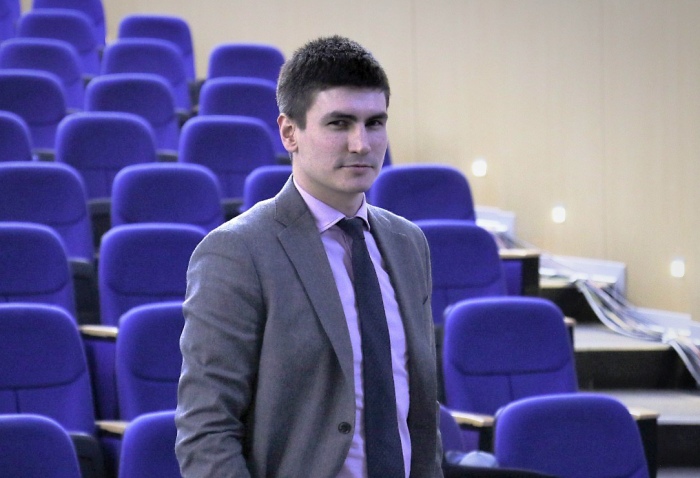
UPDATE: April 15, 2020 More than 90 people attended the first workshop by FIDE Competitions Director Maxim Korshunov. In view of this success, we have decided to repeat it next week, again on Monday and Tuesday (April 20-21). The content, format, and other details regarding the workshop remain exactly the same (see below). Likewise, a second stage workshop with more advanced content (for those who have already attended the first one), will be held on April 27-28. Maxim joined FIDE in September last year, having previously worked at the Russia 2018 FIFA World Cup (as stadium manager, leading a team of more than 150 direct subordinates), the World EXPO 2015 in Milan (as Deputy Head of Department at the Russian Pavilion), and the Winter Olympic Games in Sochi 2014 (as Senior Manager within the Organizing Committee). The conference will be be held over ZOOM. In order to register, simply send an email to korshunov@fide.com. Prior to the start, the organizer will send a link from where you can join the lecture. Schedule:20.04.2020 [Monday], 12:00 (GMT 0)21.04.2020 [Tuesday], 12:00 (GMT 0) Title – Event operational planning tools Lecturer – Maxim Korshunov, FIDE Competitions director. Description – The lecturer will show operational tools that can help chess organizers to deliver the best practices of worldwide events: During the conference you will find out: a) How to prepare operational plans for an eventb) How to create responsibility assignment matricesc) How to do daily check-lists and check the venue on a day-to-day basisd) How to plan and deliver the zones of the venue for the different client groupse) How to activate a sponsorship f) How to integrate activities together with local authorities. Photo: Eteri Kublashvili
Arkady Dvorkovich: I have no regrets
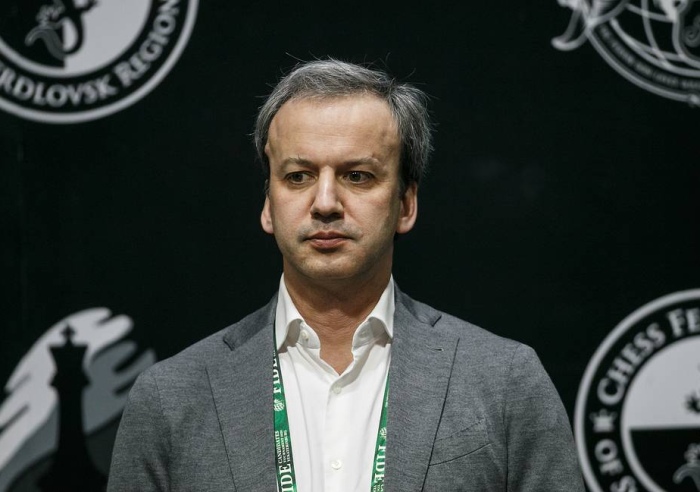
FIDE President Arkady Dvorkovich gave a big interview to a popular Russian newspaper Kommersant. This is the first part of this interview. Let’s start with the Candidates Tournament. You opened it in the middle of March, exactly on the day the Ministry of Sport of the Russian Federation issued an order imposing severe restrictions on sports events in the country. Do you have any regrets about your decision to run this event? After all, you had to put in on hold halfway through. Arkady Dvorkovich: I have no regrets. It was a conscious decision. I personally weighed all the factors that had to be taken into consideration before the event. First and foremost, it was about chess fans all around the world as so many people were looking forward to watching this competition. I was 100% sure that we would provide the health security of all the participants and people involved in the organization of this tournament. It was a critical factor. Besides, it was very important not to disrupt the World Championship cycle and to do our best to keep to the schedule. Another key factor was providing equal rights and conditions for all the participants. For example, Ding Liren arrived in Russia in advance on March 1, to get the required 14-day quarantine. Had we failed to ensure his participation in the Candidates Tournament (the decision was being made at the end of February) the entire event would have been in question. The final line-up was formed 10 days before the event. All the participants reaffirmed their willingness to contend for the chess crown. We did not have sound reasons to postpone the tournament. Some participants, for example, Alexander Grischuk complained about the atmosphere and the problems with concentration during the games. Were you aware of that? A.D.: First of all, there were no official complaints. We quickly reacted to all requests, made many concessions, took into considerations even tiny details to create a comfortable psychological atmosphere. Don’t forget, that all the players are real professionals. Allow me to remind you about the order by the Ministry of Sport of the Russian Federation. Essentially, this order canceled all the sports competitions in Russia, didn’t it? A.D.: The Candidates Tournament is not a mass sport event as there were only eight players participating. It was not affected by these restrictions. We were in constant contact with regional authorities, the Ministry of Sports of the Russian Federation and Rospotrebnadzor (Federal Service for Supervision of Consumer Rights Protection and Human Welfare) regarding the event and got the green light. I understand that it is very hard to make projections right now. Do you have any scenarios regarding the completion of the event – plan A, plan B, and plan C? A.D.: We do. Plan A – the optimistic scenario – is to hold the second part of the event in August or September. Many experts believe that this is a realistic timeframe bearing in mind how the situation with the COVID-19 has been evolving. We might return to normal life by the middle or the end of the summer. In this case, the winner of the Candidates Tournament will have enough time for thorough preparation for the World Championship match – approximately 3 months. But again, this is an optimistic scenario, under which the title match will be held in December of 2020 as planned. Are there less optimistic scenarios? A.D.: A less optimistic plan is to move the entire cycle a few months later. However, this is an undesirable alternative for us. We believe that the first, optimistic scenario can materialize. Let me clarify just in case. Will the second part of the Candidates be held in Yekaterinburg? A.D.: It will. I see no obstacles. We have the confirmation from our key partners, SIMA Land company and the regional authorities. They expressed their willingness to hold the second part of the event in Yekaterinburg. Naturally, if some other location wants to host it, we will consider such a request. At present, Yekaterinburg remains our priority. Let’s return to the World Championship match. Will it be held in Dubai in December as you mentioned before? A.D.: We hope it will take place in December in Dubai. In the case of force-majeure, we will be considering the alternatives. Presently, our partners are still willing to hold this match. If there is any contract? A.D.: We agreed on the terms. It remains just to sign the contract. At the beginning of the year, FIDE published the terms and conditions of bidding for the right to hold the World Championship match. One of the key conditions was a guaranteed prize fund of at least €2,000,000. Is this condition met? A.D.: Sure. Why Dubai, exactly? A.D.: The idea came about several months ago in connection with EXPO-2020 that will be held in this city. The World Expo will provide maximum interest to the venue. Plus, its theme – The Global Mind – is consonant with chess. We entered into the negotiations and reached a mutual understanding. Dubai was not the only bidder. We considered several options but Dubai looks the most attractive one. I am a little concerned that you are going to hold the title match as part of EXPO. Do you think it might downgrade the event, make it some sort of a side order to the main course? A.D.: Of course not. This match is not a part of EXPO, we will just use its platform. It will be one of the central events of this period, which is going to attract the maximum audience. In other words, you are confident that this symbiosis will increase the exposure of the match. A.D.: Definitely. You already mentioned that in the best-case scenario there would be three months between the completion of the Candidates tournament and the start of the World Championship match. Indeed, it is enough for the participants to prepare for the competition, but is it a sufficient period to promote and advertise the match? Previously this process took twice as long. A.D.: We will start
South vs. North Chess Star Online Match ended in a draw
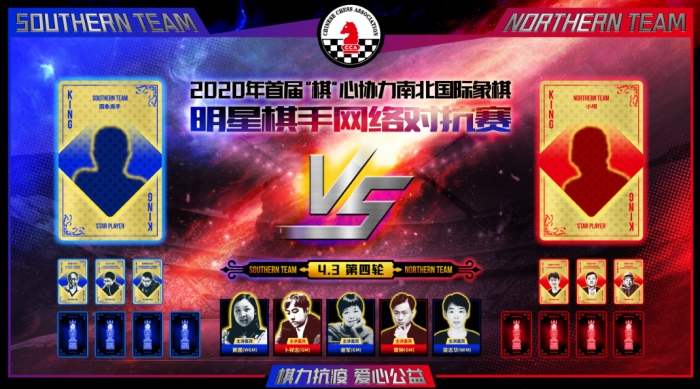
On March 30 – April 10, the Chinese Chess Association organized an online North vs South match that was live on CCTV5, the main sports broadcaster in China. The show reached 2 million views. Each team consisted of eight players five male and three female members, including such stars as grandmasters Yu Yangyi (2709), Wang Yue (2669), Li Chao (2683) playing for North and GM Wei Yi (2732), former women’s world champion Tan Zhongyi (2510) representing for South. There was a rule regarding the players’ age: 2 players in each team had to be born in the 1940s-1950s, 2 players in the 1960s-1970s, 2 players in the 1980s, 2 players in the 1990s and 2 players in the 2000s. The gimmick of the show was that the players were hidden under nicknames and neither audience nor commentators knew who was playing the game. The coaches of each team chose their players without knowing who the opponent would be. The Chinese chess community called this tournament a mystery TV series, as in each “episode”(round) spectators and commentators could guess the real identities of the players by their silhouette photos. The players were revealed after the games were over and proceeded to a flash interview where they shared their emotions and told stories from their chess careers. The match ended in a draw, 4:4.
FIDE Newsletter #003 is out

Welcome to the FIDE newsletter Welcome to the bi-weekly FIDE Newsletter. The coronavirus crisis conditions most of the content in our third issue: all official competitions have been halted, but the online chess activity never ceases, and in fact, it is thriving. For many, the global lockdown is a great opportunity to acquire new knowledge and skills, so FIDE is launching a series of online seminars and workshops, as well as a campaign to encourage the members of our chess family to strive for self-improvement. Content: Stay home, stay safe, stay sharp! FIDE news and activities Online events FIDE distributes €35,000 among chess veterans Chess in outer space Happy birthday, Garry Kimovich! Stay home, stay safe, stay sharp! The UN considers the COVID-19 pandemic the most challenging crisis since the Second World War. Probably it is also the most global event ever experienced in human history, and many think that we will come through the crisis reinforced as a society. With an estimated four billion people under a lockdown of some kind, this can also be an opportunity to improve and grow as individuals. From the International Chess Federation, we would like to encourage you, first and foremost, to follow the public health recommendations. Stay home, and stay safe! But we would also like to encourage you to stay active, both mentally and physically. Exercising will strengthen your immune system, improve your mental health, and make you feel better about yourself during this frightening period. Maybe you can’t go to the gym, but you can still get great workouts anywhere you are thanks to YouTube. There are plenty of fitness channels with free videos, offering a huge variety of exercises, from aerobics and pilates to bootcamp and boxing. Most people will enjoy more free time than usual during the lockdown. We have a near-limitless offer of TV shows, but, what if we make productive use of this time instead? A book is usually more enriching. Learning a new language is always a good option. Doing the same things but in a new and different way is common advice to prevent and limit brain aging, so why not to take up a new chess opening? Or set yourself a goal, like coming out of the quarantine as a stronger player: try and break your own rating record online! SUBSCRIBE YOURSELF HERE