

TTCA receives Award for Top Sporting Organization
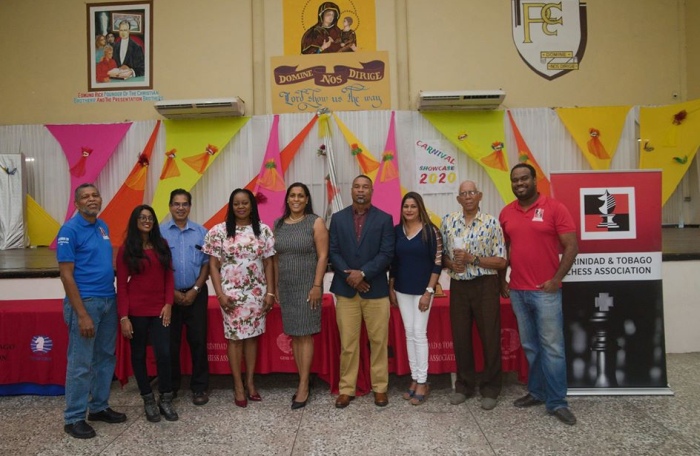
The Trinidad and Tobago Chess Association (TTCA), was awarded the Jeffrey Stollmeyer Award for Top Sporting Organization-Large for 2019 during the First Citizens Sports Foundation Awards virtual presentation aired last night on local TV stations. This honor followed previous awards received by the TTCA as Top Sporting Organization-Small Category in 2015, 2016 and 2018. The other nominees for the Large Category were the Trinidad and Tobago Hockey Board and the National Association of Athletics Administrations of Trinidad and Tobago, both of which were dominant recipients of this award in the past. This was indeed a milestone for chess in Trinidad and Tobago as it was benchmarked against mainstream sports in the country. The Jeffrey Stollmeyer Award is given to a national governing sports body that has outstandingly showcased initiatives and made significant administrative improvements and real steps towards the development of its athletes. Additionally, the youth nominees for chess, WCM Shemilah James and IM Alan-Safar Ramoutar, were shortlisted as two of the top 10 youth athletes for their performances in 2019. The TTCA President, Sonja Johnson, told that she was very proud yet humbled by the recognition given to the TTCA in the national sporting landscape as this puts the TTCA well on its way to becoming one of the Top 5 sporting organizations in Trinidad and Tobago. Ms. Johnson also remarked that this achievement was a collective effort and expressed her heartfelt thanks to her executive members. She also expressed gratitude to the players, parents, arbiters, clubs and the International Chess Federation. “The funding granted by FIDE really assisted us in achieving this milestone and I would personally like to thank FIDE President Arkady Dvorkovich for providing the level of support to help us make such an impact.” Ms. Johnson added. Ms. Johnson also cited the increased focus on developing strategic partnerships as one of the key elements of success of the TTCA and specifically recognized FIDE, the Ministry of Sport and Youth Affairs, The Trinidad and Olympic Committee and the Embassy of the Kingdom of the Netherlands.
Magnus Carlsen stages online super tournament
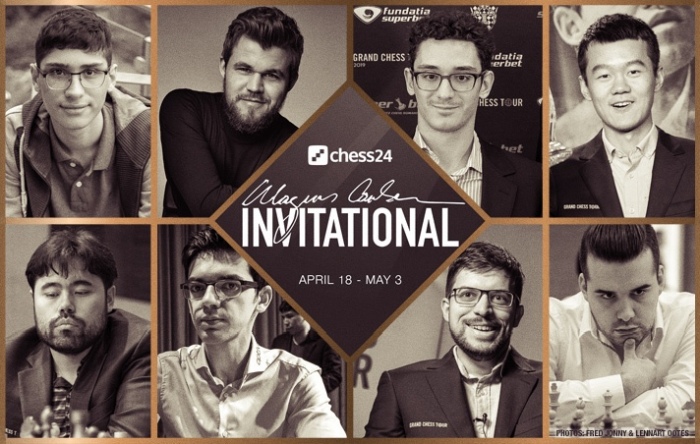
While the global spread of COVID-19 is preventing offline sports events from happening, Magnus Carlsen decided to organize an 8-player online event with a whopping prize fund of $250,000. The winner of the tournament is guaranteed $70,000. The world champion has turned to the online chess world a while ago, first organizing Play Magnus company after obtaining the world championship title in 2013. Recently, he has significantly extended his presence in the game’s online sector when “Play Magnus” merged with popular Internet portal chess24 in the spring of 2019, followed by buying Chessable and extending the range of services of all the companies in the group. The online super tournament that was announced on April 2, sees the world champion challenge seven of his biggest rivals to a 2-week battle. The event featuring Magnus Carlsen, Fabiano Caruana, Ding Liren, Ian Nepomniachtchi, Maxime Vachier-Lagrave, Anish Giri, Hikaru Nakamura, and Alireza Firouzja will be streamed on Chess24 with commentary in 9 languages. The $250,000 tournament will be running from April 18th to May 3rd with the following format: 8 players first compete in a single round-robin over 7 rounds Each match features four 15+10 rapid games, where the winner gets 3 match points and the loser 0 If the match ends 2:2 an Armageddon game (5 vs. 4 minutes) is played, with the winner getting 2 points and the loser 1 The top four players after Round 7 enter the Final Four knockout – if match points are equal, game points are the first tiebreaker The semi-finals, 3rd place match and final use the same 4-game match system and decide the overall winner
Faig Gasanov turns 80
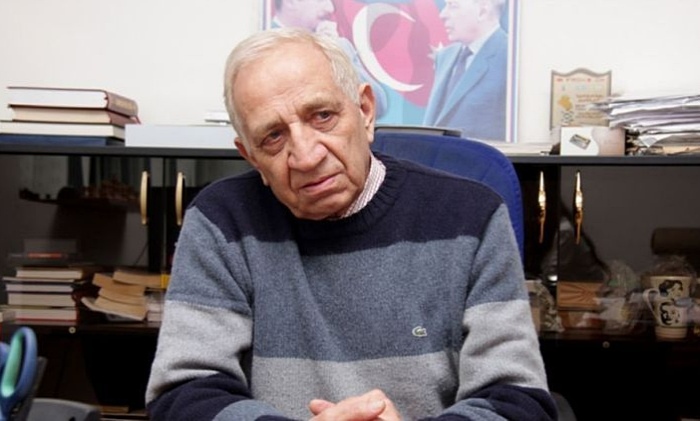
Faig Gasanov turns 80 today! The patriarch of Azerbaijani chess made a significant contribution to the development of the game in one of the strongest chess countries in the world. He was a chief arbiter of the Chess Olympiad 2016 and all the editions of Gashimov Memorial in Shamkir. Gasanov is also widely known as a host of weekly Şahmat klubu (Chess Club) program, which is broadcasting each Sunday in AzTV. He has been presenting this chess show for 51 years. Now he continues to serve the chess world as vice-president of the Azerbaijan Chess Federation. The President of Azerbaijan Ilham Aliyev signed a decree to award Faig Gasanov the Sharaf Order (Order of Honor) for his outstanding achievements in promoting sport in the country. Many happy returns of the day!
#03
Stay home, stay safe, stay sharp! FIDE news and activities Online events FIDE distributes €35,000 among chess veterans Chess in outer space Happy birthday, Garry Kimovich! READ NEWSLETTER
Chess in outer space
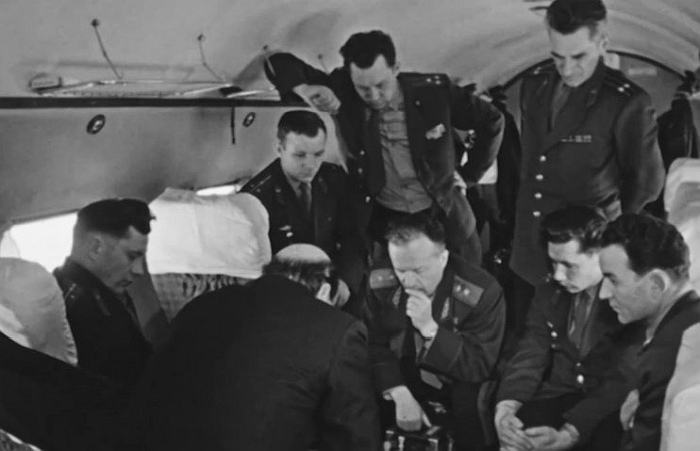
Today is the International Day of Human Space Flight (#HumanSpaceFlight), held on April 12 to commemorate the first space flight by Yuri Gagarin, in 1961. In this picture Yuri Gagarin, Grigory Nelyubov and Nikolai Kamanin are playing chess during the flight that took them to the Baikonur Cosmodrome, the legendary launching place in Kazakhstan from where the space exploration began. Seven days after this picture was taken, Gagarin would be leaving the atmosphere, starting a completely new chapter in the history of humankind. Truth be told, Gagarin was not particularly interested in chess – no more than the average Russian person. But nevertheless, chess was one of the very first human leisure activities brought to space by the cosmonauts. The set on this photo was carried aboard the Soyuz 3 and 4 capsules in 1968-1969. Magnetic pieces are not allowed on zero-gravity environments, because they could end up in unexpected places where they would interfere with the on-board instruments. The Soviets designed special chess sets, with pegs and grooves to keep the pieces in place. Photo: Chad Cullen / National Air and Space Museum, Washington. In June 1970 the Soviet astronauts Andrian Nikolayev (Mission Commander) and Vitaly Sevastyanov (Flight Engineer), who were aboard the Soyuz 9 spacecraft, played a consultation game against the earthbound Viktor Gorbatko (also an astronaut) and Nikolai Kamanin (Soviet general, and head of the astronaut training program). Sevastyanov and Nikolayev spent 18 days in space, a record at the time. Their mission was used to investigate the social and psychological implications of prolonged spaceflight. The zero-gravity chess board that they used, signed by the two cosmonauts as well as Boris Spassky (at that time the world champion), Mikhail Botvinnik, Igor Bondarevsky, Alexander Kotov, Salo Flohr, and Andor Lilienthal, was sold by Sotheby’s in 2018 for $1,250. Photos: Sotheby’s Vitaly Sevastyanov was an avid chess fan – so much so, that he would later become President of the Soviet Union Chess Federation from 1977 to 1986 and from 1988 to 1989. He played a very important role during those years when chess was still dominated by the Soviet players. Photo: Sputnik / Alamy Stock Photo Not only the Soviet cosmonauts took chess to outer space. Many of their American counterparts, the astronauts, were also keen players. For instance, the first man to walk on the moon, Neil Armstrong (1930-Aug 25, 2012) was a chess fan. In his biography by Leon Wagener (“One Giant Leap”), the author reveals that Neil played chess with his six-year-old son Mark, while he was quarantined upon his return from the Moon. Contrary to the Russians, the Americans didn’t come up with special designs for zero-gravity chess boards. Instead, they resorted to simple plastic pieces fitted with velcro. That’s what the NASA Astronaut Greg Chamitoff did in 2018 in order to take a chess set with him on the space shuttle. In August 2018 he played a chess match against Houston Mission Control and won two games against ground control while playing from the International Space Station (ISS). Photo: NASA. In 2008, NASA and the US Chess Federation teamed up to host a match between the astronaut and Earth. The USCF coordinated worldwide voting on the Earth’s moves, which were proposed by the K-3 champions, the Chess Club at Stevenson Elementary School in Bellevue, Wash. In honor of Human Space Flight Day and of the half-century anniversary of the Cosmos-Earth chess game (which took place on June 9, 1970), Roscosmos State Corporation for Space Activities, Chess Federation of Russia and Moscow Museum of Cosmonautics organize an online chess tournament among schoolchildren. The games will be played on chessplanet.ru on April 18. Info and registration (in Russian): Ivanishin (right) is seen on this picture playing chess with his colleague Chris Cassidy (left), at the Cosmonaut Hotel crew quarters at the Baikonur Cosmodrome in Kazakhstan (the same place from where Gagarin took off), a few days before the launch took place. Photo: Andrey Shelepin/Gagarin Cosmonaut Training Center. If you happen to leave in Missouri, you are still on time to visit the exhibition “Ground Control: A Journey Through Chess and Space“, at the World Chess Hall of Fame. The exhibition is on view until April 26. The links between chess and space exploration demonstrate that the game of chess – and other strategy games – are intrinsic to humankind. They are part of our culture, and one of the oldest forms of human social interaction.
Candidates 1950: Where it all began
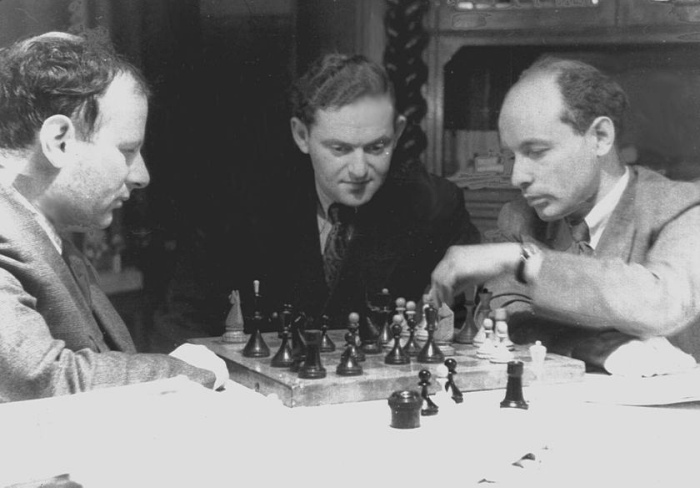
The first-ever 1950 Candidates Tournament in Budapest, Hungary, became a turning point in the history of chess. Before this event, there was no system in place to determine a challenger in a World Championship match. Any potential challenger had to negotiate with the champion himself, secure funding and arrange a match. After Alekhine’s death in 1946, followed by Botvinnik’s victory in the 1948 World Championship Tournament, FIDE organized the first World Championship cycle that included Zonal, Interzonal and Candidates tournaments. Five qualifiers of the Interzonal tournament (Saltsjobaden, 1948) were supposed to join four participants of the 1948 World Championship tournament (Reshevsky, Keres, Smyslov, and Euwe) plus Robin Fine in a double round-robin competition. Unfortunately, Reshevsky and Fine opted not to play (according to another version the U.S. State Department barred them from traveling to Hungary due to Cold War), while Euwe did not get a leave from the university. Subsequently, FIDE decided to replace them with players who finished 6th-9th in the Interzonal tournament: Miguel Najdorf, Gideon Stahlberg, Salo Flohr and Igor Bondarevsky (the latter withdrew). Vasily Smyslov, Paul Keres and the winner of the first Interzonal tournament David Bronstein entered the event as the main favorites but it was Isaac Boleslavsky who held the stage for the most of the event. Playing the tournament of his life, he demonstrated very solid opening preparation, deep strategic concepts, tenacity in defense and error-free calculation. Boleslvasky played one of his finest games in Round 6 in which he routed Smyslov in just 22 moves and joined the leaders. Boleslavsky – Smyslov 16. Ne4! Bxe3 17. fxe3 Rc2 18. Nbd6! Rf8 19. Bxa6 bxa6 20. g4 Ng7 21. Nf6 Bc6 22. Rfc1 1-0 Halfway through Boleslavsky was leading the field with an excellent score +3, followed by Keres (+2) and Bronstein (+1). The Estonian maestro won probably the most spectacular game of the event, which became his trademark. Keres – Kotov 10. Nxe6! Qxe6 (10… Nxh5 11. Qd5! Nb6 (11… Qxd5? 12. Nc7#) 12. Qxc4 Nxc4 13. Nc7+) 11. Nd5! Kd8 12. Bg4 Qe5 13. f4 Qxe4 14. Bxd7 Bxd7 15. Nxf6 gxf6 16. Bxf6+ Kc7 17. Bxh8, and White converted his extra exchange 1-0 In the second part of the event, Boleslavsky scored three more victories (the one over Szabo is particularly impressive) and pulled away. At some point, many thought that the 30-year old Soviet GM had punched his ticket to the World Championship match with Botvinnik. Indeed, after Round 16 Isaac was a full point ahead of Bronstein – the only player who had a theoretical chance to catch up with the leader. In the last two rounds, Boleslavsky made two quick draws, hoping that his old friend and compatriot would not be able to win both games, but that is exactly what happened! First David outsmarted Stahlberg with Black in a very complicated game, then in the final round facing Keres with White, he took a lot of risks but got to opponent’s king and so tied for the first place. Bronstein’s spurt in the second part of the tournament staggers imagination – the GM from Moscow scored 7 out of 9! The following fragment illustrates his high-voltage, aggressive style: Bronstein – Najdorf 13. f6! Kh8 14. d5 Na5 15. Ng3 gxf6 16. Nf5 Bc8 17. Qh5 Bxf5 18. exf5 Rg8 19. Rf3 Rg7 20. Bh6 Rg8 21. Rh3 1-0 The event in Budapest became the only Candidates Tournament to end in a tie for the first place (in London 2013 Magnus Carlsen and Vladimir Kramnik scored equal number of points but the former became the winner thanks to better tiebreaks). Bronstein and Boleslavsky had to play a playoff match, which was held in the summer of 1950 in Moscow. It ended in another tie, but Bronstein won the first decisive game and became the official challenger. One of the event favorites Vasily Smyslov was hovering around 50% almost all the way but his fortune changed in Round 16. After obtaining an overwhelming position, his opponent, Alexander Kotov went for a flashy combo but missed an important subtlety. Arguably, this game can be called a miscalculation of the tournament. Kotov – Smyslov Black looks hopeless. That’s what Kotov, Najdorf (who praised him for the played sequence) and even Smyslov himself initially thought. It turns out that White’s idea is refuted by 42…Rf2+! with an immediate win. Smyslov found this move and scored a full point. Since top-five finishers of the event were guaranteed spots in the Candidates 1953, this vexing defeat cost Kotov dearly – he ended up in sixth place, just a half-point behind Najdorf. Later Kotov did qualify for the Candidates 1953 after turning in the most impressive performance of his chess career at the Interzonal 1952 held in Stockholm. In two final rounds, Smyslov made two draws and finished clear third a half-point ahead of Keres, who lost steam in the second part of the event (4th place). Other players had their share of bright moments in Budapest but did not participate in the race for the top spot. Final standings:Source: Wikipedia Although the 1950 Candidates in Budapest was not the most spectacular event it set a trend and paved the way for the historical tournaments in Zurich (1953), Amsterdam (1956), Yugoslavia (1959) and Curacao (1962). It is symbolic that after many years of play-off matches and knockout tournaments, FIDE eventually returned to this good old round-robin format so popular among chess players and spectators all around the world.
FIDE Arbiters’ Commission releases Arbiters’ Manual 2020

The FIDE Arbiters’ Commission is pleased to release the edition 2020 of the FIDE Arbiters’ Manual. The document includes welcome word by FIDE President Arkady Dvorkovich and an introduction written by Laurent FREYD Chairman FIDE – Arbiters Commission. This version contains updated regulations from the FIDE Handbook: – C02 and C05, by the Technical Commission about Tournaments – B02, by the Qualification Commission, about Rapid and Blitz rating Structured in 12 Chapters, the topics have been reorganized to follow the preoccupations of the arbiters: 1. Governing play: Roles and duties, Laws of Chess, Anti-Cheating, Pairings 2. Players’ focus: Ratings and norms 3. Technical references: Tournaments and tie-breaks 4. Administrative: titles and classifications of arbiters, application forms Since the new FIDE ARB Commission was nominated, Councilor IA Shohreh Bayat took the lead on the Manual. She closely worked with one of our valuable members IA Alex McFarlane in a real marathon of reviews, proposals and improvements. They also got notable contributions from IA Tomasz Delega (Chairman of the ECU Arbiters’ Council), IA Aris Marghetis (Former Secretary of the ARB and FIDE Lecturer), IA Alex Holowczak (Secretary of the Qualification Commission), IA Gopakumar MS (Member of the Fair Play Commission and FIDE Lecturer, IA Hal Bond (Member of the Planning and Development Commission and FIDE Lecturer). Many thanks to all contributors! Any feedback, comments, proposals to continue improving the Arbiters’ Manual are welcome! Feel free to address them to the ARB Commission (secretary.arbiters@fide.com & shohreh_b1987@yahoo.com)
FIDE distributes €35,000 among veterans
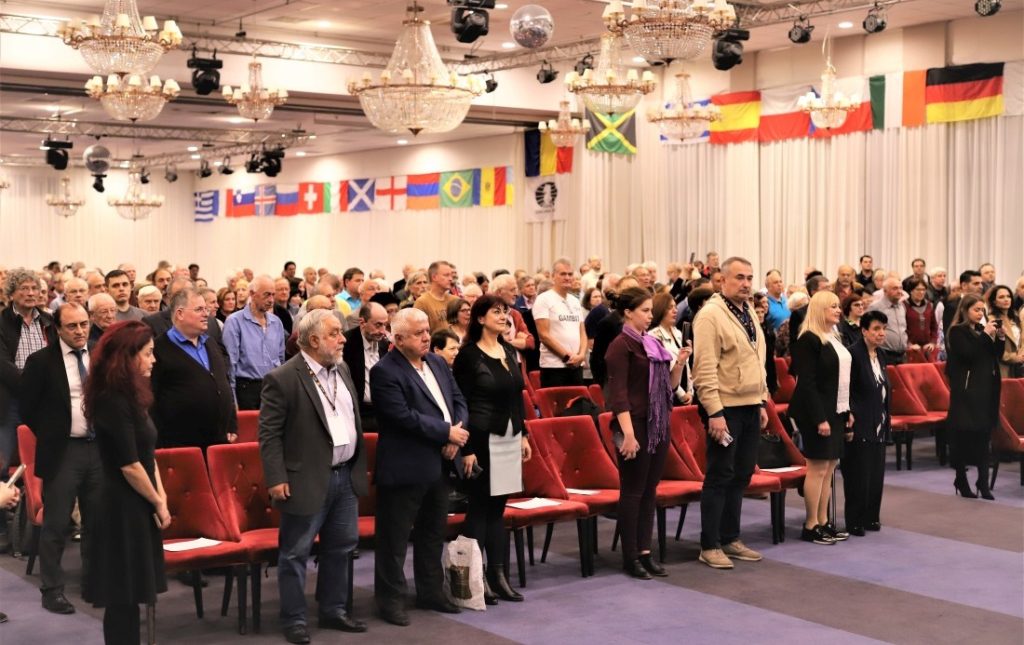
As it was previously announced, the International Chess Federation has budgeted the sum of €50,000 for a program to support chess veterans in 2020. Combined with the decision of waiving fees to our seniors, this is FIDE’s contribution towards giving back a little to those who devoted their entire life to chess. Like in 2019, the initial plan was to allocate €20.000 to provide stipends to individual nominees, and €30,000 to increase the prize fund of the World Seniors Championship. However, due to the ongoing uncertainty created by the global spread of the new Coronavirus, we still don’t know if this event will go ahead as planned, or it will have to be canceled/postponed. In view of these uncertainties, the dedicated panel working on the assignment by FIDE Council found advisable to redistribute this amount, allocating a record total amount of €35,000 directly to stipends. The general consensus was that this was much needed in these difficult times. After carefully considering the numerous applications received, the Council decided that these will be the 17 chess players, coaches, and promoters who will benefit from FIDE’s support: Alexander Nikitin (RUS)Heikki Westerinen (FIN)Viktor Zheliandinov (UKR)Vlastimil Jansa (CZE)Evgeni Melikset-Begi (GEO)Gabriela Olarasu (ROM)Viacheslav Dydyshko (BLR)Qi Jingxuan (CHN)Yaacov Zilberman (ISR)Slim Bouaziz (TUN)Gerry Walsh (ENG)Boris Itkis (MLD/ROM)Lyudmila Belavenets (RUS)Jesus Gonzales Bayolo (CUB)Dmitry Kayumov (UZB)Lkhamsuren Myagmarsuren (MGL)Emmanuel Omuku (NGR) Among the recipients, there are individuals from 16 different countries, representing 4 continents. The Council has also tried to have all bodies and categories represented: players, coaches, and arbiters. In terms of their dedication and contribution to chess, all the aforementioned individuals demonstrated outstanding merits, and they deserve not only this financial help but also the unanimous recognition of the chess community. About some of the recipients: Alexander Nikitin will always be remembered as one of Kasparov’s first mentors, but he also trained Etienne Bacrot, and coached Boris Spassky for his rematch against Bobby Fischer in 1992. Nikitin was also the head of the young chess players’ school of Spartak Sports Society, attended by many famous grandmasters including Alexander Grischuk and Dmitry Yakovenko. Heikki Westerinen was Finland’s first-ever Grandmaster (1975) and a four-time national champion (1965, 1966, 1970). Thanks to him the popularity of chess grew in this country, and he also left his mark in the international arena by virtue of his sharp style – being the King’s Gambit and the king hunts part of his personal trademark. Viktor Zheliandinov (17 March 1935) a Soviet-Ukrainian Chess player, International Master and coach. He achieved very good results in the strong Championship of the Soviet Armies, winning this event in Prague 1966 and coming out third in Gavana 1967. As a coach, he was a member of Karpov’s team during the 1985 match, but what he enjoyed the most was working with young players. His most famous pupil was Vassily Ivanchuk, whom he started coaching when he was a schoolboy, and continued to do so during his participation in the famous Linares tournament. More recently, he has worked with Mateusz Bartel. Daughter of master Sergey Belavenets who fell in a battle in 1942, Liudmila Belavenets (June 7, 1940) chose her field of work in his honor. Liudmila Belavenets was a strong player, winning the Women’s Soviet Chess Championship in 1975 and obtaining the Woman International Master in 1977. She achieved the highest results in correspondence chess, too: in 1990 she became the Women’s World Champion in this discipline. However, she won the hearts of many generations of young chess players as one of the most famous Moscow coaches. In 1973 she started to work in “Young pioneers” center, but is most known for her work in “Spartak” chess club named after Petrosian. She was the first coach of GMs Alexander Morozevich, Alexey Vyzmanavin, Andrei Sokolov. In 2010, Belavenets was awarded the title of FIDE Senior Trainer. Now, at 79, she is still active and surrounded by a new generation of young players. Slim Bouaziz became the first African person to earn International Grandmaster title. The leading Tunisian player for over 30 years, he participated in five Interzonal Tournaments and sixteen Chess Olympiads. During his long and prolific chess career, he has won the Arab Chess Championship twice (1986 and 1991) and shared first place in the international tournaments in Belgrade (1977) and Bucharest (1992). In 2014 Slim Bouaziz also became a FIDE International Organizer. Lhamsuren Myagmarsuren was the first player to represent Mongolia in an Interzonal Tournament. After winning the West Asian zonal tournament in 1966, he competed in the Interzonal Tournament in Sousse (1967). Four-time Mongolian champion (1965, 1980, 1981, 1982), he participated in 10 Chess Olympiads and won the individual gold medal at the fourth board in Leipzig (1960). Vlastimil Jansa won the Czechoslovak Chess Championship in 1964, 1974 and 1984. He represented his country at the Chess Olympiad on a number of occasions, winning a team silver medal in 1982. He is an author of several books and many theoretical articles, as well as a very active coach. Jansa played an important role in the development of David Navara, among others. At 77, he is still very active, having won the 2018 World Senior Championship in the 65+ category. Photo: DENÍK/Jaroslav Bílek
FIDE Trainers Commission announces a series of online seminars
The FIDE Trainers Commission (TRG) is pleased to announce a series of FIDE Trainer Online Seminars – no less than twenty are planned in the period between April 1 and September 30, 2020 – which will cover all geographical regions and accommodate all major languages. In particular, TRG acknowledges the interest and plans of the European Chess Union (ECU) to organize four seminars in June and another four in September 2020. TRG works with FIDE Affiliated Organizations and FIDE on promoting these FIDE Trainer Online Seminars and invites all parties concerned to cooperate with us and contribute to this initiative. Our first seminar was held for Europe (April 3-5) and was led by FIDE Senior Trainers Thomas Luther and Artur Jussupow. The next one will be for Asia – East Asia and Oceania (April 24-26) facilitated by the Philippine Academy for Chess Excellence le FIDE Senior Trainer Jayson Gonzales. The list of lecturers includes the biggest names in Asia, such as FIDE Trainer Awards winners Ramesh RB (India) and Yu Saoteng (China) and two chess legends, Asia’s first grandmaster Eugenio Torre (Philippines) and Asia’s first World Champion Xie Jun (China). May will see a German language seminar from (May 1-3) led by FIDE Senior Trainer Uwe Boensch who will be assisted by Artur Yussupow and Thomas Luther and a Spanish language seminar (May 22-24) led by FIDE Senior Trainer Alonso Zapata. The seminar schedule is available on the official website. Full details of each seminar are also published one the TRG website. All the questions regarding the seminars can be directed to trainers@fide.com.
CALL FOR BIDS: FIDE World Championships 2022
IMPORTANT: Please note that FIDE is considering an option to postpone the 2020 competitions to 2021, and the 2021 competitions to 2022. Thus, all those bidding for the 2022 events shall be prepared that their bids will be considered for 2023. Deadline 4th of September 2020 1. World Junior Chess Championships 2022 2. World Youth U16 Chess Olympiad 2022 3. World Youth (U14, U16 & U18) Chess Championships 2022 (Europe) 4. World Cadets (U08, U10 & U12) Chess Championships 2022 (Europe) 5. World Youth & Cadets Rapid & Blitz Chess Championships 2022 6. World School Chess Championships 2022 7. World Senior Chess Championships 2022 8. Word Senior Team Chess Championships 2022 9. World Amateur Chess Championships 2022 A bid for any FIDE Competitions onwards shall include the name of a FIDE licensed International Organizer. All bids should be submitted by the due date in a sealed envelope to the FIDE Secretariat, postal address: Avenue de Rhodanie 54, 1007 Lausanne, Switzerland. Alternatively, or scanned documents can be sent to the email: office@fide.com, by 4th of September 2020, 16:00 local time. Related documents: Full document with the call for bids (pdf) Bid form (pdf) Bid form annex (pdf)