

FIDE releases Gender Equality in Chess Index 2026
Second edition of the GECI ranks 119 federations, with all regions showing improvement since 2023 Brisbane, Queensland – On International Women’s Day, the FIDE Women in Chess Commission (WOM) and The University of Queensland published the second edition of the Gender Equality in Chess Index (GECI), a comprehensive measure of female participation, performance, and progress across 119 chess federations worldwide. The GECI uses a geometric mean of three indicators – Participation (percentage of female players), Performance (female rating levels relative to male), and Progress (female representation in youth championships) — to produce a single score between 0 and 100 for each federation. The Commission intends to continue updating the rankings every two years. The 2026 GECI reveals broad-based improvement since the first edition in 2023. Average scores rose in every region, with Africa leading at 67.6, followed by Asia (64.5), the Americas (63.1), and Europe (56.7). Seventeen federations — including China, Turkmenistan, and Trinidad & Tobago – have been ranked for the first time. Mongolia retains the top position with a score of 89.26, followed by Sri Lanka (86.99) and Uganda (84.62). The largest rise comes from the United Arab Emirates, which rose 73 places from 77th to 4th. The Maldives climbed 50 places to 13th. The report’s interview section includes interviews with three federations that illustrate different paths toward stronger female participation in chess. The UAE’s rise was driven by institutional coordination between the federation, government ministries, and the national Olympic committee, including the mandatory inclusion of girls in all youth championship delegations. In the Maldives, the chess association equalized prize money between the Women’s and Open categories and is launching a project called “Checkmate Geography” to extend training across its archipelago of over 1,000 islands. And in Sri Lanka, we hear the story of the Wijesuriya family — led by ten-time Women’s National Champion Suneetha Wijesuriya, who, unable to afford her own set, drew a chessboard on the floor with chalk — showing how grassroots development can help build a national chess culture. “When we created the GECI in 2023, we wanted to give federations a clear, evidence-based picture of where they stand on gender equality. You can’t improve what you don’t measure,” said GM David Smerdon, Associate Professor at The University of Queensland and lead author of the report. “Two years later, we’re seeing that this approach is working — federations are using the index to identify gaps and take action, and scores are improving across every region. International Women’s Day is about recognizing both how far we have come and how far we still need to go. In chess, we now have the data to do both.” “The stories in this report remind us that gender equality in chess is not just a policy question, it is a human one,” said Dana Reizniece, Deputy Chair of the FIDE Management Board. “A woman in Sri Lanka drawing a chessboard with chalk, a federation in the Maldives ensuring girls on remote islands can access training, a country in the Gulf mandating that every youth delegation includes girls. These are the decisions that change the game.” “The improvement we see in the 2026 rankings is a strong signal, but our work is far from done,” said Anastasia Sorokina, Chair of the FIDE Women in Chess Commission. “We call on every federation to use the GECI as a starting point for meaningful action.” The full report is available at https://doi.org/10.14264/9ec1c7e
Chess Women’s Day Celebration 2026: Visible, connected, worldwide
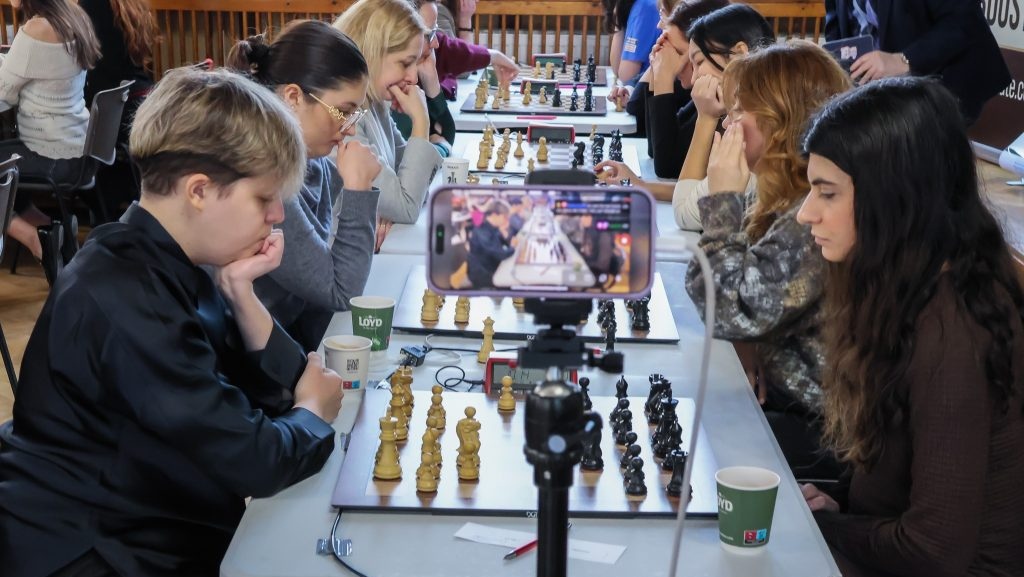
Throughout the month of March, the FIDE Commission for Women’s Chess once again brings the global chess community together through the Chess Women’s Day Celebration, inviting federations, clubs, academies and organisers worldwide to celebrate women and girls in chess. Following the inspiring success of last year’s first global celebration, the 2026 edition continues under the theme “Visible, Connected, Worldwide.” The goal is simple yet powerful: to increase the visibility of women and girls in chess, strengthen connections between organisers and communities across continents, and highlight the many initiatives that promote equity and opportunity in the game. Throughout March, a wide variety of events – tournaments, simultaneous exhibitions, lectures, workshops and community gatherings – take place across the world. Each of them contributes to a shared global effort to celebrate women in chess and inspire new generations of players. A strong start in Poland The celebration began before March, with a women’s event in Poland the XV Radzikowska Memorial, one of the strongest and most established women’s chess festivals in Europe. A highlight of the festival was the exciting Team Poland vs Team World match, where leading Polish players faced invited international stars. Alongside the main match, a rapid tournament for girls and women offered an opportunity for young players to compete and interact with elite players. The FIDE Commission for Women’s Chess partnered with the organisers of the festival, supporting the best performing girls with special prizes and training sessions with top Polish women grandmasters. Women’s Chess Day and futures tournament at the Prague Chess Festival March kicked off in a perfect way at the Prague Chess Festival, where the Commission partnered with organisers to support the Futures Tournament, a round-robin event for talented young girls played alongside the prestigious Masters and Challengers sections. For the participants, this meant experiencing a world-class chess environment and sharing the stage with top players such as Gukesh Dommaraju, Nodirbek Abdusattorov, and Divya Deshmukh. This year’s Futures event had a very special ambassador – legendary Swedish grandmaster Pia Cramling, who met with the girls and their parents to share insights from her remarkable chess career. She also gave a simultaneous exhibition, creating a memorable moment for everyone involved. As part of Women’s Chess Day activities, Divya Deshmukh also took on the role of chess instructor, introducing the basics of the game to Czech actress Aňa Geislerová in a relaxed and engaging session. The Futures tournament was won by Kaja Rzadkowska (Poland), followed by Christina Jordan (Switzerland) in second place and Zuzana Stará (Czech Republic) in third. A major celebration in Kazakhstan Another highlight of the global celebrations took place on March 6 with the Qazaq Queens Chess Fest 2026, organised by the Kazakhstan Chess Federation – a long-standing and highly active partner in promoting chess development and women’s participation in the game. The event brought together players, organisers and guests in a vibrant festival atmosphere that beautifully celebrated both women and chess. With its elegant setting and engaging programme, the event truly reflected the spirit of the Chess Women’s Day Celebration. A special role in the organisation and development of women’s chess initiatives in Kazakhstan is played by Gulmira Dauletova, Executive Director of the Kazakhstan Chess Federation and a member of the FIDE Commission for Women’s Chess. Through her continued work and leadership, numerous initiatives promoting girls’ and women’s participation in chess continue to grow in the country. Queens’ Online Chess Festival connects players worldwide One of the largest initiatives of the celebration is the Queens’ Online Chess Festival, organised by the FIDE Commission for Women’s Chess as part of the Chess4All FIDE WOM project. Running from March 1–29, 2026 and dedicated to International Women’s Day, the festival is free to join and open to women and girls of all ages and playing levels. Two parallel competitions are held throughout the month: Queens’ Women’s Open Tournament Unrated Princesses’ Tournament The festival began with the African continent on March 1 and immediately showed impressive growth. This year alone, 114 African women players registered, marking the highest participation from the continent in the history of the event. With players continuing to join from across the world, the festival highlights how online chess can connect communities globally. The Commission also expresses its gratitude to Lichess for providing the playing platform. Partnerships, dialogue and new initiatives The celebration also includes cooperation with several international festivals and initiatives working to increase women’s participation in chess. One of them is the Budapest Spring Festival, where the entry fees for all women players were waived in both groups of the tournament, underlining a shared commitment to making high-level chess more accessible and inclusive. The festival also hosted a Women’s Chess Roundtable on March 4, creating space for discussion, exchange of ideas and inspiration among women in chess. The roundtable included participation from Anastasia Sorokina, Chair of the FIDE Commission for Women’s Chess. Storytelling and social impact As part of the March programme, the Commission also cooperates with the FIDE Social Commission in supporting the Storytelling & Impact Content Masterclass, an initiative dedicated to creating meaningful visual storytelling for social and sports initiatives. The lecture is delivered by award-winning creative director Maxim Kolyshev, a Cannes Lions finalist and winner of more than 150 international awards. In this inspiring session, participants explore how powerful stories are created and how they can build communities and generate real social impact. Celebrating Women’s Day across continents On International Women’s Day, a special simultaneous exhibition will take place in Saint-Tropez, organised by the chess club Les Fous de la Vieille Tour. Participants will have a rare opportunity to face the 12th Women’s World Champion Alexandra Kosteniuk, whose remarkable career has inspired thousands of girls around the world. Partner events across Africa are also bringing women together through competition and celebration. In Malawi, an invitational women’s round-robin tournament will take place on March 8, while another women’s event is scheduled from March 26–30, demonstrating the country’s continued efforts to promote greater equity and participation in chess. Further
Call of interest for arbiters at the 46th FIDE Chess Olympiad and 3rd FIDE Chess Olympiad for People with Disabilities

The FIDE Arbiters’ Commission (ARB) is opening a call of interest to all International Arbiters and FIDE Arbiters with a valid FIDE license who wish to be part of the arbiter team at the 46th Chess Olympiad and 3rd FIDE Chess Olympiad for People with Disabilities. Both events will be held in Samarkand, Uzbekistan, taking place from September 15-28 and September 10-18, respectively. The call of Interest will be open for one month, from March 7, 2026 to March 29, 2026, 23:59 CET. Important note:* Chamilo is the ARB Training Portal, which we are using to support the process. We will take advantage of the call of interest to include colleagues who haven’t followed training sessions yet under this new system. Survey link: https://arb-learn.fide.com/main/survey/fillsurvey.php?iid=48&invitationcode=auto&cid=20&course=COI&sid=0&language=en_US In case it’s your first time using the portal or you don’t remember it, you may want to initialize your password, using the lost password link: I lost my password
Nodirbek Abdusattorov triumphs in Prague
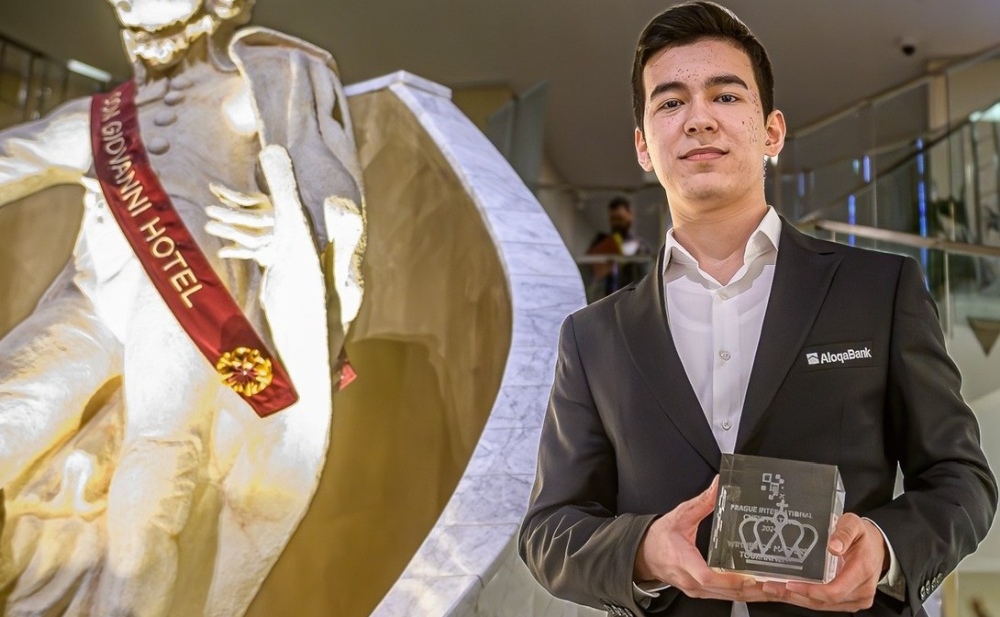
The 2026 edition of the Prague International Chess Festival 2026, featuring the Masters, Challengers and Futures tournaments, is now in the books. The prestigious Masters tournament, a 10-player round-robin with classical time control, featured a formidable lineup and was fiercely contested event from start to finish. GM Jorden Van Foreest led most of the way scoring three straight victories in Rounds 3-5 (including a win over the World Champion Gukesh D), but never felt safe as his competitors stayed hard on his heels. The race culminated in the penultimate eighth round: the Dutchman slipped in an equal endgame and lost to the last year’s winner Aravindh Chithambaram, while Nodirbek Abdusattorov defeated David Navara and surged ahead. Going into the final round a half-point ahead of Van Foreest, Abdusattorov drew with Hans Niemann and secured the title with 6/9, as his main rival suffered second consecutive defeat, this time at the hands of Parham Maghsoodloo. As a result, Maghsoodloo, Aravindh and Van Foreest tied for second place on 5/9, with the first two joining Abdusattrov on the podium due to superior tiebreaks. Abdusattorov, the event’s only unbeaten player, claimed his second major title of 2026, gained 9 rating points and consolidated his leading position in the FIDE Circuit 2026 – 2027. Final standings – Masters To the delight of the home crowd IM Vaclav Finek (CZE) won the Challengers event. WCM Kaja Rzadkowska from Poland emerged victorious in the Futures tournament. Final standings – Challengers and Futures Photos: Prague International Chess Festival Official website: https://praguechessfestival.com/en/2026
Vladimir Tukmakov celebrates his 80th birthday
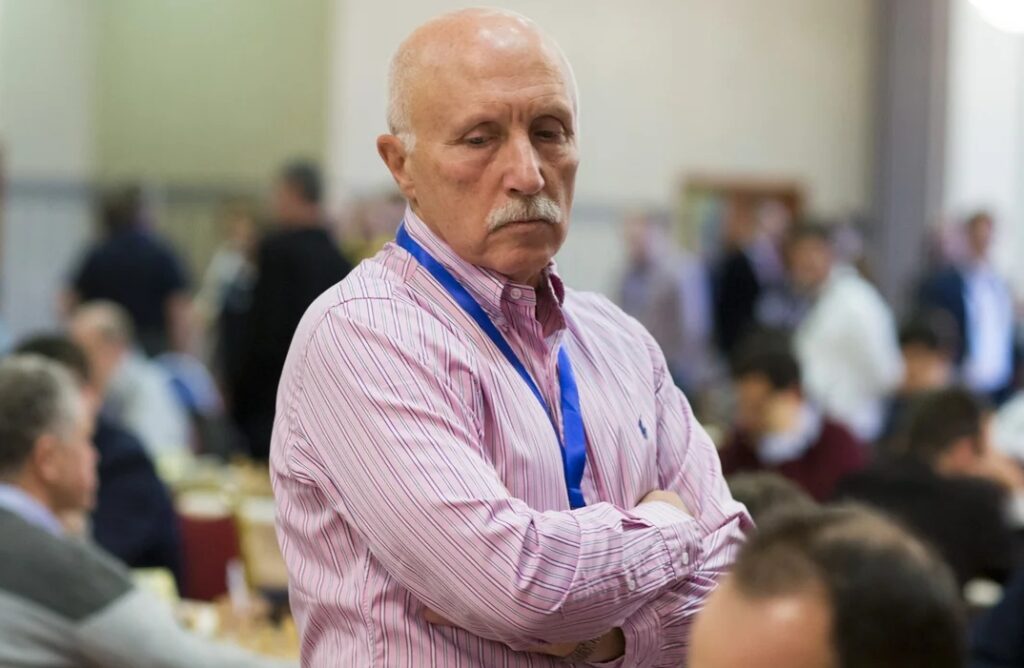
A renowned Grandmaster, chess author, and successful coach, Vladimir Tukmakov celebrates his 80th birthday today. Born in 1946 in Odessa – a city famous for its rich chess traditions – Tukmakov displayed promise from a young age, becoming a true leader of the post-WWII generation of Soviet chess talents. He quickly established himself as an excellent team player. His career first blossomed when he contributed to, and later captained, the USSR team to consecutive victories in the World Student Team Championship from 1966 to 1972, earning nine gold medals along the way. Tukmakov earned the Grandmaster title in 1972 following strong performances in elite events. These included second-place finishes at the USSR Championships in Riga (1970), Baku (1972), and Moscow (1983), finishing behind Korchnoi, Tal, and Karpov, respectively. In his only Olympiad appearance in 1984, he secured team gold. He also represented the USSR at the European Team Chess Championships in 1973, 1983, and 1989, collecting an impressive five gold medals (three team, two individual). At the momentous USSR vs. Rest of the World match in London (1984), Tukmakov made a surprising but important contribution. Starting as a reserve for the Soviet team, he was twice asked to substitute for Smyslov on board 4 and once for Polugaevsky on board 3. He delivered a positive score against Ljubojević (one win, one draw) and Korchnoi (one draw). In international tournaments, his best results include 2nd place (behind Fischer) at Buenos Aires 1970; 2nd (behind Karpov) at Madrid 1973; shared 1st (with Jansa and Ivkov) at the IBM Amsterdam Tournament 1974; 1st at Decin 1977; shared 1st (with Sax) at Las Palmas 1978; 1st at Vilnius 1978 (ahead of Tigran Petrosian); and 1st at Malta 1980. Later, he finished 2nd (behind Yusupov) at Yerevan 1982 and 2nd (behind Miles) at Tilburg 1984. Tukmakov also won the strong Lugano Open in 1985 and the 30th Reggio Emilia Tournament in 1987/88. At the Amsterdam OHRA-B Open in 1990, he shared first place with Judit Polgár. Additionally, he won the Canadian Open Chess Championship in 1989 and 1994. Photo: Maria Emelianova After transitioning from active play in the late 1980s, Tukmakov became a highly successful coach. He headed the Ukrainian national team starting in 2004, leading it to gold medals at the Chess Olympiads in Calvià (2004) and Khanty-Mansiysk (2010), along with multiple European and world team medals. Recognized as FIDE Trainer of the Year in 2010 and recipient of the trainer’s “Oscar,” he has mentored top players including Anish Giri and Wesley So. In 2024, he received FIDE’s Best Trainer award as part of the FIDE 100 celebrations. Tukmakov has also authored bestselling chess books such as Profession: Chess Player (2010), Modern Chess Preparation (2012), and Risk and Bluff in Chess (2015), offering insights into professional chess strategy and psychology. We wish Vladimir Tukmakov many more years of highly productive and creative work!
FIDE Women’s Candidates 2026: A clash of generations

Experience meets ambition as eight elite players compete for the right to challenge the Women’s World Champion. In three weeks’ time, eight of the best female chess players in the world will compete in a double round-robin for the right to challenge the reigning Women’s World Champion, China’s Ju Wenjun. The FIDE Women’s Candidates Tournament is scheduled to begin on March 28 at the Cap St Georges Hotel & Resort, located on the western side of the Mediterranean island of Cyprus. Over fourteen rounds of classical play, the tournament will determine who advances to contest the crown in the final stage of the World Championship cycle. In accordance with FIDE regulations, players from the same federation must meet in the early rounds of the tournament. The full pairings for each round have already been released – check here. The 2026 field artfully blends experienced Candidates veterans such as Anna Muzychuk, Tan Zhongyi, Kateryna Lagno, and Aleksandra Goryachkina with energetic next-generation contenders like Zhu Jiner, Divya Deshmukh, Vaishali Rameshbabu, and Bibisara Assaubayeva, making for a dynamic tournament narrative. Given the double round-robin format, the matchups between seasoned players and rising stars will be critical, especially when psychological endurance and preparation depth become deciding factors heading into the final rounds. Expect a diverse range of styles – from Vaishali’s tactical dynamism to Tan Zhongyi’s refined strategic approach. Let’s take a closer look at the contenders, sorted by their current March 2026 FIDE ratings. Zhu Jiner (China, 2578) Photo: Mark Livshitz A world-class Chinese grandmaster, Zhu has rapidly climbed the elite ranks and enters Cyprus as the highest-rated participant. She qualified by winning the FIDE Women’s Grand Prix 2024–25 series, consistently finishing in top places across the Grand Prix legs and showcasing her dynamic, aggressive style. Renowned for her sharp, top-notch opening preparation and excellent middlegame tactical skills, Zhu enters the competition as a serious contender for the top spot. Her only potential vulnerability is inexperience at the Candidates level – this will be her debut in the event. Tan Zhongyi (China, 2535) Photo: Michal Walusza A former Women’s World Champion (2017–2018) and proven classical player known for strategic depth, Tan Zhongyi qualified via her third-place finish in the 2025 Women’s World Cup. She has been part of multiple World Championship cycles as both champion and challenger; her experience boosts her psychological resilience. After finishing runner-up in the 2022–2023 cycle, she reaffirmed her strength in long classical events in 2024 by winning the Women’s Candidates Tournament in Toronto to earn another world title shot. Tan is widely regarded as a deeply strategic and resilient player, combining classical foundations with modern practical strength. Less dependent on tactical chaos, she thrives on accumulating advantages move by move and grinding down her opponents in slightly better endgames. In a Candidates-style double round-robin, her stability and experience make her particularly dangerous over 14 rounds, where consistency often outweighs short bursts of brilliance. Aleksandra Goryachkina (FIDE, 2534) Photo: Mark Livshitz Widely considered one of the most complete and technically refined players in women’s chess, Goryachkina combines deep preparation, positional mastery, and exceptional endgame precision. She announced her arrival at the very top in 2019 by winning the Women’s Candidates Tournament and earning the right to challenge Ju Wenjun for the world title, coming within touching distance of the crown in a tightly fought match. Peaking in 2021 at 2611 – one of the very few female players to have crossed that mark – she captured the 2023 Women’s World Cup and more recently added a major milestone by claiming her first World Championship title, winning the Women’s World Rapid Championship in Doha 2025. A perennial top-ranked player, Goryachkina brings depth of elite experience. She qualified as runner-up in the 2024–25 FIDE Women’s Grand Prix series and will be a strong candidate to challenge for first place based on her performance in the cycle. Anna Muzychuk (Ukraine, 2522) Photo: Michal Walusza Anna Muzychuk enters the Women’s Candidates as one of the most accomplished players of her generation, with sustained success across formats and a career spanning more than two decades at the top level. A Grandmaster since 2012, she became only the fourth woman in history to break the 2600 rating barrier. Her achievements in faster time controls are particularly notable: she is a three-time world champion, winning the Women’s World Blitz title in 2014 and completing a rapid and blitz double in 2016.In classical chess, Muzychuk reached the final of the 2017 Women’s World Championship, where she lost to Tan Zhongyi in rapid tiebreaks. In recent years, she has remained a consistent presence among the world’s leading players, highlighted by two first-place finishes in the 2025 Women’s Grand Prix and a first-place finish at Norway Chess Women 2025. Muzychuk joins the Candidates as a late replacement for Humpy Koneru, entering the field less than a week before the start of the tournament. After coming close through several qualification paths in 2025, she now has another chance to fight for a place at the summit of the women’s world championship cycle. Bibisara Assaubayeva (Kazakhstan, 2516) Photo: Michal Walusza Qualified for Cyprus as the highest-placed contender in the FIDE Women’s Events 2024–25 series, Assaubayeva is one of the most distinctive talents in women’s chess. Unlike purely positional grinders, she thrives in active positions where initiative and momentum matter. The winner of the Women’s World Blitz Championship in 2021, 2022, and again in 2025, she shows exceptional composure in knockout and fast-paced formats, while her classical results have progressed steadily, culminating in the grandmaster title. Her recent strong finishes in women’s circuit events showcase her resilience and adaptability. In January 2026, Assaubayeva delivered a strong performance in the Tata Steel Challengers, gaining 19 rating points and reaching a career-high rating of 2516. Making her Women’s Candidates debut, she will be willing to create fire on the board with her aggressive, unafraid style. Bibisara is especially effective when games become concrete and calculation-heavy. Kateryna Lagno (FIDE, 2508) Photo: Michal Walusza With
Second Continental Online Chess Championships for Prisoners: Registration now open
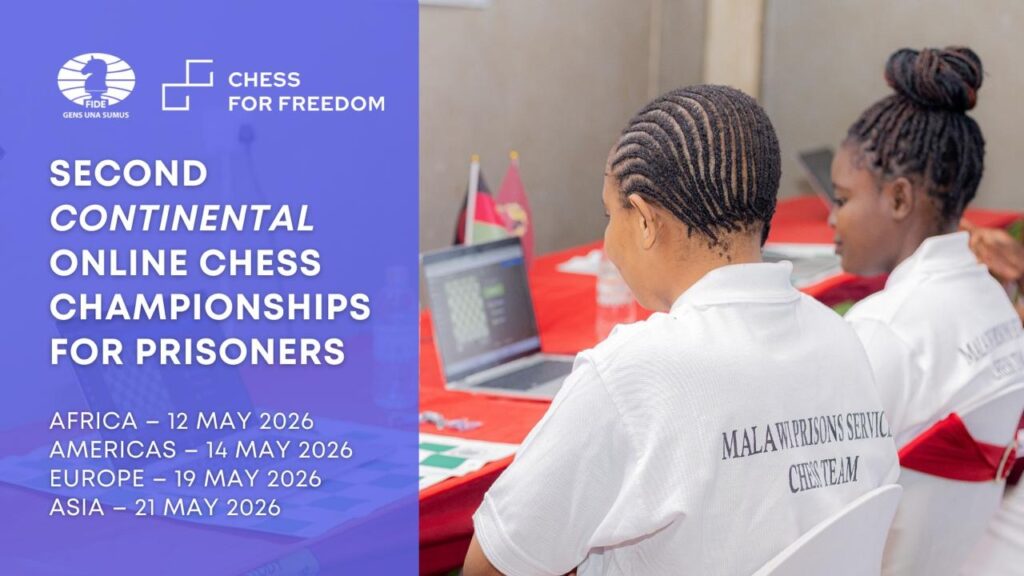
The FIDE Continental Online Chess Championships for Prisoners returns for its second edition, set to take place across four continents in May 2026. This event builds on the momentum of the inaugural continental championships in 2025 and is part of FIDE’s ongoing Chess for Freedom initiative – a programme designed to expand opportunities for intellectual engagement, personal development, and social reintegration through chess. The first Continental Online Chess Championships for Prisoners, held in May 2025, marked a major milestone in the Chess for Freedom programme, bringing together teams from correctional institutions around the world in structured online competition. That pioneering event demonstrated the power of chess to create connection and opportunity even in challenging circumstances, reinforcing the value of regular regional championships as a complement to FIDE’s established intercontinental events. The 2026 Continental Championships will again feature separate regional competitions for the following continents: Africa – May 12, 2026 Americas – May 14, 2026 Europe– May 19, 2026 Asia – May 21, 2026 Each continental championship will take place over a single day, with teams from correctional facilities within the region competing online on Chess.com. The format will vary based on the number of entries, using round robin or Swiss systems to ensure competitive balance and engagement. National federations and correctional institutions are invited to register teams representing: One men’s correctional facility team One women’s correctional facility team One juvenile team (players under 20) Countries that organise national prison chess championships may qualify additional teams, expanding access to regional competition. The championships feature rapid time control (10 minutes with a 5-second increment) and are structured to maintain fair play and security, with oversight and technical support coordinated by FIDE and its partners. As in the first edition, the focus remains on providing meaningful competitive opportunities while upholding the integrity of the event and the dignity of participants. Continental champions will be recognised with official titles and certificates, and all participants will receive acknowledgement for their achievements. FIDE encourages participating institutions to share reports and photos, where permitted by local regulations, to highlight the ongoing impact of chess behind bars. Registration is open until 1 May 2026, with no entry fee required. The 2nd Continental Online Chess Championships for Prisoners represent the continued evolution of the Chess for Freedom programme, reinforcing FIDE’s commitment to using chess as a constructive force for inclusion, empowerment, and personal growth around the globe. Registration & key dates Registration deadline: May 1, 2026 Registration: Click [HERE] to register Technical meeting: Week of May 5, 2026 (via Zoom) Correctional institutions must complete the online registration form and confirm their team’s participation via email to Mikhail Korenman at mikhail.korenman@ccsheriff.org.
FIDE Infinite Chess Project finds a kindred spirit in Los Angeles
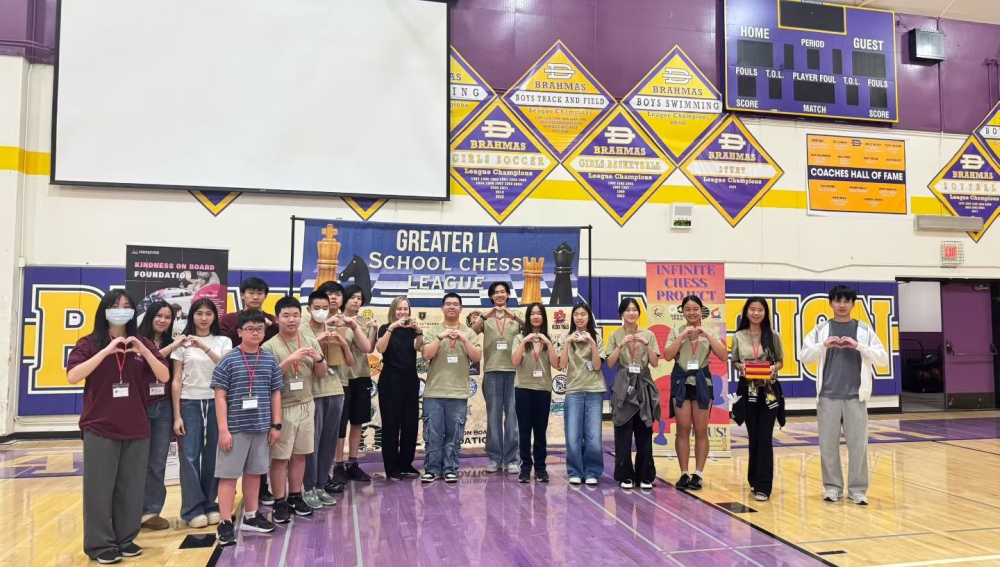
On a recent weekend in the Greater Los Angeles area, the air in the tournament hall wasn’t just filled with the quiet clicks of chess clocks and the scratch of pencils on score sheets. It was filled with a powerful sense of purpose. The occasion was the 2026 Greater LA School Chess League, a tournament that, in its second year, has more than just grown in size – it has blossomed into a profound partnership between a local non-profit and a global movement for social good. Organized by the Kindness On Board Foundation (KOBF) and co-hosted by the Diamond Bar High School Chess Club, this year’s event was a resounding success. Participation surged from 26 teams in 2025 to an impressive 46 teams, representing 32 schools from across the sprawling metropolis. But what truly set this tournament apart was its heart. This year, the Kindness On Board Foundation proudly hosted the event as a fundraiser for FIDE’s Infinite Chess Project, a global initiative dedicated to teaching chess to children with autism spectrum disorder and other developmental disabilities. The Los Angeles chess community responded with characteristic generosity. Thanks to the contributions of participating families, the event raised nearly $7,000 to support the Infinite Chess Project’s mission. For Jonathan Chen, founder and director of the Kindness On Board Foundation, the event was a perfect reflection of his organization’s name. “This tournament is more than a competition – it is a celebration of kindness, teamwork, and commitment,” said Jonathan Chen. “We are proud of what we are building together and look forward to continuing this tradition in the years to come.” The connection with the Infinite Chess Project was made tangible by the presence of two of its key figures. Traveling from Canada was Ala Mishchanka, a FIDE Infinite Chess Project ambassador and co-author of the project’s handbook. With over 21 years of experience as a Special Needs Educational Assistant in Toronto, Mishchanka brought not only her official role but also a lifetime of on-the-ground expertise. She delivered an inspiring and informative lecture to the KOBF’s volunteers on supporting children with autism, a session that was deeply appreciated by the local team. In her opening speech Ala Mishchanka shared the heartfelt origin of the story of the Infinite chess project, which began in 2019 at private chess school in Belarus. Inspired and started by remarkable chess professionals Anastasia Sorokina and Natalia Popova the project started with the simple question from a parent: could his son with ASD also join the chess lessons? In 2021 Anastasia Sorokina expanded the project and became the leader of the International Infinite Chess movement. From that moment, a global family was born. “Today, 28 countries have joined the Infinite Chess family,” Ala Mishchanka told the assembled players and families. She highlighted the project’s comprehensive achievements, including a unique methodological guide for teachers and parents, which she co-authored and which has now been translated into seven languages. “Our mission,” she explained, “is to unlock the unique potential of these extraordinary children, using the infinite, predictable logic of chess to build foundational skills for life.” The virtual presence of Maria Tamkovich, Secretary of the FIDE Social Commission and coordinator of FIDE Infinite Chess, further underscored the international collaboration. Maria’s words of encouragement resonated with the volunteers, young players, and their families, reinforcing that they were part of something much larger than a single local tournament. The event was a testament to grassroots organisation and community spirit. Jonathan Chen extended sincere thanks to Diamond Bar High School and Chess Club advisor Eric Sorensen, whose unwavering support over three months of preparation was instrumental. As the tournament drew to a close, the focus shifted from the scores on the board to the impact off it. In a moving ceremony, Ala Mishchanka took the stage to present one of FIDE’s highest social recognitions. She explained that the FIDE Social Chess Award was established during the FIDE Year of Social Chess to recognize individuals and organizations making outstanding contributions to the social impact of chess. Its primary aim is to highlight efforts that go beyond competitive play, demonstrating how chess can serve as a powerful tool for inclusion, education, empowerment, and community building. “By recognizing exemplary contributions, the award encourages national federations to support social chess initiatives, celebrate local heroes, and share inspiring stories that demonstrate chess’s broader societal value,” Ala Mishchanka announced. “And now, I have the great honour to present one of FIDE’s highest recognitions for such a hero – the Kindness On Board Foundation.” She highlighted the global impact of the foundation’s support: “Thanks to your support, Infinite Chess students in South Africa, Gambia, Ukraine, and Sri Lanka have received not only additional groups and chess lessons but also new equipment and supportive materials. Thank you very much on behalf of FIDE and all Infinite Chess partners.” The award was a powerful culmination of the day’s events, cementing the partnership between the local foundation and the global initiative. The 2026 Greater LA School Chess League proved that a chess tournament can be a powerful platform for change. By weaving together competition, fundraising, and education, the Kindness On Board Foundation and the Infinite Chess Project have built a lasting bond, demonstrating that the most meaningful victories are the ones we achieve together.
Monaco Championship 2026: Levacic and Dornbusch claim titles

IM Damir Levacic and WGM Tatiana Dornbusch are newly crowned chess champions of еру Principality. The Monaco Chess Championship 2026, a 7-round Swiss tournament held from February 23 to March 1, brought together the country’s leading players with man and women competing in the same pool. The event not only determined the national titleholders but also finalized the selection of the teams representing Monaco at the upcoming Chess Olympiad. Open and women’s titles IM Damir Levacic emerged as the clear winner of the tournament, scoring 5.5/7 to secure the title of Monaco Champion 2026. Despite suffering a third-round defeat at the hands of top seed GM Amir Bagheri, Levacic finished strongly with three straight victories to clinch the title. Five players shared second place on 5 points, reflecting the highly competitive nature of the championship: GM Amir Bagheri Riccardo Costalonga GM Igor Efimov FM Alexis Cahen FM Patrice Verdier Tie-break criteria determined the final ranking among the players on equal points. WGM Tatiana Dornbusch secured the title of Women’s Champion of Monaco 2026, finishing as the highest-ranked female player with a score of 4.5/7. She edged out WIM Marija Zvereva who achieved the same score but had an inferior Buchholz-tiebreak. WCM Svetlana Berezovska and WCM Fiorina Berezovsky also completed solid tournaments. Complete final standings Monaco teams for the Chess Olympiad Based on the results of the national championship and selection criteria, the Monaco Chess Federation confirmed the following line-ups for the forthcoming Chess Olympiad: Open team IM Damir Levacic GM Amir Bagheri Riccardo Costalonga GM Igor Efimov FM Alexis Cahen Women’s team WGM Tatiana Dornbusch WIM Marija Zvereva WCM Svetlana Berezovska WCM Fiorina Berezovsky WIM Julia Lebel (82) The composition of both teams combines experienced titled players with motivated competitors, aiming to represent Monaco with strength and stability on the international stage.
FIDE March 2026 Rating List – Correction

According to Article 0.2.1 of the FIDE Rating Regulations, a tournament and its playing schedule must be registered: 0.2.1 Not later than 30 days before the tournament starts, if one of the players in the tournament is rated in excess of 2700, or a female player rated in excess of 2500. Due to an oversight in the approval process, the Russian Chess Crown match was included in the March 2026 FIDE Rating List in breach of these regulations. Once the error was identified, the Qualification Commission (QC) removed the event from the FIDE Rating System in accordance with the applicable rules. As a result, Sergey Karjakin’s status has been changed to inactive, and he has been removed from the list of active players in the FIDE rating list. The FIDE Qualification apologises for any issues this may have caused with the release of the new rating list, and will work at improving the approval process in the future. The current standard rating list is available here: https://ratings.fide.com/top_lists.phtml?list=open