

FIDE Grand Swiss 2025: Expect the unexpected in Samarkand
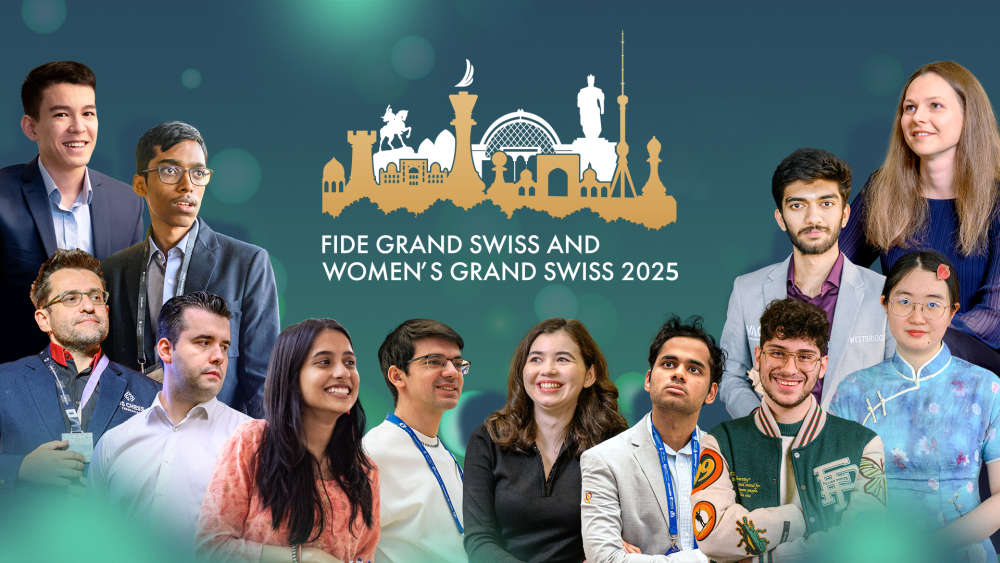
For two weeks in September, the ancient capital of the Silk Road will be home to many of the best chess players in the world. When talent, youth, experience, and ambition collide, uncertainty is the only rule. Since its initiation in 2019, the FIDE Grand Swiss – held every two years – has distinguished itself as the strongest classical chess tournament. Featuring 11 rounds played under the Swiss system it is a battleground where the best face the best and only exceptional performance can secure victory. This is hardly surprising given what is at stake – substantial prizes and coveted qualifying spots for the 2026 Candidates Tournament in the Open and Women’s categories. The total prize fund amounts $855,000, with $625,000 allocated to the Grand Swiss and $230,000 to the Women’s Grand Swiss. The primary qualification goal of the tournament is clear: the top two finishers in both the Open and Women’s events will secure their places in the 2026 Candidates, which will decide the next challenger for the World Championship title. “The Grand Swiss has always stood as a unique tournament and one of the most anticipated events in the FIDE calendar. We are pleased that it will be taking place in Uzbekistan – a great chess nation which is investing in the sport and has a proven track record in organising major chess events,” FIDE President Arkady Dvorkovich said. “The rising youth dominating the chess scene in recent years will be tested in Samarkand, facing many of the most seasoned players on the planet. I am very much looking forward to the clash of generations. Overall, I believe that this tournament will have a strong positive impact on the promotion of chess, not just in Uzbekistan or central Asia, but much more broadly,” he added. The unpredictable winners of the Grand Swiss A look at the previous editions of the Grand Swiss – three in the Open and two in the Women’s category – shows that one thing is clear: once the games start, there isn’t much difference between the rating favourites and the underdogs, and nothing is certain until the end. In 2019, underdog Wang Hao emerged as the winner after a lucky victory over David Howell. The Chinese GM edged out the favourite, Fabiano Caruana, thanks to a better tiebreak. In that tournament, the then 23-year-old Kirill Alekseenko stunned the field, finishing in third place. Then in 2021, in Riga, Alireza Firouzja made his big mark on the global scene by overcoming seasoned GMs and winning the tournament outright. In a field dominated by youth, the experienced player Alexei Shirov delivered a great performance, tying for third place and earning a spot in the 2022 FIDE Grand Prix. In 2021, the inaugural Women’s Grand Swiss was held, which was marked by Lei Tingjie’s, securing the title with a round to spare. In the third edition, held at the Isle of Man in 2023, Firouzja faltered and finished in the middle of the scoreboard, but it was the Indian players who stole the show, with Vidit Santosh Gujrathi capturing the Open and Vaishali Rameshbabu triumphing in the Women’s competition. Vidit, despite losing in round one, rallied brilliantly to finish half a point ahead of Hikaru Nakamura. Players to look out for at the 2025 Grand Swiss This year’s Grand Swiss will see 116 players take part in the Open, including the World Champion Gukesh D, and 56 in the Women’s tournament. The Open tournament field is formidable. Eighteen players boast ratings above 2700, placing them in the Super-GM category, alongside 74 GMs rated 2600–2699 – world-class competitors capable of toppling anyone. With top contenders hailing from chess powerhouses such as India, the U.S, France, Germany, China, the competition will be fierce. Photo: Maria Emelianova Rameshbabu Praggnanandhaa, the current leader of FIDE Circuit, headlines the ranking list in Samarkand. The Indian youngster – who only turned 20 on August 10 – is already a seasoned player having dominated many tough tournaments and represented his country in Olympiads and team events. Praggnanandhaa is enjoying a career-best year as he became the top-ranked player in his native India and fourth in the world, his highest placement so far. Most recently, Praggnanandhaa was the runner-up of the Sinquefield Cup, which secured him a place in the playoff stage of the Grand Chess Tour. The superb strength and performance he has had this year so far has put Praggnanandhaa at the top of the favourites to win the Grand Swiss. Another title hopeful is Gukesh D – the 19-year-old World Champion who has made history several times already, most notably by becoming the first Indian to breach the 2750 ELO barrier, as well as being the youngest-ever winner of the Candidates and later on World Champion. Gukesh has had a bright year so far – finishing as the runner-up at Tata Steel and taking third place in Norway Chess, where he defeated Carlsen and Nakamura. Gukesh’s strength and world crown make him an exceptionally strong favourite in the tournament, but his status also makes him a prime target for many of the players in the Grand Swiss. The 19-year-old is already renowned for his focus and for managing to keep his nerves steady. Whether he does that in Samarkand will be decisive for his performance in the Grand Swiss. Arjun Erigaisi, India’s third big hope at the event, is also in strong form. A former national number one, he’s now ranked among the best players in the world. Then there’s Vidit Santosh Gujrathi, the 2023 Grand Swiss winner chasing for another title. Other top players in the race include the 2021 Grand Swiss winner, 22-year-old Alireza Firouzja, who captured another Bullet Chess Championship title in 2025, had a solid performance at the Superbet Rapid & Blitz and was a runner-up in the Esports World Cup, losing to Magnus Carlsen. Photo: Rafal Oleksiewicz Germany’s Vincent Keymer is another one to watch out for – the winner of the German Championship, Keymer is
FIDE World Cup 2025 heads to Goa, India

The FIDE World Cup 2025 is coming to Goa! From October 30 to November 27, 2025, the world’s top players will gather on India’s west coast for one of the most exciting chess events. This knockout spectacle brings together 206 players fighting for a share of USD 2,000,000 and three coveted places in the 2026 Candidates Tournament. Every round is win-or-go-home, making the World Cup one of the most dramatic tournaments on the calendar. Why Goa? Goa’s stunning beaches, vibrant culture, and warm hospitality makes it an exciting backdrop for this global showdown. Players and fans will experience world-class chess alongside a destination famous for its energy and charm. India’s connection to chess runs deep, and in recent years the country has become a global force, producing top players and hosting significant tournaments. Last year, Gukesh Dommaraju became the World Champion, whilst Indian teams won the Chess Olympiad in both Open and Women categories. The momentum continued: this July, the Women’s World Cup saw a standout performance by Divya Deshmukh, who lifted the trophy and captured worldwide attention. Staging the Open World Cup in Goa builds on these successes and gives local fans an opportunity to watch their stars compete against the very best on home soil. Arkady Dvorkovich, FIDE President: “India has become one of the strongest chess nations, with outstanding players and passionate fans. After the success of the FIDE Women’s World Cup held in Georgia earlier this year, we are proud to bring the FIDE World Cup to Goa. It will be a celebration of chess, and a unique experience for players and spectators from around the world. The representatives of 90+ countries are expected to take part, and it will be one of the most followed events in chess history.” Narendra Modi, Prime Minister of India: “India is delighted to be hosting the prestigious FIDE World Cup 2025 and that too after over two decades. Chess is gaining popularity among our youth. I am sure this tournament will witness thrilling matches and showcase the brilliance of top players from around the world.” Nitin Narang, AICF President: “This is a proud moment for Indian chess, and we are committed to delivering an event that reflects both the passion of our fans and the professionalism of our federation. The World Cup will not only inspire millions across the country but also showcase India’s growing stature as a global hub for chess. We are deeply thankful to FIDE for granting India the honor of hosting the World Cup 2025 in Goa.” Key Details Dates: 31 October to 27 November 2025 Venue: Goa, India Players: 206 Format: Eight-round knockout Top 50 seeds enter from Round 2 Matches are two classical games, with rapid and blitz playoffs if tied Candidates spots: Top three finishers qualify for the 2026 Candidates Tournament List of qualified players: worldcup2025.fide.com/participants/ Regulations for FIDE World Cup 2025 (PDF) With Goa confirmed as the host city, anticipation is building for an unforgettable month of high-stakes chess. Stay tuned for more information. The countdown to the FIDE World Cup 2025 has officially begun!
World Youth Chess Olympiad U-16 concludes in Barranquilla, Colombia
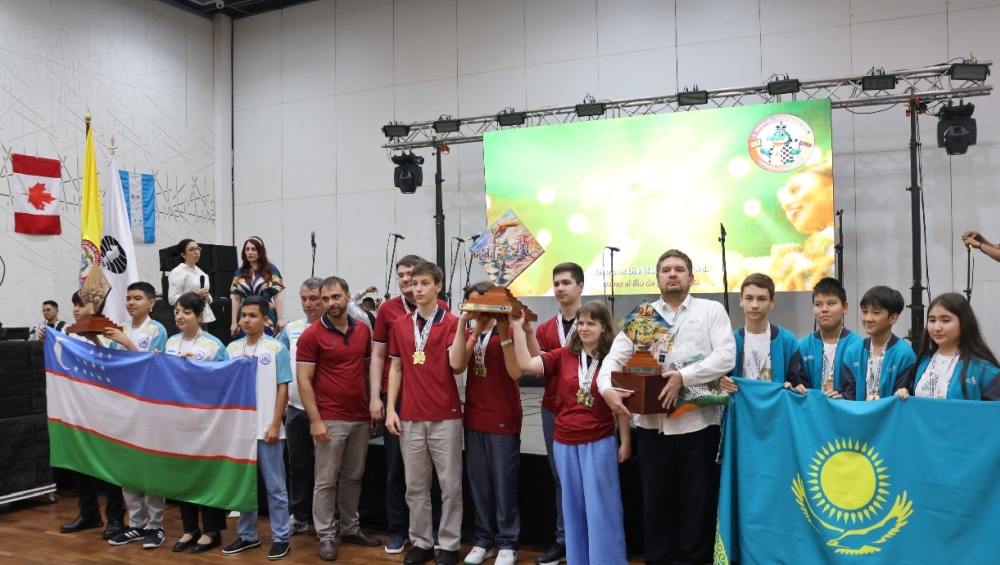
The city of Barranquilla has written a new chapter in the history of international chess. From August 16 to 23, 2025, the Colombian Caribbean capital became the heart of the chess world, hosting the U-16 World Youth Chess Olympiad—an unforgettable event that brought together more than 45 delegations from five continents. For eight days, the playing hall was filled with strategy, talent, and dreams. The ticking of clocks, the silence of concentration, and the emotions of every move transformed Barranquilla into a true temple of youth chess. Team rankings – champions crowned After nine rounds of fierce battles, camaraderie, and resilience, the final standings crowned the world’s best youth teams: FIDE 1 – Absolute Champion, with a flawless record of 9 victories in 9 rounds. Uzbekistan – Runner-up, with 7 wins and 2 draws. Kazakhstan 2 – Third place, with 7 wins and 2 losses. The top-seeded FIDE 1 team dominated the competition, securing gold with a round to spare. Uzbekistan affirmed its status as a new powerhouse of youth chess, while Kazakhstan showed that its young generation is ready to compete at the highest level. Individual brilliance – board winners The Olympiad also shone a spotlight on individual talents dominating their boards: Board 1 medalists: 1 place – GM Ivan Zemlyanskii (FIDE 1) – 7.5/9 2 place – IM Mukhammadzo Suyarov (Uzbekistan) – 7/9 3 place – IM Sauat Nurgaliyev (Kazakhstan 1) – 7/9 Board 2 medalists: 1 place – GM Savva Vetokhin (FIDE 1) – 8/9 2 place – IM Khumoyun Begmuratov (Uzbekistan) – 7/9 3 place – Matvei Savelev (FIDE 2) – 7/9 Board 3 medalists: 1 place – GM Artem Uskov (FIDE 1) – 8/9 2 place – FM Alan Petukhov (Kazakhstan 1) – 8/9 3 place – IM A.R. Ilamparthi (India) – 7/8 Board 4 medalists: 1 place – CM Prathamesh Sherla (India) – 8/9 2 place – WIM Jinela Rodríguez Rivero (Cuba 1) – 8/9 3 place – WGM Anna Shukhman (FIDE 1) – 7/9 The Olympiad was more than a sporting competition—it was a celebration of diversity, unity, and cultural exchange. Players of different languages, religions, and traditions sat across from one another, proving that on the 64 squares, everyone speaks the same language: the language of chess. Barranquilla, with its warmth and hospitality, embraced every delegation as family. It became a place where new friendships were born, dreams were nurtured, and the spirit of fair play shone brightly. Closing ceremony to remember The closing ceremony blended sport, art, and culture in an unforgettable evening. Champions were honored in the presence of distinguished guests, including: Daniel Trujillo, Secretary of Sports, Mayor’s Office of Barranquilla Akaki Iashvili, FIDE Special Tasks Director Weymar Fernando Muñoz, President of the Colombian Chess Federation Erick Hernández, representative of the Chess Confederation of the Americas (CCA) Eduardo de la Rosa, Governor of Atlántico The legendary Banda de Baranoa brought the evening to life with vibrant rhythms and a spectacular performance that filled the hall with joy, music, and color. Delegations clapped, danced, and celebrated together, closing the Olympiad not as rivals, but as one global family. The Colombian Chess Federation expresses its deep gratitude to all delegations, federations, organizers, and sponsors who made this world-class event possible. Thanks to their commitment, Colombia has shown itself not only as a chess-loving nation, but also as a country capable of hosting events of global excellence. This Olympiad produced more than champions—it created memories, friendships, and inspiration. It proved that chess is not confined to the board: it is a school of life, a bridge between cultures, and a path toward a brighter future for youth. Barranquilla bids farewell with pride and joy, crowned the World Capital of Youth Chess 2025. The pieces are now at rest, but the spirit of this Olympiad will remain alive in every child who dared to dream, compete, and win—not just on the board, but in life. Photos: Federación Colombiana de Ajedrez Official website: youtholympiad2025.fide.com/
A night of celebration and chess: World Under-16 Chess Olympiad begins in Barranquilla, Colombia

Yesterday, the city of Barranquilla, Colombia, hosted the grand opening ceremony of the World Under-16 Chess Olympiad at the Elías Chegwin Coliseum. With delegations from 45 countries and 86 teams, the parade of flags filled the arena with color and excitement, marking the official start of one of the world’s most prestigious youth chess competitions. The evening was filled with joy, music, and culture, concluding with an unforgettable performance by the winner of Yo me llamo Shakira, who thrilled the audience with her show. Prominent figures from the International Chess Federation (FIDE) and FIDE America attended the event, reaffirming international support for the growth of chess in Colombia and highlighting the significance of this global sporting occasion. Distinguished personalities from the chess world, as well as from the sporting and cultural spheres, were present, including José Carrillo Pujol, President of FIDE America; the FIDE America board; Akaki Iashvili, FIDE Special Tasks Director; Victor Bologan, FIDE Executive Director; Dr. Vivi Barguil, Executive Director of the Rueda Rueda Foundation; Weymar Muñoz, President of the Colombian Chess Federation; and Daniel Trujillo, Sports Secretary, along with delegates, federation presidents, and representatives of various partner organizations. FIDE Executive Director Victor Bologan and FIDE Continental President for the Americas José Carrillo Pujol made the first ceremonial moves, officially setting the competition underway. The Colombian Chess Federation extends its deepest gratitude to all the individuals, institutions, and organizations that made this Olympiad possible—especially the sponsors, whose support has helped transform Barranquilla into the world epicenter of youth chess. Photos: Federación Colombiana de Ajedrez Official website: youtholympiad2025.fide.com/
Velammal MHS School (India) takes gold at 2025 World Schools Team Championship
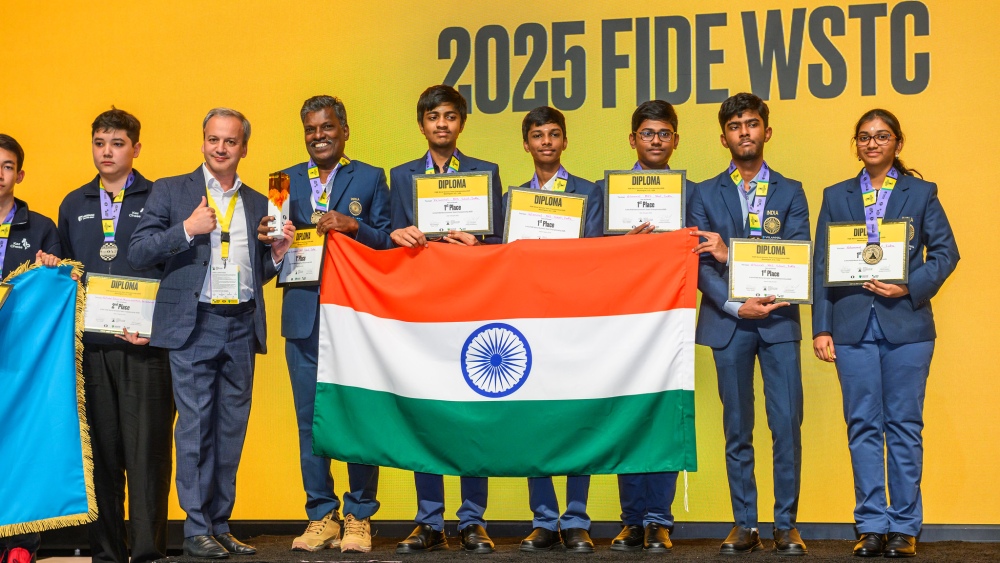
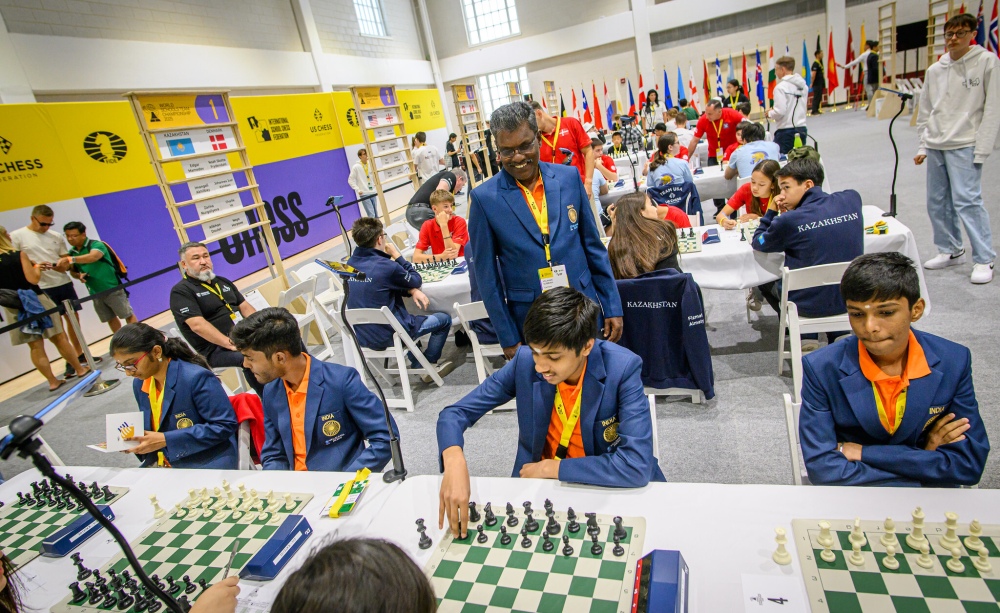
After eight exciting rounds, the 2025 World Schools Team Championship wrapped up today in Alexandria, Virginia. Set on the beautiful campus of Episcopal High School, the event brought together some of the most talented young chess players from around the world. Rising above the rest with a perfect score, Velammal MHS School from India claimed the gold medal, winning all eight of their matches. With India continuing to make waves across all levels and formats of chess, this victory adds yet another title to the country’s growing collection. Velammal MHS is no stranger to success—former students include Grandmasters R. Praggnanandhaa and Leon Mendonca. So it came as little surprise when the team entered the final round with the top spot already secured. The race for second place was much closer, with seven teams still in contention heading into the final round. Kazakhstan’s National School of Physics and Mathematics ultimately clinched the silver medal, finishing with the same number of match points as The Harker School (USA) but edging them out on tiebreaks. The Harker School earned a well-deserved third place, just ahead of Astana 2 RSPM, who narrowly missed the podium. Top 10 Final Standings: Complete final standings In addition to team honors, board medals were awarded to players who delivered outstanding individual performances. Three participants finished with perfect scores (8 out of 8)—a remarkable achievement: Imangali Akhilbay (KAZ – National School of Physics and Mathematics) on board two (pictured below, left), Edisa Berdibaeva (KGZ – School-Gymnasium No. 11, Karakol) on board three, and Pranav K. P. (IND – Velammal MHS School), who played reserve on board five. After the final moves were played, players were treated to fun and educational excursions in Washington, D.C. They visited the National Museum of Natural History and the National Air and Space Museum —two of the city’s most iconic landmarks. With most teams heading home the next day, these outings were the perfect way to cap off their time in the U.S. The week came to a close with a vibrant closing ceremony in the auditorium. The evening kicked off with music, audience engagement, and a warm welcome from the host, followed by the U.S. national anthem. David Hater, FIDE delegate and Executive Board Member of the U.S. Chess Federation, gave opening remarks before the FIDE anthem played. FIDE President Arkady Dvorkovich then took the stage to address the audience, extending his congratulations to the champions and gratitude to all who contributed to the event’s success: “I want to start by congratulating the winners on their great result! Your success is well-deserved, and I hope you leave here with not only medals but also with experiences that will encourage you to achieve more in life. And to all the other teams and their coaches, thank you for the passion and sportsmanship you showed. You have all made this event into a true example of what chess is all about; sportsmanship, friendship, creativity and progress.” A highlight reel followed, showing memorable moments from the week and drawing cheers as players spotted themselves and their teams on screen. Chief Arbiter Alex McFarlane then addressed the crowd, thanked the officials and arbiters, and confirmed everything was in order to begin the awards. Board medals were handed out one by one, with FIDE Vice Presidents and officials joining the Chief Arbiter to present the honours. Tournament Director Nadzeya Krauchuk took the stage next and introduced a second video, this one capturing the off-the-board moments that defined the spirit of the event. (All videos and content can be found on the official FIDE YouTube channel). Then came the big moment: the team awards. The top three schools were announced, with Velammal MHS School stepping onto the top of the podium as confetti filled the air and the Indian national anthem played. It was a joyful celebration of a week of dedication and hard work. Flags were raised, as FIDE President Arkady Dvorkovich returned to the stage to officially declare the 2025 World Schools Team Championship closed. As the curtain closes on this remarkable event, what remains are the connections, memories, and achievements shared by students from across the globe. The 2025 World Schools Team Championship will be remembered not only for its competitive excellence, but also for its message of unity, friendship, and the future of chess. Written by Charlize van Zyl Photos: Michal Walusza Official website: worldschoolteam2025.fide.com/
Velammal MHS School of India pulls ahead at the World Schools Team Championship
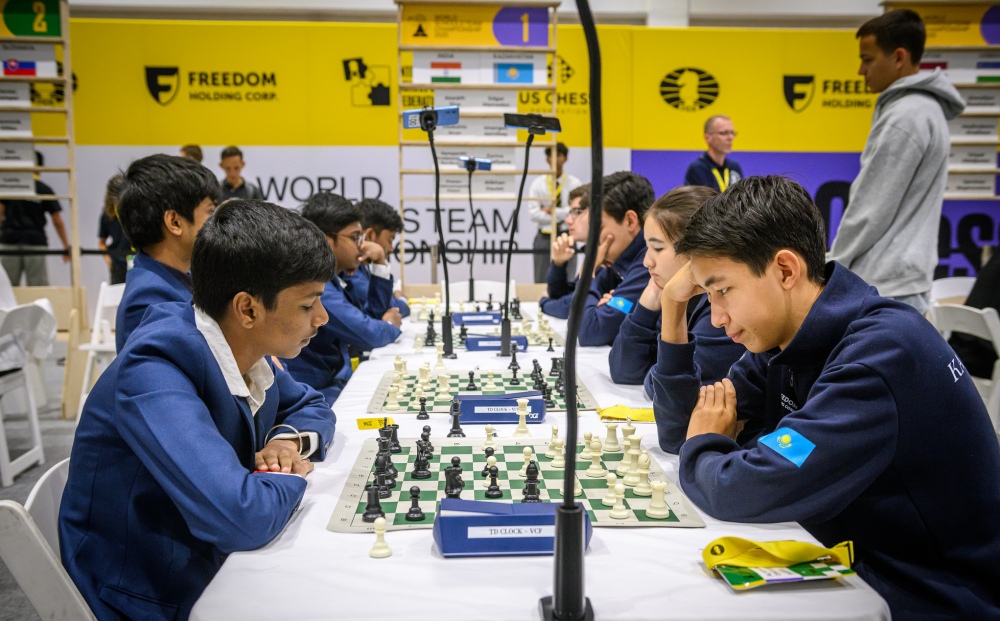
Day 3 of the World Schools Team Championship delivered another dose of high-stakes drama and memorable moments, both on and off the board. With two rounds played, the competition intensified as top contenders clashed, and underdogs continued to defy expectations. At the close of the day, India’s Velammal MHS School leads the event, holding strong as the tournament moves toward its final stage. All eyes in Round 5 turned to the top board, where a clash between the first and second seeds took centre stage. Kazakhstan’s National School of Physics and Mathematics faced off against Velammal MHS School in a match that lived up to the hype. With board one ending in a draw, it was the bottom two boards that made the difference; both claimed by the young Indian team, securing them a critical victory in the fight for first place. Meanwhile, Sri Lanka’s Royal College, Colombo continued their amazing run with another upset, this time against Slovakia’s Gymnázium, Grösslingová 18, Bratislava. The final score was 2.5-1.5, with all boards drawing except for board two, where the 1620-rated Sri Lankan player stunned his much higher-rated opponent (rated 2016) with a beautifully played finish. This victory propelled Sri Lanka into joint lead, setting up a highly anticipated Round 6 showdown against India with both teams entering the match on perfect scores. In this top-of-the-table encounter, between Velammal MHS School and Royal College, Colombo the Indian team proved too strong, claiming a convincing 3.5-0.5 victory over with two wins and two draws. The result solidified India’s position at the top of the standings heading into the final rounds. Away from the competition tables, the tournament continues to offer a wide range of activities designed to create a fun and social atmosphere for the players. As mentioned in previous updates, the players’ lounge remains a popular hangout, with its mix of games, beanbags, and chill-out zones. But the fun doesn’t stop there – each day wraps up with group activities, from basketball to nature walks, there are a lot of options for the kids to enjoy and socialize with each other. Today’s end of the day activity included a swanky silent disco – which, if you are older and haven’t heard of or experienced before yet (like me!) it is a party setting where music is played through individual headphones for every person. A wonderful setting for fun and to make new friends! Earlier in the day, and also ahead of the championship, players were treated to an excursion to the US Capitol, offering them the chance to take in some local history and culture. Tomorrow marks the seventh and eighth rounds of the tournament. With tensions mounting, and only one day left to play, the stage is set for an exciting finale that will determine the 2025 World Schools Team Champions. Moment of the day The result from round 5 with Sri Lanka’s Royal College beating the higher seed Slovakia’s Gymnázium, Grösslingová with a critical victory, is an incredible result in itself. But the way the decisive game ended made it even more memorable: White just blundered with 26.Qd4?? And suddenly the white king was in grave danger. Black pounced with 26…Qf3! (26…Nf3 was more accurate, but the move played was both elegant and effective). White tried 27.Nf4, defending the g2-pawn but it failed to 27…Nh3+! 28.Kh1 Nxf4 29.Rg1 Nxg2 30.Qb2 and White resigned, facing imminent checkmate after 30…Nf4+. Top 10 after Round 6 Smart Moves Summit Day two of the Smart Moves Summit focused on how chess connects with business, communication, and education. The day opened with a series of TED-style talks exploring the transformative power of chess, followed by a panel on sponsorships and strategic partnerships at the crossroads of chess and learning. Keynote speakers then discussed how to build sustainable school chess programs, and a roundtable discussion featuring top streamers and chess social media managers explored the growing role of social media, gaming, and online platforms in chess promotion. Alongside the main sessions, masterclasses covered topics such as inclusive environments, fair play through data, and effective training methods. As the summit concludes and the final rounds of chess approach, both the competitive and educational aspects of this event reflect the richness and global reach of the chess world. Written by: Charlize van Zyl Photos: Michal Walusza Official website: worldschoolteam2025.fide.com/
A day of fierce matches and lasting friendships at WSTCC 2025
The World Schools Team Championship in Alexandria continued with great momentum today, as two more rounds were completed. The intensity of the competition is growing, with three teams – Kazakhstan’s National School of Physics and Mathematics, India’s Velammal MHS School, and Sri Lanka’s Royal College, Colombo still leading the standings on a perfect score. As the tournament progresses, the atmosphere on and off the board continues to reflect not just the fierce competitive spirit, but also the unique camaraderie that makes this event so special. Shortly before 10:00, the playing hall was alive with anticipation. Students filled the space, eager to begin their games. Some had started the day with a walk around the scenic grounds of Episcopal High School, enjoying another bright and sunny morning. Others spent time in the vibrant players’ lounge, where activities like air hockey, table tennis, and, naturally, casual games of chess offered a fun way to relax before the serious matches began. Despite their different routines, the shared feeling among all the participants was one of excitement and good spirits as they returned to the boards. One of the core messages of this championship is “friendship” – the kind that transcends borders and is often born through shared love for chess. This sentiment came to life today in touching ways, as players exchanged thoughtful gifts from their home countries with their opponents. From decorative trinkets to fridge magnets, these simple gestures spoke volumes about the bonds being formed. It is clear that, beyond the chessboard, meaningful connections are being made here at the World Schools Team Championship. On the competitive front, the battles are intensifying. The tournament favourite, the National School of Physics and Mathematics, has delivered a commanding performance so far, with each board maintaining a perfect score and no points dropped. Not far behind, India’s Velammal MHS School is also showcasing remarkable consistency, having conceded just a point and a half (three draws) across all rounds. Their strategy of placing lower-rated players on the top boards continues to spark intrigue. Among today’s standout performances was Sri Lanka’s Royal College, Colombo. The team made waves in the third round by stunning the 8th-seeded English side, Hampton School, with a resounding 4-0 victory. In the fourth round, they faced the third seed, University High School, and dominated the match 3:1 continuing their impressive journey on this global stage. Moment of the Day The moment of the day comes from the Round 3 match between Velammal MHS School and US The Harker School on board 2 where IM Arun Daakshin delivered a crushing final move in this position, which was met with an immediate resignation by Black. The move is 24.Qxf6!! The squares around the black king are completely dominated by White. If 24…Kxf6 then 25.Be5# game over. Looking ahead, tomorrow’s pairings promise exciting matchups as the Swiss system begins pitting the top teams against one another. With the leaderboard tightening, the battle for the championship title is about to enter a thrilling phase. Top 10 after Round 4 Smart Moves Summit Parallel to the chess battles, the Smart Moves Summit kicked off today – a two-day conference spotlighting the powerful role chess can play in shaping education. With 15 scheduled topics, the summit brings together thought leaders, educators, and policymakers to explore chess as a tool for leadership, inclusion, and innovation. The day began with an official opening ceremony and flowed into panels that addressed various themes, from global leadership in chess education and its integration in early childhood learning, to increasing inclusivity and leveraging AI in educational technology. The day concluded with a thought-provoking session on methodology, policy development, and public sector collaboration. Alongside the panels, two masterclasses provided hands-on insight into using chess for cognitive development in early learners and the dynamics of strategic gameplay. The second and final day of the Smart Moves Summit will take place tomorrow, August 5, alongside rounds 5 and 6 of the championship. As the tournament heats up and the summit continues, Alexandria remains the center of both high-level chess and meaningful dialogue about the game’s future in education. Written by: Charlize van Zyl Photos: Michal Walusza Official website: worldschoolteam2025.fide.com/
Opening moves in Alexandria: World Schools Team Championship 2025 begins
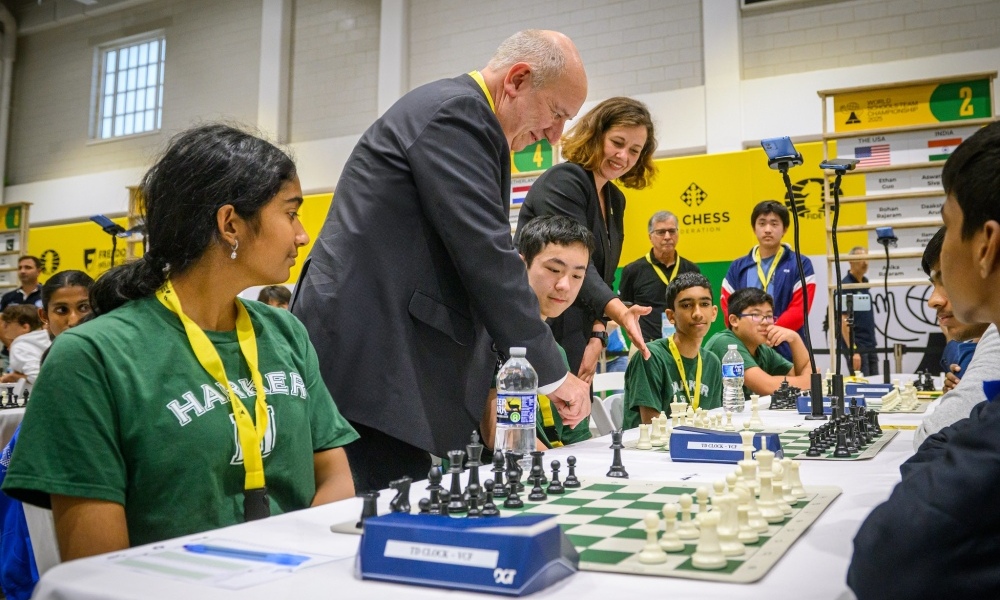
The World Schools Team Championship 2025 officially got underway at Episcopal High School, located in the historic city of Alexandria, just outside Washington, D.C. A flagship event in the global scholastic chess calendar, the tournament brings together hundreds of students representing nearly 50 countries. While the players are here to compete for international glory, the championship is equally a celebration of friendship, diversity, and shared passion for the game of chess. With participants ranging from unrated newcomers to seasoned International Masters, the tournament features a remarkable mix of talent and potential. This variety has already led to a wide spectrum of exciting games in the early rounds. At the top of the starting rankings is Kazakhstan’s National School of Physics and Mathematics, led by newly titled Grandmaster Edgar Mamedov, with a formidable average rating of 2229. Close behind is India’s Velammal MHS School, averaging 2210. The host country, the United States, is represented by four schools. Leading the American contingent is University High School, which holds third place in the starting rankings with an average team rating of 2003. The tournament’s first round began promptly at 11:30. Ceremonial first moves were made on the top four boards by distinguished guests: FIDE President Arkady Dvorkovich, President of the International School Chess Federation Timur Turlov, Minister of Educational Transformation of Barbados Hon. Chad Blackman, and Minister of Sport and Recreation of Costa Rica Donald Rojas Fernández. In the opening round, the top-seeded teams performed as expected, securing confident victories over their lower-ranked opponents. However, the second round saw the competition intensify as more closely matched teams faced off across the boards. By the end of the day, 11 teams secured wins in both rounds and concluded Day 1 with a perfect score of 4 match points. KAZ – National School of Physics and MathematIND – Velammal MHS SchoolENG – HamptonKAZ – Seed Educational ComplexNZL – Wellington CollegeSRI – Royal College, ColomboKAZ – Astana 2 RSPMUSA – The Harker SchoolSGP – Raffles InstitutionGRE – 1st General Lyceum of XanthiAUT – Privates Gymnasium Sacre Coeur Wien Moment of the day SUI – Kantonsschule Alpenquai Luzern SGP vs Raffles InstitutionBoard 4: Infanger, Philip vs Loh, Yang Hao Our moment of the day comes from board 4 in the match between Singapore’s Raffles Institution and Switzerland’s Kantonsschule Alpenquai Luzern. The match delivered one of the day’s biggest surprises, as the 19th-seeded Raffles Institution defeated the fifth seed by a commanding 3:1 score. The spotlight moment unfolded in a tense endgame after a rollercoaster battle where both sides had chances. In the critical position, White played 60.Kd5??, a decisive mistake that allowed Black to break through with 60…Kg6 61.Ke5 h5 62.gxh5 Kxh5. With the white king cut off, it could no longer stop Black’s advancing passed pawn, especially with the black king perfectly placed to shepherd it forward. Instead, the correct move was 60.Kf3, keeping the white king in front of the pawns, and ready for opposition – a key principle in pawn endgames. One possible line would be 60…Kg6 61.Kg3 h5 62.gxh5 Kxh5 63.Kh3, where the white king maintains opposition, denying Black any meaningful progress. Rounds 3 and 4 will be played on Monday, August 4, and after eight rounds, the tournament champions will be crowned on August 6. As the competition continues, so does this unique celebration of youth, talent, and international friendship through chess. Photos: Michal Walusza Official website: worldschoolteam2025.fide.com/
Let the games begin: Celebrating the start of the World Schools Team Championship 2025
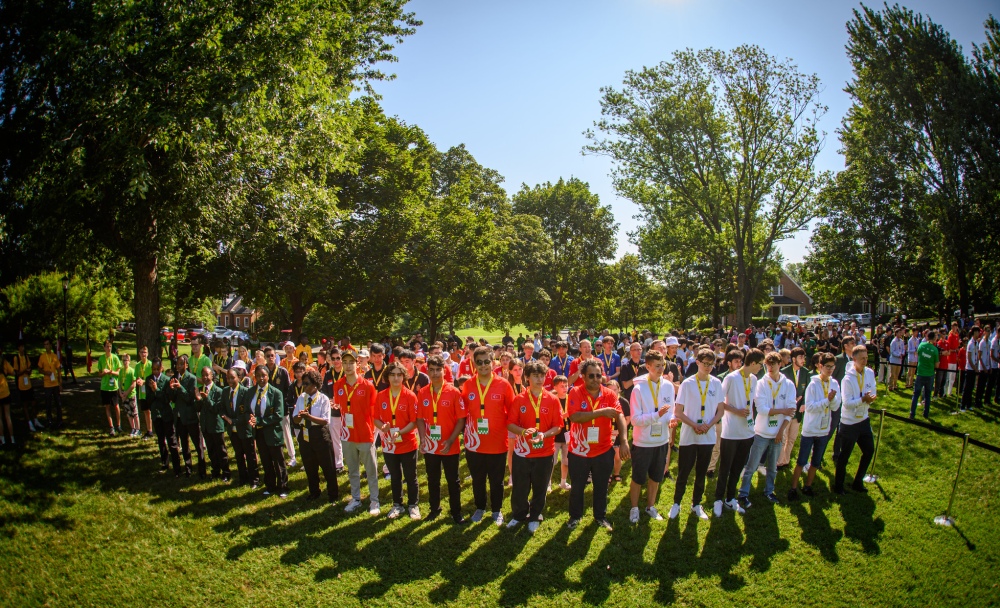
The opening ceremony of the World Schools Team Championship 2025 began with a colorful Parade of Nations, featuring players from more than 50 countries including India, China, the United States, and Norway. This was followed by the official transfer of ownership from FIDE to the International School Chess Federation, after which the event was formally declared open. The tournament officially commenced on August 3, 2025, in the historic city of Alexandria, Virginia. Hosted at Episcopal High School, just outside Washington, D.C., the venue offers a beautiful campus with modern facilities and rich tradition, an ideal setting for a tournament that encourages critical thinking, fair play, and global connection. This event will bring together over 50 teams from around the world, uniting young chess players in a truly international competition. Unlike a traditional indoor event, the opening ceremony embraced the sunny weather and took place outdoors on the grass lawn in front of the Hoxton house dormitory. Schools lined up in alphabetical order, and one by one, teams marched toward the front stage, proudly holding their country’s flag. The ceremony host introduced each team over the speakers, with upbeat music playing in the background to energize the crowd. The audience responded with loud applause, giving every team their moment in the spotlight. After all the teams had been welcomed, the national anthem of the United States played, followed by the FIDE anthem. FIDE President Arkady Dvorkovich then took the stage to pass the championship flag to Timur Turlov, President of the International School Chess Federation (ISCF). This symbolic gesture marked the official transfer of responsibility for the event to the ISCF. “Following the World Corporate and the World Rapid & Blitz, this is the third major global chess event we are hosting in the U.S. in just over a year, and we hope to do more. We are eternally grateful to our partners, particularly Freedom Holding and Mr. Timur Turlov – for their generous support for chess globally, at all levels. And on this note, it is my honour to formally entrust the International School Chess Federation with care and stewardship over the FIDE World Schools Team Championship,” said Arkady Dvorkovich, President of FIDE. Timur Turlov followed with a speech highlighting the educational value of chess and the importance of making the game accessible to children everywhere. “Chess is not just a sport. It’s a way of thinking. It teaches discipline, decision-making, and the ability to see the consequences of your actions. It’s a game that shapes the kind of thinking every person needs – in life, in his or her career, in society. I say this not only as the head of a federation, but as a father whose children play chess. I see, game after game, how they learn to think, to be patient, to win – and sometimes to lose with dignity. Chess is a school of life. And we want more children around the world to have access to this beautiful game,” said Timur Turlov, President of the International School Chess Federation. He ended his speech by officially declaring the World Schools Team Championship 2025 open, drawing a warm round of applause from the crowd. The opening ceremony was attended by distinguished guests and prominent figures from the global chess and academic communities. Among them were present Dr. Bill Poucher, Executive Director of the International Collegiate Programming Contest (ICPC), ACM Fellow, and Professor of Computer Science at Baylor University, recognized for his decades-long contributions to computer science and innovation and Dana Reizniece, former Latvia’s Minister of Economics and Minister of Finance, and current FIDE Deputy Chair. Their presence underscored the significance of the event and its role in shaping the future of scholastic chess worldwide. Applications are now open to host the next World Schools Team Championship! National chess federations, educational institutions, and event organizers interested in hosting the tournament are invited to submit their proposals. Please include a description of the venue, infrastructure, and a letter of intent. All applications should be sent to: info@ischoolchess.com For more information and the full program, please visit the official website of the Federation and follow our social media accounts – exciting, inspiring, and unforgettable moments lie ahead! More information: Championship website: worldschoolteam2025.fide.com/ Summit website: worldschoolteam2025.fide.com/summit/ ISCF website: ischoolchess.com/ General Partner: Freedom Holding Corp.Join us in Washington, D.C. / Alexandria from August 2–7, 2025.
World Women’s Team Championship 2025 heads to Linares, Spain
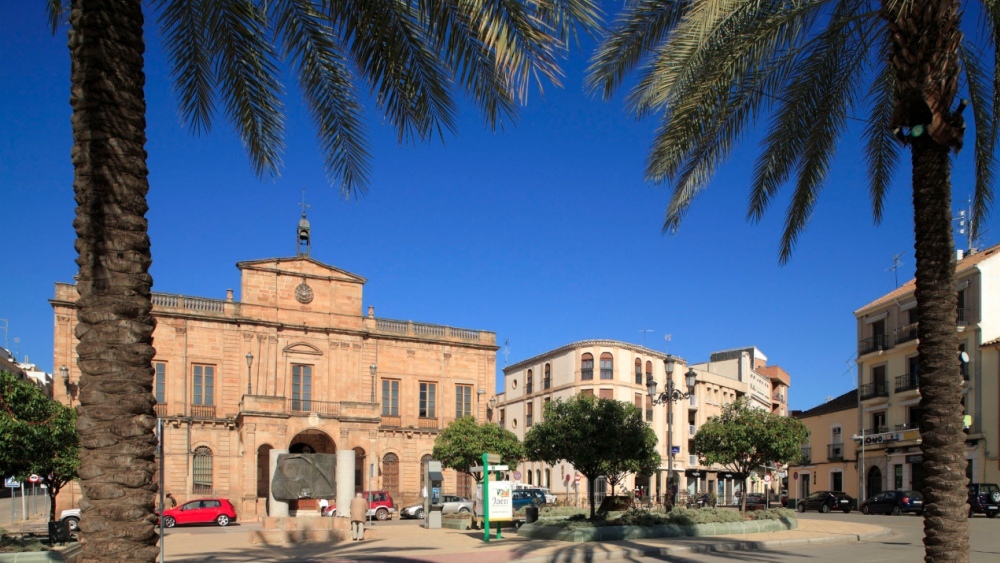
Photo: Michal Walusza The FIDE World Women’s Team Championship 2025 is set to take place in the legendary chess city of Linares, Spain, from November 17 to 24. Known as one of the most iconic venues in chess history, Linares will once again be in the global spotlight as it welcomes 12 of the world’s strongest women’s national teams to compete for the prestigious world title. “I am very excited that the Championship goes to Linares. The city is famous for its rich chess tradition – however it is not only about the past, but also the present and the future. I’d like to thank the local chess community and the Spanish Chess Federation for the cooperation, and we look forward to an exciting event,” said Emil Sutovsky, FIDE CEO Photo: European Best Destinations First held in 2007, the FIDE World Women’s Team Championship has become one of the most important events on the women’s chess calendar. Previous winners include China, Russia, Ukraine, and Georgia (reigning champion), with China claiming a record four titles. The event not only crowns the best national women’s team in the world, but also showcases rising stars and team spirit. The 12 teams competing in Linares are: * Semi-finalists of the 2023 edition: Georgia France Kazakhstan USA * Top-rated teams from each continent: China (Asia) Ukraine (Europe) Peru (Americas) Egypt (Africa) * Top federations by average rating (August 2025): India FIDE Team * Host nation: Spain * FIDE President’s nomination: To be announced The championship features 12 teams, split into two pools of six for a round-robin stage. The top two teams from each pool will advance to the knockout stage, consisting of semi-finals and a final. Each match between two teams consists of four boards, and matches are played under the standard time control: 45 minutes + 30 seconds per move from move one. Full regulations for World Women’s Team Championship 2025 (PDF)