

FIDE Women’s World Cup Final, Game 2: Elite-level precision as Humpy and Divya head to tiebreaks

Tan Zhongyi clinches third place and candidates spot in a thrilling battle against Lei Tingjie The second game of the Women’s World Cup final ended in a solid draw. Humpy Koneru attempted to unbalance an equal position with an enterprising pawn sacrifice, but Divya Deshmukh defended accurately, and the game was drawn after 34 moves. “It should have been an easy draw, but I got into trouble for no reason,” Divya remarked candidly after the game. With both classical games drawn, the title will now be decided in tomorrow’s rapid tiebreaks. Humpy, the reigning World Rapid Champion, enters the playoff with strong credentials, but Divya has shown remarkable composure and resilience in previous tiebreaks, having already defeated Grandmasters Zhu Jiner and Harika Dronavalli in earlier rounds. “I think I’m going to give my best tomorrow,” said Divya. “She is of course a very strong player, but I’m hoping things go my way.” In the battle for third place, Tan Zhongyi emerged victorious against fellow Chinese Grandmaster Lei Tingjie. In an exciting encounter, Tan capitalized on a major blunder by Lei in the late stages of the game. With the win, she not only claimed the bronze medal but also secured a coveted spot in the Candidates Tournament. Tan, a former Women’s World Champion, has now achieved an impressive record in the three editions of the Women’s World Cup: two third-place finishes and one fourth place. Elite-level Precision as Humpy and Divya head to tiebreaks The second classical game of the Women’s World Cup final between Humpy Koneru and Divya Deshmukh was a showcase of top-tier accuracy. Both players recorded a remarkable 99% accuracy score, with an average centipawn loss of just three—a clear testament to the elite level of play on display. Humpy surprised with the fashionable Zukertort setup: 1.Nf3 2.e3 3.c4—a line used by players like Levon Aronian and gaining popularity in recent years. Though not a staple in Humpy’s repertoire, she had previously used it to score a notable win over IM Salome Melia at the 2024 New York Rapid & Blitz, where she clinched the World Rapid Championship title. As expected, Divya’s preparation was impeccable. With a series of precise moves, she comfortably neutralized White’s initiative and steered the game into a balanced queen and minor piece endgame. The position was dynamically balanced—Humpy had the bishop pair, but the closed center allowed Divya’s knights to hold their ground. After a lengthy think, Divya played 21…Ne4, a principled and engine-approved choice that invited complications. Humpy immediately seized the opportunity to transform the position with 22.Bxe4 dxe4 23.d5!, sacrificing a pawn to open the long diagonal and activate her bishop. Though down a pawn, White seized the initiative. Divya found herself under sudden pressure and explained afterward: “I got myself into a mess for no reason. I was trying to see if there was a win, but I missed Qb8.” That moment came on move 26: Despite being a pawn ahead, Black was caught in a bind. The knight on d8 was pinned and vulnerable, and mating threats loomed. Divya, showing great defensive prowess, played Kh7, eventually freeing herself with a precise …Nc6 maneuver. Though she had to return her extra pawn, the simplification allowed her to force a perpetual check, bringing the game to a balanced conclusion. With both classical games drawn, the final will now be decided in rapid and blitz tiebreaks tomorrow. According to an unofficial FIDE poll of 10,000 viewers, the odds are almost evenly split: 52% favor Divya, while 48% lean toward Humpy. The outcome now hinges entirely on their speed chess prowess and nerves under pressure. https://youtu.be/6Xj8N1NLW9Q Tan Zhongyi clinches third place and Candidates spot in thrilling battle Against Lei Tingjie In the other decisive match of the day, Tan Zhongyi overcame Lei Tingjie to secure the bronze medal and, crucially, the final qualifying spot in the 2026 Candidates Tournament, which determines the challenger for the Women’s World Championship. Lei opened with the Giuoco Pianissimo, a quiet but deeply theoretical variation of the Italian Opening—a line she had already employed multiple times during her semi-final clash with Humpy Koneru. Tan, well-prepared for the encounter, followed familiar territory from her Round 5 victory over Vaishali, but in this game, she allowed Lei the opportunity to pin the knight on g5 early after castling. “I actually didn’t expect her to play this opening. I had prepared this before when I played against Vaishali, and back then I made a mistake in the move order, but I reviewed it again, and I didn’t expect that she would play it today. I feel pretty lucky,” Tan confessed in a quick postgame interview. The first critical moment arose just out of the opening: This position has appeared in several top-level games, with players like Aronian and Vidit choosing the creative 12.Ra3!?, sacrificing the d4 pawn in exchange for swift rook activity. Instead, Lei introduced a novel idea: 12.Bb5!?. After 12…exd4 13.Nc4! dxc3 14.Nxb6!, the game took a sharp tactical turn: If Black greedily continues with 14…cxb2, White responds with 15.Bxb2 cxb6 16.Ra3!, followed by 17.Nh2 and 18.Rg3, setting up a devastating kingside assault in exchange for two pawns. Recognizing the danger, Tan wisely declined the material and prioritized piece activity and king safety with 14…cxb6. From that point on, both players followed the engine’s top line with astonishing precision, showcasing exceptional preparation and decision-making under pressure. The second pivotal moment occurred in the late middlegame: Here, Tan had a winning opportunity with 35…Qf1!, pinning the g2 pawn and threatening both mate and the rook on d4. However, spotting the correct follow-up—36.Rxe6 h5!—was far from easy. This subtle pawn move shuts down any escape via g4, and with …Qh1# looming, White would have been helpless. Tan missed the win, and Lei managed to regain balance with two pawns and a knight for the rook, entering a complex endgame. However, with the clock ticking down, Lei made a fatal error in a tense position: Here, 52.Kg3 would have prolonged
FIDE Women’s World Cup Final, Game 1: Narrow escape for Humpy Koneru; solid start by Divya Deshmukh

Tan Zhongyi and Lei Tingjie also split the point in a balanced game The first game of the final was as exciting as it gets. Divya unleashed some excellent opening preparation and was on the verge of scoring a win in under 25 moves. However, Humpy defended tenaciously and capitalized on a few inaccuracies to salvage a draw. The second game of the match will be played tomorrow, with Humpy having the white pieces. In her post-game interview, Humpy admitted she had narrowly escaped defeat: “I think she was clearly better after 12.Rb1 instead of 12.Nc4. After that, I’m not sure what was going on, but it was very complicated.” In the third-place match, Tan and Lei split the point just after the 30-move threshold. Lei will have the white pieces in tomorrow’s second game, with the winner securing the final Candidates qualification spot. Let’s take a closer look at the games. Although Divya is comfortable playing both 1.e4 and 1.d4, the former has been her weapon of choice throughout the tournament in Batumi. So, it came as a surprise to see her open today’s game with 1.d4 — and even more so when Humpy Koneru responded with the Queen’s Gambit Declined, a defence she had largely set aside since 2005. Humpy reintroduced the Queen’s Gambit Declined to her repertoire in 2023, but has used it sparingly compared to her other openings. Her most recent outing in this line — a loss to Lei Tingjie in Norway Chess 2024 — followed the variation featured in today’s game. Reflecting on that earlier defeat, Humpy said in her post-game interview: “I think that she prepared on this game and I just misplayed the opening and she got a big advantage.” The first critical moment came very early. According to the database, this position has appeared in about thirty elite-level games — all of which continued with 7.f3, reinforcing the e4 pawn and guarding against 7…Nxe4. But Divya deviated with 7.Be2 — a rare move, though not a novelty. GM Evgeny Bareev had employed it against GM Vassily Ivanchuk back in 1992. Today, engines rank it as their third choice. Humpy spent around ten minutes considering her reply and ultimately declined the pawn with 7…Bb7, possibly wary of running into home preparation. Undeterred, Divya castled and offered the pawn again. This time, Humpy accepted — and suddenly the game became sharply tactical, reminiscent of the original Bareev–Ivanchuk clash more than three decades ago. According to the engine, Divya missed an opportunity to achieve an opening advantage on move twelve but certainly on move fourteen she went wrong. In this critical position, the computer recommends 13…Kd8 for Black. After 14.Qe2 Re8, the position appears dangerous, but with precise play, it remains objectively equal. However, Humpy opted for 13…Kf8?, a natural-looking move that unfortunately gave her opponent a real chance to seize the initiative. “I don’t remember exactly the reasons, but I felt that 13…Kd8 was the wrong move,” Humpy said after the game. Sensing that an opportunity had arisen, Divya went into deep thought but ultimately missed the most punishing continuation. She played 14.Bxb7?, grabbing material but allowing the position to equalize after 14…Qxb7 15.Qe2 Nc6 16.d5, when the excellent defensive resource 16…h5! returns the extra piece and neutralizes White’s initiative. “I felt that after 16…h5 I was out of danger,” Humpy reflected. https://www.youtube.com/watch?v=G28SnnLdqsQ&t=7s Instead of capturing on b7, Divya should have played 14.Qe2!, maintaining a crushing +2.5 advantage according to the engine. The move intensifies the pressure on the exposed Black king and keeps White’s attacking momentum alive. Of course, finding such a precise continuation over the board, especially under time pressure, is never easy. Divya was visibly distressed at the end of the game after missing her chance to secure the win — the disappointment was evident on her face as she sat at the board. Even so, both players graciously spent time with fans who had been waiting all afternoon for a photo opportunity and a chance to meet their chess idols. Although all eyes were focused on the main game of the finals, the battle for third and fourth place was equally significant. The winner would secure the third qualifying spot for the Candidates Tournament, plus a €5,000 pay jump. Both Chinese players, good friends and frequent training partners, brought their best to the board. Tan opened with 1.c4, and the game soon transposed into a well-known position from the Queen’s Gambit Declined, Exchange Variation. Both players blitzed out their moves rapidly, demonstrating excellent theoretical knowledge. Instead of pursuing the mainstream minority attack plan—characterized by 10.Qc2, followed by 11.Rab1 and a later b4-b5—Tan opted for a less common approach with 10.a4. The idea was to play 11.a5, aiming to clamp down on the queenside. Recent games from elite players such as Caruana, Praggnanandhaa, Vidit, and Grischuk seem to support this strategy. The pace slowed as the game transitioned into the middlegame around move fifteen. Both players maneuvered their pieces carefully, seeking out the best squares. Their accuracy remained impeccable—no outright mistakes were made. However, a couple of small inaccuracies by Tan on moves 29 and 30 shifted the balance toward Lei. Though the engine suggests Black holds a modest +1 positional advantage—roughly equivalent to a pawn—the position was blocked, and White’s knights stood powerfully in the centre. Black’s slight edge mainly lay in a better pawn structure. Lei offered a draw just as her clock ticked down to fifteen minutes. In the end, both players left the hall together in good spirits, their friendship evidently undiminished by the fierce contest. Follow the games live and watch the action with expert commentary provided by GM Valeriane Gaprindashvili and IM Almira Skripchenko on the FIDE YouTube channel. Written by IM Michael Rahal (Batumi, Georgia) Photos: Anna Shtourman About the tournament: Scheduled to take place from July 6th to July 28th, the 2025 FIDE Women’s World Cup will gather together in Batumi (Georgia) the world’s best female chess players. A total of
FIDE Women’s World Cup Round 6: Humpy clinches victory in thrilling tiebreak
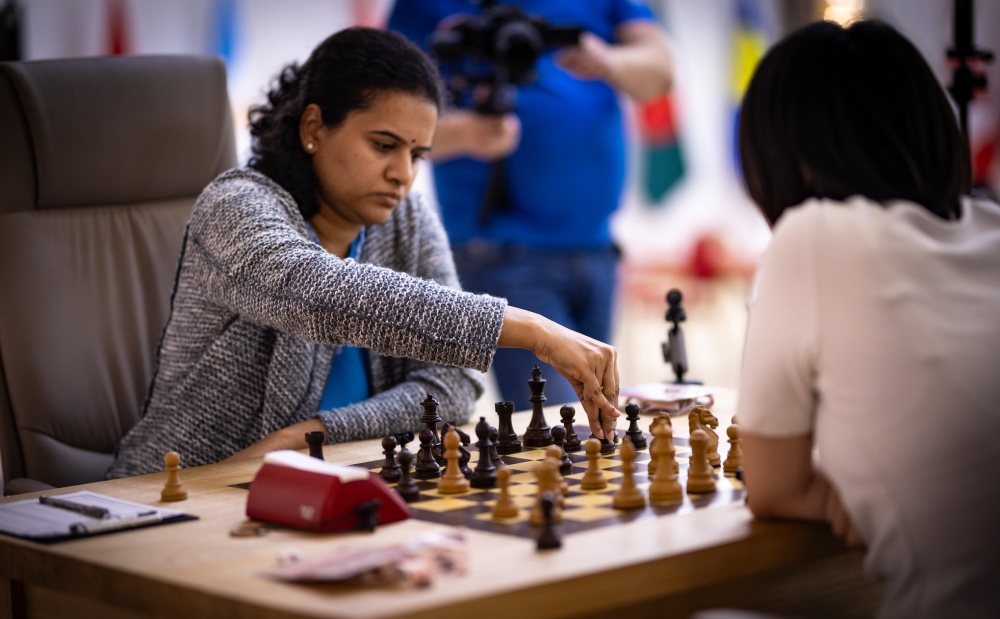
After tomorrow’s rest day, Humpy will face off Divya in the final Something extraordinary is happening in Indian chess — and the world is starting to take notice. India has taken the global chess stage by storm in 2024, delivering one historic moment after another. First came the unprecedented double triumph at the Budapest Olympiad, where India clinched gold in both the Open and Women’s sections. Then, Gukesh D, the teenage sensation from Tamil Nadu, became the World Chess Champion, etching his name in history as the youngest undisputed champion in the modern era. And now, in a development that underscores the country’s growing stature in women’s chess, India have two players in the final of the Women’s World Cup — a first in the event’s history. On one side is the prodigious Divya Deshmukh, just 19 years old, who stunned former Women’s World Champion Tan Zhongyi with a clinical 1.5–0.5 victory in the classical games. On the other is the ever-reliable Humpy Koneru, India’s top female player for nearly two decades, who booked her place in the final this afternoon after a thrilling six-game tiebreak victory over Lei Tingjie at the Batumi Grand Bellagio. If 2024 is any indication, Indian chess isn’t just rising — it’s redefining the global chess landscape. It took six fiercely contested games for Humpy Koneru to secure her place in the final, edging past Lei Tingjie with a final score of 5–3. The match, marked by tense moments and momentum shifts, showcased both players’ resilience and rapid skills under pressure. The contest began with two 15+10 rapid games, both ending in draws. Lei missed a clear winning opportunity in the first game, and Humpy later acknowledged her slow start: “It was a very tough match. Initially, I played quite badly with the Black pieces and she always had the advantage.” The breakthrough came in the 10+10 rapid section, where Lei struck first with a win in Game 3. But Humpy responded with steely determination, leveling the score in Game 4: “After the loss, it was a very difficult situation, but I was able to come back.” Heading into the 5+3 blitz tiebreaks with everything on the line, Humpy displayed her composure and tactical sharpness, winning both games in time scrambles to seal the match. https://www.youtube.com/watch?v=K_85695yDcg Reflecting on the battle, Humpy was gracious in victory: “I played a bit shaky in the rapid, but she also gave a very good fight. It could have gone either way.” Looking ahead to the final, Humpy highlighted the significance of an all-Indian clash against Divya Deshmukh: “I think it’s one of the happiest moments for chess fans because now the title will go to India for sure. But of course, as a player, tomorrow will be quite a tough game as well—Divya has played tremendously well in this whole tournament.” As Humpy advances to the final, her performance not only underlines her enduring class but also marks a proud milestone for Indian chess. Let’s take a closer look at some of the key moments of the match. In the opening encounter of the 15 + 10 rapid tiebreak, Humpy narrowly escaped a dangerous position. Lei Tingjie missed a golden chance to seize a decisive advantage with the intuitive sacrifice 19.Bxh6! gxh6 20.Qd2, initiating an unstoppable kingside attack. Despite spending nearly a minute evaluating the idea, Lei likely abandoned the line due to the lack of an immediately forced win — a common practical decision under time pressure. Humpy survived the scare, and the game eventually ended peacefully. Though the second game concluded in a solid draw, it was clear that Humpy held the upper hand throughout. Lei finally broke through in the third rapid game, now at a 10 + 10 time control. In an already slightly worse position due to weak light squares, Humpy blundered with 22…h5?, allowing the powerful response 23.Bc4!, simultaneously threatening the rook on e6 and the vulnerable f7 pawn. After 23…Rb6 24.gxh5+ Nxh5 25.Nxh5 Kxh5 26.Bxf7+ White emerged a clean pawn up. Humpy mounted a determined defence, but Lei converted her material advantage flawlessly to clinch the win. After this game, Lei was seen taking a short break in the lobby, quietly refocusing for what could be the decisive fourth rapid game. The fourth 10 + 10 rapid game was all Humpy, but even at the end she had to be careful. Humpy found the accurate 38.Qc7! forcing resignation, side-stepping the trap 38.fxe3? Qe4!, and it’s Lei who can force at least a perpetual check, if not more. After this comeback, the vibe in the room was that Humpy was on a roll, while Lei might have been slightly discouraged. Even so, both 5+3 blitz games were tremendously exciting and ultimately decided by tactics. The following moment in the fifth basically gave Humpy the key to the final. Black has to be very careful here – the extra pawn isn’t worth as much as the tactics on the seventh and eighth rank. With just a few seconds on her clock, Lei blundered with 44…Ra6?, and after 45.Qd7! hitting f7, 45…Qf8 46.Rc8, she lost her queen and the game. Instead, the correct move order was 44…Qf8! followed by 45…Ra8, and it should be a draw. Written by IM Michael Rahal (Batumi, Georgia) Photos: Anna Shtourman About the tournament: Scheduled to take place from July 6th to July 28th, the 2025 FIDE Women’s World Cup will gather together in Batumi (Georgia) the world’s best female chess players. A total of 107 players from 46 different federations are set to participate in the event, including seventeen of the current top twenty! Chess legends, seasoned professionals and emerging talents will play for the $50,000 first prize, in addition to three qualifying spots for the Candidates. The full pairings tree and day-by-day results can be found on the Women’s World Cup website.
FIDE Women’s World Cup R06 Game 2: Divya Deshmukh makes history by defeating former Women’s World Champion to reach final

Lei Tingjie and Humpy Koneru will tiebreak tomorrow In one of the most thrilling afternoons of chess in recent memory, India’s rising star, IM Divya Deshmukh, delivered a stunning upset by defeating former Women’s World Champion, GM Tan Zhongyi of China, to advance to the final of the FIDE Women’s World Cup. The 19-year-old from Nagpur made history as the first Indian woman to reach the final of this prestigious tournament. With this landmark achievement, Divya also secures one of three highly sought-after spots in the FIDE Women’s Candidates Tournament, bringing her within striking distance of a world title challenge. In addition, her performance earns her a Grandmaster norm, a major milestone on the path to the sport’s highest title. Still absorbing the momentous result, Divya reflected candidly in her post-game remarks on stage: “I think I could have played much better. I was winning at a certain point and then it got complicated. I think I messed up in the middlegame and that I should have had a much smoother win.” As she now prepares for the final, all eyes are on Divya Deshmukh, whose fearless play and quiet determination have already secured her a place in chess history. In the other hard-fought semi-final encounter, Indian GM Humpy Koneru maintained sustained pressure throughout the game, never allowing her opponent, GM Lei Tingjie, an easy path to equality. “Today’s game was very tough, and I think at some point she could have won,” Lei admitted in her post-game interview, acknowledging the uphill battle she faced. Despite being on the defensive for much of the game, Lei showed remarkable resilience and accuracy, with only one critical moment near the end where she stood on the verge of defeat. In the end, the draw was a hard-earned and well-deserved result. “Tournaments are like this—very up and down. At this point, you just have to fight for every game,” Lei concluded, reflecting the gritty determination required at this elite level of competition. Let’s take a closer look at the two games. Humpy Koneru vs Lei Tingjie (0.5-0.5) A special guest of the event, Mr. Armaz Chagalidze, Representative of the Ministry of Sport of Georgia, had the honor of making the first move on Humpy’s board. With a 5.5–4.5 head-to-head lead in Humpy’s favor, expectations were high for a tight and tense encounter — and the players did not disappoint. Humpy opened with 1.d4, to which Lei responded with the Slav Defence. Interestingly, although the Exchange Variation is not Humpy’s typical weapon of choice, she recently used it successfully against IM Nurgyul Salimova at the Pune Grand Prix. On the other side of the board, Lei has a long-standing history in the line, with games dating back to 2013 and continuing through 2024. The first key psychological moment occurred on move seventeen. Humpy paused to consider her options. A clear path to a draw existed via the repetition line: 17.Bb5 Rfc8 18.Ba6, which would have almost certainly led to a threefold repetition and a quick handshake. Instead, showing ambition, Humpy opted for 17.f3 e5 18.dxe5 Nxe5 19.Qxd7 The game transitioned into a complex and unbalanced double rook and pawn ending, with Humpy slightly better. However, Lei demonstrated excellent defensive precision, notably sacrificing a pawn to keep her rook and king active — a practical choice that neutralized White’s advantage. For a long stretch, engines evaluated the position as 0.00 — and the game seemed destined for a draw. And indeed, it was. But not before one final twist. With only one minute on her clock, Humpy missed a golden opportunity: 64.Rd5! This move cuts off the black king, followed up with 65.Kc5, White would have had a winning position. Instead, Humpy played 64.f5+?? Kd6, allowing Lei to set up the well-known Philidor third-rank defense, and from there, she held the draw without difficulty. “I was under pressure most of the game, but I think the endgame should be holdable. Still, it’s hard to defend,” Lei commented after the game. Looking ahead to the tiebreaks, she added calmly: “I’m just happy to play the tiebreaks after today’s game. If I lose, I don’t care. If I win, it will be a kind of gift.” https://youtu.be/YYDgQpz0PfM Divya Deshmukh vs Tan Zhongyi (1-0) The classical head-to-head score between these two competitors favoured Tan Zhongyi 3–1 going into today’s game. Nevertheless, in their previous encounter, the result was adraw—with Divya pressing in the final phase. This game marked a small but significant shift in Divya’s opening repertoire: for the first time in classical chess, she essayed 3.c3 against the Sicilian. Typically known for her preference for the Open Sicilian with 3.d4, the early deviation suggested a specific preparation or a surprise strategy. However, signs of discomfort emerged early on, as she spent considerable time during the opening phase—indicating she was slightly unfamiliar with the nuances of the position. At this moment, Divya played the natural 15.Qxc1, maintaining her lead in development. However, this was a missed opportunity. The engine reveals a much stronger continuation: 15.Qxd8+ Kxd8 (or 15…Bxd8 16.Nd6+) followed by 16.Rac1 Bb7 17.Rfd1+ In this line, White not only wins a pawn but also seizes long-term pressure with dominating rooks on the open files. It would have posed serious practical problems for Tan Zhongyi. By move 23, Divya faced a critical decision: to launch an attacking initiative or go for concrete gains by winning a pawn in exchange for the opponent’s activity. She chose the latter—a path that engines evaluate as suboptimal. This slight misjudgement shifted the momentum, and soon Tan Zhongyi seized the initiative. But the tide was far from settled. In this tense, complex moment, Tan had just under eight minutes remaining and used six of them here, calculating deeply. Unfortunately for her, she chose the wrong continuation. Tan played 32…Bxf3 followed by 33.gxf3 dxe2, allowing White to regain control. Instead, she had a spectacular tactical resource: 32…Rg4! 33.Nxe8 Bxf3! If 34.Nxc7, then comes 34…Rxg2+ 35.Kf1 Rxh2, and White cannot stop the devastating checkmate on h1. This stunning queen sacrifice would have turned the tables completely, and with Divya having only 30 seconds on the clock, it’s unclear whether she could have navigated through the complications. After Black’s missed chance, the game became
FIDE Women’s World Cup Quarterfinals Game 1: Lei and Humpy strike the first blow
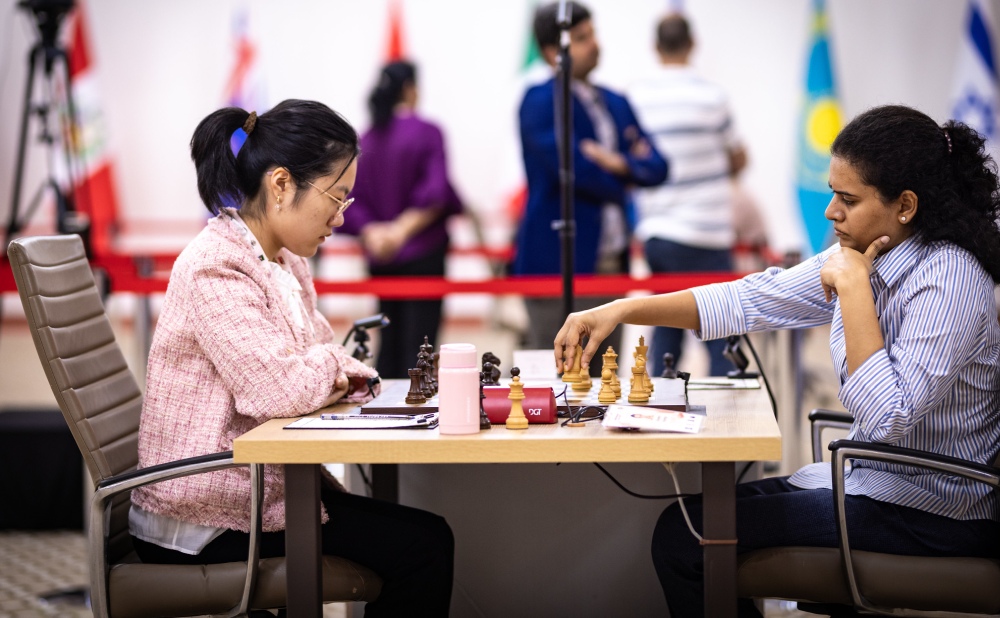
Top seed GM Lei Tingjie made a strong bid for a place in the semi-finals of the World Cup by winning the first game of her quarterfinal match against GM Nana Dzagnidze. The game ended dramatically when Dzagnidze overstepped the time limit. Despite the victory, Lei was candid in her post-game reflections: “I think today I played quite horribly, but the position was quite complicated. I spent a lot of time thinking, while my opponent developed her pieces very quickly.” With this win, Lei Tingjie now needs only a draw in the second game to secure her place in the final four. One of the other favourites to win the Cup, India’s top Grandmaster Humpy Koneru, pulled ahead in her two-game match against IM Song Yuxin. “It was a very complex game,” Humpy said afterward. “I wasn’t too sure about playing this position because she seemed very well-prepared, but I decided to take the risk anyway.” The other two games of the round ended in draws. The four encounters tomorrow will ultimately decide who advances in the World Cup and secures one of the three coveted spots in the Candidates Tournament—the next step toward the World Championship. Let’s take a closer look at the games: GM Humpy Koneru – IM Song Yuxin (1-0) Fully recovered after her grueling tiebreak victory over former Women’s World Champion Alexandra Kosteniuk, Indian GM Koneru Humpy struck first in her quarterfinal match against surprise contender IM Song Yuxin. In the opening, Song demonstrated excellent home preparation, blitzing out her moves with confidence. Humpy, on the other hand, took a more measured approach. On move thirteen, she introduced the new idea 13.e4, a move she found over the board. This appeared to be an improvement over a line previously seen in Vidit–Aronian, and it immediately took Song out of her preparation. By move seventeen, Humpy boldly sacrificed a pawn in exchange for active piece play. Song accepted the challenge, but within a few moves, she found herself under significant pressure. Humpy’s initiative grew rapidly, and by the time the dust settled, Song was already on the defensive — as clearly illustrated in the following diagram. White was an exchange up for a pawn, but both the rook on f5 and the knight on f3 were under attack. In this tense moment, Humpy opted for simplification with 23.Rxf6?!, returning the exchange while maintaining a slight advantage. However, the powerful tactical shot 23.Qf5! would have been decisive. After 23…Nxe6, White could continue with 24.Qxe6+ Kh8, and then the brilliant 25.Ng5! would have left Black in a hopeless position: If 25…Bxg5, then 26.Bxb7 threatens mate on e8, which cannot be stopped. If 25…Bxg2, then 26.Nf7+ Kg8 27.Nd8+, once again leading to a forced mate on e8. Though Humpy missed this crushing continuation, she continued to press her initiative and ultimately converted her advantage into a full point with confident play. After the game, she joined IM Michael Rahal, FIDE Press Officer for the World Cup, in the media center to share her thoughts on the first game. https://youtu.be/C7BM6EpILJs GM Nana Dzagnidze – GM Lei Tingjie (0-1) World Cup top seed Lei Tingjie continued her impressive run in the tournament with another victory, this time against Georgian Grandmaster Nana Dzagnidze. Despite not being at her best, Lei managed to navigate a tense and error-prone game to emerge victorious in dramatic fashion. Dzagnidze, the last remaining Georgian player in the tournament, had the White pieces and opted for the Reti Opening — a popular flank strategy. Lei responded classically, quickly staking her claim in the centre with pawns. The game soon left known theoretical paths, transitioning into a complex “hanging pawns” structure, setting the stage for a deeply strategic battle. Both players spent considerable time navigating the intricacies of the position, exchanging strong moves with occasional inaccuracies. For much of the game, Dzagnidze held the upper hand. However, as she approached time trouble, mistakes began to creep in, and the balance started to shift. In a surprising twist, Dzagnidze overstepped the time control, handing Lei the win. “At the end of the game, both of us had made a mistake on the scoresheets and we both thought we had reached move forty, although in reality we were at move thirty-nine,” Lei explained afterward. “It was a dramatic ending, and I feel sorry for her, but the final position is completely winning for me.” Despite the unexpected conclusion, Lei’s resilience and tactical awareness saw her through. With this win, Lei Tingjie moves one step closer to the title, proving once again why she is the tournament’s top seed. After the game, she joined Charlize van Zyl in the interview area to share her reflections on the match. https://www.youtube.com/watch?v=6wGfKYnp7eY IM Divya Deshmukh – GM Harika Dronavalli (0.5-0.5) When two players perform at 99%, a draw is often the only realistic outcome. Harika chose the ultra-solid Berlin Defence against Divya’s Ruy Lopez, where Divya opted for a lesser-known side-line favoured by Spanish GM David Antón Guijarro. After the opening, Divya appeared to hold a slight edge—thanks to open central files and better piece coordination—but the engine’s evaluation indicated only a minimal advantage. Harika responded well by trading off-key pieces and smoothly liquidating into an equal rook and minor piece endgame. The players agreed to a draw on move 31, a result that arguably favours Harika, who will enjoy the White pieces in the second game of the match. GM Vaishali Rameshbabu – GM Tan Zhongyi (0.5-0.5) The longest game of the afternoon saw a critical moment early on when Vaishali missed the chance to consolidate an extra pawn. The move 22.Qe2, played instead of the more promising 22.Ra3, allowed Tan Zhongyi to seize the initiative. As the game transitioned into the endgame, the Chinese Grandmaster successfully won the exchange for a pawn and pressed hard to convert her advantage into a full point. However, Vaishali defended with precision and resilience, ultimately securing a well-earned draw after seventy-three moves. Follow the games live and
FIDE Women’s World Cup Round 4 Tiebreaks: the four Indians push through

Tomorrow’s quarterfinals are set: Lei Tingjie vs Dzagnidze, Humpy vs Song Yuxin, Harika vs Divya and Tan Zhongyi vs Vaishali This afternoon’s tiebreaks proved every bit as exciting as anticipated. Two of the Indian players had already secured their spots in the final eight after the 15/10 rapid games: Women’s World Rapid Champion GM Humpy Koneru and World Junior Champion IM Divya Deshmukh. The other two matches were fiercely contested. GM Harika Dronavalli clinched her place in the final eight by defeating GM Kateryna Lagno in their 98th (!) game—a remarkable display of endurance and skill. Let’s take a closer look at the afternoon’s action: GM Zhu Jiner vs IM Divya Deshmukh (0.5-1.5) In the first 15+10 rapid game, playing with White, Zhu Jiner surprised everyone by opening with the rarely seen Konstantopoulos King’s Knight Opening—an offbeat line I personally had never encountered before! Despite its unorthodox nature, she managed to secure a slight edge heading into the middlegame. However, Divya remained composed throughout. She patiently waited for Zhu to overextend, then launched a precise counterattack. Following a series of trades, the Indian International Master steered the game into a superior rook endgame. While the engine evaluates the position as theoretically drawn with perfect play, it was extremely difficult to defend in practice—especially under time pressure. With excellent technique she converted and pulled ahead in the tiebreak. Between rounds, Divya relaxed with her mother, while she checked some opening files on her laptop. In the second 15+10 rapid game, Zhu Jiner made a bold and insightful decision by sacrificing her queen for a rook and a bishop, aiming to avoid a highly drawish position. This queen sacrifice was not only strategically sound but also demonstrated her deep understanding of the position and willingness to take risks in pursuit of victory. In other circumstances, it might have worked out for her—but Divya is operating on an entirely different level these days. She found the precise sequence to maintain balance on the board, calmly neutralizing the pressure. In fact, the final position offered her real chances to press for a win, but she wisely chose to take the draw and secure her qualification. After the match, Divya shared a warm hug with her mother before heading over to join FIDE’s Charlize van Zyl for a post-game interview. https://youtu.be/Y_xbMFpOVd8 GM Humpy Koneru vs GM Alexandra Kosteniuk (1.5-0.5) In the first game, Kosteniuk equalized comfortably and quickly seized the initiative. Humpy struggled to find her footing and opted for a daring piece sacrifice—a double-edged decision that was an excellent practical choice given the circumstances, aiming to complicate the position. While such a sacrifice would likely have failed in classical time controls, Kosteniuk, pressed for time, was unable to parry all of Humpy’s threats effectively. The second game unfolded more smoothly for the current World Rapid champion. Apart from one specific tactical moment in the opening, Kosteniuk overextended and soon found herself on the defensive. Humpy steadily increased the pressure, eventually reaching a winning endgame. Although the game ultimately ended in a draw, that result was enough to secure Humpy’s place in the final eight. After the game, Humpy kindly joined FIDE Press Officer Michael Rahal in the media centre to analyse her second game. https://youtu.be/5Q060EJt1eo GM Kateryna Lagno vs GM Harika Dronavalli (1.5-2.5) In the first 15/10 rapid game, Harika attempted to surprise her opponent by opting for the rare Ulvestad variation of the Two Knights Defense. However, Lagno was well-prepared and confidently followed the theoretical moves, securing a slight advantage entering the middlegame. From there, she maintained the initiative and kept up the pressure throughout. Although Harika had a few opportunities to force equality, the game ultimately swung in Lagno’s favour. Qualification was in Lagno’s hands in the second game. In this position, Harika blundered huge with 45.Qf3??, attempting to simplify by exchanging queens and convert her extra pawn in the endgame. In fact, that’s more or less what happened! However, Lagno astonishingly missed a winning opportunity. Instead of playing 45…Qe7??, she could have captured the bishop with 45…Rxd5! Now, if 46.Qxd5, then 46…Qxf2 threatens mate with 47…Qh2#, while 46…Nxf6 defends the rook and maintains a decisive advantage. “I saw it as soon as I dropped the queen,” Harika admitted immediately after the match. “But when she didn’t play Rxd5, I knew I still had a chance to make a comeback.” In the third tiebreak, the 10/10 rapid section, Lagno pressed throughout the game, creating a powerful passed d-pawn. At one point, the engine indicated a winning advantage for her, but it was never straightforward. The presence of opposite-coloured bishops meant that even with the extra pawn, victory was far from guaranteed. The fourth and final rapid game was a technical masterpiece. Harika kept up relentless pressure but needed a final blunder from Lagno — an unfortunate queen exchange — to seal the match with a beautifully executed bishop endgame. https://youtu.be/jYhzHNl7CGk IM Meruert Kamalidenova vs GM Vaishali Rameshbabu (3.5-4.5) This match was the longest of the four, ultimately being decided in the blitz games. Both players traded wins in the rapid games, proving that they were more than able to make a comeback from certain elimination. Kamalidenova took the head start in the first game, taking advantage of Vaishali’s weak castled king, while in the second game it was Vaishali who prevailed in a slightly better endgame. The third rapid game was a tactical landslide for Vaishali but Kamalidenova showed her ferocious spirit with a huge comeback in the fourth. Ultimately, the match had to be decided in the blitz games. The first of the two was a 96% accuracy totally equal game, but the second could have gone either way. In her postgame interview, Vaishali was actually very relieved – she realised she could have been going home at a certain point. https://youtu.be/hSlSacTKSCo Follow the games live and watch the action with expert commentary provided by GM Valeriane Gaprindashvili and IM Almira Skripchenko on the FIDE YouTube channel. Written by IM
FIDE Women’s World Cup Round of 16 Day 2: Lei Tingjie, Tan Zhongyi, Nana Dzagnidze and Song Yuxin advance to quarterfinals
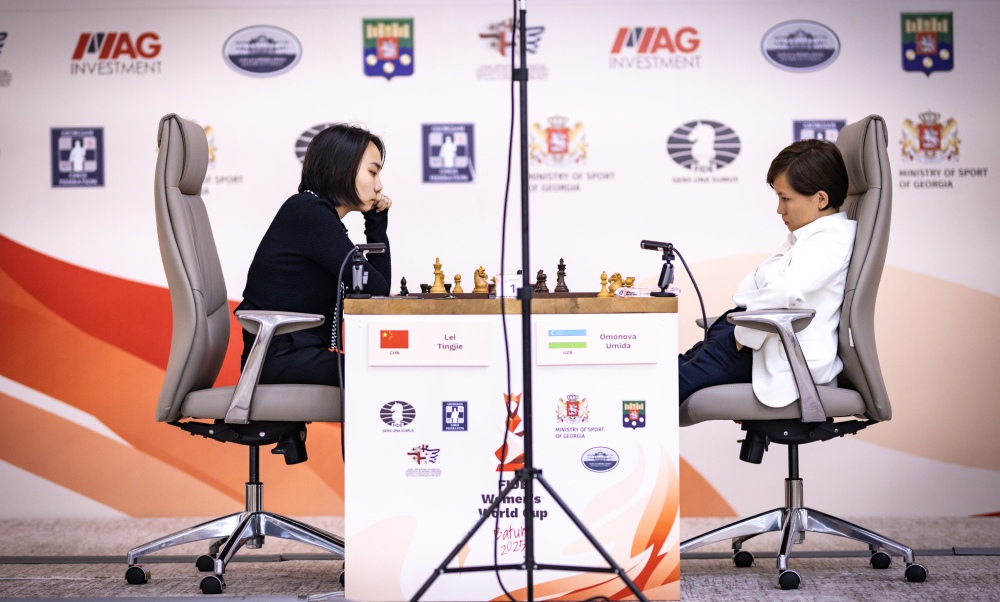
The four Indians head to tiebreaks tomorrow for quarterfinal spots The second game of Round of 16 in the Women’s World Cup knockout stage brought plenty of excitement and high-stakes drama. Of the eight matches played, only two had a decisive result, while six ended in draws—pushing most of the action into tiebreak territory. China’s top seeds, GM Lei Tingjie and GM Tan Zhongyi, continued their dominant run, qualifying directly for the quarterfinals without having played a single tiebreak so far. Joining them are GM Nana Dzagnidze and the tournament’s standout underdog, IM Song Yuxin, who punched her ticket to the final eight. All eyes now turn to the four Indian contenders, who will return tomorrow for what promises to be a thrilling round of tiebreaks. With a major prize increase and a coveted quarterfinal slot at stake, the pressure couldn’t be higher. Let’s take a closer look at how this afternoon’s games unfolded… Needing a win to force a tiebreak, WIM Umida Omonova opened with 1.e4, clearly signaling her intent to fight. GM Lei Tingjie, however, set aside her usual 2…Nc6 repertoire and instead opted for the ultra-solid Petroff Defense—an opening that’s become a hallmark of China’s top players. While Omonova was unable to gain any tangible advantage out of the opening, she remained persistent, pressing throughout the game and staying alert for any slip from her experienced opponent. In the position, 40.Nf5? was indeed a pivotal mistake—especially painful given that Omonova had ample time on the clock. The preferred continuation, 40.f4! Rxb3 41.f5!, would have launched a powerful kingside initiative, tying down her opponent’s pieces and maintaining strong winning chances. Missing this moment cost her not only the advantage but ultimately the game, which ended in a perpetual check — a common escape route in high-stakes matches when one side falters. Despite this, Omonova’s postgame attitude was strikingly mature. Rather than dwell on the missed opportunity, she looked ahead with determination, expressing her focus on upcoming competitions and her long-term goal of becoming World Champion. This mindset is critical at the elite level, where resilience often defines careers more than individual victories or defeats. IM Divya Deshmukh generally plays the Sicilian defence with Black but the open games with 1…e5 have always been considered a safer option when a draw is a good result. GM Zhu Jiner opted for the Mieses variation of the Vienna Game, a subtle and less mainstream attempt to sidestep heavy theory and provoke imbalances in quieter waters. Zhu had only played this line twice before (in 2018), suggesting this was a prepared surprise weapon. The choice may have been strategic, targeting Divya’s lack of familiarity in this specific line. In fact, Divya had only faced it once, against GM Anton Korobov in Tata Steel 2014, a game which she lost. Overall, this was a smart psychological and strategic decision by Zhu—taking Divya out of her comfort zone (the Sicilian), steering the game toward less familiar terrain, and possibly exploiting a weak spot in her repertoire. Both players blitzed out the opening, showcasing deep preparation and high-level understanding—even in this relatively obscure side-line. It’s remarkable to consider the sheer volume of opening theory top players must internalize to perform at this level. Once the queens were exchanged, it became apparent that Zhu Jiner had a deeper grasp of the resulting position than her opponent. As the game transitioned into a complex multi-piece endgame, Zhu emerged with a clear advantage. Demonstrating excellent endgame technique and playing with 96% accuracy, she skillfully converted her edge into a full point, forcing the tiebreak. After the game, Zhu Jiner joined us in the media center and shared her reflections on her performance. https://www.youtube.com/watch?v=qryecjOsjpI After yesterday’s solid draw, GM Nana Dzagnidze’s plan this afternoon was to play solidly and try to press. “I have played more than 50 games against GM Mariya Muzychuk,” she explained in her postgame interview. “But today she surprised me with an opening she has never played before.” Despite the surprise factor, the strategy backfired. Nana Dzagnidze calmly seized a pawn, traded down to a simplified position, and showcased superb endgame technique to secure the full point—effectively dodging the need for tomorrow’s tiebreaks. Though visibly fatigued, Dzagnidze graciously stopped by the press room afterward, offering a quick masterclass on converting a pawn advantage in the endgame. A lesson well worth staying awake for! https://www.youtube.com/watch?v=OprS5z5J48c GM Lela Javakhishvili’s choice of a reversed King’s Indian Defence as White shows a fighting spirit—it’s an aggressive and somewhat unorthodox weapon, especially when playing for a must-win. However, IM Song Yuxin’s cool handling of the position—equalising early and seizing the initiative—speaks volumes about her underrated strength. To not just neutralize an aggressive setup but also take over in the center and queenside implies deep understanding and precise calculation. As she was in a must-win situation, Lela pushed her kingside pawns, trying to create winning chances. This aggressive strategy backfired, costing her a pawn. Song then got the upper hand and could have played for a win, but instead, offered a draw from the position of strength, which was accepted by Lela — a decision that helped Song qualify for the next round. In a classical Neo-Grunfeld Defence, IM Yuliia Osmak sacrificed a full pawn in the opening in exchange for a strong pawn centre and active piece play. The line has a decent reputation and has been favoured by elite players such as GM Shakhriyar Mamedyarov. Osmak launched a fierce kingside attack, ultimately winning an exchange for a pawn — a promising advantage for the Ukrainian player, who needed a victory to level the score. However, GM Tan Zhongyi, drawing on her vast experience at the highest level, expertly defended her position and maintained equilibrium. After a tense battle, the players agreed to a draw on move forty, splitting the point. GM Humpy Koneru secured a slight positional advantage early on in a classical Bogo-Indian Defense facing Alexandra Kosteniuk. She steadily increased the pressure, and over time, her advantage
FIDE Women’s World Cup Round of 16 Day 1: Lei Tingjie, Tan Zhongyi, Song Yuxin and Divya take the lead

Refreshed after their rest day, the sixteen qualifiers returned to the Grand Bellagio venue for the first of the two-game Round of 16 matches that will determine who advances to the quarterfinals. The round was formally opened by the Head of the Sports Department of the Autonomous Republic of Adjara, Irma Nizharadze, who welcomed the players and wished them good luck. She then performed the ceremonial first move on Lei Tingjie’s board, marking the official start of the round. Seeded number one and a former Women’s World Championship challenger, GM Lei Tingjie opted for a solid approach against her young opponent’s tactical prowess. It wasn’t their first encounter. “I played a blitz game against Omonova two years ago at the World Blitz and Rapid Championship and noticed that she’s a very talented and resourceful player,” said Lei after the game. “So, I decided not to waste too much time on the clock.” “It worked out very well for her when WIM Umida Omonova, perhaps slightly out of her depth, made a couple of positional mistakes and quickly found herself in a desperate position. Omonova attempted an exchange sacrifice to generate counterplay, but it ultimately proved ineffective. ‘I don’t necessarily think that I am in the best form of my life. Every game seems normal, and I just wait for my opponent to make a mistake,’ Lei explained after the game.” https://www.youtube.com/watch?v=kBql7VtCHkg IM Divya Deshmukh delivered a fantastic performance this afternoon, decisively overcoming an opponent who had posed significant challenges in recent tournaments, including two previous losses at the Nicosia and Pune 2025 Women’s Grand Prix legs. “I didn’t prepare specifically for this game. Since I had a poor score against GM Zhu Jiner, I thought it might be some sort of mental block. So, I decided to focus on playing against the pieces instead, and once the game started, it didn’t matter who I was playing,” explained Divya in her post-game interview with FIDE’s Star Interview host, WIM Charlize van Zyl. Divya’s strategic handling of the Najdorf, especially seizing control over the d5-square, shows deep positional understanding. Dominating that square in the Sicilian often means restricting Black’s counterplay and securing central control. By forcing principled exchanges, she clearly transitioned into a favorable good knight vs bad bishop endgame — a textbook example of converting a small edge into a winning position. Those endings are notoriously difficult for the defender, and her tactical precision in the final phase just capped off a well-played game. https://www.youtube.com/watch?v=eKjiTMa2s68 China’s GM Tan Zhongyi took revenge for her loss in the 2020 Online Olympiad against Ukraine’s IM Yuliia Osmak. “I think my performance has been average, especially in the second round where there were some issues,” Tan explained after the game. It was a strong performance by the former Women’s World Champion, and one of the players here, who already knows what it feels like to finish among the top spots in this event. Under pressure for most of the game, Osmak finally succumbed on move 31, despite the draw being within reach. When asked afterward about how she personally handles pressure, Tan responded, “I think there’s nothing you can really do about it; it’s something every player has to endure.” Moment of the day Playing with White, Tan is slightly better but to hold the draw Osmak must get her king to the d8 square as fast as possible. The correct move therefore would have been 31…Ke8 but after a few minutes thought Osmak played 31…Nd7? allowing 32.Bb5 Ke8 33.Re1! Kd8 34.Kd3! and suddenly the rook will invade the seventh rank. A few moves later, Osmak had to resign as the combined strength of the rook, bishop and passed pawn had created an unstoppable mating net. https://www.youtube.com/watch?v=5WVfIeYLs24 IM Song Yuxin joined her two higher-rated country colleagues in the winning group with a fine performance against local GM Lela Javakhishvili, giving her a head start going into the second game of the match tomorrow. Although she was trailing 1.5-0.5 in their head-to-head score from two 2019 Chinese League games, Song capitalized on her deep home preparation to refute her opponent’s slightly dubious opening. Always smiling, Song joined us in the media center to analyze her game and share insights into her daily tournament routine. https://www.youtube.com/watch?v=X-i82gP31qc The other four matches concluded in solid, uneventful draws. GM Alexandra Kosteniuk delivered an exceptionally precise performance against GM Humpy Koneru in a Spanish Berlin Defense, achieving a remarkable 98% accuracy with no inaccuracies. These two players are well-acquainted, having faced each other 73 times across various formats, with Kosteniuk holding a slight edge at 36.5 to 32.5 points. GM Kateryna Lagno had a crucial moment to seize the advantage in her game against GM Harika Dronavalli. However, after missing this opportunity, the game gradually simplified into an equal rook ending, which eventually ended in a draw. This result added draw number 48 to their personal head-to-head record, which now stands at 23 wins for Lagno, 22 for Harika, out of a total of 92 games. Both GM Mariya Muzychuk (playing against GM Nana Dzagnidze) and GM Vaishali Rameshbabu (facing IM Meruert Kamalidenova) fought hard for a win but were unable to find a decisive advantage at any point in their games. They will all return tomorrow afternoon with colours reversed to determine who will advance to the quarterfinals. Follow the games live and watch the action with expert commentary provided by GM Valeriane Gaprindashvili and IM Almira Skripchenko on the FIDE YouTube channel. Written by IM Michael Rahal (Batumi, Georgia) Photos: Anna Shtourman About the tournament: Scheduled to take place from July 6th to July 28th, the 2025 FIDE Women’s World Cup will gather together in Batumi (Georgia) the world’s best female chess players. A total of 107 players from 46 different federations are set to participate in the event, including seventeen of the current top twenty! Chess legends, seasoned professionals and emerging talents will play for the $50,000 first prize, in addition to three qualifying spots for the
FIDE Women’s World Cup Day 9: Song Yuxin eliminates Anna Muzychuk
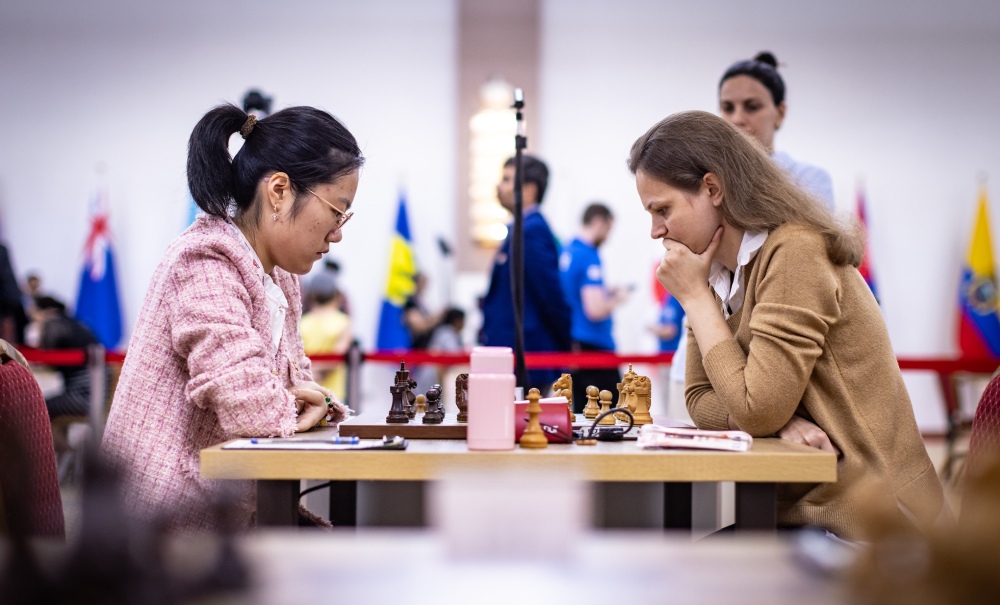
The Round of 16 is set: Lei Tingjie-Omonova, Dzagnidze-M.Muzychuk, Humpy-Kosteniuk, Song-Javakhishvili, Zhu Jiner-Divya, Lagno-Harika, Tan Zhongyi-Osmak and Kamalidenova-Vaishali The World Cup tiebreaks are unforgiving. In such high-stakes, compressed formats — especially with time controls like 15+10 and 10+10 — there’s so little room for error or recovery. The story of GM Vaishali versus IM Carissa Yip stands out not just for the result, but for the emotional and psychological arc behind it. Even though all the third-round tiebreak matches were interesting in their way, I was paying special attention to the match between India’s GM Vaishali, elite GM Praggnanandhaa’s older sister, and IM Carissa Yip, the America star that has a local camera crew following her around preparing a Netflix special on women’s chess. Carissa Yip being followed by a Netflix crew adds another layer. The spotlight can be motivating, but also creates added pressure. Vaishali, on the other hand, might have flown under that radar, and her underdog success makes for a compelling story. In the first two rapid games, Vaishali was completely lost—something she candidly admitted in her post-game interview. But she fought on, defending as best she possibly could, just hoping for the results to turn around. Vaishali’s ability to survive lost positions in the early rapid games shows deep psychological fortitude. In knockout formats, surviving can be just as crucial as winning. Just like in football matches, if you keep on hitting the post, don’t be surprised if your opponent scores in the last minute – you have to get the job done. And Vaishali exactly did that. In the first 10/10 game she played superbly. Her quote — “even though I’m not better at all, this is the best position I have had in the whole match” — is both honest and telling. It shows how players gauge hope and energy not just by the objective evaluation of position, but relative to the flow of the match. That moment, perhaps, was the turning point. Once Vaishali won the first 10/10 game, the psychological burden flipped. Yip, who had been pressing before, now had to play catch-up under pressure — a very different psychological space. Although she was visibly tired, Vaishali picked up her mom immediately after the game and joined us in the media center within five minutes for a short interview. She even took the time to analyze the key game for all of us. https://youtu.be/lyCXxfe1LPQ?si=KBAAiRrW8Um90Onx One of the other Indian players competing this afternoon had a similar situation. After playing extremely well against GM Kateryna Lagno in the two classical games and the first three rapid games, IM Vantika Agrawal imploded in the final 10/10 game of the day, allowing Lagno to advance, as in the second round against FM Anastasia Avramidou. Vantika’s level of play was impressive, and the heartbreak of narrowly missing out must have been very difficult to deal with. Facing someone as experienced and strong as GM Kateryna Lagno and pushing her to the limit is no small feat. Taking Lagno to the final Armageddon-style rapid game (“10/10”) shows how tightly contested the match was. As a side-note, playing the Flank Attack against the French Defence is particularly interesting. It’s not often seen at the top level — especially in such high-stakes games — so for Lagno to deploy it not once but twice with White is bold and worthy of study. Without a doubt, IM Song Yuxin was the underdog story of the afternoon. Her victory isn’t just a personal triumph — it’s a reminder of how deep preparation, resilience, and nerves of steel can turn the tables in elite chess. With five Chinese players in the final 16, it’s clear that the country continues to produce world-class talent at an astonishing rate. GM Anna Muzychuk surprised her opponent with the 2.c3 Alapin Variation against the Sicilian in the first game of the match. Although she’s been a lifelong 1.e4 player, Muzychuk had rarely ventured into this line, last playing it back in 2023. The unexpected choice appeared to catch Song off guard; she mishandled the opening and quickly landed in a losing position. Already ahead in development, Muzychuk’s 11.Qb3 followed by 12.Bf3 highlighted the weaknesses on Song’s queenside and her lack of piece play. The game was over on move 17. Needing just a draw to clinch qualification, Muzychuk adopted a cautious strategy. For 45 moves, the game remained balanced, with a symmetrical two-rook endgame suggesting a peaceful outcome. However, chess is a merciless game — one imprecise move was all it took for Song to seize the initiative. Doubling rooks on the seventh rank, she broke through Muzychuk’s defenses and levelled the score. In the third game, Song refined her earlier approach to the Alapin and reached a strong position. With accurate and confident play, she gradually outplayed Muzychuk to take the lead. The fourth and final game saw Song pressing with an extra pawn in a slightly better endgame. A draw was enough to win the match, and she played sensibly to neutralize any counterplay, securing the result and the match victory. Check out her post-game interview! https://www.youtube.com/watch?v=SXhlcnmt1XQ Playing for Switzerland, GM Alexandra Kosteniuk defeated IM Meri Arabidze (from Georgia) by 1.5-0.5: the only 2-game tiebreaker. In game one, Kosteniuk got a promising advantage from the opening against the Philidor Defence but eventually the game simplified into an equal rook ending, resulting in a draw. But in game two, Kosteniuk, playing Black, unleashed her knights, causing chaos in the center and setting up a mating net to secure the win. In her postgame interview with Charlize van Zyl, Alexandra expressed mixed feelings — she enjoys the experience, but is aware of the pressure and the risk of being eliminated at any moment. https://www.youtube.com/watch?v=-3fCdl23O1w The match between GM’s Nana Dzagnidze and Valentina Gunina was arguably the most dramatic of them all. In the first game, Gunina emerged from the opening with a clear advantage, but a series of inaccuracies allowed Dzagnidze to steer the game
FIDE Women’s World Cup Day 8: Gunina and Lagno roar back

Six matches will be decided in tiebreaks tomorrow The second games in the two-game matches of the FIDE Women’s World Cup continued to deliver tension and unpredictability—ranging from solid, careful maneuvering to explosive tactical skirmishes—and today was no exception. In the earlier rounds, players were often seen smiling and chatting casually, but today painted a different picture. With elimination looming for many, the playing hall was pin-drop silent. As players arrived and settled into their games, some closed their eyes in meditation while others stared intensely at the pieces before them. Among those fighting for survival, Kateryna Lagno stood out. Despite losing to Vantika Agrawal yesterday, she arrived early and appeared in high spirits. In this unforgiving format, there’s no time to dwell on past mistakes—something Lagno, with her vast experience, clearly understands. That resilient mindset was on full display not just in her game but across several crucial matchups. Let’s take a look at what happened today: Early qualifiers Lei Tingjie, Zhu Jiner, and Mariya Muzychuk confirmed their status as top seeds by winning both games and cruising into the Round of 16. Umida Omonova, Humpy Koneru, Lela Javakhishvili, Tan Zhongyi, and Meruert Kamalidenova also scored vital second-game victories to secure their spots in the next round. https://www.youtube.com/watch?v=z8JoY5zZTiA Meanwhile, Divya Deshmukh and Yuliia Osmak, both of whom had won their first games, held comfortable draws today to advance. Divya shared her thoughts after the match, admitting: “I wasn’t too happy about the pairing with Injac—she’s a strong player and has been doing well recently—but I felt I got lucky yesterday.” https://www.youtube.com/watch?v=X8P9eUZxy84 Comebacks Only two players who lost yesterday managed to fight back and force tiebreaks. Valentina Gunina, came very well prepared today dismantling Nana Dzagnidze Caro-Kann Defence after the Georgian GM missed a powerful pawn thrust. In a slightly inferior position, Nana played seemingly logical 21…Rg6??, which failed to 22.e6! “As a Caro-Kann player I don’t like playing against c6 myself which is what Nana played, so my coach and I prepared something special with 3.c4,” Valentina shared after the game. It did not too long for Gunina to wrap it up. After 22… Nc5? 23.Nc6! Nana threw in the towel. Kateryna Lagno essayed Saemisch system against Vantika Agrawal’s Nimzo-Indian and prevailed in a sharp tactical melee leveling the score and sending their match to a tiebreaker. Round of 16 on the line Lagno – Agrawal and Gunina – Dzagnidze will join the pairs Arabidze – Kosteniuk, Song Yuxin – Anna Muzychuk, Stavroula Tsolakidou – Harika Dronavalli, Carissa Yip – Vaishali R (who drew both games) to contest for a place in the round of 16. In her short interview after the game Carissa explained that she took a quick draw yesterday because there’s not much available in the line. She pressed hard today but Vaishali played and defended really well to secure a draw. https://www.youtube.com/watch?v=WoAbXE1JkGA The Round 3 tiebreaks will be played tomorrow starting at 3 PM local time. Photos: Anna Shtourman About the tournament: Scheduled to take place from July 6th to July 28th, the 2025 FIDE Women’s World Cup will gather together in Batumi (Georgia) the world’s best female chess players. A total of 107 players from 46 different federations are set to participate in the event, including seventeen of the current top twenty! Chess legends, seasoned professionals and emerging talents will play for the $50,000 first prize, in addition to three qualifying spots for the Candidates. The full pairings tree and day-by-day results can be found on the Women’s World Cup website.