

FIDE launches first digital museum dedicated to chess history

A first-of-its-kind digital museum dedicated to chess provides global access to FIDE’s archive, offering researchers and chess fans a curated look into the game’s evolution As part of its 2024 centenary celebrations, FIDE has unveiled an online museum tracing chess history from ancient times to modern tournaments. The Open Chess Museum endorsed by FIDE aims to become the world’s largest repository of chess artifacts, showcasing valuable items from every corner of the world and every era of chess history. For the first time, a full historical record of chess is freely available online—featuring rare, never-before-seen materials ranging from hand-annotated scoresheets to championship medals and personal artifacts of top players. The project also aims to highlight lesser-known facts and stories from the game’s past. FIDE President Arkady Dvorkovich said the project offers “a closer, in-depth perspective on chess” and reflects “FIDE’s broader push towards digital engagement with the public.” “Chess is one of the oldest and richest sports in history. Over centuries, countless books have been written about the game, the players, the events. Much of this is now available online—but what’s missing is a central, official reference point telling the full story of chess. The FIDE Online Chess Museum is exactly that: a place where you can find key information about the most significant events and the people who shaped the game,” said Dvorkovich. “We hope the chess community—and those curious about the game—see the value in the resources now freely available to explore and enrich the sport,” he added. Visitors navigate the museum through five thematic sections. The “Collection” segment includes photographs, handwritten letters, Olympiad posters, commemorative pins, and personal belongings from famous players—alongside historical documents and autographs. The history section begins with a visual timeline showing all the key stages in the history of chess, up to 1913 and the first steps to create an international chess organization. A dedicated segment traces FIDE’s history from early international efforts in 1913 to its evolution into the sport’s global authority. This part features high-quality photos and scans of documents based on which the chess world is organized and governed. The “World Champions” part includes detailed biographies, annotated games, and key publications chronicling the careers and legacies of the game’s greatest players. The project marks a milestone in chess historiography and signals FIDE’s renewed commitment to public engagement. Following up on FIDE’s slogan – the game is just beginning – the Open Online Chess Museum aims to be a constantly evolving project. FIDE is inviting other collectors, galleries, national federations, clubs and players to join in and have their collections and artifacts also featured on the museum’s website. The museum is free to access via the website museum.fide.com.
Sensational Anna Muzychuk takes down WGP Cyprus after gripping finale

After nine long and tremendously exciting rounds, the Cyprus Women’s Grand Prix has come to a close. Moreover, this afternoon’s final round was highly entertaining, despite all five games ending in draws. In fact, the final tournament winner, Anna Muzychuk, was only decided at the very end, based on a unique combination of factors. Zhu Jiner failed to convert what seemed like a big advantage against Nana Dzagnidze while, at exactly the same time, Olga Badelka was unable to finish-off a decisive +12 advantage against Stavroula Tsolakidou. Both Anna Muzychuk and China’s young prodigy Zhu Jiner scored solid +2600 performances and tied for first on 6/9, leaving behind Harika Dronavalli, Aleksandra Goryachkina and Mariya Muzychuk at a massive one-point distance in the final standings. Anna will take home the trophy and winner’s recognition, but the prize-money and WGP circuit points will be shared with Zhu Jiner. After the closing ceremony, Anna shared her thoughts with the FIDE Press Officer. “I am very happy that I won the event: the last time I shared first place in a tournament was thirteen years ago, so this win is indeed very special for me. For that, I would like to thank the organization for creating good conditions for the player and of course everyone that helped me to achieve it.” Regarding her chances to win one of the two Candidates spots, Anna was quite down-to-earth: “Obviously a win in this tournament increases my chances to qualify, but everything is still very unclear. I will try to prepare well for Austria and just hope that things will go well for me.” Let’s take a closer look at this afternoon’s playing session. Mariya Muzychuk – Aleksandra Goryachkina ½-½ The first game to finish exhibited excellent home preparation by both players. Facing her opponent’s Berlin Defence in the Ruy Lopez, Mariya chose a line that’s well-known for being very drawish at the highest level, although every now and then White is able to score a win. However, Goryachkina who has always been exceptionally well-prepared in the opening, side-stepped any potential dangers. Maybe 28.Kh2 instead of 28.Qc3 might have been a way to keep things going for White but after the exchange of queens the position ultimately liquidated into a clearly drawn rook endgame. To top things up, the accuracy score displayed was uncanny: 99%! With this result, both players both players finished with a solid, undefeated +1 score (eight draws and one win). For Goryachkina, she picks up some useful Grand Prix points in her third and last leg of the cycle, giving her excellent chances to qualify for the future Women’s Candidates Tournament. Elisabeth Paehtz – Divya Deshmukh ½-½ The German Grand Master, who has manifested publicly that Cyprus will probably be her last official classical tournament, opened the game with the London system. In response, Divya opted for a lesser-known line, but which has been tried out by some of the best players in the world, including Magnus Carlsen. After fifteen moves the position was totally blocked and there didn’t seem much going on. However, at one point, Divya offered the exchange of queens, which wasn’t accepted by Elizabeth, and the game immediately ended in a draw by move repetition. Understandably, Paehtz just wanted to end the tournament as soon as possible, but the ending suggests that after the exchange of queens she would have had a sizeable advantage. Divya finishes the event very slightly under expectation but takes away a huge learning experience in her journey to the top. Harika Dronavalli – Anna Muzychuk ½-½ Both players have a long playing history together: eighteen games, with 14 draws and three wins for Harika – a slight statistical edge. They have been playing since they were kids – their first official game was in Spain, at the U-10 Oropesa del Mar World Championship in 2000, exactly twenty-five years ago! Ultra-solid, Harika was looking for a risk-free edge in her game today, knowing very well that the pressure was on her opponent: Anna needed at least a draw to remain in contention for first place. Intending to unbalance the game, Anna went for the slightly unusual but playable 5…Nh6 variation in the English Agincourt, an idea tried out by Gukesh’s second Gajewski in 2022. Caught by surprise, Harika played it safe and traded queens, but White had no advantage in the queenless middlegame. After more piece trades, a draw was agreed in a completely equal rook ending on move forty: Harika had an extra pawn but no way to progress. Once again, accuracy levels of 99% indicate the extremely high level of precision in this game. Olga Badelka – Stavroula Tsolakidou ½-½ “I was so lucky,” a happy Stavroula told me immediately after the game. “I was completely lost if she had played 36.Qg5, I think I would have been mated in a few moves.” Badelka missed a golden opportunity to score her second win in the event. The game began with the ceremonial move performed by Mr. Evros Stylianou, General Manager of the magnificent Hilton Nicosia, the perfect venue for an elite round-robin chess tournament. The former Belarus player, now representing Austria, played a great attacking game, and totally outplayed Tsolakidou in a fashionable line of the King’s Indian Defence. But just when she was probably expecting Stavroula to resign, Olga missed her chance to score. Moment of the day Badelka would have taken the point home had played here 36.Qg5! with decisive checks on e5 or f6. Instead, she went 36.Qe4 and after 36…Qe7! realized that things were not so simple as 37.fxe5 runs into 37…Qxa3 and it’s a mess. Even after the miss, the engine still gives her a decisive advantage, but it’s always tricky to bring it home after realizing you let go of a winning opportunity. Stavroula started to defend perfectly and after trading queens transitioned into a rook ending, down a pawn. And as the saying goes, “All rook endings are drawn!” Zhu Jiner – Nana Dzagnidze ½-½
WGP Cyprus: Anna Muzychuk and Zhu Jiner to battle for the title in the final round
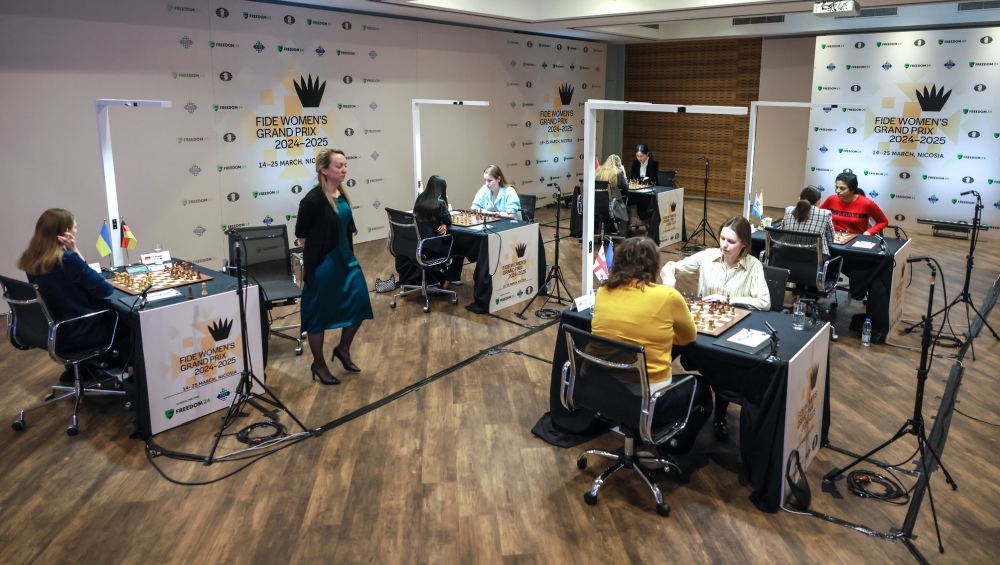
It couldn’t get more exciting! With this afternoon’s victory over Elisabeth Paehtz, Anna Muzychuk bounced back from her seventh-round loss to tie with Zhu Jiner at 5.5/8, setting up a thrilling final round at the Cyprus Women’s Grand Prix. Muzychuk will play Black against Harika Dronavalli, while Zhu Jiner will enjoy the white pieces against Nana Dzagnidze. Another happy contender was Divya Deshmukh, who scored her first win of the tournament by defeating Olga Badelka. Interestingly, this was the game chosen for the ceremonial first move, performed by five-time World Champion and FIDE Deputy President Vishy Anand. Anand played 1.Nf3, and as fate would have it, this very piece delivered the final blow with the maneuver 63.Ne5-d7! Let’s take a closer look at the five games. Aleksandra Goryachkina – Harika Dronavalli 0.5-0.5 Goryachkina’s quick draw against Paehtz yesterday gave her plenty of time to prepare for today’s game against Harika. Also, their head-to-head record favoured Goryachkina heavily – three wins and six draws, with no victories for Harika. However, Aleksandra’s Grand Prix situation is very special. Having won an event and tied for first in another, a decent result here more or less guarantees her a Candidates. With this in mind, it makes sense for her to avoid major risks. Her preparation for the game was top-notch. First, she sacrificed a pawn for piece compensation in a well-known position of the French Tarrasch. Then she followed it up with the “engine” novelty 15.Ng5, a very dangerous attacking idea. But Harika was on her game today and quickly found the way to neutralize her opponent’s initiative. After the exchange of queens, Harika still retained her extra pawn, but a draw was quickly agreed upon due to the opposite-coloured bishops. Anna Muzychuk – Elisabeth Paehtz 1-0 Anna and Elisabeth are good friends and colleagues. But when it comes to chess, it’s no-holds-barred. “It’s not so easy because Elisabeth is my best friend in the chess community, and we have spent a lot of time together,” said Anna after the game. In twenty official classical games, Anna has pulled ahead with four wins and only one loss, while the rest of the games were draws. “Anna is playing with White and after yesterday’s loss she will try very hard to score the full point today,” dared GM Gershon on the live stream. “Exactly, as you can imagine she didn’t look happy this morning, as she was struggling to get herself together for today’s game,” confirmed WGM co-commentator Karlovich. However, Karlovich also mentioned that she had lunched with Paehtz, “I spoke to Elisabeth during lunch and I think she is ready for a fight today and try to surprise her opponent in the opening.” And indeed, she did! Elisabeth opted for the Queen’s Gambit Accepted, a defence that she has used very sparingly in her career (although one of the games was against Anna’s younger sister!). “In fact, I played 1.d4 as the first move, which I do very rarely. I thought I was going to surprise her!” said Anna, reflecting on her opening choice. Anna did her best to find a way to make progress to no avail. To make things even worse, she quickly fell behind on the clock: at one point she was down to six minutes for seventeen moves. However, fortune favours the brave and, with Anna under severe time pressure, Elisabeth blundered 24…Qc5? instead of 24…Rxd4 with equal play, and then more importantly, 28…Qd8? instead of the superior 28…Qd7, which seems to be holding. After that, Anna had no trouble picking up a couple of pawns and bringing the point home, ensuring an exciting finale to the tournament. In her postgame interview, she instructively explained how Elisabeth’s position started to go downhill after 23…e5. https://www.youtube.com/watch?v=w2nVPmBBKTs Stavroula Tsolakidou – Zhu Jiner 0.5-0.5 Leading the event with 5/7, Zhu Jiner decided to go all-in with an aggressive approach in this important game against Stavroula. Instead of the solid Ruy Lopez or Italian game, she went for her favourite Sicilian, the Najdorf variation. Tsolakidou’s response was unsurprising – the aggressive 6.Bg5 followed by 7.Qf3 and 8.0-0-0, echoing her 2017 victory over Zhu Jiner at the World Junior Girls Championship. Her opening strategy was successful: her opponent was caught off-guard with 9.g4 and spent quite a lot of time figuring out the best response. Zhu Jiner took up the gauntlet, captured the “poisoned pawn”, and the game was on! The position remained balanced, according to the engines, but it was very double-edged, and anything could happen. But the exchange of queens on move twenty-two cooled things down. In the queenless middlegame, Zhu Jiner had the two bishops but a slightly worse pawn structure: the game was heading for a draw and indeed a draw was agreed on move forty-nine, both players clocking a 98% accuracy score with no mistakes whatsoever. Nana Dzagnidze – Mariya Muzychuk 0.5-0.5 The head-to-head between Nana and Mariya is quite extensive. In eighteen classical games, twelve games have ended in a draw, with two wins for Nana and four wins for Mariya. In addition, as GM Gershon most astutely pointed out, both Nana and Mariya have only played one leg of the cycle and this is their second event: if one of them were able to score two consecutive game wins, they might have a chance to fight for one of the two candidate spots. Indeed, a very important game for both of them. The opening was the Three Knights variation in the Grunfeld, with a well-deserved reputation of being very solid. Neither of the two players wanted to risk today, and each time a piece could be traded they would go for it. Around move twenty-five, Mariya enjoyed a slight initiative on the board and also quite a bit of extra time con the clock (twenty minutes for Nana’s six minutes, with fifteen moves to the time control). However, Nana kept her cool, played solidly and without much trouble was able to liquidate into an equal ending.
WGP Cyprus: Shake-up at the top! Badelka defeats Muzychuk, Zhu Jiner leads
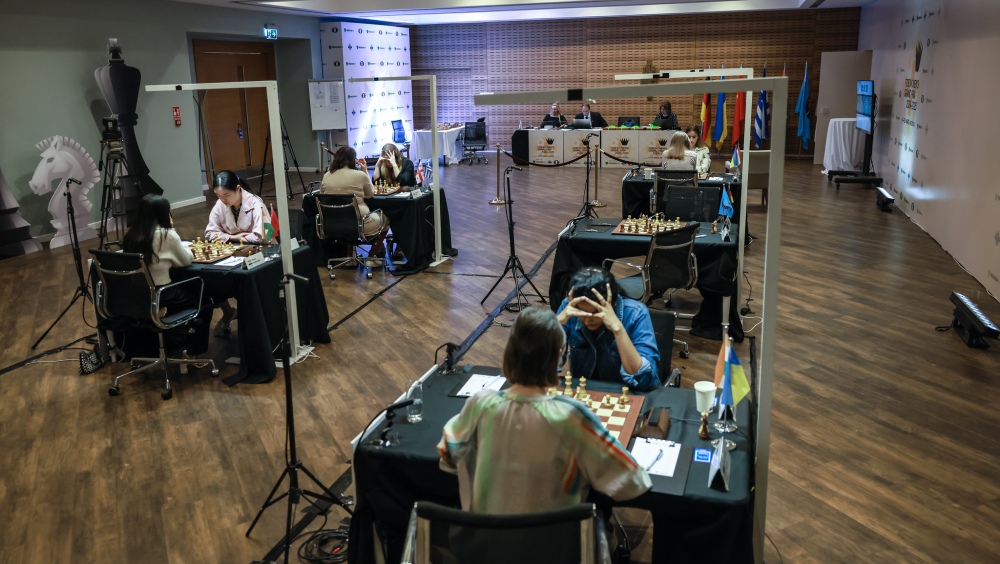
The shortest round of the tournament featured three decisive results and the emergence of a new leader. In a surprising turn of events, Olga Badelka defeated Anna Muzychuk in a spectacular attacking game, allowing Zhu Jiner to claim the top spot with her victory over Divya Deshmukh. Nana Dzagnidze also returned to a positive score, taking down Stavroula Tsolakidou with the black pieces. The ceremonial first move was made in the game between Zhu Jiner and Divya Deshmukh. Former Women’s World Champion and current FIDE Treasurer, Zhu Chen, played the first move for Zhu Jiner, while FIDE Vice-President Joran Aulin Jansson did the honors for Divya. Let’s take a closer look at the five games. Elisabeth Paehtz – Aleksandra Goryachkina (0.5-0.5) Although players cannot agree to a draw before move forty, they can bypass this rule in the case of a threefold repetition—exactly what happened in the first game to finish this afternoon. Both Elisabeth and Aleksandra ended the game with more time than they had at the start, indicating they were content with an eleven-move draw. Harika Dronavalli – Mariya Muzychuk (0.5-0.5) The second game to finish also ended in a draw but in this case it was hard-fought. Muzychuk brought a rather new move (7…c4) in the London opening to the table, achieving a very solid position. After he exchange of queens there was not much to play for in the ending, and a threefold repetition on move twenty-eight sealed the result. Both players achieved a 99% accuracy score – a testament to the high-level displayed in the encounter. Olga Badelka – Anna Muzychuk (1-0) The upset of the day! Refreshed from the village outing on the free day, Olga Badelka seems to be having the time of her life. After holding Goryachkina to a draw yesterday, today Olga played a game for the ages, defeating leader Anna Muzychuk with a ferocious attack in the Colle-Zukertort. “It’s better to win late than never,” were her first words in the postgame interview. https://www.youtube.com/watch?v=cZwaeu7n0sE I had a very well-needed rest on the free day with the mountain excursion to the village, and I am still trying to find my focus,” continued Olga. The key moment of the game occurred on move fifteen. Moment of the day Muzychuk has just played 14…Ne4 intending to exchange the knights after 15.cxd5 Nxd2. However, Badelka is not forced to recapture, and instead she spotted a nice intermezzo 16.dxe6! with a massive attack that ultimately proved decisive. When asked about Muzychuk’s blunder 14…Ne4, Badelka responded: “Maybe she wasn’t happy with the outcome of the opening: she had already spent half an hour and maybe she wanted to simplify things quickly, but it wasn’t to be.” Zhu Jiner – Divya Deshmukh (1-0) Shortly after Badelka had won her game, Zhu Jiner confirmed her excellent moment of form in the tournament by defeating Divya Deshmukh in great style. Divya opted for her signature French defence against which Zhu Jiner chose the Steinitz variation with an early 10.dxc5. Divya took some time to respond and soon ended up in a difficult position. However, according to the engine, she could have turned the tables with the tricky 21…e5 instead of 21…b3? after which Zhu Jiner didn’t give her a second chance. “I just tried to focus on myself and try my best to play. I didn’t see too much about the other results” explained Zhu Jiner in her post-game interview. https://www.youtube.com/watch?v=vJTbi_qLQr0 During the interview, Zhu Jiner showed us how she would have been forced to use an underpromotion to a knight to win the game if Divya hadn’t resigned. Stavroula Tsolakidou – Nana Dzagnidze (0-1) The final game to finish saw a completely recovered Nana Dzagnidze defeate Stavroula Tsolakidou with the black pieces. Stavroula essayed a secondary line against Dzagnidze’s trusted Sicilian Taimanov which promises a very chaotic position with attacking chances for both sides. However, it seemed that Dzagnidze was very comfortable in the complications – an unlucky choice for Stavroula who never found her moment in the game. According to the engine, sacrificing the exchange with 18.Bf2 didn’t offer enough compensation and the follow-up was just not enough to trouble Dzagnidze’s relatively safe king. The Georgian GM wrapped up the game with ease, happy to have left behind yesterday’s blunder against Harika. Round 8 dates and pairings: The eighth round of the 2024/25 Women’s Grand Prix series will be played on Sunday, March 23rd at 15:00 CET local time in Nicosia, Cyprus. These are the pairings of the round: Nana Dzagnidze – Mariya MuzychukAleksandra Goryachkina – Harika DronavalliAnna Muzychuk – Elisabeth PaehtzDivya Deshmukh – Olga BadelkaStavroula Tsolakidou – Zhu Jiner More information about the event, including the regulations and details of the pairings, as well as live games can be found on the official website: womengrandprix.fide.com You can follow the games live and watch the action with our wonderful commentators GM Alik Gershon and WGM Anastasiya Karlovich on YouTube. Written by Michael Rahal Photos: Mark Livshitz
Four contenders chase Anna Muzychuk’s lead in WGP Cyprus
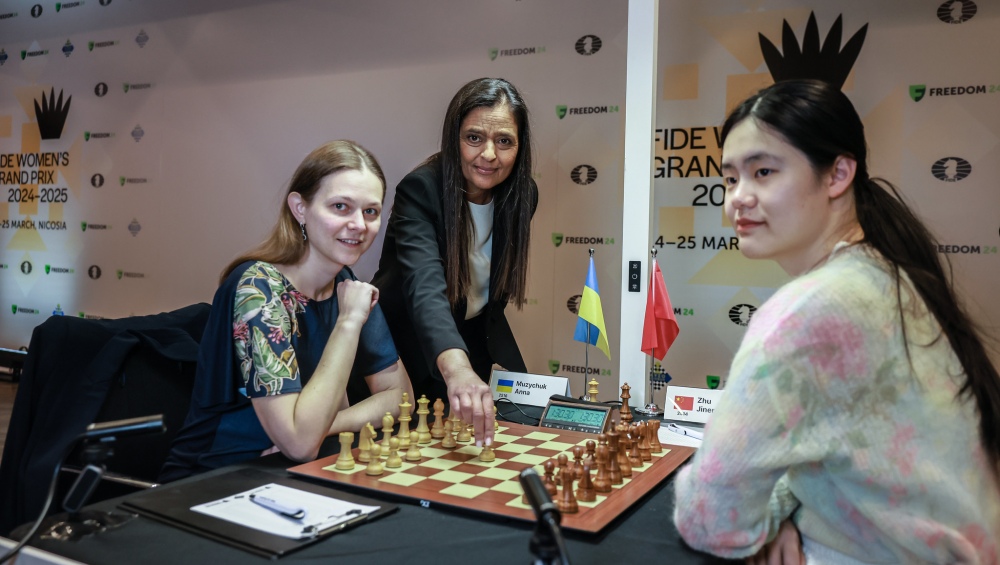
With her game ending in a draw, Anna Muzychuk remains at the top of the Cyprus WGP cross table after six rounds, with a total of 4.5 points. Anna’s opponent today, Zhu Jiner, trails her by half a point (4/6), maintaining the same gap with three other players just behind on 3.5/6—Aleksandra Goryachkina, Mariya Muzychuk, and Harika Dronavalli. FIDE President Arkady Dvorkovich performed the ceremonial first move at the game between Divya Deshmukh and Stavroula Tsolakidou while Clea Hadjistephanou Papaellina, from the Department of Education of the University of Cyprus in Physical Education played the first move for Anna Muzychuk in her game against Zhu Jiner. After the round begun, Dvorkovich joined the commentator’s booth, expressing his satisfaction on how the WGP cycle is developing. “The Grand Prix cycle has expanded: there are six events now instead of four, prizes are higher, more players participate. It shows are focus on the development of women chess and are dedication to the whole World Championship cycle for women players,” he said. Dvorkovich is in Cyprus attending the FIDE Council, which meets in person once or twice a year to discuss many strategic subjects – for example the structure of the World Championship cycle. Among many other issues, this afternoon they attended the presentation of the virtual FIDE Online Museum, which will be officially inaugurated next week. Let’s take a closer look at the five games of Round 6. Anna Muzychuk – Zhu Jiner (0.5-0.5) The most important game of the day paired together the leader of the tournament, Anna Muzychuk (4/5), with Zhu Jiner, trailing Anna by half a point. They had faced each other previously in classical chess a couple of times in the past – both of those games ended in a draw. The commentators were slightly taken aback by Muzychuk’s choice in the opening, the 3.Bb5+ Moscow variation in the Sicilian. “An interesting choice, although not without its own dangers. I think that Anna wants to play for a win today but without risking too much,” explained GM Alik Gershon in the booth. The Chinese GM opted for the solid 3…Bd7 and, facing Muzychyk’s Maroczy bind, chose the interesting side-line 7…Qg4 instead of the much more common 7…cxd4, which basically forces the trade of queens. Interestingly, the elite Chinese GM Li Chao has played this line a few times in the past. It soon became clear that Zhu Jiner had analysed the endgame extensively and, in fact, Muzychuk soon realised that she had no advantage and proposed a draw by means of a three-fold repetition. Slightly ahead on the clock, Zhu decided to play on, exerted some pressure but after accurate play by the leader a draw was eventually agreed on move forty-two. Mariya Muzychuk – Elisabeth Paehtz 1-0 Apart from being good friends, Mariya and Elisabeth have faced each on nine occasions, with a good record for the younger of the two Muzychuk sisters: two wins and seven draws. Playing today with White, and considering Elisabeth’s shaky start, Mariya pushed from the get-go for an open and aggressive game, choosing the Open Sicilian. “The 6.h3 line against the Najdorf is one of the more fashionable lines, preventing …Ng4 in certain situations. In some lines it’s more useful whereas in others it’s less useful,” explained GM Alik Gershon on the live stream. “In other lines White can play the concrete g4, asking some questions to the f6-knight”. Soon the fight for the d5-square became the game’s focal point: by exchanging her dark-squared bishop for the knight on b6, Mariya managed to transfer her knight from b3 to d5 and secured a huge positional advantage along with excellent attacking chances on her opponent’s kingside. It’s not totally clear where Paehtz made her fatal mistake – it just seemed that she was positionally outplayed. Mariya was very happy with her first win in the event. In her postgame interview, she considered a couple of ideas that didn’t appear on the board. https://www.youtube.com/watch?v=An59NxTPzlw Divya Deshmukh – Stavroula Tsolakidou 0.5 – 0.5 Belonging to the younger generation, Divya and Stavroula haven’t had enough time yet to string many classical games against each other. In fact, they have only played twice before, with two draws. For today’s game, Stavroula had prepared the 6…Be7 secondary line in the Open Ruy Lopez, a variation that Magnus Carlsen has used quite often in the past. Maybe she was hoping to surprise Divya but the Indian came very well-prepared to the game, even finding the 11.b3 / 12.Ba3 manoeuvre quite fast. The game quickly transitioned into a queen+rook+minor piece equal middlegame. In the commentary booth, WGM Anastasiya Kharlovich provided some insights: “Anand suggested that as Divya is an aggressive player, everyone wants to take her to the ending.” Although Stavroula’s pawn structure was slightly damaged, she had a good compensation in the form of piece activity. Divya decided to call it a day and force a perpetual draw on move forty-one, just after the time control. Nana Dzagnidze – Harika Dronavalli 0-1 Nana and Harika have a lot of history together, having played a total of twenty-one classical games in the past, with a totally equal score of thirteen draws and four wins each. With regard to Dzagnidze’s unpretentious opening choice – the rare Agincourt defence – GM Gershon put forward his theory: “Nana just wants to get a game, with as little theory as possible and then let the better player win.” In any case, she definitely caught her opponent of balance: the move 7…c5 cost Harika twenty minutes while on move 8…d4 – which is actually an inaccuracy – she spent another twenty-eight minutes. It has to be said though, that Dzagnidze was also in unfamiliar territory, spending a lot of time as well. Ultimately, faced with an unfamiliar position, Harika decided to sacrifice a pawn, hoping to get some form of compensation. Both players entered time trouble, leading to mistakes. Dzagnidze’s 19.Nf5? (instead of the much better 19.Nxf7!) allowed the counter 19…e4! which
WGP Cyprus: Anna Muzychuk and Zhu Jiner jointly lead after four rounds

After three more or less quiet rounds, with high accuracy scores and very solid play, the participants unleashed their inner power this afternoon at the Hilton Nicosia. None less than four games ended with a decisive result in the fourth round of the Cyprus Women’s Grand Prix. Nana Dzagnidze, Harika Dronavalli, Aleksandra Goryachkina, and Anna Muzychuk all secured victories, while Zhu Jiner and Mariya Muzychuk settled for a draw, leaving Anna Muzychuk and Zhu Jiner co-leading the tournament with three points. The ceremonial first move was performed by the President of the Cyprus Chess Federation, Mr. Criton Tornaritis, who opened for Alexandra Goryachkina in her game against Greece’s top female player, Stavroula Tsolakidou. Let’s take a closer look at all five games. Nana Dzagnidze 1 – Elisabeth Paehtz 0 Nana and Elisabeth have played dozens of games together, the first one going back to the U-10 Girls European Championship in 1995. The opening was a fun one, as you rarely see a reversed Blumenfeld Gambit at this level nowadays. “Their fortunes changed slightly yesterday: Nana suffered her first loss, while Elisabeth stopped her losing streak. After the round, she said that she was feeling better and that hopefully her play will improve,” explained commentator GM Alik Gershon. Black grabbed the extra pawn and decided to hold onto it. Of course, White did have a good pawn center and excellent attacking chances with the pair of bishops in exchange. In her postgame interview, Dzagnidze explained that, playing with White, she wanted a fighting game, and that her choice of opening served this objective very well. Paehtz’s key blunder occurred on move twenty-one when she chose 21…Ra-c8 which just loses material after 22.Rb1! and all the tactics favor White. From then on, Dzagnidze wrapped up the game in style. https://www.youtube.com/watch?v=Y61yq3mJnrM Mariya Muzychuk 0.5 – Zhu Jiner 0.5 The most important game of the round was the only one to end in a draw. Playing with White, former Women’s World Champion Mariya Muzychuk wanted to pile up the pressure on the leader of the event. The opponents tested a very long theoretical line of the Mikenas-Carls variation of the English Opening, which is regularly played at the highest level by the likes of Ian Nepomniachtchi and other elite GMs. Both players were very clearly booked-up, blitzing out the opening at total ease. The middlegame turned out to be slightly better for Muzychuk enjoing a bit more space and active piece play. By invading the b-file with her rook, she managed to pick up the weak a7-pawn, converting her positional advantage into something more tangible. But Zhu Jiner remained solid and maintained the balance with precise play. At some point, she was even enjoying some attacking chances against Mariya’s king. All in all, it was a very correct game, with both players registering 98% on the accuracy score. Aleksandra Goryachkina 1 – Stavroula Tsolakidou 0 Goryachkina alternates her opening choice based on her opponents. Having a +3 score against Stavroula, she definitely wanted to go for a win. This afternoon she went for 1.e4 and Tsolakidou immediately replied with 1….c5. “The Sicilian Defence! It shows her fighting spirit today,” said WGM Anastasiya Karlovich in the commentary booth. “We always welcome the Sicilian here, the more fighting and interesting the games are, the better it is for the players, the spectators and the commentators of course,” added GM Alik Gershon. The opponents went down one of the main paths of the Rossolimo Attack, which has appeared in Cyprus several times already, including one game by Tsolakidou. Playing extremely fast, Goryachkina exchanged her two bishops for knights in order to reach a position with a strong knight on d5. Based on her speed, it became apparent that Aleksandra was playing according to her home preparation. Feeling pressure both on the board and on the clock, Tsolakidou traded-off the d5-knight and soon after sacrificed an exchange to get just a pawn in return. According to the engine, she was still worse but holding. However, low on time she lost control over the position, allowing Goryachkina to convert her extra material and score her first win of the tournament. Anna Muzychuk 1 – Divya Deshmukh 0 Anna Muzychuk chose the advance variation of the Caro-Kahn, and after including 4.h4 she exchanged bishops on d3 – a very trendy line nowadays. Divya, in her turn, exchanged quees and transisioned into an endgame which the engine assessed as quite reasonable for her. Nevertheless, it was still quite tricky and Divya spent half of her remaining time on just one move, which turned out to be a mistake (24…Nb6? instead of the superior 24…Nd-b4). Muzychuk sensed her opportunity and pushed forward, attacking her opponent’s weaknesses and putting a lot of pressure on the clock, ultimately scoring her second win in a row. In her postgame interview, Anna mentioned that she was surprised by her opponent’s opening choice. She also added that maybe Divya didn’t figure out how to react to White’s activity in the endgame. https://www.youtube.com/watch?v=f2ywqjmmjP8 Harika Dronavalli 1 – Olga Badelka 0 No doubt willing to take her opponent out of her opening book, Harika opted for one of the most creative opening ideas I have seen in the past months. In an English Opening with 1.c4 e5, she first played 2.a3!?, startling Badelka, who took four minutes to react, and then 4.h4!? with a completely new position emerging on the board according to my database. “My opponent had only played 1…e5 against the English three or four times, so I decided to play something different,” Harika explained. MOMENT OF THE DAY Harika was kind enough to show us this moment on the board in her postgame interview. The key position occurred on move eight. Badelka blundered an exchange with the 8…Qd7? allowing 9.Bh6! Now the bishop can’t be captured because of 10.Nxf6+ winning the queen, and therefore the only move is to castle, after which White exchanges knights and wins the rook on f8. “These things can
WGP Cyprus: Zhu Jiner maintains the lead while Anna Muzychuk scores her first win
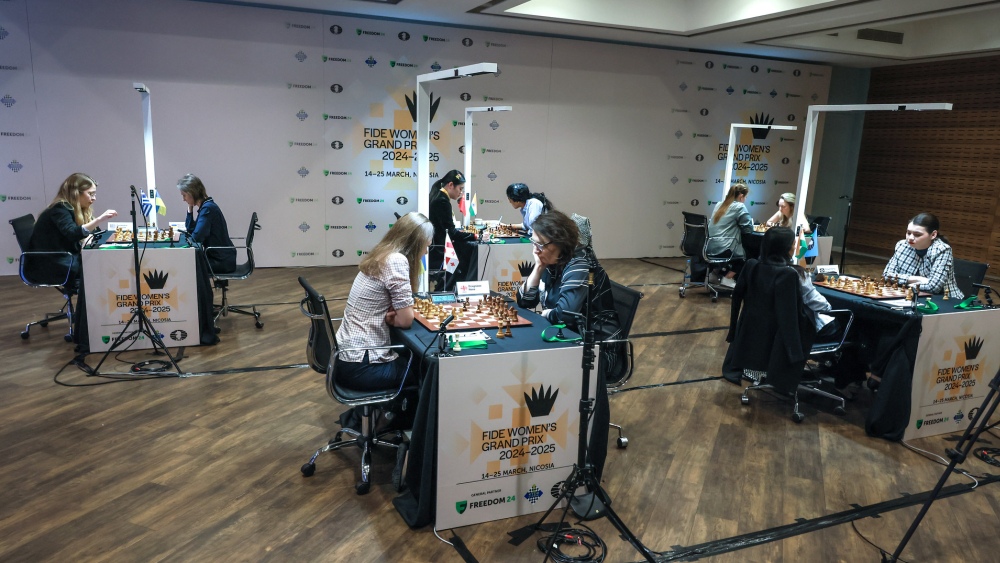
The third round of the FIDE Women’s Grand Prix Cyprus was played this afternoon at Hilton Nicosia. The ceremonial first move was performed by His Excellency Liu Yantao, the Chinese Ambassador, who opened the game for Zhu Jiner, and by His Excellency Mr. Manish, the Indian Ambassador, who played for Harika on the same board. With accuracy scores in the high nineties across most games, the round featured many fighting draws, proving that this will be a closely contested event. The only decisive result of the round was Anna Muzychuk’s victory over Nana Dzagnidze, ending in checkmate on move 83—the longest game of the tournament so far. Let’s take a closer look at all five games. Divya Deshmukh 0.5 – Aleksandra Goryachkina 0.5 Despite having faced each other only four times, Goryachkina has been a tough opponent for Divya, winning three games and drawing one. However, Divya has made substantial progress in recent months and, playing with White, was eager to improve her record. Goryachkina defended with the Berlin variation in the Ruy Lopez, one of her regular setups with Black. Both players had obviously done their homework as they blitzed out twelve moves of theory. Suddenly, Divya slowed down, spending nearly forty minutes on her fourteenth move! Possibly fearing some complications, the young Indian went for a solid continuation with a massive piece trade. The resulting rook and opposite-color bishops endgame was completely equal and after further simplifications a draw was agreed on move forty-two. The 99% accuracy game score is a testament to the no-risk approach taken by both players. Stavroula Tsolakidou 0.5 – Mariya Muzychuk 0.5 The Greek International Master is rapidly becoming a fan favourite player to follow. All her games are exciting, and today’s encounter was no exception. In two previous classical games, Stavroula had already defeated Mariya Muzychuk, while the other ended in a draw. After a close shave yesterday against Harika, Stavroula opened with 1.d4 and went for the very new 9.Rg1 in Semi-Slav Anti-Moscow Gambit. Visibly surprised, Mariya spent nearly fifteen minutes figuring out her reponse. Although it took her some time, to her credit Mariya nailed all of the twenty difficult computer moves, while Stavroula was blitzing out her own preparation. Tsolakidou was very impressed with her opponent’s play. “I prepared all the line at home with my coach,” said Stavroula in her postgame interview. “It’s amazing that Mariya was able to find all the computer defensive moves, but my coach did warn me to be prepared for this scenario.” Muzychuk achieved an impressive 100% accuracy score: she played a complicated game like a top-level computer, finding her way to a draw in the complications. Check out the Stavroula’s interview for mind-boggling lines. https://www.youtube.com/watch?v=QIaxFrxKw7w Zhu Jiner 0.5 – Harika Dronavalli 0.5 Having faced each other on six occasions, with six draws recorded, this matchup would prove to be very equal and the 98% accuracy score confirmed this prediction. Facing Harika’s Winawer French, the leader of the tournament advanced her h-pawn “a la Kasparov”. Harika reacted correctly with the precise maneuver 9…b6, trading off the light squared bishops and subsequently the queens on the a6-f1 diagonal. The resulting endgame had the bishop vs knight imbalance but both players kept it close to the vest with absolutely no mistakes and a draw was agreed on move forty-one. With this result Zhu Jiner keeps the lead going into the fourth round. Olga Badelka 0.5 – Elisabeth Paehtz This was the first time that IM Olga Badelka faced GM Elisabeth Paehtz in classical chess. The game opened as an English Defence and remained quite balanced until Badelka launched a fierce kingside pawn storm. True to classical principles, Paehtz counterattacked in the centre by sacrificing a couple of pawns for active piece counterplay. At one moment, Badelka had three extra pawns, but Paehtz’s activity was immense, based mainly on her active dark-squared bishop in the middle of the board, which ultimately allowed her to force a perpetual check. “The game was tremendously complicated,” Olga explained in her post-game interview. “In fact, I was very worried about the safety of my own king.” Although she missed some small opportunities in her calculations, Olga was satisfied with the draw and the chance to play against the best female players in the world. https://www.youtube.com/watch?v=jnCO5CK_XkA Anna Muzychuk – Nana Dzagnidze 1-0 A classic matchup! Anna and Nana have played no less than twenty-six classical games against each other, with a total score of seven wins for Dzagnidze, three wins for Muzychuk and sixteen draws. These two players know each other in and out! The Georgian GM decided to abandon her favorite defence, the Najdorf Sicilian, in favor of the rare O’Kelly variation, in an attempt to surprise her opponent and take her “out of the book”. After three or four minutes of thought, Anna Muzychuk returned the favour by playing 3.Be2 instead of one of the more popular moves, and only seven moves the position was totally new, with no major game references in the databases. “Knowing Anna, who is such a hard-working person, and normally prepares for so many hours the day before the game, during the morning, she checks everything! She probably spent so much time preparing all the options, but I don’t think 2…a6 was one of them,” explained commentator WGM Anastasiya Karlovich on the live stream. As the game progressed, the position in a Marozcy pawn structure was mostly equal, although it was always Muzychuk who was pressing. In the ending, Dzagnidze had to defend a queen ending a pawn down, a draw according to the engines, but it still accuracy was needed. Moment of the Day After defending the ending correctly for more than 50 moves, Dzagnidze blundered right at the end. It has to be said that both players were nearly out of time, essentially only playing with the 30-second increment. In this position, Dzagnidze played 83…Kg8, which loses after 84.f5! Qh1 and now 85.Qe8+ Kg7 86.f6 checkmate! The correct move, which
FIDE WGP Cyprus: Zhu Jiner leads after two rounds
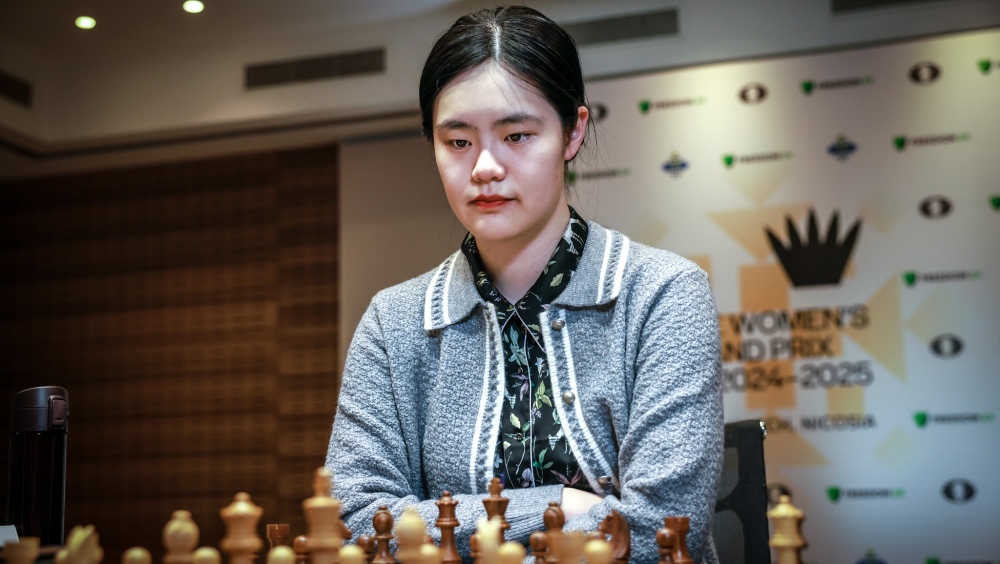
The second round of the FIDE Women’s Grand Prix Cyprus began punctually this afternoon at 15:00 at the Hilton Nicosia. The ceremonial first move was performed by Valeriya Avksenteva, Deputy Executive Director of main sponsor Freedom24. She opened the game for Mariya Muzychuk, who faced Divya Deshmukh. Although only one game ended in a decisive result, with Zhu Jiner emerging as the new leader of the tournament, all five were quite entertaining in their own right. Let’s take a closer look at all five games. Mariya Muzychuk 0.5 – Divya Deshmukh 0.5With a 99% accuracy score, the first game to finish was the encounter between former Women’s World Champion Mariya Muzychuk and up-and-coming young Indian star Divya Deshmukh. Although a bit under the radar with a cold, Divya equalised comfortably in the Steinitz variation of the French defence. The opponents followed a 2023 game between Caruana and Carlsen until move nine, when Divya tried 9…cxd4 instead of the main line 9…Be7. It looked like Divya had it all worked out in her home preparation – she hardly spent any time finding the precise follow-up manoeuvre 12…Nb8 and then 13…Nc6, fighting for the d4-square. After the subsequent exchange of queens, Muzychuk also allowed the four rooks to be traded, resulting in an absolutely equal light-squared bishop endgame. A draw was agreed on move forty. “Most of the game was prepared before-hand but in the end, I had to do some serious calculations to make the draw. I am sure that there must be many different ways to achieve it,” said Divya in a conversation with us after the game. Nana Dzagnidze 0.5 – Olga Badelka 0.5 The Austrian International Master is playing in her first Grand Prix cycle. Unfortunately, being drawn number six on the cross table, she has been forced to play two consecutive games with Black in her first two challenges. In today’s game against seasoned Grand Master Nana Dzagnidze, she went for the Queen’s Gambit Accepted, a somewhat risky choice as Nana herself played this defence successfully yesterday against Goryachkina. Moreover, although Dzagnidze has been around forever, this was the first classical game between them. Dzagnizde surprised her opponent with the move 9.Bg5 and Badelka went into the tank for more than twenty minutes, trying to figure out the right setup. Although she managed to force the exchange of queens, the ending was better for Dzagnidze: a healthier pawn structure and better placed minor pieces. The engine was suggesting a +1.5 White’s advantage around move twenty. But, low on time, Dzagnidze started to lose the thread of the game and gave Badelka some breathing space. Displaying excellent defensive technique, Badelka neutralized her opponent’s advantage and a draw was finally agreed in a close-to-equal position on move forty-three. Elisabeth Paehtz 0 – Zhu Jiner 1 Playing with White, and in an attempt to recover from yesterday’s defeat, Paehtz opted for the 5.Qb3 line in the popular Ragozin defence. Zhu Jiner chose to deviate from mainline theory by playing 5…a5 instead of 5…c5, but then went into the tank for more than fifteen minutes when Paehtz pinned her knight with 7.Bg5. The game progressed in a principled manner, ending up in a middlegame position in which Black enjoyed more active short-term options with her bishop pair, but White had the superior pawn structure. It would all boil down to the weakness of the isolated d-pawn: would it hold or not? And indeed, the d5-pawn finally fell but in exchange for the a2-pawn and the game headed into an equal rook and bishop ending, with four pawns apiece. A draw should have been the logical result but Zhu Jiner kept setting little traps and finally Paehtz fell for one of them. Nonetheless, even a piece down the engine still considered the position to be a draw, but it was very tricky to hold and eventually Paehtz blundered, allowing Black to create a passed pawn. Elisabeth fought for another 24 moves, but had to resign in the end. In her postgame interview, Zhu Jiner showed us some of the key lines that she considered to pick up her second point. https://youtu.be/qtijlstyqKQ Aleksandra Goryachkina 0.5 – Anna Muzychuk 0.5 A perfect game by both contenders! Playing White for the second time in a row, the former Women’s World Championship challenger opened with 1.e4 instead of 1.d4, which she used unsuccessfully yesterday against Dzagnidze. Anna Muzychuk, the younger of the two sisters, and former World Blitz and Rapid World Champion, defended with the Two Knights variation of the Sicilian Defence. Displaying excellent opening preparation, Goryachkina opted for a secondary line, first with 4.Bd3 and then trading knights on c6, a system that has recently become quite trendy. Although the choice of opening might have come as a surprise for Muzychuk, she reacted in a very principled way, developing her pieces comfortably and securing a safe, symmetrical position. However, Goryachkina conserved a small but nagging advantage: a slightly superior dark-squared bishop and, more importantly, a big advantage on the clock. On move twenty, Muzychuk had only thirty minutes left against Goryachkina’s full hour. To her credit, Anna defended superbly, neutralizing any intent of aggression, and traded down to a no-risk, bishop ending. A draw was agreed on move forty-two. Harika Dronavalli 0.5 Stavroula Tsolakidou 0.5 Definitely the most entertaining game of the round! Harika went for the Rossolimo Attack – an enterprising option bearing in mind that Stavroula won her game yesterday with precisely this opening. Playing the sharp 6.Qxd4 line, Black was forced to weaken her kingside, but theory maintains that Black is more than OK: a solid pawn structure and bishop pair. Indeed, even Carlsen defeated Vachier-Lagraeve in 2019 in this line. After fifteen minutes of thought, and definitely out of her opening preparation, Harika threw a spanner into the works with 11.b4, an unbalancing move with pros and cons for both sides. Stavroula offered a three-fold repetition on move twenty-one but Harika decided to play on. With fifteen moves to
Zhu Jiner and Stavroula Tsolakidou strike first in WGP Nicosia
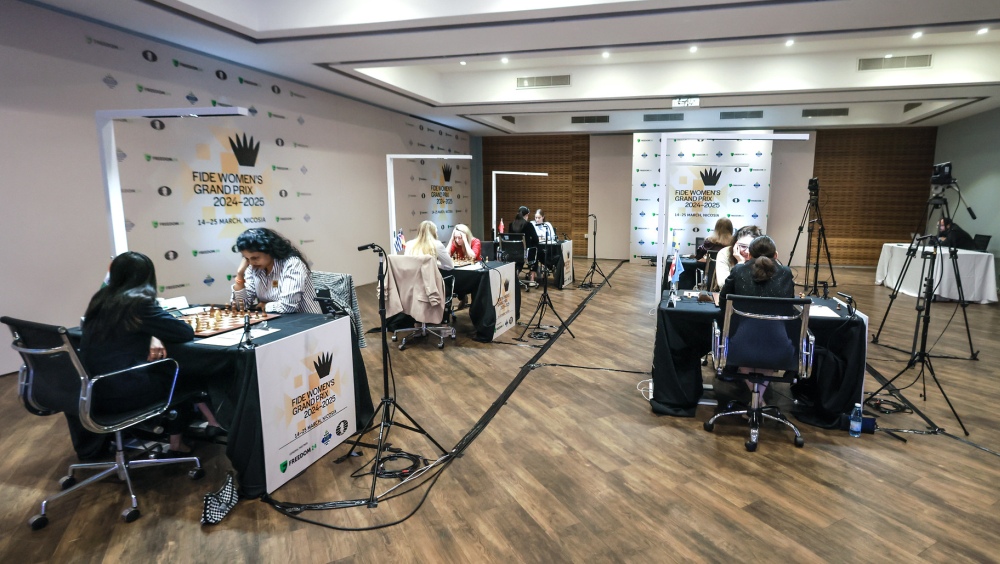
The first round of the Cyprus WGP was highly entertaining. Except for the encounter between the Muzychuk sisters, which ended in a quick draw, the four remaining games were fought to the bitter end, resulting in two important wins for Stavroula Tsolakidou and Zhu Jiner. The fourth leg of the FIDE Women’s Grand Prix 2024-25 kicked off this afternoon at 15:00 in the fantastic Hilton Nicosia. Evgenii Tiapkin, executive director of main sponsor Freedom24, performed the ceremonial first move for Stavroula Tsolakidou. One of the toughest events of the six that compose the Grand Prix, Cyprus features leg 2 winner Aleksandra Goryachkina, former Women’s World Champions Anna and Mariya Muzychuk, side-by-side with young powerhouses such as China’s Zhu Jiner and Greece’s own Stavroula Tsolakidou. If the fighting spirit displayed this afternoon at the Hilton Nicosia is a prelude to the rest of the tournament, glorious afternoons of great chess await us. Let’s take a closer look at all five games. Aleksandra Goryachkina 1/2-1/2 Nana Dzagnidze Thanks to her two excellent results in Shymkent and Monaco, Goryachkina currently leads the Grand Prix and is widely considered the favourite here: a strong performance in Cyprus would practically secure her spot in the next women’s Candidates Tournament. Starting off the tournament with White against Georgia’s Nana Dzagnidze, with whom she has a +3 =8 record with no defeats, couldn’t be better. But Dzagnidze is a very experienced player, and her international rating of 2513 is no small feat. She tends to play with strength and focus: defeating her takes a lot of energy and commitment. Goryachkina began with the Queen’s Gambit, one of her usual openings, against which Dzagnidze had prepared a line in the Accepted Variation, in which she faces an isolated queen’s pawn. Although Goryachkina developed a small initiative during the first moves, Dzagnidze neutralized White’s attack and ultimately exchanged queens. The endgame seemed to favour the Georgian GM very slightly but, low on time, she wasn’t able to capitalize, and the game petered out into a draw. Both players performed this afternoon at the highest level with an all-around 98% accuracy score. Anna Muzychuk 1/2-1/2 Mariya Muzychuk The Muzychuk sisters have faced each other in classical chess on twenty-one occasions in the past. Except for a single win by Anna in the 2002 U-12 Ukrainian Girls Championship, all the other games have ended in draws, and this afternoon’s encounter was no exception. Today they battled it out in a 99% accuracy Najdorf Sicilian, more specifically a line that features eleven master games that all end in equal endgings and subsequent draws: for example, a 2009 bout between elite GM’s Akopian and Miroshnichenko. Although the tournament rules forbid draws before 40 moves have been played, a three-fold repetition is one of the few exceptions to the rule, and a peaceful outcome was signed on move twenty-seven. Divya Deshmukh 1/2-1/2 Harika Dronavalli As per rules, players of the same federation must face each other in the first round. Both Indian players, playing in their second tournament of the cycle, decided to go for a fight, but proceeded with caution trying not to overstep. The result? A long, 50-move, 98% accuracy draw, more than enough for both players to be content with their over-the-board efforts. In their previous three encounters, Harika was dominating with two wins and one draw but today she had to settle for a half-point. For most of the game, in a well-known solid line of the Ruy Lopez Berlin, fan-favourite Divya nurtured a very small edge with White. But the pawn structure was symmetrical and Harika managed to force some interesting exchanges – it soon became clear that the talented young player from Nagpur wasn’t getting anywhere. Moreover, her experienced opponent finally obtained the bishop pair and, for a moment, entertained the idea to press for the advantage, but to no avail. Divya kept things under control and a three-fold repetition was recorded on move fifty. Zhu Jiner 1-0 Olga Badelka A six-event cycle that runs over several months is bound to produce replacements. Players that may fall ill, or run into other commitments, vacate their spots for other contenders, under the specific rules of the competition. Both Zhu Jiner and Olga Badelka fall into this category. Although Nicosia is the fourth of the six tournaments, and all players are set to play three, funnily enough, for both of them this is their first event! Olga Badelka has replaced Regina Theissl-Pokorna and will play in Cyprus and her home country Austria, while Zhu Jiner is replacing China’s own Lei Tingjie and will add the India and Austria legs to Cyprus. Even though the game began as a Ruy Lopez, it soon developed into a slow Italian opening. Going into the middlegame, it seemed that Badelka had equalised comfortable but a couple of minor inaccuracies – 15…Bxf3 and above all 20…Nh7 landed her in a very difficult position. Zhu Jiner had the two bishops against her opponent’s two knights, plays a superior pawn structure. To top it all, Badelka was slowly spending all her time, in an attempt to defend against her opponent’s attack. With excellent combinatorial play, the Chinese prodigy won a couple of pawns and opened up the gate to her opponent’s king, forcing the Austrian to resign on move forty-seven. In her postgame interview, Zhu Jiner gave us her thoughts on her fine performance. https://youtu.be/S92m9mKCaXY?si=jP-JmXJ89DH-ZL4p Stavroula Tsolakidou 1-0 Elisabeth Paehtz The other victory of the day went to Greece’s top-ranked female player, Stavroula Tsolakidou. The twenty-four-year-old player from Kavala, who actually turns twenty-five during this event, gave a fine performance against another very experimented GM, Elisabeth Paehtz, representing Germany. Both players went down a rabbit hole in an extensively pre-analysed variation of the Sicilian Rossolimo Attack. On move thirteen, with both opponents having used hardly any time on the clocks, Paehtz offered a draw by means of a three-fold repetition attempt. Eager to continue the fight, Stavroula went into the tank, considered her options, and
Fourth leg of FIDE WGP 2024-2025 kicks off in Nicosia

The fourth leg of the 2024-25 FIDE Women’s Grand Prix kicked off this evening in the magnificent Nicosia Hilton Hotel, in the capital of Cyprus. Under the auspices of the International Chess Federation and Cyprus Chess Federation, the event runs from the 14th to the 25th of March, and will showcase the skills of ten of the best female players in the world. The opening ceremony began at 19:00 with the national anthem of the Republic of Cyprus, followed by the anthem of FIDE. Immediately afterward, FIDE CEO Emil Sutovsky took the stage, welcoming everyone to the opening ceremony, and highlighted the significance of the tournament. “In the past two years, Cyprus has become one of the European chess hubs. We are delighted with our cooperation with the Cyprus Chess Federation and with our partner, Freedom, who are backing a number of important events all over the world. Our mission here is not only to stage a high-level event, but to lay a foundation and keep building on the previous work to make chess more popular, more accessible and more attractive to everyone.” Furthering their firm commitment to promoting chess in Cyprus, and supporting the event, Freedom Holding Corp CEO Timur Turlov, initiated his speech thanking the players for their participation and pointing out that it is a great honor to have them here. “I believe that the Cyprus role as interconnector of finance and chess will continue to grow. This is a country with very welcoming people, great weather, great cuisine, and with a lot of opportunities to enjoy and also focus on your business.” Turlov wished the players to be really focussed on their games but also have fun during their breaks and, if at all possible, visit other beautiful cities in Cyprus, such as Limassol. He was also very grateful to FIDE for their continued cooperation. “I am very thankful to FIDE for our partnership. We definitely share the same values and I believe that we will continue this cooperation through some new initiatives such as the International School Federation. I really see how prestigious this game is rising all over the world and how more and more people are being involved.” Finally, the President of the Cyprus Chess Federation, Criton Tornaritis, took the floor, welcoming all the players to Cyprus and highlighting the joint association with Freedom. “This is the second time we organize this tournament in Cyprus and I hope that there will be a third time. The most important thing for me is to enjoy some good games. Chess in Cyprus before Freedom was very poor. Now we have more than 2,000 members, most of them kids.” After the speeches, the attendees enjoyed the performance by a talented group of young dancers from Live Dance Studio, who brought a touch of energy and artistry to the ceremony. The evening culminated in a family group photo, with all the players on the stage joined by FIDE Secretary General and tournament director Lukasz Turlej and Takis Nikolopoulos, Chief Arbiter. Afterward, the guests had the chance to speak to the players, take photos, and enjoy the cocktail reception. The first round is scheduled for Saturday, March 15, at 3pm. As per rules, players representing the same federation must face each other at the start of the event. You can follow the games live and watch the action with our wonderful commentators GM Alik Gershon and WGM Anastasiya Karlovich on YouTube. Written by Michael Rahal Photos: Mark Livshitz Official website: womengrandprix.fide.com/