

WGP India: Zhu Jiner and Humpy face-off for the tournament

Both Zhu Jiner and Humpy won their games this afternoon and have extended their lead over the rest of the players. They will face-off in tomorrow’s seventh round, with Humpy playing White and in need of the win to overtake the Chinese GM. After five days of intense battle and many decisive outcomes, the players, arbiters and organization staff of the Women’s Grand Prix enjoyed the hospitality of Pune on their free day. The organizers chartered a bus to visit the centre of the city to visit the Dagadusheth Halwai Ganapati Temple, dedicated to the God Ganesha and the Shaniwarwada Fort Pune, with its majestic portal. The afternoon continued with a trip to one of the largest malls in Pune for souvenir hunting and refreshments. Today’s ceremonial first moves were performed on the Harika vs Divya board by Justice Mrs. Neela Gokhale, member of the Mumbai High Court, and Pankaj Patil, Deputy Commissioner of the PCMC. Adv. Shivaraj Kadam also participated in the opening game ceremony. Let’s take a closer look at this afternoon’s games. Harika Dronavalli 0.5 – 0.5 Divya Deshmukh The first game to finish between Olympic team colleagues Harika and Divya ended in relatively quick draw. In a symmetrical variation of the English opening, they followed a 2020 game between top GM’s Vladislav Artemiev and Mircea Parligras. In both of the games, White had a very slight edge due to a backward d-pawn but in exchange Black did have excellent piece coordination. After lengthy manoeuvres, and some inaccuracies by his opponent, Artemiev scored the win, but this afternoon Harika preferred to repeat the position three times and secure the draw just before move thirty. Munguntuul Batkhuyag 0-1 Humpy Koneru The number one Indian female player, Humpy Koneru, took a major step towards tournament victory by defeating Mongolia’s top women player Munguntuul Batkhuyag in a complicated variation of the Two Knights defence. “I noticed that she never plays 4.Ng5 against the Two Knights so I decided to try out this line,” explained Humpy in her post-game interview. The tricky Ulvestad variation caught Munguntuul by surprise, and she spent a lot of time in the opening. The Mongolian quickly ended up in a very bad position, with opposite-side castled kings and a massive attack for Humpy. “I knew it was a very important game for me with the black pieces, and I just wanted to try whatever I could. The position just gave to a complex opening and I was happy when I saw it over the board,” Koneru shared. Although it was a tough game, Humpy was kind enough to come to the media centre and explain her thoughts. A must-watch interview! https://www.youtube.com/watch?v=lU4B1_Kx9YA Zhu Jiner 1 – 0 Vaishali Rameshbabu Only a few minutes after Humpy had secured the full point, Zhu Jiner scored her own fourth win of the event, retaining the lead before tomorrow’s decisive match-up against the Indian. Zhu opened with a Sicilian Rossolimo Attack, a line that she had already tried out against Salome Melia earlier in the tournament. Well prepared with Black, Vaishali sacrificed some of her weak pawns in order to transfer all of her pieces towards her opponent’s kingside. And it definitely seemed to be working! Moment of the day With fourteen moves to go to the time control, and Black under her last minute, Vaishali blundered here with 26…Nxc2?? allowing Zhu Jiner to take back control of the board with 27.Nxd5! and eventually win decisive material, as she explained to us in her post-game interview. The correct move was 26…Rh6!, threatening mate on h2 and after 27.Nf1 Nxg2! 28.Rxg2 Bxf3 leads to a complex material imbalance which is not worse for Black. https://www.youtube.com/watch?v=N0NOzP0IDWc&pp=0gcJCX4JAYcqIYzv Salome Melia 0 – 1 Polina Shuvalova The third decisive result of the round was Shuvalova’s second win in the tournament, this time against tailender Salome Melia. The Georgian IM opened with the Delayed Alapin variation against Shuvalova’s Sicilian defence and got quite a decent position from the opening. After installing a bishop on d6, her position seemed promising but she soon lost the advantage by playing 19.Nd4? instead of 19.c4, opening up the position for her other bishop. The rest of the game is a textbook example by Shuvalova of how to exploit a misplaced minor piece. If you want to enjoy her move by move explanations, join us in her postgame interview and improve your play! https://www.youtube.com/watch?v=UHKgQVpuT4I Alina Kashlinskaya 0.5 – 0.5 Nurgyul Salimova Who said a draw was boring? Possibly one of the most exciting games of the tournament, it started out as a solid Petroff Defence, but immediately spiced up when Kashlinskaya opted for the 5.Nc3 variation, which generally leads to opposite-side castled king’s positions. After the opening phase, Kashlinskaya ventured upon12.Ng5 at one point and then had to drop back immediately. Not a good sign. A few moves later she launched an attack with 14.g4 but it was met with 14…g5! a not at all obvious defence by Salimova. Nonetheless, the key mistake was 21.Rg1? dropping a pawn, and leaving Kashlinskaya with a very bad ending. But the game isn’t over until it’s over. Approaching time trouble both players started to trade mistakes: at one point, Salimova’s advantage was +35.7!! But the position was a mess, king’s and queen’s all over the place – and indeed even Kashlinskaya enjoyed one specific moment in which she had a decisive advantage. In the end, the game was drawn by perpetual check on move sixty-seven, a result that probably doesn’t leave any of the two players satisfied. Round 7 dates and pairings The seventh round of the fifth leg in the 2024/25 Women’s Grand Prix series will take place on Monday, April 21, at 15:00 CET local time in Pune, India. These are the pairings: Nurgyul Salimova – Salome Melia Vaishali Rameshbabu – Alina Kashlinskaya Humpy Koneru – Zhu JinerDivya Deshmukh – Munguntuul BatkhuyagPolina Shuvalova – Harika Dronavalli More information about the event, including the regulations and details of the pairings, as well
FIDE Women’s World Championship in numbers
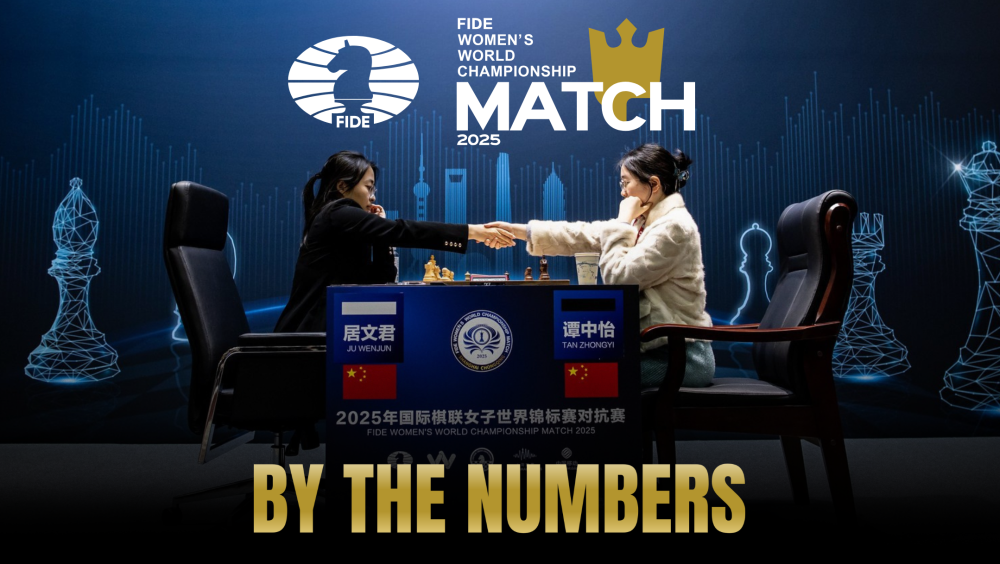
As the 2025 FIDE Women’s World Championship Match comes to a close, the numbers tell a compelling story of fighting chess. Spanning two cities and nine gripping games, the match between Ju Wenjun and Tan Zhongyi was a battle of precision, stamina, and nerves, reflected not just in the score – but in the statistics. Total moves played: 517A total of 517 moves were played throughout the match, with both players navigating sharp opening preparation, complex middlegames, and tense endgames. Minutes spent at the board: 2,246The games were all lengthy battles spanning over a total of 2,246 minutes – that’s nearly 38 hours of focus and mental exertion! Longest game:Game 3 – 87 moves, 326 minutesThe longest game of the match was Game 3, lasting 87 moves and 326 minutes. It was a critical turning point in the match, with Ju converting a small advantage into a full point after a marathon struggle. After more than five hours, it ultimately tilted the momentum of the match as Ju bounced back from her game 2 loss, regaining her confidence. Shortest decisive game:Game 7 – 47 moves, 242 minutesIn contrast, the shortest victory came in Game 7. It lasted 47 moves and 242 minutes, and ended in a decisive win for Ju Wenjun. Interestingly, this was Tan Zhongyi’s favorite game. Tan, playing with the black pieces, held a slight advantage, which Ju first equalized and then transitioned into a winning endgame. Highest accuracy decisive game:Game 8 – Ju Wenjun: 98%The highest accuracy in a victory was recorded in Game 8, where Ju Wenjun scored an exceptional 98% accuracy with the black pieces. After Tan erred in the middlegame, Ju capitalized with great precision, leaving her opponent no room to come back. Average accuracy across the match: Ju Wenjun: 96.4% Tan Zhongyi: 94.6% The consistency and precision of both players speak volumes about the world-class level of the match, with Ju holding a slight but significant edge. Most popular opening:Sicilian DefenseThere were many repeat openings, particularly by Tan, and it was her consistent choice of employing the Sicilian Defense as Black that makes this the most popular opening of the match. The Sicilian, known for its dynamic and unbalanced nature, its constant use reflected both players’ combative spirit and unwillingness to settle for quiet draws. In the end, Ju Wenjun held her nerve and claimed the title for a fifth consecutive time—an incredible achievement that speaks to her consistency, strength, and experience at the very highest level. But this match was never one-sided. Tan Zhongyi pushed her all the way, creating chances and keeping the tension alive until the very end. It was a hard-fought battle, rich in content and drama, and one that will be remembered as a true showcase of elite women’s chess.
Crowning a Champion: Ju Wenjun clinches her fifth title

In the final game of the FIDE Women’s World Championship Match, tension could be felt in the playing hall. Tan Zhongyi entered the game with nothing to lose, while Ju Wenjun carried the pressure of needing only half a point to secure her fifth world title. The stakes couldn’t have been higher. Draws have been a rarity throughout the match, with six out of the eight previous games producing decisive results. That made the outlook for today’s game particularly intriguing. Would Ju play solidly to secure the draw she needed, or would we witness another fighting battle? Though the score may suggest a dominant performance from Ju Wenjun, the reality is far more nuanced. Tan Zhongyi fought hard throughout the match, often holding promising positions, and never allowing Ju an easy ride. Despite being down, she entered the final game hoping to create imbalance and generate winning chances. But Ju, calm and focused, played with clarity and precision, guiding the game to the draw she needed. The final game opened with the Sicilian Rossolimo—revisiting the line from Game 6 where Tan, with the black pieces, obtained a slight edge. This time, Ju deviated with 5.Re1 instead of 5.d4, and the players soon found themselves navigating a fresh and dynamic position. White accepted an isolated queen’s pawn, which Ju temporarily sacrificed before regaining it after a series of trades. 18.Rad1 e5 19. Bxd4 exd4 20. Qb4 a5 21. Qxd4 Qxd4 22. Rxd4 Although Ju was behind on the clock by 30 minutes, the evaluation bar was firmly rooted in 0.0, with a simple and open position. Following further exchanges, the game transitioned into a rook endgame, and by move 38, repetition confirmed the result: a draw. Despite the absence of fireworks in the final game, the match as a whole was anything but dull. The final score might mislead the casual observer into thinking Ju Wenjun steamrolled her way to victory, but the reality was more complex. Every game was filled with tension, and no outcome was certain until the final moments. Take, for instance, Game 2, which appeared dead equal until a sharp collapse under time pressure: 40…Ke8?? (instead of 40…b4!)Ju Wenjun, playing Black, faltered at the critical moment, allowing Tan Zhongyi to seize her opportunity and score her first win. This pattern repeated in every single game – both players lay in wait like pythons beneath the sand, ready to strike the moment their opponent slipped. Or Game 6, where Tan, pushing too ambitiously, lost the thread: Instead of maintaining balance with quiet play, Tan pushed 31.h4? a move that allowed Ju to break through with 31…g4. The momentum shifted entirely, and Ju converted her advantage with surgical precision. These examples are not isolated. Nearly every game in the match followed this pattern of high tension, mutual pressure, and a readiness to capitalize on the opponent’s mistakes. In the final post-game press conference, Ju and Tan expressed that their favorite games were games 8 and 7 respectively because of the quality of play. The Women’s World Championship Match has shown us an admirable display of not only skill – but immense fighting spirit from both sides. And fighting spirit is, after all, a key ingredient for any great chess player. With this draw, Ju Wenjun secures her place in history. She is now a five-time Women’s World Champion—a new record among Chinese players. Her legacy, built on years of consistent excellence and determination, will inspire generations to come. FACT SHEET, Game 9, FIDE Women’s World Championship 2025: White: Ju WenjunBlack: Tan ZhongyiResult: ½ Opening: Sicilian Rossolimo Game length: 38 movesMatch score: 6.5-2 (in favour of Ju Wenjun) Follow FIDE’s social media channels for updates, tune into YouTube for live commentary and coverage, and visit the official match website for more information. Written by Charlize van Zyl Photos: Anna Shtourman Official website: womenworldchampionship2025.fide.com/
Game 7 turns dramatic: Ju Wenjun capitalizes to lead 5-2
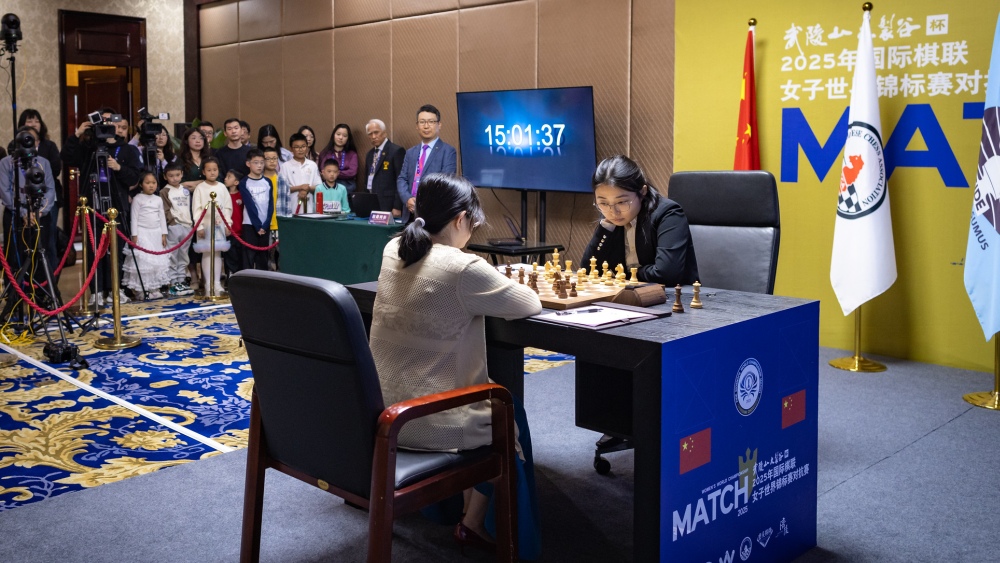
After a two-day break, the FIDE Women’s World Championship Match resumed with Game 7 in its second host city, Chongqing—and what a dramatic game it was. It looked as though Tan Zhongyi was on track to repeat her 2018 feat by claiming victory in the first game of the second half, but under immense time pressure, she first allowed her advantage to slip into equality and then made a critical error that left her in a completely lost position. Ju Wenjun converted with precision, extending her lead in the match to 5–2. The ceremonial first moves were made by Xu Yuhua, General Secretary of the Chinese Chess Association (and, of course, the 11th Women’s World Chess Champion), and Wu Hui, Member of the Standing Committee of the Chongqing Fuling District Committee. The moment before the game began was tense. As the 60-second timer on the clock counted down, the hall fell completely silent. Both players were locked in deep focus, their eyes fixed on the board. One could almost feel the pressure in the air. While both players face the shared weight of a World Championship match, their circumstances differ greatly. Tan Zhongyi, the challenger, began the second half trailing by two points—a significant deficit that will require her to take risks in the remaining games to try and level the score. Ju Wenjun, the reigning World Champion, holds the lead, but also bears the pressure of maintaining it. We’ve now left her home turf, which seemed to favor her, so the question becomes: Can she keep up her momentum on Tan’s home ground? Of the first six games, four ended decisively—a rare occurrence at the World Championship level. And with so much at stake for both players, that trend of decisive results may well continue. Once again, the opening was a Sicilian—in fact, every game with Ju as White and Tan as Black has featured the Sicilian, while every game with the reverse colors has seen an English Opening. Though this repetition might seem monotonous, the variations have been different. In today’s game, we saw a Rossolimo, setting the stage for an imbalanced, fighting battle. Both players appeared well-prepared, with Ju achieving another Maroczy Bind setup, her pawns on e4 and c4. Tan responded confidently, blitzing out moves from a line previously played by her second, Jeffrey Xiong, against Wesley So in 2020. While Xiong lost that game with the Black pieces, Tan deviated with 9…Be7 instead of 9…Bc4. Interestingly, neither player was aware of that earlier game. Overall, Tan has shown superior opening preparation throughout the match, and today was no exception—until Ju steered the game out of theory and into uncharted territory. An interesting observation: Tan spent more time in the opening than in any of the previous games. In the post-game press conference, she admitted this was a deliberate attempt to find variations that would give her winning chances right from the opening. Ironically, that approach eventually led to the fateful time trouble. Still, it was Black who seemed more comfortable, maintaining an edge through much of the opening and middlegame. She even secured an extra pawn, and with the bishop pair on the board, her position looked promising. However, failing to capitalize on key moments, Tan eventually allowed the position to equalize, until, under time pressure, she committed the most critical error of the game: Black had multiple options in this position, such as 35…Kg7 and 35…Rb4, and needed to realize that the c6-pawn could not be protected due to …Bb7, activating her worst-placed piece. Instead, Tan erred by first playing 35…Bb7?, stubbornly holding onto the pawn. This was met with 36.Bc5!, forcing the dark-squared bishops trade; otherwise, White’s knight would jump to d6. After 36…Bxc5 37.Nxc5, the tables turned and White now had a monster knight versus a miserable bishop. Tan could have tried to resist with the 37…a4 push, but this opportunity was missed. Instead her bishop became locked up on a8, with the key effectively thrown away. White soon collected the h-pawn, then the a-pawn, and played the remainder of the game essentially a piece up due to Black’s bad bishop. This game was expected to unfold differently—even this report was originally written with a focus on positional nuances and critical decisions from both sides. But ultimately, Tan’s 35…Bb7 became the game’s defining moment. Despite playing well and gaining an advantage with the Black pieces, that one move overshadowed everything else. In chess, it’s often said that the loser is the one who makes the last mistake, and today, that was Tan Zhongyi. Ju Wenjun now leads the match 5-2 and needs only 1.5 points from the remaining five games to retain her title. Game 8 will take place tomorrow, April 14, at 15:00 local time, with Tan Zhongyi having the white pieces. FACT SHEET, Game 7, FIDE Women’s World Championship 2025: White: Ju WenjunBlack: Tan ZhongyiResult: 1-0Opening: Sicilian RossolimoGame length: 47 movesMatch score: 5-2 (in favour of Ju Wenjun) Follow FIDE’s social media channels for updates, tune into YouTube for live commentary and coverage, and visit the official match website for more information. Written by Charlize van Zyl Photos: Anna Shtourman Official website: womenworldchampionship2025.fide.com/ About the Match The 2025 FIDE Women’s World Chess Championship match between Ju Wenjun and Tan Zhongyi follows a 12-game format. The first player to score 6.5 points will be declared the winner. The time control for each game is 90 minutes for the first 40 moves, followed by 30 minutes for the rest of the game, with an increment of 30 seconds per move starting from move 1. If the match is tied at 6-6 after all 12 games, a tiebreak will determine the champion. The tiebreak procedure involves a series of rapid and, if necessary, blitz games to ensure a decisive outcome.
Chongqing welcomes the second half of Women’s World Championship Match

The 2025 FIDE Women’s World Championship Match between reigning World Champion Ju Wenjun and Challenger Tan Zhongyi continues in Chongqing, where the second half of the match was officially opened today with a press conference at the luxurious Jinke Grand Hotel – the venue for the remainder of the event. The players and their teams arrived yesterday evening after a long journey from Shanghai, which included a 2.5-hour flight followed by a scenic bus ride from Chongqing Airport to the hotel. Nestled in the mountains, Chongqing is one of the largest cities in the world. As Tan Zhongyi noted during the Game 6 press conference, although the match is taking place in her home city, it is still quite far from where she resides. Beyond the picturesque views, what truly stood out was the warmth and hospitality of the people. The local organizing committee went above and beyond to ensure a smooth and comfortable arrival for all traveling from Shanghai. Their meticulous planning and attention to detail reflect a high level of professionalism. The press conference panel featured several distinguished officials: Deputy Chair of the FIDE Management Board Dana Reizniece, Secretary General of the Chinese Chess Association Xu Yuhua, Deputy Director of the Chongqing Municipal Sports Bureau Du Xueyong, and Member of the Standing Committee of the Chongqing Fuling District Committee Wu Hui. Representing FIDE, Dana Reizniece extended heartfelt thanks to the organizing teams in both Shanghai and Chongqing for their commitment and dedication: “I would like to express our sincere gratitude to the organizers of the first part of the match in Shanghai—the Shanghai Administration of Sports, the Chinese Chess Association, the Shanghai Chess Academy, and the Shanghai Board and Card Games Administrative Center. The tournament was exceptionally well organized, and the conditions provided for both players and officials were outstanding. The professionalism and dedication of the organizers ensured a world-class experience for everyone involved. Thank you for your excellent work. I would also like to extend our heartfelt thanks to the Chongqing Administration of Sports, the Chess Department of China Qi-yuan, and the Chongqing Board and Card Games Administrative Center for having us here. We had the pleasure of experiencing their outstanding work during the 2023 match, and we are confident that, once again, we will witness the same level of dedication, professionalism, and commitment over the coming days.” At the heart of this match lies a celebration of women and chess. Dana Reizniece continued: “For nearly a century, the world of chess has celebrated its queens. From the trailblazing Vera Menchik in 1927 to Ju Wenjun today, 17 extraordinary women have held the title of World Champion, each leaving a lasting legacy and opening doors for the next generation. China has played an incredible role in this. Today’s match between Tan Zhongyi and Ju Wenjun is not only a milestone for the sport — but also a moment of national pride. China is one of the world’s leading chess nations, producing world champions and contributing greatly to the development of our sport. Women’s chess has seen remarkable growth, and FIDE is proud to have placed its development at the heart of our mission. And yet, our work is far from over. FIDE is proud to support this growth through new initiatives like the Women’s Grand Prix, tournaments for women and girls, support for chess moms competing in over-the-board events, and many others — all aimed at creating more opportunities for female players around the world.” Mr. Du Xueyong then took the floor to present the match schedule and logistical preparations. The second half consists of six games, unless a player reaches 6.5 points before that, which would secure the title. If the match is tied after 12 classical games, tiebreaks will follow to determine the winner and crown the new champion. The championship trophy – a stunning glass Phoenix Coronet, was unveiled today by Ms. Reizniece. Crafted using an ancient Chinese glass-making technique, it features a delicately designed peony flower at its center. Known as the “king of flowers,” the peony is a symbol of prosperity, grace, and beauty in Chinese culture. The process of creating the trophy also holds deep meaning: “Craftsmen fired the pink peony at temperatures over a thousand degrees. Every step was done with great care and skill. This process reflects the spirit of craftsmanship – just like a chess champion, the trophy was made through hard work, many challenges, and the pursuit of excellence.” Soon, a new Women’s World Champion will be crowned. Who will lift the phoenix coronet – Ju Wenjun, defending her title, or Tan Zhongyi, reclaiming it once again? The seventh game is scheduled to begin tomorrow, April 13, 2025, at 15:00 local time. Follow FIDE’s social media channels for updates, tune into YouTube for live commentary and coverage, and visit the official match website for more information. Written by Charlize van Zyl Photos: Anna Shtourman Official website: womenworldchampionship2025.fide.com/ About the Match The 2025 FIDE Women’s World Chess Championship match between Ju Wenjun and Tan Zhongyi will follow a 12-game format. The first player to score 6.5 points will be declared the winner. The time control for each game is 90 minutes for the first 40 moves, followed by 30 minutes for the rest of the game, with an increment of 30 seconds per move starting from move 1. If the match is tied at 6-6 after all 12 games, a tiebreak will determine the champion. The tiebreak procedure typically involves a series of rapid and, if necessary, blitz games to ensure a decisive outcome.
Goodbye, Shanghai! Ju extends lead before the break in Chongqing
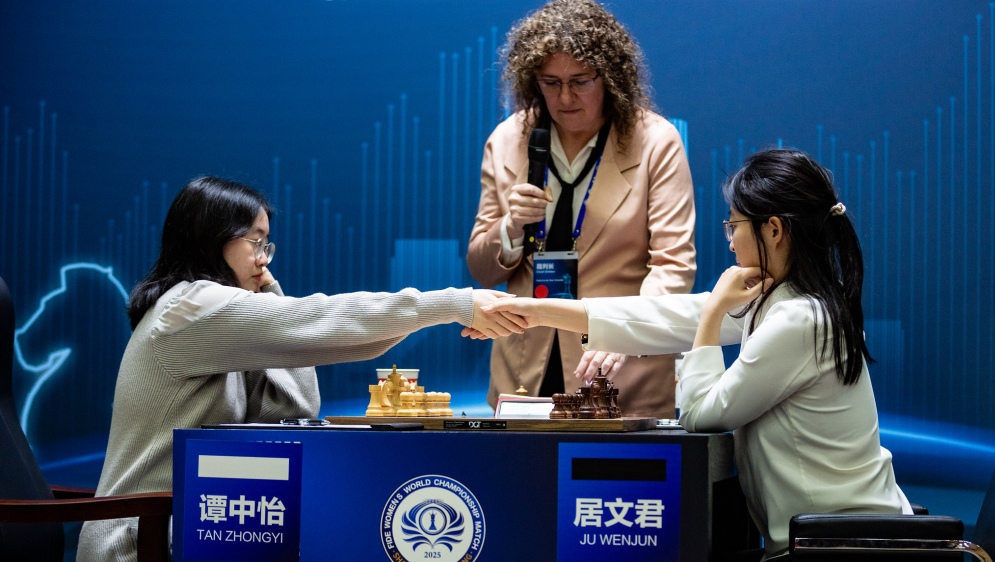
Women’s World Champion Ju Wenjun defeated Challenger Tan Zhongyi with the black pieces to close out the first half of the match with a crucial win. This result marks her third victory in the last four games, giving her a 4–2 lead as the match shifts to Tan’s home city of Chongqing. When asked yesterday whether the result of today’s game would carry any particular significance, both players emphasized that each game holds equal importance and would be approached accordingly. Yet, considering that it was the final encounter before the halfway mark and two upcoming rest days, it’s fair to conclude that, objectively, this one did matter. The first ceremonial moves in Game 6 were performed by Zhang Yi, Director of Youth Sports and Education Dept., Shanghai Administration of Sports and Victor Bologan, FIDE Management Board Executive Director. Once again, the English Opening made an appearance, but this time Tan Zhongyi chose a double fianchetto setup. The opening, however, did not yield a favorable position for White after the challenger opted for 12.Ne5 instead of more natural 12.Na3-c4 played in the game Duda – Anand (Global Chess League, 2023). With straightforward and solid play, Black equalized first and then seized the initiative. A key weakness in White’s position was her knight on a3. In chess, we are taught the phrase “knights on the rim are dim” (coined by Siegbert Tarrasch in the 19th century) referring to their limited activity on the edge of the board. Though initially, Tan Zhongyi’s knight had good opening prospects, it remained on the edge for far too long, and when it eventually moved, it moved too much, dancing around the board and never finding a good square. Eventually, Black’s initiative turned into a tangible advantage: Ju appeared poised to secure her second consecutive point after she played 21…g5! with the idea of grabbing space on the kingside and taking control over the light squares. Not an easy move to find on the board, particularly since Black had many other attractive options in an already comfortable position. It was by far the best move and she made it! Tan blitzed out 22.Ne1 (the best defensive move in the position) and another critical moment arose. The combination of ideas revolving around g5-g4 and c5-c4 pushes became crucial. On the kingside, Black would control the light squares, preparing the knight’s hop into g5. Meanwhile, on the queenside, the creation of a passed pawn and the threat of pushing c3 loomed. The position was so commanding that FIDE commentator GM Evgenij Mirosnichenko remarked, “Black can even say ‘pass’ in this position and not make a move, and she would still be winning.” And yet, Ju followed up with one of the few moves that allowed White to fully equalize. 22…Bf6? Although at a glance the bishop on b2 appeared well-placed on the long diagonal, it was, in reality, an ineffective piece, facing little more than empty space. By playing …Bf6, Black gave White the opportunity to exchange this bishop, followed by a series of trades involving the rooks. In a flash, the venom was sucked out of Black’s position. Carrying out Black’s plan with ether 22…g4 or 22…c4 was key to sustaining the advantage, but with those trades, the initiative petered out. With most pieces removed from the board, Black’s earlier kingside expansion, once strength, became a liability as her king was exposed. Tan wisely kept the queens on the board, a decision that preserved her chances in a position where a knight endgame would have clearly favored Black, thanks to her queenside pawn majority and more active king. The position with queens, knights, and pawns remained balanced and appeared to be heading toward a draw. But in this match, assumptions about outcomes have often proven unreliable. Even seemingly equal positions have been transformed into wins by both players. Ju Wenjun had faltered in the second game’s endgame – her only misstep so far, leading to a loss. But since then, she has showcased impeccable endgame technique, vindicating herself with strong performances in successive games. Today was no exception. “The area of the game we’re the least good at is ‘passively waiting’,” remarked Mirosnichenko, referring to the subtle art of doing nothing when the position calls for it – allowing your opponent to reveal their hand. Ju seemed to grasp this nuance perfectly, while her compatriot did not. In this calm yet critical position, White did not remain patient. Instead, she played 31.h4?, a provocative move that introduced a range of tactical possibilities. Was this Tan’s attempt to press for a win? The move allowed Black to seize control with 31…g4! a dominating response that shifted the balance in her favor. After 32.Qb7+, there were some opportunities for White, as many of Black’s responses would lead to equality. However, a misstep such as 32…Kg6? Would have drastically changed the engine evaluation. This is an interesting tactical puzzle moment – how can White seize the advantage here? (solution at the end) But Ju responded precisely with 32…Qd7! forcing the exchange of queens and neutralizing any chance of counterplay. With the queens off the board, the endgame became straightforward. Ju centralized her king and converted the advantage confidently—delivering a masterclass in endgame play and making it appear effortless. Of course, no game on a world championship stage is ever truly easy, especially with the pressure involved. But Ju seems to be managing that pressure well, having won three of the last four games. She heads into the second half of the match with a commanding two-point lead. A strong surge in momentum, though, the two-day break could still shift the psychological dynamics. For Tan Zhongyi, the break offers a much-needed reset. She now returns to Chongqing with the weight of back-to-back losses. Whether playing on home soil will help revive her confidence remains to be seen. “It will be tough, but I’m a professional player and I know how to deal with pressure,” the challenger said when asked about how
Ju Wenjun strikes and seizes the lead in Game 5
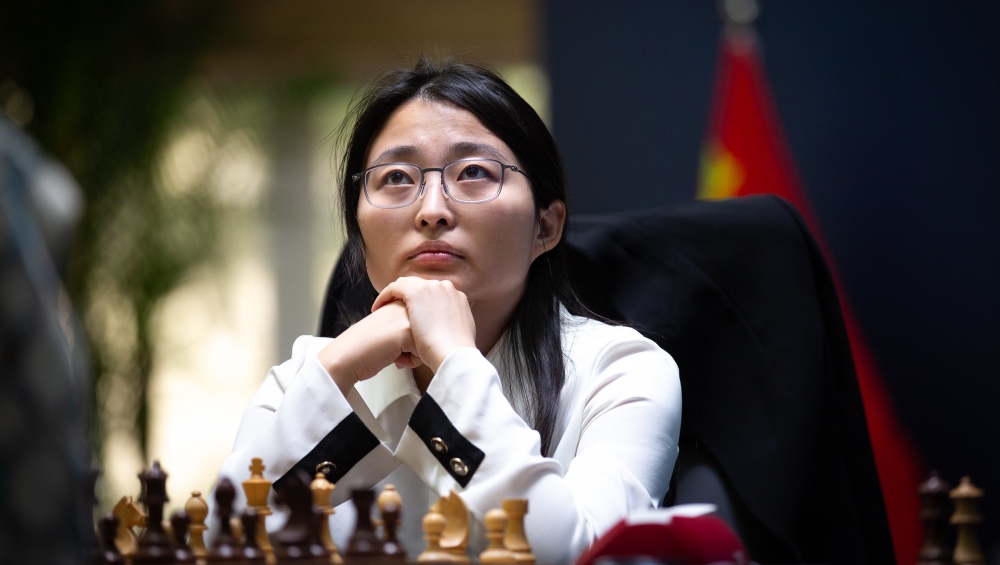
For the first time in the match, reigning World Champion Ju Wenjun has taken the lead, winning Game 5 in commanding fashion. After an opening that went awry for Tan Zhongyi, playing with the Black pieces, White quickly gained a significant advantage. Though the evaluation fluctuated, Ju remained in control, eventually picking up material for no compensation—leading to a completely dominant position and a well-deserved victory. Today’s game was a sharp contrast to the marathon 81-move draw in Game 4. In that encounter, Tan obtained promising positions but failed to convert. This time, the roles were reversed, and Ju Wenjun made no such mistake. She kept a firm grip on the position, never allowing her opponent a chance to escape. This sense of déjà vu has been a recurring theme throughout the match—even before it began. The same two players are once again battling for the world title, and this year, we’ve even seen repeated opening choices. In every game where Ju has had White, Tan has responded with the Sicilian. However, today, Tan opted for the Kan Variation, an intriguing decision that even drew a comment from Grandmaster Anish Giri on X (Twitter). As usual, Tan blitzed out her opening moves, appearing confident in her preparation (or at least projecting that impression). Throughout the match, her Black games have featured similar pawn structures. However, Ju, who typically takes more time in the opening, surprised her opponent with the early advance 10.c5 (a new move in this position), steering the game out of Tan’s prepared lines. For the first time in the match, Tan paused for 10 minutes on a single move. In the post-game press conference, Tan admitted that this move was not part of her preparation, so she had to find a way forward at the board. However, the plan she chose was not ideal. Her pieces became awkwardly placed, while Ju’s setup was smooth and harmonious. To make matters worse, Tan lagged in development, repeatedly moving the same minor pieces. A few moves later, White had taken the upper hand, but her advantage briefly slipped away: Here, the intermezzo 15.Qd4 would invite 15…cxb2, after which 16.Bxb2 creates powerful pressure along the a1–h8 diagonal. The move also targets the weakened kingside, controls the e5-square, and if Black castles (15…0-0), then 16.f5! would be devastating. In the game, Ju opted for 15.bxc3 – a solid choice that still retained an advantage. However, after 15…Bb7, the Qd4 idea became critical to implement. Instead, Ju played the more passive 16.Qe2, dropping a significant part of her advantage. Now, any kingside expansion with f5 could be met by the knight’s jumping to e5. Ju admitted in the post-game press conference that she did not spend much time on Qd4. Two moves later, it was actually Black who pushed 17…f5? (instead of the more reserved 17…Qc7), but it backfired, weakening her king’s position and leaving White with a commanding advantage. It was not easy getting a confidence read on Tan – she would often play with her usual speed, and stroll around the tournament hall even though the position on the board told a different story. The optics of confidence have worked for her so far, but this time a comeback seemed unlikely as the game progressed. Even though Ju did not convert her advantage with a surgical precision, she was always more comfortable, and the one in the driver’s seat. Eventually, she picked up another pawn and emerged two pawns up for which Black had no compensation. With a material advantage, an outside passed pawn, and better-coordinated pieces, White’s win became straightforward. Ju had a wide range of playable options, while Black struggled to find any plan at all. Yet, as we’ve seen throughout the match, it’s never truly over until the final move. Tan tried to stir up counterplay, first by exchanging two minor pieces for a rook and a pawn, followed by infiltrating White’s vulnerable back rank with threats of mate. Ju had to navigate carefully, sidestepping potential pitfalls. But the World Champion demonstrated necessary accuracy when it mattered most. Eventually, with her ammunition run out, Tan Zhongyi had nothing left to fire and, after 59 moves, she resigned. This marks the first time Ju Wenjun has taken the lead in the match – an important psychological boost, especially with the added confidence of playing on home soil. One final game remains in Shanghai before the match moves to Chongqing, and it is shaping up to be the most psychologically significant of the match so far. FACT SHEET, Game 5, FIDE Women’s World Championship 2025: White: Ju WenjunBlack: Tan ZhongyiResult: 1-0Opening: Sicilian Defence, Kan VariationGame length: 59 movesMatch score: 3-2 (in favour of Ju Wenjun) Follow FIDE’s social media channels for updates, tune into YouTube for live commentary and coverage, and visit the official match website for more information. Written by Charlize van Zyl Photos: Anna Shtourman Official website: womenworldchampionship2025.fide.com/ About the Match The 2025 FIDE Women’s World Chess Championship match between Ju Wenjun and Tan Zhongyi follows a 12-game format. The first player to score 6.5 points will be declared the winner. The time control for each game is 90 minutes for the first 40 moves, followed by 30 minutes for the rest of the game, with an increment of 30 seconds per move starting from move 1. If the match is tied at 6-6 after all 12 games, a tiebreak will determine the champion. The tiebreak procedure involves a series of rapid and, if necessary, blitz games to ensure a decisive outcome.
Draw full of drama: Tan Zhongyi misses her chance to take the lead
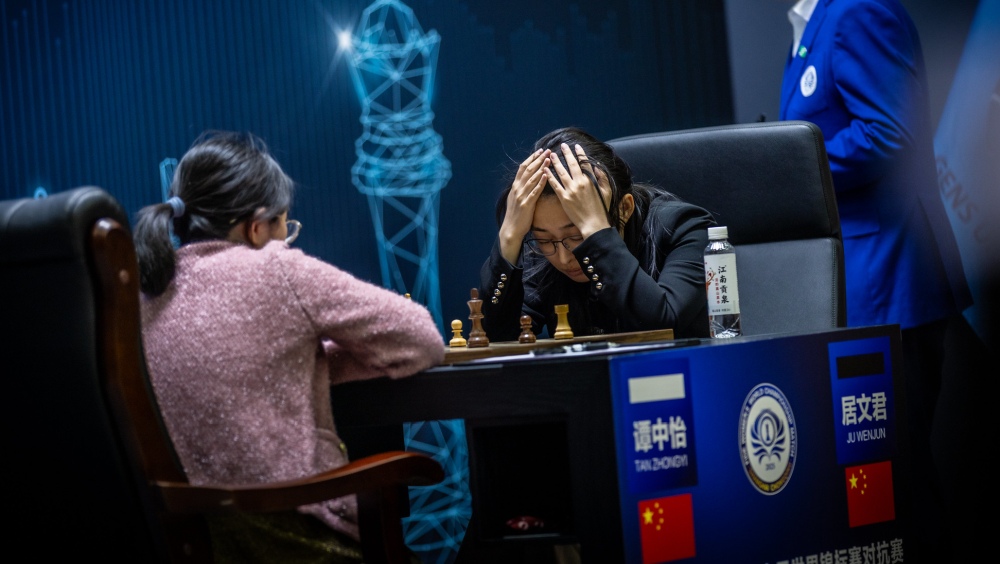
Time trouble and middlegame madness characterized today’s game, and not just in moments, but throughout nearly every phase. It was a game that teased decisive results, but ultimately ended in a draw that felt anything but quiet. With two of the three previous games in the match ending decisively, today’s clash carried psychological weight. Would the players opt for a cautious draw, or dare to push for a lead? If the match so far was any indication, fireworks were more likely than fizzle, and indeed, the game sparked to life straight out of the opening. Song Hui, Deputy Director of Shanghai Administration of Sports and Mohd AI-Mudahka, Arab Chess Federation 1st Vice-President performed the first ceremonial moves in Game 4. Tan Zhongyi revisited her Game 2 opening with 1.c4, but Ju Wenjun deviated with 1…e6, followed by a confident 2…Bb4 after 2.Nc3. Tan paused only briefly before playing 3.Qb3, bringing her queen out early. Known for her quick play that showcases her confidence, Tan even remarked in yesterday’s press conference that she believes she could be playing faster. It made one wonder whether Ju’s opening preparation had surprised her. However, it was Ju who soon began to fall behind on the clock, and by move 6, the players had reached a position unseen at top level. Once again, they entered an original battleground. The first clear sign that this would be a fighting game came when Ju sacrificed a pawn in exchange for activity and attacking chances. Tan declined the offer, continuing with 12.Be3, but then, a few moves later, she offered her own pawn in return: Ignoring Black’s pressure on the d-pawn, Tan played 18.Bf4, causing Ju to burn 20 minutes on her reply. After 18…Nxd4 19.Rfd1 Nb5 20.Nxb5 axb5 21.Qb3, Black found herself in a tangled position and short on time, with just over 20 minutes remaining. At this point, White seemed poised to score a third straight win in the match. Tan had outplayed her opponent and taken control. But perhaps that very control made her overconfident as Tan missed a critical detail. Here, 24.Qxb6 would have restored material balance while leaving White with the bishop pair, actively placed pieces, a dangerous outside passed pawn and great winning chances. Instead, Tan opted for the ambitious 24.Bd6, perhaps envisioning a continuation like 24…Re8 25.Ba3 and a smooth path to victory. In the post-game press conference, Tan said that she simply miscalculated. Ju, however, quickly responded with 24…Ra5! Suddenly, …Qxb6 was no longer attractive due to …Nc8, which would neutralize White’s advantage by eliminating the bishop pair. The tide turned. The game continued and an interesting moment arose on move 30 which I want to present to the reader as a fun puzzle (you can find the solution at the end). Here, Ju had the opportunity to play 30…d4, sacrificing a pawn (a recurring motif in the game). But this pawn was poisoned. If White captured with 31.Rxd4, she would walk into serious trouble. (Try solving this as a puzzle – solution at the end!) Instead, Ju played 30…Bf5, preparing the exchange of light-squared bishops. A few moves later, she misjudged a queen trade, and White regained the advantage with a bishop versus knight, a more active rook, and a dangerous outside passed pawn. But the pattern repeated. Tan, in her trademark rapid style, pushed her b-pawn too early, neglecting a vital endgame principle: activating the king before advancing. Though her plan was correct, the sequence mattered, and this inaccuracy allowed Ju to counter with her d-pawn, pushing it all the way to the second rank. It was ultimately exchanged for White’s h-pawn, and the once-promising b-pawn had barely moved. Ju’s time trouble, an ongoing theme in the match, returned in full force. With under a minute on her clock and a tough position to navigate, she was under tremendous pressure. Tan, still up by over 20 minutes, tried to keep the heat on by playing quickly. But once again, this cost her dearly. In a position where precision was key, she missed the optimal move order, and the game became a technically drawn rook and pawn endgame. On move 81, with only the kings left on the board, the players shook hands as the game was drawn. The match was destined to be a closely contested one, and today’s game proved it once again. Tan had her chances, and expressed disappointment in her play in the post-game press conference, but Ju showed why she is the reigning World Champion and found key moves in critical moments. Tomorrow they will have their second official rest day before resuming the battle. Puzzle Solution The d4 pawn push opened up the d5-square for Black so 31.Rxd4 is met with 31…Nd5! And White has to capture as the queen and bishop are forked. But 32.Bxd5 runs into 32…Qb1+ 33.Kg2 Bxd5+ 34.Rxd5 and 34…Qe4+! picking up the rook. FACT SHEET, Game 4, FIDE Women’s World Championship 2025: White: Tan ZhongyiBlack: Ju WenjunResult: ½-½Opening: EnglishGame length: 81 movesMatch score: 2-2 Follow FIDE’s social media channels for updates, tune into YouTube for live commentary and coverage, and visit the official match website for more information. Written by Charlize van Zyl Photos: Anna Shtourman Official website: womenworldchampionship2025.fide.com/ About the Match The 2025 FIDE Women’s World Chess Championship match between Ju Wenjun and Tan Zhongyi follows a 12-game format. The first player to score 6.5 points will be declared the winner. The time control for each game is 90 minutes for the first 40 moves, followed by 30 minutes for the rest of the game, with an increment of 30 seconds per move starting from move 1. If the match is tied at 6-6 after all 12 games, a tiebreak will determine the champion. The tiebreak procedure involves a series of rapid and, if necessary, blitz games to ensure a decisive outcome.
Déjà vu in Shanghai: Ju and Tan begin title rematch with balanced battle
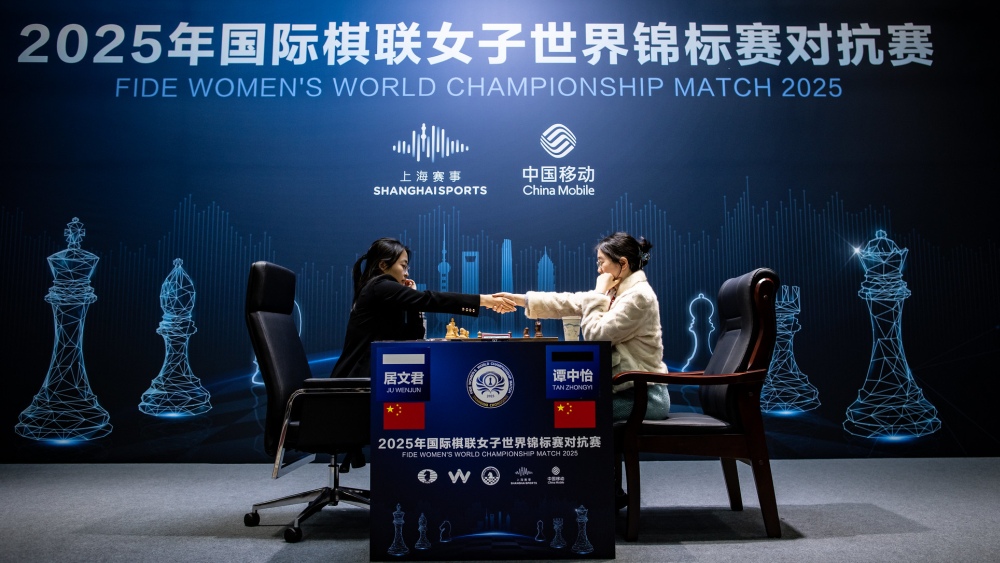
The FIDE Women’s World Championship Match 2025 began today at 15:00 local time in Shanghai, China. Ju Wenjun had the White pieces, while Tan Zhongyi, playing with black, steered the game into the Sicilian Defence. After 39 moves, with no major fireworks, the game concluded in a logical draw. Yesterday was a packed media day featuring interviews, press conferences, and the opening ceremony – all pointing toward a fiercely competitive match ahead. The storyline is compelling: two world champions, current and former, battling for the coveted title. Adding further intrigue is the déjà vu element, as the two players faced off in 2018, when Ju was the challenger and Tan the reigning champion. Ju claimed the title in that match and has successfully defended it ever since. This time, the roles are reversed, with Tan returning as challenger for the first time against her compatriot. The psychological backdrop is equally fascinating. In her exclusive interview with FIDE, Tan spoke with confidence, emphasizing that while she viewed herself as “lucky” to be playing the 2018 match (having winning the title in 2017 in a knockout tournament) this time she felt more assured, having earned her place by winning the Candidates. With only a six-point rating difference between them, the outcome may come down to confidence. At the start of today’s game, their body language told a subtle story. Tan appeared relaxed, sipping coffee and glancing around the room, while Ju was intensely focused, her eyes fixed solely on the board. The ceremonial first move was made by He Fengxiang, Director of the Chess and Card Sports Management Center of the General Administration of Sport of China and President of China Qiyuan, along with Xu Bin, Director of the Shanghai Municipal Sports Bureau. At exactly 15:00 local time, the chief arbiter started the clock, and the match was officially underway. Both players raced through the early stages of the Sicilian Defence, French Variation – a calmer line compared to typical Sicilian battles. Ju deviated from the mainline with 5.Bd3 – a less common continuation than 5.Nc3, though not unusual at the elite level. Tan, seemingly still in preparation, continued to play quickly. However, after 9.Bg5, the challenger paused for over five minutes, suggesting she was now out of preparation. In the post-game press conference, she acknowledged the psychological impact of that move and responded accurately with 9…h6. A few moves later, Ju took her time for the first time in the game, indicating that both players were now navigating unfamiliar territory – something rare and refreshing at this level in today’s computer-driven era. Ju appeared slightly more comfortable out of the opening thanks to her active pieces, while Tan’s bishop on c8 remained undeveloped. On move 14, Ju spent nearly 20 minutes before simplifying the position with a trade and breaking in the center, signaling that the game was drifting toward a draw – though not without its complexities. An interesting moment arose on move 18. Ju opted not to play 18.cxd5, which would have gained an extra pawn but allowed Black’s pin with 18…Ba6. Instead, she targeted the weak h6-pawn with 18.Qe3, prompting Tan to find the precise 18…Qg5. After the queens were exchanged, White captured on d5, leaving Black with an isolated queen’s pawn, balanced by the open nature of the position and a bishop versus knight scenario. Neither side had a tangible advantage or clear path to push for more. With this in mind, neither player was willing to take significant risks. With the engine bar showing complete equality, the game eventually ended in a draw. While we didn’t witness any fireworks today, the game suggested that we won’t be seeing quick, uneventful draws either. Will the players adopt a more aggressive approach as the match progresses? Or will caution prevail, potentially leading to tiebreaks? It’s too early to tell, and only time will reveal the course of this tightly contested match. The second game of the match will take place on Friday, April 4t, at 3 PM local time in Shanghai, with Tan Zhongyi playing White. FACT SHEET, Game 1, FIDE Women’s World Championship 2025: White: Ju WenjunBlack: Tan ZhongyiResult: ½-½Opening: Sicilian Defence, French variationGame length: 39 movesMatch score: ½-½ Follow FIDE’s social media channels for updates, tune into YouTube for live commentary and coverage, and visit the official match website for more information. Written by Charlize Van Zyl Photos: Anna Shtourman Official website: womenworldchampionship2025.fide.com/ About the Match The 2025 FIDE Women’s World Chess Championship match between Ju Wenjun and Tan Zhongyi follows a 12-game format. The first player to score 6.5 points will be declared the winner. The time control for each game is 90 minutes for the first 40 moves, followed by 30 minutes for the rest of the game, with an increment of 30 seconds per move starting from move 1. If the match is tied at 6-6 after all 12 games, a tiebreak will determine the champion. The tiebreak procedure involves a series of rapid and, if necessary, blitz games to ensure a decisive outcome.
A grand occasion: 2025 FIDE Women’s World Championship opening ceremony
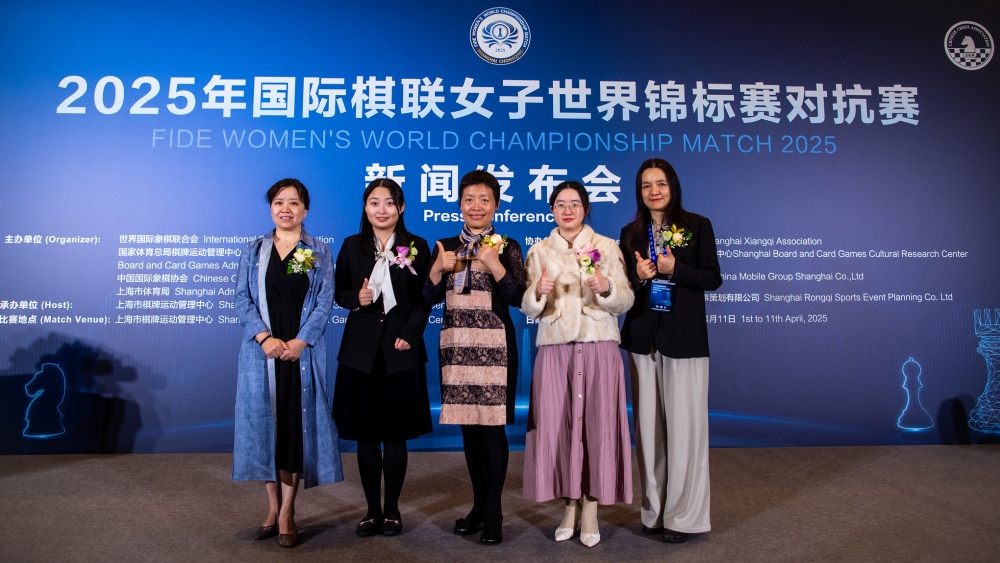
The official press conference and opening ceremony of the 2025 FIDE Women’s World Championship took place today in Shanghai, set against a prestigious backdrop befitting such a significant event. At approximately 16:00 local time, journalists gathered in the Grand Banquet Hall on the fifth floor of the JW Marriott Hotel Shanghai, eagerly awaiting the start of the official opening press conference for the 2025 FIDE Women’s World Championship Match. The press conference was divided in two segments – the first featuring officials and organizers, and the second with the players. Grandmaster Ni Hua, who recently served as Ding Liren’s second during the 2024 World Championship in Singapore, moderated the first half of the proceedings. The panel comprised Victor Bologan, FIDE Management Board Executive Director; Song Hui, Deputy Director of the Shanghai Administration of Sports; Du Xueyong, Deputy Director of the Chongqing Administration of Sports; Xu Yuhua, Deputy Director of the Chess Department of China Qi-yuan and General Secretary of the Chinese Chess Association; Liu Shizhen, Director of the Shanghai Board and Card Games Administrative Center; and Huang Bo, Director of the Chongqing Board and Card Games Administrative Center. Translation between Mandarin and English was provided throughout. Xu Yuhua presented the match details, after which Victor Bologan expressed FIDE’s gratitude to the organizers and emphasized the event’s significance, describing it as a “Celebration of Chess and China.” The floor was then opened to journalists for questions. Soon after, the stars of the event; Ju Wenjun and Tan Zhongyi, arrived. Questions centered on how the players felt and what the match meant to them. Both appeared in excellent spirits, smiling and responding to questions with enthusiasm. The atmosphere soon shifted to celebration as guests moved to the other side of the Grand Banquet Hall. With elegantly decorated tables filling the space, the setting perfectly reflected the grandeur of the occasion. The ceremony began with a promotional video that captured the intensity and drama of the championship about to commence. This was followed by introductions of the players and guests, and the playing of both the national anthem of the People’s Republic of China and the FIDE anthem. Xu Bin, Director General of the Shanghai Administration of Sports, delivered a welcome address, stating: “We are delighted to host the FIDE Women’s World Championship Match once again. Ju Wenjun will defend her title as reigning champion against Tan Zhongyi, marking their second showdown in this Championship Match. I believe that this world-class event will reignite Shanghai’s passion for chess once again, and further promote the popularity and development of the sport.” Next, He Fengxiang, President of China Qi-yuan, spoke about the prestige and legacy of chess in China: “As a brilliant crystallization of human wisdom, chess has always resonated with the development of the times since its introduction to China. From Xie Jun winning first world champion in 1991, which ushered in a new era of women chess in China, to Ding Liren’s historic breakthrough in winning the men’s champion in 2023, generation after generation have devoted unremitting efforts for 34 years to compose a magnificent chapter by presenting ‘the shining stars of the chess king and queen’ in the chess world.” Victor Bologan then read a letter on behalf of FIDE President Arkady Dvorkovich, who was unable to attend. “The match between Tan Zhongyi and Ju Wenjun is not only a milestone for chess but also for China,” he began, highlighting the nation’s legacy in the sport: “My dear friends, this year marks 50 years since China joined FIDE. Today, China is one of the world’s great chess nations. It has produced world champions in both the open and women’s competitions, holds the record for the most Women’s World Champions (six, ahead of the USSR’s five), and boasts numerous players in the world’s top 100. With such success comes great responsibility—to promote and expand the game. FIDE and the global chess community are deeply grateful for China’s contributions and hopeful that we will see even more investment in chess, more events, and an even brighter future for the game in this country.” Then came the eagerly awaited drawing of lots. Two bouquets were placed in front of the players, where the chief arbiter placed two silk bags in each and invited the World Champion to choose her bouquet. Ju Wenjun picked the flowers closest to her and opened her bag to reveal a white queen, determining their colors for the first game. The evening concluded with He Fengxiang, Xu Bin, Victor Bologan, Xie Jun, Song Hui, and Du Xueyong taking the stage to press their hands on the stage screen as a symbolic gesture marking the official start of the match. With the ceremony complete, guests and players remained in the banquet hall to enjoy a dinner featuring Chinese delicacies. The first game is scheduled to begin tomorrow, 03 April 2025, at 15:00 local time. Follow FIDE’s social media channels for updates, tune into YouTube for live commentary and coverage, and visit the official match website for more information. Written by Charlize Van Zyl Photos: Anna Shtourman Official website: womenworldchampionship2025.fide.com/ About the Match The 2025 FIDE Women’s World Chess Championship match between Ju Wenjun and Tan Zhongyi follows a 12-game format. The first player to score 6.5 points will be declared the winner. The time control for each game is 90 minutes for the first 40 moves, followed by 30 minutes for the rest of the game, with an increment of 30 seconds per move starting from move 1. If the match is tied at 6-6 after all 12 games, a tiebreak will determine the champion. The tiebreak procedure involves a series of rapid and, if necessary, blitz games to ensure a decisive outcome.