

Chess joins the International World Games Association

Lausanne, Switzerland – 25 April 2026 – The International World Games Association (IWGA) is pleased to announce that the International Chess Federation (FIDE) has been granted membership status within the organisation. The decision was taken by the IWGA Members during the Annual General Meeting (AGM) held at the Olympic Museum in Lausanne on 25 April 2026. Following a review process of the application submitted, IWGA Members voted to approve FIDE’s admission. With this decision, the number of IWGA Member Federations increases to 40. FIDE’s inclusion represents an important step in the continued development and diversification of the IWGA, further strengthening its global reach and the range of sports represented within The World Games Movement. As the international governing body for chess, FIDE brings a well-established global structure and a strong community of players and stakeholders. IWGA CEO, Joachim Gossow, welcomed the decision, stating: “We are very pleased to welcome FIDE as a Member of the IWGA. Chess is one of the most widely practised and recognised disciplines worldwide, and its inclusion reflects our commitment to embracing a diverse range of sports, including mind sports, within our organisation.” FIDE President, Arkady Dvorkovich, stated: “Chess is a truly global sport that unites millions of players across all continents through strategy, discipline, and creativity. Its inclusion within the IWGA reflects the growing recognition of mind sports alongside traditional athletic disciplines and the shared values of excellence, fair play, and international exchange. We are very excited for this new chapter and the opportunities it will bring for the continued development of chess within the international sporting movement.” The IWGA looks forward to collaborating with FIDE and exploring future opportunities within The World Games framework. About IWGA The International World Games Association (IWGA) is a non-profit-making international sports organisation recognised and supported by the International Olympic Committee. The IWGA comprises 40 International Member Sports Federations. It administers and promotes The World Games (TWG), a multi-sport event held every four years that features popular, traditional, emerging, and trend sports on its programme. The World Games 2025 took place in Chengdu (CHN) from 7-17 August 2025. 4,000 athletes from more than 110 countries took part in this 12th edition. The World Games 2029 will take place in Karlsruhe, Germany, from 19-29 July 2029, 40 years after it hosted TWG in 1989. Official website: https://www.theworldgames.org/
An emotional farewell to a historic 2026 Candidates

The closing ceremony of the 2026 FIDE Candidates and Women’s Candidates was a vibrant and memorable finale, an evening filled with emotion, celebration, and a distinctly Cypriot charm. Set against the stunning beachfront of the St. George’s Hotel & Resort, the one-and-a-half-hour show blended traditional dance, live music, bursts of fireworks, and moments of light-hearted humour. Hosts Maurice Ashley and Charlize Van Zyl opened the evening promptly at 8 p.m., welcoming an audience of more than 100 players, coaches, family members, friends, sponsors, and organizers. There was a palpable sense of pride and relief in the air after three intense weeks of competition, with smiles and laughter shared among the guests. Following the national anthem of Cyprus and the FIDE anthem, the audience was treated to a moving video recap of the tournament’s most memorable moments. The film drew warm applause and, maybe for some, a touch of nostalgia. The ceremony continued with a pre-recorded message from the President of Cyprus, Nikos Christodoulides, who praised the players’ dedication and highlighted the importance of hosting such a prestigious global event on the island. Viswanathan Anand, five-time World Champion and Deputy President of FIDE, then took the stage to warm applause. In a thoughtful and reflective speech, he spoke about the unmistakable generational shift taking place in the chess world: how a fearless new wave of players is rising, challenging, and standing shoulder to shoulder with the game’s long-established titans. The mood then shifted to celebration, as traditional Cypriot music and dance performed by a local troupe brought colour, rhythm, and energy to the evening. This lively interlude set the stage for a series of speeches from key figures, including Criton Tornaritis, President of the Cyprus Chess Federation; Valeriia Avksenteva, Deputy Executive Director of Freedom24; Marinos Lamprou, Mayor of Akamas, and Panayiotis Markou, Director of Sales and Marketing at the St. George’s Hotel & Resort. It was Markou’s speech, however, that sparked the most emotional response of the evening. As he announced that each room the players had stayed in would be named after them, the audience erupted into a warm and sustained applause.The ceremony continued with the introduction of the sixteen contenders of the 2026 FIDE Candidates and Women’s Candidates Tournaments, presented by Angelika Valkova. With charm and wit, she engaged some of the players in light-hearted questions, drawing genuine laughter and relaxed, candid responses. Finally, the prize-giving, the emotional climax of the evening, brought the ceremony to its most meaningful and memorable moment. In the FIDE Women’s Candidates, Zhu Jiner claimed the bronze medal, while Bibisara Assaubayeva took silver. They were joined on the top step of the podium by the winner, Vaishali Rameshbabu. As the three stood together, the audience rose in a heartfelt standing ovation, acknowledging not just their results but the intensity and brilliance of their performances, with the national anthem of India adding a powerful note to the celebration. The awards were presented by Valeriia Avksenteva, Deputy Executive Director of Freedom24, and Isai Scheinberg, a long-standing supporter of chess and the first recipient of the FIDE Medal of Merit in the 21st century. Attention then turned to the Open Candidates. Fabiano Caruana received the bronze medal, while Anish Giri secured silver. They were joined by the tournament’s winner, Javokhir Sindarov, whose achievement was met with enthusiastic applause, while listening to the anthem of Uzbekistan. Sindarov, visibly moved, delivered a short and sincere speech, expressing gratitude and reflecting on his journey. The awards were presented by Viswanathan Anand, Deputy President of FIDE, and Marina Stylianides, Director of Cap St. Georges and Korantina Homes. The evening concluded on a unique and touching note with a pre-recorded telephone conversation between the President of Uzbekistan and Sindarov. The full broadcast of the closing ceremony can be watched on the FIDE YouTube channel: https://www.youtube.com/watch?v=MX6t9yot0X8 Written by IM Michael Rahal, FIDE press Officer Photos: Michal Walusza, Niki Riga
FIDE Candidates: Sindarov inches closer as all games are drawn; Zhu Jiner joins Vaishali in the lead
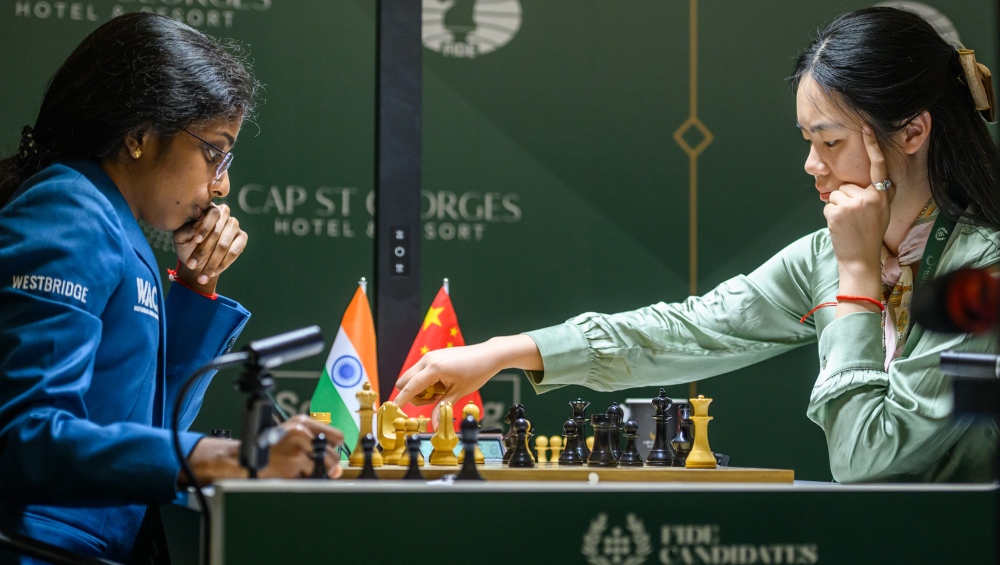
Javokhir Sindarov chose a cautious approach, drawing his game against Hikaru Nakamura this afternoon. With two rounds remaining, he moves one step closer to winning the Candidates and earning the right to challenge Gukesh for the title. The rest of the games also ended in draws, although Anish Giri came very close to defeating Wei Yi. In the women’s section, Zhu Jiner made a strong statement by winning over Vaishali with the black pieces in an impressive game, moving into a tie for the lead. Bibisara Assaubayeva also secured a victory over Kateryna Lagno, narrowing the gap, while Anna Muzychuk missed a major opportunity against Aleksandra Goryachkina. With just two rounds to go, the tournament remains wide open. Let’s take a closer look at the action. The ceremonial first move was performed by Mr. Manish, High commissioner of India, who opened the game for Vaishali. Before the round began, all eyes were on the pairing between Javokhir Sindarov, leading the tournament with a two-point advantage, and Hikaru Nakamura. Would Sindarov push for a win? “Every draw gets him miles nearer to the end goal,” noted commentator Peter Svidler during the live broadcast. The eight-time national champion, drawing on his vast elite experience, correctly anticipated that a cautious approach would prevail. After trading all the pieces and signing the scoresheets, while the rest of the field were still deep in their openings, Sindarov and Nakamura headed to the media centre to explain their swift and strategically sound draw. https://www.youtube.com/watch?v=0KeVjzNc6_c Sindarov was explicit about his strategy: “Yesterday’s game was very important, and today I needed a quick draw to rest and prepare well for tomorrow’s game against Anish Giri during the rest day. I was aiming for forcing draw lines; a fast draw is ideal for my situation. In fact, if I had the chance, I would have offered a draw immediately, but we have to play 40 moves.” Nakamura also adopted a pragmatic stance: “If the scores were closer, I would have gone for a King’s Indian Defence, but I didn’t see any reason to take risks. I’ve stabilized my performance, but it hasn’t been my best tournament and, realistically, I was never going to win it. I’m just looking forward to the end.” Still, Sindarov had a contingency plan: “If Hikaru had played something unusual, I was well prepared and ready to fight. But before the game, my coach advised me not to go for a long battle if he stuck to his usual lines. Against Anish, though, I’m ready for a long fight if he wants to push for a win: we’ll see.” The remaining three games also ended in draws, underlining the remarkably high level of play among all the contenders. In their encounter, Andrey Esipenko and Praggnanandhaa R entered a sharp and dynamic opening that both players had deeply analysed in their home preparation. Unsurprisingly, the game was handled with near-perfect precision and ultimately steered to a draw, with accuracy levels approaching 99%. Matthias Bluebaum, meanwhile, stuck to his preferred Carlsbad structure in his game against Fabiano Caruana, introducing a subtle twist with 6.Qc2. As commentator Jan Gustafsson described it, it was “a cunning little waiting move.” The game was another model of precision, reaching an accuracy of 97–98%, with virtually no mistakes from either side. However, Anish Giri missed a significant opportunity to close the gap with Javokhir Sindarov in his game against Wei Yi. Wei Yi remained faithful to his Candidates preparation with the 2.Nc3 and 3.Bc4 setup, but on this occasion, he was outprepared. Giri seized the initiative early, winning a pawn and transitioning into a favorable middlegame featuring a strong knight against a weak bishop, yet ultimately was unable to convert the advantage into a full point. The key moment of the game arose on move 32. With nearly 20 minutes remaining to make eight moves, Anish Giri spent 15 minutes searching for a winning continuation. The position is extremely tricky. Although Giri has extra material, his king is exposed and White’s passed c-pawn carries significant counterplay. The winning move was, perhaps unsurprisingly, 32…Qe3!. A queen exchange would have effectively decided the game in Black’s favour. If 33.Qd5+ followed, then 33…Kh8! and after 34.Bg7+ Kxg7 35.Qxg5+ Kf7 36.Qf5+ Ke7 37.Qxh7+ Kd6 38.Qd7+ Kc5!, Black escapes the checks with a decisive advantage. Instead, Giri chose a different continuation, namely 32…Qc5? which failed to 33.c7! Although Anish retained some chances later in the game, he was ultimately unable to convert. His final opportunity will come in the next round, where he faces a must-win situation with the white pieces against tournament leader Javokhir Sindarov. With three decisive outcomes and just one draw, the round in the FIDE Women’s Candidates proved even more exciting. Zhu Jiner scored an impressive victory with the black pieces against Vaishali Rameshbabu in a rich and complex game, joining the tournament lead with only two rounds remaining. Both players joined Zach for the press conference after the game. https://www.youtube.com/watch?v=yRW5ImwBTmM Meanwhile, Bibisara Assaubayeva also scored a crucial win over Kateryna Lagno, moving to within half a point of the leaders. Assaubayeva opted for a fashionable line in the Greco Gambit – generally considered equal for Black – but one she had analyzed deeply in preparation. The game quickly turned highly tactical, and at one stage it seemed as though Lagno might come out on top. However, the momentum eventually shifted, and the full point went to the Kazakh grandmaster. In her press conference, Assaubayeva expressed both relief and gratitude, particularly for her mother’s support: “I am happy that I won today. It’s my first win against Lagno in classical chess, although it wasn’t my best game. It was a difficult position to play because there were many weaknesses, and it wasn’t easy to understand what to do. I missed some tactics, but I had time to think and found some practical ideas to keep fighting. At some point it was at least a draw, and then I found a way to
FIDE Candidates: Sindarov preserves lead as Vaishali takes command

Javokhir Sindarov continues to dominate the FIDE Candidates after Round 11, where all games ended in draws. With only three rounds remaining, he still holds a two-point lead. If Sindarov maintains stability, he’s in an excellent position to win the tournament and secure a shot at the world title. In the women’s section, Vaishali R scored a crucial win with the black pieces over Aleksandra Goryachkina, moving a full point ahead of the field and taking clear control heading into the final rounds. Let’s take a closer look at this afternoon’s eleventh round action in the playing venue at the Cap St. Georges Hotel & Resort, here in Cyprus. Of course, the key game of the afternoon was the encounter between Fabiano Caruana and Javokhir Sindarov. Caruana essayed a relatively new idea – 11.Be3 in the mainstream Catalan Opening – a move that has already been played a couple of times by Nihal Sarin. “I didn’t really prepare for the last two games; I just played something safe. But then I got a bit of pressure and some serious winning chances at one point,” Caruana explained after the game. The idea involves a pawn sacrifice in exchange for long-term compensation. “We know that Caruana’s preparation runs deep!” exclaimed commentator Jan Gustafsson during the live broadcast. Co-commentator Peter Svidler offered a different perspective: “It’s not played with the intention of proving an advantage, but rather to reach a strange new position that the opponent may not yet have seen.” Sindarov, however, defended excellently, returning the pawn at the precise moment and securing an important draw for his tournament chances. “I tried to make an impact in the tournament, but he defended very well,” Caruana concluded. https://www.youtube.com/watch?v=vH70eNvlvA0 The other three games also ended in draws, although there were missed opportunities along the way. The game between Hikaru Nakamura and Wei Yi was a solid encounter, with both players blitzing out the classical mainline of the Catalan Opening. Sensing that his opponent was deeply prepared, Nakamura opted to force a threefold repetition at an early stage, though not before spending nearly forty minutes weighing his options. In his post-game interview, Nakamura explained his decision-making process and also shared some thoughts on his upcoming clash with the tournament leader. https://www.youtube.com/watch?v=PCAQSJb8MrI&t=19s In an attempt to catch the leader, Anish Giri tried to improve on a previous game by Andrey Esipenko earlier in the tournament, opting for 11.Qa4 instead of 11.Rc1. Esipenko had already equalized comfortably in that earlier encounter, and interestingly, the same move had also appeared in game fourteen of the Fischer–Spassky World Championship match. However, trying to outplay Esipenko in an isolated pawn–minor piece endgame is a notoriously difficult task. His defensive technique was once again impeccable, and Giri was unable to generate any real winning chances. A draw was agreed on move 43, a result that can be considered a model example of defensive play in this type of structure. The player who will likely regret the afternoon most is no doubt R Praggnanandhaa, who reached a winning position against Matthias Bluebaum but ultimately failed to convert. Praggnanandhaa had already missed a strong continuation a few moves earlier, but with only five minutes left for six moves, the critical moment arose. He played 34.Qf3, activating his queen with threats against f7. However, after 34…d4!, Black’s coordination suddenly held everything together; the queen on b3 defends f7, and the initiative faded, allowing the game to simplify into a draw. Instead, the decisive continuation was: 34.Rxf7! with strong attacking ideas, including the threat of 35.Qxg5 and mating patterns on g7. The key line continues: 34…Rxe5 35.Qa7!! Bd3 (covering h7) 36.Rxg7+ Kh8 37.Rc7 (or 37.Rf7) with decisive threats such as 38.Rc8 and 38.Qd4, leading to a winning attack. In the FIDE Women’s Candidates, Vaishali Rameshbabu took a major step toward winning the tournament by defeating Aleksandra Goryachkina with the Black pieces. In their game featuring a London System, Vaishali equalised comfortably, and the position was heading toward a draw when Goryachkina missed a crucial tactical resource spotted by her opponent. Most moves would have preserved equality (one of them is 30. a4), but 30.Be2–c4?? proved to be the decisive mistake. Under time pressure, Goryachkina failed to notice that her rook was becoming dangerously trapped. After 30…Bc6!, White had no way to prevent …Nd7, which would win the trapped rook. Goryachkina tried 31.Rxc5, but after 31…b6, she was forced to give up the exchange and resigned a few moves later. In her post-game press conference, Vaishali reflected on the game and her improved standing in the tournament. https://www.youtube.com/watch?v=kyMWZwgDNp4 The other three games also ended in draws. Kateryna Lagno and Anna Muzychuk have played many games against each other, with Muzychuk holding a slight plus score in their head-to-head. This time, Anna switched from the Grünfeld Defence to a Queen’s Indian / Bogo-Indian hybrid. Although the position out of the opening was slightly more pleasant for White, Muzychuk held the balance comfortably, finishing with an impressive 98% accuracy. The game between Zhu Jiner and Divya Deshmukh was also very well played by both sides. Zhu Jiner spent a long time in the opening in a Maroczy Bind sideline against the Sicilian, but Divya had clearly done her preparation and played quickly, reaching a slightly inferior but fully defendable position. She even had a small chance to press in the endgame, but the game ultimately petered out into a draw. Finally, Tan Zhongyi came closest to scoring a full point against Bibisara Assaubayeva. As commentator Peter Svidler noted, Tan has been having a difficult tournament so far, with three losses and no wins. In this game, she arrived well-prepared, played confidently, and put her opponent under pressure. However, just when a draw in the rook endgame should have (and ultimately did) arise, Assaubayeva made a single inaccuracy that briefly allowed winning chances. Unfortunately for Tan, those chances were not converted, and the game still ended in a draw. Standings after Round 11 This afternoon’s fan-zone activities included
FIDE Candidates: Sindarov stumbles, Giri strikes as race tightens
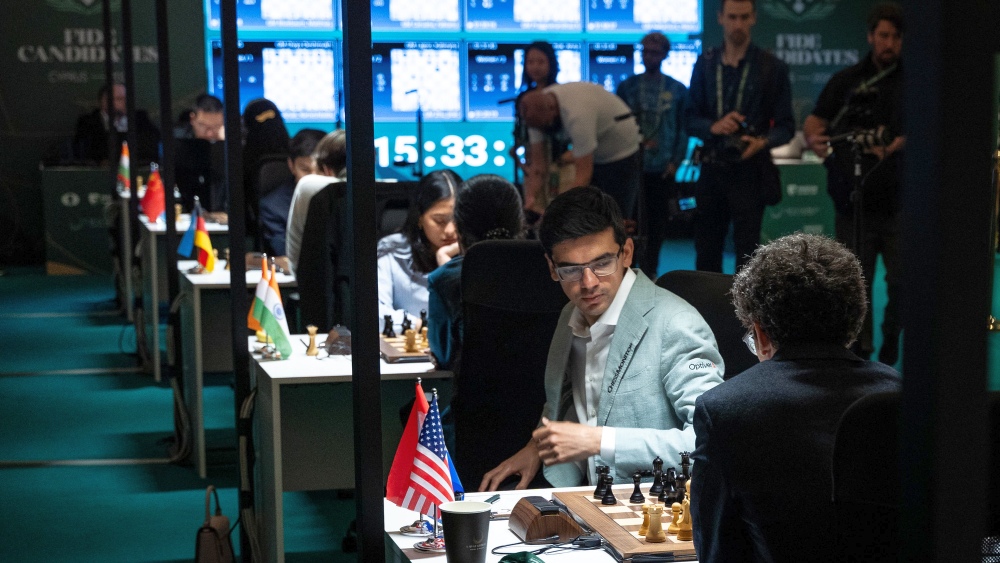
Javokhir Sindarov missed a clear opportunity to secure victory this afternoon against Matthias Bluebaum, allowing Anish Giri to narrow the gap after defeating Fabiano Caruana with the black pieces. With five rounds remaining, Sindarov still leads by 1.5 points. Vaishali and Zhu Jiner share the lead at the FIDE Women’s Candidates with 5.5/9, following victories over Divya Deshmukh and Kateryna Lagno, respectively. Meanwhile, Anna Muzychuk squandered a highly promising endgame, slipping behind the leaders. Let’s take a closer look at how the afternoon unfolded. The ceremonial opening move was played by Paris Klerides, General Secretary of the Cyprus Chess Federation and FIDE Delegate for Cyprus, who made the symbolic 1.e4 on behalf of Matthias Bluebaum. However, Bluebaum opted for 1.d4 instead. Javokhir Sindarov replied with a very rare line – the Harrwitz Attack in the Queen’s Gambit Declined. Commentator Jan Gustafsson was surprised: “I have never seen this move order before, so I suspect that maybe Bluebaum hasn’t either.” Very soon, both players found themselves in uncharted territory, reaching a position with opposite-side castling and no significant master games for reference. Position of the day The critical moment arose after White played 24.bxa4. In this position, Sindarov would have had excellent winning chances with 24…Qb7 or even 24…Qa5, keeping the queens on the board and continuing the attack. Instead, he chose 24…Bxa4?, allowing a queen exchange and easing the pressure. In the post-game press conference, Sindarov admitted his miscalculation: “It was an interesting game. I had a big advantage, but I missed his resource 29.f5 in the endgame. I thought I was winning a pawn, but I should have kept the queens on the board; I would have had a very strong attack.” Bluebaum, for his part, acknowledged his good fortune: “I played like a clown and wanted to resign after 22…a4, but he let me escape into the endgame and secure a draw.” https://www.youtube.com/watch?v=ESfOEFV_Nsg During the afternoon an unexpected visitor made an appearance in the playing hall and then did a spot of commentary in the analysis booth. With this result, both Fabiano Caruana and Anish Giri had a chance to close the gap, and they didn’t disappoint. Having competed in elite tournaments for over fifteen years, it is no surprise that they have faced each other many times, with a narrow 7–4 edge in favor of the Dutch number one. In a classical Italian Game, with Giri leaving his trusted Najdorf in the “drawing box” for this encounter, both players followed well-established theoretical lines, reaching a complex middlegame with a closed pawn structure and roughly an hour remaining on the clock for each. The position remained approximately balanced, though slightly easier to handle for Giri, when Caruana committed a serious blunder on move 37, very near the time control and under mounting pressure. As he transitioned toward the endgame, he activated his king, inadvertently allowing a subtle tactical shot that Giri spotted immediately. Giri uncorked the fantastic 42…f5+! and after 43.exf5 Kh6!! threatening 44…Bh5 mate. Caruana resigned as 44.fxg6 fails to 44…e4! followed by 45…Qg5 mate or 44.Kf3 e4!+ 45.Qxe4 Bh5+ 46.Kf4 Qg5 checkmate. https://www.youtube.com/watch?v=WmdMT3ajOBs The other two games also ended in draws, although R Praggnanandhaa let a winning position slip against Wei Yi and was clearly disappointed after the game. The last game to finish, between Hikaru Nakamura and Andrey Esipenko, was a 92-move draw. The position remained balanced for most of the game, although Nakamura eventually managed to win a pawn. Peter Svidler quickly captured the essence of Black’s opening choice: “It’s a pretty dry position in which Andrey is basically saying that he doesn’t mind being strategically slightly worse because he will make a draw.” In the end, Esipenko demonstrated excellent rook endgame technique, holding the draw without any real difficulty using the method of frontal checks. It is a must-see game for anyone looking to improve their technique in this type of ending. In the Women’s FIDE Women’s Candidates Tournament, R Vaishali and Zhu Jiner broke away from the five-way tie with important victories. Vaishali, now scoring 3.5 out of her last four games, defeated Divya Deshmukh, who blundered a tactical sequence in the middlegame that left her without adequate defense. In her post-game interview, Vaishali said she was very happy with her performance, while Divya admitted that her middlegame play had been inaccurate, pointing in particular to 17…Nd7, where she overlooked the ensuing ideas involving Qd4. https://www.youtube.com/watch?v=VwHeH05QaP8 Meanwhile, Zhu Jiner employed the fashionable setup with 1.Nf3, 2.e3, and 3.b3 with White. Kateryna Lagno responded in classical style, seizing central space with pawns and the bishop pair in exchange for a long-term weakness around her castled king. After the queens were exchanged, Lagno blundered a pawn in the endgame, and Zhu Jiner converted her advantage with excellent technique. FIDE’s presenter Charlize van Zyl caught up with the winner after the game. https://www.youtube.com/watch?v=HxFBuzoXndQ The other two games ended peacefully. Bibisara Assaubayeva introduced a very interesting idea on move three in the Rossolimo Attack against Aleksandra Goryachkina with 3…Nd4. Peter Svidler was surprised: “This is a move that, honestly, I did not think was playable in this particular setup, but I guess everything is these days.” However, the surprise value of a move, combined with a few focused hours of engine preparation, can work wonders in a single game. Jan Gustafsson noted: “Goryachkina did look very shaky yesterday (against Kateryna Lagno) when faced with a surprise.” In this afternoon’s encounter, however, Goryachkina chose not to take risks, opting instead for a solid approach with mass exchanges leading to an equal endgame. In the final game, both players – Tan Zhongyi and Anna Muzychuk – were coming off losses the previous day and needed a win, albeit for different reasons. Facing a sharp and tactical Grünfeld Defence, Tan opted for an early queen exchange, aiming to capitalize on the bishop pair in the endgame. Muzychuk, however, established an excellent blockade with her knight and maintained a superior pawn structure, eventually achieving a significant advantage in the
Candidates clash: Sindarov breaks away, Caruana falls behind
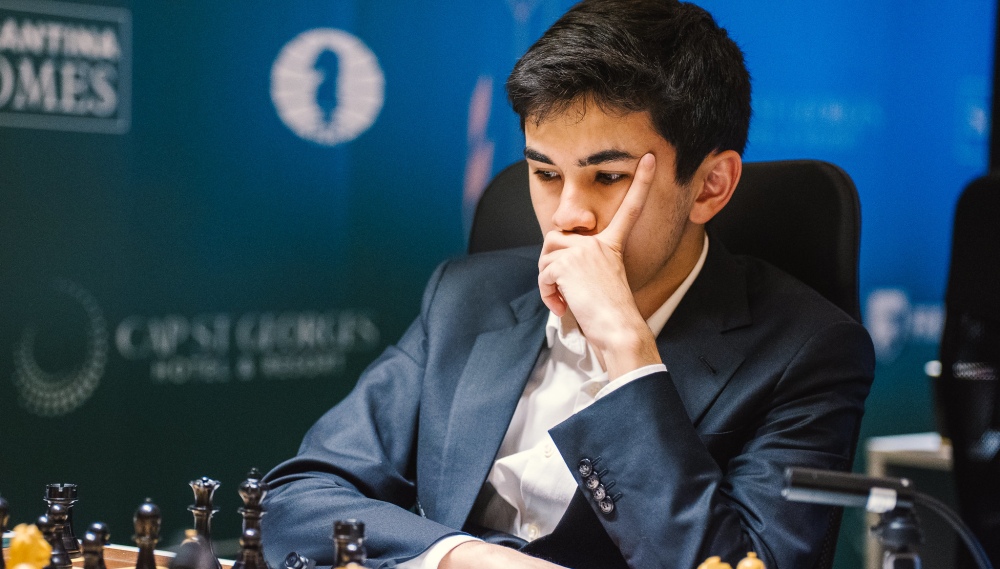
Javokhir Sindarov has now scored an incredible five wins from six games, defeating Wei Yi to further extend his lead in the FIDE Candidates Tournament 2026. Meanwhile, Fabiano Caruana could only manage a draw and now trails by one and a half points. In the FIDE Women’s Candidates Tournament 2026, last-minute replacement Anna Muzychuk continues her remarkable run, beating Zhu Jiner with the black pieces to become the sole leader on 4 out of 6. Let’s take a closer look at this afternoon’s action in the playing venue at Cap St. Georges Hotel and Resort. Two ceremonial opening moves took place today. Demetris Skourides, Chief Scientist of the Republic of Cyprus, made the first move for Wei Yi in his game against Sindarov. Meanwhile, the game between Caruana and Esipenko featured young talents at the board: 12-year-old WCM Aida Paunescu, the current Women’s Champion of Cyprus and the youngest national chess champion, played the opening move for Caruana, while 18-year-old FM Rafail Antoniou, the reigning Champion of Cyprus, opened for Esipenko. What began as a Vienna Game in the clash between Wei Yi and Javokhir Sindarov quickly transposed into a classical Bishop’s Opening, an excellent practical decision by the Chinese grandmaster, steering the game away from heavily memorized lines. In the post-game press conference, Wei Yi explained his opening choice: “My team found this interesting idea and I liked it and wanted to try it (5.a3). I knew that the position was not easy to play for both sides, but my opponent played some very strong moves.” Sindarov responded ambitiously, quickly securing the bishop pair, though at the cost of certain weaknesses on his kingside. Reflecting on the early phase, he said: “This move 5.a3 surprised me and I was pretty much out of the book. But if I get a chance to play a dynamic position from either side, I will always be very happy.” https://youtu.be/01WD3HInkFg?si=p3x–S-WIpoghCtb The tournament leader gradually equalised before ultimately taking control, capitalising on his opponent’s time trouble. Sindarov was candid about his approach: “I played very solidly. I think I was a bit worse, but I started to like my position when my bishop landed on d4. I also had a big clock advantage, and I could press. I took advantage of his mistakes in time trouble.” Asked about his performance, Wei Yi admitted: “My opponent is in good shape, but today I had White and tried to fight for the win. However, I made some mistakes in time trouble.” Considering the tournament situation, Fabiano Caruana was always likely to apply early pressure against Andrey Esipenko, a player known for his classical and principled style. Accordingly, he opted for the Reti Opening, aiming to steer the game into flexible and less predictable territory. “As Garry Kasparov once did in a must-win game, this setup has entered chess lore,” explained commentator Jan Gustafsson during the live broadcast. “If you want to win, play Nf3–g3–b3 and go from there.” However, this time the strategy yielded little. Esipenko handled the symmetrical position with remarkable precision, reportedly playing at a 98% accuracy rate and leaving Caruana with no real winning chances. The draw means the American now trails the tournament leader by 1.5 points, though his overall score of +2 remains solid. In another key encounter, Hikaru Nakamura faced Praggnanandhaa R, against whom he holds a favourable head-to-head record, with two wins and four draws. For the first time in the tournament, the Nimzo-Indian Defence appeared on the board. Nakamura seemed slightly surprised by the choice, spending considerable time navigating the theoretical lines, albeit within one of the many available side-lines. In contrast, Praggnanandhaa looked entirely comfortable, equalising smoothly. Both players appeared satisfied with the outcome and soon steered the game toward a threefold repetition, agreeing to a draw on move 23. Reflecting afterwards, Nakamura noted: “The final position is hard to judge—probably equal. But I was surprised my opponent didn’t decide to play on, given that his tournament situation is better than mine.” https://youtu.be/S-tVbYpuRMQ?si=lo5VfrtEcedQzz8p An intriguing matchup saw Anish Giri face Matthias Bluebaum. Their only previous encounter, in Tata Steel Chess Tournament earlier this year, ended in dramatic fashion, as Giri overpressed with the black pieces and was convincingly defeated in a miniature. Today’s game, however, followed a completely different course. A classical Carlsbad structure arose from the Queen’s Gambit Declined, with queens exchanged early. While theory holds that Black can hold such positions, it often comes at the cost of defending long-term structural weaknesses: a pair of doubled isolated pawns. Bluebaum rose to the challenge admirably, defending with precision for a full 84 moves to secure the draw. Meanwhile, in the FIDE Women’s Candidates Tournament, Anna Muzychuk emerged as the sole leader after an important victory with the black pieces against co-leader Zhu Jiner. Combined with a loss by Bibisara Assaubayeva, Muzychuk now leads the standings by a full point. Zhu opted for a quiet Italian Game, choosing the relatively rare 5.Be3. Muzychuk equalised comfortably before gradually seizing the initiative. In a bold turn, she sacrificed material to launch a powerful attack, which ultimately proved decisive. Reflecting on the game, Muzychuk said: “It was a very stressful game. I did expect the Italian but not this line, so I was trying to figure it out over the board. Zhu Jiner is a very strong player – the highest rated – and she had won the last two, so it was a dangerous game for me.” https://www.youtube.com/watch?v=vtujvBDxM1Y Aleksandra Goryachkina essayed the Two Knights Defence against Tan Zhongyi, who arrived exceptionally well-prepared, confidently blitzing out her opening moves. Out of the opening, Tan secured an extra pawn heading into the middlegame, but the tactical complications ultimately favoured Goryachkina. With a well-calculated combination, she managed to win her opponent’s queen. However, Tan demonstrated remarkable defensive resilience, constructing a fortress that Goryachkina could not break down, thus denying her a first victory in the event. In another dramatic encounter, Vaishali R scored her first win of the tournament against Kateryna
FIDE Candidates: Sindarov shines, Caruana keeps pace; Drama builds in Women’s Candidates
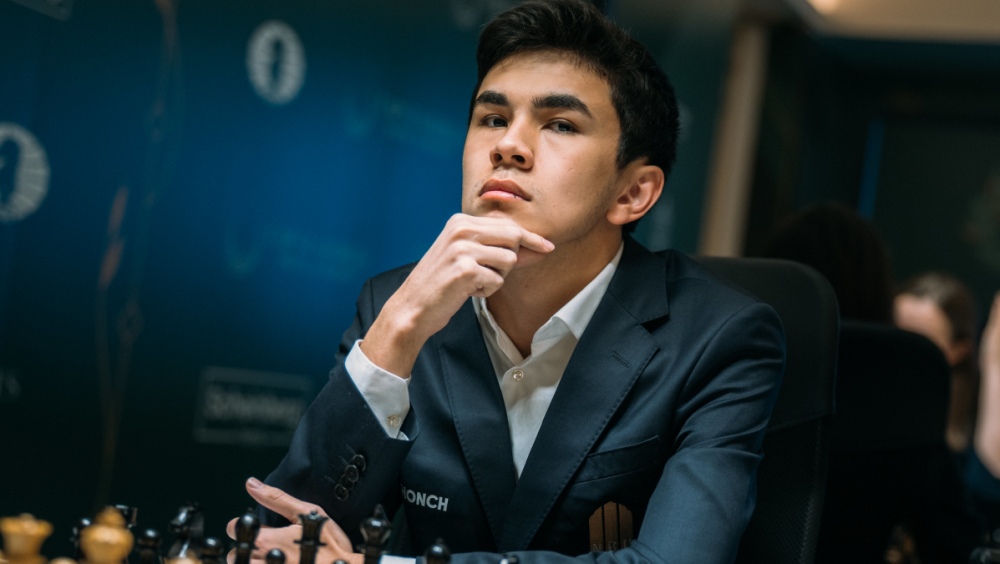
Javokhir Sindarov defeated Hikaru Nakamura this afternoon in the fifth round of the FIDE Candidates, reaching a score of +4 after five rounds. Fabiano Caruana also secured a win against Matthias Bluebaum, keeping the pressure on. In the FIDE Women’s Candidates, Kateryna Lagno won over the leader Bibisara Assaubayeva and is back in contention, while Zhu Jiner scored a brilliant victory against Vaishali and now shares the lead. Let’s take a closer look at how the action unfolded this afternoon. The ceremonial first move was played on the board between Nakamura and Sindarov by José Carrillo Pujol, FIDE Continental President for the Americas. After yesterday’s rest day, most expected the players to arrive with fresh ideas, theoretical novelties, and plenty of energy – and the round did not disappoint. In his pre-game conversation with GM Peter Svidler, commentator GM Jan Gustafsson joked, “I just hope they won’t ‘hallouminate’ on the chessboard today,” a clear reference to yesterday’s Halloumi cheese workshop. Without a doubt, the most important game of the day was Hikaru Nakamura, playing White, against tournament leader Javokhir Sindarov. Nakamura had expressed the view that this was his last real chance to fight for first place. “It might be an overstatement, but it’s less absurd than you might think,” opined Svidler on the broadcast. Sindarov opted for the Triangle System, but Nakamura came well prepared, entering the main line that ultimately involves sacrificing two pawns. “The compensation is self-evident, even two pawns down, White is very much in the game here,” explained Svidler. “Yesterday I had a lot of time to prepare due to the rest day,” said Sindarov. “This gambit is very tricky, and you can lose immediately if you forget one of your lines, but I checked it thoroughly yesterday.” Both players blitzed out their opening moves, following a high-level game between Nodirbek Abdusattorov (2716) and Arjun Erigaisi (2712). Notably, Abdusattorov is Sindarov’s teammate on the Uzbekistan national team. It is difficult to pinpoint exactly when Hikaru Nakamura left known theory, but before long he was forced to give up another pawn to maintain the initiative. In this position, Nakamura, already very low on time, chose 20.Kh1, and after 20…Nd4! the end was near. Instead, his best chance would have been 20.Bxc6 bxc6, followed by 21.Qg3, with ideas such as Be5, h5–h6, and Kh2/Rg1, keeping the fight alive. However, Javokhir Sindarov remained in full control of the defence. With precise calculation, he neutralized all of Nakamura’s attacking chances and simplified into a completely winning opposite-coloured bishop endgame. Reflecting on his score, Sindarov attributed it to both preparation and form: “I am just lucky to get into lines that I have prepared beforehand. Also, I am really playing well.” https://www.youtube.com/watch?v=qr8LV1aS5b8 Today’s game against Matthias Bluebaum was a key encounter for Fabiano Caruana, who needed to raise his level to stay within striking distance of the leader. He prepared a sideline in the Petroff Defence that proved highly effective. “The fact that Caruana goes for 4.Nc4 is a pretty clear illustration of how devoid of ideas people are in the main line these days. I think Caruana is simply trying to reach a position that Bluebaum hasn’t examined in detail and then just play chess,” explained Peter Svidler. In the game itself, Caruana obtained a promising position out of the opening, and Bluebaum eventually collapsed under sustained pressure. “The win is very important, it felt like I had the initiative throughout,” said Caruana in his post-game interview. Bluebaum, on the other hand, was clearly dissatisfied with his performance: “I didn’t really know the line. I feel like every move I played in the game was terrible today.” Asked whether he had saved this opening idea specifically for this matchup, Caruana offered insight into elite-level Candidates preparation: “It wasn’t something specific. I was considering several options for both games and decided to switch back to 1.e4 and play more directly. Usually, I don’t try to save ideas: if I think I have something playable, I go for it, because you never know if you’ll get another chance. Also, I don’t know if the idea will work, so I try not to overthink these things.” https://www.youtube.com/watch?v=GN2wyrqJO24 The final two games in the FIDE Candidates ended in draws, with neither side managing to obtain a tangible advantage. The encounter between R Praggnanandhaa and Andrey Esipenko featured a solid Zukertort System, nothing ground-breaking from a theoretical standpoint, but safe and reliable. A draw by repetition was agreed with most of the pieces still on the board. Meanwhile, Wei Yi introduced a highly unusual novelty (9…c5) in a well-known position of the Catalan Opening against Anish Giri. The Chinese grandmaster sacrificed a pawn based on deep home preparation. “A fresh and completely new approach – somewhat of a gamble, though,” remarked Peter Svidler. A few moves later, Wei Yi had already regained the pawn and reached a completely satisfactory position: his preparation proved accurate, and a draw was soon agreed. In the FIDE Women’s Candidates, two decisive outcomes in this round have kept the standings tight, with three players now tied for first place. Kateryna Lagno scored a crucial victory against Bibisara Assaubayeva in a sideline of the Classical Sicilian Dragon. On move 14, Assaubayeva made a questionable positional decision (14…e5?!) and soon embarked on a risky plan, sacrificing both a pawn and the exchange in search of tactical compensation. Although she generated some chances, Lagno ultimately converted her material advantage with confidence. https://www.youtube.com/watch?v=N8HDPNYRlJ8 Also joining Anna Muzychuk at the top of the standings is Zhu Jiner, who produced a positional masterpiece against R Vaishali. Handling an Italian Opening with great finesse, Zhu outplayed her opponent on both wings and secured a superior middlegame pawn structure. Vaishali did her best to contain her weaknesses, but as the game approached the second time control, mounting time pressure and a deteriorating position proved decisive. “I was under pressure for a long time and it became very unpleasant. Even so, I was trying to find a
FIDE Candidates: Javokhir Sindarov records third win as Anna Muzychuk moves into joint lead
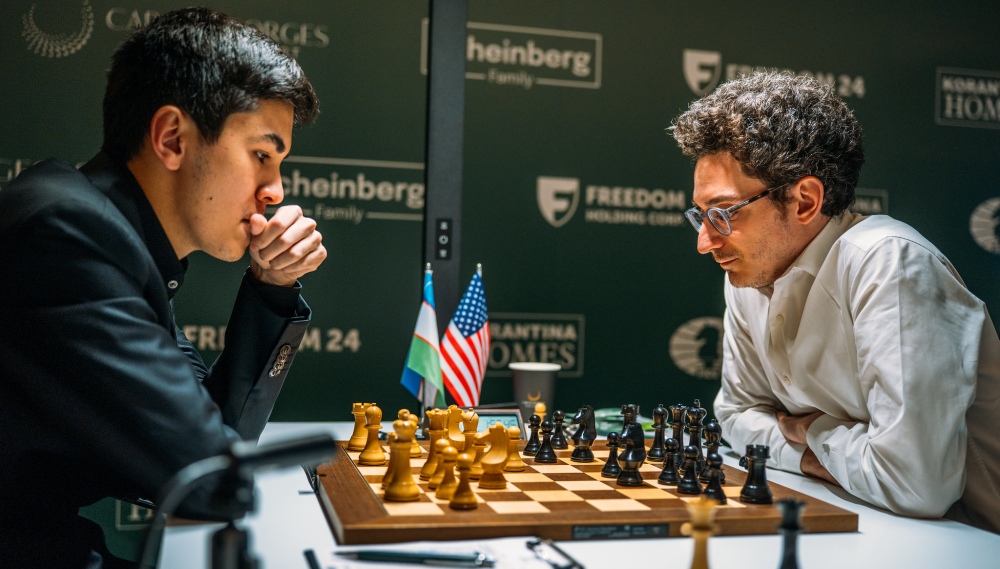
Javokhir Sindarov scored his third win of the tournament this afternoon, taking a major step toward winning the FIDE Candidates after defeating Fabiano Caruana with impressive opening preparation. In the FIDE Women’s Candidates, Zhu Jiner and Anna Muzychuk regained momentum with important victories. Muzychuk now shares the tournament lead with Bibisara Assaubayeva. Let’s take a closer look on how the action unfolded this afternoon at the Cap St Georges Hotel & Resort Roman Dubov, Chairman of Total Sports Investments, opened the game this afternoon for Sindarov in his game against Caruana while Tshepiso Lopang, Continental FIDE President for Africa played the ceremonial first move for Assaubayeva in her game against Tan Zhongyi. The game between the two tournament leaders was, as expected, the highlight of the round. Playing with the black pieces, Fabiano Caruana opted for the solid Queen’s Gambit Accepted, but was caught off guard by Javokhir Sindarov’s move order and emerged from the opening with a slightly inferior position. Playing at a brisk pace – Sindarov notably spending much of his time pacing along the playing hall – the Uzbek prodigy confidently followed his home preparation, quickly building a significant advantage on the clock. The critical moment came on move 17, when Caruana played 17…f5. Reflecting in the post-game press conference, Sindarov explained: “I remembered that in my opening files the pawn on d4 had to be taken, but I wasn’t sure about the exact lines. After 18.Bc4, Black’s position is already very unpleasant.” By around move 20, Caruana was already under serious pressure. “I kind of got caught in the opening with 16…Rg8, and I went wrong,” he admitted. Commentator Jan Gustafsson added: “He is in serious time trouble and also has a bad position.” Sindarov continued energetically, converting his advantage with a direct attacking approach. He expressed satisfaction with his play afterward: “Maybe I made some mistakes in the middlegame, I’m not sure, but I think I played a very good game. I was lucky to get this opening,” he said, before leaving to sign autographs for the many fans in attendance. In his game against Anish Giri, Andrey Esipenko adopted an uncompromising approach, choosing a secondary line against the Najdorf Sicilian, perhaps in an attempt to catch his opponent off guard. However, Giri proved well prepared and responded with an ambitious king march across the board following Esipenko’s striking 10.Nf5. In the commentary booth, Peter Svidler praised the concept: “Esipenko is using the geometry of the board to continue the attack.” Giri later explained the idea behind his opening choice: “Black has a million ways to handle this line, but I was hoping no opponent would think I am bold enough to go for this variation. My king is in greater danger, but I have some long-term assets.” Although Esipenko appeared to be playing in the right spirit, he went astray with 18.Qxd3. Instead, 18.Rxd3 would have preserved dynamic chances and likely led to a more balanced position with attacking possibilities. Reflecting on this moment, Esipenko was candid: “I saw 18…Ba4, but I thought I would find something, as 18.Qd3 looks more logical than 18.Rd3. I didn’t think it was a critical moment, and I was surprised that I couldn’t find anything afterward.” Giri did not take long to consolidate his advantage and ultimately converted with his extra material. He expressed satisfaction after the game: “I am happy to win today and to reach 50% after four rounds–lately I haven’t been starting very well.” https://www.youtube.com/watch?v=hTivLbanAXA The contrast in Hikaru Nakamura’s time management is striking: a player renowned for completing high-accuracy games in a matter of minutes spent nearly forty-five minutes on the opening phase. The game against Wei Yi ultimately featured the offbeat Dragondorf Sicilian, a variation that neither player likely anticipated in their pre-game preparation. Nakamura appeared satisfied with the outcome of the opening, obtaining a sound position with the black pieces while maintaining a time advantage heading into the middlegame. The game remained relatively balanced until the critical moment on move 40, when Wei Yi committed what could have been a decisive error. However, Nakamura was unable to find the most precise continuation in a double-rook endgame despite being a pawn up, allowing the game to eventually simplify into a draw. In his post-game interview with Charlize van Zyl, Nakamura reflected on the missed opportunity: “It was a very interesting game. I took some liberties in the opening, and around the time control it should have been a draw, but it seems that there was a winning opportunity which I missed.” The fourth game of the round was a solid and uneventful affair. Playing with the black pieces, R Praggnanandhaa opted for the reliable Semi-Slav Defence, which soon transposed into an isolated queen’s pawn structure. Matthias Bluebaum responded by simplifying along the c-file, initiating a series of exchanges. Although he carried the bishop pair into the endgame, Praggnanandhaa’s well-placed knight on e4 ensured that the position remained comfortably balanced. Following further simplifications, the players agreed to a draw by threefold repetition on move 37. In the Women’s Candidates, two games ended decisively. Anna Muzychuk defeated Kateryna Lagno in a finely played positional game that ultimately culminated in tactical complications. “I chose this line to avoid some concrete variations,” Muzychuk explained after the game. Lagno defended resourcefully under pressure for much of the encounter but faltered on move 28. At this point, Muzychuk had sacrificed a piece for two pawns and a strong initiative. Lagno could have opted to exchange queens, entering a slightly worse but defensible endgame, even if it required returning the extra material. Instead, she chose to continue with 28…exd4, after which 29.Qxd4 left White with a decisive attack, and the game concluded just three moves later. The other decisive result saw Zhu Jiner prevail with the black pieces over Divya Deshmukh – an important victory that keeps her within reach of the tournament leaders. It is difficult to pinpoint a single decisive mistake, but Divya’s position gradually deteriorated from
FIDE Candidates Round 2: A day of draws and moments of missed glory

After the tactical excitement of yesterday’s round, the players opted for a more technical approach this afternoon in the FIDE Candidates Tournament 2026. As a result, all eight games ended in hard-fought draws, leaving the standings unchanged, with Fabiano Caruana, R Praggnanandhaa and Javokhir Sindarov leading the field on 1.5/2. In the Women’s FIDE Candidates Tournament, Divya Deshmukh and Zhu Jiner missed great opportunities to take the lead each blundering into tactical sequences against Vaishali R and Kateryna Lagno, respectively. All eight contenders are tied for the lead on 1/2. Viswanathan Anand, FIDE Deputy President, officially opened the second round by making the ceremonial first move in the all-Indian clash between Divya Deshmukh and R Vaishali. After greeting both players, Anand played 1.c4 – the very move later chosen by Divya to begin the game. Clearly, being a five-time World Champion comes with its advantages when it comes to anticipating a grandmaster’s intentions. Playing with the black pieces, Fabiano Caruana opted for a rare move order in the Catalan, allowing Anish Giri to secure a slight edge, though not enough to seriously press for a win. “Anish is generally very well prepared in the openings, so I went for a rare line, but he was ready for it. I suffered a little, but I think I played accurately enough to neutralize the slight pressure he had,” Caruana explained in his post-game interview. Both players delivered an exceptionally precise performance, each achieving 98% accuracy without a single mistake. https://www.youtube.com/watch?v=3bl2Ag1CvU8 Although Wei Yi made a slight inaccuracy in the main line of French Defence, Praggnanandhaa R was unable to fully capitalize. “I’ve played against the French recently, so it didn’t come as a big surprise. I think I got a good position and a time advantage in the opening,” Praggnanandhaa said after the game. Although he eventually managed to win a pawn, the Chinese grandmaster defended resourcefully, steering the game into an opposite-coloured bishop ending and comfortably securing the draw. The “#GreatBluebaumSweep” may have come to an end, but Matthias Bluebaum can still be satisfied with his start to the tournament. Two solid draws in the opening rounds suggest he has arrived in Cyprus with ambitions well beyond merely avoiding last place. “The Great Sweep was obviously a joke, but I’m definitely not unhappy at all with how the tournament has started,” he said with a smile before attending the local press duties. In today’s game, Bluebaum opted for a solid Petroff Defence against Javokhir Sindarov. The Uzbek grandmaster was unable to generate any serious chances, and a draw was agreed on move 42. Meanwhile, Andrey Esipenko pressed a slight but persistent edge against Hikaru Nakamura, even managing to win a pawn. However, Nakamura’s endgame defence proved impeccable: he found a precise way to simplify into a rook ending and held the position comfortably. Despite being the last game to finish, spectators remained fully engaged, following every move until the very end. The first game to finish in the Women’s FIDE Candidates Tournament was an uneventful draw between Anna Muzychuk and Tan Zhongyi, leaving both players on 50% after the first two rounds. The former Women’s World Champion opted for the ultra-solid Petroff Defence – a favourite at the elite level in China – successfully preventing Muzychuk from creating any real chances. A few minutes later, Aleksandra Goryachkina secured her second draw of the event with the black pieces against Bibisara Assaubayeva, improving on a recent game between Arjun Erigaisi and Shamsiddin Vokhidov, which had ended in a win for Erigaisi. Well prepared, Goryachkina chose a safe continuation in a complex middlegame, ensuring a solid result. Playing with the black pieces against Kateryna Lagno, Zhu Jiner obtained an advantage out of the opening after her opponent misplayed her preparation. Gradually improving her position, Zhu accumulated a significant edge and looked on course to claim the full point. However, in a highly complex position and despite being two pawns up, she blundered into a rook sacrifice that forced an immediate draw by perpetual check. Arguably, the clearest opportunity to score in this round fell to the young Indian World Cup winner Divya Deshmukh. After pressing throughout the game in a Carlsbad structure with the white pieces, she seemed on the verge of taking the lead in the event when disaster struck. Following a queen exchange with 37.Qg4!, Divya would have emerged with a clean extra pawn and excellent winning chances in the endgame. “I was not sure what to do after 37.Qg4: I thought my position was very bad,” admitted Vaishali after the game. Instead, Divya opted for 37.Qg3?, allowing 37…Rxc5 38.Qe5+ Kh7 39.Rb8 Rc1+ 40.Kh2. It appears that White is winning: the black queen is under attack, and mate on h8 is looming. However, Vaishali had foreseen a tactical resource Divya walked straight into: 40…Qxh3+! 41.gxh3 Nf3+, after which Black regains the queen and comfortably holds the resulting rook endgame. Both Divya and Vaishali later attended the official press conference, where they analysed this dramatic encounter in detail. https://www.youtube.com/watch?v=JHAjR2eY7iw&pp=0gcJCdsKAYcqIYzv The fun zone, hosted by FIDE presenter Angelika Valkova, featured a nineteen-board simul with former Women’s World Champion Alexandra Kosteniuk. Kosteniuk dominated the exhibition, winning 18 games and losing only one. The lucky victor of the single win received a chess clock as a prize. Standings after Round 2 Round 3 will commence on March 31, at 3:30 pm (Cyprus) Round 3 pairings – FIDE Candidates Tournament: Matthias Bluebaum – Andrey EsipenkoPraggnanandhaa R – Javokhir SindarovFabiano Caruana – Wei YiHikaru Nakamura – Anish Giri Round 3 pairings – FIDE Women’s Candidates Tournament: Vaishali Rameshbabu – Anna MuzychukAleksandra Goryachkina – Divya DeshmukhZhu Jiner – Bibisara AssaubayevaTan Zhongyi – Kateryna Lagno Official website: https://candidates2026.fide.com/ Event photo gallery: https://www.flickr.com/photos/fide/ Live daily broadcast with GM commentary: https://www.youtube.com/@FIDE_chess Written by IM Michael A. Rahal (Cyprus) Photos: Michal Walusza, Yoav Nis
Road to the crown: 2026 Candidates Tournament begins in Cyprus

World-class players, expert predictions, and a festival of chess await as the battle for a shot at the world title unfolds at Cap St Georges Resort With just one week to go before the start of the 2026 Candidates Tournament, excitement for the event is building at full speed. The sixteen players (eight men and eight women) who will compete for the right to challenge the world champion will soon travel with their respective teams to the island of Cyprus. As in previous editions, the organizing team has planned various parallel activities to ensure a complete experience for all fans eager to attend their first Candidates as spectators. The venue Cap St Georges Hotel & Resort is an award-winning luxury destination on the unspoiled coastline of Peyia, Paphos, Cyprus, offering an inspiring setting where elegance, tranquillity, and excellence come together. Surrounded by landscaped gardens with centuries-old olive trees, the resort reflects the island’s character through refined architecture and well-designed spaces, with a strong focus on privacy, comfort, and attentive service. Guests enjoy exceptional facilities, including Olive Tree Beach and Kafizis Beach, a beachfront framed by the resort’s natural surroundings, outdoor and heated indoor swimming pools, a spa and wellness centre, fully equipped fitness facilities, and a diverse collection of ten restaurants and bars offering refined international and local cuisine The side events The Pafos Municipality & Pafos Chess Club are hosting the 4th International Open Tournament, from April 13-19 (overlapping the Candidates’ final week). The event will be a 9-round classical Swiss with a €5,000 prize fund – ideal for international norm and title seekers! The event has already attracted 10 GM’s and many other titled players. Check out the line-up here. The tournament fan-zone, hosted by Angelika Valkova, will feature master-classes, simultaneous displays, lectures and Q&A during the event, with legendary players such as Vishy Anand, Nigel Short, Boris Gelfand, Victor Bologan and Alexandra Kosteniuk. In addition, each game day two or three players will join the fans after their games for interviews and photo opportunities. The line-up and schedule is evolving continuously and can be found here. Standard ticket holders can watch the games live from the viewing area inside the playing hall and have access to the fan zone. VIP ticket holders enjoy an enhanced experience, including access to the VIP lounge, live viewing from VIP seats inside the playing hall, preferential seating in the fan zone, all-day catering service, and a unique opportunity to play a chess game with a Grandmaster. Tickets are available here https://tickets.fide.com/ with special limited-time offers and multi-day discounts available. Expert forecasts Over the past few days, many experts have shared their opinions about the tournament, indicating who has the greatest chances of winning and who could be the surprise player of the event. As a five-time World Champion, Vishy Anand has taken part in this event multiple times, giving him some of the most valuable insight to draw upon. “The Candidates is one of the great competitions in chess. People are very-highly motivated, and they have a chance to play for the world title, which is obviously the big prize.” “We have four people who are new and four who have played the Candidates before, with a few unexpected names. Bluebaum is a bit of a surprise; while with Wei Yi and Esipenko you sort of think that they could be in there. Also, Fabiano and Hikaru are getting on in age: it doesn’t show but in a long event you never know. Obviously, they remain very strong and very competitive, but I think youngsters almost always have more energy.” Breaking down the tournament on the Perpetual Chess Podcast, Jan Gustafsson (one of the onsite commentators) outlined the most likely approach. “I think that the good-old game after game strategy does apply. It’s good to score points at any moment but the players will start taking more risks when they are at plus one and there’s not that much tournament to go. You can’t really pace yourself in the Candidates, but sometimes when a player gets to plus three they freeze a little bit or stop taking risks and wait for the moment to score against a lower-rated opponent.” Gustafsson’s co-host is once again none other than Peter Svidler, an eight-time national champion and three-time Candidates contender. Although he acknowledged that all the players have a reasonable chance, one stands above the rest. “For me this has always been the most exciting tournament of the year, and definitely one of my highlights of the year. I don’t think there is a clear favourite but if I had to pick a player with a gun to my head I would go with Fabiano Caruana. He is so consistent and has a fantastic record playing in the Candidates However, it’s a very interesting field this year – Praggnanandhaa also has a decent shot.” Official website: https://candidates2026.fide.com/ Written by IM Michael Rahal – FIDE press Officer (Barcelona, Spain) Photos: Michal Walusza