

Carlsen and Caruana reach FIDE Freestyle Chess World Championship Final

Magnus Carlsen will face Fabiano Caruana in the final of the 2026 FIDE Freestyle Chess World Championship. Both grandmasters advanced through the semifinals on Saturday. World number one Magnus Carlsen now has the chance to claim a 21st world title. The Norwegian defeated Nodirbek Abdusattorov (Uzbekistan) 3–1, taking control of the match in the decisive phases and closing it out over four games. Caruana (USA) overcame German Vincent Keymer 2½–1½, converting an early lead and holding firm under pressure. Both younger semifinalists had chances during their matches, but the experienced opponents prevailed in critical moments. The final will determine the first FIDE-recognized Freestyle Chess World Champion under the federation’s official framework. By reaching the final, Carlsen and Caruana have secured qualification for the 2027 FIDE Freestyle Chess World Championship. The third and final qualification spot will be decided in the third-place match between Abdusattorov and Keymer. In the lower bracket, Hans Niemann beat Levon Aronian 2½–1½, while Arjun Erigaisi defeated Javokhir Sindarov 3–1. Niemann and Erigaisi will play for fifth place, with Aronian and Sindarov contesting seventh. The women’s exhibition match between Bibisara Assaubayeva and Alexandra Kosteniuk is level at 1–1 after two games of their best-of-four encounter. The championship concludes on Sunday with the final and placement matches. A full report is available [HERE]. Photos: Lennart Ootes and Steve Bonhage / Freestyle Chess Official website: https://www.freestyle-chess.com/
FIDE Freestyle World Championship: Carlsen, Keymer, Caruana and Abdusattorov contenders for the title
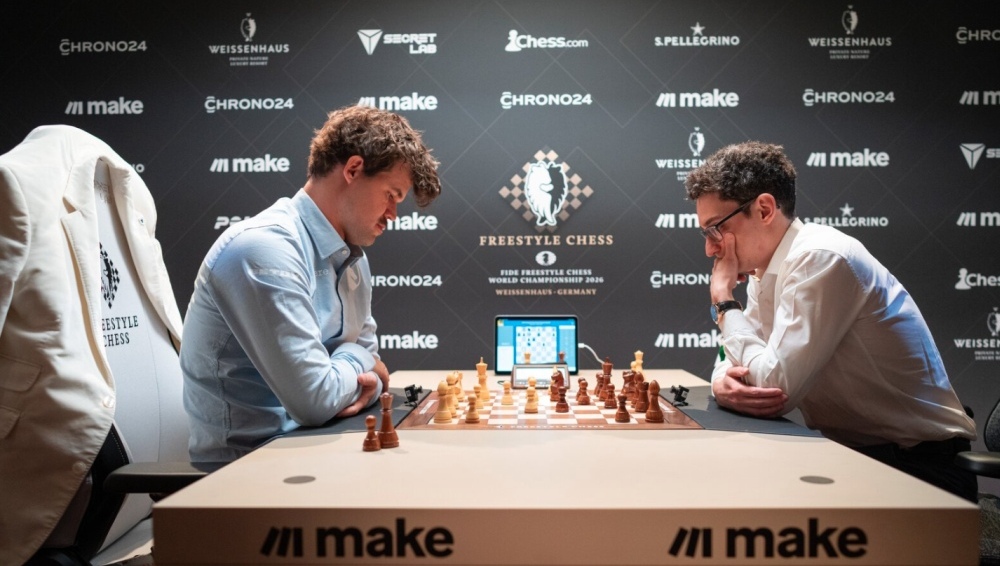
Qualification race remained open until the end in round-robin tournament Magnus Carlsen, Vincent Keymer, Fabiano Caruana and Nodirbek Abdusattorov have qualified for the semifinals of the FIDE Freestyle Chess World Championship and remain in contention for the 2026 world title. The four secured their places after the completion of the seven-round rapid round-robin on Friday in Weissenhaus, Germany. Carlsen won the round robin with 4.5 points out of 7 games. Keymer, Caruana and Abdusattorov each finished on 4 points. Hans Niemann scored 3.5, Arjun Erigaisi 3, while Javokhir Sindarov and Levon Aronian concluded the day on 2 points. Qualification remained undecided until the final round, with several players still in contention and even the possibility of a four-way tie on 4 points. Only after the last results were confirmed did the semifinal field become definitive. Freestyle Chess returned to Weissenhaus in Northern Germany once again in early February, with more at stake than ever before. This year, a cooperation with FIDE means that the official world title is at stake alongside a prize fund of $300,000 and three spots for the 2027 world championship cycle. Now renamed Freestyle Chess, which might appeal to a wider audience, the Chess960 world championship was last held in 2022 when Hikaru Nakamura won the title. The American grandmaster chose not to defend his title and focus on the upcoming Candidates Tournament instead, but his successor will surely be a worthy champion as well. A single-day round-robin of seven rounds was the traditional opener on Friday and delivered four semifinalists who are still in contention: Carlsen, Caruana, Keymer, and Abdusattorov. Especially after his victory of the 2025 Freestyle Grand Slam Chess Tour in South Africa, there is no doubt who is the favorite once again: Magnus Carlsen. “I like the fact that it’s cut-throat and it’s not going to be easy to come through for anybody,” was what Carlsen said about it at the press conference ahead of today’s opening day. It should be noted that a world title in this format of chess is one of the few trophies still missing in his cabinet. The Norwegian star, sporting a moustache in Weissenhaus, has often appeared rusty and had some bumpy starts in these round-robin tournaments during the 2025 Tour, but not this time. He seemed fully warmed up from the start, perhaps because he was making the rounds on social media the other day in a cute video in which he played chess with his wife Ella. Starting with two draws and three wins out of the first five rounds, Carlsen was a point ahead of the field and virtually certain of qualification with two rounds to spare. The tournament was a seven-round rapid event with games of 10 minutes and a five-second increment, and a new starting position for each round. It started with the always interesting clash between Carlsen and Hans Niemann. The American GM had entered the tournament as a wildcard and against Carlsen he was under pressure but got away with a draw. FIDE World Cup winner Javokhir Sindarov played quite well in the next round and was close to holding Carlsen to a draw as well, until the latter found an extraordinary checkmate idea deep in a rook endgame: In this objectively equal endgame, Sindarov played 49…b4??, missing White’s treat. Something like 49…a5 would have led to a draw: 50.bxa5 Kxa5 51.Kf4 c5 52.Ke5 d4 53.cxd4 cxd4 54.Kxd4 b5 55.Ke5 Kb4and Black is in time with the counterplay. 50.g8=Q! Javokhir instantly realized that taking the queen is met by 51.Rxb7 checkmate and so he resigned. 1–0 Another player who had a good start was Caruana, who won his first two games and then drew his next two. The all-American clash ended in his favor as Niemann followed the wrong strategy of material vs. dynamics, as was noted by commentator Judit Polgar. (It’s a joy once again to have the star of the recently launched Netflix documentary Queen of Chess being part of our commentary team once again, alongside Peter Leko, David Howell, Tania Sachdev and James “Dash” Patterson.) Levon Aronian, the winner of the Las Vegas leg of last year’s Tour, had an unfortunate first day and didn’t make it into the top four. He called it “a day of blundering,” and explained that he was out of practice because he hadn’t played chess for two months. After spoiling a winning position in the fist round, he had a similar experience against Carlsen in the third, losing a promising endgame. Arjun Erigaisi had the wildest tournament of them all: he didn’t draw a single game today. The Indian GM, who is the highest rated player of his country and the world number five in classical chess, was the only player to beat Carlsen, in round six. He didn’t just beat him, he crushed him. It was one of the few games where the engine showed an evaluation “better for White” from start to finish, and the eval bar just went up and up. Very impressive. Vincent Keymer, the splendid winner of Weissenhaus a year ago, started well again on home soil. The German GM qualified with a round to spare after beating Caruana in a very nice game in round six. There was a brief moment where the latter missed a draw, but otherwise, Keymer was fully in control. 29…Rdxe5?? Black had to focus on counterplay on the second rank: 29…Rc5! 30.b6 Rcc2 and White cannot avoid a perpetual. After the move played Black was doomed: 30.b6 Re1+ 31.Rxe1 Rxe1+32.Kf2 Rb1 33.a5 Kf7 34.Be3 Ke6 35.a6 1–0 A wounded Caruana now had to face Carlsen-killer Arjun in the final round, who was also still in contention. As it turned out, both players absolutely needed to win this game to make it into the top four, and it was the highly experienced American grandmaster who pulled it off. This time, Arjun was on the wrong side of a one-sided game; he never got a chance after some early mistakes in the opening. Caruana and Keymer finished on 4/7, half a point behind Carlsen, and there
FIDE and Freestyle Chess launch World Championship at Weissenhaus

Weissenhaus, February 13, 2026 – The FIDE Freestyle Chess World Championship 2026 was officially launched at Weissenhaus today. Eight of the world’s leading grandmasters begin their campaign for the title under the joint staging of the International Chess Federation (FIDE) and Freestyle Chess. The championship places the Freestyle format within the official FIDE World Championship framework and establishes a direct qualification pathway for the next cycle. With the 2026 world title, $300,000 in prize money and three qualification spots for 2027 at stake, the event carries both immediate sporting pressure and long-term consequence. The winner receives $100,000, while the top three finishers qualify directly for the FIDE Freestyle Chess World Championship 2027. Structure and legitimacy In the opening press conference, Freestyle Chess co-founder Jan Henric Buettner described the launch as the culmination of the format’s development alongside FIDE. “We are proud of what we have achieved together,” Buettner said. He noted that the world championship brings together the best possible players and represents a condensed structure in which “each day is extremely important.” Buettner also addressed the inclusion of the women’s exhibition match, referencing long-standing advocacy from former world-class player and Freestyle Chess commentator Judit Polgar for stronger competitive integration. He confirmed that the winner of the exhibition match will qualify for the future FIDE Women’s Freestyle Chess World Championship, as part of the developing pathway for the women’s cycle. Carlsen and the stakes of the title Among the contenders are Magnus Carlsen and Vincent Keymer. Carlsen, who arrives at Weissenhaus after winning the 2025 Freestyle Chess Grand Slam Tour, described the format as “cutthroat” and said he was “grateful for the opportunity.” Carlsen noted: “It’s not easy to come through for anybody. I hope it’s going to be me.” Should Carlsen prevail, he would add the Freestyle world title to his record and claim what would be recognized as his 21st world championship title across formats. Keymer echoed the competitive assessment. “Like Magnus, I will try to win,” he said, while agreeing that the format leaves little margin. “You never know. Magnus has to be the favourite – he wins most top events – but for sure it’s not going to be easy for him.” FIDE oversight Representing the federation, FIDE Technical Delegate Pavel Tregubov described Freestyle as “a challenging new format” and said the championship would serve as a test at the highest level. “This is the beginning of a tradition. Let’s see how it develops,” he said. Tregubov emphasized that FIDE considers the title on par with other official championships. “We value this title like all other championship titles. We take it very seriously,” he stated, calling it “a high-level event.” He added that the federation is determined to develop the format further, noting that earlier editions under a different name had already shown that “the players like it.” Elite field, demanding format The three-day tournament opens with a rapid round-robin at 10 minutes plus five seconds increment. The top four advance to the knockout stage. Semi-finals and the Final are played as best-of-four matches at 25 minutes plus 10 seconds increment, while matches for fifth and seventh place are best-of-two. If tied, an Armageddon game determines the winner. For each round, the starting position is drawn at random, with classical position 518 excluded. All simultaneous games begin from the same setup. The format removes established opening theory and demands calculation and adaptability from move one. Women’s exhibition match Alongside the main championship, Weissenhaus will host a women’s exhibition match on February 14 and 15 featuring former Women’s World Champion Alexandra Kosteniuk and reigning Women’s World Blitz Champion Bibisara Assaubayeva. The best-of-four match will be played at 25 minutes plus 10 seconds increment, with Armageddon if required. The exhibition is positioned as a precursor to a future FIDE Women’s Freestyle Chess World Championship. The championship is broadcast globally via digital streaming platforms with live commentary and daily coverage. Photos: Freestyle Chess / Lennart Ootes and Stev Bonhage Hock und Partner – Beratungsgesellschaft für Marketing und Kommunikation mbH Till Behrend Rothenbaumchaussee 1 D-20148 Hamburg T: +49 (0) 40 413 228-0 M: +49 (0) 151 4231 7721 t.behrend@hock-partner.de media@freestyle-chess.com www.freestyle-chess.com
FIDE Global Conference on Chess in Society and Education opens in Bhubaneswar
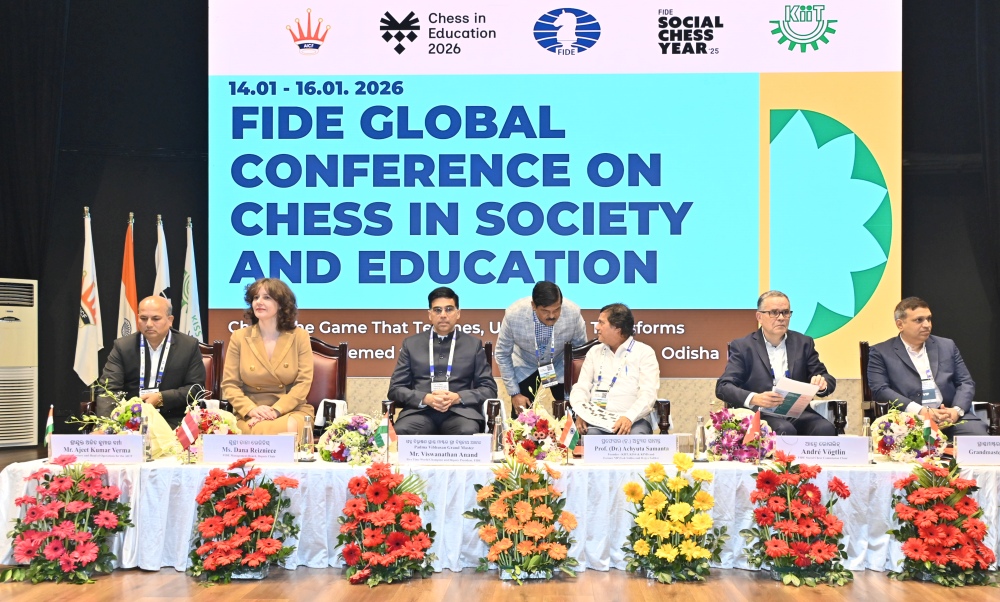
The FIDE Global Conference on Chess in Society and Education opened at KIIT University in Bhubaneswar on 14 January 2026, bringing together education leaders, researchers, social impact practitioners, and chess organisers for a three-day programme that also marks the launch of the FIDE Year of Chess in Education 2026. During the opening session, the moderator highlighted the role of Kalinga Institute of Industrial Technology (KIIT) as host of the conference and a long-standing centre for chess and education initiatives. KIIT has been organising international chess festivals for over 18 years, with the most recent edition featuring a total prize fund of INR 1.30 crore. The institution has produced 46 international chess players and hosted more than 30 international events, including World Junior Championships. Chess has also been integrated into KIIT’s broader educational framework, reflecting a sustained commitment to using the game as a tool for learning and development. The conference then formally opened with a ceremonial lamp-lighting, marking the inauguration of the event, followed by opening addresses from senior officials and partners, including Dana Reizniece, Deputy Chair of the FIDE Management Board, Viswanathan Anand, FIDE Deputy President, and Achyuta Samanta, Founder of KIIT, alongside André Vögtlin, Chair of the FIDE Social Chess Commission, Abhijit Kunte, Grandmaster, and Mukesh Ranjan Das, Executive Director (HR) of IndianOil. The opening ceremony and remarks set the tone for the conference’s two linked themes: chess as a social tool with measurable impact, and chess as a structured support for learning. “Education is about turning mirrors into windows,” said Dana Reizniece in her address to the audience, linking the idea to FIDE’s mission of using chess as a tool for empowerment and expanded ways of thinking. Anand emphasised that chess in education is “not to produce professional players,” but to help students “learn habits that improve performance in class,” pointing to focus, discipline, and decision-making as skills that transfer beyond the board. The conference then turned to the speakers and their presentations, with the day organised in thematic sections. FIDE Social Chess 2025 highlights and priorities for 2026 Vögtlin opened the conference programme with a review of the FIDE Social Chess Year 2025 and a forward look to 2026. He highlighted flagship campaigns across the year, including a month-by-month rhythm of themed initiatives, and the Social Chess Day tournament “Every Move Counts”, organised with Lichess.org, which drew 20,078 players worldwide. “Chess is more than a game. It is a tool to empower, include, educate, and transform communities worldwide,” said Vögtlin. “Following the success of the FIDE Social Chess Year 2025, 2026 will focus on scaling, professionalising, and globally embedding social chess as a measurable, evidence-based social impact framework.” The amplified connectome of the brain: Chess, the best scientific tool Dr. Cristóbal Blanco Acevedo followed with a neuroscience-focused presentation on how chess engages the brain across multiple systems rather than in a single “chess area”. “The most important question is not whether the brain will change, but into what it will change,” he said, pointing to the impact of environment and habits in a world of constant information overload. He explained that chess activates multiple areas of the brain simultaneously, particularly those linked to memory, calculation, and emotional control, while cautioning that not all forms of cognitive training translate effectively into real-life performance. How to build a big international social chess ecosystem for various social groups A core mid-morning session focused on how chess can be built into social ecosystems across different communities, with speakers from humanitarian, grassroots, and club-based backgrounds. Joining from Geneva, Francesca Bonelli, Head of Partnership and Coordination at UNHCR, outlined the scale of global displacement and the role sport can play in wellbeing and opportunity. UNHCR reports that 123.2 million people were forcibly displaced by the end of 2024. She also highlighted the FIDE and UNHCR collaboration that began in 2021 with a pilot “Chess for Protection” project in Kakuma, Kenya, and has since expanded to additional locations. Russell Makofsky, Founding Board Member of The Gift of Chess, spoke online about a practical, distribution-led approach to access, tracing the organisation’s origins to community initiatives during the Covid-19 pandemic and outlining its goal of distributing one million chess sets globally by 2030. “We saw how something as simple as a chess set could open doors,” Makofsky said. “When communities have access, opportunities begin to grow.” The session also included contributions from Rodrigo Barbeiton, who shared experiences from Club Magic Extremadura in Spain and the role clubs can play in long-term engagement. FIDE Social Chess programme updates After the networking break, the conference shifted into project-level updates from the FIDE Social Chess portfolio. Anastasia Sorokina (online) presented Chess for Protection, focusing on expanding safe, structured chess activities in refugee settings, particularly for girls and schools. Mikhail Korenman presented updates on Chess for Freedom, outlining developments in prison chess and upcoming continental and intercontinental competitions. Prabitha Urwyler presented Chess for Hope and Recovery, describing chess as a tool that provides structure, routine, and reflection in rehabilitation contexts. April Yunwei Zhong, via recorded video, highlighted how Chess for the Elderly supports both cognitive activity and social connection. Maryia Tamkovic presented Infinite Chess, focusing on adaptive learning models designed to meet players where they are. Social chess in India The afternoon returned to regional practice with a focus on India. In a standout contribution, Neelaya, Secretary of the Andaman and Nicobar Chess Association, presented initiatives shaped by geographic isolation and limited recreational infrastructure. He described projects spanning schools, orphanages, prisons, beach clean-ups linked to “Checkmate to Plastic”, culturally sensitive outreach to Indigenous communities, and onboard chess championships during long inter-island ship journeys. “The story of chess in Andaman and Nicobar islands is ultimately a story of belief in people, in potential, and in the power of thoughtful engagement.” he said, “Each move played on the chess board represents a larger life decision to think before acting, respect others, and to persevere despite setbacks” ending with, “Sometimes the strongest waves of change begin with a single move.” IndianOil
Magnus Carlsen and Bibisara Assaubayeva win World Blitz crowns

Magnus Carlsen defeated Nodirbek Abdusattorov in the knockout finals 2.5-1.5 to clinch his ninth title in the World Blitz. In the Women’s competition, with the same score, Bibisara Assaubayeva won over Anna Muzychuk to claim her third World Blitz title and qualify for the 2026 Candidates. The 2025 World Blitz Championships concluded in Doha with two familiar World Champions in this discipline. Second place in the Open Blitz went to Nodirbek Abdusattorov, while Arjun Erigaisi and Fabiano Caruana share the bronze. In the Women’s Blitz, Anna Muzychuk took silver, while the bronze went jointly to Zhu Jiner and Eline Roebers. In both the Open and Women’s competitions, the top four players from the first advanced to knockouts consisting of semifinals and finals, each a four-game match. The first stage was a Swiss-system tournament with 19 rounds in the Open and 15 in the Women’s event. Open Blitz The first day of the Open finished with Arjun Erigaisi, Maxime Vachier-Lagrave, and Fabiano Caruana sharing the lead after 13 rounds. Six more rounds on Day 2 would determine the final four players advancing to the knockout stage. The day started with a sensational ending of the game between Armenia’s Haik Martirosyan and Magnus Carlsen. In a tense position, with both players in severe time trouble, the Norwegian lost his composure and accidentally knocked off most pieces on the board with just two seconds left on his clock. As Magnus scrambled to reset them, he also pressed the clock (gaining two more seconds) before all the pieces were placed correctly, which was illegal. The arbiters were called in, and the incident – already visible on camera – was reviewed. Sector arbiter Chris Bird consulted with the players and explained the rules applicable in this situation. According to the regulations – which were presented to the players in the Technical Meeting ahead of each tournament – if a player brings the game into disrepute “with the intention of preventing their time expiring, the player should expect to be penalised by losing the game.” After hearing to the explanation, Carlsen accepted the decision and shook Martirosyan’s hand. This was a serious setback for the Norwegian – his second time in the tournament he dropped a piece in time trouble and ended up losing. Despite the incident, Carlsen kept his composure and rebounded in the following rounds. As the final rounds neared, several top players withdrew, concluding they had no chance of reaching prizes or top places. Among those who left early were Hans Niemann, José Eduardo Martínez Alcántara, Aleksandr Shimanov, and Maksim Chigaev. Caruana entered the final round on 13 points, sharing second with Carlsen, who had won four straight games after his loss to Martirosyan—including a crucial victory over Vachier-Lagrave (MVL) as Black in the penultimate round. Vachier-Lagrave, who had been in the top three for much of the event, slipped to a group on 12.5 points, sharing fourth. With first place and the top knockout spot decided, the final round determined the remaining three qualifiers. Erigaisi drew, while Caruana defeated Hakobyan with Black to claim clear second with 14/19. Carlsen split the point with Abdusattorov to finish on 13.5/19, enough for sole third. Six players finished tied for fourth with 13/19, including Nihal Sarin, Wesley So, Nodirbek Abdusattorov, and Maxime Vachier-Lagrave. Based on tiebreaks, Abdusattorov emerged on top of the group, clinching the final spot in the knockouts. The final standings in the Swiss-tournament phase of the World Blitz Open are available [HERE]. Women’s Blitz Day-one leader Eline Roebers continued dominating in Rounds 11 and 12 but lost in Round 13 to Bibisara Assaubayeva, who took sole lead. Playing the Sicilian, Assaubayeva seized the initiative early and won comfortably, reaching 10.5/13. Assaubayeva’s stay at the top was short-lived. In round 14 she overlooked a piece in time trouble and lost to the two-time women’s world blitz champion Valentina Gunina. With one round left to play, Gunina topped the standings with 11 points out of 14, half a point ahead of Assaubayeva. Six players shared third place, including Anna Muzychuk, who had climbed steadily with two wins and two draws on Day 2. In the final round, Gunina and Muzychuk faced each other in an Italian Game. Gunina seized the initiative and reached a dominant position with an extra piece, but time became her enemy. With seconds on her clock, she overlooked a deadly check from Muzychuk that turned the game around. Gunina fought bravely but eventually capitulated. When the dust settled, five players finished tied at the top on 11/15: Bibisara Assaubayeva, Anna Muzychuk, Eline Roebers, Zhu Jiner, and Valentina Gunina. With only the top four advancing to the knockout stage, Gunina was the unfortunate player to miss out – a disappointing end to an otherwise strong tournament. The final standings in the Swiss-tournament phase of the World Blitz Open are available [HERE]. Knockout drama In the semi-final matches in the Open, Uzbekistan’s top player, Nodirbek Abdusattorov, defeated India’s Arjun Erigaisi 2.5–0.5. Abdusattorov won both of the first two games. In game three, playing as White, Erigaisi managed only a draw, eliminating the need for the fourth game. In the other semi-final in the Open, it was a duel of two old foes: Magnus Carlsen and Fabiano Caruana. After two hard-fought draws, in game three Carlsen managed to swing the game as Black and win. In the fourth game, Caruana did not manage to achieve more than equality, and the score was 2.5–1.5 for Carlsen. The final was a nail-biter. Abdusattorov won the first game as Black with superior endgame precision, announcing a potential upset. In the second game, Carlsen struck back with the black pieces, grinding out a win in a dead-equal endgame. Following a draw in game three, everything depended on the final, fourth game. Carlsen prevailed in a tense battle and sealed his ninth World Blitz crown. “This was a very tough event for me. It could have gone either way. But when we got to the knockouts, I
World Blitz in Doha: Tight race in Open as Eline Roebers leads Women’s event

After 13 rounds, Arjun Erigaisi, Maxime Vachier-Lagrave, and Fabiano Caruana share the lead in the Open section of the FIDE World Blitz Championship with 10 points each. In the Women’s Blitz, the Netherlands’ Eline Roebers emerged as the sole leader with 8.5/10. The 2025 FIDE World Blitz Chess Championships started in Doha on Monday, December 29. Day one featured 13 rounds in the Open and ten in the Women’s competition. A trio of players tops the Open standings. Arjun Erigaisi, who moved into first place in Round 11, has enjoyed a stellar run, including a dramatic win over Magnus Carlsen when the Norwegian’s piece flew off the board and his time expired. Erigaisi’s only defeat came at the hands of Jorden van Foreest. Maxime Vachier-Lagrave recovered from an early setback in Round 2 to join the leaders by Round 12. Finally, Fabiano Caruana surged to the top with a strong finish, including a lucky victory over Carlsen, who blundered a rook. The leaders are chased by six players on 9.5 points. The co-champions from 2024, Magnus Carlsen and Ian Nepomniachtchi, sit on 9/13. In the Women’s event, Eline Roebers defeated Aleksandra Goryachkina in Round 9 to tie for the lead, then outplayed Argentina’s Candela Francisco Guecamburu with Black in Round 10, securing the sole lead. Goryachkina, Umida Omonova (the sole leader after Round 6), and former Women’s World Champion Antoaneta Stefanova trail by half a point with 8/10. The Open Blitz The first sole leader in the Open emerged after Round 6 – Jorden van Foreest was the only player with a 100% score. The 26-year-old Dutchman, who won the Dutch championship this year, defeated the likes of Firouzja and Erigaisi. In Round 7, van Foreest fell to Nodirbek Abdusattorov, who briefly joined a six-way tie for the lead at 6/7. Things didn’t go well for the Dutchman after that, and he finished the day on 8/13. By the end of Round 10, Arjun Erigaisi stood alone at the top with 8.5/10, having drawn only once (with Firouzja) and lost once (to van Foreest). Entering the final round of the day, three players were tied at 9.5/12: Erigaisi, Vachier-Lagrave, and Caruana (who joined the lead by beating Carlsen). All three drew their final games: MVL with Caruana and Erigaisi with Daniil Dubov. With other games on top boards ending in draws, the trio remains at the top after day one. Magnus Carlsen finished on 9/13. He suffered two big setbacks – losing to Erigaisi on time and overlooking a rook against Fabiano Caruana. Magnus also drew four games – with Javokhir Sindarov, Oleksandr Bortnyk, Jorden van Foreest, and Alexander Grischuk. With six rounds remaining, Carlsen will need to sharpen his game if he wants to reach the top four. Top 10 after Day 1 – Blitz Open The Blitz drama: When pieces fly off the board The moment that captured the full drama of the World Blitz event happened in Round 9. Magnus Carlsen was fighting a tense endgame with India’s top player, Arjun Erigaisi. The Indian had nine seconds on his clock while Carlsen was down to three. Just as Carlsen was about to make a queen move, his queen slipped off his hand and flew off the table. Alexander Grischuk, who happened to be passing by at that moment, jumped and tried to move out of the way quickly. By the time Carlsen picked up his queen and put it back on the board, his time had already run out. The Norwegian couldn’t hide his anger, slamming his fist on the table. The Women’s Blitz As in the Open, the first sole leader in the Women’s Blitz emerged after Round 6. Uzbekistan’s Umida Omonova defeated a whole field of strong players, including Koneru, Danielian, Lagno, and Yip, to reach the top. In Round 7, Omonova lost to Aleksandra Goryachkina, who took the lead and held it for the next three rounds (despite losing as Black to Eline Roebers in round nine). In the final round of the day, Goryachkina drew as White on board one with former Women’s World Champion Antoaneta Stefanova, putting them both on eight points. Meanwhile, on board two, Eline Roebers defeated Candela Francisco Guecamburu with the black pieces. With 8.5/10, Roebers ended the day as the sole leader. Behind her are Goryachkina, Omonova, and Stefanova, all on eight points. The defending Women’s World Champion in the Blitz Ju Wenjun finished the day on 5.5 points, just above 50%. With five more rounds to go in the Women’s Blitz, Ju has almost no chance of reaching the knockouts. Top 10 after Day 1 – Blitz Women From knockouts to “sudden death” games: The rules of the Blitz format The World Blitz Championships are made up of two stages. The first is a large Swiss tournament (19 rounds in the Open, 15 in the Women’s event). The top four players then advance to the knockout stage, which consists of four-game matches. The knockout format in the Blitz was first introduced in the 2024 event, when it featured eight players. The change from last year is that the number of players who qualify for the knockouts is four instead of eight. If the score is even after four blitz games, one sudden death game shall be played to determine the winner of the match. In the previous edition in New York, Ju Wenjun won the Blitz crown. In the Open, the title was shared jointly by Magnus Carlsen and Ian Nepomniachtchi after the two ended up in a series of hard-fought draws. The two-day event features 150 players in the Open and 140 in the Women’s competition, fighting for the prize fund worth just over half a million euros (nearly 600,000 USD). With the time control of three minutes plus a two-second increment per move, starting from move one, this tournament is traditionally the sharpest and most electrifying chess event of the year, with surprises and setbacks in almost every round. The standings after Day 1
FIDE World Rapid, Day 2: Drama in Doha as Carlsen stumbles

After two days of FIDE World Rapid in Doha, Vladislav Artemiev and Hans Niemann share the lead in the Open on 7.5/9. In the Women’s Rapid, Zhu Jiner maintained her position at the top, but is joined by defending champion Humpy Koneru, with both ending the day on 6.5/8. In the Open event, Magnus Carlsen – who had 4.5/5 on day one – was put on the back foot on day two, starting with a draw and a defeat. Instead, it was Vladislav Artemiev (who defeated Carlsen) and Hans Niemann who shone, ending the day as joint leaders. They are chased by four players half a point behind: Carlsen, Sarana, Erdogmus and Abdusattorov. Zhu Jiner continued strongly in the Women’s Rapid and is now level with Humpy Koneru, who scored 3.5 points in four games. Both are on 6.5/8. They are trailed by as many as ten players on 6/8. The Open Rapid The standout players of the day in the Open were Vladislav Artemiev and Hans Niemann. One of the co-leaders on day one, Artemiev was in great form on day two. He opened with a victory as Black against India’s Arjun Erigaisi, coming back from a lost position and playing much of the game on increment. After Round 6 he became the sole leader of the tournament, with a half-point advantage. In Round 7, Artemiev defeated Carlsen in a game where the world’s top-rated player made a grave mistake on move 15, which cost him dearly. This win put Artemiev on 6.5 points, a full point ahead of the field. Artemiev concluded the day with two calm draws with Maxime Vachier-Lagrave and Alexey Sarana. “I am pleased with my performance, and everything is feeling good,” Artemiev told FIDE in a brief comment. Artemiev is joined at the top by Hans Niemann, who scored 3.5/4, conceding only a draw to compatriot Ray Robson. After a 4.5/5 on day one, Carlsen’s performance on day two slipped. In the first game of the day, in round six, he played the Sicilian against Maxime Vachier-Lagrave. Things didn’t go that well for Carlsen, who found himself with tripled pawns on the e-file and spent more time looking for the moves. After transitioning to a rook endgame where White had a 4-3 pawn advantage, it was clear that the best outcome for Carlsen was a draw. After testing Carlsen for a few moves, MVL agreed to split a point. Then came a huge upset for Carlsen in round seven. After surrendering on move 30, the Norwegian stormed out of the playing hall, visibly unhappy. Carlsen bounced back in Round 8, with a comfortable victory against Armenian GM Shant Sargsyan in the Italian Game. In Round 9, he faced US GM Ray Robson (who had held Hans Niemann to a draw in Round 7). Carlsen was better on time and managed to secure an extra pawn in the center. Robson resisted for a while, often having less than 10 seconds on his clock, but eventually capitulated in a hopeless position. With two straight victories, Carlsen joined the group of four players on seven points. It includes Abdusattorov, Sarana, and 2446-rated prodigy from Türkiye Yagiz Kaan Erdogmus. The 14-year-old teenager netted 3.5/4 today, defeating the likes of Joren Van Foreest and Nihal Sarin in the last two rounds. World Champion in classical chess, Gukesh D, had an uneven performance on day two. Starting with two draws, in Round 8 he prevailed over Spain’s David Anton in a topsy-turvy game. However, in the following round he was completely dismantled by Nodirbek Abdusattorov in the King’s Indian Attack. With this defeat, Gukesh finished on 6.5 points. Defending Rapid Champion Volodar Murzin improved his performance, but only somewhat. After three defeats and two victories on day one, Murzin made a draw and two victories in Rounds 6, 7, and 8. However, in the last round of the day, he fell as White to Vahap Sanal after trapping his queen. He is now at 50% with 4.5/9. Seasoned heavyweight Levon Aronian, who had a great performance this year, is also one of the top players struggling in Doha. After scoring 3/5 on day one, he began the second day with two defeats. Levon bounced back with two wins and is now on 5/9. Ian Nepomniachtchi started the day with a loss with the white pieces in the game against Maksim Chigaev. The two-time candidate for the title of World Champion in classical chess responded with two draws and a win, finishing the day on 6/9. The Women’s Rapid The women’s event remains extremely tight. While the Open section of the Rapid had five rounds on day one, the women’s section had four. By the end of Round 7, defending champion Humpy Koneru emerged as the sole leader on six points, followed by eight players on 5.5. She was on six points, followed by eight players on 5.5 points. Among the chasers was Aleksandra Goryachkina, who has been very consistent in the tournament so far. After starting the day with a game against Zhu Jiner, Goryachkina finished it with the round seven leader, Koneru. Playing against the Petrov, Goryachkina emerged clearly better from the opening but erroneously grabbed a pawn on move 24, giving the opponent sufficient counterplay. The game ended in a draw, which was enough to secure Humpy a shared first place. Day 1 leader Zhu Jiner drew her round-five game against Goryachkina in an even endgame. Two more draws followed – against top contenders Nino Batsiashvili and Mariya Muzychuk. In the final round of the day in the Women’s event Zhu was facing World Cup winner Divya Deshmukh. Following interesting complications in the middlegame, the opponents landed in an unbalanced but roughly equal position. However, Divya’s seemingly harmless move 30…e4 turned out to be a blunder costing her the game. With this victory, Zhu scored 6.5 points and joined Koneru in the lead. World Champion in classical chess, Ju Wenjun, suffered a major setback at the start
FIDE World Rapid 2025: Magnus Carlsen and Zhu Jiner set early pace on day one in Doha

Norwegian Magnus Carlsen leads a group of five players on 4.5 points after five rounds in the open section of the FIDE World Rapid. China’s Zhu Jiner is the sole leader in the women’s section – the only player to achieve a perfect 4/4. The 2025 edition of the FIDE World Rapid kicked off at the Sports and Events Complex of Qatar University. With several hundred spectators in attendance, the tournament’s atmosphere was focused and professional as the year’s final world championship moved from ceremony to competition. The Open Rapid After five rounds on day one, five players share the lead in the Rapid: Magnus Carlsen, Arjun Erigaisi, Maxime Vachier-Lagrave, Vladislav Artemiev and the reigning World Champion in classical chess, Gukesh D. At the opening press conference on Thursday (December 25), Carlsen said that he had come to Doha to win. He backed up those words with four convincing victories in the first four rounds. But in round five he was facing Arjun Erigaisi – one of the leading players of the new generation. In the Queen’s Gambit Declined, the two went for a line which quickly transitioned into an equal queen and rook endgame. Famous for his excellent technique and ability to “squeeze water from a stone”, Carlsen pushed hard. They eventually reached a rook ending where Carlsen had two extra “f” and “h” pawns. This theoretically drawn position requires precision from the weaker side which Erigaisi demonstrated, denying Carlsen the perfect score on day one. After a turbulent performance at the Global Chess League in Mumbai, the World Champion Gukesh D had a great run on day one in Doha. Starting with a draw in round one, he went on to score four victories to join the leaders. Defending World Rapid Champion Volodar Murzin had a difficult opening day and finishing on just two points. He suffered his first setback as early as round two at the hands of his compatriot Rudik Makarian. He went on to lose two more games before making a comeback in round five. With 2/5, his chances of retaining the crown won in New York in 2024 appear slim. Another slow starter in the World Rapid is Praggnanandhaa. The elite world player won his first-round game, but then made two draws. In round four, he suffered a loss as Black to more than 150 points lower-rated Levan Pantsulaia, ending the day on a disappointing note. Vasyl Ivanchuk – who won the World Rapid in Doha in 2016 – is also on three points, drawing four games after his first-round victory. The Women’s Rapid Zhu Jiner holds the sole lead in the Women’s Rapid section after winning all four of her games today. The Chinese GM dominated from the outset, securing strong positions in every encounter – including against seasoned opponents such as Armenian Grandmaster Elina Danielian and Georgia’s Nana Dzagnidze. In Round 5, she will face Aleksandra Goryachkina, the former Women’s World Championship challenger. https://youtu.be/vyPsqAnQV38 As many as seven players are trailing Zhu by half a point. Leading the chase is Nino Batsiashvili, who also performed strongly in the recently concluded Tech Mahindra Global Chess League. Joining her are two former Women’s World Champions Mariya Muzychuk and Antoaneta Stefanova, former women’s challenger Aleksandra Goryachkina, India’s Harika Dronavalli, Song Yuxin (who stunned the field with her run at the Women’s Grand Swiss in Samarkand) and Sara Khadem. Former Women’s World Champion Tan Zhongyi was one of the biggest tragic figures of the day. In round three, she had a completely wining position against none other than the winner of the Women’s Grand Swiss, Vaishali Rameshbabu. However, in time trouble, Tan blundered overlooking a back-rank checkmate – a rare oversight at this level. With victories in all three other games, it is fair to say that Tan deserved to be in the lead; but in rapid chess, luck and misfortune are also big factors. Defending Women’s Rapid Champion Humpy Koneru also sits on 3 points, with two wins and two draws. Meanwhile, the reigning Women’s World Champion in classical chess, Ju Wenjun, ended the day on 3 points as well. In Round 1, she was held to a surprising draw by Azerbaijan’s Govhar Beydullayeva, rated over 300 points lower. Playing White, Beydullayeva seized the initiative early and maintained an edge for most of the game. Ju escaped only by sacrificing material to reach a technical draw – a bare king versus a pawn and a bishop and of the “wrong color”. After winning in Round 2, Ju suffered another minor setback in Round 3, missing a clear chance to win material as Black against Umida Omonova, settling for another draw. The action can be followed live on the FIDE YouTube Channel, featuring expert commentary by GMs Maurice Ashley, Peter Leko and IM Jovanka Houska. Written by Milan Dinic Photos: Anna Shtourman and Lennart Ootes About FIDE World Rapid and Blitz Championships The FIDE World Rapid & Blitz Championships 2025 are taking place in Doha, Qatar from 25 to 30 December, bringing together the world’s elite chess talent for a thrilling end-of-year showdown. Held at the Sports and Events Complex, Qatar University, this edition features both Open and Women’s events in Rapid and Blitz formats, with a total prize fund of over €1,000,000. Doha returns as host after nine years, underscoring Qatar’s growing stature in the chess world. Official website: worldrapidandblitz2025.fide.com/
WRB starts in Doha – the pearl of the chess world

The 2025 FIDE World Rapid and Blitz Championships were officially opened in Doha, marking the start of one of the most watched chess events globally. As players and guests gathered in the playing arena at the Sports and Events Complex of Qatar University, the ceremony opened with a performance by the traditional Qatari music group Farkah. Dressed in national clothing and accompanied by drums, the ensemble performed “Today is the happiest day”, a song traditionally associated with the beginning of celebrations. The formal part of the ceremony began with the intonation of anthems of Qatar and FIDE, followed by an artistic performance symbolizing the battle of black and white pieces on the chessboard. The president of the Qatar Chess Federation Mohammed Al Mudahka – the country’s first Grandmaster – greeted the guests and wish them a warm and pleasant experience in the country which proudly calls itself “the global capital of sport.” FIDE President Arkady Dvorkovich reminded that Doha was a successful host of the World Rapid and Blitz Championships in 2016, noting that FIDE was proud to return “to a country which supports chess,” pointing to events such as the Qatar Masters. He added that “chess has a home in Qatar,” and linked the message to the country’s heritage with the line that Qatar is “the pearl of the chess world.” Dvorkovich thanked the hosts, the Qatari Chess Federation and its president Mohammed Al Mudahka, for welcoming the chess community “with warmth and open arms”. Turning to the players, Dvorkovich said the World Rapid and Blitz “traditionally marks an exciting end to the year,” and that this edition should be no different. “I wish the players the best of luck, fair play, good games and great experiences here in Doha,” he said. “May the best player win and may the spirit of chess flourish.” The ceremonial opening concluded with Dvorkovich and Al Mudahka making symbolic first moves on a chessboard, before moving to the top-boards in the Open and the Women’s section. The first event to take place is the World Rapid Championship, with 300 players from all over the world are taking part. The World Rapid consists of 13 rounds in the Open and 11 in the Women’s event, with five and four rounds taking place on day one, respectively. The action can be followed live on the FIDE YouTube Channel, featuring expert commentary by GMs Maurice Ashley, Peter Leko and IM Jovanka Houska. Written by Milan Dinic Photos: Anna Shtourman and Lennart Ootes Official website: worldrapidandblitz2025.fide.com/
Season’s greetings from FIDE President

Dear chess friends, As the year ends, I want to thank you for a remarkable 2025. The chess calendar was packed. From the Women’s Grand Prix series to the World Cup and the Grand Swiss to the Global Chess League, we saw our sport grow in every region. This success does not happen by magic. It happens because of you. Behind each of these events were people who worked hard to make them happen: the organisers, federation officials, arbiters, coaches, players, cohorts of volunteers and the members of the FIDE team. I am grateful for their trust, energy and support for chess and am confident that we are building a strong base for the growth our sport is experiencing. We also made progress off the board. We focused on inclusivity and education, and we held the Smart Moves Summit in Washington, where we joined together the worlds of chess and education. We strengthened our financial stability and increased support for players and federations. We secured new partners and projects, from India to Norway and around the world, who see the value in what we do. The coming year will bring more excitement – from the launch of the Total Chess Championship with Norway Chess, to the Candidates, world championship matches and the Olympiad – it will be another significant year for chess. I look forward to these and other projects, as we continue to spread chess around the world. Chess has always been and will continue to be a bridge between nations and cultures, uniting people regardless of differences. This is who we are – a global chess family that works together on sharing the beauty of our sport and on discovering new talents and future champions. I wish you and your close ones all the best in 2026. Best regards, Arkady Dvorkovich