

I am woman, I am president: Women at the helm of national federations

Out of 201 FIDE members, only 13 have women presidents. In a slow but steady shift, more women are taking executive roles in chess and business. FIDE spoke to four women who run national chess federations. Here is what they say about the role women can play in chess away from the board. In 1971 the Australian singer Helen Reddy came out with the song “I am woman” which by 1972 reached the number one spot on the U.S. Billboard Hot 100 chart. The famous chorus “I am strong, I am invincible, I am woman,” went on to become an anthem of the rising feminist movement. At the same time, another story of women’s voices was taking shape: in 1971 FIDE organised the first Women’s Interzonal in Ohrid (which was Yugoslavia, at the time), a step towards bringing it in line with the competing system for men. The following year, Nona Gaprindashvili defended her world title against Alla Kushnir by the narrowest margin, eight and a half to seven and a half. In Skopje, the Soviet team with Gaprindashvili and Kushnir on the top two boards dominated the Women’s Olympiad. Also that year, Olga Rubtsova quietly became the first ever women’s world correspondence champion, and the only person in history to hold both over the board and correspondence world titles. For the first time since Vera Menchik, it became more common to talk about women in chess. On the board, women were already making a breakthrough in chess. But away from the board, they were almost absent from the rooms where chess was governed. Nona Gaprindashvili – who is the first woman in history to earn the title of Grandmaster – was also faced with dismissal by many of her male colleagues or men in positions of power. Turning back to the U.S. where the global feminist movement from the 1970s was most prominent, it took another three decades before the U.S. Chess Federation elected its first woman president – Beatriz Marinello (pictured below), in 2003. Today the picture of women in chess looks quite different, but it is far from transformed. At the moment, according to FIDE data, out of 201 member federations, only 13 have a woman president. That is still a small percentage, yet – it would have been unthinkable when Helen Reddy first recorded her song and Gaprindashvili faced Kushnir across the board in Riga. Things are changing. The changing times Recent years have seen more emphasis and support not just for getting women into chess, but for using chess to help them improve their own careers. FIDE has not only increased the number, scope and support for women’s events, but has made women’s chess one of its top priorities, with the Commission for Women’s Chess and the appointment of Dana Reizniece as the Deputy Chair of the organisation’s Management Board. For years, FIDE’s finances have been looked after by Zhu Chen – a former Women’s World Champion, who is the treasurer of the International Chess Federation and is tasked with overseeing revenue flow and ensuring financial transparency. The Commission for Women’s Chess has supported programmes that help countries build women’s national teams from scratch. A 2024 initiative helped nine federations to send a women’s team to the Chess Olympiad for the first time. A conference on chess and life balance discussed the impact motherhood has on a woman’s chess career. Development projects such as the Queen’s Gambit Challenge have brought together more than five hundred eighty women from over eighty countries for training and support. The struggles women face in chess – be it as players or decision-makers in organisations – are the same as those faced in business. A recent Global Gender Report by the World Economic Forum notes that women are a large share of the workforce but a much smaller share of senior leadership. Deloitte’s Women in the Boardroom report, published in March 2024, notes that “women hold less than one-quarter (23.3%) of the world’s board seats”. Like companies, chess federations exist in that same world. They are sports bodies, but they are also employers, event organisers and public facing institutions. When women take the chair in those organisations, they are not only symbols. They are also decision makers in a sector that shapes how millions of children and young people first meet the game. FIDE spoke to several women who are presidents of national chess federations and asked them to share their views and tips on women looking to make a career in chess which is not strictly tied to the performance on the chessboard. From Women’s World Champion to federation President Few stories link together a path from “I am woman” to “I am president” better than that of Xie Jun. She began in Chinese chess at six. At ten, she switched to what people in China call “international chess” and by sixteen she was already in the national team. In 1991, she became Women’s World Champion, the first world champion from outside Europe. She recalls that moment in simple terms, saying that nothing compares to seeing your national flag raised for the first time at a world title match. In parallel with her chess career, Xie Jun pursued a doctorate in psychology – an extremely rare combination in the chess world. Her transition from the board to the boardroom was gradual: After playing she started coaching, then taught at university and worked as a sports administrator, and in 2024 she became the President of the Chinese Chess Association. “Every promotion felt like a logical ‘next move’ on a larger board, if you want to change the rules, you have to help write them,” notes Xie Jun. Xie Jun making the first ceremonial move in the 2025 FIDE Women’s World Championship Match On the evergreen question of work-life balance, Xie gives a simple answer: “I treat life like a long game with two clocks: family and career. If you work hard enough and put your heart into it, you
Battle for the final Candidates spot: Women’s Events 2024-2025 race heats up
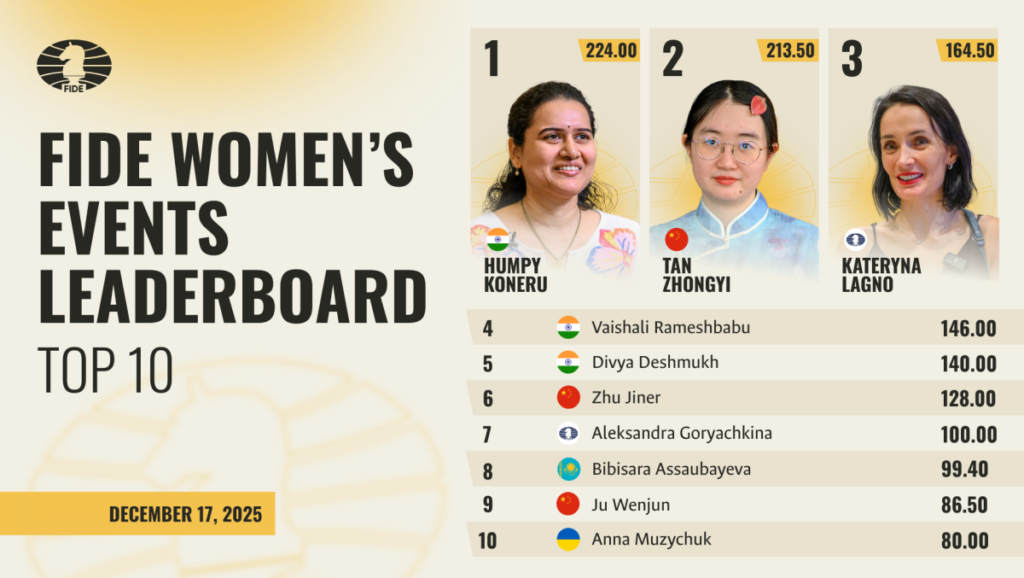
The Women’s Events 2024-2025 has entered its decisive phase. Following the triumphs of Vaishali R and Kateryna Lagno in the Women’s Grand Swiss, all seven leading players in the Women’s Events race secured qualification for the Women’s Candidates 2026 through various pathways. The eighth and final spot in the competition – which will determine the challenger for the women’s world title – remains open. Currently leading the race for that last berth is Bibisara Assaubayeva (99.4 points), who sits eighth, just behind the already-qualified players. Given her impressive resume in fast time controls, the two-time World Women’s Blitz Champion appears to have the strongest claim on paper heading to the Women’s Rapid and Blitz Championships 2025. Chasing her are Song Yuxin, Anna Muzychuk (both on 80 points), the winner of the 2022–23 Women’s Candidates Lei Tingjie (62 points), and the experienced Harika Dronavalli (58.5). All four remain strong candidates for the final slot, provided they deliver strong results at the upcoming events in Qatar. Further down the standings, young Afruza Khamdamova, former Women’s World Champion Alexandra Kosteniuk (both on 38.5), Mariya Muzychuk (26.40), Nana Dzagnidze (25), Ulviyya Fataliyeva (20), and Irina Krush (20) still have mathematical chances. With significant number of points available at the upcoming Women’s Rapid and Blitz Championships, none of them can yet be ruled out. Each of these contenders faces the formidable challenge of outperforming the competition in the season’s final events to claim the last coveted place in the Women’s Candidates 2026. We maintain a dedicated page on our website for the FIDE Women’s Events 2024–2025, featuring the latest information on eligible tournaments, current standings, and regulations. Visit: FIDE Women’s Events 2024-2025
Top 10 women players fighting for the crown in Doha

Women’s chess, like the Open, has its own cycles, storylines and stars. Doha will bring many of them together under one roof. Over the past few years, FIDE has pushed women’s chess up the agenda. The International Chess Federation declared 2022 the Year of the Woman in Chess and backed it with programs for girls, coaches and officials, as well as gender quotas in some official roles. The Commission for Women’s Chess now openly speaks of a “surge in the interest of women in chess” and sets its mission to make the game “beloved and accessible” to women worldwide. Still, there is a prevailing view in the wider chess community that more needs to be done to get women and girls playing chess. Women constitute only around 11 percent of FIDE members, according to a 2024 research paper on gender and chess. Yet the direction is clear: More national federations are fielding women’s teams. Ahead of the 45th Olympiad in Budapest, nine countries prepared female teams for the first time, helped by a dedicated FIDE project. Also for the first time in the Chess Olympiad, players who have small children were given support to bring over their children and a guardian, so they would not have to be separated during the long event. Prize funds are rising as well. The World Rapid and Blitz in Doha has a total purse of one million euros, with three hundred thousand reserved for the women’s events, split between rapid and blitz. The Women’s Grand Prix series has seen its overall prise fund jump from eighty thousand to one hundred twenty thousand euros, and the top prizes per tournament also increased. Some top events, such as Norway Chess, now run women’s super-tournaments with the same prize money as the open. Off the board, more women are visible as content creators and public figures. Rankings of “female chess influencers” already list several dozen active streamers and social media personalities. Players such as Anna Cramling or the Botez sisters show that a chess career today is not just about competition, but also about commentary and full-time streaming in front of global audiences. A 2024 survey of elite women players found that 65 percent believe a woman will one day win the overall world title, many expecting it within the next decade. In this wider shift, the women arriving in Doha for the World Rapid and Blitz form the top edge of the pyramid. The ten highest-rated players in the women’s field combine world title experience, blitz genius, and a mix of established champions and younger stars. These are the leaders of women’s fast chess in Doha. Ju Wenjun – the benchmark Photo: Anna Shtourman Top seed Ju Wenjun, with a rapid rating of 2530 on the entry list, comes to Doha as the player everyone else measures themselves against. In April she defended her Women’s World Championship title for the fifth time, beating Tan Zhongyi 6.5–2.5 in a match played in Shanghai and Chongqing. Earlier, she had already dominated the World Rapid and Blitz in New York. Ju won the 2024 Women’s World Blitz Championship, beating Lei Tingjie in an overtime final, and shared second to seventh place in the Women’s Rapid. She is not just a classical specialist. Ju is a complete all-around champion who handles every time control with calm and precision. In Doha, she is the natural favourite, but also the main target. Tan Zhongyi – fighter in every format Photo: Michal Walusza Tan Zhongyi, second seed on 2507 and a former Women’s World Champion, has been locked in a rivalry with Ju for almost a decade. She earned her second world championship match by winning the 2024 Women’s Candidates Tournament with nine points from 14 games, finishing one and a half points ahead of the field. While she could not stop Ju in the 2025 title match, Tan scored the first win before the champion pulled away. In tournaments, Tan stays near the top in both classical and rapid. At the 2025 Women’s World Cup, she again reached the latter stages but was eliminated in the semifinals by the eventual winner IM Divya Deshmukh. Tan’s approach is practical and determined. She defends tough positions for hours and is equally ready to attack if a chance appears. In rapid and blitz, that ability to hold bad positions and keep the game going can be worth as much as sharp preparation. Aleksandra Goryachkina – Grand Prix leader and rapid star Photo: Michal Walusza Aleksandra Goryachkina is another well-known face in women’s chess. Rated 2505, she is one of the strongest women players, a former world championship challenger and often a participant of Open rather than Women’s competition. Her recent performances have been strong. In 2024, she won the Tata Steel Chess India Rapid women’s event in Kolkata, scoring 7/9, staying undefeated and finishing a point and a half ahead of her nearest rival. In the same season, she took first place at the Shymkent leg of the FIDE Women’s Grand Prix, then followed it in February 2025 with victory in Monaco, again winning a three-way tie on tiebreak. Wins in Shymkent and Monaco secured her second-place finish in the overall Grand Prix standings (behind Zhu Jiner) and earn a spot in the next Candidates Tournament. Still, at the 2025 Women’s World Cup, she had a rough time and was eliminated early by Meruert Kamalidenova. In fast chess, Goryachkina is known for her excellent positional understanding and endgame technique. A camera-shy player, Goryachkina prefers to let the moves on the chessboard speak for her. Lei Tingjie – silver in New York, always in contention Photo: Anna Shtourman Lei Tingjie, seeded fourth on 2496, has been near the summit of women’s chess since her run to the 2023 world championship match against Ju Wenjun, which she lost by the narrowest of margins, 5.5 – 6.5. Last December, in New York, she reached the final of the 2024 Women’s World Blitz Championship and only lost to
Global Chess League opens Season 3 at Mumbai’s Royal Opera House

The first franchise-based chess league in the world – GCL – has entered its third season with a grand opening ceremony at the historic Royal Opera House in Mumbai. Is chess art, sport or entertainment? The game, long seen as an individual competition played in silence behind closed doors, is undergoing a transformative change both on and off the board. The Global Chess League – a bold attempt by TechMahidnra and FIDE to make chess into a billion-dollar fan-based league sport – is driving the charge. Capitalising on India’s rise as a global chess powerhouse, the third edition of GCL takes place in the country’s financial and entertainment capital – Mumbai. A royal ceremony for the royal game The Royal Opera House in Mumbai – whose foundations were laid in 1909 – is a unique architectural jewel in Asia, regarded as India’s only remaining traditional opera theater. With extravagant interiors mixing baroque and Indo-European influences, its auditorium ceiling provides an ideal acoustic reception from every part of the building. After opera performances, live music and film projections, the Royal Opera House will for the first time be the venue of a global chess event. The opening ceremony included the unveiling of the GCL Season 3 trophy. The ceremony was led by Anand Mahindra, Chairperson of the Mahindra Group, whose presence underlined the league’s ambition and growing global stature. He was joined by chess legends Viswanathan Anand, Arjun Erigaisi, Praggnanandhaa R, Harika Dronavalli, Volodar Murzin, and Alireza Firouzja. A trophy with a story The trophy itself tells part of the story of what GCL wants to be. Designed by Pininfarina, the 95-year-old Italian firm that helped shape Ferrari, Alfa Romeo and Maserati, it brings the language of fast cars and industrial design into the world of chess. Sharp, rising lines and polished metal give a sense of speed and movement. It is a fitting symbol for a rapid league that wants to grow quickly and speak to a wider public. For the next ten days, every move played in Mumbai will be made with that silver shape in mind. GCL as part of FIDE’s strategic effort For the International Chess Federation, the Global Chess League fits into a wider effort to bring chess to new audiences. FIDE President Arkady Dvorkovich did not hide his support for the project. “The Global Chess League has firmly established itself as one of the premier destinations for chess, bringing elite competition to a global audience in a fresh, modern, and exciting format. The GCL has an important role in FIDE’s strategic effort to popularize the sport and make it more attractive to the broader audience. I am certain that Season 3 will continue this evolution, showcasing the world’s best players and reinforcing FIDE’s commitment to making top-level chess more engaging, inclusive, and globally accessible.” The competition and the concept Season three keeps the basic structure that made the Global Chess League stand out from the start. Six franchises will compete across 34 matches, played over ten high-intensity days in a double round-robin, followed by a third-place playoff and the Grand Finale on 23 December. Every encounter is a six-board clash with a fixed mix of men, women and prodigies. Season 3 continues to feature six teams and bring the world’s elite onto a single stage. Among the big names headlining the season are Alireza Firouzja, Fabiano Caruana, Hikaru Nakamura, Wesley So, Maxime Vachier-Lagrave, Hou Yifan, Zhu Jiner, Bibisara Assaubayeva, and Alexandra Kosteniuk, alongside India’s finest, headlined by the former world champion and first Indian GM Vishwanathan Anand. Reigning two-time champions Triveni Continental Kings, led by Alireza Firouzja, Vidit Gujrathi, and Zhu Jiner, return with their sights set on an unprecedented hat-trick. Speaking at the pre-tournament press conference, Akash Premsen, CEO, Triveni Sports and Team Manager Triveni Continental Kings, said, “Coming in as two-time champions is a privilege, but it also raises expectations. The field is stronger than ever, and every match will demand precision. Our squad is experienced, balanced, and hungry, and we’re fully committed to defending the title with the same discipline that has defined our journey so far.” Kailash Kandpal, CEO, Ganges Grandmasters, framed his team’s approach in simple terms. “We’ve built our Season three squad around a solid core. The league continues to raise the competitive bar, and our focus is on consistency, teamwork, and delivering high-quality chess across all ten group-stage matches.” For PBG Alaskan Knights, World Champion Gukesh D and Arjun Erigaisi form a powerful spine. Team owner Punit Balan said, “With Gukesh and Arjun spearheading our lineup, competing in India adds a special layer of energy and expectation. Both are world-class talents, and the atmosphere here elevates every move. We believe our blend of youth, experience, and momentum positions us strongly for a deep run this season.” The FYERS American Gambits (who have added “FYERS” to their name), with Hikaru Nakamura as their icon, promise an aggressive, modern style. Their co-owner and CEO, Prachura PP, put it this way. “The Global Chess League has transformed how fans experience elite chess, and being part of that evolution is a tremendous opportunity. Our roster is dynamic and versatile, and we’re excited to bring an aggressive, ambitious style of play to a league that rewards bold, modern chess.” Alpine SG Pipers, fronted by Fabiano Caruana, Praggnanadhaa R and Anish Giri with Hou Yifan leading the women’s board, and UpGrad Mumba Masters, led by Maxime Vachier-Lagrave and Wesley So, complete a lineup that is strong on every board. “The calibre of players in Season three is exceptional, and we’re proud to contribute to that standard. With a roster built for high-quality, resilient chess, our aim is to deliver consistent performances from the opening weekend through to the knockout stages,” said Rohan Gupta, owner of Alpine SG Pipers. For the home franchise, UpGrad Mumba Masters, playing in Mumbai adds extra motivation. CEO Suhail Chandhok said, “This season features one of the most competitive fields we’ve seen, with world-class talent across every board. For
FIDE World Cup: A quick draw sets up tiebreaks for title as Esipenko wins third place
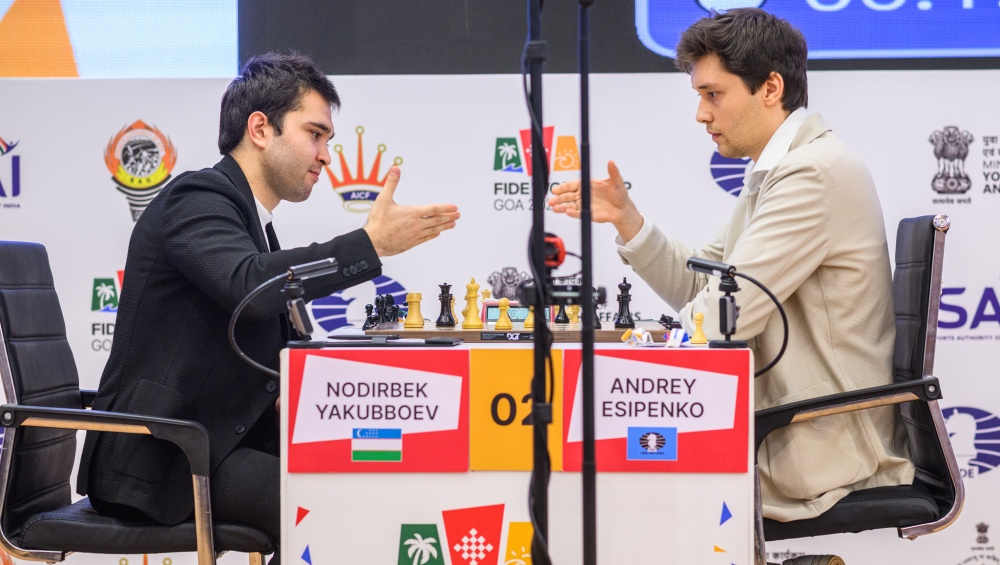
What a day at the FIDE World Cup finals. The players entered with very different levels of pressure. On one side, Javokhir Sindarov and Wei Yi faced far less tension, with the high likelihood of a draw sending their match to tiebreaks, a recurring pattern throughout this event. That is exactly what happened, as the game concluded within thirty minutes. On the other board, Nodirbek Yakubboev was in a must-win situation to level the match and keep his chances alive in the tiebreaks. Perhaps, nerves weighed heavily on the young Uzbek player, as he faltered early and allowed Andrey Esipenko to take control and secure victory. The first move was made by another local sporting icon, Ms. Saina Nehwal, Olympic bronze medalist in badminton, setting an inspiring tone for the day. Let’s take a look at the game for third place, and then a closer look at the contenders for first: Round 8 Game 2 results: Nodirbek Yakubboev 0–1 Andrey Esipenko Wei Yi ½–½ Javokhir Sindarov Nodirbek Yakubboev (2689) vs Andrey Esipenko (2693) The game began with an offbeat Neo-Catalan in which Yakubboev, playing White, opted for a line that concedes a slight advantage to Black but introduces early complexity and aims to take Esipenko out of his comfort zone. The idea seemed promising until one inaccurate decision completely shifted the momentum, and Yakubboev was unable to recover. Here, White played 11.Bxd5? labelled an “inexcusable move” by GM Peter Leko in the FIDE studio because it gives up the crucial light-squared bishop and hands Black full control over the light squares. After 11…Nxd5 12.Qxd5 b5!, with …Bb7 coming next, Black’s initiative is already very strong. White also cannot capture the seemingly free rook: 13.Qxa8 Bb7 14.Qa7 Nc6! 15.Nxc6 Qxc6 Here Black threatens immediate checkmate along with …Bb8 to trap the queen. In the game, Yakubboev instead played 13.Nf3 and continued from a difficult position. Esipenko’s handling from this point was especially notable: rather than following the computer’s top choices, he played natural, harmonious moves, very much in line with the style often compared to Capablanca, placing his pieces on perfect squares and increasing the pressure at the right moments. It was a clean, instructive conversion as he traded-off key pieces, maintained full control, denied counterplay, and finished the game with a beautiful mating net. Black is already completely winning here. Esipenko continued with 24…Nc1, inviting the mistaken 25.Rxc1 (which occurred in the game), and then followed with 25…Rxd2+ 26.Kg3 Qe2. White could delay but not prevent the impending checkmate. This victory sealed the match for Esipenko, who left the hall visibly relieved and exhausted. With two classical wins, he bypassed tiebreaks entirely and secured both third place and a coveted spot in the 2026 Candidates. Wei Yi (2752) vs Javokhir Sindarov (2721) There was little to elaborate on in the game for first place, as the players entered another Rubinstein Variation of the Four Knights Spanish, a line well known for its drawish nature. Both players blitzed out their moves with ease, clearly choosing to conserve energy and head into the tiebreaks tomorrow. Since the game offered little material, here is a closer look at the finalists: Wei Yi Wei Yi has long been regarded as one of the most naturally gifted attacking players of his generation. He became a grandmaster at 13, one of the youngest in history, and has built a career defined by calculation, creativity, and consistency at elite level. His resume includes a World Youth Championship title, three Chinese Championship titles, and two Olympiad gold medals in Tromsø 2014 and Batumi 2018. His famous win over Lázaro Bruzón in Danzhou 2015 remains one of the most celebrated modern attacking masterpieces. In recent years, he has delivered strong results in top classical and rapid events, including the victory in the 2024 Tata Steel Masters, maintained a 2700+ rating, and proven to be a dependable top-board player for China. Reaching the final here in Goa reflects his stability and resourcefulness throughout this event. Wei Yi’s 2025 FIDE World Cup ResultsRound 2: beat GM Kacper Piorun 2–0 (classical)Round 3: beat GM Benjamin Gledura in rapid tiebreaksRound 4: beat GM Parham Maghsoodloo in the final blitz gamesRound 5: beat GM Samuel Sevian 1.5–0.5 (classical)Quarterfinals: beat GM Arjun Erigaisi in the fourth rapid gameSemifinals: beat GM Andrey Esipenko with a key rapid win Javokhir Sindarov Javokhir Sindarov is one of the brightest stars of Uzbekistan’s new generation. Born in 2005, he became a grandmaster at age twelve and has since grown into a central figure in Central Asian chess. He is a two-time Uzbek Champion and a key member of the national team that won the 2022 Olympiad in Chennai. His 2025 season has been exceptional. He won the TePe Sigeman & Co Tournament, tied for first at the UzChess Cup Masters only to be edged out in tiebreaks, and achieved a 2796 performance rating at the FIDE World Rapid Team Championship. His impressive results have strengthened his position among the world’s rising elite. Reaching the final in Goa is the biggest individual milestone of his career so far, and combined with his qualification for the 2026 Candidates Tournament, it marks his arrival as one of the most ambitious young talents in top-level chess. Sindarov’s road to the 2025 FIDE World Cup finalRound 2: beat GM Nikita Petrov 1.5–0.5Round 3: beat GM Nikolas Theodorou 1.5–0.5Round 4: beat GM Yu Yangyi in rapid tiebreaksRound 5: beat GM Frederik Svane 1.5–0.5Quarterfinals: beat GM José Martínez in a six-game classic–rapid–blitz marathonSemifinals: beat GM Nodirbek Yakubboev in rapid tiebreaks Both finalists are not only serious Candidates contenders, but entirely deserving World Cup finalists. Tomorrow, only one will lift the Viswanathan Anand Trophy. The winner will be decided in the tiebreaks beginning at 15:00. Don’t miss it. The action can be followed live on the FIDE YouTube Channel, featuring expert commentary by GMs Jan Gustafsson and Peter Leko. To watch the games in person, tickets can be purchased [HERE] Written by WIM Charlize van Zyl
FIDE World Cup: Esipenko strikes first against Yakubboev as Sindarov and Wei Yi draw
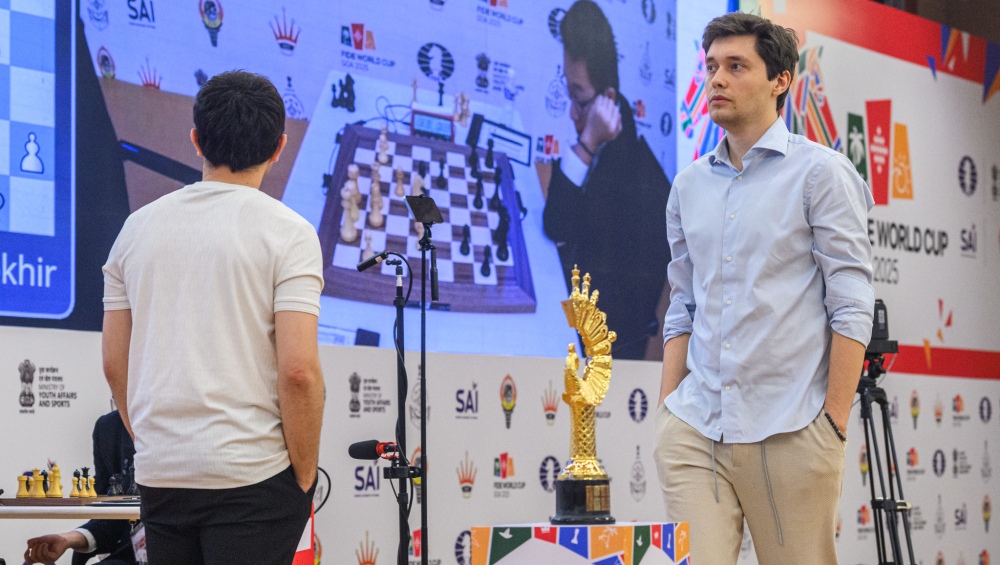
After seven gruelling rounds and twenty-three days of intense chess, the FIDE World Cup reached its final stage with Wei Yi and Javokhir Sindarov battling for first place and the 120,000 USD first prize, and Andrey Esipenko and Nodirbek Yakubboev fighting for third place and the final Candidates qualification spot. Both matches carry enormous weight, creating a tense atmosphere throughout the hall. In the match for the title, a complex opening led to a position where Wei Yi had chances to push for more, but with the Black pieces he steered the game toward a more balanced continuation and an eventual draw. On the other board, Andrey Esipenko successfully recovered from yesterday’s loss and struck first in his match against Yakubboev. A notable change in the hall today was the arrival of the official trophy, the Viswanathan Anand Trophy, displayed on the stage for the first time. Glistening under the overhead lights, it immediately drew the attention of media, spectators, and the players themselves. The ceremonial first move was made by Indian sporting icon Abhinav Bindra, an Olympic gold medalist in shooting who made history by winning India’s first-ever individual Olympic gold. A fitting choice for the board of Wei Yi – Sindarov, as both players are Olympiad gold medalists themselves in 2014, 2018, and 2022 respectively. Let’s take a look at the two games today: Game 1 results Andrey Esipenko 1-0 Nodirbek Yakubboev Javokhir Sindarov ½ – ½ Wei Yi Andrey Esipenko (2693) vs Nodirbek Yakubboev (2689) Emotionally, the battle for third place may be even more demanding, as both players entered today still carrying the weight of semifinal losses. Yakubboev was coming off a ½–1½ tiebreak defeat to his compatriot Javokhir Sindarov, while Esipenko had experienced an equally painful ½–1½ loss defined by one final, decisive blunder that turned a winning position into a loss. As our commentator GM Peter Leko noted during the broadcast, the best way to recover from a loss is simply to play good moves the next day, and that is exactly what Esipenko did to take the lead in the match. An Open Sicilian that soon transposed into the Four Knights Variation set the tone. The game quickly entered a sideline chosen by Yakubboev, who then spent considerable time on his ninth move, raising questions about his level of preparation and confidence. Esipenko achieved the better position out of the opening, and an important moment soon arose: Here, 15.Nd6 is a strong knight jump that plants a thorn in Black’s camp. After 15…Bxd6 16.exd6, the pawn cannot be captured by the queen straight away due to the threat of c4 hitting the pinned bishop. And after 16…Bxf3 17.Rxf3 Qxd6 18.f5, White is clearly better. In his post-game visit to the studio, Esipenko explained that he had seen this line but did not evaluate it as favorably for White as the computer suggests. Instead, he opted for 15.Be3 and the game continued. Eventually, the players transitioned into an endgame that chess engines evaluate as equal. Still, it required a great deal of accuracy from Black. After making a couple of inaccuracies, Sindarov should have gone for a rook endgame down a pawn with drawing prospects, but he chose otherwise. White was already slightly better on both the board and the clock. For better or worse Black should have traded his knight for the bishop and work hard for a draw after 32…Nxc1 33.Kxc1 cxb3 34.axb3 Rd3 35.Rf2+ Ke7 36.Rf3 Rd5. However, with only a few minutes remaining, Black played 32…h5?, allowing Esipenko to keep the bishop with 33.Bd2 (although Be3 was even stronger). After that, Black’s position collapsed rapidly: 33…Ra5 34.Be3 a6 35.bxc4 Re5 36.Bd4 Rg5 37.Kf2 Rxg3 38.Be3 and Yakubboev resigned. Aside from playing good moves, Esipenko described how he recovered after yesterday’s heartbreak: dinner at his favourite restaurant, time relaxing with his second, and switching off from chess by watching the Arsenal vs Tottenham football match,.made even sweeter by his favourite team, Arsenal, winning and lifting his mood. Now the momentum shifts to Yakubboev, who must regroup and strike back with the White pieces tomorrow. Javokhir Sindarov (2721) vs Wei Yi (2752) The match for first place is a closely contested one, with both players in excellent form, riding strong momentum, and a touch of luck, from earlier rounds. Although both earned Candidates qualification after their semifinal victories, the work is far from over. One match remains to determine the overall champion and the significant prize fund. Both entered today with confidence reinforced by winning their previous matches. With the Black pieces, Wei Yi again relied on his main weapon of the event; the Petroff Defense: 1.e4 e5 2.Nf3 Nf6. Sindarov countered with the lesser-played Modern Attack, 3.d4, soon reaching a fresh position. Judging by their quick pace, both players appeared very well-prepared. The game evolved into a high-level strategic battle where both continued with impressive accuracy. It was the kind of game that is difficult to fully grasp at a glance, but revealing of the depth of understanding that top-level players possess. When everything appeared balanced, an important moment emerged: White should simply capture on c5 here, but instead erred with 22.Rb1, giving Black a chance, though not an easy one to convert. The sequence 22…Qxd3 23.Qxd3 Bxd3 24.Rxb2 resulted in the following position: This is the final critical moment. Black was the one pressing but needed to find 24…Rxf4! After 25.Nxc5 Rxg4 26.Bg3 Bxf1 27.Kxf1 Rf8+, Black has a rook and two pawns for two minor pieces. It is by no means winning, but Black is the stronger side pushing for something. Instead, Wei Yi chose 24…Bxe4, and the game immediately simplified into a drawn opposite-colored bishops endgame, followed by an expected draw. In the post-game interview, Wei Yi mentioned that he had calculated 24…Rxf4 but evaluated it as better for White, and since he had the Black pieces today, he preferred the more solid continuation, an outcome he said he was satisfied with. Tomorrow the players switch colours. Let’s
FIDE World Cup 2025 semifinals: Game 2 ends in deadlock as tiebreaks await
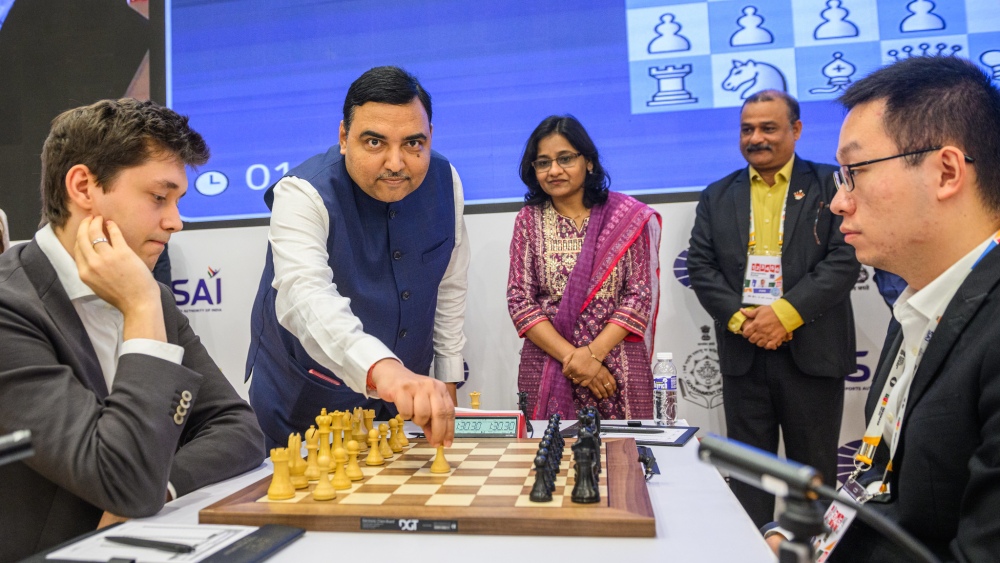
The second classical games of the semifinals followed a familiar script in Goa. Once again, deep preparation shaped both encounters, long early thinks filled the hall, and the positions that emerged were rich but balanced. And once again, neither game produced a winner. With two more draws on the board, all semifinal spots will now be decided in tomorrow’s tiebreaks. The ceremonial first moves were made by Mr. Sanjay Dhivre, IRS (Indian Revenue Service), Additional Commissioner of Income Tax, and Mrs. Bhagyahree Dhivare, IAS (Indian Administrative Service), CEO of the Election Commission Nagaland on board two. The first result arrived from the all-Uzbek clash between Javokhir Sindarov and Nodirbek Yakubboev. Their game featured subtle opening nuances before resolving into a level endgame on move 31. For two players who know each other exceptionally well and entered a line offering limited winning chances, the early handshake felt natural. The second game, between Andrey Esipenko and Wei Yi, carried more tension. The Chinese grandmaster had been outprepared and slightly outplayed in their first game. When I ran into him at dinner last night, I asked him about it, and he admitted he was “lucky” to escape with a draw. So it was concerning to see a similar storyline developing today when Esipenko, now with the white pieces, produced specific preparation and reached a slightly better position. He even had a moment where he could have pressed for more, but the chance passed. Wei stayed solid under pressure and steered the game to safety. With nearly a full month of play behind them, hours of preparation each day, and the physical and mental strain of the World Cup at its peak, fatigue is becoming a real presence for the final four. Today might have reflected exactly that. Here is how the games unfolded. Semifinals Game 2 results: Andrey Esipenko ½-½ Wei Yi Javokhir Sindarov ½-½ Nodirbek Yakubboev Andrey Esipenko (2693) vs Wei Yi (2752) Today’s game began with the Nimzowitsch Attack in the Petrov. Esipenko showed clear preparation in older theoretical paths, choosing 7.Bf4 (a line popular in the early 2000s) instead of the more modern 7.Be3. Wei Yi appeared surprised and paused for several minutes before replying. Despite having played this structure before, including a 2016 game against Wesley So, he clearly expected something different. This once again highlighted the strong preparation from Esipenko and his second, David Paravyan, who have been working effectively here in Goa (reportedly in between lobster dinners). Another notable moment arrived a few moves later when Esipenko played the rarer 10.Be2, spending around twelve minutes before committing. It raised the question of whether he had left his preparation or was digging deep to recall his lines, but in either case, it was another surprise. Later in the game, a critical moment arose, one that required calculation and understanding rather than automatic moves. In a position where White could press slightly, Esipenko chose a safer continuation instead of the line that offered the most practical chances. Here, the direct 20.f4 would have stopped Black from playing …g5 and left the h-pawn as a long-term target. It was not a winning attempt, but it was the kind of position where White makes Black solve problems under pressure. In a knockout setting, it would have been an attractive practical try. Instead, Esipenko chose 20.f3, allowing 20…g5. Both players developed naturally on the only open e-file. Wei tripled his heavy pieces lining up an “Alekhine’s gun” formation, but all rooks were eventually exchanged on the same file, easing Black’s defensive task. With the position equalised, the players began to repeat moves. Wei was low on time, and Esipenko played on briefly to push him to move forty, but no progress was possible. A second repetition confirmed the draw. Javokhir Sindarov (2721) vs Nodirbek Yakubboev (2689) The young Uzbek teammates agreed to a draw on move 31 in an objectively level endgame, but the opening phase contained several important subtleties. The game began with the Four Knights Spanish, the same opening Sindarov faced as Black in his second game against José Martínez in the quarterfinals, where the players followed a forcing drawing line. Today’s game started similarly but deviated early: 1.e4 e5 2.Nf3 Nc6 3.Nc3 Nf6 4.Bb5. Here, Yakubboev visibly hesitated, reaching for his knight before pausing and finally committing to the Rubinstein Variation with 4…Nd4. Perhaps he recalled Sindarov’s previous game and preferred to avoid that exact path, but he went ahead with the move nonetheless. This time, White deviated with 5.Nxd4 instead of 5.Bc4. The resulting structure is known for being solid for White but lacking major winning prospects, making it an interesting choice from Sindarov, who is usually more ambitious with the White pieces. A key moment soon appeared, demanding long calculation from both players. Here, Black’s main theoretical choice is 9…0-0, willingly giving up the pawn because after 10.Bxd7 Bxd7 11.Qxd7 Rae8, Black has threats such as …Qxf2 and ample compensation through piece activity and pressure. However, with elimination on the line, the semifinalists have generally been choosing safer continuations. This may explain Yakubboev’s decision to play 9…c6 instead, keeping the pawn. But this was not ideal, as it allowed White to build some initiative with 10.Qe2+ Qe7 11.Qh5!. The point is that capturing the bishop with 11…cxb5, is met by 12.Bg5 with a heavy pressure along the e-file – a type of dynamic position that suits Sindarov well. After thinking for nearly 30 minutes, Sindarov instead played the immediate 10.Qh5. This nuanced move-order shift gave Black slightly more room to reorganize. Yakubboev gradually solved his development issues, exchanged pieces, and steered the game into a balanced endgame that led to the eventual draw. One might label this 99%-accuracy duel as a “stale draw,” but a closer look reveals several important moments. Still, taking this match to tiebreaks by teammates and close friends is understandable, if not expected. But tomorrow, only one of them will progress, and with faster time controls, the depth of preparation and sensitivity
FIDE World Cup semifinals open with hard-fought draws
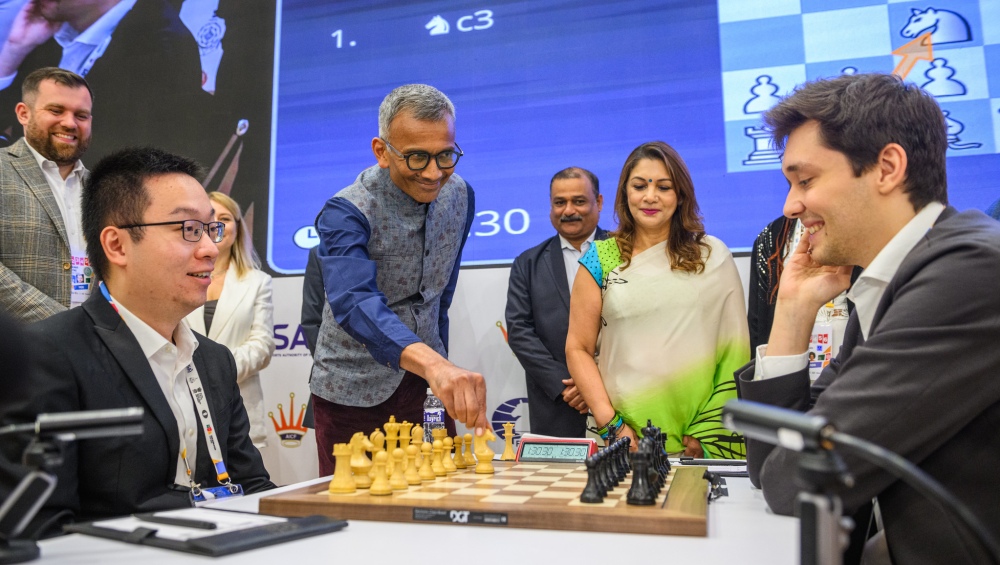
After a quiet rest day yesterday, the players returned to the hall where they have been competing for the last twenty days. A new stage setup elevated the boards, symbolic and fitting for the spectacle that the final rounds of the FIDE World Cup promise to bring. Today marked game one of the semifinals, and although both matches, Wei Yi vs Andrey Esipenko and Nodirbek Yakubboev vs Javokhir Sindarov, ended in draws, they were anything but uneventful. Deep preparation, opening surprises, time pressure and several only-move moments defined the day. Grandmaster Wei Yi, as has become routine, was the first to arrive, followed shortly by his opponent Grandmaster Andrey Esipenko. With a few minutes to spare before the round began, both sat quietly at the board, focused and still. Grandmaster Nodirbek Yakubboev arrived next, carrying his usual five bottles of water. Just before the clocks were started, the ceremonial first move took place, and moments later a slightly flustered and narrowly on-time Javokhir Sindarov entered the hall and took his seat opposite his Uzbek teammate. Today’s first move on the board between Wei Yi and Esipenko was made by Mr. Anup Shah, Managing Director of Resort Rio Goa, and Mrs. Alpa Shah, Director of Resort Rio Goa, two people who have led the wonderful hospitality provided to us throughout the last month. This month of remarkable chess has brought us to these intense final stages. As Grandmaster Fabiano Caruana, the first qualifier to the 2026 FIDE Candidates, stated online, the World Cup is an incredibly difficult tournament and regardless of how well one performs, only three participants leave truly happy: the three Candidates qualifiers. Watching the field shrink after every round has been bittersweet. With players departing every few days, the dining hall has grown quieter. And knowing that one of these four semifinalists, after fighting so hard to reach this point, will soon join the list of 202 eliminated players feels equally, if not more, bittersweet. Still, this is the nature of the event. Success here demands skill, stamina and a measure of luck. Semifinals Game 1 results: Wei Yi ½ – ½ Andrey Esipenko Nodirbek Yakubboev ½ – ½ Javokhir Sindarov Wei Yi (2752) vs Andrey Esipenko (2693) The first surprise of the day came immediately when Esipenko met Wei Yi’s 1.e4 with 1…e6. It was the same French Defense that the Chinese number one had successfully employed in his first quarterfinal game against Arjun Erigaisi. With a rest day available for preparation, unexpected choices made strategic sense, and Esipenko’s decision became even more logical when it became clear that he was not heading into a main line, but the Rubinstein Variation: 1.e4 e6 2.d4 d5 3.Nc3 dxe4 followed by 4.Nxe4 Nd7. It was reasonable to assume that Wei Yi may not have deep practical experience here. Although initially caught off guard after anticipating what he considered a guaranteed Italian, our commentators Grandmasters Peter Leko and Jan Gustafsson quickly agreed that this was a clever and well-timed choice by Black. Wei Yi appeared taken aback by the opening and took his time before committing to a structure and a plan. Esipenko essentially won the opening phase, reaching a slightly better position with two bishops and holding a significant time advantage. Wei Yi, on the other hand, found himself struggling to find chances for activity while also feeling the growing pressure of the clock. Then, suddenly, everything turned. A critical nuance required Black to play 27…Qf5 to remove White’s queen from the center before taking the pawn on h5. That line would have left White with an inferior but holdable position – requiring accuracy. Instead, Esipenko played the immediate 27…Qxh5, and after several minutes of calculation, Wei Yi unleashed the stunning 28.Bxa6! The bishop cannot be taken because the Black king would be exposed to decisive threats. The game continued 28…e5 29.Rd8 Rxd8 30.Rxd8 Ka7. Black attacked the bishop and threatened with 31…Bf5 but another incredible only-move followed instantly: 31.Qa4! which drew applause in the studio from Peter Leko. The game then concluded with 31…bxa6 32.Rd7+ Bxd7 33.Qxd7+ Kb6, after which the players agreed to a draw due to an unavoidable three-fold repetition. Being caught in deep preparation and finding yourself worse as White in a World Cup semifinal is never easy, but Wei Yi once again showed why he is one of the strongest performers of the event. He held his nerve, calculated with precision under extreme pressure, and found the correct moment to strike. Esipenko has previously said that luck is a necessary ingredient for success in the World Cup, and today it was his opponent who had that combination of accuracy and good fortune. Nodirbek Yakubboev (2689) vs Javokhir Sindarov (2721) Despite arriving slightly late, Sindarov seemed relaxed and confident. This was evident not only from his quick early moves and usual pacing around the hall, but also from the enthusiastic high-five he exchanged with his board neighbour Andrey Esipenko as they crossed paths in the opening minutes. Yakubboev, who arrived with the benefit of two consecutive rest days after avoiding quarterfinal tiebreaks, came armed with strong preparation against Sindarov’s Semi-Slav, the same opening they had played in their last two classical encounters. White opted for a sideline with 5.Qd3, but Black appeared completely prepared and unfazed, blitzing out correct theory as if he had predicted it. Soon, in fact, it was Yakkuboev who seemed surprised, spending 23 minutes on his 11th move despite Black having played only natural, expected moves. Despite this sharp start, nothing complicated emerged. Once both players were out of theory, the position settled, and they navigated it with great accuracy. After trading down to an even endgame, where only White could really push for something, Black offered a draw on move 30, which Yakubboev accepted. It was a calm and unsurprising beginning for two players who know each other deeply and have faced each other many times. Notably, both played with great accuracy, with respective scores of 99% and 100%. Tomorrow
FIDE World Cup: Three quarterfinals poised for decisive tiebreak battles
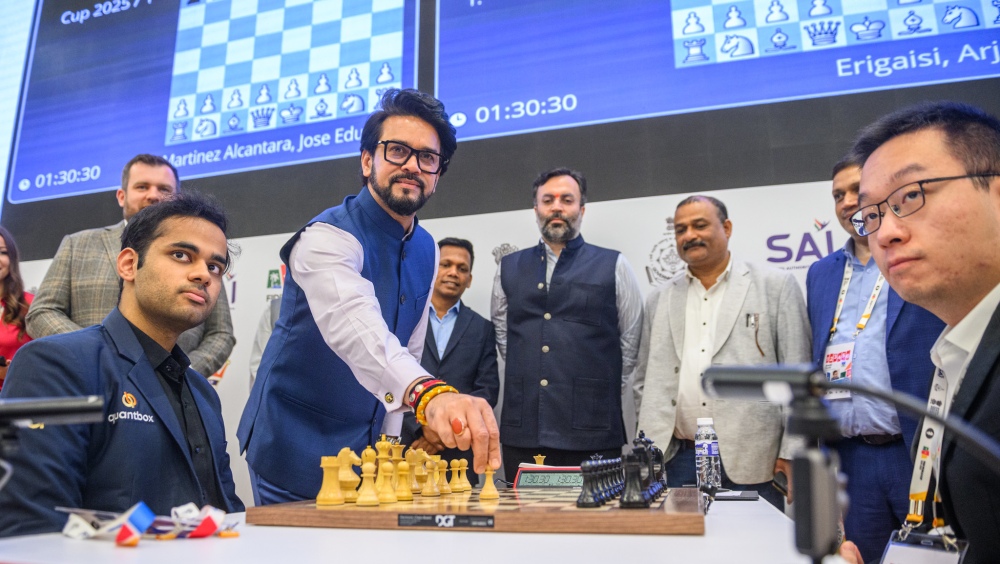
The tension was evident as players entered into the playing hall today, several arriving just minutes before the clocks were started, a sure sign of the pressure mounting at this decisive stage of the World Cup. The air in the playing hall was quiet and concentrated, yet packed with spectators eager to witness the eight remaining players in action. With only four spots in the semifinals, chess fans were treated to a blend of high-stakes precision and tightly controlled risk. The outcome was draws across all boards, meaning tiebreaks in three of them, and GM Nodirbek Yakkuboev advancing as the first semi-finalist after his victory over Alexander Donchenko yesterday. Before play began, the ceremonial first move was made by Mr. Anurag Singh Thakur, former Sports Minister of India, Member of Parliament, and Chairman of the Parliamentary Standing Committee on Coal and Mines on Board 2, for Erigaisi vs. Wei Yi. Quarterfinals Game 2 results: José Eduardo Martínez Alcántara ½-½ Javokhir Sindarov Arjun Erigaisi ½-½ Wei Yi Andrey Esipenko ½-½ Sam Shankland Alexander Donchenko ½-½ Nodirbek Yakubboev With the semifinal lineup still very much undecided, here’s a closer look at how each game unfolded today. Nodirbek Yakkuboev (2689) vs Alexander Donchenko (2641) Alexander Donchenko had a great deal at stake today. After fighting hard to survive the Round 5 tiebreaks, his classical loss yesterday left him in a must-win situation. He certainly tried, pushing until the very end, creating an imbalanced structure that forced Yakubboev to stay alert. The game followed the Exchange Variation of the Queen’s Gambit Declined, and Donchenko appeared well-prepared, gaining a 30-minute time advantage early on. However, despite his confident opening, his pace slowed and a series of imprecise choices led to a position where his winning chances faded. Black has just played the thematic 21…Bb1, aiming for a Ba2–c4 maneuver. While White has no obvious plan here, Donchenko chose one of the weakest options with 22.f3?, a move our commentators called “strange” as it gave Black easy counterplay. Yakkuboev responded with 22…f5 and followed through with his intended bishop maneuver, fully seizing the initiative. The critical moment came soon: White’s pieces were poorly coordinated, and the pawns on the third rank were vulnerable. Here, the powerful 26…Re8 could have posed major problems for White, especially with the threat of …Nb5 looming. If White tries passive defense with 27.Re1 Black builds up pressure with 27…Rb5 28.Rc2 Rb3. For instance, the natural-looking 29.Ng2 to guard the e-pawn is met by 29…Bd3 30.Rf2 (or 30.Rc3, also losing) 30…Bxb1 31.Rxb1 Nc4, leaving Black in full control. Instead, Yakkuboev started with 26…Rb5, allowing 27.Rg2. Though Donchenko escaped immediate danger, Black still held a comfortable edge. After further exchanges, the game entered a tense endgame where White appeared to retain some chances. However, Yakkuboev maintained accuracy and steered the game to a dead-even draw. With this result, he became the first player to qualify for the semifinals of the 2025 World Cup. Wei Yi (2752) vs Arjun Erigaisi (2773)As the only remaining Indian player in the field, Grandmaster Arjun Erigaisi carries significant expectations. Yet he has remained composed throughout the event, arriving calm at the board each day and greeting enthusiastic fans waiting (and chanting his name) outside. After a quick draw yesterday, today’s strategy was different – with the White pieces, Arjun prepared a fresh idea in the Queen’s Gambit Declined. Wei Yi, however, played confidently and quickly as well. The game soon left known theory and entered territory in which both players could just play chess. Tension started when Wei Yi chose to complicate with 18…c5, accepting an isolated queen’s pawn but gaining activity. The position suddenly became sharp: Arjun played the quiet-looking 20.Qe2 instead of the more natural 20.Qb1. Commentators GMs Jan Gustafsson and Peter Leko praised it as “strong and unexpected,” as it unpins the queen while provocatively placing it opposite Black’s rook and hinting at Na4 ideas. It posed psychological pressure. Wei Yi spent over 30 minutes here, visibly unsettled and shifting in his chair, before deciding on 20…Qc6. After 21.Nd2, however, Black 21…Nd7? (21…Nh5 was the better choice – we will get into that mess later, so bear with me if you want to get into deep analysis) allowing a tactical sequence: 22.Nb3 Bxc3 23.bxc3 Rxc3 Here Arjun had a golden opportunity – 24.Bxd5! and after 24…Qc8 25.Rxc3 Qxc3 White simply captures a free pawn with 26.Bxb7. Black also can choose 24…Qxd5 – and here is why the earlier mistake of 21…Nd7 matters. 25.Rxc3 Ng5 26.e4 (only move to keep the advantage and stop …Nf3), 26…Rxe4 27.Rd1! And the d7-knight is ill-placed and hanging. Instead, Erigaisi played 24.Qd2? and after 24…Rxc1 25.Rxc1 Qa6 26.Bxd5 Nf6! Wei Yi equalized and the game was drawn on move 32. Now let’s go back to the better 21…Nh5 which makes the difference. Now 22.Nb3 Bxc3 23.bxc3 Rxc3 24.Bxd5 does not hold the same venom after 24…Qxd5 25.Rxc3 Ng5 26.e4 Rxe4 and Black’s pieces, particularly the knights, are very active. The same idea we saw in the previous line of 27.Rd1 is a big blunder because of the desperado 27…Qxb3! And suddenly Black would be winning. This tactic would not be the same with the knight on d7. All of this analysis just goes to show how small nuances of a position can affect the evaluation but only surface moves later, and it’s curious to know whether all of this was seen. After intense days like these, we don’t corner the players for interviews, but after tomorrow I will definitely find out from the match’s victor how much was calculated here. Javokhir Sindarov (2721) vs José Eduardo Martínez Alcántara (2644)The draw between Sindarov and Martínez was the most curious result of the day, not for the score, but for how swiftly it was achieved. The players entered a known drawing line in the Four Knights Spanish and followed the theory to a peaceful result in just 20 minutes. For Martínez, who had the White pieces and momentum from previous rounds, it
FIDE World Cup: Quarterfinals set after high-stakes Round 5 tiebreaks

The FIDE World Cup in Goa reached a boiling point today as four intense tiebreak matches unfolded, each with a place in the quarterfinals on the line. With no more second chances and yesterday’s classical draws setting the stage, today’s rapid and blitz battles brought drama, tension, and decisive outcomes across the board. Before the games began, the ceremonial first move was made for Lê Quang Liêm on Board 2, by Mr. Kedar J Naik, Member of the Legislative Assembly of Goa and Chairman of the Goa Tourism Development Corporation. Sam Shankland and Andrey Esipenko secured clean wins early in the first rapid portion against Daniil Dubov and Alexey Grebnev respectively, while José Martínez defeated Pentala Harikrishna in the 10+10 rapid. Alexander Donchenko took Lê Quang Liêm into blitz territory before stamping his ticket to the next round. The quarterfinal lineup is now complete, and as the dust settled, four more players advanced with confidence and momentum on their side. Round of 16 tiebreaks results: Daniil Dubov 1-3 Sam Shankland Andrey Esipenko 2.5-1.5 Aleksey Grebnev José Martinez 3.5-2.5 Harikrishna Pentala Alexander Donchenko 4.5-3.5 Lê Quang Liêm Here’s how the day played out: Daniil Dubov – Sam Shankland In earlier interviews, Daniil Dubov made no secret of his strategy: to steer matches into tiebreaks. As a former World Rapid Champion, he felt this format played to his strengths. He also claimed that playing solidly with White and pushing with Black was the best way to capitalize on opponent’s overextending. But today, Sam Shankland flipped that plan on its head. Playing White in the first rapid game, he unleashed a novelty in the opening that led to an imbalanced position and early initiative on his side. With pressure mounting and the clock on his side, Shankland methodically limited Dubov’s options. Dubov, rarely short of creative ideas, struggled to find counterplay and instead fell into mistake after mistake, resulting in a convincing win for the American. The second game, a symmetrical English, saw early queen exchanges and a dry position that offered little for either side. A draw seemed impending, but Dubov overpushed in the endgame, losing the game and with it, his World Cup run came to an end. After the match, Shankland reflected on reaching the quarterfinals once before in 2021, a run that ended painfully at the hands of Sergey Karjakin in tiebreaks. “That’s haunted me ever since,” he admitted, adding that he now hopes to “banish the demon” for good. https://www.youtube.com/watch?v=PTRXDSWaWkA Andrey Esipenko – Alexey Grebnev It raised eyebrows when Andrey Esipenko took relatively quick draws in his classical games against Alexey Grebnev. But if anyone doubted his strategy, the first rapid game removed all uncertainty. After a Petroff turned into a wild opposite-side castling battle, Esipenko seized the initiative by move 14 and was in complete control by move 20. It was a dominant win. The second game was a stark contrast and stretched all the way to move 145. Esipenko, now with Black, came out of the opening in a stable position. When it looked like both players were shuffling pieces with no progress, Esipenko made a bold choice to open up the queenside. This ambition backfired with a missed tactic, and suddenly Grebnev was up a pawn. But nerves kicked in and Grebnev misplayed the critical move order and let Esipenko seize control once more The game soon turned into a technical endgame with each side down to a rook and Grebnev holding two pawns to Esipenko’s one. Esipenko, calm and prepared, navigated the position to a theoretical draw. Ironically, by move 145, both players had more time on their clocks than they did on move 50. With this match victory, Esipenko reached the deepest stage of a FIDE World Cup in his career. Harikrishna Pentala – José Martinez This was widely expected to be the longest match of the day, especially after the first two rapid games ended in uneventful draws. Much of the chatter centered around José Martínez’s reputation as a blitz expert, regularly beating the world’s best online. That meant Harikrishna’s best chances were in the rapid phase. In their first rapid game, the players entered a Richter-Rauzer Sicilian and while both appeared prepared, a few subtle inaccuracies left Harikrishna with isolated doubled pawns and passive pieces. Martínez, whose pieces worked seamlessly together, activated his rooks and pushed the kingside majority. The result was a smooth breakthrough and the first decisive game of their match – a must-win situation for Harikrishna in game two. In the second game, Harikrishna opted for an offbeat Caro-Kann with …Na6 on the third move, likely intending to avoid his opponent’s preparation. The opponents quickly entered unexplored territory and a critical position arose at move 21: Harikrishna quickly played 20…Nd3?, a move which our commentator Peter Leko exclaimed is a good move if it does not lose. Martinez had to see the important move 21.g4! and after 21…Qe4 suddenly 22.Bxf7+ gives White a huge advantage as capturing is not possible due to Ng5. Instead, Martinez played 21.Rad1 and the position became equal once more. In his post-game interview, he acknowledged seeing this line but decided to not enter the complications. Even so, the move g4 was played a few turns later, this time with full effect. Harikrishna erred instantly and Martinez seized a decisive advantage. With everything in hand, Jose chose a threefold repetition to seal the draw and punch his ticket to quarterfinals. In his interview, Martinez issued a spirited challenge to the field: “Those who want to go far in this World Cup have to get through me.” With his confidence and composure, it’s easy to see why he’s becoming one of the breakout names of the tournament. https://www.youtube.com/watch?v=x8VM1iNxW9s Alexander Donchenko – Lê Quang Liêm The last match of the day to finish briefly seemed like it would actually be the first match to finish after Alexander Donchenko struck first with the black pieces. After yesterday’s tense and heartbreaking draw where one misstep in the